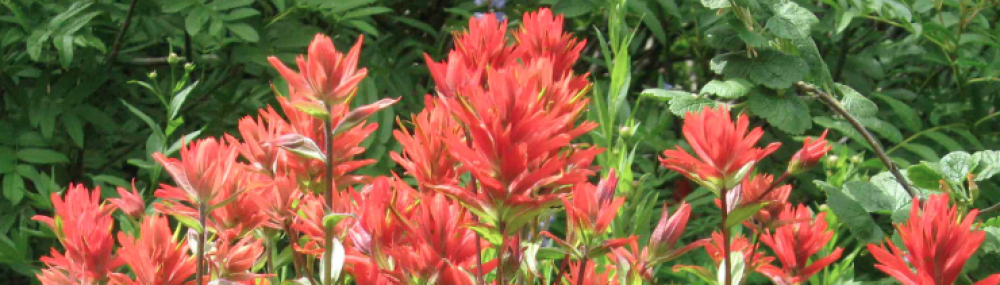
In April and May flowers are literally bursting forth. One needs to look for and step carefully around the first flowers that are barely inches tall. It is hard to keep up with all that is happening. This is the first “What’s in Bloom” post of the season. More to come very soon
Our early spring wildflowers typically arise from underground storage units: tubers, bulbs, or corms. They leaf out, flower, set seed, and disappear within a few weeks. These are termed “spring ephemerals”. Some are already going by in the south end of the valley, but others are still visible to the north end of the park.
Two particularly elusive species:
Turkey Peas – Orogenia linearifolia – are perhaps the hardest to find when they start blooming the end of April. They look like spots of white on brown ground. The flowers are tiny—5 curled white petals surrounding maroon anthers. The flower clusters are often no larger than a thumbnail – little is known about its insect pollinators. If no pollinators show up so early in the spring, plants can self-pollinate to produce seeds for future generations.

Leaves are linear once they stretch out. All this arises from a corm – a swollen underground stem that stores starches over the winter.
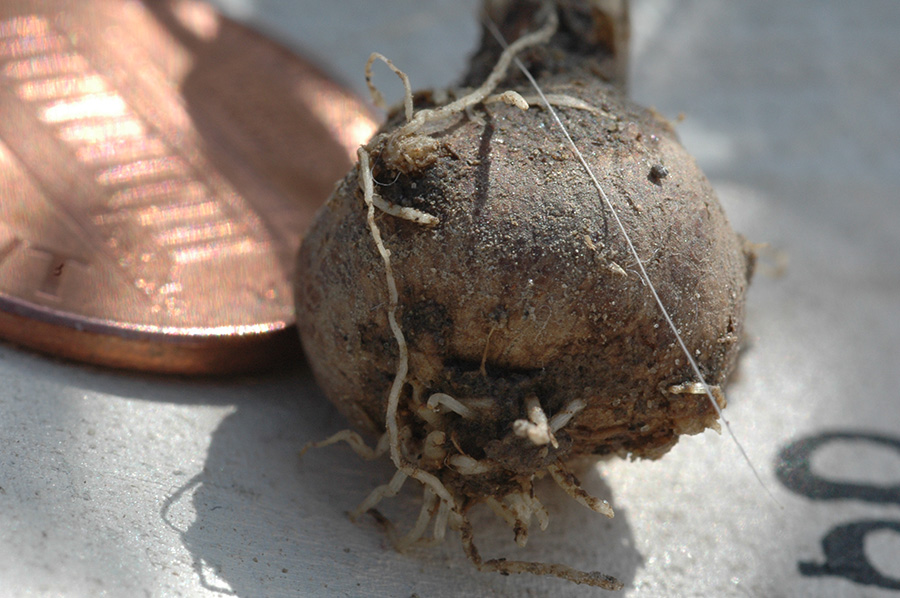
Many people have handled the heftier corms of crocuses. Here the corms are the “peas” that are eaten by sandhill cranes, bears, and likely others. Turkey Peas are in the Carrot or Parsley Family.
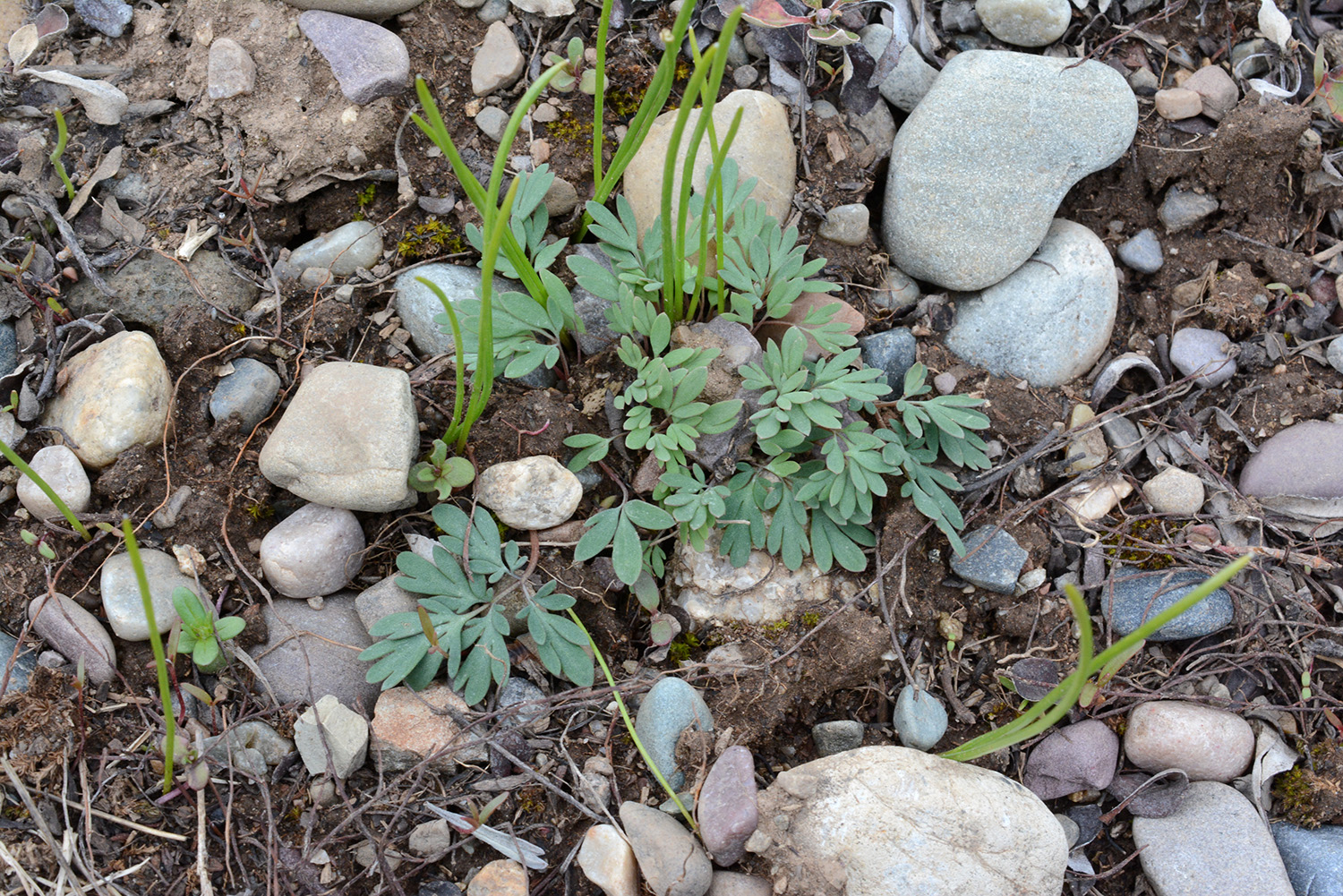
Steer’s-head – Dicentra uniflora – is a regional favorite. Look closely for the bluish compound leaves.
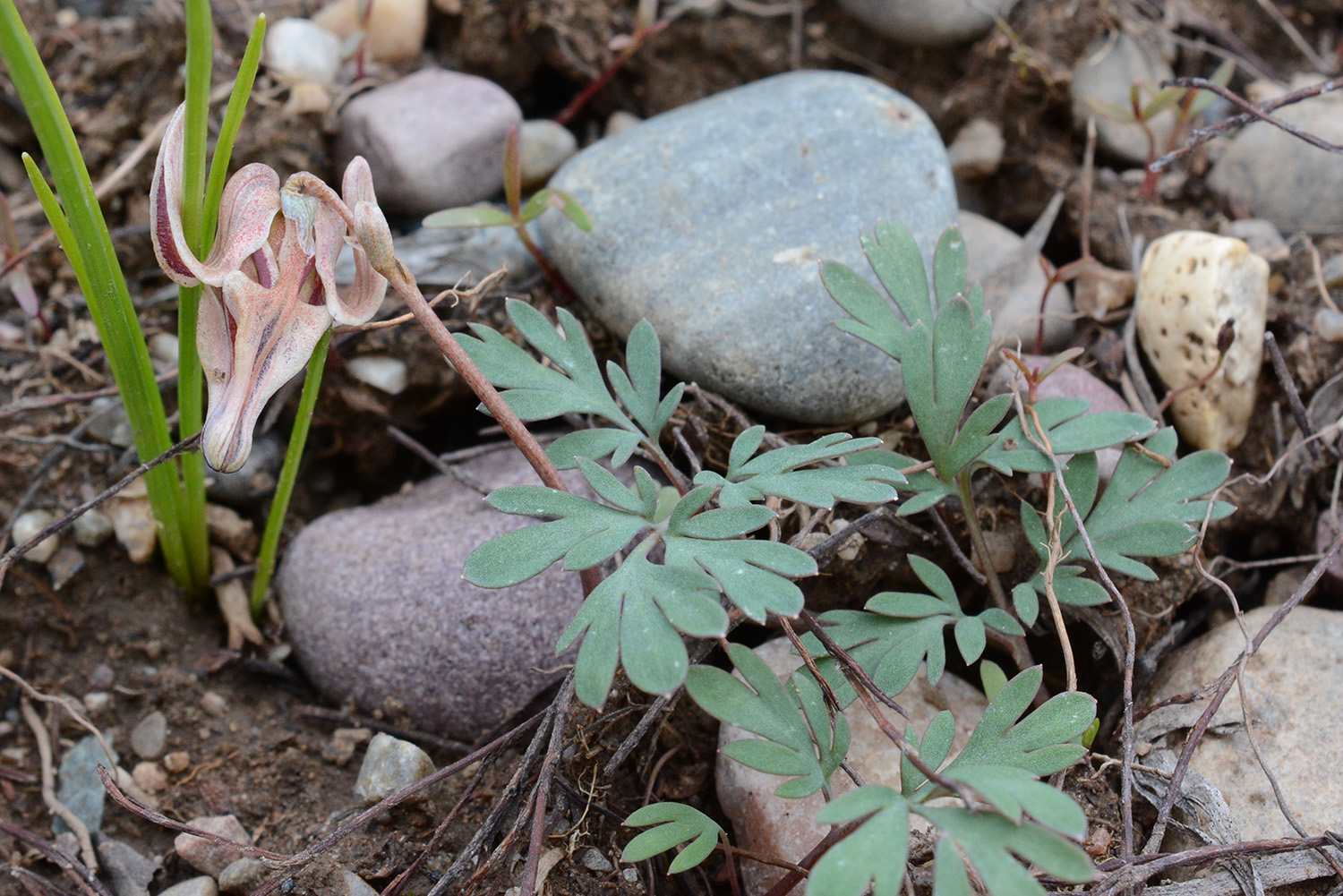
Then for the unique flower: truly a western motif. Two outer petals form the horns and the two inner petals fuse to form the steer’s head.
Queen bumblebees, which emerge early along with the flowers, are known pollinators of their eastern cousins—Squirrel-corn – Dicentra cucullaria – and likely also pollinate Steer’s-heads in Wyoming. The plants host the larva of Clodius Parnassian butterflies.
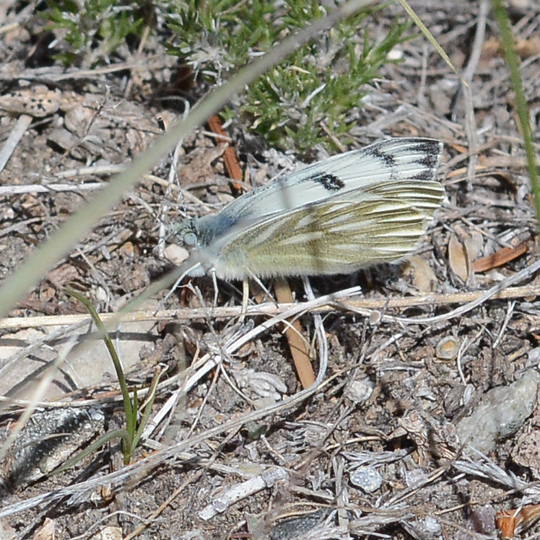
Much easier to find!

Buttercups have bright-yellow, truly glossy petals due to the rare combination of structural and pigmentary coloration. The gloss of the petals provides a strong visual signal to insect pollinators and increases the reflection of sunlight to the center of the flower to heat up the reproductive organs. Find why this glossiness is unique– technical but fascinating: https://www.ncbi.nlm.nih.gov/pmc/articles/PMC5332578/
Utah Buttercup – Ranunculus jovis – has been glowing across sparse sage flats since the end of April.
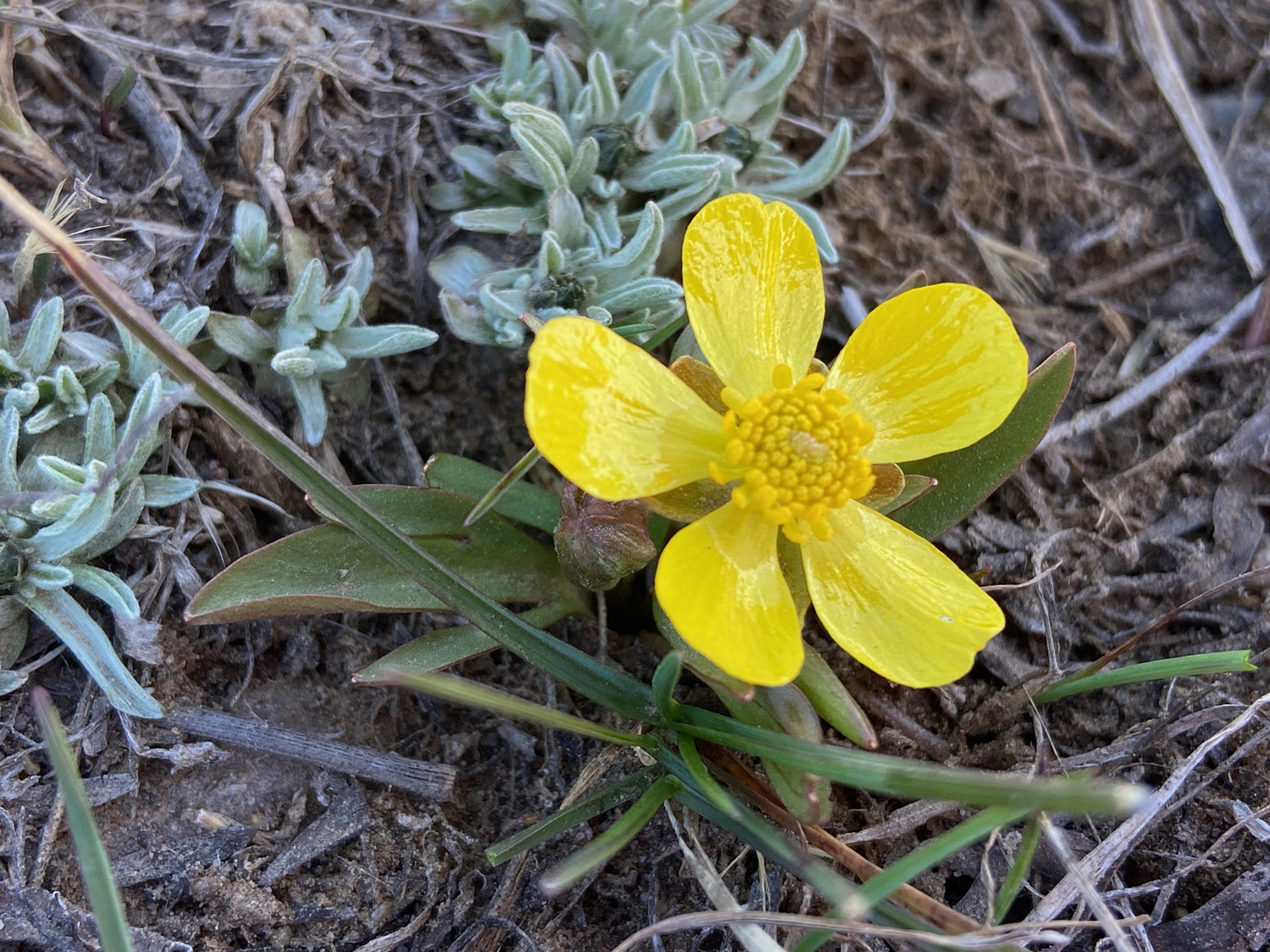
Note the leaves are deeply lobed. The roots are swollen tubers—like bulging pantaloons.
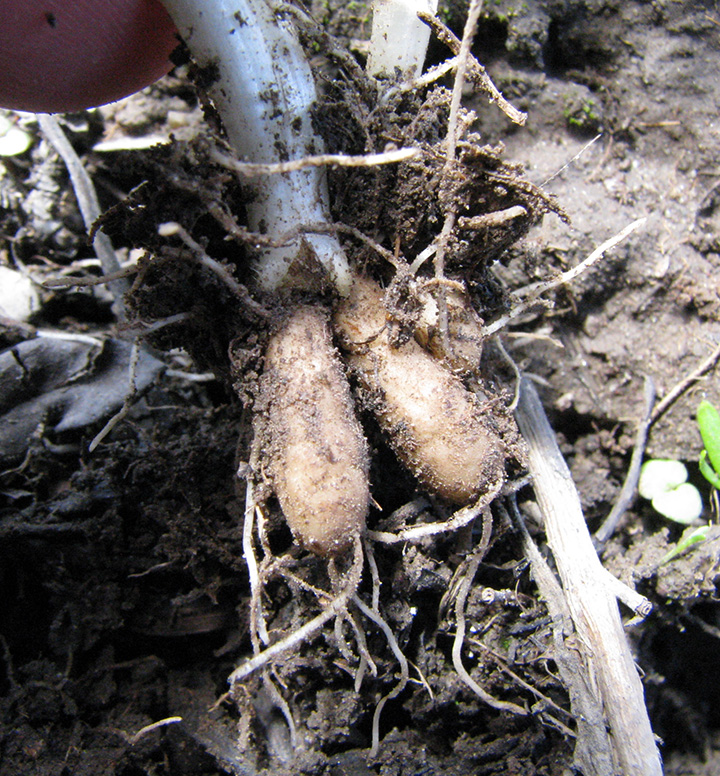
Sage Buttercup – Ranunculus glaberrimus – leaves are slightly different: the lowest leaves are entire, a feature that is a bit hard to discern until the stems stretch with age. The roots are stringy!
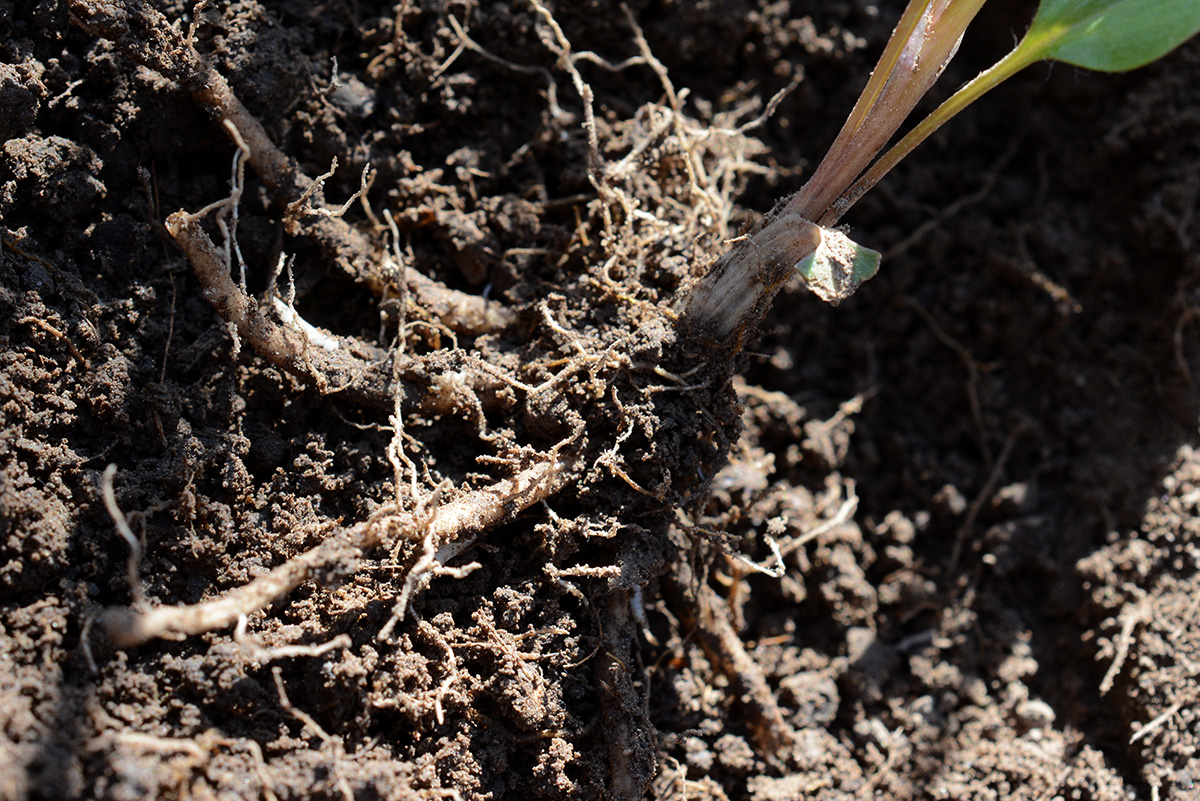
Spring Beauties – Claytonia lanceolata – are scattered like a dusting of snow throughout the sageflats right now.

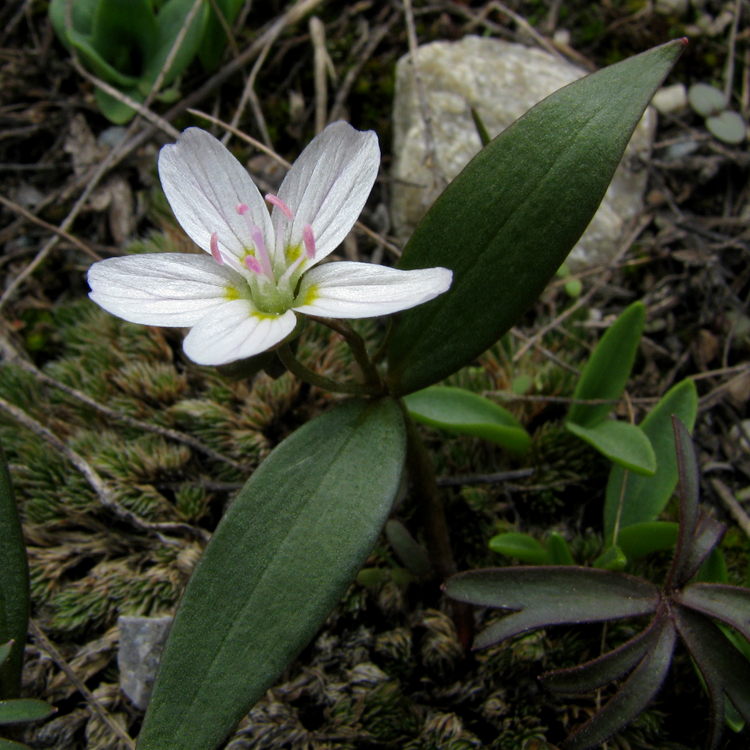
Notice the wide-open white flowers with pinkish lines heading into the center.
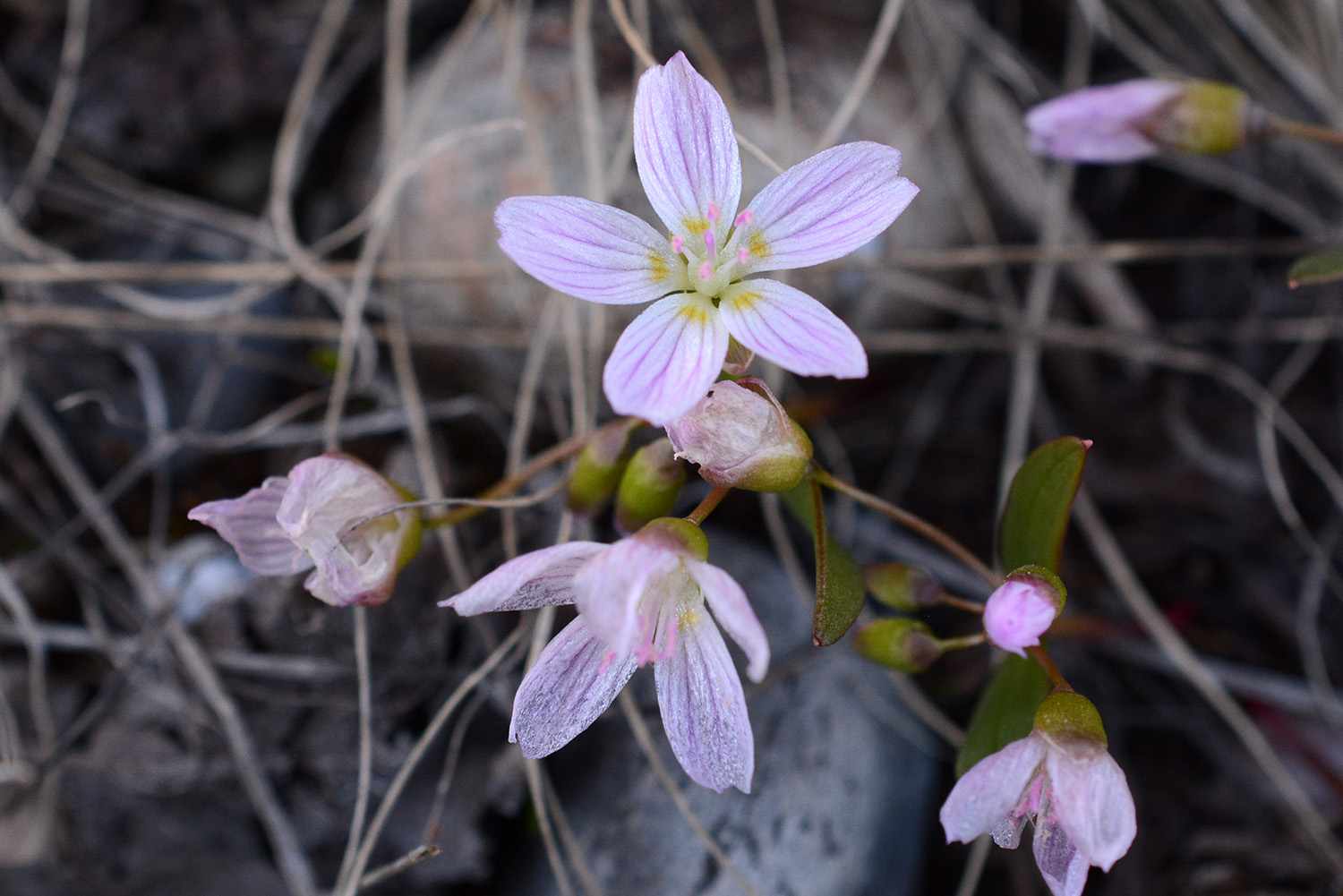
These nectar guides encourage pollinators to visit the center of the flower to pick up pollen grains from the 5 pinkish anthers. Visiting another flower, the small insect may drop off pollen onto the central pistil with 3 flaring stigmas. Often anthers and stigmas mature at separate times to encourage this cross-pollination – e.g. genetic exchange.
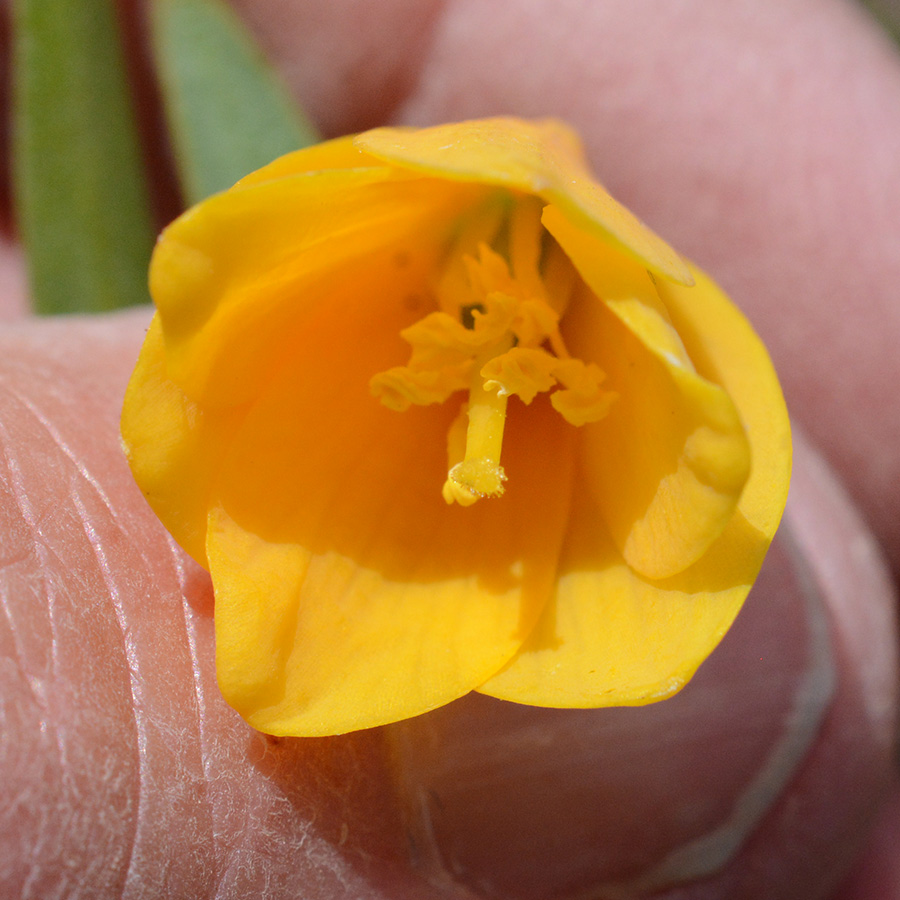
Yellowbells – Fritillaria pudica – are abundant now in sageflats up the inner park road.
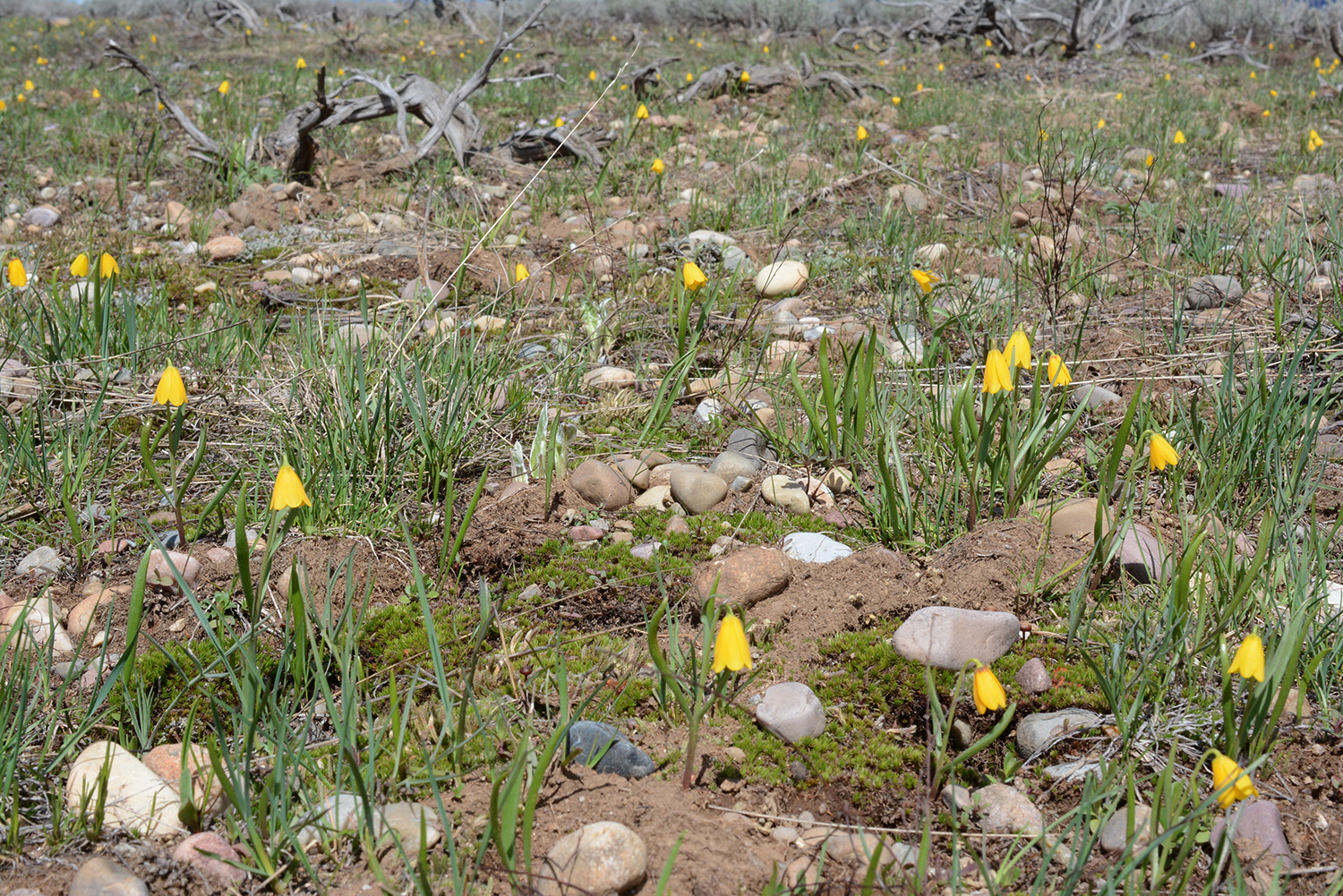
Dangling 4-6″ above the ground, the bell-like flowers entice a variety of pollinators.
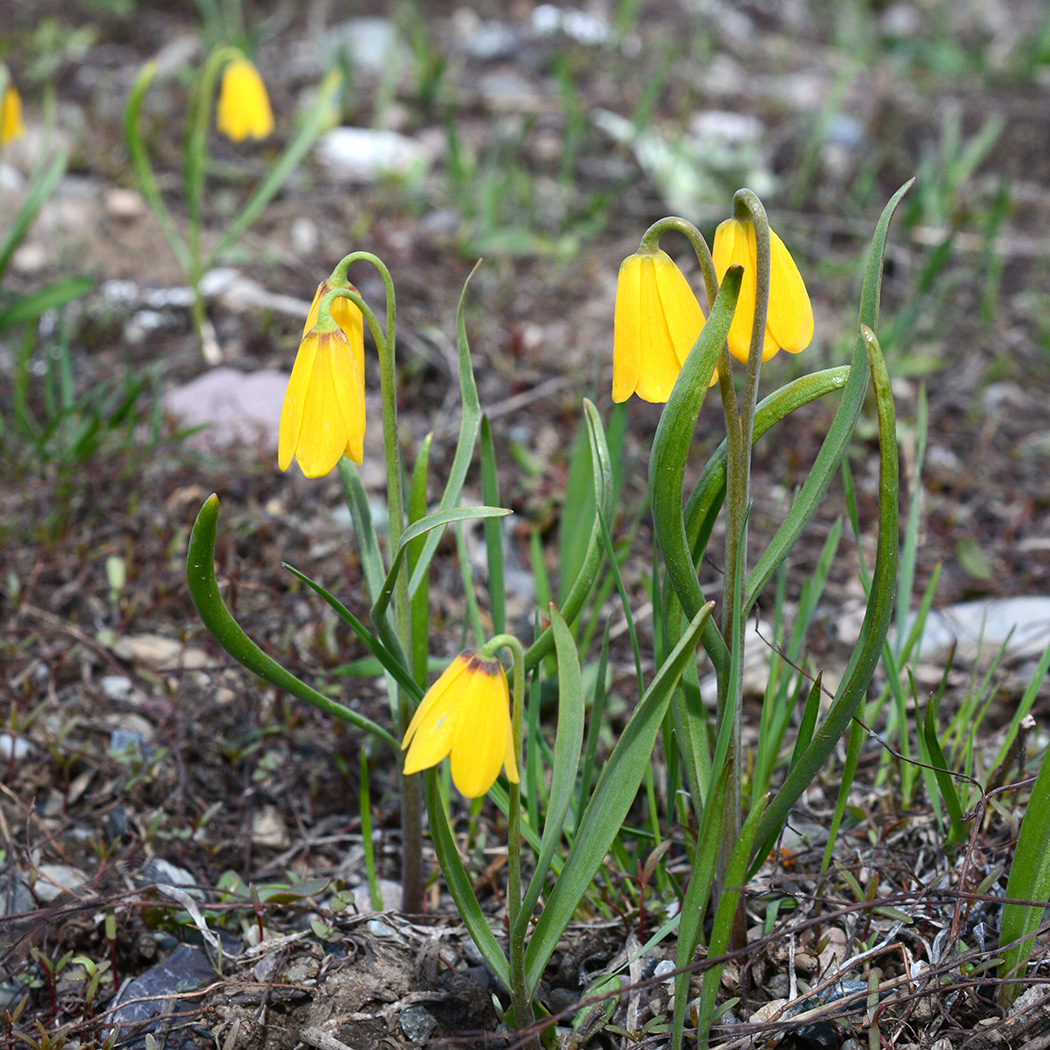
Inside the bell, the stigma arises first above the anthers and then…

the anthers extend and split apart releasing pollen.
Dry slopes and knolls:
Some of the best places to see early spring flowers are on the dry slopes and knolls on the east side of Jackson Hole.

These barren-looking hillsides are dry for several reasons. Often they receive less snow than the mountains to the west; the wind blows off the snow; and south facing slopes receive the warmth of early spring sun which melts what remains. Wind further wicks off moisture. Also, the rounded steep slopes hold few nutrients: what little plant litter there is often washes down slope. With these dry, windswept, and nutrient-poor conditions, plants are sparse and small—only a few inches high. Plant are often hairy and/or silvery to prevent desiccation.
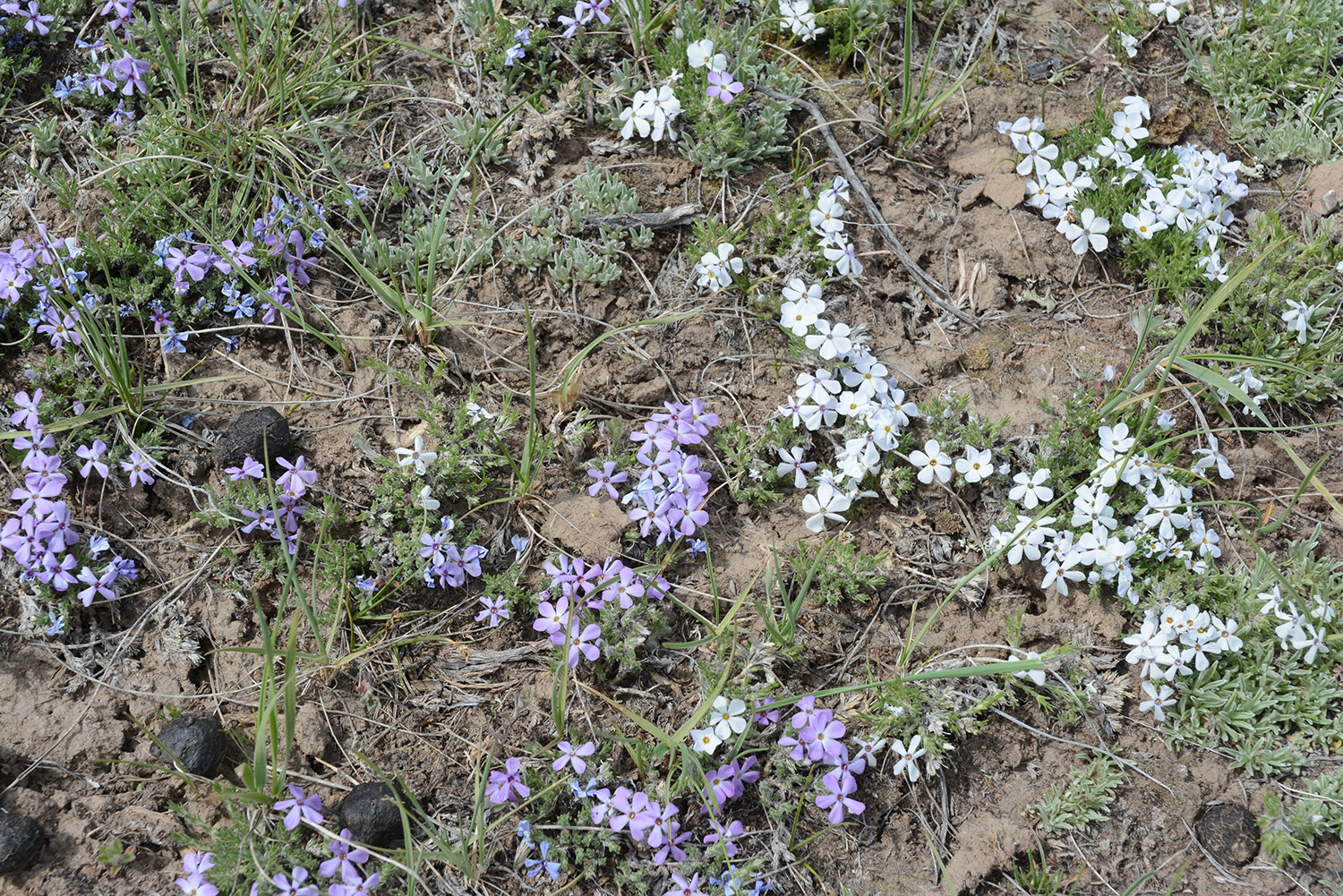
The fragrance of Hood’s Phlox – Phlox hoodii – attracts many pollinators who fly to the white (or blue) tubular flowers. They perch on the flaring petals and dip their probosci down the floral tubes for nectar. They fly away with pollen that they drop off at the next receptive flower.

Note the stiff needle-like leaves have “cobwebby” hairs which help identify this species.
Pursh’s Milkvetch – Astragalus purshii – forms tiny silvery tufts of pinnately divided leaves with white to cream flowers with a dash of purple.
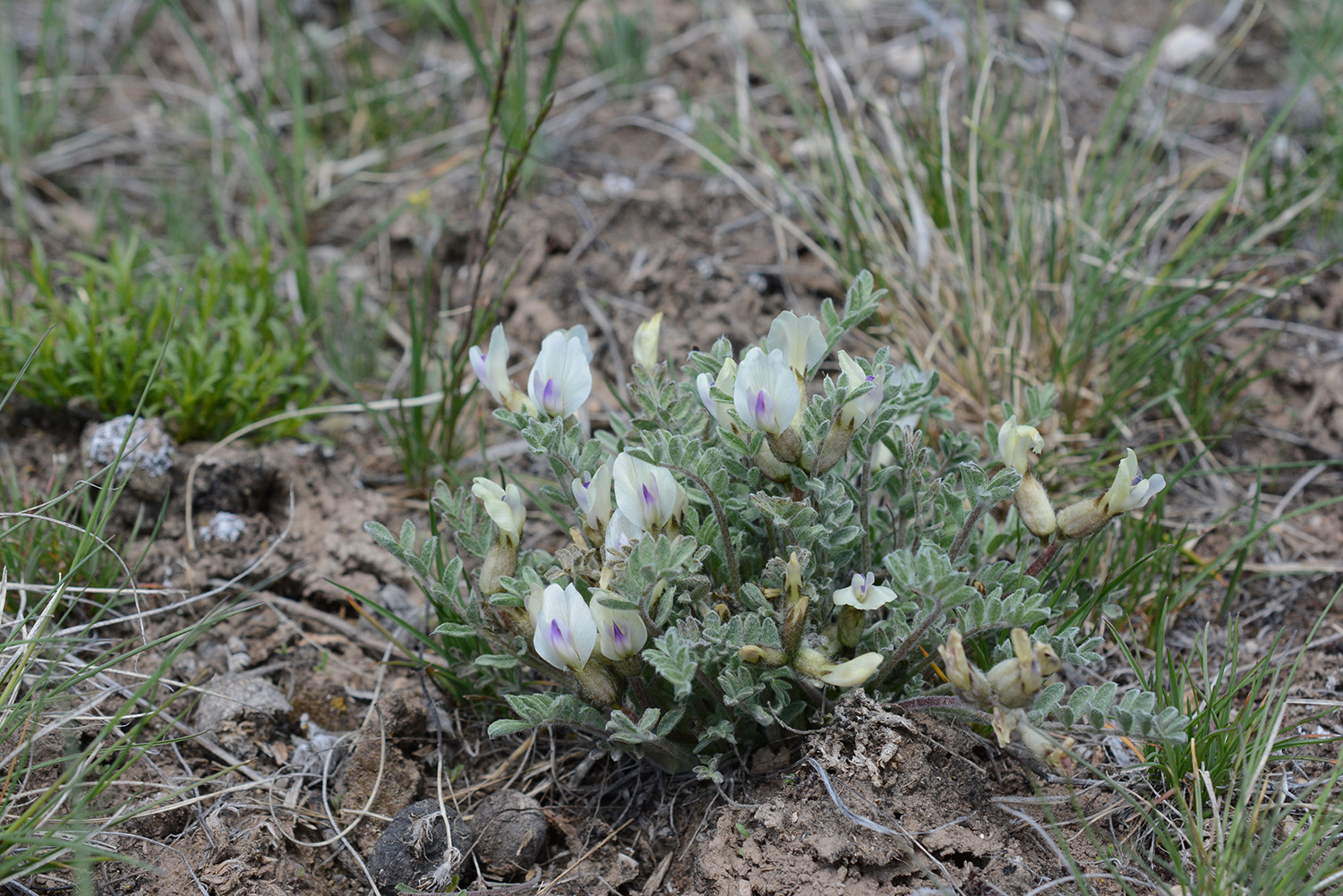
In the Pea Family, the flowers of Pursh’s Milkvetch have an upright banner, two side petals called wings, and a rounded keel. In this case the keel is often tipped in purplish blue.

The very hairy pods will form quickly.

Looking inside you can see the relationship to its relatives: peas and other legumes. But do not eat. Many milkvetches are toxic.

Also in the Pea family, the magenta flowers of Hare’s-foot Locoweed – Oxytropis lagopus – catch the eye.
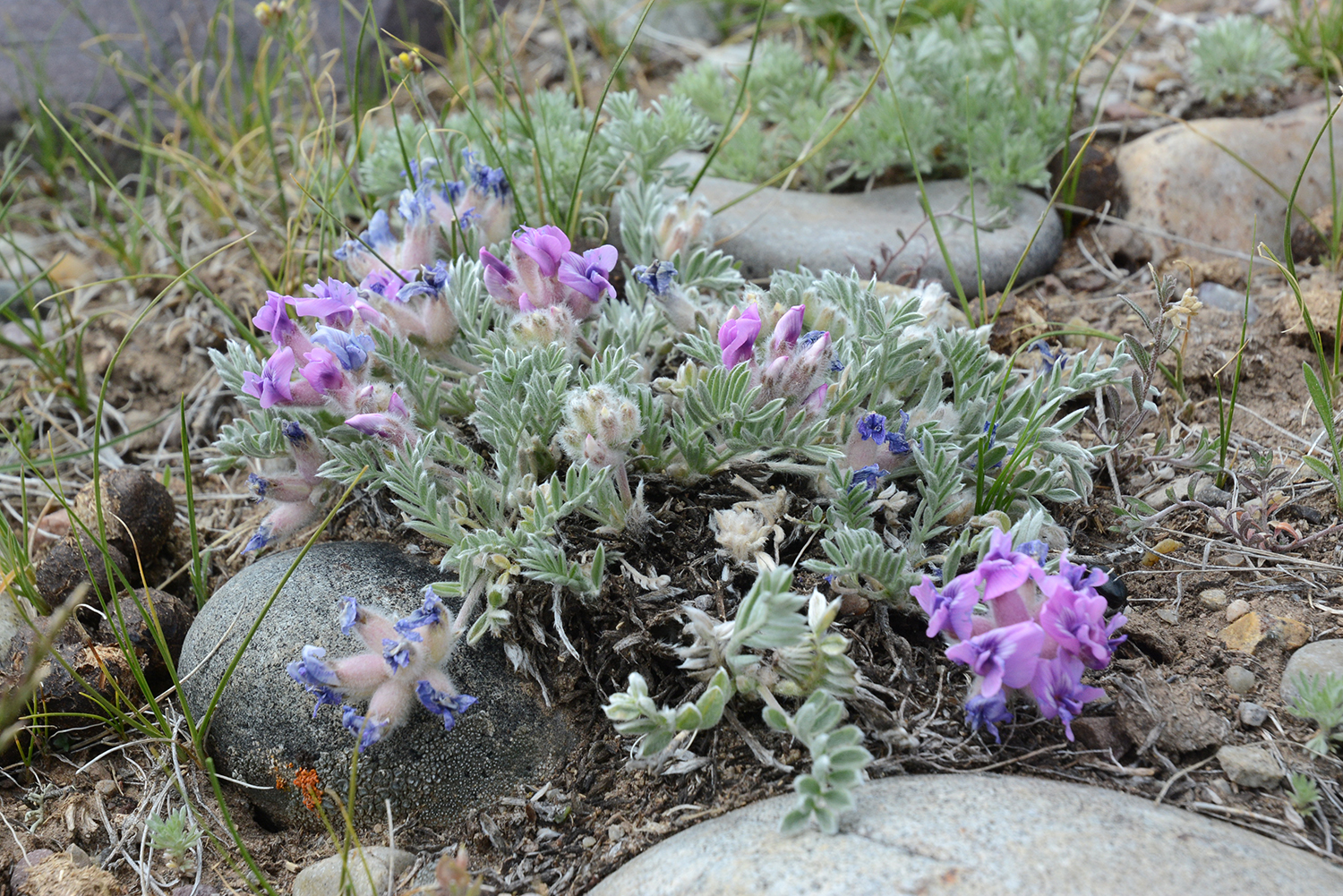
The pinnately divided silvery leaves are very similar to Pursh’s Milkvetch; however, the flowers are clearly different.
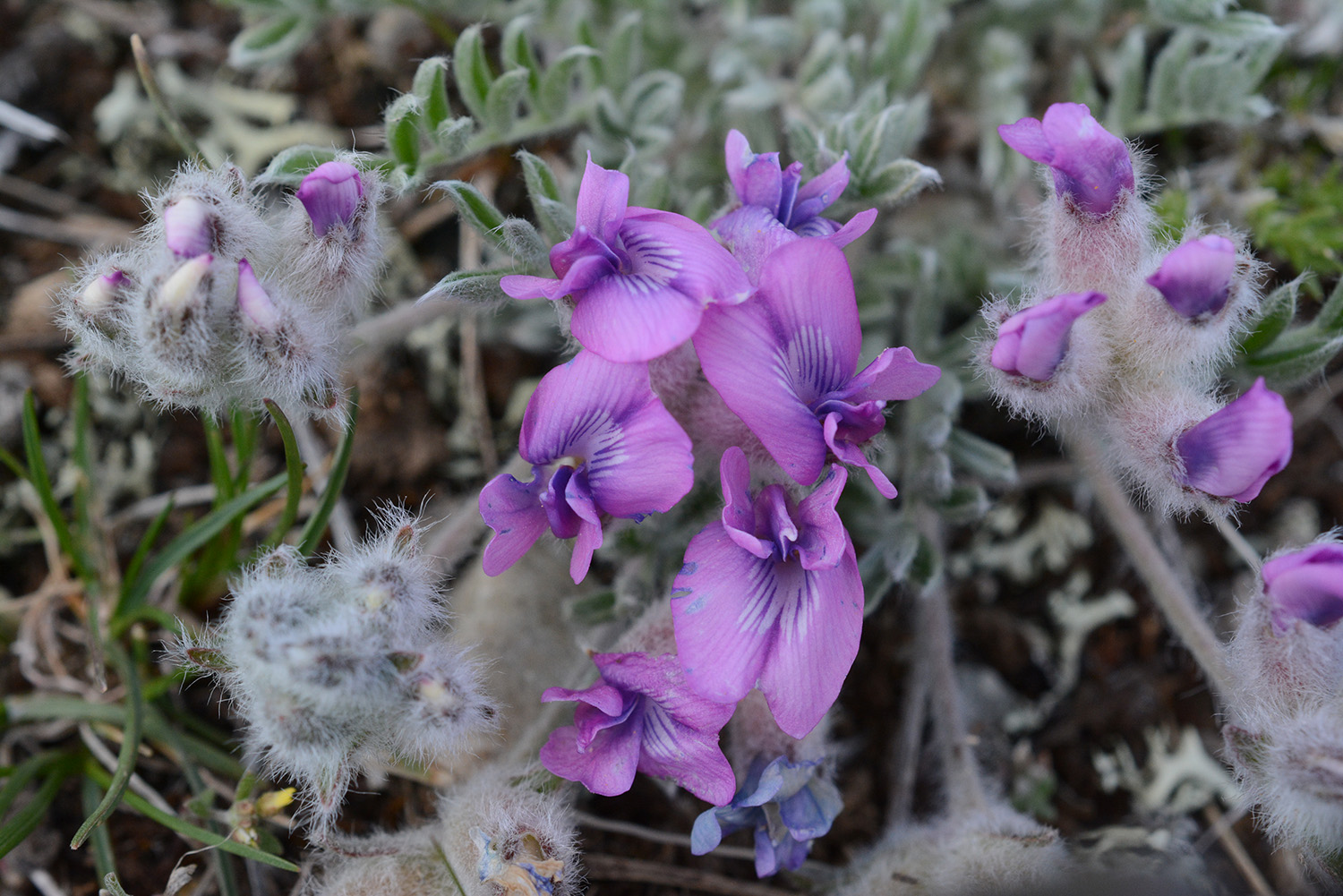
The pea-like flowers are wonderfully decorated with nectar guides and a white spot to direct visiting bumblebees. Unlike Astragalus where the keel is rounded, in this genus the tip of the keel of the flower is pointed out – I think of being gored by an ox to remember the botanical name Oxy-tropis.
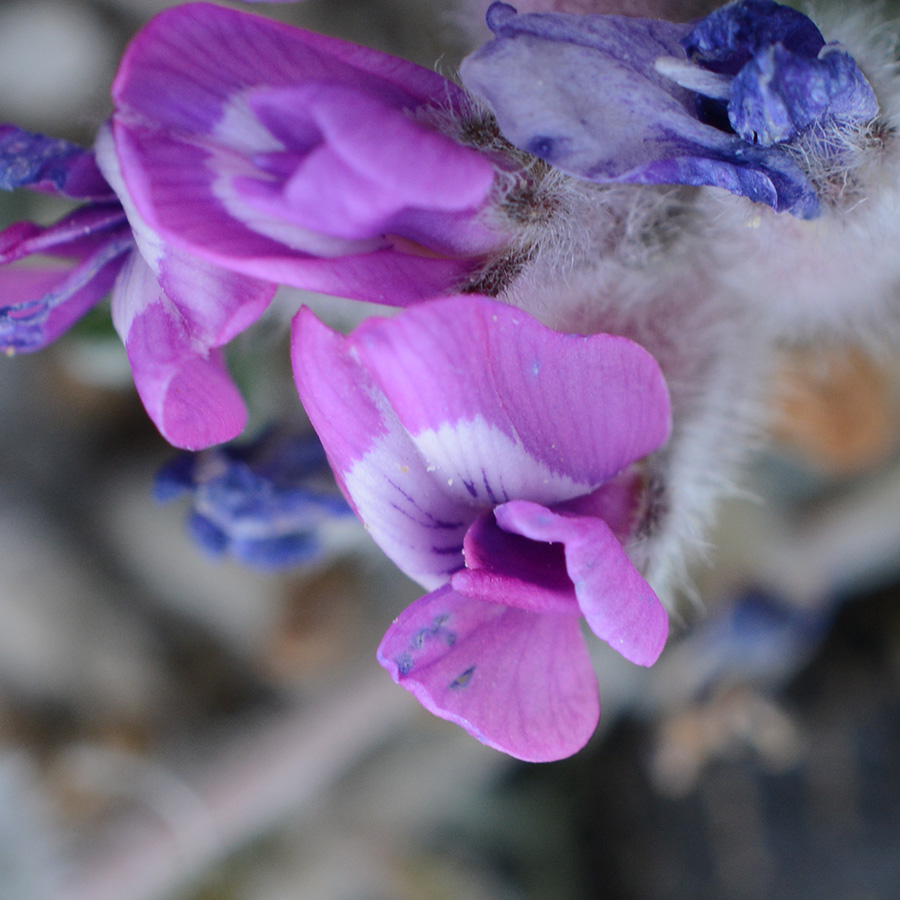
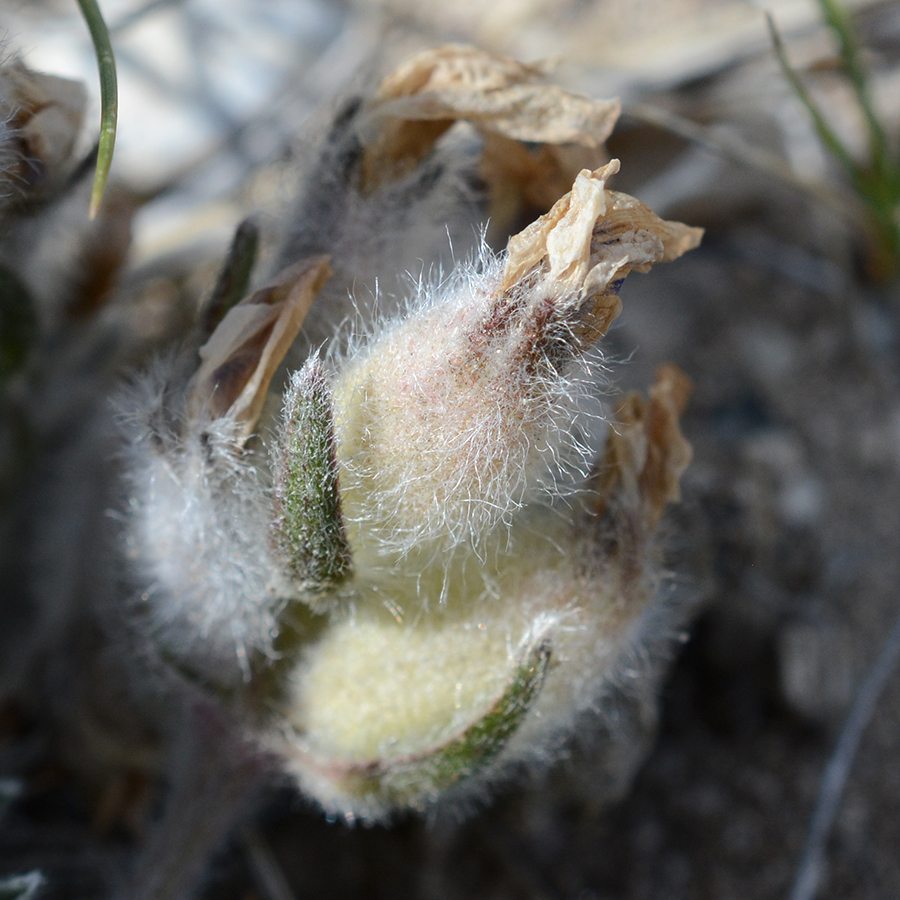
The calyx (the cup or vase that surrounds the base of the petals) has plentiful white hairs often with a few black bristly hairs underneath.
Members of the very large Aster Family – often called Composites – have many small flowers set upon a platform, all of which is surrounded by protective “bracts”. The petal-like flowers are “ray” “flowers, and the tinier tubular flowers are “disc” flowers. There are many variations of this “flower plan.”
Townsend’s Easter Aster – Townsendia leptotes – flowers are nestled in bunches of linear leaves. All arises from thick underground stems.
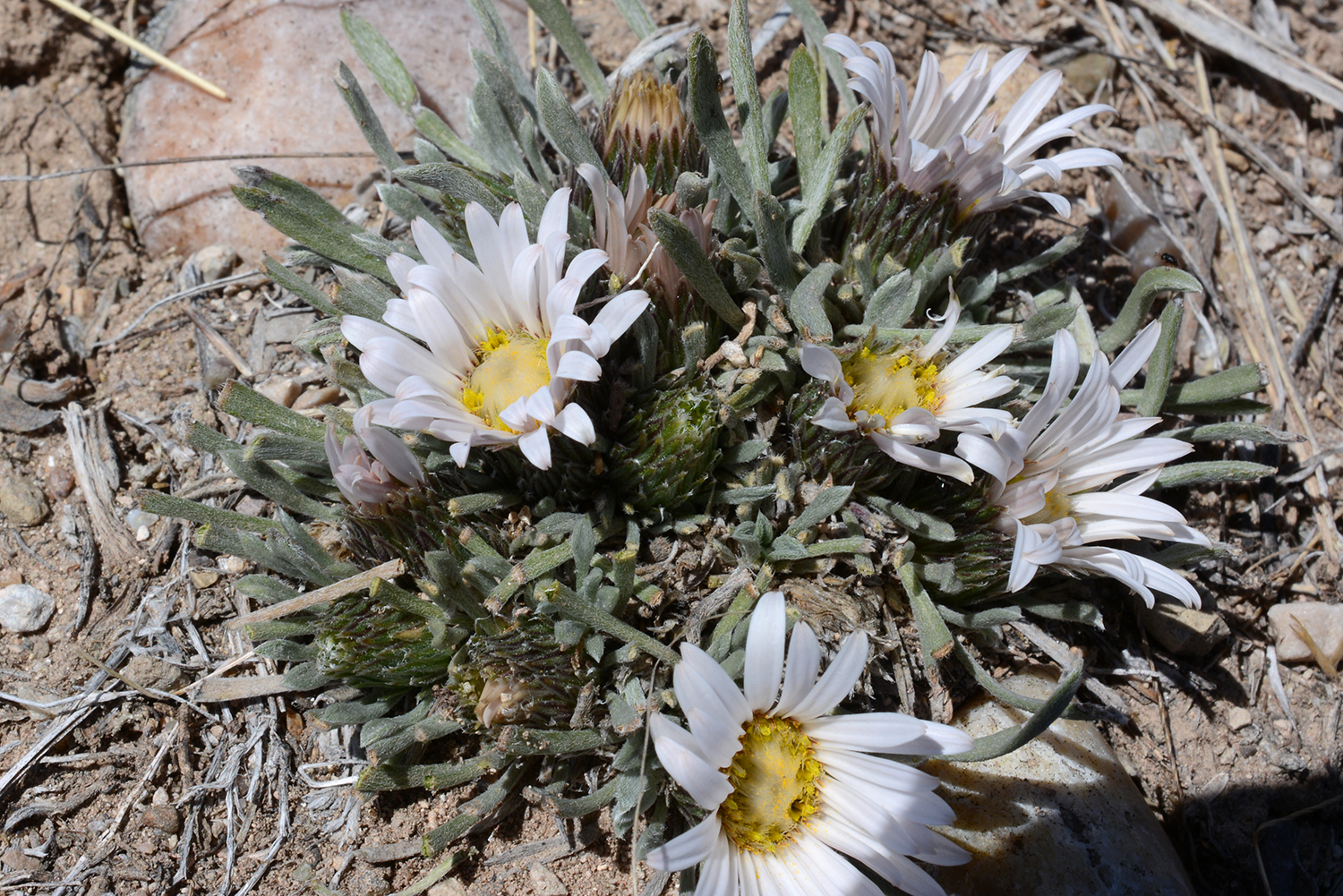
Notice the elegant rows of maroon/green bracts surrounding the dense flower heads.
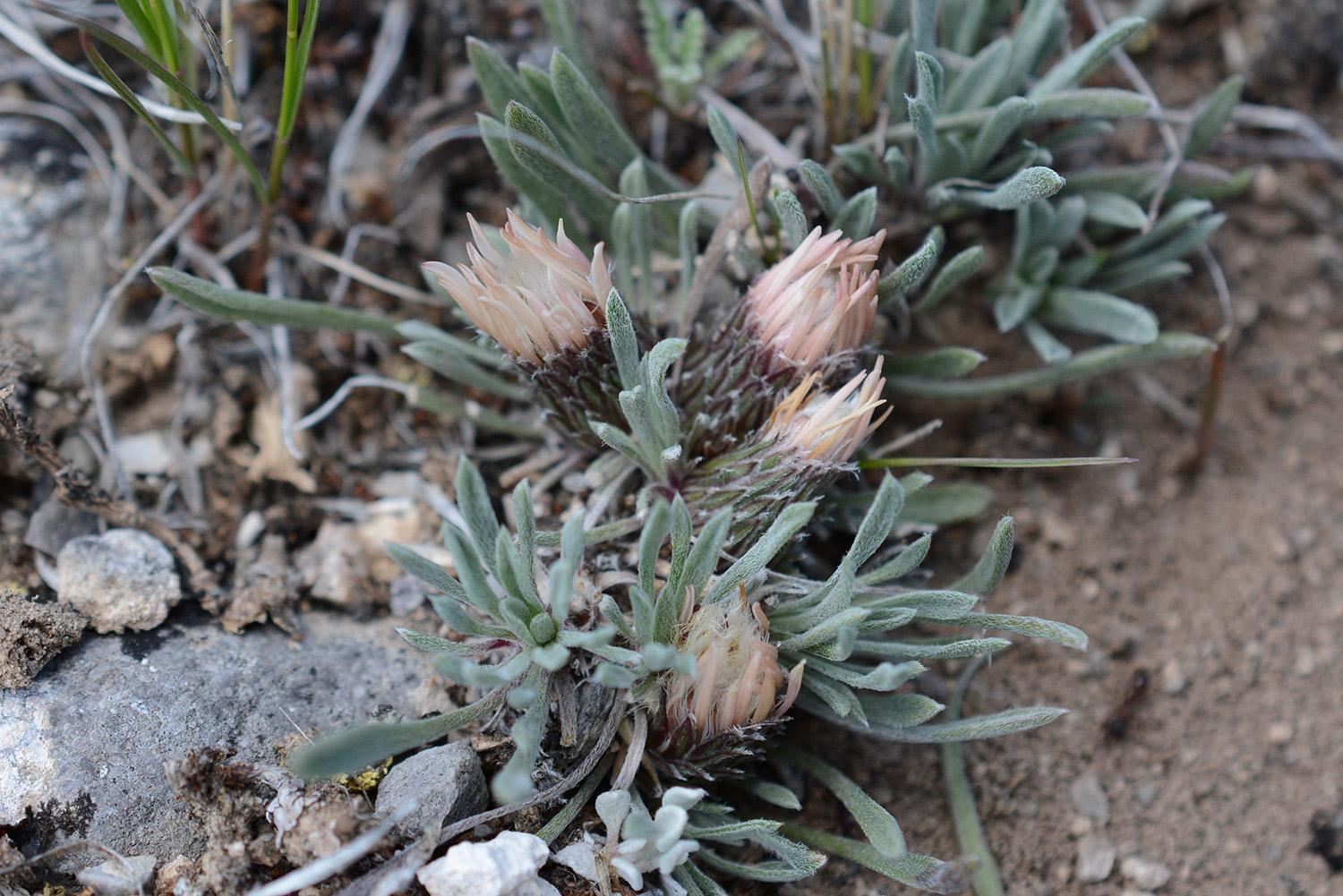
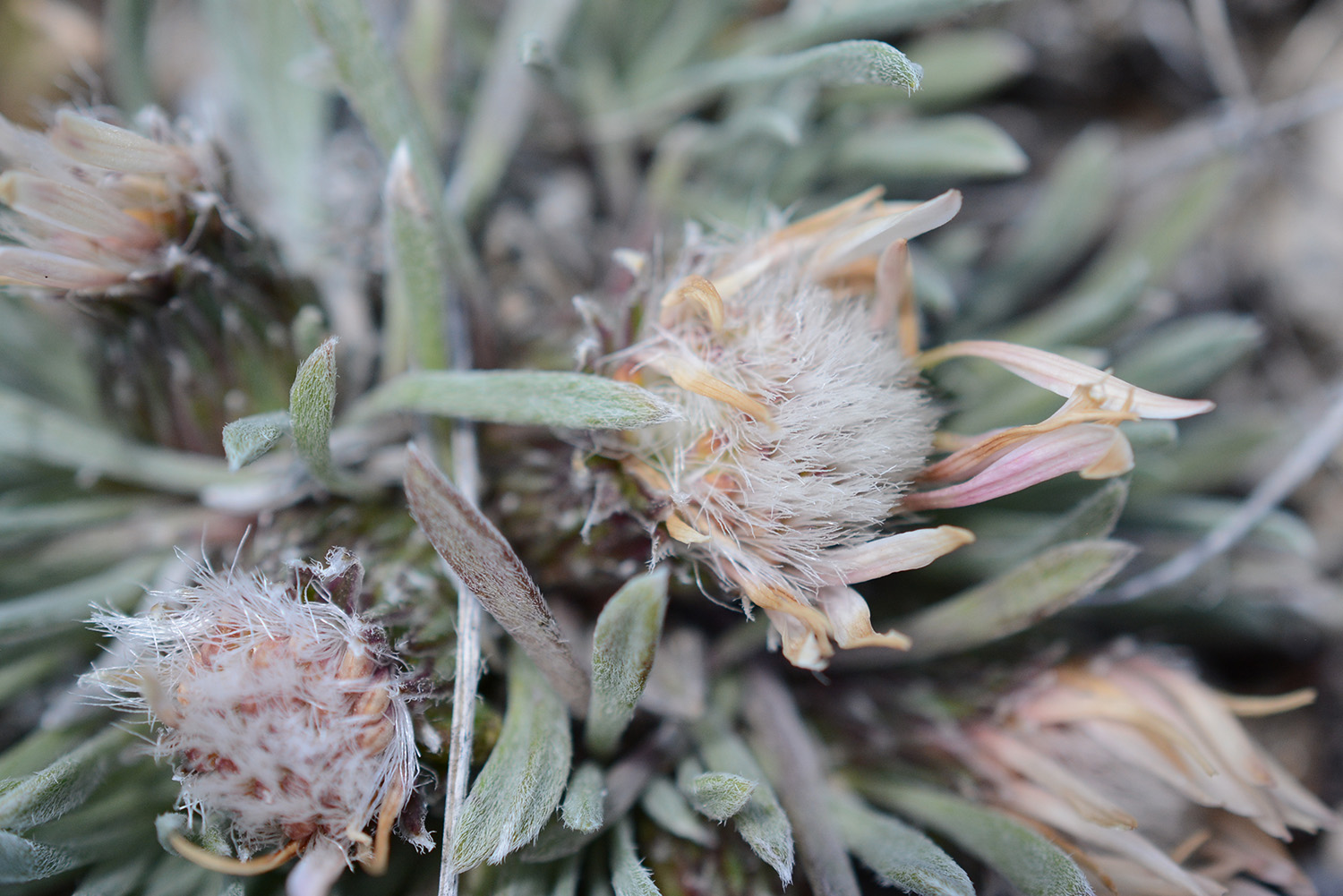
In the photo below you can see the bristly hairs of each individual flower. Fruits will be achene with a bristly pappus. (Dandelion seeds also have a pappus which helps them disperse by wind.)
Of several local pussytoes, the first to bloom is Low Pussytoes – Antennaria dimorpha.
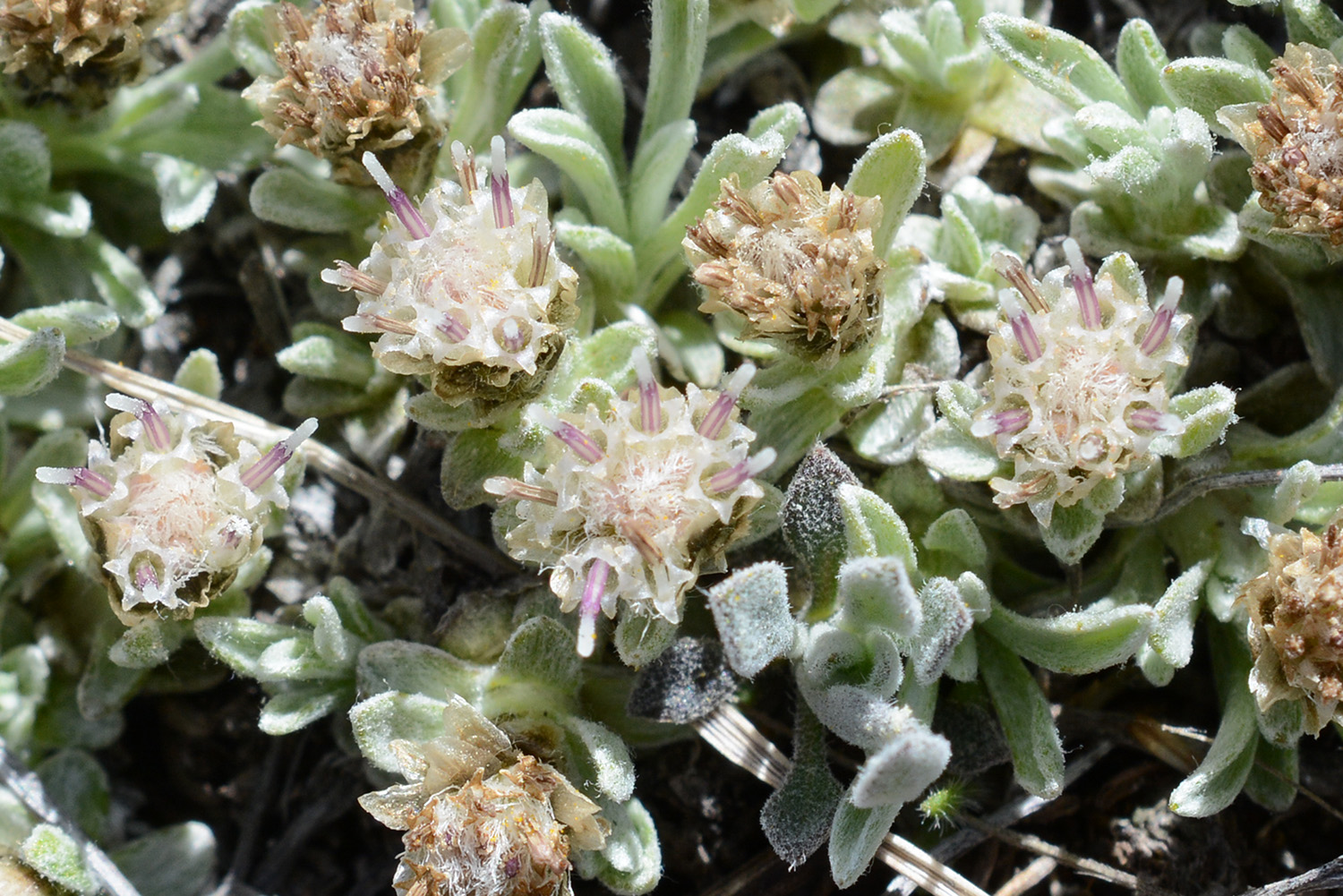
The flower heads of all disc flowers and are surrounded by mats of silvery leaves.

Most flower heads of Low Pussytoes have only female disc flowers—they don’t need the wind to scatter pollen upon them as they can self-fertilize. In any case, the male flowers would be on separate plants. Most pussytoes are wind pollinated with separate male and female plants to encourage cross-pollination.
Umber Pussytoes – Antennaria umbrinella – is just raising its heads of flowers.

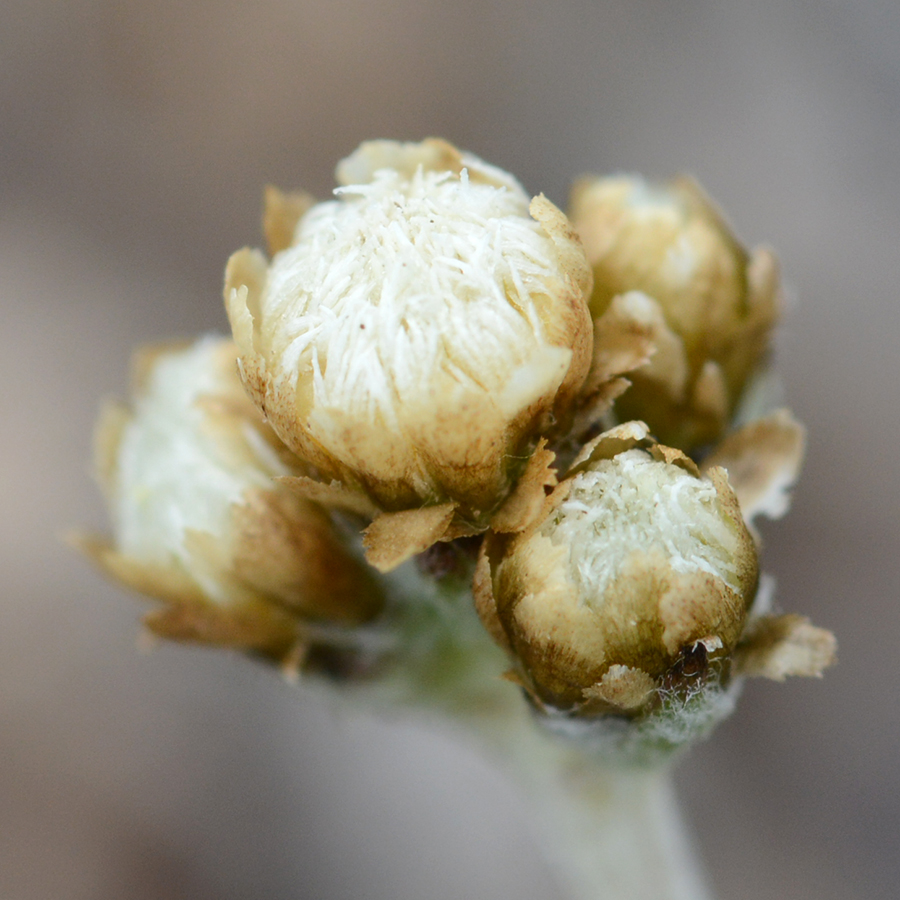
Flower heads are surrounded by brownish bracts.
Cutleaf Fleabane/Daisy – Erigeron compositus – is beginning to come out with its daisy-like flower heads. Here there are several white ray flowers surrounding the fertile yellow disc flowers.
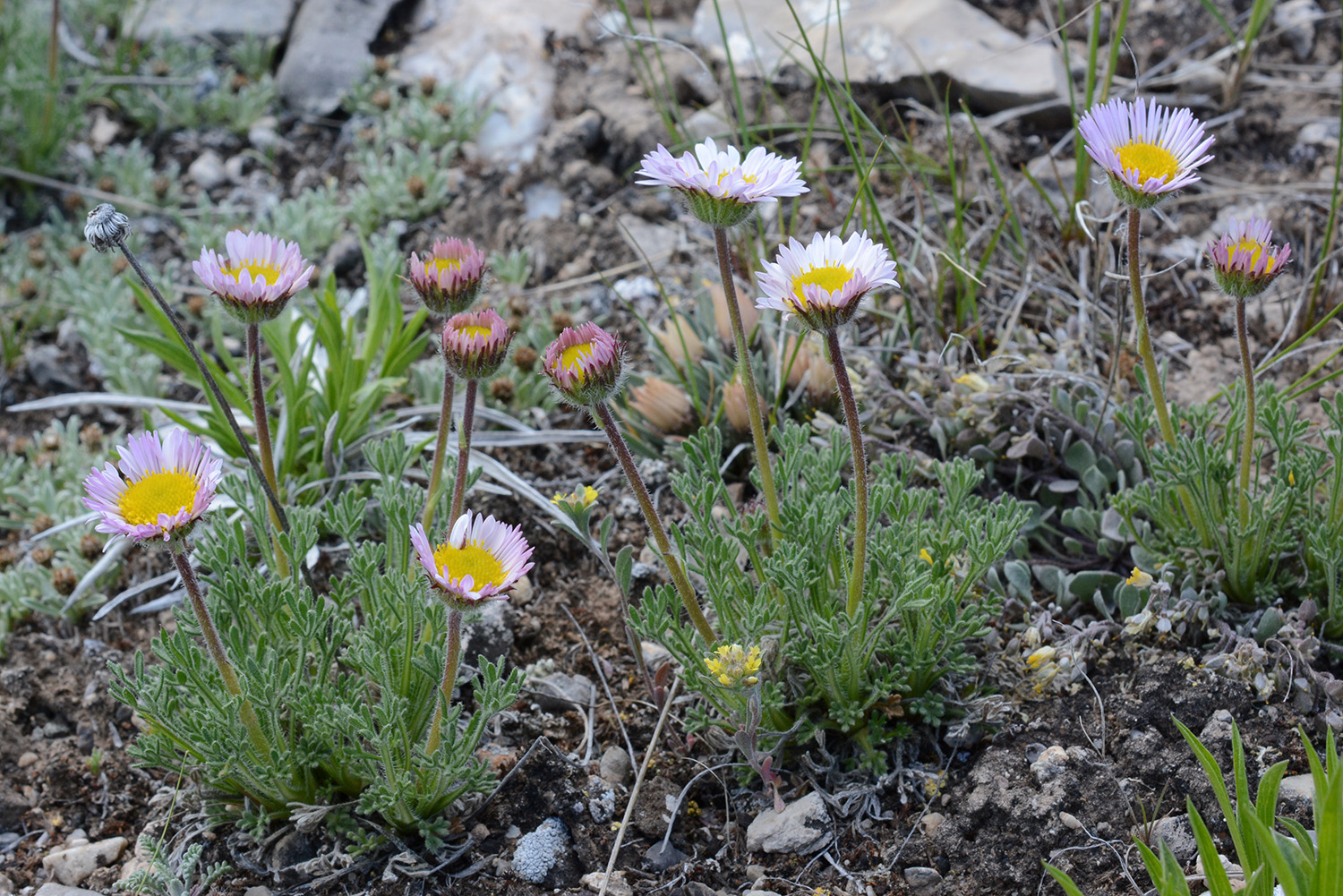
Like all members in this genus, the protective bracts are the same length like a palisade fence. Notably, this fleabane has divided leaves.

We will see many more composite flowers in the weeks to come.
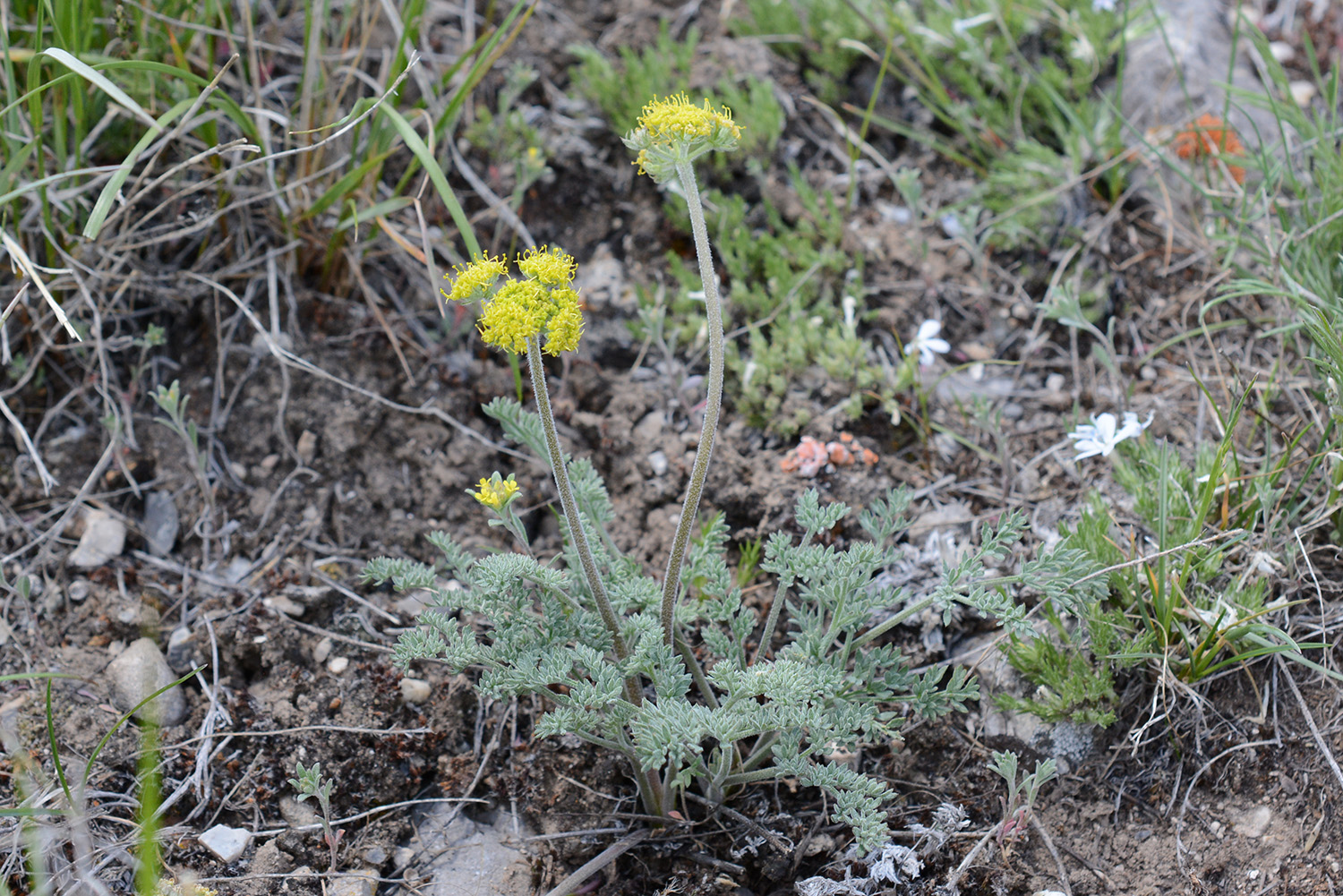
Another common plant on these dry knolls with silvery compound leaves is the Desert Biscuitroot – Lomatium foeniculaceum. A member of the Parsley Family, the tiny yellow flowers are borne in umbels. See how the pedicels arise from a central point and then the individual flowers are also clustered around a central point, as in ribs of an umbrella.
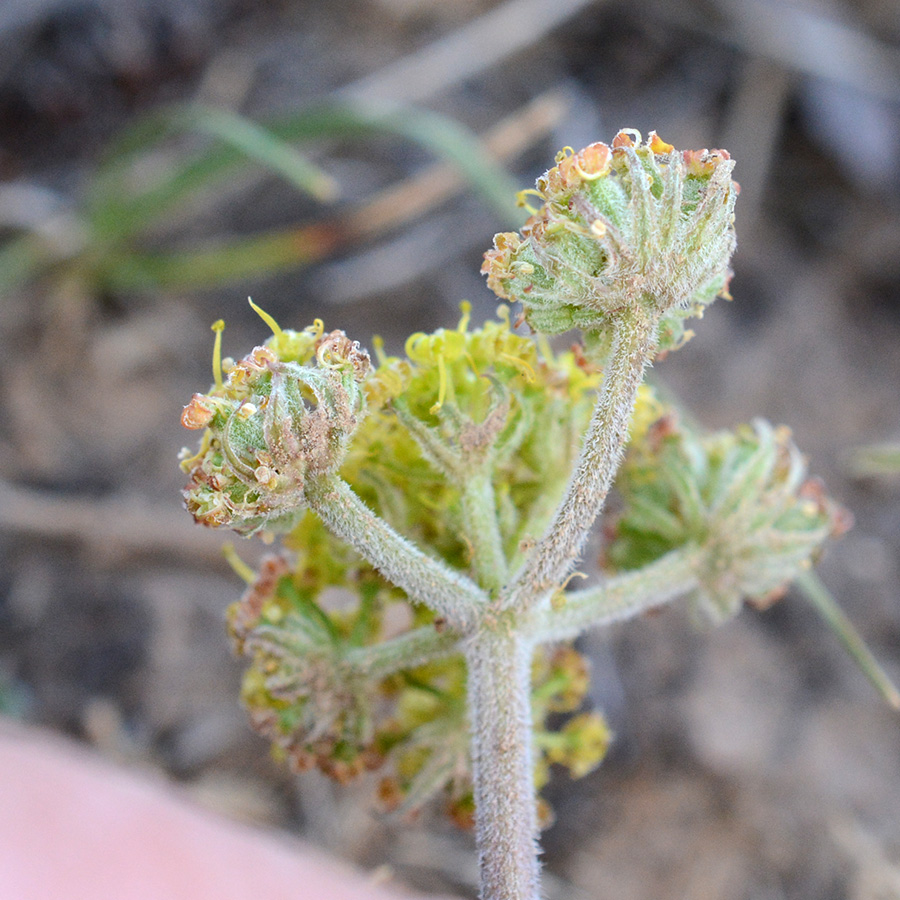
Tiny insect pollinators will clamber over this collection of flowers to help form schizocarps – split dry fruits. Schizocarps are important in identification of many members of this family.
Members of the Mustard Family – Brassicaceae – are also found on these knolls. The family overall is easy to recognize with its 4 petals, 6 anthers, and one ovary. The ovary can become a long fruit – a sleek “silique” – or a squat “silicle”. For exact identification one not only must examine the tiny hairs on stem and leaves – straight, star-like, or branched, but also, must wait for the fruits to mature. Mustards can be particularly tough botanical puzzles.
A Rockcress – Boechera sp, – is leaning over what appears at first to be a stem topped by a yellow flower…or something.
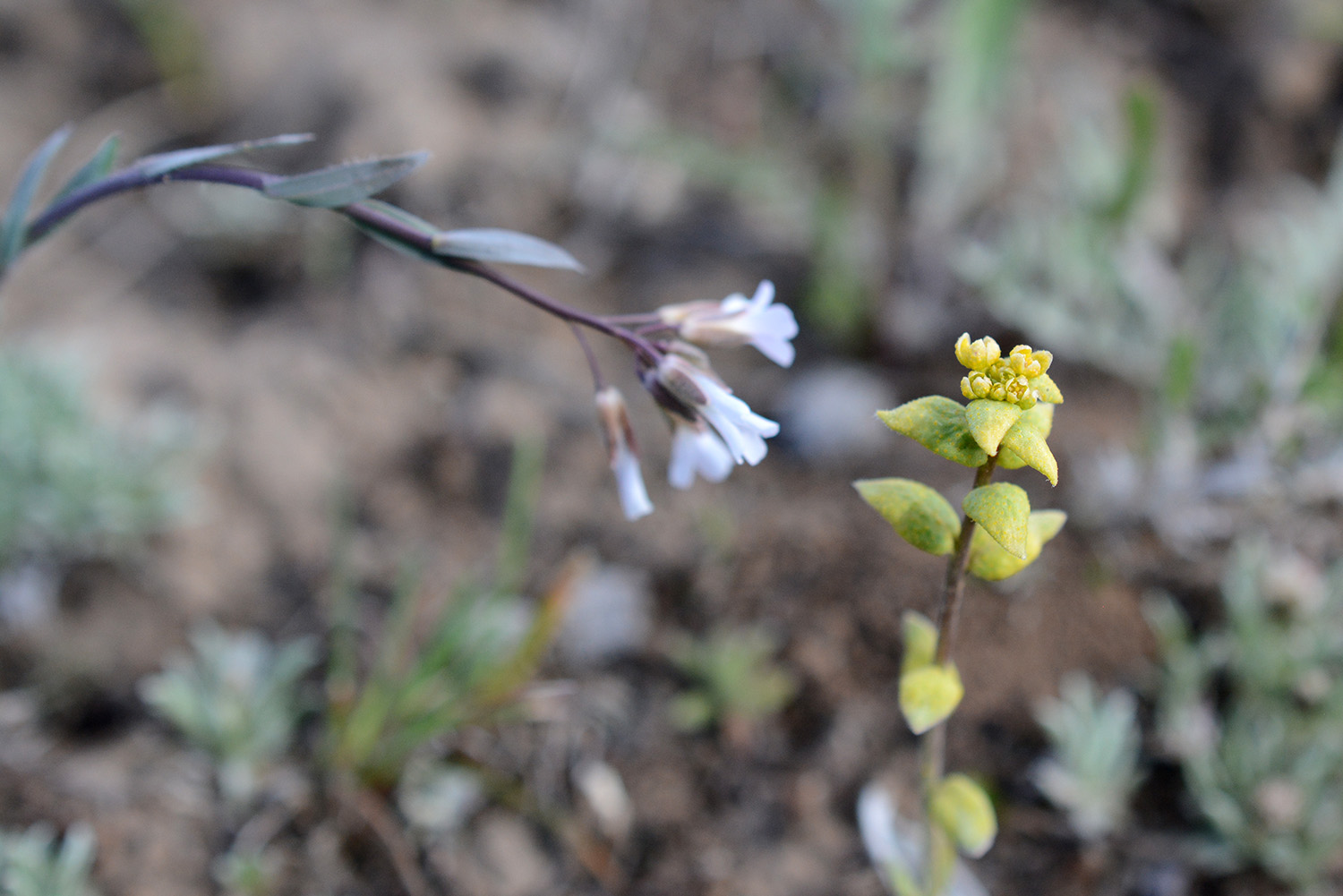
Actually, the mustard stem is infected with a rust fungus Puccinia monoica. Fungus spores infect and sterilize the mustard and withdraw resources to form features and smells similar to a flower—pseudo-flowers. The sticky material along with new pigments that reflect UV light attract pollinators. Cups of spermatogonia form, holding sex cells which are then carried off by the insects to another infected plant, thereby enabling fusion of the sex cells.
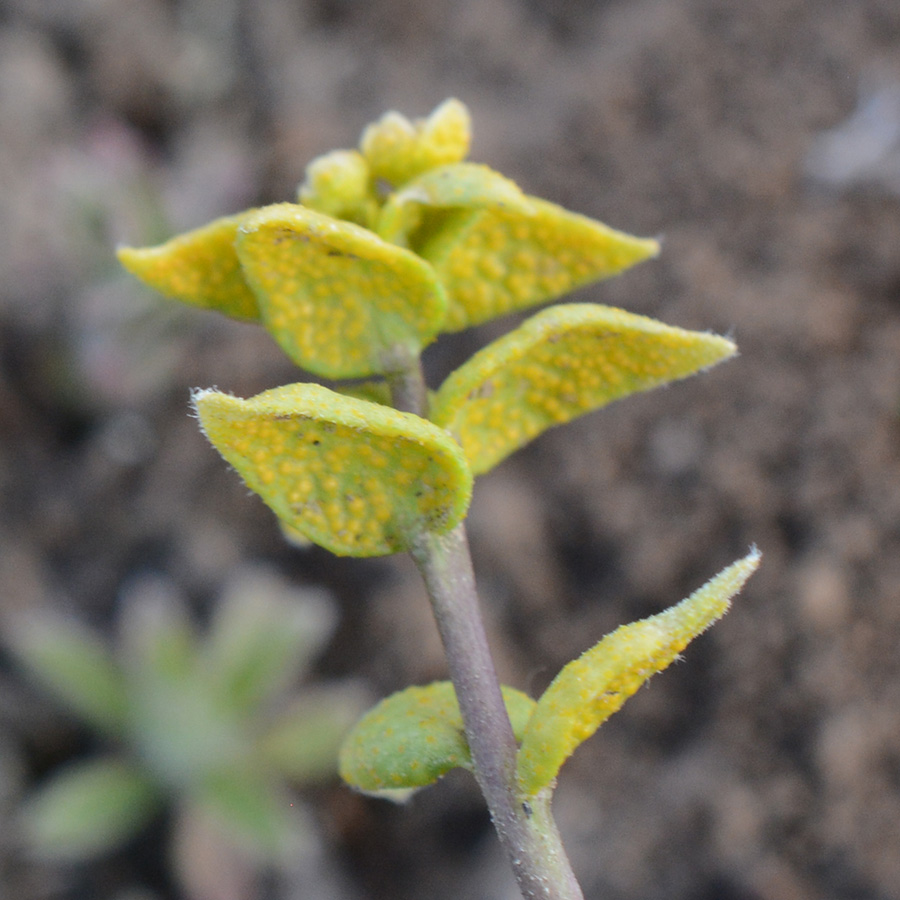
The next step is the formation of spores held in yet another structure. These spores then infect grasses, and after 2 more steps, the life cycle eventually circles back to infecting the mustard. For a full description go here. Both people and insects can be fooled by a fungus.
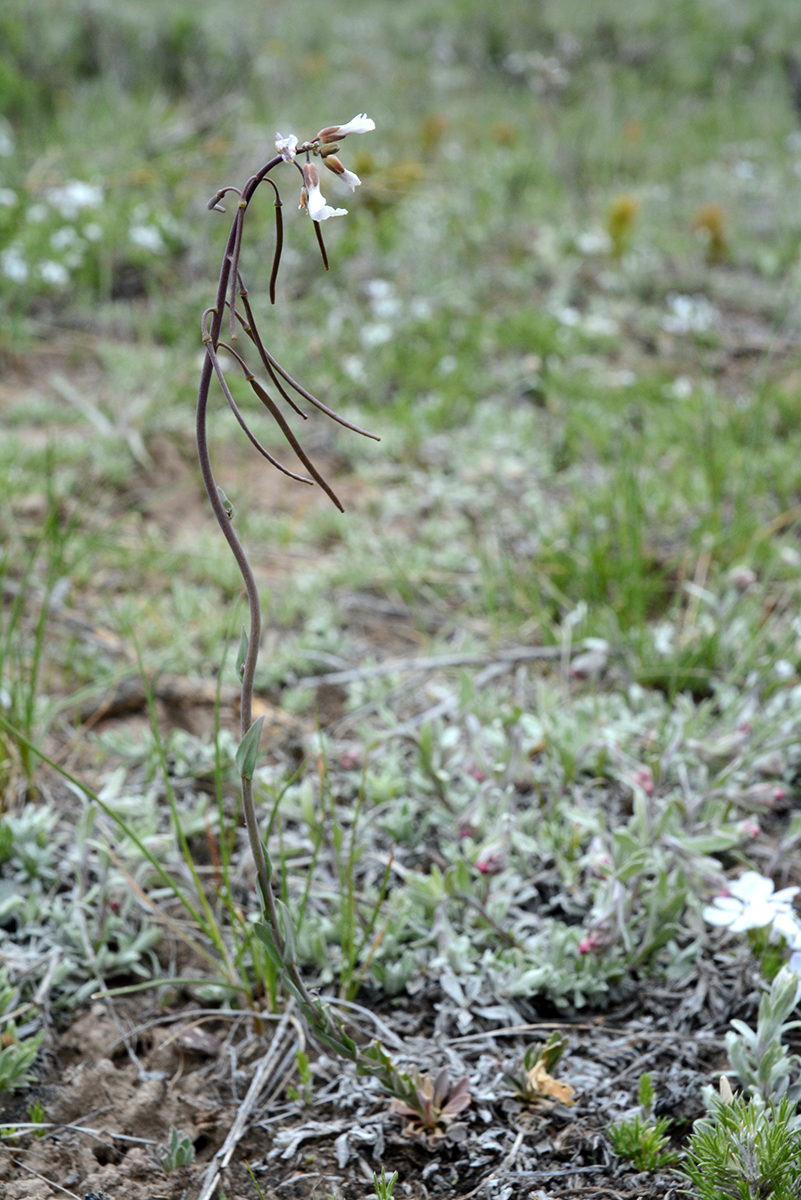
Holboell’s Rockcress – Boechera holboeii – starts small and then grows tall as it expands its downward arching sleek siliques. Different taxonomists have different names for members of this species complex.
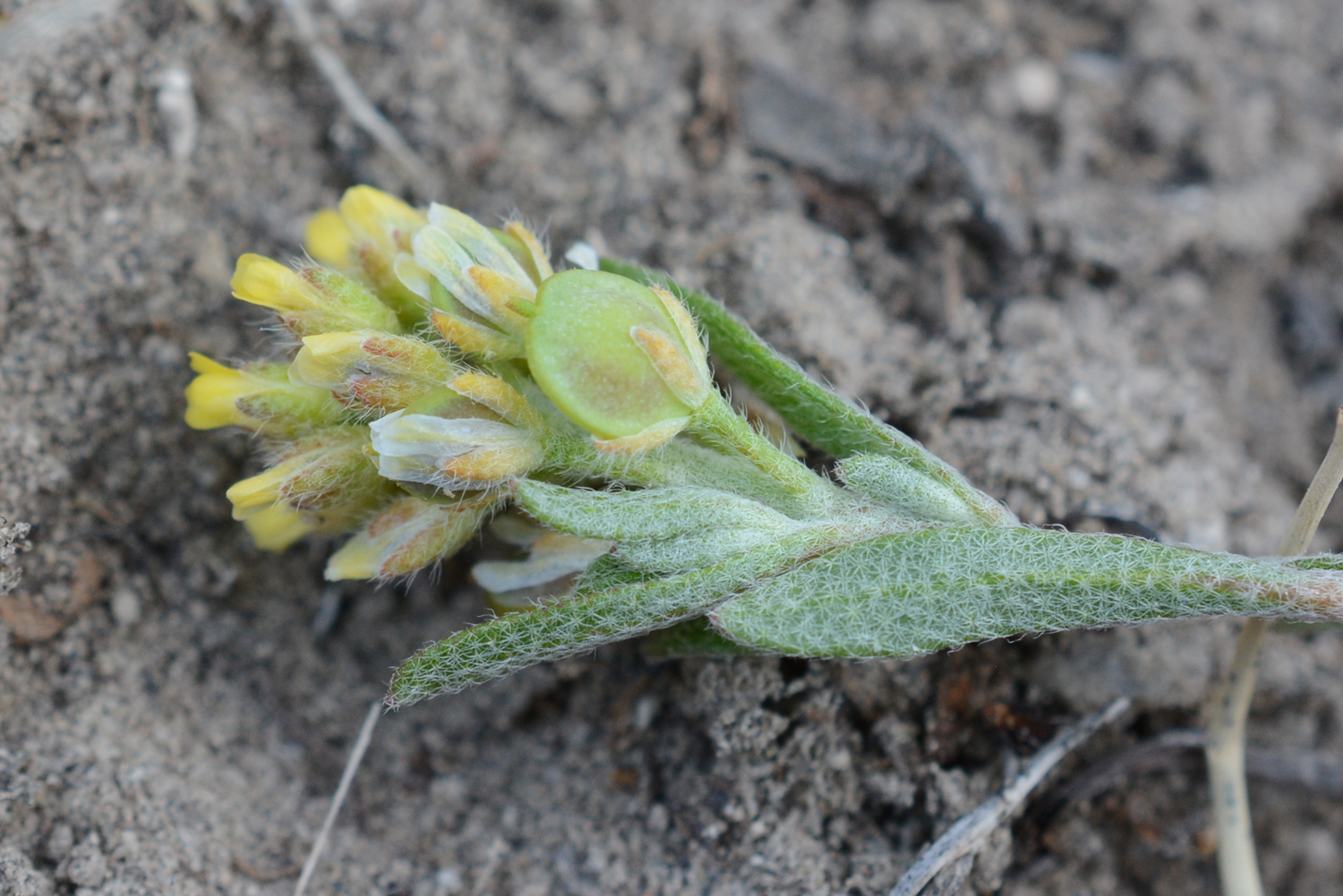
Desert Alyssum – Alyssum desertorum – are weedy non-native annuals from Eurasia that seed into disturbed ground. Only a few inches tall, it is not as pesky as many other invasive species.

Its fruits are squat silicles. Note the star-branched hairs. Hairs can be an important ID feature of mustards, and can be quite beautiful.
Nuttall Yellow Violets – Viola nuttalii var. praemorosa/Viola praemorsa – are raising their cheerful flowers for bees, flies, and even ants. They have nectar in the back of a spur. The lines and hairs on the lower petals guide the insects to this reward. If no pollinator comes, this violet (and many others) have a back-up strategy: they produce cleistogamous or hidden flowers below the leaves. These flowers don’t have any showy petals but do have pollen and ovaries to produce seeds, although the seeds don’t have any new genetic diversity. Capsules from both types of flowers explode the seeds out upon the ground.
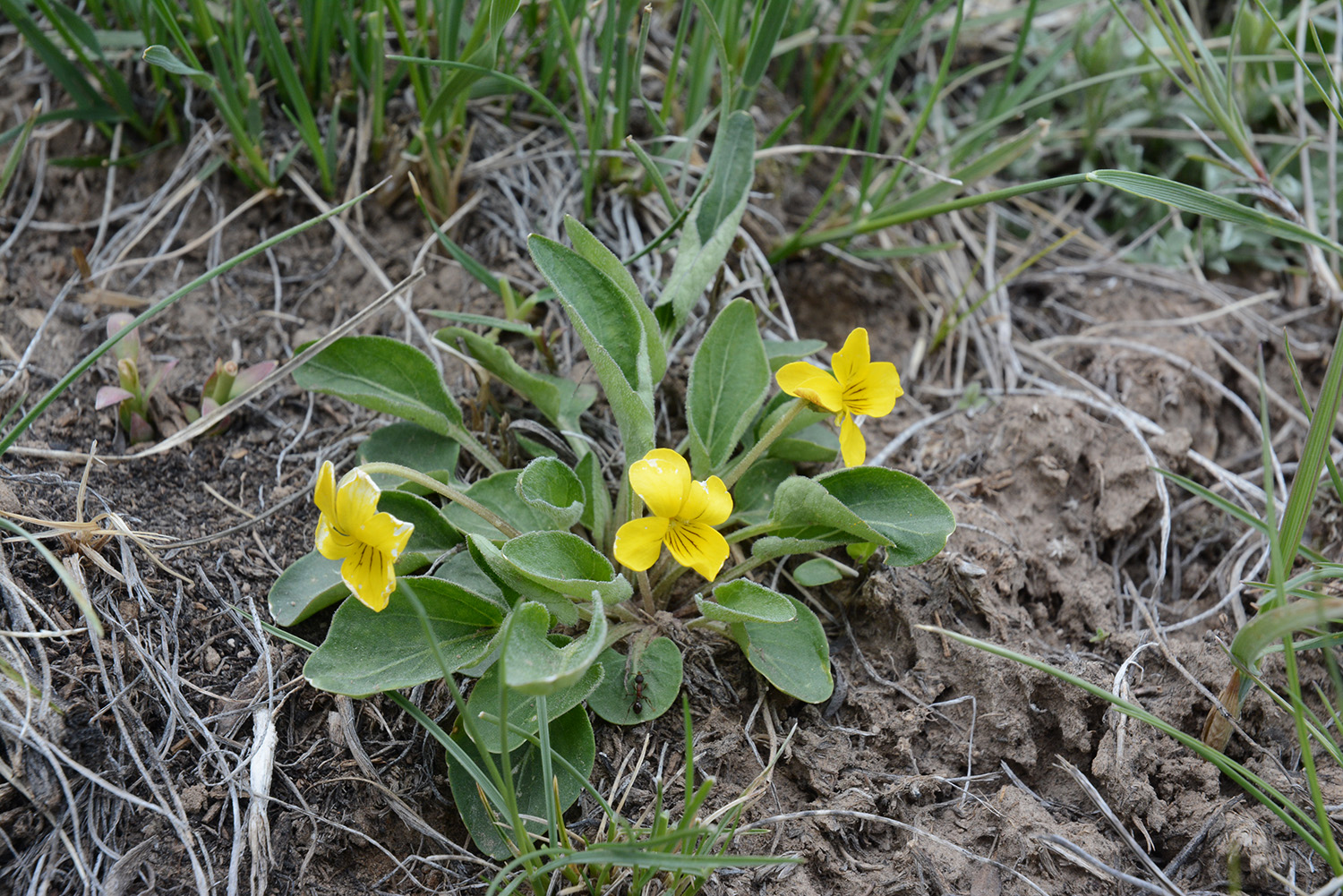
Nuttall’s violets and their cousins have a tangled taxonomy. Helpful identification features for this species is in part the darkened backs of the two top petals.
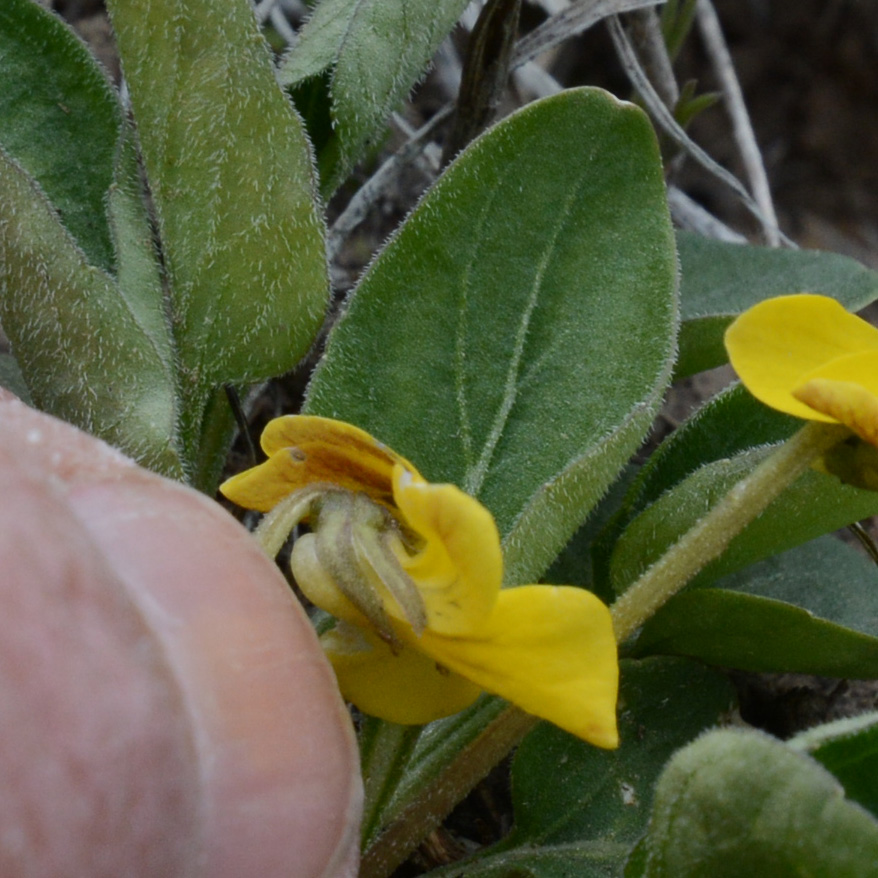
Violets are important host plants to the caterpillars of fritillary butterflies.
Adding brilliant dashes of scarlet to dry hillsides are Desert Paintbrushes – Castilleja chromosa.
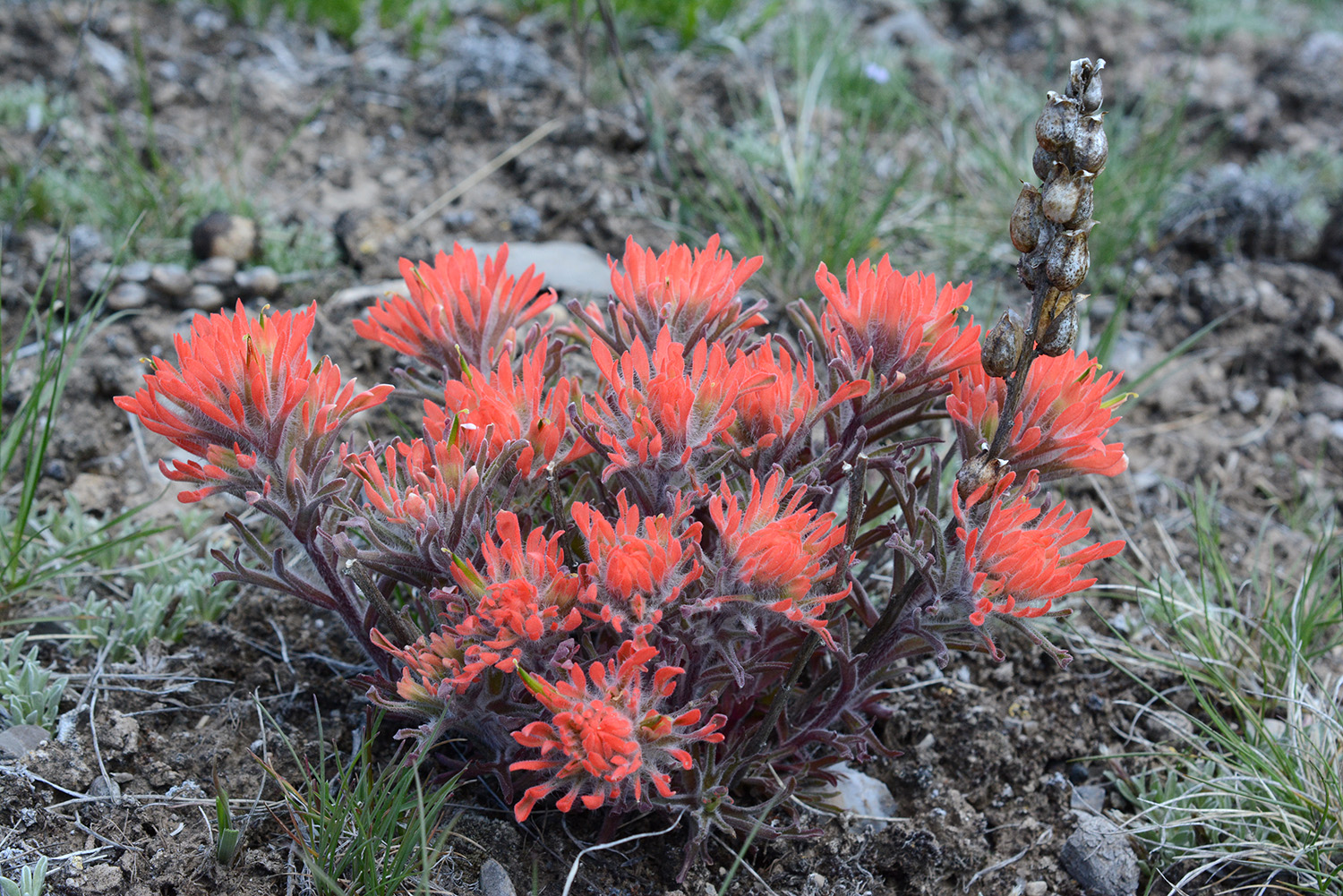
Most of the color comes from expansive lobed bracts and sepals.
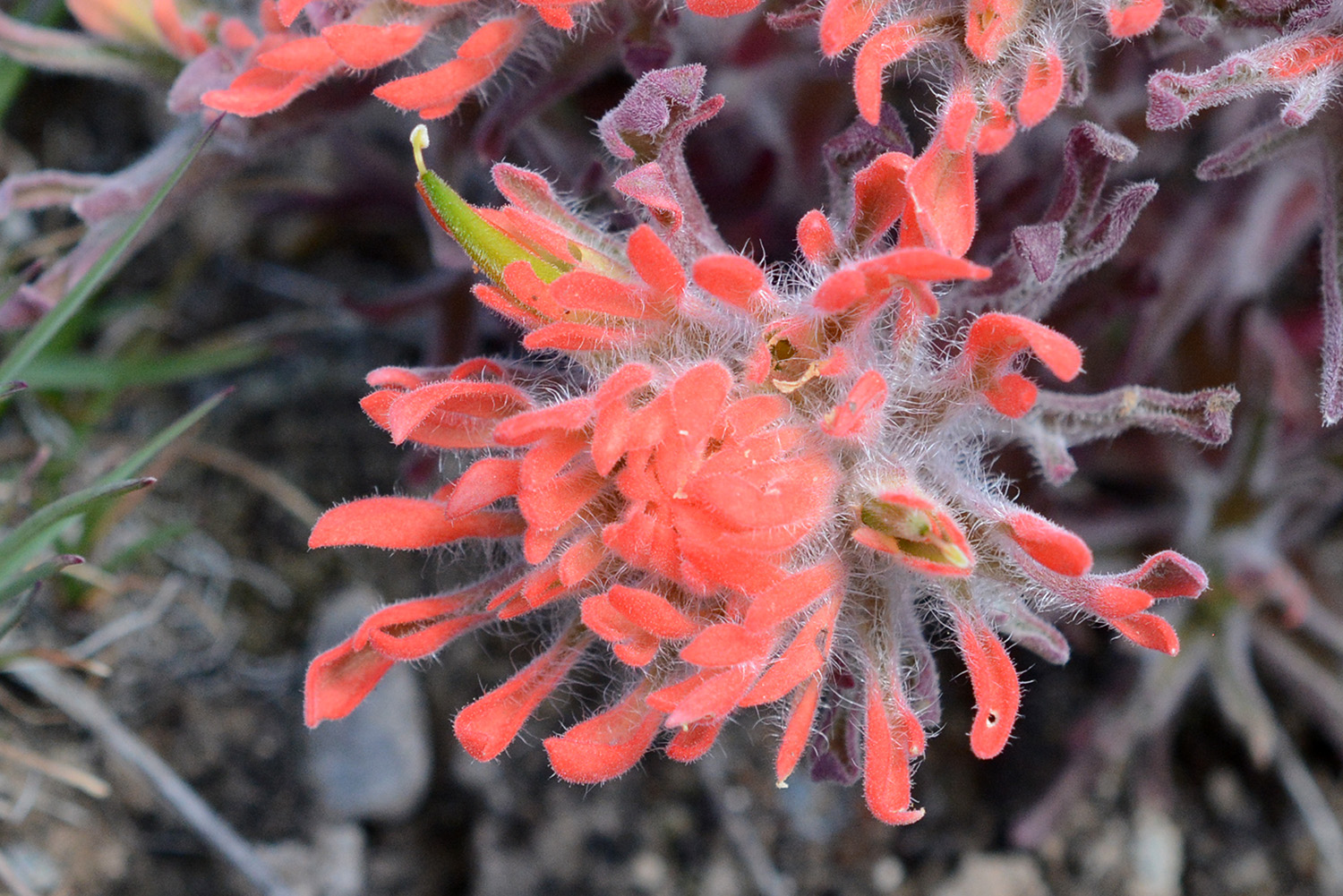
Tucked inside is the green galea: a tube formed by the green petals. A stigma is reaching out in this photo. The anthers are tucked inside. The plants are particularly hairy and stout at this stage which distinguishes them from several red paintbrushes to come.
The roots of paintbrushes attach to other plants and draw nutrients and/or toxins from the host—they are hemi-parasites. In this case Desert Paintbrushes have been documented on beard’s-tongues – Penstemon spp. – and dusty miller – Chaenactus douglasii. Many paintbrushes use grasses and sage. Because of its parasitic nature, paintbrushes are now in the Broomrape or Orobanche Family, no longer the Figwort Family .
The next “What’s in Bloom” post will focus on larger plants coming into bloom fast in sagebrush habitats. It’s hard to keep up with the production wrought by photosynthesis.
We welcome any corrections or suggestions.
May 21, 2024
Note: no AI was used in producing this post.
 Teton Plants