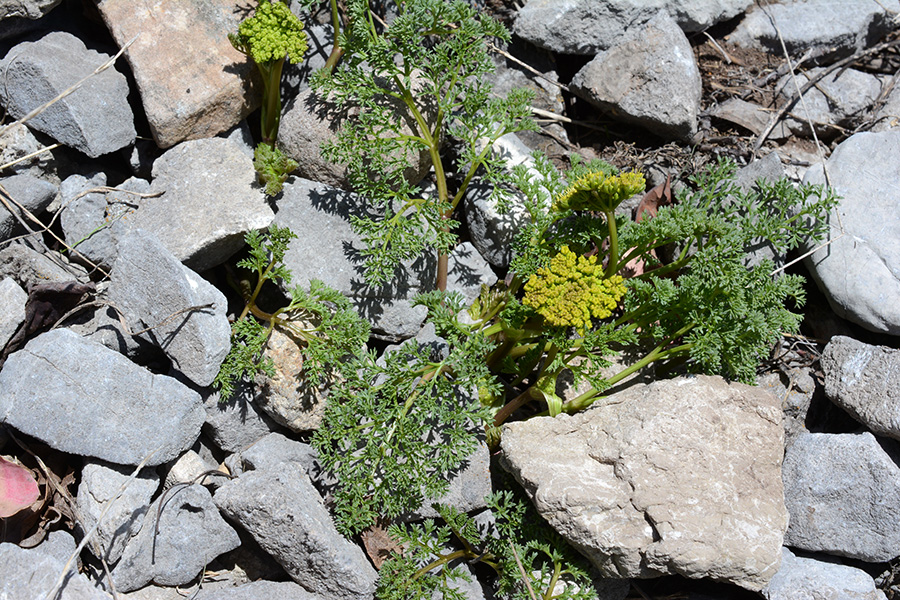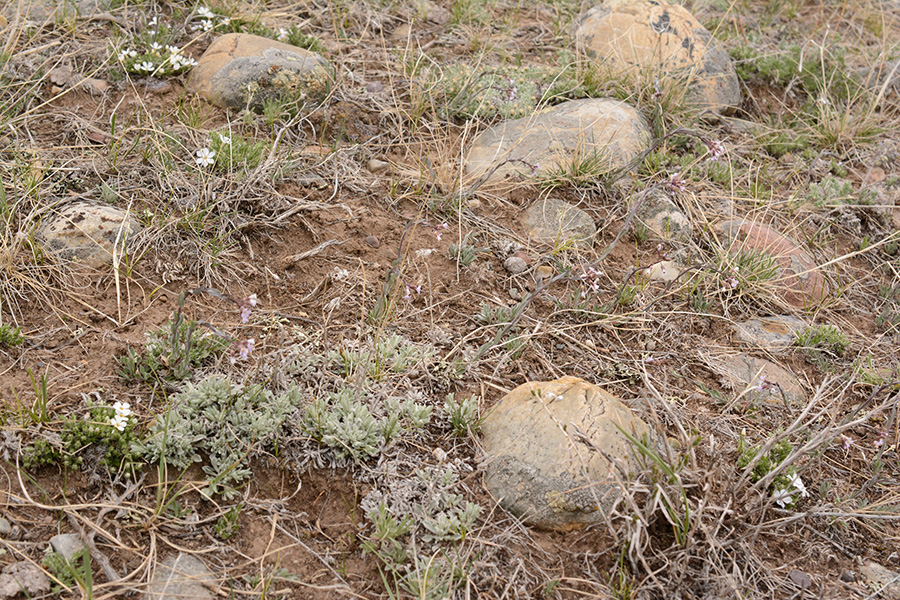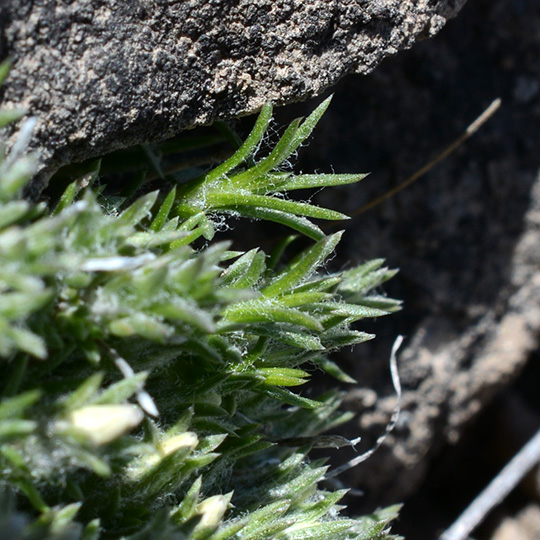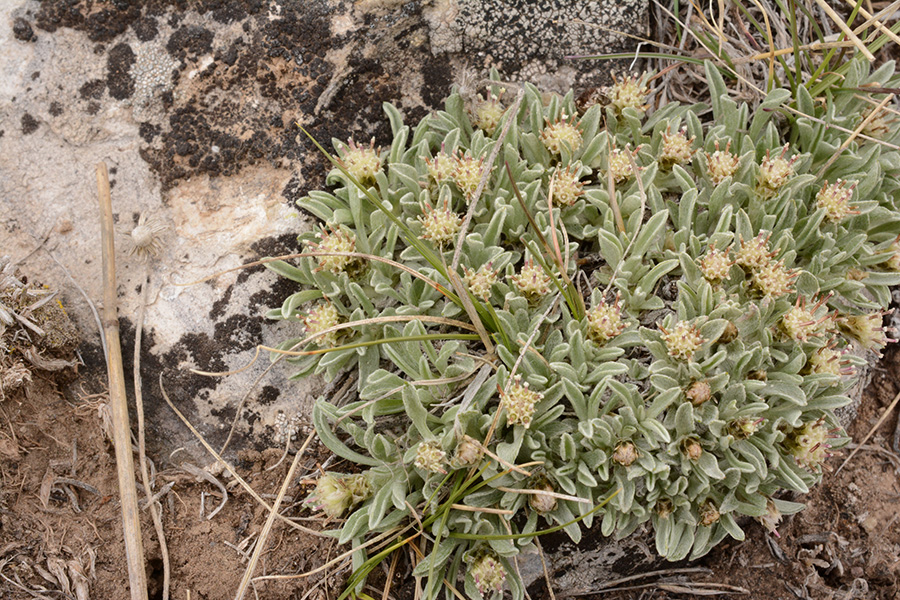
End of Season Blooms…Mostly Composites

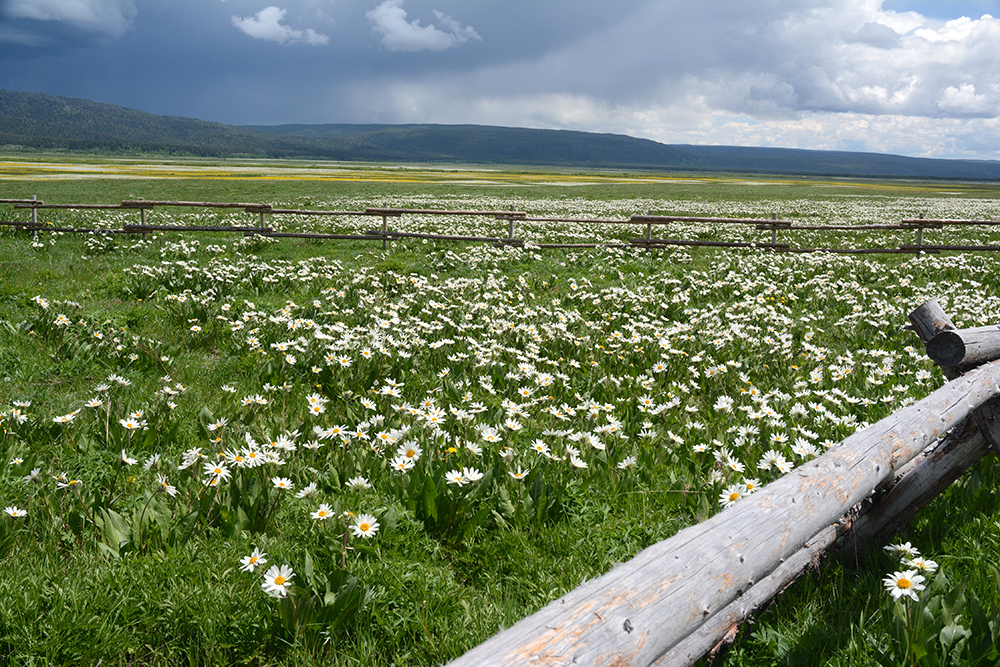
We have enjoyed a fabulous season of flowers, thanks to extra moisture from late snow-melt then rains into August.
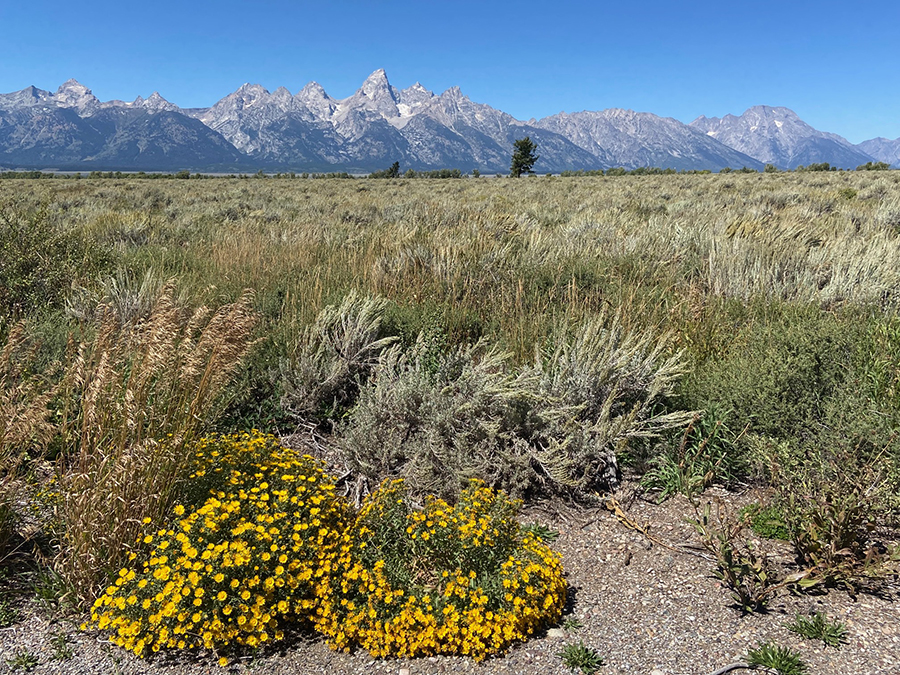
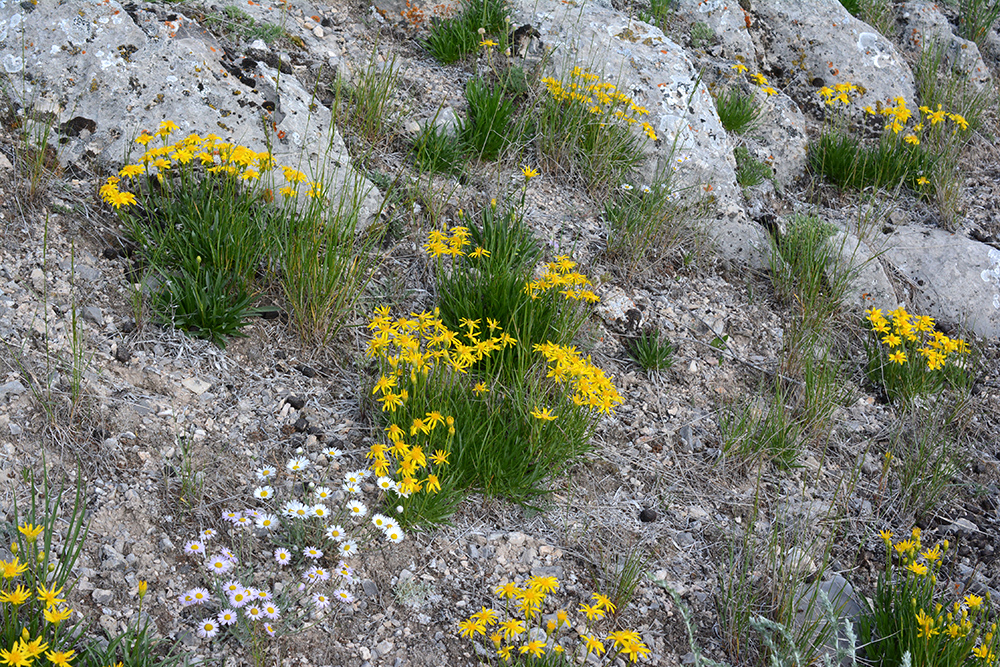
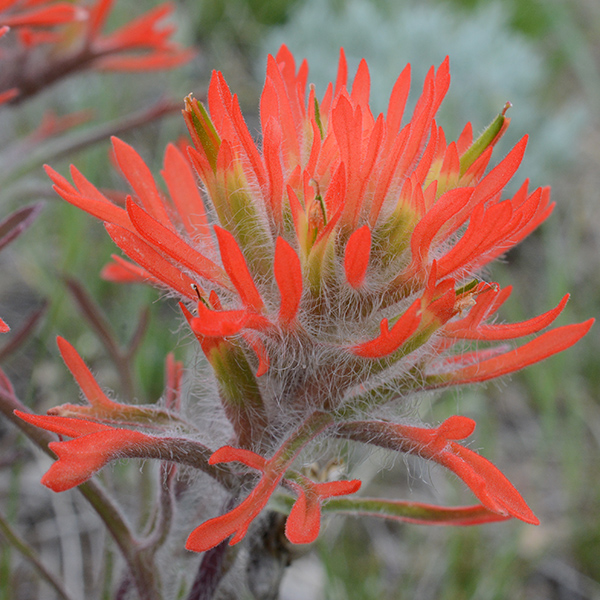
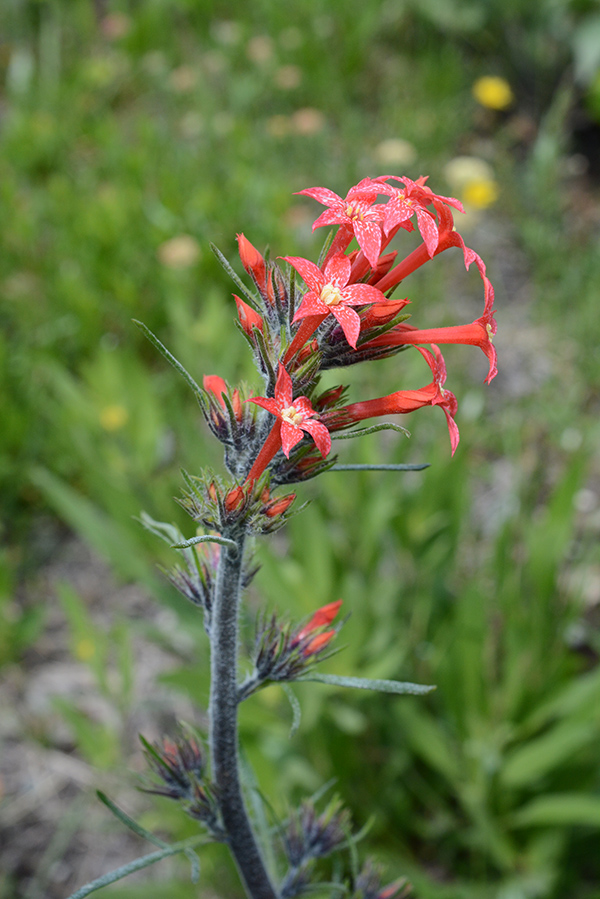
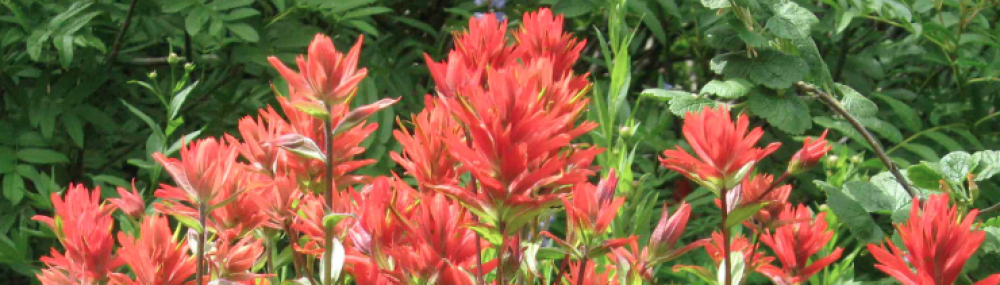
The valley has a few die-hard yellow composites and some tough blue asters along roadways. Higher up, remnant mid-summer flowers persist—such as Yarrow, Giant Red Paintbrushes, and Scarlet Gilia—but most late season bloomers are aster look-alikes. As always, the Composite Family (formally Asteraceae) steals the show for color be it yellows or blues, and some whites.  Indeed, this highly successful family is deemed to be the most advanced plant family and is found around the world.

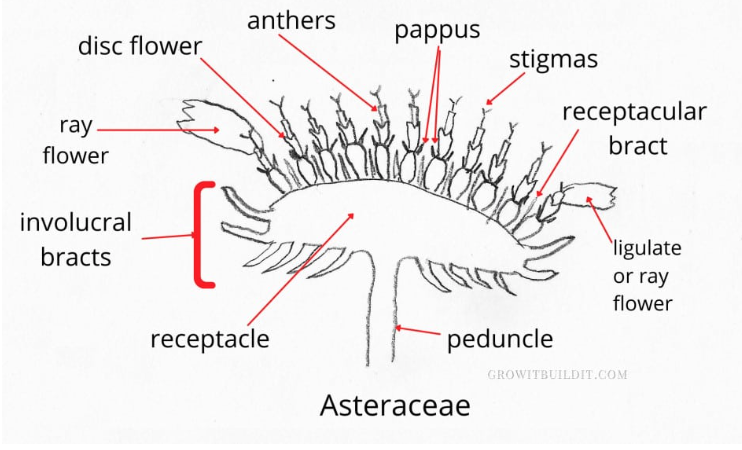
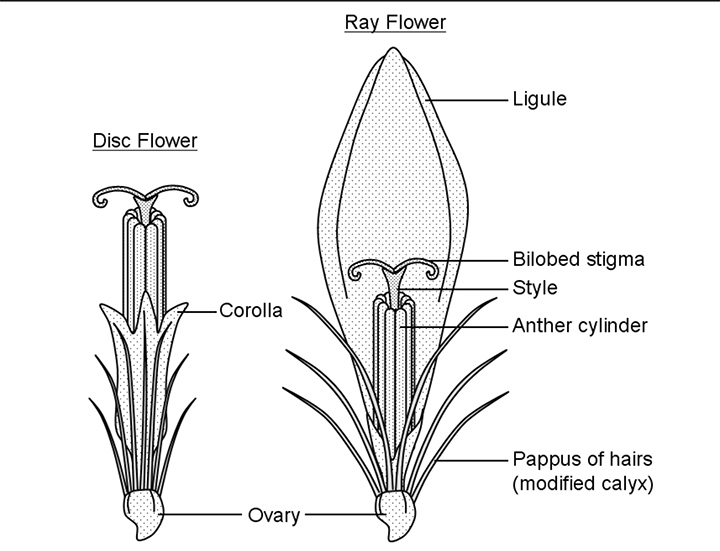
As so many of the species below are composites, here is a simple diagram of the basic flower plan for reference. Many flowers – disc and/or ray flowers – sit upon a platform or “receptacle” and are surrounded by protective bracts. Bracts are particularly helpful in ID:
Flowers along Grand Teton National Park roads and drier slopes:

Yellows:

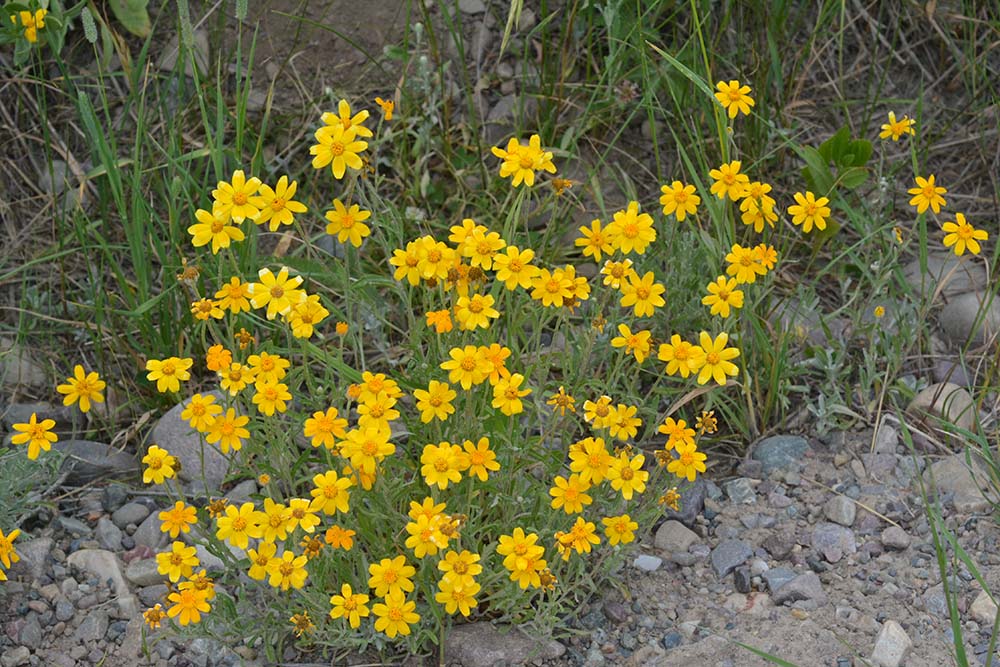
Showy Golden-eyeVigueria/Heliomeris multiflora  – has been flowering all August and continues as into September.  Averaging about 2 ½’ tall, the leaves are oblong and opposite up the thin stems. Flowers hang out singly on the branching stems. Note the yellow ray flowers fade in color: they are slightly lighter at the tips and slightly darker toward the center. 

This subtlety is likely a significant contrast to an insect’s vision—a bull’s-eye to draw them in.

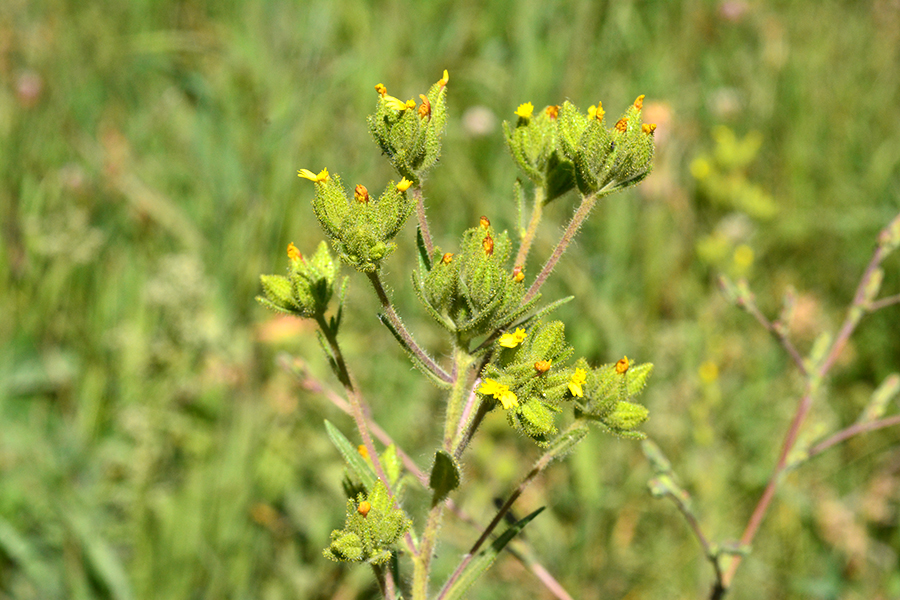
GumweedGrindelia squarrosa – is indeed gummy. Bright-yellow flowers line park roads.

Notice the cup of bracts that surrounds the many yellow flowers—both ray and disc.
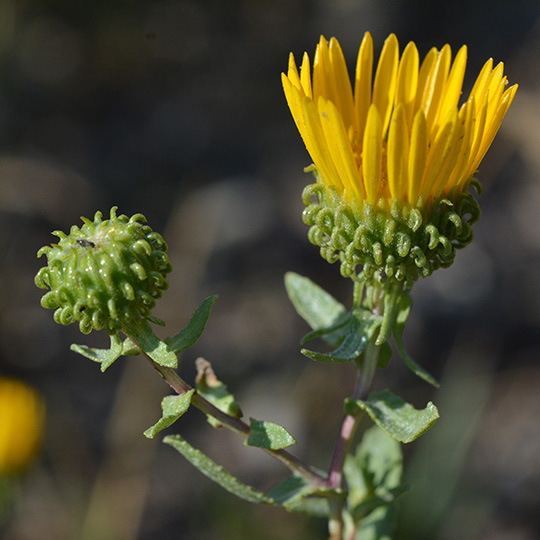
The bracts curve downward into points. The leaves are more-or-less blunt ovals about ½-1” long with slight teeth. While definitely native to elsewhere in Wyoming, this “weedy” species appears to be a fairly recent newcomer to Teton County.
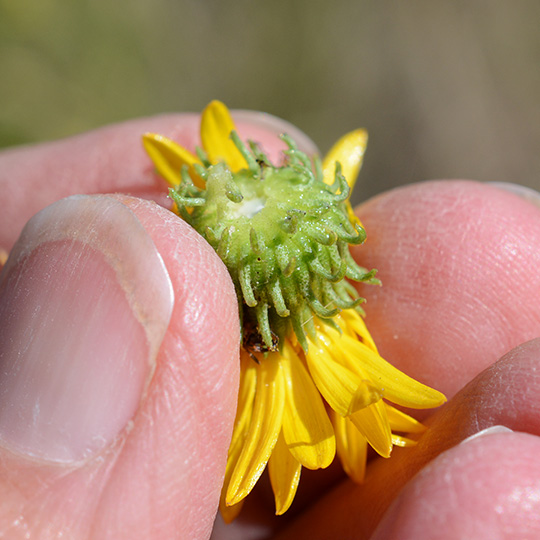
Most parts of the 1’ plants ooze a clear pitch-like sap if torn. The fresh sap from a flower head has been shown to reduce inflammation from “acid venoms” injected by bites of snakes or spiders, including recluse brown spiders. Depending on where it is growing, plants absorb and concentrate selenium from the soil. And different parts have been used carefully as various medicinal treatments. (reference: John Mionczynski)

Another late August bloomer is 6-12”-tall and wide-spreading Golden AsterHeterotheca depressa. The pale-yellow flowers are now mostly going to seeds which are readily dispersed by wind. 
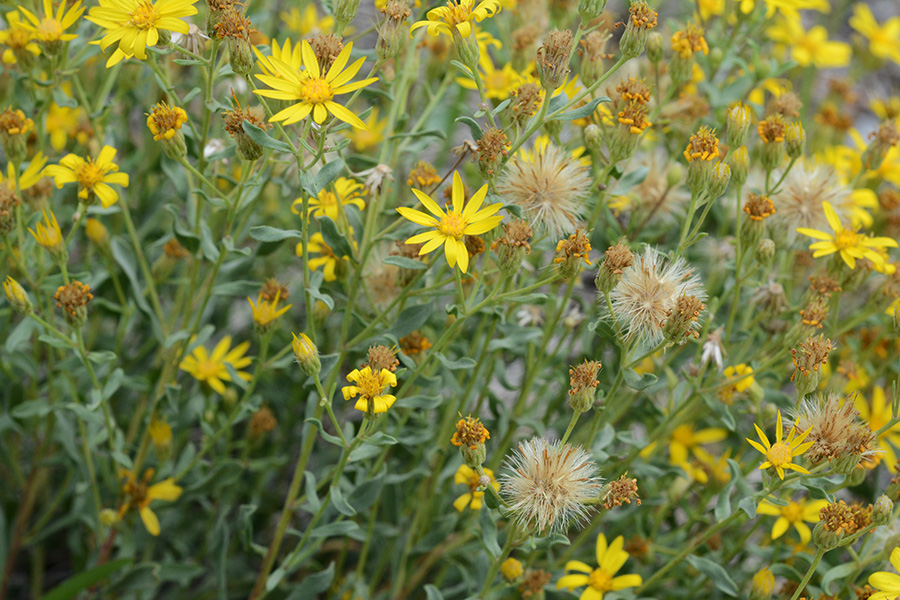
Look for the 1/2″ -1”-long, oblong leaves with fine hairs that add a grayish tinge to the plants.  It is most frequent around Moose and north along the park road.

All of a sudden do you smell something like freshly oiled macadam roads while hiking? Look under foot; you will likely find the aptly named TarweedMadia glomerata

This 6”-1’ plant has glandular hairs which contain a pungent resin.  Only 1-3 yellow ray flowers and a very few disc flowers are found in each ¼” head. Despite the tiny flowers, native bees are attracted to the nectar, and the seeds are favored by birds and small mammals.  These annuals are used in restoration projects in disturbed soils to prevent erosion and start the healing process as other plants move in.

Of particular appeal to pollinators of all sorts—bees, butterflies, flies – are shrubby rabbitbrushes. Pollinators are clutching to any nectar source they can find at this late season. The two obvious species blooming now in the valley floor are in two different genera.

The tallest and showiest species is Rubber RabbitbrushEricameria nauseosa var. nauseosa.  Flower heads are bright yellow on this 3-4’+ shrub; the straight stems have alternating very narrow green leaves 2” long. 
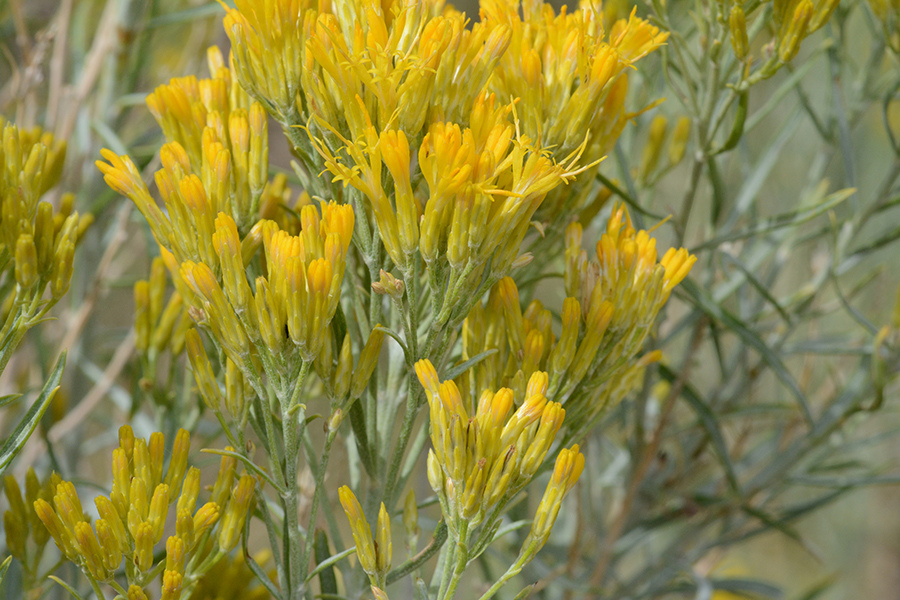
The grayish stems are “tomentose”: covered tightly with many fine gray hairs.

The common name alludes to the fact that the plants exude a white sticky sap which was considered a source of rubber back in 1904.  It is currently being studied as an allergy-free form of latex. 

The other species in bloom often called Green RabbitbrushChrysothamnus viscidifolius – has slightly twisted sticky (viscid) leaves. Plants are usually only a foot or two high and also thrive in dry soils.
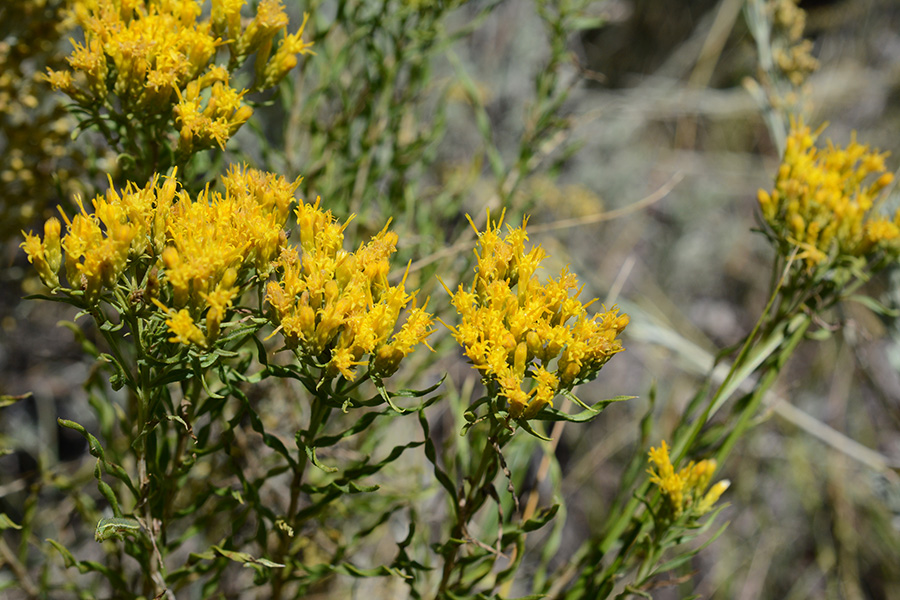
It has slightly twisted sticky (viscid) leaves more or less hairy.
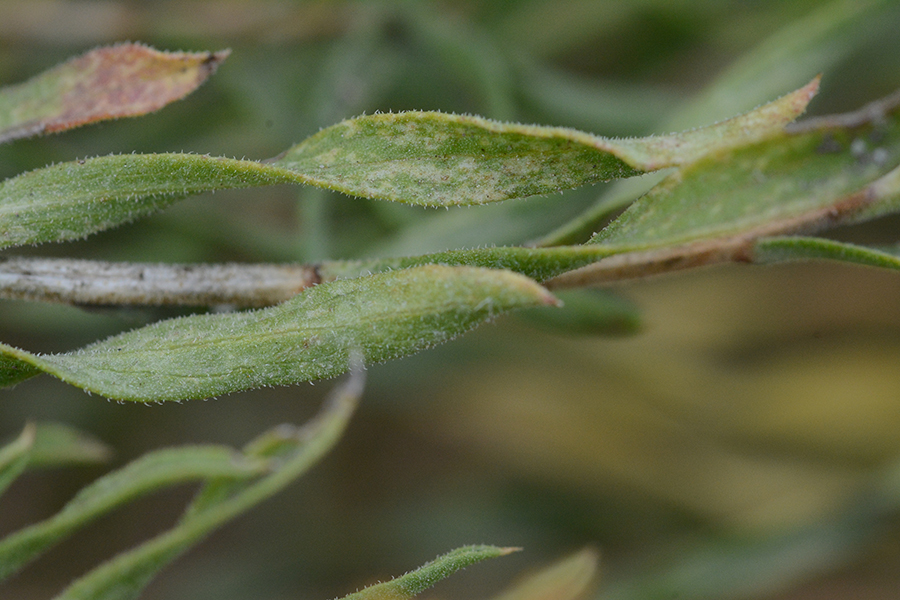
Both these species have several varieties in Teton County, so be aware of variations in appearance.

Some late blue “asters” from valley roads and higher elevations

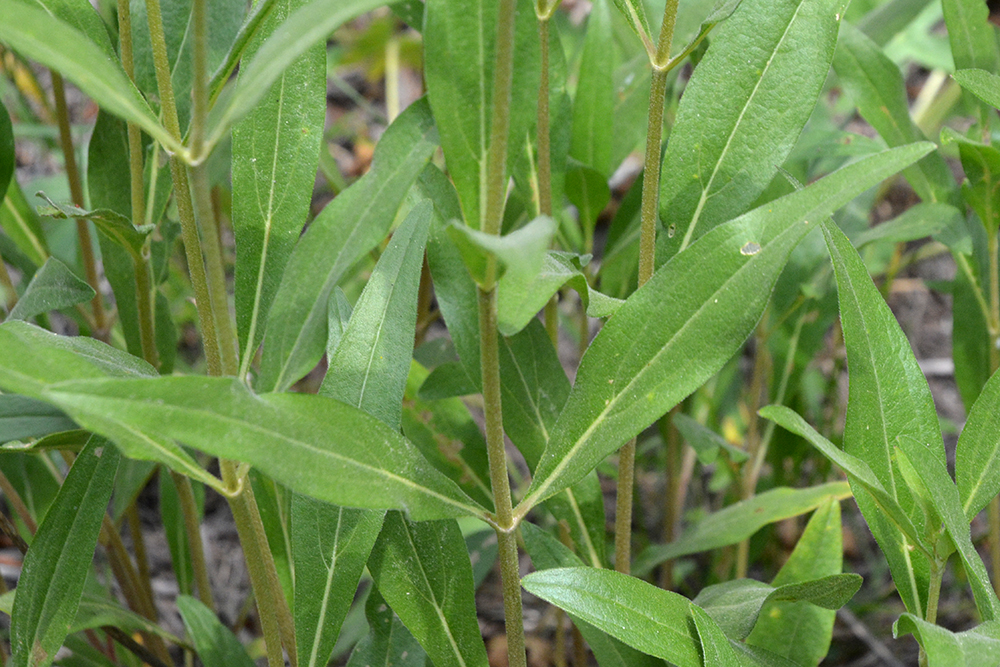
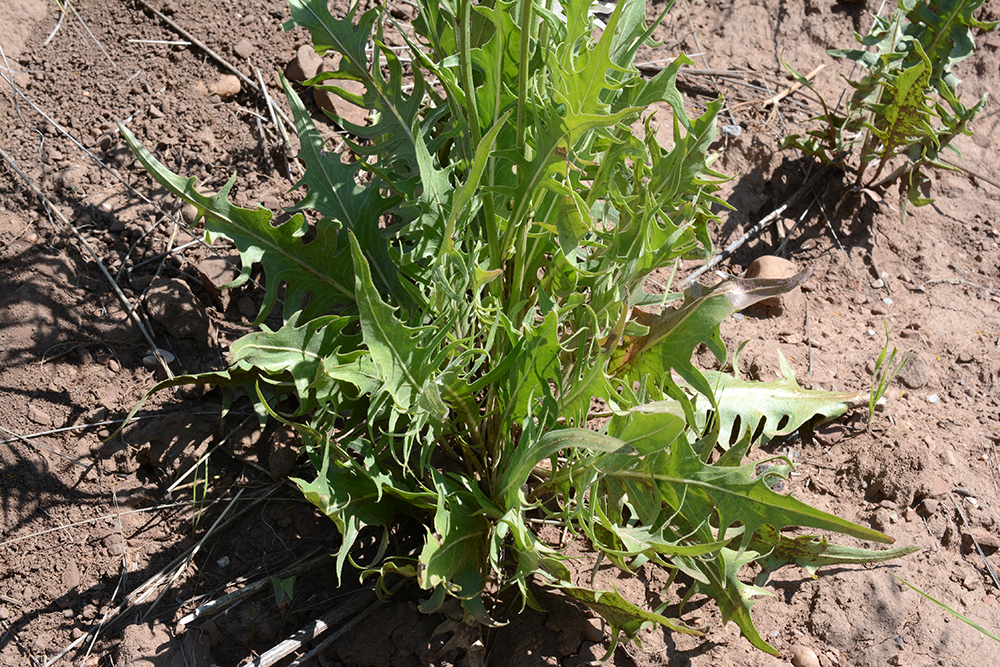
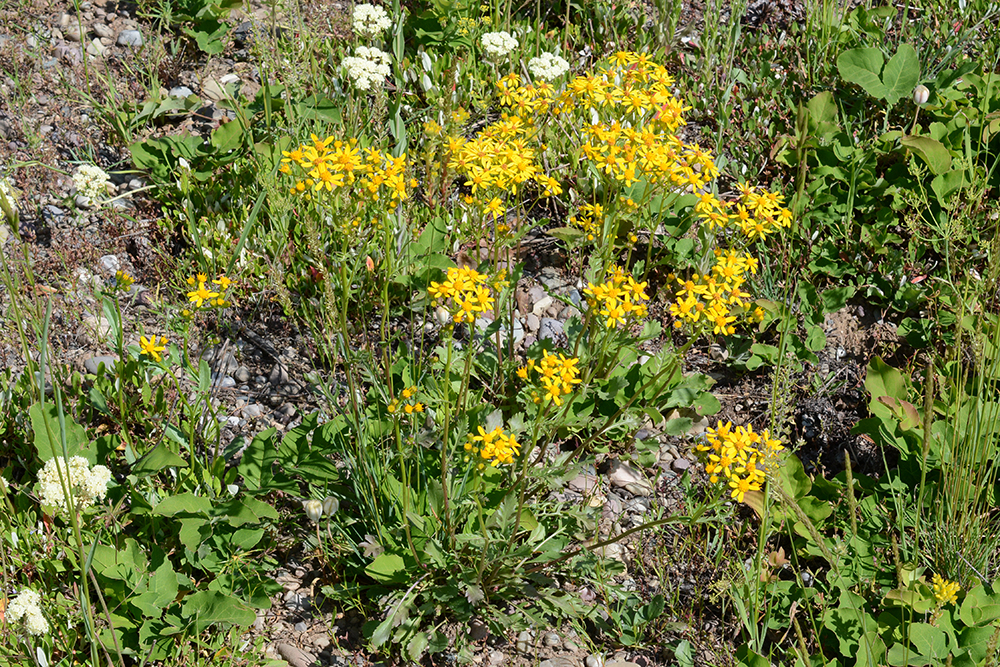
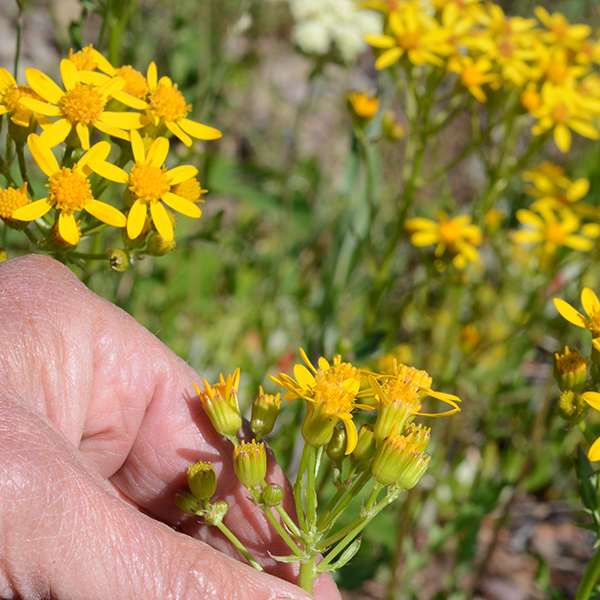
Below are several different kinds of “asters”.  Taxonomists keep shifting the names around.in part because they are now using DNA as a definitive way to tell how closely plants are related. Thus many of the following species that were in the genus “Aster” are now in genera such as Symphyotrichum, Euephalus, Eurybia…not easy to pronounce or to tell apart. Lay people still call those in this look-alike group Asters. The visible differences (vs, microscopic DNA) are often most obvious in the bracts that surround the head of these composites. Identification provides botanical puzzles that are more rewarding than solving crossword puzzles or Sudoku, at least in this author’s thinking. Each plant has its own association with its setting.

Pacific AsterSymphyotrichum ascendens – has been blooming since early August, often alongside Showy Golden-eye. The genus SySymphyotrichum is a large group of American Asters which have bracts of varied lengths overlapping like untidy shingles. 

In this species the flowers are blue,
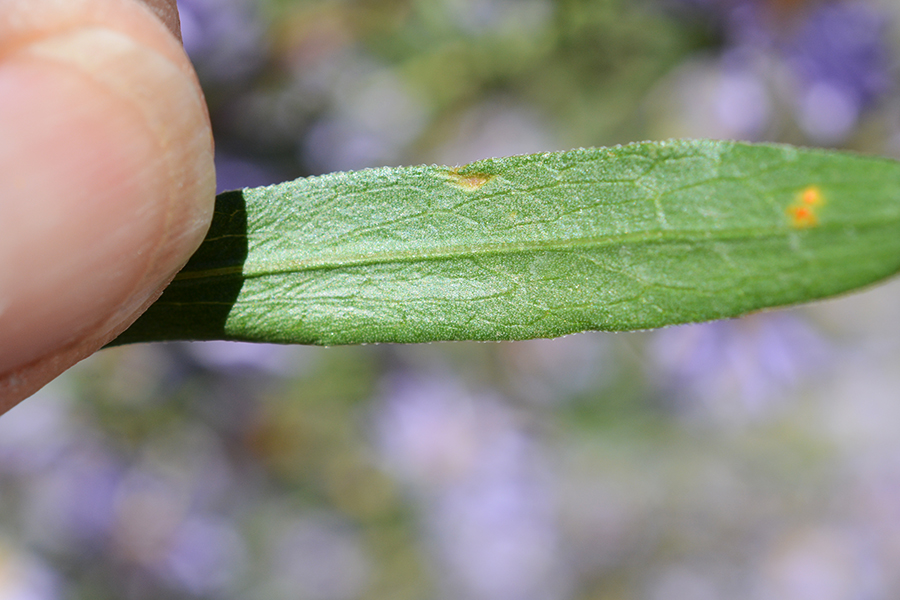
and the leaves are linear with veins that form elongate patterns.
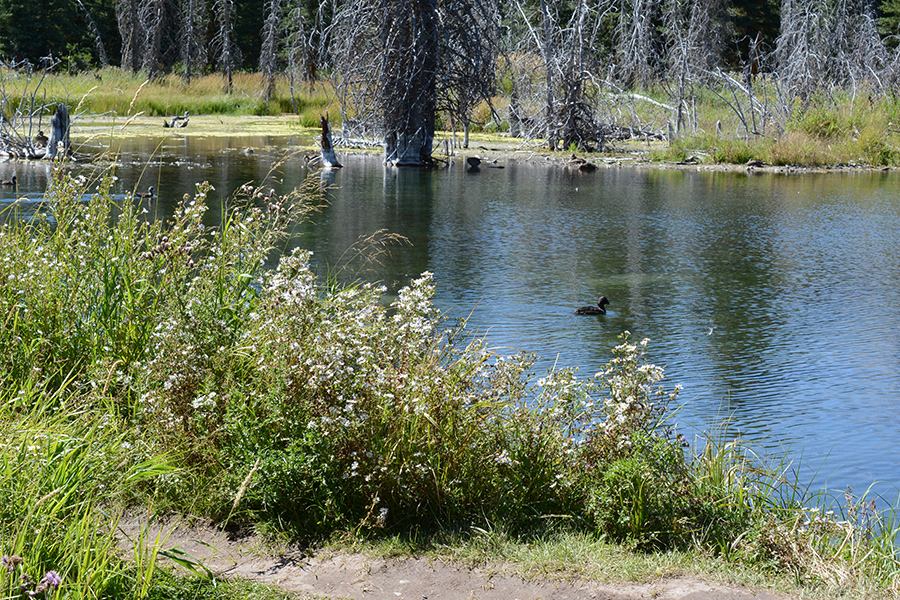
Eaton’s AsterSymphyotrichum eatonii – grows in moist areas. It is blooming around the beaver ponds at Schwalbacher’s Landing in the park and along stream sides.
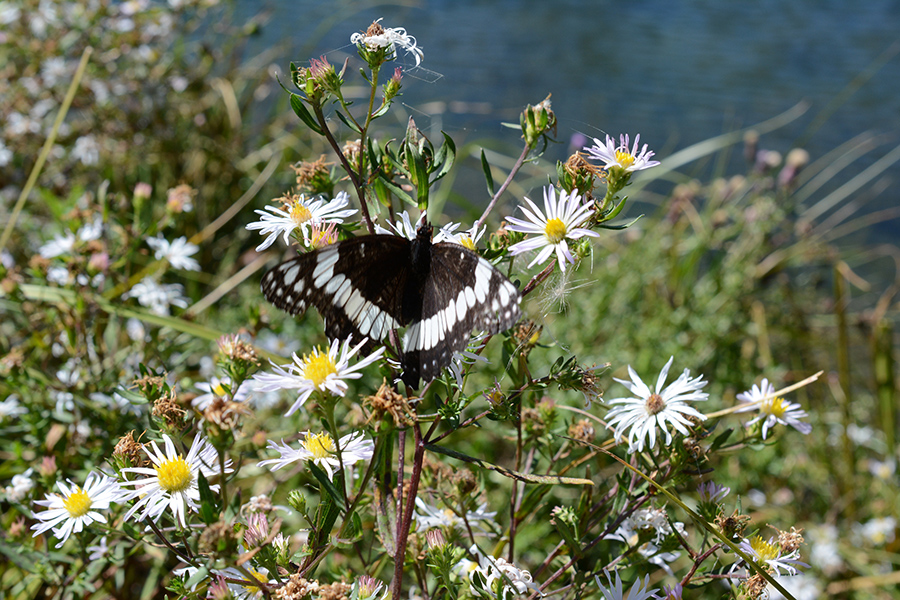
Flowers are abundant on the top third or more of the 3-4’ plants, attracting this Weidemeyer’s Admiral butterfly.
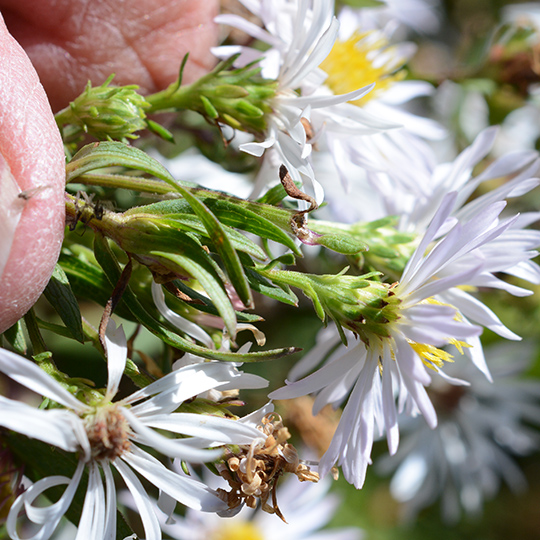
This species also has the shingle-like green bracts. The leaves are narrow and 3-4” long near the top.      

Thickstem Mountain AsterEurybia integrifolia – indeed has thickish, slightly zigzagging stems which are covered in glandular sticky hairs. 

The untidy bracts are also glandular and tend to curl outward. The flower heads are a notable deep violet. 
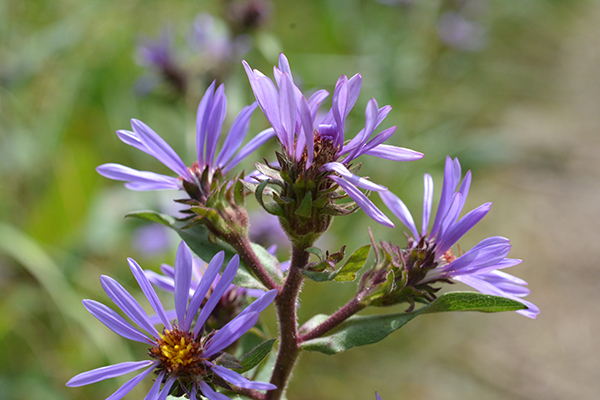
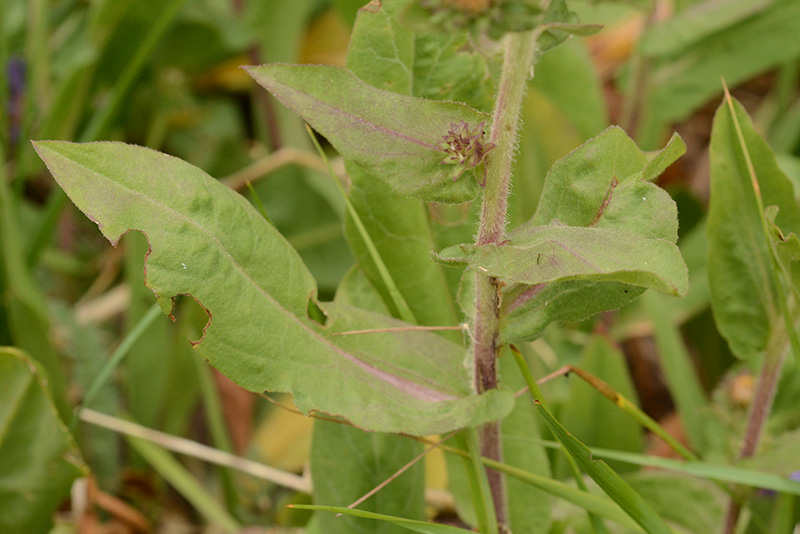
Overall, the plants usually grow 2-3’ tall with the leaves at the base up to 6” long, which become shorter and clasping as they alternate up the stem.
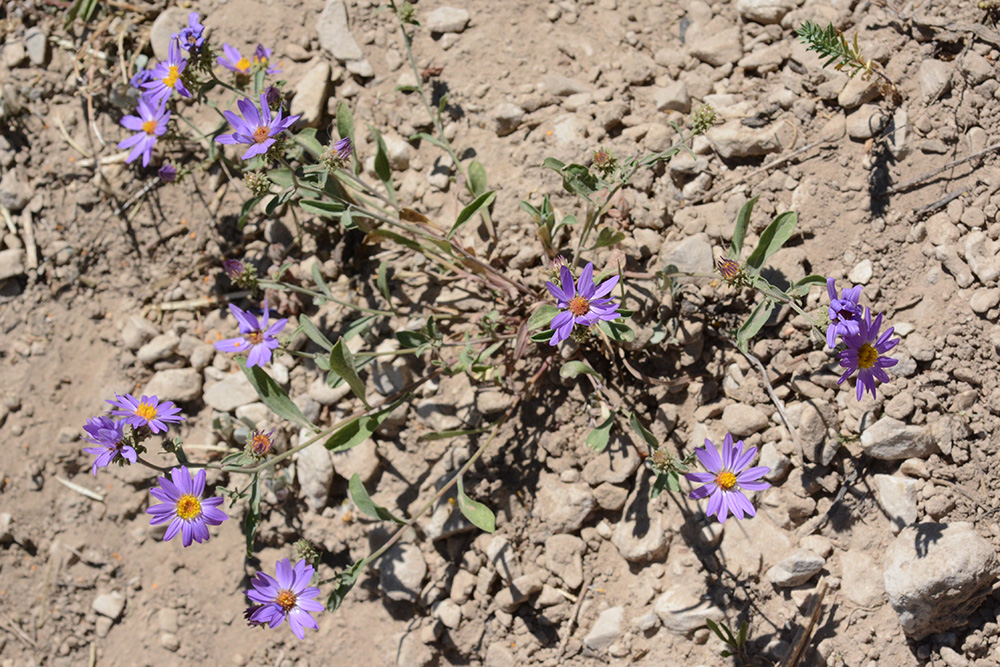
Found scattered in dry sites in the valley or high on Teton Pass grows Hoary TansyasterMachaeranthera canescens

The deep-purple ray flowers accentuate the yellow disc flowers in the center. 

The surrounding bracts are small, stiffly hairy, and curl outwards. The 6-12” stems are wiry with thin leaves often with spiny teeth – (another name is Spiny Aster). 
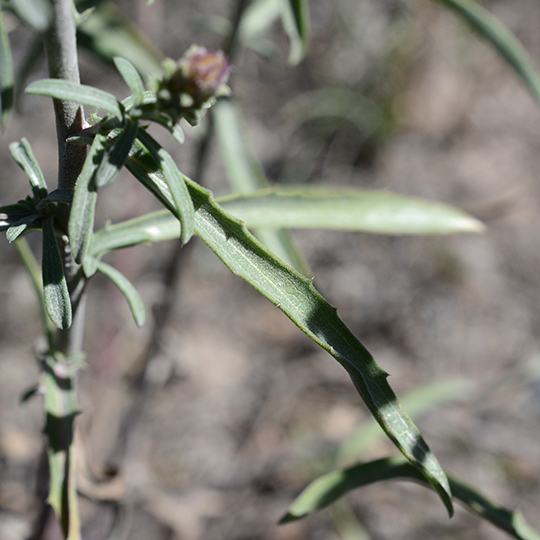
The plants are sticky and fragrant. This rather delicate looking plant is very durable.

Opposite in character and found in moister, higher elevations is the more rambunctious Leafy-bracted Aster – Sympiotrichum foliaceum var. foliaceum

It is a strong grower up to 3 or more feet tall with 8” leaves at the base. Flower heads are blue with many ray flowers. The bracts are foliaceous – like little leaves. 
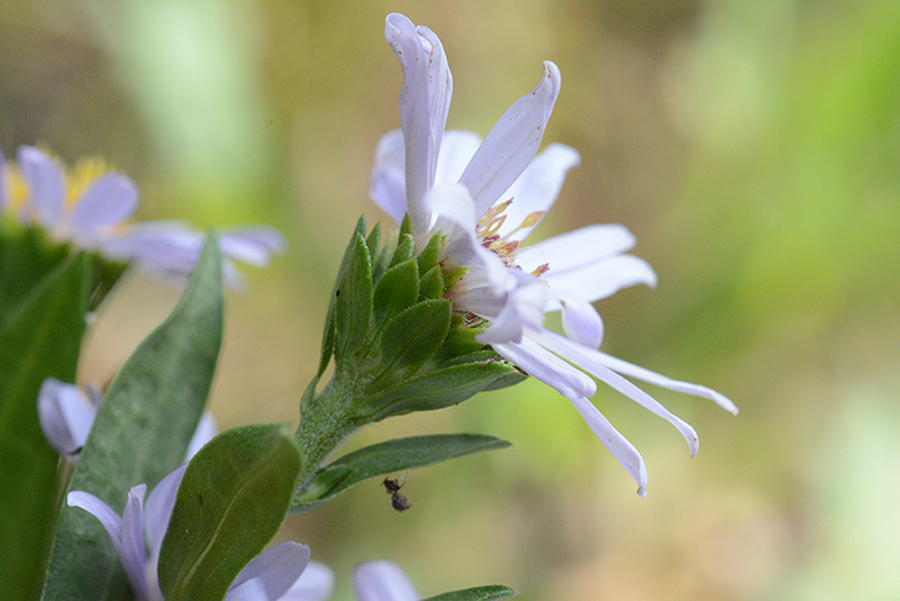
Other lower growing varieties are found at very high elevations.

Speaking of higher elevations, this is usually where I have seen Chaffy Asters. The bracts are “imbricate”, arranged like tidy shingles around the head. They are firm and usually slightly colored as seen here in Engelmann and Elegant Chaffy Asters in the photo. 
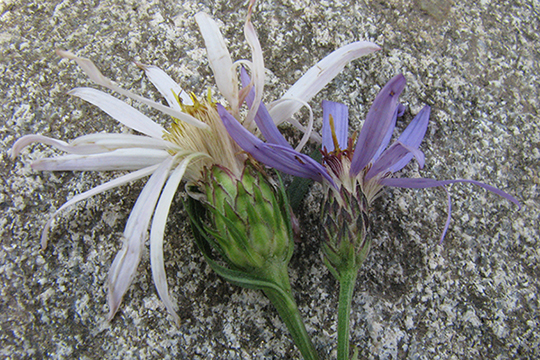
Ray flowers vary in number and depending on species can range from white to blue to violet. The leaves typically remain the same length as they alternate up the stem. You may well have noticed these plants on the trail up to Ski Lake or along the Old Pass Road, or such.

Engelmann’s Chaffy AsterEucephalus engelmannii – has 4-6” leaves alternating up the 4-5’ stems.  Many white flower heads spread out at the summit.  The white ray flowers are relatively few. 

Gray Aster – formerly  Eucephalus glaucus, now in the genus Herricka – has not only white flower heads but also “glaucus” or bluish-gray leaves and stems. 
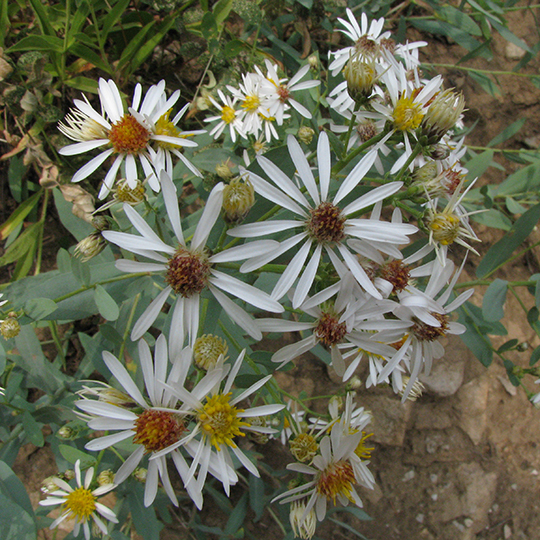
I see it in patches here and there, such as on the Old Pass trail south to Mt. Elly. Curiously, this species has had five botanical names…more than any others I have come across. Clearly the taxonomists are undecided or can I say perhaps confused?

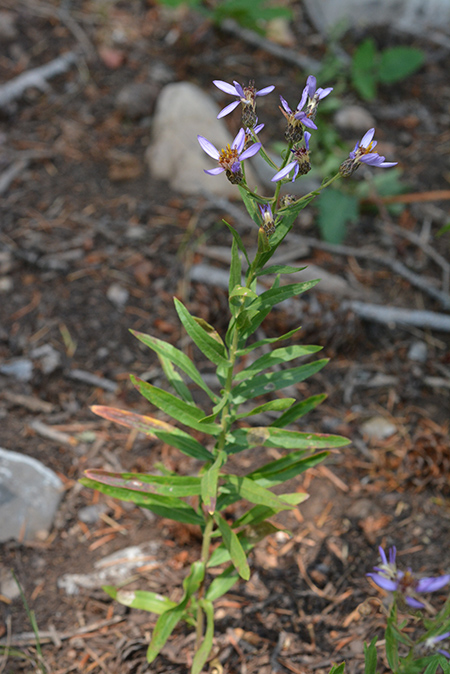
Elegant AsterEucephalus elegans – is indeed the most elegant of the three chaffy asters. The flowers are a deep violet-blue surrounded by a tidy set of imbricate bracts outlined in purple. 
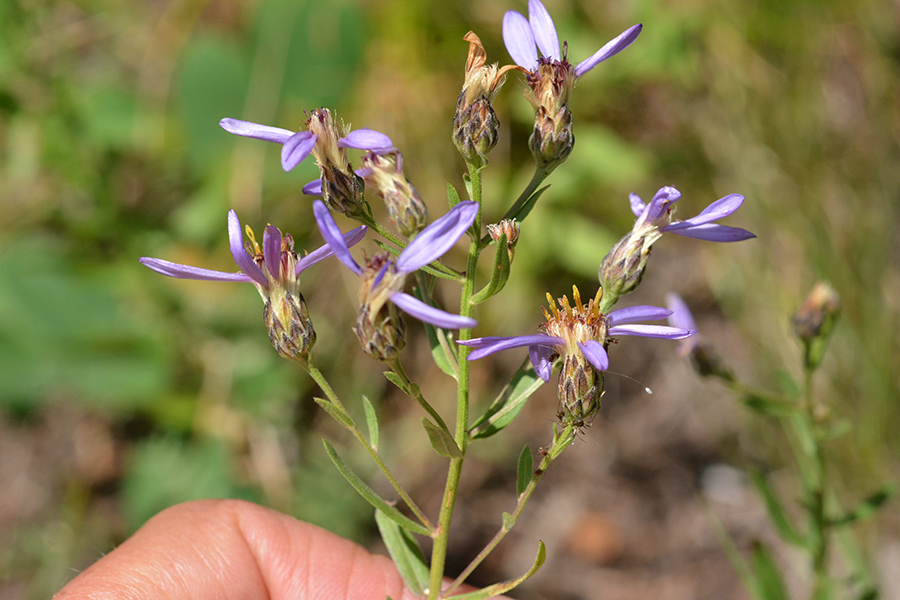
Plants are relatively small in their stature.
In the diagram below you can see both a disc and ray flower. Note that the pistil comes up through the cylinder of 5 anthers with the bilobed stigma.
Shown below in the photo is a disc flower. You can see the closed pistil stretching up through the 5 anthers that face inwards in a circle.  As of the female pistil stretches up through the anther column, the male anthers release their pollen onto the outside of the emerging straight style, where grains become available to pollinators. 

This “plunger” pollination is typical of many composites.

And a dominant shrub:

Mountain Big SagebrushArtemisia tridentata var. vaseyana – is now blooming on Antelope Flats and other sage-dominated habitats.
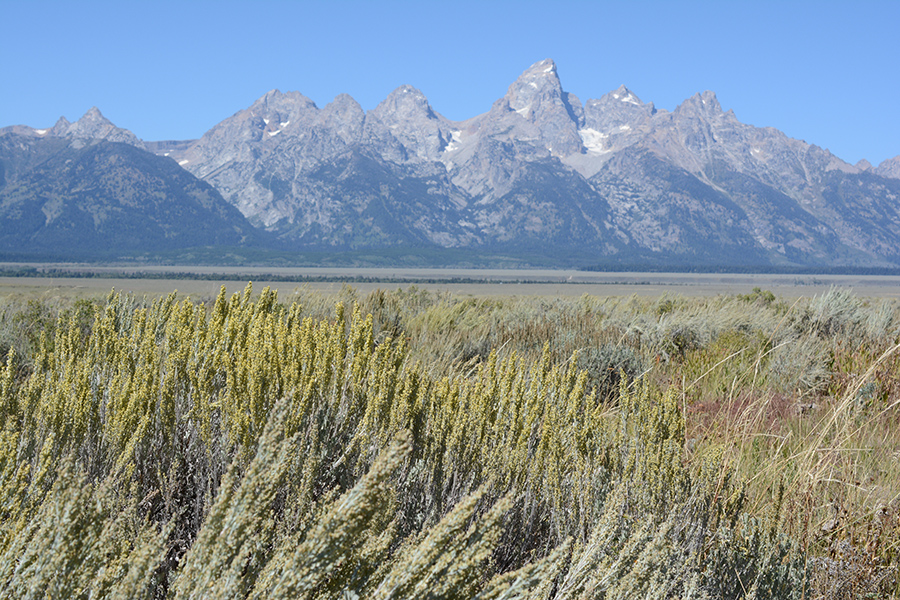
You can see the yellowish spires of the inflorescence waving in the wind. This wind-pollinated plant has light pollen grains that shake out on the wind and can be a big bother to those with allergies.
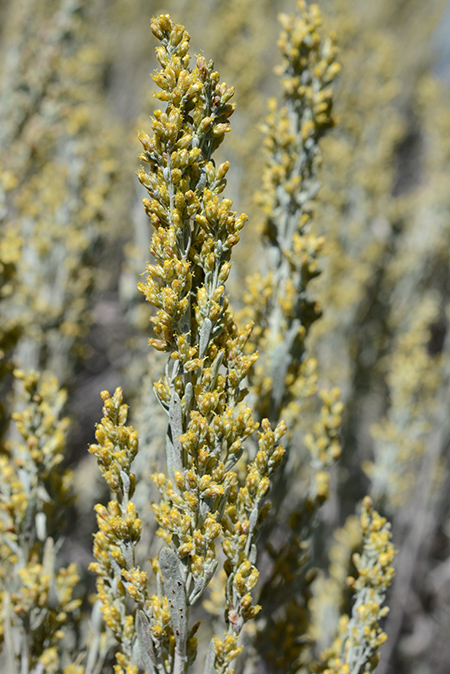
The composite flower heads are tiny and held above the foliage to enable free flow of pollen from one plant to another. 
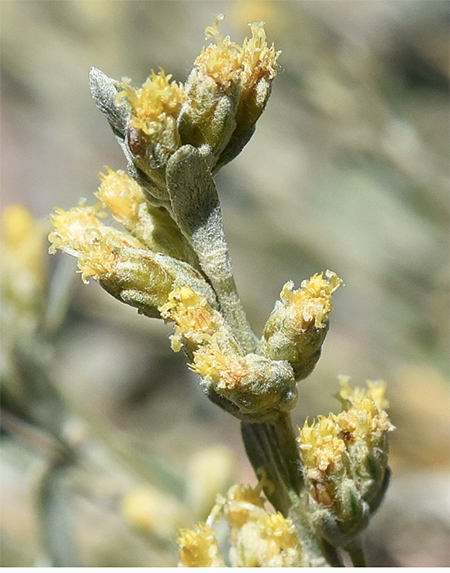
(photo by Bob Sweatt – CalFlora.org)

Flower heads have both male and female flowers. Masses of pollen grains are produced in order to increase the odds of landing on a female flower at some distance. Seeds are tiny and drop off over the fall into the spring.  With a lot of luck, some will germinate in the spring and begin to form adult plants with deep taproots, well adapted to soils saturated briefly from snow melt in spring, and then dry soils throughout summer. Roots may grow 9′ or more to reach sufficient water.  

Despite the plentiful sagebrush seeds, restoration of sagebrush habitat in Grand Teton National Park and elsewhere is a difficult process. Several projects by The Nature Conservancy and GTP continue to experiment with the casting of seed or planting small plants (plugs) to reestablish these essential habitats.

And one final plant not to overlook:

HarebellsCampanula rotundifolia – are remarkably sturdy for such small, delicate-looking plants. 

The lowest leaves are roundish, the stem leaves are about 1 – 1 1/2″ long and very narrow – a rare shape shift for a plant. The bell-like flowers have a story about anthers and pistils. 
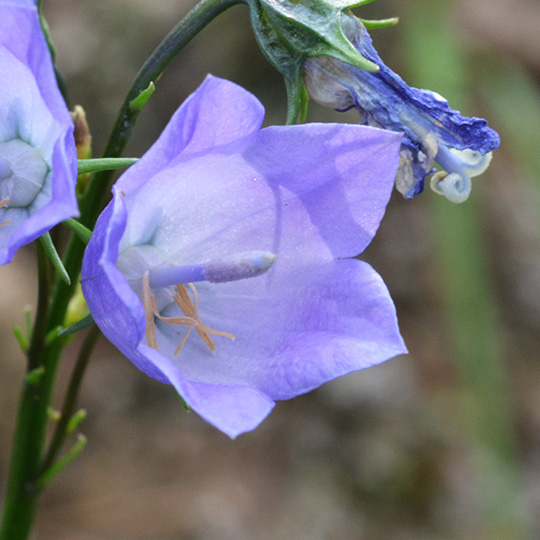
By the time flower opens, the male anthers have released their pollen onto the extending style.  One can see this with a 10x handlens.  You can see the brown withered anthers at the base of the pistil. The pistil continues to stretch and the stigma opens into three parts. If a pollinator doesn’t come by and gather the pollen, the flower can self-fertilize: the stigmas curl back and reach the grains from the same flower.

Harebells will continue to bloom into the end of fall.
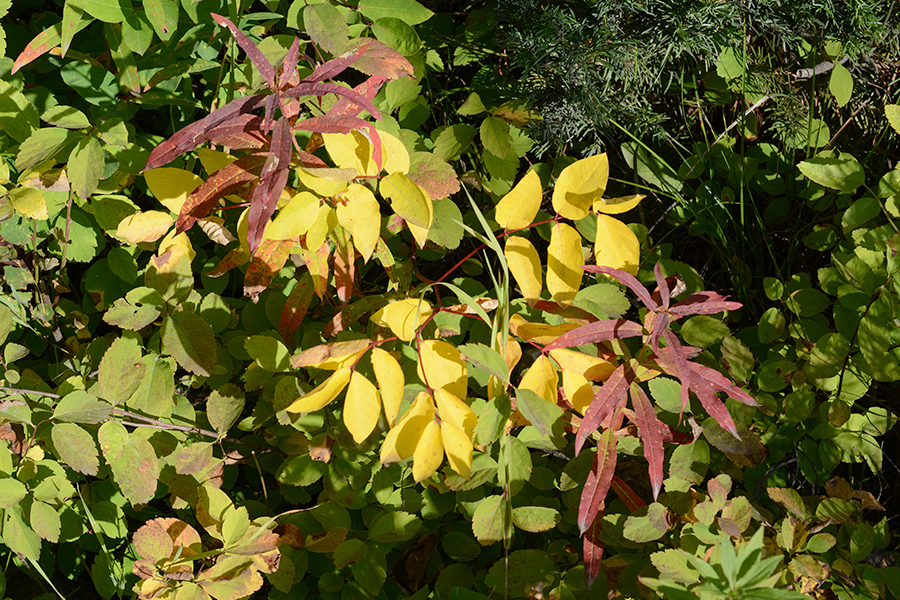
Flowers are fading, but leaves are changing color and fruits are forming and being gobbled by birds, small mammals, and bears! Autumn will become ever more bountiful and colorful as the days become shorter.

Enjoy!

Frances Clark, Wilson, WY

Sept 1, 2023
What’s in Bloom in the Sunny Sites – Early July

This posting complements one of June 20 on Sagebrush Flats.  Several of the plants listed there are still blooming, such as spectacular stands of deep-yellow Mule’s-ears, wands of Scarlet Gilia, bunches of Silky Lupines, and occasional False Dandelions along with more plentiful Congested Sandworts.  It all depends on location: elevation, aspect, and soils.

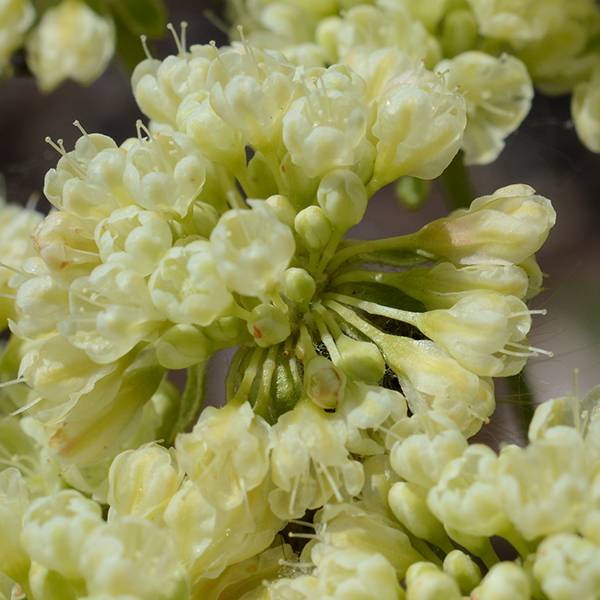
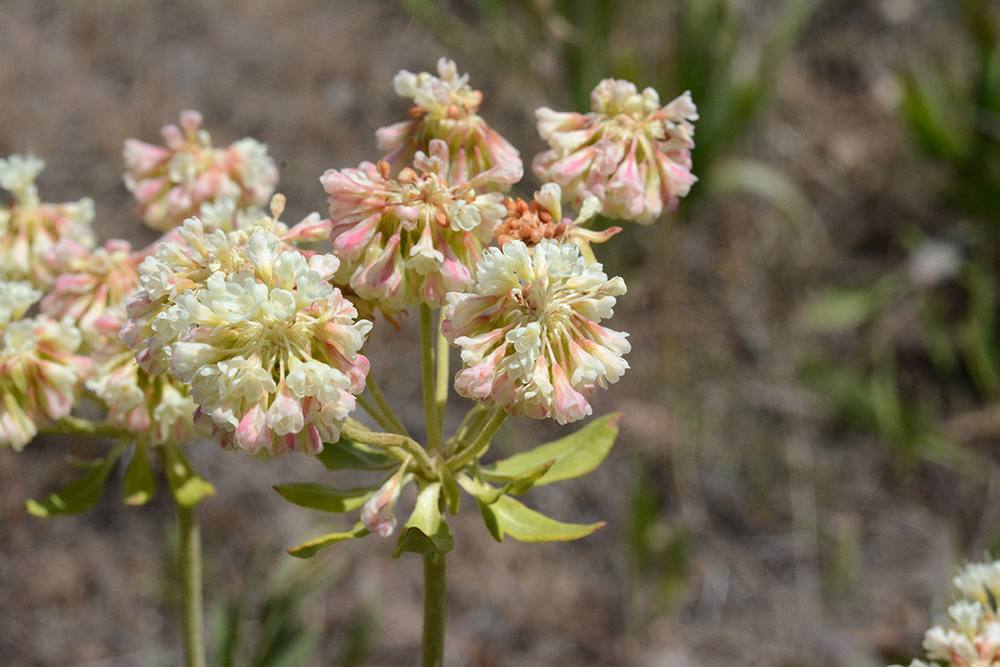
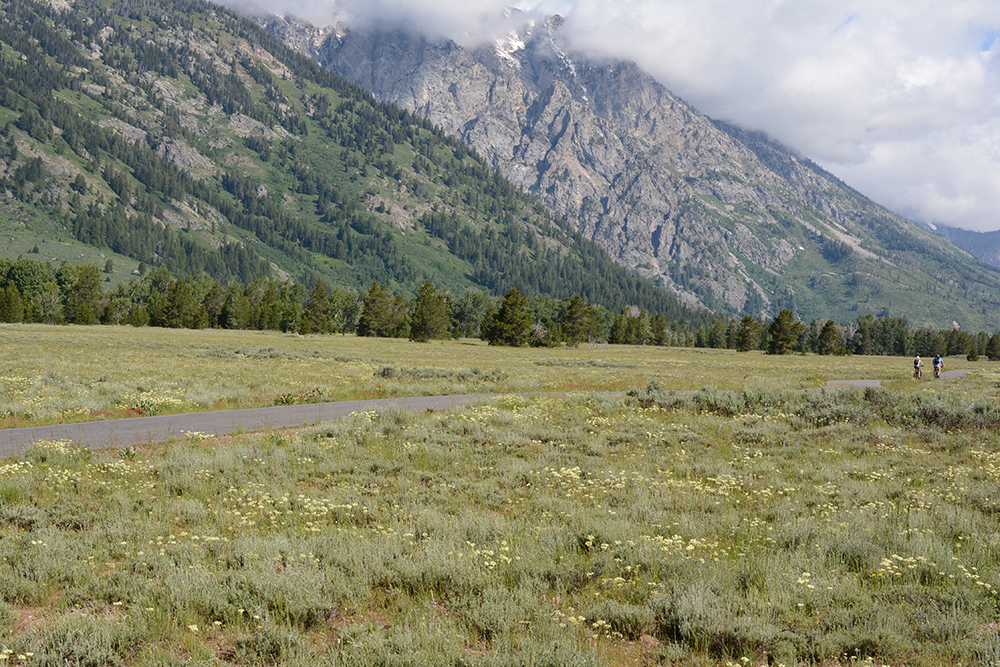
At the time of this posting, the most abundant species of the sageflats and sunny sites elsewhere appears to be Sulphur BuckwheatEriogonum umbellatum.

Their sulphur yellow flowers flowers are held in clusters surrounded by a whorl of bracts.

The small leaves form mats beneath.

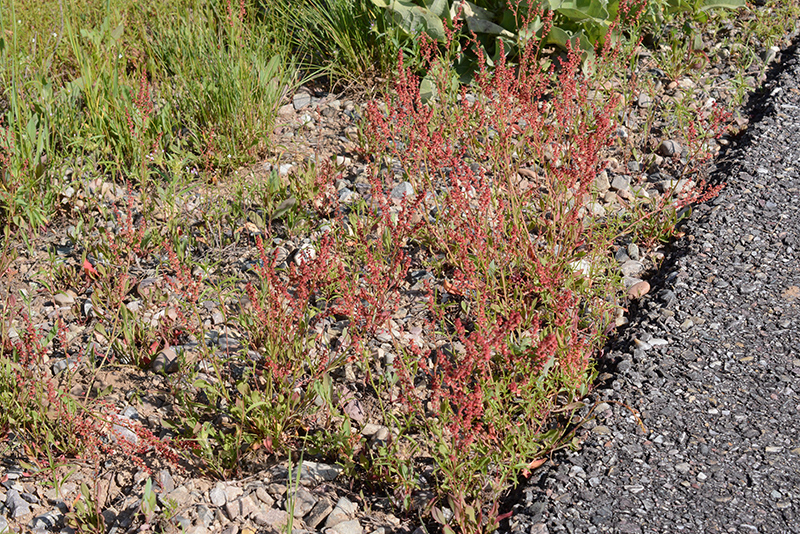
Scattered in betweenon disturbed ground, such as along the pathway in the park, are drifts of a weedy, reddish annual – Common Sheep SorrelRumex acetosella. The seeds will be relished by many small birds and mammals. And these pioneering annuals help to retain soil and add nutrients and organic matter to the site, paving the way for slower establishing perennials.

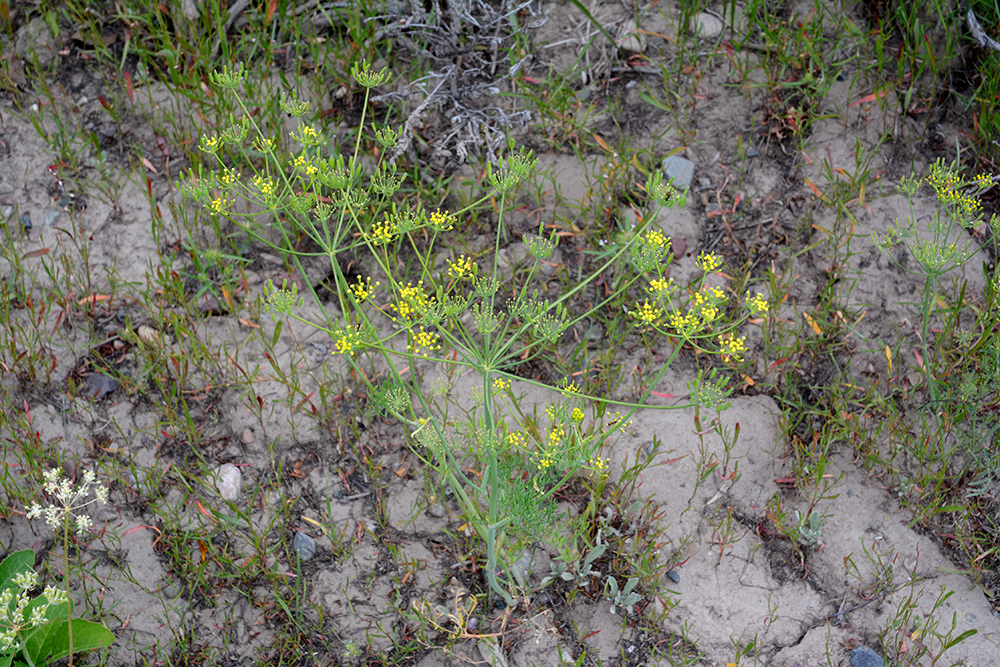
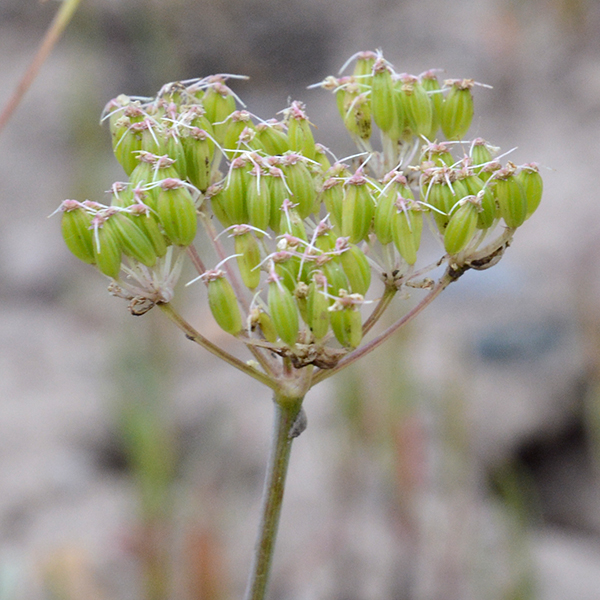
Notably, Ambiguous Spring Parsley featured in the May bloom posting is still on the scene, albeit with fewer flowers and more fruits. It is noticeable also along the inner park road edges and road cuts or other disturbed areas.

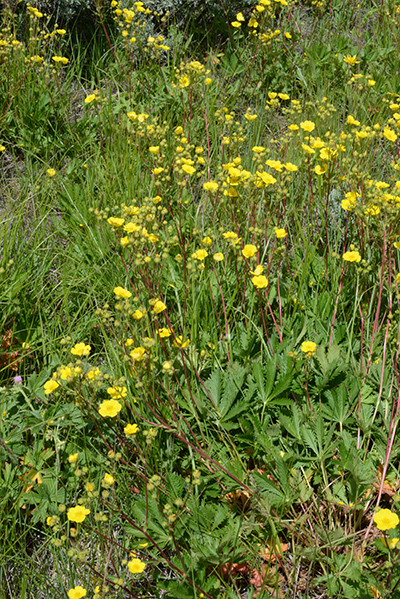
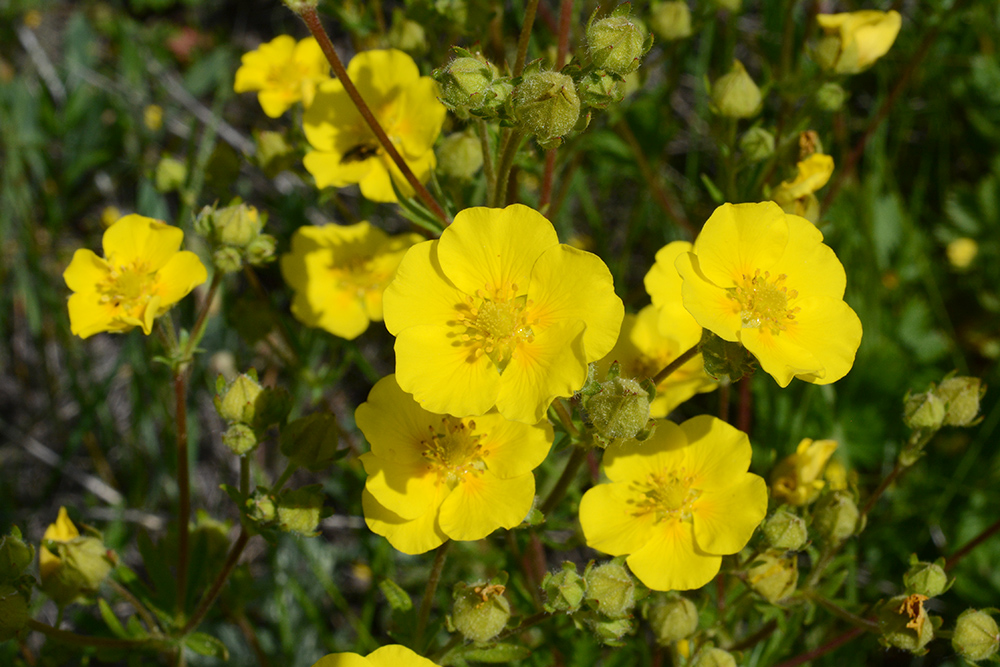
CinquefoilsDrymocallis/Potentilla – have appeared cheerfully on the scene. Potentillas, now called Drymocallis, have 5 pointed, green sepals; 5 yellow, roundish petals; many anthers; and many, many pistils set on a cone-shaped receptacle in the center. Leaves are either palmately or pinnately compound.

Slender or Graceful CinquefoilDrymocallis/Potentilla gracilis – holds out stems with bright  yellow flowers. Each petal is marked with a dash of orange at the base.

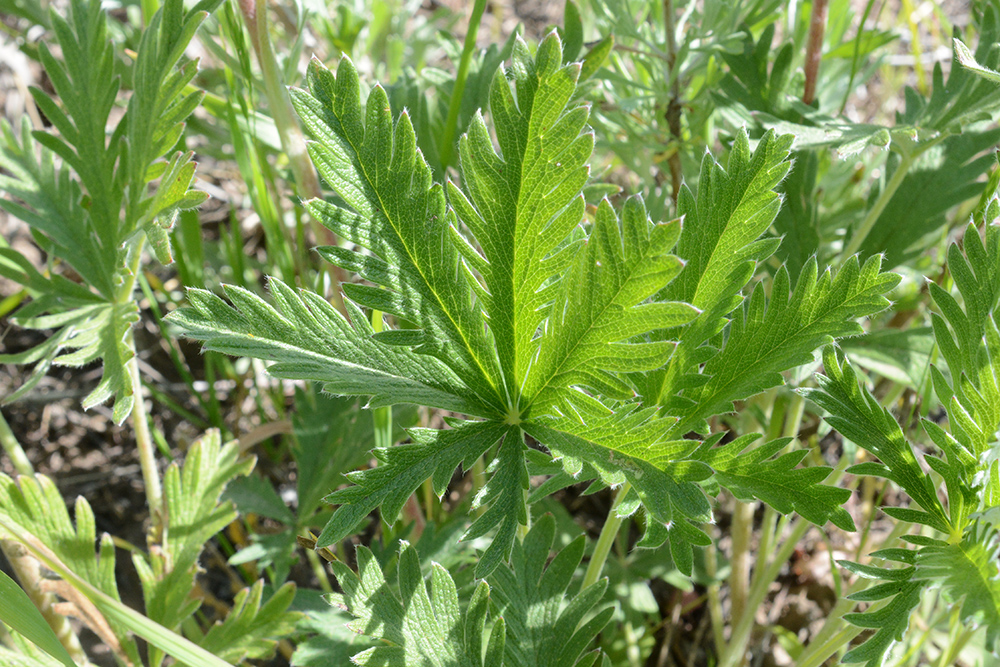
Palmately divided leaves have 5-7 lobes and are toothed. 

Within the species are at least two subspecies we won’t worry about at the moment.

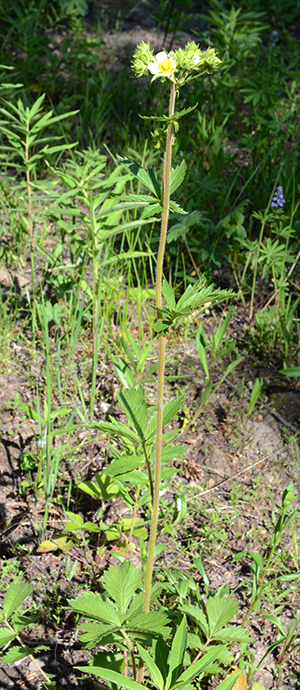
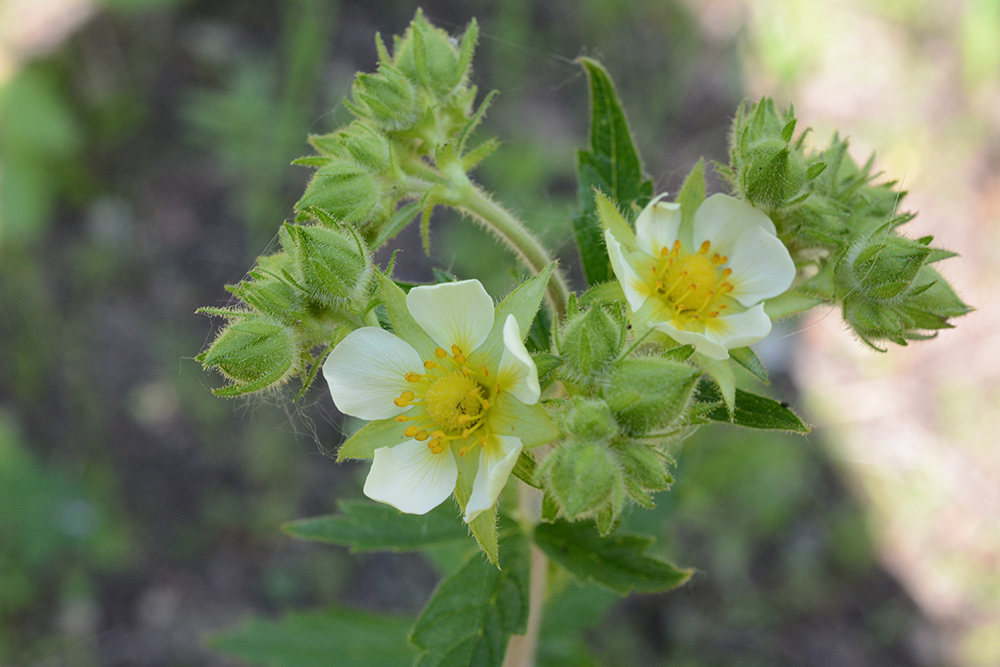
Tall CinquefoilDrymocallis arguta – is 2-3’ tall with pinnately divided leaves.

Flowers are pale yellow to whitish and are held up at acute angles to the stem in tight clusters – like fists. 

Therefore, I think of argu-mentative to define this arrangement, which may help to remember is as  D. argu-ta. The plants are very sticky or glandular on stems and sepals.

Our state flower, Wyoming paintbrushCastilleja linariifolia is just arriving on the scene.

The lean, long green galea extends beyond the orange-red sepals on 2-2.5’ stems.

Leaves are also divided into linear lobes. I think of the lean cowboys of Wyoming.

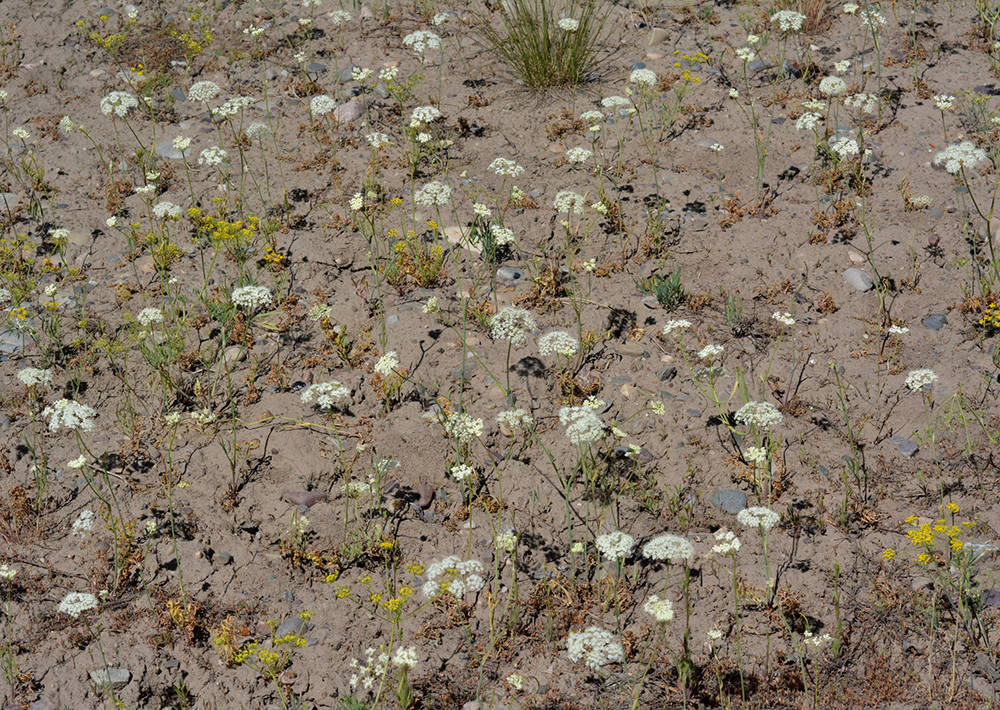
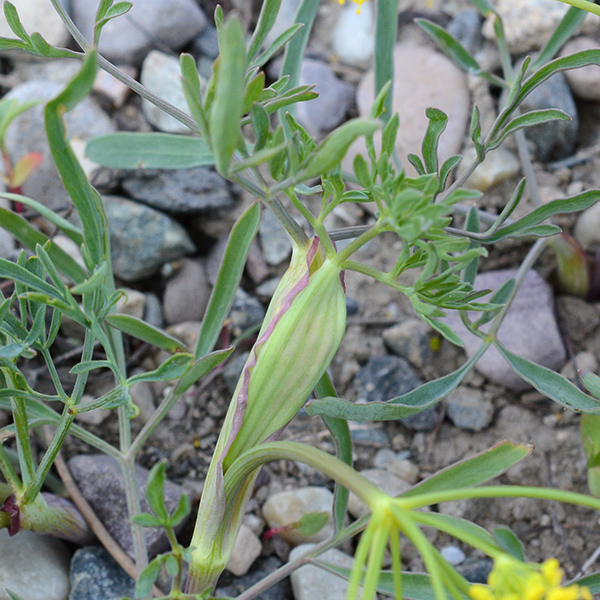
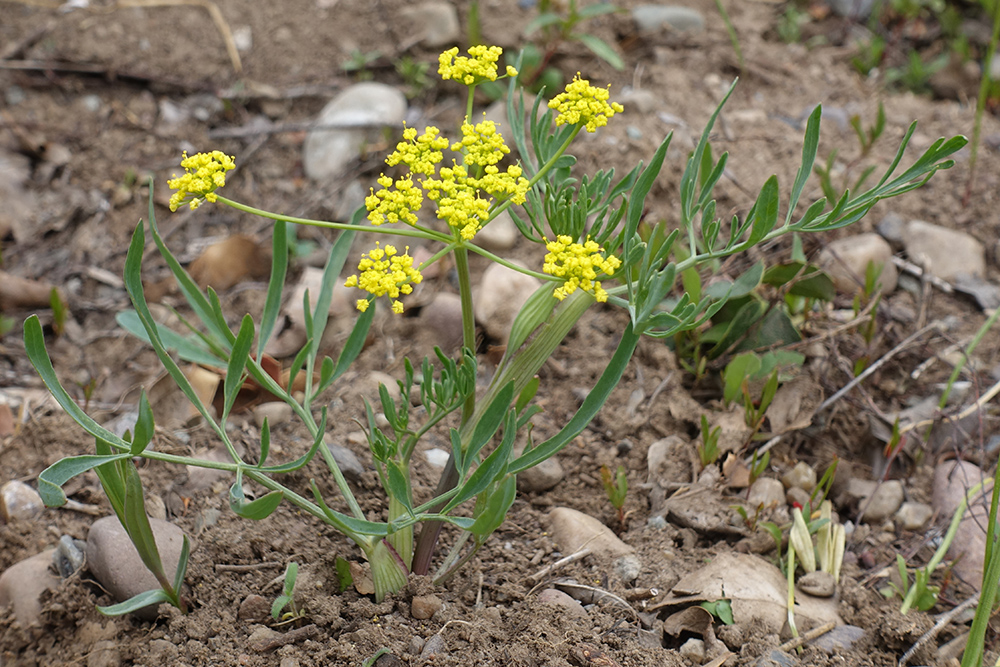
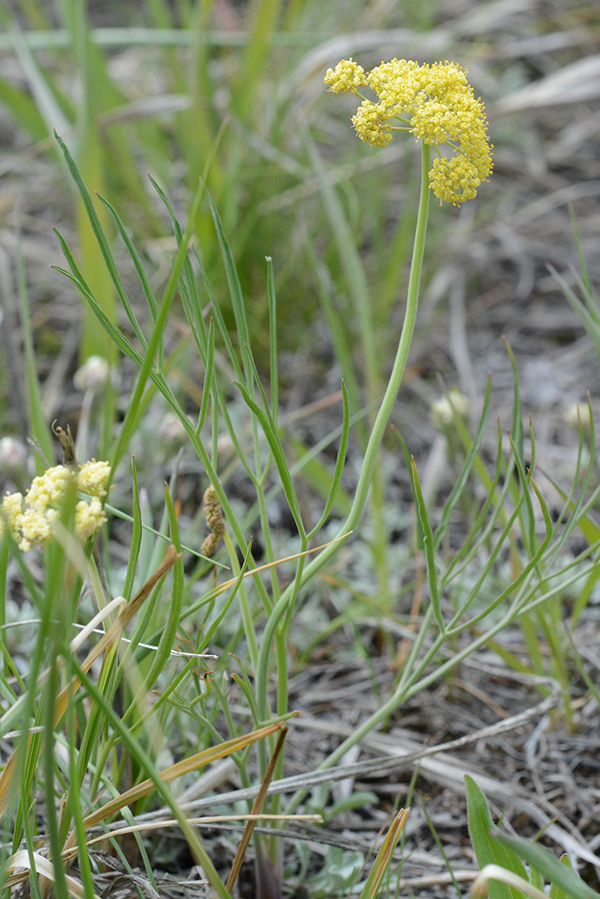
Notable is the Yampah species found only in Teton County in Wyoming – Bolander’s Yampah Perideridia bolanderi. 

It is flourishing along the very north end of the Moose-Wilson Road.

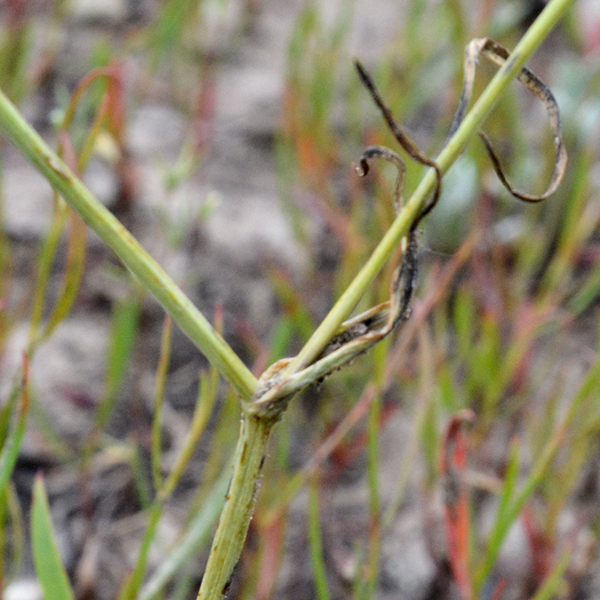
It tends to bloom earlier than the common Yampah – Perideridia gardnerii/montana. Petioles of the leaves are dilated (expanded) where they meet the stem. The leaflets are variable.

The fruits (schizocarps) will be oblong (vs more rounded).

Some rarer species:

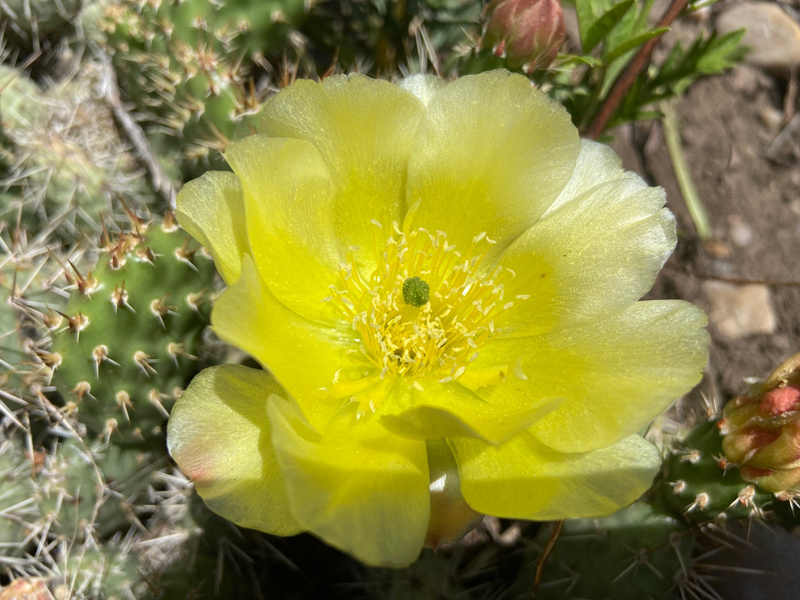
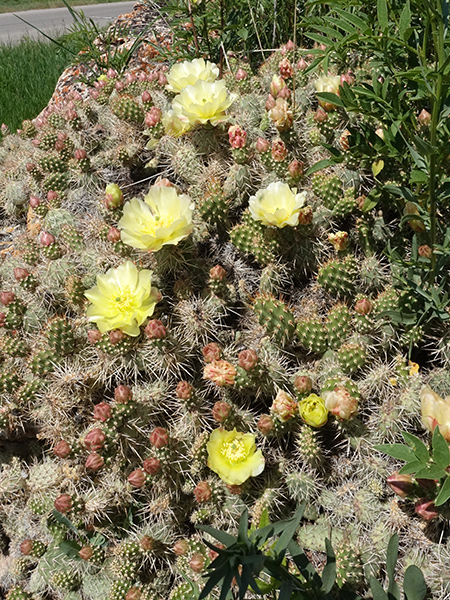
Brittle Prickly Pear CactusOpuntia fragilis – is blooming on rocks at Kelly Warm Springs. 

Watch out!  The spines attach readily to boot, fur, or you.  You can see that the plants are migrating up hill, likely spread by roving wildlife or tourists.

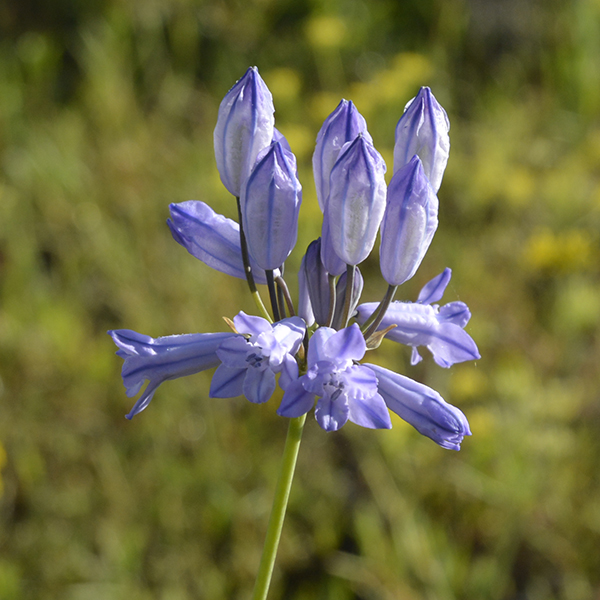
Some folks have been finding the tapered blue flowers of Wild HyacinthTritelia grandiflora

These elegant blue vase-like flowers are held up on 18” stems which grow from bulbs. They are on the very eastern edge of their range here in western Wyoming. They are in the Lily Family.

Also in the Lily Family, but very different looking are Sego LiliesCalochortus nuttallii.  They sprout from bulbs on very dry slopes. We witnessed flowers being visited by what appeared to be flying ants. 

Not sure if they were actual pollinators. Sego lily bulbs have been a traditional food of several Native American groups, and this vital food was introduced by local tribes to the Mormons as a survival food.  As a consequence, Sego Lily it is the state flower of Utah.  (USDA)

New yellow composites:  There are always more composites to identify!

One-flowered Little-sunflowersHelianthella uniflora – are abundant on slightly more moist sites in sageflats, up hillsides, and under dabbled shade of aspen groves.

The flowers are held up singly and the leaves have 1-3 visible veins.

Tapertip HawksbeardsCrepis acuminata – are showing up here and there.

We have several different hawksbeards. This one has many (approx. 40) flower heads on a branching stem, each with about 5-12 ray flowers

all surrounded by about 5-8 smooth bracts. 

The stems and leaves are also essentially smooth. The leaves are about 6” long, mostly basal.  Their shape is distinctive with long-tapering tip and deeply incised, pointed lobes. 

Ragworts/GroundselsPackera streptanthifolia – is one of three confusing relatively low growing groundsels. ID is based primarily on the highly variable leaves.

This species has tidy yellow flower heads with a few ray flowers with equal-length, smooth bracts, often tipped in black.

Their stem leaves are variably lobed and can slightly clasp the stem.

Most of the truly basal leaves are rounded and taper to the petiole. (Look around carefully for these…in this photo they are upper right corner).  

Woolly SunflowerEriophyllum lanatum – grows only about 8” tall. 

The broad, even-length bracts are slightly pointed and covered in fine white hairs.

The stems are also tomentose and the 2” linear leaves slightly less so.

You can notice the slight variation in color of the ray flowers: lighter yellow at the tips grading to a darker almost orange shade toward the base, likely forming a very noticeable “bull’s-eye” to pollinators with ultra-violet vision.

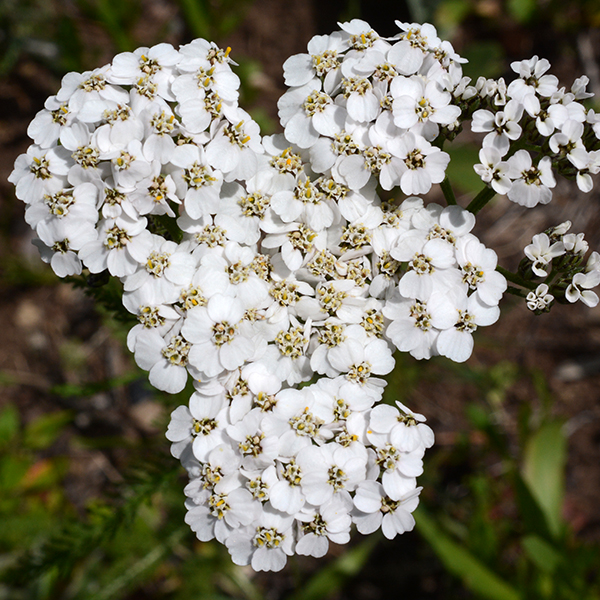
Harder to recognize as a composite is Common YarrowAchillea millefolium.  The species is found with many variations in chromosome numbers throughout much of North America, Europe, and Asia in relatively dry, lean soils. The composite flower heads consist about 3-5 small, white ray flowers and several disc flowers.

The feathery-looking leaves are finely dissected and very fragrant. Plants spread by rhizomes and can form dense colonies.

For thousands of years this chemically complex species has been used for medicinal purposes. It is named after Achilles of Greek mythology who is said to have used it to aid his wounded soldiers. This robust plant has been selected for colorful cultivars for gardens and can be considered quite aggressive. Needless to say, such a widespread species is also important for all sorts of insect pollinators.

Flowers mostly of meadows to dappled shade of Aspen groves.

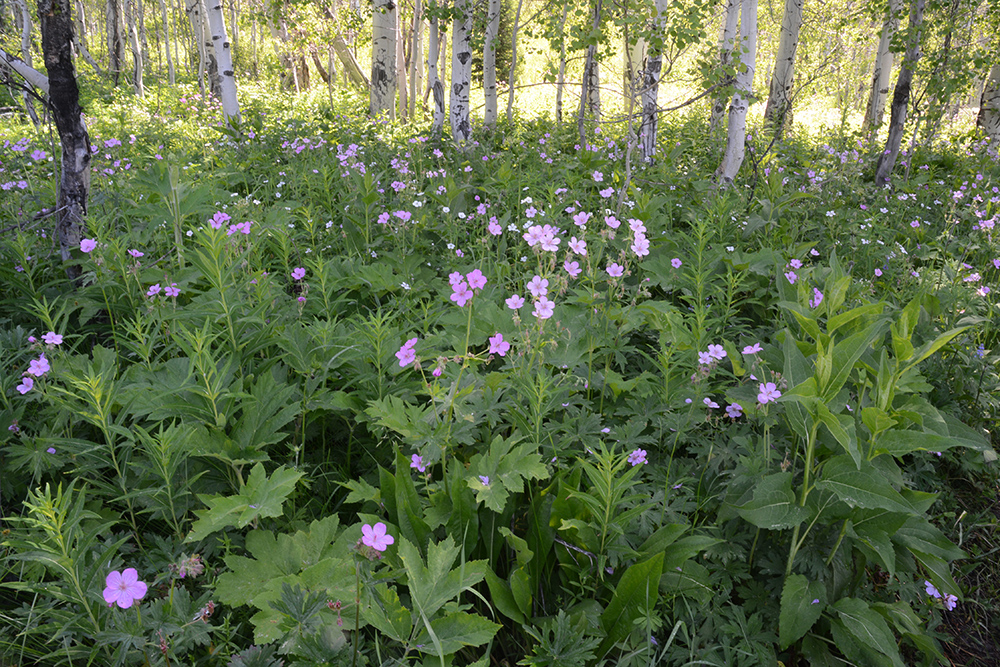
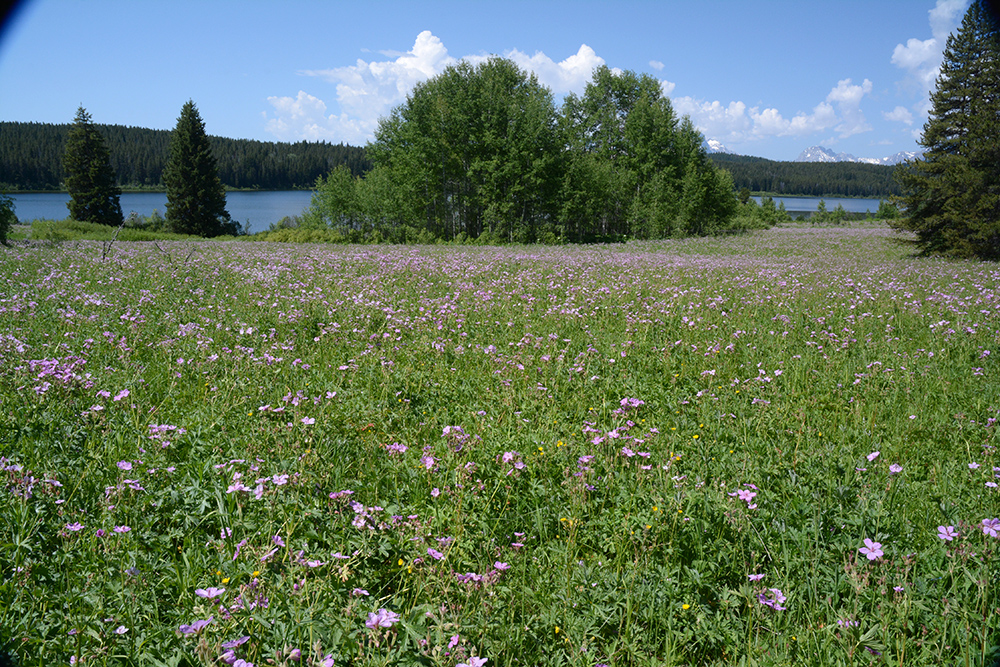
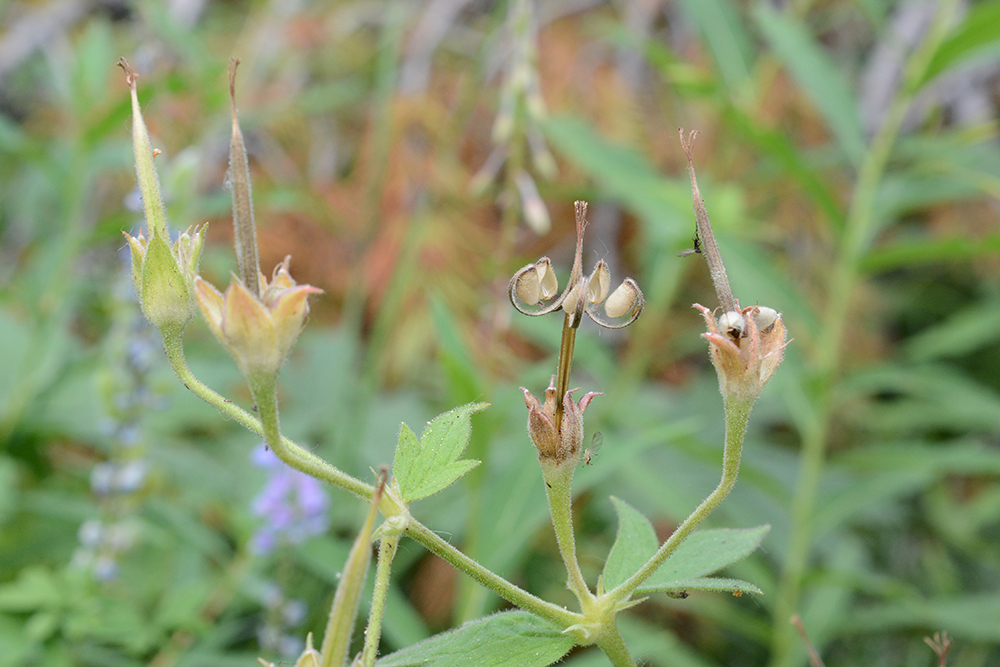
Profusions of Sticky GeraniumsGeranium viscossissimum – cover many areas. Watch as the flowers begin to form their fruits that will catapult the seeds onto new ground. 

Five-nerved Little-sunflowersHelianthella quinquenervis – are particularly robust 5-6’ tall in relatively moist meadow sites.

Look for the 5 obvious nerves or veins on their larger lower leaves for ID.

The large heads tend to glare right at you. Later the seeds will be plucked out by pine siskins and goldfinches.

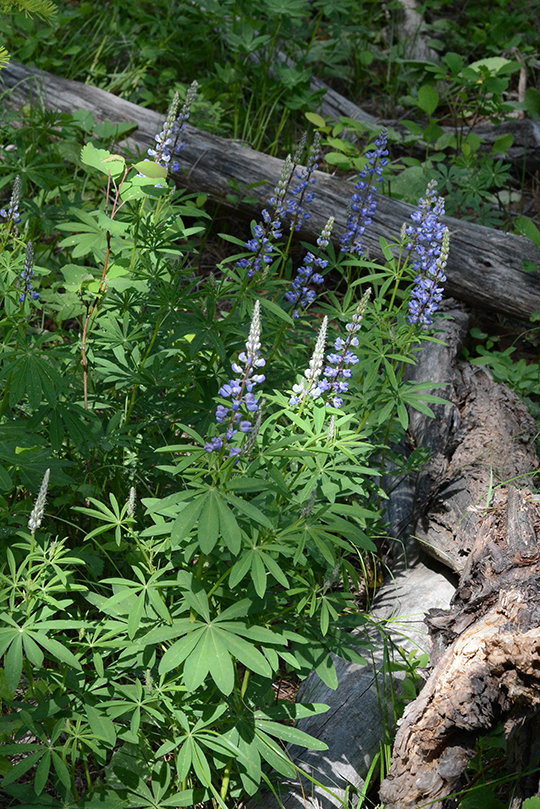
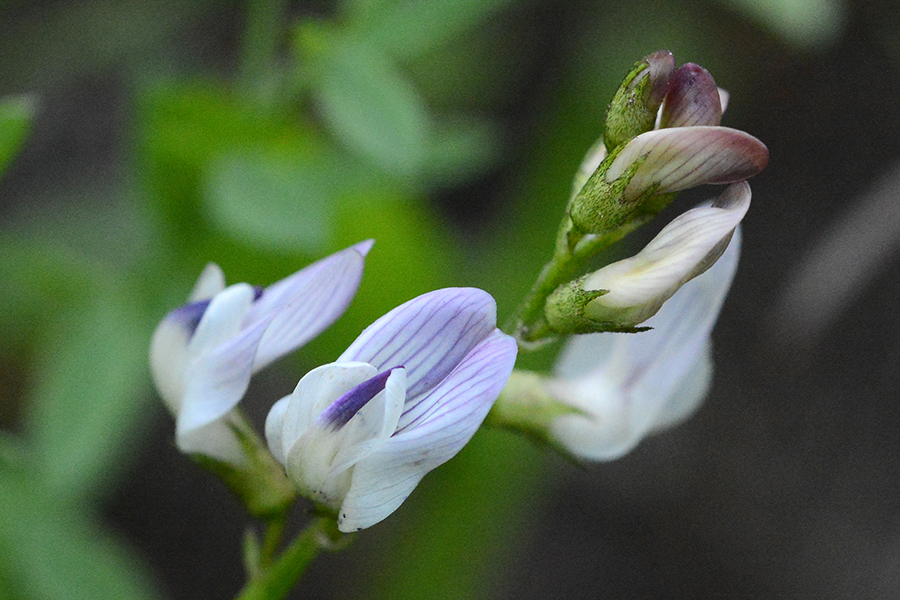
Silvery Lupines  – Lupinus argenteus – also grow on open slopes or in part shade, or even in the dense shade of lodgepole pine forests. 

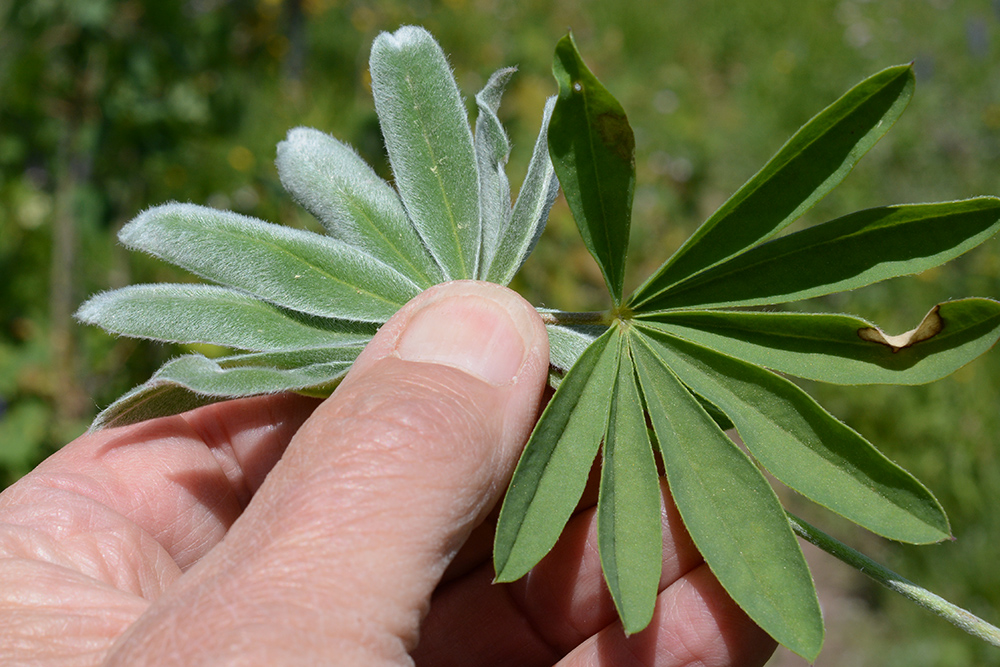
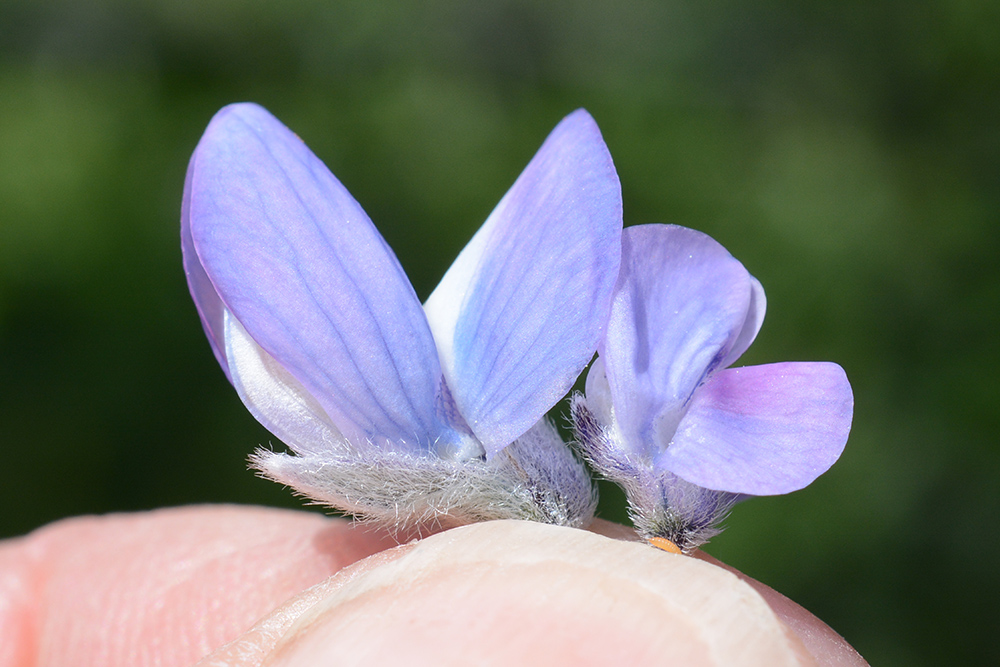
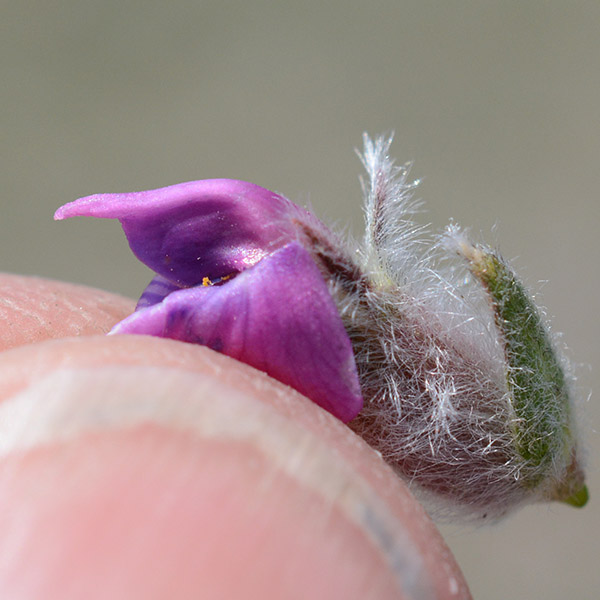
To distinguish it from its dry-habitat cousin Silky Lupine –  L. sericeus, note the palmate leaves are greener, less hairy (Silky on left,Silvery Lupine on right);

The silvery lupine flowers are smaller, more compact, usually darker,and without silky hairs on the back of the banner.

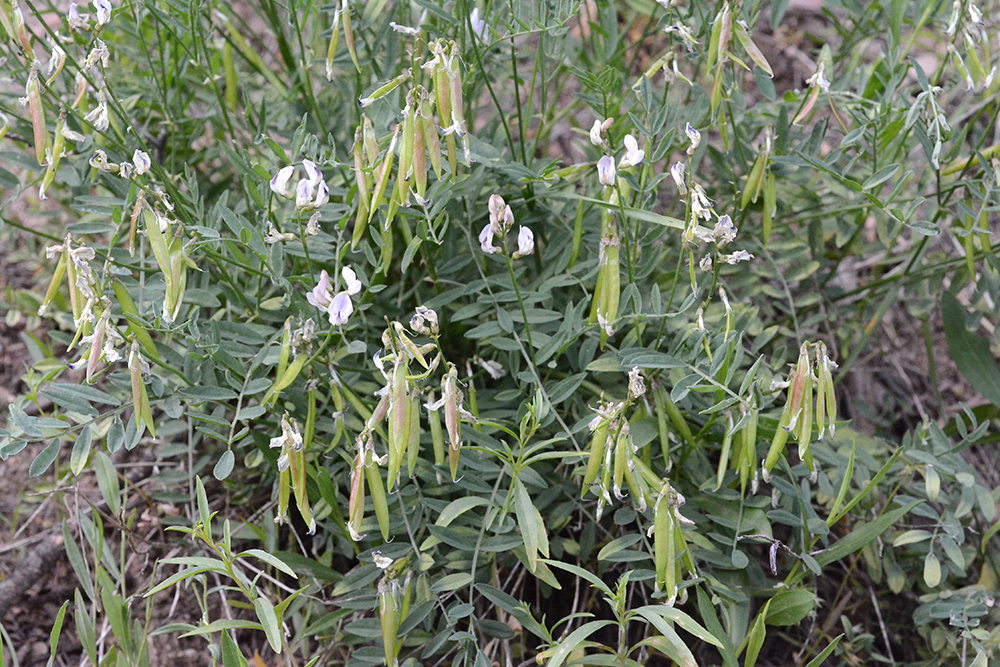
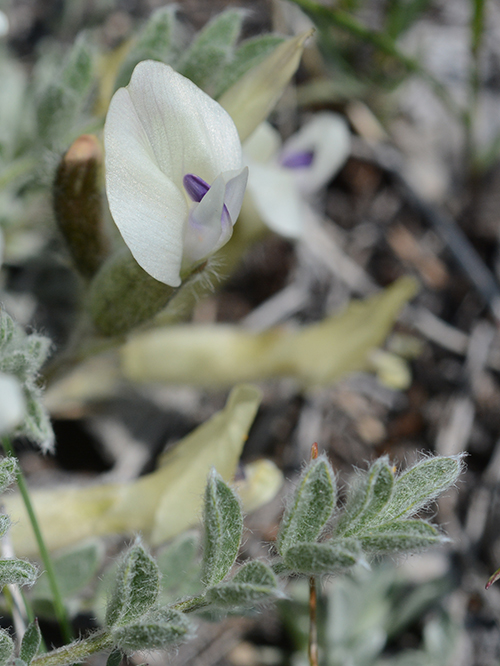
Timber MilkvetchesAstragalus miser – form mostly inconspicuous patches about a 1’ high and wide. The leaves are finely pinnately compound.

The small, pale white-to-bluish pea-like flowers are already producing small pods.

There are many species of of milkvetches – this is one of the most common in these habitats. Remember, milkvetches are toxic to many animals.

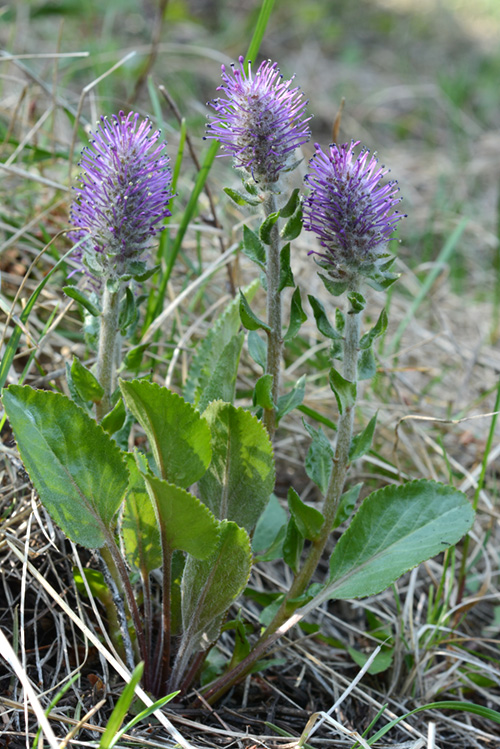
Fernleaf LousewortsPedicularis bracteosa – are flowering and fast fading in the light shade of Aspen groves or nearby hillsides, but they will soon be common in high meadows such as on the way to Ski Lake.

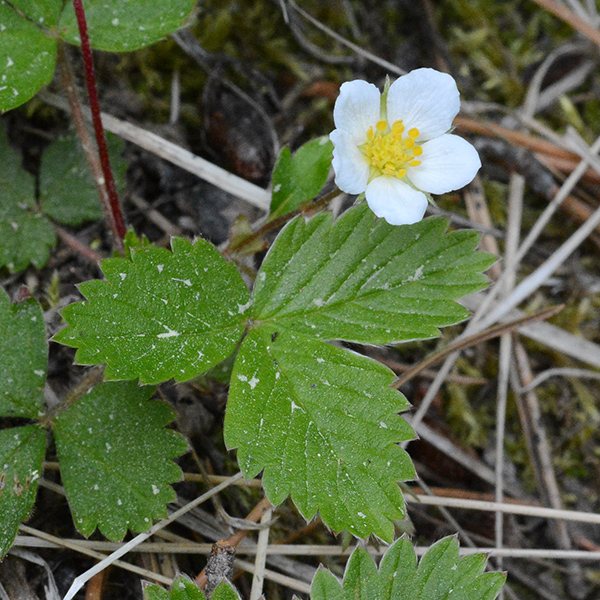
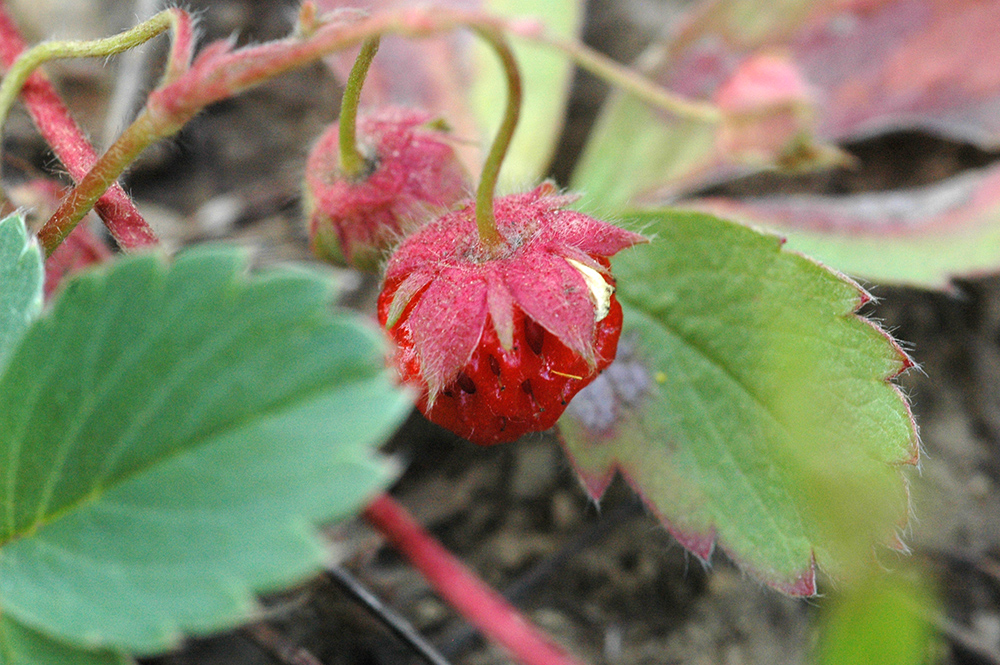
Wild strawberries creep into the verges of fields and forests.  They have 3-parted leaves, white 5-petaled flowers with many anthers and pistils. Brown seed-like fruits (achenes) lie on the outside of the swollen red receptacle—forming what we call the “berry”.  Note birds and small mammals may gobble delicious fruits before you see them. Plants spread by stolons: creeping stems over the ground.

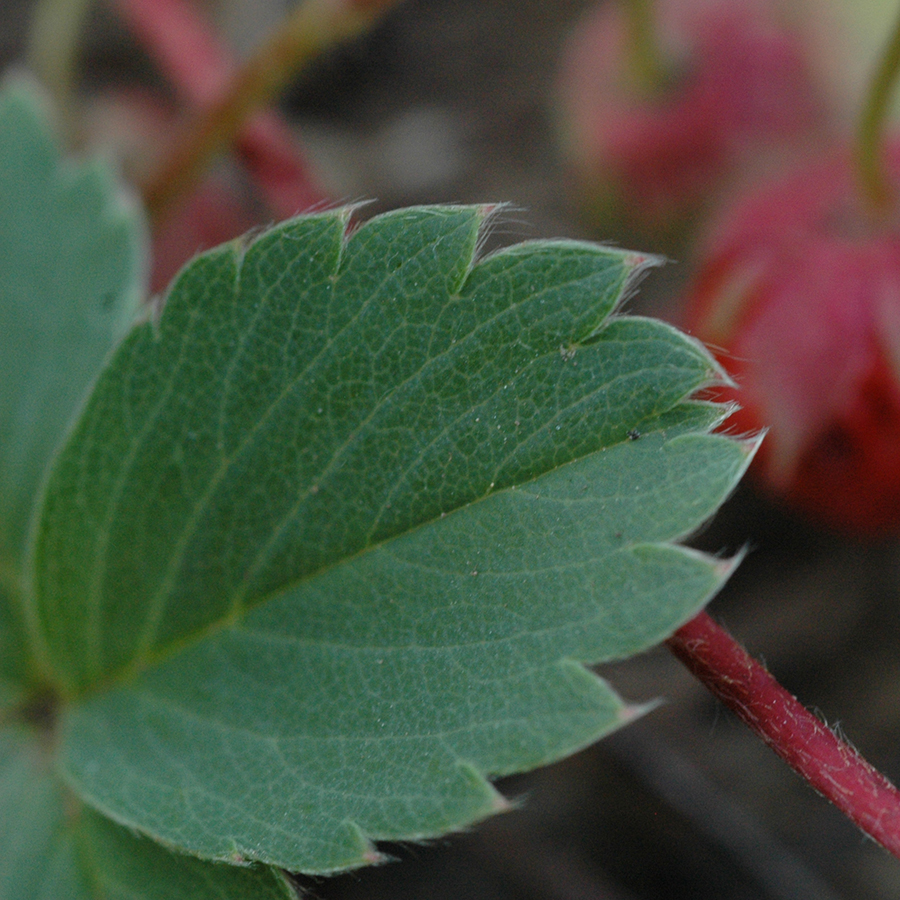
Woodland Strawberry – Fragaria vesca – has leaves with obvious incised veins and are nearly hairless on the surface, but shaggy underneath.  The terminal tooth is usually longer than or equal to the adjacent two teeth.

The fruits lie on the surface of the receptacle, similar to our typical domestic strawberry. Flower stems are usually longer than the leaves. (Fruit photo from unknown source on web)

Common StrawberryFragaria virginiana – has 3-parted hairy leaves with the terminal teeth usually shorter than the two side teeth.

The leaves can have a blue-ish cast to them.  Plants tend to be hairier overall than Woodland Strawberries. The best way to ID them for sure is the fruits are embedded in the red flesh of the receptacle.

This species is one of the parents of the cultivated strawberries found in supermarkets.

Great Red paintbrushCastilleja miniata – is the third red paintbrush seen so far this year. The flower clusters are held at the top of 12″ plus stems and the bracts and calyx tubes are toothed to lobed and surround the more-or-less green galea or petal-tube. The leaves are simple. 

This resembles and is often confused with a higher elevation (sub-alpine) species Rosy Paintbrush – C. rhexifolia.

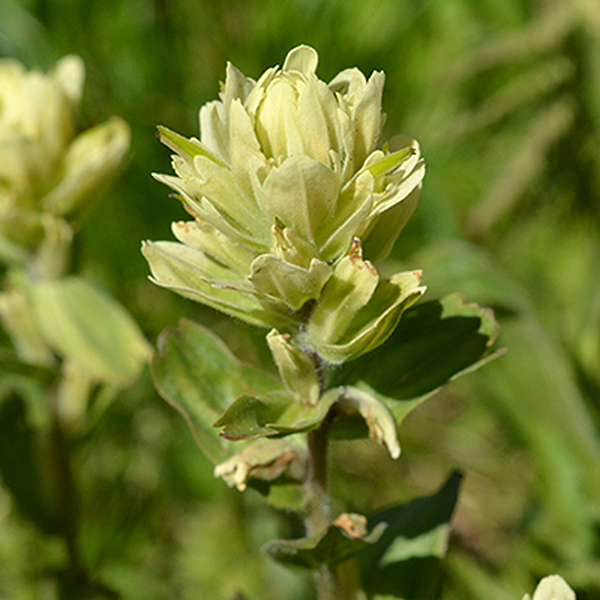
Sulphur PaintbrushCastilleja sulphurea – flowers are also clustered at the top of approx. 18″ stems. They have pale-yellow, broad, rounded bracts and rounded, toothed sepals.

Paintbrushes are notoriously difficult to ID as they can hybridize, self-fertilize, and generally muddle their chromosomes. Therefore bract and sepal shapes, sizes, and colors can range widely in appearance.

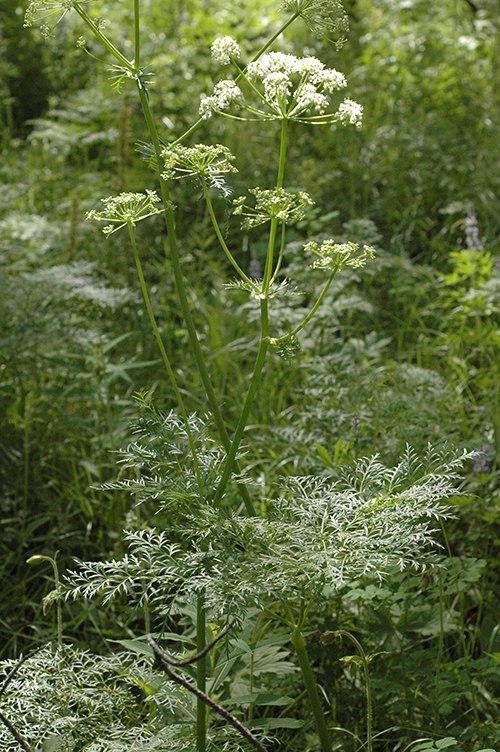
Fernleaf-Licorice Root – or Northern Osha – Ligusticum filicinum – is a new member of the Carrot Family appearing on the scene with its delicate domes of many fine umbels of white flowers that stand above finely dissected carrot-like leaves. (They are related to carrots). 

The root beneath the 3-4’ plants is thick and fragrant.  These plants and close relatives have been used by tribal groups for thousands of years for various medicinal purposes.  An interesting reference. regarding its use is provided by Ben Clark formerly of Wilson. 

Tall meadows are growing into their full splendor along the bumpy dirt road to Two-Ocean Lake in the Park. They include several of the flowers mentioned above: Sticky Geraniums, Five-nerved Sunflowers, Silvery Lupines,  and Northern Osha. 

Hard to Miss – Green Gentian or Monuments Plants! – Their story…

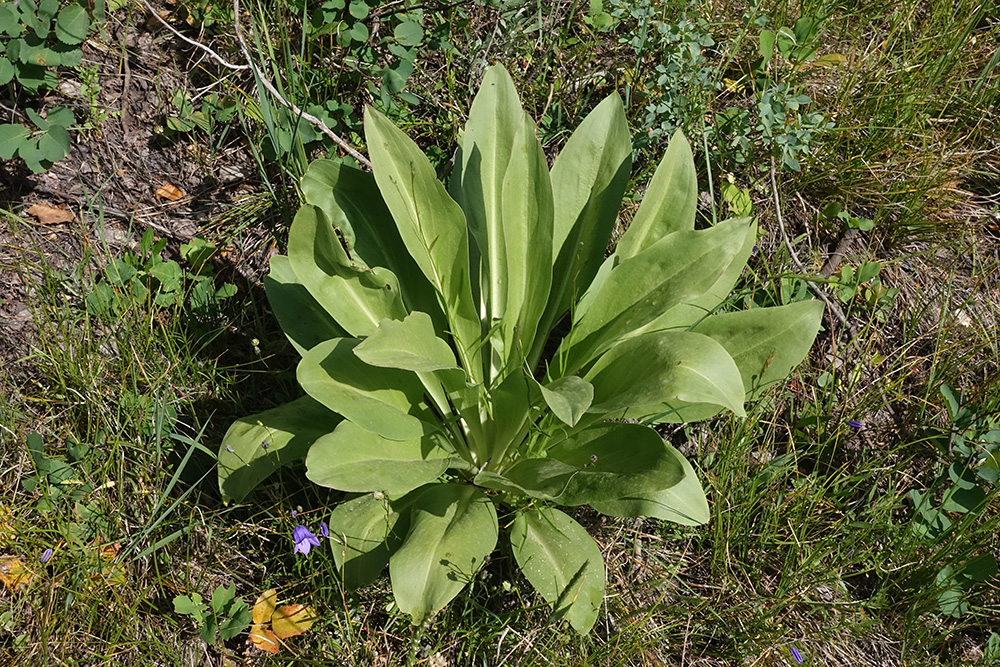
Green Gentian/ Mounument Plant Frasera speciosa – is having a big year. 

These perennial “monocarpic” plants first form rosettes of leaves. 

The first few years, plants may exhibit only 1-2 leaves; if conditions go well, they will add another leaf or so each year. They use the summer leaves to store food down into their deep taproot for the winter.  Depending on the previous growing year, in spring a plant produces a larger rosette which, in turn, stores more food. 

Part of their energy “budget” is spent on defense. Each year they not only need energy to produce new leaves, but also, they need to manufacture enough chemicals to keep away predators…I see few blemishes on a leave.  Defense is expensive as we know from our national military budget. 

Years go by as the rosettes slowly become more and more leafy each year. Eventually, enough leaves (at least 20) will have stored enough food.  Certain weather conditions (still being researched) then trigger flower-bud formation deep down. A given geographical area is subject to the same weather conditions. 

Three to four years later, the plant produces a 4-6’ spire producing dozens of flowers. The flowers are open to all sorts of pollinators who show up and indeed fertilize the plants. 

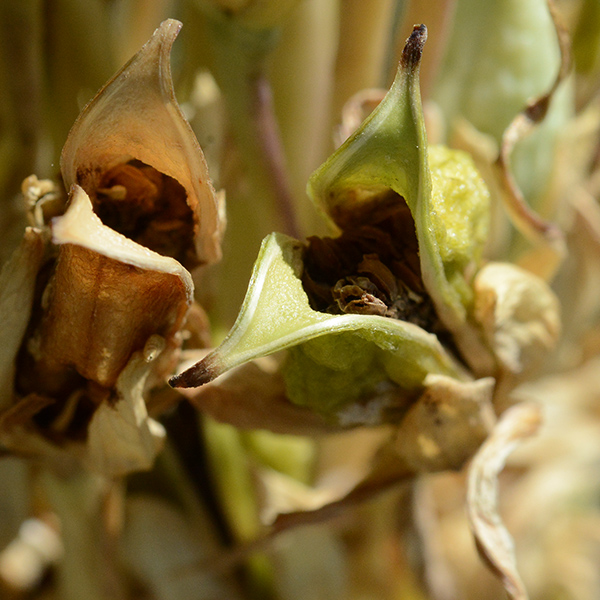
And by late summer, capsules have formed with dozens of seeds inside each. Each Green Gentian plant produces hundreds of flowers, thousands of seeds and then dies (similar to Century Plants).  

Seeds shaken out by the wind often land not far from the parent where they are shaded and nourished by the parent plant decomposing above them.  Seeds are gobbled up by predators; but with so many, at least some seeds are missed. With luck, they will germinate and start growing single leaves, year by year.  It takes decades to grow from seed to flower! 

So, what we are seeing now is synchronicity of flowering triggered 3-4 years ago. We often overlook all the rosettes of various sizes still accumulating enough energy for the next big bloom cycle.  For more info see University of Colorado article.

We hope this posting catches you up on the more common plants of sun and shade.  Note the species we have seen in the past month or so will be showing up at higher elevations and in different densities and combinations as the summer continues on.  Check out past postings, too.  Many cover the same species or others found at similar date of posting.

Have fun!

Frances Clark, Teton Plants, Wilson, WY

July 10, 2023

As always we appreciate corrections. Some of these species are hard to ID. We want to make sure we are putting out correct info. Any questions or suggestions, please contact us at tetonplants@gmail.com. Thank you!

What’s in Bloom in the Woods – Early July

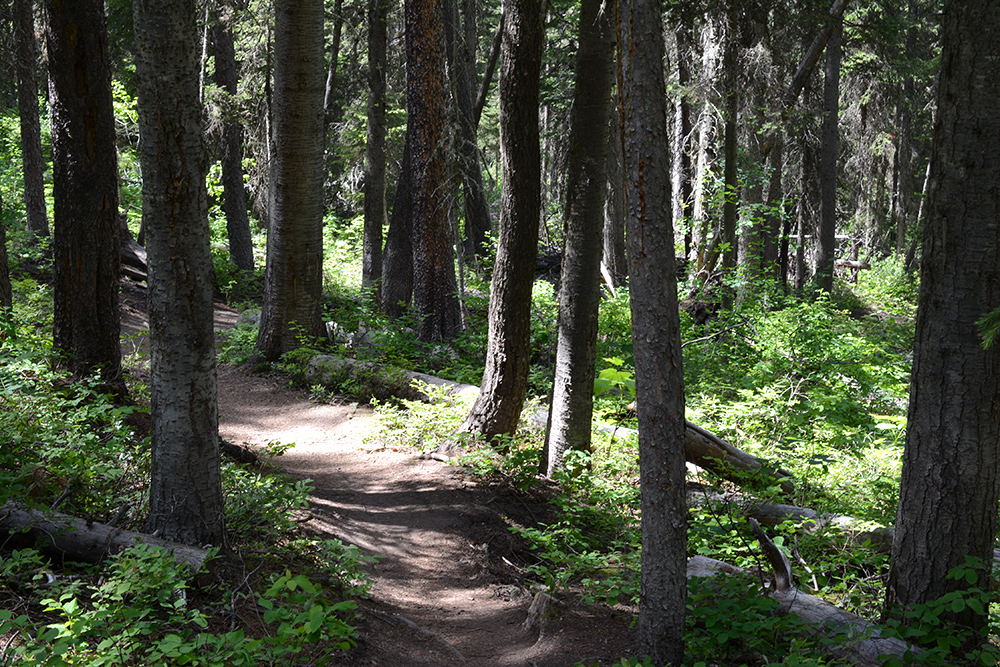
With our first sunny, days in the 70s, some of us are moving into the forests for our hikes. Trails around Phelps Lake, String Lake, Trail Creek, and Cache Creek all have areas of older growth spruce-fir forests. The understory plants have to be able to thrive in low light, cooler temperatures, lower nutrient soils, and a shorter growing season than those species that grow on the sunny sageflats and slopes or under aspen groves. Some forest flowering plants will by chance grow in light gaps, others have adapted to perpetual shadows.

Larger plants:

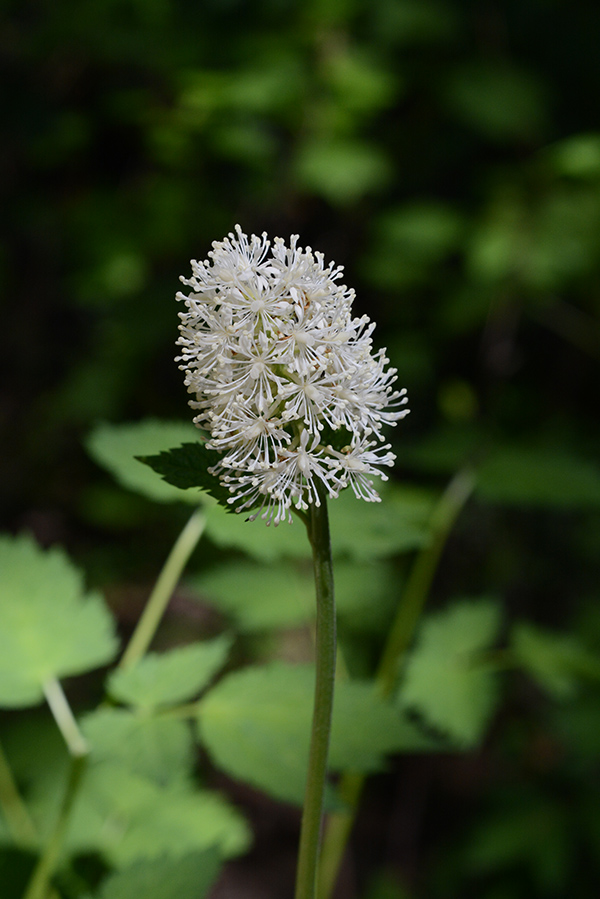
Red BaneberryActea rubra – post pompoms of small white flowers held 2-3’ above skirts of compound leaves.  Their delicate white sepals (no petals) have mostly shed. 

Over the next month, watch as the single ovaries swell and become shiny red fruits. 

These are poisonous for us to eat, but not for the birds and small mammals.

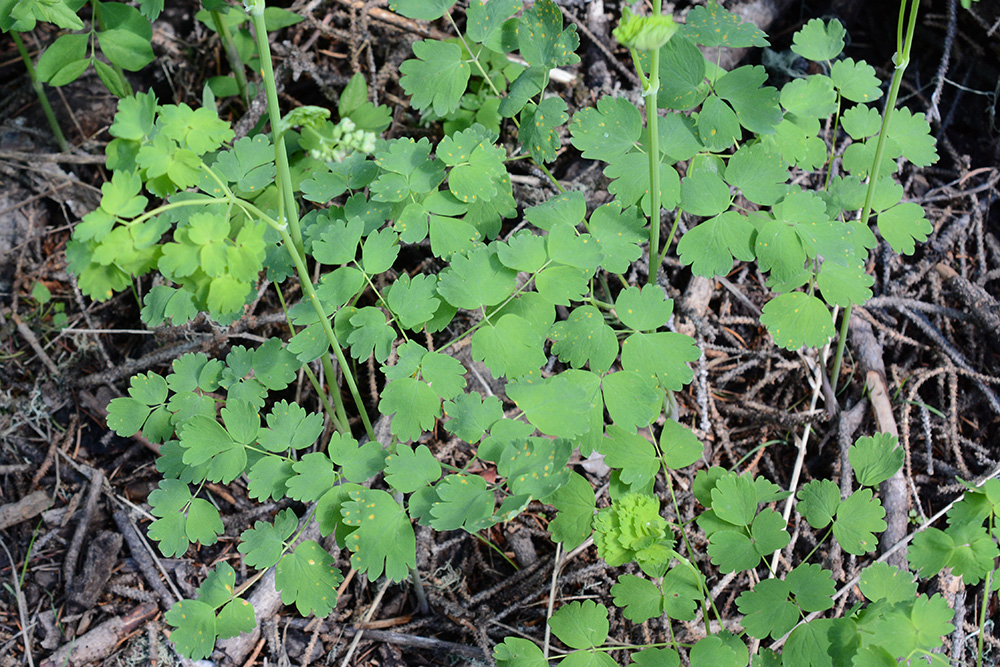
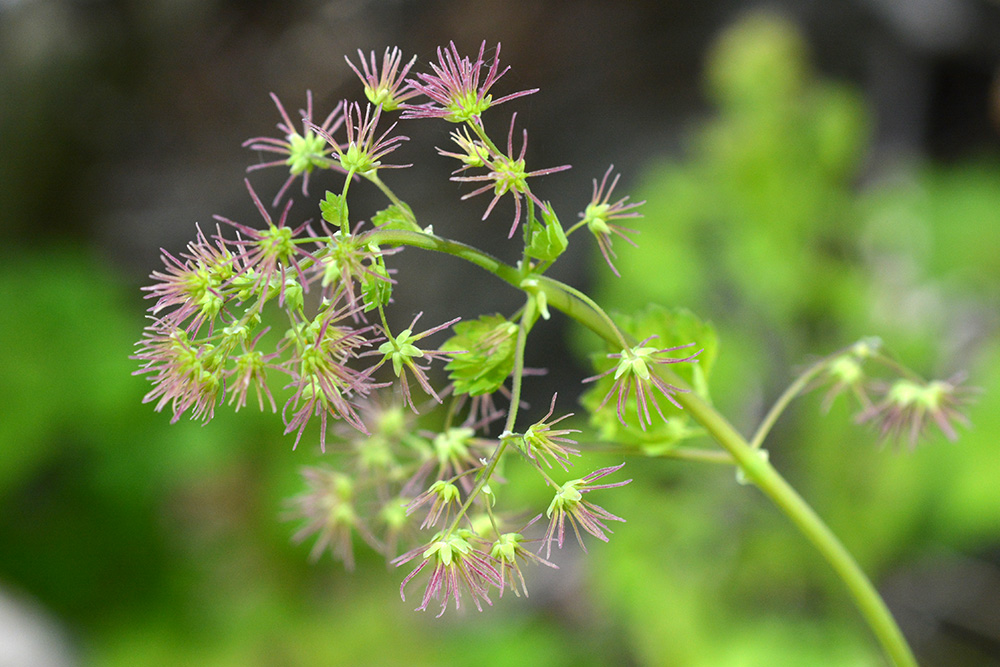
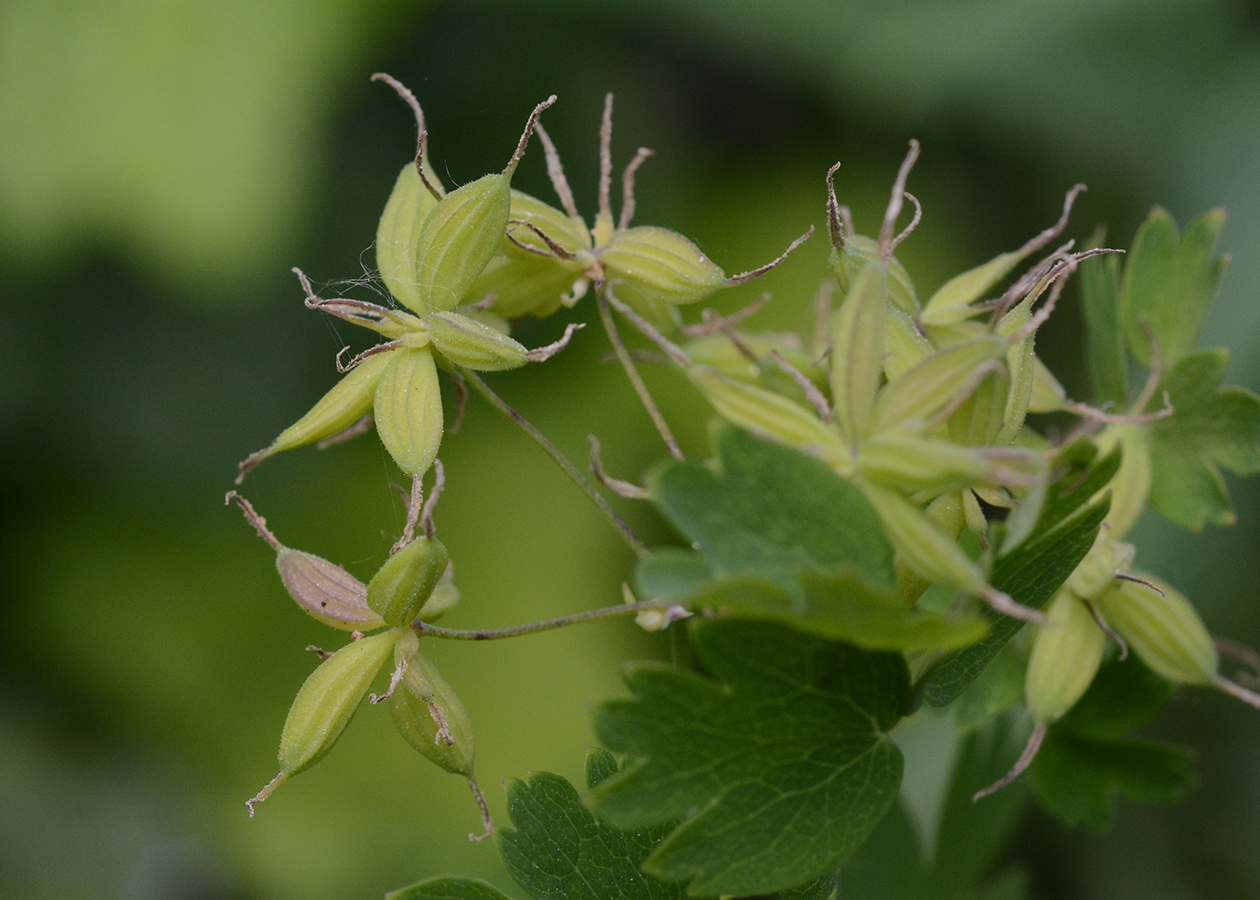
Meadow RueThalictrum sp. – The leaves are very similar to the delicate compound leaves of its cousin columbine.

However, the wind-pollinated flowers are inconspicuous with male flowers with their dangling stamens (no petals) on one plant:

and wide-spreading filaments with sticky stigmas of females on another plant:

The wind blows the pollen from the anthers and with luck scatters polllen grains upon the stigmas of the females, thus fruits will form. 

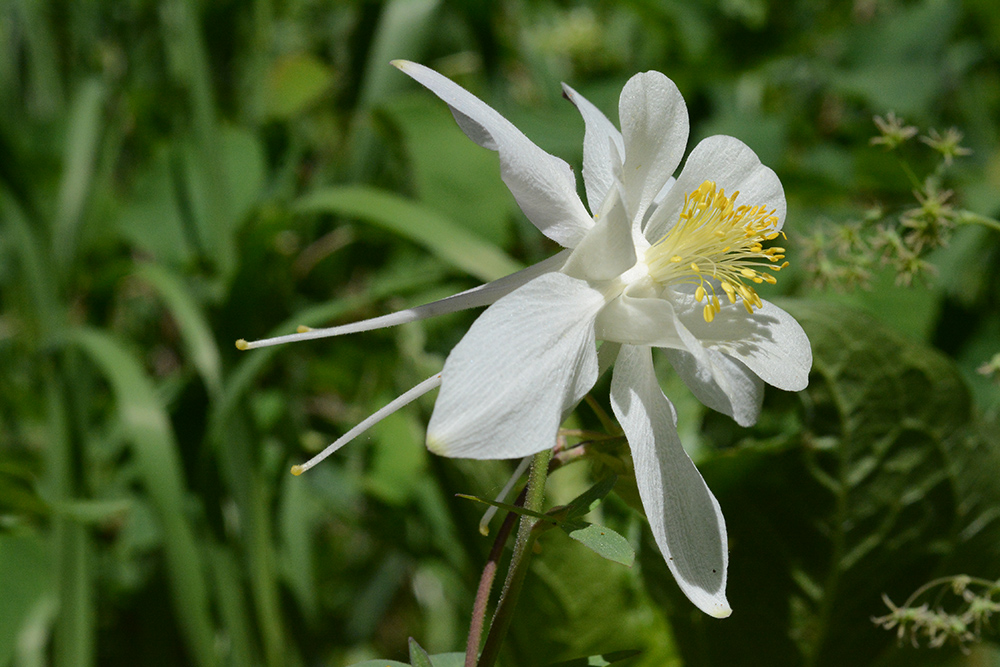
Colorado ColumbinesAquilegia coerulea – are just emerging. Hard to miss the elegant, soaring flowers. The 5 long spurs harbor nectar in the far ends. Hummingbirds, long-tongued bees, or hawkmoths, all with long mouth parts, hover and reach deep for the sugary treat, incidentally bumping their bodies upon the many anthers and collecting pollen. 

With their  flight to a next, more mature flower, they will transport the pollen to 3 protruding stigmas while once again seeking nectar.  Then pollen grains can grow down into the separate 3 ovaries and stimulate seeds to form within 3 dried capsule fruits. 

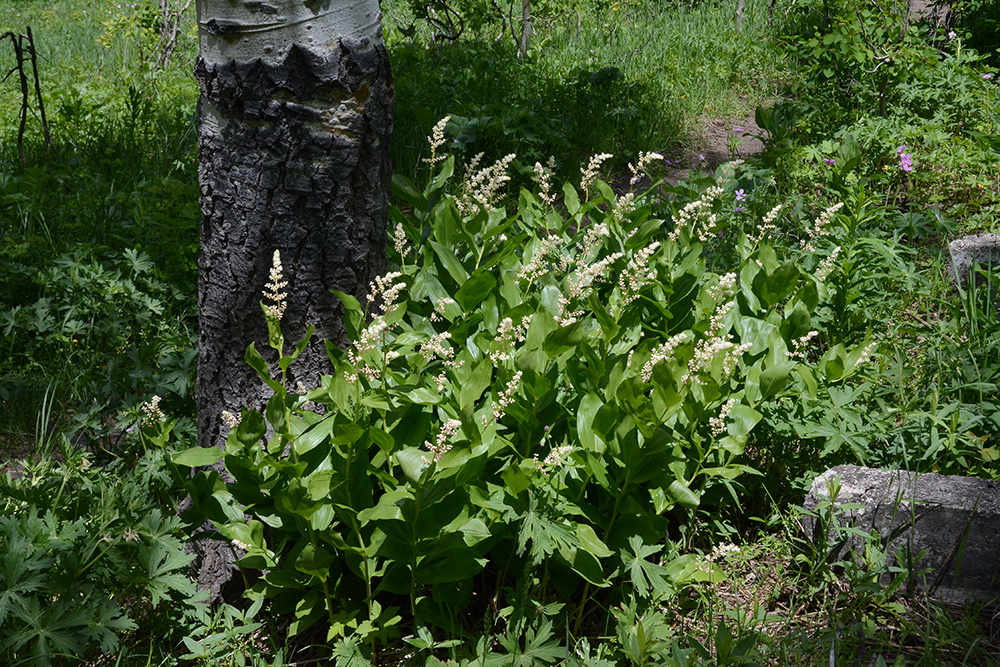
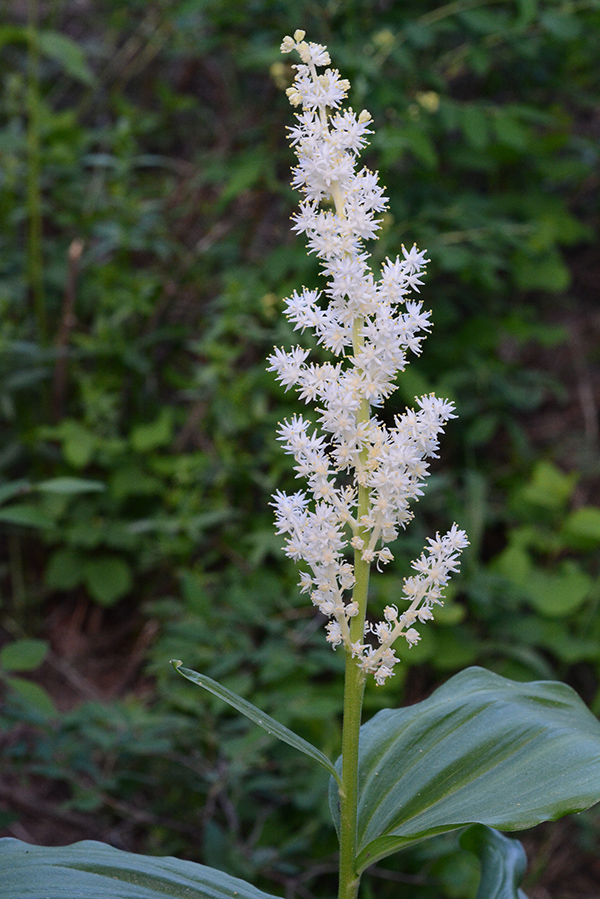
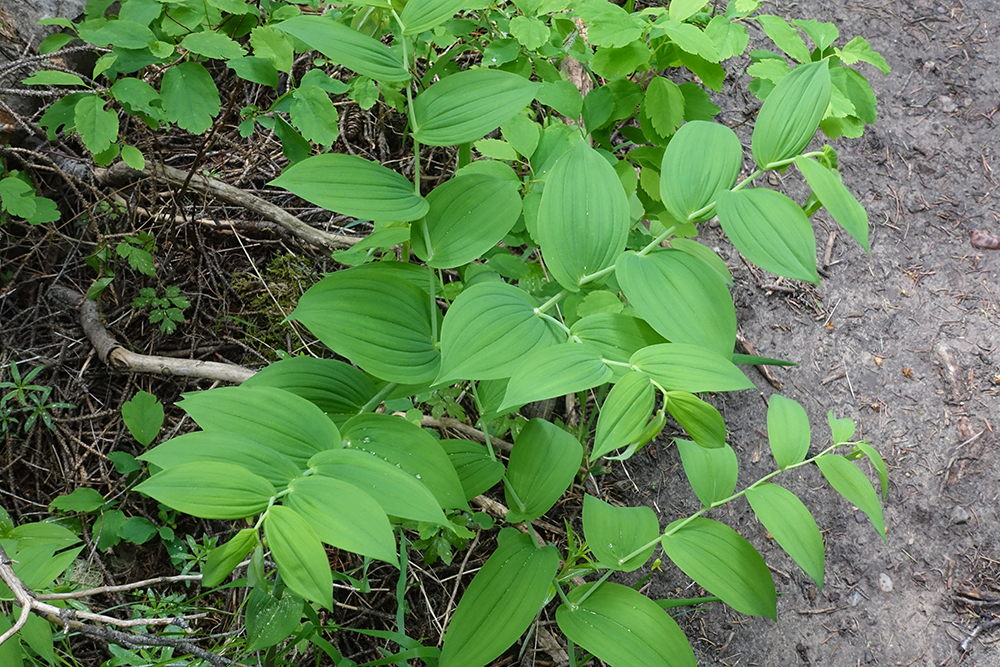
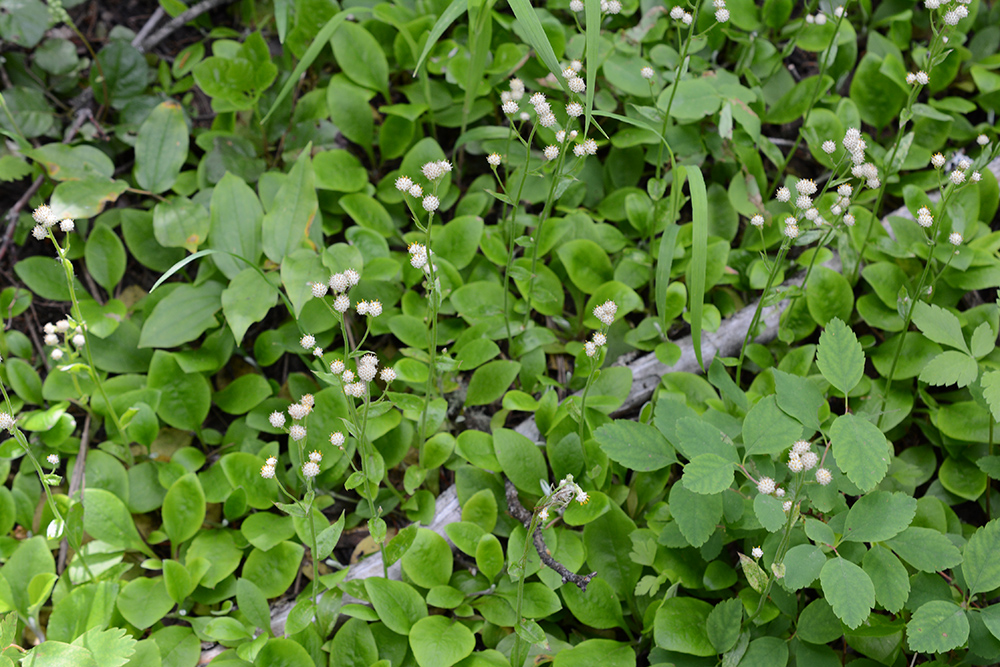
False Solomon’s-sealMaianthemum racemosum – stands 1.5-2’ plus tall.

The leaves with parallel veins alternate up the stems, and panicles of small white flowers plume out at the terminus. 

Twisted-stalks – Streptopus amplexifolius – arch over streams. 

Their 3-4’ stems branch and hold alternate leaves with parallel veins. Each axil (where leaf meets stem) has a single yellow flower held out upon a kinked stalk.

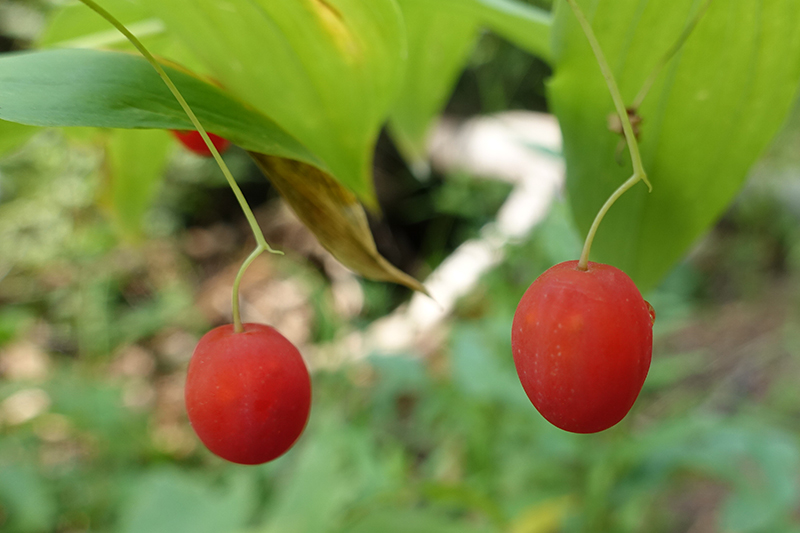
Later ovoid red fruits will dangle from the same spots. 

Bending down low:

Canada VioletsViola canadensis – often form patches of distinctive heart-shaped leaves. 

The white flowers have delicate purple nectar guides leading into the yellow center of the flower. 

Insects land on the lower petals, follow the lines to the center, and probe for nectar in the back of flower to initiate the pollination process.

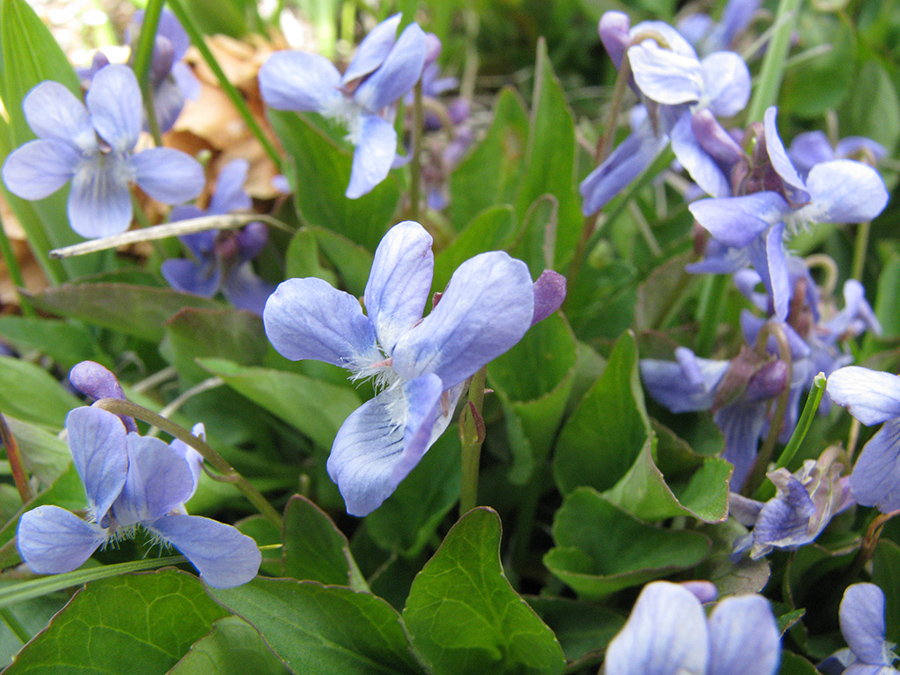
Hoodedspur Violet, Early Blue Violet, Sand Violet are just a few names for wide ranging Viola adunca.  Whatever the name, these plants form cushions of loose, heart-shaped leaves growing from the base or on short stems and produce blue violet blooms. The distinctive ID feature is the relatively long spur of the flower. 

If by chance the petalled flowers are not pollinated by bees or other pollinators, most violets have a back-up. They form cleistogamous flowers at the base of the plants.  Without fancy petals or fragrance, these hidden flowers self-fertilize so the plants still develop seeds, even without a mixture of new genes. Seeds are the means by which the next generation of plants can move away from their parent plant to go forth, grow, and multiply on their own. 

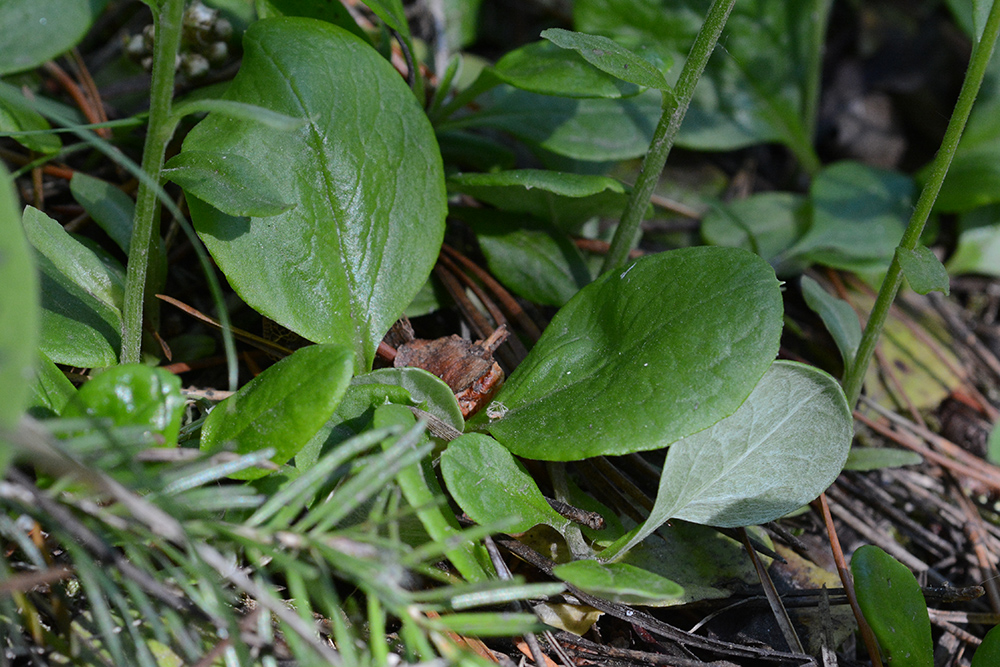
Unlike the many species of pussytoes we find in dry sunny locations, Racemose PussytoesAntennaria racemosa – thrive in shade. 

The 2” elliptical leaves are smooth green on top and hairy white on the underside.

They form extensive mats beneath the 6-18” flower stalks. Here the “pussytoes” or composite male or female flower heads are held out wide in racemes or panicles.

If you look carefully, you may find two relatives of the Saxifrage Family:

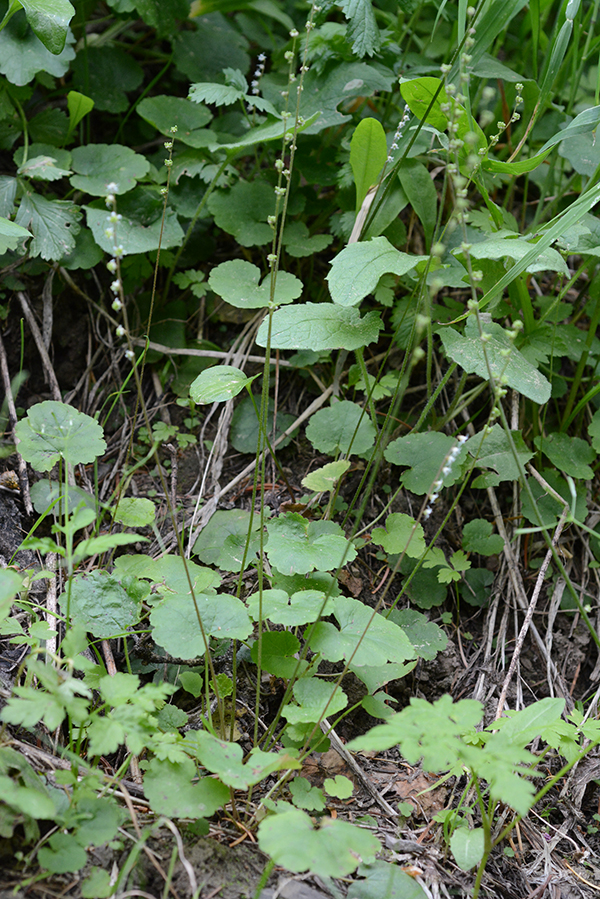
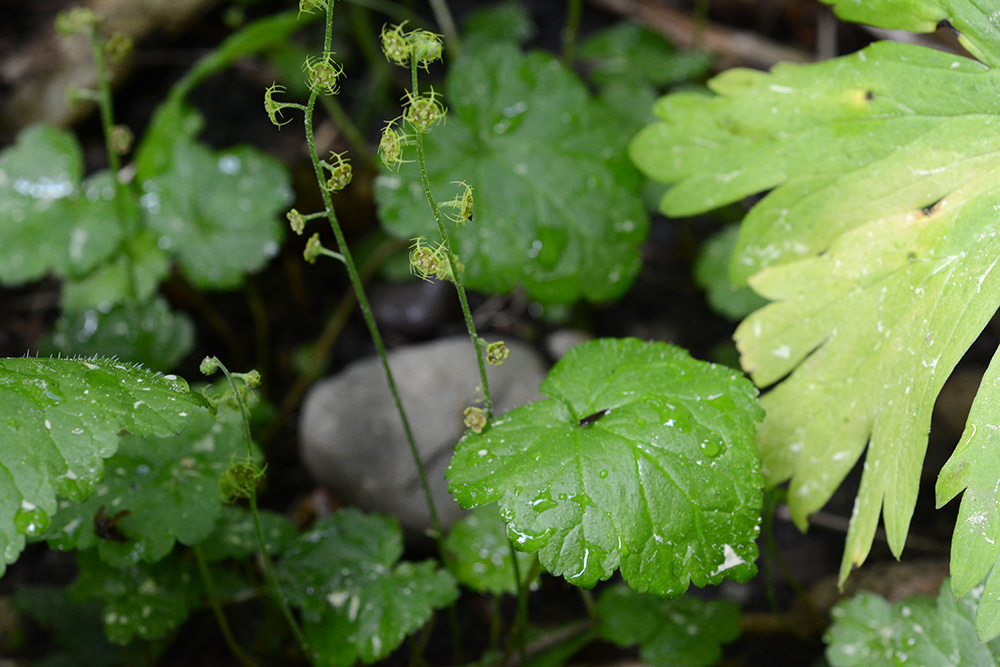
Delicate 1-2’ wands of tiny white flowers of Small-flowered MitrewortMitella stauropetala – stand in the shade along trail sides. 

Look closely at the little cups (hypanthiums) formed by 5 white, blunt sepals and 5 thread-like petals.

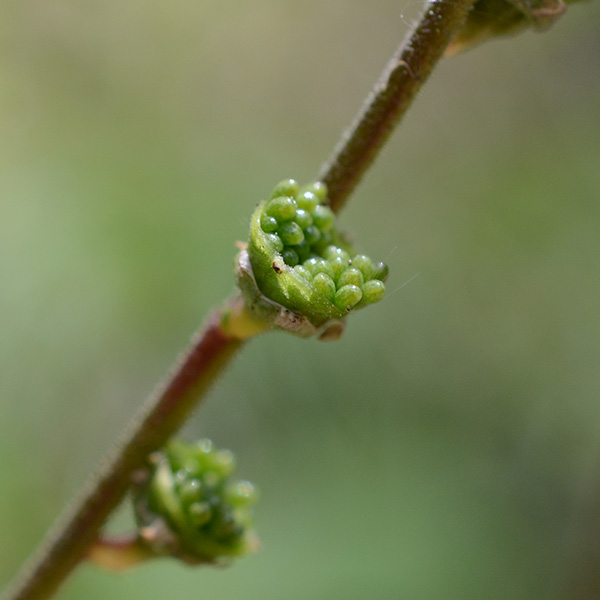
If you keep looking around, you may find a more mature stem with cups brimming with un-ripened seeds.

Seeds will become shiny black.  Rain will “splash” them out upon the forest floor when fully ripened. The scalloped, almost round leaves are at the base of the plants.

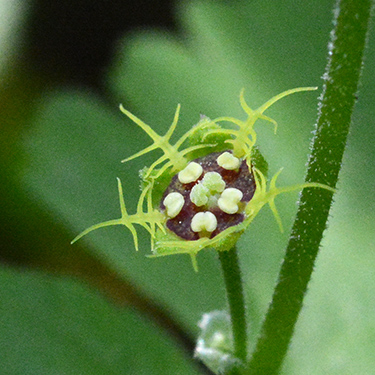
Five-stamen MitrewortMitella pentandra – is harder to find as plants are smaller and the flowers more obscure,.

The cup-shaped flowers are wide open. The five sepals are green and pointed and the 5 greenish petals have 5-7+ thread-like lobes.

These delicate petals stand just outside the 5 whitish anthers that surround a reddish nectar disc, with greenish splayed stigmas in the center.  The fruits will be very similar to those of Small-flowered Mitrewort. 

Orchids

Orchids are particularly fascinating plants.  Often their flowers have evolved to be pollinated by very specific pollinators. Typically, flowers have inferior ovaries, above which are 3 sepals that flare to the top and 2 sides, then 3 petals, two of which may be similar to the sepals and/or form a  “hood” above the third petal below which is usually quite distinct and called a “lip”. The stamens, style, and stigma are fused to form a “column”.  There are thousands of different orchids around the world, so needless to say, there are thousands of variations of appearance.

In general, pollen is held in a wad of hundreds of tiny grains called a pollinium.  This pollen wad is carried by the pollinator to another orchid of the same species, and the wad sticks to the sticky tip of the central column.  Then hundreds of pollen grains grow down into the inferior ovary where hundreds of eggs await. 

If fertilized, the seeds will form inside a dry capsule that will split part.  Seeds are dust-like…tiny. They are scattered by the wind.  As orchid seeds don’t have any extra food tucked in with the embryo, when they land  seeds count on specialized ectomychorrizal fungi to grow into them and provide nutrients and water for sustenance.  Some orchids form a “protocorm”, an underground mass of cells that slowly expands and eventually forms defined shoots that emerge above ground.  Also, after blooming a year or so, an orchid may disappear underground for time and pop up elsewhere in the area. Truly elusive plants.

Again, pollinators are very specialized. Lured in by fragrance, shape, color, and possibly nectar, the pollinator is directed by the form of the flower to position exactly to pick up or drop off the pollinium.  Not much is known about many of the pollinators of orchids or their essential ecotomychorrizal associates. Finding an orchid is a very special treat. Please do not pick or dig orchids!  And watch your step.  Thank you.

Some orchids we have seen in the past week or two:

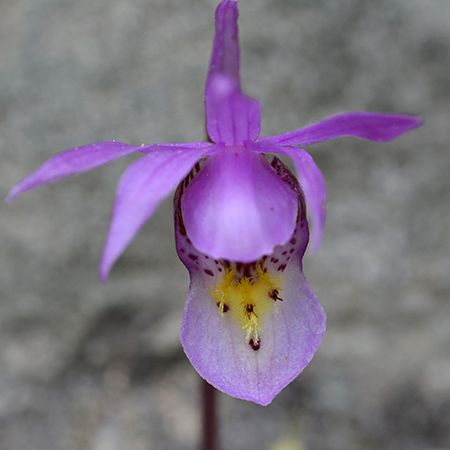
Fairy SlippersCalypso bulbosa – are said to be pollinated by young queen bumblebees.  Attracted by scent and design of the flowers, bees arrive looking for pollen and/or nectar. 

However, while they may bop against the pollinium and carry it off, the queen bee is not rewarded with pollen or nectar.  She may try another flower, dropping off the pollinium, but again no reward for her. So she gives up. The Fairy Slipper lucked out on luring in a novice queen bumblebee and thereby being pollinated! 

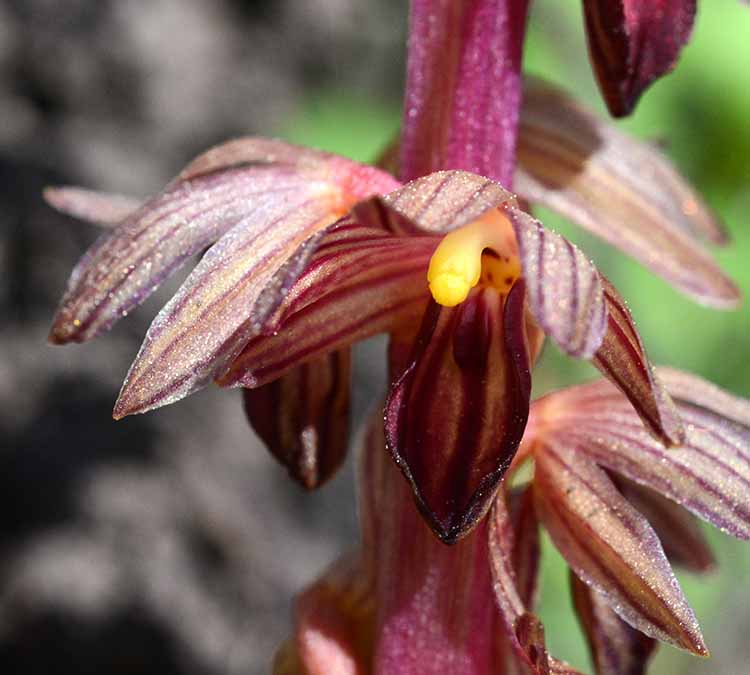
Coralroots – Corallorhiza spp., – are named for their knobby root structure.  Without any chlorophyll, these plants are completely dependent on ectomychorrhizal fungi throughout their life.  Of the 5 species native to Teton County, we have been seeing two:

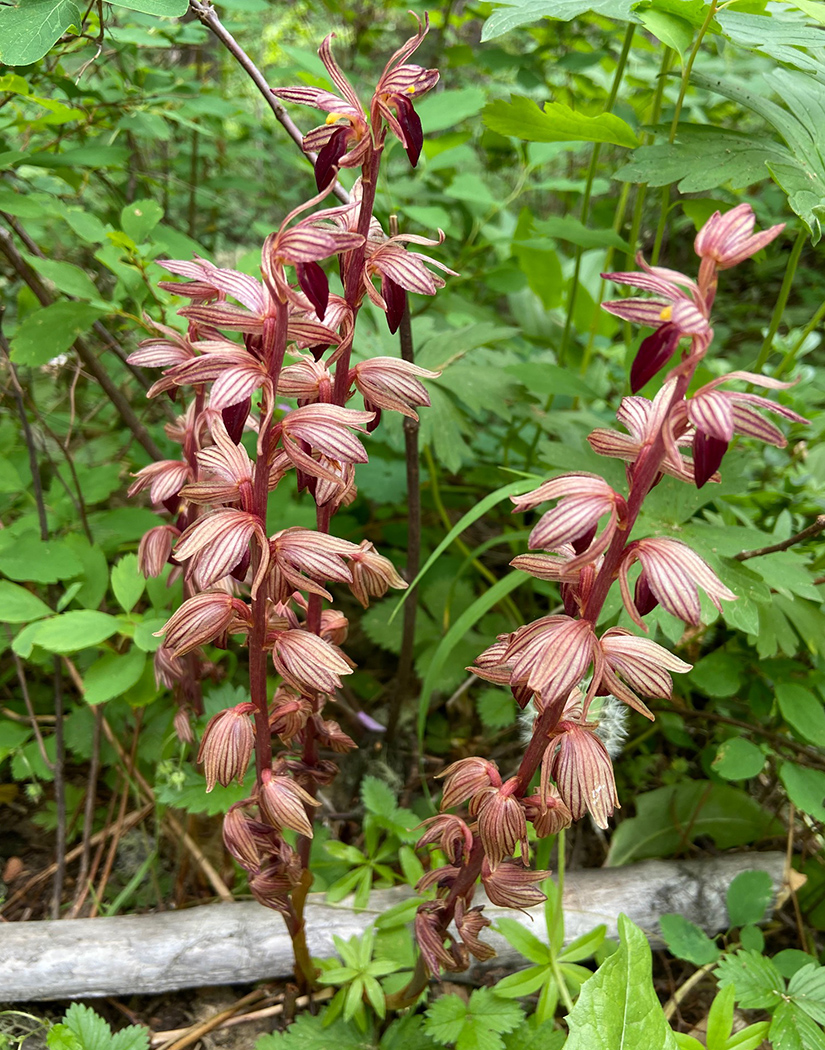
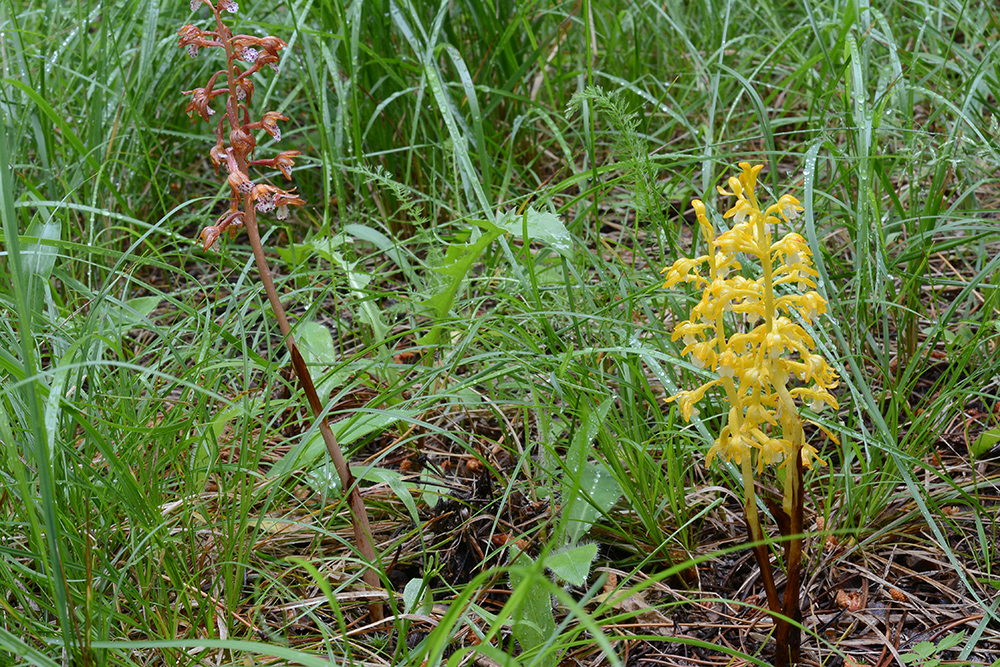
Striped Coralroot  – Corallorhiza striata – has blurry reddish stripes on pinkish sepals and upper petals. You can see the thickish column with the yellow wad of pollinia. 

The lower petal or “lip” is deep maroon. Plants can grow up to 2’ or so and have many flowers.

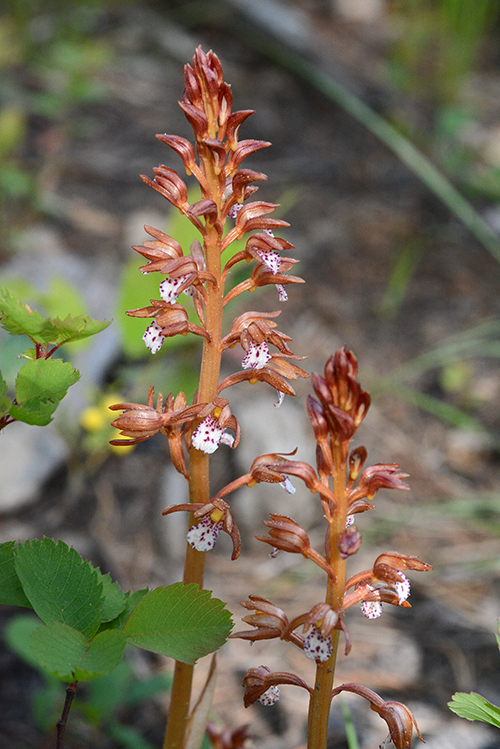
Spotted CoralrootCorallorhiza maculata – can sport reddish or yellowish stems and flowers. 

Different colored plants can grow side by side. 

Look for several reddish spots and two teeth on the lip. Some flowers do not have the spots, but always will have the teeth at the back of the lip.  

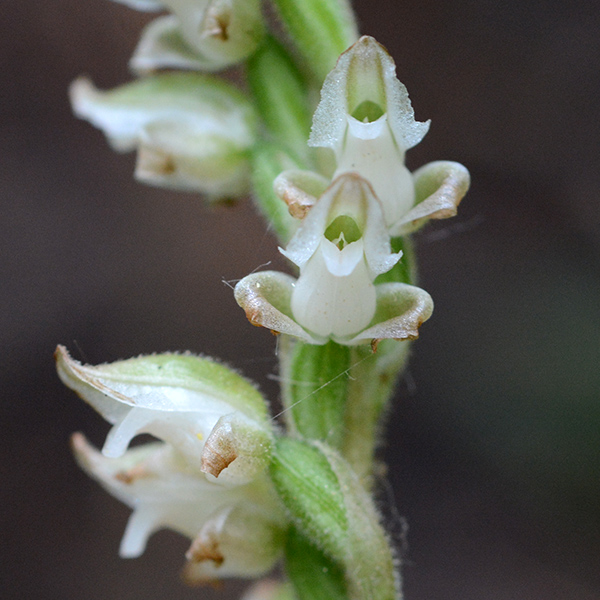
The mottled leaves of Rattlesnake OrchidGoodyera oblongifolia – are evergreen and form rosettes connected by rhizomes. 

Soon up through the center of the rosette will grow 6” stalks with a spiral of small whitish hairy flowers. 

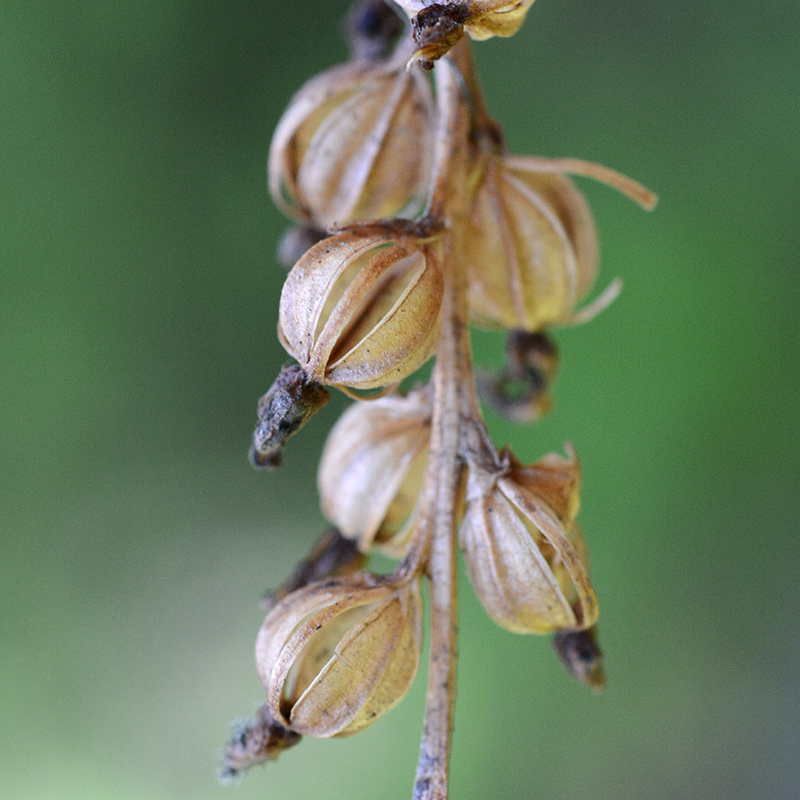
Typical of many orchids, the Rattlesnake Orchid fruits are dry capsules which break into narrow slits, gradually releasing hundreds if not thousands of dust like seeds upon the wind.

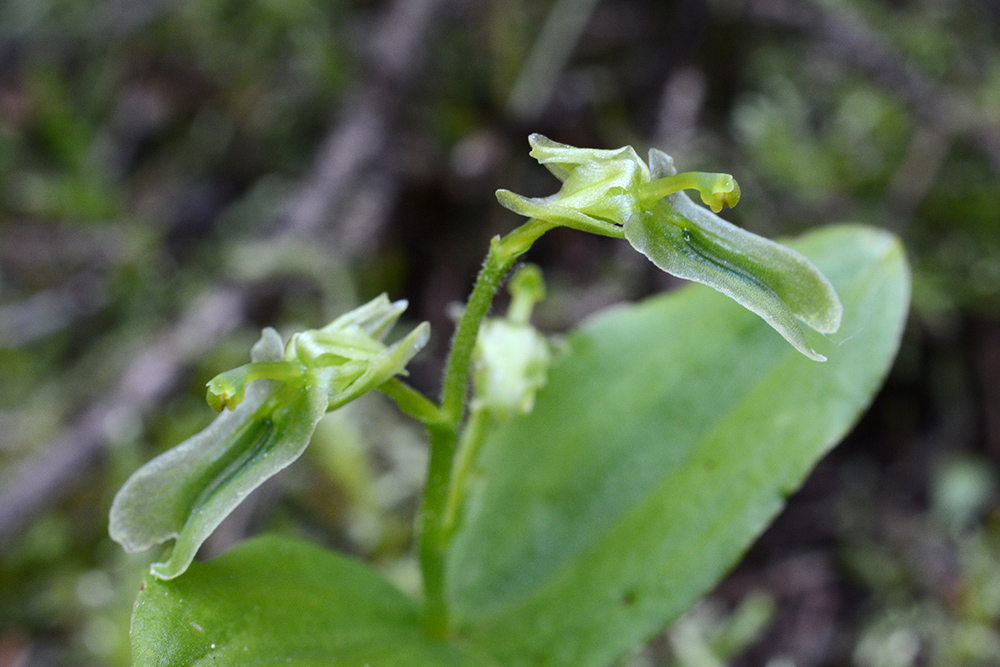
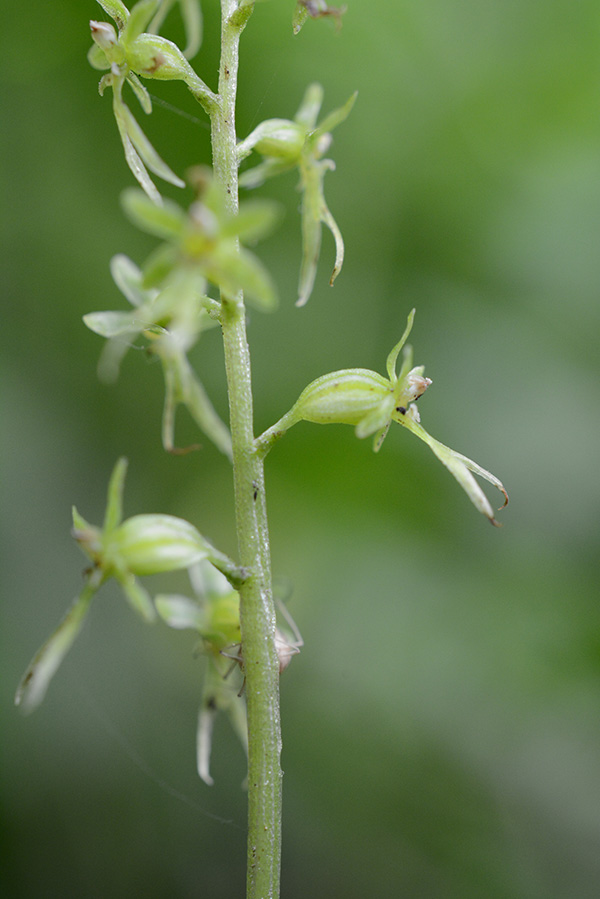
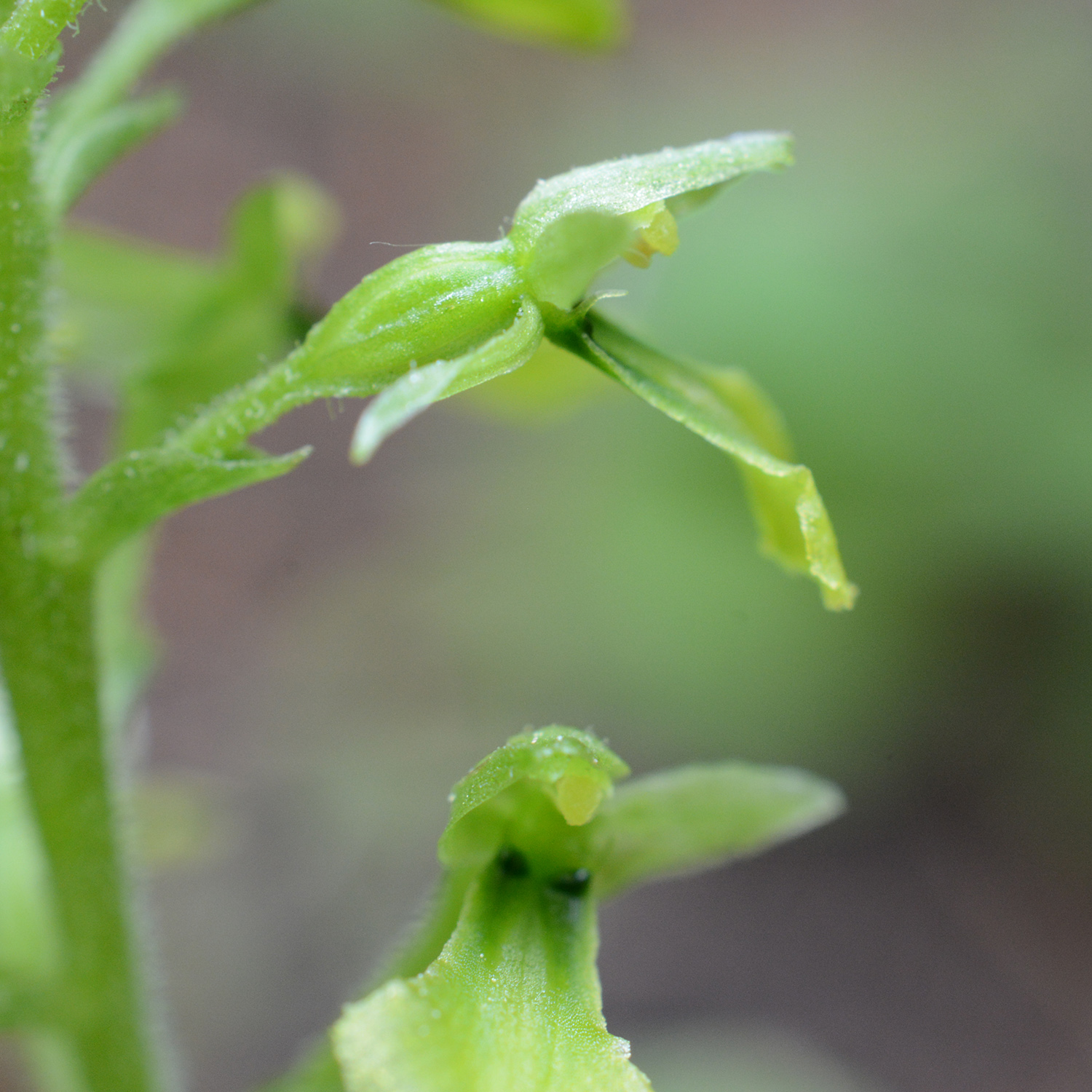
Twayblades Listera spp. – are some of the smallest, and rarest orchids we have seen. The genus is easily identifiable by the two opposite leaves midway up a single stalk. The flowers have long protruding lips.

Northwestern Twayblade – Listera caurina – is relatively common growing up to 3-4”. 

Note the several flowers, each have a lip which is slightly rounded or squared at the tip.

If you can get down close enough with a hand lens you may see two very tiny transparent teeth at the base of the lip:

Broad-lipped Twayblade – Listera convallarioides – is also rare – we have seen this 2” plant once by pure luck.  The lip has an obvious indentation. Also look at the profile of the flowers and how it differs from Northwestern Twayblade.

Heart-leaved Twayblade – Listera cordata – is also rare, again with only one sighting. Note the lip is split into two very delicate segments.

Again, this plant is only 1-2” high.

For much more info on our North Temperate orchids, go to Go Orchids

More “belly botany”:

Over the next few weeks several 2-6” evergreen plants will bloom. To truly see their flowers, one has to get down on one’s belly. (Do watch out for other plants nearby as you kneel or step.)  One such gem that has just begun blooming is:

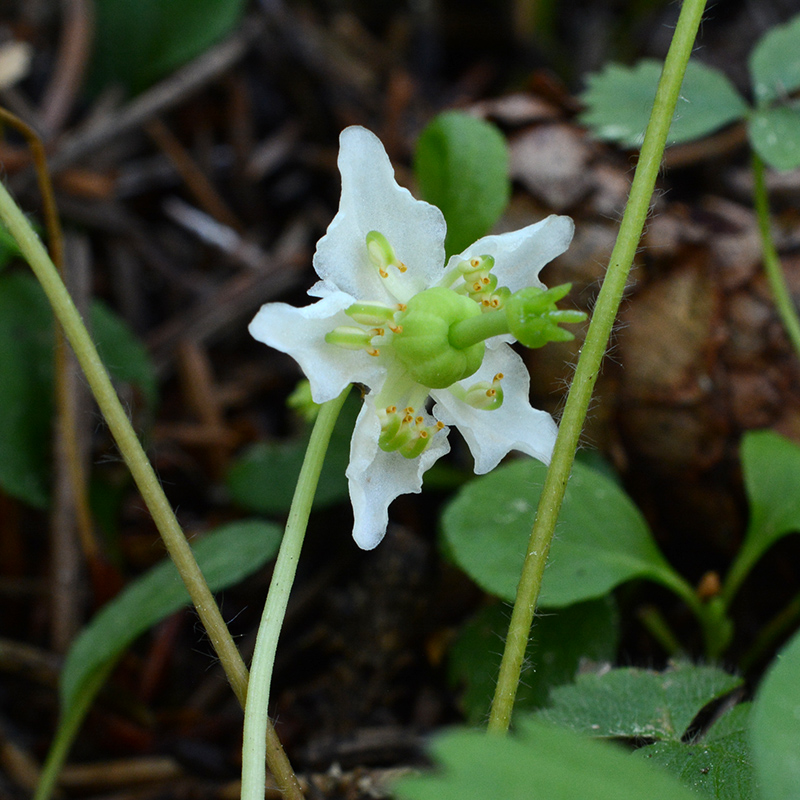
One-flowered Shinleaf, Single DelightMoneses uniflora – is in the Heath Family and is related to several other evergreen species of deep shade and acid soils of evergreen forests. 

It is about 4” tall tops. The anthers are tubular, arranged in groups around the 5 parted stigma. Pretty cool if you can get all the way down and very gently take a look at the flowers with a 10x handlens.

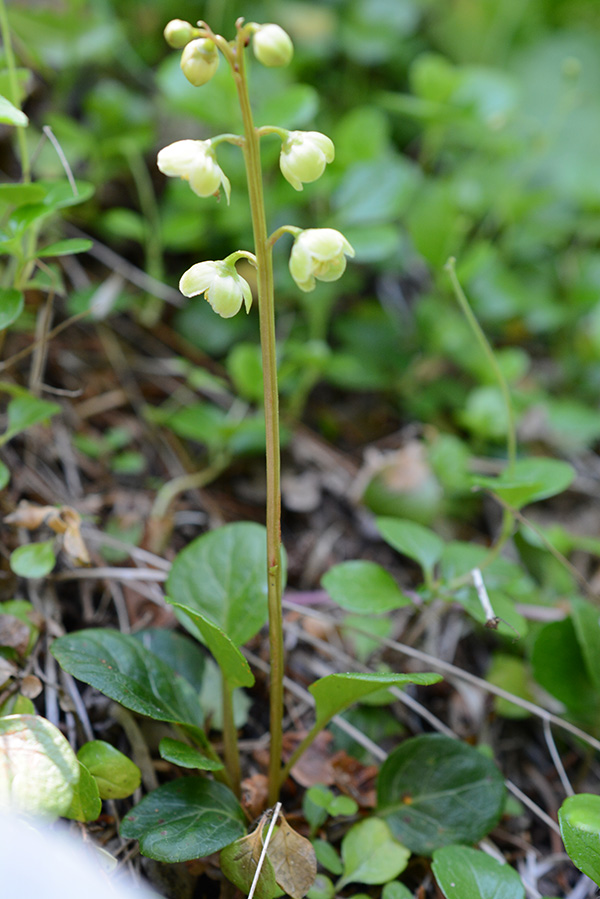
Another evergreen wonder is Green PyrolaPyrola asarifolia.  A few round evergreen leaves are near the base of the 3-4” stem which holds 4-5 creamy white flowers. 

Soon these species will be accompanied by other evergreen members of the Heath Family including more Pyrolas, Orthillas, and Pipsissewas.

Enjoy walking the woodland trails: watch your feet and find the flowers!

Frances Clark, Teton Plants

July 4, 2023

As always we appreciate corrections, concerns, comments. Best to email us at tetonplants@gmail.org

What’s in Bloom on Sageflats and Sunny Surroundings – June 20, 2023
The valley is resplendent with Balsamroot – across Antelope Flats, up the eastern slopes of Shadow Mountain, along Wally’s World, and elsewhere. This abundant species is accompanied by an entourage of showy flowers worthy of note as well.  Some are quite demure, and others puzzles to ID.  But all signify spring moving quickly into summer in sunny Jackson Hole. 

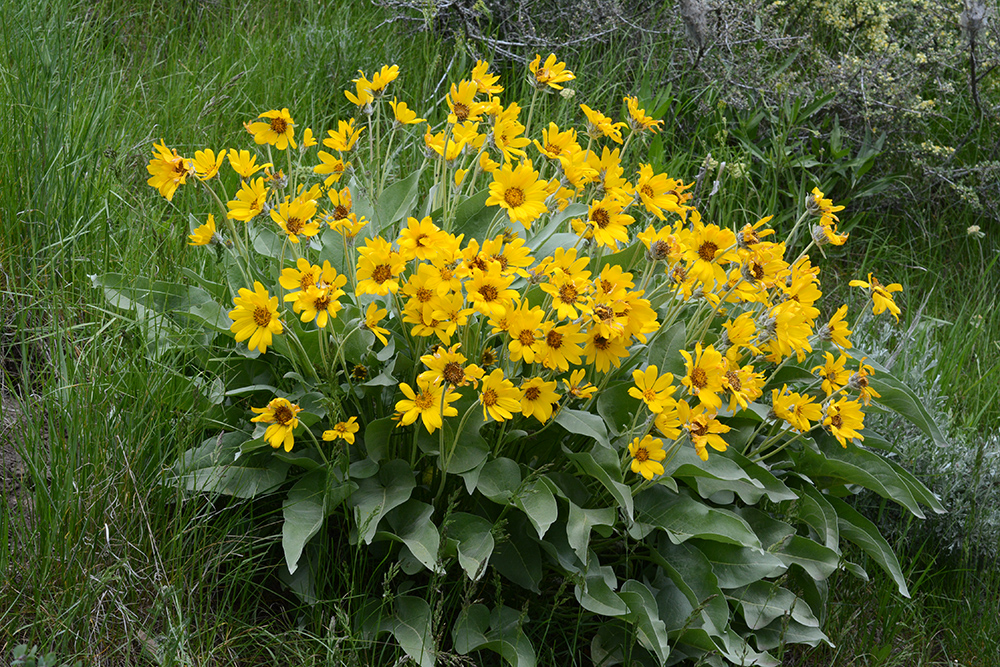
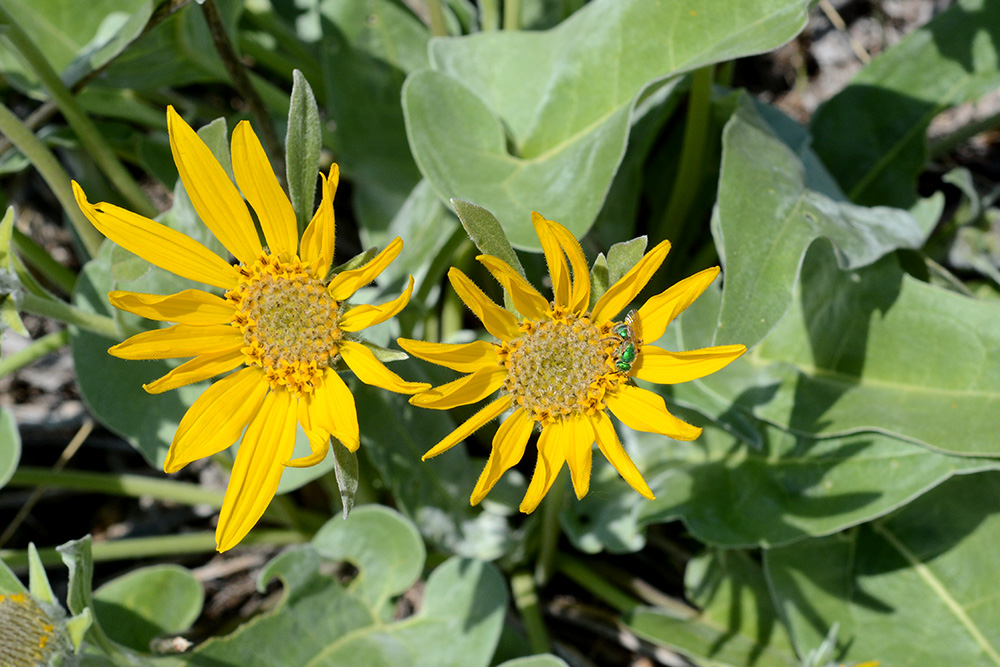
Arrowleaf-Balsamroot – Balsamorhiza  sagittata-  is a classic “composite” flower. The flower heads include many small individual flowers standing on a platform, all surrounded by protective bracts. Most are small disc flowers disc flowers that bloom from the outside in. The outer ray flowers help to attract and also serve as landing platforms for myriad pollinators.

Each yellow disc flower performs “push pollination”. Inside the tube of 5 fused yellow petals, 5 dark anthers face inward forming a tight circle.  The closed 2-parted yellow stigma extends up through this column, pushing pollen released by the anthers up and out for pollinators of bees and such to come and get it. Later the stigma of the flower opens wide to capture pollen from a different flower to prevent self-fertilization.  However, if for some reason a pollinator does not deliver pollen, the curled-back stigmas can reach for its own pollen. Each of these flowers will each make a single fruit, as does our commercial sunflower.  In Arrow-leaf Balsamroot, large, arrow-shaped leaves are all basal and grayish hairy. Also only one flower is held up on each stalk.

As Arrow-leaf Balsamroots fade, Mule’s EarsWyethia amplexicaulis – comes into their own.  Several bright orange-yellow flower heads bloom on the stems. Dark green, smooth, mule-ear shaped leaves alternate up the stems. These plants grow in more water retentive soils. They dominate Wally’s World ridge and also low sites around the valley such as near the Oxbow in the park.

Other yellow composites:

Sahkalen ArnicaArnica sororia – As in most all arnicas, leaves are opposite, each yellow head of both ray and disc flowers is surrounded by an even row of bracts. Usually single flower heads are held above 2-4 sets of opposite, sessile, ovate leaves on each stem, with more leaves with 3 veins at base. Details include white, slightly bristly hairs around the base of each disc flower.  Overall plants are sticky hairy.

These arnicas are particularly plentiful out the northern end of Flat Creek Road in the Elk Refuge and scattered out Gros Ventre Road on the way to Kelly.

Western GroundselSenecio integerrimus – A common sagebrush habitat species, this groundsel stands about 12-18” tall. Most leaves are at the base, but some oblong leaves alternate up the stem.

Note the fine cobwebby hairs on stem and leaves. Flower heads have bracts that are smooth, equal length, and tipped in black.  They surround a few outer ray flowers and several more disc flowers in the center. I have been seeing a caterpillar eating these plants. (Anyone know what species it is?)

Stemless GoldenweedStenotus acaulis – In dry rocky roadsides and hill tops, one finds extensive mats of 3-4”, upright spear-shaped leaves are overtopped by numerous yellow flower heads.

Heads include several yellow, oblong, blunt ray flowers surrounding several disc flowers. Heads are protected by 3-4 rows of pointed, hairy bracts. This species tends to grow best on drier knolls within sagebrush or grassland habitat.

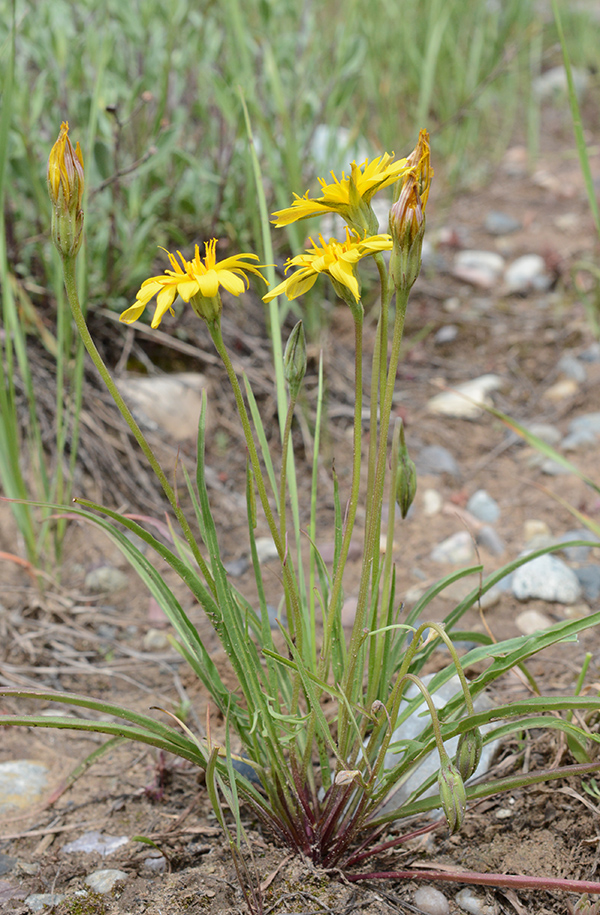
Also mixed in are two other 6-8” species that look very similar at first. A puzzle for botany nerds. Both have tap roots, heads with all yellow ray flowers surrounded by somewhat broad bracts arranged in 2-3 alternating rows. Leaves are long and narrow.  From there to details:

Microseris – Microseris nutans – often has several stems with several flowers arising from the base. Note that some stems and leaves alternate up the stem.  Also, flower buds nod…hence “nutans”.

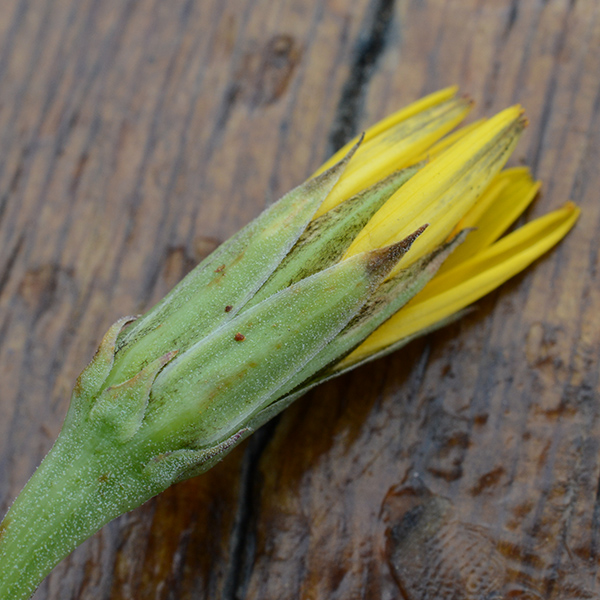
Narrow leaves have smooth to slightly toothed edges. Even finer details: the outer bracts are few and short, the inner two rings have longer, broader bracts that taper to a point.

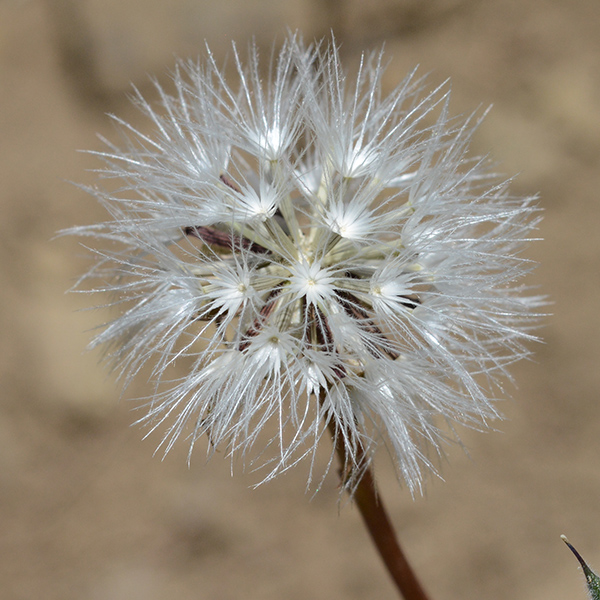
The shiny white pappus of each fruit is “plumose” with broad scaly bases. 

Nothocalais – Nothocalais troxmoides – is very similar (they used to be in the same genus Microseris). Compare closely: Typically Nothocalais has only a single flower stem surrounded by thin, slightly wavy, all-basal leaves.

The bracts are all about the same length, often finely dotted with purple. Each fruit has bristles that broaden only slightly at the base.

Confusing yellow composites to come:

False DandelionsAgoseris glauca varieties – tend to be larger than the above, leaves are all basal, some with fine teeth, flower heads of all yellow ray flowers borne on single stalks.  Bracts and leaf shape determine which subspecies.

HawksbeardsCrepis spp.  – Many all-ray flower heads held up on several branching stems. 

Leaves variable, often with large sharp teeth, arranged both at base and alternating up stems. 

White composites:

We have many Fleabanes or Fleabane DaisiesErigeron spp. – in Teton County growing from a few inches to a few feet high.  They can be difficult to key to species.  All Fleabanes have equal-length bracts surrounding usually many thin ray flowers that in turn encircle tiny yellow disc flowers, like a typical “daisy”.  The white (vs blue) species are the more complex to ID, I find.

Shaggy or Low FleabaneErigeron pumilus – form dense bunches of hairy (sticking out like a fraidy-cat hair) stems and leaves about 4-5” high. Commonly found in drier soils of sagebrush and dry knolls.

Another very similar low species is easier to ID: – Cutleaf DaisyErigeron compositus.  Also, low growing with white composite heads in similar dry habitats, this species has divided leaves. It is going to seed now.

Rarely seen in Jackson Hole but abundant up at Island park, ID,  in moist meadow areas are White WyethiaWyethia helianthoides

Hard to miss or mistake!

A mix of colorful species:

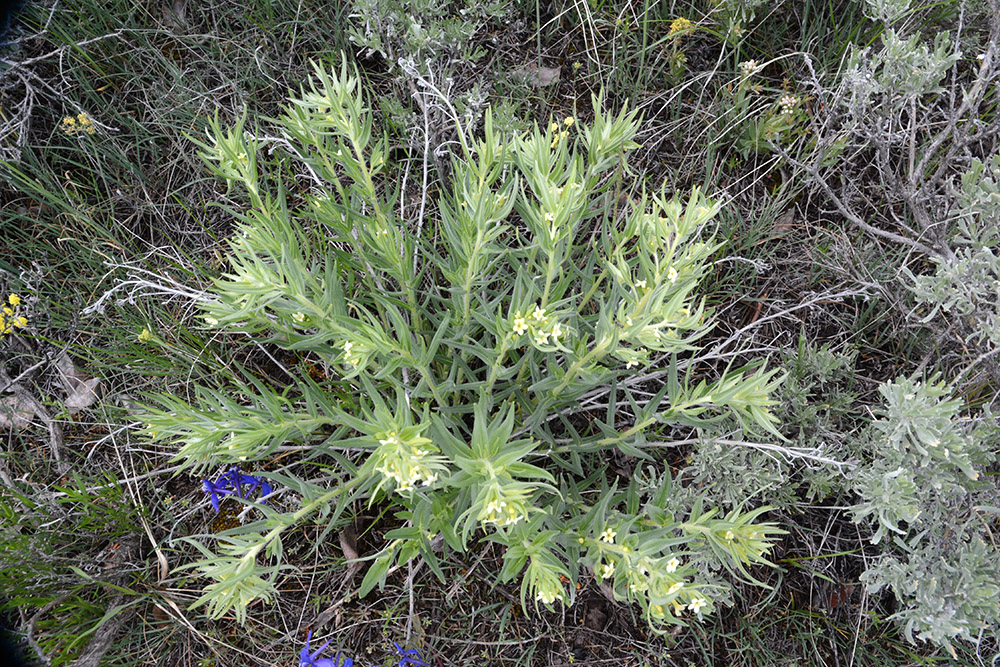
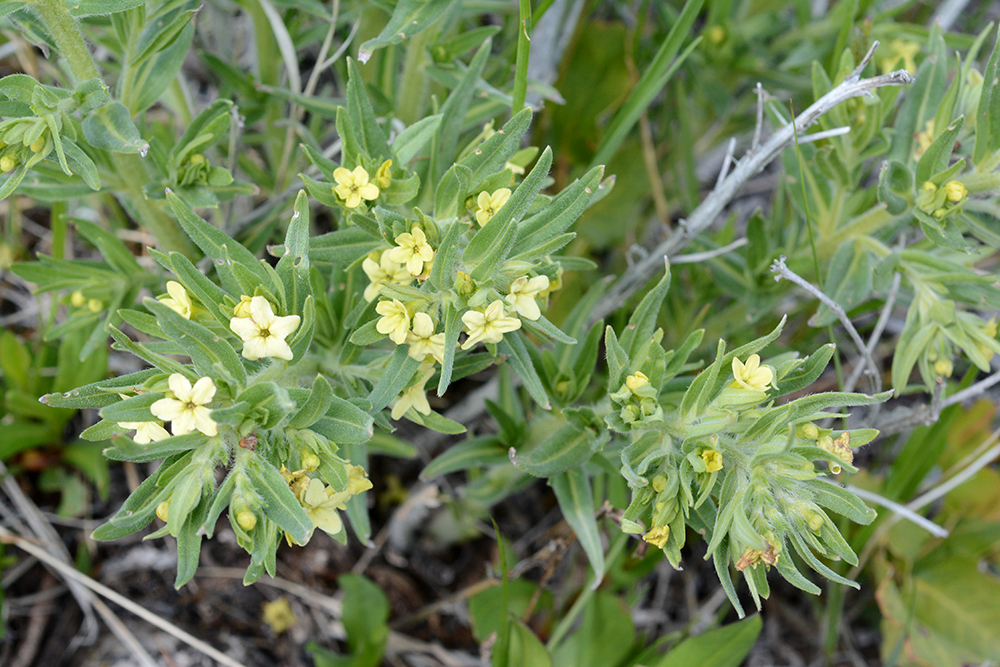
Stoneseed/PuccoonLithospermum ruderale – are robust plants with 1-2’ tall straight stems.  Narrow leaves are 1-2” long, alternating up the stem.

Pale-yellow tubular flowers are clustered and tucked into the axils of the upper leaves. Flowers have a lovely fragrance.

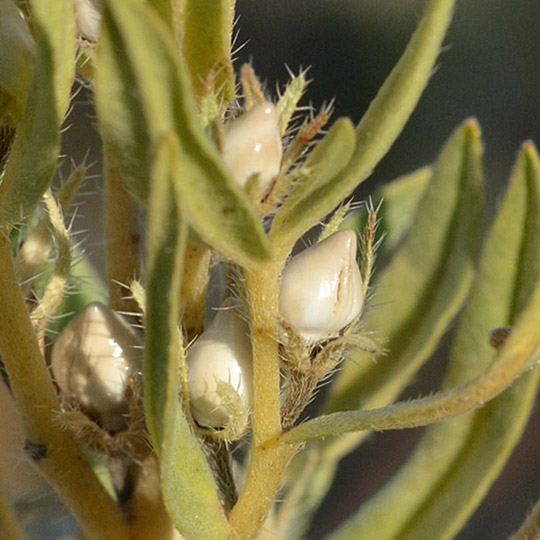
Later they will form very hard white fruits each with one seed – hence its name Stoneseed.  Borage Family

Sulphur BuckwheatEriogonum umbellatum – is just unfurling its flat-topped clusters of creamy yellow to pinkish flowers. 

Note the collar of oval leaves below the inflorescence and the many mat-forming leaves at the base. Buckwheat Family/Polygonaceae

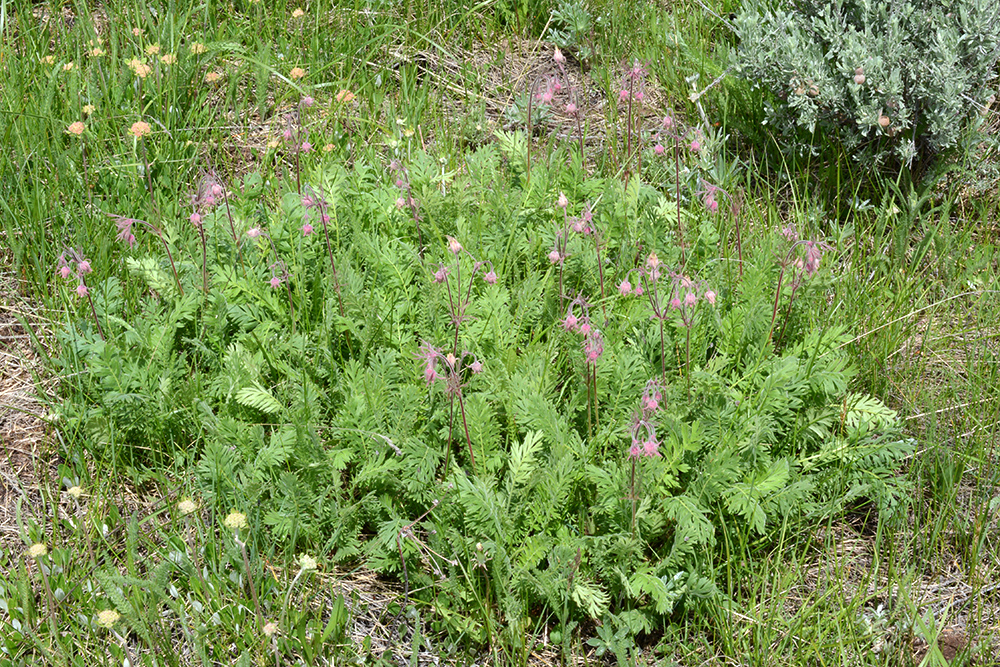
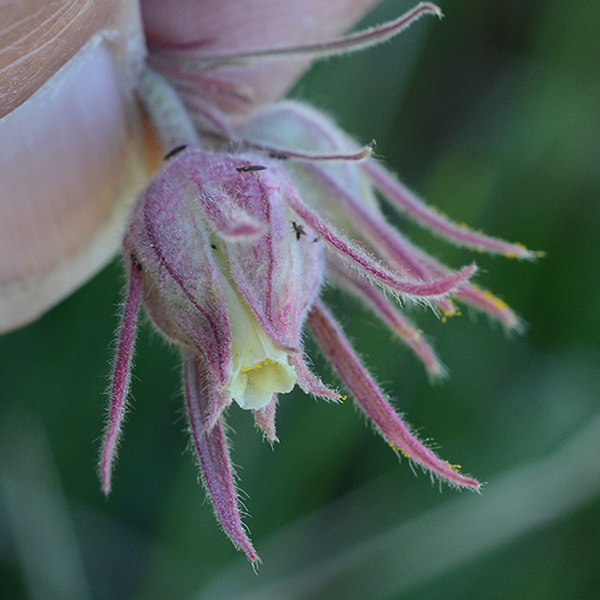
Prairie SmokeGeum triflorum – Usually 3 (-5) pinkish rose-colored flowers dangle about 6-12” above the finely pinnately divided leaves which cluster at the base. 

The 5 sepals are rose colored, with 5 yellow petals barely peering out.

Later the many separate pistils mature into individual fruits with unfurling fine long hairy stigmas that give the plant is Prairie Smoke name.  Rose Family.

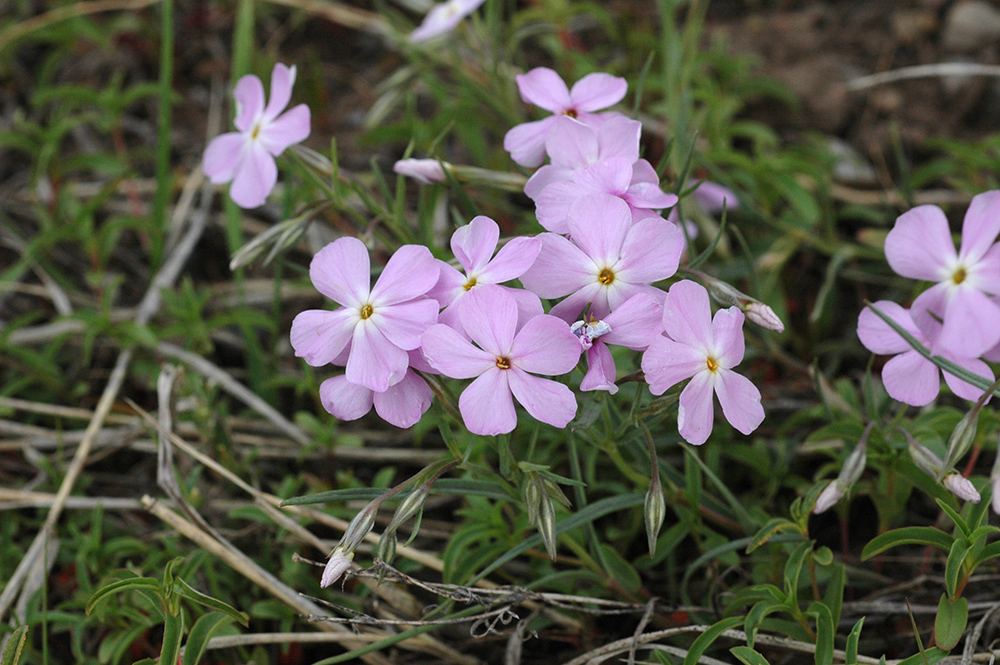
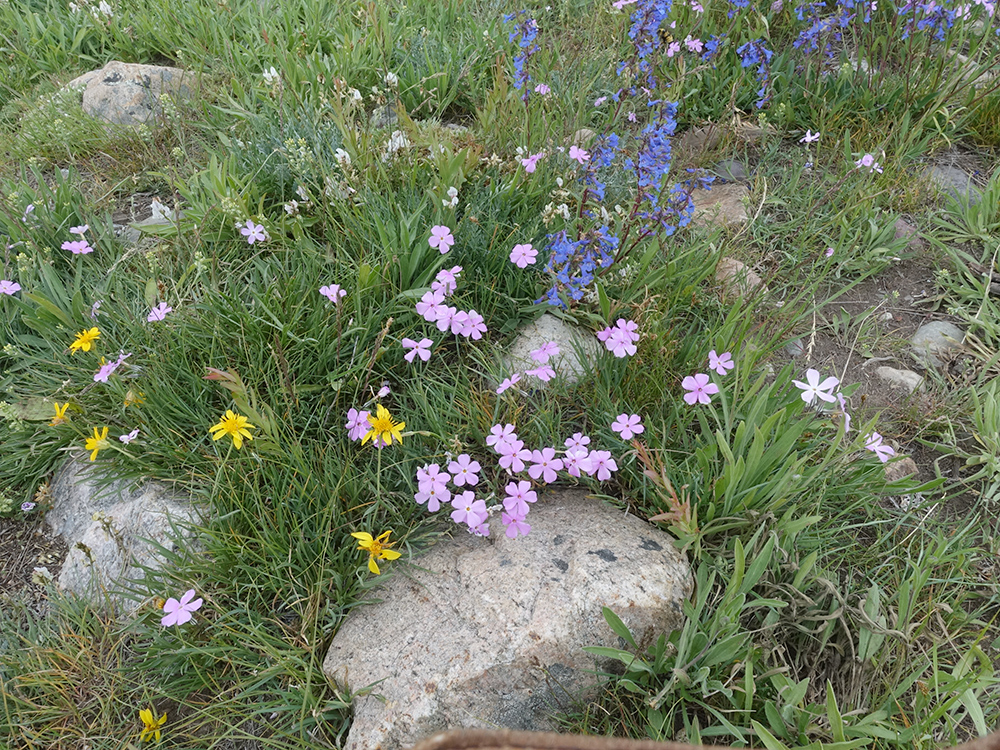
Long-leaved PhloxPhlox longifolia – forms pinkish, bluish to white patches along roadsides, sageflats, and other sunny spots.

This plant stretches its 6-12” stems to display its flowers. The fragrance is wonderful and attracts long-tongued insects that can perch on the flaring petals and reach down into the long tube for nectar. Phlox Family/Polemoniaceae

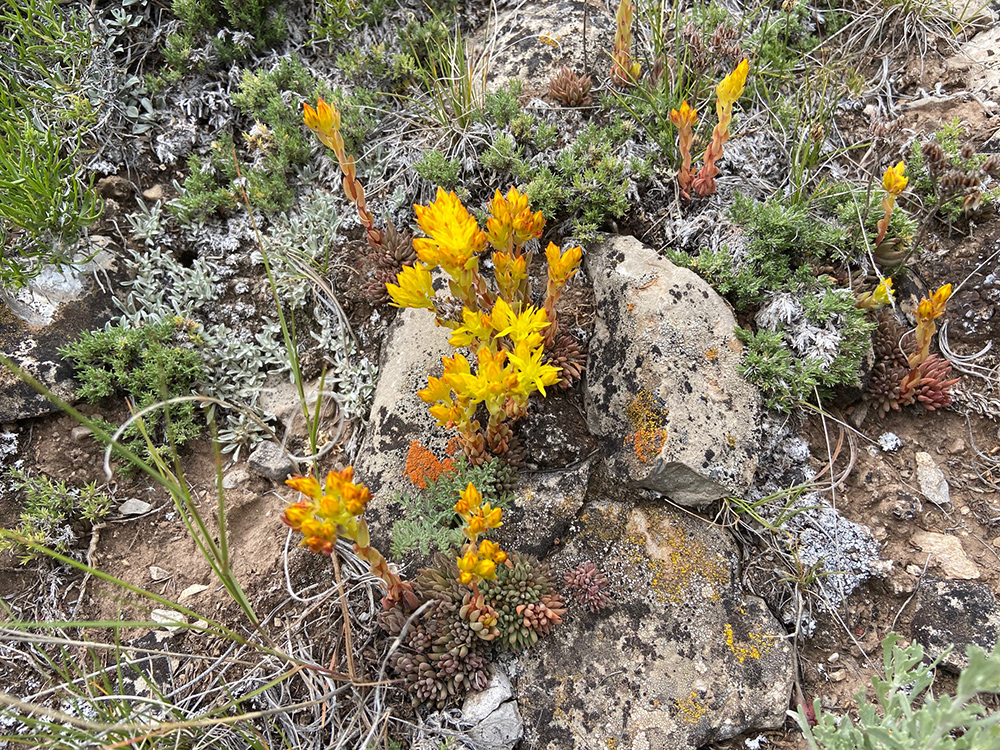
StonecropSedum lanceolata – clusters of 2-3” stems with pudgy ¼- ½ ” succulent leaves grow on rocky sites. The sepals are deep orange but the 5-petaled flowers are yellow when fully opened.

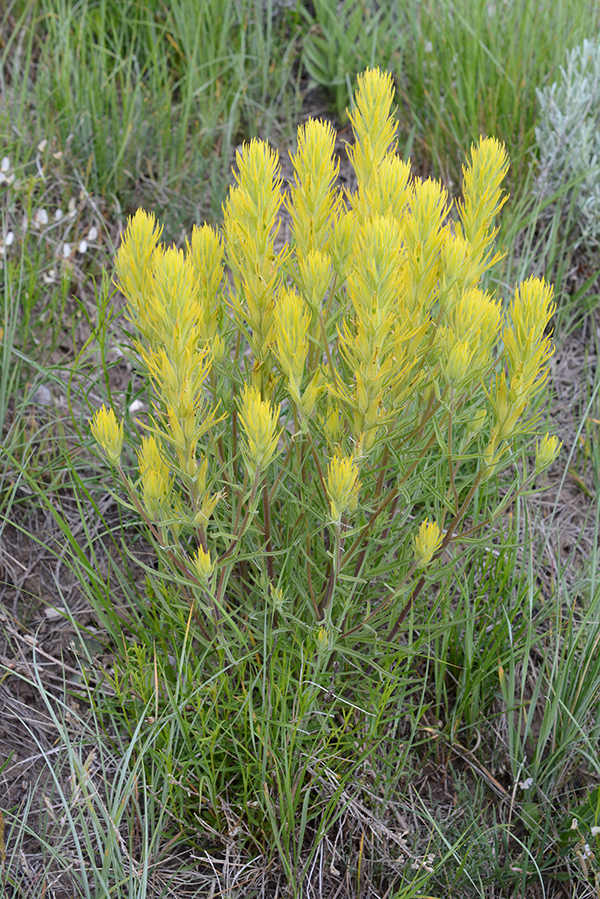
Yellow PaintbrushCastilleja flava var. flava– is frequent on sageflats right now. Growing up to 18”+ tall, it presents yellow flowers held out above the axils of greenish-yellow divided bracts. 

The yellow-green calyx is narrow with two short-pointed side lobes and longer slits back and front.  The mature corolla of 4 fused petals extends beyond the calyx of sepals, often leaning out.  The galea is clearly longer than the lip.The anthers are tucked inside and the stigma will extend out a bit. Leaves are divided into sparse thin lobes. 

As with many of our paintbrushes, this species is a hemiparasite. Its known host plant is not surprisingly sagebrush – Artemisia.

And still flowering strong, are Desert PaintbrushesCastilleja chormosa – in a class of its own for its brilliant, glowing,scarlet color of it bracts and sepals. Its hard to pick the best picture!

In the first fall, the dissected leaves of Scarlet GiliaIpomopis aggregata – form frilly looking, unimpressive rosettes for the first winter.

Come spring stems sprout up to 3-4 feet by end of June and flower. Most plants then die, essentially being biennials.

The seeds will produce, with luck, the next cohort of Scarlet Gilias to greet the next year’s hummingbirds and moths.

Blues:

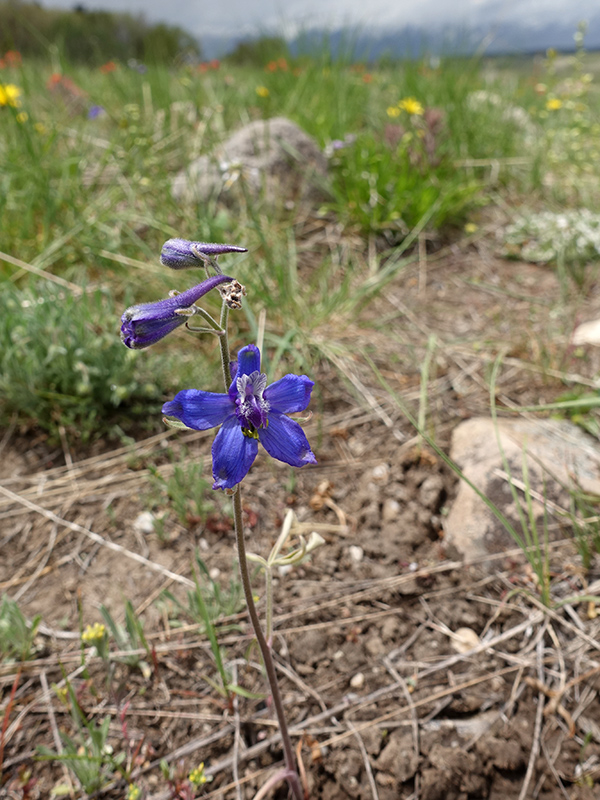
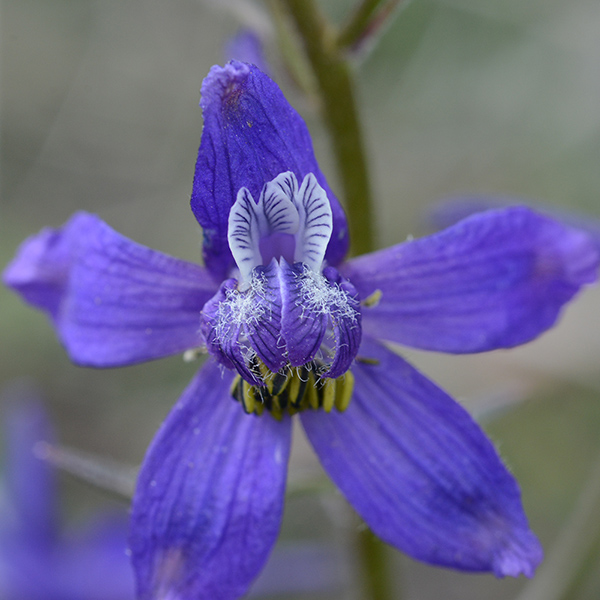
Nuttall’s Larkspur Delphinium nuttallii – is an early-spring larkspur of only about 6-8” high.  The leaves are palmately divided, reminiscent to a bird’s foot. The flowers are deep blue. Delphinium flowers are intriguing. 

Take a close look, and if not in the national park, maybe pick one flower and with all due respect dissect it with some friends as a learning opportunity.  Observe the outer flaring 5 colorful sepals. The uppermost one forms a spur out the back. Of the 4 petals, 2 whitish ones with nectar lines stand upright, firm, and extend tubes back into the spur, holding nectar; the two blue petals with whitish hairs droop below and provide a landing pad for pollinators. They also cover the cluster of anthers. 

Hidden within the anthers are three stigmas that will mature after the anthers have released their pollen to prevent self-fertilization. Nectar held in the two spurs encourages long-beaked birds – hummingbirds – or long-tongued insects to reach deep inside going back and forth between the two tubes, thereby hitting their heads or body on the dangling anthers or later upon the stigmas. Nuttall’s Larkspur differs from Low LarkspurD. bicolor (photo below) – having all similar-sized sepals and the slits (notches) in the two lower petals are >1/4 of their length. I have seen these up in Yellowstone. Buttercup Family/Ranunculaceae

Two LupinesLupinus spp.

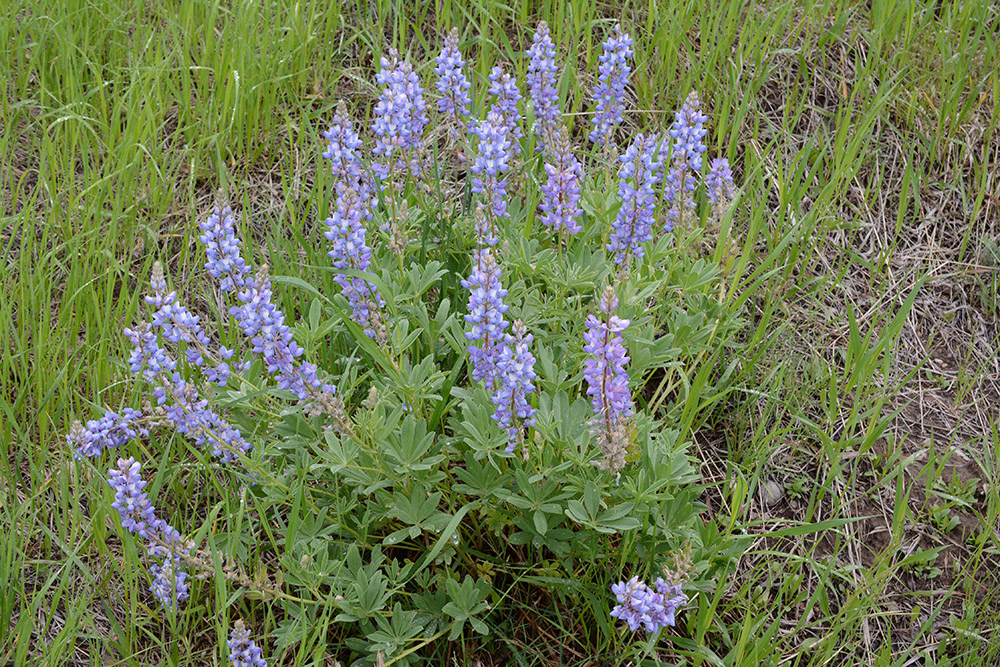
A couple of weeks ago, large 1-2’ blue lupines amassed along cobbly river basins such as seen from the highway while crossing Gros Ventre River or Spread Creek, and from the park road by Jenny Lake and into Lupine Meadows. 

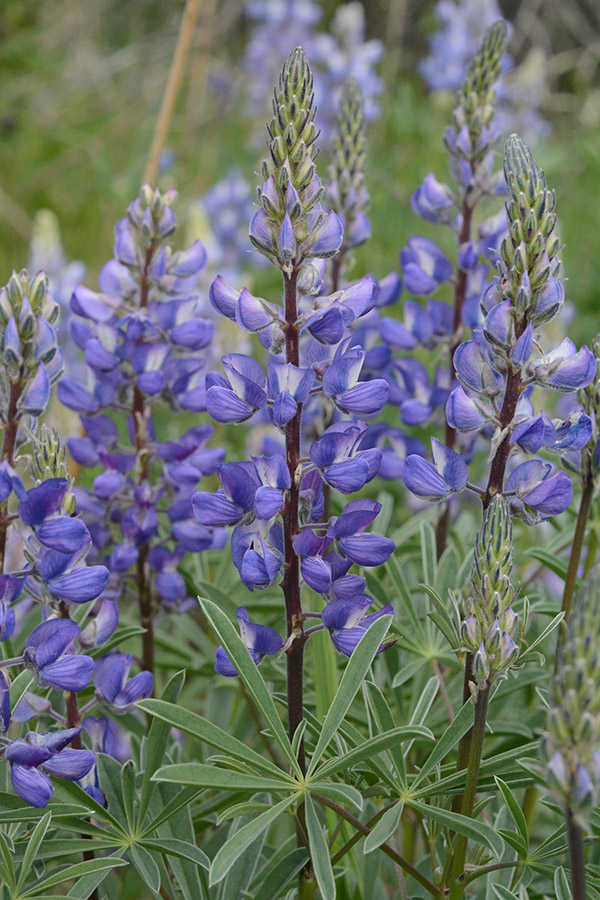
Large-leaf LupineLupinus polyphyllus – has many palmately divided leaves and flower stalks with wide-open blue pea-like flowers. The back of the “banner” is more or less smooth.

Just emerging in sageflats are Silky LupinesLupinus sericeus.  These differ in having

many silvery hairy leaves, forming slightly smaller flowers with obvious silky hairs on the back of the upright petal or banner. 

All lupines are poisonous with alkaloids that are more concentrated in early growth or in seeds.  Being legumes, lupines also can fix their own nitrogen.  Some Paintbrushes – Castilleja spp. – actually attach to lupines underground and draw off alkaloids to reduce herbivory.

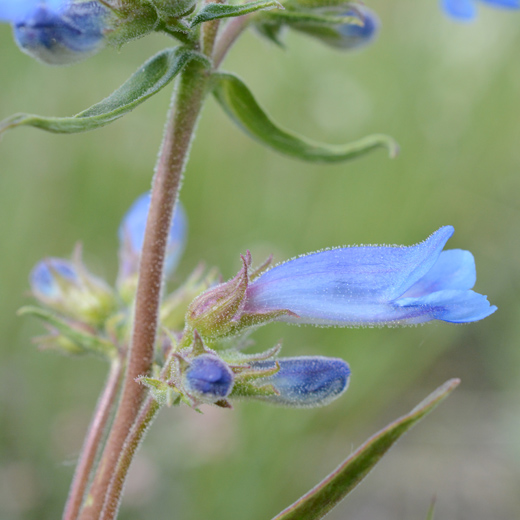
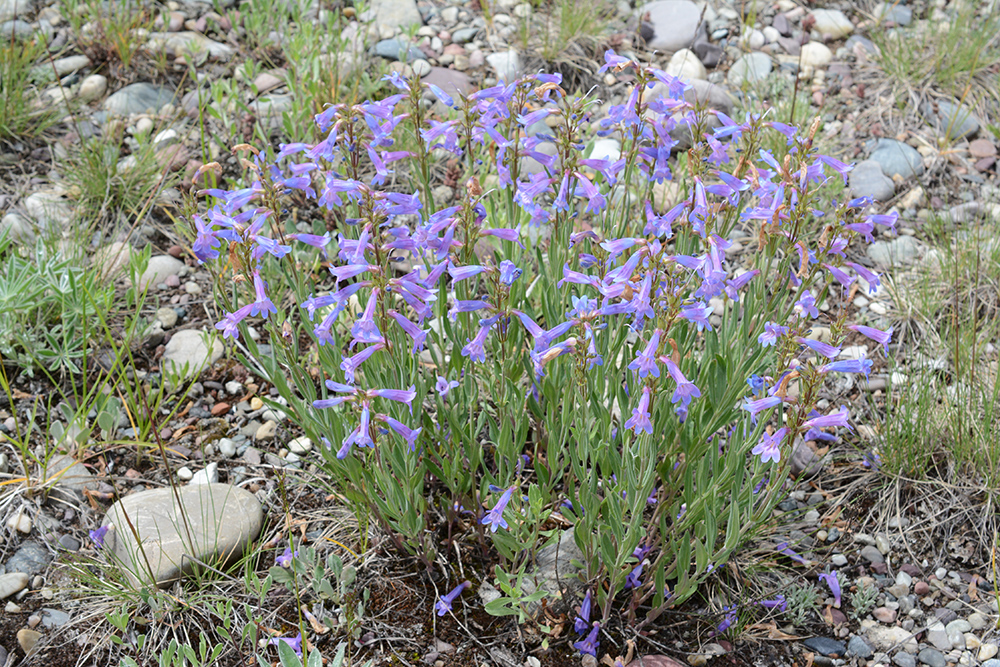
Mat-root Beardtongue – Penstemon radicosus – is in small1-1.5’-tall patches. All Penstemons have opposite leaves and tubular flowers with 4 anthers curled up inside and one tongue-like staminode—a sterile, often hairy stamen–that lies on the floor of the flower. 

We have many penstemons, this one keys out to Mat-root Beardtongue because of the glandular hairs on sepals and petals (and all over the plant), the sepals that narrow to a point, and 1 mm smooth anthers arranged end to end inside.

There is no cluster of leaves at the base of the 18” stems.

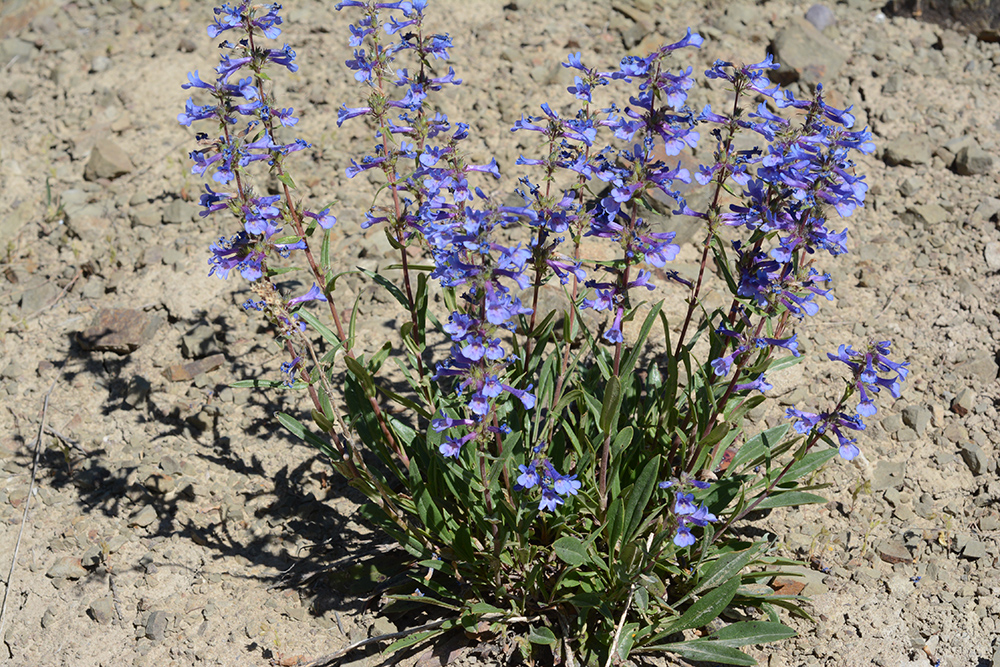
Low PenstemonP. humilis – is technically a very similar species: It has even smaller anthers .5-.8 mm and clusters of elongate leaves at the base.

Some botanists can recognize the gestalt of each species. I still have to key them out–more fun than crossword puzzles or wordle!.

These species, like many penstemons, are pollinated by bumblebees. Snapdragon/ Scropulariaceae now in the Plantain Family/ Plantaginaceae

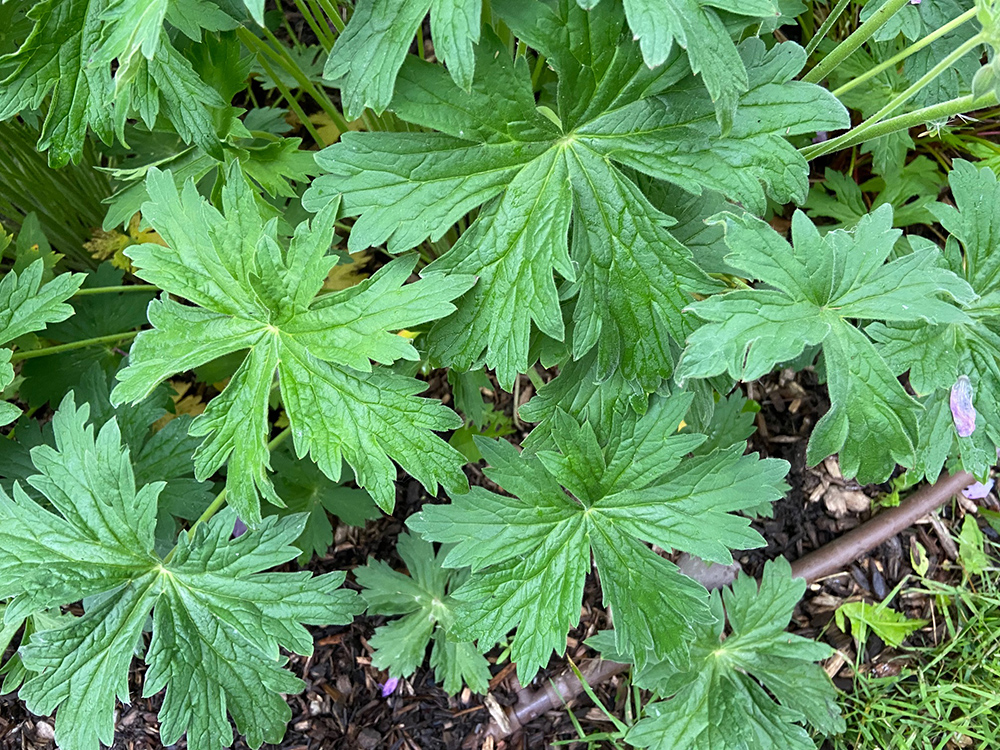
Sticky Geranium – Geranium viscossissimum – is opening its 5 pink to blue petals, attracting a range of pollinators who can land easily and follow the nectar guides to the center of the flower.  Male anthers shed pollen first, then they dry up and a few days later the 5 pinkish stigmas expand ready to catch pollen brought from another flower.

Leaves are palmately divided into sharp-tooted leaflets.

Glandular hairs make the stems sticky. These hairs trap tiny insects, from which plants obtain nutrients! Geranium Family/Geranicaceae

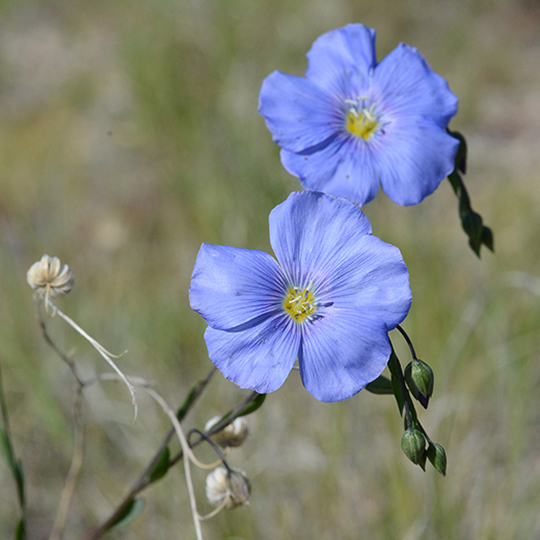
Lewis’ FlaxLinum lewisii – is common along hillsides and roads right now. Its sky-blue saucer- shaped flowers wave atop 2′, slender stems arrayed with narrow leaves. 

Long, strong fibers have made this species and particularly its European cousin Common Flax – Linum usitatissimum  – truly very useful for making cordage, linen, canvas, etc. The oil linseed oil, and flax seeds are used as a dietary supplement. Linoleum also comes from flax. Lewis’ Flax is named after Merriweather Lewis of the Lewis and Clark Expedition. The historical herbarium specimen is dated July 7, 1806, Montana. Flax Family/Linaceae

Whites:

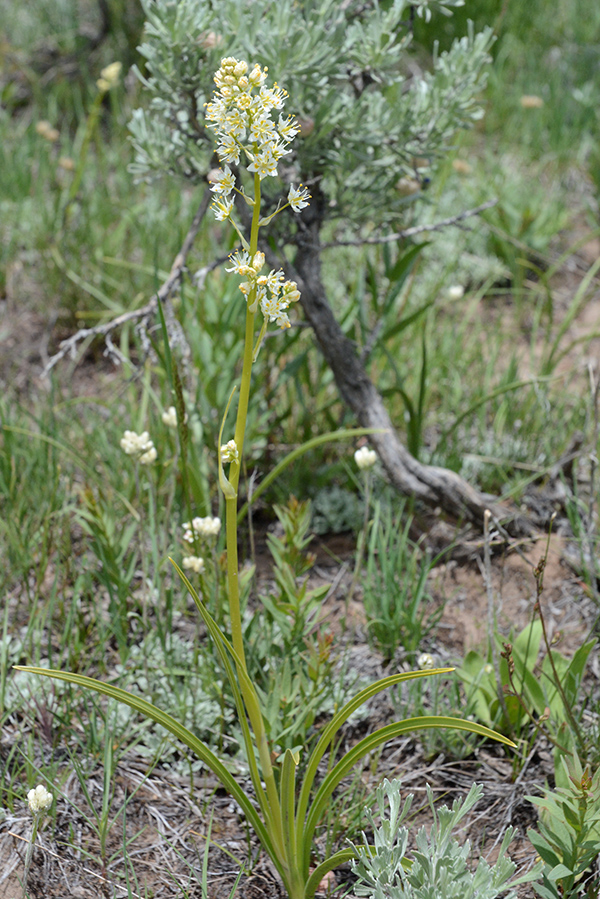
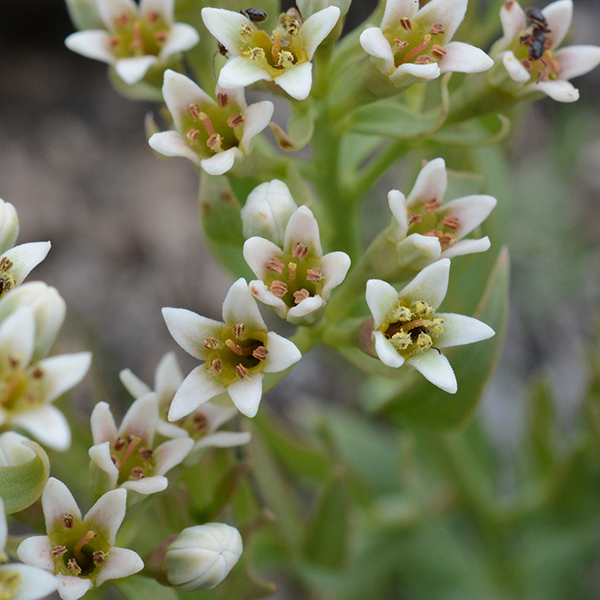
Meadow Death CamusToxicoscordion/Zigadenus venenosus – is indeed poisonous. Plants contain a neurotoxic steroidal alkaloid called zygacine. Dried plants remain toxic for at least 20 years. (USFS)  Look for 6-12”-long, narrow basal leaves and a taller raceme of many white, slightly yellowish (from nectar glands) flowers.

The plants grow up from storage bulbs. Formerly Lily, now Bunchflower Family/Melanthaceae

Often seen among pussytoes or fleabanes, Bastard ToadflaxComandra umbellata  – grows to 4-6”. Plants have alternating bluish green, smooth, lanceolate, 2” leaves. The pinkish buds open into white flowers clustered at the tops; each flower has 5 sepals (no petals) with 5 anthers, and one inferior ovary what will produce a hard urn-shaped drupe. 

This native plant serves as an alternate host of the Comandra Blister Rust which infects lodgepole pines in our area. (It is not the same as the introduced white pine blister rust that plagues 5-needled white pines such as whitebark pines.)  Bastard Toadflax also is a hemiparasite which draws nutrients from a variety of species including pussytoes, asters, wild strawberries, sedges, aspens, and roses to name a few.

The taxonomists are mixed on which family it belongs to. Dorn places it in the Sandlewood Family, and currently Rocky Mountain Herbarium has added in the fully parasitic Lodgepole Pine Dwarf Mistletoe – Arceuthobium americanum.

Others have put Bastard Toadflax in yet its own family Comandraceae.  In any case it is an odd-ball genus has few close relatives in North America, despite its broad range across the continent into Europe.

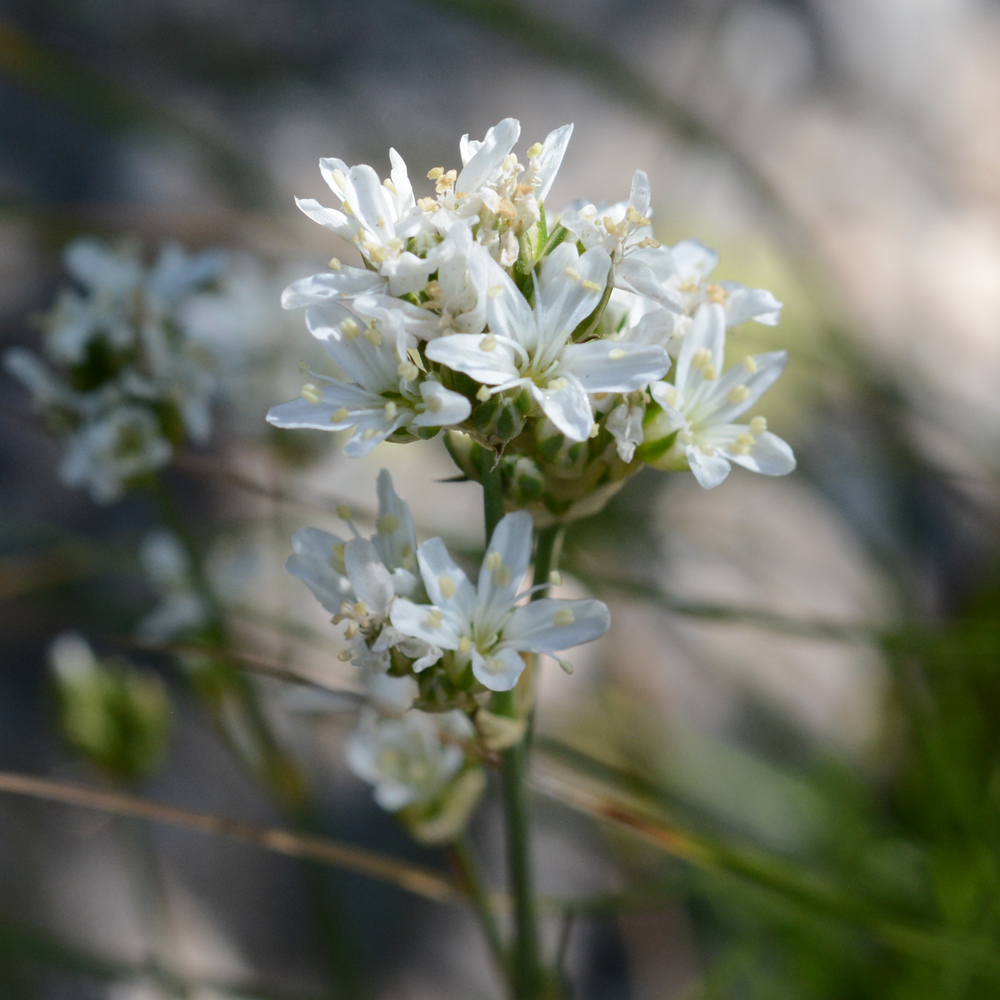
Congested SandwortEregomone/Arenaria congesta – holds up bunches of several white flowers, each with 5 petals, 10 anthers, 3 styles, all atop of wiry 5-6” stems with opposite narrow leaves. Just beginning to bloom. Pink Family/Caryophyllaceae.

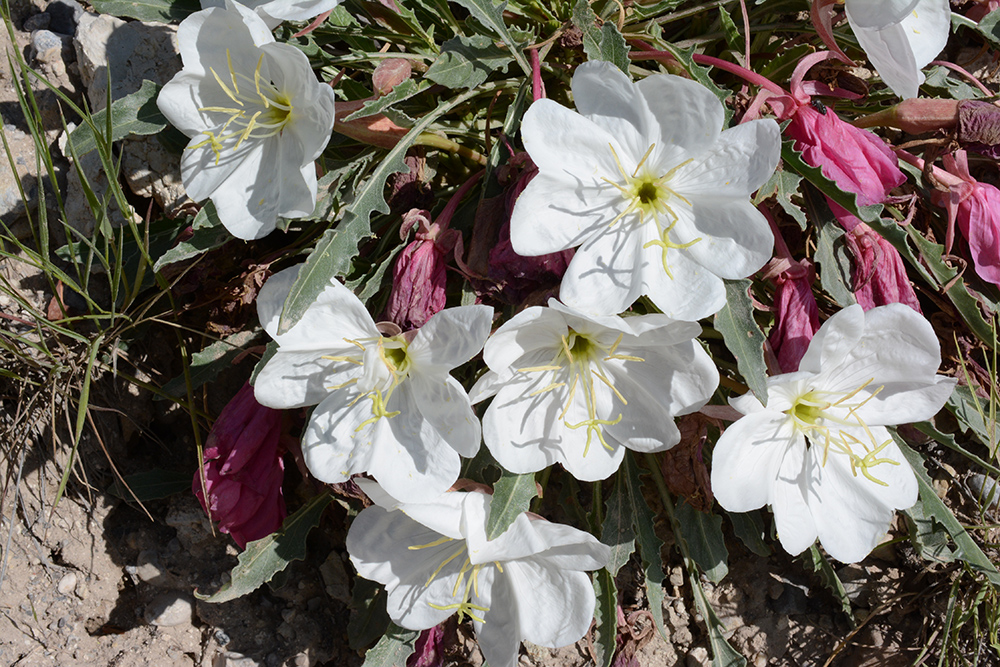
Evening PrimrosesOenothera caespitosa – have huge white flowers that fade to pink and fold up by midday. The fragrance is wonderful, worth getting down on hands and knees. They depend on hawkmoths for pollination. Evening Primroses grow only here and there on usually very dry slopes. It is a bonanza to find this plant. Evening Primrose Family/Onagraceae.

The flowers will keep coming in a variety of combinations to enjoy. The north end of Flat Creek Road, Antelope Flats, the Park Road, Wally’s World, Cache Creek trails are all places to see an abundance of favorites.

Frances Clark, June 19, 2023

As always we appreciate corrections and comments.

Spring Flowers are Popping

May 25, 2023
Many new flowers have emerged this past week with our warm (70s), sunny weather and now rain. Those mentioned in the last posting, such as Spring BeautyClaytonia lanceolata, Utah ButtercupsRanunculus jovis, and Yellowbells – Fritillaria pudica – are blooming strong in the north end of Teton National Park.

New flowers are emerging in sage flats and up slopes:

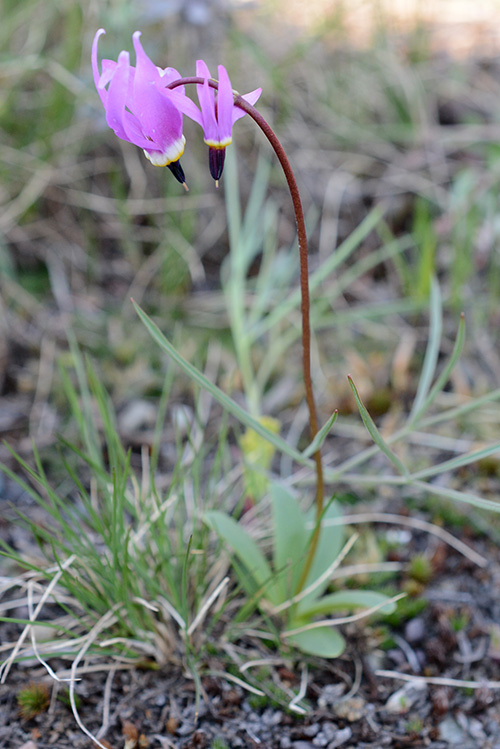
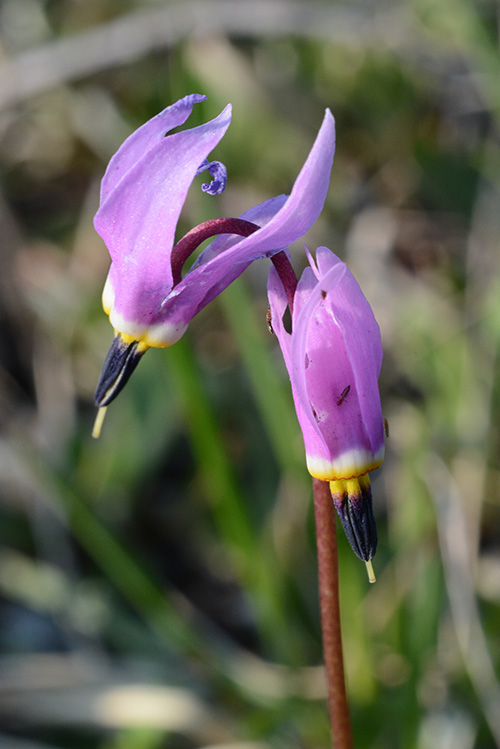
 Shooting StarsDodocatheon conjugens  – grow only a few inches high. 

Five pink petals fold back and five dark anthers ring the protruding single stigma. These plants are buzz pollinated. 

A bee comes in, clings to the tiny clefts at the base of the petals, vibrates its wings at a certain frequency, and thereby releases pollen onto its belly.  It flies to another flower where the stigma is sticking out, and the stigma dabs up the pollen—pollination!

Woodland StarsLithophragma spp.- are patchy along the northeast corner of the Antelope Flats loop, but likely elsewhere as well. Members of the Saxifrage Family, they have sticky hairs and 5-petaled, white flowers. We have three species to look for. 

The most frequent now is Fringe-cup Woodland StarLithophrama glabrum.  Note the white petals each have 3-5 lobes. Also, 8-12” plants have hairy, red bulbils in many of the axils of the divided leaves. The bulbils help the plant spread vegetatively, a bonus in hard spring times when pollinators are scarce.  

Two other species to look for:

Slender Woodland Star – Lithophragma tenellum also has 3-5 lobes to each petal, but no bulbils.  Also, the stem leaves tend to be pinnately (feather-like) divided.

Little-flowered Woodland StarLithophragma parviflorum – typically has only 3 divisions to its petals. The cup-like calyx tends to narrow gradually to its base. Stem leaves are palmately divided.
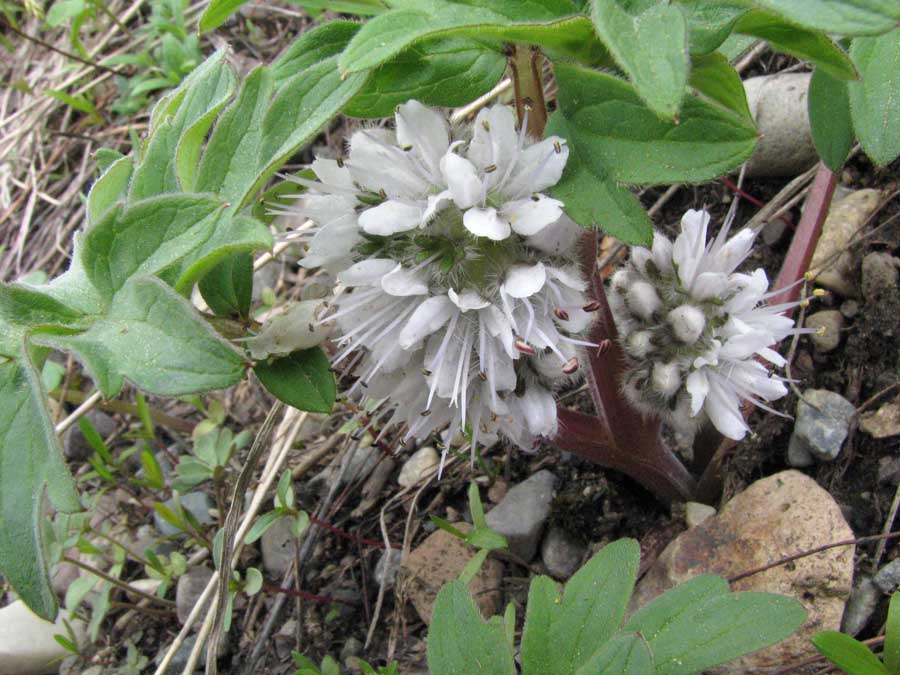
Ballhead WaterleafsHydrophyllum capitatum – are flowering beneath their overarching divided leaves.  You have to lift the leaf to see the hairy snowball-like cluster of many white flowers with elongated anthers.  A fun discovery!

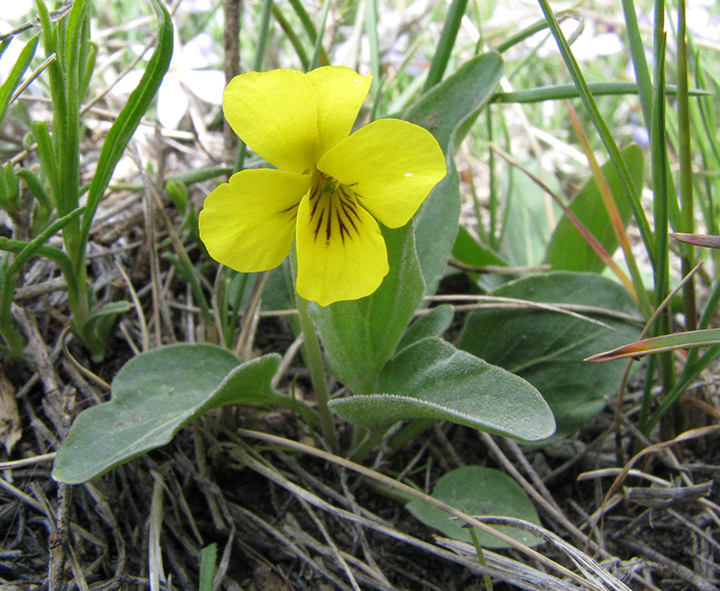
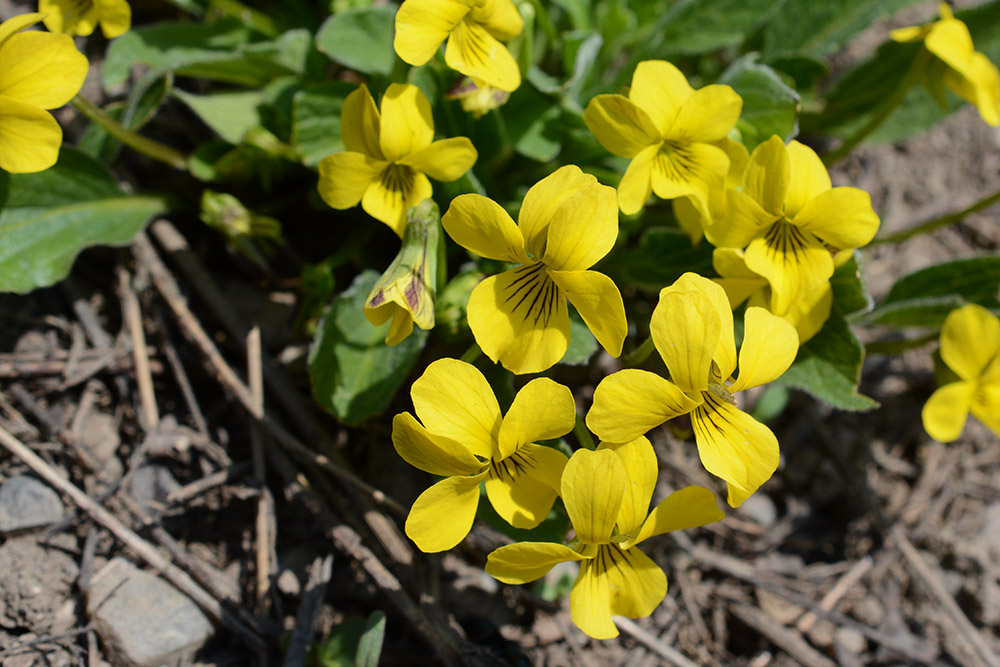
Yellow VioletsViola spp. – First, let’s just enjoy the yellow violets that are emerging! Amidst a bunch of leaves, yellow “irregular” flowers come forth.  “Irregular” means there are two similar sides like your face. 

Note the lines that draw the pollinator into the center of the flower. The insect perches and then pushes its head inside to seek nectar, which is held in the back of the flower; thus, the insect picks up or drops off pollen during its maneuver to reach a sugary reward or pollen itself.

Several yellow violets look similar and can be tricky to ID. Many identification keys use proportions and dimensions of the leaves but leaves are highly variable. Taxonomists separate different kinds/species based on highly technical features: fruit shape, seed details, and genetics. Experts acknowledge the complexity of the matter. 

Without getting into the botanical weeds, we place this species as a variety of Nuttall’s Violet, likely Viola nuttallii var. praemosa or just V. praemosa.

Goosefoot VioletViola purpurea var. venosa – has distinctively lobed leaves, like a webbed goosefoot. The flowers tend to come out a bit later than the Nuttall violet complex.

Wyeth BiscuitrootLomatium ambiguum – is emerging along the Park Road and and will become more prominent in the next week or two. Its umbels of sharp-yellow, tiny flowers have rays that are uneven in length.  Look for the swollen bases (petioles) of the leaves: they are the beginning of a single divided leaf. 

The linear leaflets are irregular in shape, length and arrangement—truly ambiguous in its growth pattern.

Also in the Parsley family (note the umbels!), Nine-leaf BiscuitrootLomatium simplex, formerly L. triternatum var. platycarpum – is growing taller. Compared to L. ambiguum, its umbels are more regular, the flowers a paler more lemon yellow, and the leaves are clearly pinnately divided into similarly sized segments.  This species has at least three common names.  Common names are like nick names – often very localized among friends vs. the botanical names which are like formal legal names. 

Up Josie’s Ridge – (many of these plants are found elsewhere)

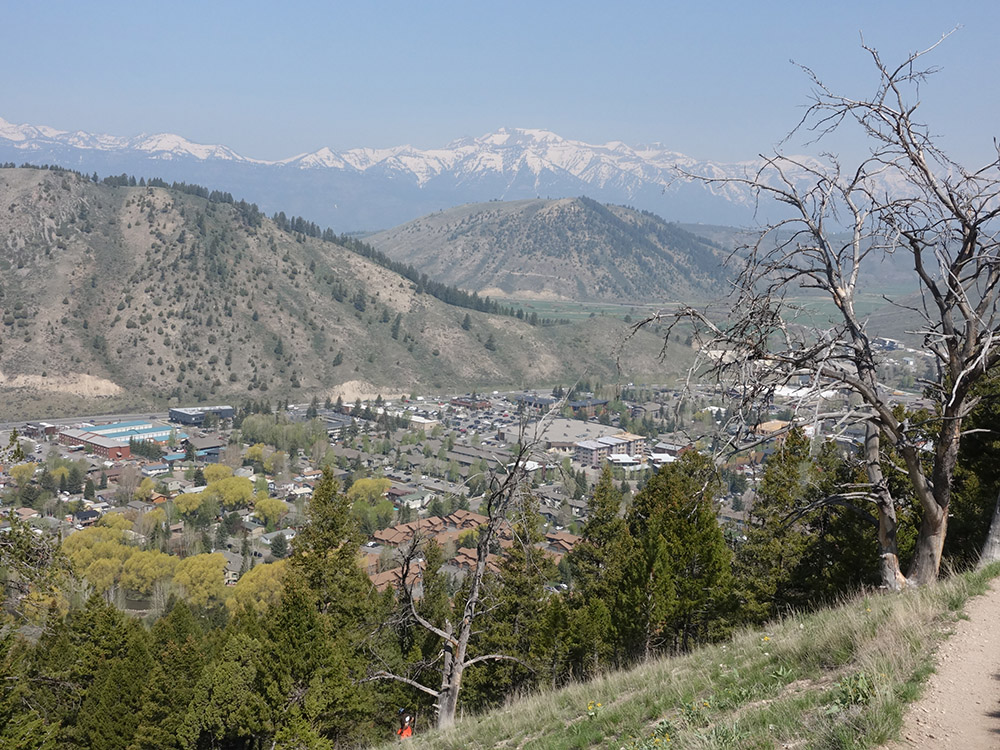
Josie’s Ridge, which runs west of Snow King, rises 1000’ above Jackson. 

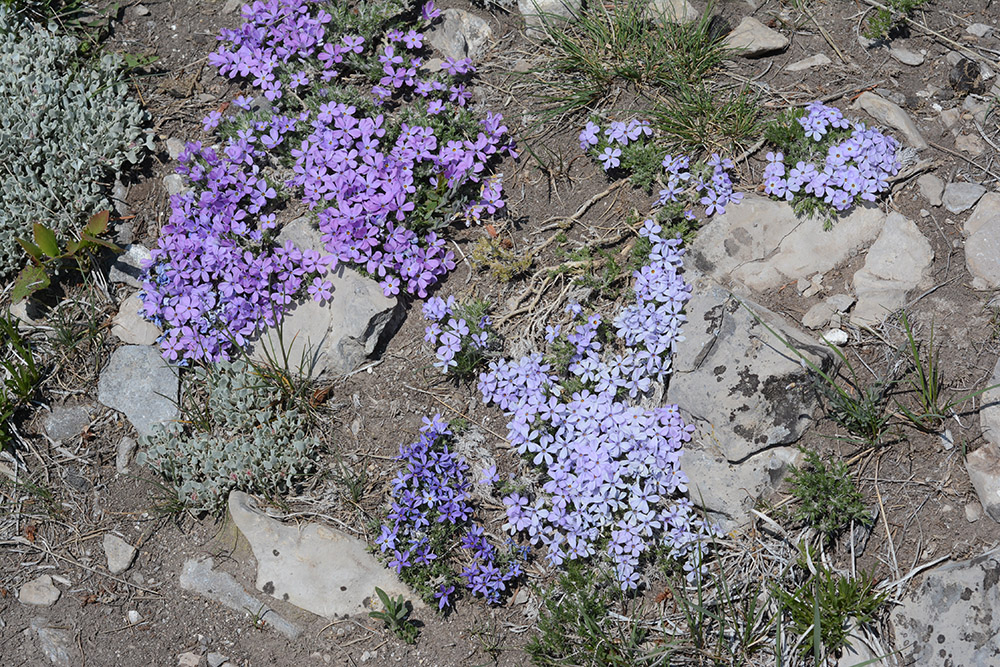
The dry, open lower elevation hosts a wonderful array of varied-blue shades of Hood’s PhloxPhlox hoodii. Elsewhere flowers tend to be white. The difference may be some genetic variation or due to soils. Anyone know the answer?

Take a moment to catch a whiff of the sweet fragrance or get down and put your nose into the bouquet. It is often the fragrance of a flower that draws in the insects from a far, before they notice the color – just as you may first smell a bakery down a side street before you see the sign.  In other places they are beginning to fade in our weekend heat, but again are fresh at higher elevations.

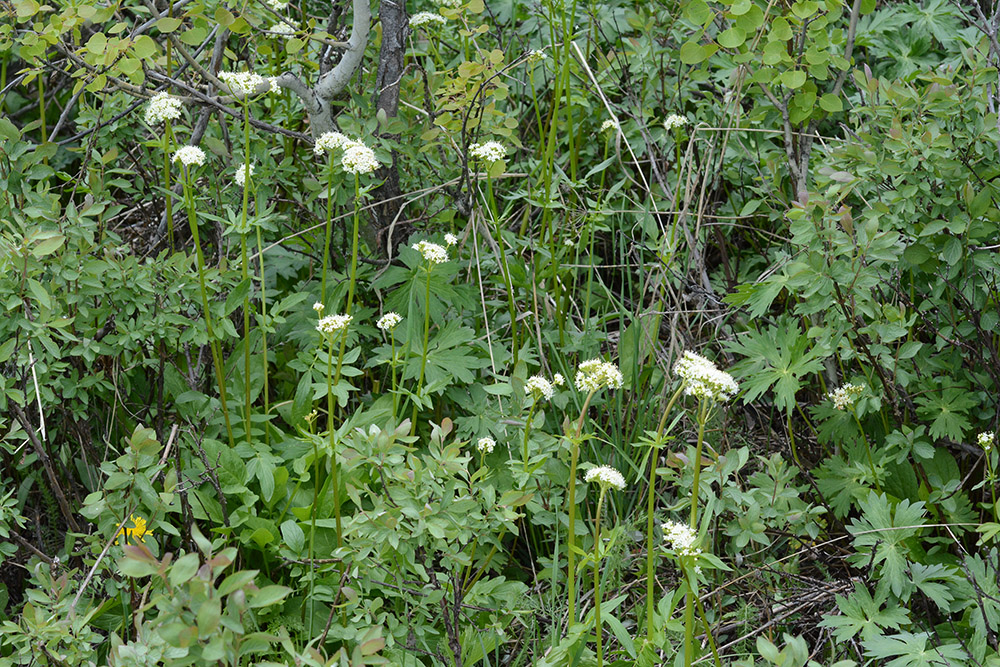
Tucked in more shady areas grow Western ValeriansValeriana occidentalis. Note the candle-arbor arrangement of the flower clusters.  White petals are in 5’s. 

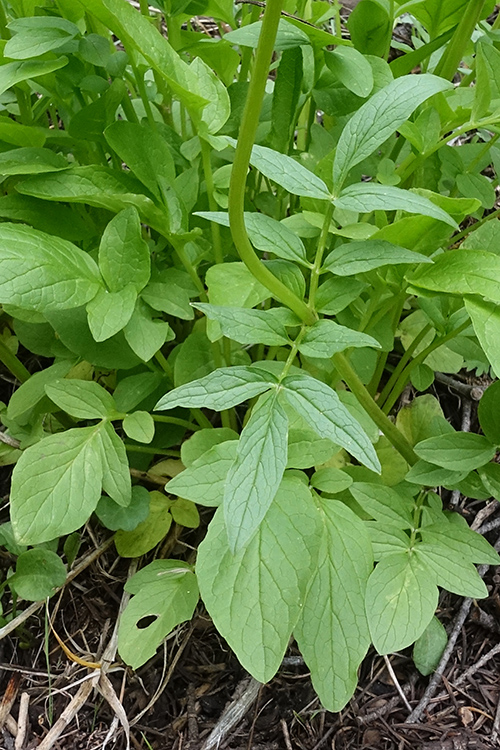
Stem leaves are opposite and mostly pinnately divided, while the basal leaves are in more of a bunch and can be whole. Plants grow to up to 2.5′ tall. 

Valerian root of herbalists is from the European species Valeriana officinalis. It is known as a mild sedative to reduce anxiety and help sleep.  As a general rule, different species in the same genus can have significantly different chemical properties and can have different effects on individuals. Be very cautious when wild collecting for herbal treatments.

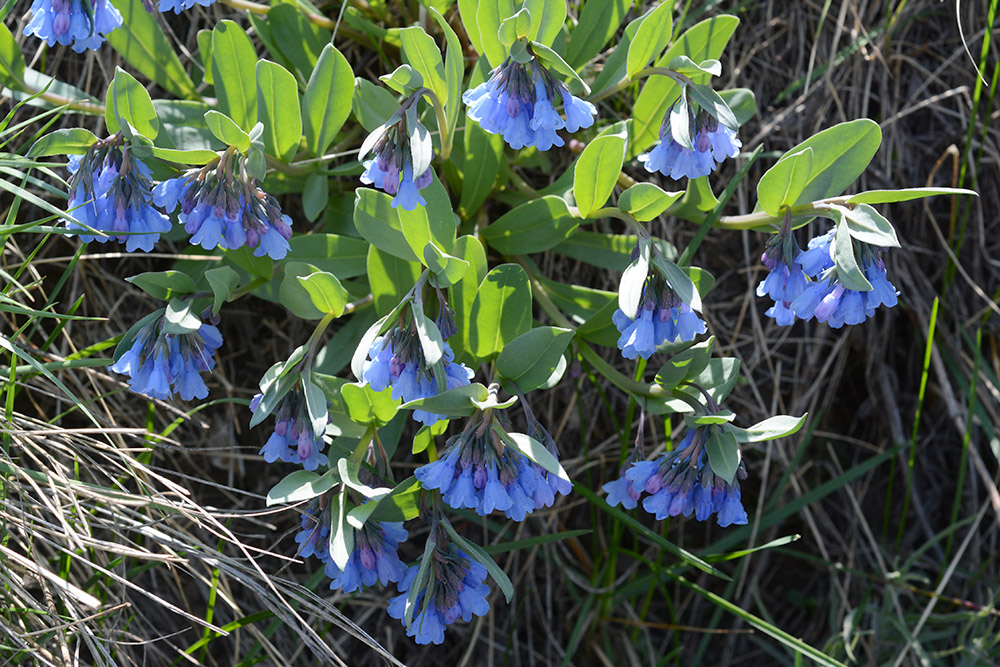
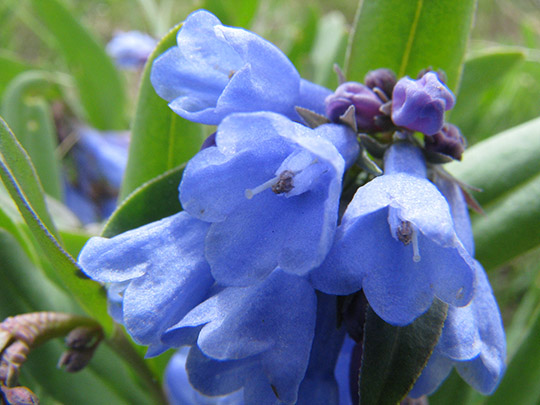
Mountain BluebellsMertensia oblongifolia – grow in occasional patches. 

The dangling tubes of flowers start off pink and then become blue and open up when ready to be pollinated. Pollinated flowers drop off.

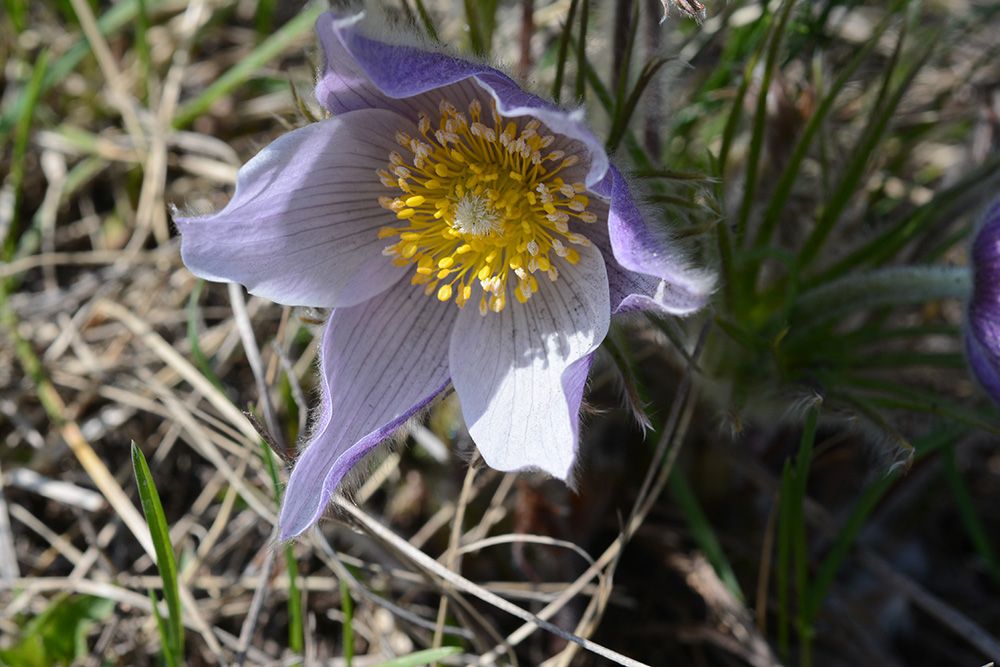
As one climbs up the step switchback trail, one is rewarded by plentiful American Pasque FlowersAnemone/Pulsatilla patens var. multifida.

Seasonal favorites, these members of the Buttercup Family, have 5-7 blue sepals (no petals) that surround many anthers and many separate pistils.  The hairy divided leaves are opposite on the 12” stems. These are all-time spring favorites!

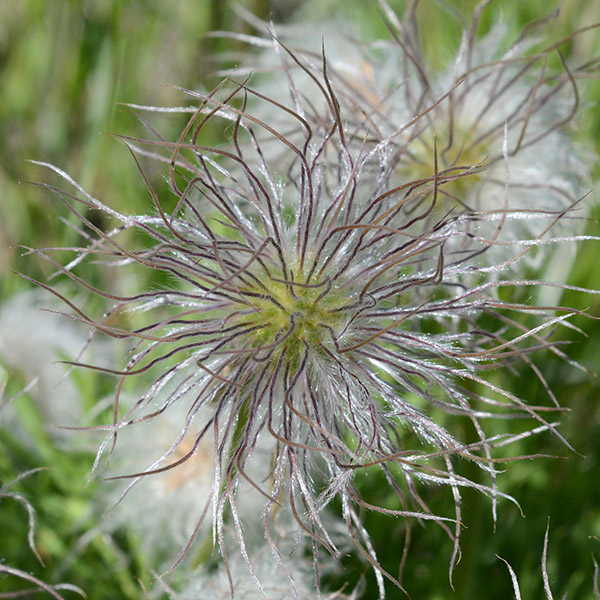
And later they are known as Phyllis Diller or Dr. Seuss plants when the pistils develop into fruits.

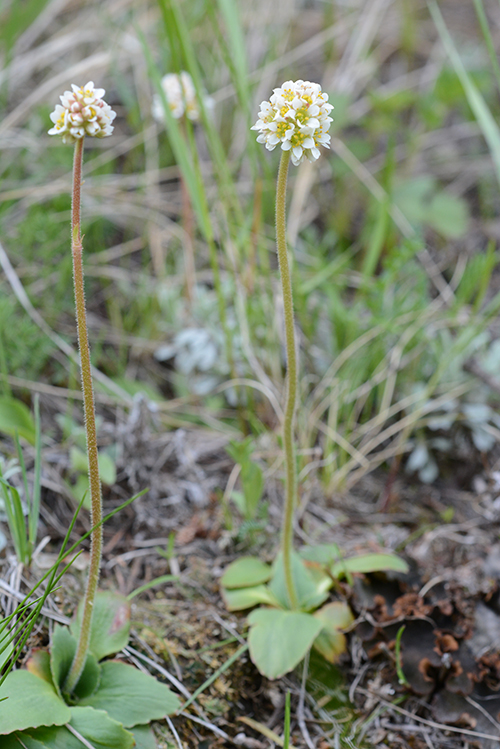
Diamond-leaf SaxifrageSaxifraga rhomboidea – are scattered in the grasses. 

Each white tight flower head stands 6-8” above a cluster of slightly toothed, triangular basal leaves. The stems have glandular hairs.

Typical of the Saxifrage Family, each flower has two divergent stigmas that look a bit like a dunce cap when the pistils ripen into two follicles.

Don’t overlook the few KittentailsBesseya wyomingensis – that stand about 8-10” high. 

The blue color of the 2-3” inflorescence is created by many stiff violet blue filaments of the stamens tipped with darker stigmas. Each flower has two stamens and one pistil with two minor bracts at the base. The leaves are soft hairy—actually most of the plant is “furry”—perhaps the source of the common name. In some places Kittentails have already gone to fruit.

The Latin Besseya is likely honoring the Mid-western botanist of the mid- to late 1800s, Charles Edwin Bessey, as was Bessey’s Locoweed (see below). Plant names, both common and scientific, have lots of stories behind them.

At the top Josie’s Ridge and also other dry sites, Scarlet PaintbrushesCastilleja chromosa – are beginning to emerge.  Hard to miss.  The bright red flower clusters almost glow as the hairs catch the sunlight. All paintbrush flowers are complicated: the bracts and sepals, not the petals, usually provide the color to lure in pollinators – red often attracts hummingbirds.

They are now plentiful at the north end of Flat Creek Road.

On other dry knolls, ridge lines, and slopes, often mixed in with creamy Pursh’s MilkvetchAstragalus purshii,

is another member of the Pea Family, Bessey’s LocoweedOxytropis besseyi. The leaves of the two species are very similar—pubescent and pinnately divided, mostly basal.  This Locoweed species has tightly clustered pink flowers with the familiar shape of many members of the Pea Family: upward facing banner, 2 side wings, and keel that protects the stamens and pistil.

Look closely to see the outward protruding point of the keel (vs. the curved-up tip of the Milkvetch). To remember this pointy feature and the Latin name of this genus, I think of being gored by an ox.  Oxys-tropis is Greek for ‘sharp point‘).

Both Milkvetches and Locoweeds are highly toxic to humans and other mammals.  All parts contain an alkaloid swainsonine that affects the central nervous system, reproductive system, heart, and intestinal systems, and lycocytes. It also affects behavior e.g. makes one “loco”.  Here is a link to more info.

In the time of compiling this What’s in Bloom, more flowers are happening.

Arrowleaf BalsamrootBalsamorhiza sagittata – are running up the south side of East Gros Ventre Butte.

Nuttall’s LarkspurDelphinium nuttallii – are flourishing out Flat Creek Road. 

So many more flowers are opening each day!

Frances Clark, Wilson, WY

As always we appreciate your comments and corrections at Tetonplants@gmail.com

Spring has finally come again as have the flowers!

On recent forays around Moose, Kelly Warm Springs, and out Flat Creek Road, eager botanists have found an array of early spring favorites. Often you have to get down on your belly to see the cool identification features (belly botany).  With so few flowers to date, this “What’s in Bloom” focuses on how much you can see if you really look.

Among sage flats or under open cottonwood stands:

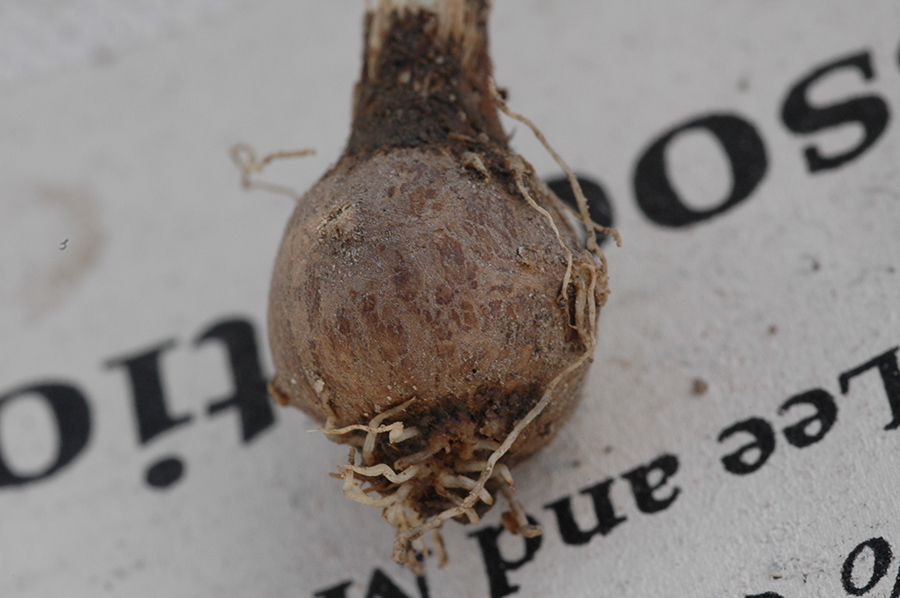
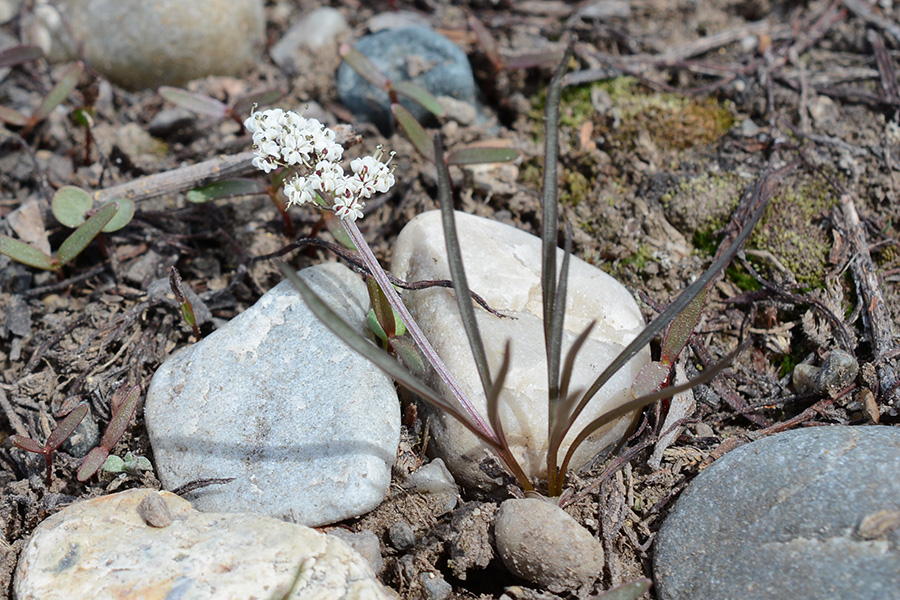
Very early, and requiring a keen eye to find, are Turkey Peas – Orogenia linarifolia. The “peas” are underground bulbs. These starchy features are relished by squirrels and likely burrowing small mammals, such as voles and pocket gophers. 

The leaves are indeed linear as the botanical name implies – actually long lobes of divided leaves. The white flower clusters are barely an inch across and likely pollinated by tiny flies or gnats.  Turkey Peas are very small members of the Carrot/Parsley Family – Apiaceae.  Several more members of this family will be emerging this spring.  They can be tricky to ID, especially as the fruits are often the definitive key feature. Patience required.

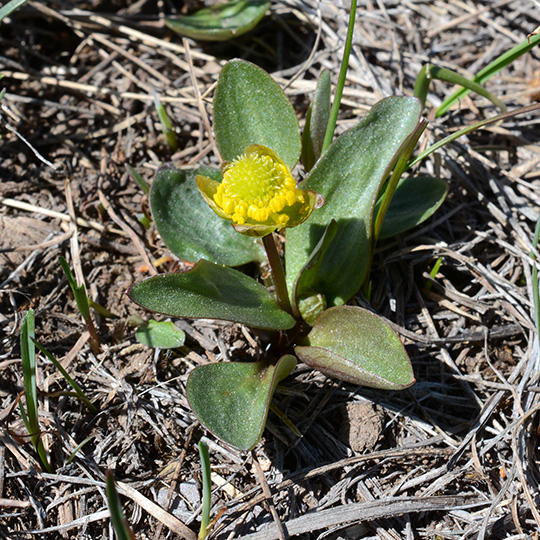
Sagebrush and Utah ButtercupsRanunuculus glaberrimus and R. jovis – are adding sunny sparkles to flats and slopes. 

Sagebrush Buttercups have simple leaves

while Utah Buttercups have 3-lobed leaves. The flowers are typically 5 petaled, but some have none.

The glossy look of buttercup flowers is a result of morphology and physics of the petals. See: Glossiness of Buttercups

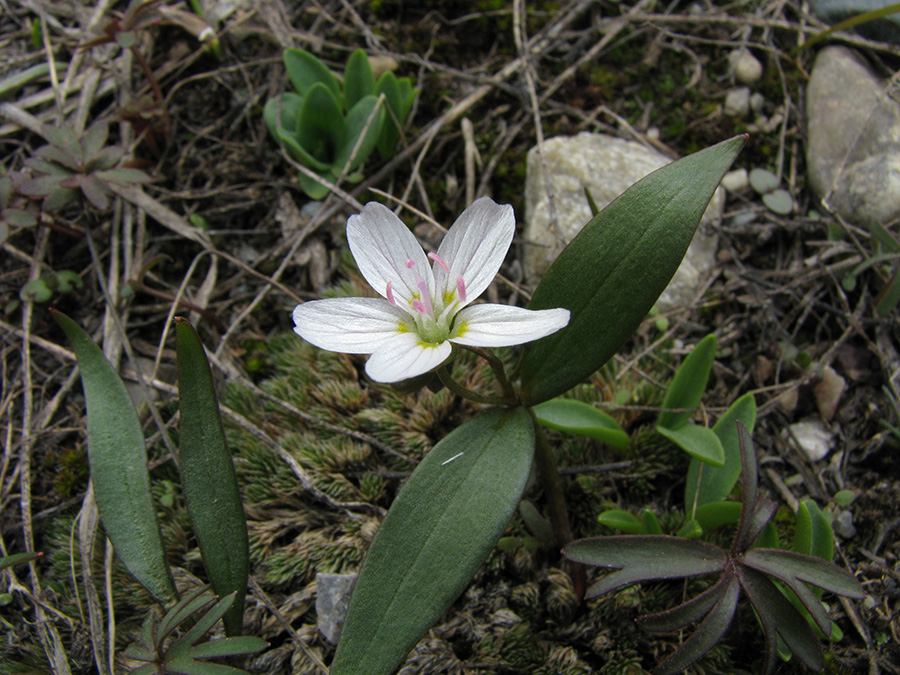
 Spring BeautiesClaytonia lanceolata – are just unfurling their opposite leaves and expanding their white flowers—5 petals with 5 delicate pink anthers. 

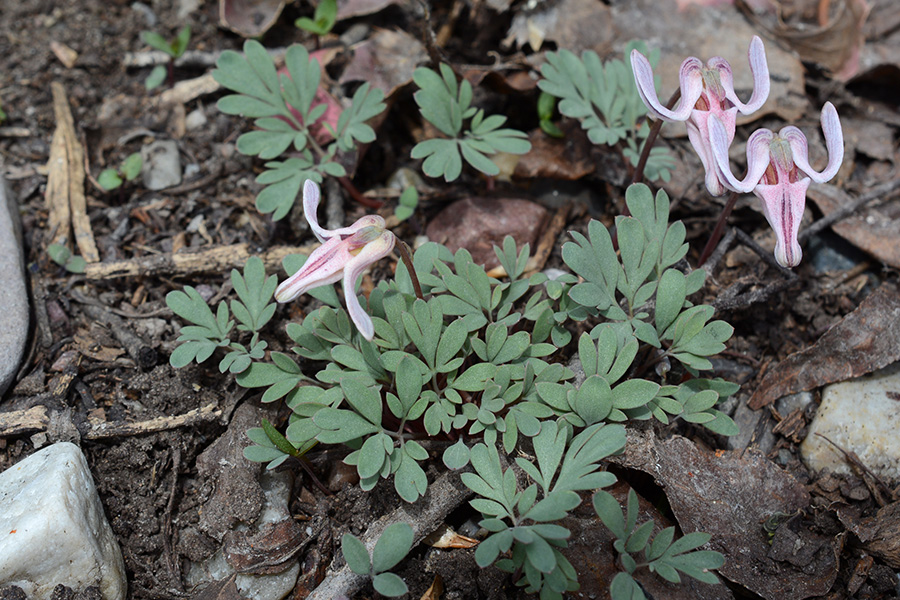
Also, a challenge to discover, but definitely worth the effort, are Steer’s HeadsDicentra uniflora. Look for the bluish, roundish leaflets and then for the expanding flowers only an inch or so off the often-pebbly ground. Their flowers epitomize the West!

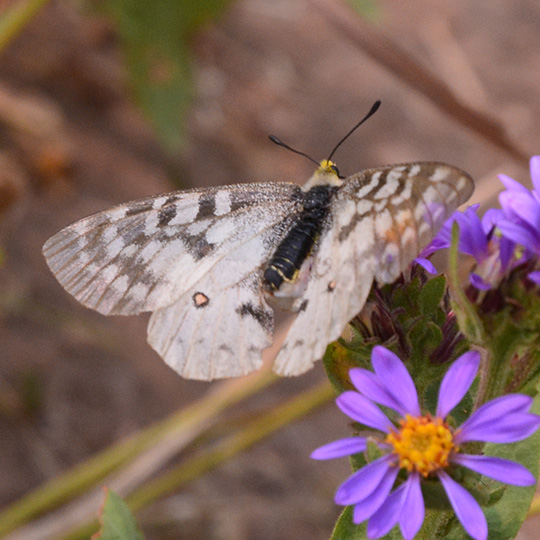
The plants go from flower to seed within 3 weeks and the leaves soon disappear – they are termed “spring ephemerals” for their brief spring appearance. Research indicates that it may take 10 years from seed to the first flower.  The plants are also host plants for the larvae caterpillars of the Clodius Parnassian Butterfly – Parnassius clodius
A lot of cool info for such tiny plants. Tread carefully!

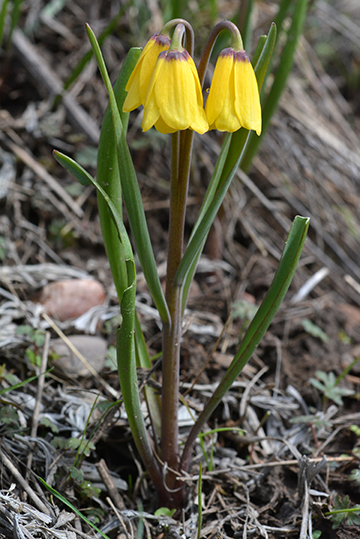
YellowbellsFritillaria pudica – are still scant.  In the Lily Family, the yellow flowers bear 6 yellow “tepals” held about 6” above ground.

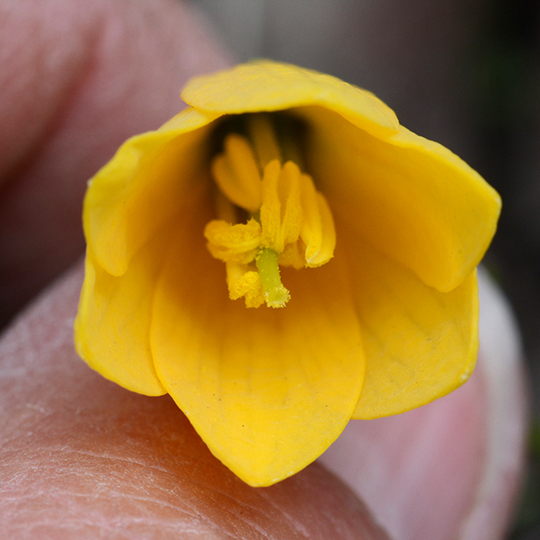
Flying low where the spring sun is warming the soil and the wind is reduced, pollinators such as flies and bees search for early nectar and pollen as seen inside this flower.

Once a flower is fertilized, researchers say it’s petal color will change from yellow to an orange, signaling pollinators not to waste time visiting it: go to nearby flowers instead. This adaptation helps other members of the local yellowbell population to be fruitful. See if you can observe this change: carefully look inside for withered anthers and growing ovaries. I haven’t quite seen it myself.

Here and there, such as in South Park Feed Ground and near the park rotary, Cous BiscuitrootsLomatium cous – are sprouting. Look for the dissected, deep green, mostly smooth leaves with reddish petioles and fists (umbels) of tiny sharp-yellow flowers.

At the base of each flower cluster or “umbel” are broad, rounded involucral bracts – a key ID species for this member of Carrot/Parsley Family.

Biscuitroots have swollen tubers which have been eaten raw or dried and pounded into flour that was used to make biscuits.  Fruits will be flat and split.

Also, in the Carrot/Parsley Family – Turpentine Spring ParsleyCymopteris terebinthus – has finely dissected leaves with a tangy fragrance when crushed. The flowers are also yellow and arranged in umbels (think of the spokes of umbrellas), but here the involucel bracts are elongated and pointed. 

These plants will form quite large mounds of fine leaves and many winged fruits. Fruits are usually needed for definitive ID of members of the Parsley Family (Apiaceae). They are termed “schizocarps”–split fruits. Turpentine Spring Parsley tends to grow in shaley soils.

Dry rocky slopes and knolls, such as found in the hills on the east side of the Jackson Hole, feature special species:

One of the earliest and most common flowering plants are Hood’s PhloxPhlox hoodii.  Related to garden phlox, Hood’s Phlox have small white-to-bluish flowers on very compact plants. Leaves are tiny, sharp, opposite, with “cobwebby” hairs. 

The tubular, fragrant flowers are furled in bud.  When the flowers unfold, a bee or fly which  is attracted by scent then color lands on the flared petals and then inserts its proboscis down into the tube for nectar, picking up or dropping off pollen grains during its visit.

Overall, the plants are smaller than the later-blooming Multiflora Phlox.

One of the smallest blooming wildflowers are Low PussytoesAntennaria dimorpha. Indeed, the mat-forming plants are less than an inch or two tall. 

Get down to look for the flower heads: Individual flowers are termed “disc” flowers and are arranged in composite heads. Male flowers produce pollen. Most of the plants I have been seeing so far are male. (photo below)

Female flowers produce delicate white stigmas surrounded by pappus hairs to catch pollen picked up by wind from any male plants nearby.

Like other pussytoes, plants are dioecious: male and female flowers are on separate plants. More species of pussytoes will be blooming soon.

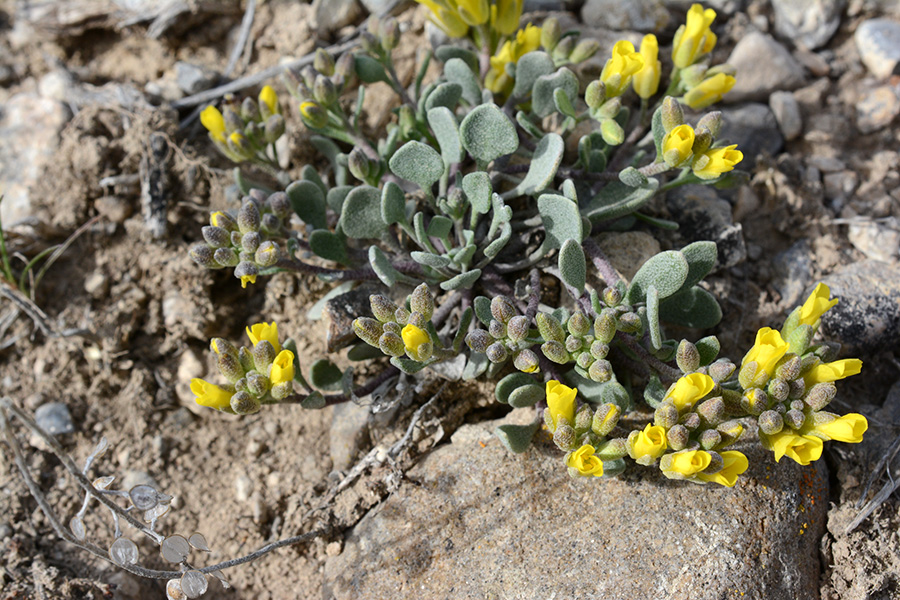
Members of the Mustard Family (Brassicaceae) are often the earliest to bloom.  Twinpods and Bladderpods (formerly Lesquerella) are now all in the genus Physaria. Generally, the genus sports silvery, stiff, often spade-shaped leaves. Precise ID features include hairs(!) and fruits; and with fruits in hand, you may still need to count the number of seeds to know the species for sure.

But for now, just enjoy the cheerful color of the 4 yellow petals and the plant’s ability to grow on rocky, dry, infertile ground. If you have a 10x handlens, you may enjoy the fancy star-shaped hairs.

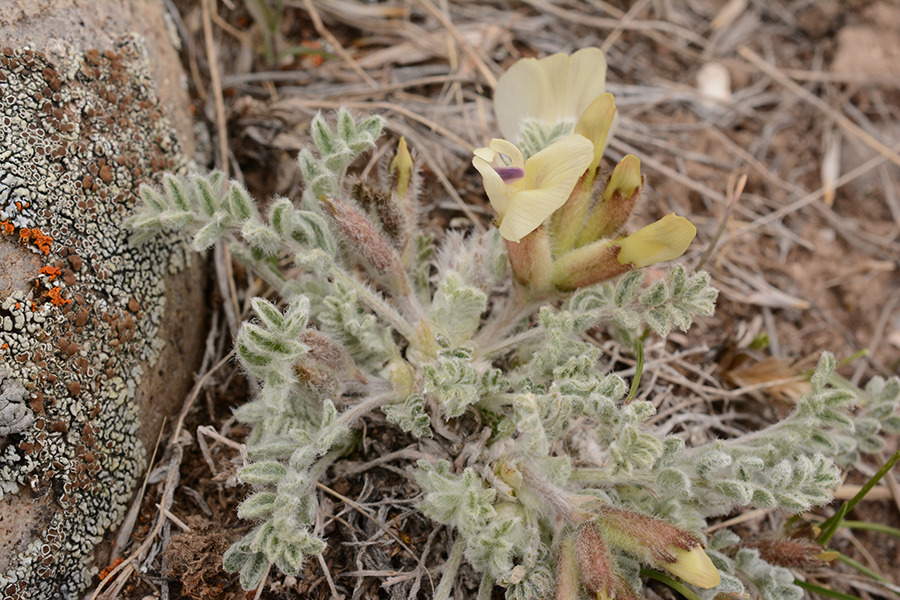
Also emerging are members of the Pea Family, Woollypod MilkvetchAstragalus purshii.  The fuzzy, pinnately compound leaves are unfurling on rocky south-facing slopes near Kelly Warm Springs.

The pea-like flowers have white to cream banners and wings and purple-tipped keels. Fruits will be very hairy, short tough pods with sharp tips—hence “woollypod” milkvetch. Many fruits from last year are still lying about. 

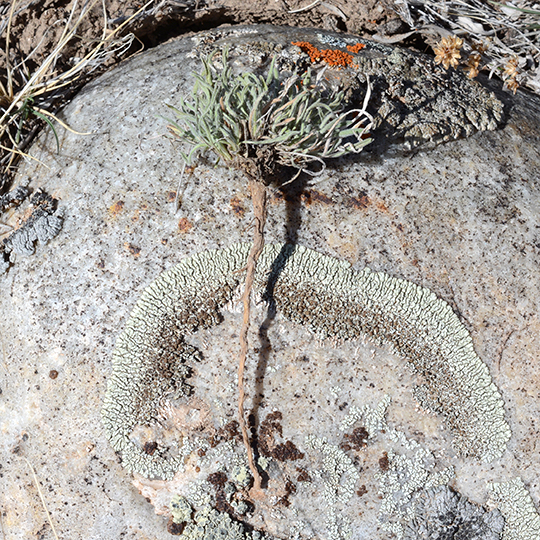
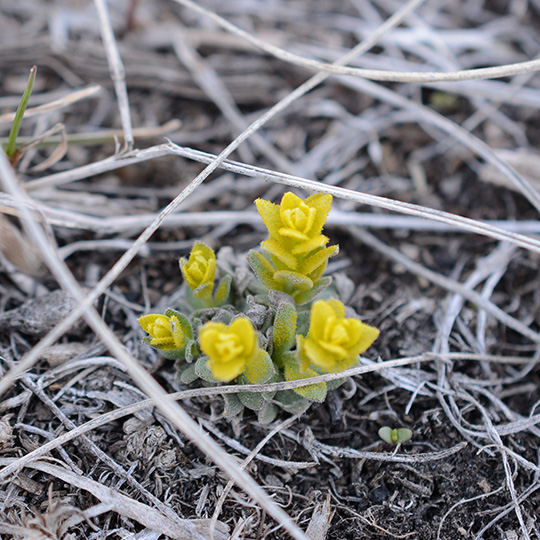
A special find is Common TownsendiaTownsendia leptotes – These perennials in the Aster Family are slow growing with 1” flower heads surrounded by many tiered, pointed bracts.  The pubescent leaves are elongate and a bit fleshy. Growing close to the ground, plants tend to tuck in among small rocks.

The photo of the tap root was taken of a plant that was uprooted for some reason—did an elk take a nibble and spit it out?  Note the root extends deeply to reach scarce water.

Don’t be fooled:

A common rockcress – Boechera or Arabis sp. – can fool you and insects by looking like they have bright yellow flowers. The leaves of rockcress can host a yellow fungus Puccinia monoica.

Fungal spores land on a young mustard and invade the host’s tissue. Spores begin to grow using the nutrients from the plant thereby, sterilizing it so the mustard does not bloom. Instead, the fungus stimulates the formation of “pseudo-flowers”: mutated leaves that look like and even smell like flowers. This  alliance of plant and fungus produces a sticky nectar-like substance and yellowish pigments that reflect UV light to further attract pollinators. These pseudo-flowers have hundreds of small cup-like “spermatagonia” which contain the sex cells of the fungus.

Insects alight on these appealing pseudo-flowers and collect fungal sperm instead of pollen, and they carry it on to the next plant with the fungus, thus facilitating sexual reproduction of the fungus, not the plant! There is another stage of the rust’s life cycle: hyphae develop producing “aecia”, which produce spores. The spores then fly on the wind to infect nearby grasses – the “alternate host”.  After two more lifecycle stages–“uredia” and “telia” — on grasses, the fungus produces spores that infect the mustards again. Truly a complicated process all starting with the bright yellow pseudo-flowers.   See: https://www.indefenseofplants.com/blog/tag/Boechera

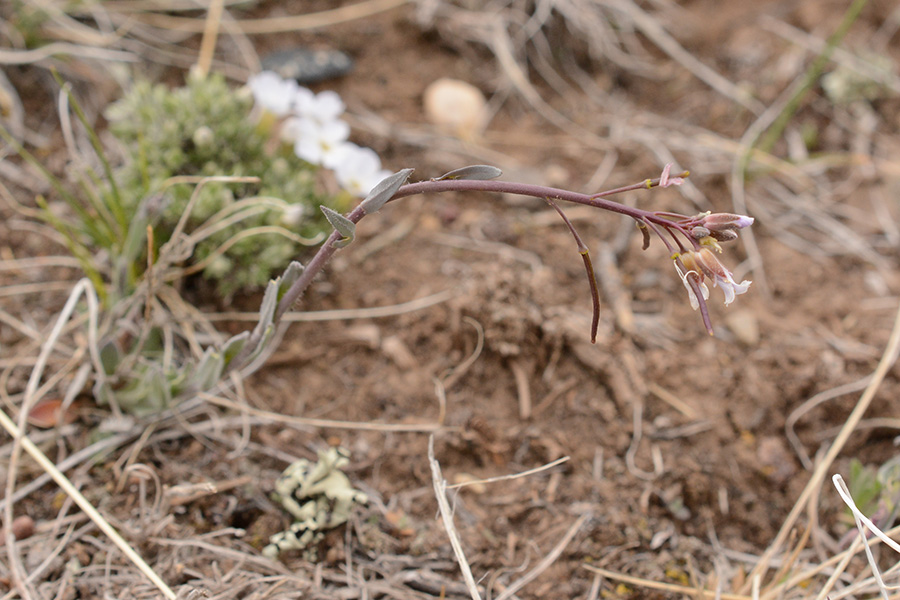
Uninfected  rockcressBoechera sp. – may be blooming nearby, sporting bluish – not yellow – 4-petaled flowers. The 3-4” plants shown here were frequent up around Kelly Warm Springs. 

The one in the photo has been keyed out in Dorn to B. exilis; however, there is much dispute, and scant herbaria specimens to confirm this species’ identity…botanist’s dancing on the head of a pin and mustards are tough to ID.

Don’t overlook the flowering trees:

AspensPopulus tremuloides – are blooming!

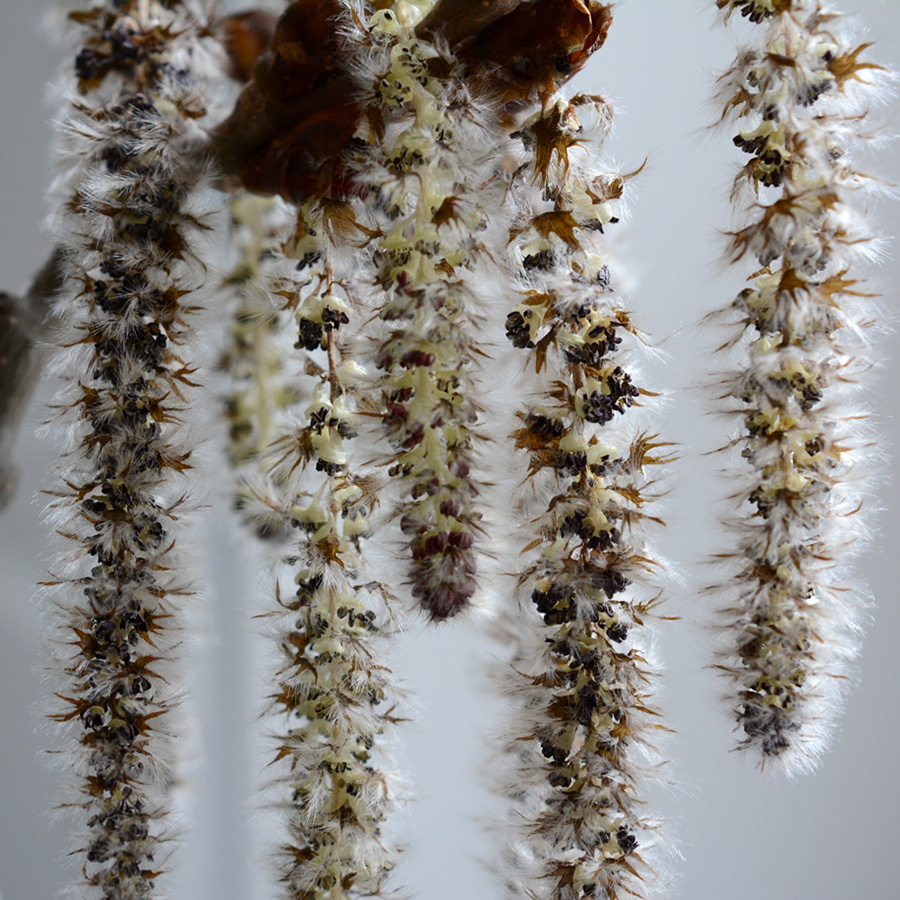
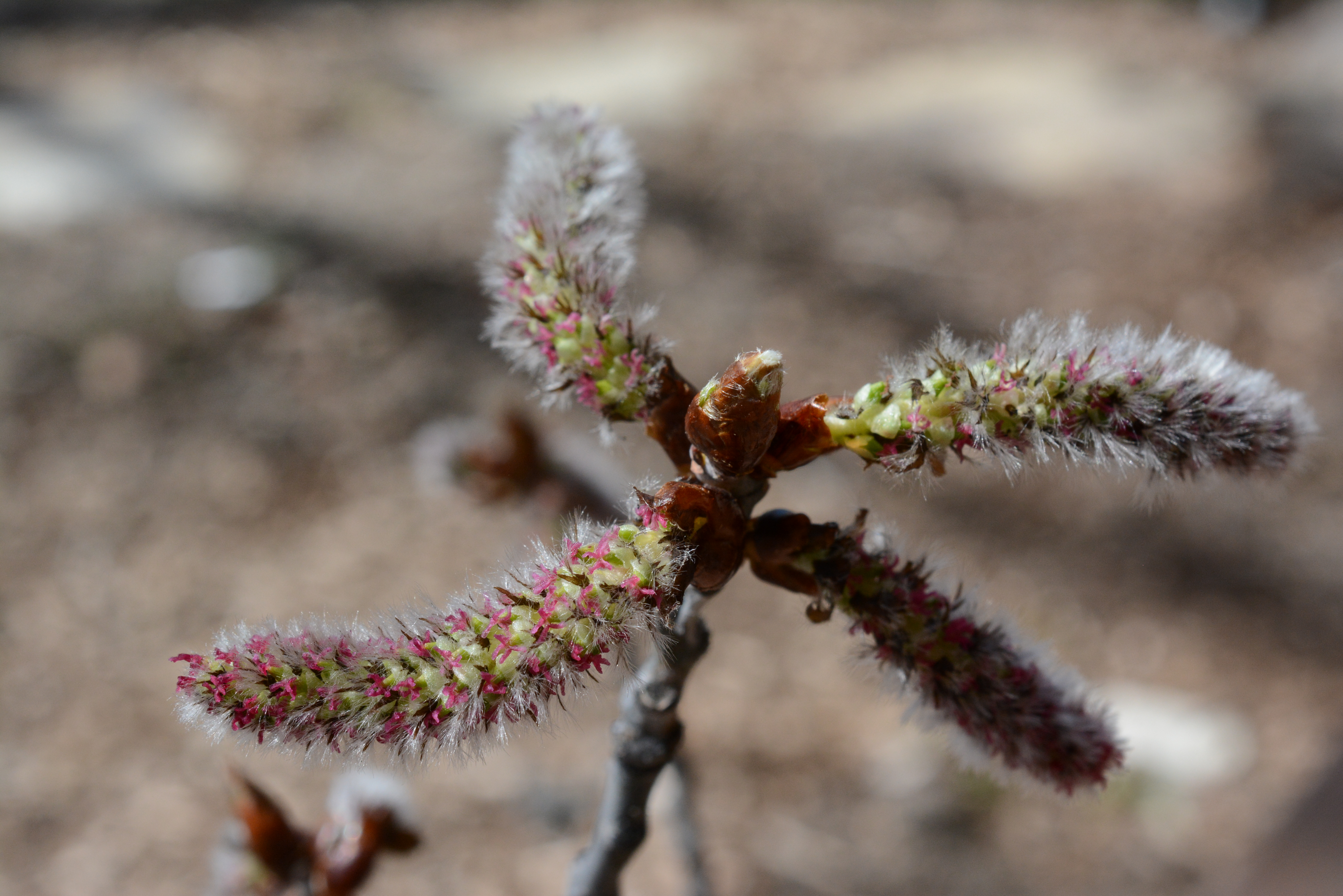
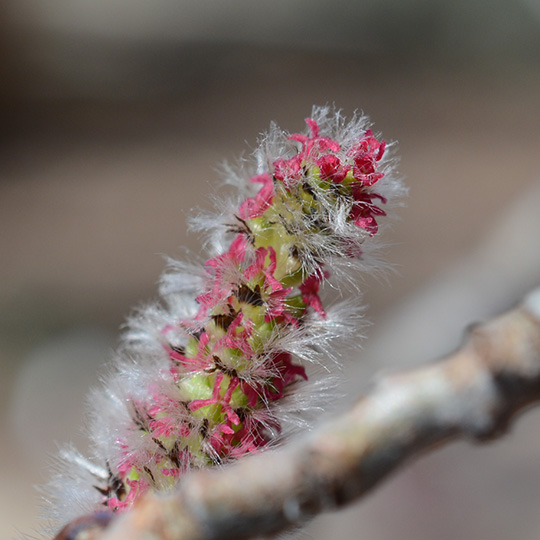
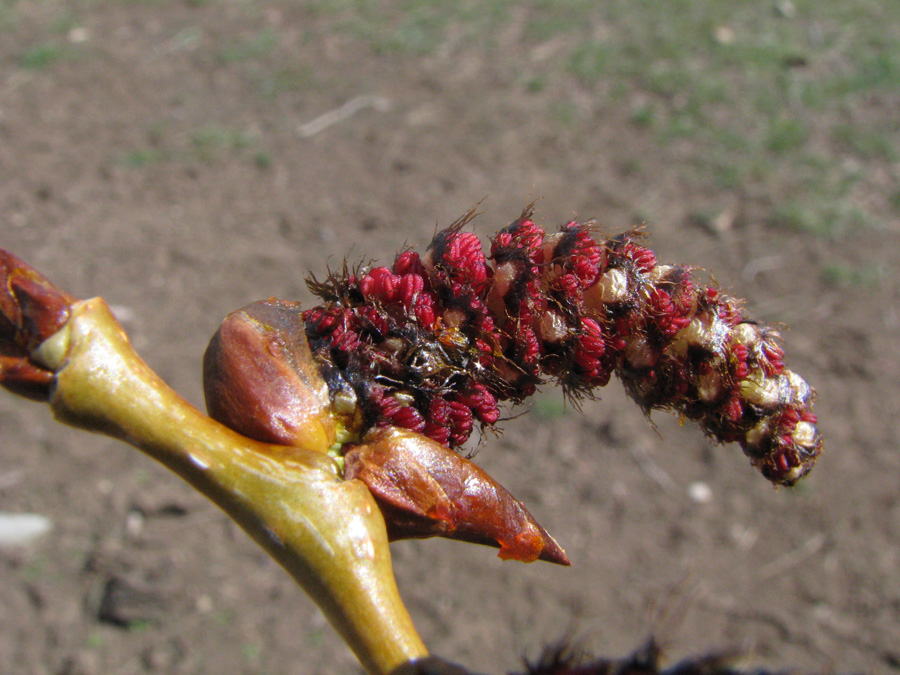
This wind pollinated species has male flowers on one plant, and females on another. Flowers are arranged in “catkins”: many Individual flowers with either anthers or stigmas are subtended by protective forked bracts edged with many hairs. The overall effect is trees festooned with fuzzy gray dangles. Male catkins tend to be longer and hang down, releasing their masses of pollen upon the wind from purple anthers.

Female catkins tend to be stiffer and slightly splayed outward, their bright red stigmas are ready to receive by pure chance any pollen grains. (two photos below)

The exhausted male catkins fall to the ground (and on your lawn) after they run out of pollen. Pick one up and take a closer look and see if you can find the old anthers held in little cups.

Amazing details!

Female catkins hold on. A month from now we will see who won the wind lottery. Leaves will emerge after the flowers have done their thing so as not to block the free flow of pollen. More on how aspens grow here

The new growth of Aspen’s larger relatives – Cottonwoods –  Populus spp. – is just popping. Cottonwoods also have male and female trees with a similar arrangement of flowers in catkins. Extraordinary what comes out of a simple brown bud.

Much more to come!  This is just a tease and a taste of wonderful botanical adventures before us.

Frances Clark

Teton Plants, Wilson, WY

P.S.  We always appreciate your corrections or queries.  Let us know at tetonplants@gmail.com – but note our response may be slow as we may be out in the field looking for flowers!