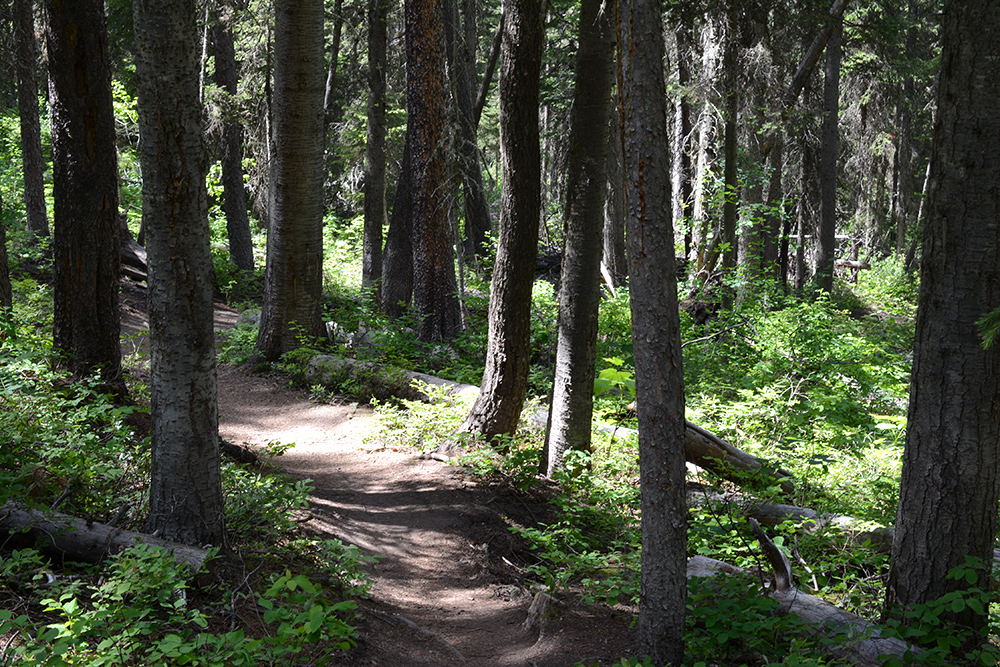
With our first sunny, days in the 70s, some of us are moving into the forests for our hikes. Trails around Phelps Lake, String Lake, Trail Creek, and Cache Creek all have areas of older growth spruce-fir forests. The understory plants have to be able to thrive in low light, cooler temperatures, lower nutrient soils, and a shorter growing season than those species that grow on the sunny sageflats and slopes or under aspen groves. Some forest flowering plants will by chance grow in light gaps, others have adapted to perpetual shadows.
Larger plants:
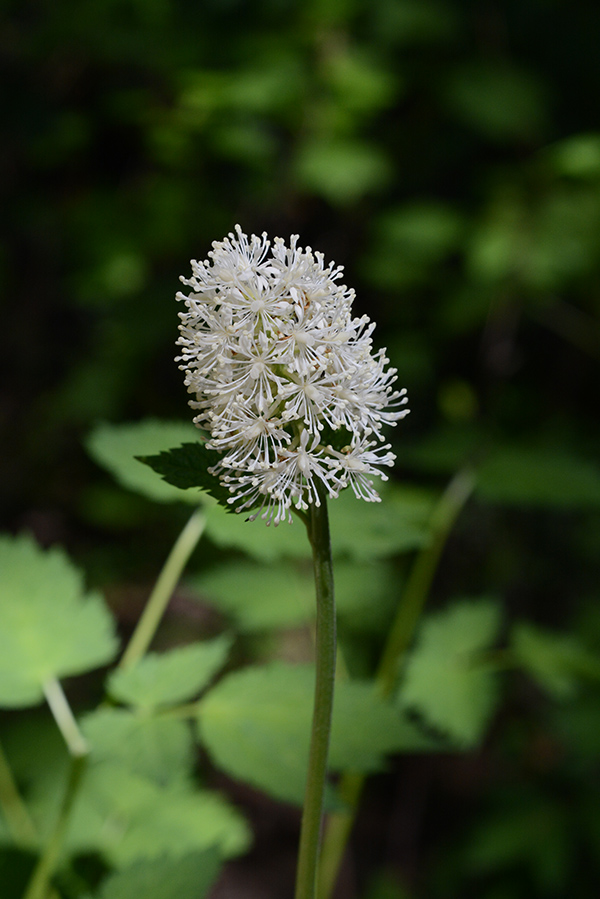
Red Baneberry – Actea rubra – post pompoms of small white flowers held 2-3’ above skirts of compound leaves. Their delicate white sepals (no petals) have mostly shed.

Over the next month, watch as the single ovaries swell and become shiny red fruits.

These are poisonous for us to eat, but not for the birds and small mammals.
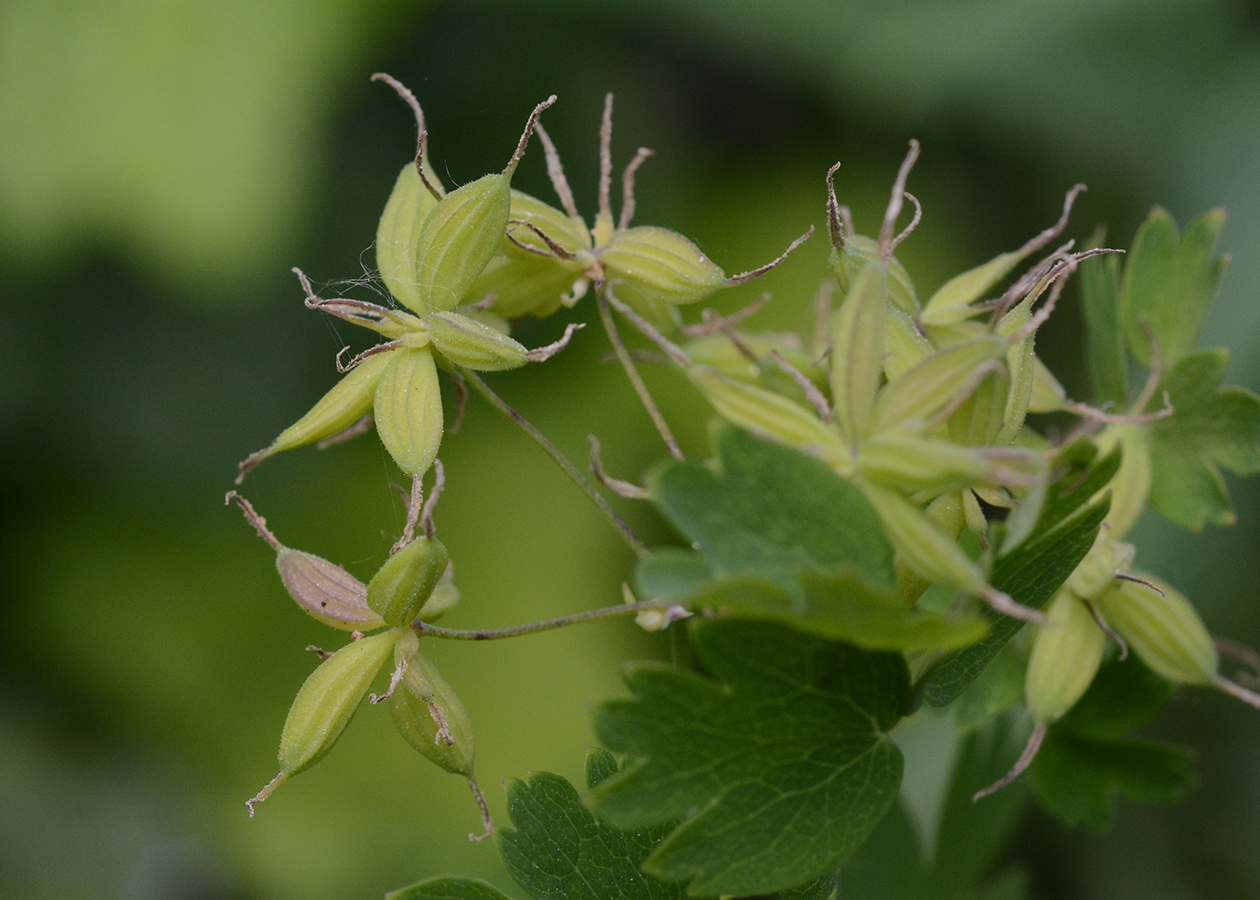
Meadow Rue – Thalictrum sp. – The leaves are very similar to the delicate compound leaves of its cousin columbine.
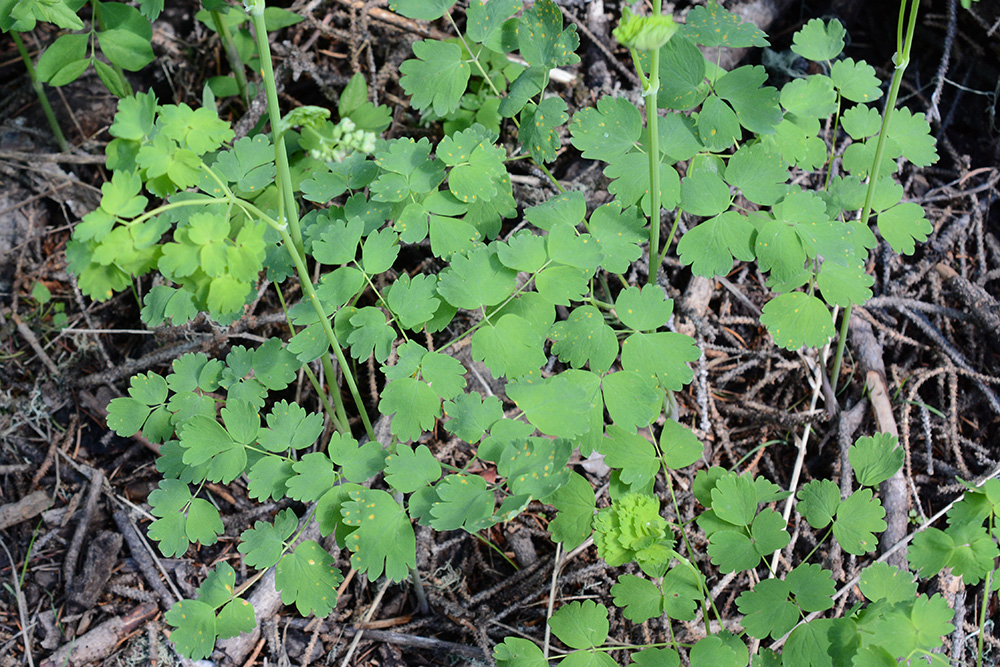
However, the wind-pollinated flowers are inconspicuous with male flowers with their dangling stamens (no petals) on one plant:

and wide-spreading filaments with sticky stigmas of females on another plant:
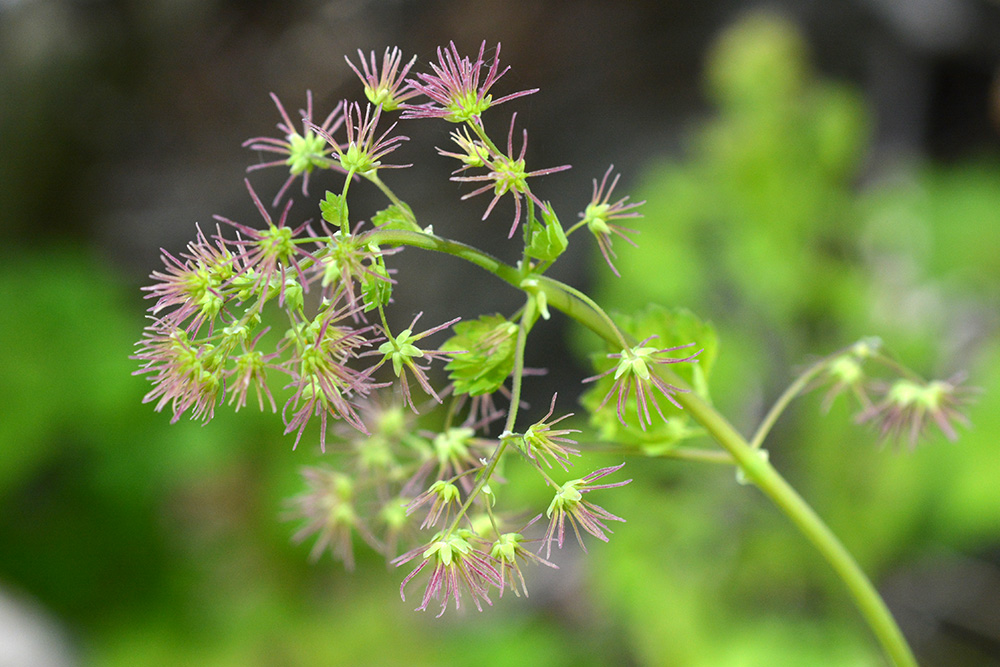
The wind blows the pollen from the anthers and with luck scatters polllen grains upon the stigmas of the females, thus fruits will form.
Colorado Columbines – Aquilegia coerulea – are just emerging. Hard to miss the elegant, soaring flowers. The 5 long spurs harbor nectar in the far ends. Hummingbirds, long-tongued bees, or hawkmoths, all with long mouth parts, hover and reach deep for the sugary treat, incidentally bumping their bodies upon the many anthers and collecting pollen.
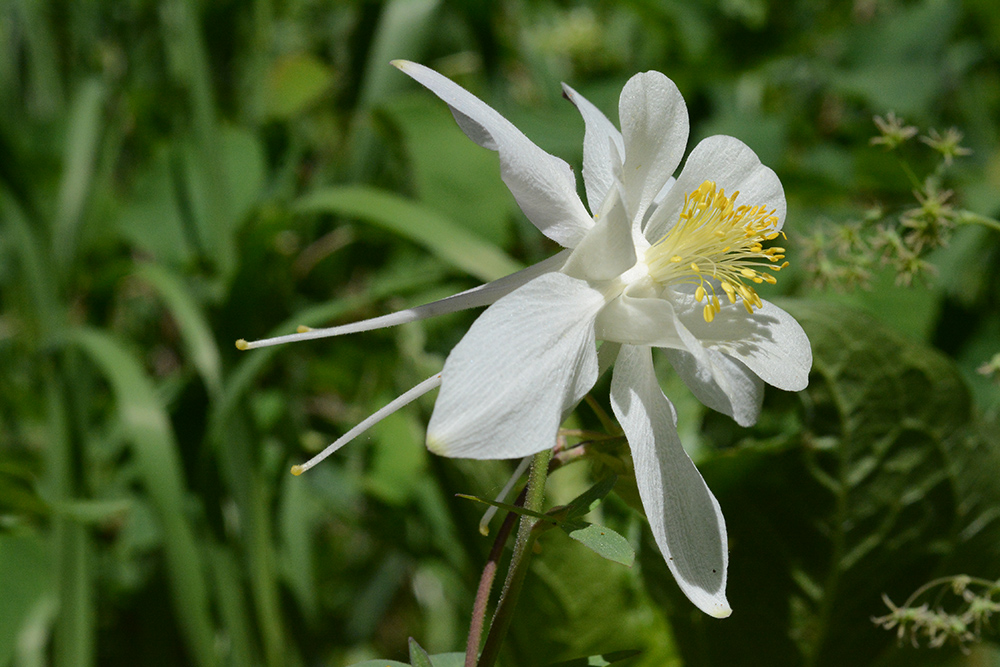
With their flight to a next, more mature flower, they will transport the pollen to 3 protruding stigmas while once again seeking nectar. Then pollen grains can grow down into the separate 3 ovaries and stimulate seeds to form within 3 dried capsule fruits.
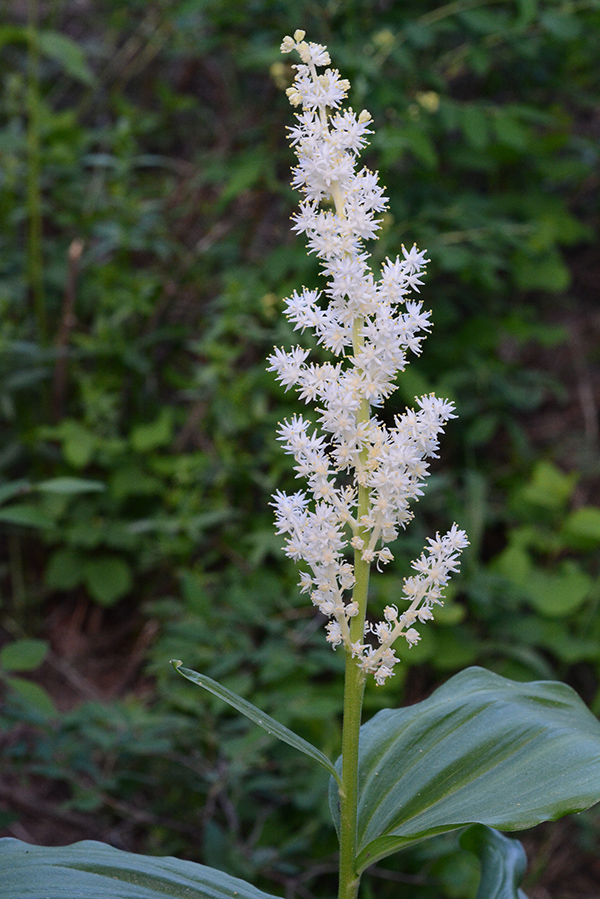
False Solomon’s-seal – Maianthemum racemosum – stands 1.5-2’ plus tall.
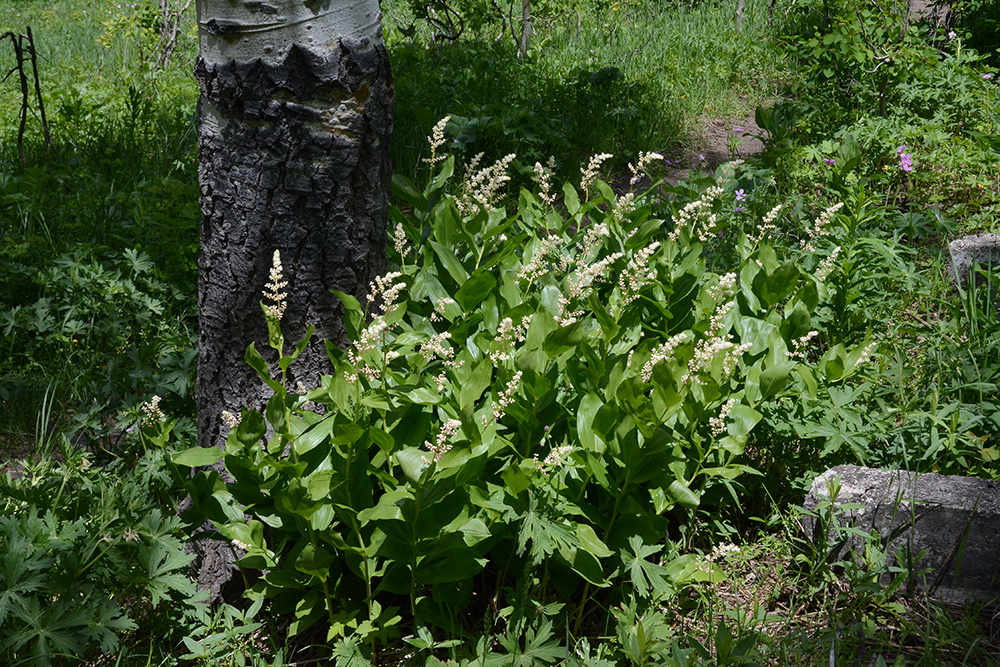
The leaves with parallel veins alternate up the stems, and panicles of small white flowers plume out at the terminus.
Twisted-stalks – Streptopus amplexifolius – arch over streams.
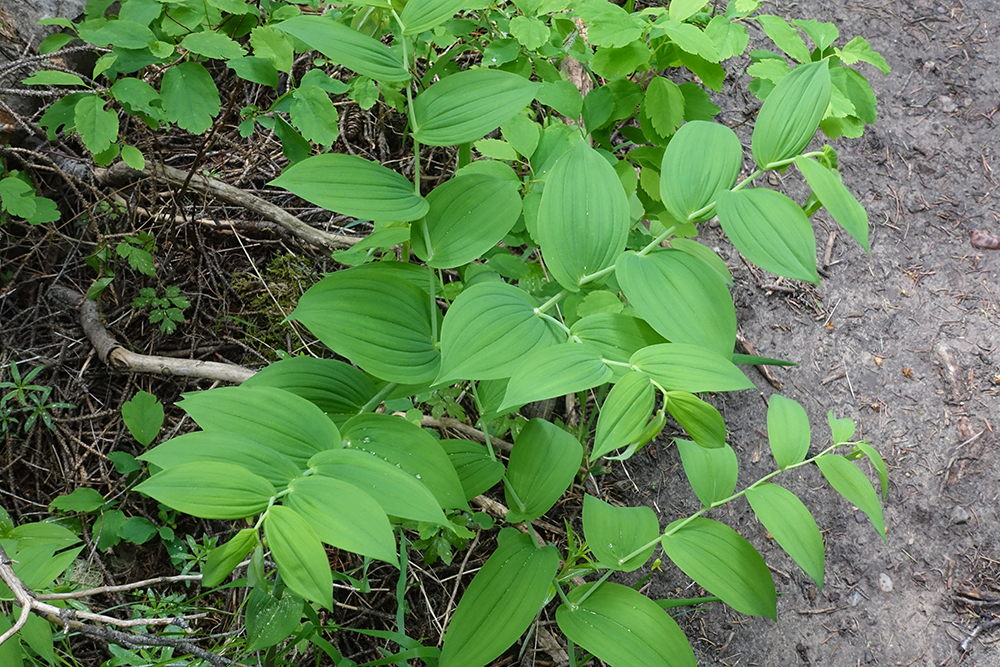
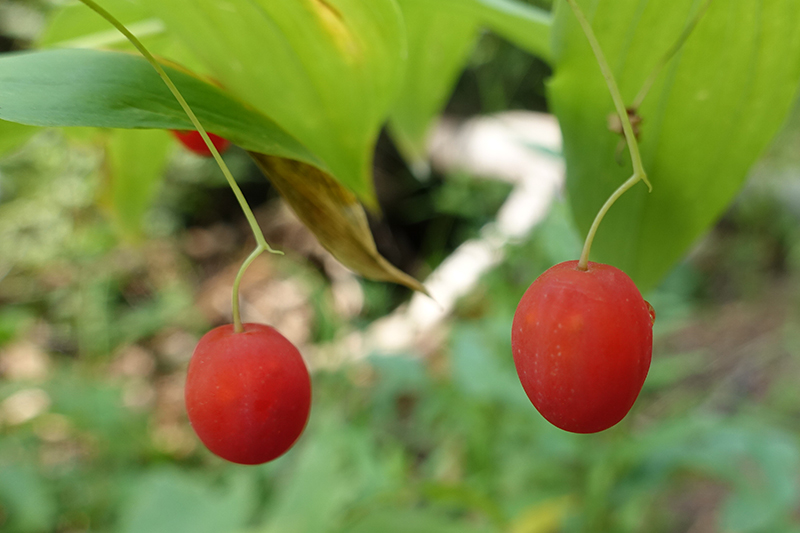
Their 3-4’ stems branch and hold alternate leaves with parallel veins. Each axil (where leaf meets stem) has a single yellow flower held out upon a kinked stalk.

Later ovoid red fruits will dangle from the same spots.
Bending down low:
Canada Violets – Viola canadensis – often form patches of distinctive heart-shaped leaves.

The white flowers have delicate purple nectar guides leading into the yellow center of the flower.

Insects land on the lower petals, follow the lines to the center, and probe for nectar in the back of flower to initiate the pollination process.
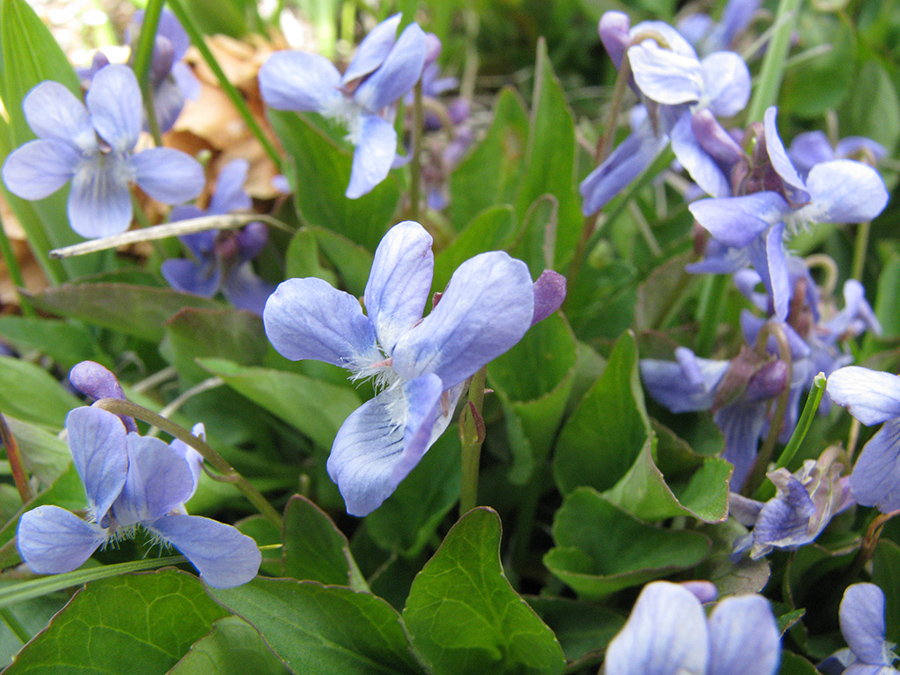
Hoodedspur Violet, Early Blue Violet, Sand Violet are just a few names for wide ranging Viola adunca. Whatever the name, these plants form cushions of loose, heart-shaped leaves growing from the base or on short stems and produce blue violet blooms. The distinctive ID feature is the relatively long spur of the flower.
If by chance the petalled flowers are not pollinated by bees or other pollinators, most violets have a back-up. They form cleistogamous flowers at the base of the plants. Without fancy petals or fragrance, these hidden flowers self-fertilize so the plants still develop seeds, even without a mixture of new genes. Seeds are the means by which the next generation of plants can move away from their parent plant to go forth, grow, and multiply on their own.
Unlike the many species of pussytoes we find in dry sunny locations, Racemose Pussytoes – Antennaria racemosa – thrive in shade.
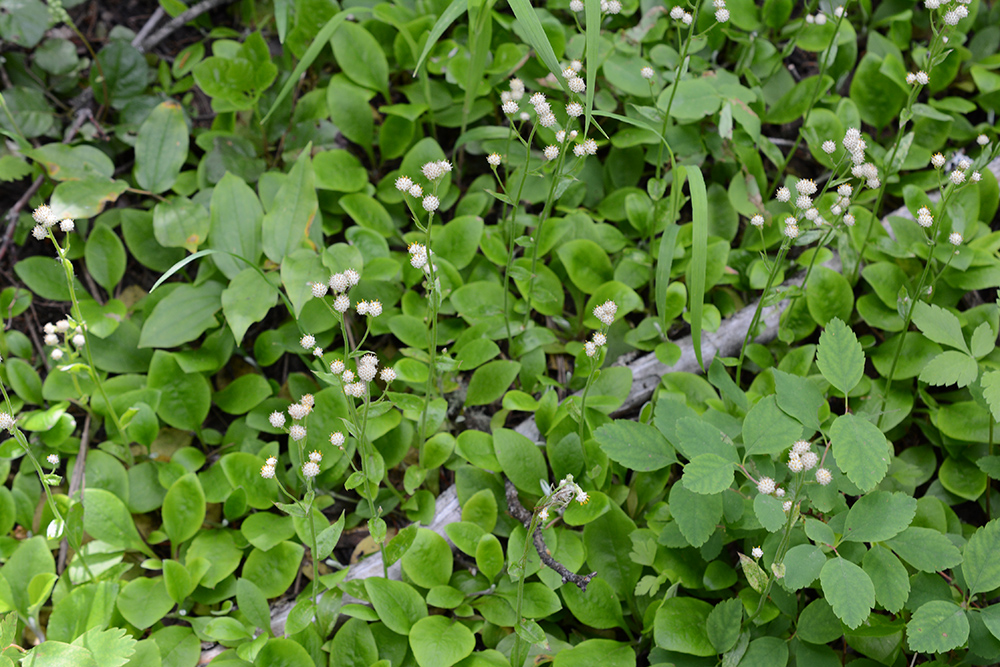
The 2” elliptical leaves are smooth green on top and hairy white on the underside.
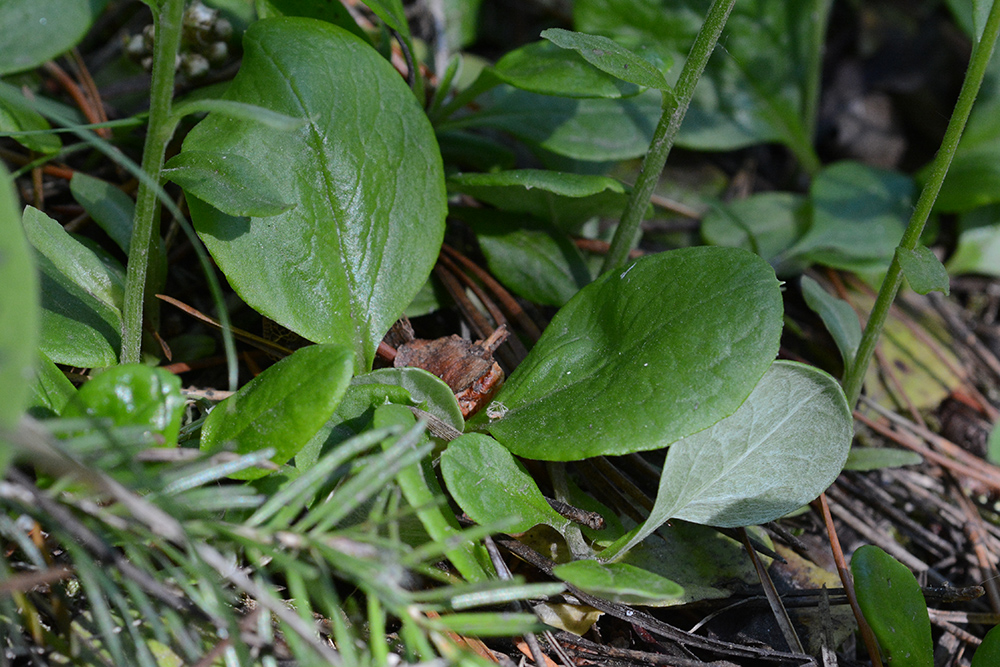
They form extensive mats beneath the 6-18” flower stalks. Here the “pussytoes” or composite male or female flower heads are held out wide in racemes or panicles.

If you look carefully, you may find two relatives of the Saxifrage Family:
Delicate 1-2’ wands of tiny white flowers of Small-flowered Mitrewort – Mitella stauropetala – stand in the shade along trail sides.
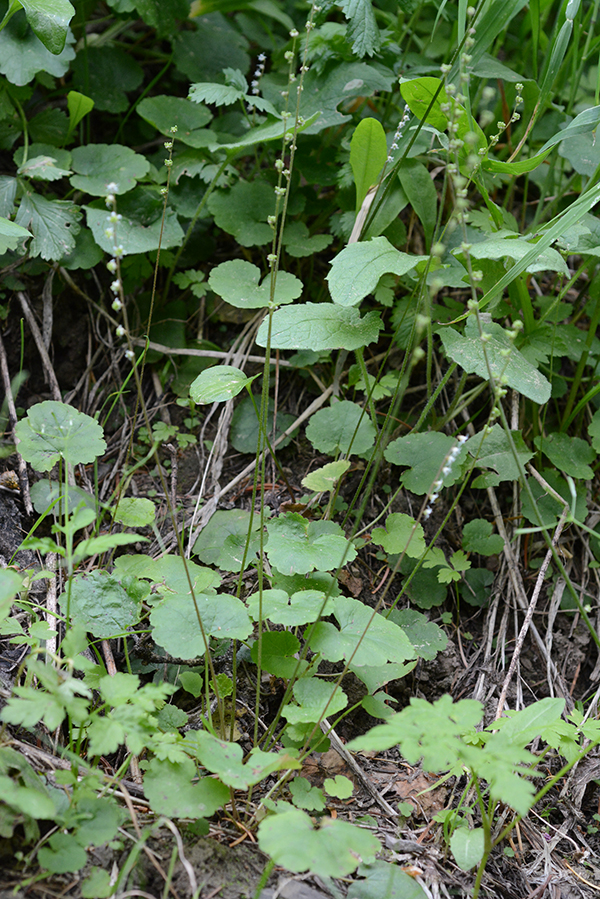
Look closely at the little cups (hypanthiums) formed by 5 white, blunt sepals and 5 thread-like petals.

If you keep looking around, you may find a more mature stem with cups brimming with un-ripened seeds.
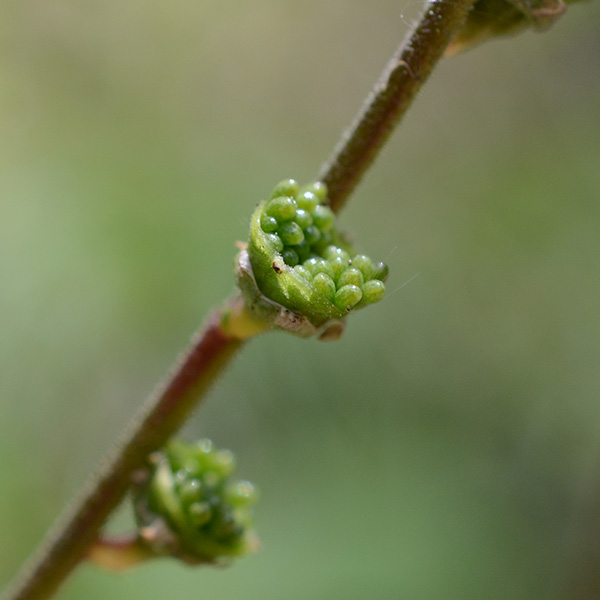
Seeds will become shiny black. Rain will “splash” them out upon the forest floor when fully ripened. The scalloped, almost round leaves are at the base of the plants.
Five-stamen Mitrewort – Mitella pentandra – is harder to find as plants are smaller and the flowers more obscure,.
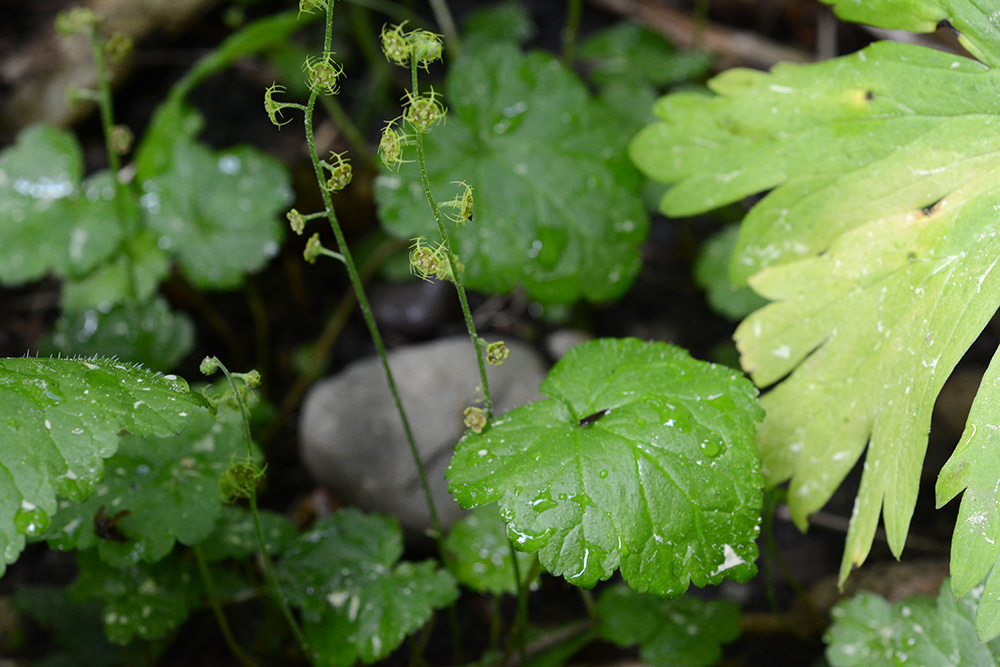
The cup-shaped flowers are wide open. The five sepals are green and pointed and the 5 greenish petals have 5-7+ thread-like lobes.
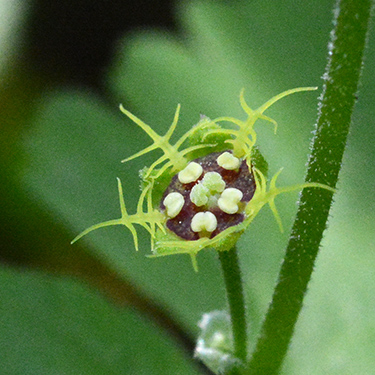
These delicate petals stand just outside the 5 whitish anthers that surround a reddish nectar disc, with greenish splayed stigmas in the center. The fruits will be very similar to those of Small-flowered Mitrewort.
Orchids
Orchids are particularly fascinating plants. Often their flowers have evolved to be pollinated by very specific pollinators. Typically, flowers have inferior ovaries, above which are 3 sepals that flare to the top and 2 sides, then 3 petals, two of which may be similar to the sepals and/or form a “hood” above the third petal below which is usually quite distinct and called a “lip”. The stamens, style, and stigma are fused to form a “column”. There are thousands of different orchids around the world, so needless to say, there are thousands of variations of appearance.
In general, pollen is held in a wad of hundreds of tiny grains called a pollinium. This pollen wad is carried by the pollinator to another orchid of the same species, and the wad sticks to the sticky tip of the central column. Then hundreds of pollen grains grow down into the inferior ovary where hundreds of eggs await.
If fertilized, the seeds will form inside a dry capsule that will split part. Seeds are dust-like…tiny. They are scattered by the wind. As orchid seeds don’t have any extra food tucked in with the embryo, when they land seeds count on specialized ectomychorrizal fungi to grow into them and provide nutrients and water for sustenance. Some orchids form a “protocorm”, an underground mass of cells that slowly expands and eventually forms defined shoots that emerge above ground. Also, after blooming a year or so, an orchid may disappear underground for time and pop up elsewhere in the area. Truly elusive plants.
Again, pollinators are very specialized. Lured in by fragrance, shape, color, and possibly nectar, the pollinator is directed by the form of the flower to position exactly to pick up or drop off the pollinium. Not much is known about many of the pollinators of orchids or their essential ecotomychorrizal associates. Finding an orchid is a very special treat. Please do not pick or dig orchids! And watch your step. Thank you.
Some orchids we have seen in the past week or two:

Fairy Slippers – Calypso bulbosa – are said to be pollinated by young queen bumblebees. Attracted by scent and design of the flowers, bees arrive looking for pollen and/or nectar.
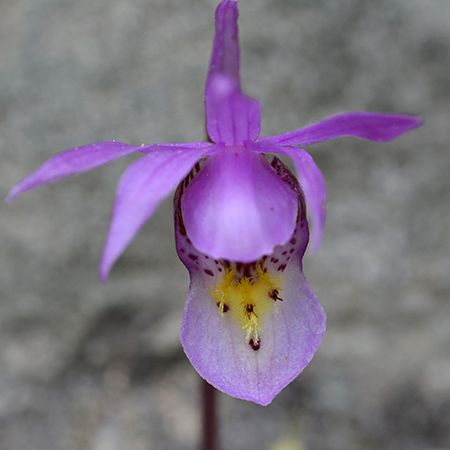
However, while they may bop against the pollinium and carry it off, the queen bee is not rewarded with pollen or nectar. She may try another flower, dropping off the pollinium, but again no reward for her. So she gives up. The Fairy Slipper lucked out on luring in a novice queen bumblebee and thereby being pollinated!
Coralroots – Corallorhiza spp., – are named for their knobby root structure. Without any chlorophyll, these plants are completely dependent on ectomychorrhizal fungi throughout their life. Of the 5 species native to Teton County, we have been seeing two:
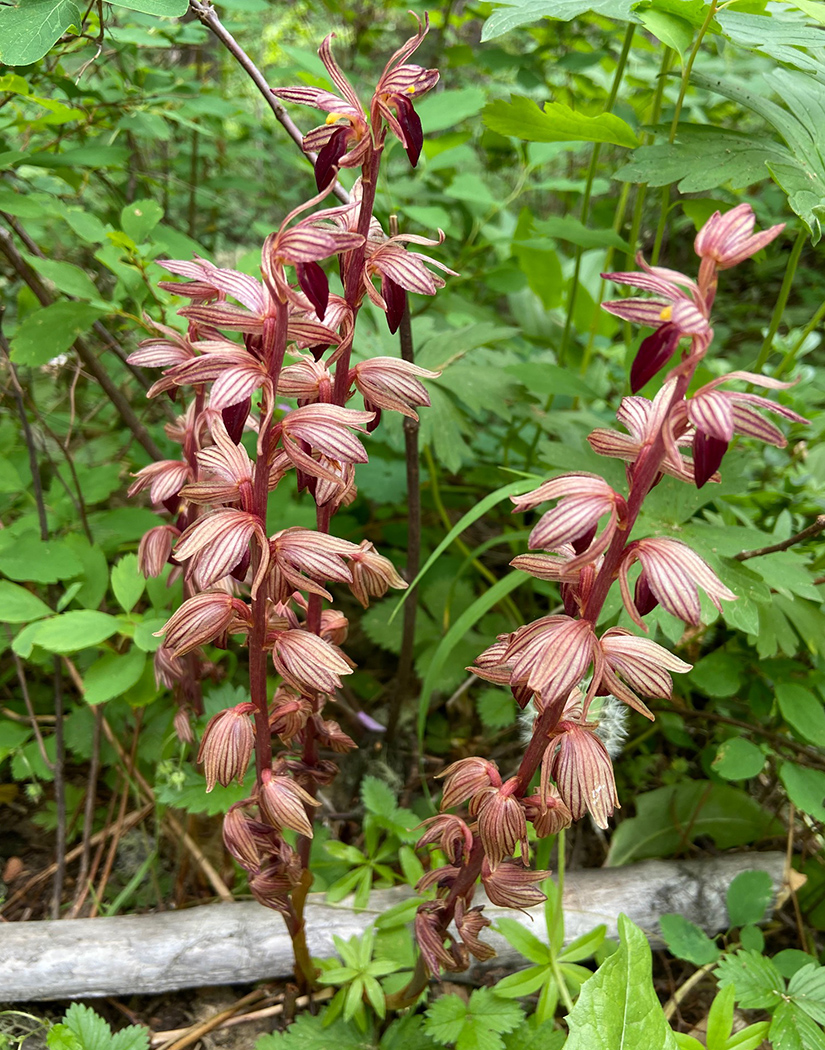
Striped Coralroot – Corallorhiza striata – has blurry reddish stripes on pinkish sepals and upper petals. You can see the thickish column with the yellow wad of pollinia.
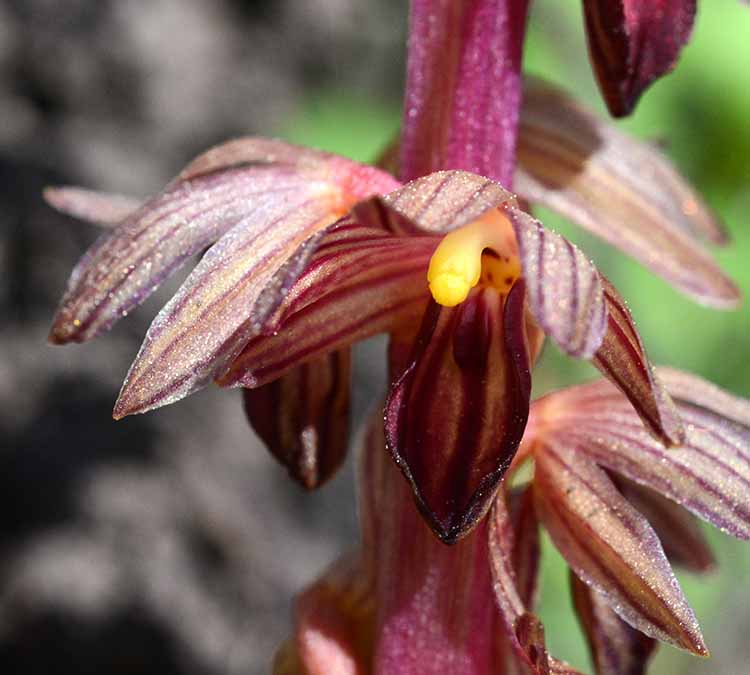
The lower petal or “lip” is deep maroon. Plants can grow up to 2’ or so and have many flowers.
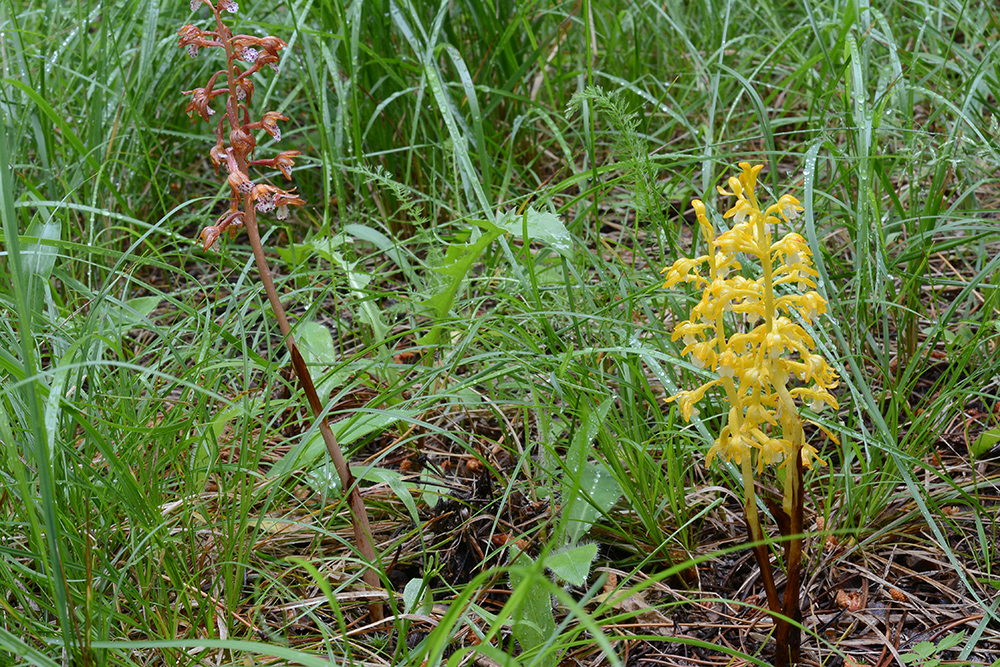
Spotted Coralroot – Corallorhiza maculata – can sport reddish or yellowish stems and flowers.
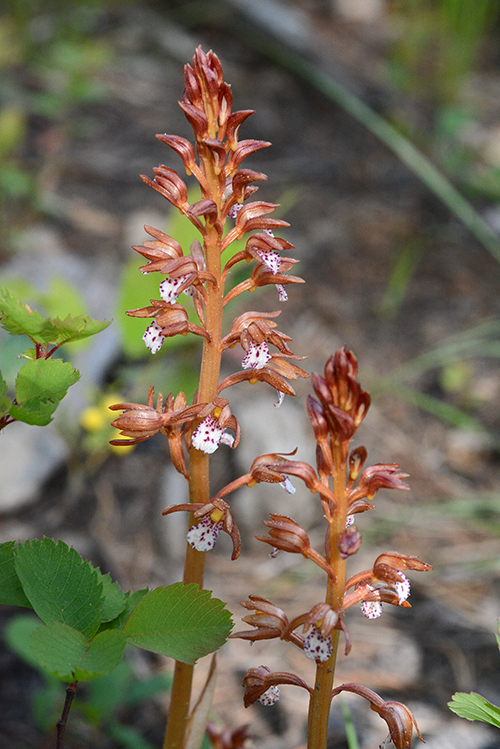
Different colored plants can grow side by side.
Look for several reddish spots and two teeth on the lip. Some flowers do not have the spots, but always will have the teeth at the back of the lip.

The mottled leaves of Rattlesnake Orchid – Goodyera oblongifolia – are evergreen and form rosettes connected by rhizomes.

Soon up through the center of the rosette will grow 6” stalks with a spiral of small whitish hairy flowers.
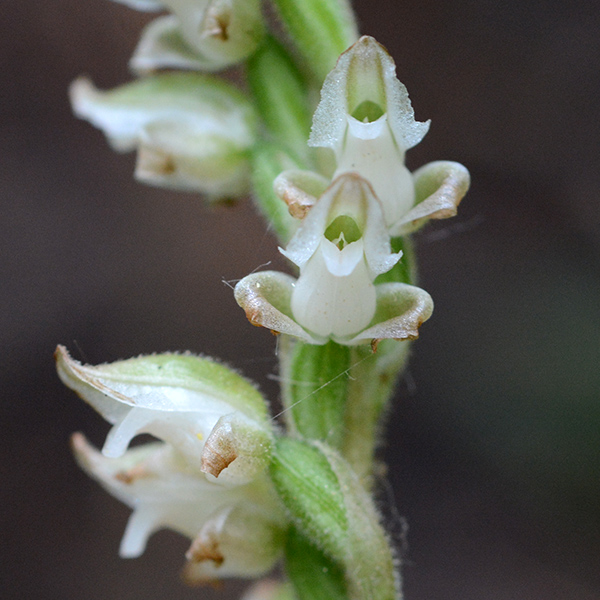
Typical of many orchids, the Rattlesnake Orchid fruits are dry capsules which break into narrow slits, gradually releasing hundreds if not thousands of dust like seeds upon the wind.
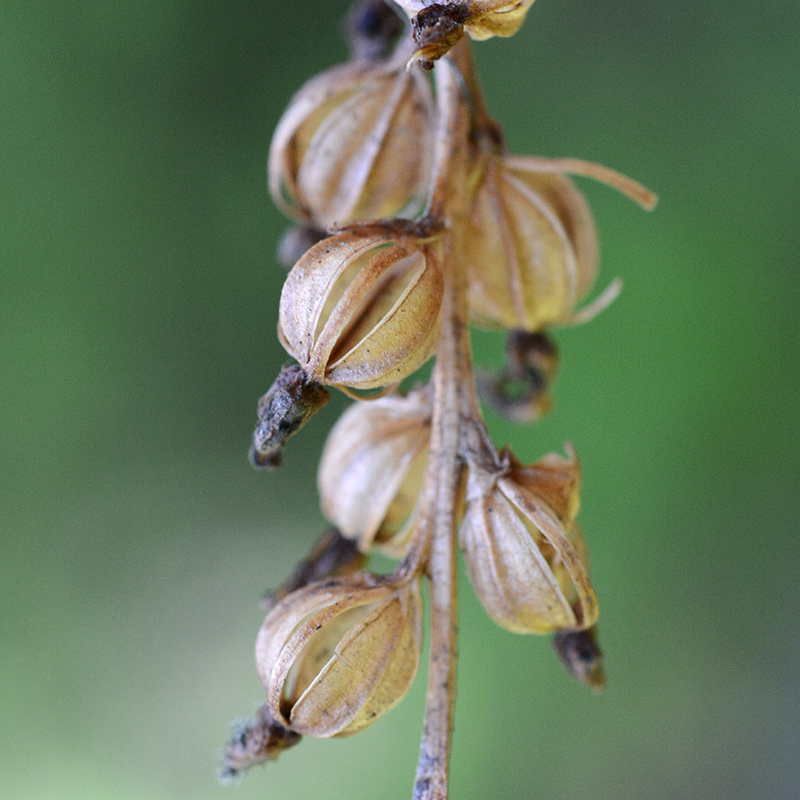
Twayblades – Listera spp. – are some of the smallest, and rarest orchids we have seen. The genus is easily identifiable by the two opposite leaves midway up a single stalk. The flowers have long protruding lips.
Northwestern Twayblade – Listera caurina – is relatively common growing up to 3-4”.

Note the several flowers, each have a lip which is slightly rounded or squared at the tip.

If you can get down close enough with a hand lens you may see two very tiny transparent teeth at the base of the lip:
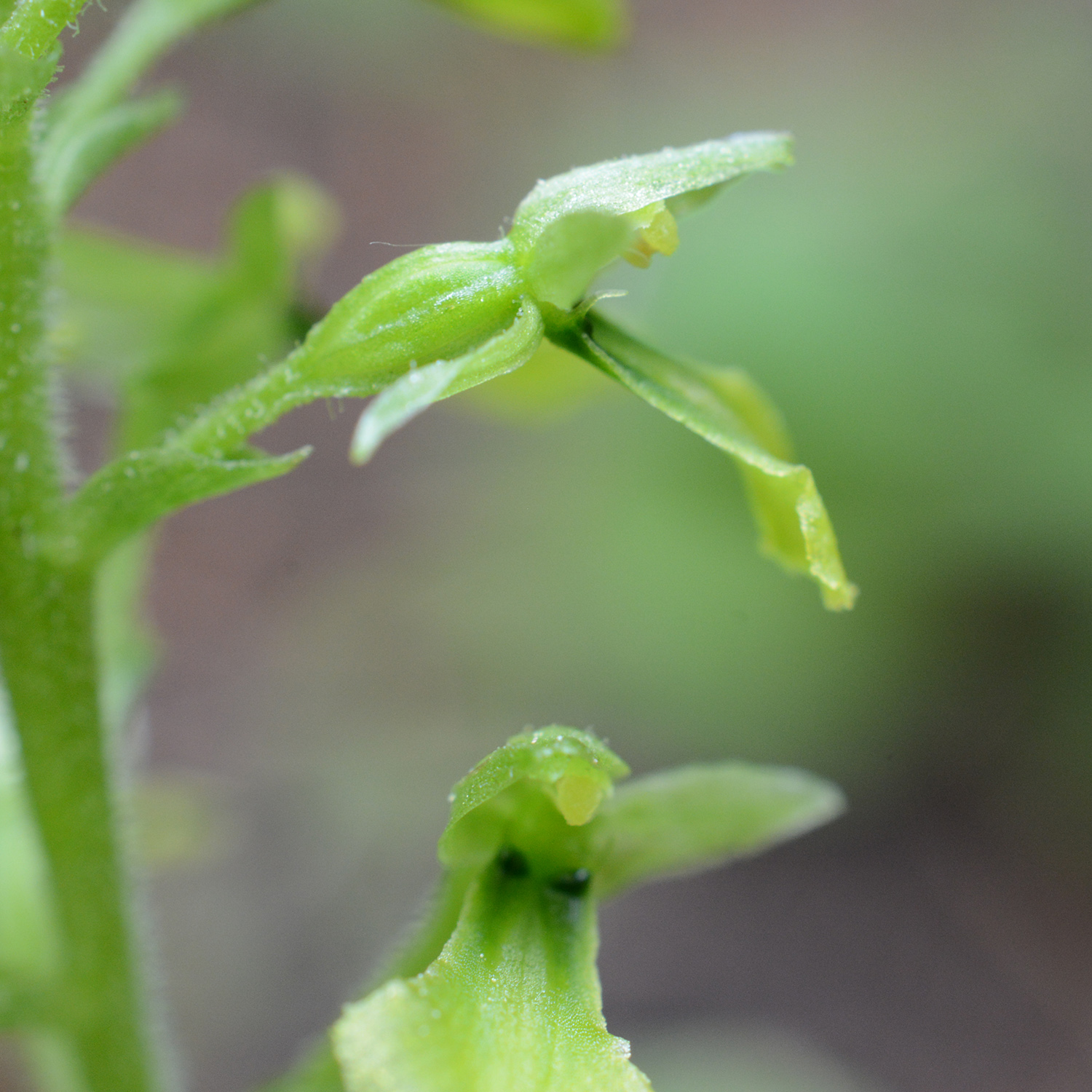
Broad-lipped Twayblade – Listera convallarioides – is also rare – we have seen this 2” plant once by pure luck. The lip has an obvious indentation. Also look at the profile of the flowers and how it differs from Northwestern Twayblade.
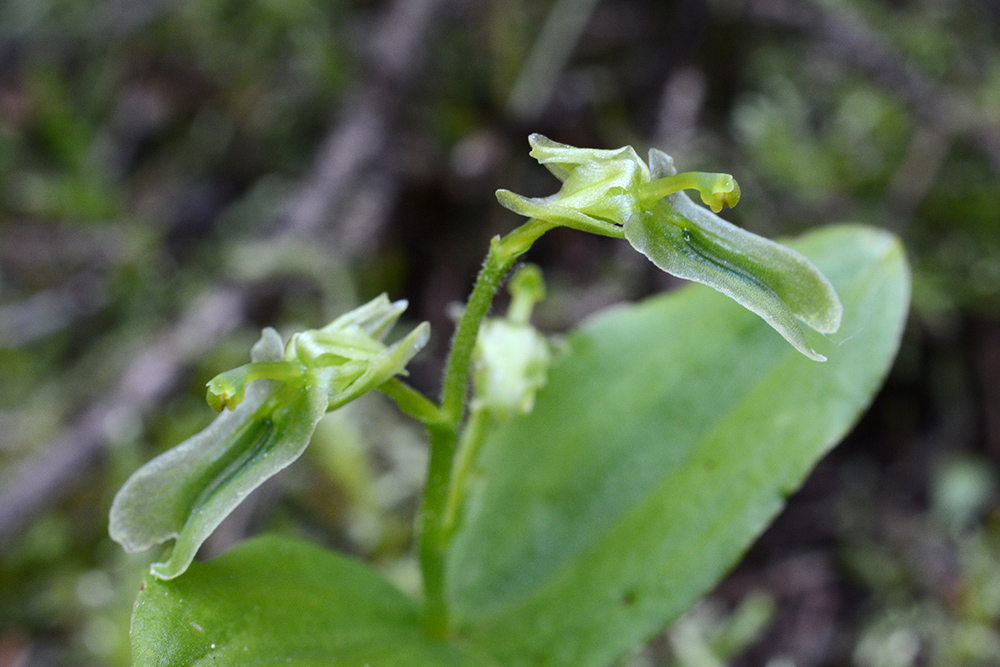
Heart-leaved Twayblade – Listera cordata – is also rare, again with only one sighting. Note the lip is split into two very delicate segments.
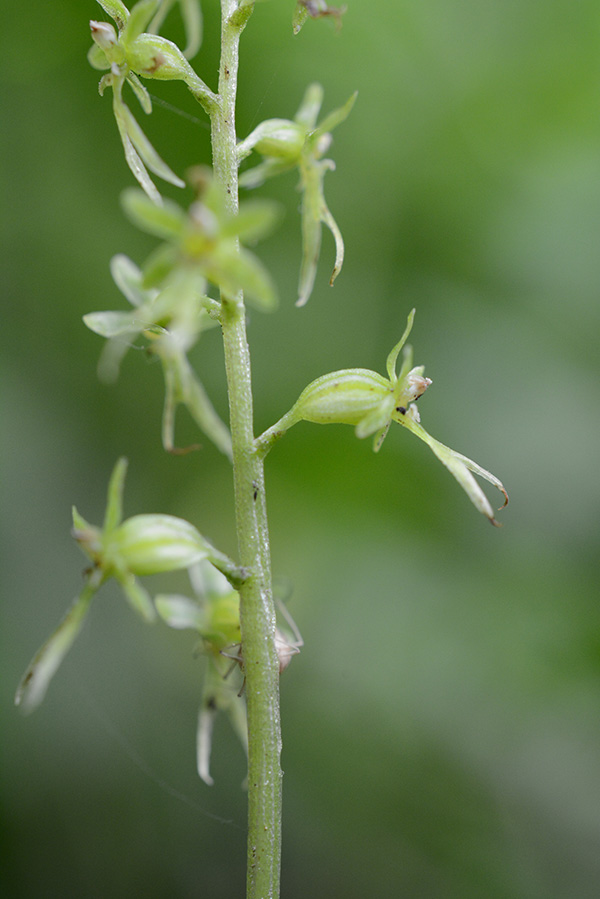
Again, this plant is only 1-2” high.

For much more info on our North Temperate orchids, go to Go Orchids
More “belly botany”:
Over the next few weeks several 2-6” evergreen plants will bloom. To truly see their flowers, one has to get down on one’s belly. (Do watch out for other plants nearby as you kneel or step.) One such gem that has just begun blooming is:
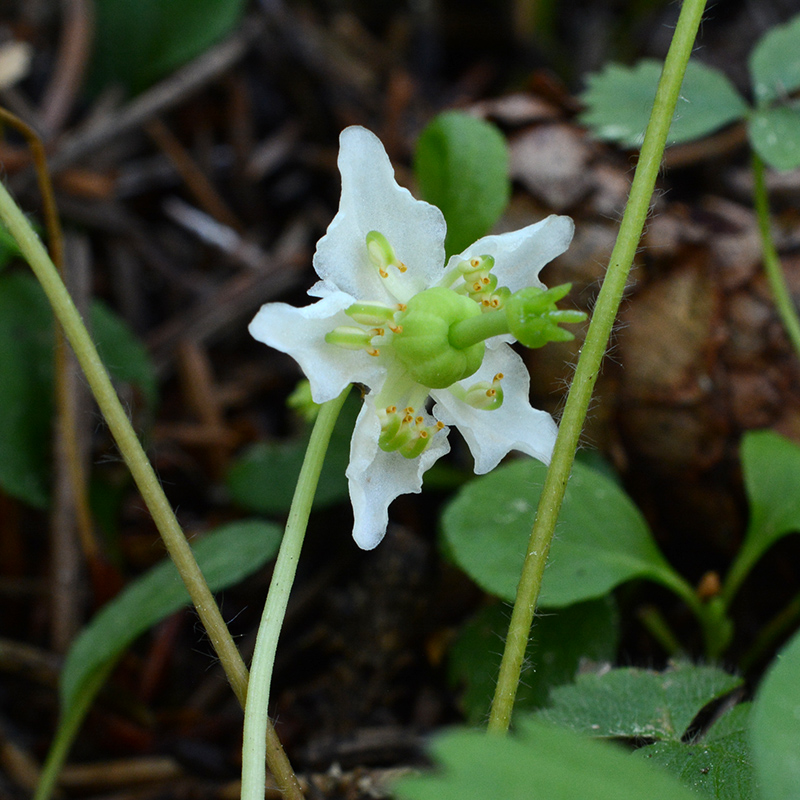
One-flowered Shinleaf, Single Delight – Moneses uniflora – is in the Heath Family and is related to several other evergreen species of deep shade and acid soils of evergreen forests.

It is about 4” tall tops. The anthers are tubular, arranged in groups around the 5 parted stigma. Pretty cool if you can get all the way down and very gently take a look at the flowers with a 10x handlens.
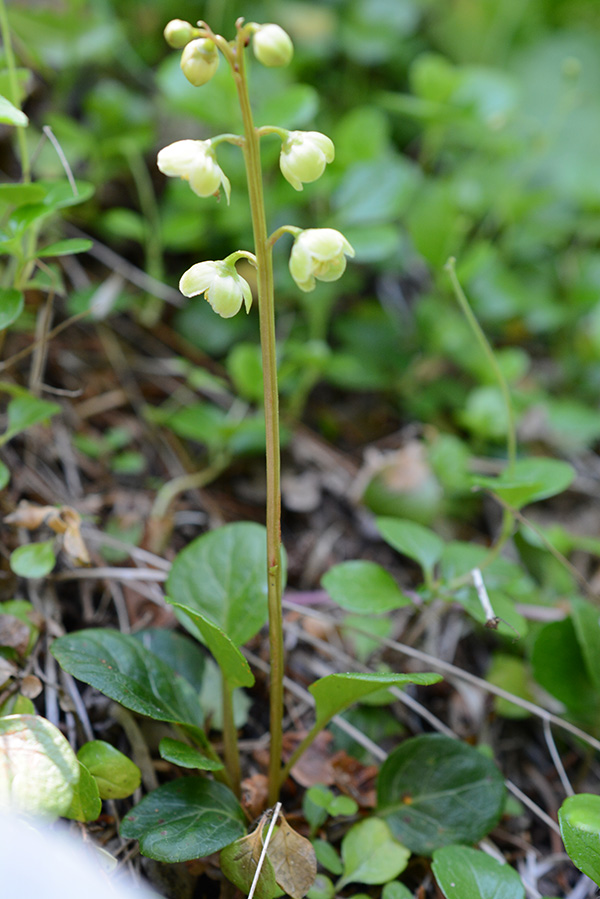
Another evergreen wonder is Green Pyrola – Pyrola asarifolia. A few round evergreen leaves are near the base of the 3-4” stem which holds 4-5 creamy white flowers.
Soon these species will be accompanied by other evergreen members of the Heath Family including more Pyrolas, Orthillas, and Pipsissewas.
Enjoy walking the woodland trails: watch your feet and find the flowers!
Frances Clark, Teton Plants
July 4, 2023
As always we appreciate corrections, concerns, comments. Best to email us at tetonplants@gmail.org
 Teton Plants
Hi, love your newsletters and yeah amazing photos. What about Pacific Coralroot, isn’t it another native orchid? It is so prevalent around the lakes in the park right now.
Your posts are superb!
And the photographs are excellent!!!