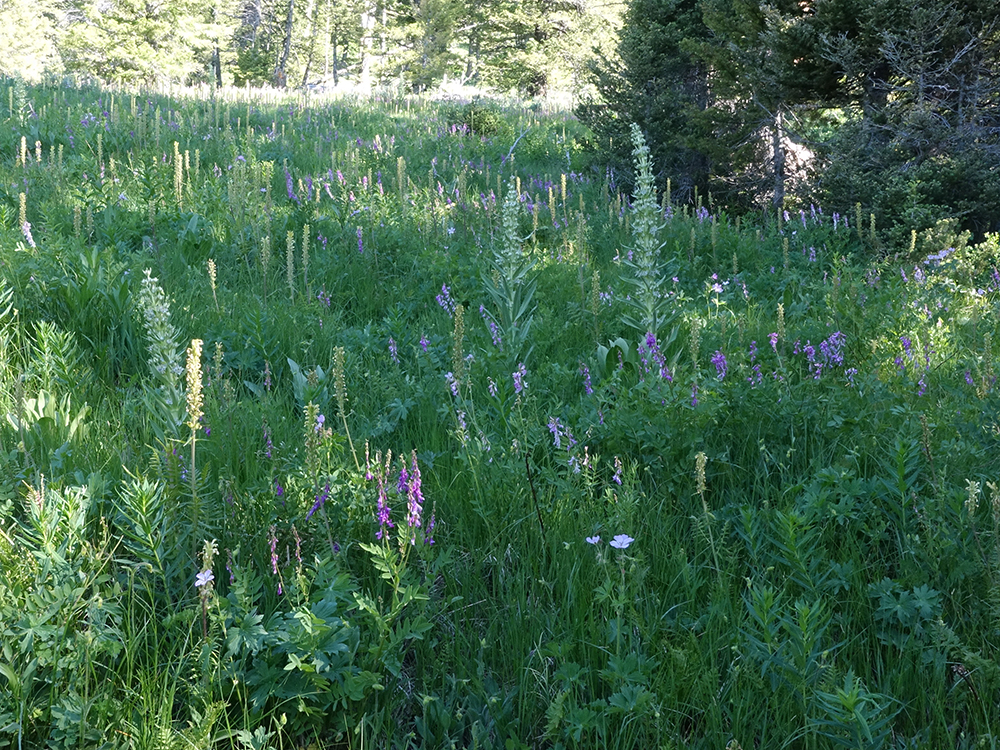
While many of the flowers in the valley are drying out, flowers are blooming along streams, in forests, and up mountain slopes where it is cooler and relatively moist. Flowers that were blooming several weeks ago down low such as balsamroots, lupines, geraniums, and scarlet gilia are just beginning at elevations of 8,000’ and higher. Many other species grow only at the higher elevations. Pollinators are also maturing from grubs to creeping or flying adults. Hummingbirds are about, too, to help plants form seeds for the next generation. Much to see, sniff, touch, and taste.
Sticky Geranium – Geranium viscossissimum – are all about. Look closely at the different stages of bloom.

The flowers open wide and their the deep-pink lines direct a variety of pollinators toward the center of the flower for nectar. The arching male anthers, when bumped, deposit pollen upon their visitors bodies; afterwards the anthers shrivel and then the female stigmas spread out ready to receive pollen brought by an insect from another flower. Then pollen grains can grow down the pistil to fertilize the eggs inside—voilà seeds. Later watch for the fruits to form, dry, and catapult the seeds into the beyond.

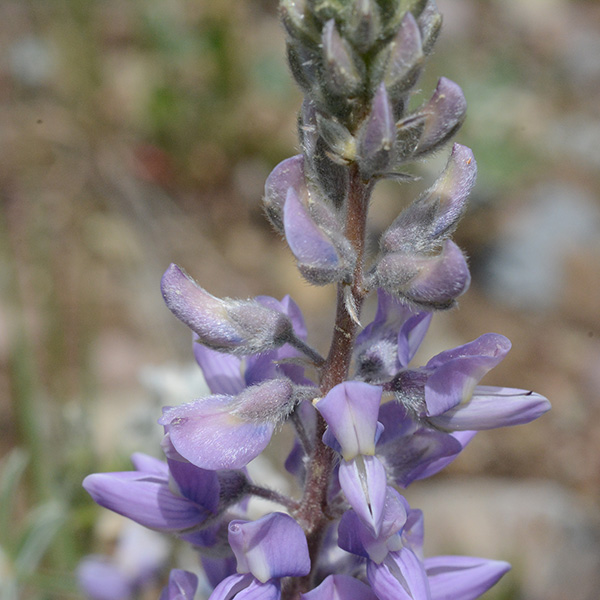
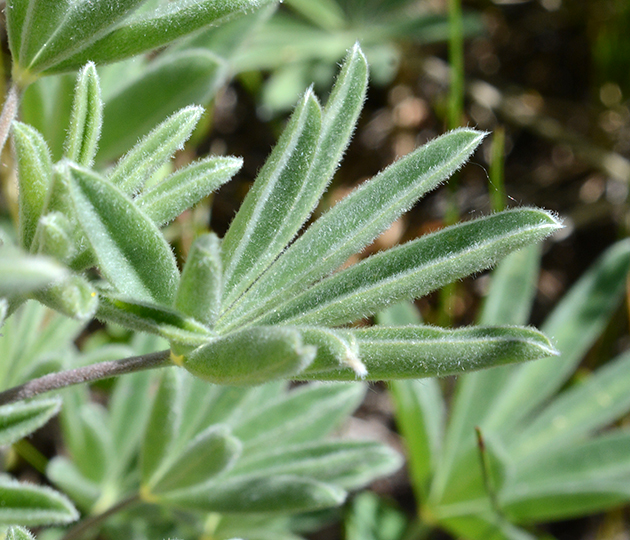
Silvery Lupine – Lupinus argenteus – thrives in the shade or in the coolness of higher elevations. For easy identification, look for the “palmately divided” leaves, and the spikes of pea-like blue flowers.
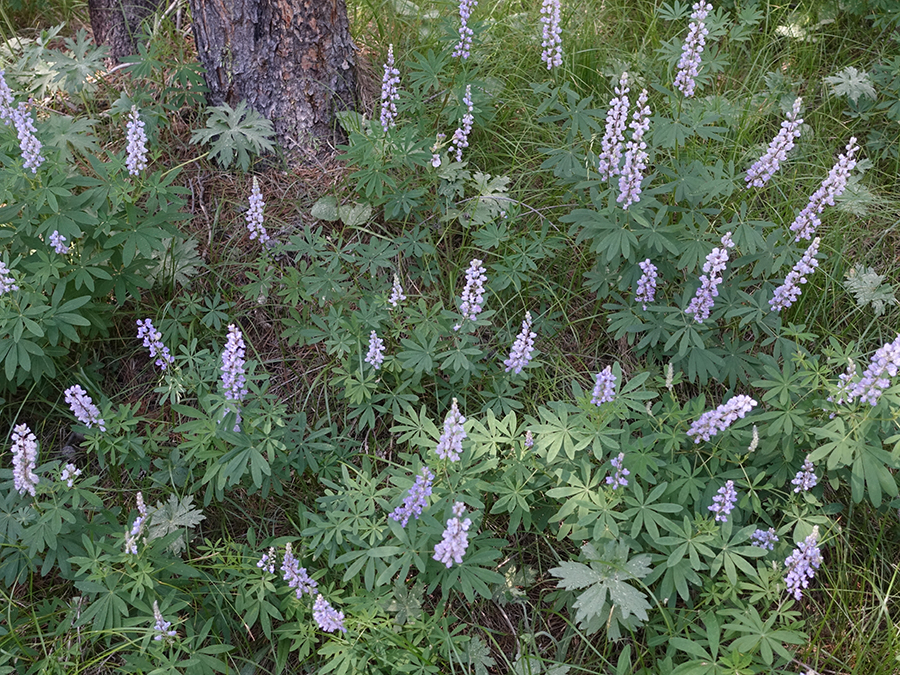
Unlike its relative Silky Lupine – L. sericeus – which has many silvery hairs to protect it from wind and sun, Silvery Lupines have deeper green leaves and hairless, smaller flowers flowers. They both produce pods with seeds inside similar to our edible pea pods, but are toxic to us.
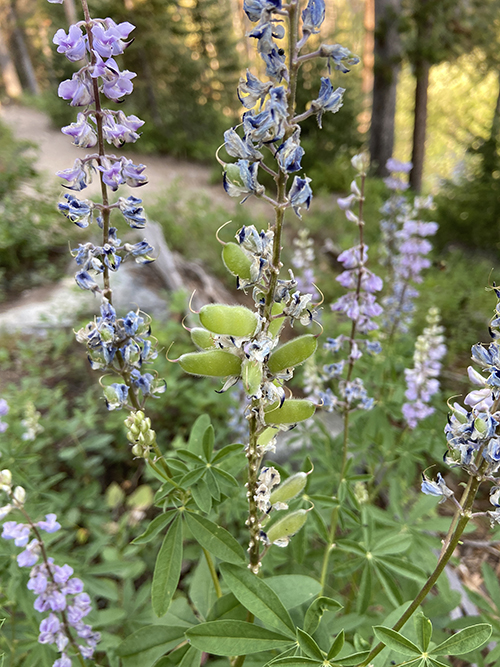
Not visible are the little nodules – swellings – on the roots which harbor bacteria. The bacteria in these protected sites are “fixing” nitrogen – changing the plentiful NH2 which plants cannot use, to the type of nitrogen that plants need to grow NH4. NH2 is plentiful in air, including the tiny air pockets in soil, but bacteria are necessary for the conversion to fertilizer. Thus, thanks to bacteria, lupines can grow in very poor soils and through their decomposition add nitrogen to the soils enabling other plants to grow.
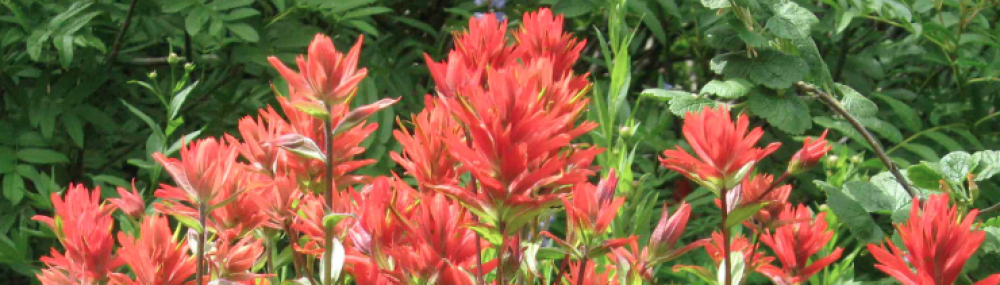
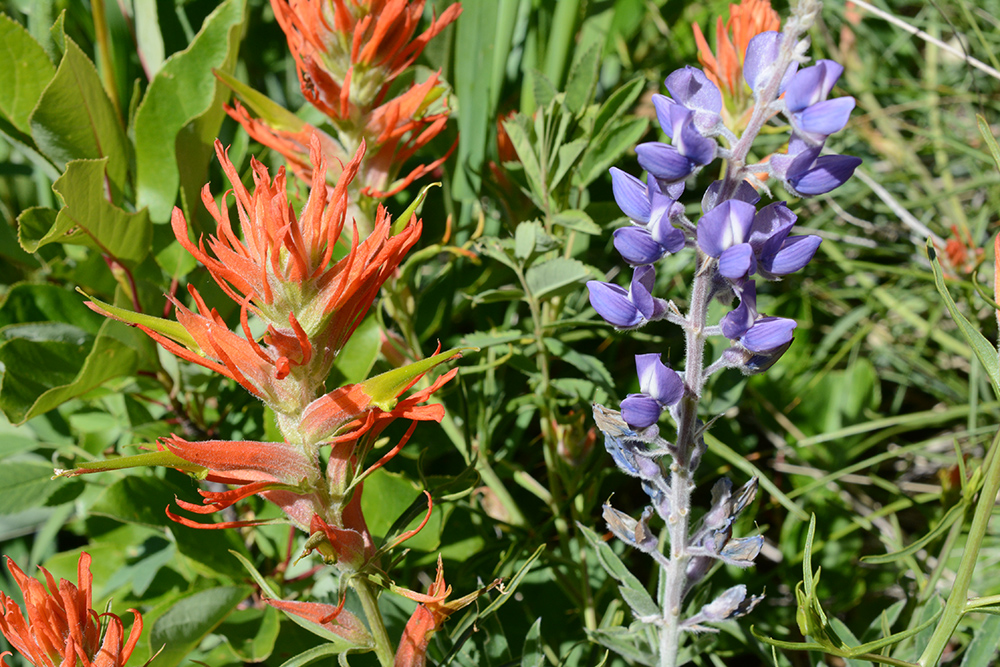
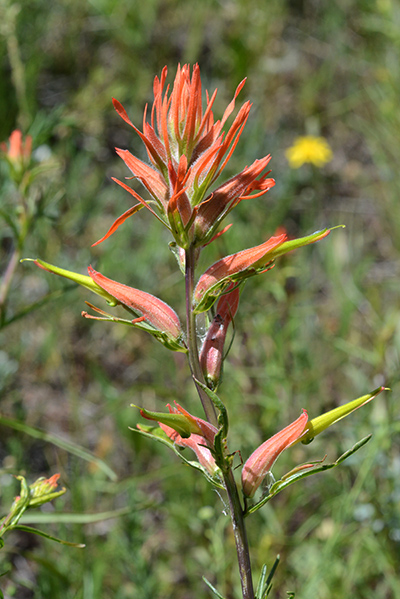
Amidst the blues of slivery lupines, one may spy a Giant Red Paintbrush – Castilleja miniata.
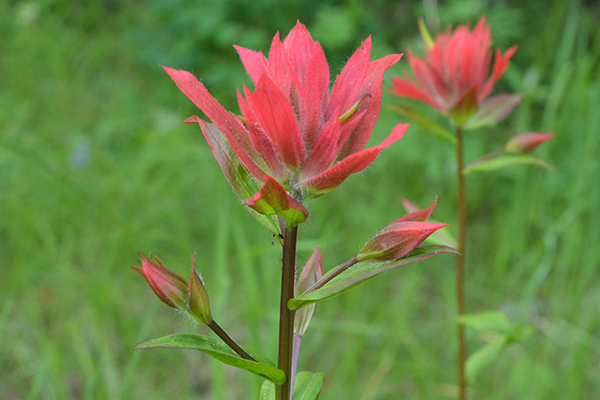
The two can connect: Silvery lupine is a host plant to the hemiparasitic red paintbrush: Lupines provides alkaloids to the paintbrush which reduces the herbivory of the red paintbrush by various insects, while not affecting pollination. Consequently, the paintbrush plants produced twice as many seeds. Click here for the reference. Very cool.
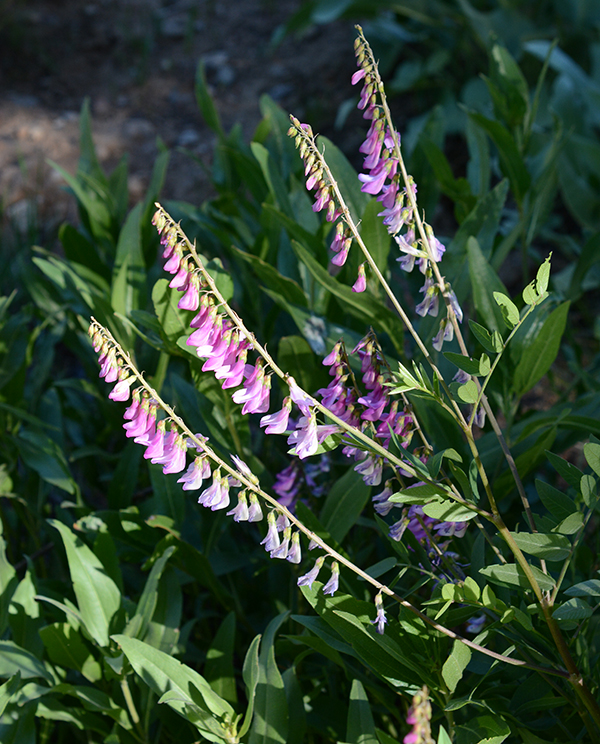
Another legume, Western Sweet Vetch – Hedysarum occidentale – has that pea-like look.

These 2+’ tall plants are beginning to bloom at higher elevations, such as along Ski Lake Trail. The flowers dangle along one side of the stem.
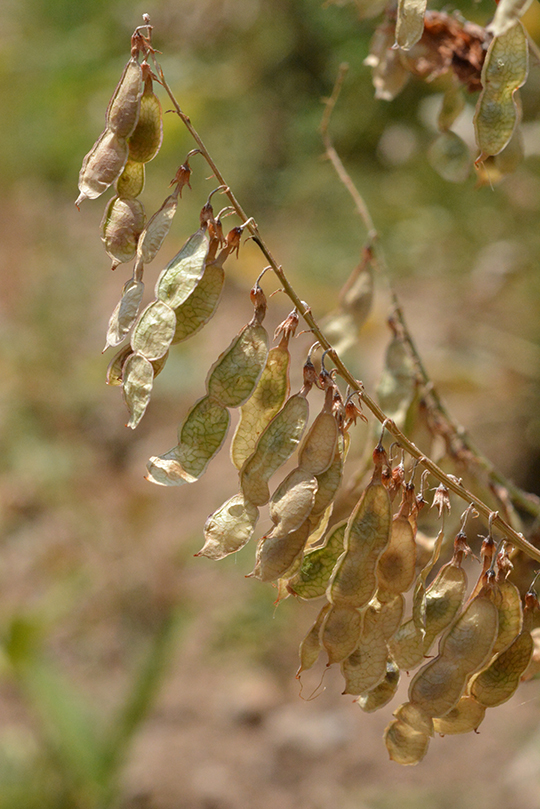
The seeds will be held in flattened sectioned pods called loments.
Bracted Lousewort – Pedicularis bracteosa – is abundant this year in aspen forests and in mountain meadows.
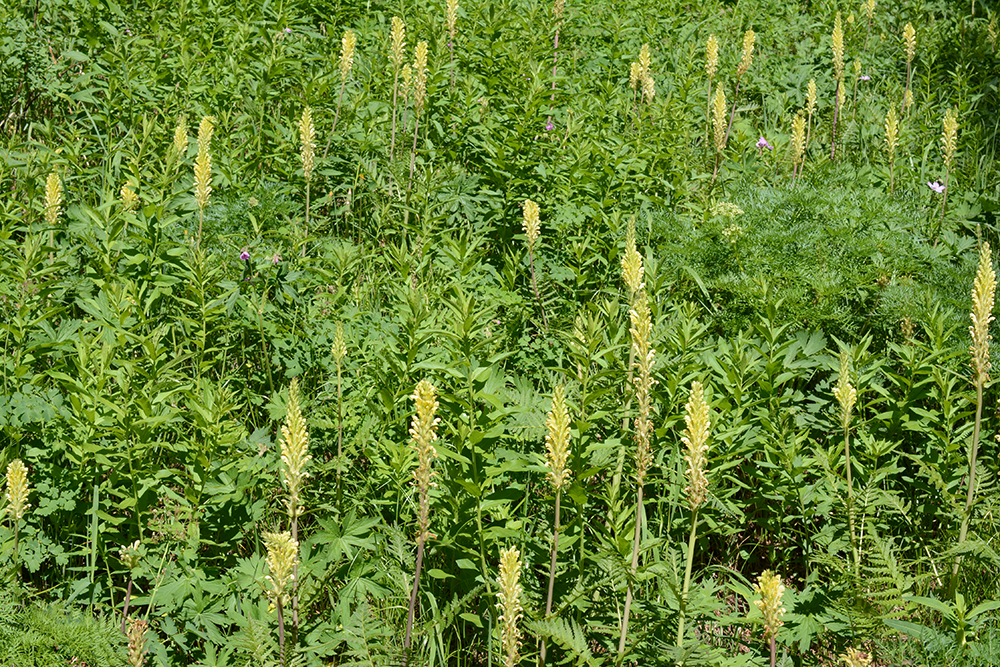
Louseworts have specialized pollination strategies: even if different species are growing in the same place and blooming at the same time, they do not seem to hybridize. Thus, they have attracted many botanists to research why they continue to be separate species. In some cases ,it is the particular fit of the flower to bee pollinator: how does the bee position itself in the flower, how does the pollen fall upon the bee and where.
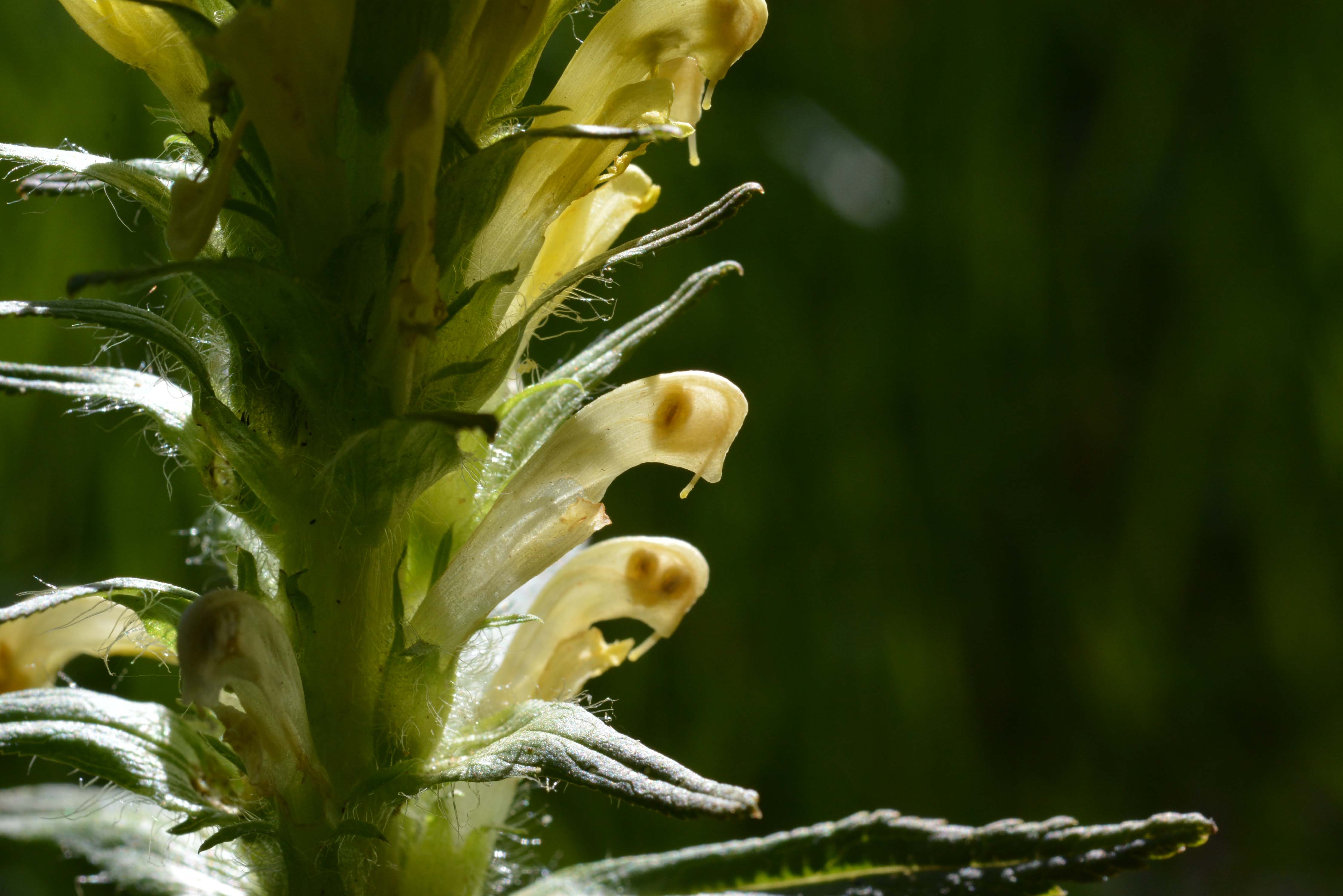
In Bracted Lousewort, the anthers are facing inwards, compressed by the “hood” of the flower. As the bee lands and starts probing, it separates the hood and the anthers dispense their pollen. When the bee visits a later-stage flower, the stigma protrudes to tap the exact place on the bee where the pollen rests.
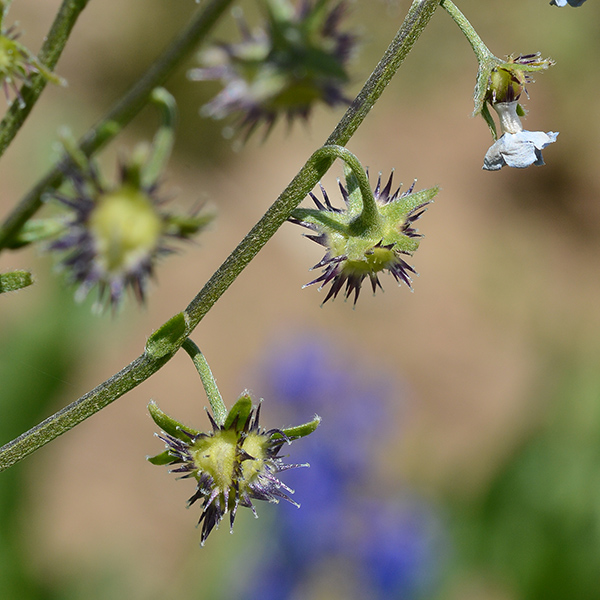
Also at higher elevations, are stands of Jessica’s Stickseeds – Hackelia micrantha. These perennials form dense clusters flowers the color of the blue sky which we admire.
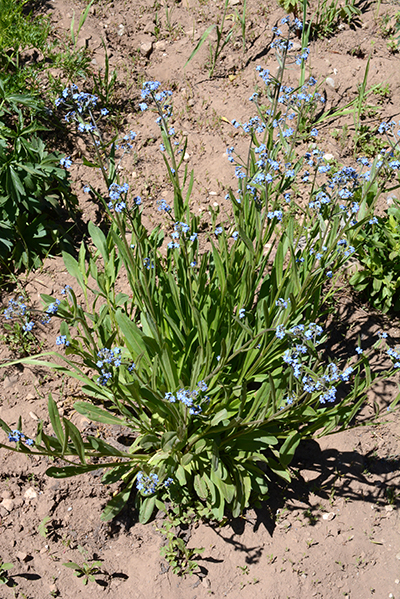
However later, they will produce pesky seeds that cling to our dogs and to our socks. This is the rooted plant’s method of traveling to a new place.
And while you are walking, you may want to look out for Stinging Nettle – Urtica dioica.
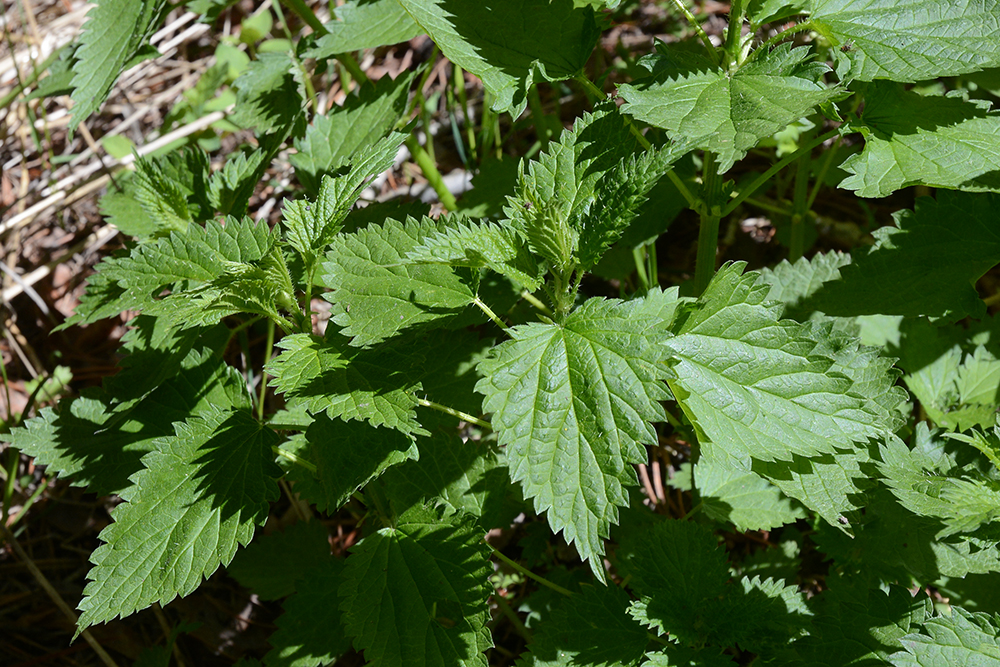
These 3-4′ tall plants are hard to see as their flowers are small and wind pollinated. If you look closely you can see the stems are square and the toothed, oval, pointed leaves are arranged opposite each other.
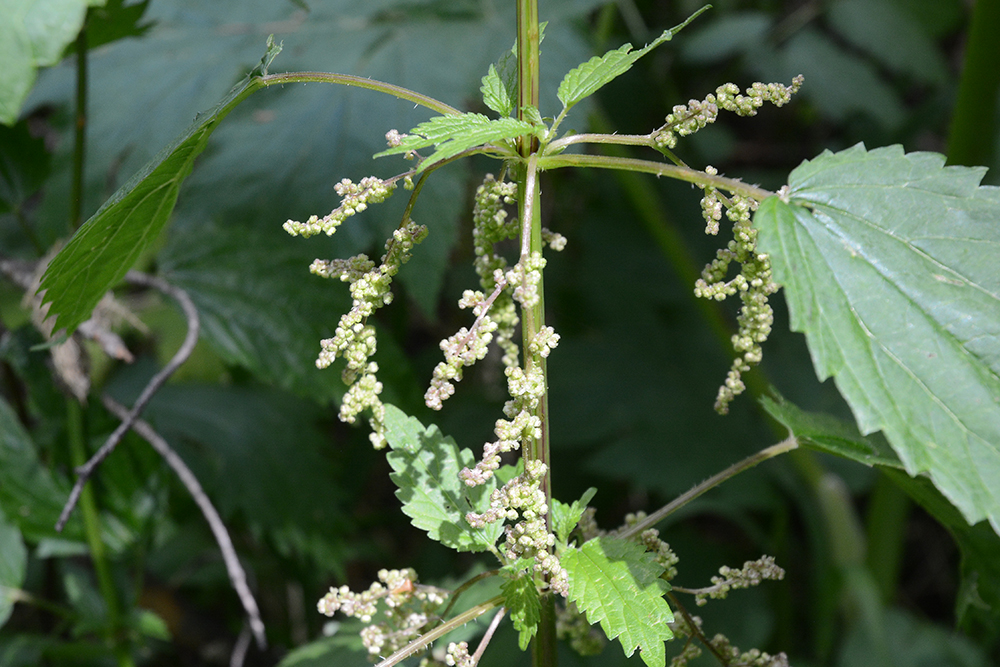
The plants are covered with tiny clear hairs which are filled with a chemical solution. When you brush against the hairs they eject a liquid that stings like a red-ant bite. Best to hike in long pants and long sleeves.
At higher elevations, one may catch the fragrance of Nuttall’s Linanthus – Leptosiphon nuttallii, a 12” tall phlox relative that is easily seen along higher elevation trails in the sun to part shade.
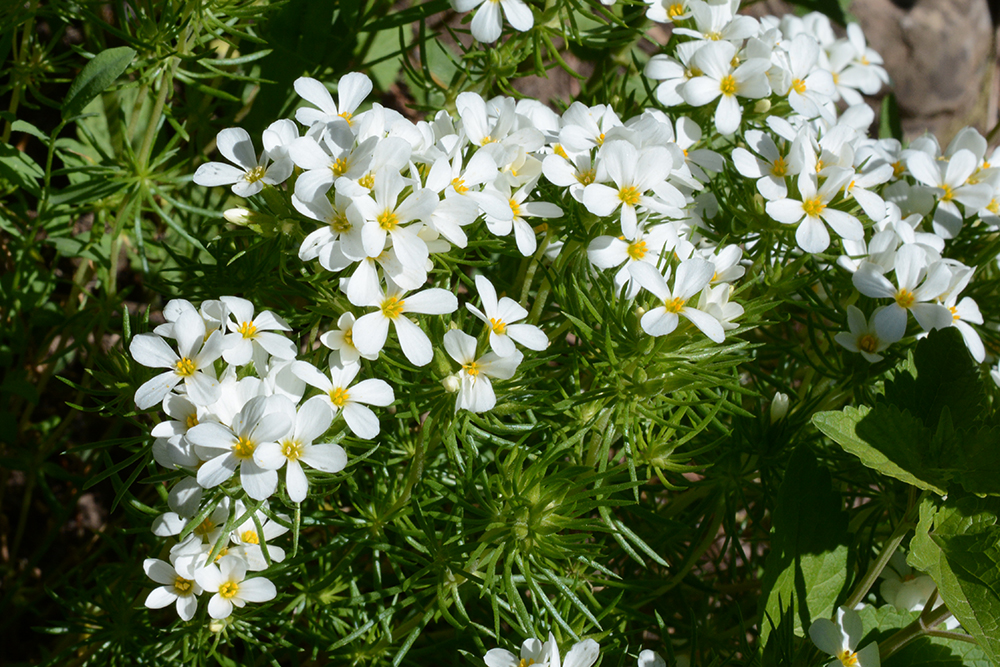
The leaves are dissected and form frilly whorls along the stems. This species has been placed in several different genera over the years – Gilia, Linanthastrum, Leptodactylon – curious.
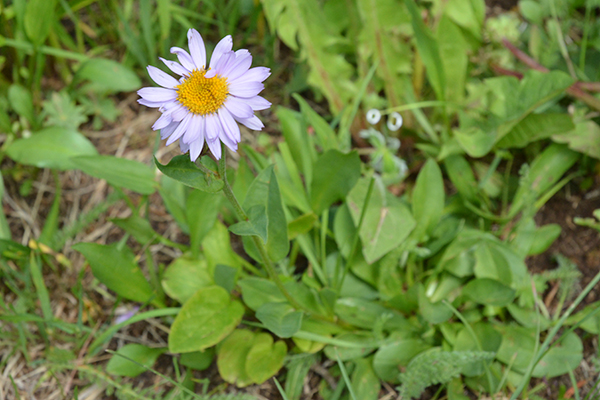
Two fleabanes are going strong now: As with all fleabanes, the bracts are of equal length around the heads with many ray and disc flowers. Rays are usually blue or white. The single fruits will be dispersed upon the wind by a hairy pappus.
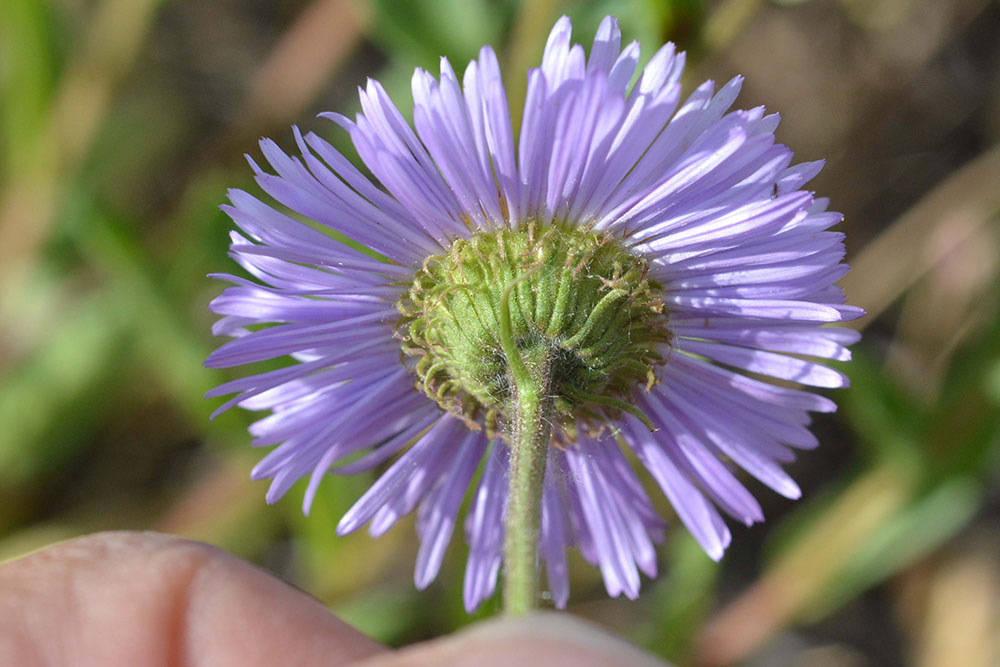
Showy Fleabane – Erigeron speciosus – has relatively narrow blue ray flowers. The oval leaves remain the same size alternating up the 2′ stems. They are very handsome garden plants as well as being at home in moist meadows and the shade of aspens.
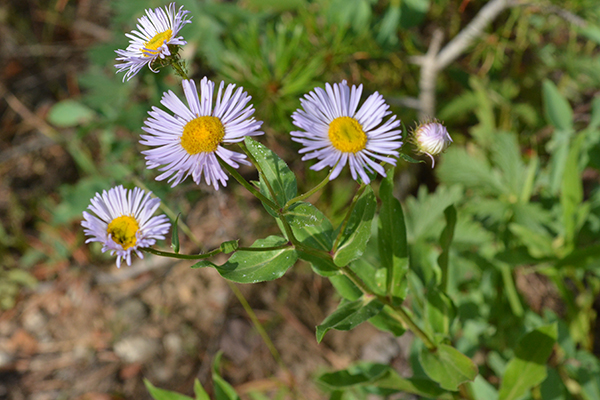
Subalpine Fleabane – Erigeron perigrinus – has relatively wider ray flowers, a cluster of elongate leaves at the base, and leaves that gradually get smaller as they go up the 18″ stems. As the name implies, they are at higher elevations, such as Teton Pass.
Many umbelliferae are blooming right now. Formally termed the Apiaceae Family or Parsley Family, this world-wide family has several features in common. The flowers tend to be small and are held up in “umbels” – umbrella-like structures: the rays come out from a single point like ribs of an umbrella. By massing the small flowers together there is more visibility and access for myriad pollinators.
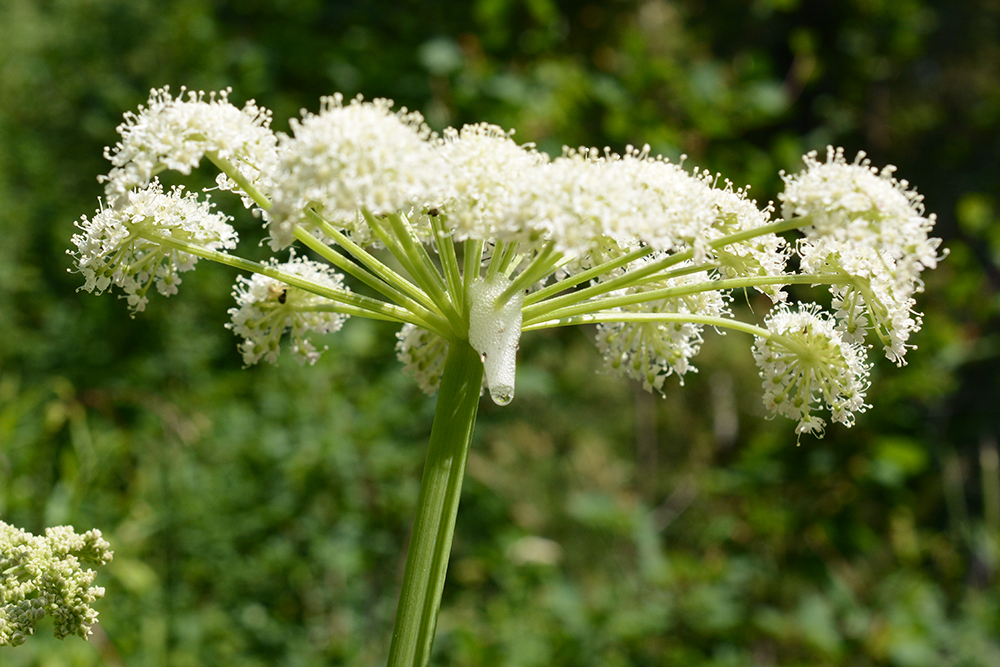
The flowers will form fruits called schizocarps: split fruits. Fruits are helpful, often necessary, in definitive ID within the genus. The leaves are often divided several times, often with a swollen base to the petiole.
Different species in this family are able to manufacture many different chemical compounds. Some are tasty. We eat carrots, celery, and fennel as vegetables and season our foods with herbs such as dill, anise, caraway, and cumin. Some plants are used medicinally, others are poisonous. Here are some that you may find along the trail. It can be fun to see how many umbellifers you can find in a season: a wildflower treasure hunt.
It is hard to miss the 6” umbels of delicate white flowers
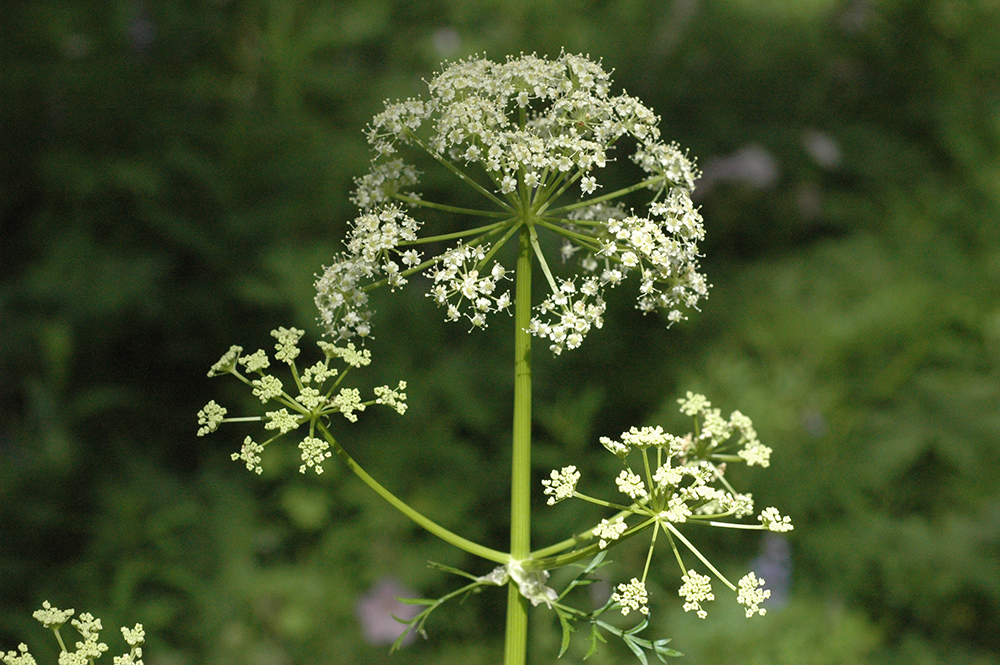
held 2-3’ above the finely dissected leaves—like carrot leaves—of Fern-leaf Lovage – Ligusticum filicinum. Many insects will crawl around the tiny flowers thereby spreading pollen. Later, ridged “schizocarps” – will form.

The roots are deep, thick, and fragrant and have been used medicinally
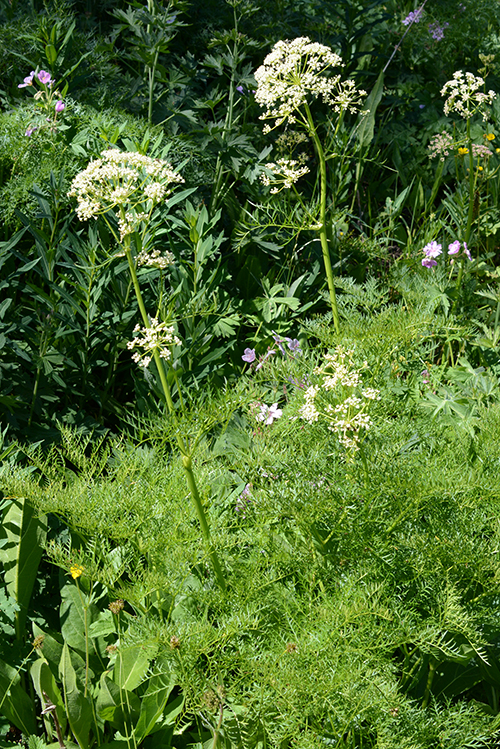
Sharp-leaf Angelica – Angelica arguta – also has white flowers,
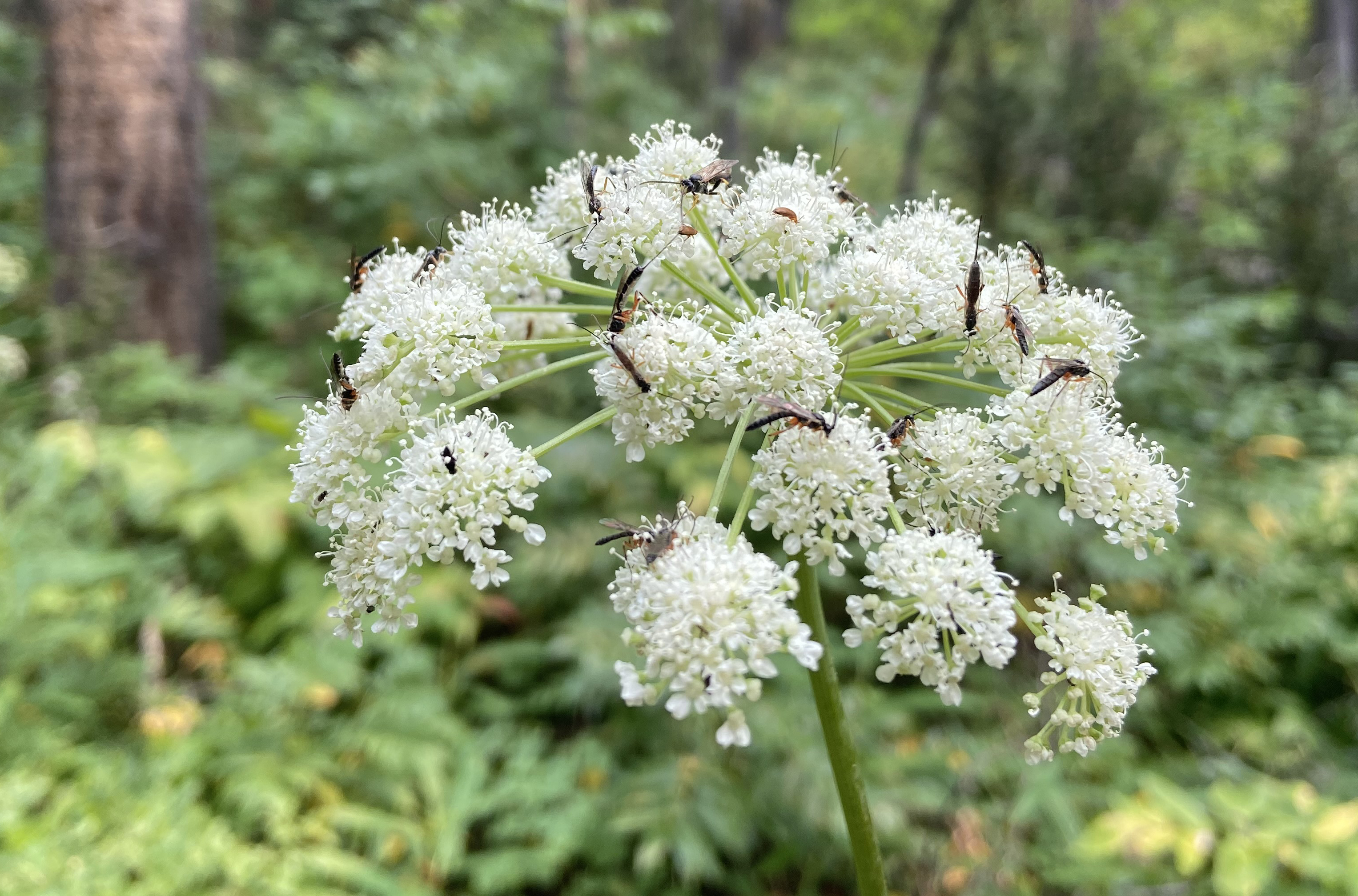
but the compound leaves have broad leaflets, like celery leaves
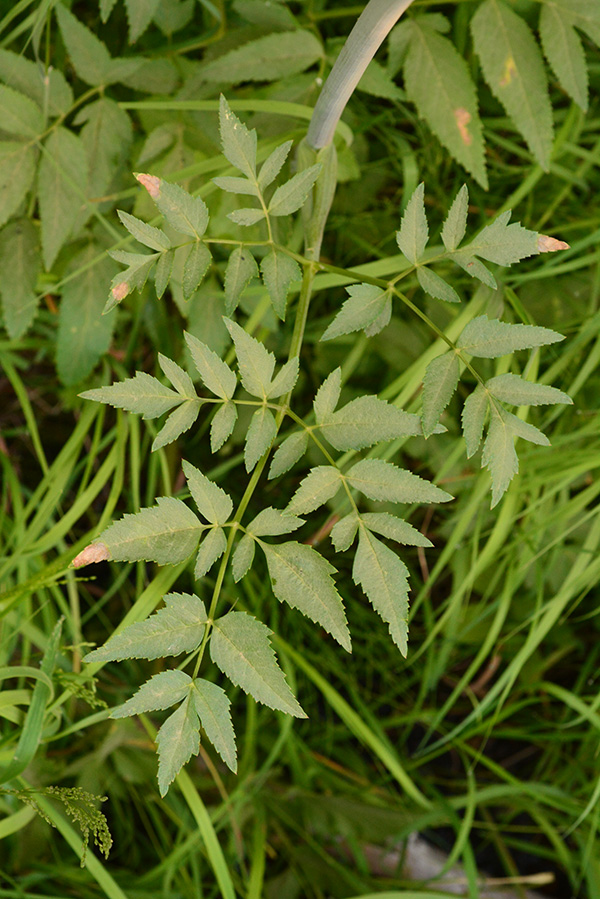
with distinctive swollen petioles.

Plants are up to 4’ tall and have a bluish-gray hue. Fruits have many ridges. Plants grow in moist places or at higher elevations.
Or you may see its 2-3’ tall relative Western Sweet Cicely – Osmorhiza occidentale – with its delicate yellow petals.
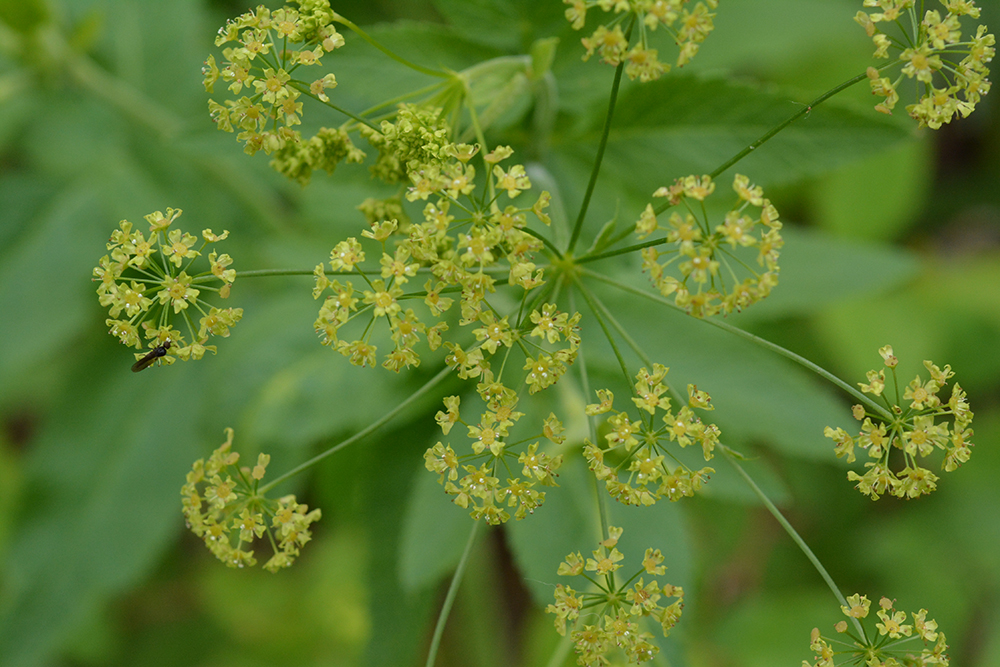
Soon it will produce tangy elongate smooth schizocarps. The fruits have a tangy licorice flavor.
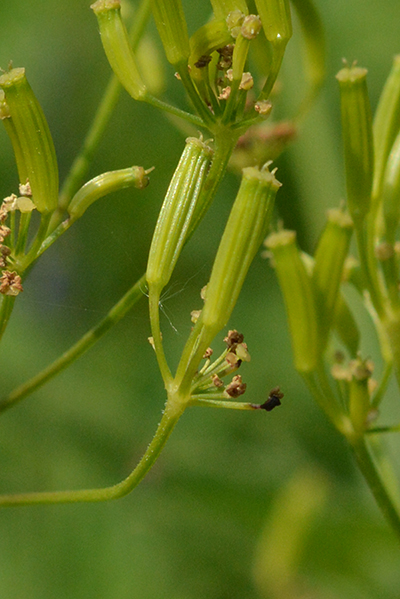
The slightly shorter Mountain Sweet Cicely – Osmorhiza chiliensis – has delicate white flowers on umbels whose ribs are held at acute angles. The elongate schizocarp has tiny hairs that help the seed attach to a passerby.
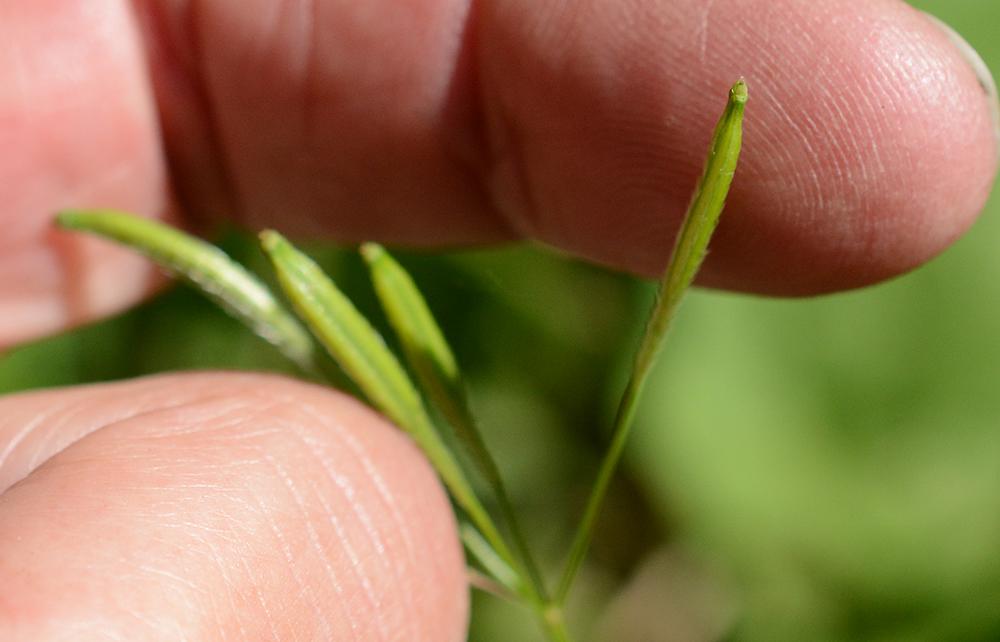
One of the smallest blooming umbellifers right now is Blunt-fruited Sweet Cicely – Osmorhiza depauperata – whose hairy fruits are slightly club-shaped and are in umbels with only a few rays that are held at wide angles.
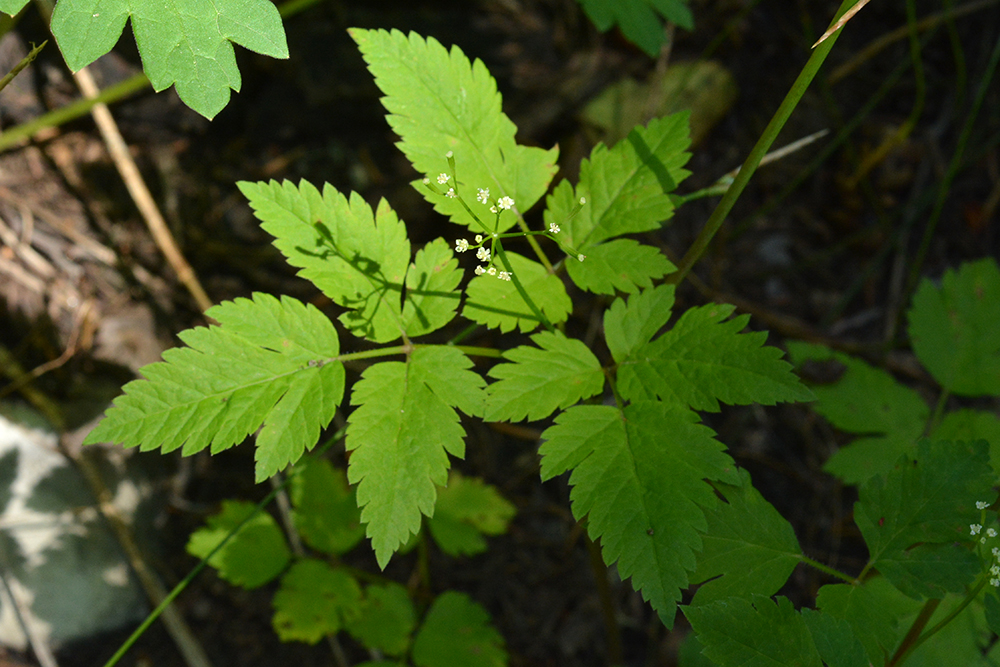
Cow Parsnip – Heracleum spondylium – is the largest member of the Parsley Family in the valley. The 3-parted compound leaves can be 3-4′ across, the stalks rise up to 5-6′ tall, and the umbels spread to the size of dinner plates. No wonder it is named after Hercules the Greek hero.
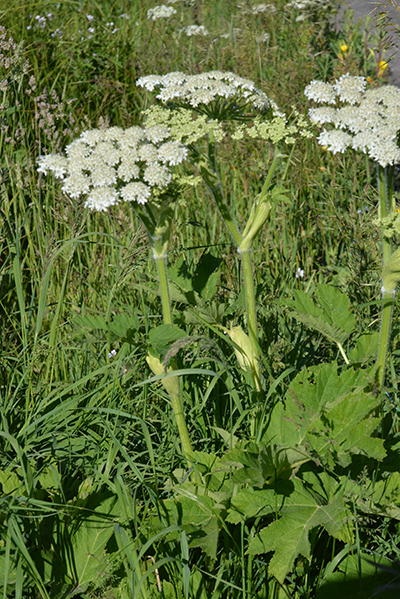
Have fun looking at the details of the above 6 umbellifers.
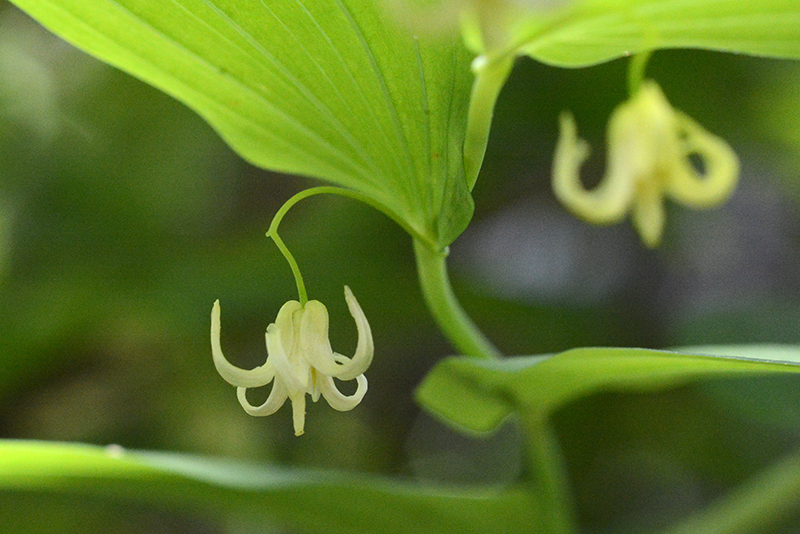
Near streams in the shade, look under the arching compound leaves of Twisted Stalks – Streptopus amplexicaulis.
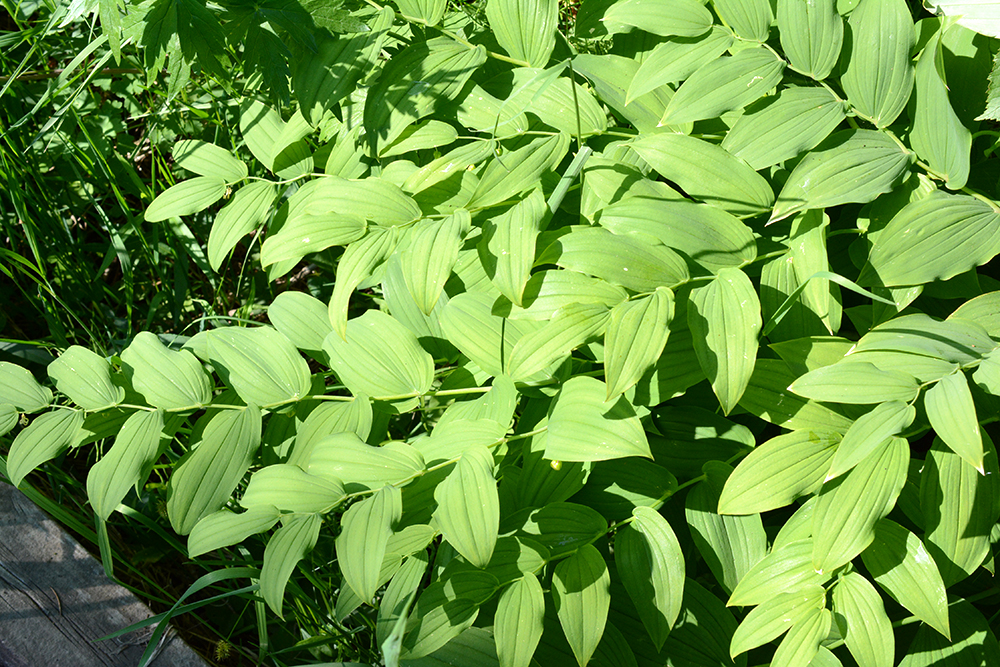
You can see tiny yellow bell-shaped flowers dangling from a kinked pedicel at each leaflet joint. These flowers will produce red fruits later in the season.
Mixed into the understory, cheerful Canada Violets – Viola canadensis – hold up their white flowers to lure in pollinators. The flowers stand out in the gloom and their scent lures in pollinators, which are then guided by lines and hairs.
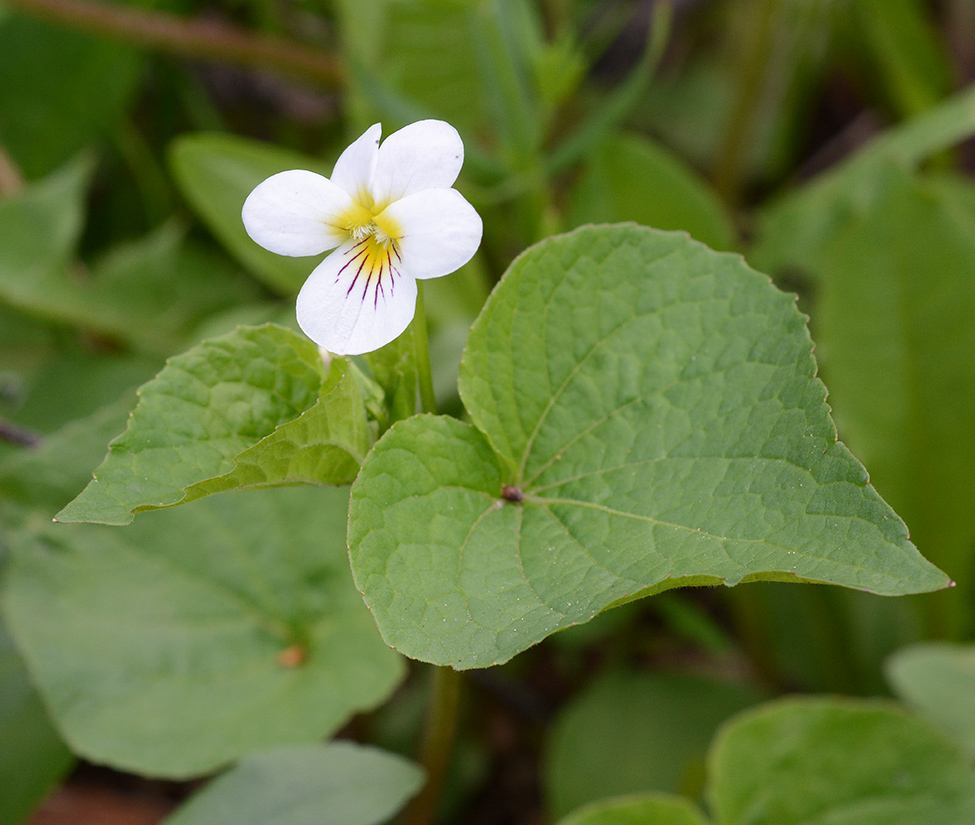
They land on the lower petals and then head toward the back of the “spur” which holds sweet nectar. In the process of pushing and prodding, the pollinator – if the right fit – will be doused with pollen which it can then carry to another violet flower where pollen grains will stick to the stigma—pollination is performed and seeds can now form!
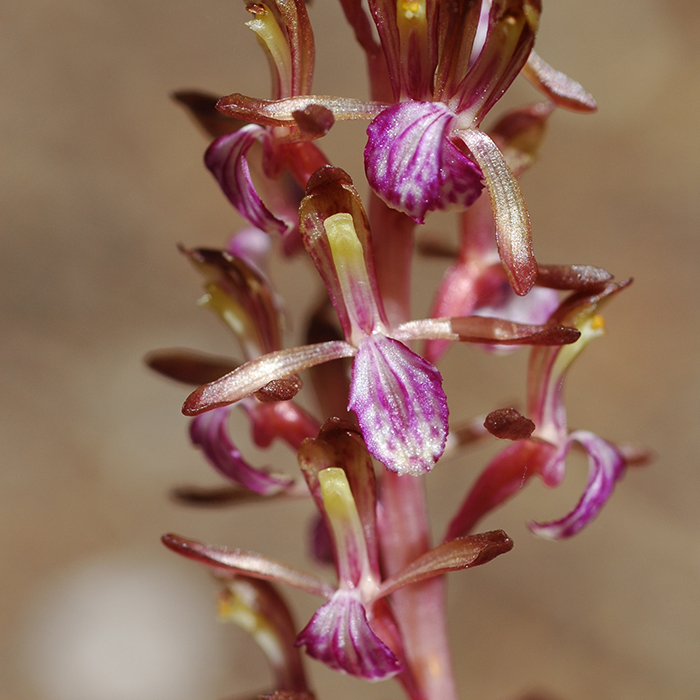
Special finds in the forest are orchids. Right now you may come across Spotted Coralroots –Corallorhiza maculata.

The spotted flowers have a tiny sharp lobe on either side the “lip” petal and are held up by either deep-maroon or yellowish stems.

With no chlorophyll, coralroots depend on specialized fungi to acquire nutrients for their germination and growth. Thread-like micorrhizae attach to knobby orchid roots and stretch well beyond to capture nutrients which they relay back to the vascular plant.
Or another species is Western Coralroot – Corallorhiza mertensiana – note the narrow lip with obfuscated lines and spots and the sepals and petals are also narrow.
While hiking in an older coniferous forest you may find the 3-4” the Northwest Twayblade – Listera caurina now Neottia banksiana. This green orchid can photosynthesize its own food, but again mycorrhizal fungi assist in its growth, particularly in the germination of its tiny seeds.
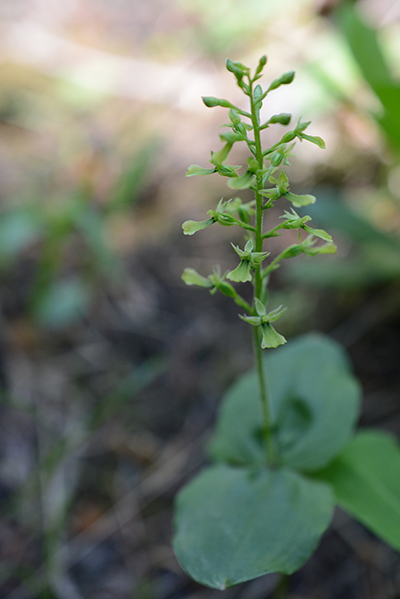
Please be extra careful around orchids: watch your step and please no picking. Their life is precarious enough.
One plant which cannot be overlooked is the 6-7′ tall False Hellebore – Veratrum californicum – found colonizing moist meadows or lakesides.
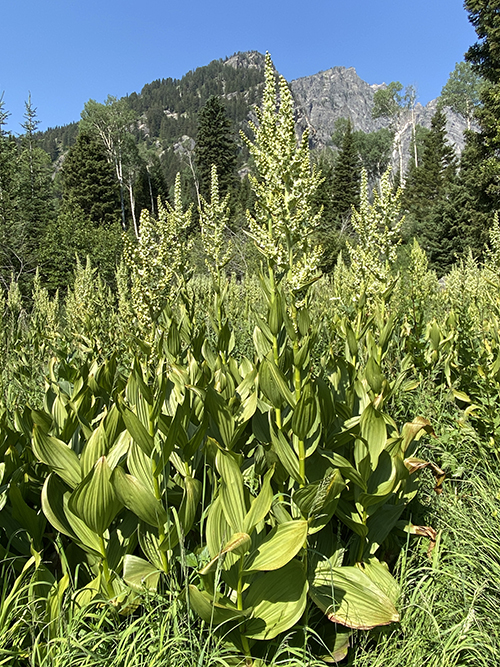
This is considered an extremely poisonous plant. Sheep, goats, and cows can be severely affected and their offspring deformed. It is also being researched for its medicinal values: in particular several of its alkaloids may be effective in cancer treatments. Roots are much more poisonous than the tops of the plants, but still toxic.
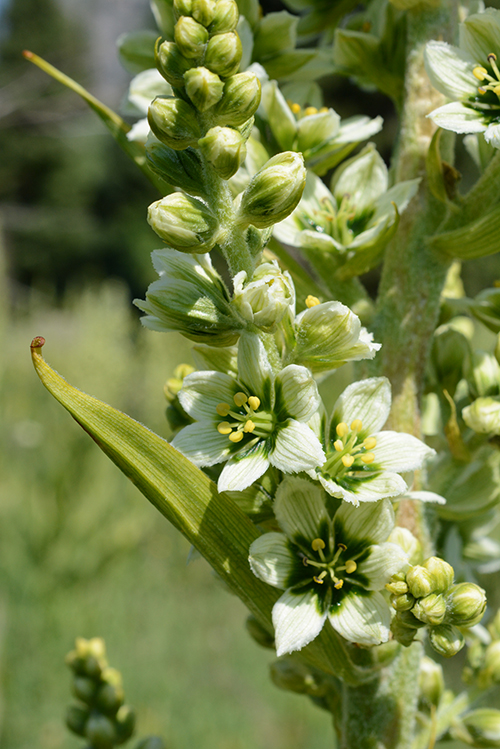
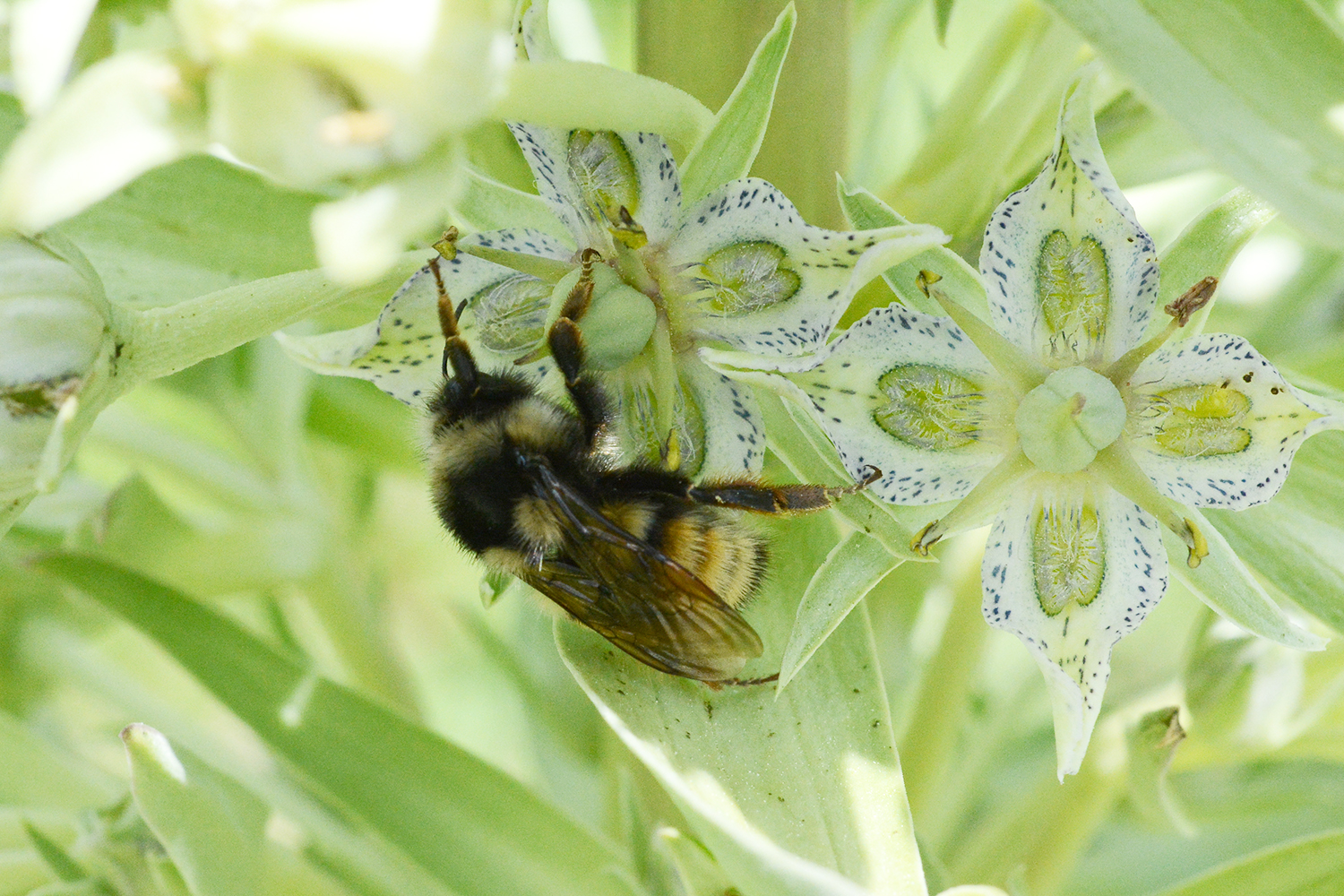
The wide-open flowers attract a variety of pollinators. They seem to have some years when they are all flowering and other years when flowers seem scant.
So much more to come. Enjoy getting out as often as you can to explore the flora of the Tetons and around the valley.
Wilson, WY, July 13, 2024




 Teton Plants