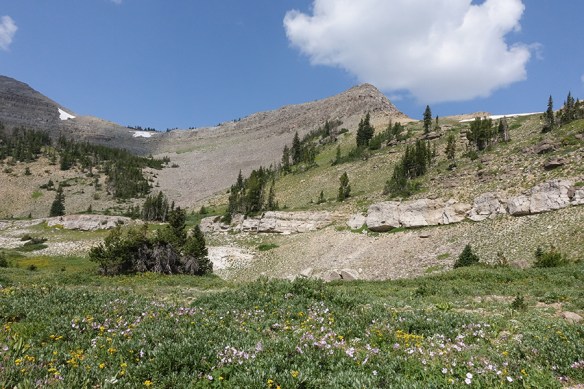
 Wildflower seekers are hiking above 8,000’, even 9,000′, for colorful displays of flowers found earlier at lower elevations. It is also time to search for unusual subalpine to alpine flowers above 9,500′ to 10,500′
Here are some recent sightings and identification tips, focusing on species specialized to grow in the very short summer season, instense sun, abrasive wind, and poor soils of high altitudes. Most of the photos were taken in the past week up on Rendezvous Mountain, but the species can be seen elsewhere.
The majority of the photos below were taken in the last 10 days around Rendezvous Mountain. The photos focus on identification tips. You are welcome to ignore the details and just enjoy their beauty. If you are a full flower nerd, know that the taxonomists do not always agree with the classification of some of the species shown…opinions among scientists often vary.
Starting from the top:
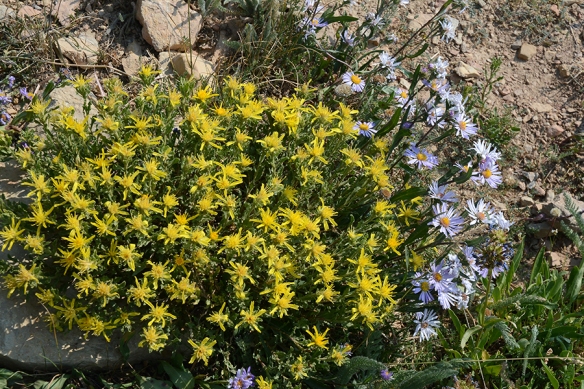
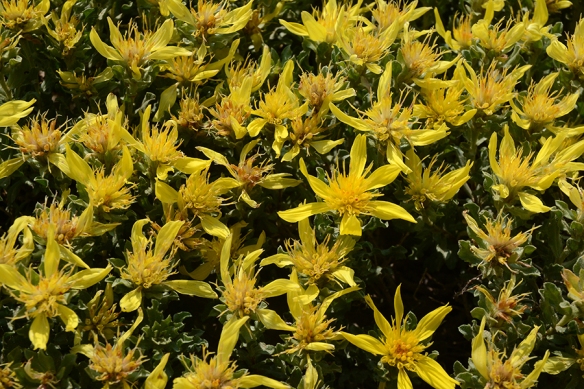
Woolly Goldenweed – Happlopappus suffruticosus – is cheerfully sprawling along the road down Rendezvous. These subshrubs have woody bases, alternate twisted leaves, and bright yellow flowers (photo above and below).
Eaton’s/Tweedy’s Thistle – Cirsium eatonii/tweedyi. – is a 2-4’ tall, native (good!) thistle which catches your attention:
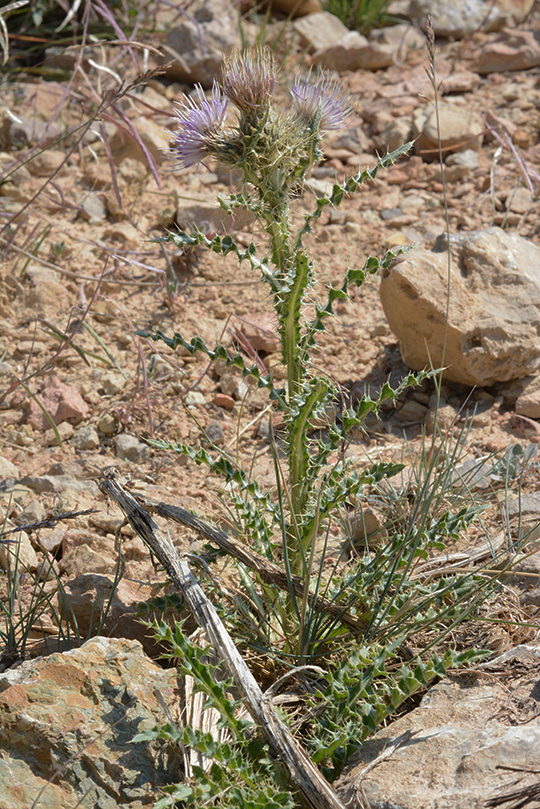
Carefully, look into the dense cluster of flowers at the top of the plants: The bracts are interlaced by a web of glistening hairs. Bracts surround 2-3” pinkish flower heads. Pollinators are plentiful!
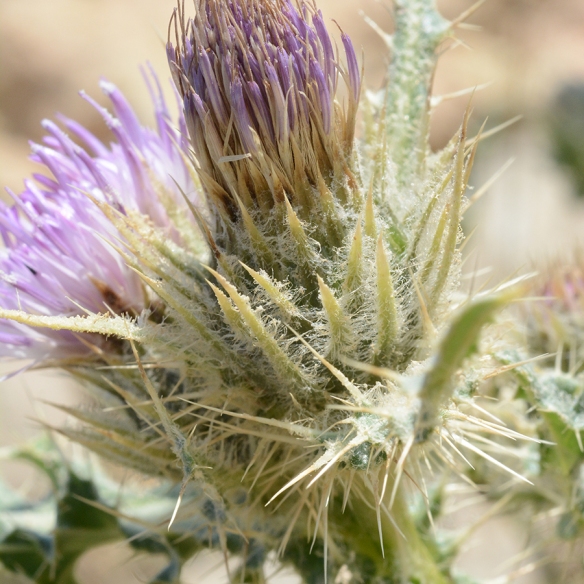 Leaves are 6-8” long, toothed to lobed, wavy, and spine-tipped. Notably, petioles run down the stem (decurrent). Tweedy’s thistle is deemed “unresolved” by the authoritative Flora of North America: it is not even considered a variety. However, the authors note that there is much post-glacial hybridization among formerly isolated populations of this complex genus.
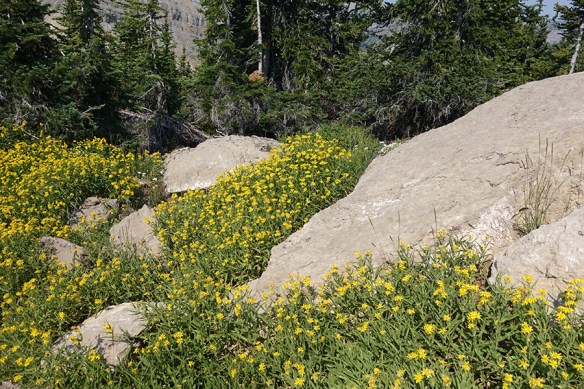 Bright yellow Long-leaved Arnica – Arnica longifolia – grows in cheerful drifts.
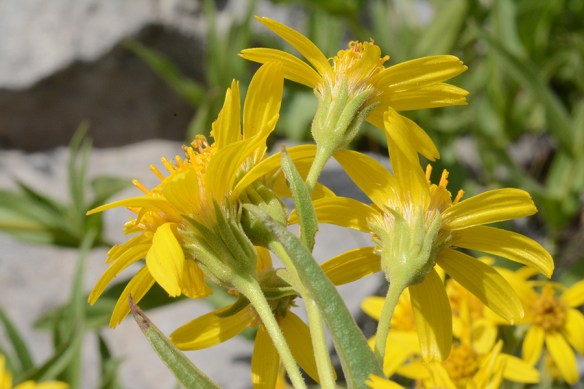 The 1-1.5’ stems feature several pairs of elongate leaves, as well as many yellow heads surrounded by equal-length bracts. The plant is overall glandular hairy with a strong odor.
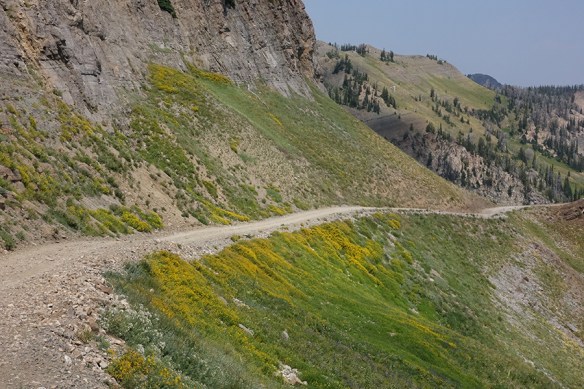 It is common as you continue down the mountain road and seen from the tram.
As you head down farther where snow piled high in the lee of mountain slope or in a bowl, plants are larger and more profuse. Here a few showy species seen on the way down to Cody Bowl:
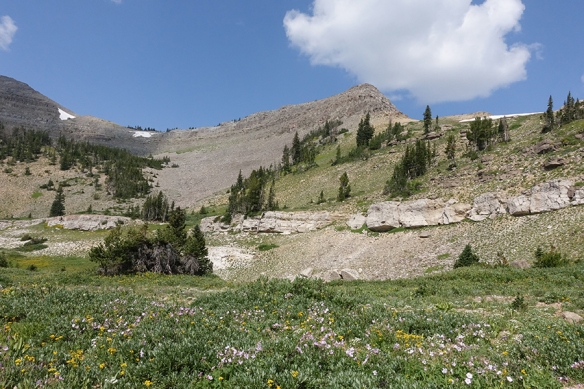
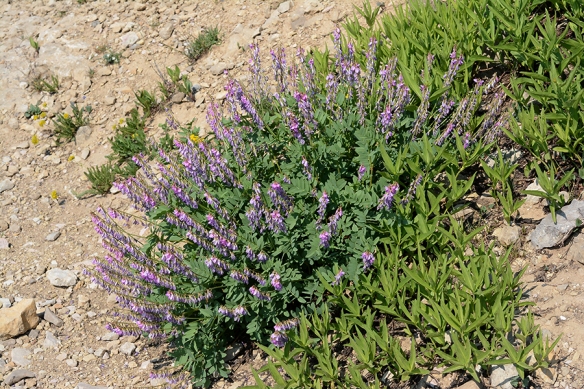 Alpine sweetvetch – Hedysarum alpinum var. americanum – has many deep violet- red, pea-like flowers (its in the pea family) dangling from one side of the inflorescence (photos above and below).
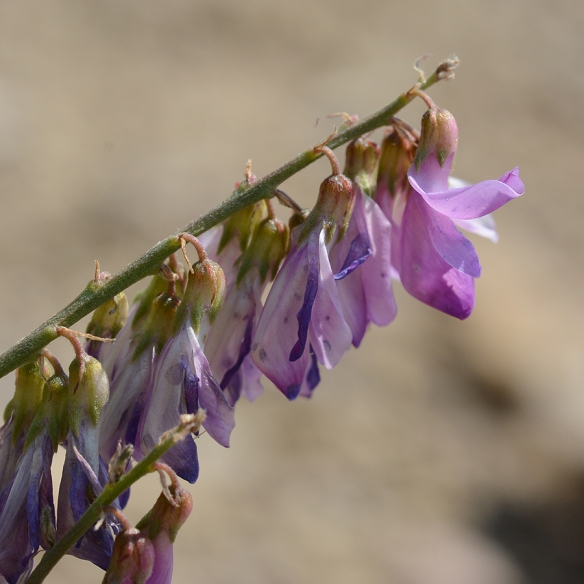 Bluish-green leaves are pinnately divided into oval leaflets. Careful measurements of flowers (9-15mm) distinguish it from the slightly larger flowered (17-22 mm) Western Sweetvetch (H. occidentale). (Not all taxonomists agree with this separation!)
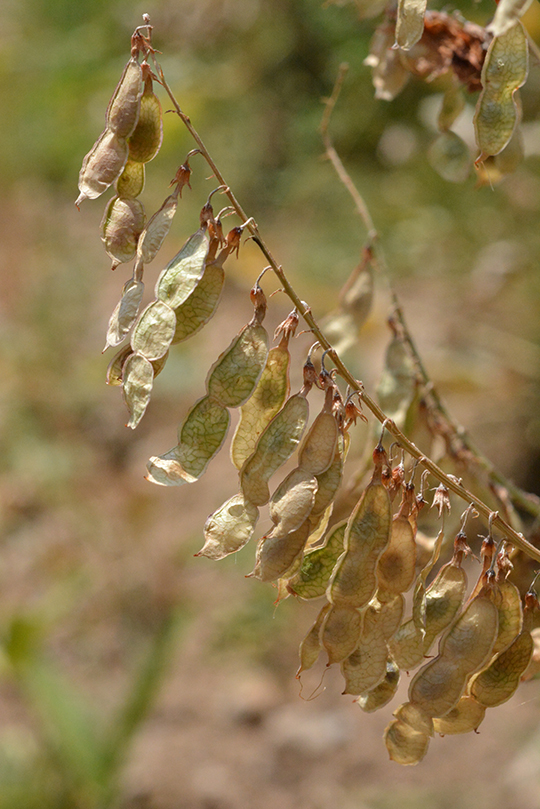
The fruits of Sweetvetches are termed loments – segmented fruits each with one seed inside. I think of them as pods flatted by a steam roller. The flat segments break off and disperse upon the wind. Many are forming now (photo above).
White-coiled Lousewort – Pedicularis contorta – has distinctive “coiled” or beaked white flowers which have evolved to fit worker bumblebee pollinators (below). Note the stigma projecting from the coiled beak formed by fused petals. When a bee lands, the stigma fits between the bee’s head and body and picks up pollen which the bee could not reach from a visit to another lousewort flower.
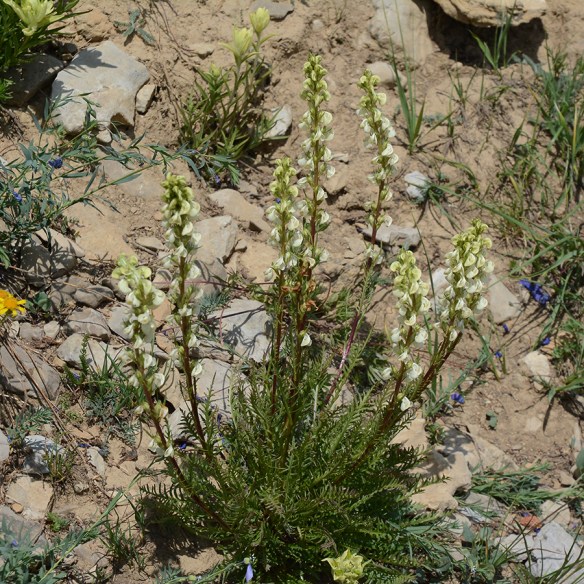
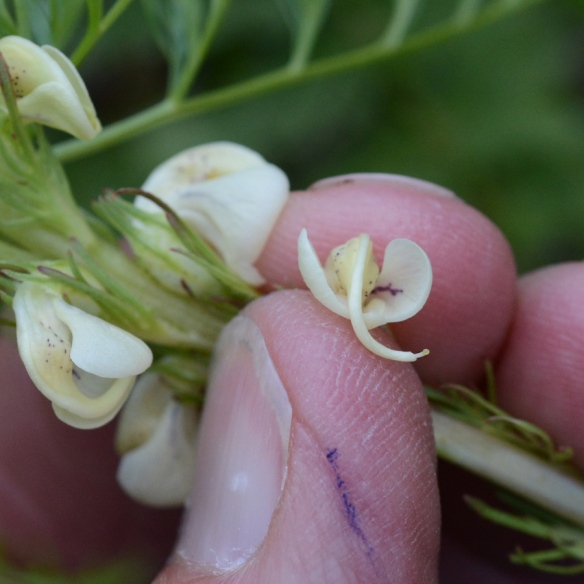 The 1’ plants have divided, mostly basal leaves, which helps distinguish it from a similar, more lower-elevation species: Parrot’s Beak – P. racemosa – which has with toothed but not lobed leaves. White-coiled lousewort is shown below.
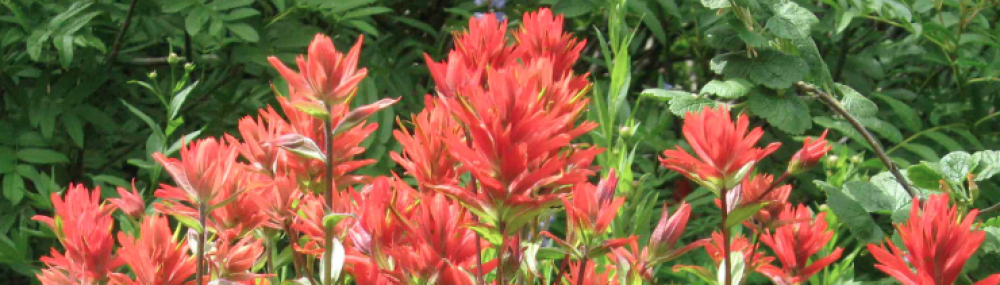
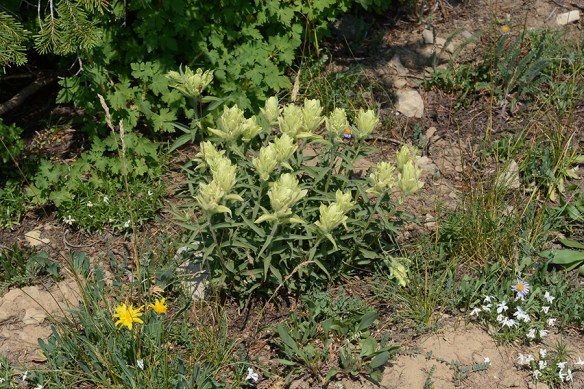
Sulphur Paintbrush – Castilleja sulphurea – continues to bloom in the shade of Engelmann spruce and Subalpine Fir, where snow collected over winter and lasted longer.
Groundsels – Senecio/Packera – are common and confounding yellow composites. They have equal length bracts like Arnicas, but the leaves alternate up the stem.
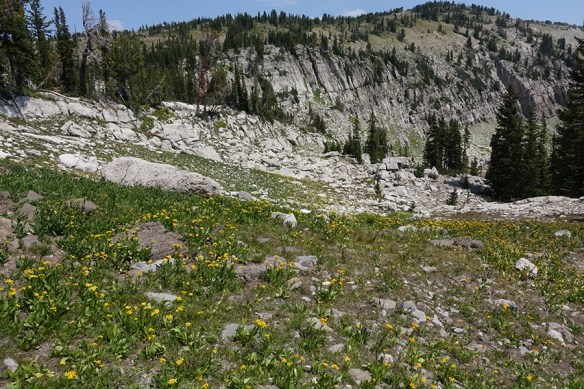
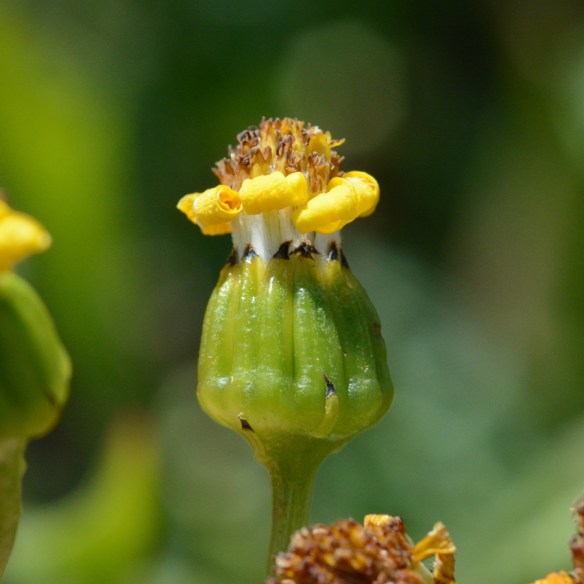
The relatively large Thickleaf Groundsel – Senecio crassulus – is still blooming strong in mountain meadows, such as Rocky Springs Loop (above). Look for the even-sized, waxy bracts with black somewhat frayed tips.
 Undulating, slightly toothed, slightly succulent or waxy leaves clasp the 1-2’ stems (below).
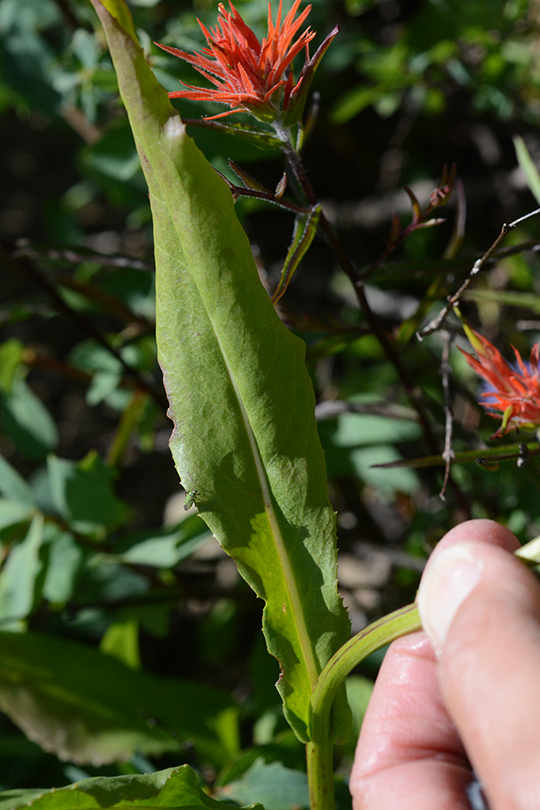
Related and once grouped in with Senecios, two different “Packeras” continue to challenge this and other botanists. The expert Arthur Cronquist said groundsels are a “transcontinental complex of ill-defined taxa.” It is a challenging (frustrating!) botanical puzzle to try to tell them apart!
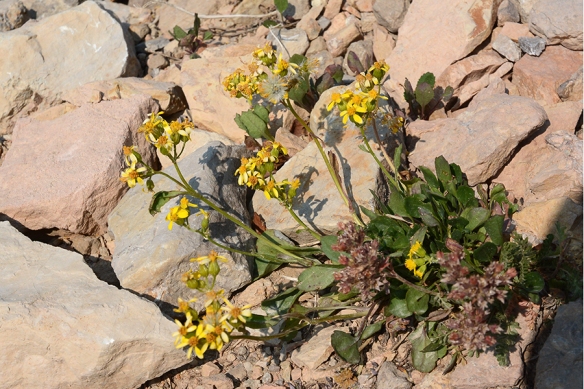
Rocky Mountain Groundsel – Packera/Senecio streptanthifolia – is found frequently at lower elevations, and more occasionally at high elevations. The lower leaves are toothed or lobed more or less, as are the upper leaves. The lower leaves are larger than the upper leaves. Plants have many yellow flower heads. I am not sure which species this is! (photo above).
Different Groundsel – Packera/Senecio dimorphophylla – is often hard to tell apart from Rocky mountain groundsel. However the scientific name di- (two), morpho- (shape), phylla (leaf) indicates a distinct difference in the shape and size of basal vs. stem leaves. The basal leaves tend to be unlobed to toothed, the upper leaves more deeply lobed and clasping the stem with arrow-shaped leaf bases (auriculate). At least a few stem-leaves are often larger or equal in size to the basal leaves (I have noticed that the lowest stem leaf is often the largest and most indicative of the species). The photo below seems a clear identification of this species. I also noted that it seeds in readily to the harsh conditions of talus. 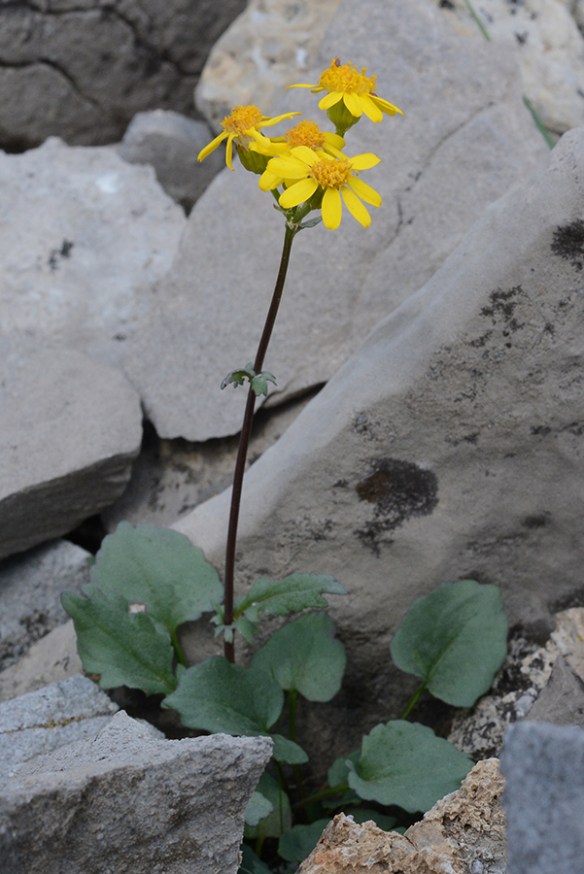
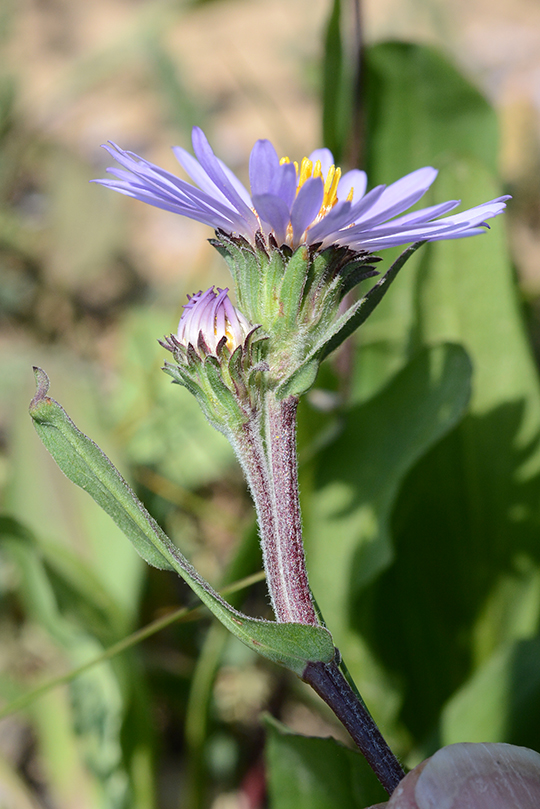
Asters are beginning to appear. A common species at high elevations is the Leafybract Aster – Symphiotrichum foliaceum var. apricum – which is low growing, with slightly clasping leaves, and wide bracts (foliaceous) with purple tips surrounding the lavender heads (photo below).
Thickstem aster – Eurybia integrifolius – also has flaring, variable bracts. Flower heads are sticky hairy and a distinctive deep violet blue. Reddish stems are also glandular hairy. This 1-2.5’ plant grows readily at lower elevations, as well (photo below).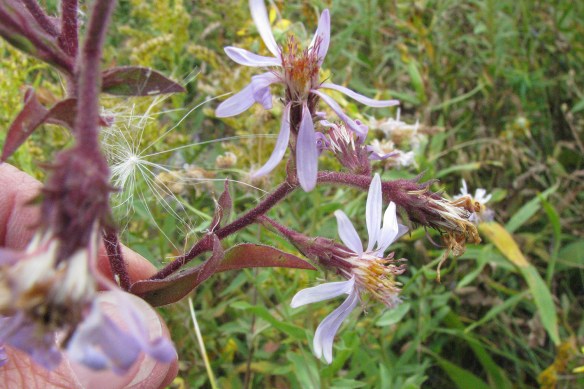
Always a special treat to see, Mountain Bog Gentian – Gentian calycosa – appears particularly abundant in moist to wet sites down to Cody Bowl. Observe the delicate lines and spots that attract bumblebee pollinators deep into the open bell shaped flowers. In this photo (below), gentian is nestled in with the common Rocky Mountain Goldenrod.
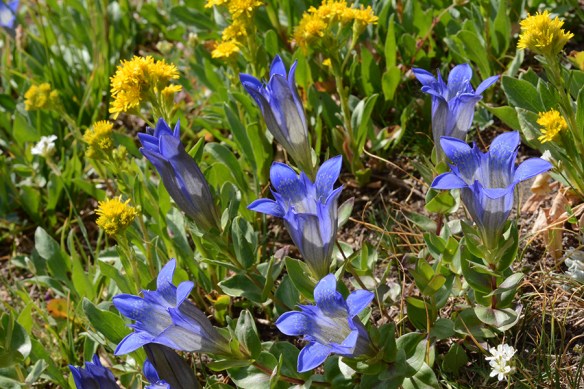
Rocky Mountain Goldenrod – Solidago multiradiata – is a common plant at both high and lower elevations in Teton County. To tell it apart from other golendrods, look for clusters of leaves at the base and stiff hairs along the petioles of the lower leaves –a sure way to know the species. The heads also have over 13 tiny ray flowers – the “multi-radiata” in its name. Height varies from an inch to a foot or so, depending on the conditions it is growing in.
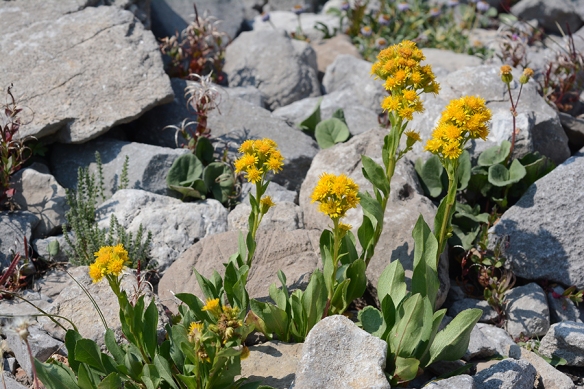
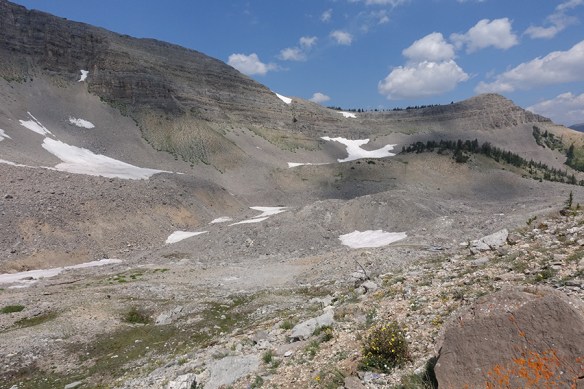 The rocky talus of Cody Bowl has several speciality flowers that seem to be able to grow out of rock.
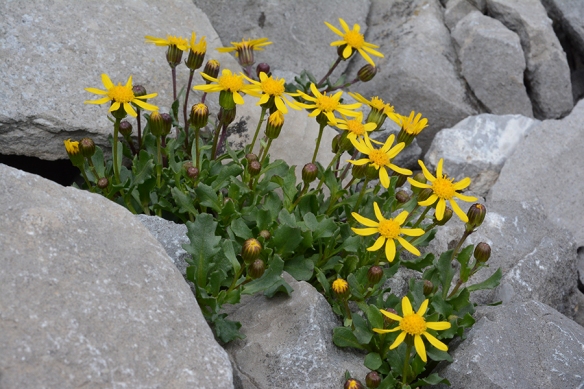 Fremont Groundsel – Senecio fremontii – has single flowers with the indicative row of waxy bracts. The small leaves are toothed and arranged along the stem: not clustered at the base (although some plants with short stems look like they have basal leaves). The flowers are single and appear large compared to the leafy body of the plant.
One unusual species Alpine Groundsel – Ligularia/Senecio amplectans – is also part of the groundsel group: Most notable are mostly solitary (1-3), nodding, ½” heads. The leaves are mostly basal and fine-toothed.
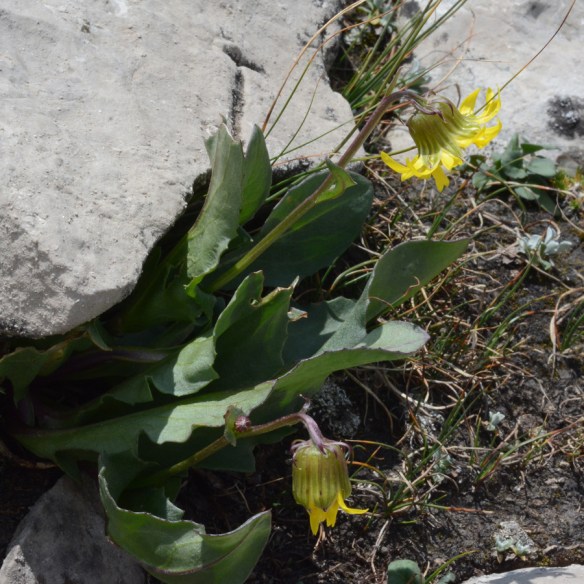
Other species are much easier to identify and appreciate:
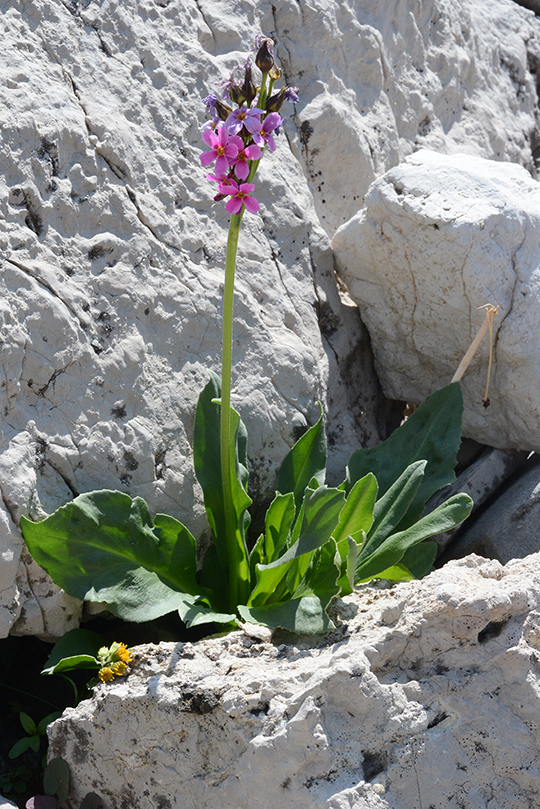
Parry’s Primrose – Primula parryii – grows very rarely in the talus of Cody Bowl. I have also seen it near the top of Targhee in a similar rocky habitat.
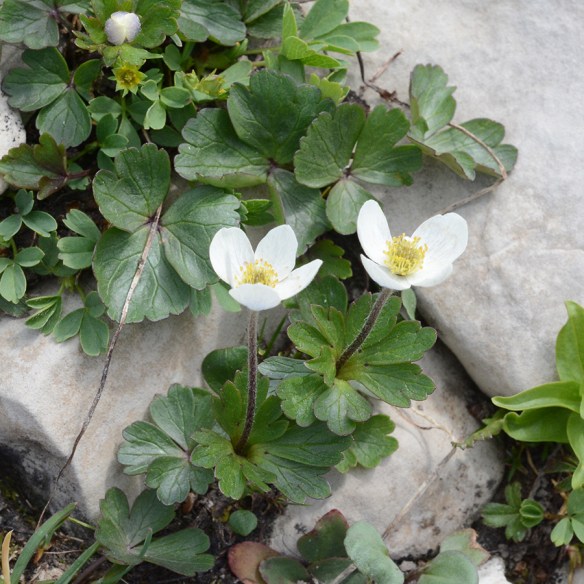 Small-flowered Anemone – Anemone parviflora – is only inches tall with tidy whorled leaves.
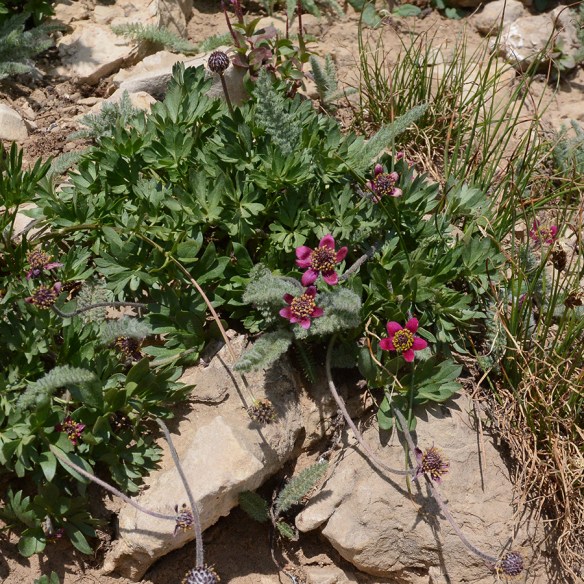 And nearby, the deep-pink Teton Anemone – Anemone tetonensis.
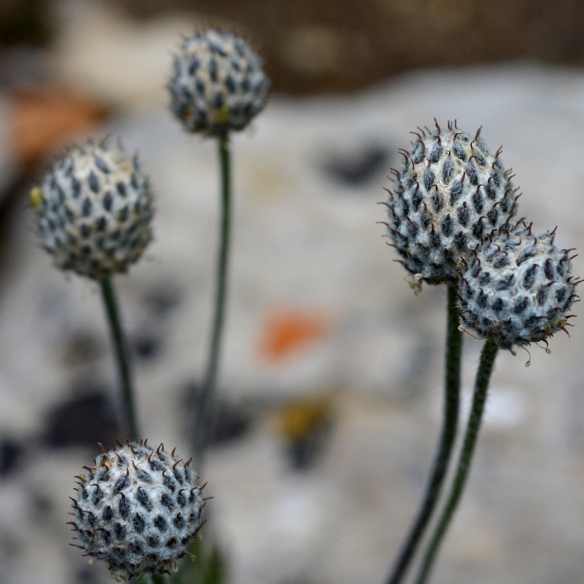 Some anemones are already setting seeds!
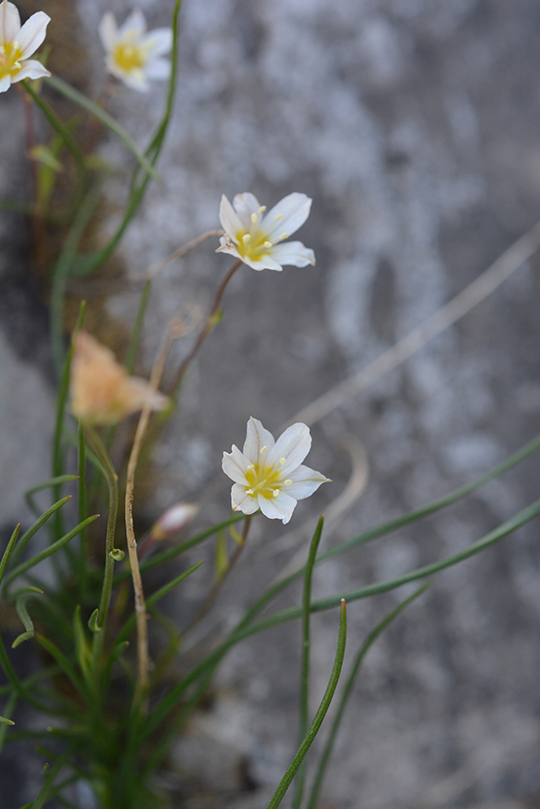
A particularly tiny plant: Alp Lily – Lloydia serotina – is only 2-6” high. Its 6 white “tepals” remind us it is in the Lily Family. It grows from bulbs.
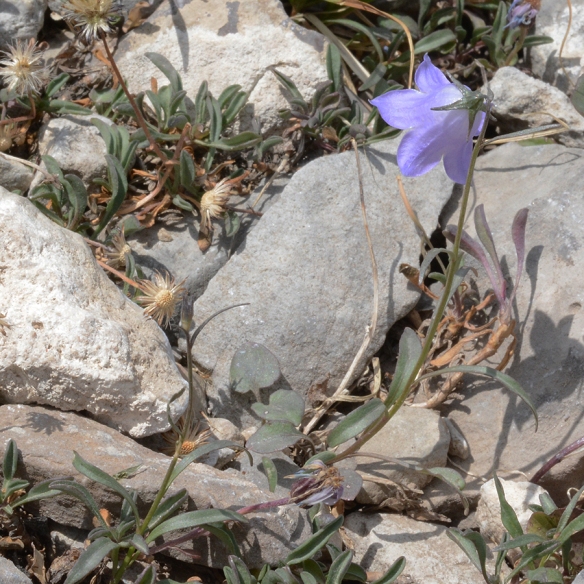 Similar in size is the Alpine Harebell – Campanula uniflora. Instead of many bell-like flowers per stem found in the more common harebell, this species has only one flower per stem, as the Latin name uni-flora aptly describes.
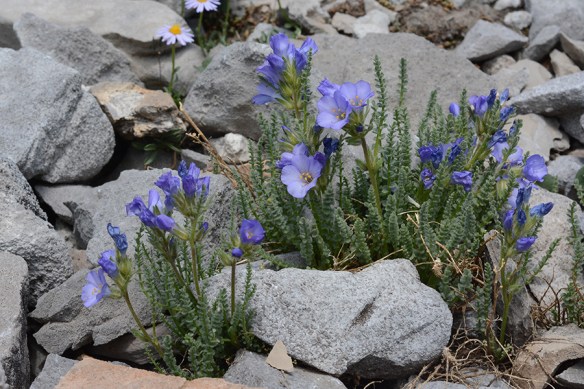 You may smell this plant before you see it’s blue flowers: Skypilot or Skunkflower – Polemonium viscosum. It ranges in size from 5-12” high.
As one heads down into the lower portion of Rock Springs Loop, flowers once again become plentiful:
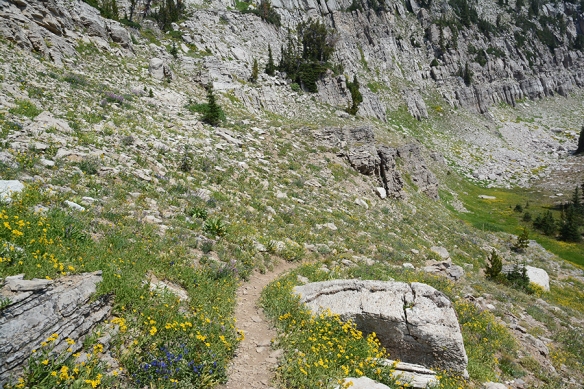 Snow Buttercups – Ranunculus adoneus – are blooming brightly in recently melted snowpatches. The leaves are divided 1-2x into narrow lobes (photo below).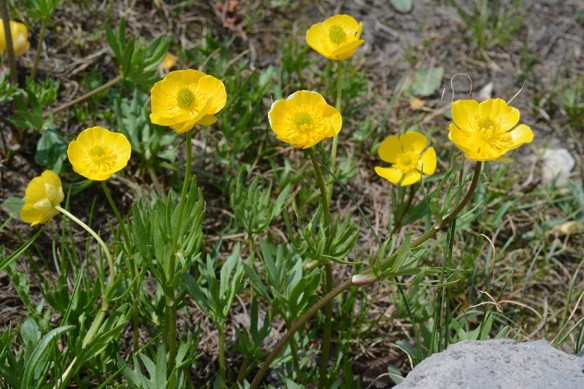
A flower mix of more subalpine or meadow species is patchy on the steep slopes. Below is a combination of Nuttall’s Leptosiphon – Leptosiphon nuttallii – and very low growing Thickleaf Grounsdsel: 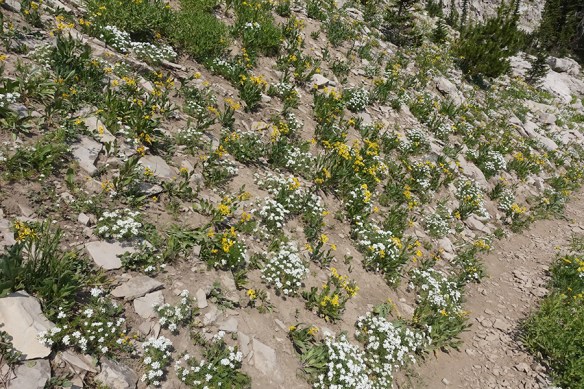 Another combination includes Sulphur paintbrush, Bog Gentian, and Coiled-beak Lousewort: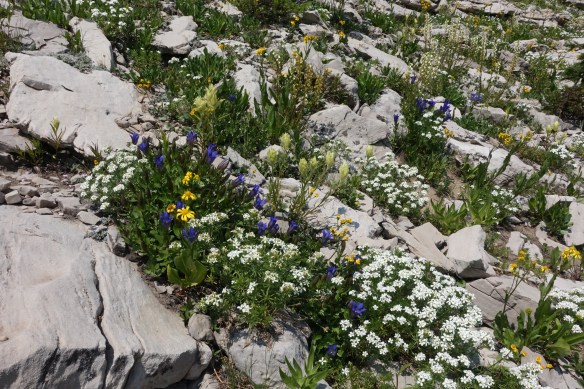
There is much more to discover in the high elevations before snow flies. Enjoy looking for the above species and more these last few weeks of summer.
And for other flowers still blooming at this time and with more aster ID go to our 2016 archives: “Get High on Wildflowers”: https://tetonplants.org/2016/08/
Frances Clark, Wilson, WY
Corrections and comments welcome!
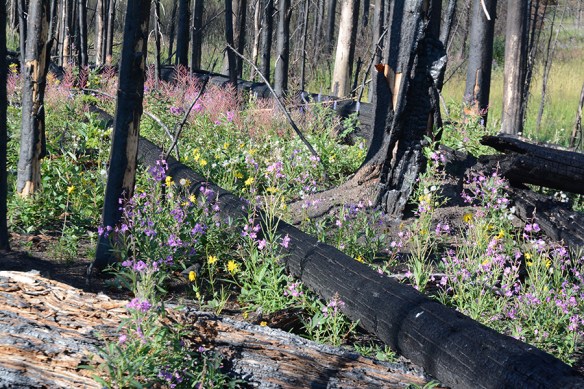
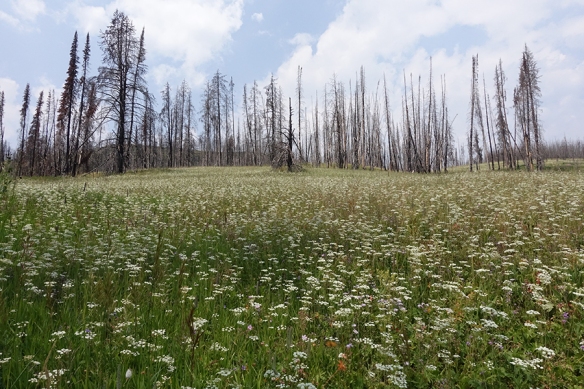 Forest fires can appear devastating at first, but for the most part nature has its systems for resilience. Depending on how hot the fire was and what plants were present both above and below ground and nearby, vegetation will return in its own due course. In some cases, plants sprout that have not been noticed in years, and indeed are triggered to flower after the heat of the moment. Others take advantage of the open ground and fly in with fresh seeds. Still others have stored seed until the magic moment. Wildlife also takes advantage of the changes.
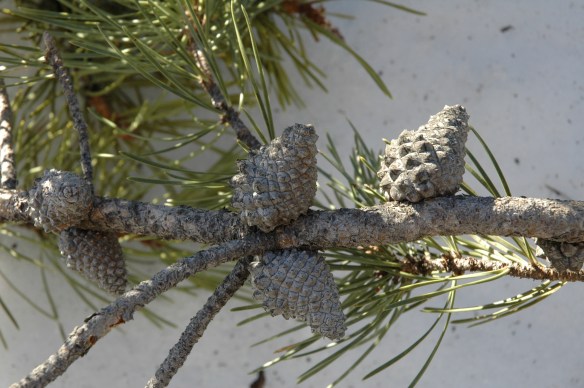 Their cones have thick scales with spine tips which protect the seeds inside from mauraders and weather for years. When a fire comes through, the resin that has sealed the scales shut melts, and cone scales open wide, releasing winged seeds upon the wind. The delicate embryos fall onto newly exposed soil, which may be enhanced by ash, and quickly germinate. Ash often contains recycled nutrients and retains warmth which helps the seeds grow. Seeds germinate quickly, giving them a headstart among competing plants. Pines in fact need sun to grow well. A truly fire adapated species!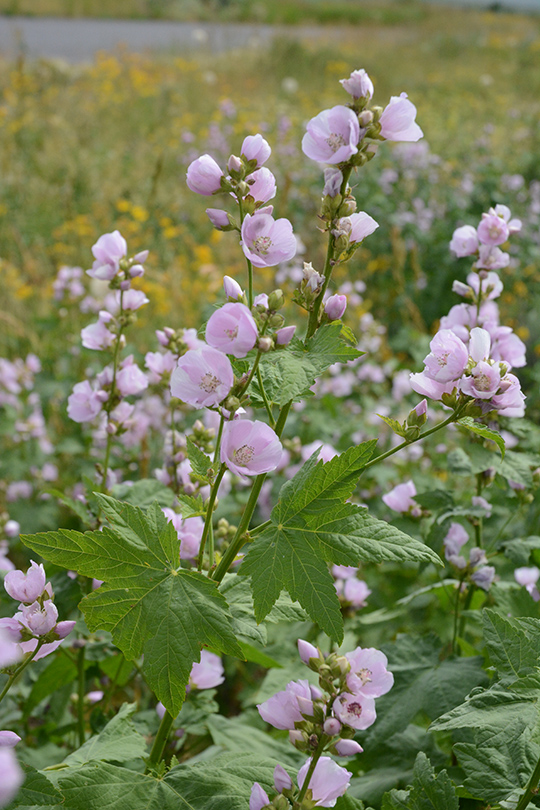
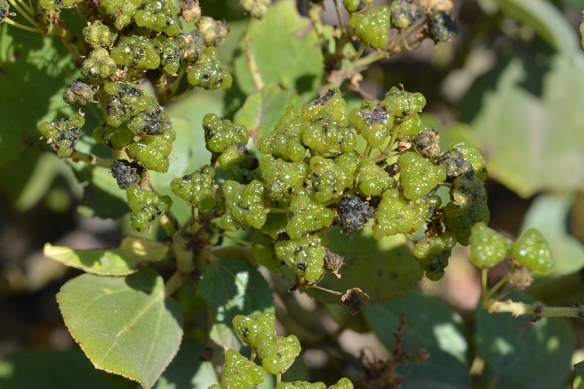
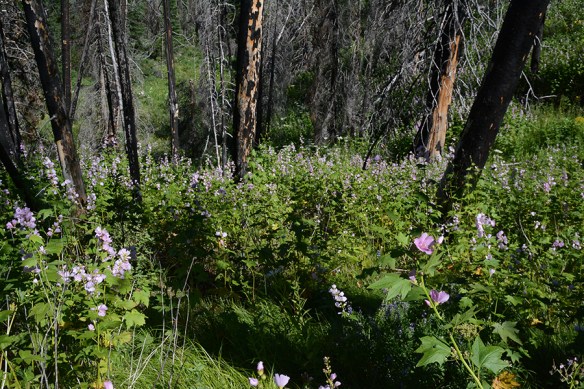 Due to a prescribed burn south of Hoback, the slopes along the trail up Palmer Creek are now covered with 4-5’ flowering Mountain Mallow plants (photo above taken 7.13.18). Soon fruits, which look like peeled hairy tangerines, will split to release seeds for the next generation decades in the future (photo below).
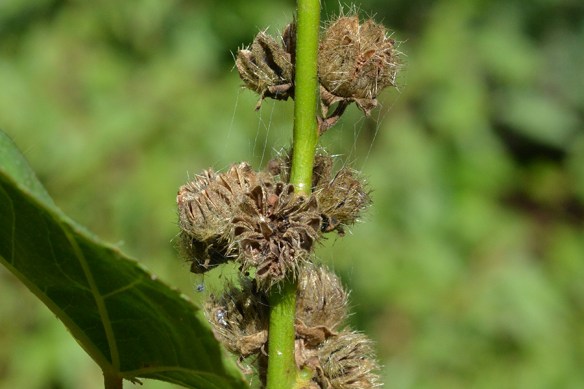 Note: In mountain mallow the seedbank is in the soil, in lodgepole pine, the seedbank is in the air.
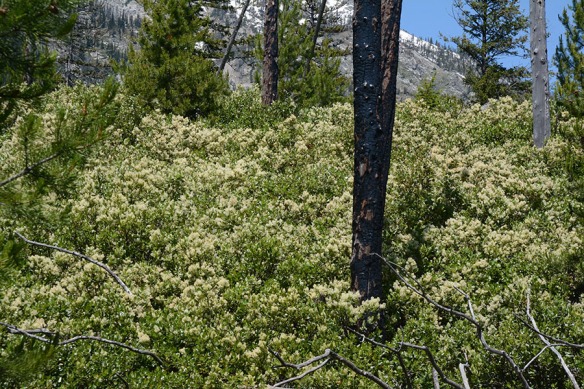 This evergreen, resinous, sprawling shrub will shoot up new branches from old roots after a light fire. After heavy burns, it can also sprout from “Rip-van-Winkle” seeds.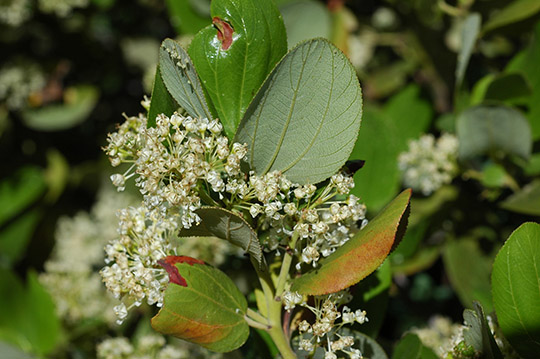
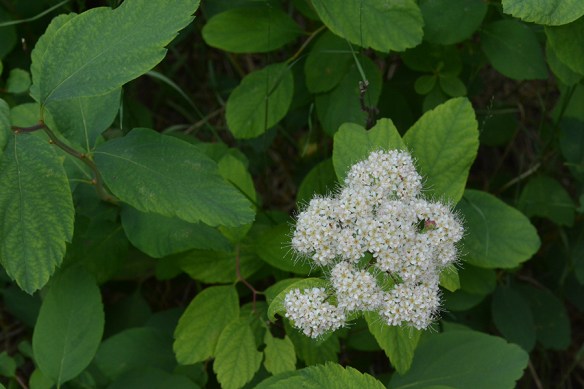
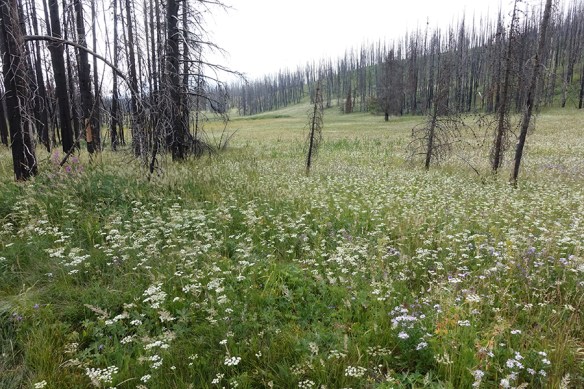 Notably, in some areas it burned through lodgepole stands that were recolonizing from a fire only a few years before. Ecologists and foresters are concerned that this unusual short “return” interval will be the pattern of future fires in this era of climate disruption.
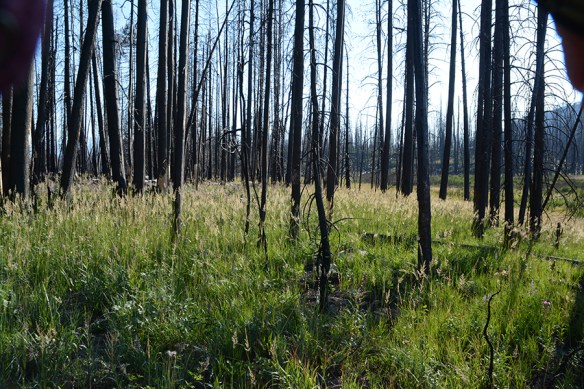 Deep fibrous roots of Pinegrass are important for holding soils, especially when soils are vulnerable to erosion after fires. Plants are blooming in profusion near the parkway.
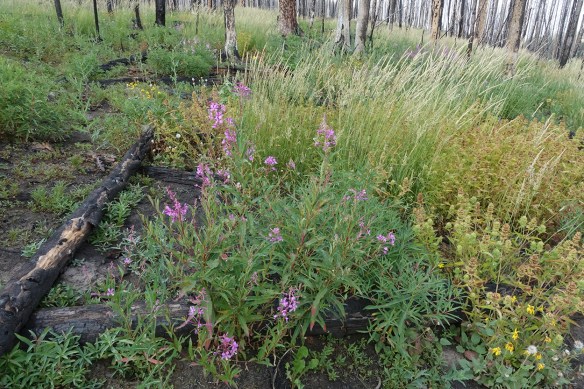 Fireweed – Epilobium/Chamerion angustifolia – is well known for showing up after fires. In the insulating soil, rhizomatous (underground creeping) stems growing 4-6” deep may have survived the above-ground heat to sprout again. Even one surviving plant can shed 1000s of seeds that can catch upon the wind, land, and germinate quickly on exposed ground. (Photo above shows both Fireweed and Pinegrass.)
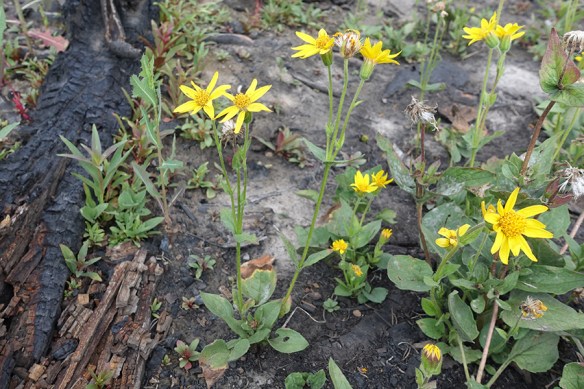 Cheerful patches of Broadleaf Arnica – Arnica latifolia – and a strange hybrid, likely Arnica X diversifolia – a cross between Heartleaf and Broadleaf arnica, are growing in charred soils (photo above).
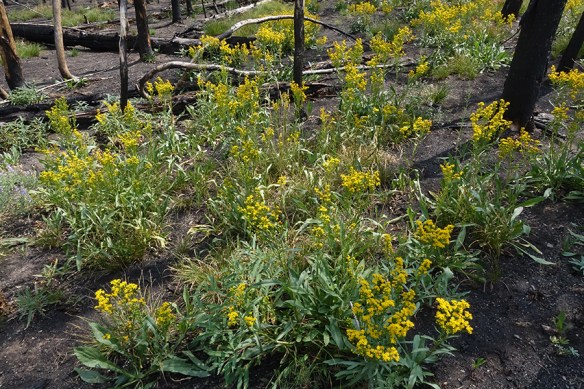 Large clumps of yellow Missouri Goldenrod – Solidago missouriensis – was dense along Grassy Lake Road, brightening the dark scene (photo above).
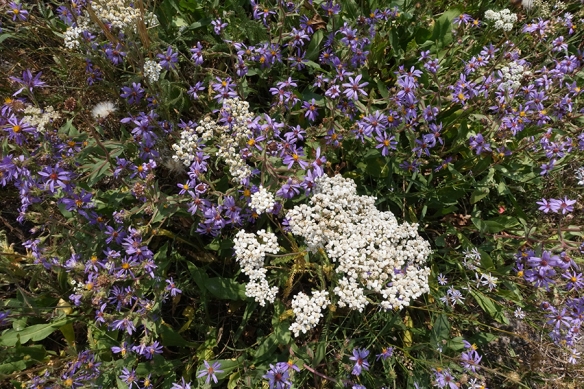 A mix of Yarrow – Achillea millefolium – and Thickstem Aster – Eurybia integrifolia – are common in fields right now, but they are also flourishing in the sun under dead lodgepole pine trees along Grassy Lake Road (photo above).
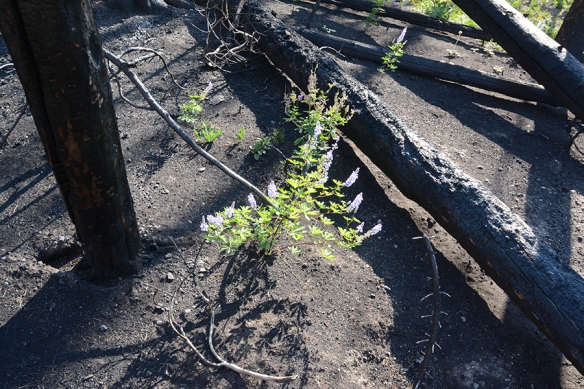 Silvery Lupine – Lupinus argenteus – seeds are “scarified” by the heat of fire, enabling buried seeds to germinate relatively quickly. As a legume, lupines have a mutually beneficial relationship with bacteria in their root nodules that can “fix” nitrogen. This provides lupines an advantage in colonizing poor soils (photo above). Their heavy seeds pop out of their pea-pod like fruits.
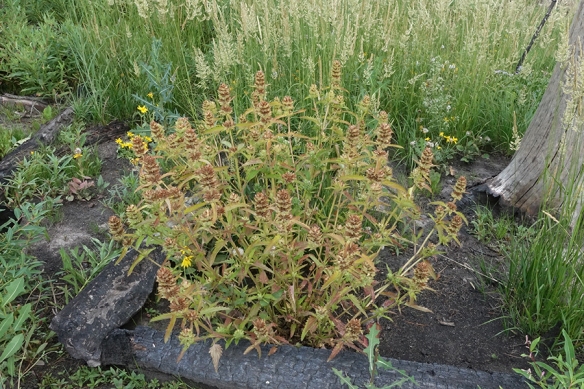 A robust member of the Mint Family – Dragonhead – Dracocephalum parviflorum – (photo above) was a new species to this botanist. Apparently it thrives in disturbed soils.
 Patches of other common meadow flowers have retained a niche as well, including Oregon Daisy – Erigeron speciosus – (photo above) with its many narrow, lavender ray flowers (ray flowers look like petals). Many perennials have deep storage roots that are often insulated by soils to heat of fire (or the cold of winter.)
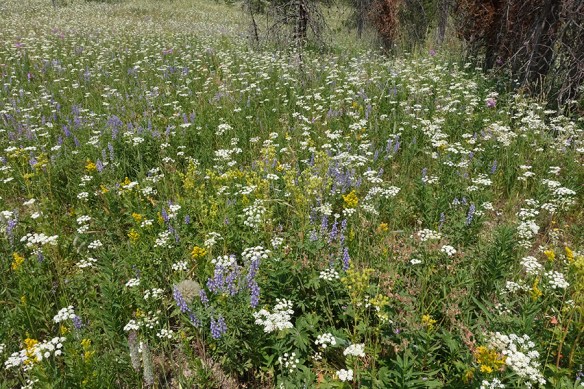 Common Yampa – Perideridia montana – has created a tapestry of white. Upon a walk through the area, one can see that many late-summer flowers which are common elsewhere as here as well: a hidden layer of Sticky Geranium – Geranium viscossimum, blue spires of Tall Delphinium – Delphinium occidentale, yellow sprays of Cinquefoil – Potentilla spp., orange-yellow Rocky Mountain Golendrod – Solidago multiradiata, and spikes of blue Silvery Lupine mix in.
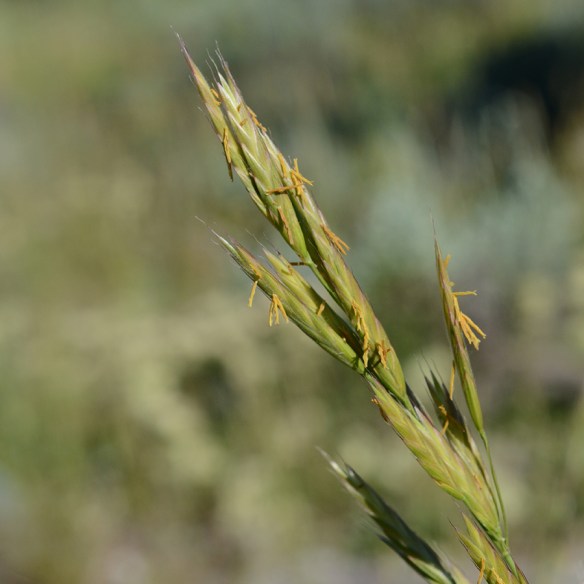
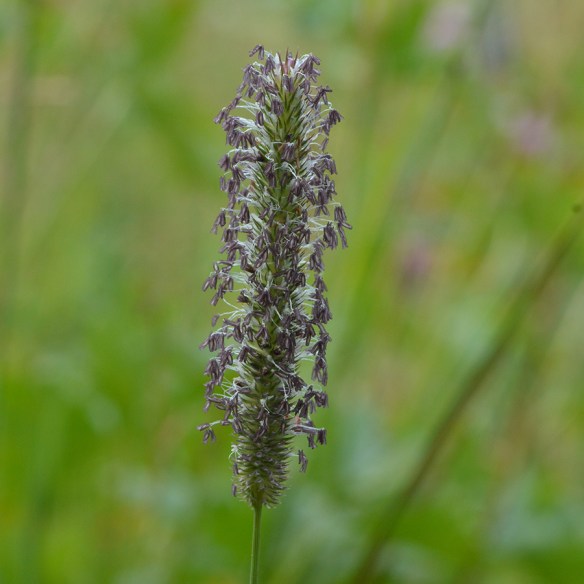 Mountain Brome – Bromus carinatus (photo below),
 and elegant spikelets of Oniongrass – Melica spectabilis (photo below):
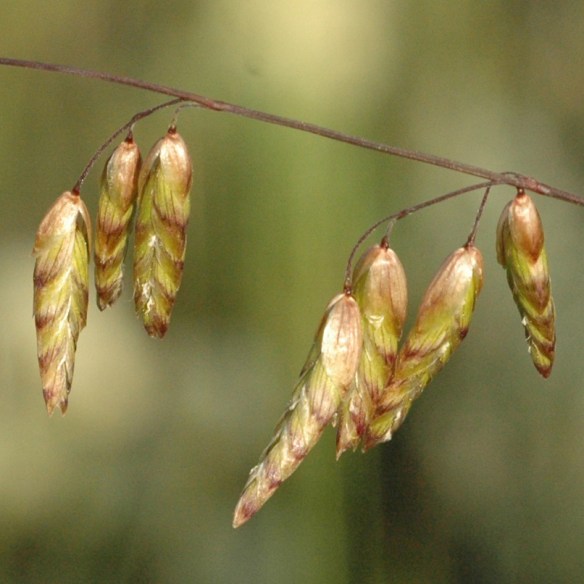 (Note all the grasses pictured above are in bloom)
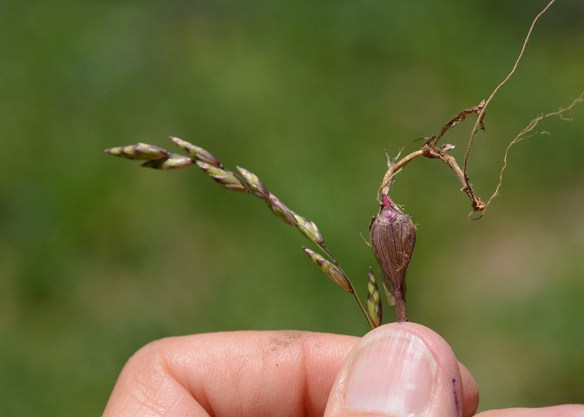 Grasses have evolved to sprout from buds at the base of their leaves – an adaptation to both browsing and fire.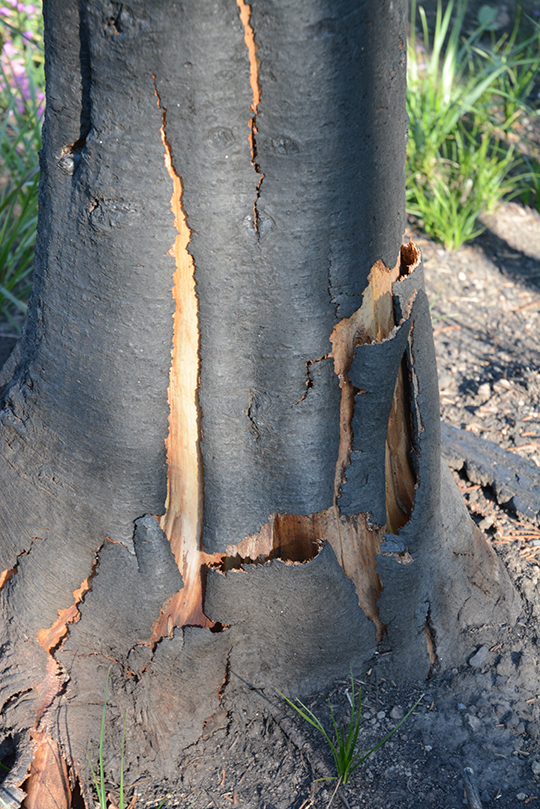
 Teton Plants