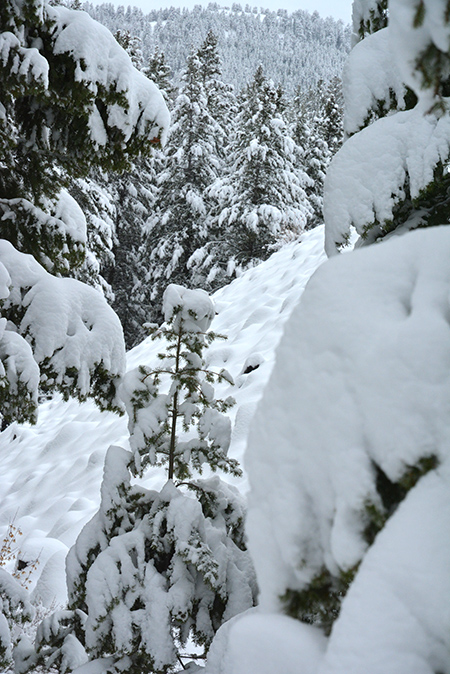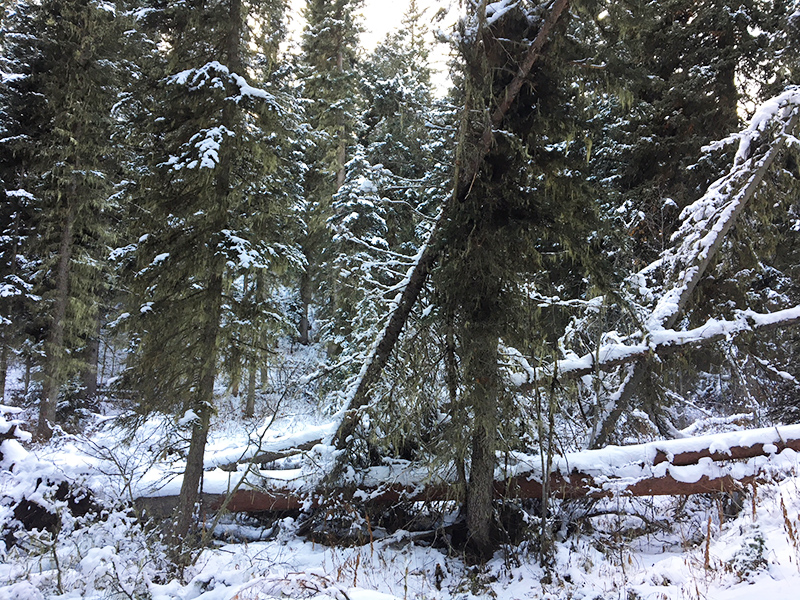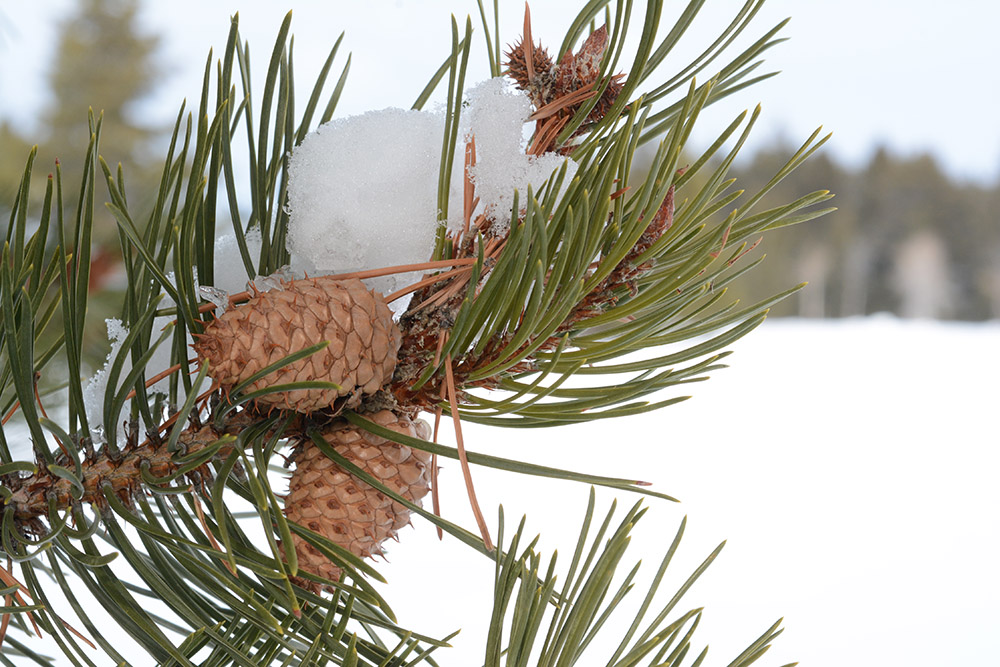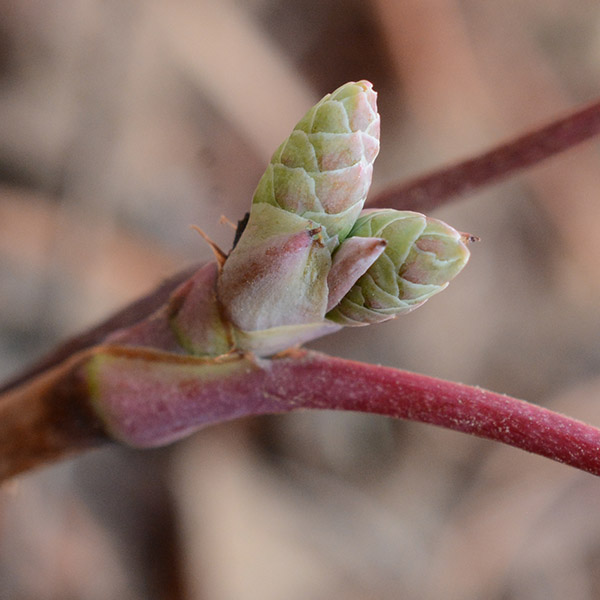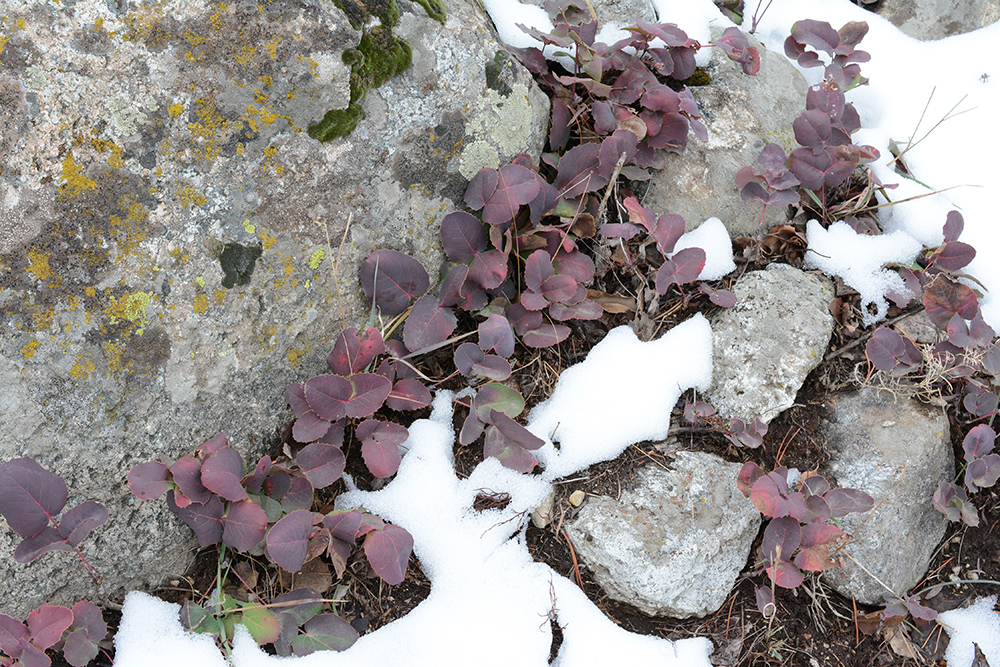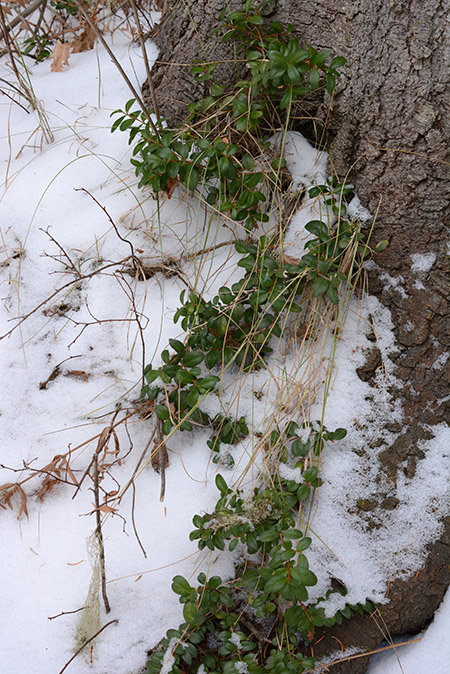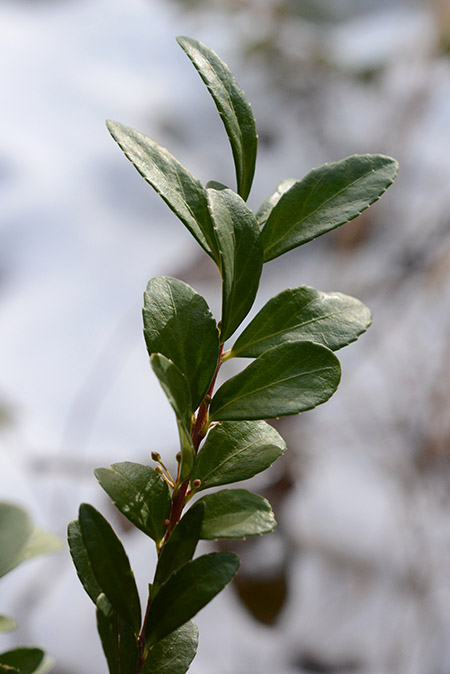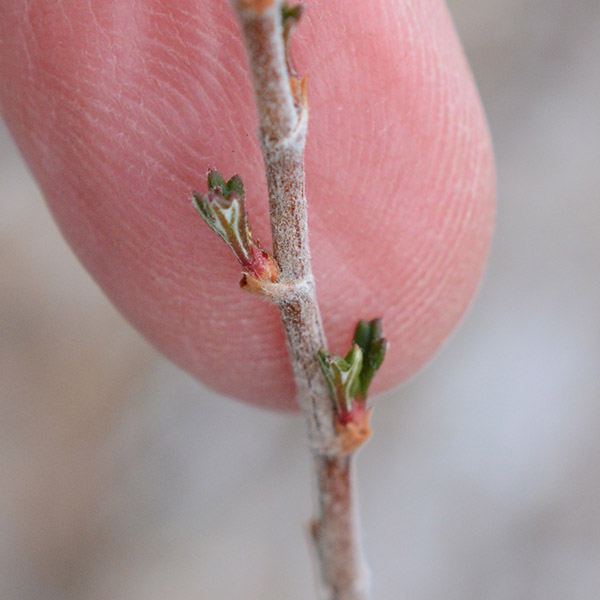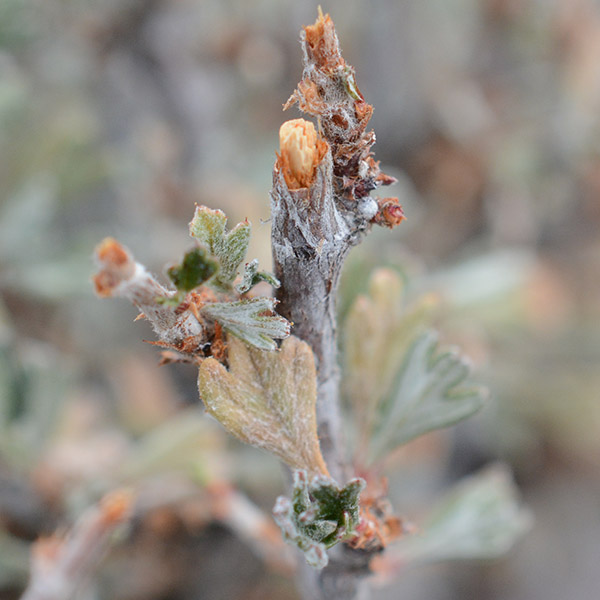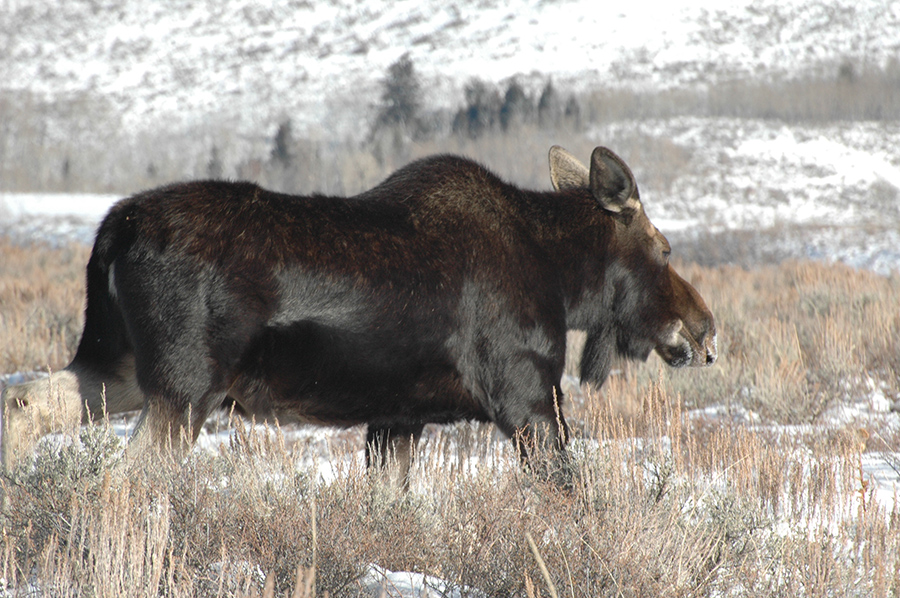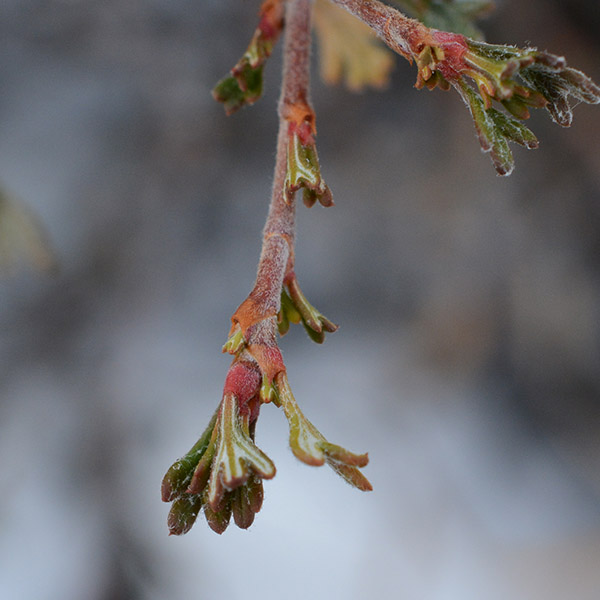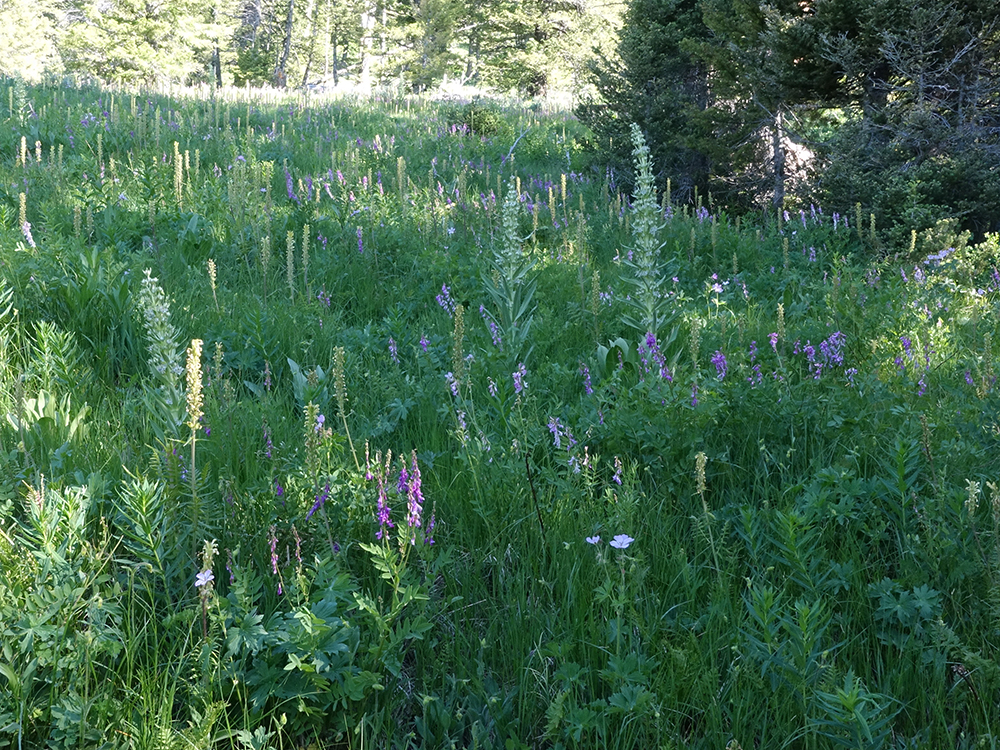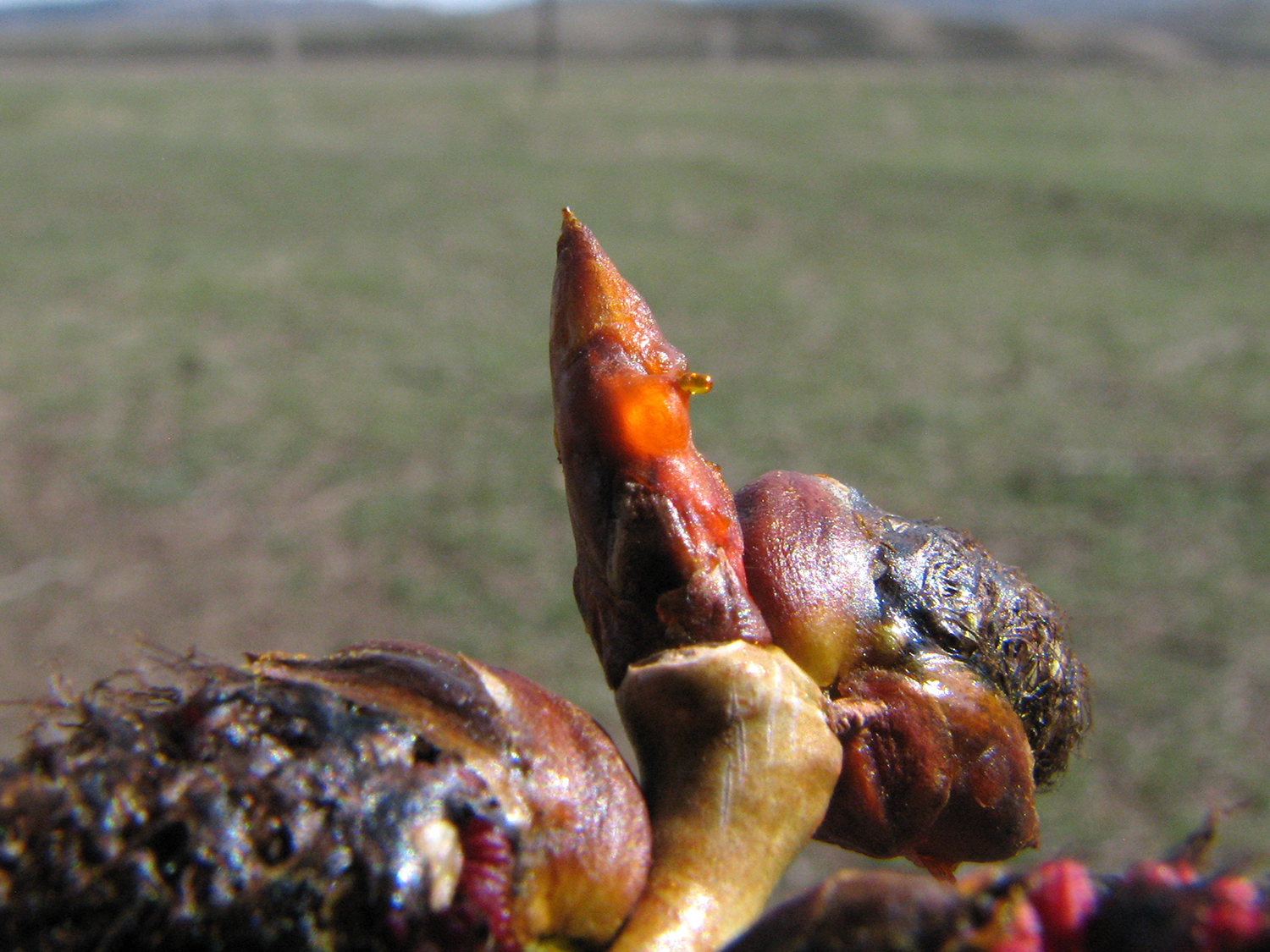
Botanically buds are incipient stems. Formed in the fall, a set of meristematic tissue (stem cells) are enclosed inside “bud scales” for the winter, all ready to break open when daylight increases, the soil thaws to release water, and the air warms. Then hormones are triggered to set the stem cells on their genetically programed path to growth. Buds can become new stems with leaves and/or new flowers. Some of the most obvious buds at this time are seen on members of the Willow Family either as a newly extending branch with leaves or in the form of catkins.
Catkins are reproductive structures. Unlike our usual flowers with fancy petals and such, catkins are typically very modest. A central stalk has many small flowers – either male or female attached to it. A “bract” or scale-like structure protects the anthers (m) or an pistil (fm). There are no sepals or petals. Most catkin flowers are wind pollinated and, therefore, come out before the leaves interrupt the flow of pollen.
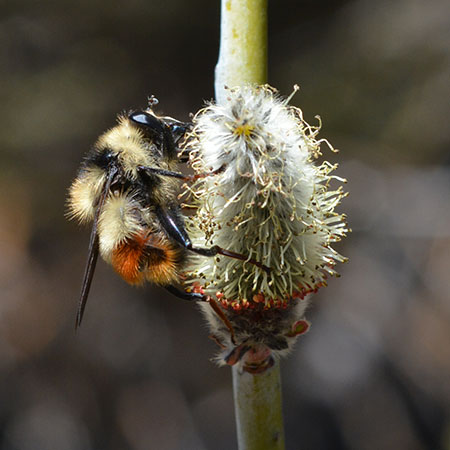
There are dozens of willow species – Salix spp. – in Teton County growing from wetlands up into the alpine. Plants are often called pussy willows because of their soft silvery-looking catkins. Many willows are the very first flowers to bloom and are therefore very important sources of both nectar and pollen for the first flies and bees of the season. These insects depend on the nutritious pollen for raising their broods. The nectar is a much-needed energy source.
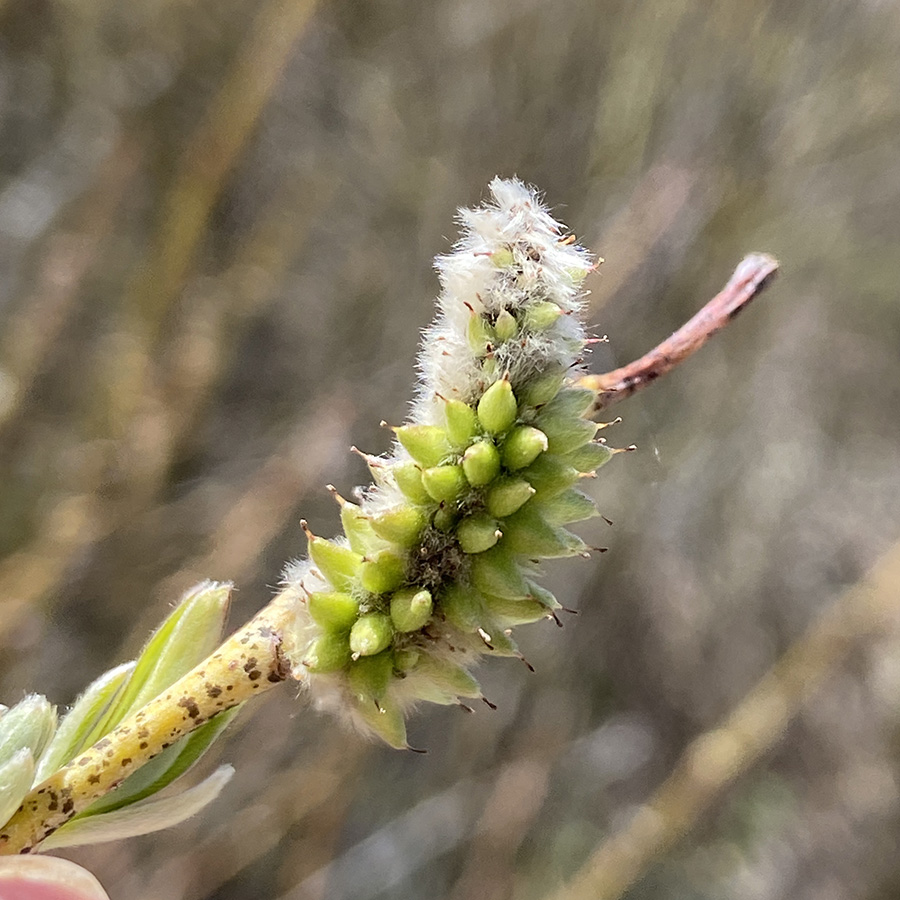
In willows, behind each bract are nectaries, as well as the essential sexual parts: male anthers or female pistil. (Note: the female structure overall is termed a pistil which includes a stigma at the top to catch pollen, sometimes a style or neck like structure, and the ovary which contains the ovules e.g. eggs). Male and female catkins are on different plants. Flowers exude a fragrance that lures in pollinators, and colorful red or bright yellow anthers also help to attract bees.
Male willow catkins with yellow anthers.Female willow catkin forming capsules. Note the stigmas at the tips.
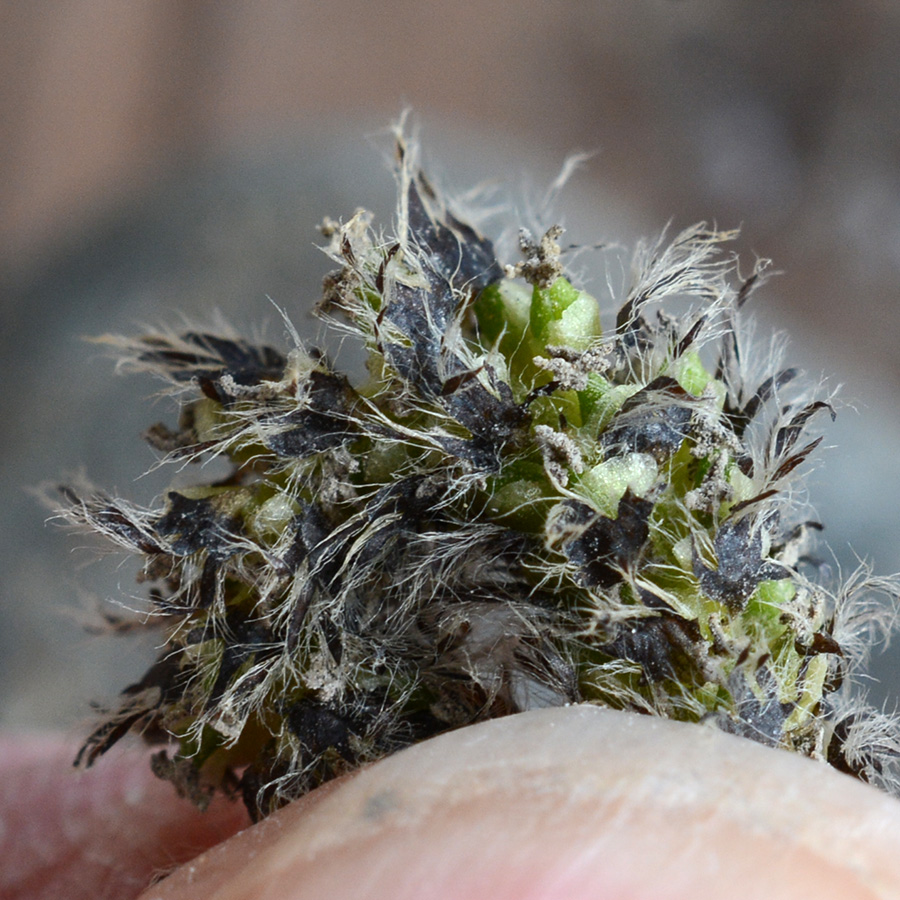
Aspens and Cottonwoods are both in the genus Populus. Unlike willows, their flowers do not have nectar and are exclusively wind pollinated. They too have male or female plants to help insure out-crossing of genes. There is no genetic diversity benefit to dropping the pollen onto a female flower on the same tree. In Populus bracts below each tiny flower are forked and hairy. The flowers are held in little membranous cups which can be hard to see. Its fun to look for these fine features with a 10x hand lens.
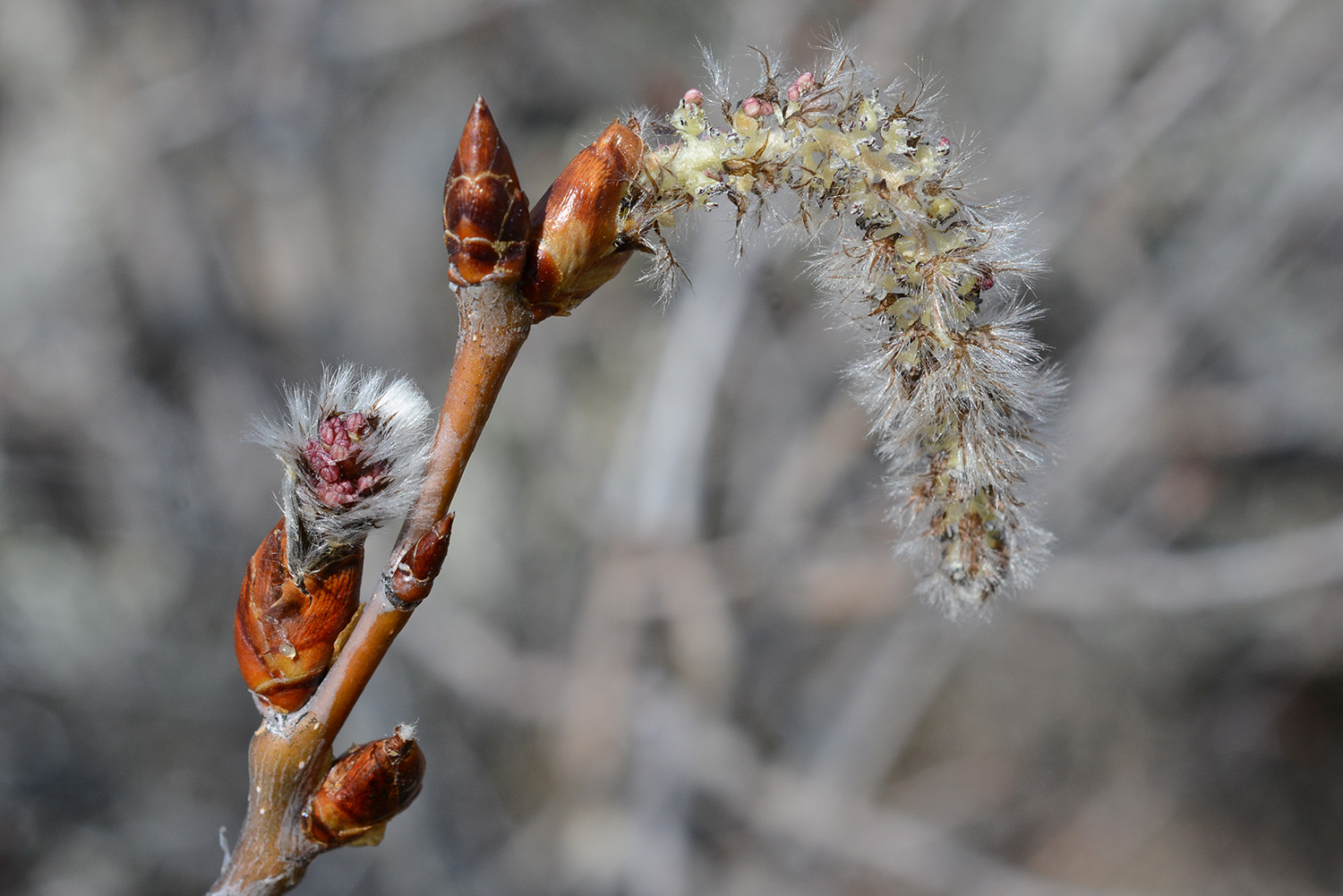
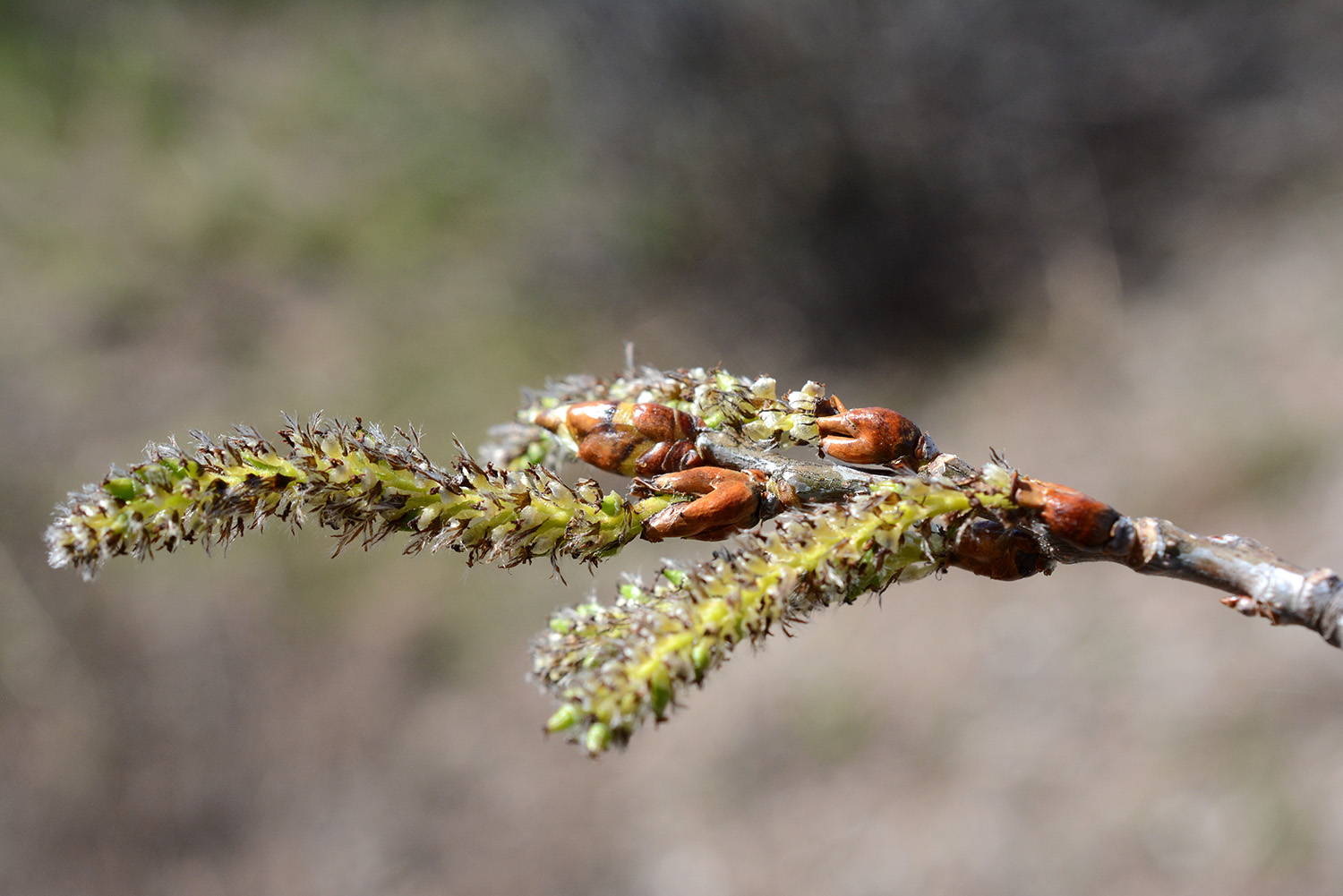
Trembling aspens – Populus tremuloides – have been dangling catkins for the past couple of weeks. Male catkins are falling off while female catkins are still extending or forming fruits.
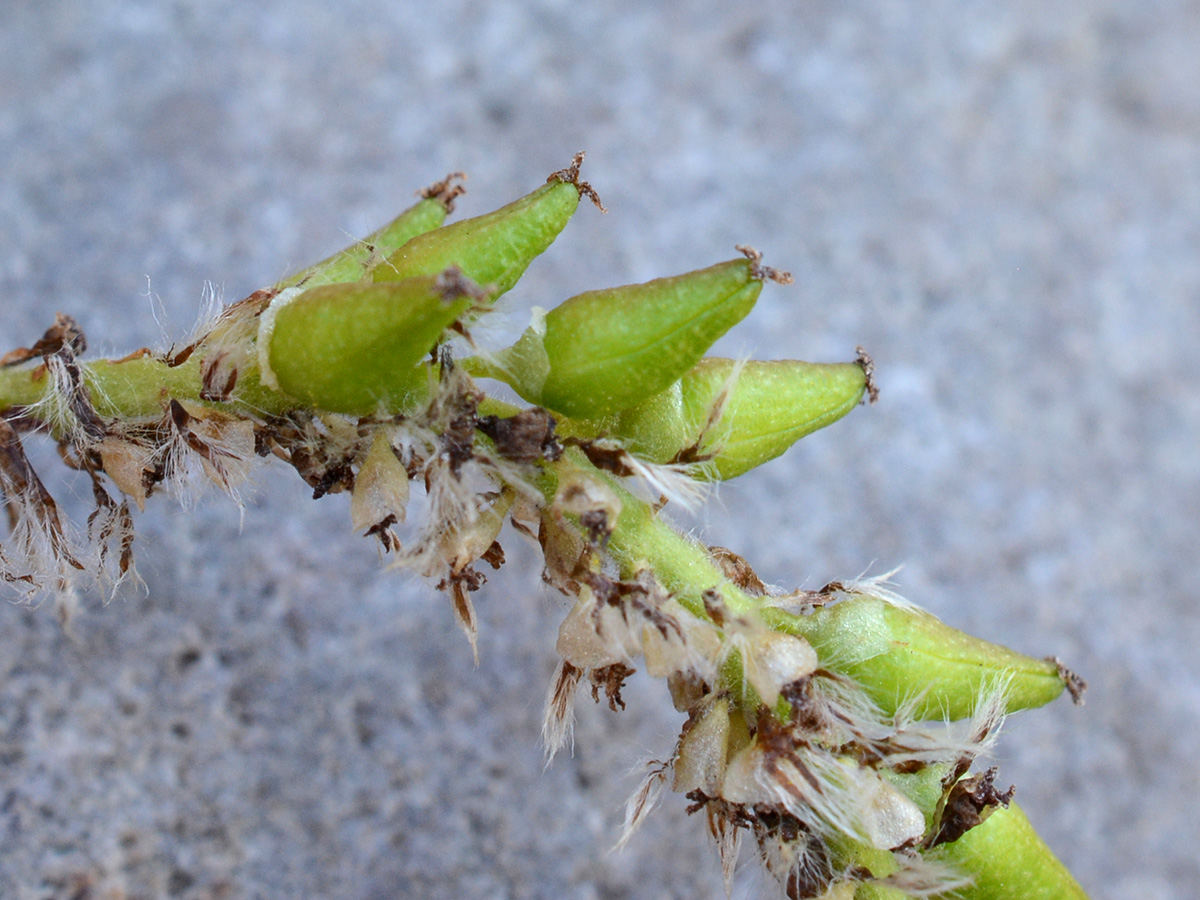
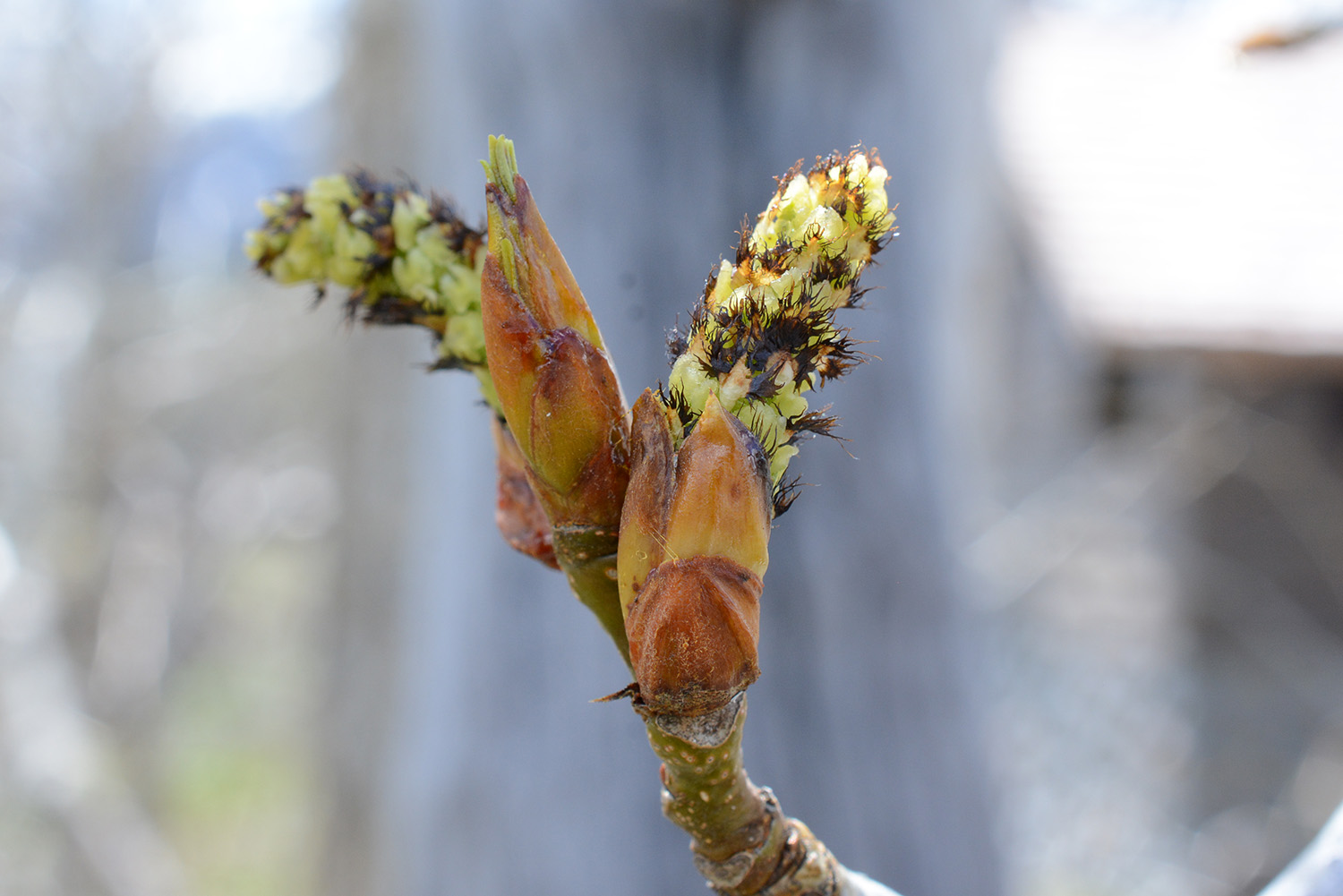
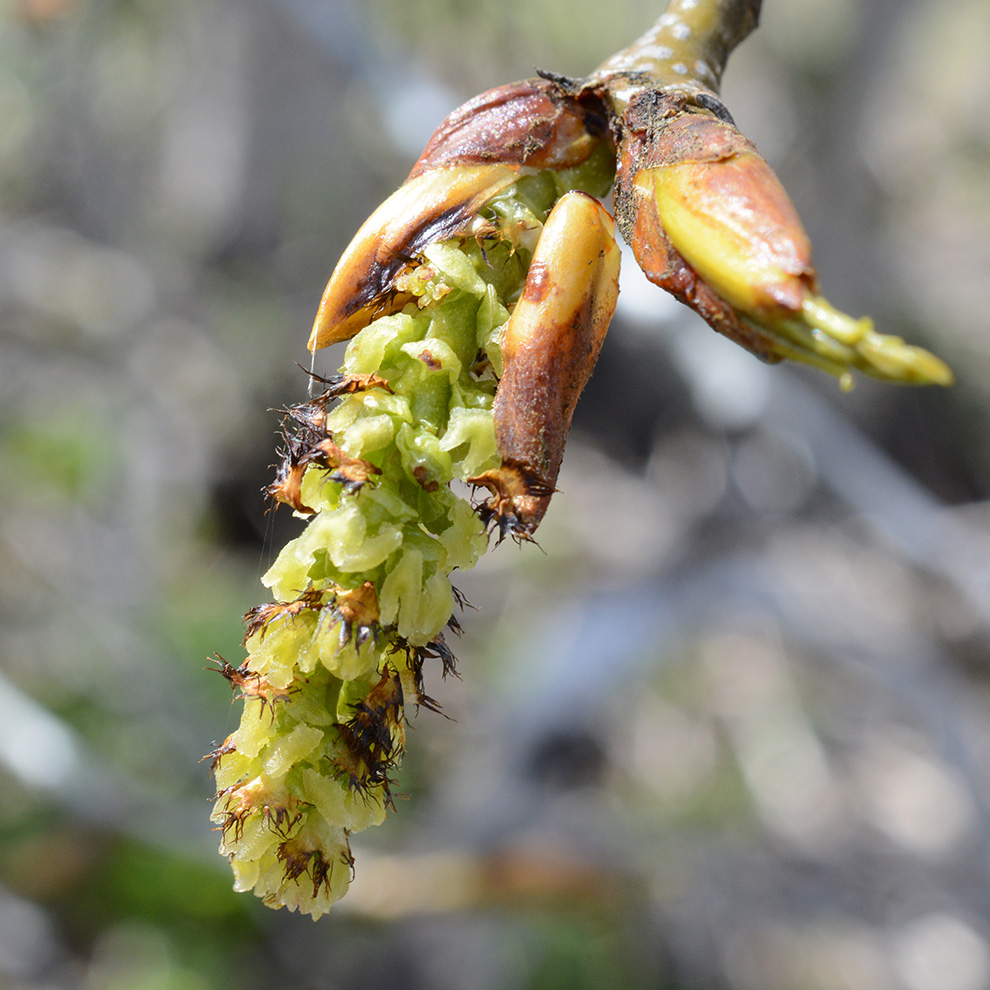
Aspen male catkins – on the left just out of its bud; to the right more extended. Note the hairy bracts.Aspen female catkins tend to be stiffer.Aspen female catkin: pistils can be seen in little cups. Dark stigmas emerge from the tips of the pistils to capture pollen. Note the black, sharply forked bracts with hairs.Once fertilized, the ovary begins to swell into a fruit called a capsule and seeds will form inside.
Although plentiful, aspen seeds are short-lived and require particular moisture and soils to survive. Most of our aspen trees sprout from rhizomes – underground creeping stems – rather than from seeds – to form large groves of one genetic identity.
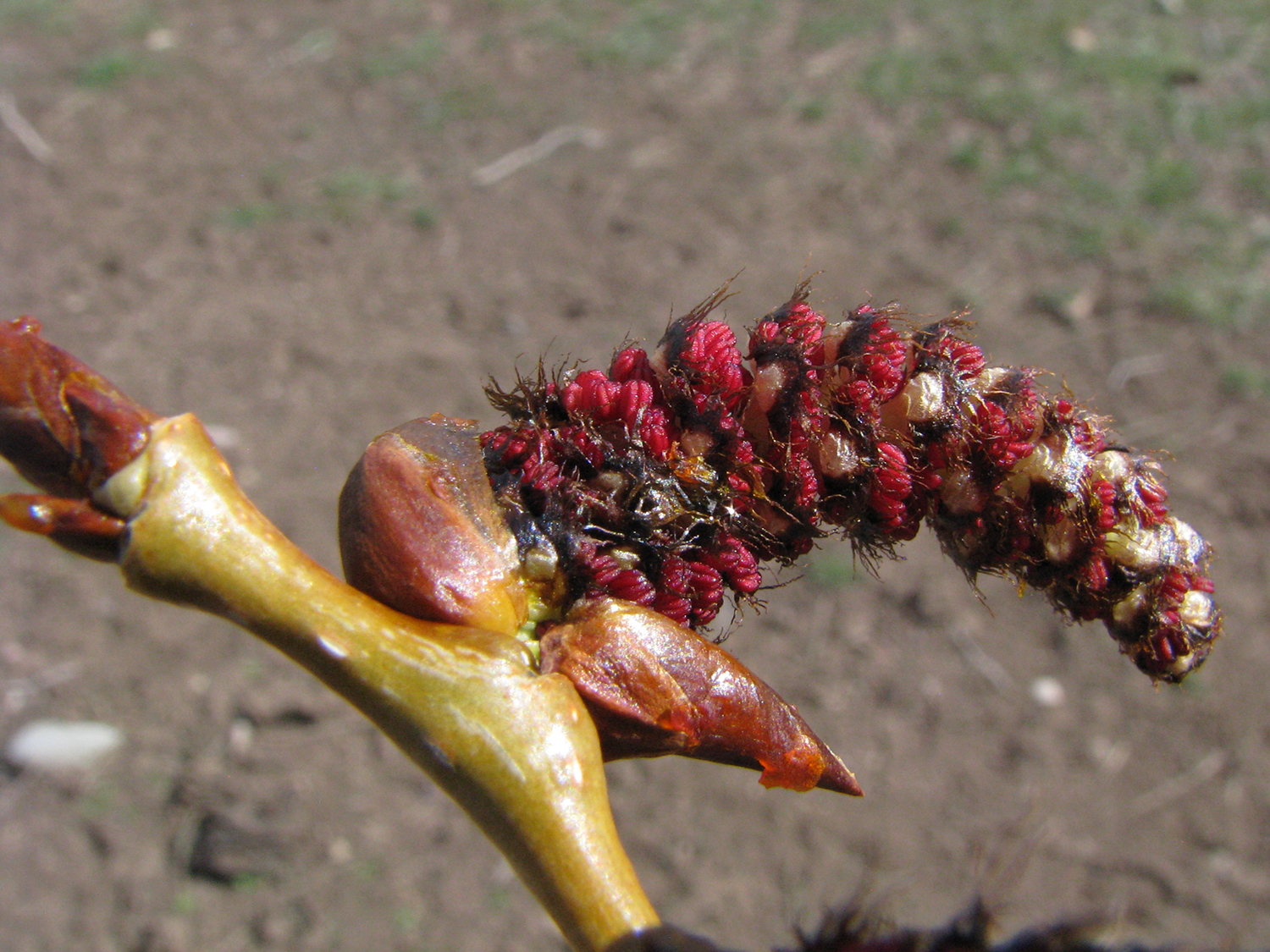
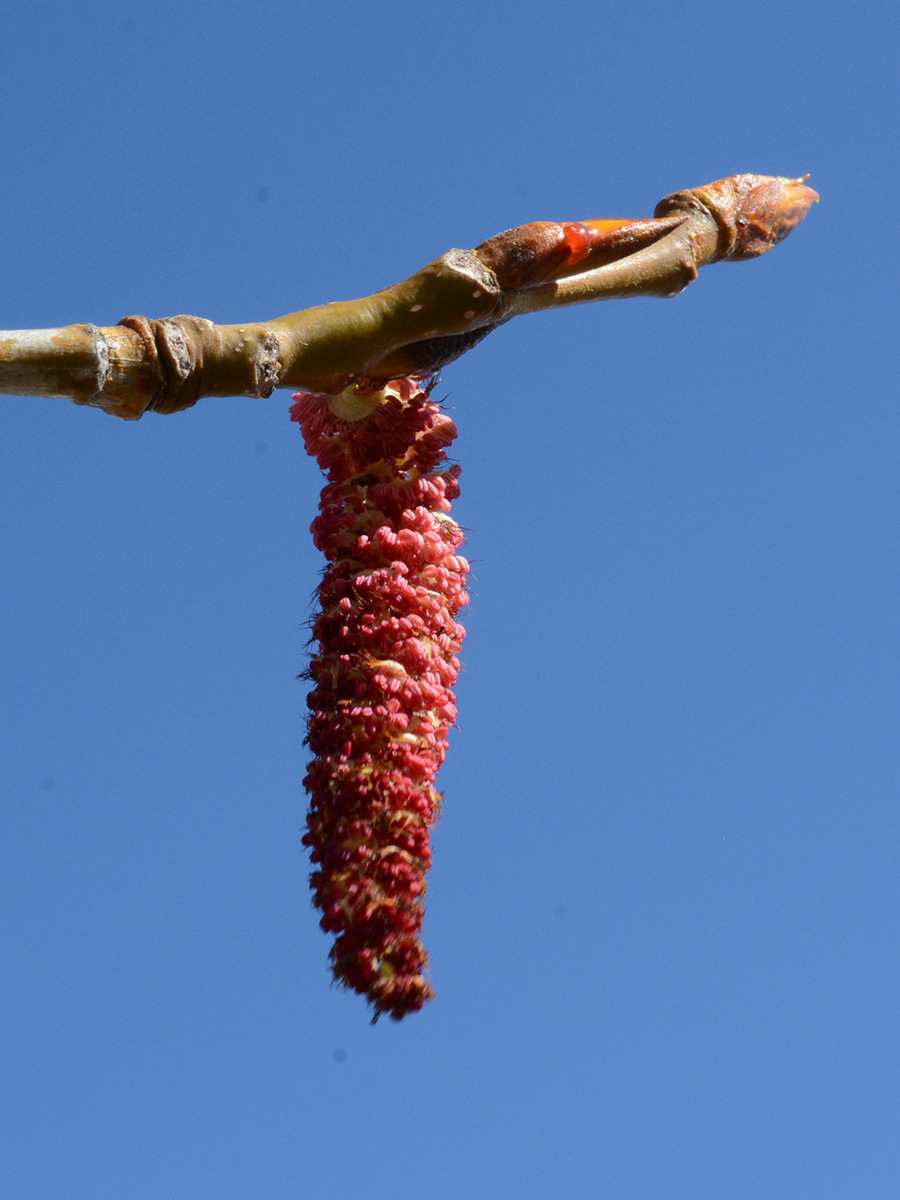
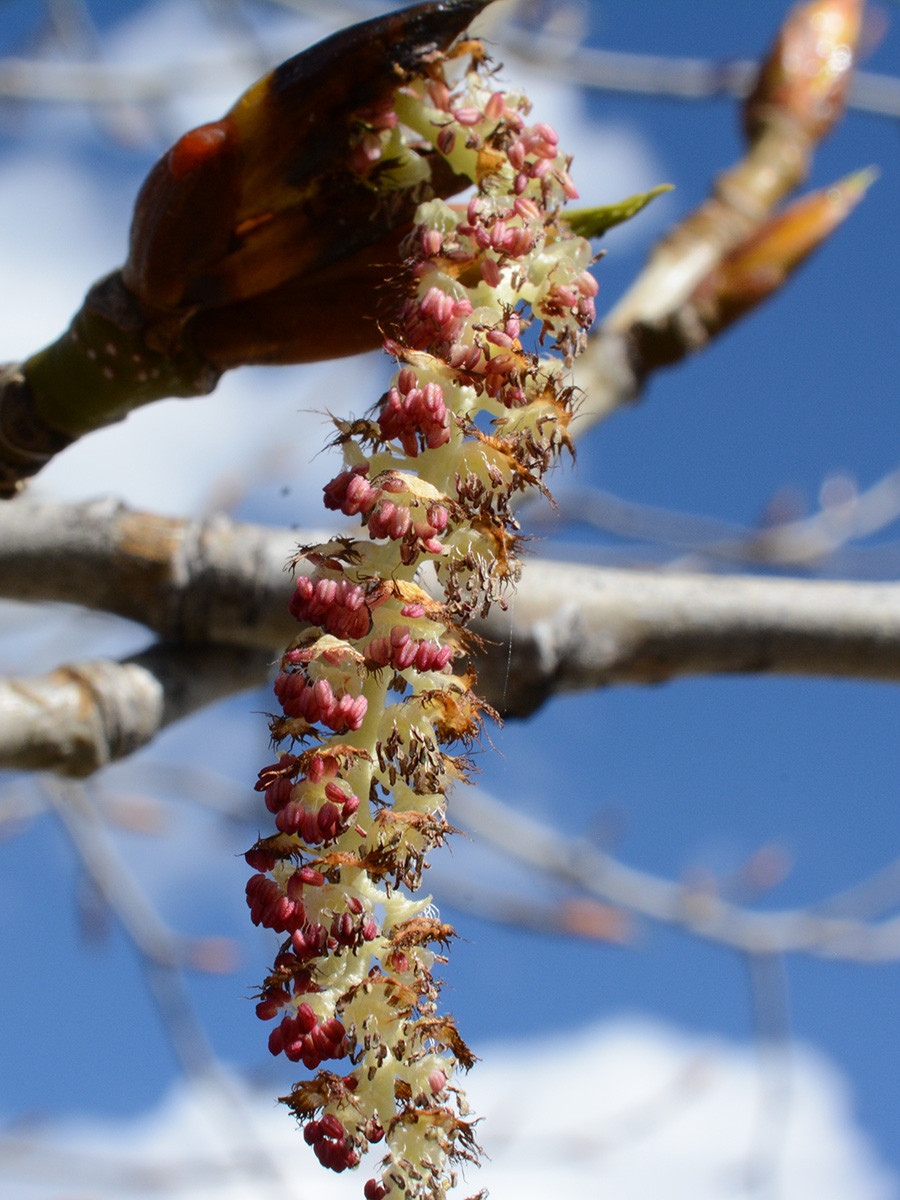
Cottonwoods – Populus spp. – have the biggest buds and catkins. Behind each lobed and silky bract and sitting in a small cup, many red anthers expand and open up. Spent male catkins then drop off. Single female pistils also sit in little cups protected by silky bracts. Their 2- to 3-parted stigmas are relatively large and fleshy looking.
Male catkins tend to stretch and dangle loosely, their anthers waving pollen upon the wind. Then the catkins fall off, done.
Females catkins are a bit stiffer. Here the stigmas are fleshy and assumedly sticky to catch the pollen as it wafts on the wind.
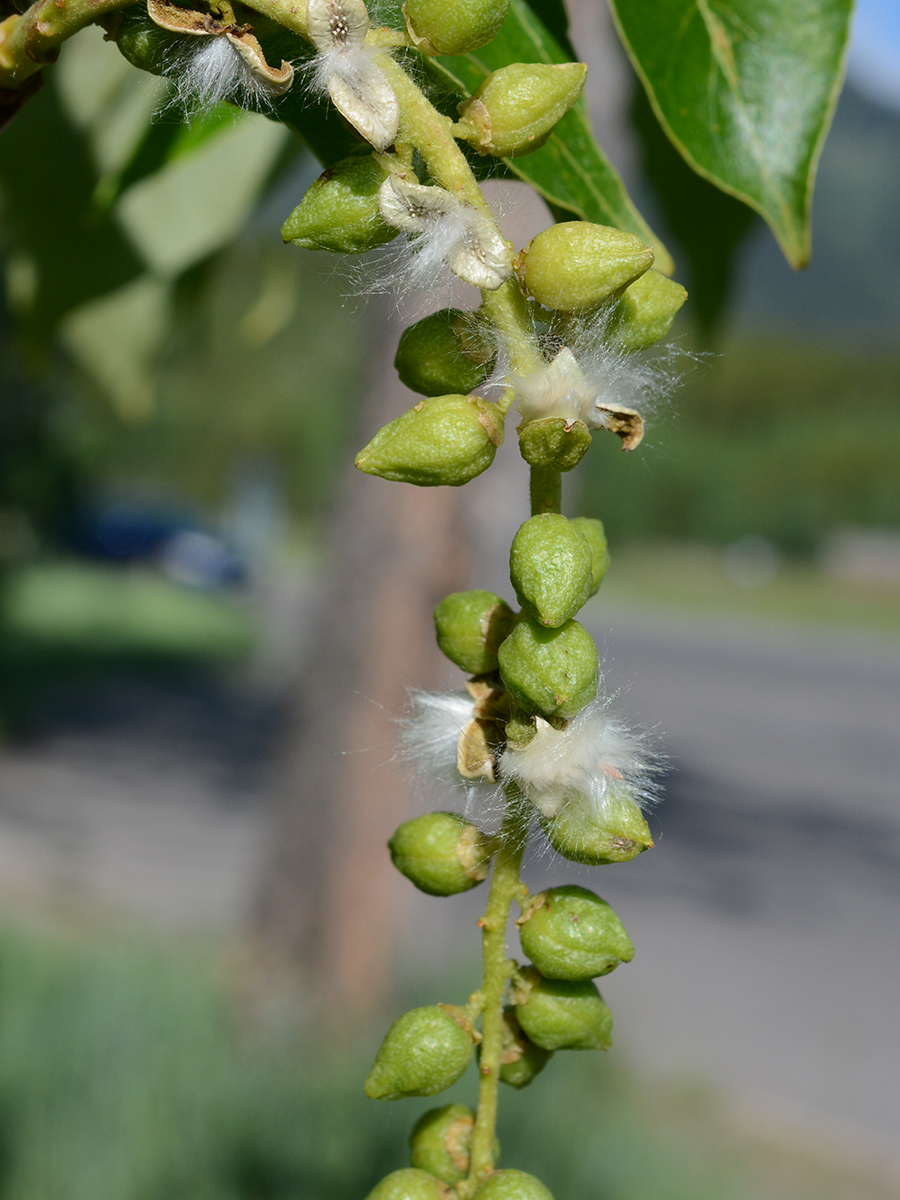
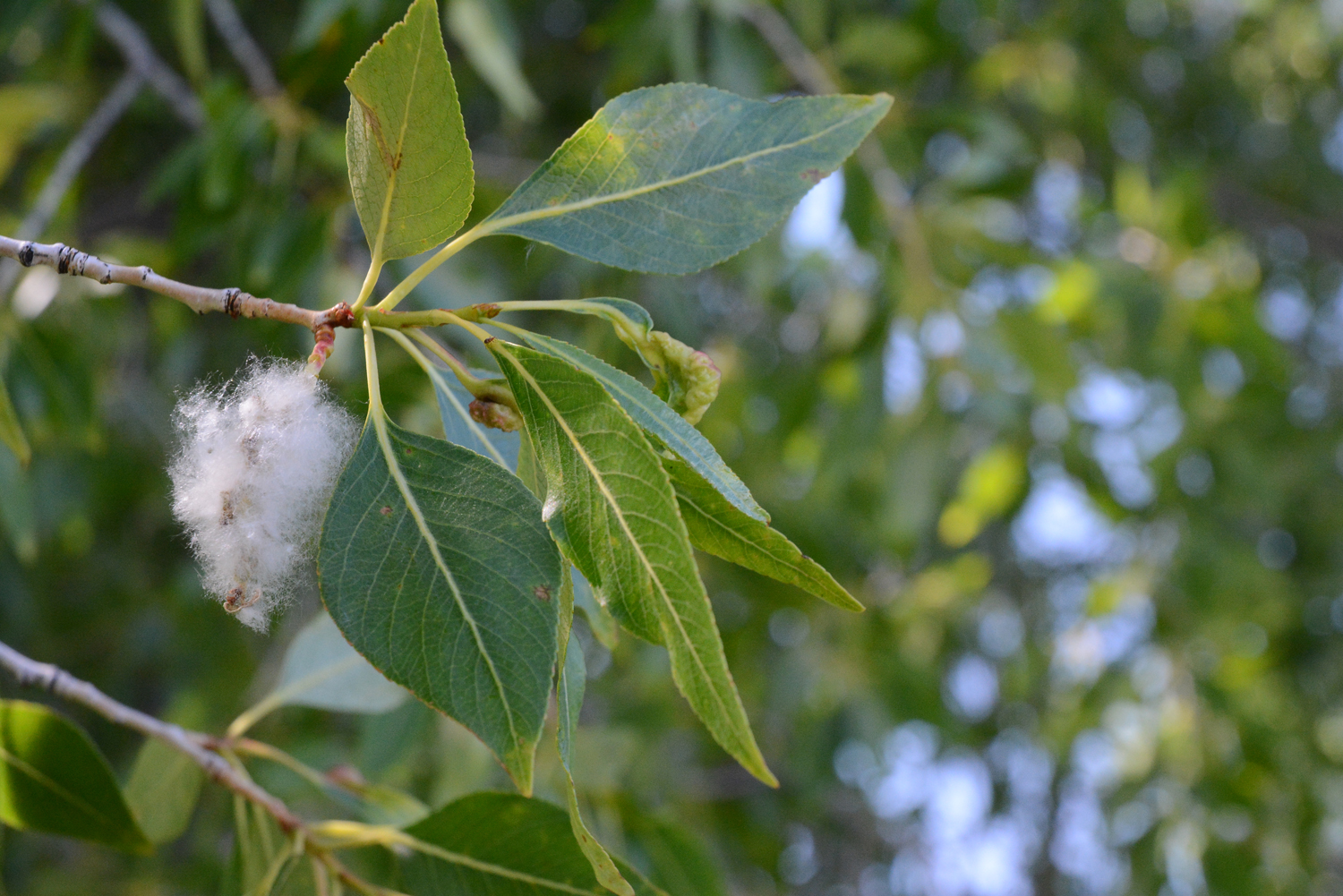
Femaile cottowood catkin just emerging. Note the black bracts.Female cottonwood catkin stretching. Note the fleshy stigmas,After pollination, over the next couple of weeks the ovaries mature into capsules and are about to burst!The catkin then explodes with fluffy seeds coming from many capsules. Fruits and leaves all came out of buds triggered to expand just a few weeks before.
The fruits of both aspens and cottonwoods will be a capsule that splits open releasing many tiny seeds attached to fluff (hairs) for distribution by wind. Seeds are viable for only 2-4 weeks.
In cottonwoods, only one seed in thousands will end up germinating and surviving into a full-sized plant. The first root must grow fast enough to continue to reach water as the soil dries. Many cottonwoods count on episodic flooding to succeed from seed.
After the willows, aspens, and cottonwoods release their tiny seeds upon the wind—like mini-snowstorms, the old catkins fall to the ground—all within about 4-6 weeks. By then the leaves are fully unfurled and there is no trace of the profusion of reproductive activities a few weeks before.
Alders are in a separate family – the Birch Family. Their male and female catkins are on the same plant.
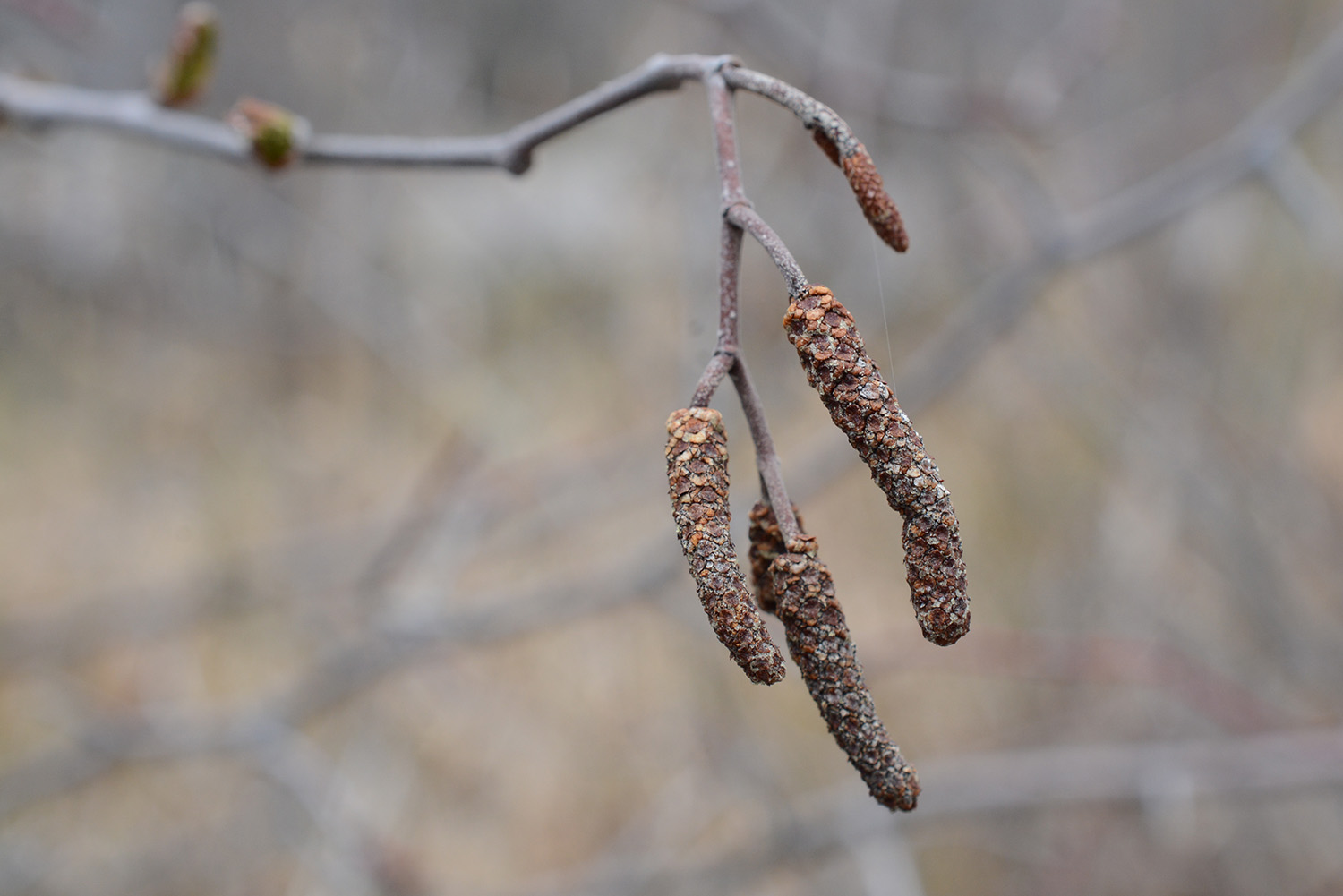
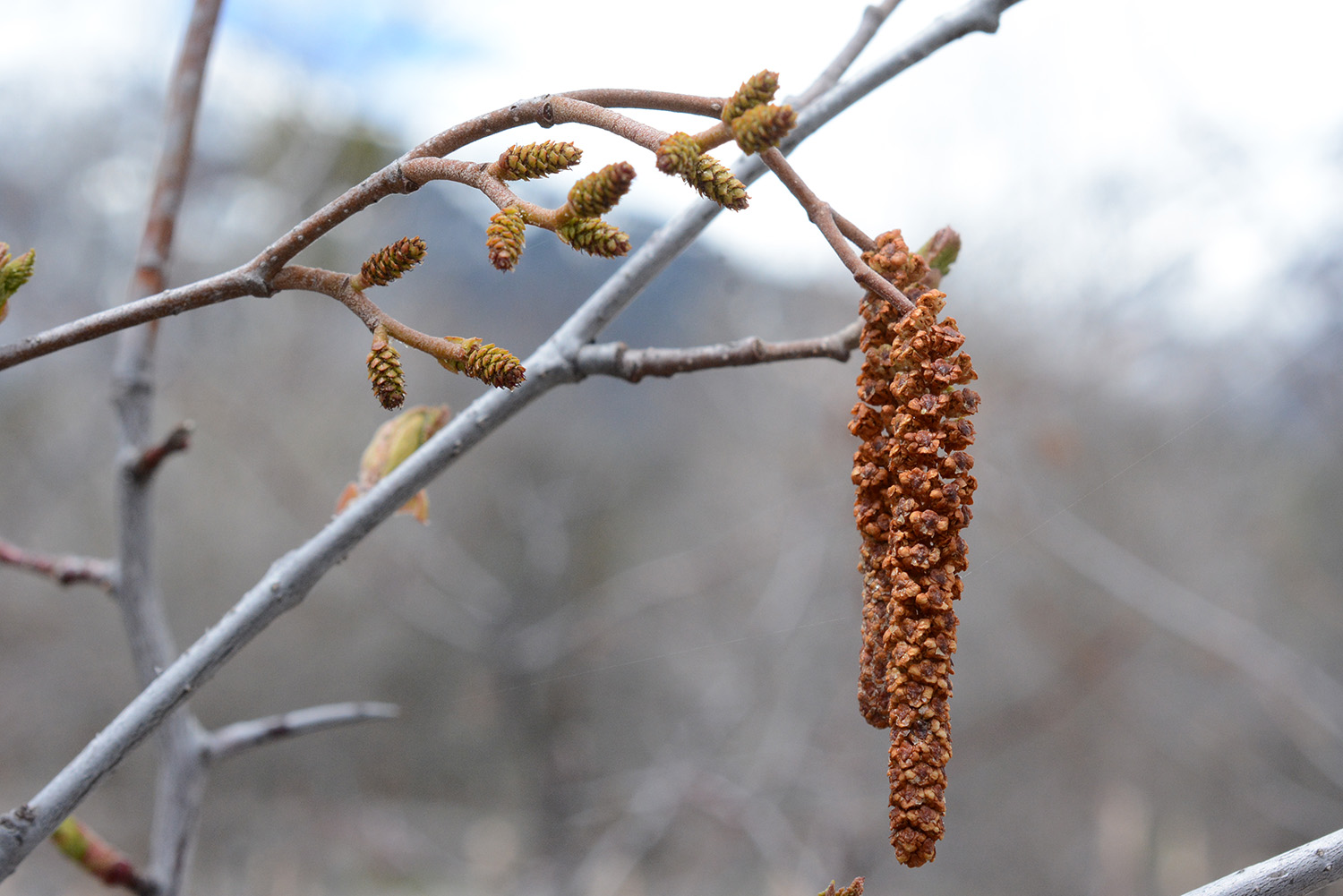
Male and female catkins are on the same tree, often on the same branch of Speckled Alders – Alnus incana var. tenuifolia. Male and female catkins have been on the ready since fall. Come spring, the male catkins stretch and dangle while the much smaller upright female catkins expand slightly.
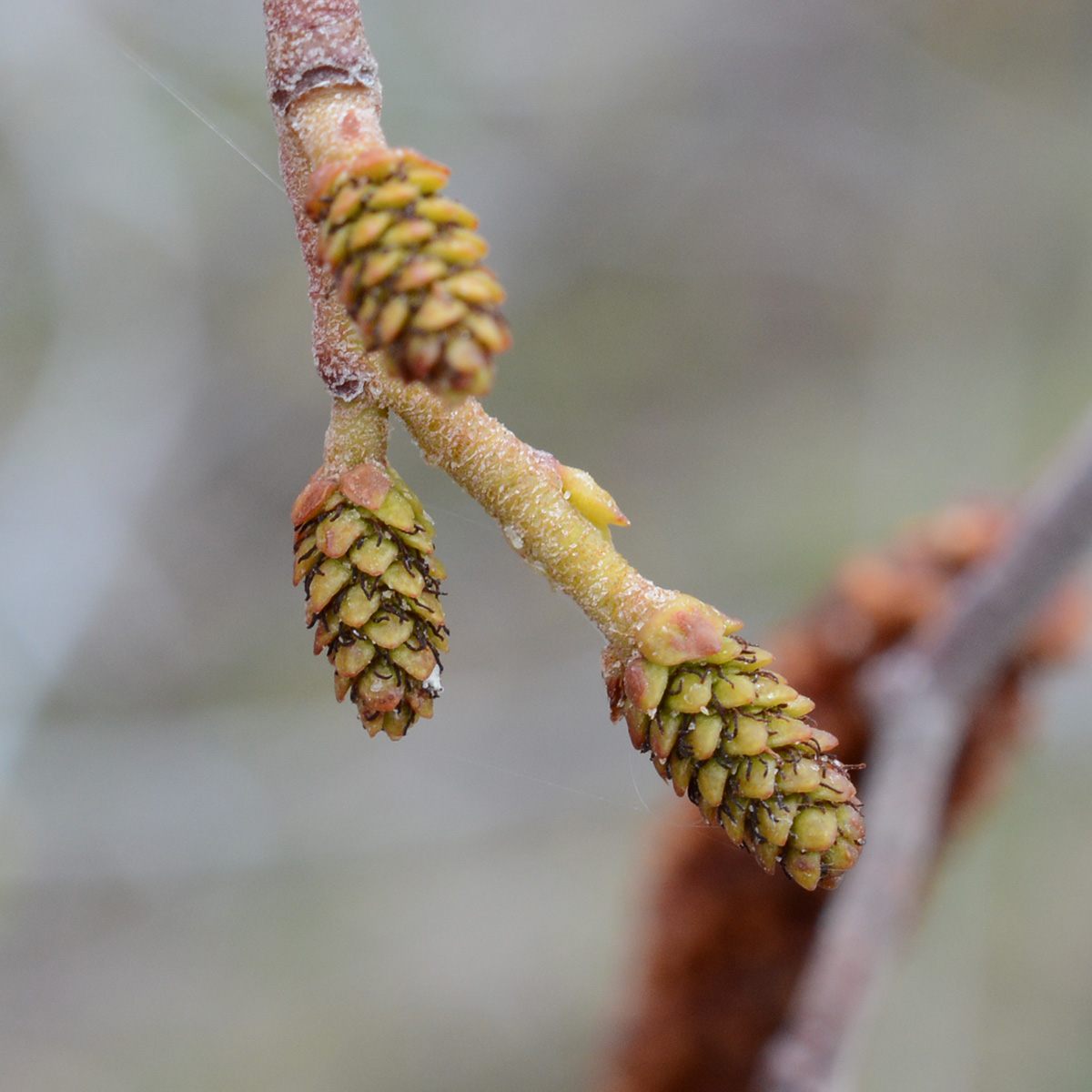
The female catkins reveal dark stigmas above each tight scale.
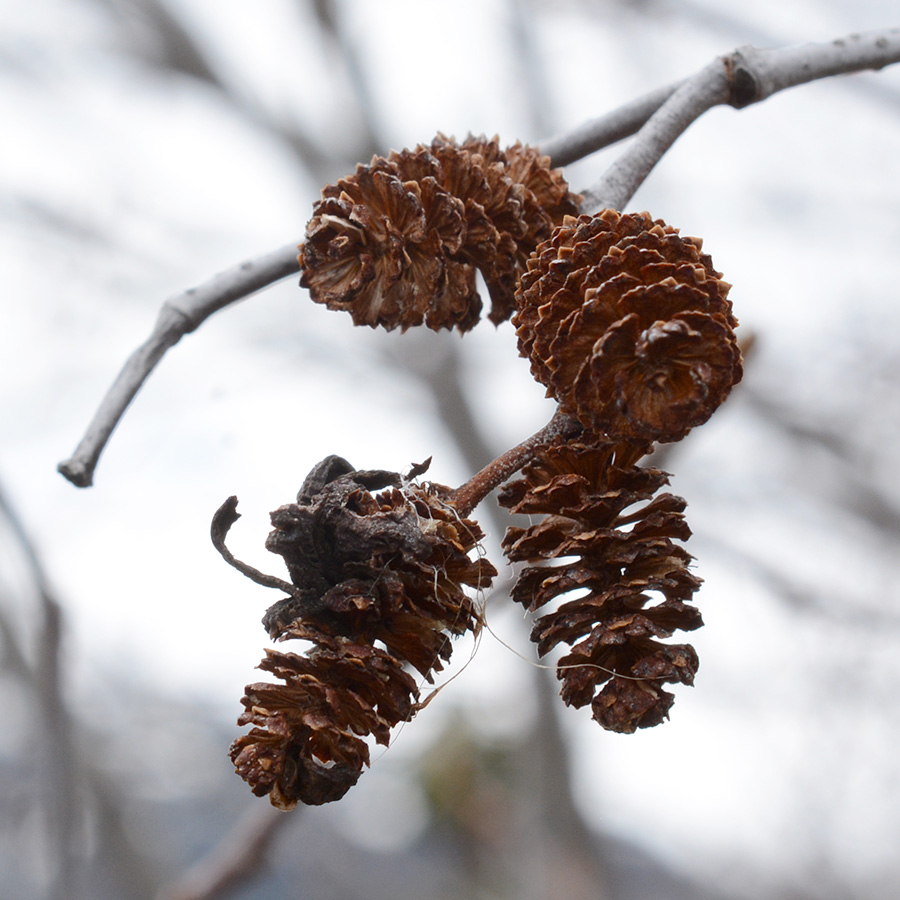
If all goes well, pollen will land on the stigmas, and a dried flat seed called a samara will slowly form. These seeds will remain within a hard cone-like structure until late autumn, when the scales will open and seeds will fly off like frisbees on the wind.
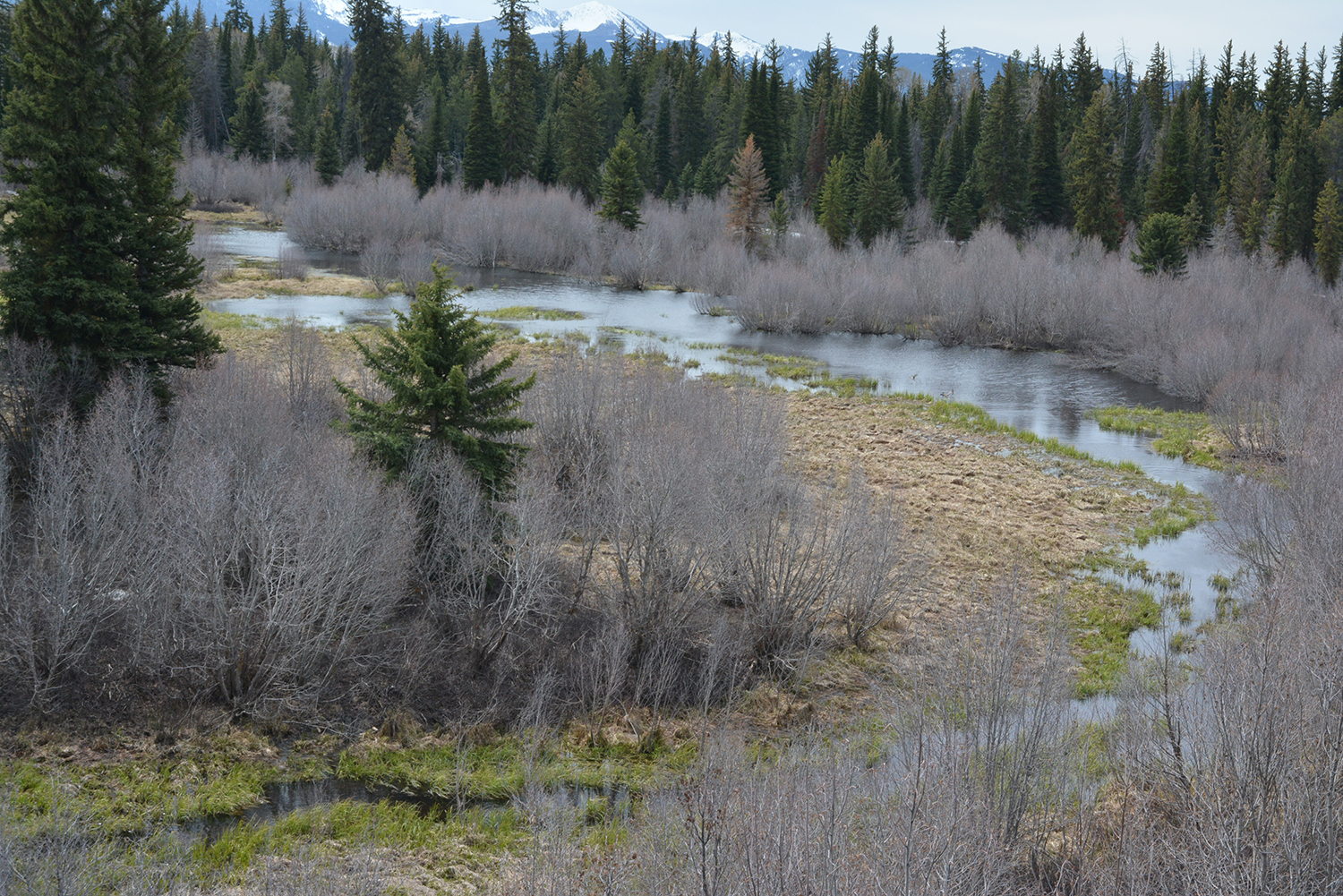
Alders can fix nitrogen (as do legumes), thereby providing much needed nutrients to exposed soils after rock slides, floods, or fires. Alders were important plants in colonizing areas after the glaciers retreated. Their fibrous roots also prevent erosion. They grow plentifully around Saw Mill Ponds and along adjacent creeks.
Have fun investigating the various ways flowers emerge in the spring and how they are pollinated to produce seeds for their future.
Many people strive to plant a meadow from a can. Unfortunately, this is not at all easy or quick. Natural meadows can take centuries to become established.
We have a wonderful array of meadows around Jackson Hole not only because we have the right ecological conditions, but also because many places escaped grazing by sheep and cows. Fortunately, you can go enjoy a meadow without having to plant, water, and weed.
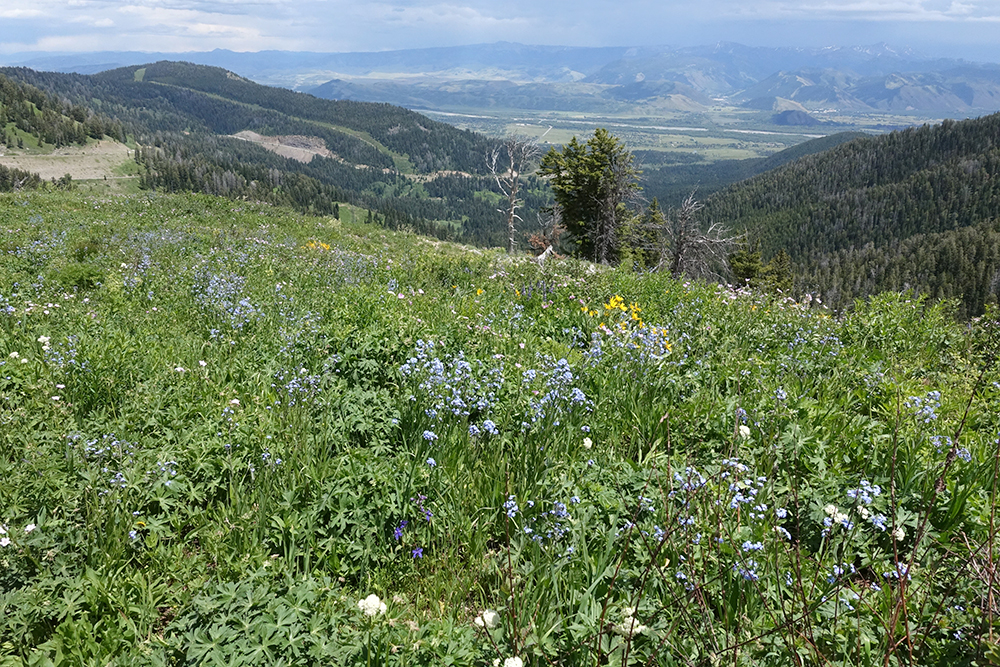
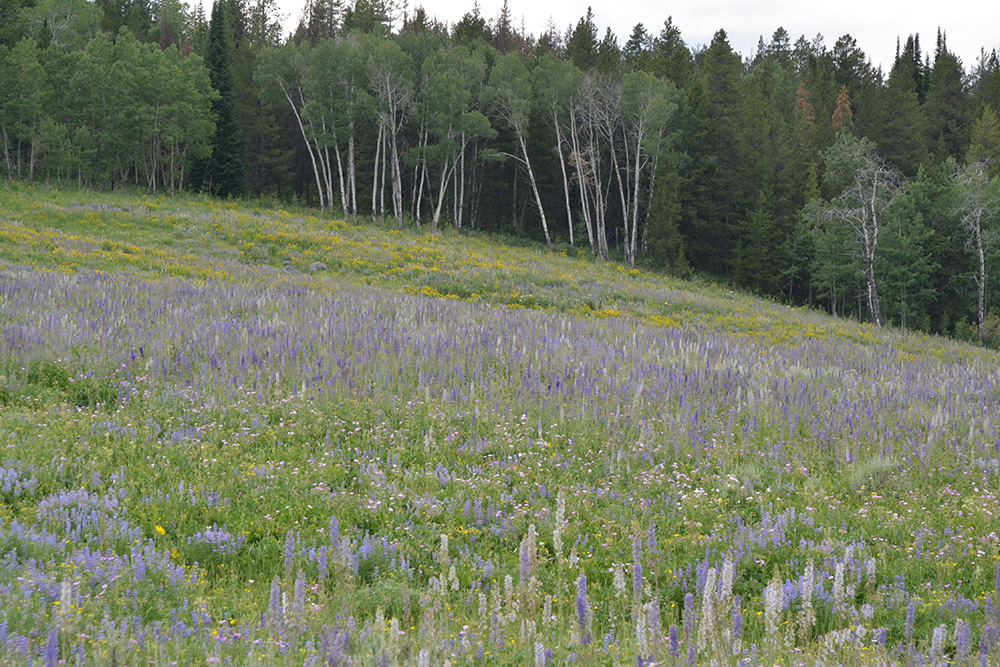
Meadows don’t come easily from a can but they can be easy to go see. In early July, we can see meadows beginning to bloom around Jackson Hole. The road to Two Ocean Lake, up Shadow Mountain, the hike to Ski Lake, and the trails south of Teton Pass to Mt. Elly all are relatively accessible, and as they vary in elevation, they keep blooming over the month.
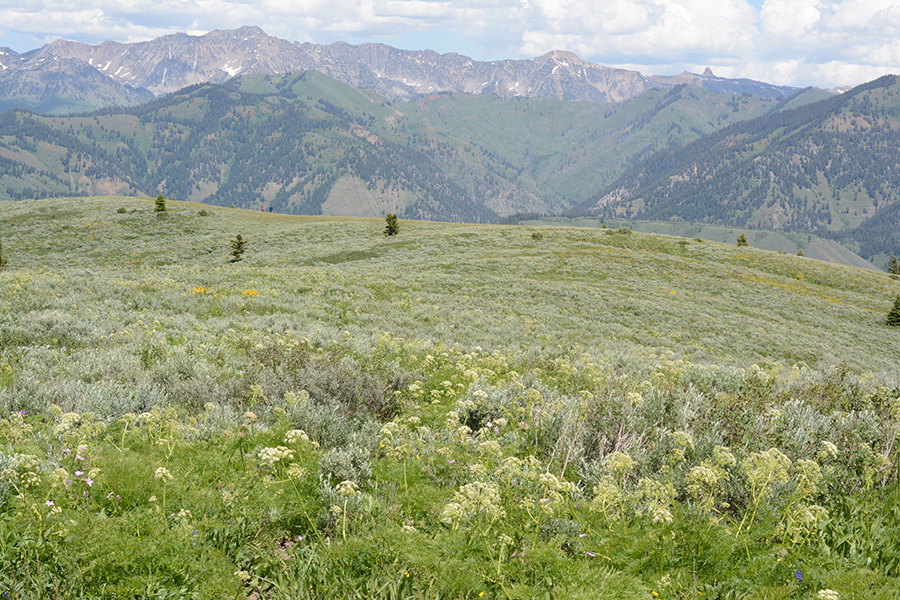
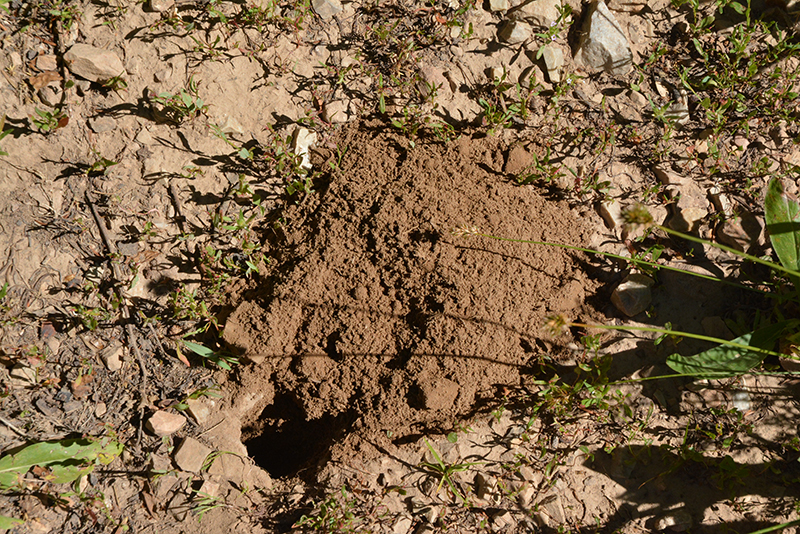
Mountain meadows are also called “tall forb communities”. They are found where there is sun, moisture, and not too hot. Snow is deep and melts off late. Soils are relatively rich, deep, and often churned by pocket gophers.
Plants are similar to the perennials in a well-nourished and watered garden border: tall and lush. It is impressive to see how much biomass is produced each year from bare ground—plants are often 3-4’ tall by mid-July.
Meadows are rich habitats. Plants sustain myriad insects: caterpillars who eat the leaves before transforming into moths or butterflies. Lepidoptera along with bees, beetles, and flies of all sorts serve as pollinators. Pocket gophers, Uinta ground squirrels, as well as bears eat the roots; and pika, moose, elk, and deer browse on the stalks and flowers. Birds rely on the nutritious insects and seeds. Looking close with a 10x hand lens shows all sorts of tiny insects crawling around.
The following plants are the mainstays of our mountain meadows. Each meadow has its own combination, but the following species are typically part of the mix soon or later.
The truly tall meadow forbs:
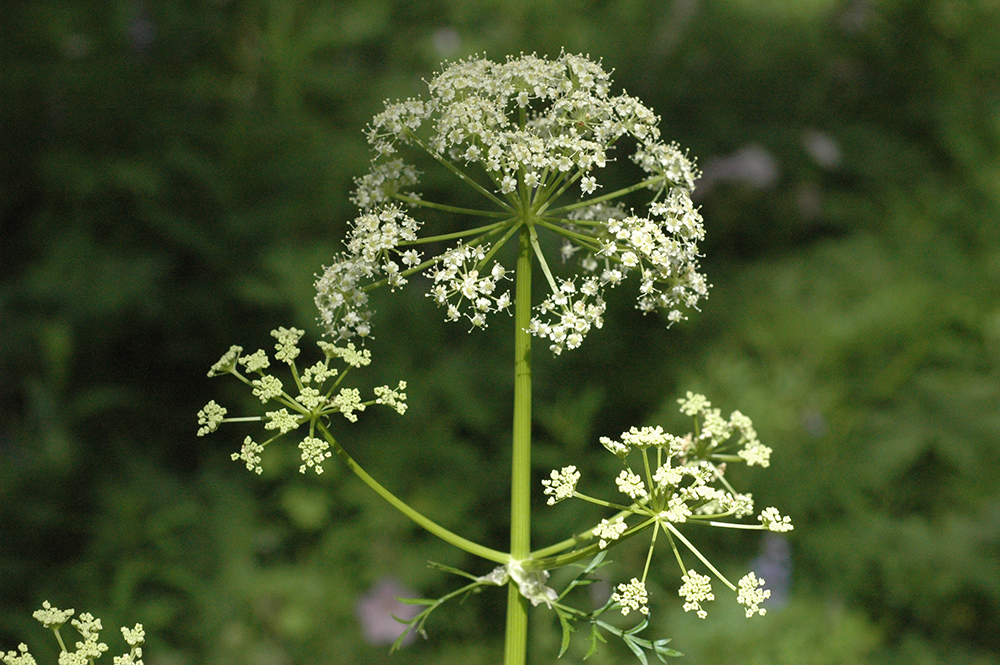
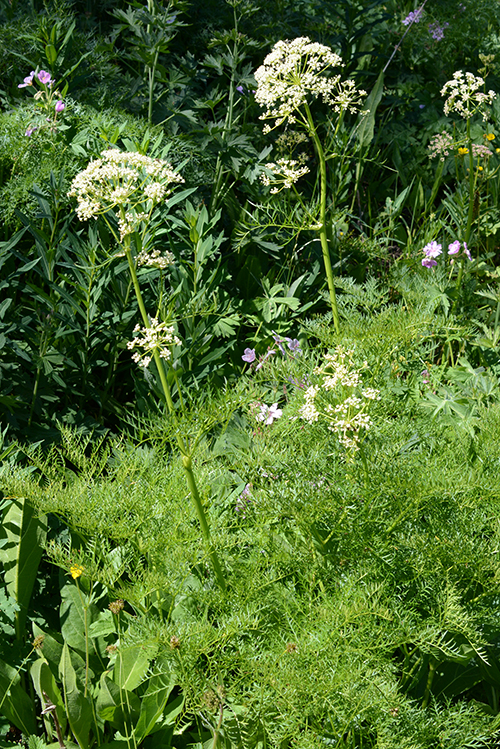
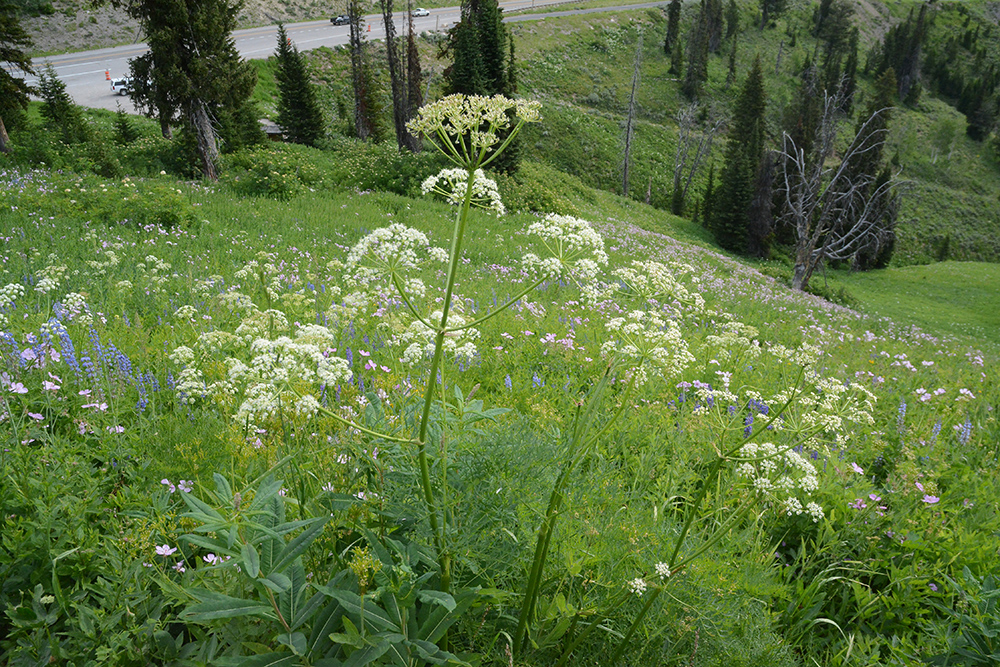
Fernleaf Lovage – Ligusticum filicinum – is outstanding with its lacy skirt of very finely divided compound leaves and umbellate (remember umbrella) inflorescences of many tiny white flowers.
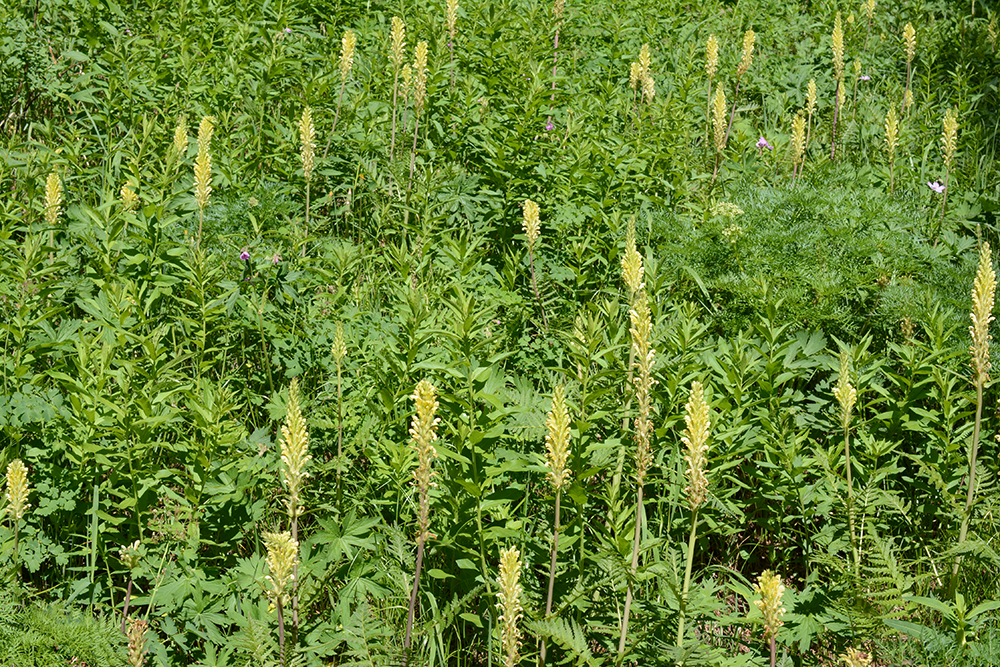
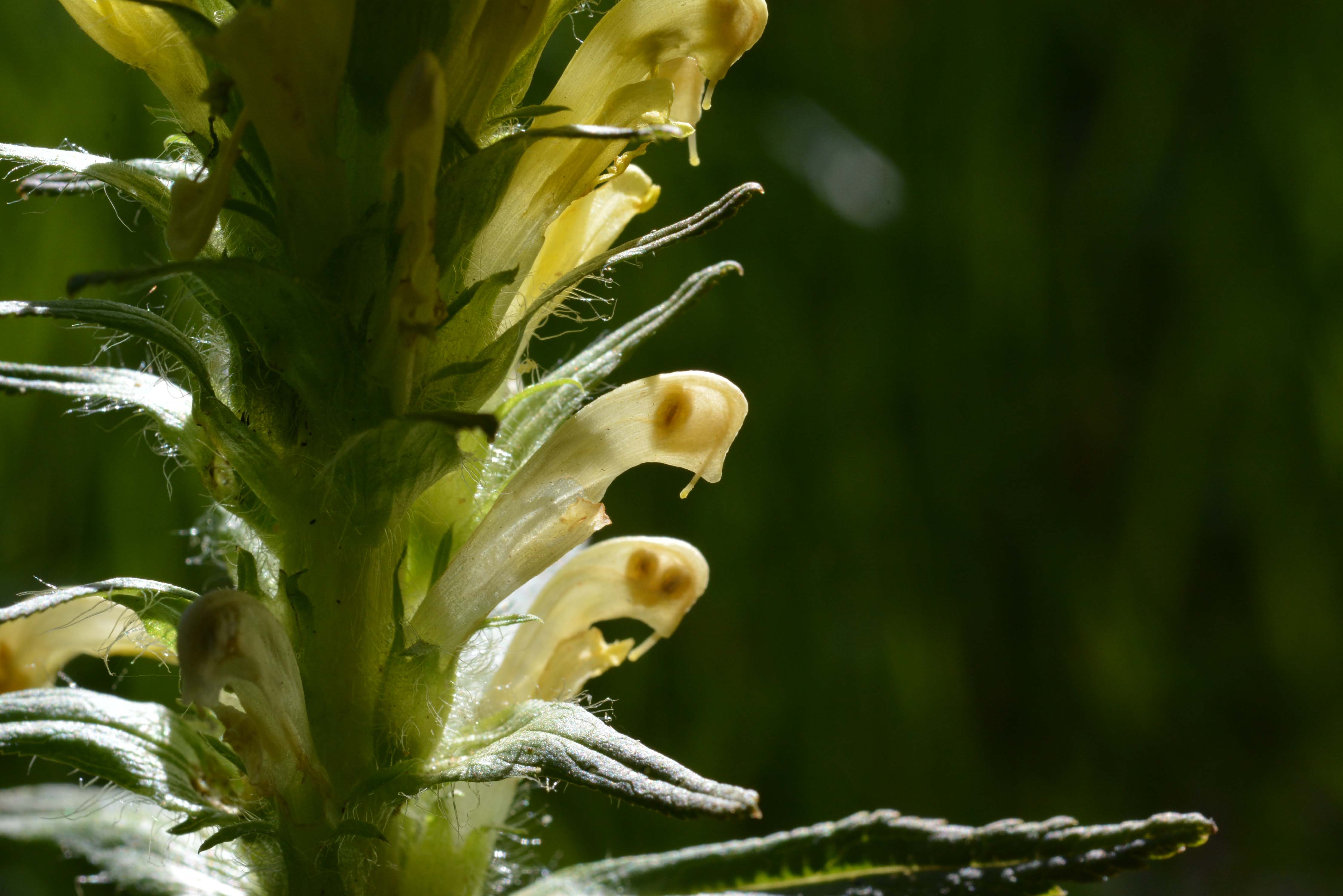
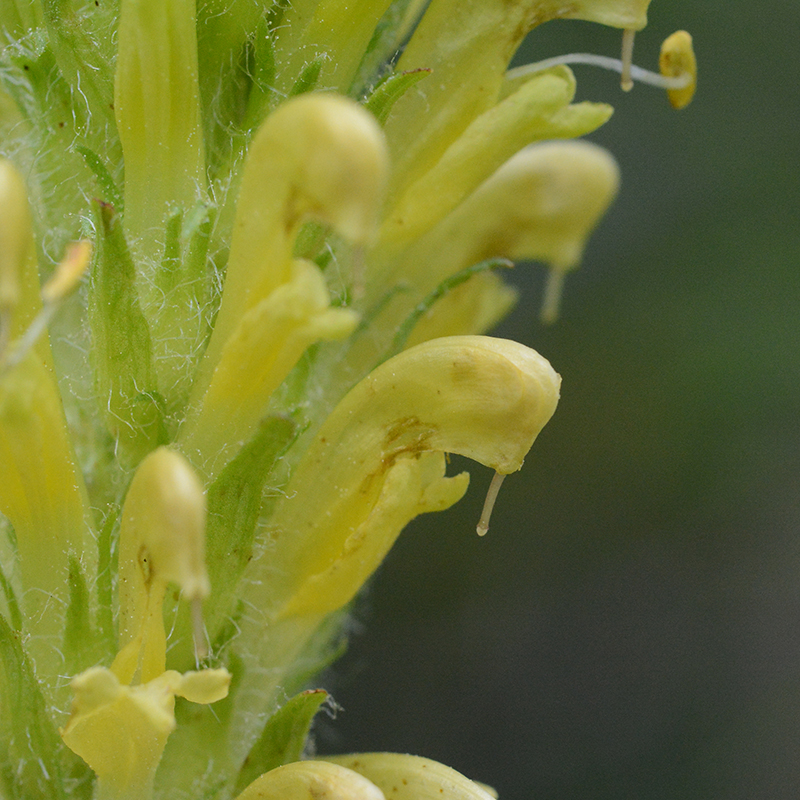
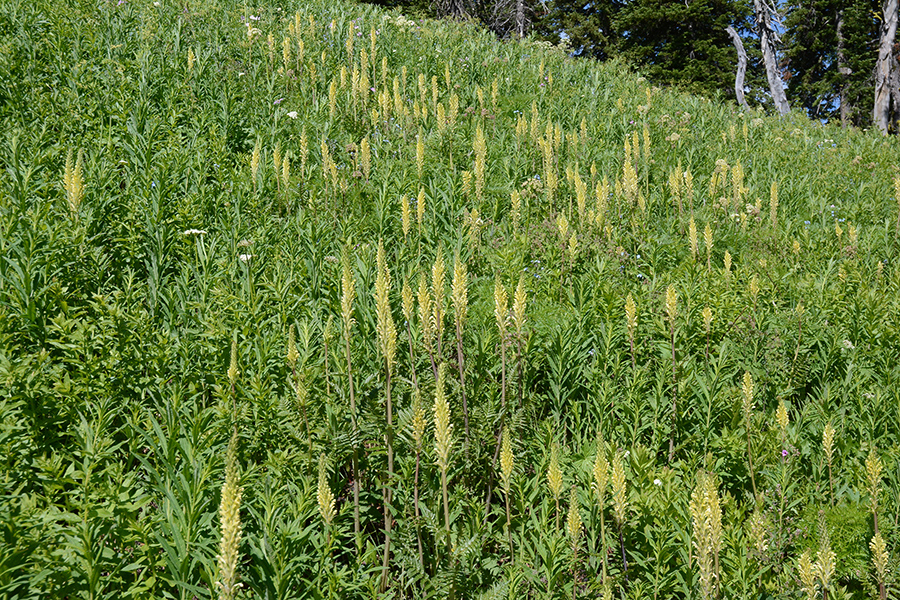
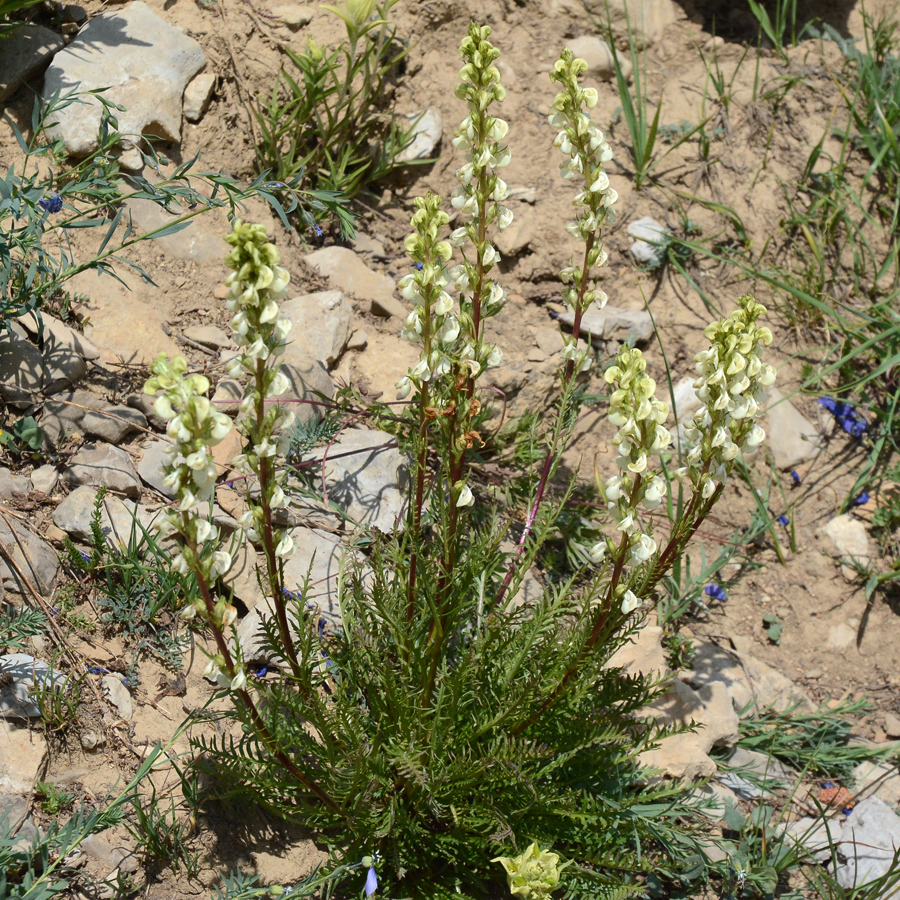
Fernleaf Lousewort – Pedicularis bracteosa – has erect 2-3′ stems full of yellow “irregular” flowers. Below the flower stalks are fern-like leaves, but not nearly as fine as the lovage above.
These flowers have co-evolved with different species of bumblebees who trigger the complicated apparatus of fused petals, hidden anthers, and single pistil to effect precise pollination. Bumblebees receive both pollen and nectar from this species. Fernleaf Lousewort is fading in lower regions but flourishing in higher meadows.
The species is hemiparasites on the Arrow-leaf Lousewort which also intermingles in moist meadows (see below) and Engelmann spruce where it receives sugars but also the alkaloid pinnidol. Nature has all sorts of relationships seen and unseen.
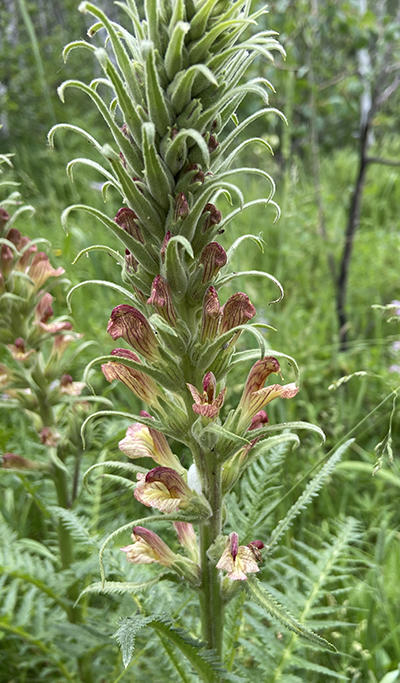
Giant Lousewort – Pedicularis procera – are not nearly as common as Fernleaf Louseworts and come out a bit later. As they name indicates, plants are much more robust growing to 4+’ and have reddish flowers with a definite long bract beneath.
I have seen them along trails at Munger Mountain, Brian Flat, and Game Creek
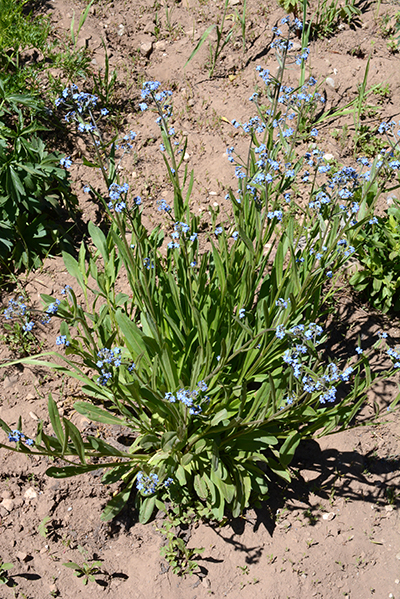
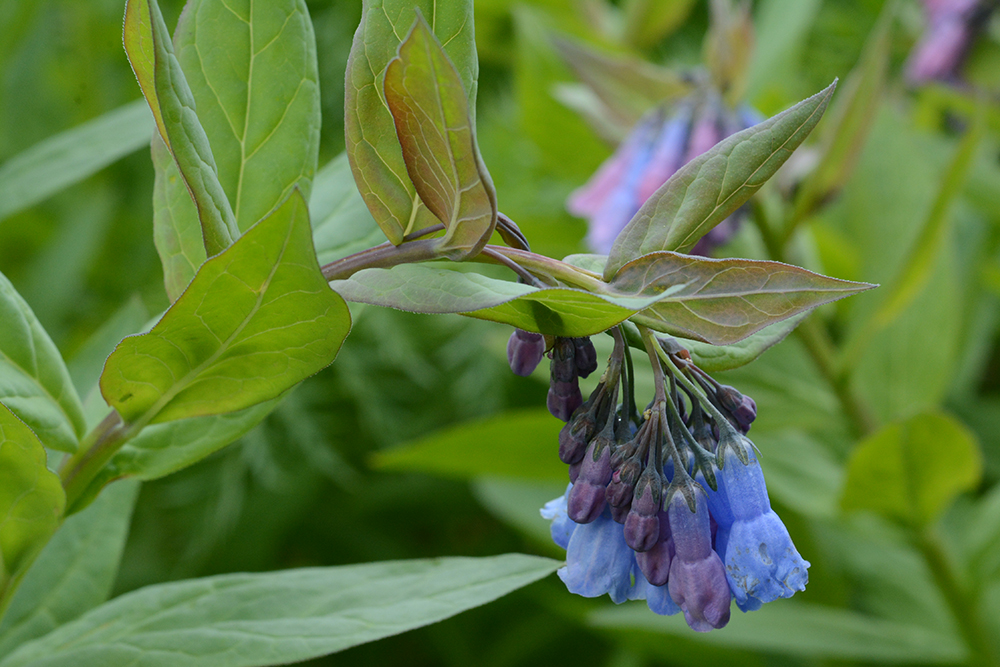
Mountain Bluebells – Mertensia ciliata – are dangling 2-4’ along mountain seeps and brooks. Their bluish green leaves have little stiff hairs along the edges: ciliate. Flower buds are pink, and open and turn blue when ready for various pollinators. The tubular petals fall off soon afterwards.
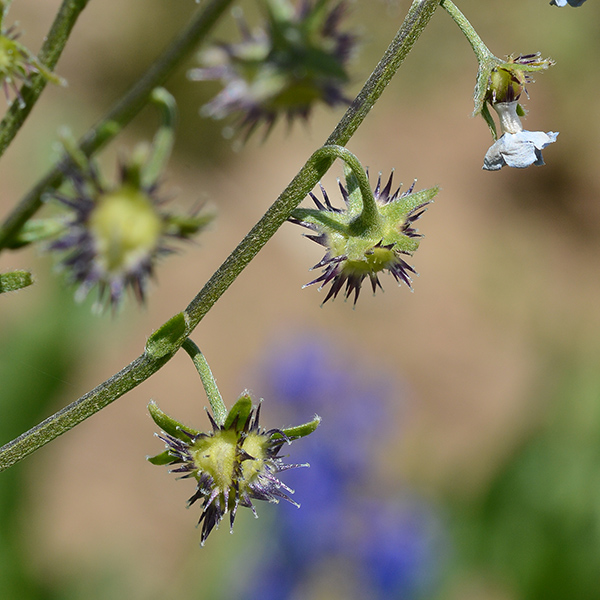
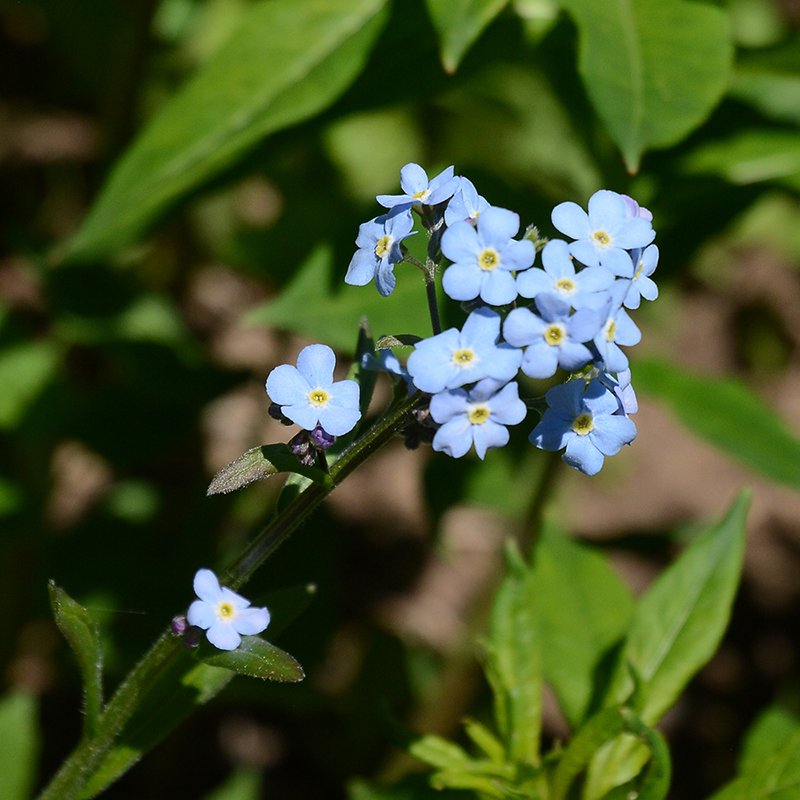
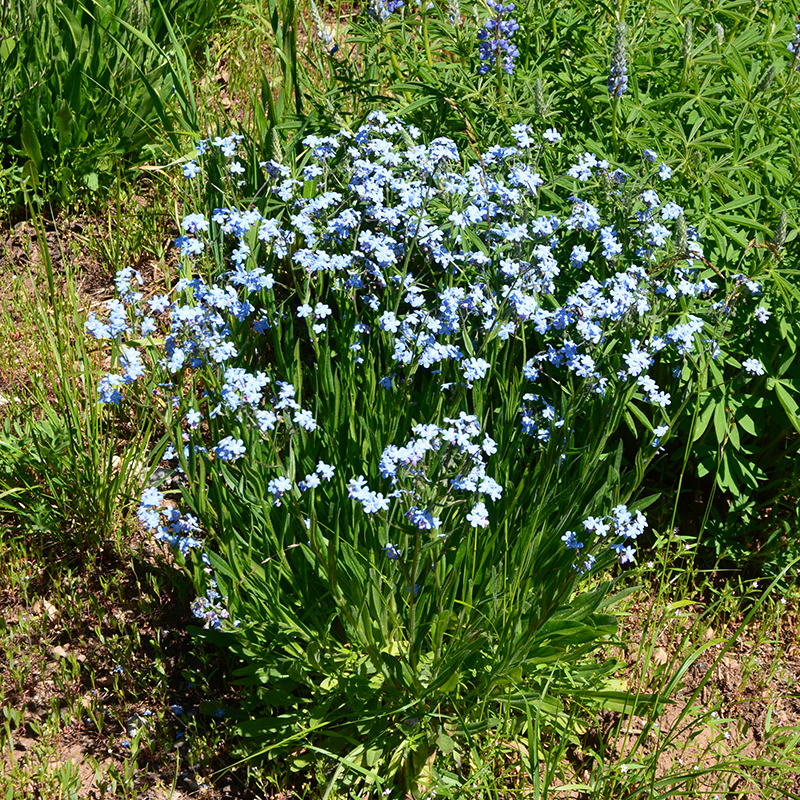
Jessica’s Stickseed – Hackelia micrantha – competes with Mountain Bluebells in capturing the the blue of the summer sky, and indeed they can be growing in the same vicinity, as in the bowls above Ski Lake.
The barbed fruits quickly form, ready to be carried along the trail by your dog or your socks.
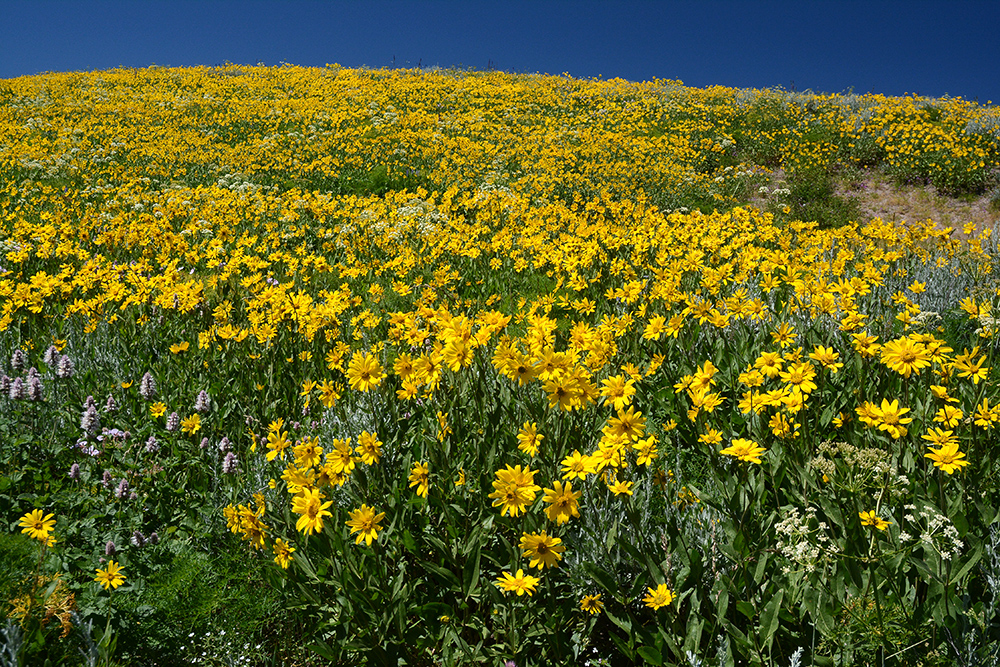
Five-nerved Little Sunflowers – Helianthella quinquenervis – grow to about 4 up to 5’ in height. They appear to stare straight at you with their 3-4”-wide composite flowers.
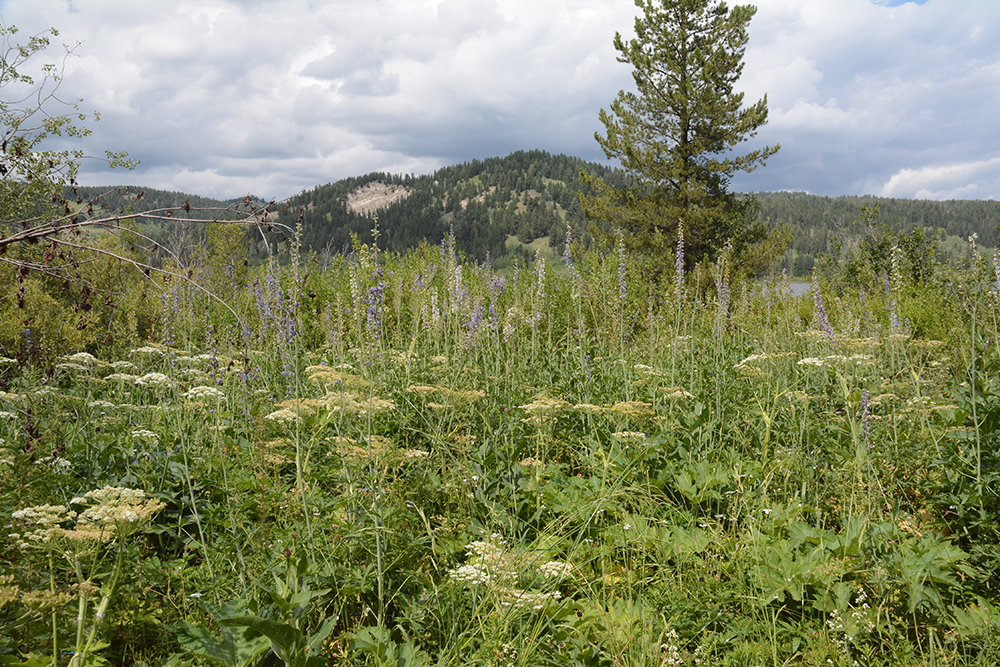
Their lower leaves have five strong veins: the central vein, and two on each side.
One-flowered Little Sunflowers – Helianthella uniflora – can form colonies up slopes and across meadows. They are smaller in stature than their five-nerved cousin and have smaller flowers. The lower leaves have about 3 faint veins.
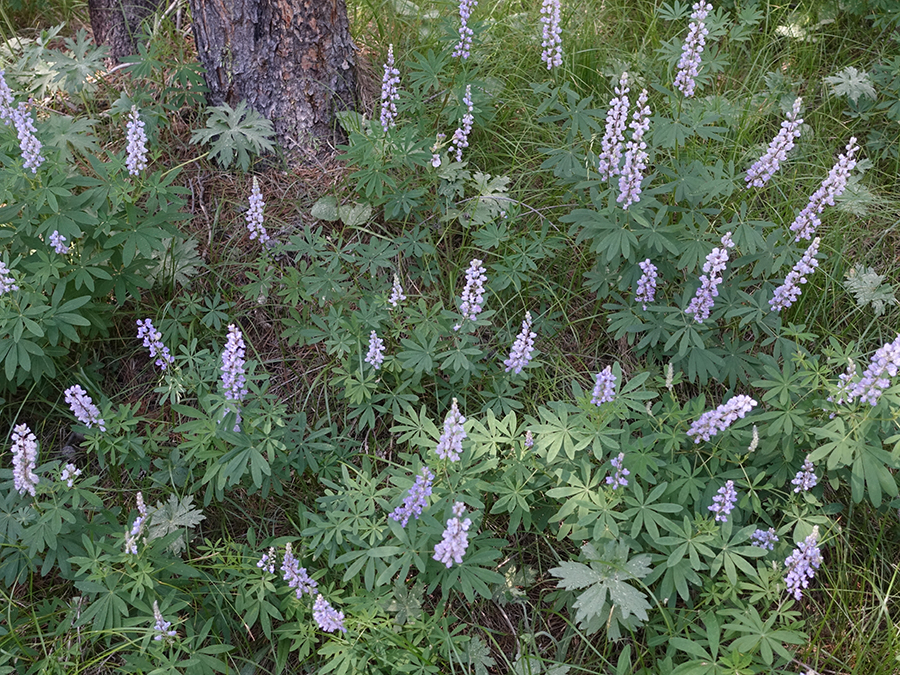
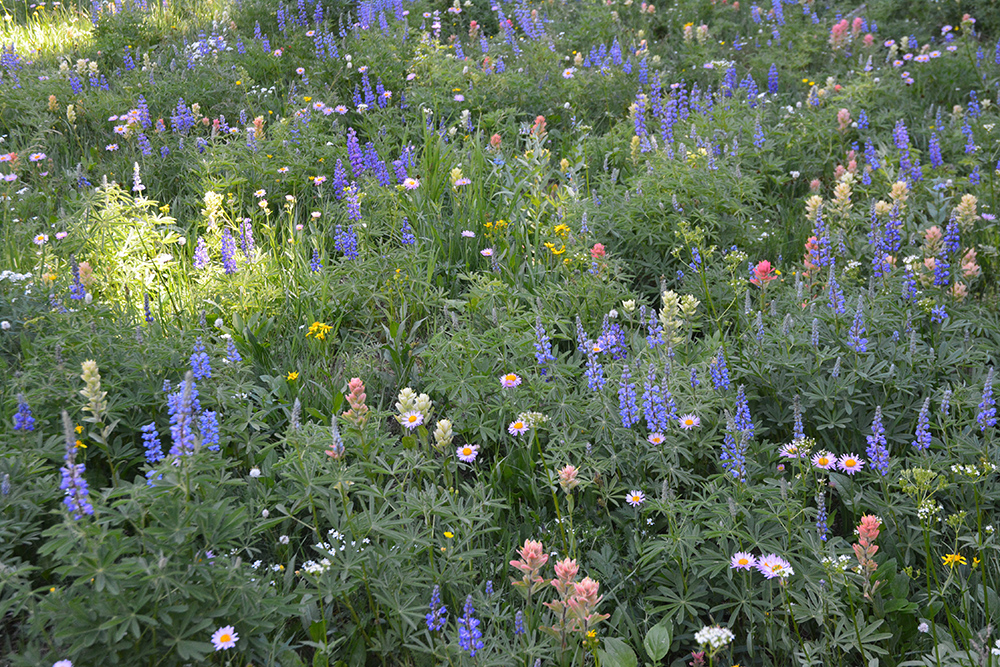
Silvery Lupines – Lupinus argenteus – are common in high elevations and as well as in shade at lower elevations. Compared to Silky Lupines – L. sericeous – which often grow with sagebrush on drier sunny slopes, Silvery Lupines overall are less hairy, flowers are a bit smaller and tighter, and the back of the banner (the upper petal) is typically smooth. (For the avid botanist there are 4 local varieties of Silvery Lupines). And for all lupines, the leaves are palmately divided: leaflets coming out from the center like the fingers from your palm.
In the Pea or formerly Legume Family, lupines all produce pods with seeds inside, like your common pea; but lupine pods and seeds are much tougher and the plant is poisonous with alkaloids. Plants “fix” their own nitrogen with the help of bacteria that reside in root nodules. The bacteria take the plentiful nitrogen (N2) out of the air (soil has air spaces) and convert it to a form usable by the plant: ammonium (NH4) which can be directly used to form proteins. (Clovers, vetches, etc. can do the same thing.)
Furthermore, lupines can be a host plant for paintbrushes (see below) which siphon off the alkaloids which then help protect paintbrush flowers from hungry insects.
Mountain Mint – Agastache urticifolia – is clearly in the Mint Family. The stems are square, the leaves opposite, and the pinkish flowers are bilateral – the flowers have two sides to them like your face, with several anthers sticking out. The final ID feature is that plant leaves, stems, and flowers are very fragrant. Hummingbirds, attracted by the pink bracts, hover to lap nectar, thereby pollinating Mountain Mints.
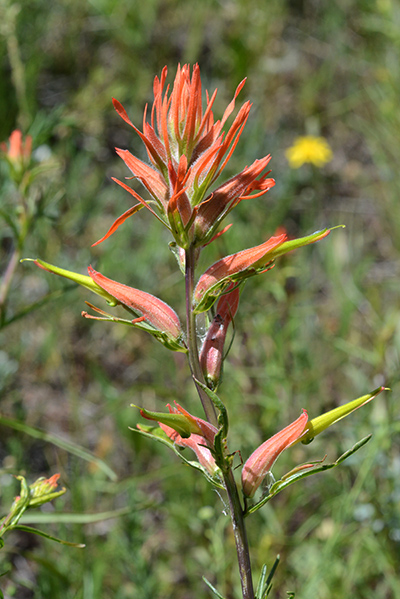
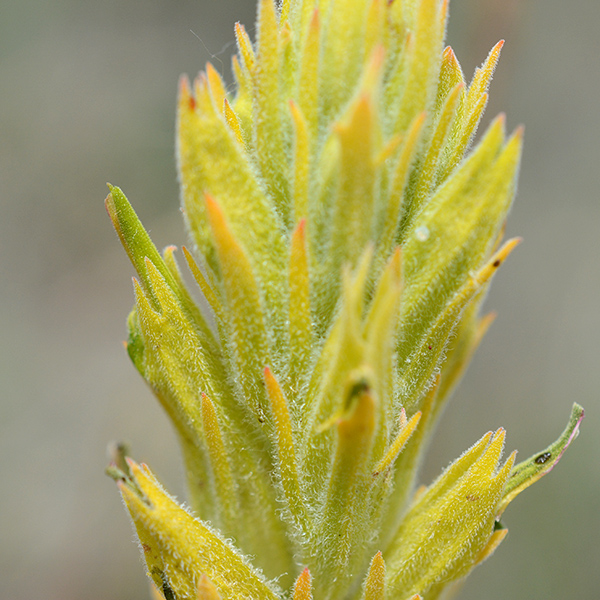
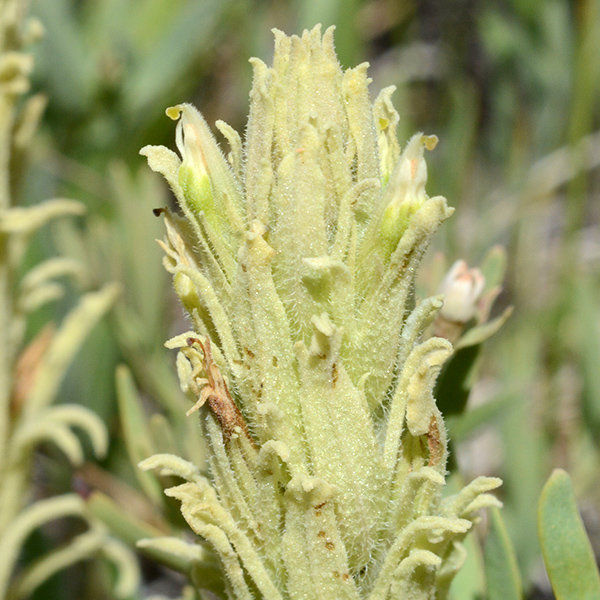
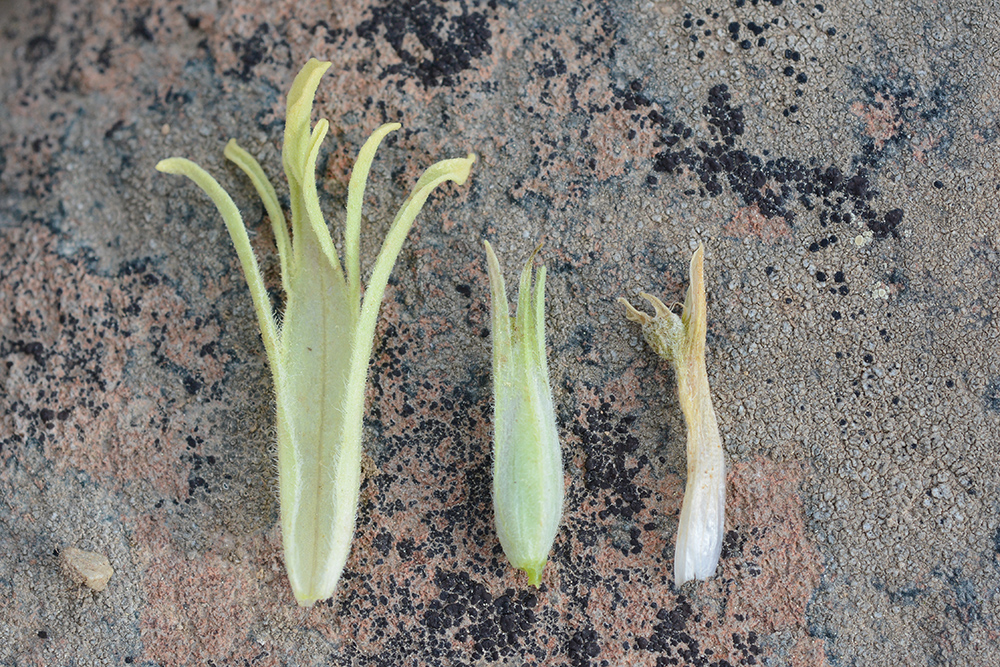
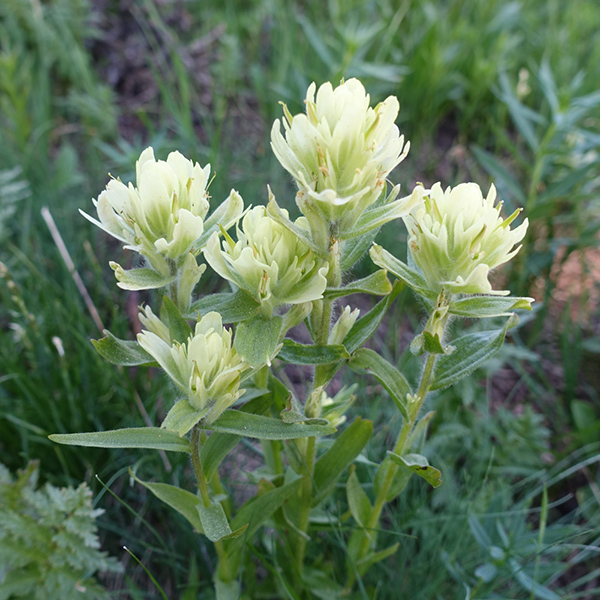
Sulphur Paintbrush – Castilleja sulphurea – can range in color from an orange to salmon to yellow to cream. They hybridize with red paintbrushes or muddle their chromosome numbers through polyploidy to make ID difficult. They are hemi-parasitic on a variety of meadow species.
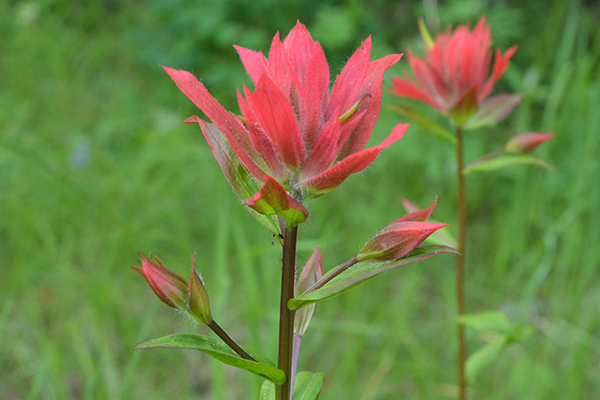
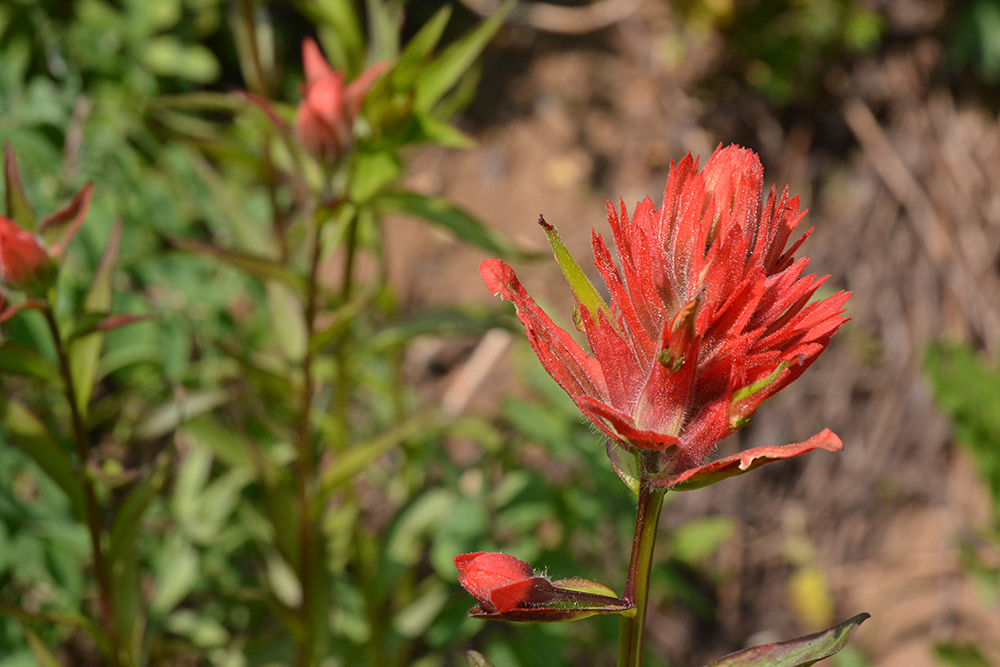
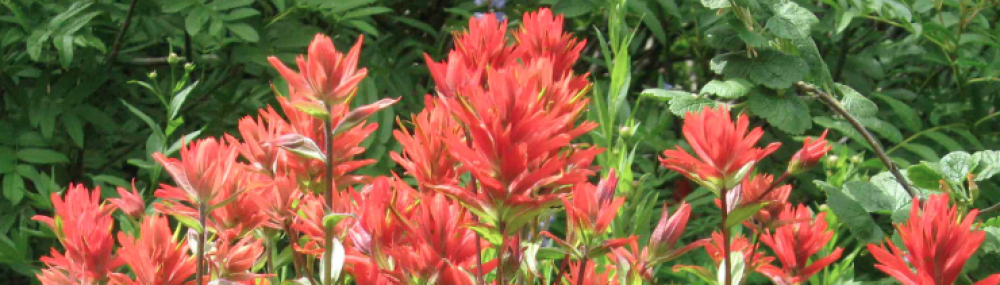
Red Paintbrushes – Castilleja miniata – are frequent at lower elevations under aspens, forest edges, and grassy slopes. They can be up to a foot or more and often branch. They often hybridize with Pale Paintbrush (C. pallescens), if nearby. Their bracts and calyx lobes are sharply pointed.
Rosy Paintbrush – Castilleja rhexifolia – is found at higher elevations than Red Paintbrush They too can hybridize and have a range of colors. Compared to Red Paintbrush, Rosy paintbrushes are more upright and rarely branched. Bracts are 1-3-lobed with the center lobe widest and often rounded, as are the other lobes. The calyx lobes are also rounded. As I say they can be tough to tell apart for paintbrushes.
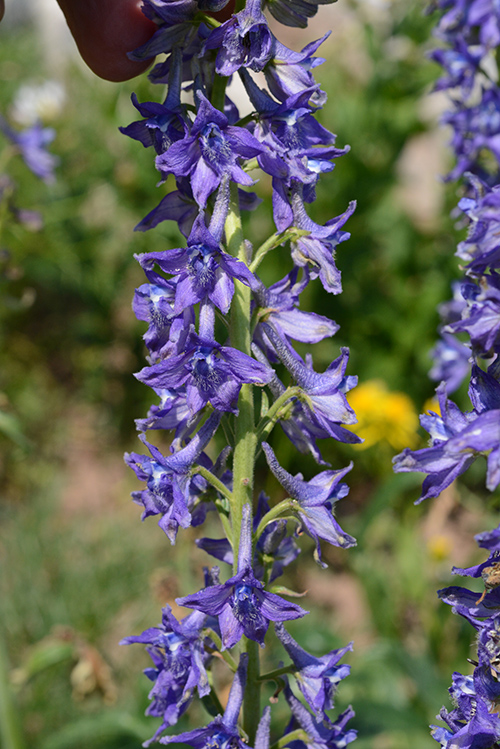
Tall Western Larkspurs – Delphinium occidentale – look like they belong in an English garden, they are so tall (to 6’) and dignified.
Studies have found that yeast passed along by bees can ferment the sugar in nectar and make flowers more attractive for pollination. Most parts of larkspurs are poisonous.
Monkshood – Aconitum columbianum – are also beginning to bloom mid-July in moist meadows and along streams. Their flowers are complicated with sepals forming the blue hooded framework over two stiff, arched nectaries which draw the insects inside.
Just below a mop of anthers forms first, and later they fizzle and the 3 female stigmas protrude. You can see this if you look at the flowers closely. Note all parts of Aconitum are poisonous.
In a study of a different species in Europe Aconitum napellus, scientists discovered that during those few days when the male anthers are fresh, plants exude more fragrance and more nectar to appeal to roaming bees. As it is not beneficial to the plant if the bee eats the pollen, the pollen is slightly poisonous. The bee is rewarded by nectar but deterred from feeding on the plentiful pollen. In any case, the bee flies to another flower where the three female stigmas are now standing out waiting. When the bee covered with pollen goes for another sip of nectar up under the hood, the pollen sticks to the protruding stigmas and pollination is affected.
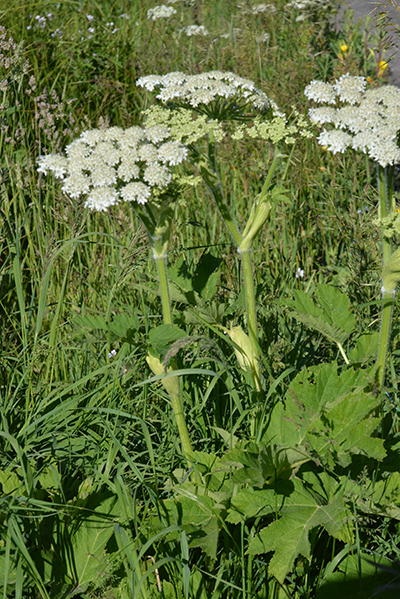
Cow Parsnip – Heracleum spondylium var. lanatum – is the largest member of the Parsley Family – truly Herculean in stature – here in Teton County, growing up to 5 feet with broad compound leaves that can be 3’ across. The flowers welcome all sorts of insects, some who pollinate, some who just chow down on pollen and nectar. The hairs on the 1”-thick stems can cause a rash for those who brush against them, but not nearly as bad a reaction of blisters if you brushed against Giant Hog Peanut, an invasive taking over parts of the East.
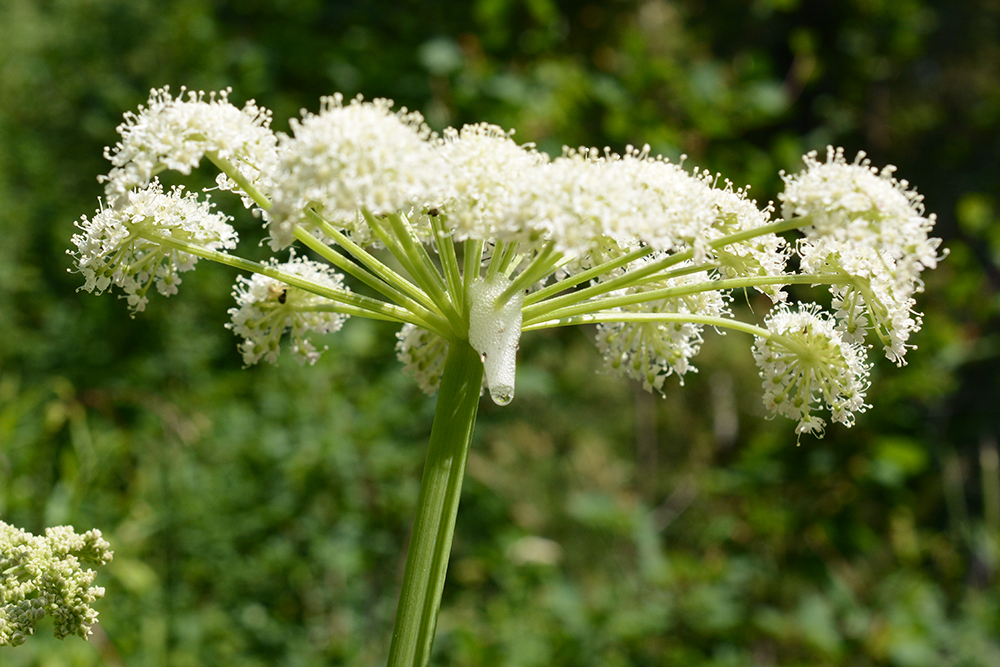
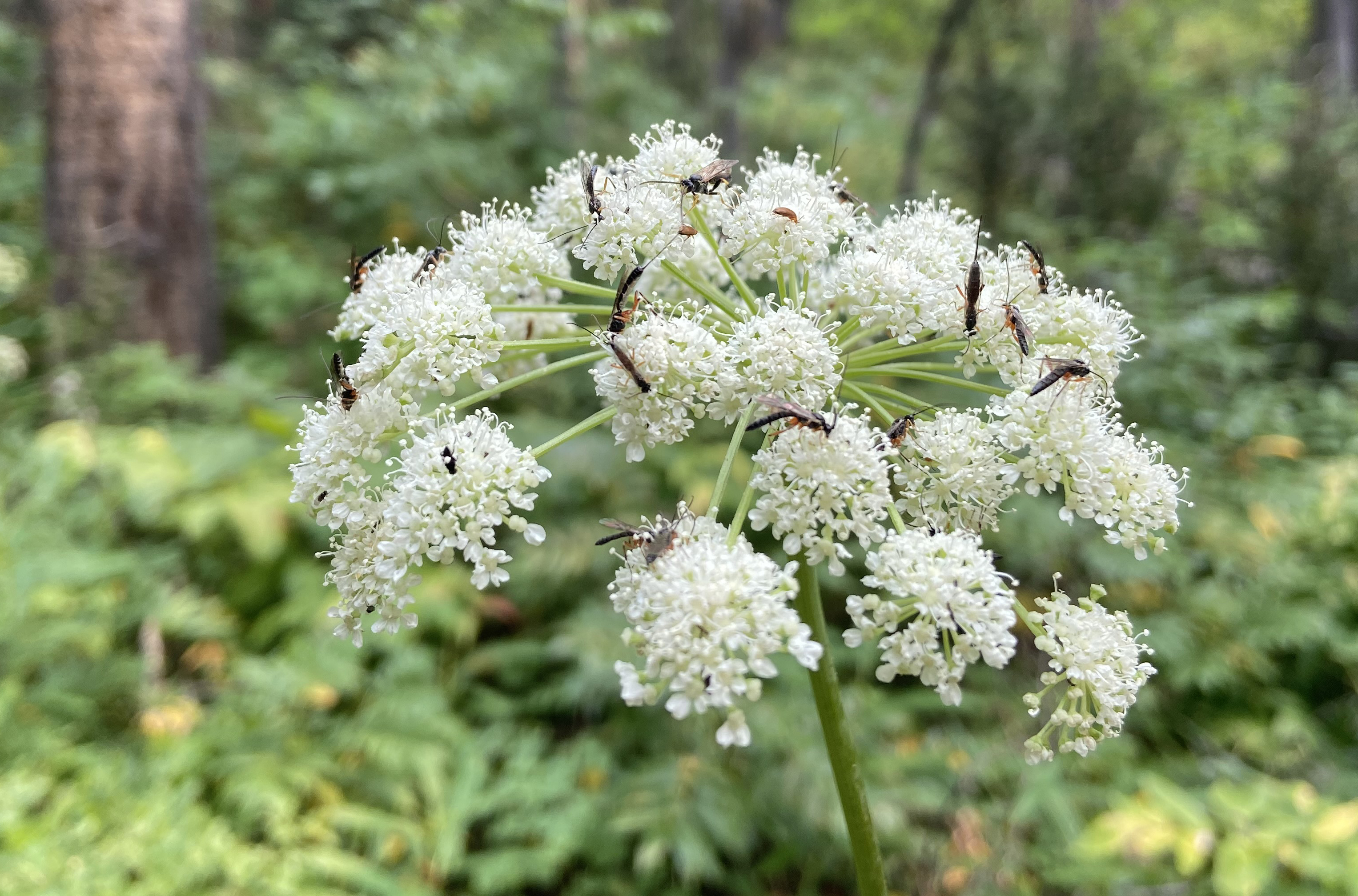
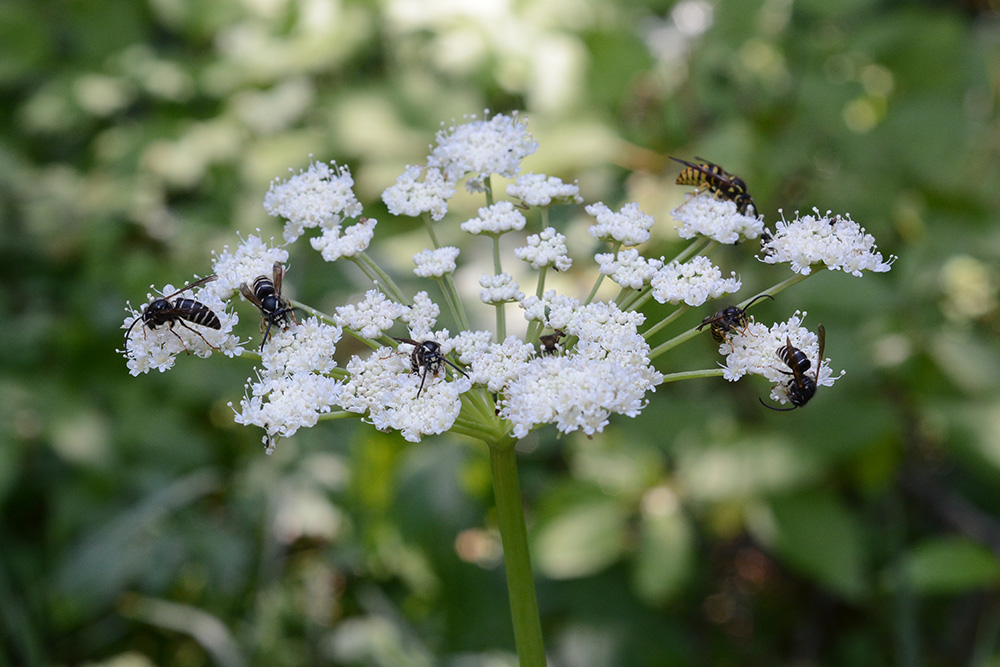
Lyall’s Angelica – Angelica arguta – are equal in stature but not in heft to its cousin Cow Parsnip. Its white umbels are beginning to bloom now and attract all sorts of pollinators.
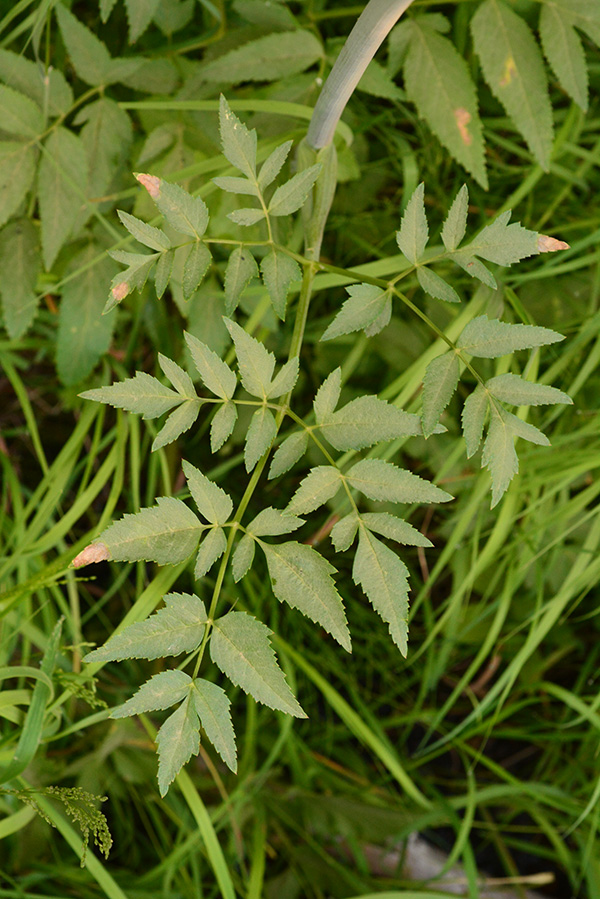
Angelica is more typical of shady forests, but also is found in seeps in more open sites. The compound leaves are also large, but relatively finely divided.
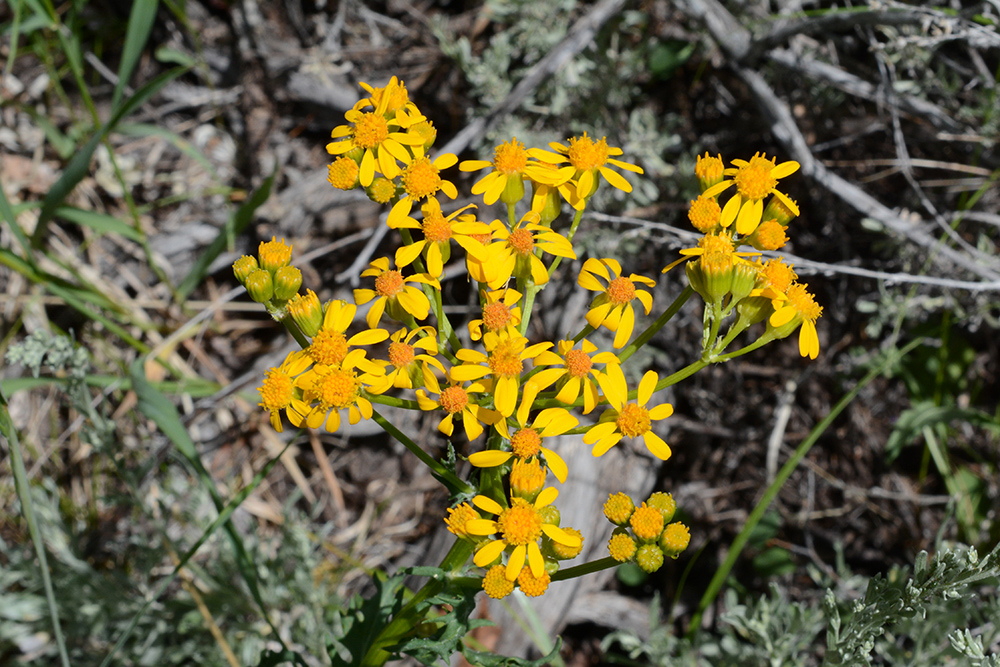
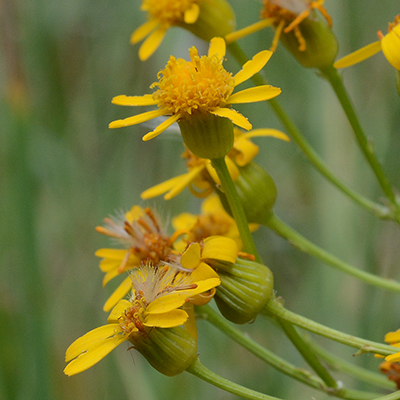
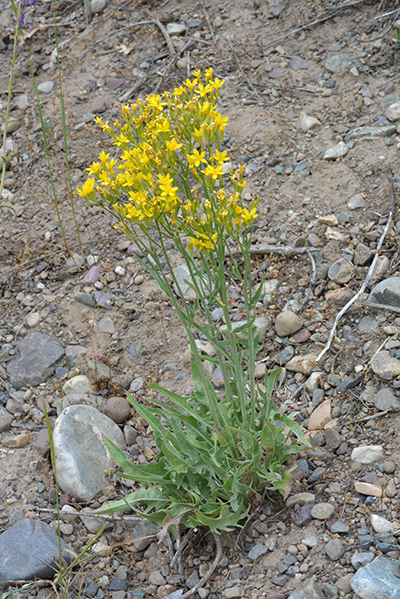
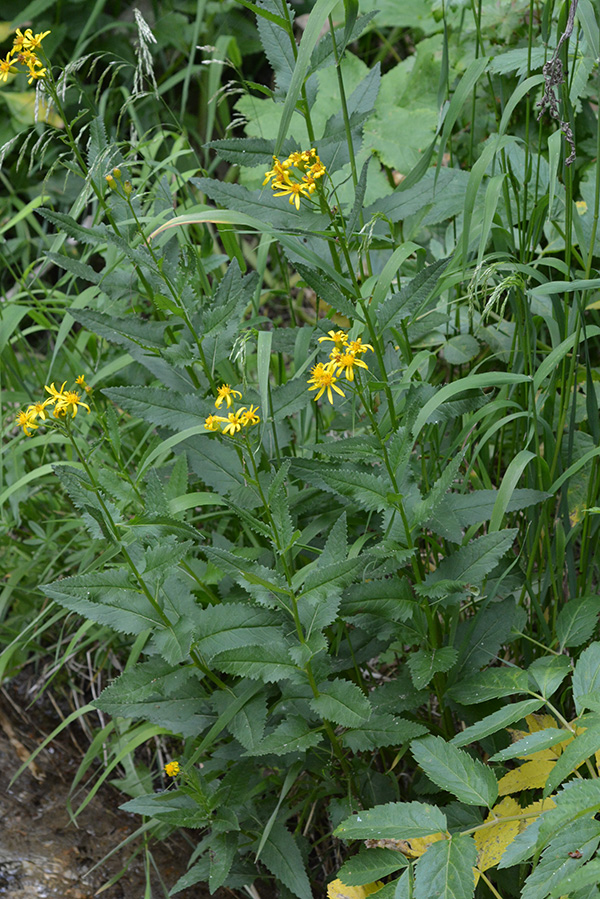
Three tall groundsels or ragworts – Senecio spp. – are blooming the 3rd week of July 2022. They can grow to 3-5’ high and have compound flower heads. The heads are surrounded by a protective row of smooth, equally sized bracts often tipped with black, (and some very short bracts),
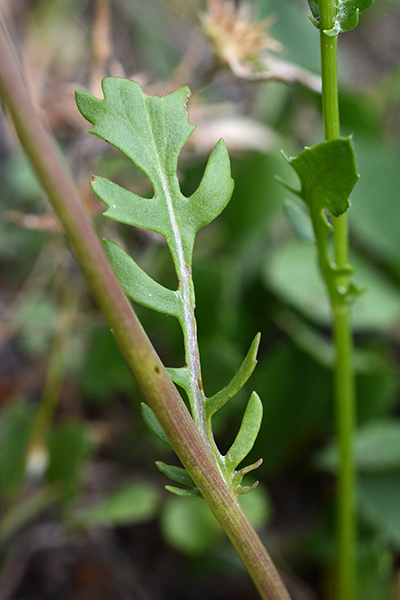
and a pinwheel of a few to several yellow ray flowers. The leaves are similar in size, ranging 3-5”, as they alternate up the stems. The leaf shapes are different and, therefore, are helpful in ID.
Saw-tooth Groundsel – Senecio serra – has oblong leaves with serrated (roughly toothed) leaves.
Arrowleaf Groundsel – Senecio triangularis – has stalked triangular and serrated leaves
and grows near streams and seeps. They can be a host plant for Fern-leaf Lousewort (see above).
Thick-leaved Groundsel – Senecio crassulus – is at high elevations. The slightly succulent, thickish oblong leaves are larger at the base and become smaller and often more clasping as they go up the stem. All is smooth. Flower heads typically have 8 ray flowers. Plants are often only about 2’ tall.
A bit lower in stature:
Cinquefoils are common in a range of habitats. They were addressed in an earlier “What’s in bloom”. However, we include them again here generally because they are so common.
Tall Cinquefoil – Potentilla arguta – is often seen arguing. The flower stalks stand stiffly up and the flowers are clustered, almost in each other’s faces.
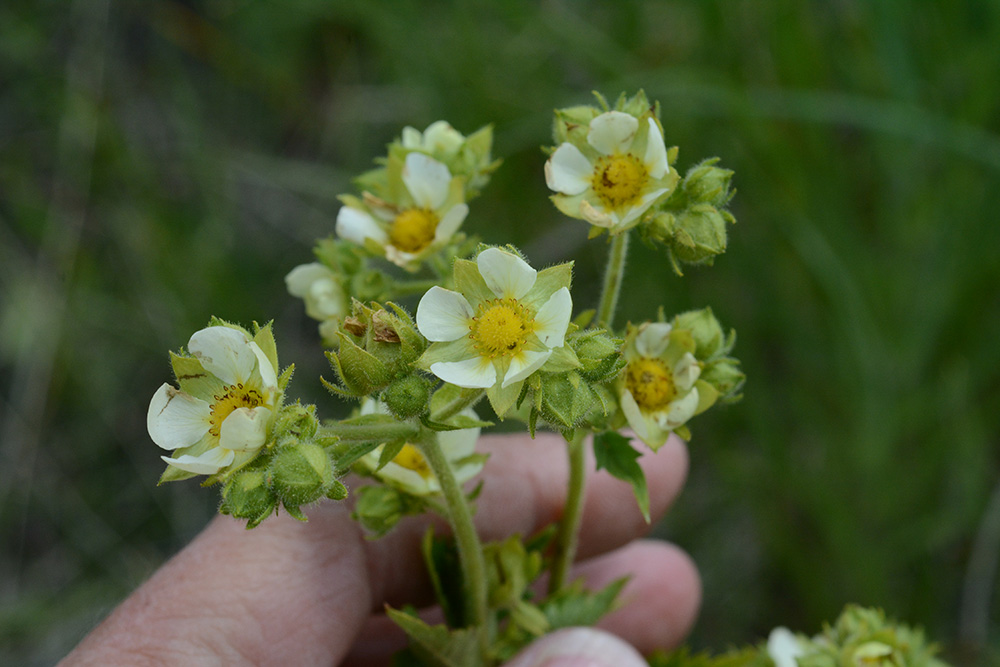
The pale yellow to creamy yellow flowers are slightly larger than the very similar Sticky Cinquefoil – P. glandulosa whose flower clusters are more relaxed. Both species have sticky glands and pinnately divided large leaves. Without measurements, I find they can be very difficult to tell apart.
Other taxa include variants of P. gracilis, P. diversifolia, and P. ovina which are good botany puzzles.
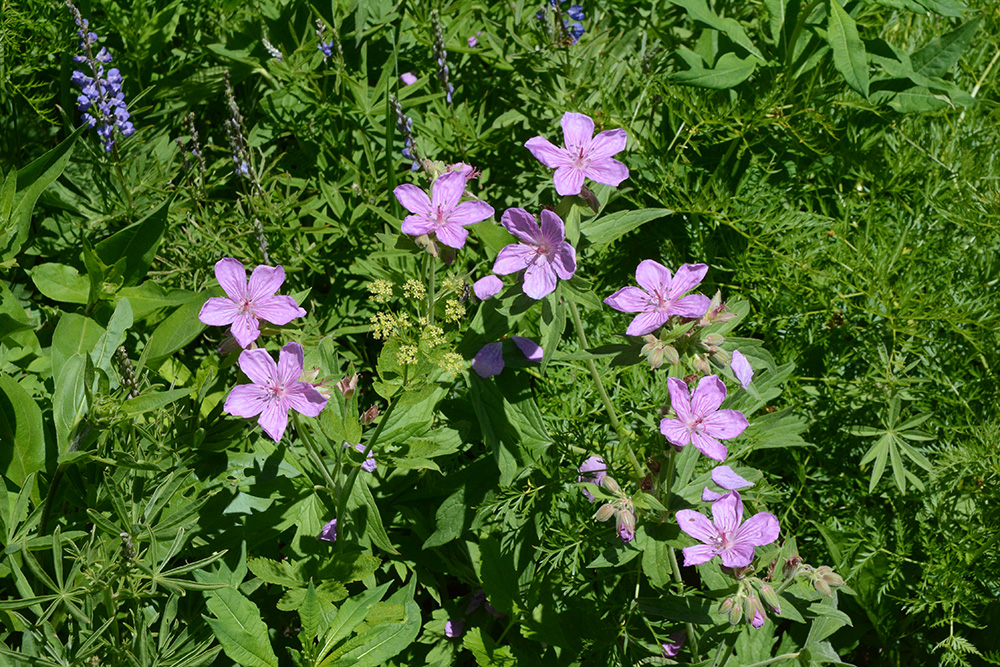
Sticky Geranium – Geranium viscosissimum – is pervasive in many habitats from sage flats to meadows to forest openings.
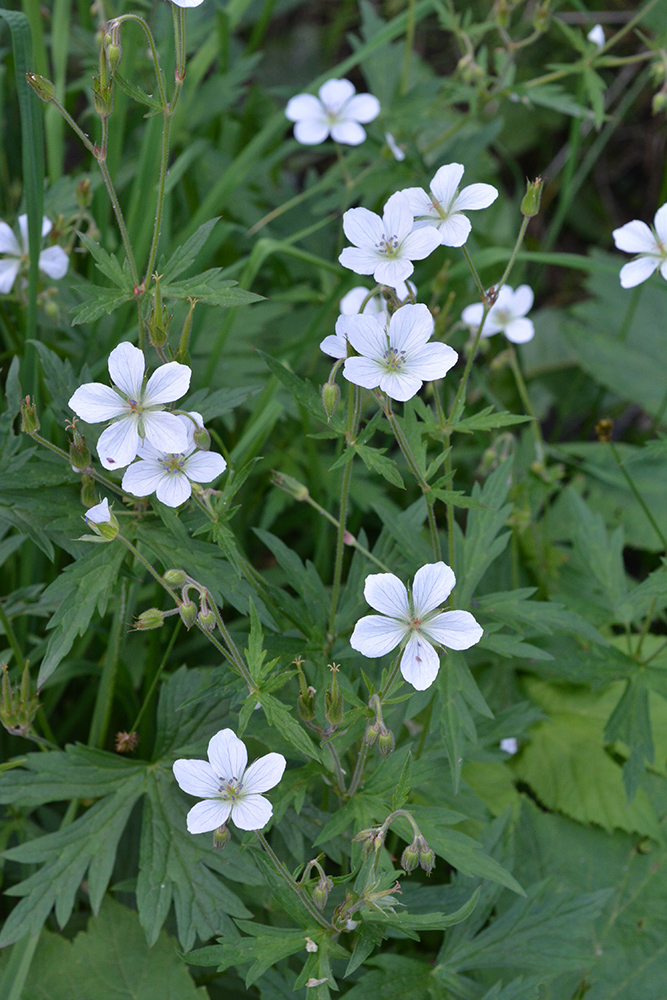
In moister or higher, cooler sites it may be accompanied by the white Richardson’s Geranium – Geranium richardsonium.
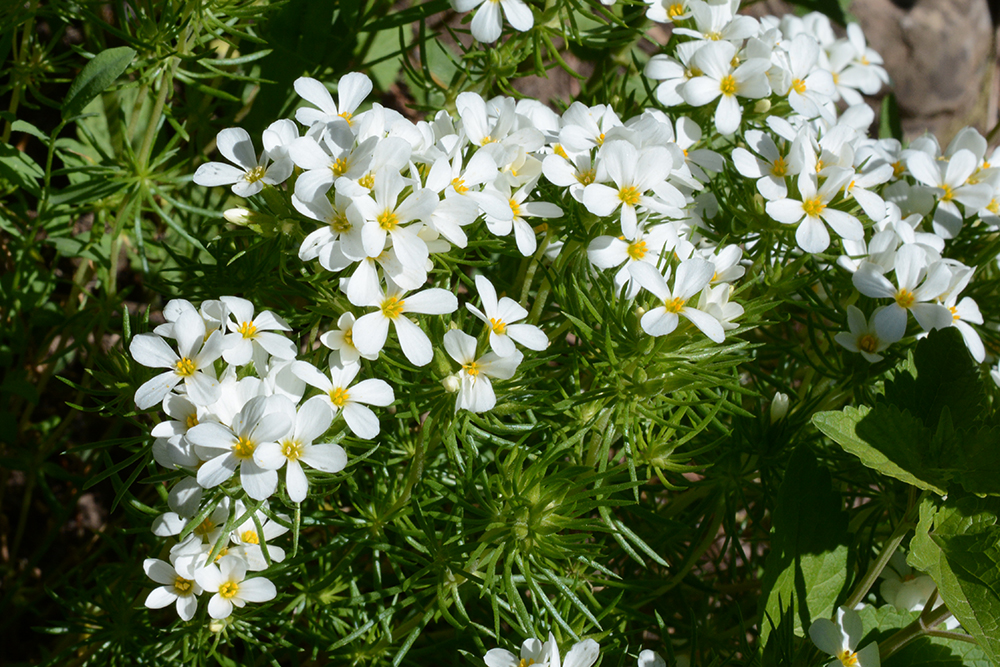
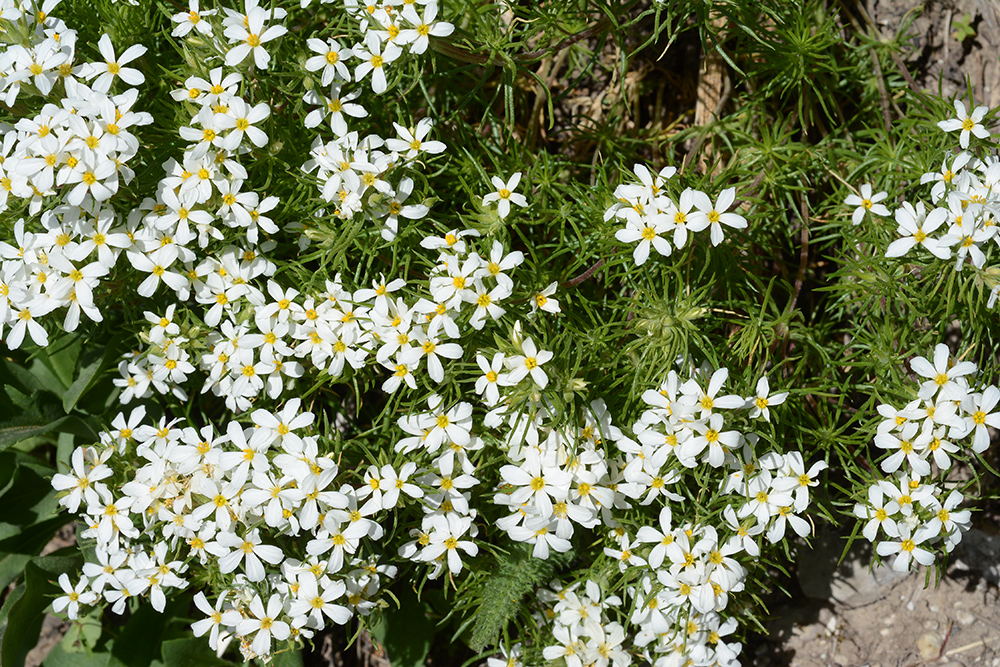
Found mostly at higher elevations, Nuttall’s Linanthus – Leptosiphon nuttallii – looks a lot like its cousin Multiflora Phlox – Phlox multiflora – which may be blooming nearby. The tubular flowers with a flare at the top are similarly designed and fragrant. In both species, the leaves are opposite but Linanthus leaves are each divided into very narrow lobes that look frilly.
When in flower, both species look like remnant snow patches.
A side note: L. nuttallii used to be in the genus Linanthus, but the taxonomists determined that their pollen grains were distinct and so it belongs in the genus Leptosiphon).
Aster-like Plants
In the next month or so, we will be seeing many aster-like flowers, which are cousins or first-cousins-once-removed in the Aster or Composite Family. All are similar in having “heads” of many small flowers: ray flowers that range from white to blue to pink ring around the disc flowers in the center. With close examination of bracts, leaves, and later fruits, one can begin to tell them apart.
Fleabanes typically have a row (or two) of equally long narrow bracts that protect a head of many narrow ray flowers surrounding the disc flowers.
There are many species, but here are two larger, more obvious ones blooming in meadows right now
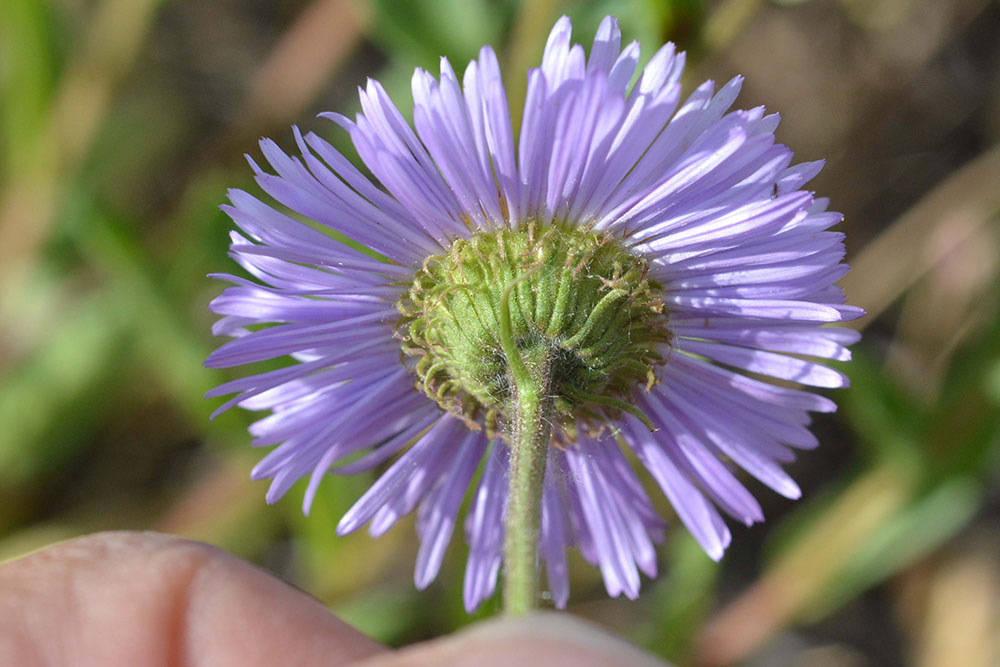
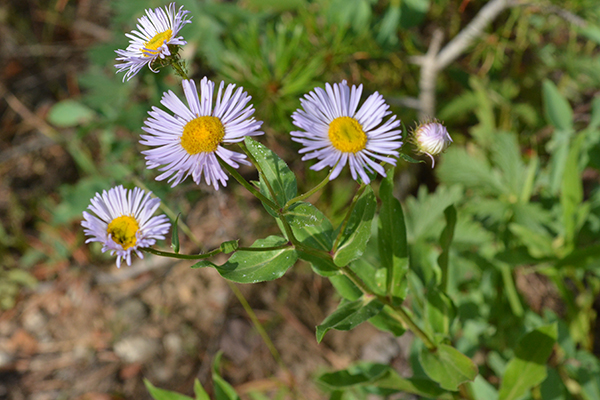
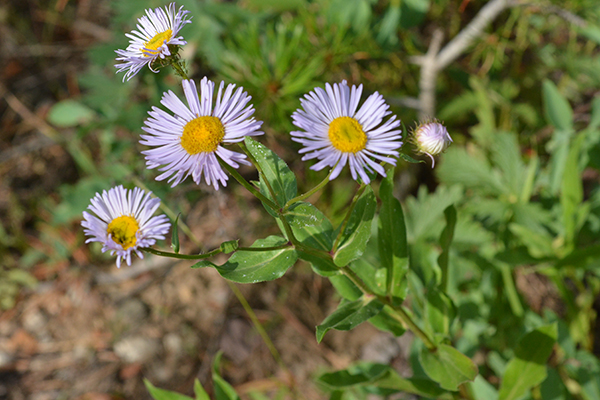
Aspen or Showy Fleabane – Erigeron speciosus – is truly showy with its many narrow (.5-1.5 mm) blue-to-violet ray flowers setting off the yellow centers of the composite head. Egg-shaped, blunt leaves with stiff-hairy margins alternate up the sturdy 1.5’ stems.
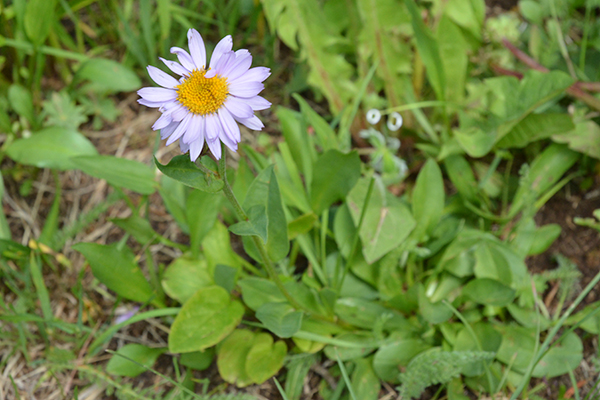
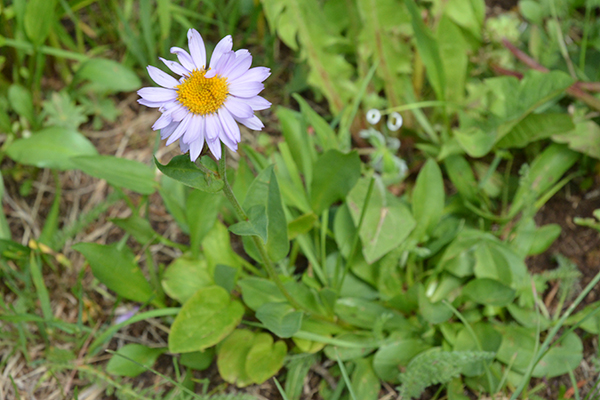
Wandering Fleabane – Erigeron peregrinus – has oblong leaves; wider (1.5-3 mm) and fewer ray flowers, and is found in moist places at high elevations
Several species of Beards-tongues – Penstemon spp. – are blooming all around, some only a few inches tall and others up to 2’+ high, and therefore must be mentioned here. The genus is pretty easy to determine with its opposite leaves and (usually blue) tubular flowers which have two lobes above, and 3 lobes below. There are technically 5 stamens (penta- five, stemon – stamen) but one stamen is sterile (staminoid) and usually hairy and lies at the base of the tube. The other 4 stamens typically coil up within the tube. One straight stigma (seen below between two anthers) is at the center of all.
There are several different species to decipher using clues of hairiness of leaves, stickiness of inflorescence, stickiness and shape of sepals, hairs on the back of anthers, and arrangement and size of anthers….. Truly puzzles for the hardy botanist. The flowers are hard to photograph for ID purposes so above is only one example — not sure of ID.
Penstemons are now in the Plantain or Plantanginaceae Family.
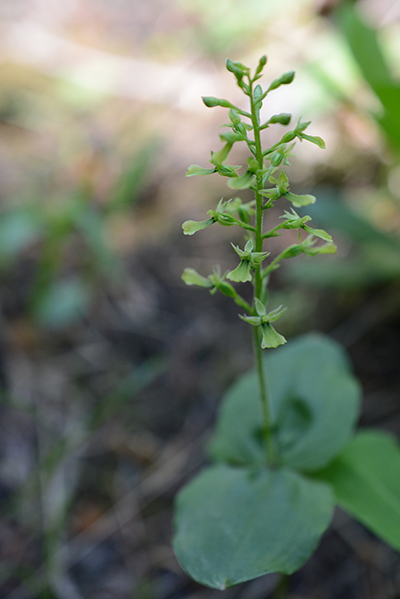
Two low white louseworts are intriguing to look at. I often get them confused at first.
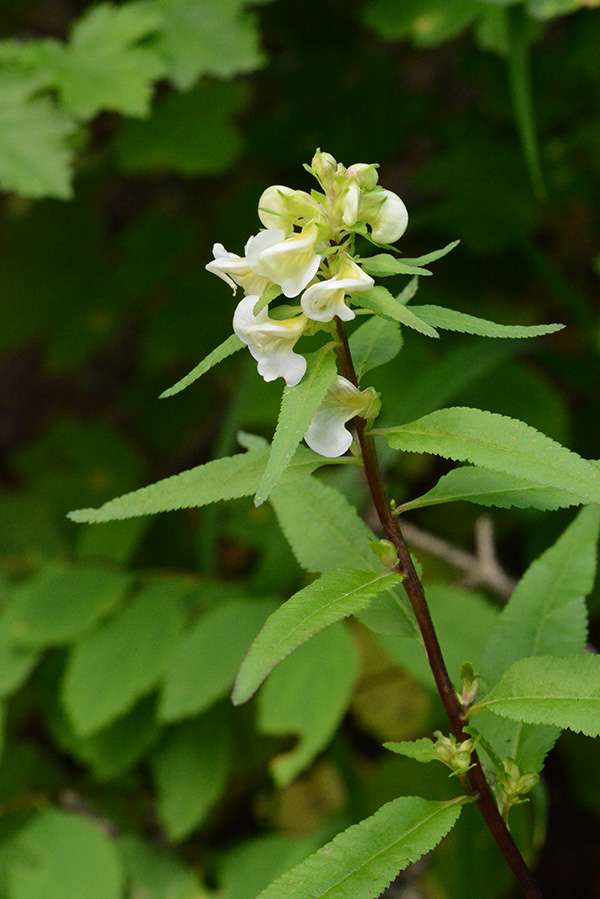
Leafy Lousewort – Pedicularlis racemosa- has elongate, finely toothed leaves. The white flowers are held between two sepals. These flowers are blooming in forests right now.
Coiled or Beaked Lousewort – Pedicularlis contorta – has a coil-like flower similar to Leafy Lousewort but grows at higher more open elevations. Coiled Louseworts have more pinnately divided leaves and their bracts are also divided. They are starting to bloom in open high elevations such as just south of Teton Pass.
These coiled, “beaked” flowers have co-evolved for “buzz” pollination by bumblebees. The vibration of the bee’s wing muscles starts the pollen grains—tucked way back in the flower — bouncing their way up and out of the long coil to shake out upon the bee. The bee tries to glean the pollen off its hairy back to feed to its young, but can’t reach between its head and thorax. When the bee lands on a flower while the female stigma is protruding, the stigma twists and fits between the bee’s head and thorax reaching the remaining pollen and is pollinated.
Louseworts are now known to be hemi-parasites and have been moved from the Snapdragon to the Orobanche Family.
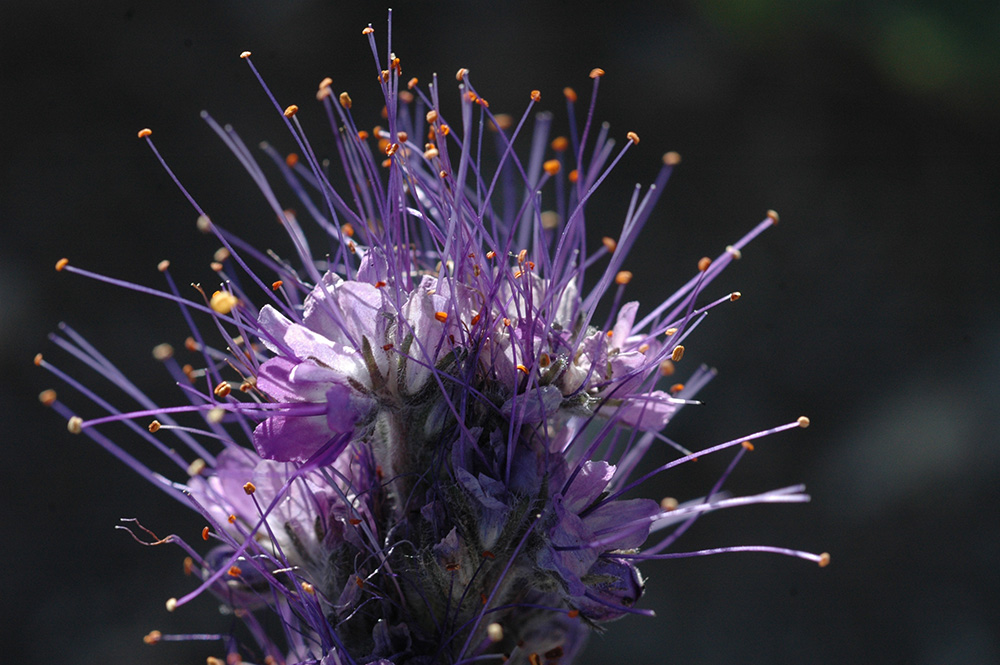
Silky Phacelia – Phacelia sericea – sends up spires of deep-violet flowers above several divided leaves. It is truly a higher elevation plant of the West, often growing above timberline in rocky soils. It is showing up on slopes south of Teton Pass.
A USDA Forest Service report says that a study found that in alluvial soils around gold mines, Silky Phacelias retained more gold in their tissues than other surrounding plants—miniscule pots of gold. A very odd fact. Actually the pots of gold (for insects) are the pollen grains on the tips of the many purple anthers shown below.
These are the typical flowers of our high meadows found in July in Teton County. Summer goes fast so please take the time to enjoy them.
Frances Clark, Wilson, WY
July 22, 2022
And please let us know of any corrections. We strive to be accurate.
Aspen groves, spruce-fir forests, and lodge pole pine stands harbor a range of herbaceous wildflowers throughout Jackson Hole. Some kinds grow in dense shade, others find intermittent patches of sun to thrive. Bloom time is short as plants need to flower and then begin to form fruits quickly before fall comes all too soon. So best for curious flower folk to get out soon and if the flowers are fading at lower elevations, hike higher. Indeed, It is hard to keep up with what is in bloom at this time of year.
The photos below help you to identify the plants at a glance and then in detail. The text will help you take a much closer look at the intriguing details of the flowers and life cycle. Also, there are a few extra “cool facts” to share with friends on your hikes. By having a “conversation” with the plant you can get to recognize it all the better on the next encounter. A 10x handlens, easy to buy by mail order, adds to the pleasure.
First the Whites Flowers:
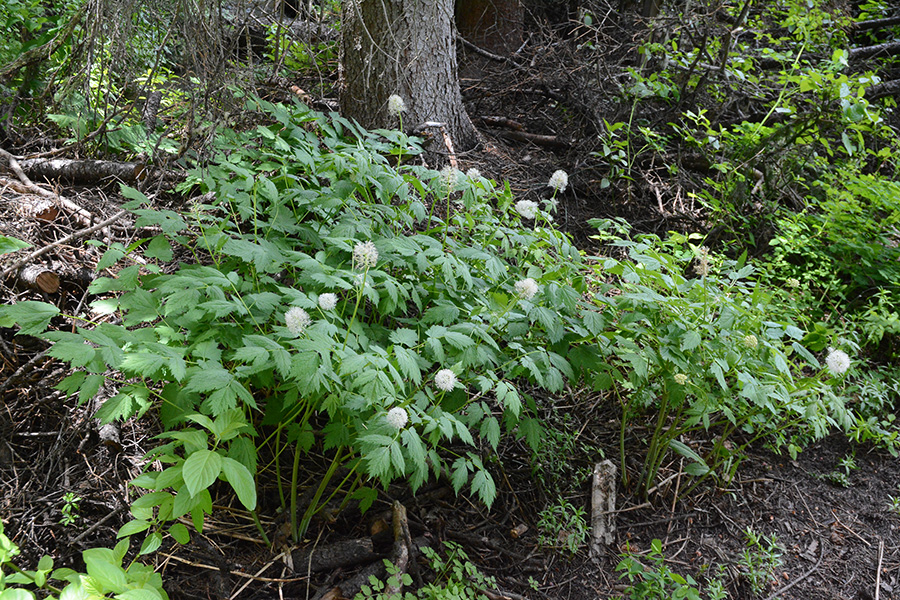
Red baneberry – Actea rubra – has a raceme of small flowers at the end of a long stem. Look closely at the delicate white flower parts into the center where you can see the thick ovary with a stigma on top.
Attracted to the white array of flowers in the shade of the forest, several pollinators alight and clamber around thereby spreading pollen onto a stigma. Then the ovary will begin to expand into a bright red (or white) fruit. In the fall, the raceme bares shiny red, poisonous (to us) fruits. In olden times, “bane” indicated poison or misfortune. Fortunately, the fruits don’t taste good, so a child (or other curious person) is likely to spit the fruit out if tempted. Baneberries can be attractive landscape plants.
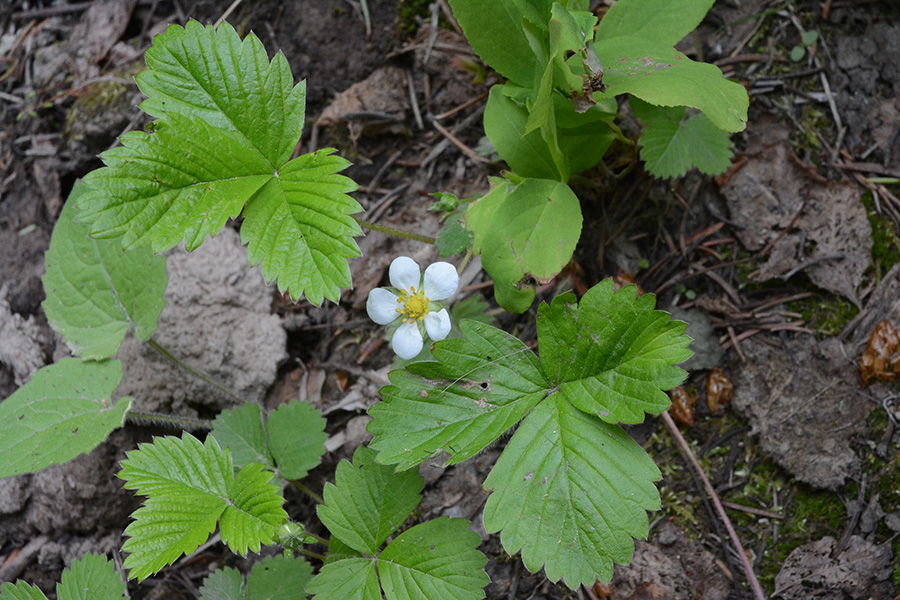
Woodland Strawberry – Fragaria vesca –– grows here as well as Europe and Asia where the fruits have been eaten since the Stone Age. We have two strawberry species in Teton County. To distinguish them, look closely: the three-parted leaves: the terminal toothof the leaflet is greater or equal to the side two teeth and the leaves are deeply veined. Later the seed-like fruits will sit atop the red flesh of the swollen stem.
Look out also for our Blue-leaf or Wild Strawberry – Fragaria virginiana – which is native only to North America. It is one of two parents to our commercial strawberry. The terminal tooth is shorter than the two adjacent teeth and the leaves are usually blue-green. The fruits will be different as well…more later.
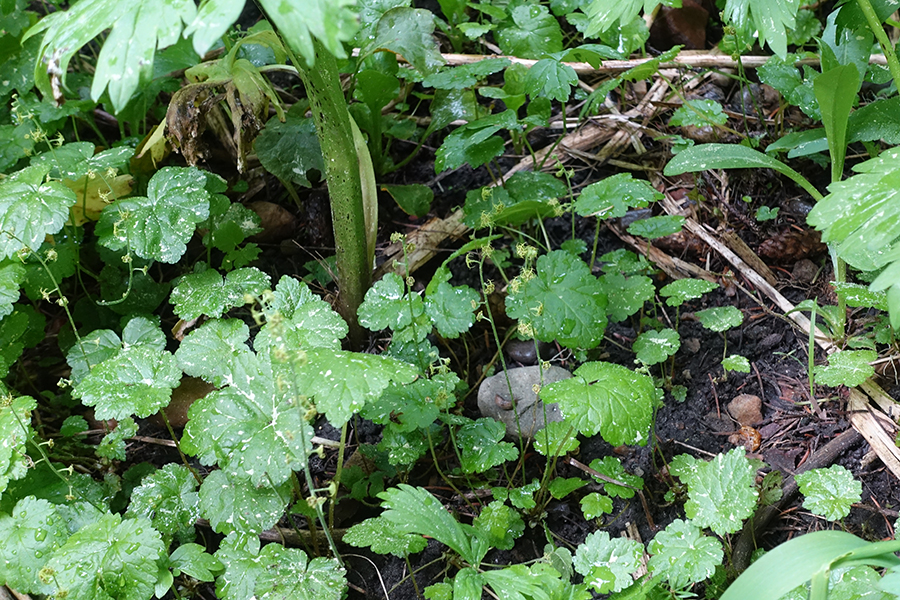
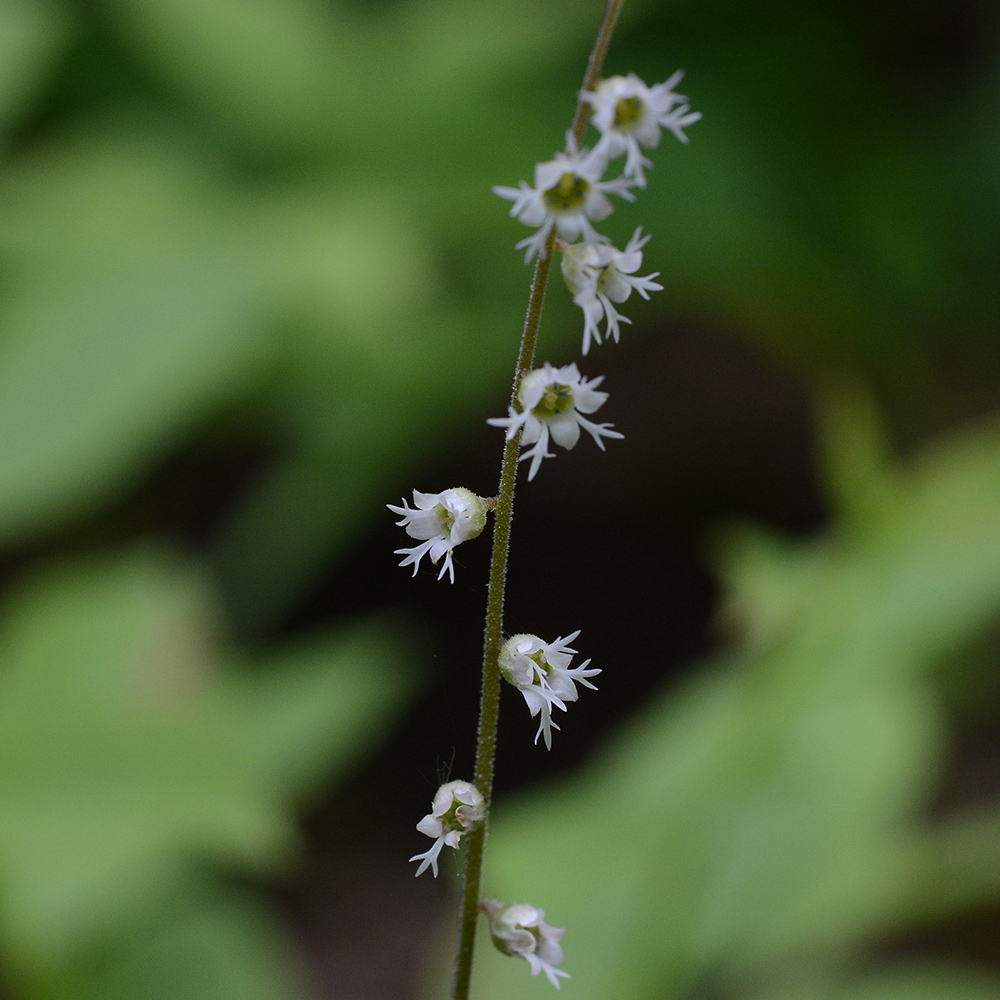
Mitreworts – We have two species of Mitella which have particularly delicate looking flowers. I often see them along a trail edge or slope where these small plants don’t have too much competition. They have a cluster of scalloped leaves at the base, and then wands of greenish to white flowers on 8-12” stalks. You have to get down low to see the details of the flower. They are in the Saxifrage Family.
Five-stamen Miterwort – Mitella pentandra – has a saucer-like cup of fused green sepals; the petals (not stamens as in the common name implies) are greenish and divided into 5-or-more linear parts like snowflakes. At their base are tiny white anthers with a stigma poking up in the center. Nectar glands fill the saucer and help cover the ovary.
Side-flowered Miterwort – Mitella stauropetala – flowers are held more or less on one side of the stalk, as the name indicates. The sepals are more pronounced: white and triangular. The petals are thread-like, barely branched and the center more of a cup.
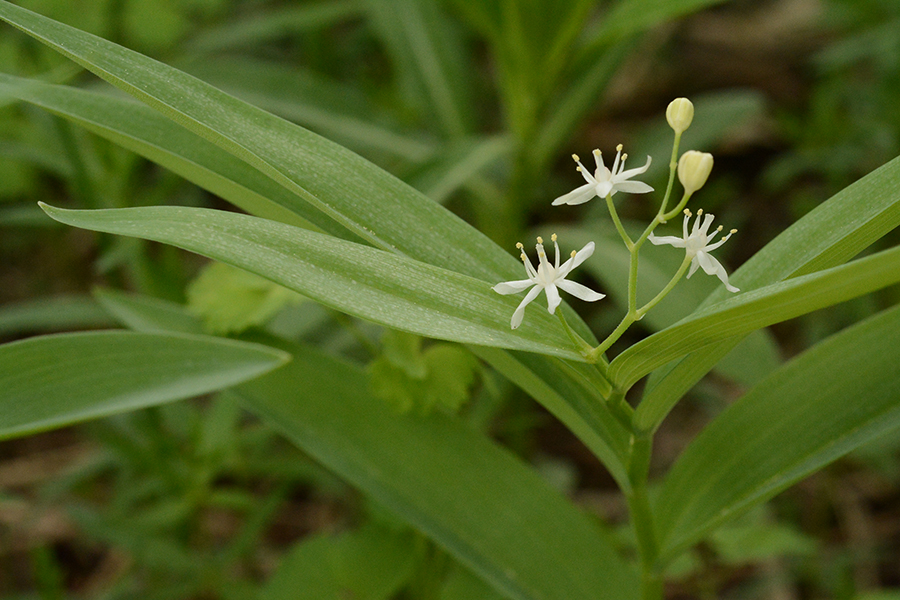
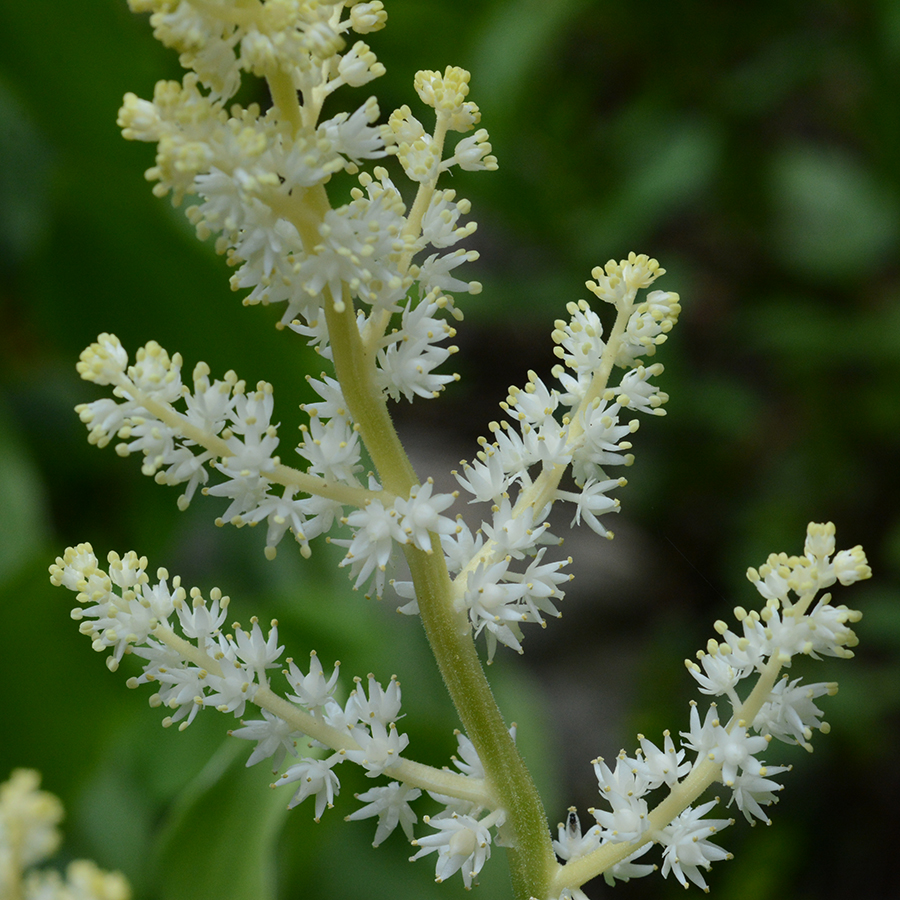
Our two False Solomon’s-seals can be a bit confusing. Both make attractive garden plants for the shade as their leaves are tidy and the rhizomes will slowly extend for the plants to fill in shady spots. White flowers are clustered at the end of the arching stems and later will bare colorful fruits. Here are the technical differences to help close observation and memory:
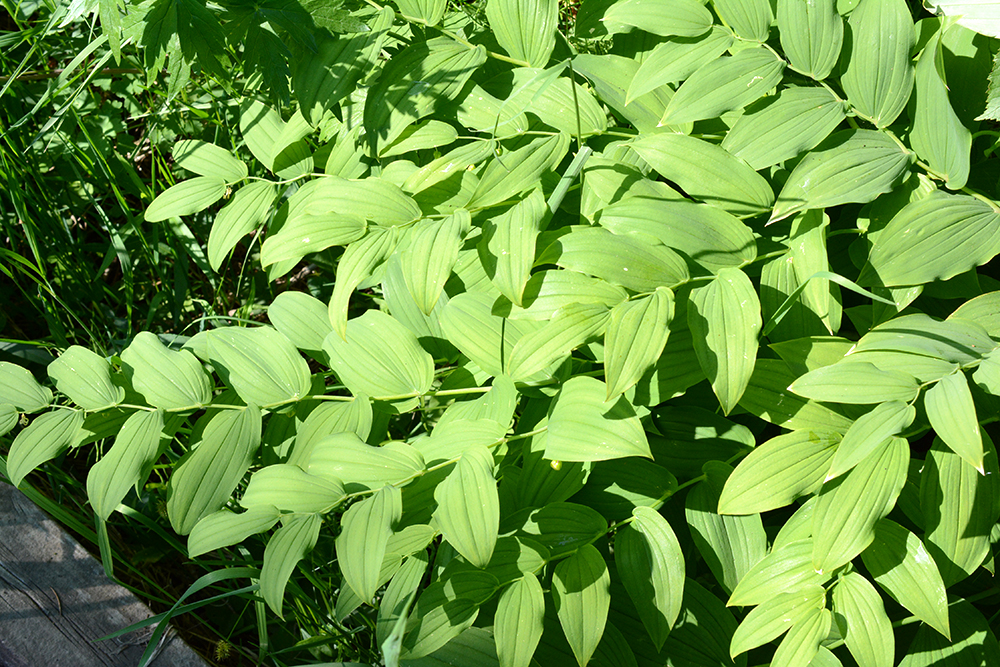
Starry False Solomon’s Seal – Maianthemum stellatum – has narrower, often bluer-green leaves. The white flowers are in a raceme—single flowers are at the end of short stalks that come off a central stalk as if they are each racing way from the center line.
False Solomon’s Seal – Maianthemum racemosum – has broader, larger, more arching, greener leaves.
The white flowers are more bunched and plentiful. Technically the inflorescence is a panicle. The flowers are at the end of a stalk that comes off a stalk from the center stalk, as if racing away in all directions as in panic.
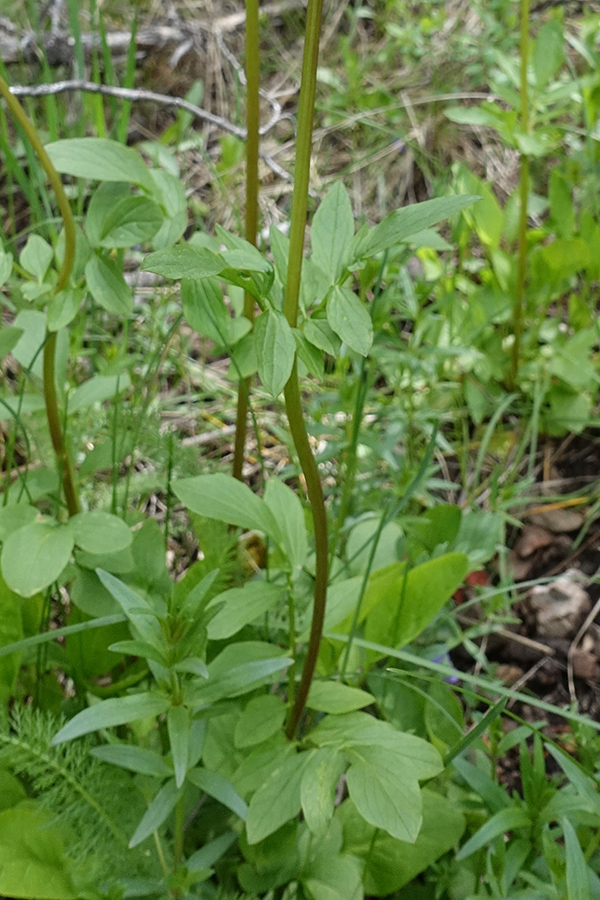
Western Valerian – Valeriana occidentalis – has been flowering along shady trail edges and in open meadows since early spring. It has a bunch of flowers (thryse) at the end, with at least one pair of opposite, compound leaves on the stem,
and more mostly simple (undivided) leaves at the base.
Many people know of valerian as a sleeping aide. Indeed, it is related to the European species V. officinalis which is a powerful nervine and sedative. Another local species Tobacco Root – V. edulis – will be blooming soon (more info in a later posting). Plant identification and research are very important in using any plant medicinally.
Cheerful Yellows:
Heart-leaved Arnica – Arnica cordifolia – is one of several arnicas here in Teton County. Arnicas have opposite leaves and usually bright-yellow flower heads with rows of even-sized bracts protecting the many flowers inside.
True to its name, this arnica has 1-2 pairs of heart-shaped leaves on short stalks, and a few others at the base. Arnica has been used successfully as a topical to help with bruising; however, ingestion can be toxic.
Bracted Louseworts– Pedicularis bracteosa – are just sending up their 1’ flower stalks from a whorl of fern-like compound leaves. The whole plant will reach 2-3’. Amazing how much biomass is produced in only a few weeks!
The flowers are bee pollinated: a bee lands on the lower lip of three fused petals. If it is the right bee species, it will vibrate its wings at a particular velocity, which causes the pollen hidden in the arching upper lip to fall upon the bee. The bee flies away, tries to glean the pollen off its back, but can’t reach the crevice between head and thorax. When the bee visits another flower in a later stage of growth, the flower stigma sticks out to reach between the crevice, thereby being smeared with pollen. Voilà, pollination!
Some Blues:
Silvery Lupines – Lupinus argenteus – are beginning to bloom in pine forests, often amongst the yellow arnicas.
This shade-loving species has less hairy leaves and smaller, more closed flowers than the Silky Lupine – L. sericeus – of open sunny areas.
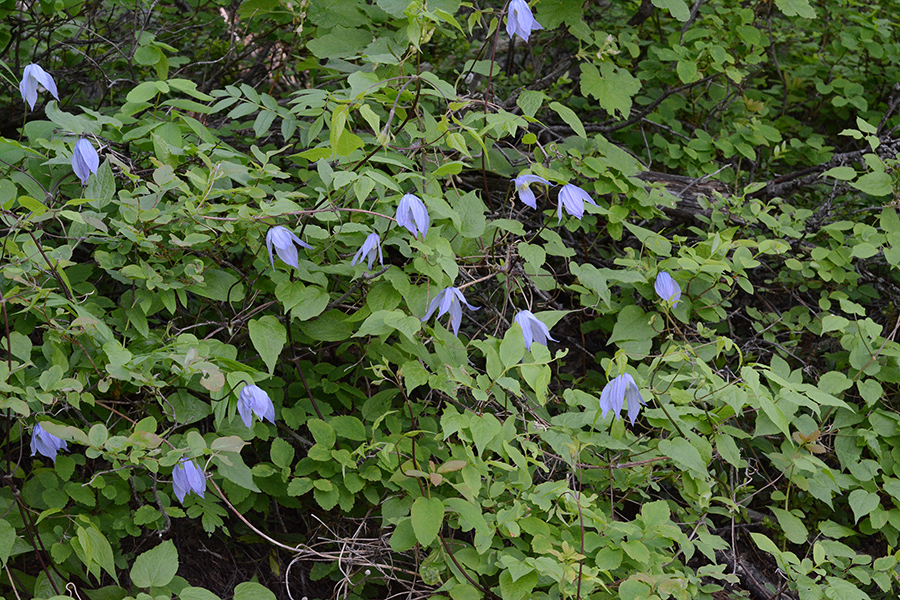
Vines of Western Clematis – Clematis occidentalis – have been wrapping themselves upon any woody stem in the forest and blooming profusely. The blue “petals” are actually sepals.
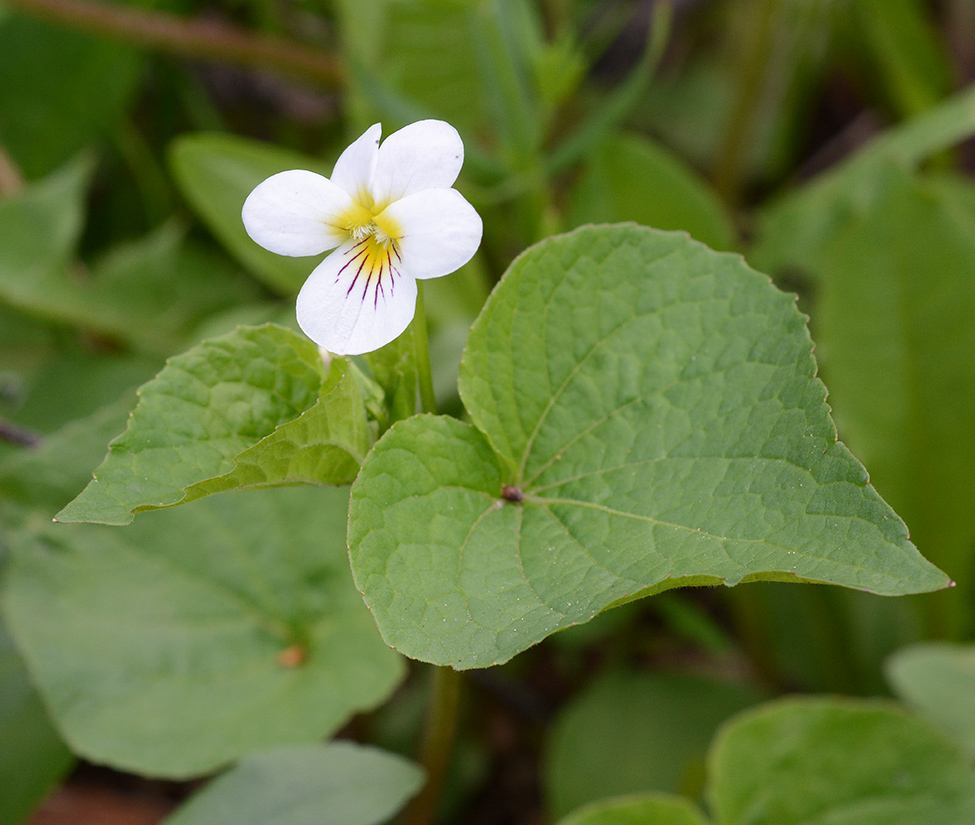
The sweet blue Dog Violets – Viola adunca – are occasionally seen along forest trails in sunny spots. We have other blue violets, but this species has a long spur in the back that holds nectar for pollinators which are strong enough to push in and reach this reward.
Wikepedia warns, “The leaves and flowers are edible and can be eaten in salads, as potherbs, or brewed as tea. These plant parts are high in vitamins A and C. However, the rhizomes, fruit, and seeds are poisonous to humans and can cause upset stomach, intestinal problems, respiratory and circulatory depression.” Maybe violets aren’t so “sweet”.
Green:
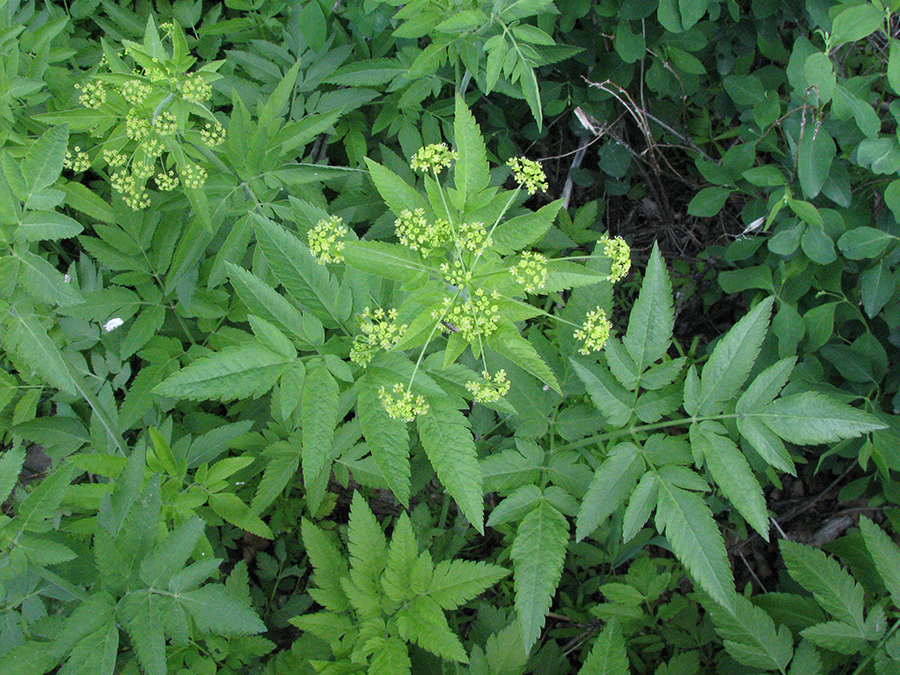
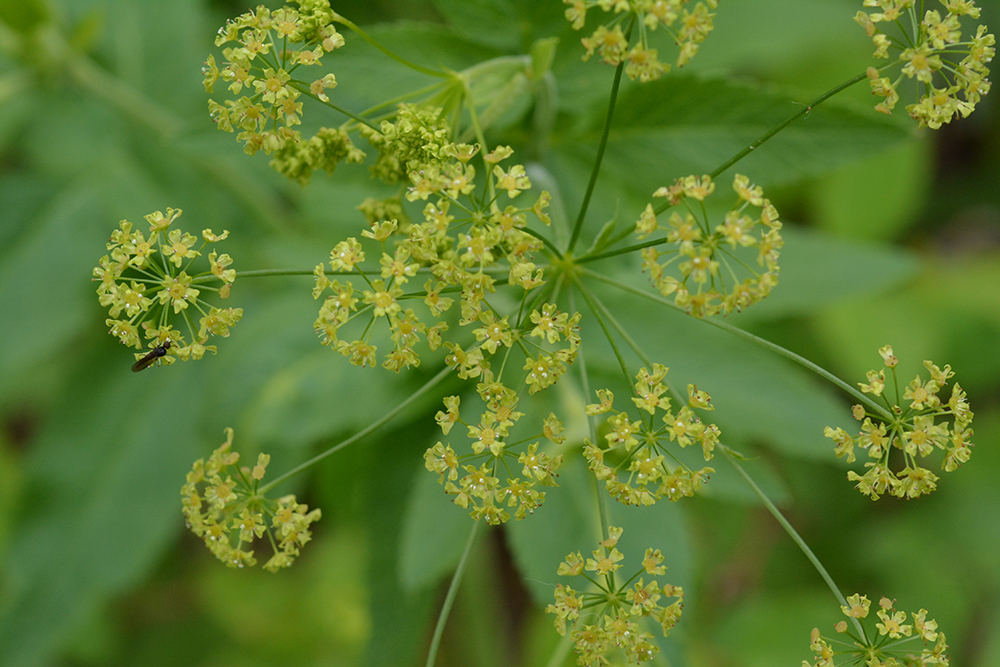
Sweet Cicely – Osmorhiza occidentalis – grows in moist shady places. It is easy to place it in the Carrot/Parsley or Apiaceae family, formerly the Umbelliferae. Very early on, the Greeks saw the similarities that now have become formal taxonomic identifiers for the family: the umbel arrangement of small flowers, e.g. the flower stalks coming from a central point like the ribs of an umbrella (umbel and umbrella have the same entymology) and typically compound leaves often with broad petioles.
Plants in this family–dill, anise, coriander, celery seed, and notably poison hemlock – Circuta maculata–also contain many fragrant to deadly chemicals. Pinch the leaves of Sweet Cicely: they smell like licorice or anise. Likely the Greeks, appreciated the foods and medicines the family provides.
The sturdy structure of umbels enable pollinators to land and crawl around the tiny flowers which have glistening nectar glands.
No Color Needed for Wind:
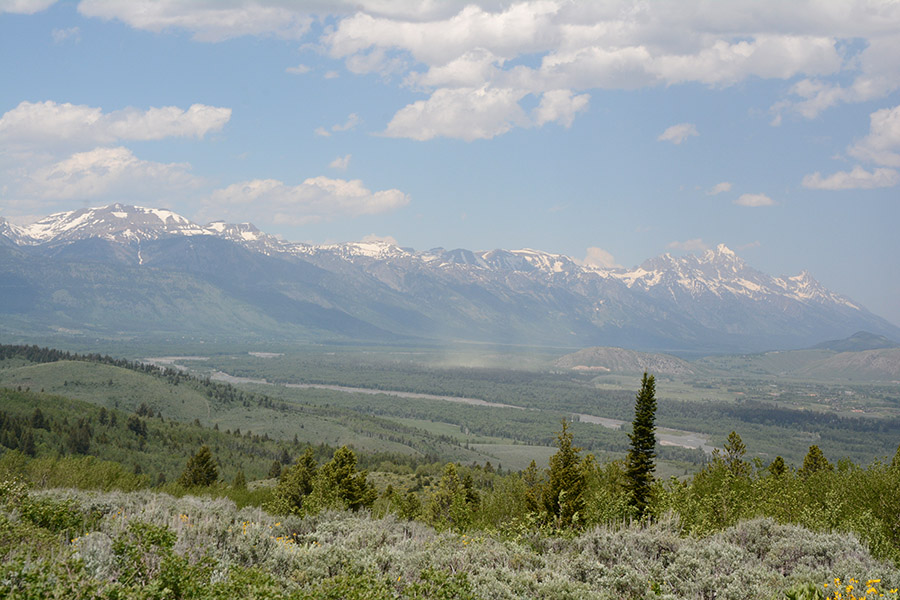
Wind pollinated flowers are in abundance now: grasses and sedges, as well as conifers. Below is a picture of a poof of pollen in the valley, likely spruce pollen. Wind-distributed pollen has to be very light to fly upon the air. No wonder allergies are rampant right now. Pollen distributed by insects is relatively heavy–one reason why strong insects are needed.
Western Meadow-rue – Thalictrum occidentalis – Is a delicate looking plant with divided leaves.
As it is wind pollinated, it does not have showy petals to attract pollinators. Instead, it depends on luck. Male plants produce small flowers with lots of dangling anthers that shed pollen upon the wind.
Hopefully, nearby is a female plant with flowers that hold up sticky stigmas to catch the pollen. Lots of bets are placed…lots of pollen is released to increase the chances of reaching a female.
If the pollen does happen to reach the stigma, the pollen grains grow down to form seeds within the ovaries below. So far, I have seen many more male plants than female plants. Having separate male and female plants helps increase genetic exchange for long-term survival of the species.
Elk Sedge – Carex geyeri – Also pollinated by wind, this species has a slightly different strategy. On the same spike, several male flowers produce anthers above and 1-3 female flowers produce long stigmas below. Often the flowers come out at different times to avoid self-fertilization.
With sedges, the fruits form within a vase-like structure called a perigynea and each flower has a scale at its base. Elk Sedges have very deep roots that help to hold the soil in place on slopes, and the evergreen leaves are indeed eaten by elk.
Orchids:
Orchids have very tricky and involved life strategies—the family is one of the most diverse and evolutionarily advanced in the world. The flowers are intricately designed to attract and fit only specialized pollinators, which are often still unknown to researchers. Once they are pollinated, orchid plants produced very fine, dust-like seeds without extra food. (Think about the contrast with bean or pea seeds which have a little nub of an embryo and lots of starchy food around it). The tiny orchid seeds depend on mycorrhizal fungi being present in the soil to nourish the tiny embryo. In many cases, a “protocorm” slowly grows underground expanding with the aid of the fungus. Once a shoot reaches the sun to produce its own food, many orchids retain a relationship with the helpful fungi. And some orchids have no chlorophyll and completely depend on fungi for their survival. For these reasons, never pick an orchid; just admire.
Fairy Slipper – Calypso bulbosa – is truly a delight to find. It has a fancy array of sepals and petals and alternating fragrances to provide allure to young queen bumblebees.
The bee lands on the flower, and unknowingly to her, a wad of pollen called a pollinia may become attached to her before she flies to the next flower…searching again for a reward. The next flower may have a protruding female stigma poised to receive the male pollinia. If so, hundreds of seeds can begin to form. Meanwhile the queen bee receives no reward of nectar or pollen and eventually learns not to bother to look for them.
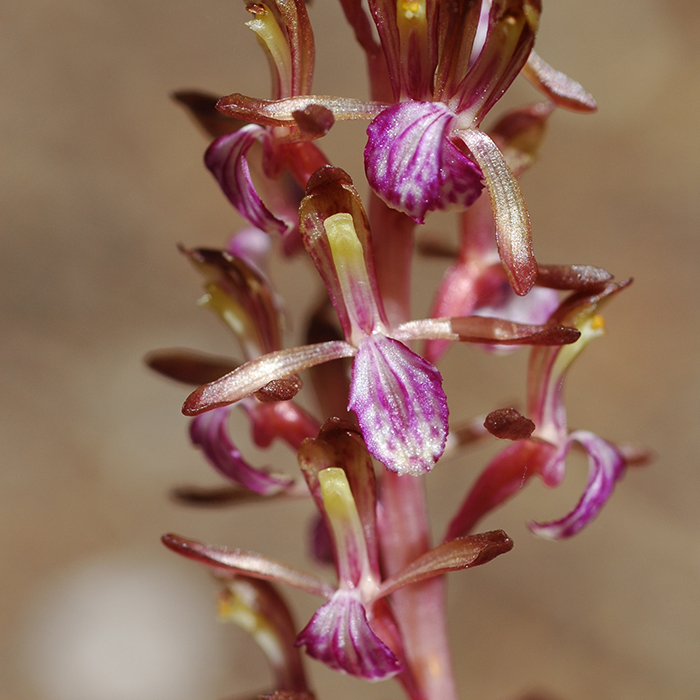
We have several species of coralroot in Teton County. The one I have seen currently in bloom is Spring Coralroot – Corallorhiza wisteriana.
This species is particularly notable because the clusters of stems can be reddish or yellow, and they may grow right next to each other.
Coralroot orchids have no chlorophyll and therefore depend on mycorrhizal fungi to provide carbon and other nutrients to keep them growing (myco-heterotrophic). The underground mycelial threads of the fungi attach to stubby root-like structures called haustoria, which look like coral, hence the common name.
An Ancient One:
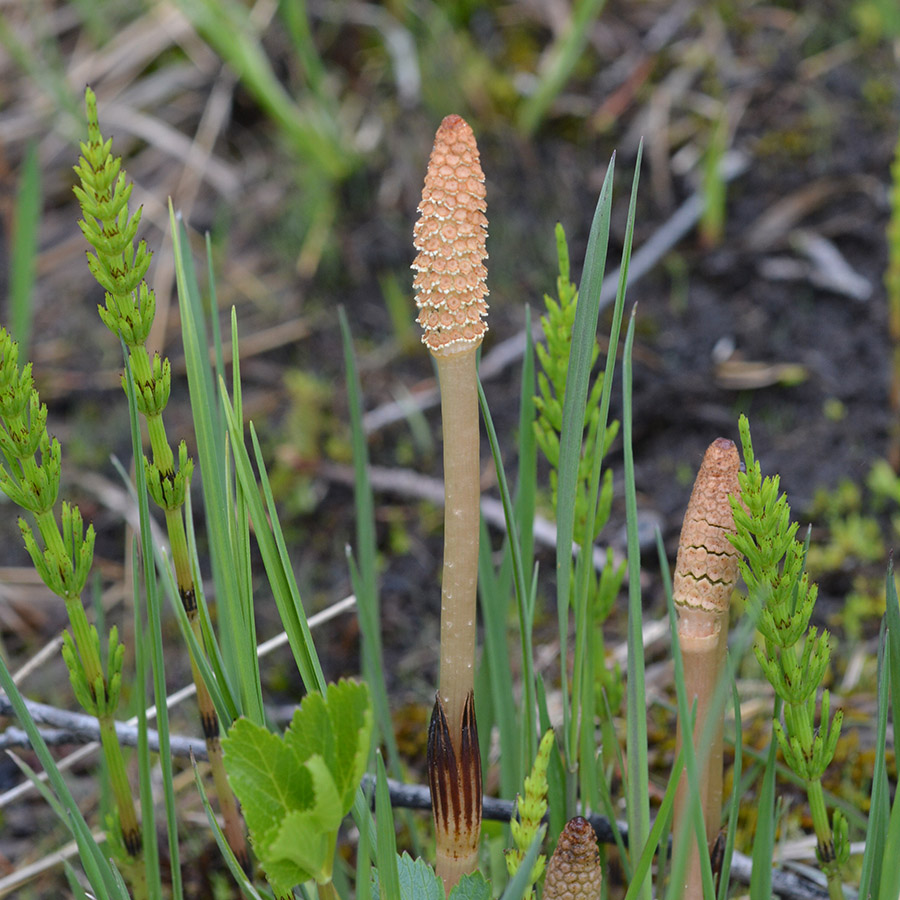
Field Horsetail – Equisetum arvense – Horsetails are in an ancient “order” of plants that has persisted over 350 million years. Their ancestors grew 45’ tall and1.5’ in diameter and formed forests when the dinosaurs roamed. Those plants are now being mined for coal. This is a photo of the strobilus on top of a brown stem separate from the branching green horsetails we see.
The cone it is releasing spores with elaters, appendages that will help the spores move on the wind. The spores will form an alternate generation of barely visible green sexual plants: gametophytes which produce either eggs or sperm. With rain, the sperm swims to eggs, and the plants we know as horsetails then sprout up. It takes these “alternating generations” to complete the very primitive, but clearly time-tested, life cycle of a horsetail. Ferns reproduce in essentially the same way.
Time to Get Out Botanizing
There are more flowers to bloom in forest openings and trailsides in the months to come. Trails up Cache and Trail Creeks, around String and Jenny Lakes, around Munger Mountain, and a bit later up to Ski Lake are readily accessible forest habitats. Myriad native insects depend on our native flora and they cannot survive on non-native species. Native insects provide critical proteins for baby birds. And the fruits will also nourish adult birds and mammals. If you have a garden, growing native plants is one way to steward our remarkable ecosystem. In any case, wildflowers are fun to observe and understand. Enjoy.
Frances Clark, Teton Plants, Wilson, WY
June 22, 2022
P.S. To hear about our programs and most recent postings directly, please contact tetonplants@gmail.com to be placed on our mailing list. Also, let us know of any errors. We want to be accurate.
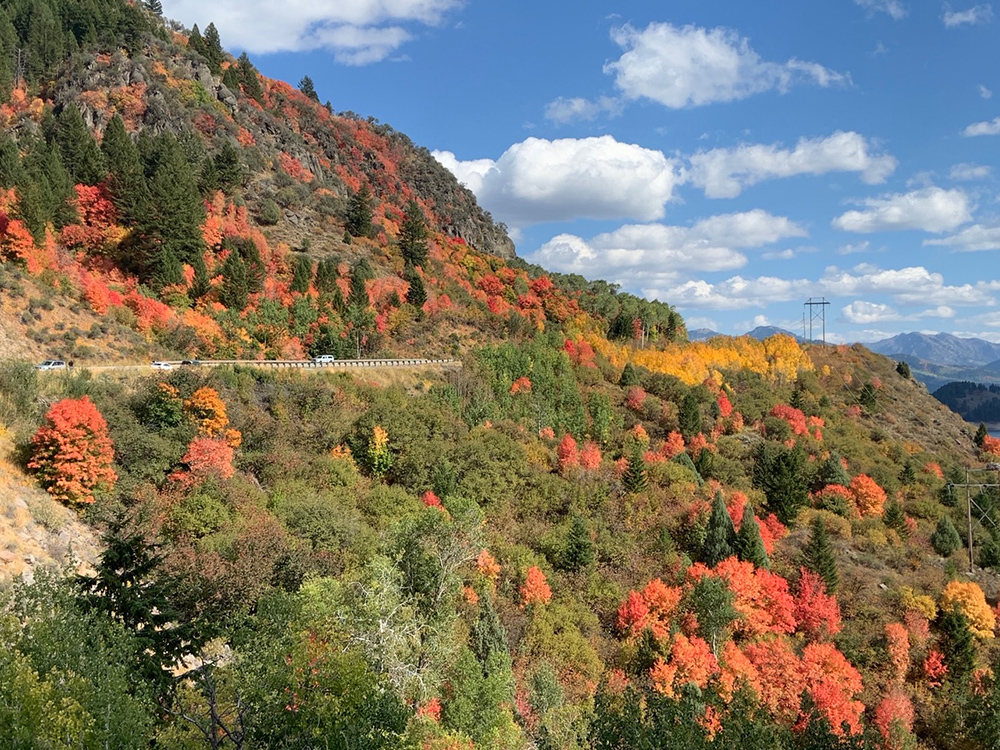
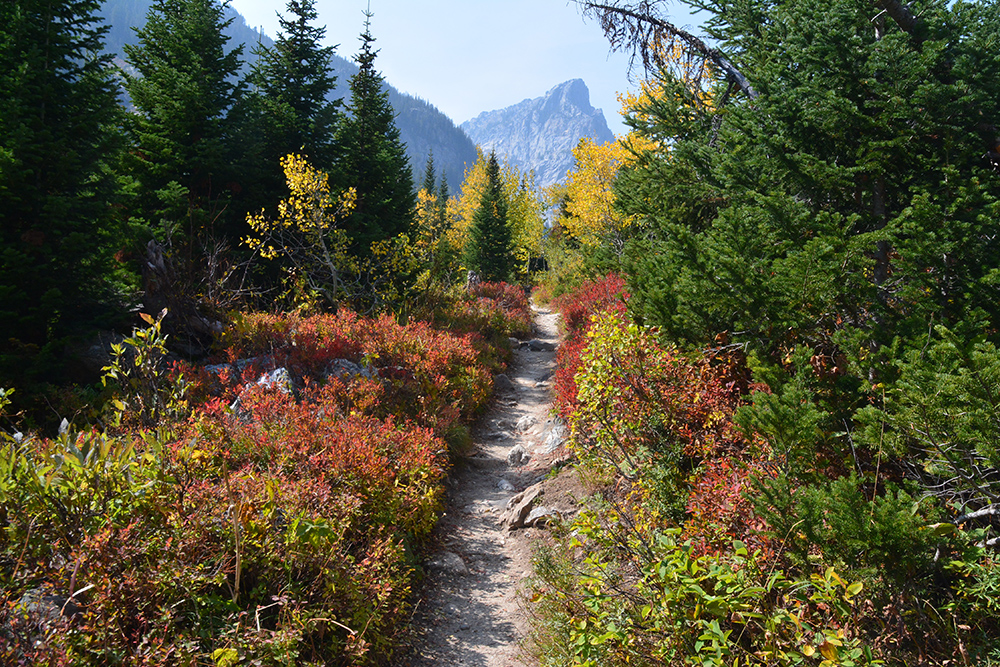
Aspens are turning yellow and orange, canyons are flaming with colors, and fruits provide feasts for wildlife. It’s a great time to get out and observe the final flings of fall.
The Rose Family is one of the most beautiful and productive families in our temperate climes.
In the grocery store we see a cornucopia cultivated apples, peaches, pears, plums, strawberries, and raspberries. On sunny slopes and forest openings birds and mammals find a similar feast of fruits provided by the Rose Family at this time of year. The background leaf color helps accentuate the display of luscious berries. This is a great year for fruits which is good because our migrating birds, small mammals including coyote and fox, and big mammals including bears, moose, and deer all relish them.
Fruits of Black Hawthorn – Crataegus douglasii – are dripping along Moose-Wilson Road, around Trail Creek, and elsewhere. Despite their inch-long thorns, these 20-25’ large shrubs or small trees appeal to bears which will climb into the crowns and scarf up the fruits. Larger bears will use their weight to bend over the branches. “Crataegus” means strong and sharp—descriptive for sure. Leaves are oval with shallow lobes and many teeth and they turn maroon or scarlet in October. Fruits are deep-red to mostly black. Another species Red Hawthorn – C. rivularis – is scarcer to find and harder to identify – slightly redder fruits and leaves are less lobed. It grows in moister sites. They are unusual to find in Wyoming.
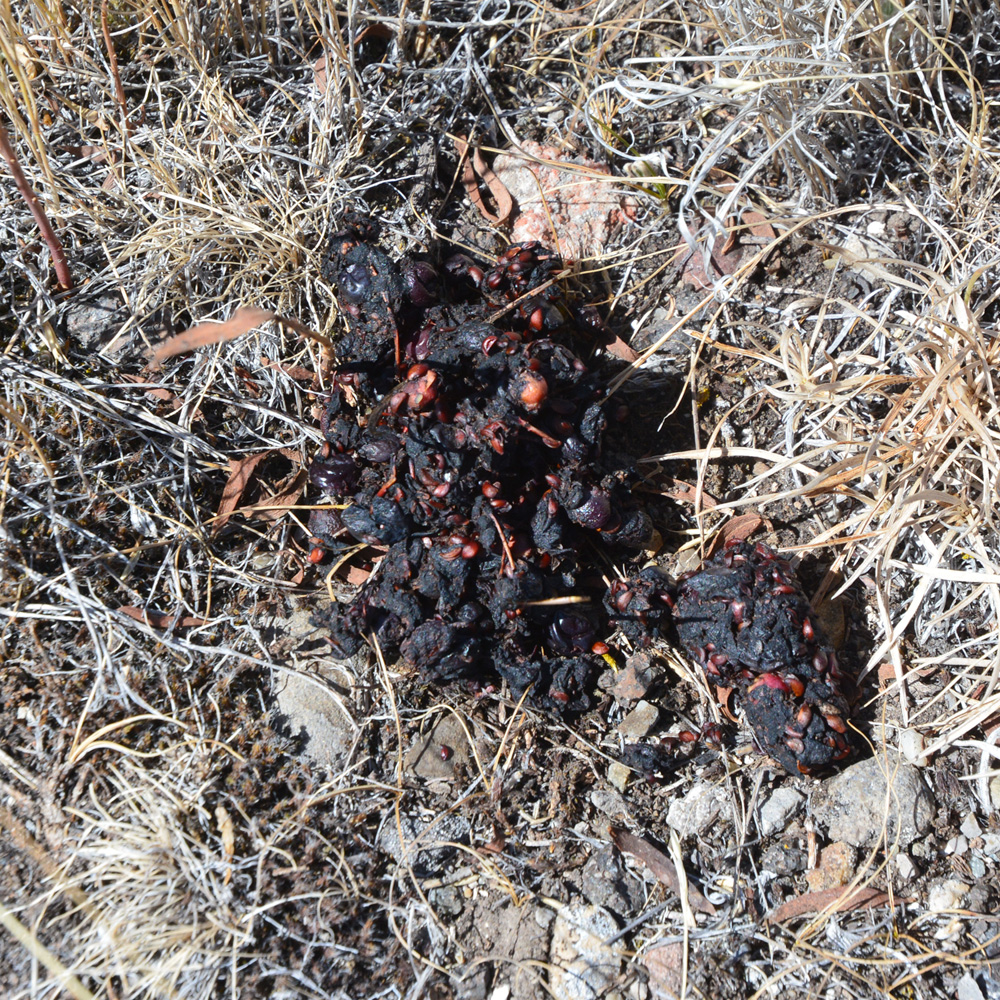
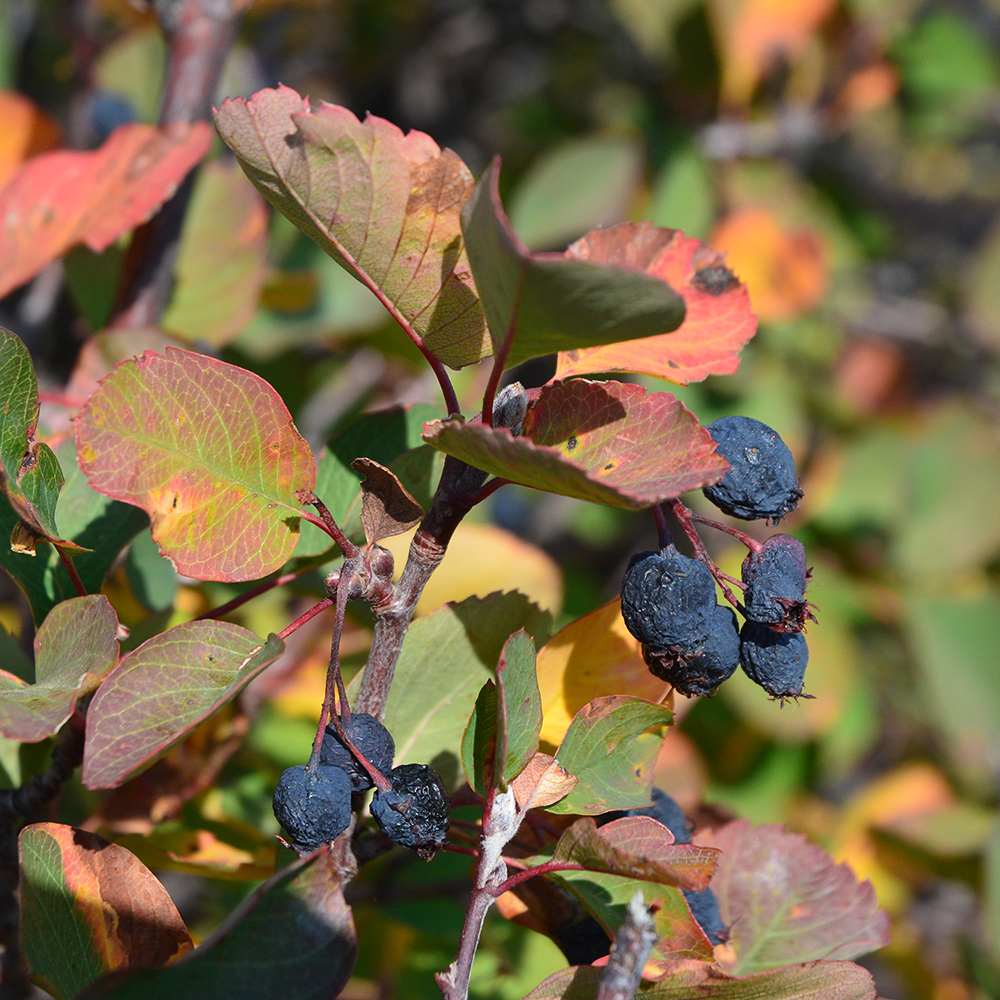
Serviceberries – Amelanchier alnifolia – are being picked off by flocks of robins, cedar waxwings, Swainson’s thrushes, and more as they migrate south. Purple poop is apparent in coyote or fox scat – could be chokecherry as well.
Oval leaves with teeth at the end often turn a mottled maroon. After a frost the slightly wizened pomes are particularly delicious—like raisins with a touch of almond. Note the round fruits are in cymes (the stalks are variable in length) and have 5 dried sepal tips sticking out the top.
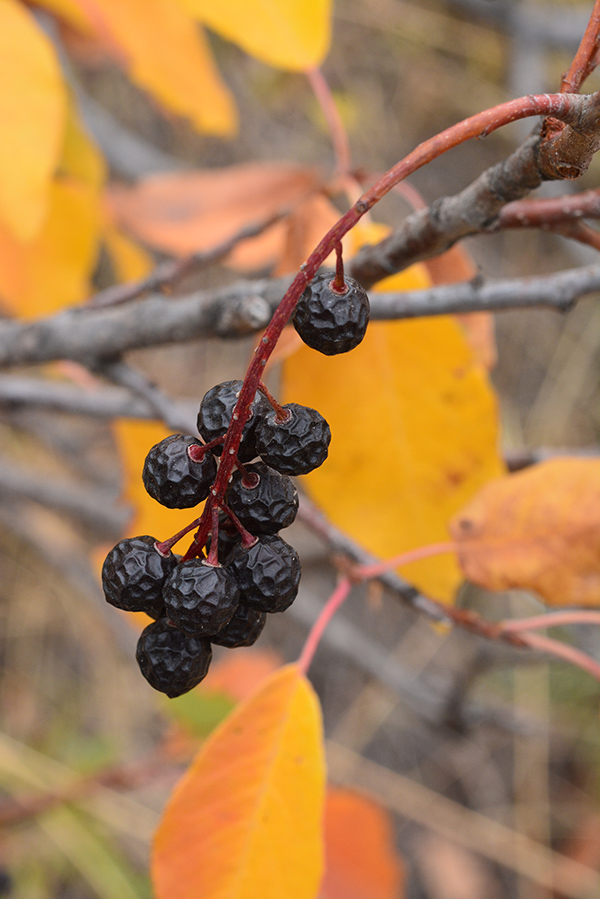
Chokecherry – Prunus virginiana – has more elongate, toothed leaves which turn a shiny orange to red. Fruits are held in racemes—on equal-length stalks off a central axis. The round berries (drupes) do not have sepals at their ends. It is important to know the difference from Serviceberries, especially as the leaves fall off, as cherry pits can be poisonous. Also the twigs have a distinctive strong odor of prussic acid (hydrocyanic acid), a precursor to cyanide which can be poisonous under certain circumstances. However, the wildlife enjoy them equally to serviceberries.
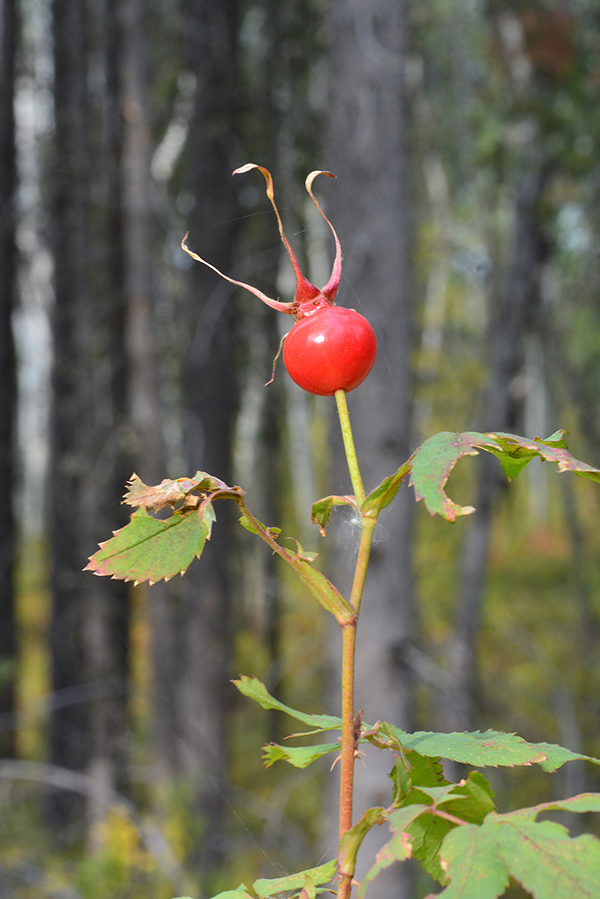
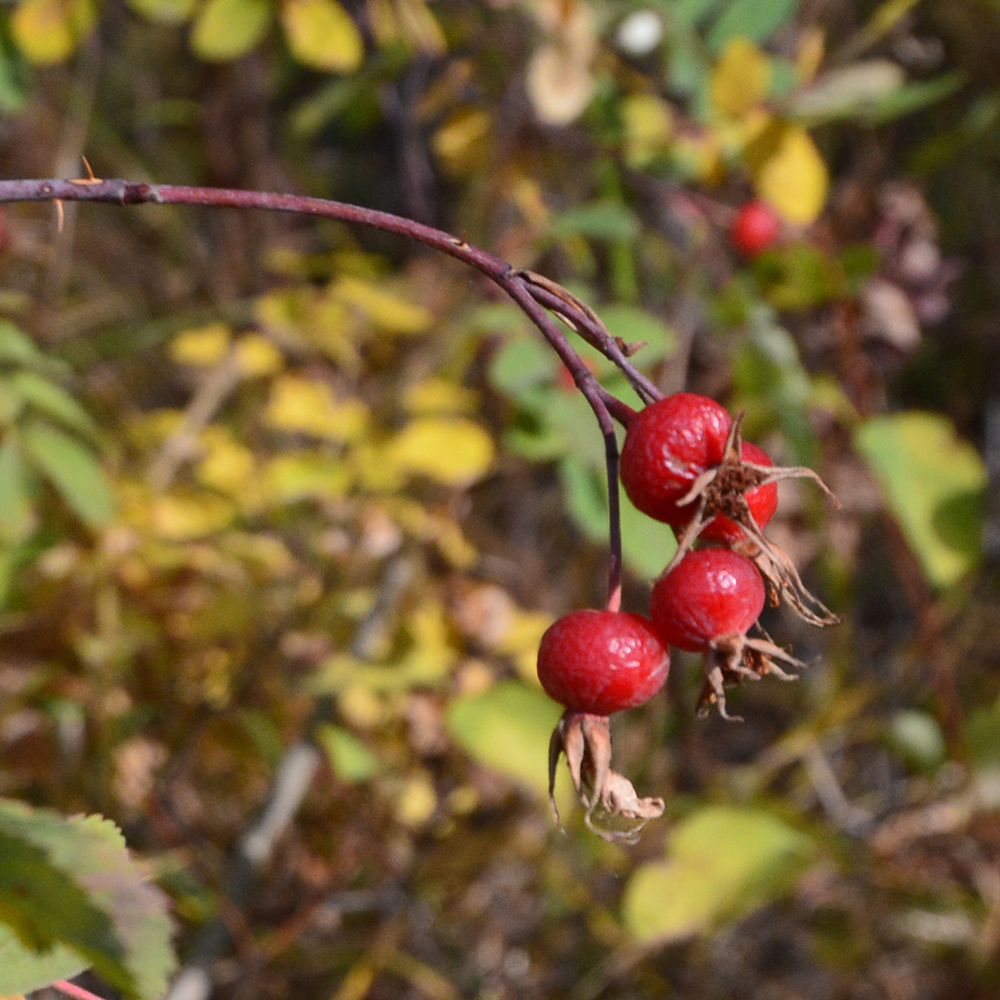
Rose hips of Nootka vs. Woods Rose stay on the thorny shrubs all winter. As with other roses, the leaves are pinnately compound—several leaflets coming off a central rachis. Hips are swollen hypanthiums—the merged bases of the sepals, petals, and stamens that swell over the pistils that turn into seed-like fruits (achenes) inside. The hypanthium is a tough, nutritious casing with lots of vitamin C. The five dry extensions from the top of the hip are actually the dried sepals that surrounded the flower petals.
Nootka Roses – R. nutkatensis – usually have only 1 (2) hip on a stalk which is 2-3x larger than the hips of Woods Rose and they have longer sepals. Rose hips are most favored by deer in the winter.
Woods Rose – R. woodsii – has several hips together. I remember the name by thinking that many trees are in the woods.
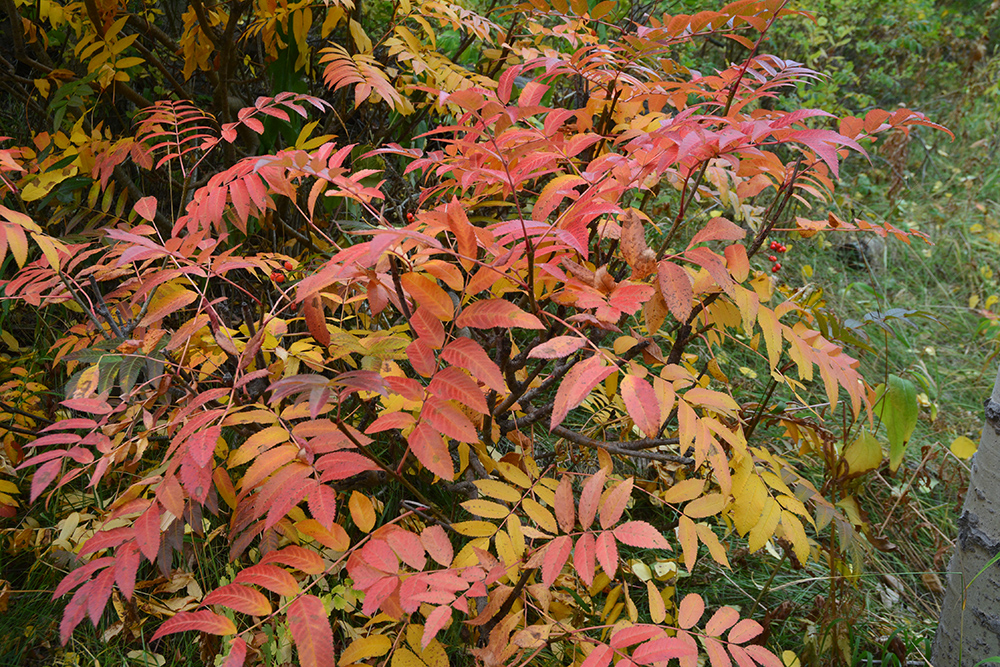
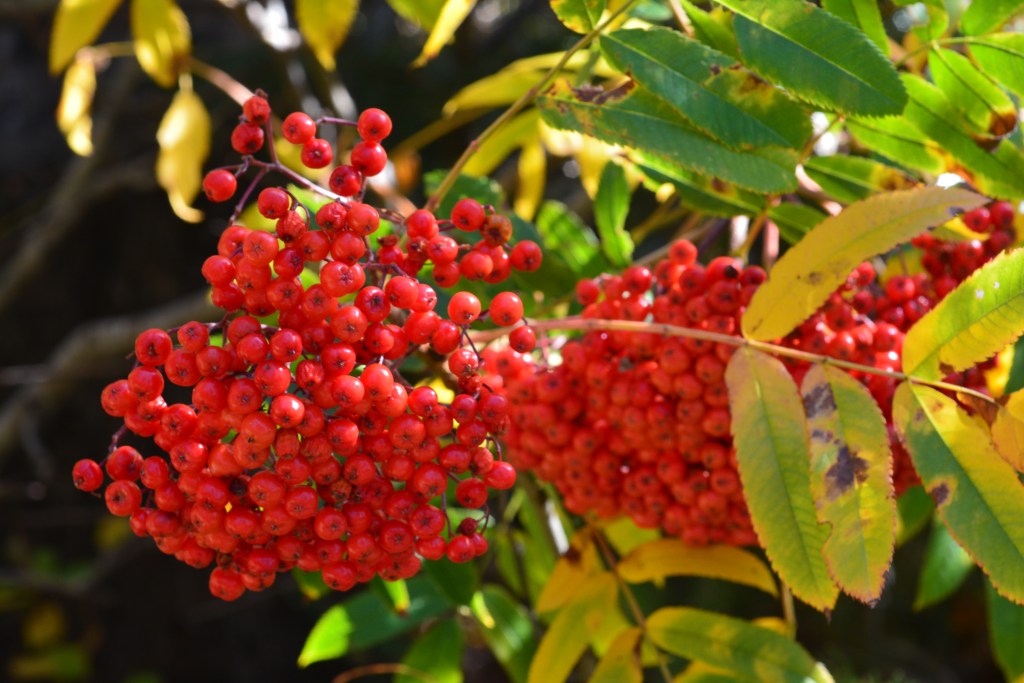
Mountain Ash – Sorbus scoparia – fruits are abundant this year. Here again the leaves are pinnately “compound” and arranged alternately up the stem. The fruits and foliage colors are some of the most dramatic out there.
The berries may not be eaten right away, leaving good sustenance for wildlife into winter.
Shrubs with Opposite leaves:
Red Elderberry – Sambucus racemosa – at first may look similar to Mountain Ash with big bunches of red fruits and compound leaves. However, elderberry is overall coarser in appearance. Stems are finger-thick, the leaves heftier and arranged opposite on the stem, and the plant stinks. Different plants have different concentrations of hydrocyanic acid that makes individuals more or less appealing to wildlife and can cause diarrhea in humans if fruits are not prepared properly for wine and jellies, etc.
European Black Elderberry – S. nigra – has been used to make whistles—the core of the stems (pith) is very soft. People used to hollow out the cavity, add a few holes along the stem—and voilá a whistle! Sambucol, an over-the-counter medicine, has been proven efficacy as an anti-viral flu medication. We have two varieties of Elderberry: S. r. var. racemosa has red berries and smooth leaves, S. r. var. melanocarpa has black fruit and slightly downy vestiture on the leaves.
Red-stemmed Dogwood – Cornus stolonifera – is a favorite and readily available landscape shrub. It has tidy, opposite oval leaves with parallel veins that turn a beautiful maroon on red stems.
The white flowers form bunches of white berries which are high in lipids—concentrated energy for migrating birds: They soon disappear. Moose also love to munch – prune – the red stems. In Montana they say dogwood is “moose ice cream!” Dogwoods grow mostly along streams.
Snowberries – Symphoricarpus spp. – are sporting soft white berries. The Greek root of the botanical name means “to bear together…fruit”. Which indeed it does – like piglets to my eye. Some flowers were clearly pollinated, other flowers were not.
Sometimes the foliage—opposite oval leaves–turns a bright yellow under aspens, but this seems a bit spotty this year.
The slightly mushy berries – soft like marshmallows – are not for us humans to eat. The berries contain an alkaloid chelidonine which can cause “mild symptoms of vomiting, dizziness, and slight sedation in children.” Sources vary on the level of toxicity—my thought is to not yield to temptation. That being said, Snowberries are hardy landscape shrubs and are good wildlife food with early leaves in spring and berries that grouse and others will eat. Our two Teton County species – S. oreophilus and S. albus – are hard to tell apart except in flower.
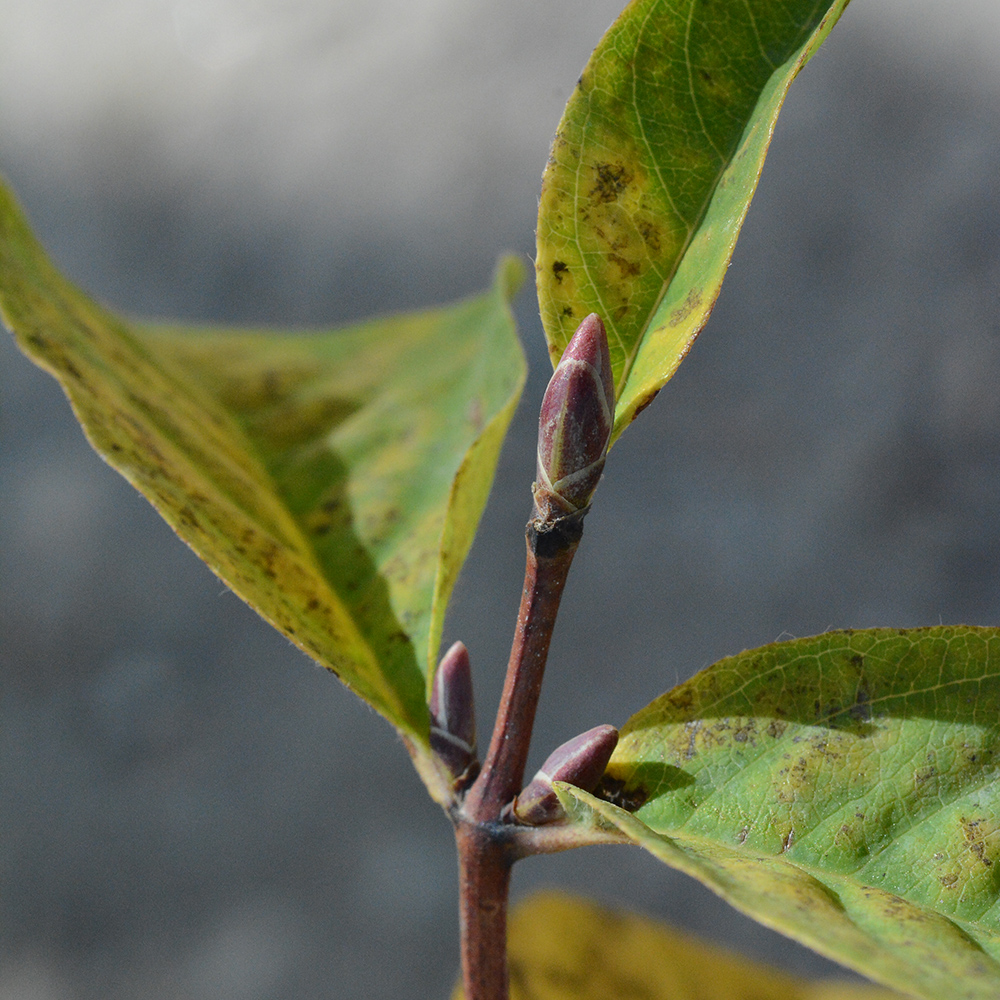
Related to snowberries – both are in the Honeysuckle family– Utah Honeysuckle – Lonicera utahensis – also has bright yellow oval opposite leaves.The twin red fruits are long gone.
When leaves fall off, the oval buds with 4-6 scales on relatively thick stems (compared to the thin twiggy stems of snowberries) help differentiate the two cousins during dormancy.
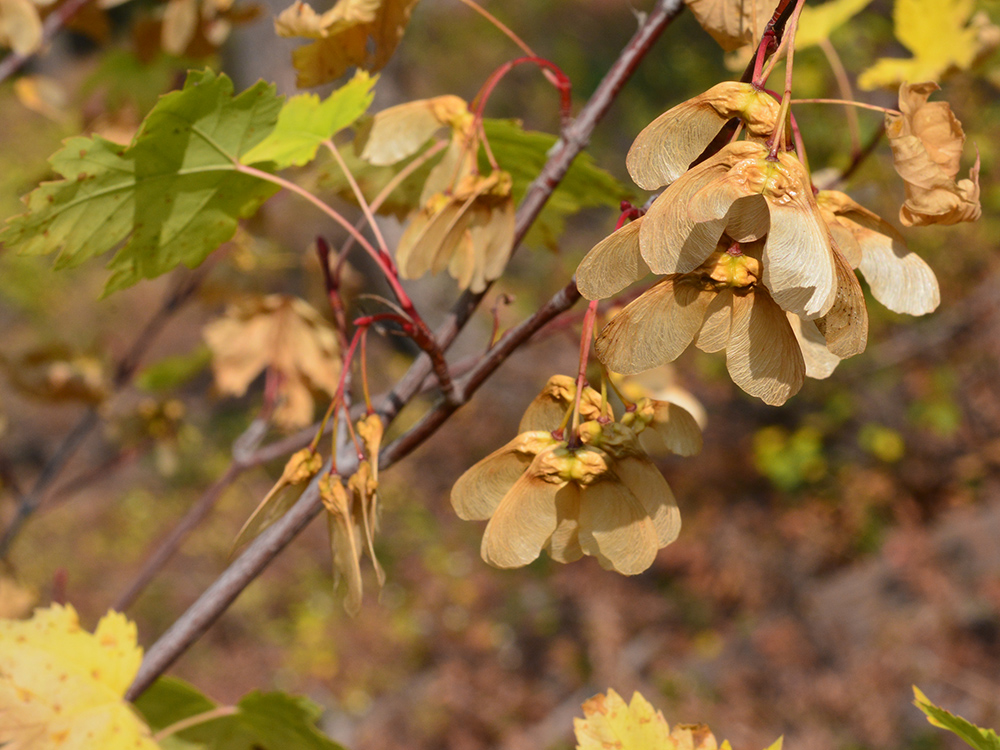
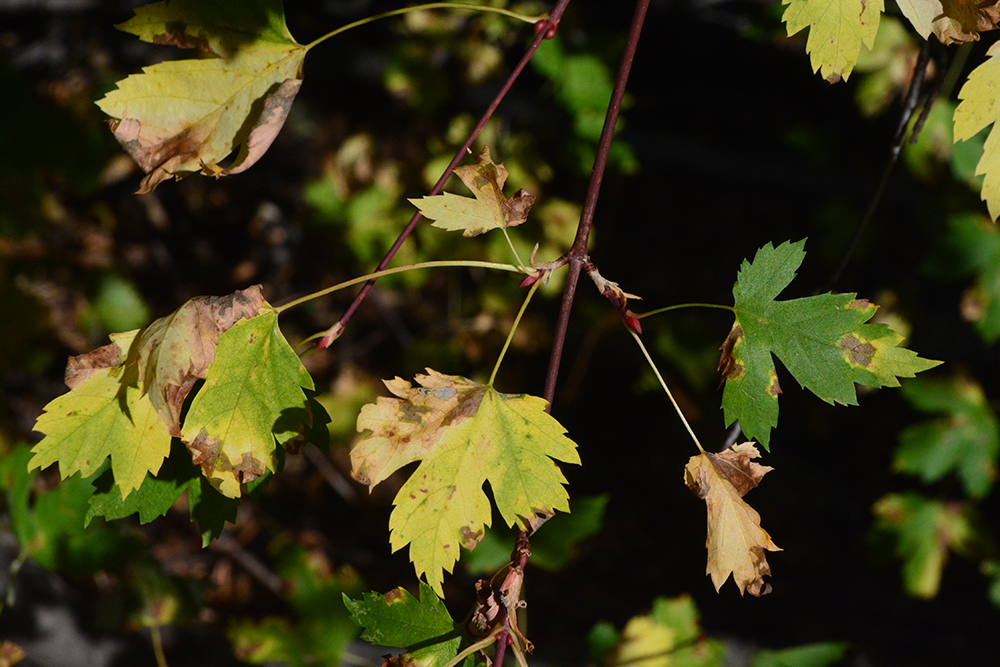
Mountain Maple – Acer glabrum – is a very shrubby plant that can grow to 15 feet tall. Winged samaras await the wind to break them loose so that the winged seeds can helicopter to new lands. The rather skimpy, lobed leaves turn variable colors along our mountain trails and slopes here in Teton County.
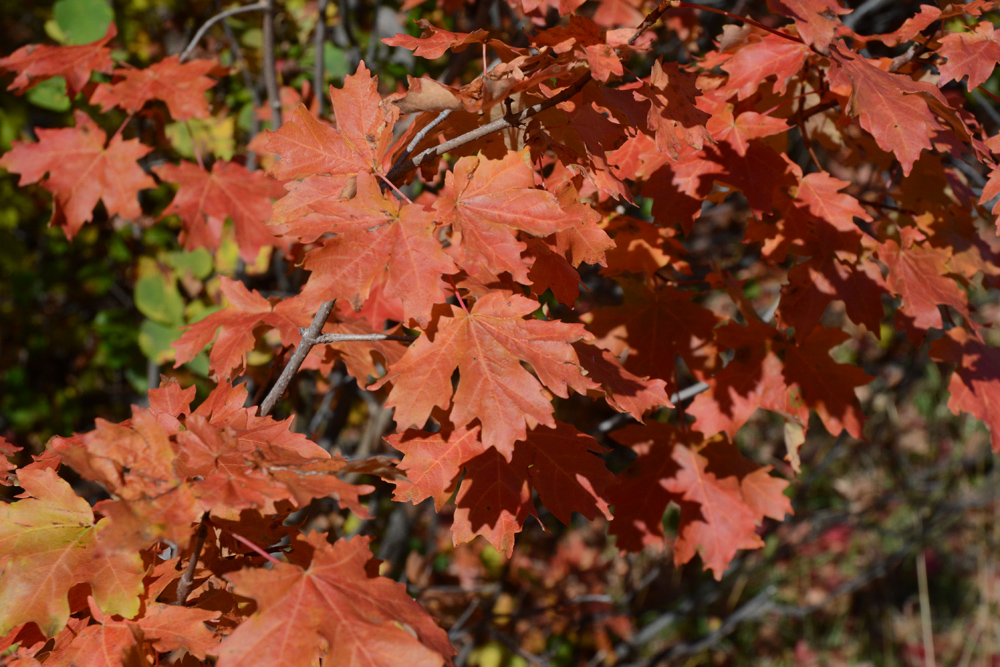
Much more brilliant and barely in the county is Big-tooth Maple – Acer grandidentatum. Joyce Batson took this picture last week along Rte 26 near the Palisades Reservoir in Idaho.
The leaves are arger with bigger teeth than Mountain Maple and the samaras are broader.
An Odd Ball:
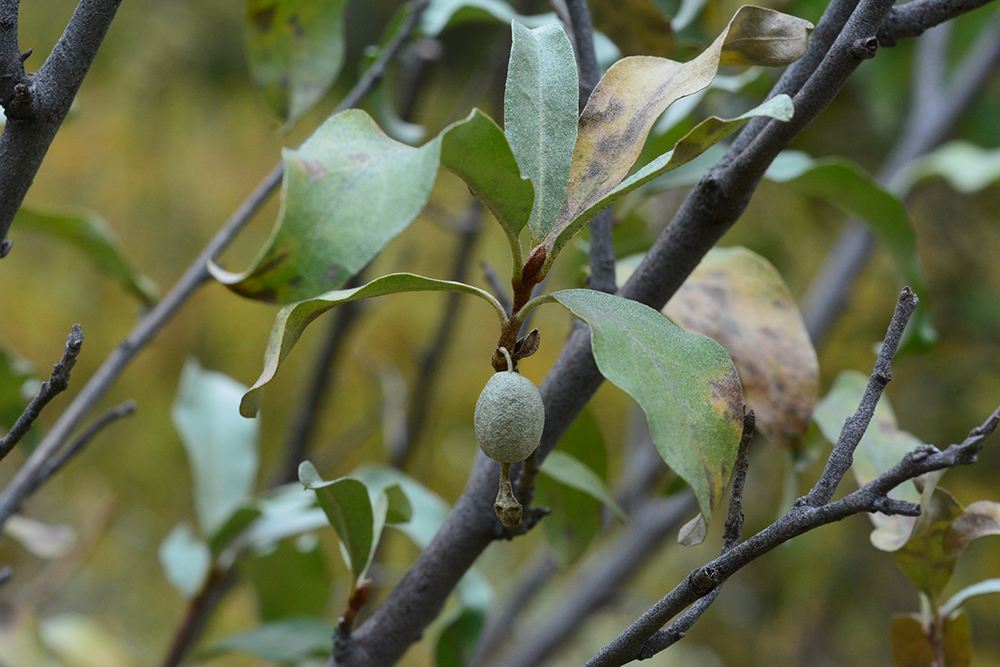
Silverberries – Eleagnus commutata – are dangling among silvery leaves in the Snake River floodplain and elsewhere. Right now the fruits and leaves are similar in color—the fruits are hard to see.
Birds eat the berries and moose particularly like the plants. Otherwise, it has moderate wildlife value. The 10-15′ tall rhizomatous shrubs can fix their own nitrogen, enhancing their own growth and that of other plants nearby. Where our floodplains are used for pasture, cattle tend to graze other species leaving alone the less palatable (to cattle) silverberries, which remain standing tall.
For Pure Color:
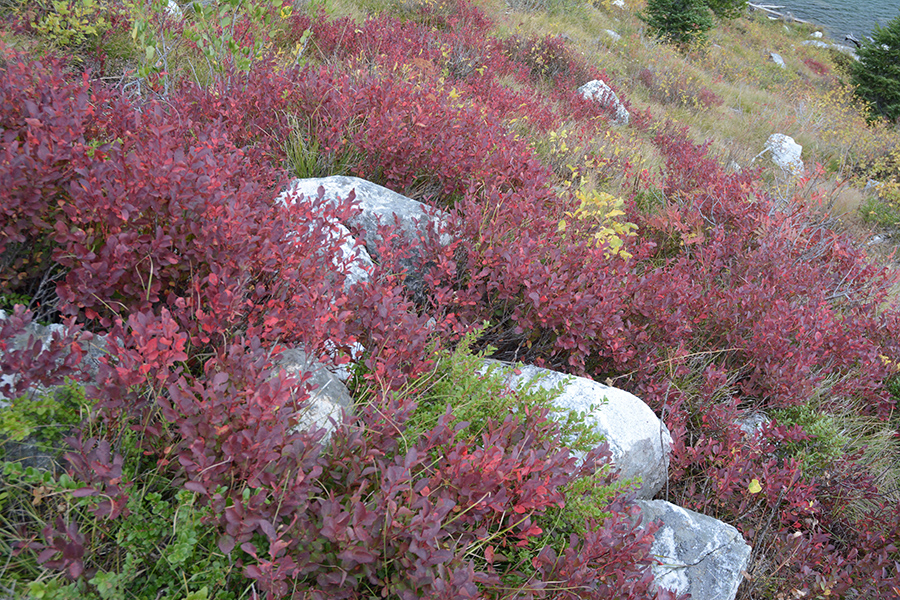
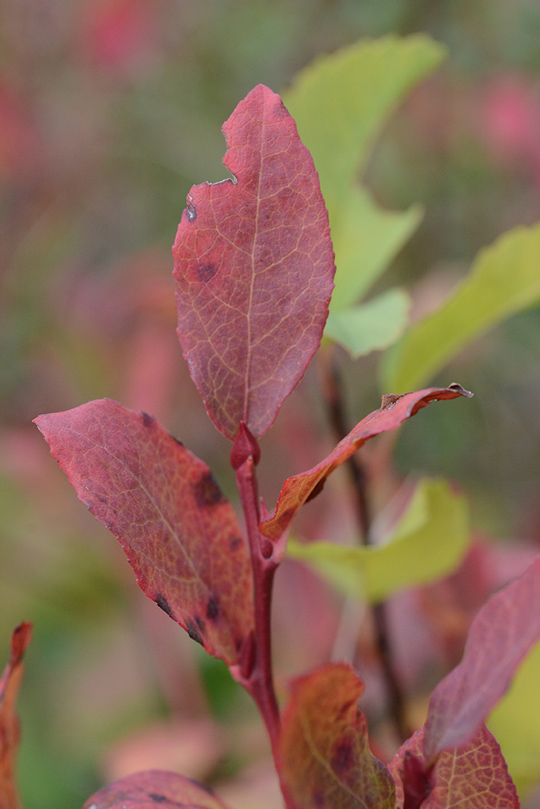
Mountain Huckleberries– Vacciniummembraceum – color up along forest paths and openings. Foliage is more intense with more sun. The delicious fruits are gone, but the leaves bring delight to the late season hiker.
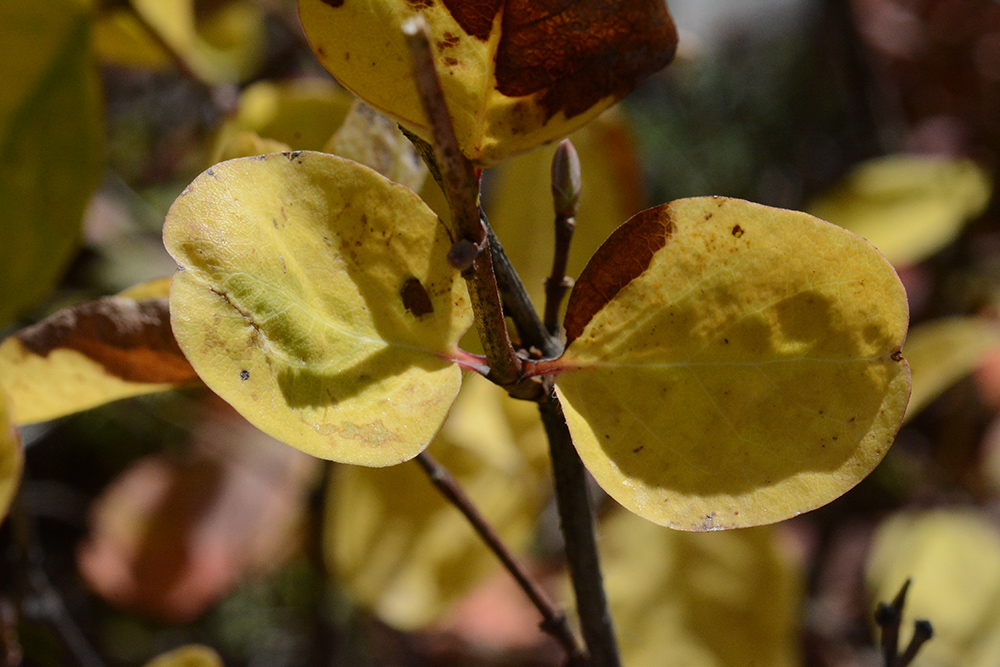
Often overlooked (at least by this botanist), False Huckleberry – Menzeisii ferruginea – turns a clear yellow in large patches along canyon trails such as Cascade Canyon. Below it is mixed in with the much larger leaves of Thimbleberry.
False Huckleberry leaves are oval, hairy, slightly sticky, and usually larger than its relative Mountain Huckleberry. And it can have a slightly skunky odor. The fruits are dry capsules, similar to its other relative azalea. For this reason it is also called False Azalea.
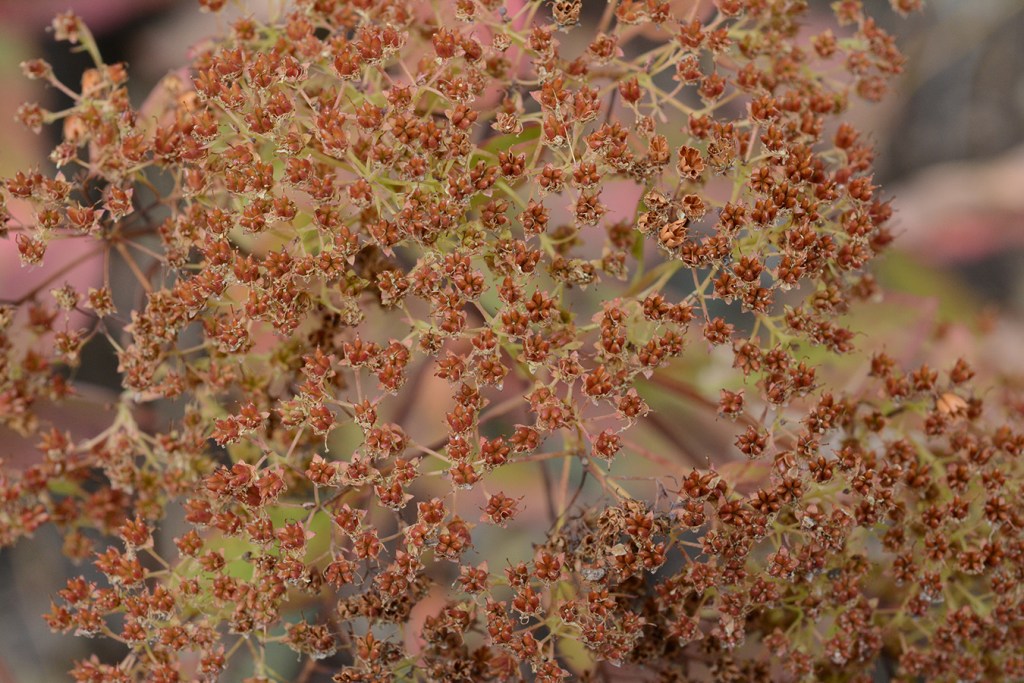
Birch-leaf Spiraea – Spiraea betulifolia – lines many woodland trails with a sweep of yellow. The oval, toothed leaves alternating up thin, rhizomatous stems contain salycidic acid – the same ingredient found in willows. Salicylic acid is the original source of aspirin, now synthesized as acetylsalicylic acid.
Of note, Spiraea is in the Rose Family, but does not have the luscious fruit of its many relatives. Instead, 5 dry fruits sit in each tiny cup of a hypanthium.
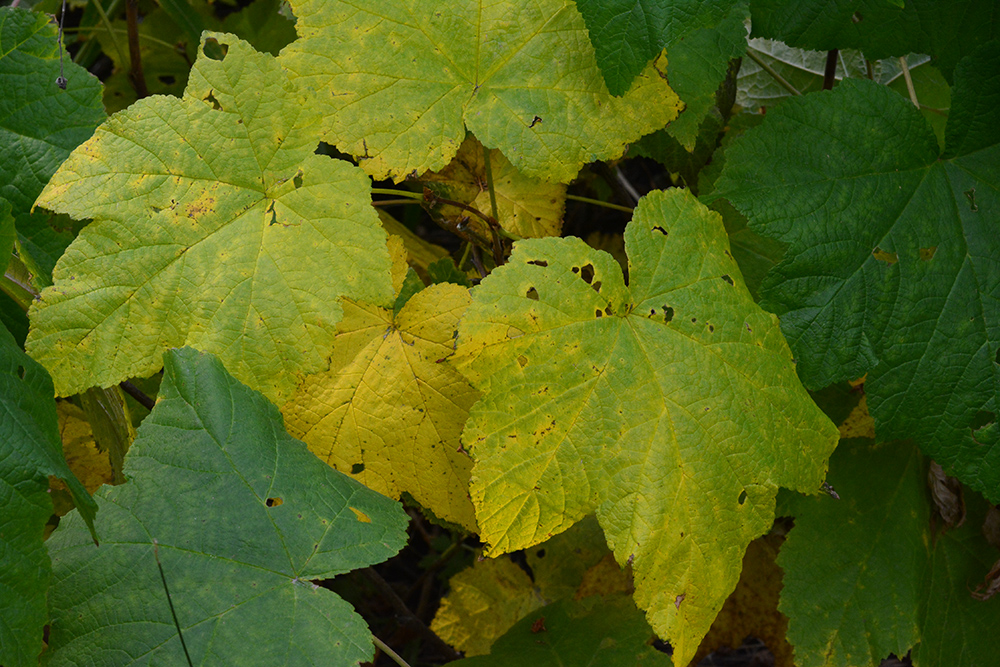
Found along streamsides or up canyon trails, Thimbleberry – Rubus parviflora – has the largest “simple” (vs. compound) leaves in the valley for shrubs. Lobed like a maple, these solar collectors are expansive, and turn bright yellow as they slowly go limp.
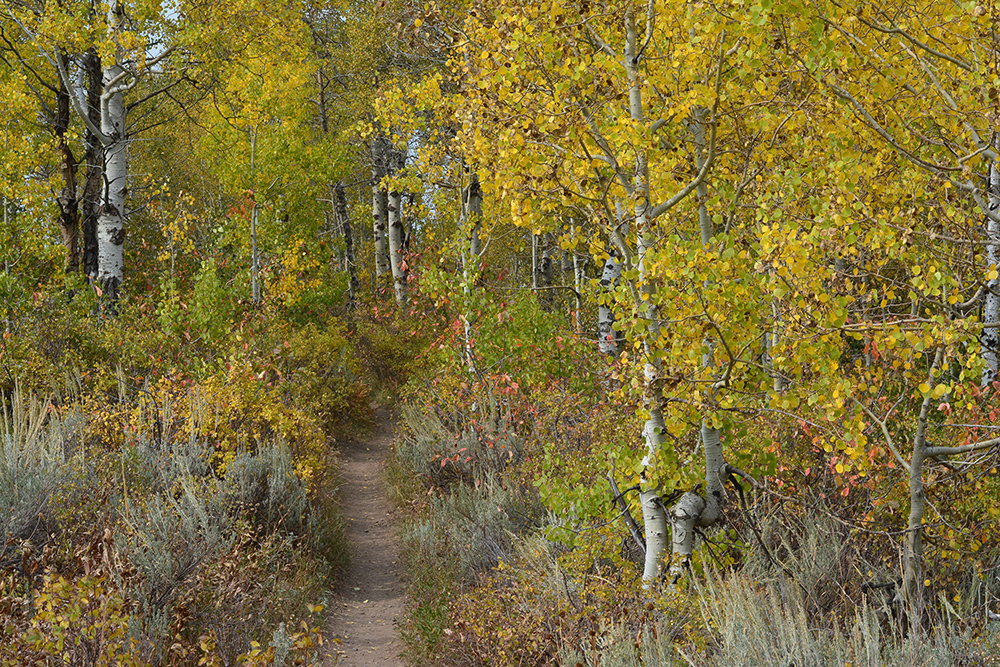
As shorter days and cooler temperatures trigger dormancy, the vessel system to the leaves is slowly sealed off, reducing available water and nutrients. Green chlorophyll dies revealing yellow pigments that have been there all summer long capturing different light spectrums. And then these too fade as their purpose is extinguished and leaves crinkle brown and drop. Buds remain the hope for the next year.
Different plant species have different arrays of yellow to orange pigments (carotenoids), and some manufacture additional red to purple anthocyanins in the fall if warm days are followed by cool, but not freezing nights. This temperature combination enables plants to produce more sugars to fuel formation of these extra pigments. Moisture can also affect the amount of color. So each species, each plant, and each year the foliage display is unique.
The season is very short. Enjoy getting out for the fall extravaganza!
Frances Clark, Wilson, WY
As always we appreciate corrections and suggestions. To get on our email list for program announcements, please contact us at tetonplants@org.
Many of our showy summer flowers are forming fruits. Now and into fall is a fascinating time to watch how plants disperse their seeds. Many birds, small rodents, even ants depend on them for food: eating them on the spot or stashing them for later, often leaving some behind to sprout. Look at the designs of the flying fruits or how others stick to animals or float away. There are so many ways plants have evolved to give their off-spring a chance to grow in the future.
For beginning plant enthusiasts, here is a bit botany to help explain what exactly are fruits and seeds. To start, fruits mature from pollinated flowers.
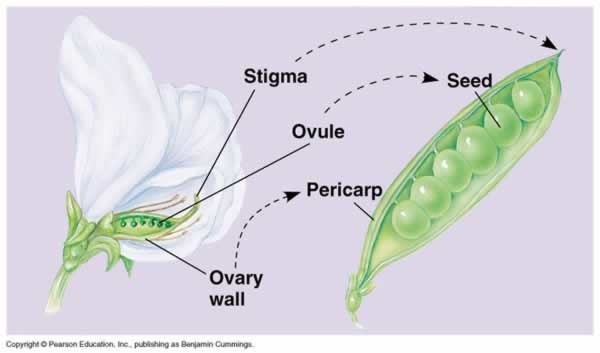
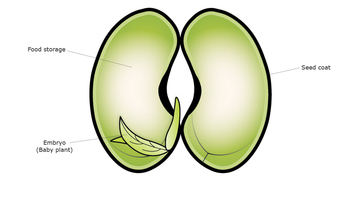
The ovary is nestled inside the petals, protects the eggs/ovules, and transforms in shape, size, color, and texture to form a fruit. The fertilized eggs/ovules become seeds which include a seed coat surrounding a tiny embryo and extra stored food—think about a bean seed as an example.
Fruits enable the seeds to move beyond the shadow of their parents—literally. Fruits are dispersed by wind, water, animal, expulsion, and gravity using all sorts of mechanisms.
Sticky Geranium – Geranium viscossissimum – catapult their seeds. A geranium fruit has five compartments (carpels) – each with a seed. As each carpel dries, it will spring upright ejecting the seed.
Parsley Family – Apiaceae – One key characteristic of this family is that the flowers, then fruits, are arranged in umbels with all branches coming from a central point like ribs of an umbrella. Members of this family are often called umbellifers. Relatives include parsley, celery, dill, anise, coriander and more.
Watch over the next few weeks to see how the fruits dry and divide. Birds, mammals, gravity, and wind can all play a part in dispersal.
Cow Parsnip – Heracleum sphondylium/maximum – is the largest member of this family in the U.S. and is found along streams and moist meadows.
Its schizocarps enlarge and flatten and develops a beautiful pattern before they break apart.
A tourist asked if Cow Parsnip gave a rash like Giant Hogweed (Heracleum mantegazzianum), which is invading the East Coast. I did some research. The genus Heracleum contains compounds (flurocoumarins) in the hairs and sap that make our skin very sensitive to ultraviolet light. If we brush against the plants, get the oils on us, and then we are exposed to sun, we can get a nasty sunburn or blisters (phytophotodermatitis). While each person reacts differently, it seems our native Cow Parsnip is not as toxic as Giant hogweed, which is native to the Caucasus Mountains bordering Southern Russia and Georgia and can grow well over 8’ tall. I have not gotten a rash from this plant.
The 3-4’ Sharptooth Angelica – Angelica arguta – was still blooming the third-week in August in moist higher elevations. The variety and number of pollinators on different umbels was impressive: flies, hornets, bees.
Various insect species can easily land and crawl about spreading pollen and sucking up nectar. Angelica fruits are ribbed, vs. flattened, and will also split in two.
Yampah – Perideridia montana – is still producing its lacey umbels of flowers in some locations, such as sage flats and burned-over areas at low elevations around the valley. Stems are about 1-2 1/2′ high with mostly linear withered leaves.
Some plants are forming tiny schizocarps.
Yampah will also begin to store starches into their taproots, which will provide food for grizzly bears. People like to forage on the tasty roots, as well. (Carrots are in the Parsley Family, too).
Western Sweetroot – Osmorhiza occidentalis – grows 2-3′ high. The elongate fruits are held up to waist high.
It is easy to sample the 3/4-1″ fruits, which while still green taste like licorice or anise.
The fruit of its less robust relative – Sweet Cicely – Osmorhiza berteroi – has a sharp point and hairs to attach to passing socks or fur.
Colorful Berries:
Clasping Twistedstalk – Streptopus amplexicaulis – has branched stems that typically arch 2-3′ high over streams or in wet sites. Leaves have parallel veins and clasp the stalks which zig-zag slightly. At each leaf node, formerly a yellow flower hung from a curled pedicel. Now a single red, ovoid fruit hangs from the same kinked stem. Who knows why the pedicels do this?
False Solomon’s seal – Maianthemum racemosum – had a spray (technically a panicle) of small white flowers at the end of the arching branches in June. Now each flower has produced speckled fruits that can be scarfed up by robins, thrushes, chipmunks, and such.
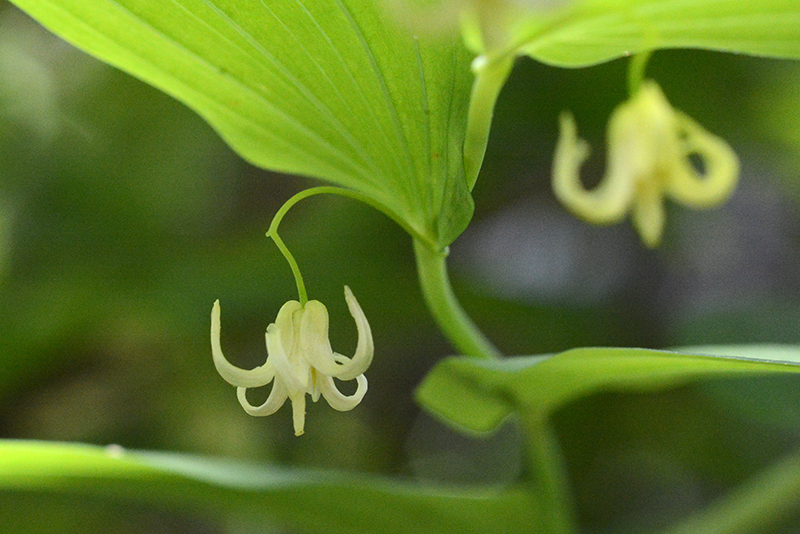
Fairybells – Prosartes trachycarpa – also bloomed in June with usually two pale yellow, lily-like flowers at the tips of the branches. The three-parted ovary has swelled into a somewhat lumpy, brilliant-red, velvet-like fruit which stands out above the bright green leaves. This arrangement is a clear advertisement to birds and mammals to come and get it.
Our local members of the Pea Family – Fabaceae – have typical pea-like flowers and pod-like fruits. The pod was the ovary deep inside the bright petals, and the seeds were the eggs inside the ovary (see diagrams above). While we think of string beans and snap peas as vegetables, they are fruits botanically speaking.
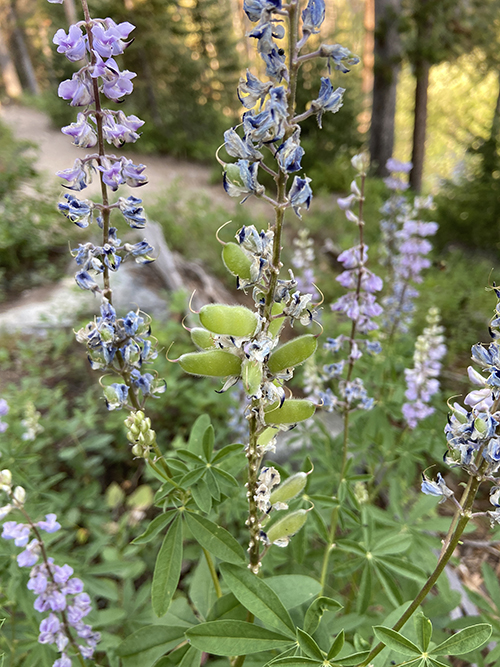
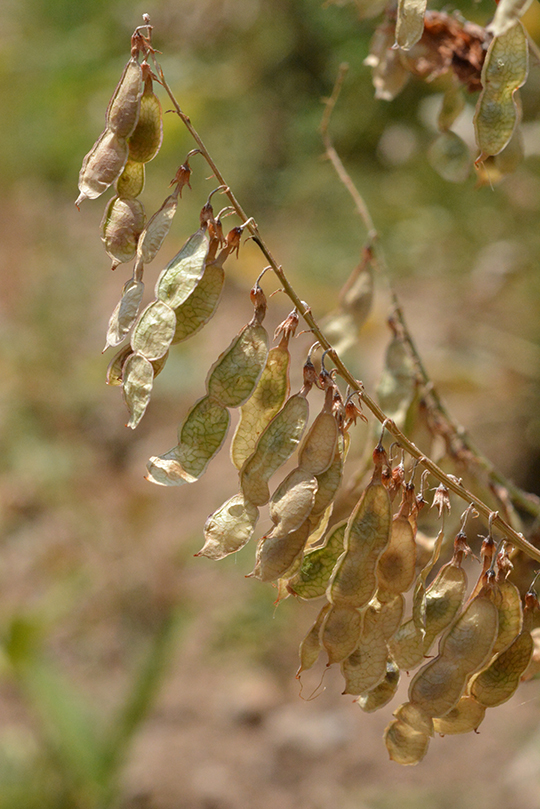
The blue pea-like flowers of Lupines – Lupinus sp. – are still blooming in some sites, but most have already formed thick, hairy pods–technically a “legume”. (For botany nerds: legumes are single carpels that split down two sides–compare to “follicle” below.) Many pods have dried, twisted, and propelled their seeds – some up to 10’! Plants and seeds contain poisonous alkaloids in varying amounts, and while most wildlife can eat the plants and seeds, they are toxic to domestic livestock, especially sheep, and to people.
For those who wish to propagate lupine from seed, it is easiest to plant ripe seed in place and let nature breakdown the tough seed coat over the winter. It is best not to transplant the young or older plants as they have long taproots that get broken, setting the plant back. One helpful link: https://www.blogs.nrcs.usda.gov/Internet/FSE_PLANTMATERIALS/publications/wapmcmt7129.pdf
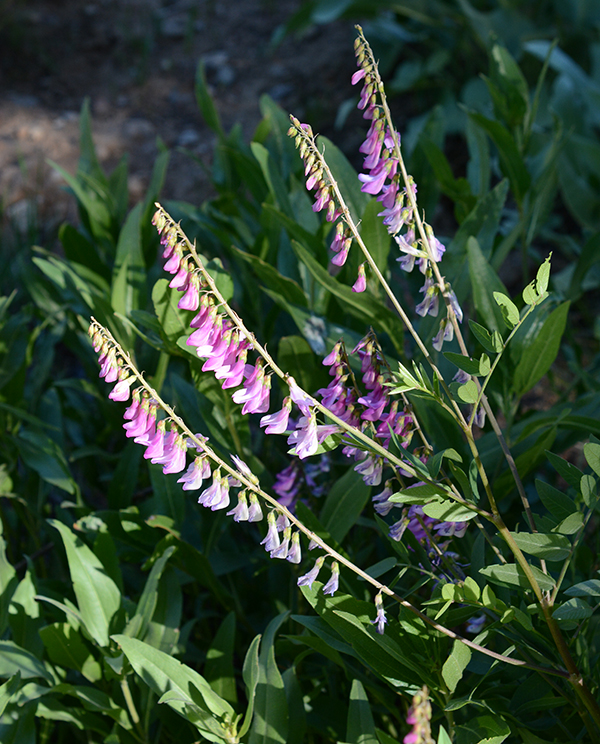
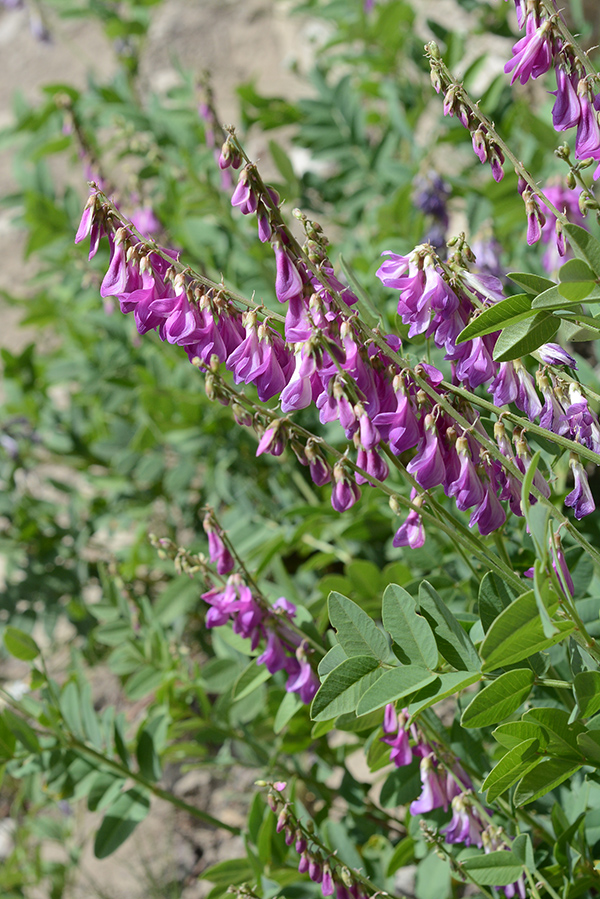
If pollinated, each magenta pea-like flower of Western Sweetvetch – Hedysarum occidentale – will produce a string of loments: essentially flattened pods. The winged segments–each with one seed–split off and are likely caught upon the wind to be transported to new ground.
The Buttercup Family has several variations:
Colorado Columbine – Aquiligia coerulea – has 5 separate dry “follicles” each containing numerous seeds. Follicles split down one side. These follicles derive from separate carpels, typical of some members of the Buttercup Family.
The blue flowers on the 5-6′ stalks of Tall Delphinium – Delphinium occidentale – bloom from bottom to top and out the side branches. So the fruits ripen from bottom to top as well. It is interesting to observe that not all the flowers are pollinated–some just fade away.
After the blue tubular flowers are pollinated, the 3 distinct carpels enlarge to form 3 distinct follicles with many seeds inside. It is easy to see the similarity of these fruits to Columbine.
A third member of the family, Fendler Meadow Rue – Thalictrum fendleri – is usually found in the forest. Meadow Rue plants are male and female and are wind pollinated. The “achenes” form only on female plants and likely just fall to the ground or perhaps a Junco or other bird comes and gets the fruits.
Its relative Sugar Bowls – Clematis hirsutissima – has individual achenes that are attached to long hairy stigmas that help them fly off on the wind. This plant is often called the Dr. Seuss or Phyllis Diller plant in the summer when it is in its “bad hair day” fruiting phase.
Other dry fruits:
Fern-leaf Louseworts – Pedicularis bracteosa – sported spires of beaked yellow flowers in early summer. Now the spikes are drying and dry capsules (formed from more than one carpel) are splitting open. Dark seeds are sifting out as the wind waves the stems about.
Bladder Campion – Silene latifolia – has cups filled with seeds that shake out over time.
Leopard Lily – Fritillaria atropurpurea – has squarrish capsules that shake out seeds:
And perhaps the most pesky dry fruits that catch a ride on our pant legs and socks, as well as our dog’s fur, is Western Stickseed – Hackelia micrantha. The sharply pronged green to brown small nutlets are often passed unseen but are soon felt as they hitchhike down the trail and even home.
Composites get around:
While many composites or members of the Aster Family produce one-seeded fruits with fluffy parachutes like a dandelion, others have fruits nestled tight in heads. For instance, Western Coneflower – Rudbeckia occidentalis – has its fruits (achenes) standing firm on cone-shaped receptacles waiting for birds, such as Pine Siskins and American Goldfinches, to find them.
As birds avidly eat the fruits, they often dislodge some that fall to the ground. (photo by Susan Marsh):
The same dispersal mechanism likely happens in Arrowleaf Balsamroot – Balsamorhiza saggitata – with birds prying out the elongate achenes held within sharp protective scales.
Many plants can have more than one dispersal mechanism. For instance, thistles–both native and introduced–can attract seed eaters which pluck out and therefore loosen fruits which then fly off upon the wind.
Keep on watching. There are many more fruits and seeds to come, each with fascinating dispersal strategies!
Frances Clark, Wilson, WY
P.S. As alwasy we appreciate corrections and comments sent to us at tetonplants@gmail.com. Also, look at the recent posting “Culmination of Composites–August 2020” for flowers that will soon be shedding wind-blown seeds.
A variety of composites – members of the Aster Family (Asteraceae) – have been in bloom since the beginning of August, and many continue to bloom into the end of the month. Composites are at their flowering peak when most insects are also at the climax of their annual life cycles. For instance, butterflies have developed from eggs to larvae to chrysalises to beautiful adults over the course of the summer. They depend on nectar in their final days. These and many other insects are laying eggs in host plants for another year. August is a great time to look at both flowers and insects!
(Photo of Fritillary on Rubber Rabbitbrush by Susan Marsh)
As some of you already know, the Aster family is one of the largest plant families in the world. The basic characteristic of the family is that many individual flowers are gathered together on a platform and surrounded by protective bracts to form a “head” that looks like a single flower—a “composite” flower.
From this simple flower “plan”, the variations multiply. The 5-parted flowers can be “ray” flowers with their petals fused into a single showy petal-like structure, or less obvious “disc” flowers with the petals fused into a tube. Heads can have a combination of both ray flowers and disc flowers, or all disc or all ray flowers and come in various sizes and colors. The surrounding protective bracts are helpful ID features and fruits have distinctive dispersal mechanisms, as well.
Ecologically, members of the Aster Family offer an abundance of nectar and pollen in one location over an extended period of time: individual flowers boom and fade sequentially. Also, the often wide-open arrangement enables many different insects to land and probe, dab, lap, and suck nectar and gather pollen accidentally or on purpose before they seek more rewards on the next similar flower. Insects munch on developing or ripened seeds, lay their eggs in flowers or stems, and otherwise make use of these often abundant plants. Birds and small rodents are common dispersers of the fruits.
With this introduction, here are some common composites that have been blooming for the past couple of weeks. We have provided some ID tips to help you look more closely.
Showy Goldeneye – Vigueria multiflora – has several cheerful yellow flower heads waving about on thin 2-3’ stems adorned with oblong opposite leaves. If you look, you will see that there is a shift in hue from a lighter yellow to a darker tone toward the center of the “golden eye”. Insects with their UV vision likely see this as a distinct bulls-eye. Showy Goldeneyes are common along park roadsides and into dry meadows.
Curleycup Gumweeds – Grindelia squarrosa – are sturdy, dense, foot-high plants found along park roads. The bright-yellow, almost glowing, flower heads have distinctive sticky bracts which curl under.
You are likely to smell Tarweed – Madia gomerata – before you see it. An acrid odor arises from around your feet where you have stepped on it. You may wonder. “Where are they paving the road?” Usually only a few inches high (although I have seen it 18” tall), these resinous plants have tiny oily hairs and small linear leaves. Heads have only a couple of ray flowers. This annual is mostly in disturbed sites and is considered a native weed.
Western Coneflower – Rudbeckia occidentalis – grows to 4-6’ high. The large oval to triangular leaves can reach 10” long and alternate up sturdy straight stems. At the top are brown-black “cones” surrounded by a collar of green bracts. The “cone” is the “receptacle” or platform for the many tiny disc flowers. Flowers start blooming from bottom—look for the yellow pollen, and spiral up over a couple of weeks to the top. These tiny flowers attract dozens of pollinators! In one large meadow with thousands of coneflowers, I witnessed bees on one-in-20 cones, often more than 1 bee/flower head, and myriad Milbert’s Tortoiseshell butterflies, all gathering pollen and nectar from these abundant “disc” flowers. Later Pine Siskins and other birds will pluck out the seeds. Again, it is likely the flowers project a UV signal that our human eyes cannot detect.
Rayless Arnica – Arnica parryi – is also composed of only “disc” flowers, unlike its much more admired relatives which have showy heads of both ray and disc flowers. Note the bracts are even in size and the leaves are opposites, as in all arnicas.
Canada Goldenrod – Solidago canadensis – is perhaps one of the most important flowers for biodiversity in the U.S. according to Dr. Doug Tallamy of the University of Delaware*. Abundant from East to West, the 2-3’ flowers colonize large areas. Here they spread best in relatively moist soils. By mid-August, they produce hundreds of tiny yellow flower heads that attract pollinators of all sorts. Other insects burrow into the stems to over-winter or lay eggs. Many birds depend on the bugs for their nutrition.
Goldenrod is not responsible for our allergies: Their showy flowers have evolved to attract insects to deliver the heavy pollen. However, often unseen nearby are plants that rely on wind to disperse pollen—such as grasses and soon sagebrush. Wind-dispersed pollen is much lighter and can lodge in nostrils and eyes.
Oregon Daisy – Erigeron speciosus – is one of a few showy blue daisies (vs asters below) that bloom into late summer. Typically, Erigerons have many, often narrow, ray flowers surrounding many yellow disc flowers. Even-sized bracts ring the flower heads like a palisade fence. One- to three-inch oval leaves alternate up the stem. These plants are showy and sturdy enough to be good garden plants!
Leafybract Aster – Symphyotrichum foliaceum/cusickii – is 1-3’ tall, has large alternate leaves which can be 4-6” long near the base, smaller near the top. The blue flower heads are surrounded by “leafy” bracts of different sizes which are arranged roughly like shingles on a roof. This species comes in various varieties, but here we group them as one.
Pacific Aster – Symphyotrichum ascendens – is a tough 1-2’ plant that seems to thrive along roadsides.
The light-blue flower heads have tidy bracts that look like well-placed shingles. The narrow leaves have veins that form elongate patterns which help determine this particular species.
Engelmann Aster – Eucephalus engelmannii – is readily identified by its 4-5′ stems cloaked by alternating 4-6” leaves that retain their size as they spiral up the stem.
The large white flower heads are surrounded by a distinctive set of bracts. This is a very common plant in aspen groves and higher elevation meadows.
Thickstem Aster – Eurybia integrifolia – thrives from sagebrush flats in the valley floor up to 9,000’ subalpine meadows. Stems are not only thick and sticky but have a bit of a zig-zag at the nodes where each leaf alternates up the stem. Deep purplish-blue flowers are protected by hefty protruding bracts covered by sticky hairs. All sorts of insects come in to pollinate them and others try to eat them…sometimes getting stuck in the forest of glutinous hairs.
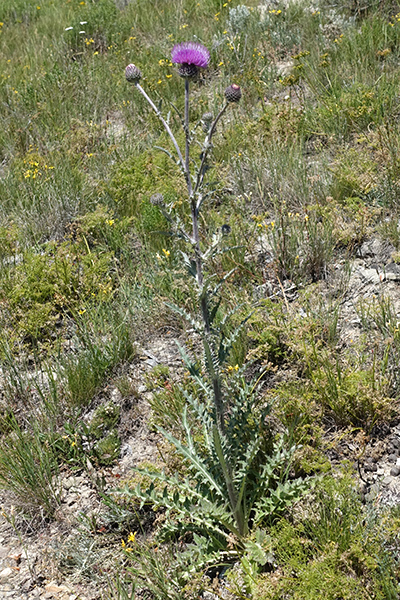
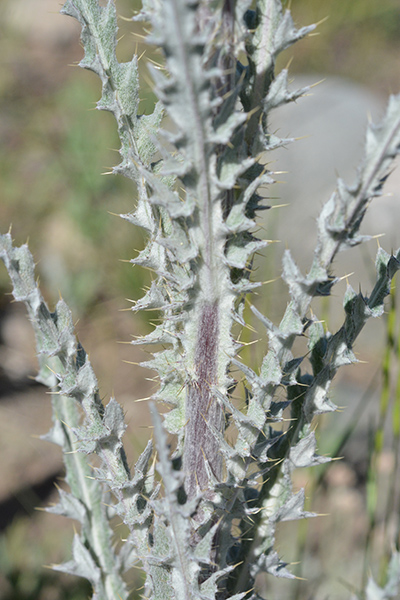
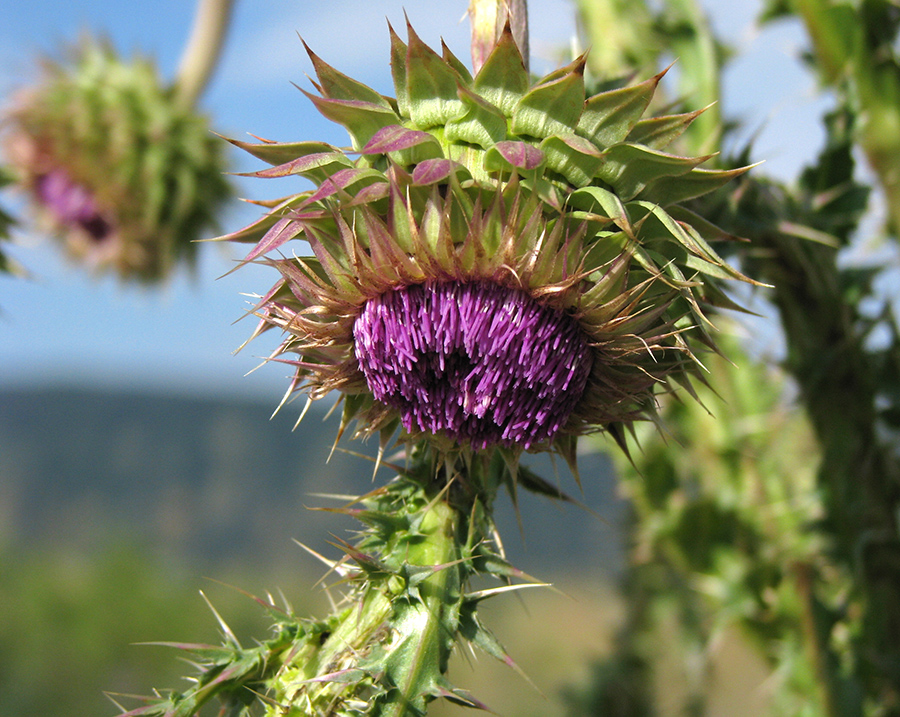
Musk Thistle – Carduus nutans – is a monster of a composite. This invasive exotic can grow up to 7’ tall sporting multiple stems with elongate lobed leaves, all armed with ferocious spines. However, it is hard not to admire the 2+” flower heads for their gorgeous color. Insects galore come to gather pollen and nectar. And recently I have witnessed pine siskins and a downy woodpecker relish the fruits.
Each fruit (technically an “achene”–a dry case with one seed inside – like a sunflower seed) is attached to a sail of fluff. Hundreds, thousands, of fruits are dispersed by the wind, seeding into pastures and along trail edges, where new plants sprout up quickly to outcompete our natives. USDA has designated musk thistle a noxious weed. Our local Teton County Weed and Pest https://www.tcweed.org/ can help land owners control it on their property.
Rabbitbrushes lure myriad butterflies, bees, and flies at the end of the growing season when nectar and pollen supplies are shriveling up. Both species do well on dry, often disturbed sites such as roadsides, construction sites, and cliff edges.
Rubber Rabbitbrush – Ericameria nauseosa – has a white sticky sap that has been investigated as a form of rubber—hence its common name. “Nauseosa” likely comes from the very strong fragrance and taste of broken twigs. Twigs are typically covered in a layer of fine white hairs – tomentum – and are rather flexible. Leaves are very narrow up to 4” long on shrubs that can be 2-4’ high and wide. The many elongate disc flowers attract a hubbub of late summer pollinators.
Douglas Rabbitbrush – Chrysothamus viscidifolus – is best identified by its twisted leaves with resinous or “viscid” glands.
The stems do not have hairs. It comes in several varieties, but this is the most common one I have seen. Typically shrubs are only a foot or so high.
While most of these flowers will be fading in color, another composite is just beginning to bloom–Sagebrush! However, their flowers are wind-pollinated and, therefore, often go unnoticed.
Many of these same flowers and more are featured on past Teton Plants posts. Look into the TetonPlants.org archives for more images and info.
Enjoy botanizing!
Frances Clark, Wilson, WY
P.S. As always we appreciate any corrections or suggestions. Email us at tetonplants.org for your comments and to be placed on our email list.
The Valley is full of flowers in June. So many so that here we present them by type—here are the shrubs, which come into their own when in full flower. Separately, we will post Wildflowers in Sageflats and Hills/Sun and Wildflowers in Forests/shade.
Most shrubs are most appreciated in spring when they bloom, although some will have colorful foliage and fruits for a short time in fall. The rest of the year, shrubs are usually overlooked as just green bushes or just twigs. So now is the time to celebrate shrubs.
Note: Shrubs are woody plants usually between 6”-20’ tall with multiple stems vs. 1 or 2 trunks of a tree.
The following are more or less in flower sequence within their group.
First to Start:
Willows – Salix sp. – There are many, many types of willows of all sizes. They are very important for wildlife: pollinating bees, nesting birds, browsing moose, and dam-building beaver to name a few.
We usually welcome their early spring catkins—pussy willows. They come in male and female versions, are pollinated by insects (not by wind, as previously thought) starting in April. By late June the female capsules are bursting with thousands of seeds attached to a tufts of fluff being dispersed by wind. Along with their relatives the cottonwoods, they are creating blizzards.
The teensie seeds are viable for only a few days, and they must land on moist open ground to germinate. Only a couple of seeds out of a million will sprout and grow up at all. Plants, though, can propagate vegetatively from broken stems stuck in the mud, as along flooded rivers or around beaver ponds.
Utah Honeysuckle – Lonicera utahensis – has oval leaves that are arranged opposite each other on the stems. The trumpet-like, pale yellow flowers are found in pairs, their ovaries attached at the very base. Later twin red berries will loll upon the green of the leaves…but not until late July.
Oregon Grape – Mahonia repens – is one of our few evergreen shrubs and is particularly tough. It grows in sun or shade, often on very rocky soils. Several thick holly-like leaflets form along the central petiole to comprise a compound leaf. In spring the “evergreen” leaves remain, although a bit tattered, until the new leaves replace them. The flowers are remarkably fragrant and last a long time. The underlying bark is yellow with “berberine” which has medicinal properties.
Mountain Maple – Acer glabrum – has inconspicuous flowers that are pollinated by wind or perhaps some insects? Each flower is usually male or female to prevent self-pollination. By now in late June you can see the beginning of the fruits forming – the double winged samaras – that will twirl to new realms later in the fall.
These common shrubs grow from a few feet to up to almost 20’ tall. They all have five green sepals, five white petals, and anthers (the pollen bearing parts) in multiples of 5. These three whorls merge into a cup-like hypanthium that will later swell and protect the seeds. Hypanthium structures are common in the Rose Family. In the very center of this cup-like feature, sit the female ovaries and eggs that will form the seeds. The fruits will be a combination of swollen protective hypanthiums and the mature seeds in the center. (image wikipedia)
All these plants are related to cultivated fruits we eat: apples, plums, pears, peaches—also in the Rose Family. Our native roses blooms in July–very soon! and produce “hips” – the tough hypanthium with dry fruits/seeds inside.
More or less in order of bloom:
Serviceberry/Saskatoon – Amelanchier alnifolia – has oval 1-1.5” leaves with a few teeth arrayed around the upper ½. Flowers are arranged along a central stalk. Being one of the earliest to bloom, it will also be the earliest to fruit.
Chokecherry – Prunus virginiana – has 4-5” oblong, pointed leaves with fine teeth all along the edges. The dozens of flowers are stiffly arranged on the long central stalk. All the parts of the plant have a chemicals that can produce poisonous cyanide under certain conditions. For instance, if cattle eat too many of the spring leaves they can become very sick. Amateur entomologists have used the leaves and bark in jars to kill insect specimens. On the other hand, western tent caterpillars thrive in their branches, and birds and other mammals will eat the fruits come fall (the particularly toxic pits pass on through).
Black Hawthorn – Crataegus douglasii – are easy to ID with their ½-1” thorns. The broad oval leaves are coarsely toothed. The flowers are in branching bunches or cymes. In August, the Moose-Wilson Road is often closed due to bears feasting on the berries.
Mountain Ash/Greene’s Ash – Sorbus scoparia – begins to bloom in late June in slightly cooler locations. The leaves are “compound” with many leaflets coming off a central stalk. The stalk then attaches to the twig. The tiny flowers form a great puff of creamy white flowers at the end of the stems.
Ninebark – Physocarpus malvaceus – is found in the southern part of Jackson Hole flowering at the end of June. Unlike other white bloomers above, it will have dry fruits. Leaves are slightly lobed and toothed.
Yellow Members of the Rose Family Join In the Parade of Bloom:
Not all members of the very large Rose Family make luscious fruits. While also having hypanthiums, the cups remain thin and brown cradling dry seed-like fruits (achenes) inside. For now enjoy the flowers.
Antelopebrush/Bitterbrush – Purshia tridentata – is especially abundant this year. You can smell the sweet yellow flowers before you come over the rise of an open hillside. Plants are often intermixed with sagebrush, growing about the same size.
The nutritious plants are valued wildlife browse throughout the year, but particularly in late fall and winter by moose. Ants and mice relish the seeds. Also these plants can fix their own nitrogen with the help of bacteria growing in the roots. Therefore, these shrubs can grow in many tough conditions. Note their small leaves are three-tipped like those of sagebrush, but they are greener overall, and the edges curl under.
Shrubby Cinquefoil – Potentilla/Diasphora fucticosa/Pentaplylloides floribunda – is a favored landscape plant for its yellow flowers in early to mid-summer and its low maintenance. It can grow in a variety of soils from sun to shade – but prefers a bit of moisture, especially when in sun.
Nurseries sell a range “cultivars” with white to deep orange flowers. Our wild native is yellow.
More June Shrubs of Various Sorts –
These four shrubs prefer more or less moist and/or cool areas and grow into substantial plants.
Silverberry – Eleagnus commutata – has been flowering under the cottonwoods along the Snake and Gros Ventre Rivers from Wilson north. They are easily seen from the dikes and from Fall Creek Road.
The 2-3” silvery oblong leaves stand out in the shade on 6’-tall, erect colonial plants. Hidden in the foliage are yellowish, highly fragrant tubular flowers.
Red Elderberry – Sambucus racemosa – looks at first glance like Mountain Ash with its white bunches of small flowers and compound leaves. However, it is overall heftier with thicker stems and heavier leaves, and notably the compound leaves are opposite each other, not alternate up the stems. Also, plants have a foul odor if pinched or crushed. Its European relative – Sambucus nigra – is the source of sambucol, the anti-viral flu mediation.
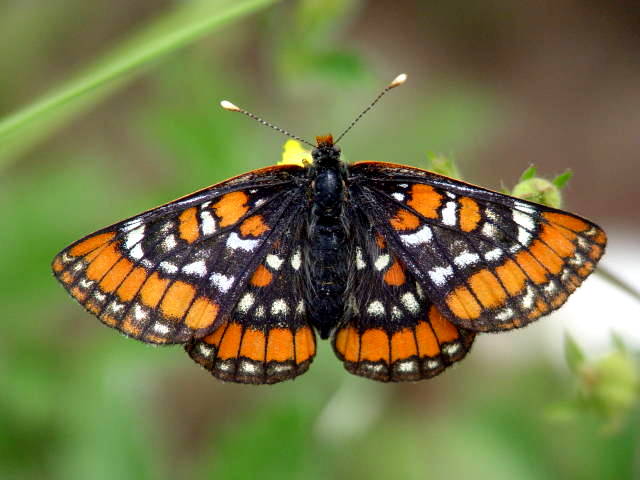
Twinberry – Lonicera involucrata – is also a substantial shrub usually found near water. The 3-6” oval leaves are opposite on the stem, and the flowers are formed in pairs. (It is a relative of the early flowering relative Utah honeysuckle – see above.) Flowers are mostly yellowish and hairy with a “bract” at their base that can be greenish yellow but later turns deep maroon. Keep an eye out for caterpillars of Gillette’s Checkerspot butterfly (photo credit: Wikipedia) which require this species for their host.
Red-stemmed Dogwood – Cornus stolonifera – is loved by moose, other wildlife, and landscapers. In fact it is an appealing “ornamental” plant for its tidy oval leaves set opposite each other on the red stems, bunches of white flowers, and later white berries. Red winter twigs are a cheerful contrast against snow. “Cultivars” have been selected with brighter red stems, variegated leaves, bigger flowers and berries. The moose relish it as is, and the birds will carry off the fruits when ready. A great plant for a “wildlife friendly” garden.
Unnotables:
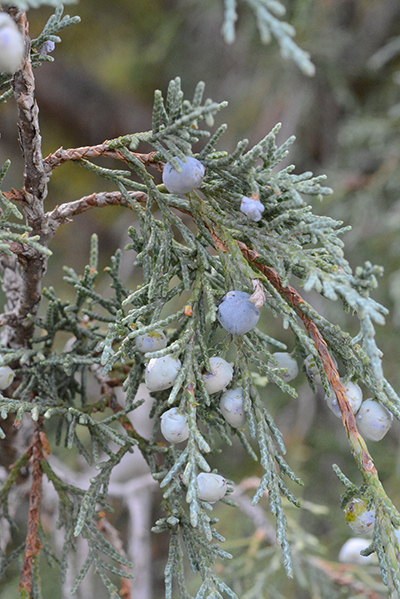
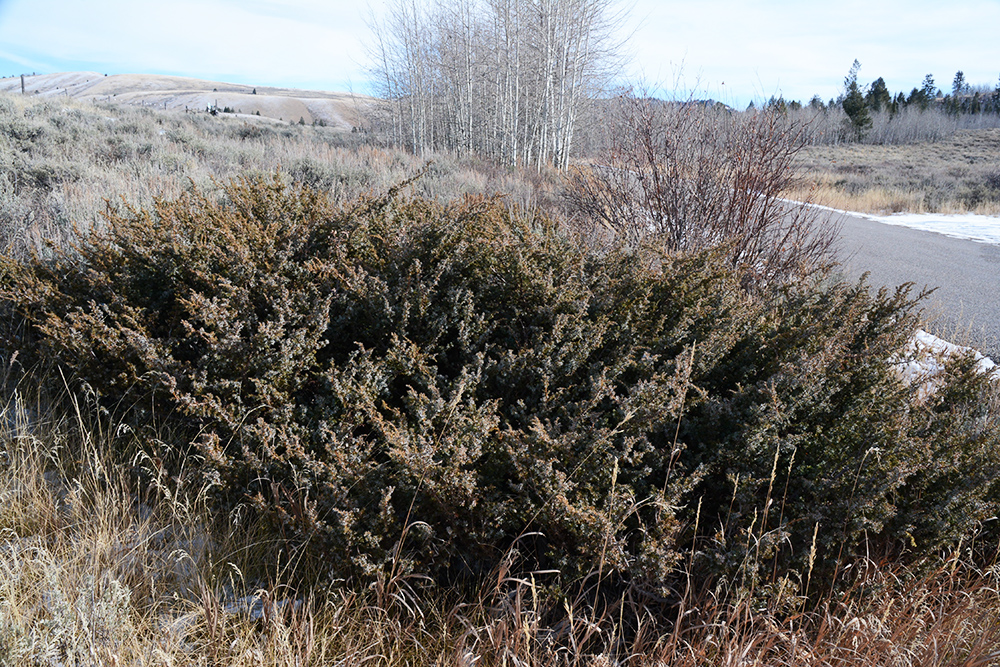
Junipers are evergreen conifers. The tree-like Western Juniper – Juniperus scopulorum – grows in all shapes and sizes on our dry buttes.
This species has scale-like leaves.
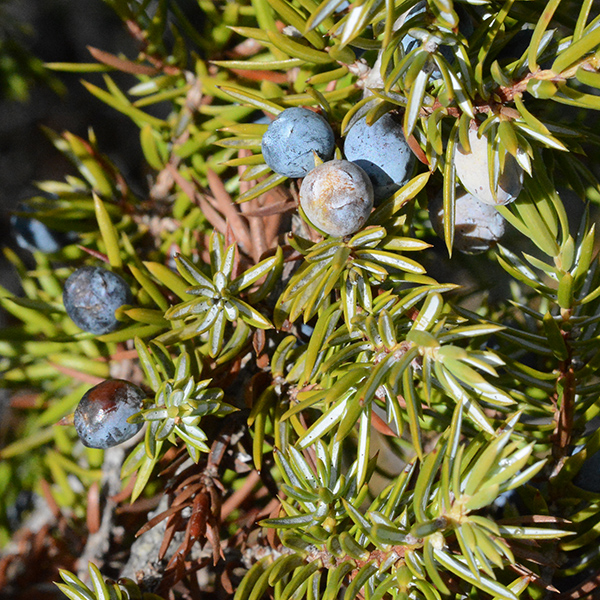
The sprawling Common Juniper – J. communis – has sharp needles that are in whorls of 3 and grows here and there in sunny spots. Both produce “berries” which are technically fleshy cones that are relished by Townsend’s Solitaires and Cedar Waxwings. However, few realize that the cones take 18 months to form, starting in June, and only on “female” plants.
Not to get into the complications of “naked seed” plants and their evolution, suffice it to say that pollen is released from tiny structures,
and with luck land on females cones of a different plant. You need a microscope to really see what is going on, but with a handlens, you can observe the first bulge of reproduction.
Others shrubs not mentioned: The gooseberries/currants – Ribes sp., various huckleberry relatives – Vaccinium sp., and a few inconspicuous wind pollinated species. We save those for later.
Enjoy the shrubs of spring…more to come this summer!
As the valley greens up and we need a respite from the world of Covid-19, many of us are out and about looking for flowers. As I write, some of our regular haunts in Grand Teton National Park are still closed (but about to open!). However, there are many other places for botanical forays.
Bridger-Teton National Forest has various accessible habitats such as more south-facing grassy slopes mixed with sagebrush and dry rocky slopes where the snow melts early. Josie’s Ridge, Cache Creek, and the lower slopes of Munger Mountain are all good jaunts. Dry hills to the north and east of Flat Creek Road; Crystal Butte near Jackson; Game Creek south of town; and Poison Creek southeast of Hoback are other accessible points. Please always respect boundaries and watch your step—many of the plants are small and fragile.
Many common flowers are presented here. Go to past posts of “What’s in Bloom?” for additional and different details.
Earliest flowers found to the south of Jackson a month ago are now fading but are still visible farther north:
Turkey Peas – Orogenia linearifolia – have the tiniest of white flowers and skimpy linear leaves. The cluster if often smaller than the size of a penny.
Two early look-alike buttercups perk up the dried grasses: SagebrushButtercups – Ranunculus glaberrimus – have simple leaves—although when they stretch out they can have two lobes.
UtahButtercups leaves are 3-lobed from first emergence.
Steer’s-heads – Dicentra uniflora – are easily overlooked until you get the search image of the leaves…then look for the flowers which have an obvious western motif.
Slightly later or in different locations Spring Beauties – Claytonia lanceolata – are sprinkled about in light shade or sun where snow has just melted. Leaves are opposite, and the flowers are pinkish with delicate, pinker veins that lead pollinators to the center of the flower.
Ever-popular Yellowbells – Fritillaria pudica – grace hillsides and sageflats with their charming bells.
As we move into mid-May, species found on grassy slopes and amidst sage brush include:
Yellow violets – Viola nuttalii varieties – have a range of leaf shapes and sizes which confuse exact identification to variety. Goosefoot Violet – Viola purpurea – is easy to ID because of its distinctive webbed-foot leaves.
OblongleafBluebell – Mertensia obtusifolia – flowers dangle, changing color from pink to blue when ready to attract pollinators.
Shooting Star – Dodocatheon conjugens – folds back its petals and has little knobs for bees to cling to—it is “buzz” pollinated. A bee lands, hangs, vibrates its wing muscles and then pollen grains sift out of the purple anthers and land on the bee’s belly. The bee flies to another flower with a stigma sticking out which then tags the pollen.
Nuttall Larkspur – Delphinium nuttallianum – will soon become more abundant and attract hummingbirds.
Dry slopes are some of my favorite spring botany spots:
Wonderfully fragrant Hood’s Phlox – Phlox hoodii – has tight needle-like leaves with cobwebby hairs that help distinguish it from the later blooming Multiflora Phlox. Flowers can range from light to dark blue on different plants of the same species.
Low pussytoes – Antennaria dimoprha – are often overlooked even when in flower – its tiny composite flowers are all male or female on separate plants. Flowers are wind pollinated or females can produce seeds without a male around.
Pursh’s milkvetch – Astragalus purshii – has typical pea-like flowers emerging beyond a clump of compound ladder-like silvery leaves. The flowers are creamy white. The genus of the Pea Family can be IDed, in part, by the two “wing” petals being longer than the “keel”, which here is purple tipped.
Bessey’s Locoweed – Oxytropus besseyi – has elegant fists of flowers above similar leaves to milkvetch. The pea-like are very similar (except for its color!); however, the “wing” petals are shorter than the pointy “keel” in this genus of the Pea Family.
Whitlow Grasses – Draba sp.- were abundant on a very dry slope. ID of this confusing genus of mustards requires the fruits to ripen. Hairs also help!
Mountain Rockcress – Boechera sp. – is another Mustard Family member awaiting full ID. All mustards have 4 sepals, 4 petals, 6 stamens – 2 shorter than the other 4, and a single pistil. The pistils of the family grow into fruits of various shapes—the key ID feature needed. (photo by Susan Marsh)
Desert Paintbrush – Castilleja chromosa – is the first of several paintbrushes that will bloom over the next several months. Its orange-red, day-glow flowers decorate dry hillsides amidst colorful rocks.
Below are some of the plants, which for some reason, have been given less prominence in past posts—not sure why:
Pasqueflowers – Anemone patens – are an early spring favorite for obvious reasons!
Diamondleaf Saxifrage – Saxifraga rhomboidea – is often overlooked. The basal rosette of rhomboid leaves gives rise to a single 2-9” stalk with a cluster of several white flowers.
Oregon Grape – Mahonia repens – is common in many habitats, but we often forget to get down and sniff the wonderfully fragrant flowers! But watch your nose on the spiny, tough evergreen leaves.
Wyoming Kittentails – Besseya wyomingensis – have no showy petals. The color comes from the purple-blue stamens that unfold to yield white pollen.
Best to get out now to see these early spring flowers before you are distracted by so many more flowers to come, such as Balsamroot!Happy Spring.
Frances Clark, Teton Plants Program Coordinator
P.S. As always, we appreciate any corrections, suggestions, or other comments!
Spring sun is warming south-facing slopes of buttes and hillsides. Snow along Grand Teton National Park roads is finally retreating. Wetlands are warming. Bugs and birds are flying about. The delight is in the details of small flowers; no big show yet.
Along roads and low openings in the valley:
Patches of yellow buttercups are the first to draw the eye.
Buttercup – Ranunculus spp. – flowers gleam, and uniquely so. The outer layer of the petals – epidermis – is only one-cell thick and the cells are particularly thin and flat. They hold pigments that absorb blue-green wave lengths of light. Thus yellow wavelengths can keep going through the outer cell layer, penetrate a thin air layer, and then reach a starch layer of cells that scatters the yellow light back up through the pigments again. Furthermore, the thin outer layer with air layer just beneath has the physical properties of a thin-film, creating the shiny look to the flowers. The combination os pigmentation and unique structural qualities of the flower cells provide the bright glossy yellow found only in buttercups and a few cousins. At certain angles, flowers actually flash a signal to passing pollinators to come visit. (For much more to this complex story see references below.)
Buttercup petals beam intense yellow light and UV wave-lenghs that signal to pollinators. Also, the curving petals with the special cell layers provide addtional warming to the reproductive parts in the center, speeding up the life cycle.
Look closely at our two similar species of buttercups:
The lowest leaf of Sagebrush Buttercup – Ranunculus glaberrimus – is unlobed, the upper leaves are 3-lobed. It is a denizen of sage flats.
Some individual Sagebrush Buttercups don’t have petals, only sepals. I dont’ know why the flashy petals aren’t there.
In Utah Buttercup – R. jovis – both the lower and upper leaves are lobed into three parts. Note buttercups have many separate anthers and stigmas—a common characteristic of this family. It is found in relatively moist locations, including woodland edges and openings.
Springbeauties – Claytonia lanceolata — grow in scattered in patches. Some blooms exhibit obvious pinkish veins that direct pollinators to yellow nectaries in the center. Pollinators bump against the anthers and get dusted with pollen.
It is easy to step on Turkey Peas – Orogenia lineariifolia. The plants look like bits of lichen or stone, nothing to think about.
However, Turkey Peas are more interesting if you take a close look at their tiny white flower with maroon centers that together form clusters barely an inch long. Think about what tiny insects must pollinate them–likey small flies and bees.
Sandhill cranes, bears, and rodents seek out the thumb-sized bulbs (“peas”) for food. (Turkeys would likely eat the bulbs if they lived in Jackson.)
The quintessential western plant Steer’s-head – Dicentra uniflora – requires some belly botany. Scan an area for divided leaves and then get down to stare at the steer-like flowers. This is the larval host plant for the Parnassian butterfly Parnassius clodius, which Dr. Debrinski from MSU is researching in Grant Teton National Park (more info on her research below).
Parnassian butterfly species on Blacktail Butte 5.4.19.
Yellowbells – Fritillaria pudica – are always cheerful! The 6-8”-high plants sprout from miniature scaly bulbs. The base of the 6 yellow tepals is said to change from red to green depending on pollination, but I can’t see any consistent difference happening to the outside flower color or anthers and pistil on the inside. Maybe you can.
Violets are flowering here and there:
Goosefoot Violet – Viola purpurea var. venosa – has leaves shaped like goose feet with a few more toes. The back of the leaves and yellow petals are often purple, hence “purpurea” in its botanical name. Note the dark center of the flower and the convenient landing pad of petals for pollinators.
Several yellow violets intergrade in leaf features which confuse me and other botanists trying to sort out the names. This cheerful specimen is one of three look-alike species – V. vallicola, V. praemorsa, or V. nuttalii. Leaf ratios, shapes, and hairiness, as well as ultimately seed-capsule sizes, determine identification.
Dry slopes and knolls: Rambles up the south side of Blacktail Butte and rocky knolls around Kelly Warm Springs yield treasures tucked into the rocky soils. Many of the plants are silvery and/or hairy and grow very slowly into low mounds or mats—adaptations to limited water and nutrients and intense light and wind.
Please watch you step…these small plants can be hard to see and some are very old.
Hood’s Phlox – Phlox hoodii – is often the first out, with its white to bluish flowers. Bees and flies pick up on the sweet fragrance. They come in and land on the flared petal tips and dip their long tongues deep down the center tube for nectar. They then carry the orange pollen off to other flowers nearby. The leaves of Hood’s Phlox are opposite, very small and tight on very slow growing stems that collectively form a cushion shape. Plants inches wide can be decades old.
Nearby, Twinpods – Physaria didymocarpa – feature bright-yellow, 4-petalled flowers at the end of sprawling 3-4” stems. Spade-shaped, silvery leaves help identify this member of the Mustard Family. Mustards usually have 4 petals, 6 anthers (2 short, 4 long), and one 2-parted pistil.
The first pussytoes to bloom is Low Pussytoes – Antennaria dimorpha. The tiny gray, finely hairy leaves form mats on the ground. Look closely for the flowers.
Individual female flowers have stigmas…
that fork to capture pollen. No males in sight.
Note female and male flowers are on separate plants. This separation helps encourage cross-pollination, but if there are no pollinators present, females can set seeds on their own. Female plants often outnumber male plants in a population.
Sprawling Cymopteris – Cymopteris longipes – is spreading its whorl of dissected silvery leaves low to the ground. As a member of the Carrot Family, plants have umbels, in this case with yellow flowers.
Cymopteris longipes has a buried pseudoscape. This buried stem is surrounded by old leaf bases. The true roots actually branch from below the area shown here.
Later, the underground stem will stretch up lifting the leaves higher to the light above growing competition. The stalk of the umbel will extend, too, elevating the winged fruits into the wind mid-summer.
Pursh’s Milkvetch – Astragalus purshii – is also just beginning to flower on dry knolls. The pea-like flowers are slightly yellow to white with a blue bow to the keel (lower two petals). Some flowers open wide for pollinator business. Note the pinnately divided leaves are silvery hairy.
The brilliant red of paintbrush – Castilleja chromosa – is provided by the leaf-like bracts. Soon tubular flowers will emerge from their axils. I am not sure why there is so much color without the presence of any flowers yet. Maybe the plants are announcing to pollinators: opening for business soon!
Our local Townsendias belong to a beautiful but often confusing genus. This plant has all the features of T. leptotes: narrow leaves, whitish petals, a whorl of 4-5 rows of pointed bracts tinged with color. Apparently this species and T. montana can hybridize or self-fertilize to the point that some experts say separating the two species appears “arbitrary.” I say, let’s just enjoy the flowers if you can find them. They are pretty rare.
Wetlands with catkins:
Shrub swamps throughout the valley are warming up. Ducks, moose, and beaver are moving through the waters under dangling catkins of alders and amidst thickets of pussywillows.
Male catkins of mountain alders – Alnus incana var. occidentalis – elongate: their pollen is released upon the wind to meet up – purely by chance – with the stigmas of female flowers (above left in photo) in separate, stout “cones.”
Later in May, its relative Bog Birch – Betula glandulosa – will bloom after its leaves have filled out.
Male catkin of Booth’s Willow – Salix boothii. Notice the waxy “bloom” on the greenish yellow stem that can rub off. This is a helpful winter ID feature.
Willows (Salix spp.) of various kinds (and there are many) are bursting their buds and producing male or female “pussies”. In willows, female fruits (capsules) are the definitive for identification, but are often elusive. Bees pollinate many willows—they seek out nectar at the base of tiny, petal-less flowers.
A male catkin of cottonwood – note the red anthers that will soon shed pollen.
Cottonwood and its congener aspen (both are in the genus Populus) also have catkins, again males and females on separate plants. It is fascinating to investigate the differences.
We are seeing just the first flurry of flowers. We will try to keep you posted on new arrivals.
Enjoy your adventures into spring!
Frances Clark, Teton Plants 5.7.19
P.S. We always appreciate comments and corrections. Please send an email to tetonplants@gmail.com
Wildflower seekers are hiking above 8,000’, even 9,000′, for colorful displays of flowers found earlier at lower elevations. It is also time to search for unusual subalpine to alpine flowers above 9,500′ to 10,500′
Here are some recent sightings and identification tips, focusing on species specialized to grow in the very short summer season, instense sun, abrasive wind, and poor soils of high altitudes. Most of the photos were taken in the past week up on Rendezvous Mountain, but the species can be seen elsewhere.
The majority of the photos below were taken in the last 10 days around Rendezvous Mountain. The photos focus on identification tips. You are welcome to ignore the details and just enjoy their beauty. If you are a full flower nerd, know that the taxonomists do not always agree with the classification of some of the species shown…opinions among scientists often vary.
Starting from the top:
Woolly Goldenweed – Happlopappus suffruticosus – is cheerfully sprawling along the road down Rendezvous. These subshrubs have woody bases, alternate twisted leaves, and bright yellow flowers (photo above and below).
Eaton’s/Tweedy’s Thistle – Cirsium eatonii/tweedyi. – is a 2-4’ tall, native (good!) thistle which catches your attention:
Carefully, look into the dense cluster of flowers at the top of the plants: The bracts are interlaced by a web of glistening hairs. Bracts surround 2-3” pinkish flower heads. Pollinators are plentiful!
Leaves are 6-8” long, toothed to lobed, wavy, and spine-tipped. Notably, petioles run down the stem (decurrent). Tweedy’s thistle is deemed “unresolved” by the authoritative Flora of North America: it is not even considered a variety. However, the authors note that there is much post-glacial hybridization among formerly isolated populations of this complex genus.
The 1-1.5’ stems feature several pairs of elongate leaves, as well as many yellow heads surrounded by equal-length bracts. The plant is overall glandular hairy with a strong odor.
It is common as you continue down the mountain road and seen from the tram.
As you head down farther where snow piled high in the lee of mountain slope or in a bowl, plants are larger and more profuse. Here a few showy species seen on the way down to Cody Bowl:
Alpine sweetvetch – Hedysarum alpinum var. americanum – has many deep violet- red, pea-like flowers (its in the pea family) dangling from one side of the inflorescence (photos above and below).
Bluish-green leaves are pinnately divided into oval leaflets. Careful measurements of flowers (9-15mm) distinguish it from the slightly larger flowered (17-22 mm) Western Sweetvetch (H. occidentale). (Not all taxonomists agree with this separation!)
The fruits of Sweetvetches are termed loments – segmented fruits each with one seed inside. I think of them as pods flatted by a steam roller. The flat segments break off and disperse upon the wind. Many are forming now (photo above).
White-coiled Lousewort – Pedicularis contorta – has distinctive “coiled” or beaked white flowers which have evolved to fit worker bumblebee pollinators (below). Note the stigma projecting from the coiled beak formed by fused petals. When a bee lands, the stigma fits between the bee’s head and body and picks up pollen which the bee could not reach from a visit to another lousewort flower.
The 1’ plants have divided, mostly basal leaves, which helps distinguish it from a similar, more lower-elevation species: Parrot’s Beak – P. racemosa – which has with toothed but not lobed leaves. White-coiled lousewort is shown below.
Sulphur Paintbrush – Castilleja sulphurea – continues to bloom in the shade of Engelmann spruce and Subalpine Fir, where snow collected over winter and lasted longer.
Groundsels – Senecio/Packera – are common and confounding yellow composites. They have equal length bracts like Arnicas, but the leaves alternate up the stem.
The relatively large Thickleaf Groundsel – Senecio crassulus – is still blooming strong in mountain meadows, such as Rocky Springs Loop (above). Look for the even-sized, waxy bracts with black somewhat frayed tips.
Undulating, slightly toothed, slightly succulent or waxy leaves clasp the 1-2’ stems (below).
Related and once grouped in with Senecios, two different “Packeras” continue to challenge this and other botanists. The expert Arthur Cronquist said groundsels are a “transcontinental complex of ill-defined taxa.” It is a challenging (frustrating!) botanical puzzle to try to tell them apart!
Rocky Mountain Groundsel – Packera/Senecio streptanthifolia – is found frequently at lower elevations, and more occasionally at high elevations. The lower leaves are toothed or lobed more or less, as are the upper leaves. The lower leaves are larger than the upper leaves. Plants have many yellow flower heads. I am not sure which species this is! (photo above).
Different Groundsel – Packera/Senecio dimorphophylla – is often hard to tell apart from Rocky mountain groundsel. However the scientific name di- (two), morpho- (shape), phylla (leaf) indicates a distinct difference in the shape and size of basal vs. stem leaves. The basal leaves tend to be unlobed to toothed, the upper leaves more deeply lobed and clasping the stem with arrow-shaped leaf bases (auriculate). At least a few stem-leaves are often larger or equal in size to the basal leaves (I have noticed that the lowest stem leaf is often the largest and most indicative of the species). The photo below seems a clear identification of this species. I also noted that it seeds in readily to the harsh conditions of talus.
Asters are beginning to appear. A common species at high elevations is the Leafybract Aster – Symphiotrichum foliaceum var. apricum – which is low growing, with slightly clasping leaves, and wide bracts (foliaceous) with purple tips surrounding the lavender heads (photo below).
Thickstem aster – Eurybia integrifolius – also has flaring, variable bracts. Flower heads are sticky hairy and a distinctive deep violet blue. Reddish stems are also glandular hairy. This 1-2.5’ plant grows readily at lower elevations, as well (photo below).
Always a special treat to see, Mountain Bog Gentian – Gentian calycosa – appears particularly abundant in moist to wet sites down to Cody Bowl. Observe the delicate lines and spots that attract bumblebee pollinators deep into the open bell shaped flowers. In this photo (below), gentian is nestled in with the common Rocky Mountain Goldenrod.
Rocky Mountain Goldenrod – Solidago multiradiata – is a common plant at both high and lower elevations in Teton County. To tell it apart from other golendrods, look for clusters of leaves at the base and stiff hairs along the petioles of the lower leaves –a sure way to know the species. The heads also have over 13 tiny ray flowers – the “multi-radiata” in its name. Height varies from an inch to a foot or so, depending on the conditions it is growing in.
The rocky talus of Cody Bowl has several speciality flowers that seem to be able to grow out of rock.Fremont Groundsel – Senecio fremontii – has single flowers with the indicative row of waxy bracts. The small leaves are toothed and arranged along the stem: not clustered at the base (although some plants with short stems look like they have basal leaves). The flowers are single and appear large compared to the leafy body of the plant.
One unusual species Alpine Groundsel – Ligularia/Senecio amplectans – is also part of the groundsel group: Most notable are mostly solitary (1-3), nodding, ½” heads. The leaves are mostly basal and fine-toothed.
Other species are much easier to identify and appreciate:
Parry’s Primrose – Primula parryii – grows very rarely in the talus of Cody Bowl. I have also seen it near the top of Targhee in a similar rocky habitat.
Small-flowered Anemone – Anemone parviflora – is only inches tall with tidy whorled leaves.
And nearby, the deep-pink Teton Anemone – Anemone tetonensis.
Some anemones are already setting seeds!
A particularly tiny plant: Alp Lily – Lloydia serotina – is only 2-6” high. Its 6 white “tepals” remind us it is in the Lily Family. It grows from bulbs.
Similar in size is the Alpine Harebell – Campanula uniflora. Instead of many bell-like flowers per stem found in the more common harebell, this species has only one flower per stem, as the Latin name uni-flora aptly describes.
You may smell this plant before you see it’s blue flowers: Skypilot or Skunkflower – Polemonium viscosum. It ranges in size from 5-12” high.
As one heads down into the lower portion of Rock Springs Loop, flowers once again become plentiful:
Snow Buttercups – Ranunculus adoneus – are blooming brightly in recently melted snowpatches. The leaves are divided 1-2x into narrow lobes (photo below).
A flower mix of more subalpine or meadow species is patchy on the steep slopes. Below is a combination of Nuttall’s Leptosiphon – Leptosiphon nuttallii – and very low growing Thickleaf Grounsdsel: Another combination includes Sulphur paintbrush, Bog Gentian, and Coiled-beak Lousewort:
There is much more to discover in the high elevations before snow flies. Enjoy looking for the above species and more these last few weeks of summer.
And for other flowers still blooming at this time and with more aster ID go to our 2016 archives: “Get High on Wildflowers”: https://tetonplants.org/2016/08/