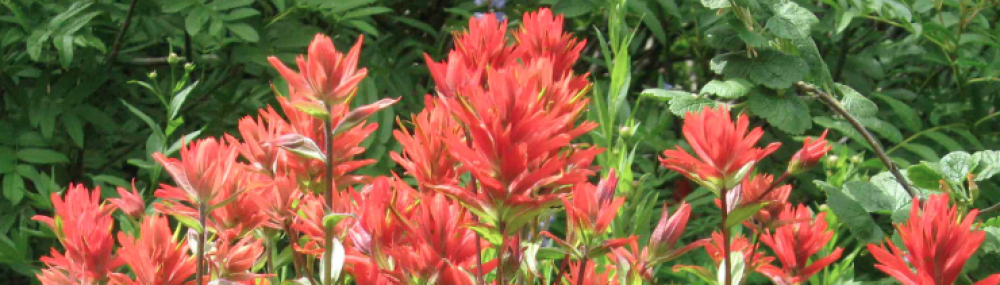

Sageflats, hillsides, and ridges throughout Jackson Hole are a bloom! Now is the time to catch the balsamroot extravaganza and to look for other treats throughout. There is so much to see. To encouarge you, below are photos with ID tips of the most common species. We have also provided some information on how flowers “work”—which pollinators come by, how do they fit, where do the fruits and seeds form. By looking closely (including dissecting plants) and knowing more, flowers are more fun. So please enjoy botanizing as you hike; or just take a walk, sit and watch what is unfurling and flying about you.
Yellow Composites:
Balsamroot exhibits a classic form of the former Composite Family now called the Aster Family. Sunflowers, asters, pussytoes, dandelions are all related. Let’s take a closer look using balsamroot as our first example.
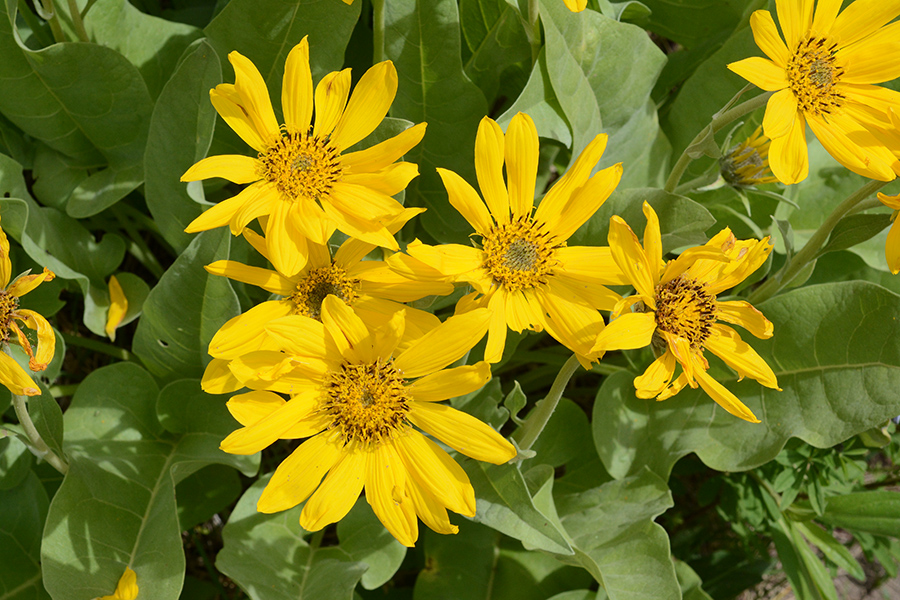
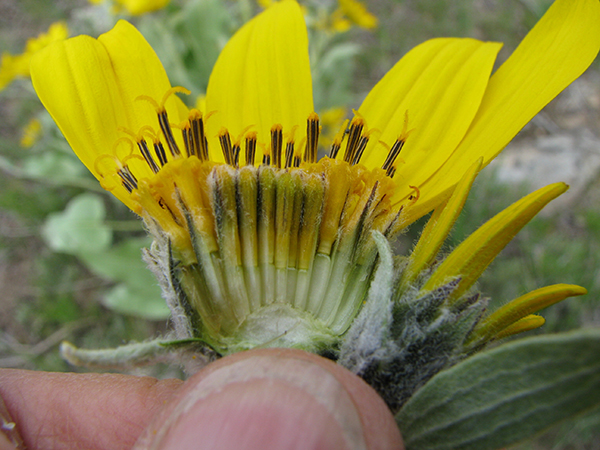
The basic flower plan in the Composite Family is a set of many small flowers arrayed on a platform surrounded by green bracts to form a “head”. Balsamroot has a ring of showy ray flowers which consist of 5 fused petals that are tongue-like (ligulate). The inner flowers are “disc” flowers also with five petals which fuse to form a tube with flared tips.
Five dark male anthers develop facing inward. The female pistil pushes through the press of male anthers to push out pollen grains that tend to stick to the outside of the stigma ready for pick up by pollinators. Soon the pollen is gone or dried up, and the stigma opens wide into a two-parted arch ready to receive pollen from another flower delivered by a pollinator helping in cross-pollination. Many different insects can easily land and forage for pollen and nectar over the course of several days. Composite heads for insects are sort of like you parking and shopping at Walmart.

Disc flowers start blooming on the outside and form a Fibonnaci spiral inwards.
Each fertilized flower produces a fruit below the petals (inferior ovary). Inside the dry fruit will be a single seed (achene). This is the same design as sunflower seeds: the hard outer shell with one seed inside. Often when you open the flower head you will see grubs settled in for a good meal.
The Composite Family has hundreds of variations (species) on this theme growing around the world. More examples are below.
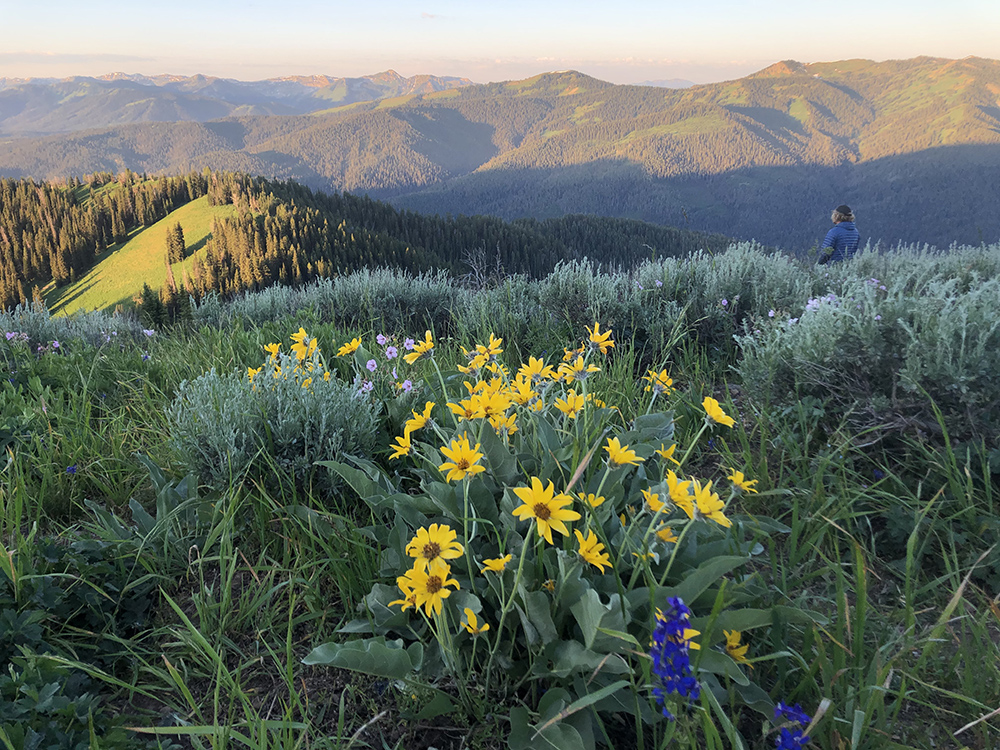
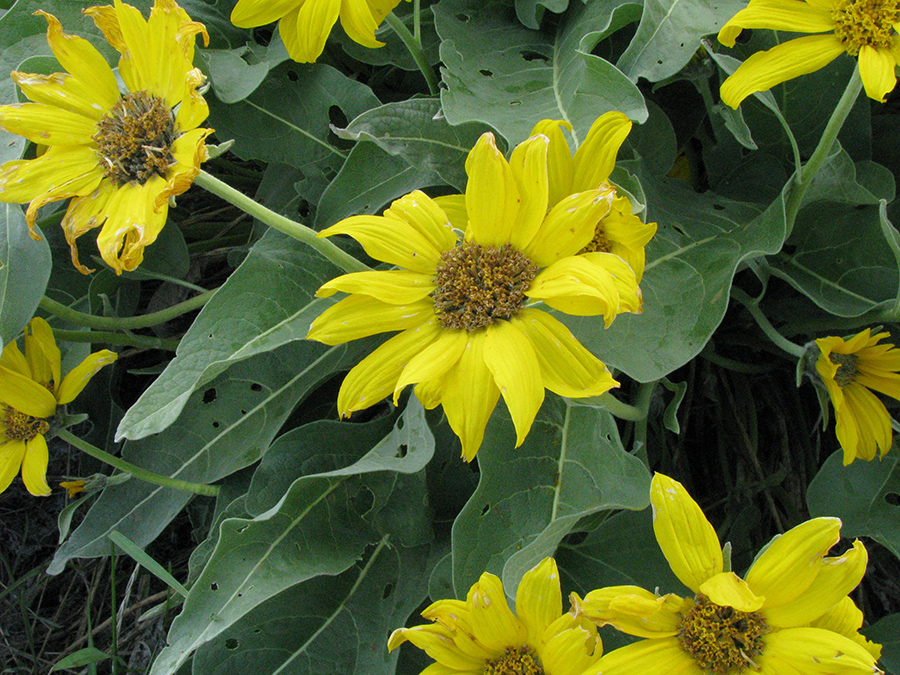
Arrowleaf balsamroot – Balsamorhiza sagittata – still dominates many slopes and sage flats in Jackson Hole right now. It has arrow-shaped, slightly hairy, large 1-2′ grayish leaves all growing on long petioles from the base. Stalks have 1-2 large flowers with yellow ray flowers and disc flowers. Fresh flowers smell like chocolate, and the roots have a balsam scent.

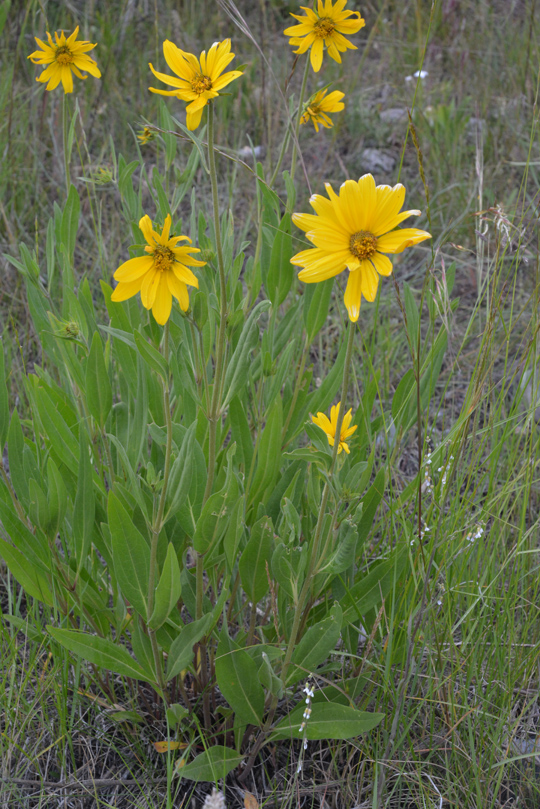
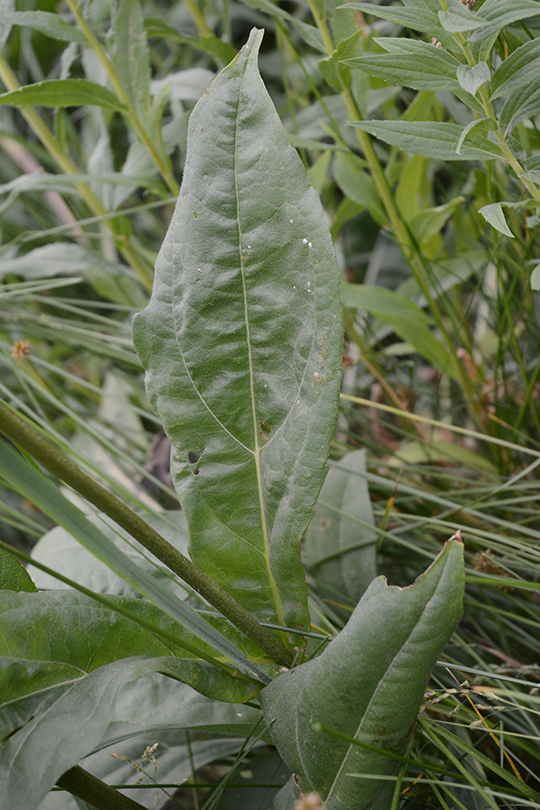
Mule’s Ears – Wyethia amplexicaulis – look similar to Arrowleaf Balsamroot at first. But note the leaves are shaped like a mule’s ears and are smooth and green.

Several orange-yellow flowers alternate up the stem along with smaller leaves. Mule’s Ears tend to be found in relatively moist, often heavy clay soils.

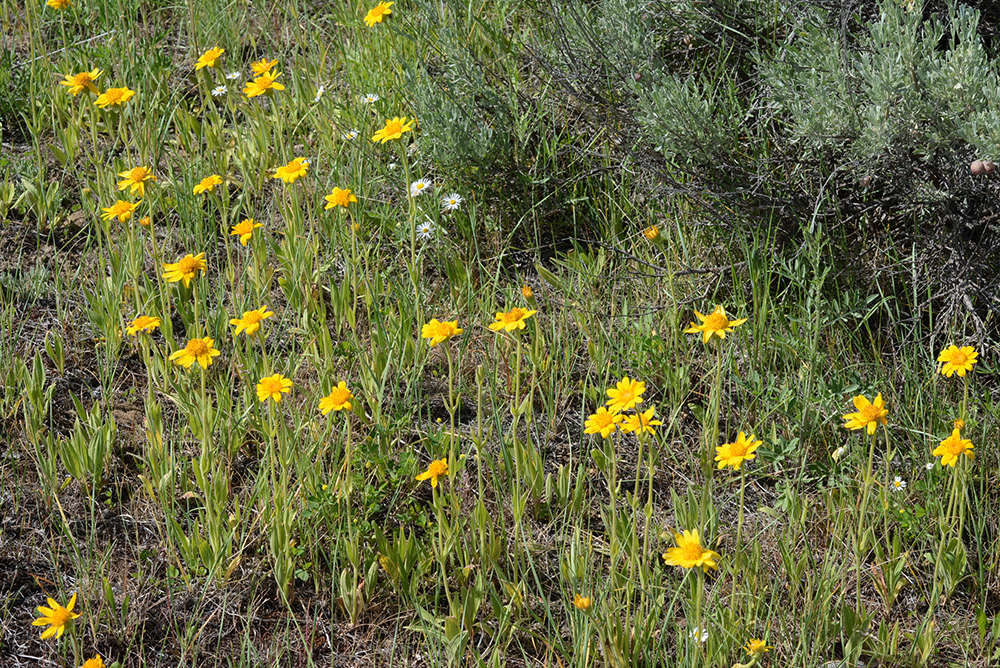
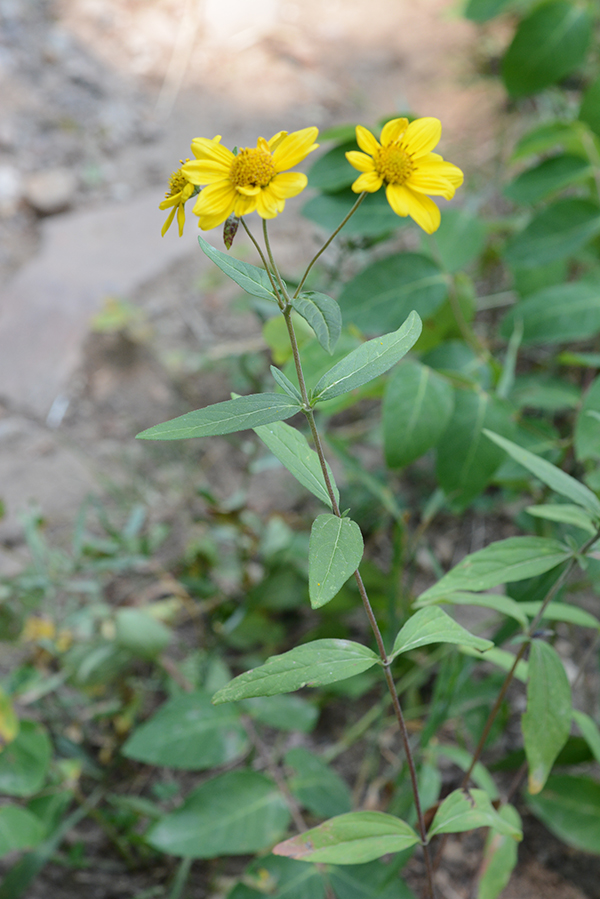
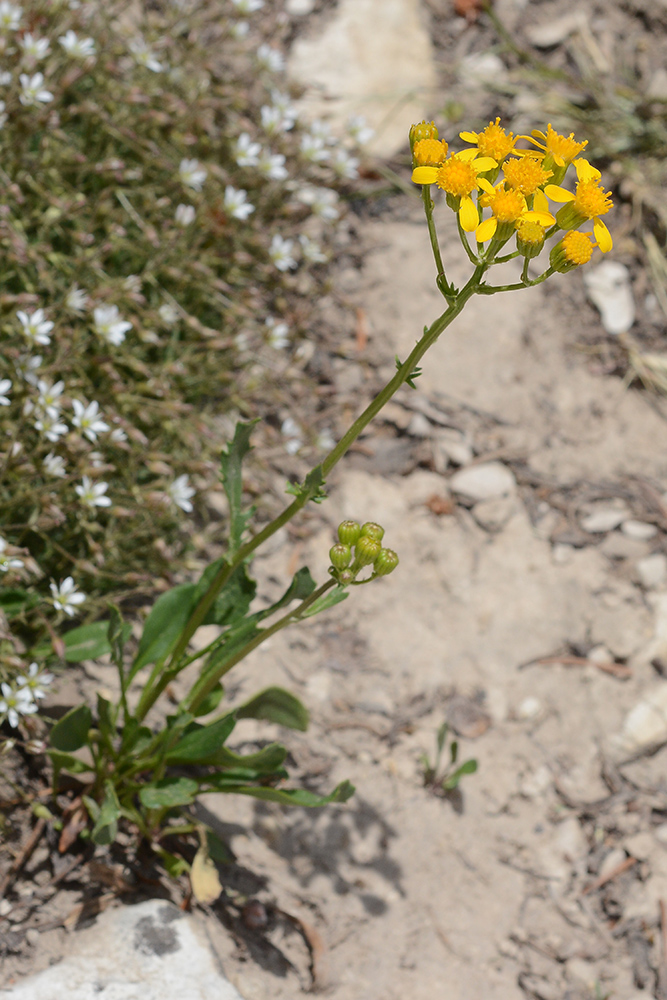
Twin Arnica – Arnica sororia – is having a good year around Antelope Flats and foothills. The bright yellow flowers stand upon 1’ stems with 2-3 pairs of narrow opposite leaves with a few more at the base.

Common Dandelion – Taraxacum officinale – This introduced European plant is still popping up in our lawns, fields, and trails. It has all ligulate or ray flowers that look like petals – actually each “petal” is 5 petals combined. The bracts are in two rows, the outer row is reflexed, the inner stands upright.
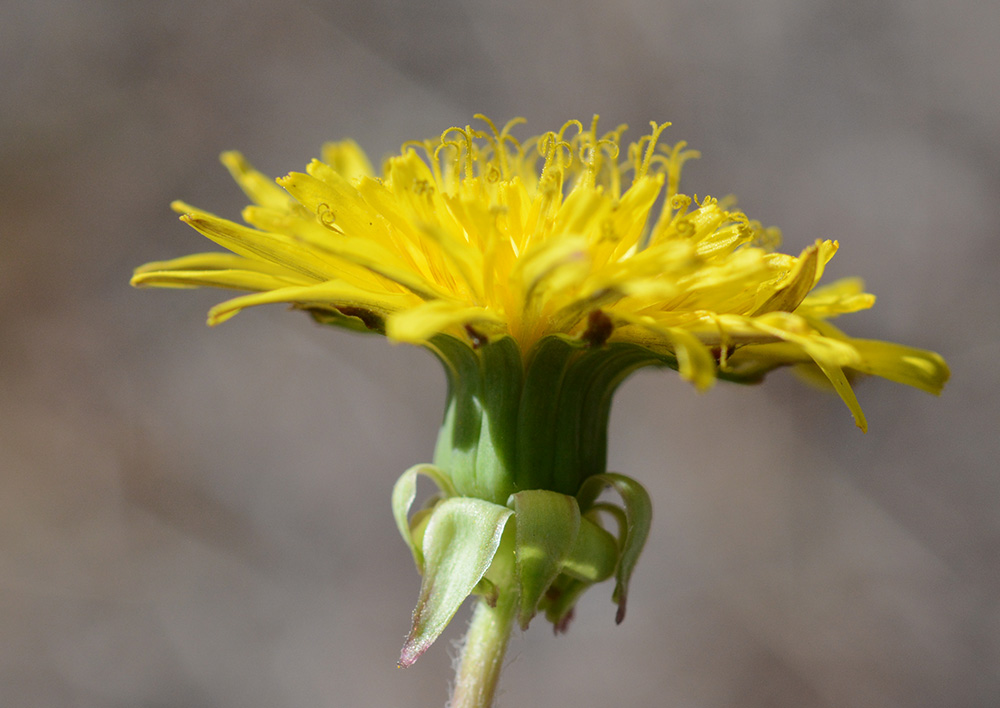
From each ray flower, tiny rough fruits (achenes) are formed and are attached to a pappus that serves as a parachute for distribution of the seeds by wind.

While annoying to us, dandelions are favored by many bees and seed-eating birds. They are also full of healthy vitamins and nutrients. https://www.mountsinai.org/health-library/herb/dandelion Note we have native dandelions seen mostly at higher elevations.
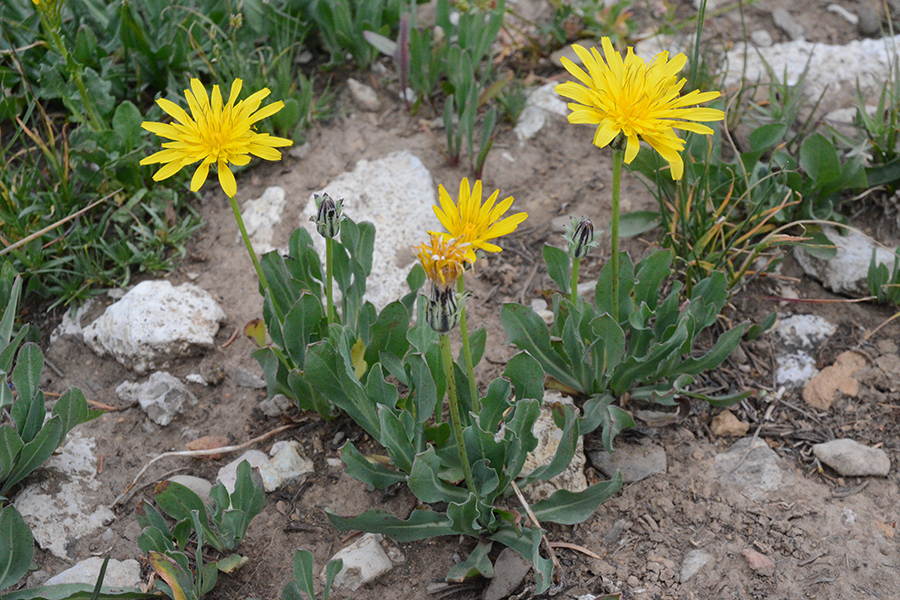
Mountain or False Dandelion – Agoseris glauca – All the flower heads have yellow, ligulate or ray flowers, as in the common dandelion. Each plant produces only one flower head.

Several rows of upright bracts encircle the heads. All the leaves are basal.
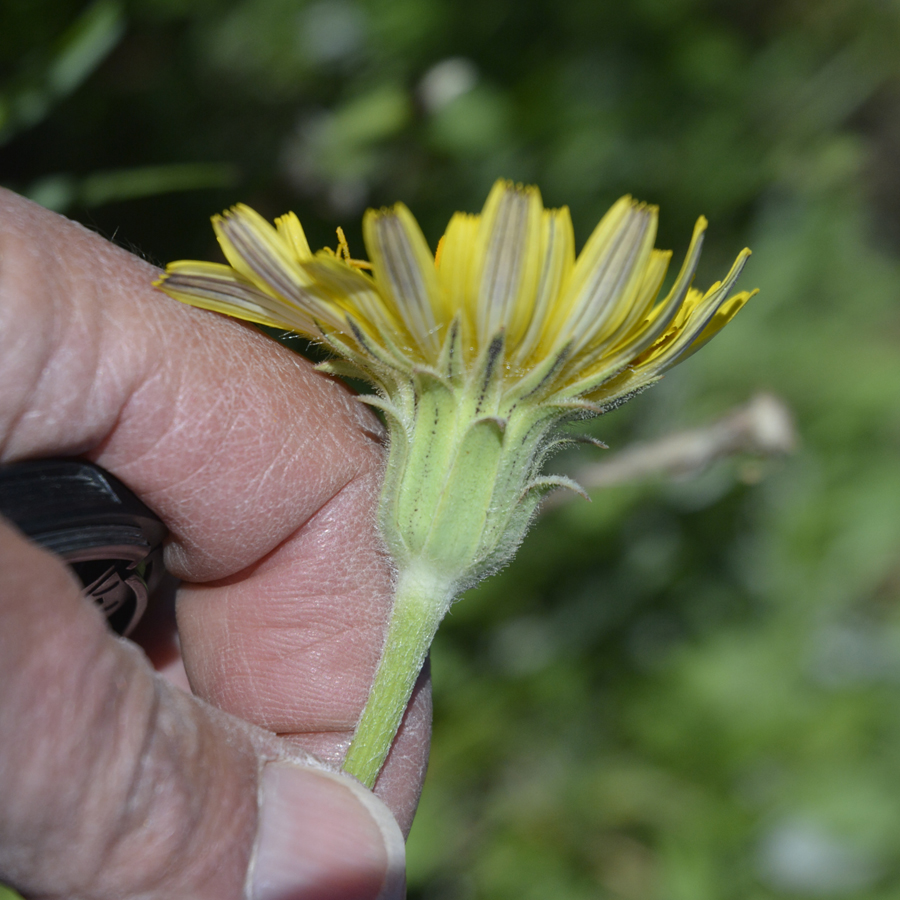
Fruits are elongated and smooth. You can see why this is called False Dandelion–it takes a close look to tell the differences.

There are three varieties of this species and two other genera (Nothocalais nigrescens and Microseries nutans) that are very similar. The achenes or fruits are the best way to be sure of your ID and are not addressed here.
Pussytoe – Antennaria sp. – flower heads have only disc flowers and scaly inconspicuous bracts and, therefore, look very small and plain compared to many of our composites. Pussytoes in general are easy to ID by their “pussytoe”-like flower heads. Heads have either male or female disc flowers on separate plants (dioecious).
In the photo, the heads with male flowers are on the left with anthers bearing pollen, and the heads of female flowers are on the right with delicate white stigmas with many extra bristles. Pussytoes often make seeds without fertilization (apotomictic) and/or are polyploids (having extra sets of chromosomes) which can make ID more complicated.

Below is a Small-leaved Pussytoe – Antennaria microphylla with a mat of small, hairy leaves

and its rosy form with pinkish bracts (female heads):

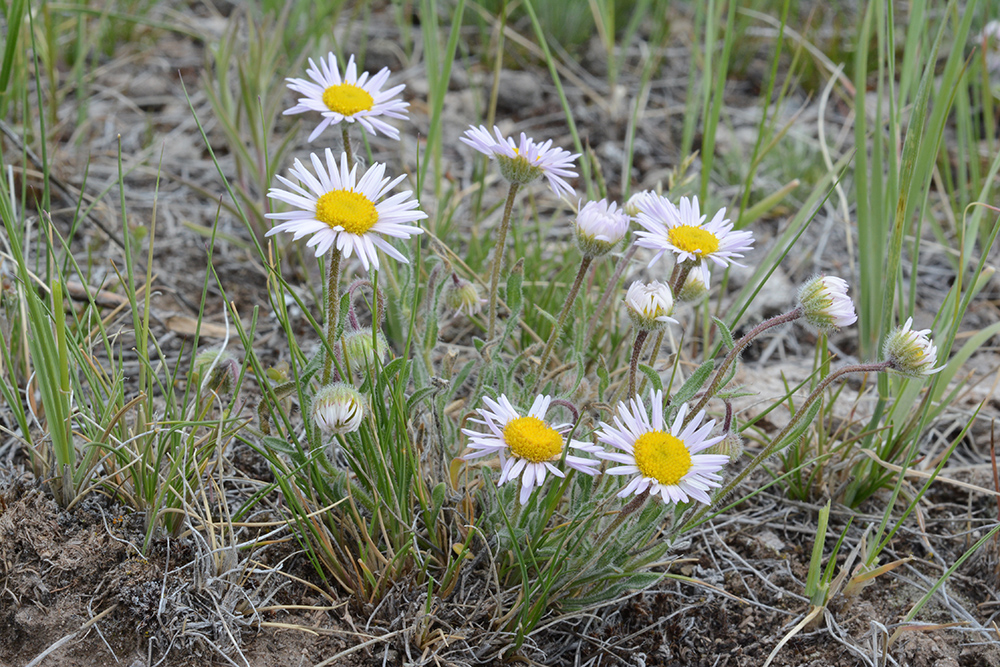
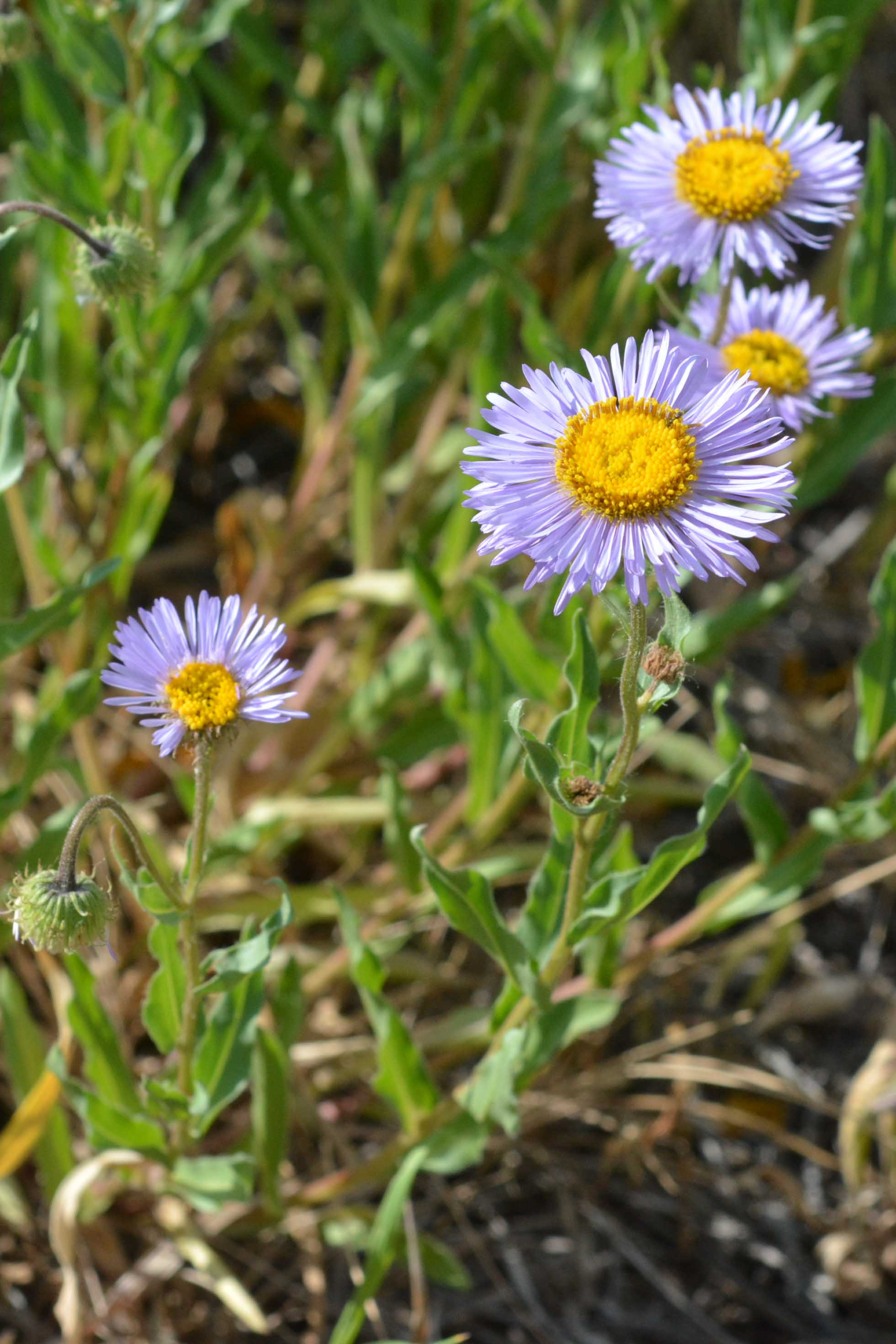
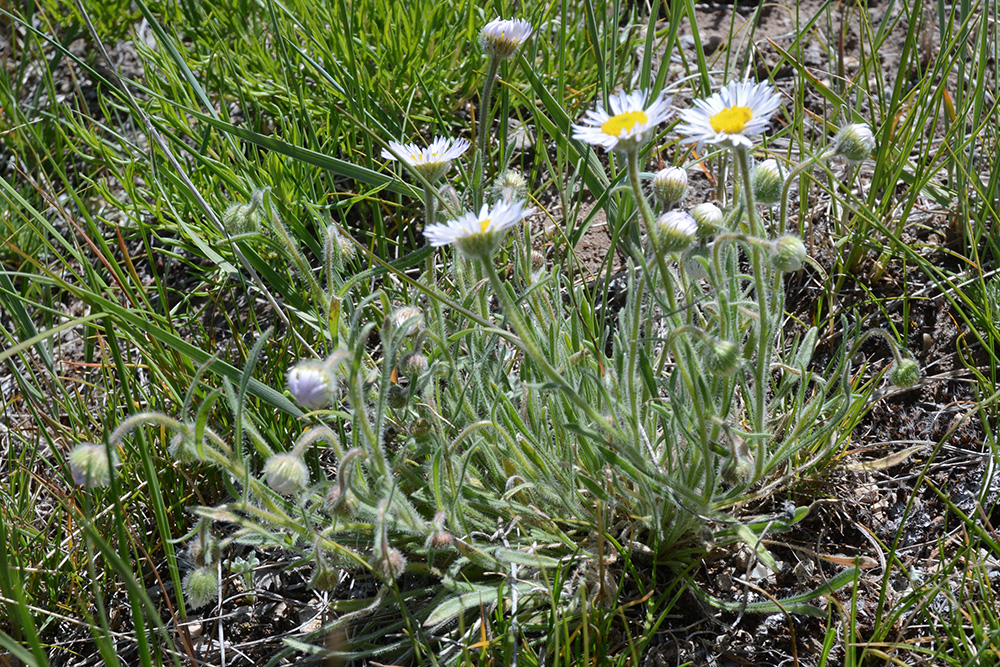
Low growing Shaggy Fleabane – Erigeron pumilus – is common on many dry knolls. Fleabanes have heads surrounded by a ring of equal-sized bracts and many narrow ray flowers. In this species the maturing flower heads nod, the 1-2″ leaves are very narrow, and hairs stick straight out like the hairs on a frightened cat! Hairs reduce water loss by shading the surface of the leaf and reducing velocity of wind currents. Hairs are common on plants growing in dry locations.
One of Many Mustards
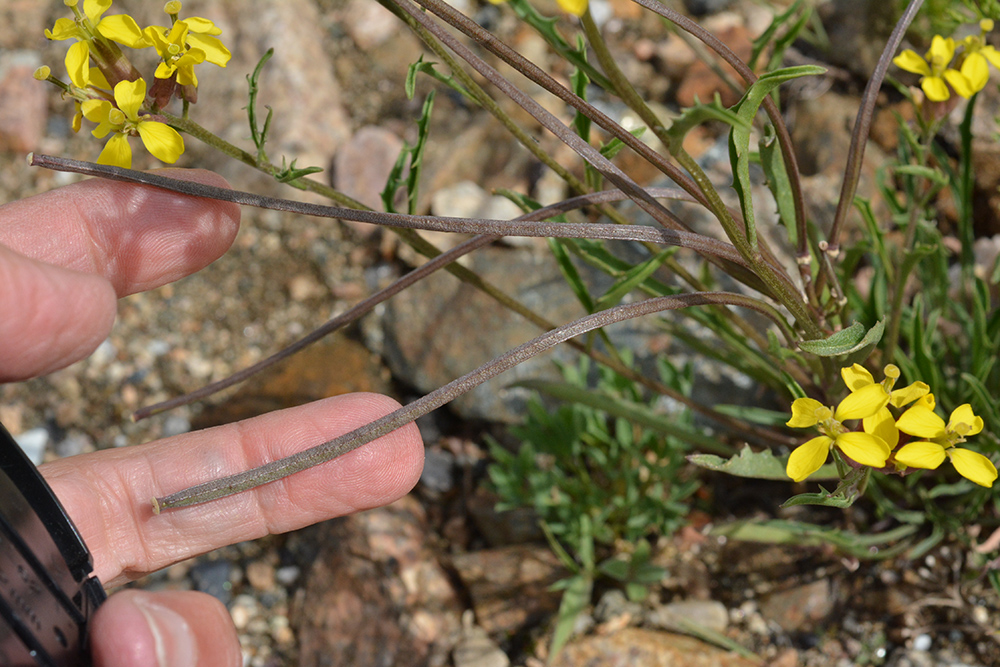
Rough Wallflower – Erysimum asperum – grows to 18″ with several yellow flowers at the top. Flowers in the Mustard Flower typically have 4 sepals, 4 petals, 6 anthers – 4 long, 2 short, and a single pistil with one stigma.
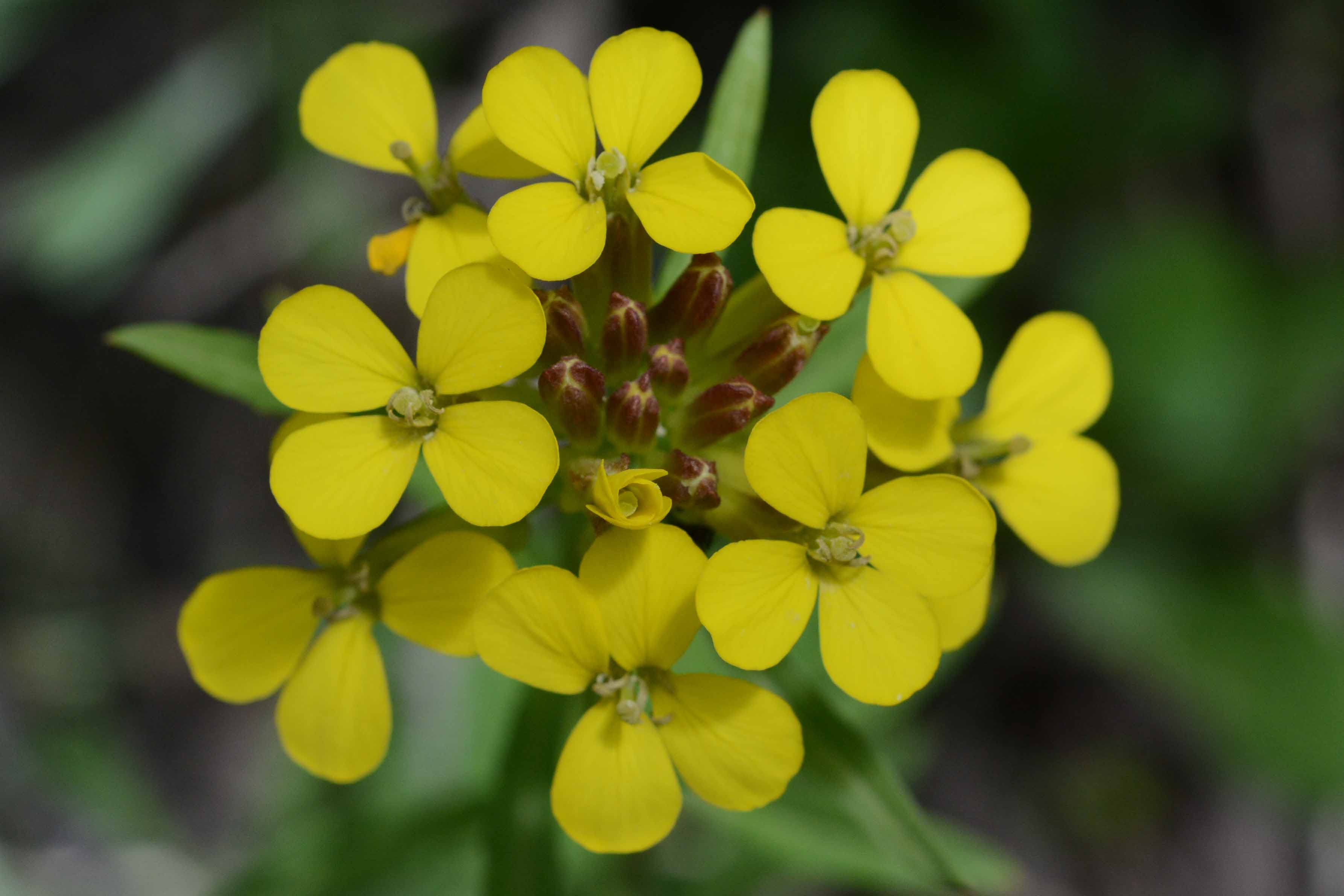
In this specis the ovary extends into a 4-6″ fruit called a silique–think sleek siliques.
Other mustards such as Penny Cress – Thlapsi arvense – may have roundish silicles where the fruit is about as long as wide. In the picture below you can seed the seeds forming inside.

This is a very weedy 12″ annual of disturbed sites; however, it can be helpful in stabilizing open slopes, providing a protective layer from eroding rain drops until other plants can take root. The Mustard Family is very large with many rare as well as many weedy plants. Fruits and even hairs may be essential for ID, a bit frustrating for this botanist.
More Yellows:
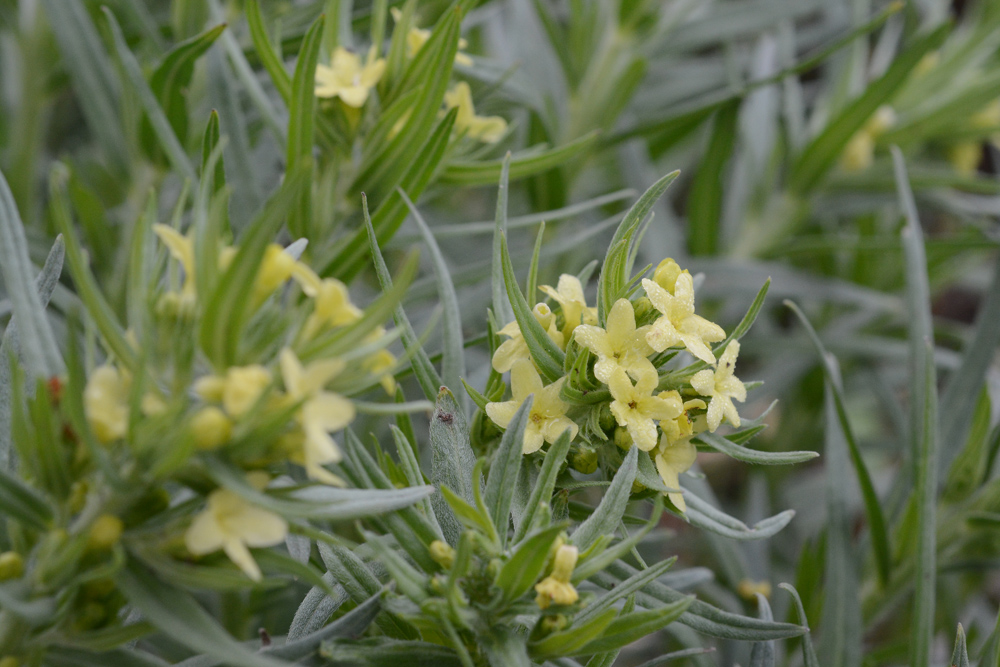
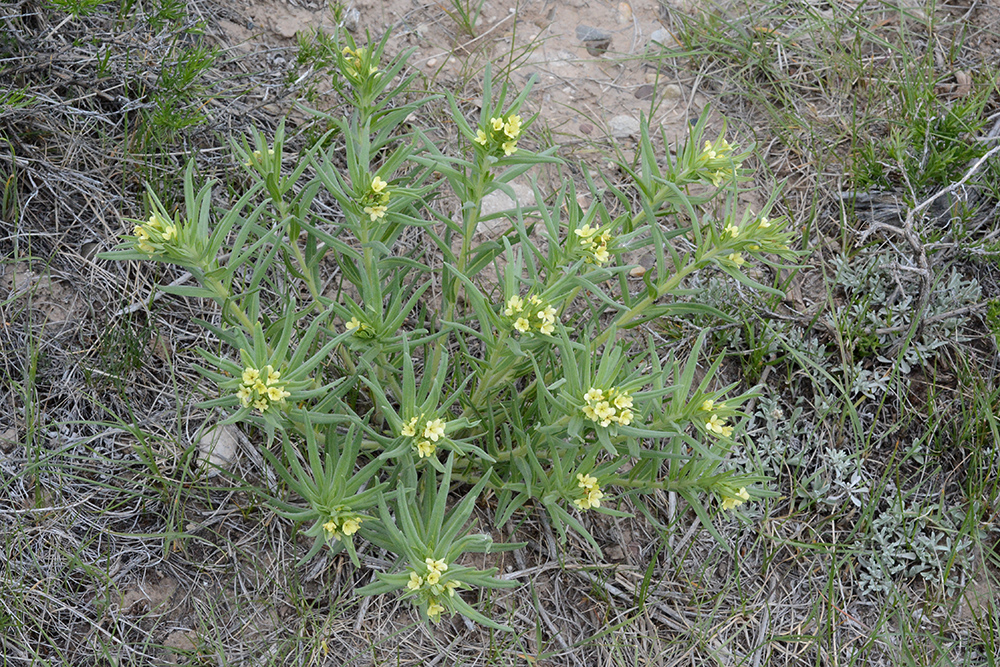
Stoneseed – Lithosperma ruderale – has delicately scented yellow flowers tucked amidst the leaves near the top of robust 1-2’ plants.
Plants have been used historically as a contraceptive by various native peoples here in North America, and its cousin was similarly useful in European. The fruits will look like white tear drops and are very tough.
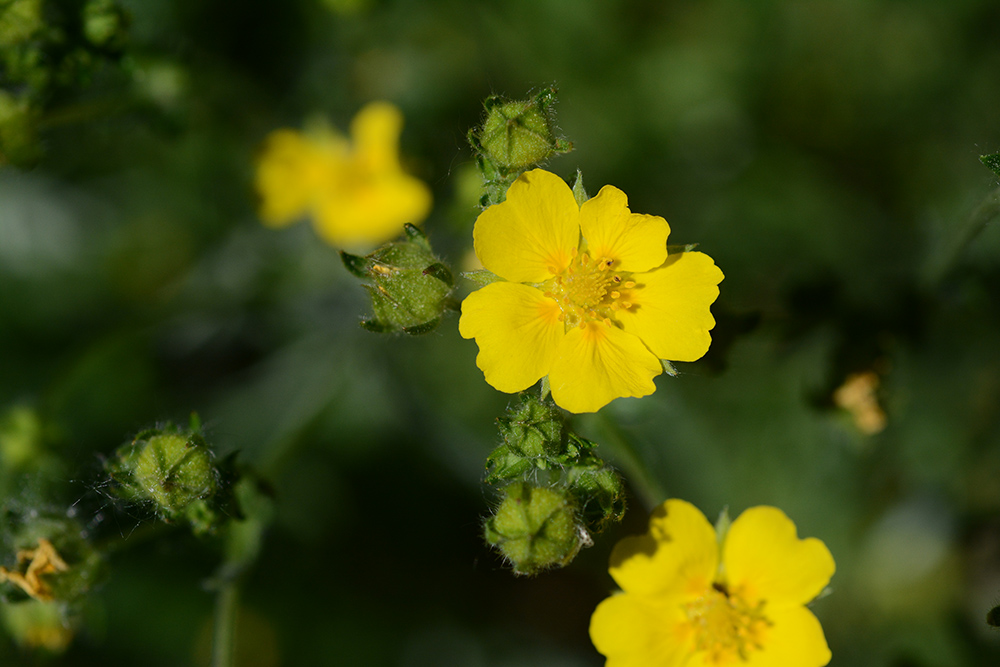
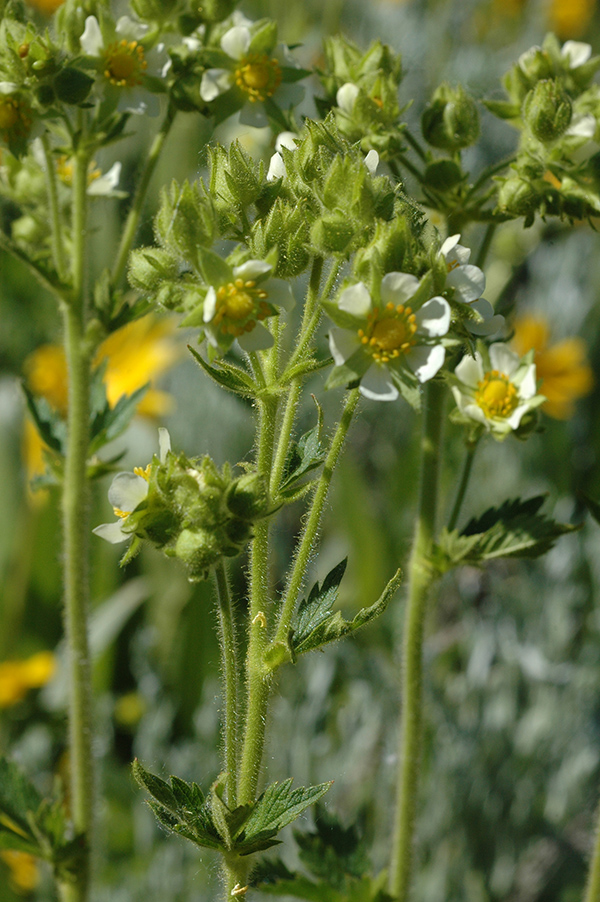
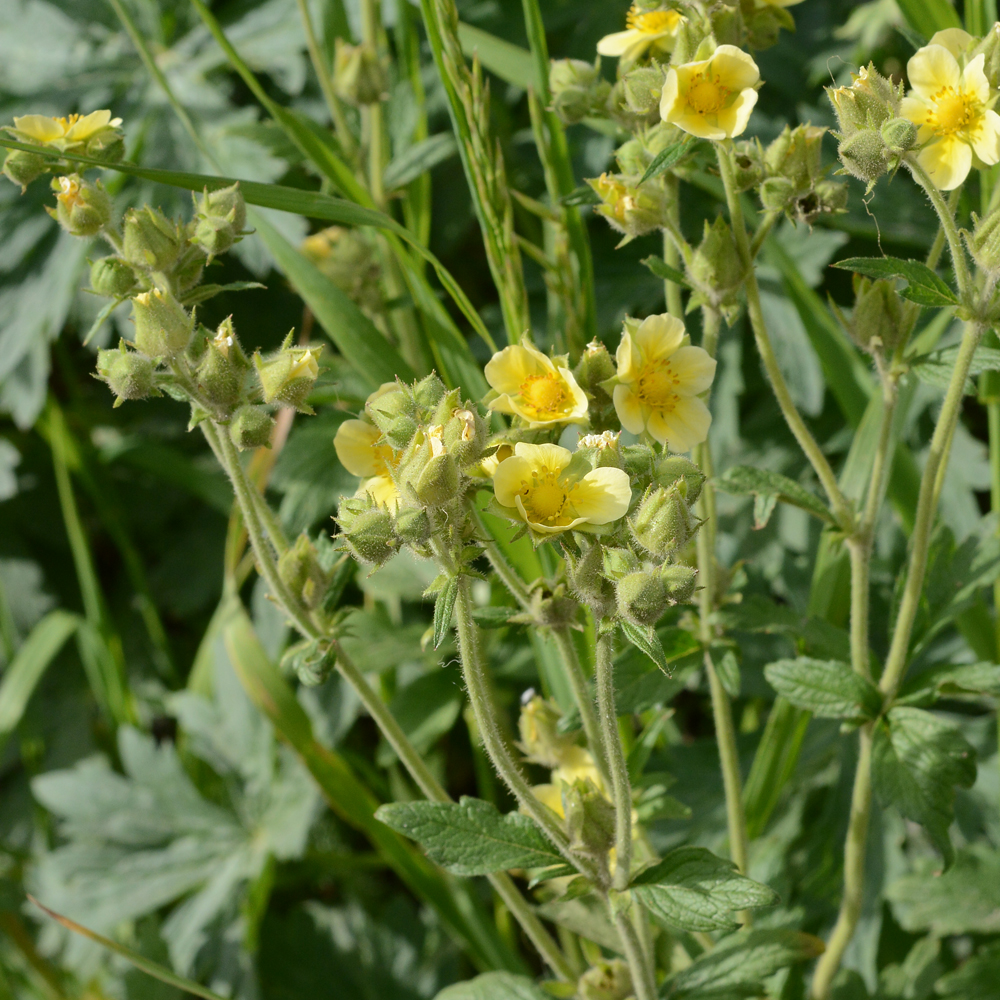
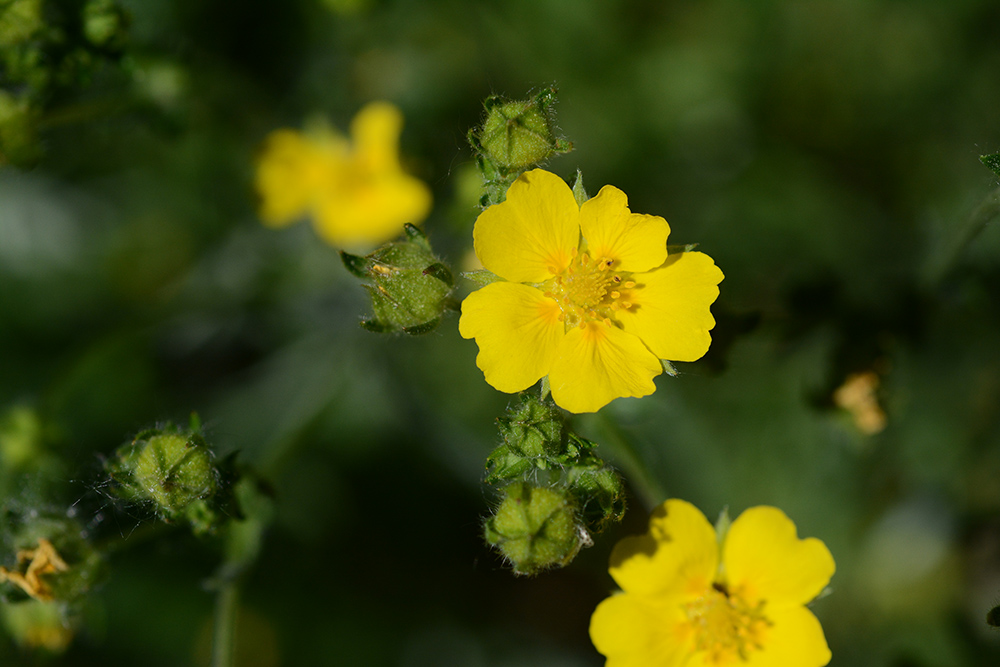
Cinquefoils – Potentilla spp. – are just coming out with their cream to yellow flowers on top of 2’ stems. About four common species with a variety of subspecies complicate precise identification, with several other low growing species also found in the county. Generally, Cinquefoil leaves are divided into 5 (cinque) or more leaflets arranged either in a palmate or pinnate arrangement. Flowers are held near the top and have 5 green sepals and 5 yellow petals with many stamens and pistils. Examining the small flower features with a 10x handlens is critical to accurate ID. Regardless of identity, cinquefoils are very important for many pollinator species, and are host plants for several different butterflies.
Paintbrushes
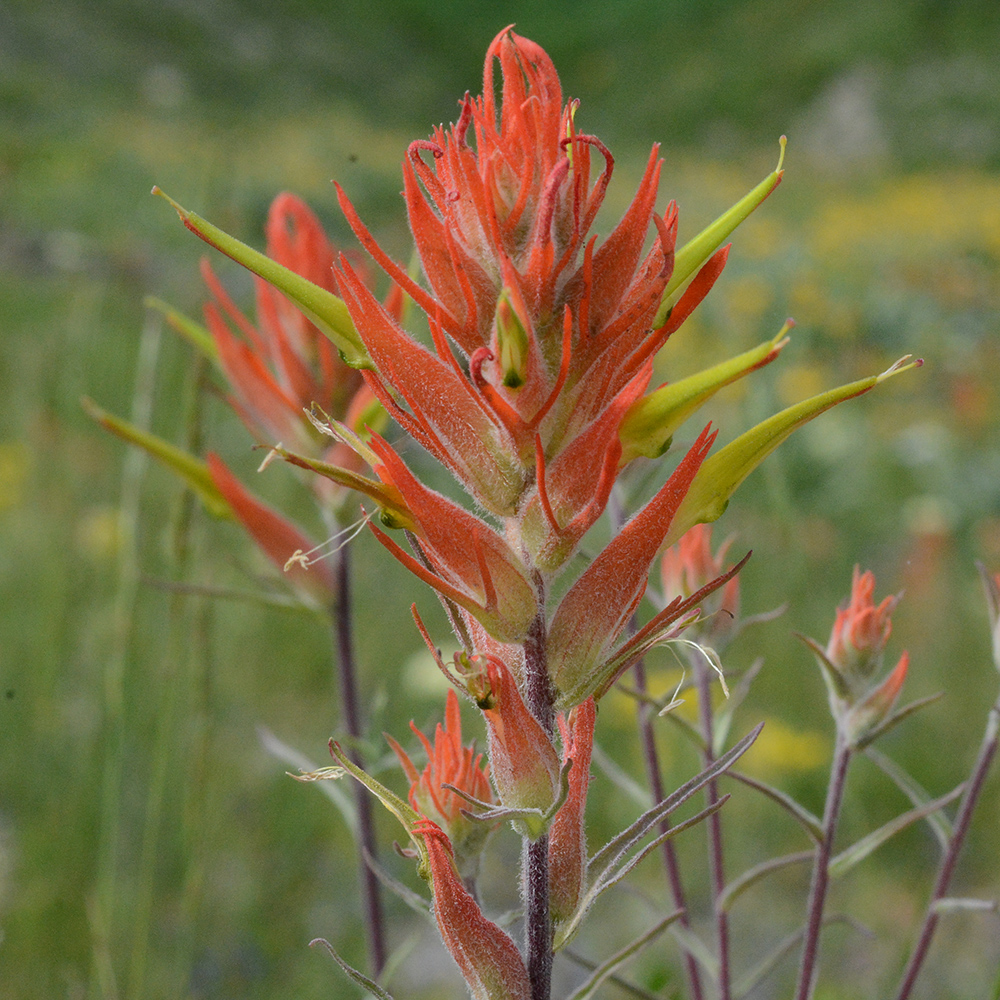
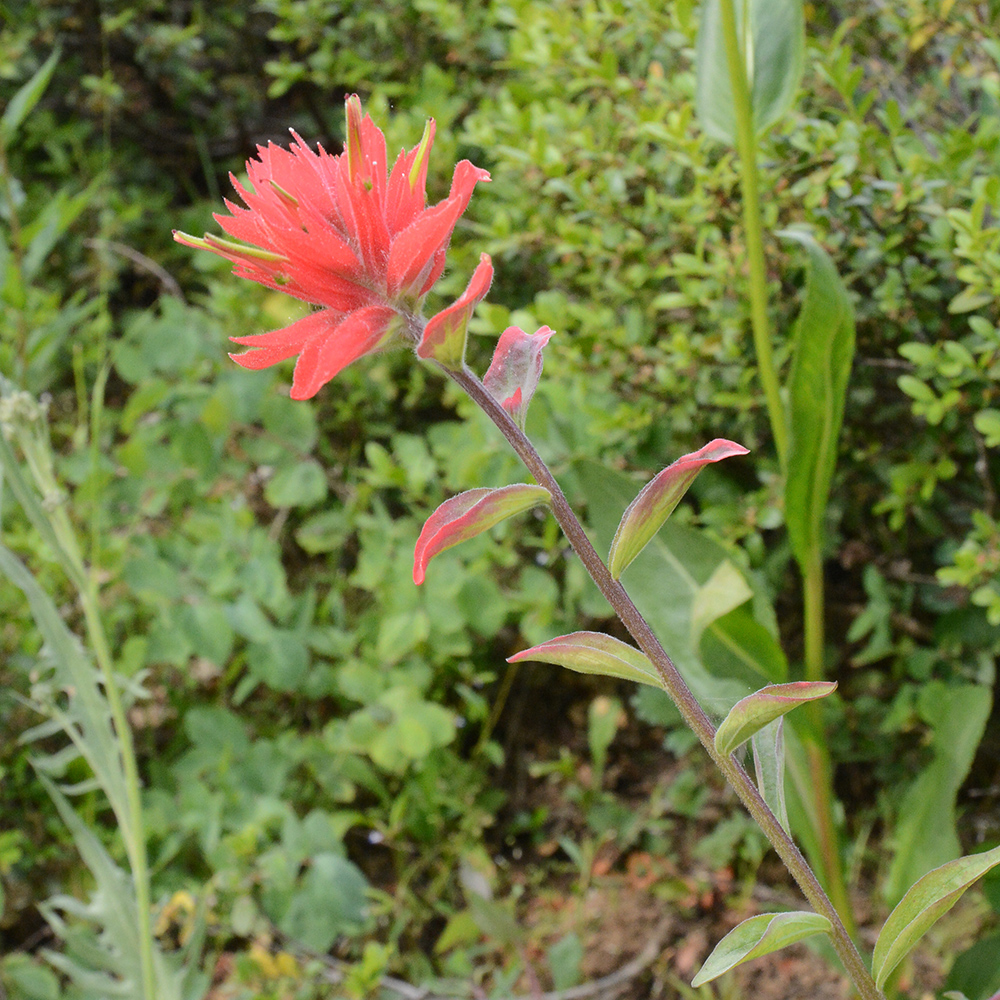
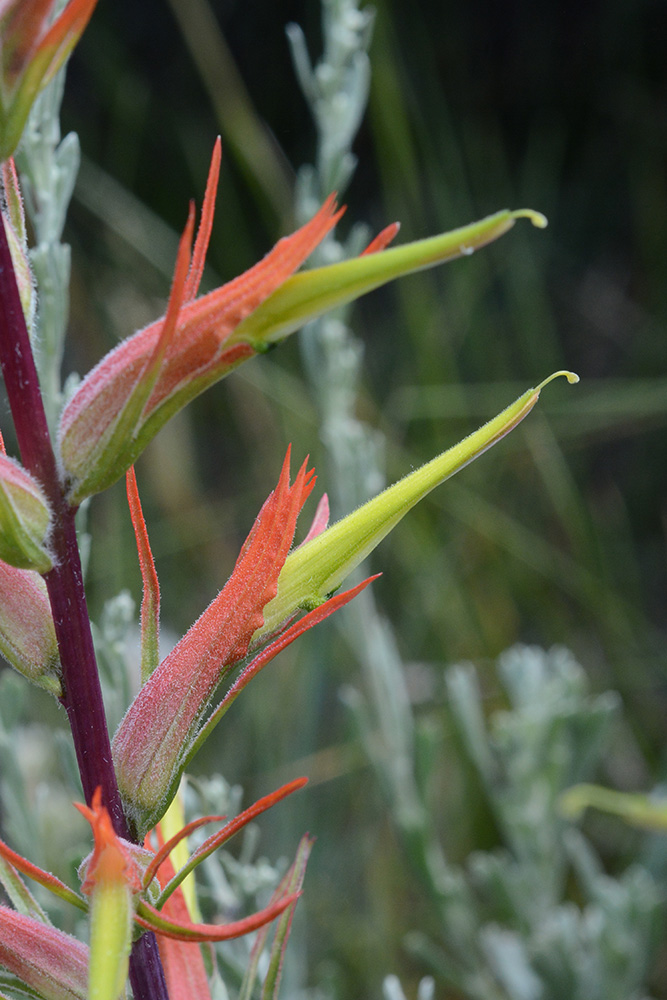
There are several species of red, orange and yellow paintbrushes in Teton County. While most people recognize a paintbrush, technical features separate the different kinds, and hybridization and allopolyploidy (multiple sets of chromosomes from different parents) add to the confusion. For instance, colors may range widely within a species.

Most paintbrushes are hemi-parasitic: they attach to grasses, lupines, and other host species to grow vigorously. Indeed, some siphon off toxins from lupines to produce particularly effective defense systems. If purchasing a paintbrush, be sure to also obtain its host plant for success.
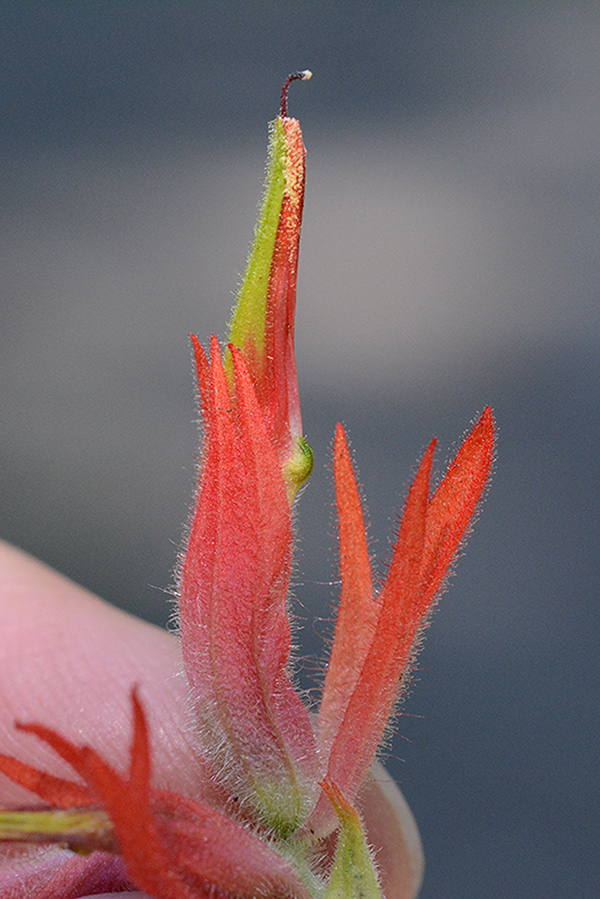
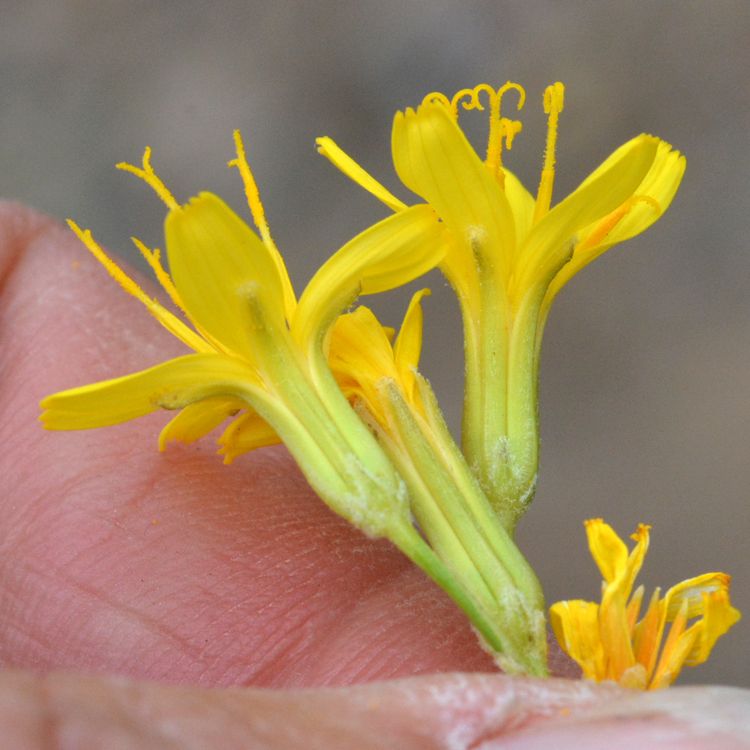
Botany is a hands-on occupation: take a 10x handlens, find some examples (not in a national park) and do some dissection to see if you can distinguish the species. Below is picture of a typical unit to start with: full unit left, taken apart to show: bract which provides added color and protection; sepals forming a tubular calyx; and the petals (corolla) creating an elongate tubular flower with a greenish “lip”. Anthers and pistil are secured within.

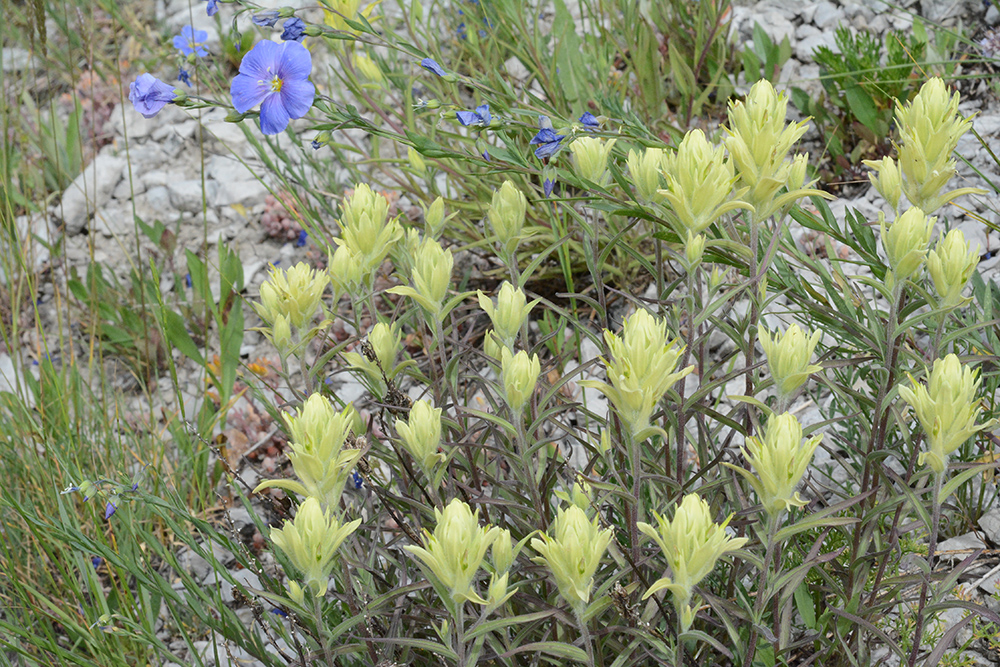
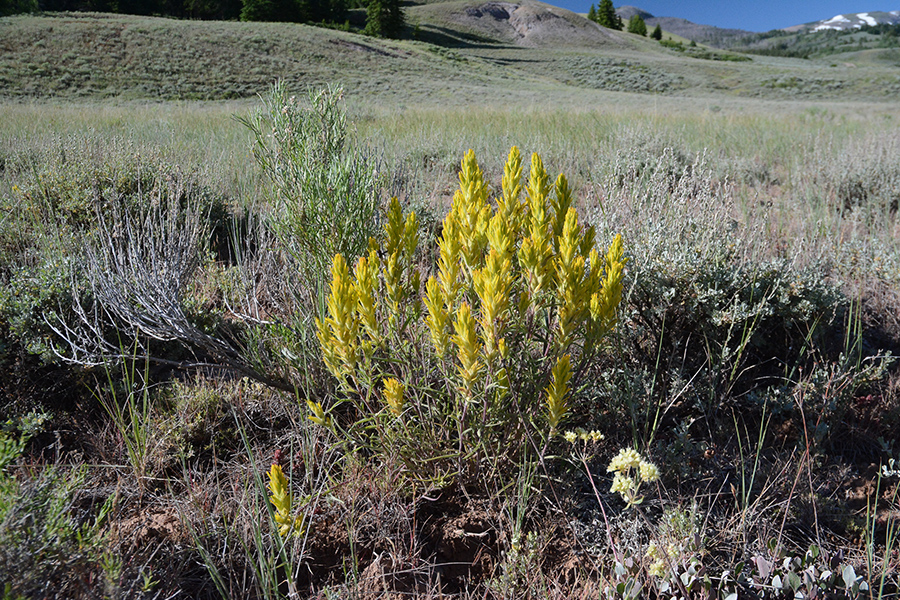
The following three yellow species are found in and around lower, sunny, relatively dry elevations of Jackson Hole now. They are not easy to ID, and just knowing the plant is a paintbrush is great!
Yellow Paintbrush – Castilleja flava – is a bright yellow color. Flowers are rather remote and not so hidden by bracts as the other 2 species. Calyx 12-23 mm long, deeply and subequally cleft above and below, its primary lobes are divided into 2 triangular, acute segments 2-6 mm long. (The photo of parts above is also Yellow Paintbrush.)
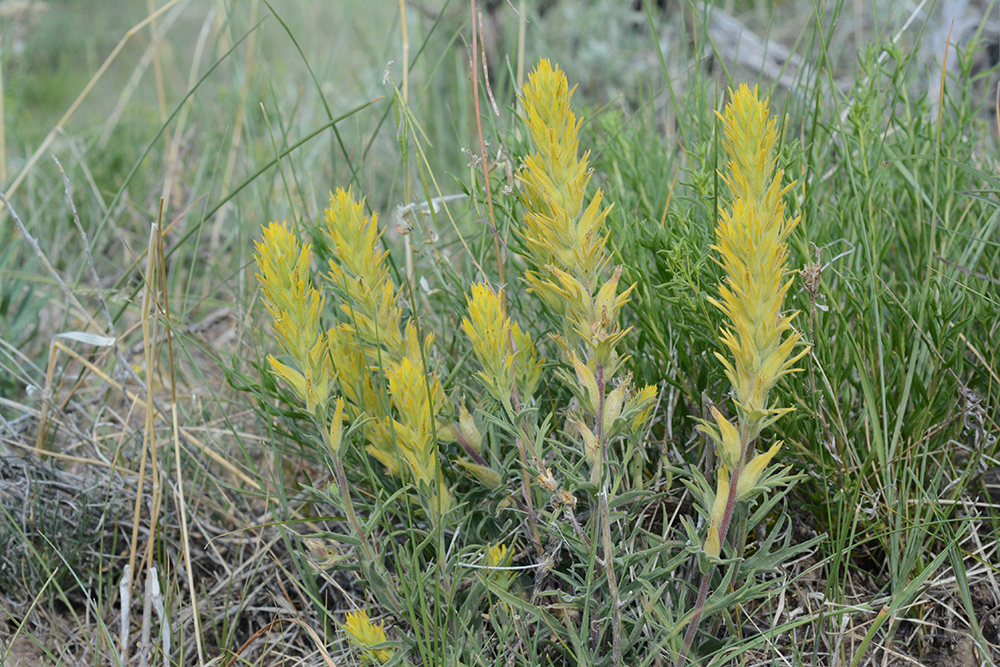

Pallid Indian Paintbrush – Castilleja pallescens – is pale yellow, the calyx (fused sepals) is cleft more deeply in front and back than to the sides. Ultimate calyx lobes are acute to acuminate. Note the large expanded pouch: lip, and the stipma jutting out the top of the flower tube.
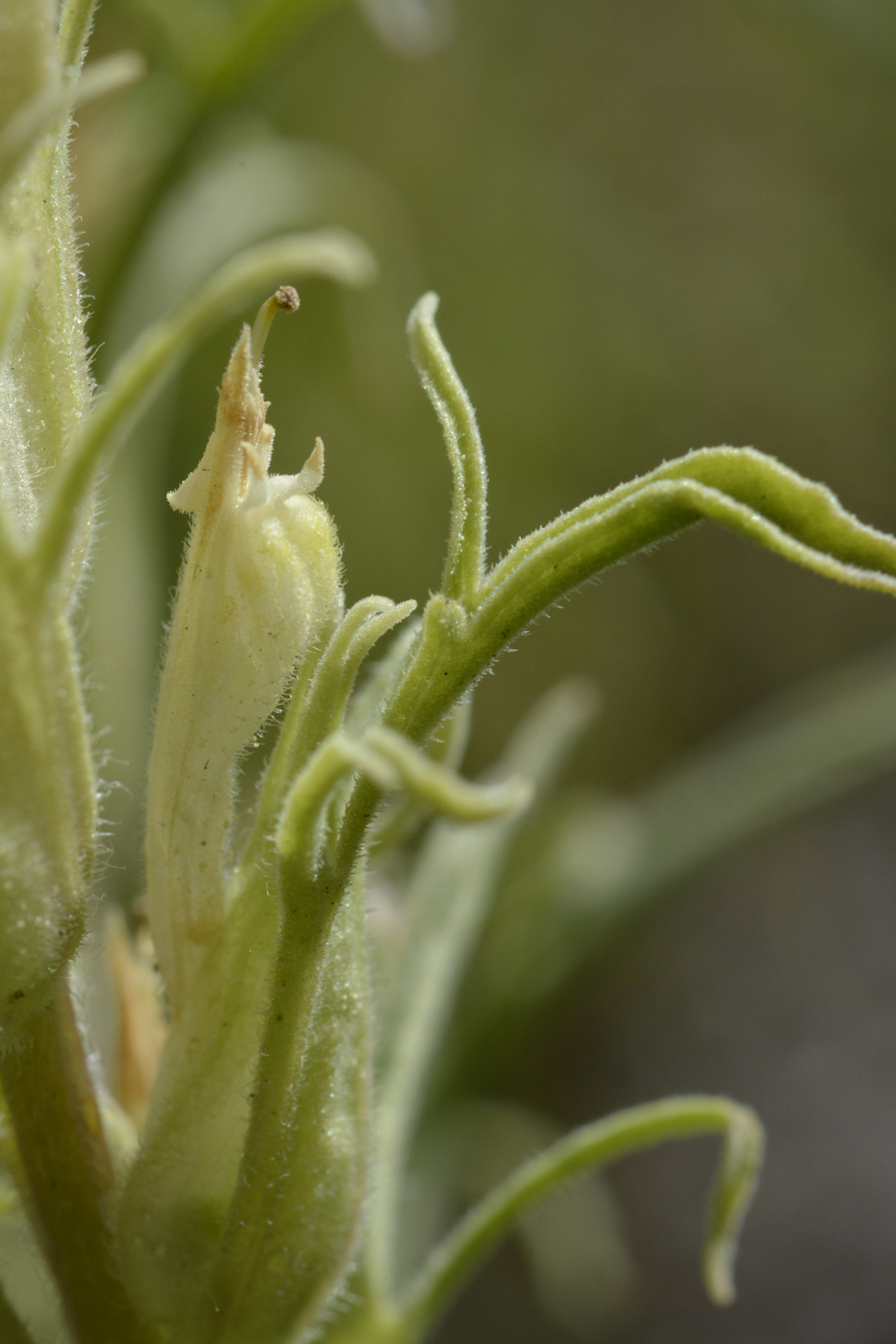
Parrot-head Indian Paintbrush – Castilleja pilosa var. longispica – Also pale yellow, the calyx is cleft to about the same length into 4 equal, pointed lobes. The inflorescence overall has puberulent to sparsely villous hairs. Plants are many-stemmed and generally decumbent at their bases. No photo, but in your dissection look for the calyx with equally sized, sharp pointed lobes.
Parsley/Carrot Family – Apiaceae
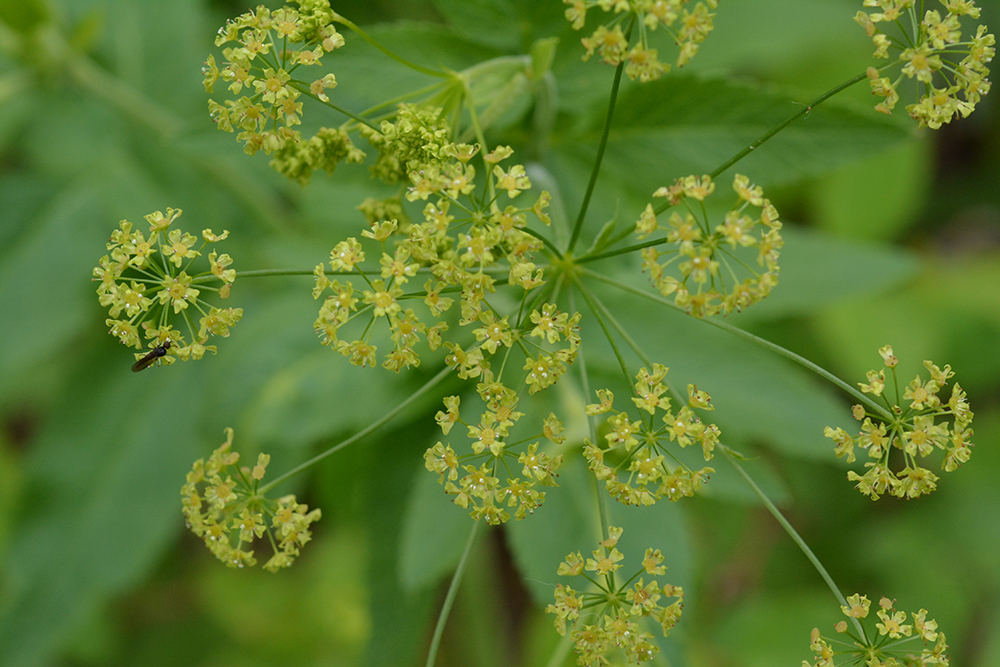
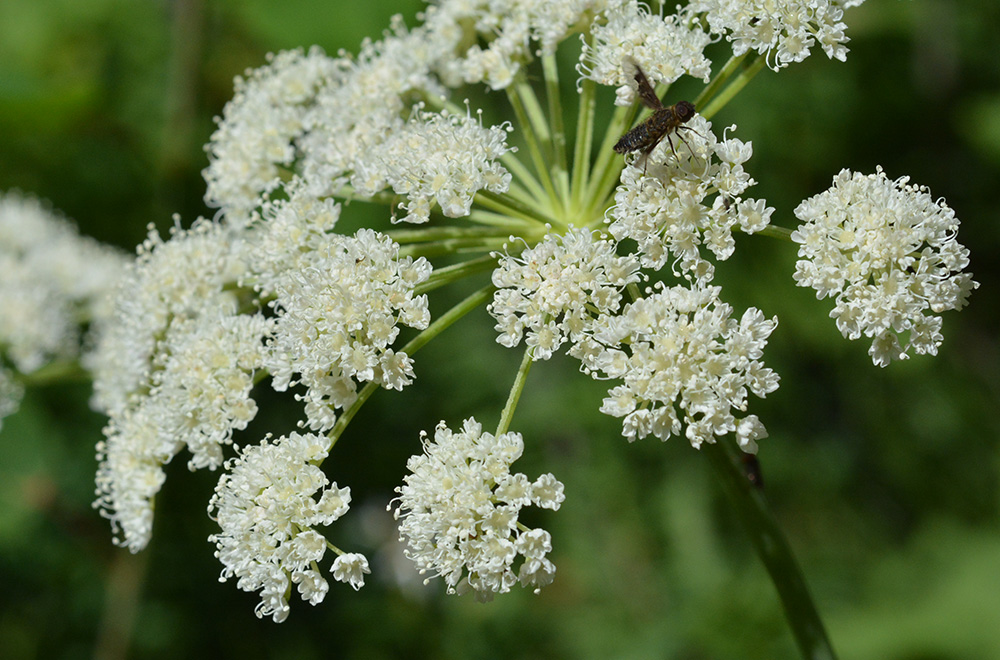
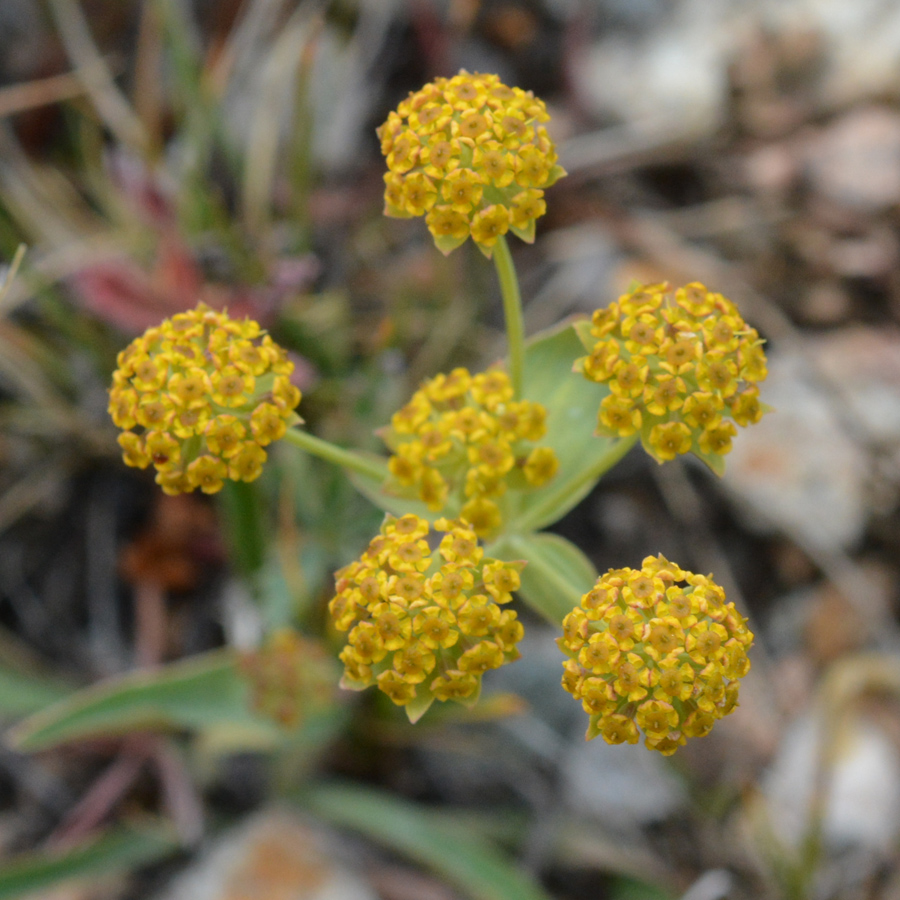
Look for the umbel of the inflorescence. The tiny flowers are held out at the end of stalks arranged around a central point like ribs of an umbrella.
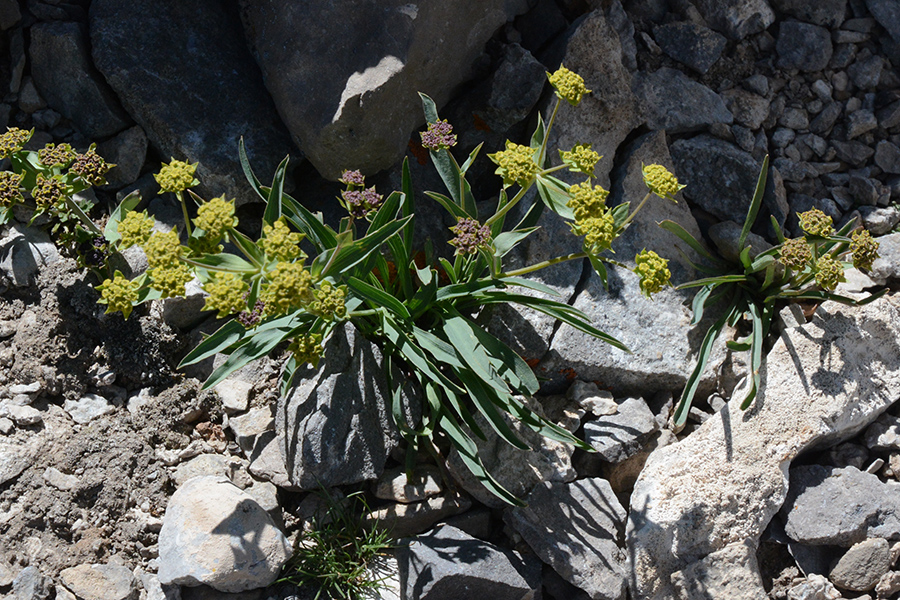
Nineleaf Biscuitroot – Lomatium triternatum var. platycarpum (now L. simplex) – As the name implies, the leaves are thrice divided in threes to from nine linear lobes and look grass like.
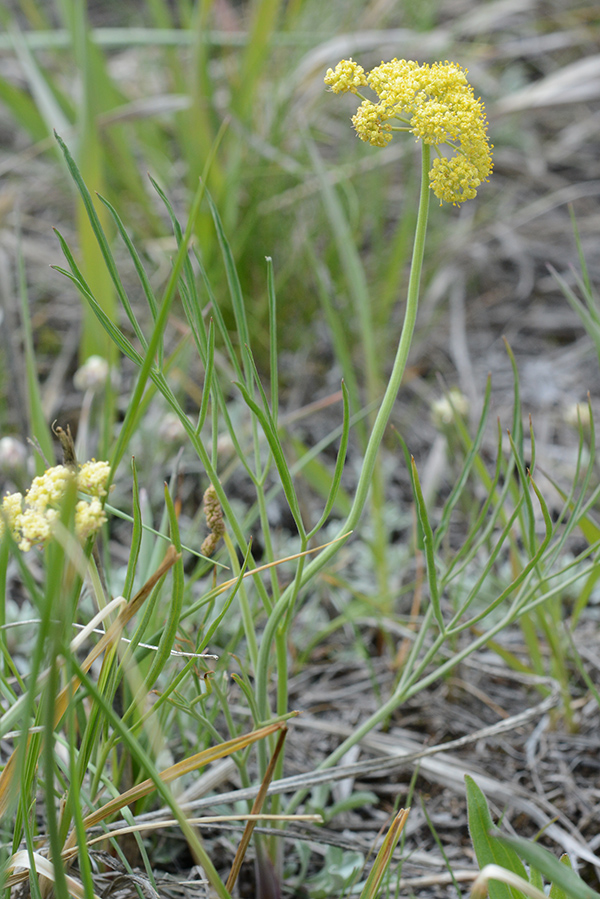
The flower umbels each have a whorl of tiny bracts around their bases.

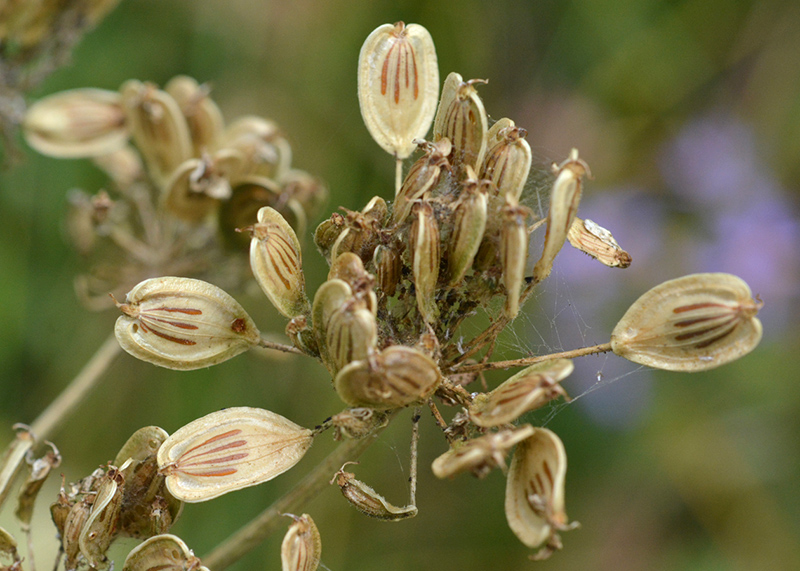
Each flower will have dried fruits that split into two single seeded parts=schizocarps. Here they are flat with a few ridges and wing-like edge. Fruits are important in ID of the Carrot Family.
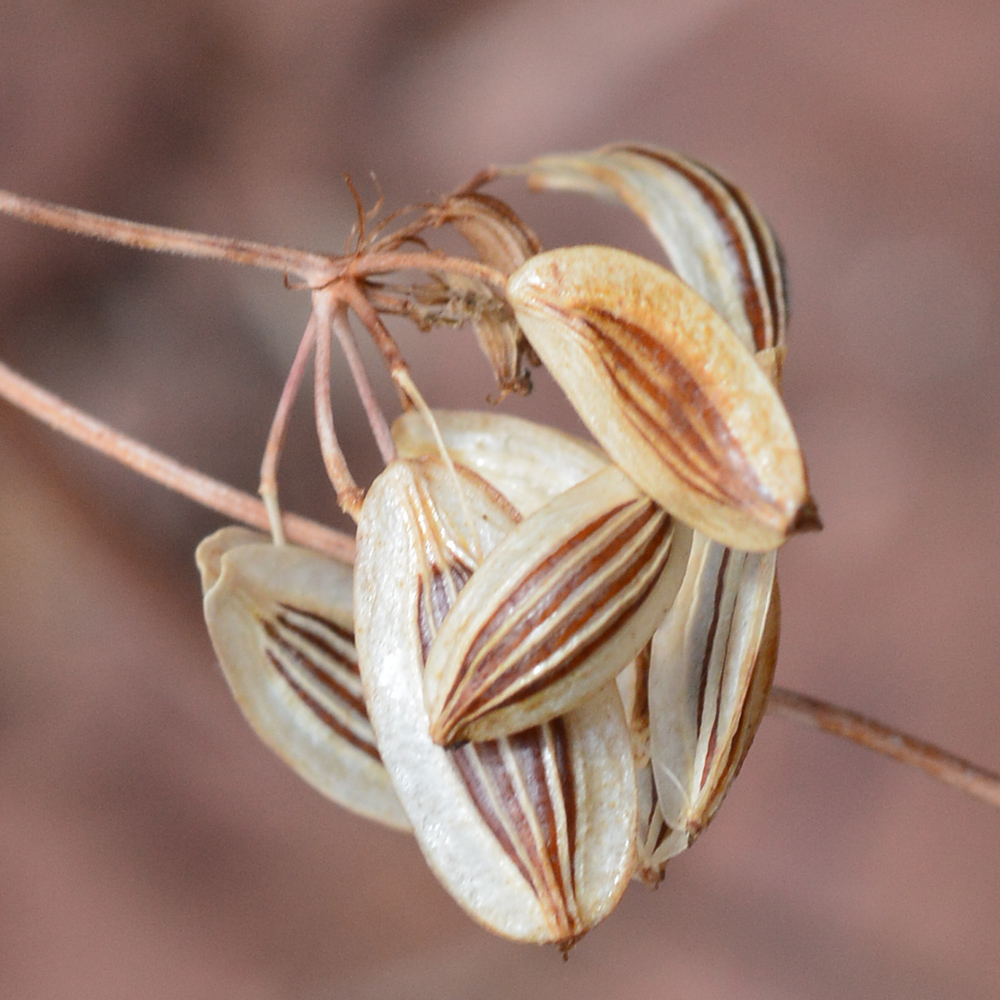
The starchy, edible taproots were a source of food and medicine to Native American tribes. The roots were cooked or dried and ground into flour, which could be shaped into cakes and stored for later use. They were also used for flavoring.
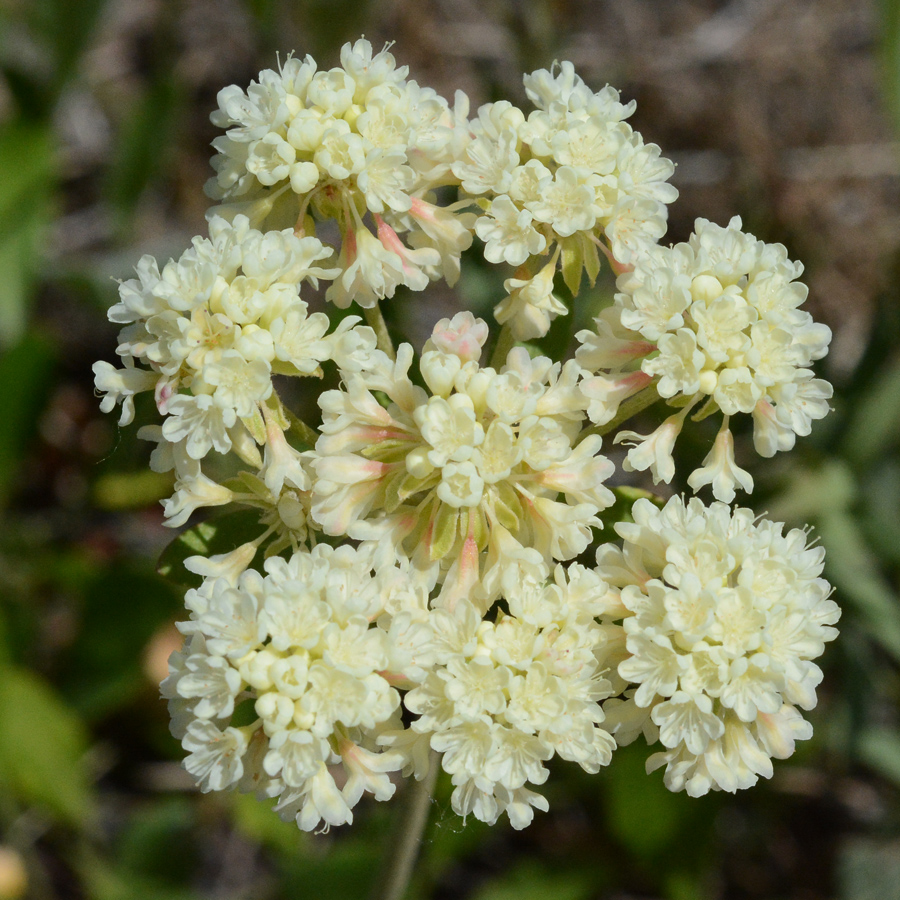
Wyeth Biscuitroot – Lomatium ambiguum – blooms along dry, often disturbed slopes and flats, and are particularly abundant around the Saw Mill Pond overlook and the road cut on the north end of the Moose-Wilson Road and the inner park road. The compound leaves are divided in uneven segments. There is no set of bracts below the flower umbel. The yellow is a shaper tone than found on the Nineleaf Biscuitroot.

Whites, creams to pinks:
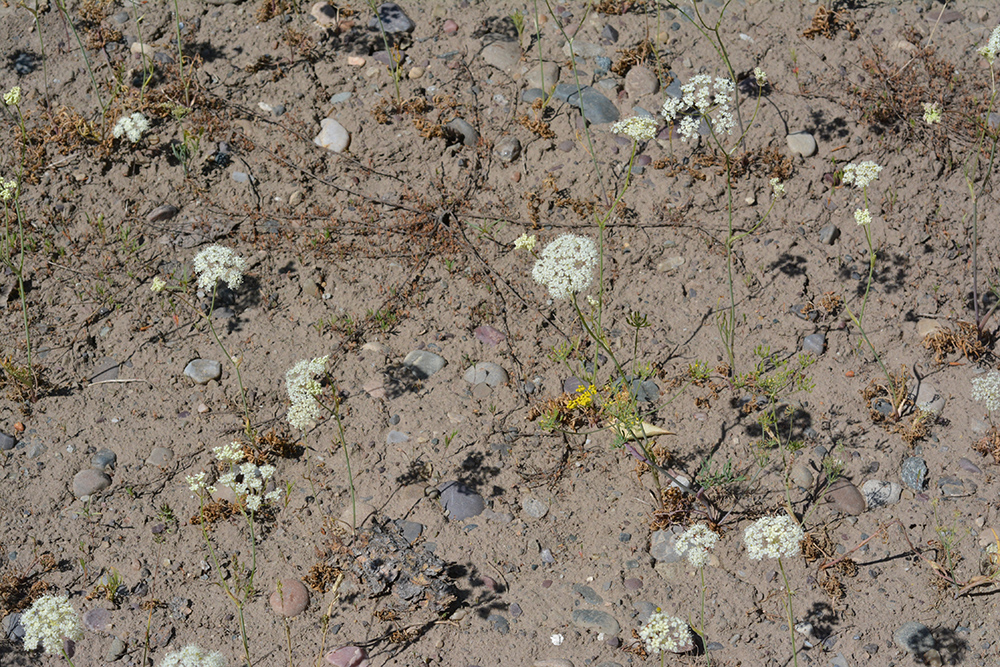
Bolander’s Yampah – Perideridia bolanderi – is clearly in the Parsley family described above with its lace-like umbels and thread-like divided leaves. It looks very similar to its cousin Common Yampah – P. montana/gairderni, but this species comes out earlier, the leaves often have swollen bases, and the fruits are more elongate.
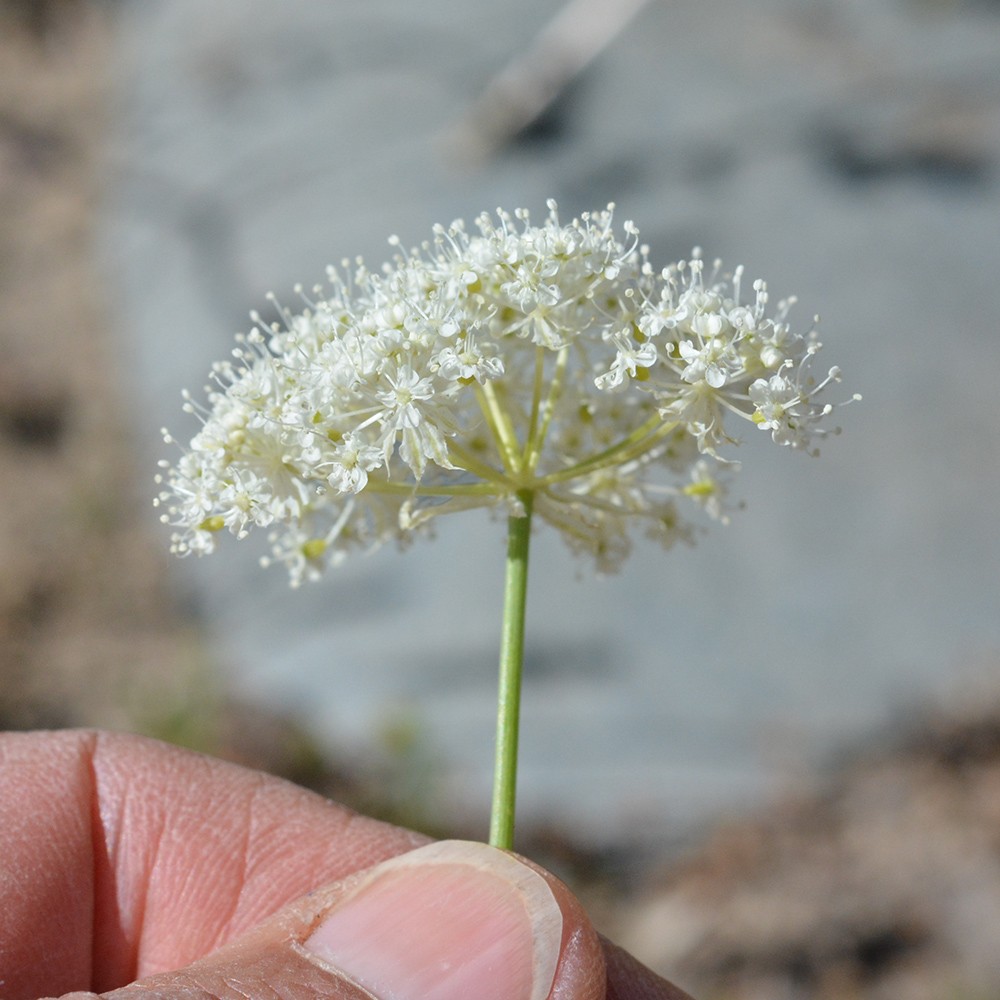
It is locally abundant now at Saw Mill Ponds Overlook on the north end of Moose-Wilson Road, but generally is rare in Teton County. Yampah roots were important food for Native Americans, as well as bears.
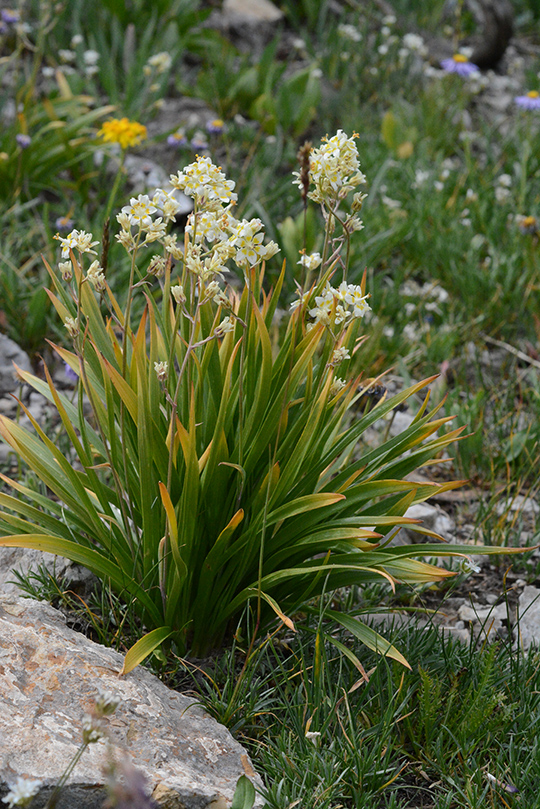
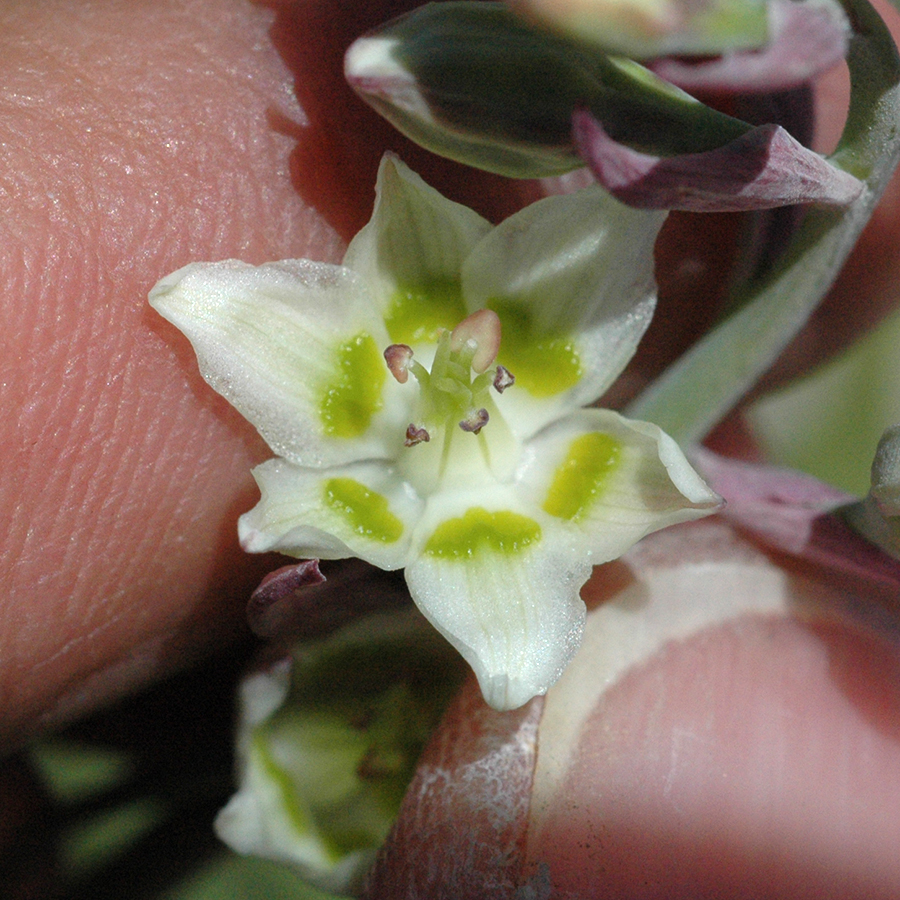
Grassy Death Camas – Zigadenus venenosum var. gramineus – is indeed poisonous. It is considered by the USFS to be one of the most deadly meadow plants to livestock, particularly sheep, and is known to affect elk, mule deer, and small mammals as well. All parts are toxic due to the presence of zygacine, a neurotoxic steroidal alkaloid.
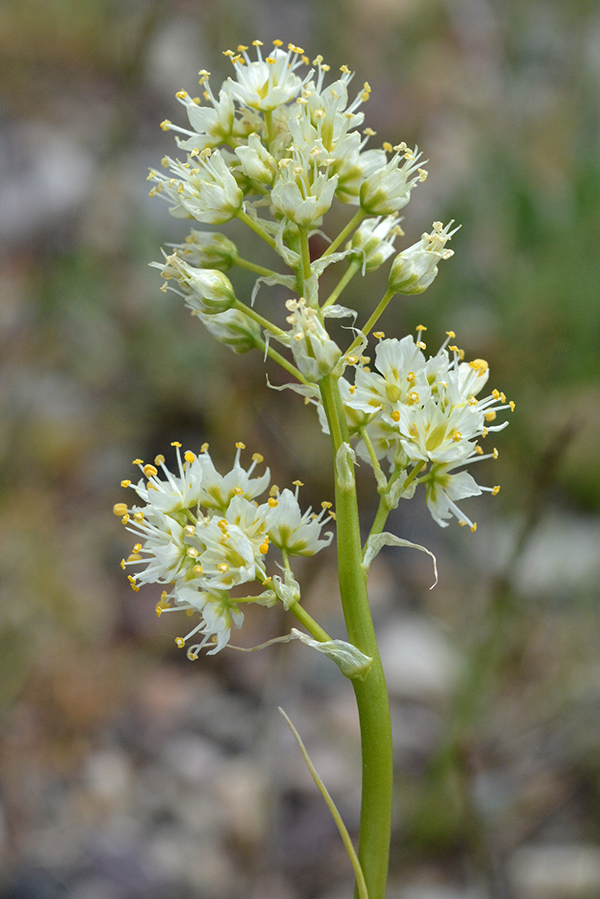
In the Lily Family, Death Camas is a bulb plant, and spreads vegetatively by bulblets. The leaves are grass-like, and the flowers are held in a panicle. Greenish yellow nectar glands form at the base of the 6 white tepals. When sepals and petals are similar they are called tepals, which is a frequent trait of members of the Lily Family, such as Easter Lily.
Field Chickweed – Cerastium arvense – is aptly named as it is often found spreading in fields as well as sunny trail sides.
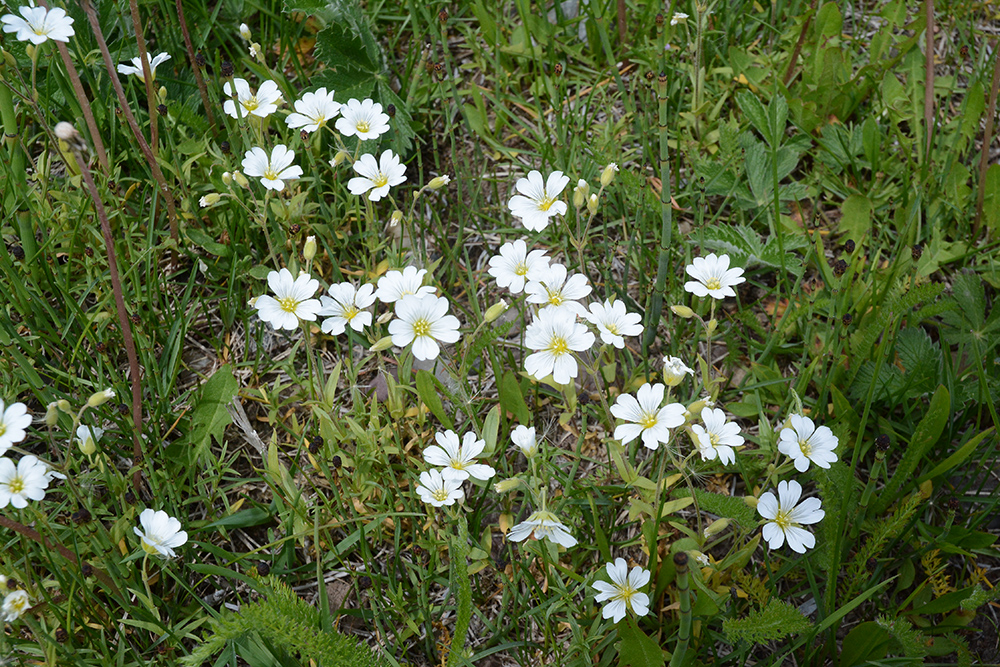
Many people pull “dastardly chickweeds” from their gardens. Indeed, the much smaller Mouse-ear Chickweed (C. fontanum) introduced from Europe is considered a weedy species.
I have planted the native chickweed to brighten some corners of my garden. I have discovered it has a wonderful fragrance! There is also a higher elevation Mountain Chickweed – C. beeringianum for when you are above 9000’. Chickweed is in the Pink Family. It has five notched separate white petals and the the leaves are narrow and opposite.

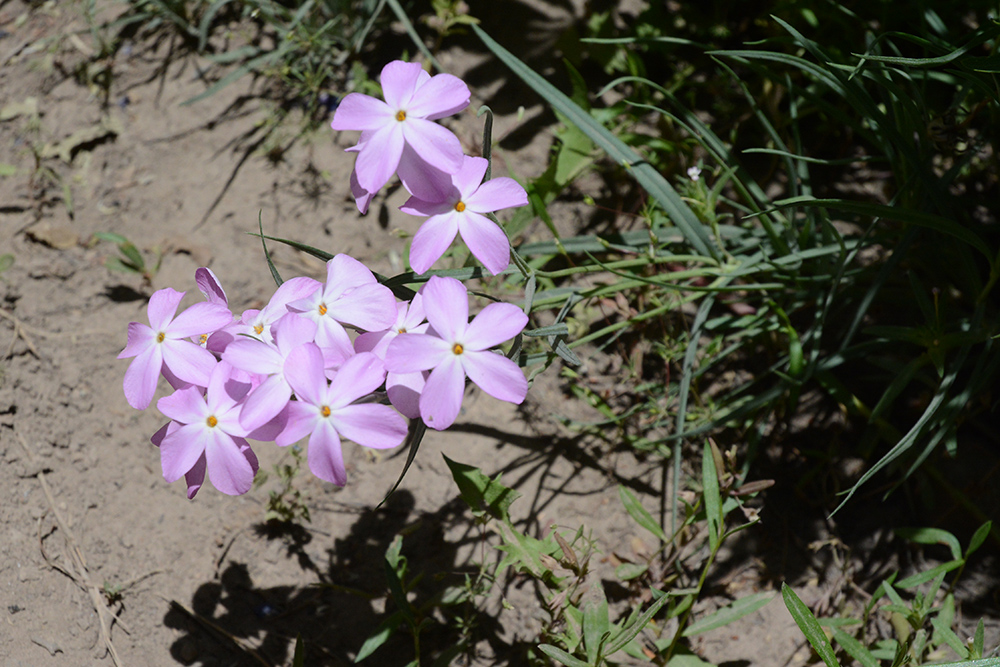
Long-leaved Phlox – Phlox longifolia – have mostly pinkish, tubular flowers whose petals flare out at the tops. Plants grow to 6” or more, often sprawling. Relative to our earlier blooming phlox, the leaves are long at 2-3”, narrow, opposite, and slightly hairy. Flower fragrance is alluring to long-tongued butterflies, moths, and some bees which land on the flared petals and dip their probosci deep inside.
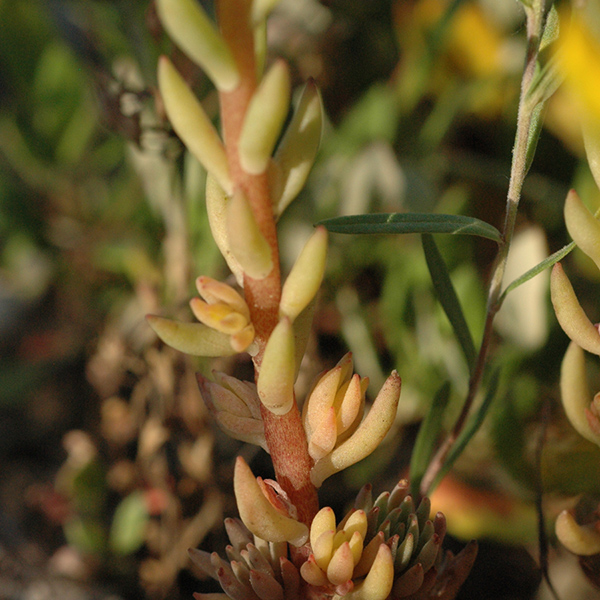
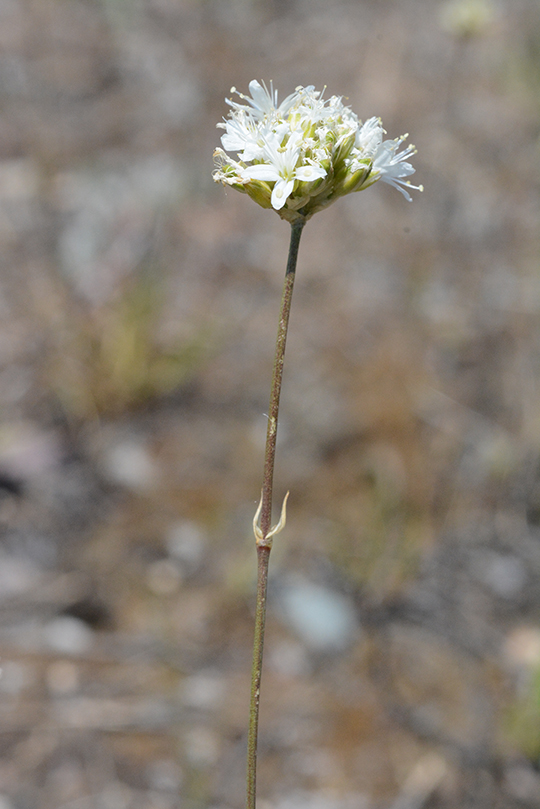
Sulphur Buckwheats – Eriogonum umbellatum – are just expanding from tight red fists, into pink to cream umbels of flowers that tower over a mat of oval leaves. (Yes, it has umbels, but no schizocarps as in the Parsely Family). Flowers lure in all sorts of insects which are in turn important protein sources for sage-grouse chicks. Plentiful dried capsules appeal to birds and rodents in the fall. Buckwheats are useful and beautiful plants for relatively dry, sunny spots in your garden.

Bastard Toadflax – Comandra umbellata – is genetically speaking odd. It is the only species in its genus (monotypic), and one of only two genera in the Comandraceae, formerly Santalaceae – Sandlewood Family. This species is found throughout much North America and restricted to the Balkan peninsula in Europe. Strange taxonomy and distribution indeed.
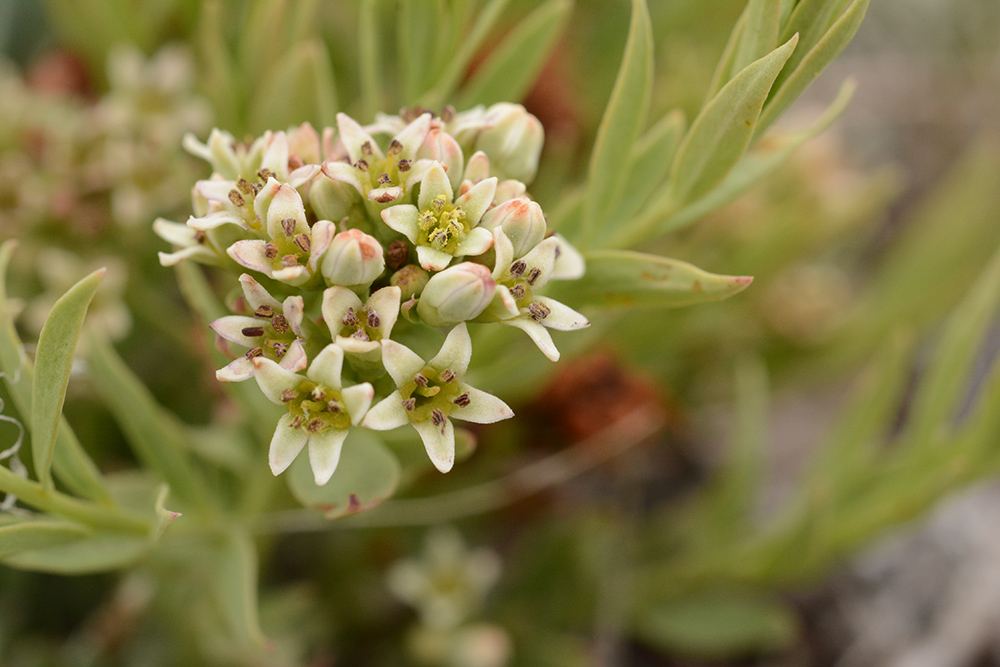
This 6″ plant is a hemiparasite, with stubby root structures (haustoria) which attach to hosts such as pussytoes, grasses, and aspens to name a few. It is also the alternate host for the comandra blister rust (Cronartium comandrae), a rust fungus that affects lodgepole and other pine species in North America.
Pinks to Rose to Reds
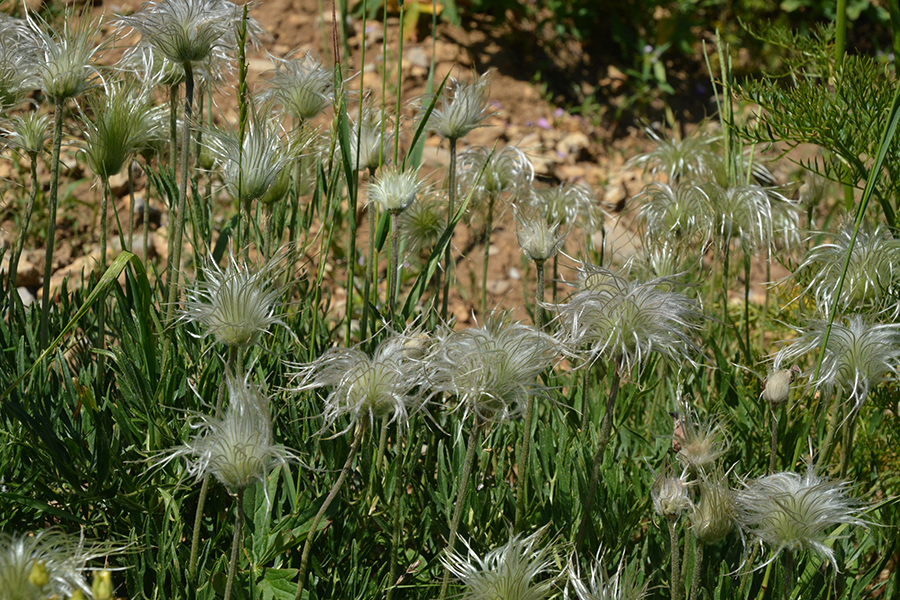
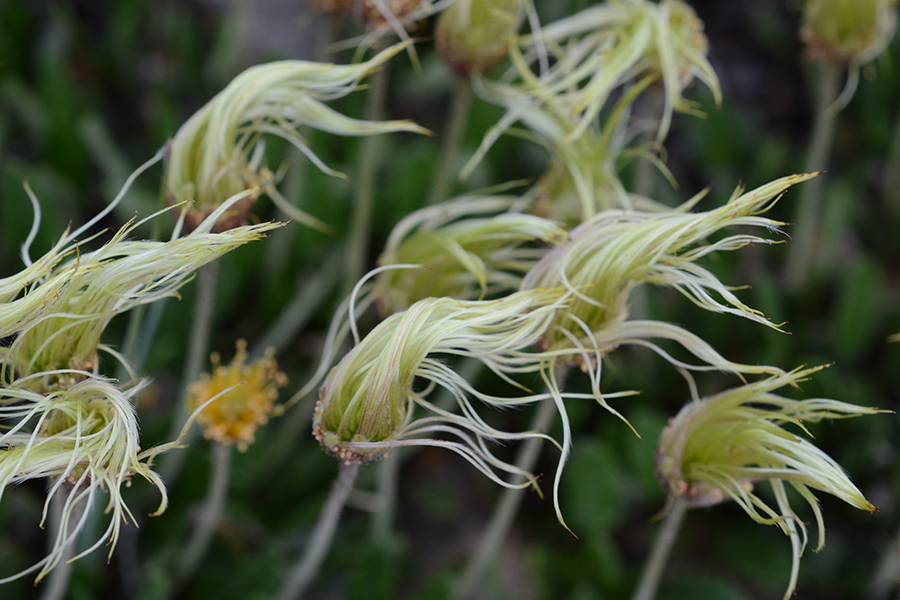
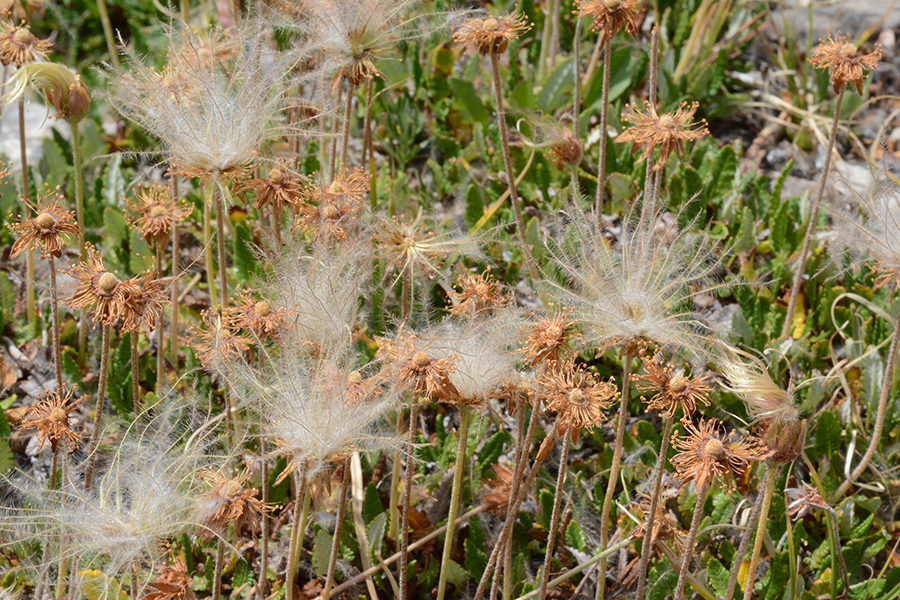
Prairie Smoke – Geum triflorum – has clusters of three dangling flowers with pinkish sepals that almost hide the yellow petals.
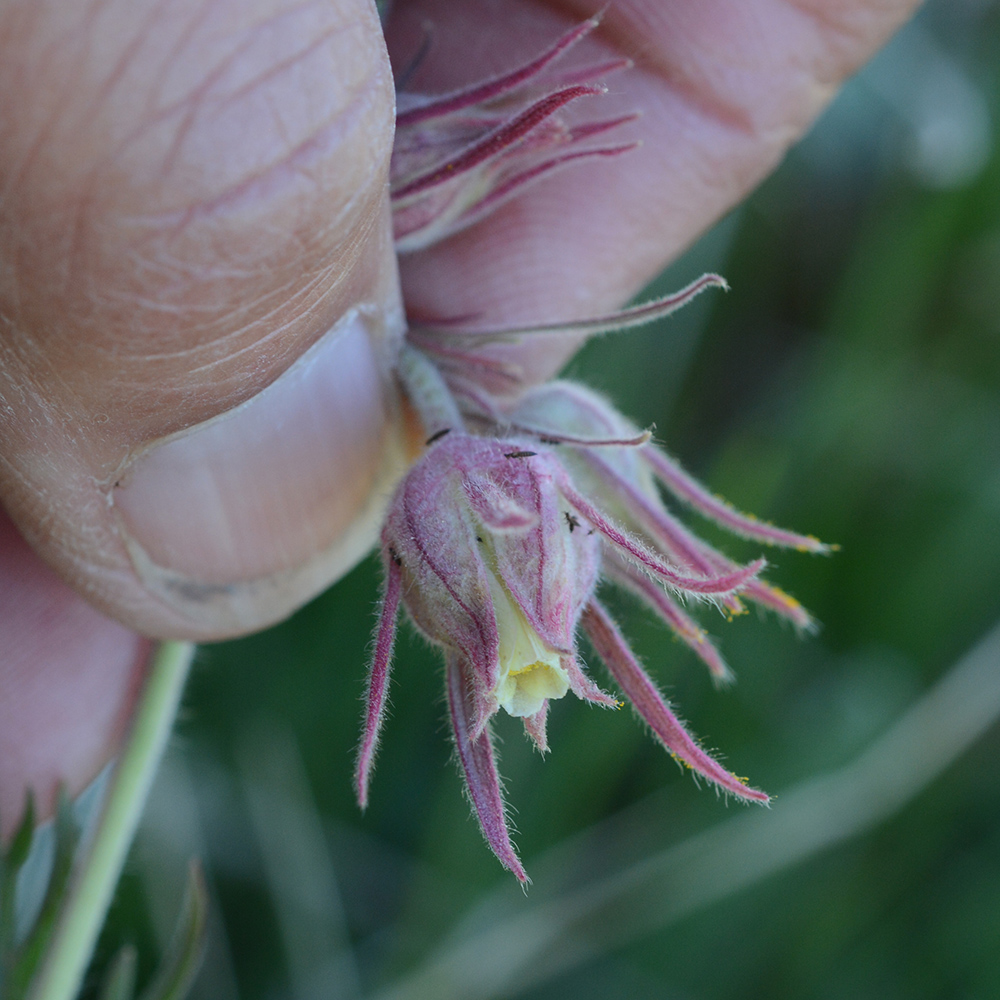
With maturity, fruits stand upright holding aloft their hairy styles which produce a smoke-like effect and help the seeds fly off to new lands.
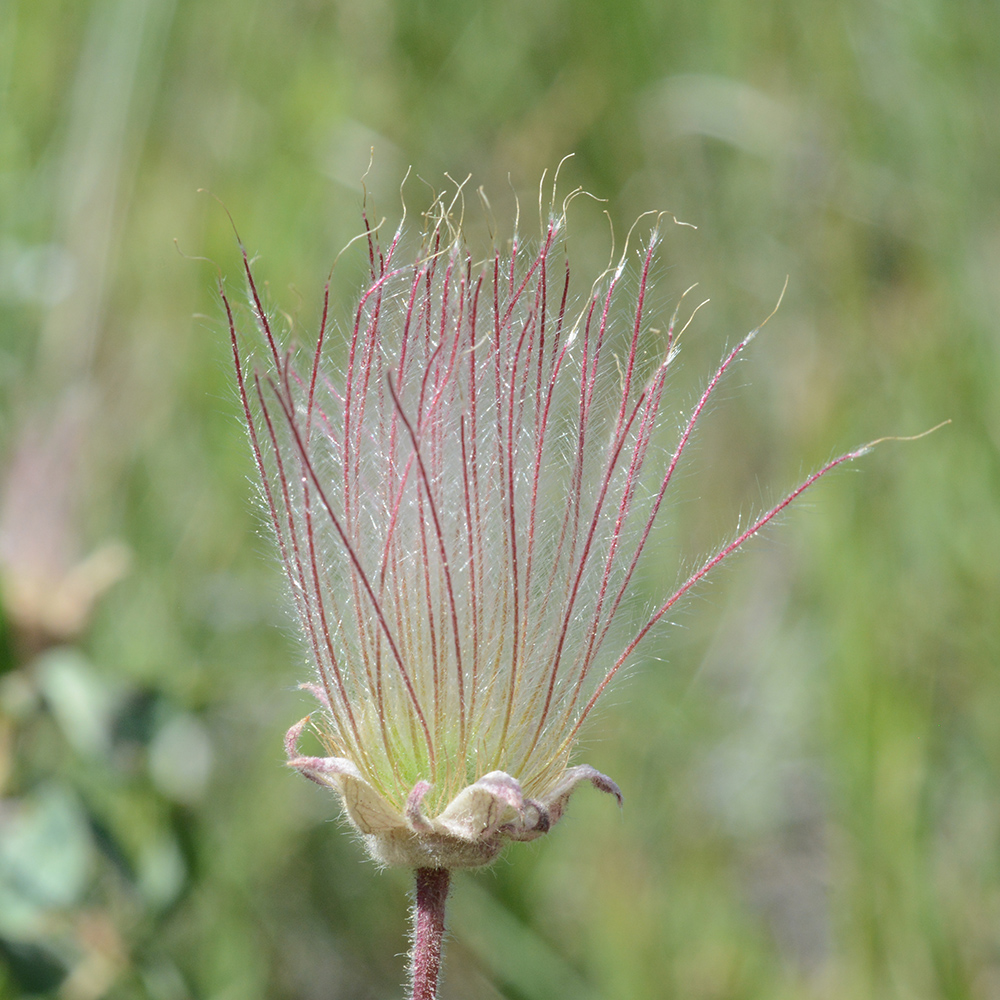
With the flowers and mat-forming, pinnately compound leaves that have a lovely fall color, Prairie Smoke is an enjoyable and commercially available native garden plant.

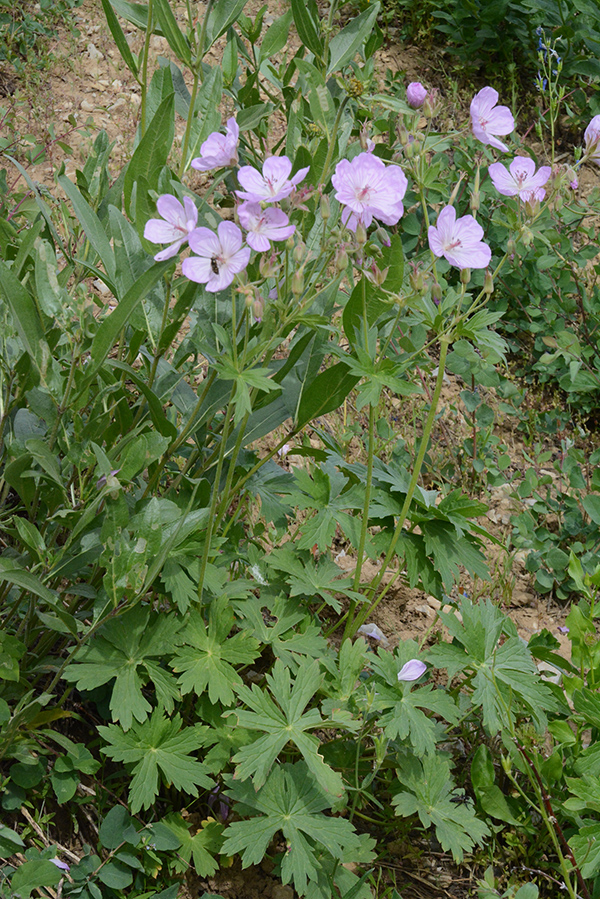
Sticky Geranium – Geranium viscosissimum – is one of the most recognized plants in our area. The 5 radial, pink-to-blue petals are perfect landing pads for a variety of insects. They can easily follow the fine “nectar guides” to the center to where pollen and stigmas await. The 10 anthers mature first. Later 5 sticky stigmas arch outward to catch the pollen. This arrangment is another strategy to assure cross-pollination.
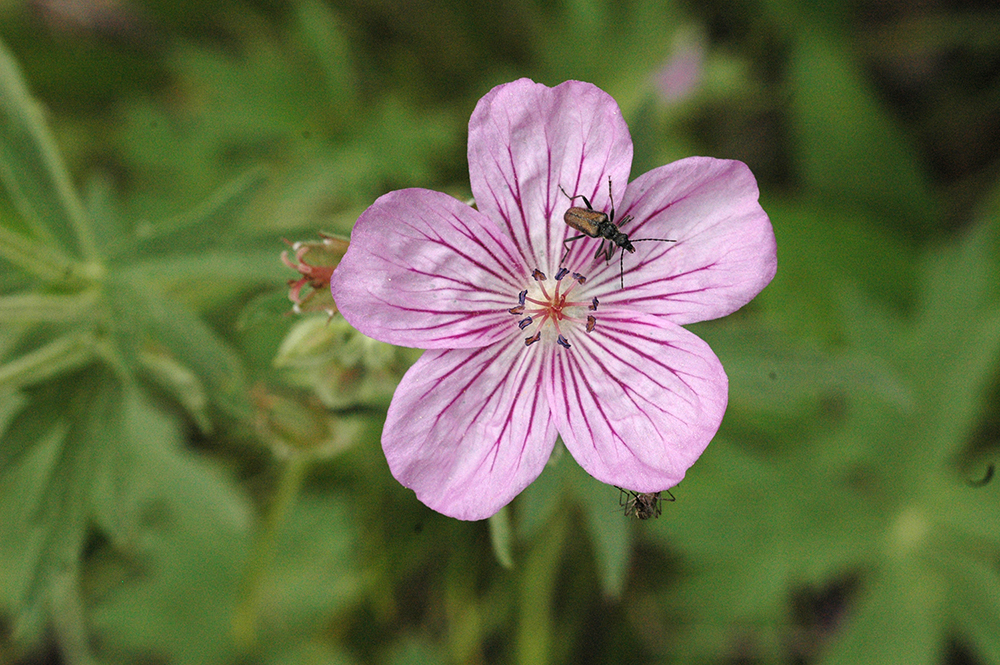
Sticky stem hairs serve to capture small, possibly marauding, insects, which in turn attract bigger insects that then glean the insects, providing the plant double protection. Also, these glandular hairs can dissolve the dead insects, enabling the plant to absorb nutrients from their bodies.
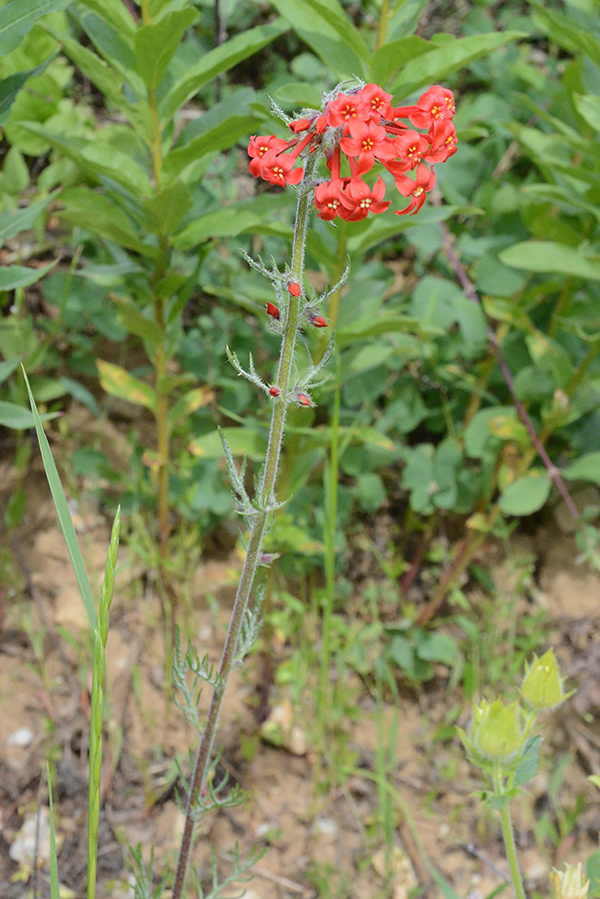
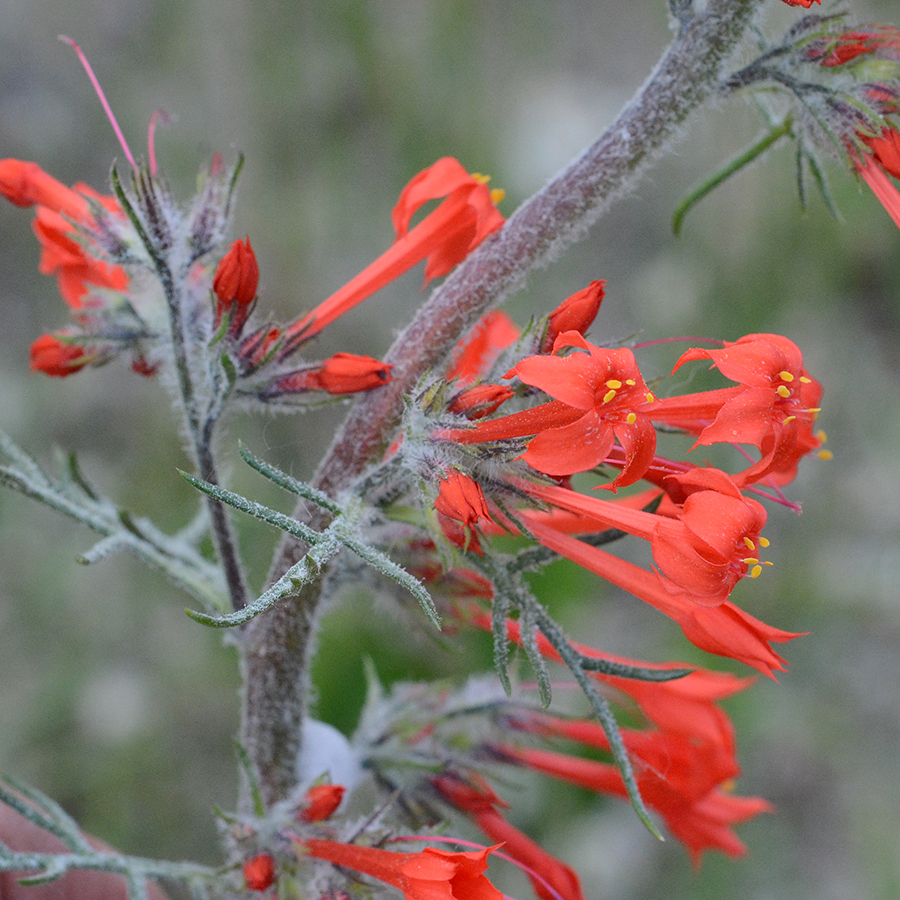
Scarlet Gilia – Ipomopsis aggregata – “Ipomopsis” means startling appearance. Indeed, these brilliant red flowers have great appeal to hummingbirds that can see red (insects cannot). These biennial to short-lived perennial plants are currently shooting up their stems and expanding their hairy dissected leaves from last year’s rosettes.

Flowers unfold and hummingbirds hover and reach their beaks and lapping tongues into the long tube for nectar. In so doing, the birds bump their heads against the protruding anthers and get a dollop of pollen which sticks. They then fly to another flower where the white stigma is ready to pick up the pollen off the bird’s forehead.
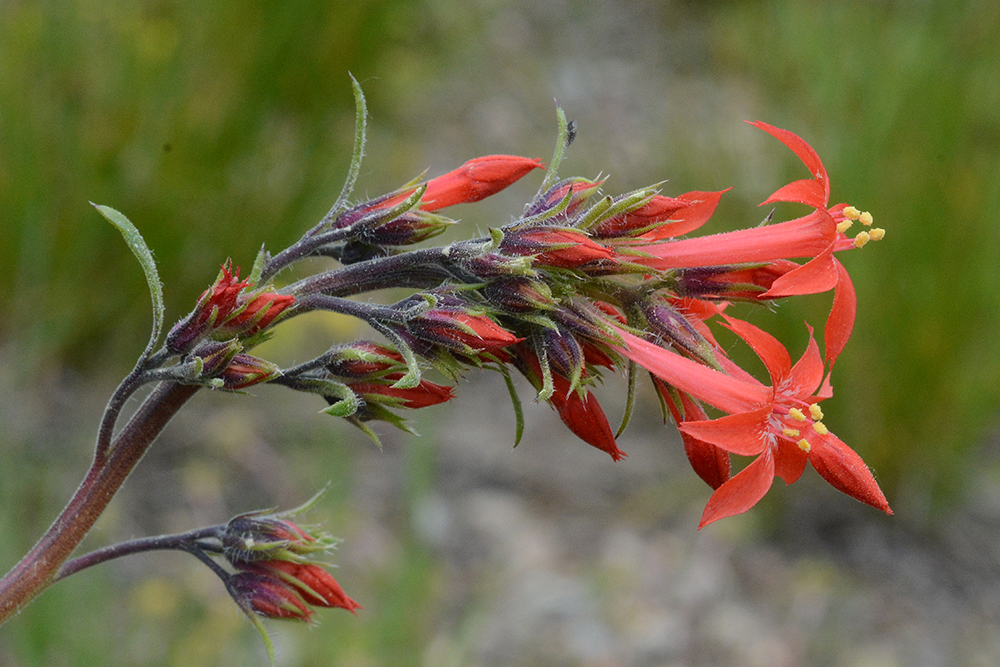
Later in the year, or in other parts of the west, Scarlet Gilia flowers may bloom more pink to white, attracting moth pollinators. The flowers have an unappealing skunky fragrance to us people.
True Blues
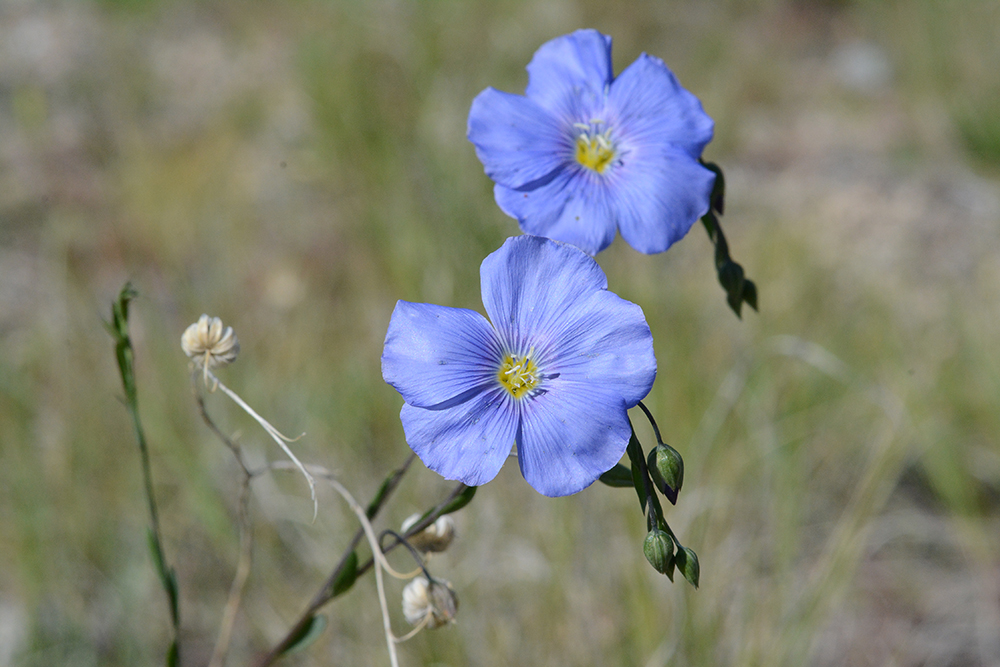
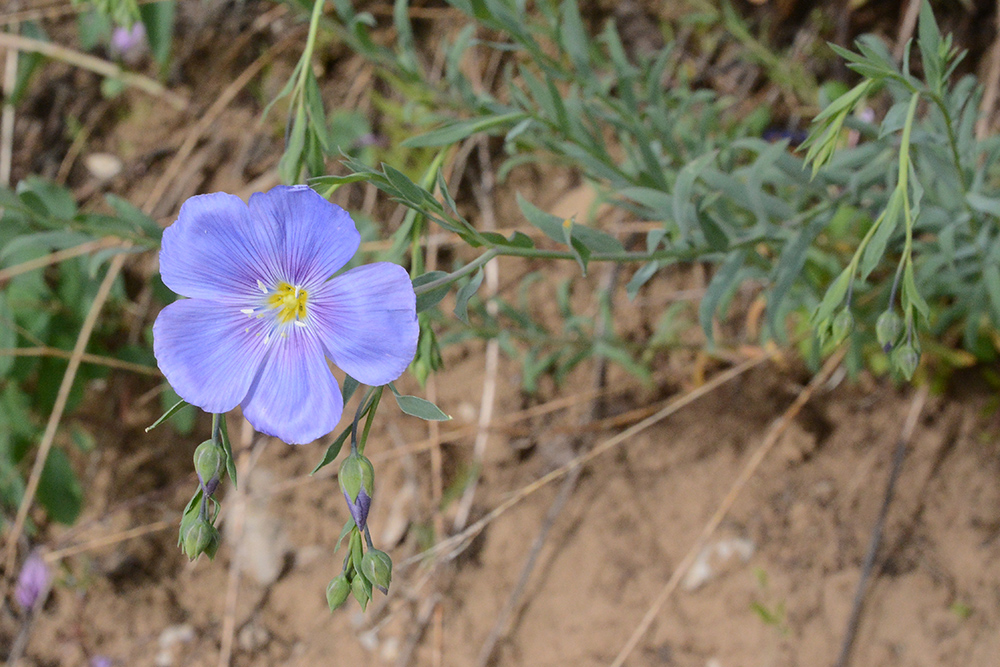
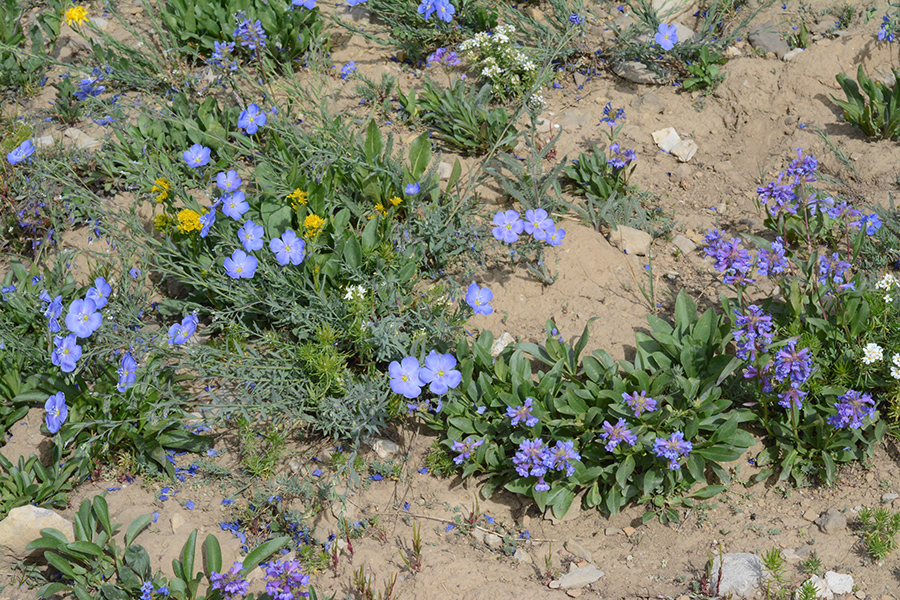
Lewis’ Flax – Linum Lewisii– is covering roadsides with their delicate wands of sky-blue flowers.

The European/Asian species Linum usitatissimum (roughly translated: very useful) has long been known for two main values. The stems have particularly long, strong fibers which have been used for centuries to make linen. Current research is being conducted on the mechanical properties of flax for making composite materials. Flaxseed or linseed oil has been used for constipation and control of cholesterol. Always check with a doctor for proper use as it can affect how one absorbs other medicines. In any case, flax is a beautiful plant.
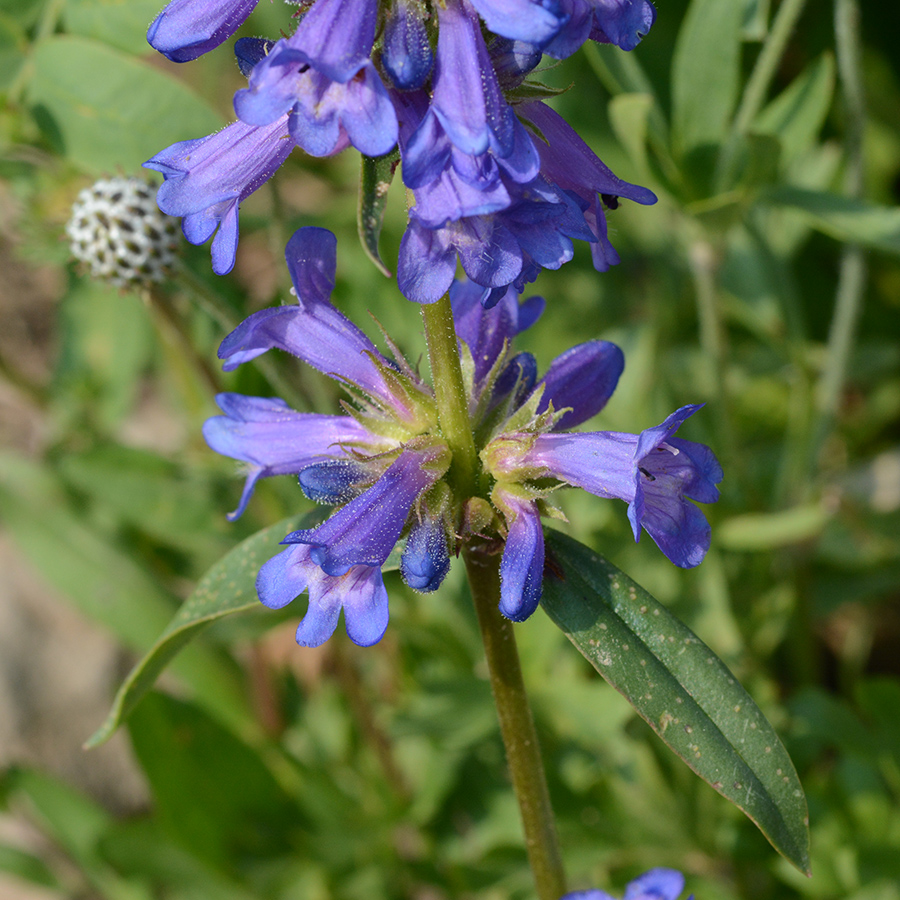
Beards Tongues – Penstemon spp. – are hanging out in patches on dry hillsides.
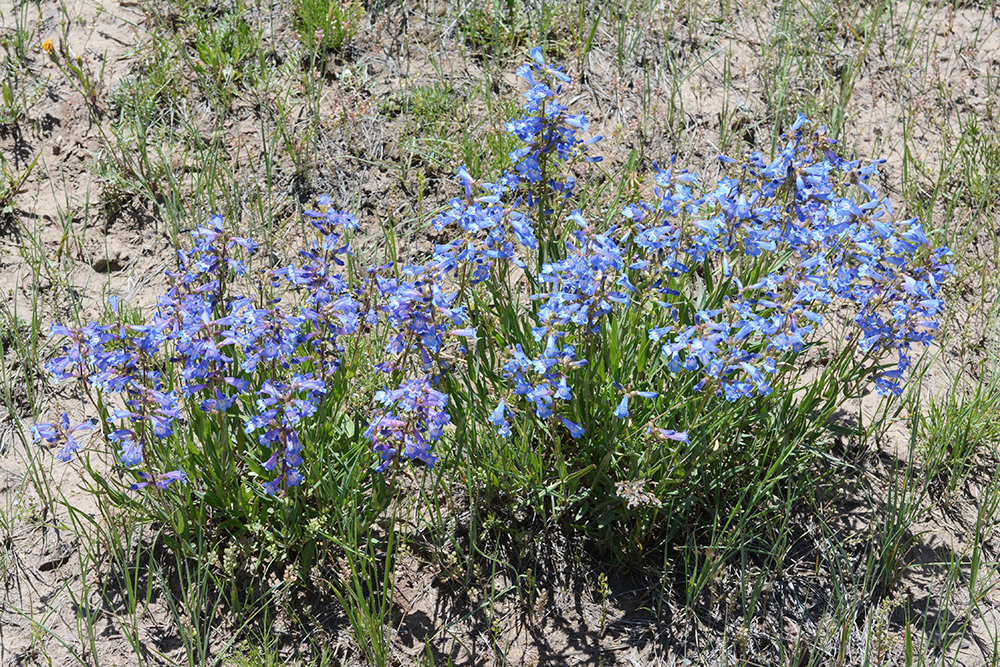
Our penstemons are blue (rarely white) and are pollinated by bees. All penstemons have opposite leaves and 5 petals forming a tube. Inside are four arching stamens, each with paired anthers. A fifth stamen that looks like a hairy tongue lies at the entry. This “staminode” doesn’t have pollen but does direct pollinators (so the researchers say).
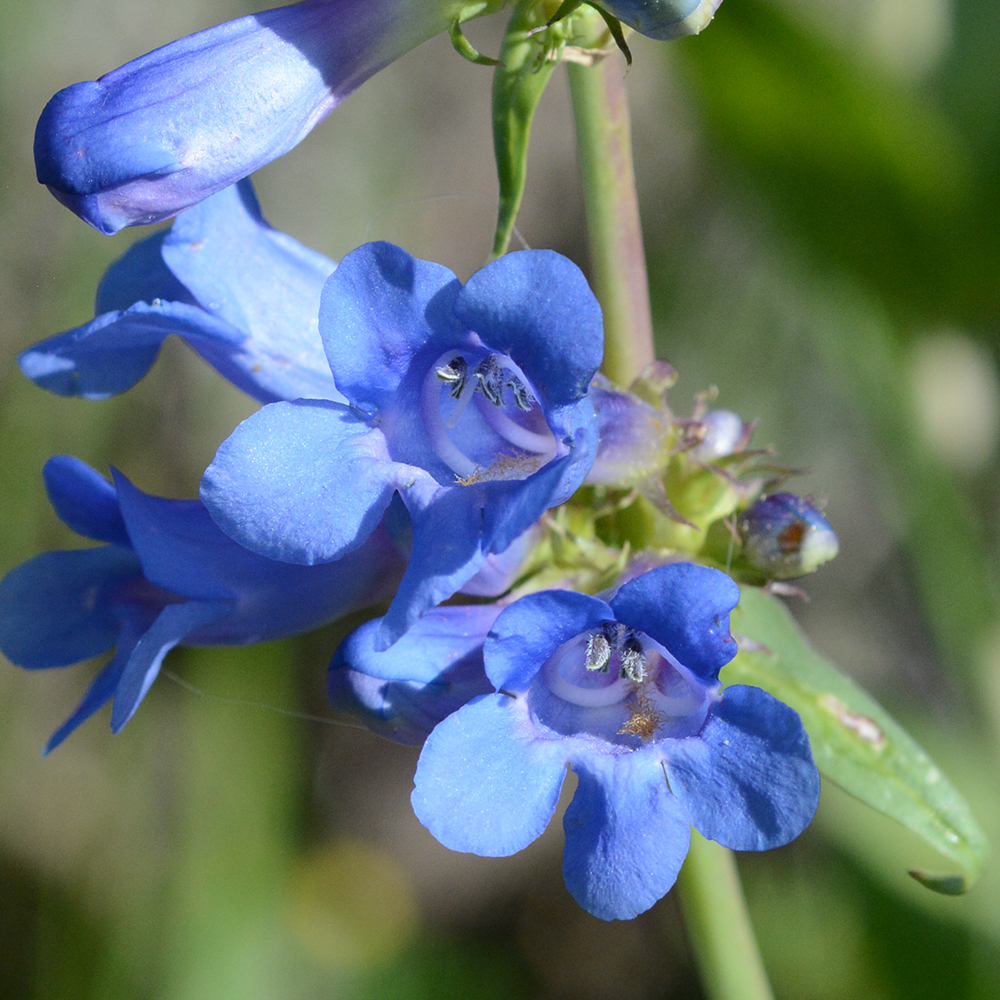
Bees land on the lower lip and follow the lines and variations of light back into the tube. Nectar is produced in hairs at the base of the stamens. Researchers say the hairy staminode helps push the bee into the anthers, where they get doused with pollen. Visting the next flower, the bee may then trip upon the long style with stigma to facilitate fertilization. Take a look inside the flowers and think like a bee or find a mini go-pro to attach to its head. (Really, how do the researchers know how a staminode works?)
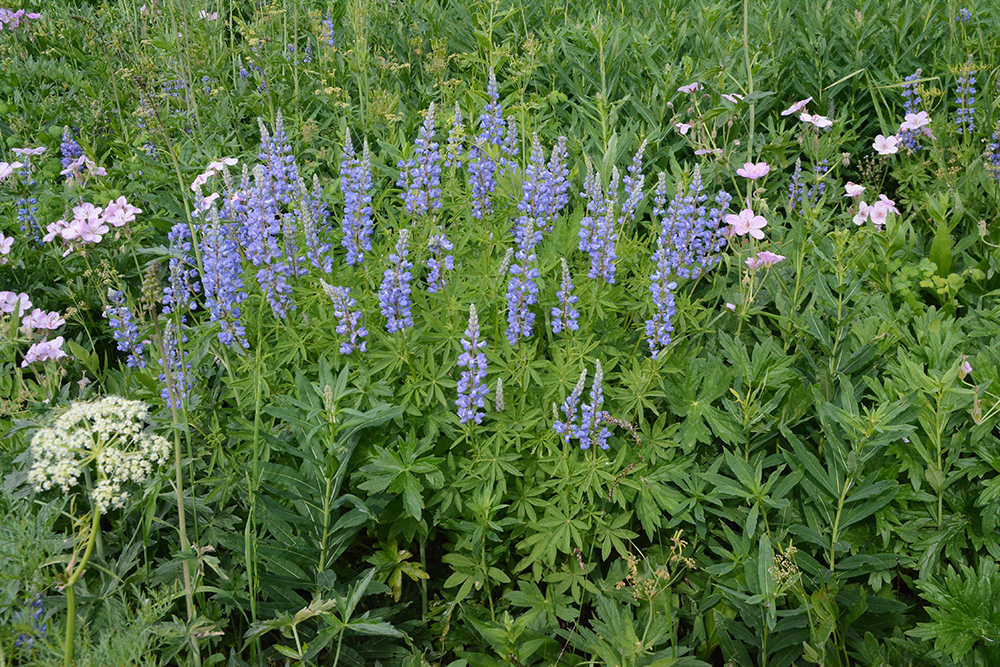
Silky Lupines – Lupinus sericea – are just coming out on the sunny open sageflats and hills. The hairy palmate leaves and pea-like flowers are definitive for ID.
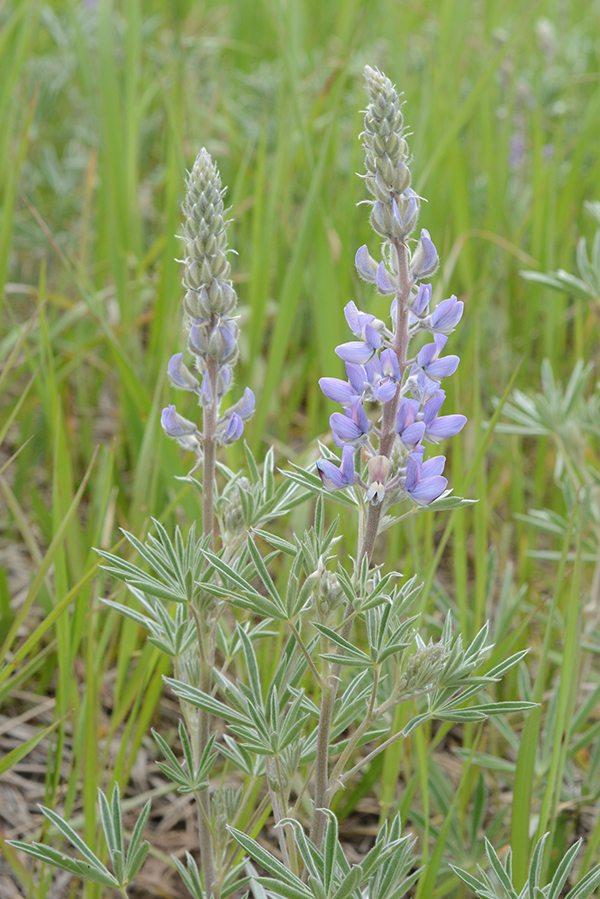
Look for white or pink dots on the upright banner: a contrasting white dot indicates the flower is fresh, ready to be pollinated; a duller pink or purple blotch indicates a pollinator has come for the nectar already or the nectar has dried up.
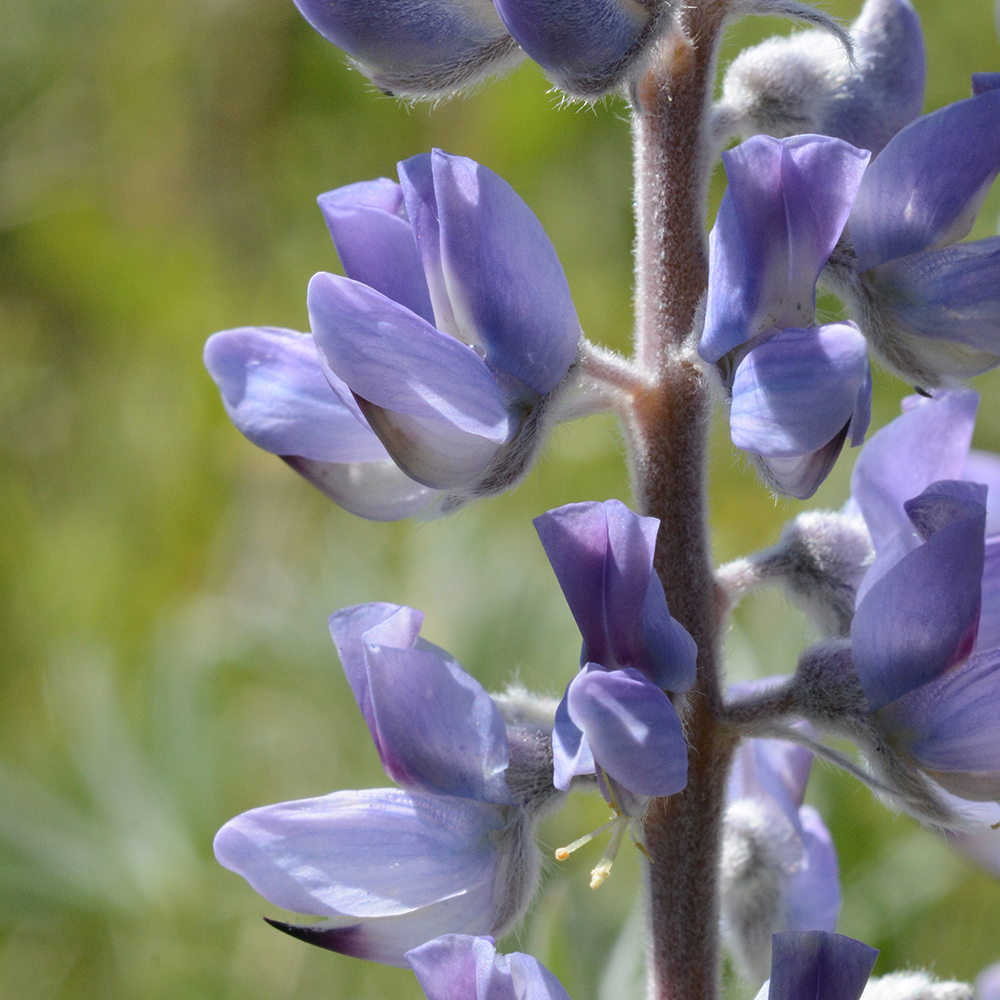
This color change serves as a signal for the bee not to waste its energy looking for nectar or pollen.
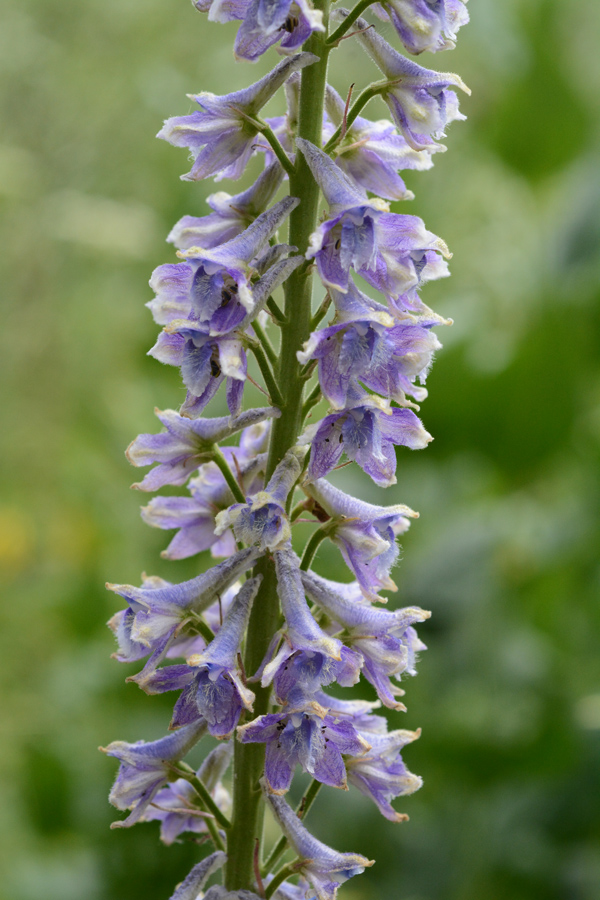
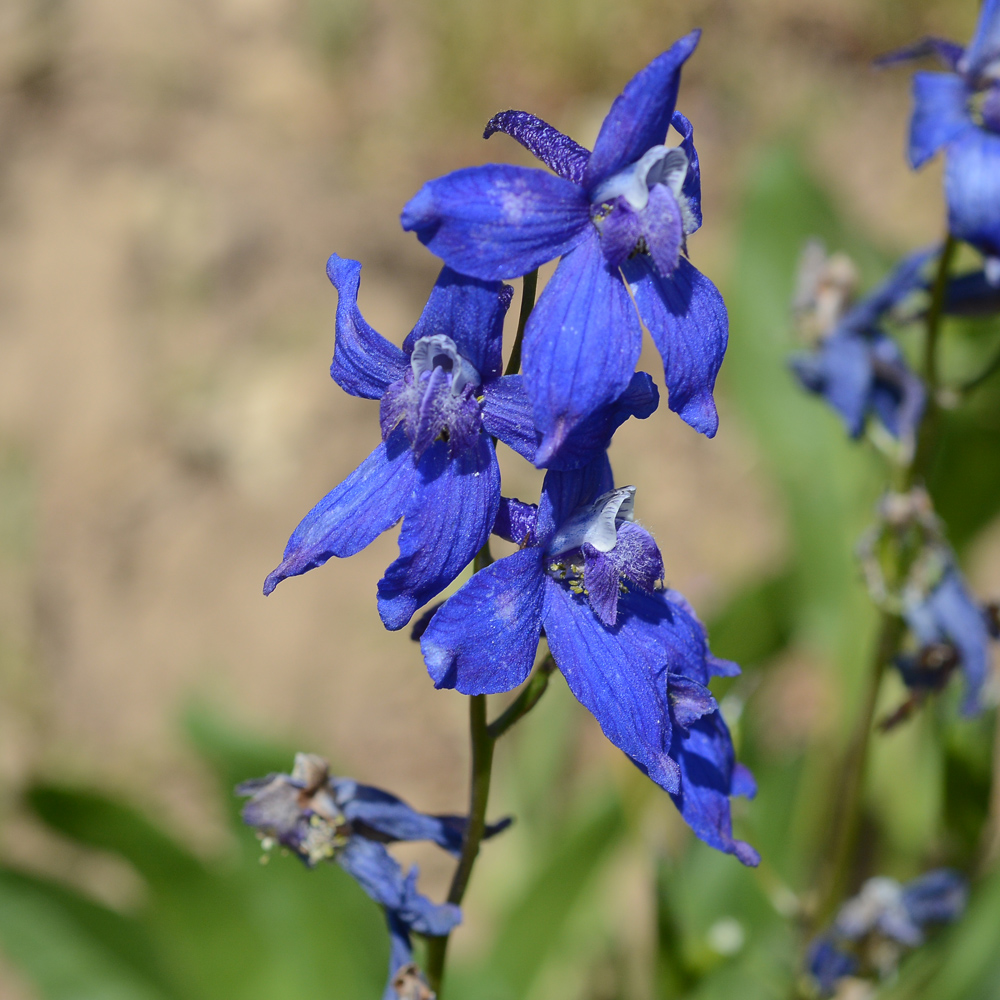
Low Larkspurs – Delphinium nutttallianum – have been blooming for a few weeks. They have welcomed migrating broad-tailed hummingbirds with their nectar.

Hummingbirds can hover just outside the flowers, thrusting their beaks into the long spurs to lap up nectar, thereby brushing against the cluster of dangling anthers. On a more mature flower, where the anthers have withered, the pollen-covered bee wiill bump upon the 3 protruding stigmas.
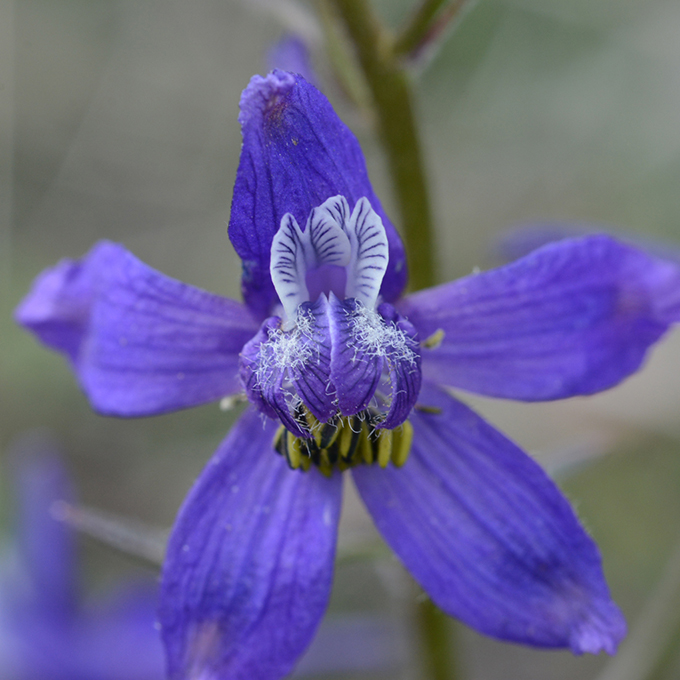
Larkspurs are poisonous to livestock and many mammals.
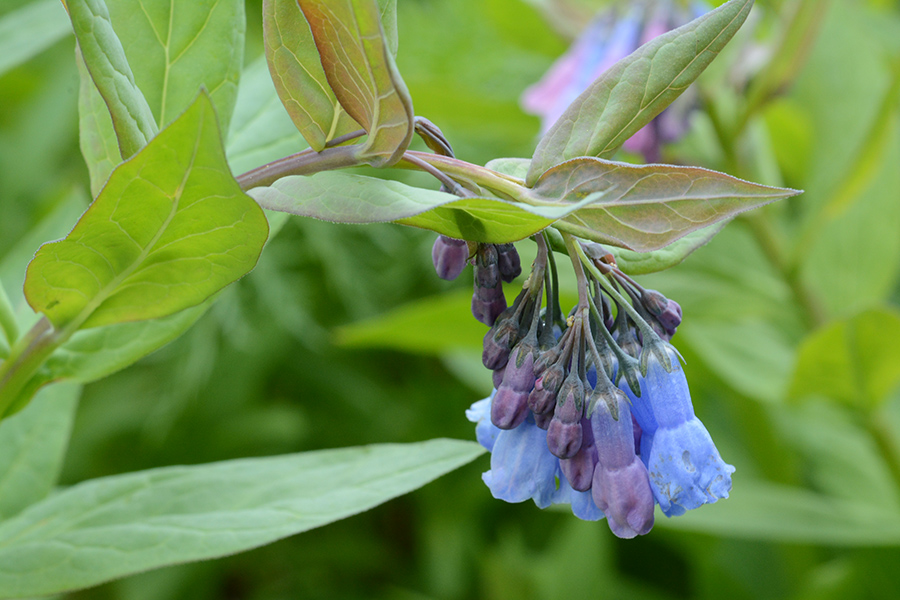
Different species of Bluebells – Mertensia spp. – are human favorites across the country and consequently have several common names. They are spring ephemerals—plants come up in early spring, are hopefully fertilized, store up food underground quickly, and then wither, leaving little trace of the plants by the end of the summer.
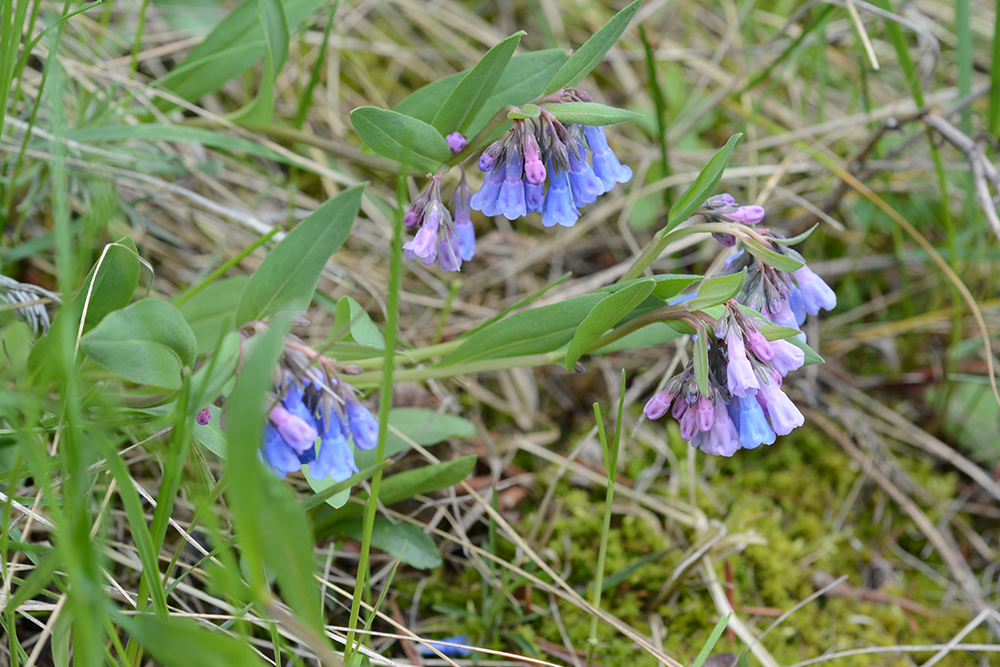
The dangle of flowers is advertisement. Several flowers together put on more of an show than if scattered on the stem. Flowers turn from pink to blue signaling treats are ready for bumblebee pollinators. And then the petal tubes drop off indicating no more customers needed. Virginia Bluebells – M. virginiana – are garden favorites in the east. Our local species may be good natives for our gardens here, as well.
Sagebrush Bluebells – Mertensia oblongifolia – grow to 12-16” on dry, often grassy hillsides (shown above). Tall Fringed or Mountain Bluebells – Mertensia ciliata – look very similar but are found arching 3’ high over streams at low elevations now, but then at high elevations in mid-August.
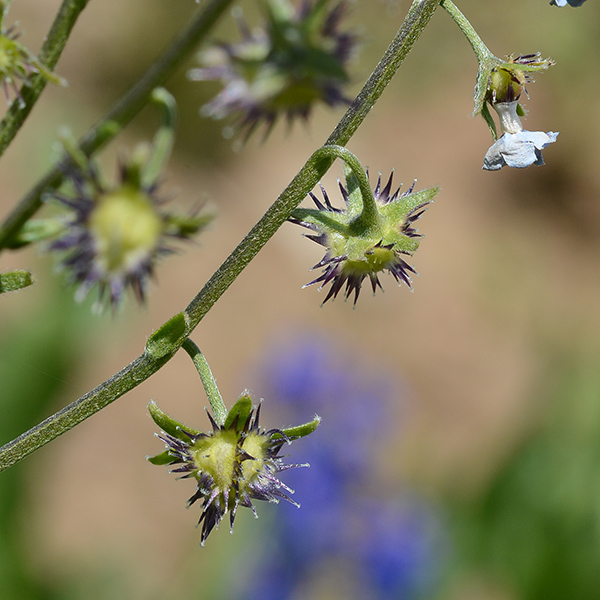
Stickseeds – Hackelia spp. – are members of the Borage Family along with For-get-me-nots – Myosotis spp. – and bluebells (above).

They have white to blue demure flowers open to the sky; however, they produce pesky fruits that attach to socks and dogs in order to make their way to new ground away from domineering parent plants. Although they appear delicate, stickseeds have an evolutionary determination to succeed.
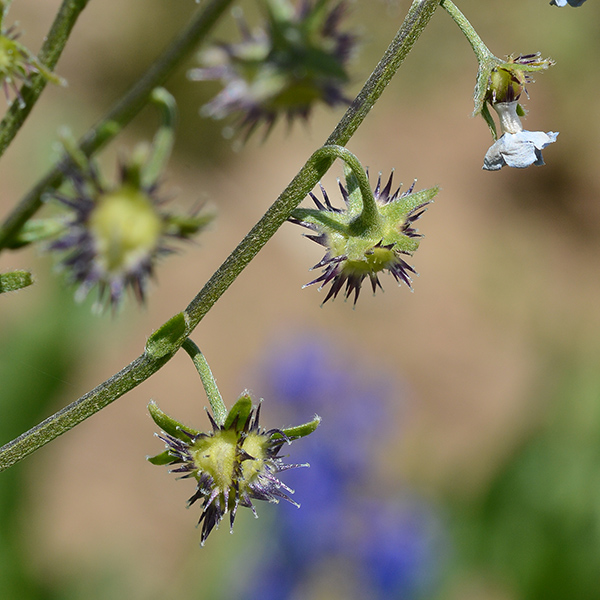
Spotted stickseed – Hackelia patens – has white flowers with delicate blue nectar guides.
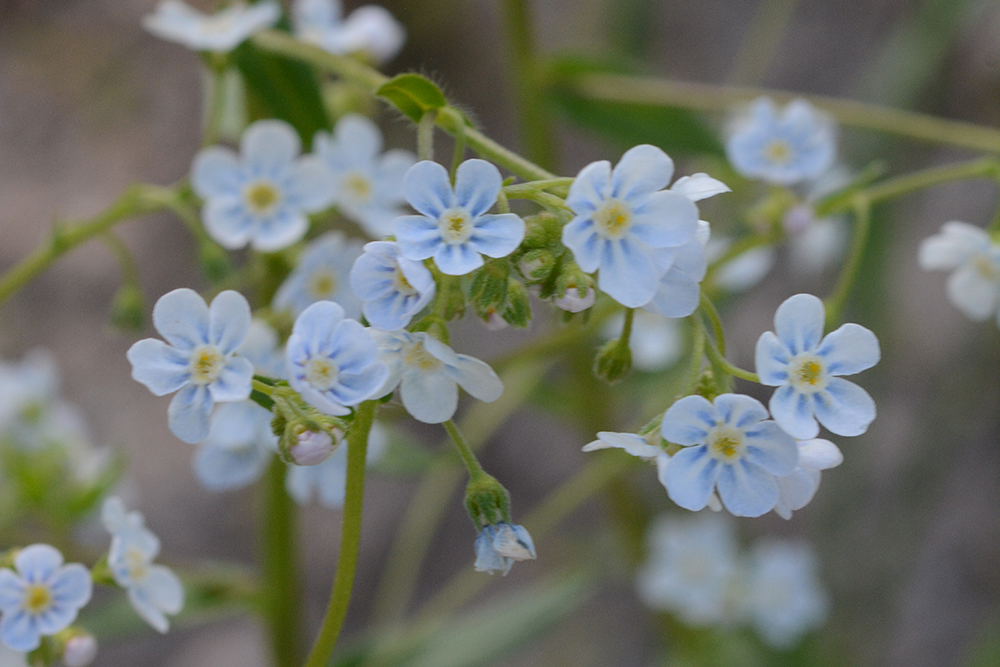
Two other stickseeds have truly blue flowers and tend to inhabit more moist, streamside habitats: Jessica’s Stickseed – Hackelia micrantha – has multiple stems which help indicate it is a perennial. Large-flowered Stickseed – H. floribunda has slightly larger flowers and fewer stems. It is an annual/biennial that grows in disturbed sites as along the Old Pass Road.
A Monumental Plant:
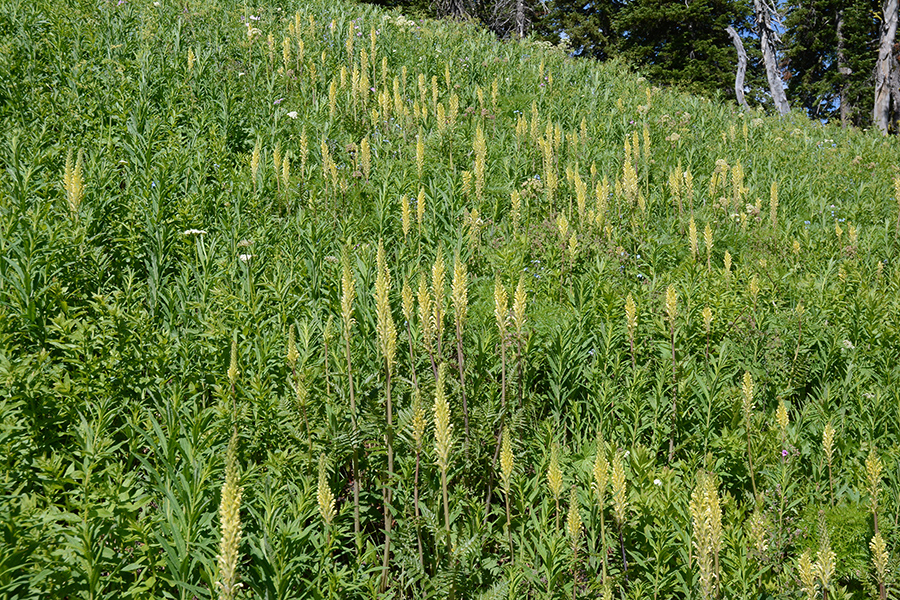
Monument Plant or Green Gentian – Frasera speciosa – is having a good year!

Its hard to miss the 4-5′ towers of flowers sprouting up on hillsides. Not so long ago, it was thought this species was a biennial or short-lived perennial: the tall tower rose from where there was a whorl of leaves the year before.

A researcher marked the plants, and through intensive research over years in the Colorado Rockies, Dr. Inouye https://www.jstor.org/stable/1940400 determined plants take several decades to bloom. They have to amass 20+ leaves, maybe adding one leaf a year if conditions are good enough. The leaves add energy into the deep tap roots for the winter which then sprout into new rossettes the next spring. Slowly, slowly they gather enough energy for the final climax.

Furthermore, it was discovered that the flower buds were triggered by relatively high rain in June and July three years before they actually bloomed! This trigger of mature plants produces cohorts of many plants blooming at once in a given area.

The open flowers attract myriad insect pollinators which then leads to hundreds of seeds, if not thousands, per plant This abundance is greater than the many consumers can stomach, and so there is a chance for some seeds to grow to maturity under the helpful decomposing shade of the toppled parent plant.

Please get out and enjoy!
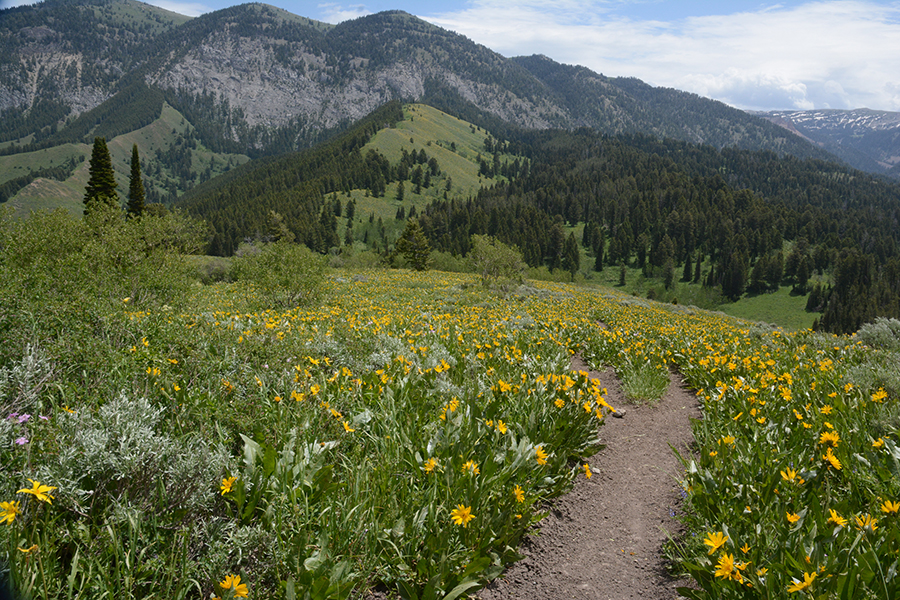
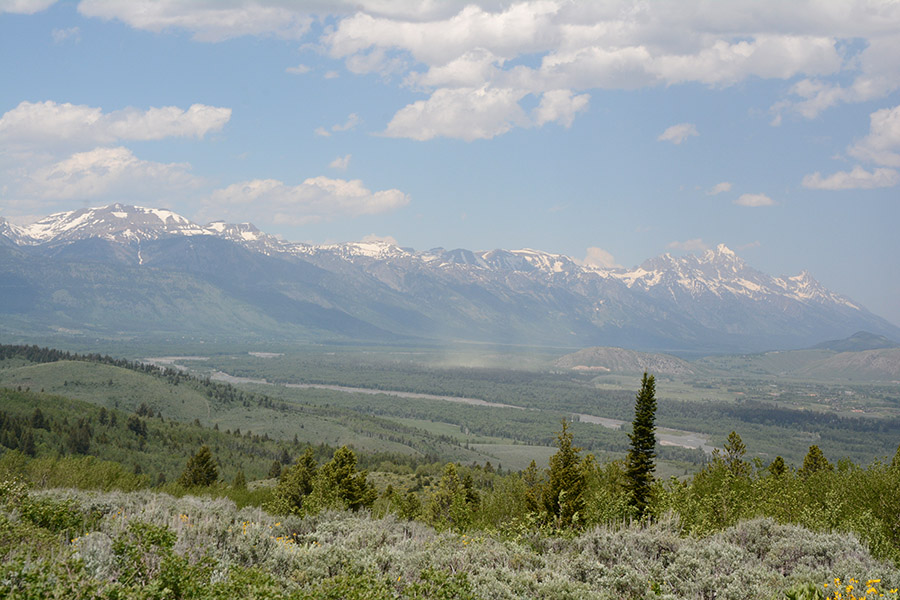
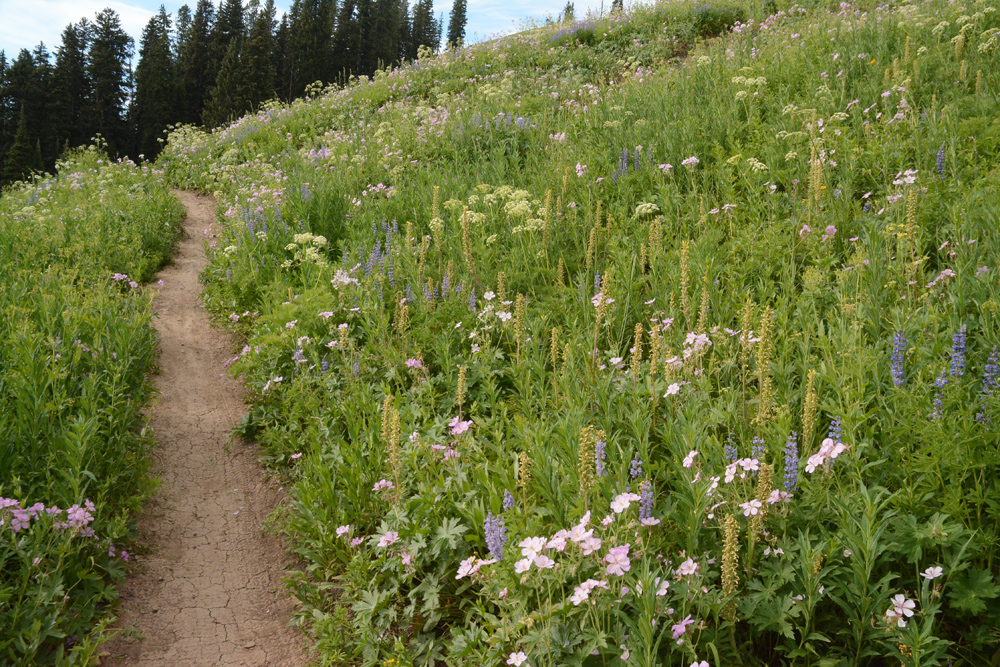
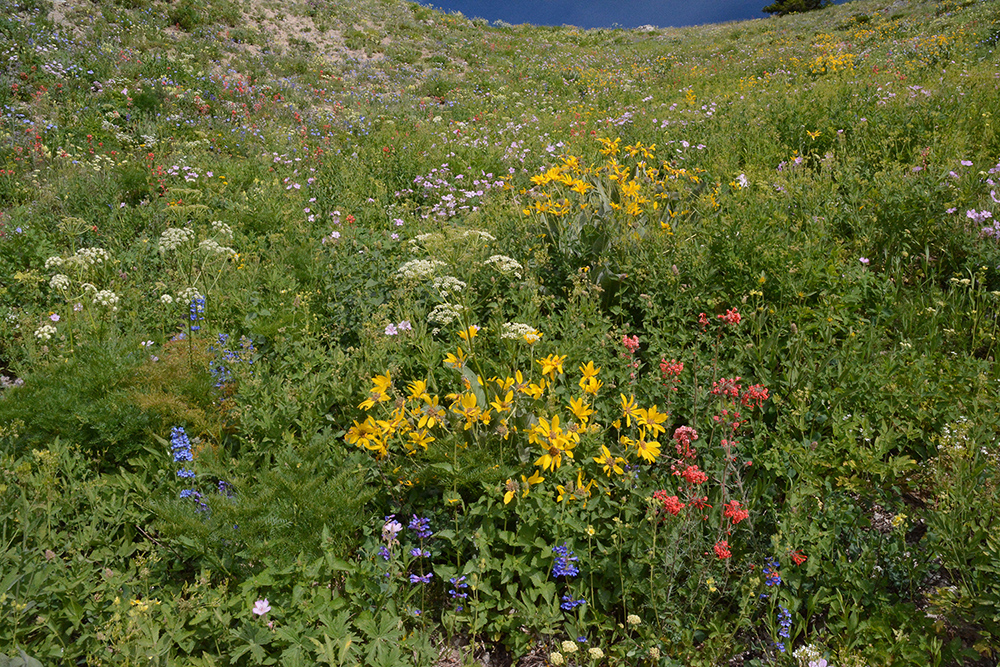
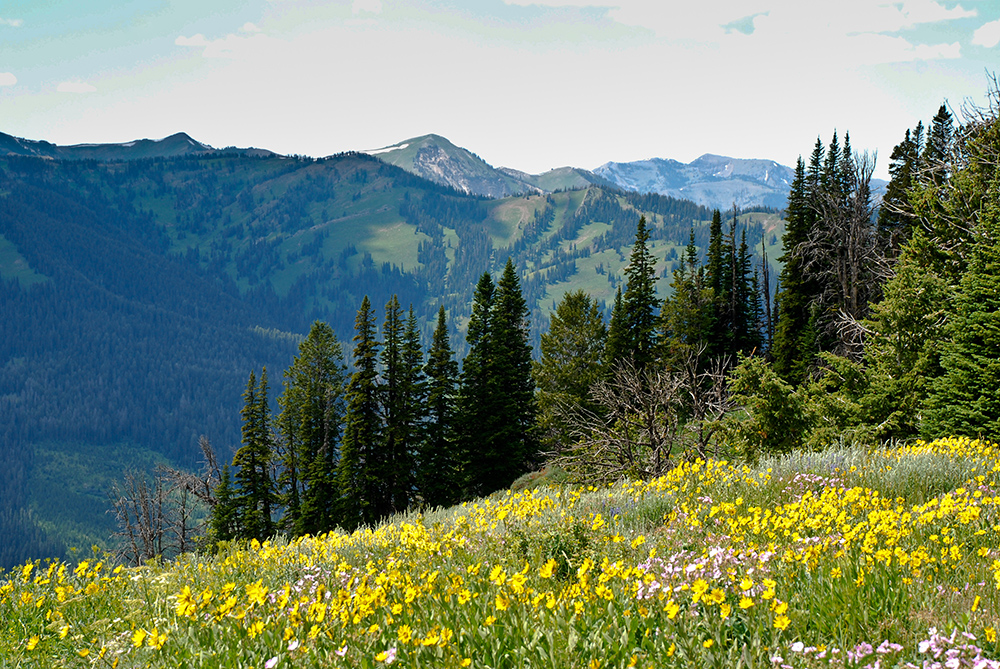
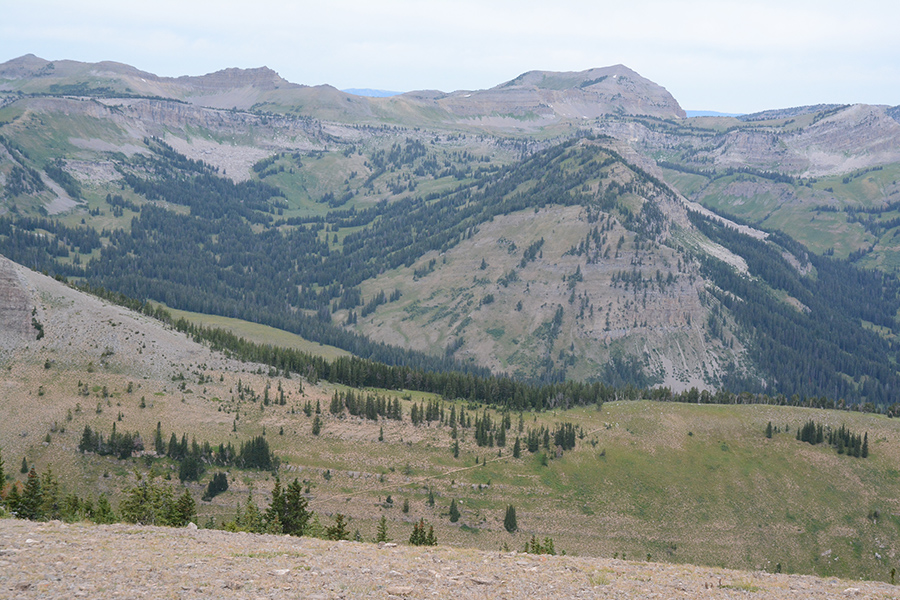
There are so many places to go and see wildflowers right now. Most of these pictures were taken driving around Antelope Flats, out by Kelly Warm Springs, and along the inner park road in Grand Teton National Park. Flowers can be found hiking up around Cache Creek just to the east of Jackson, or Trail Creek just west of Wilson. Munger Mountain and Ann’s Ridge (photo above) to the south have similar open habitats. Note: While flowers may be fading at lower elevations or in more southern parts of the valley, they may well be blooming fresh to the north or higher elevations.
If you have questions or see mistakes, please contact us at: tetonplants@gmail.com. As we are out much of the time, our response may not be quick. Also check earlier postings of “What’s in Bloom” on this same website.
Frances Clark, Wilson, WY
June 28, 2022


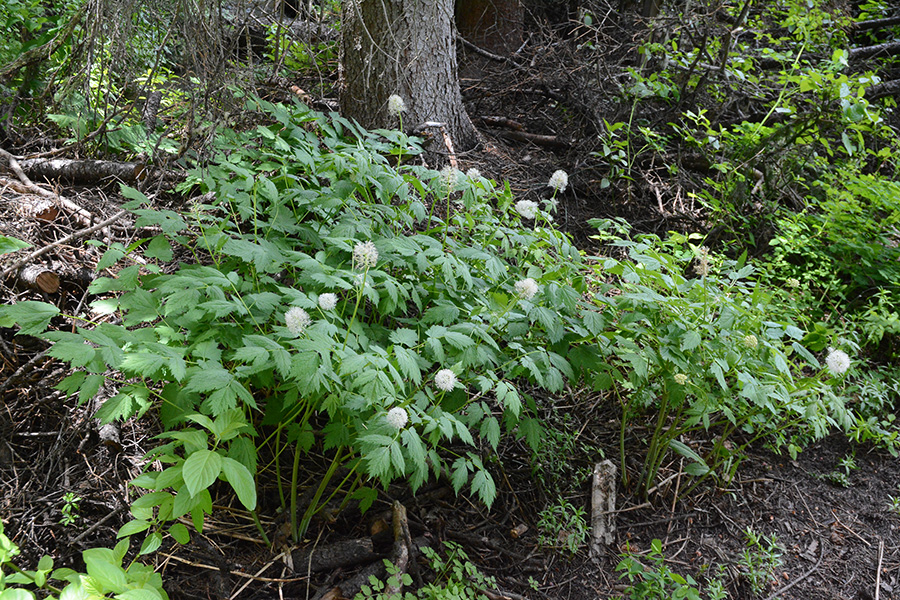



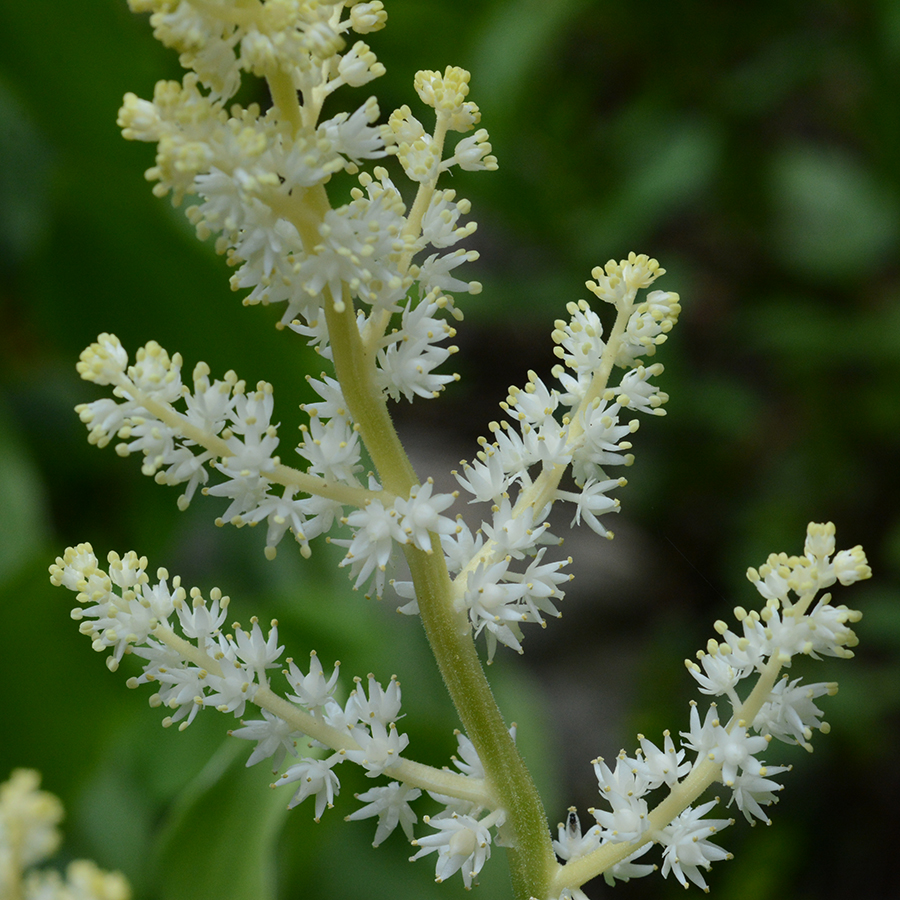

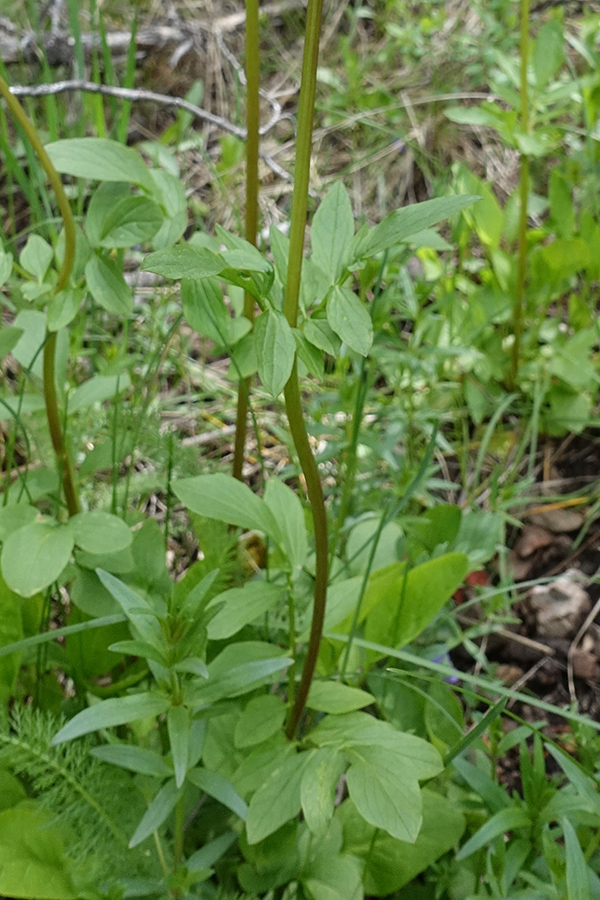


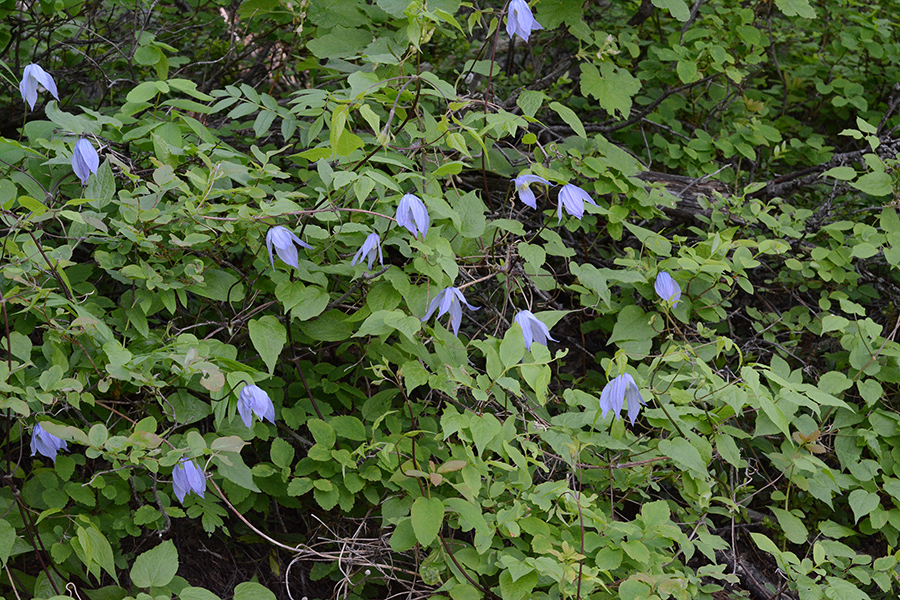

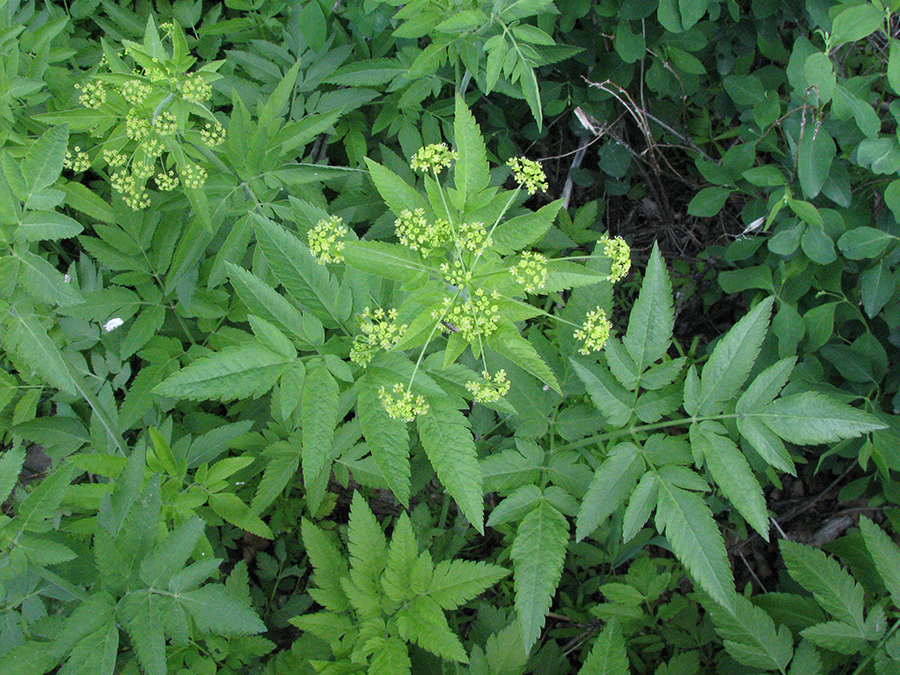
























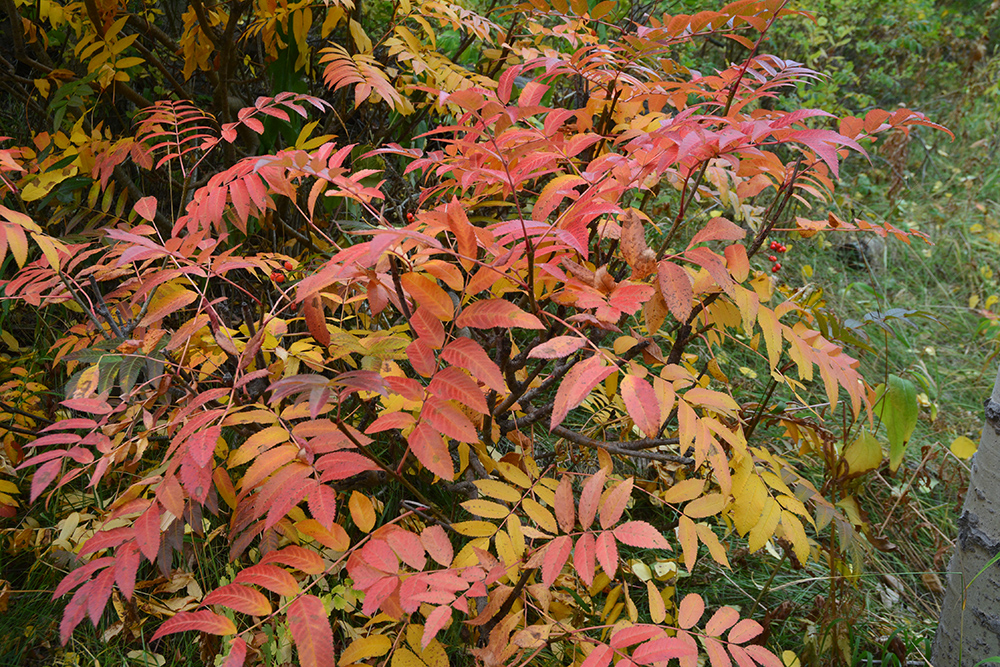
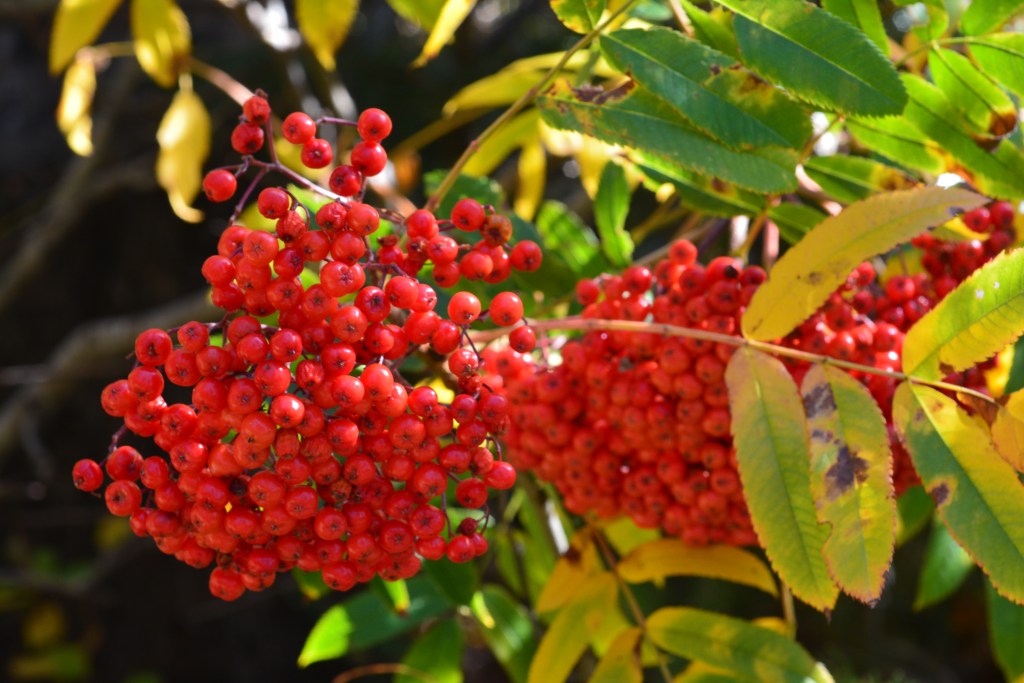


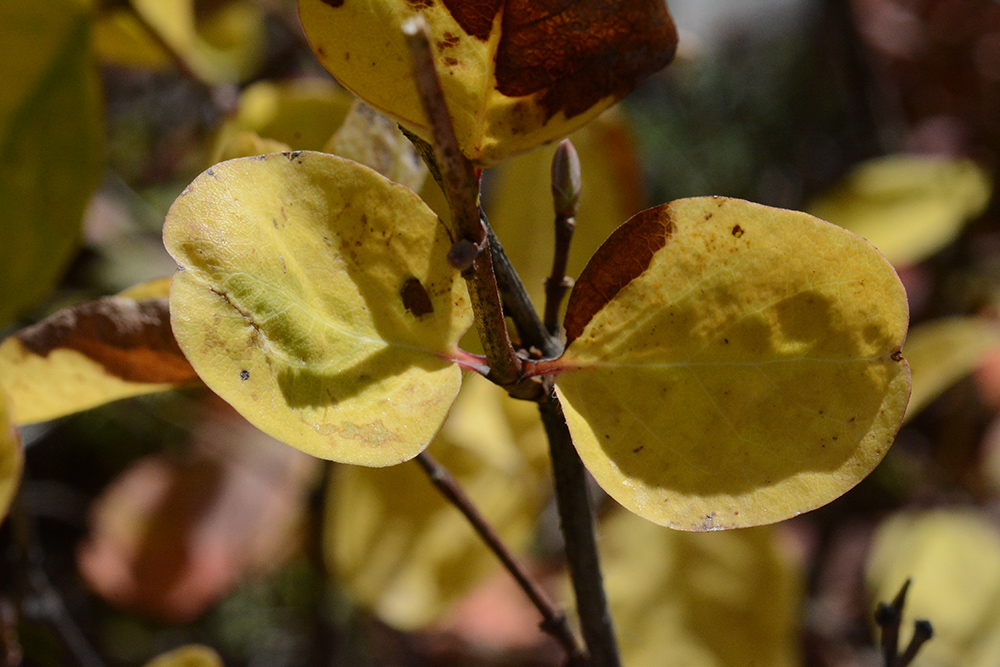
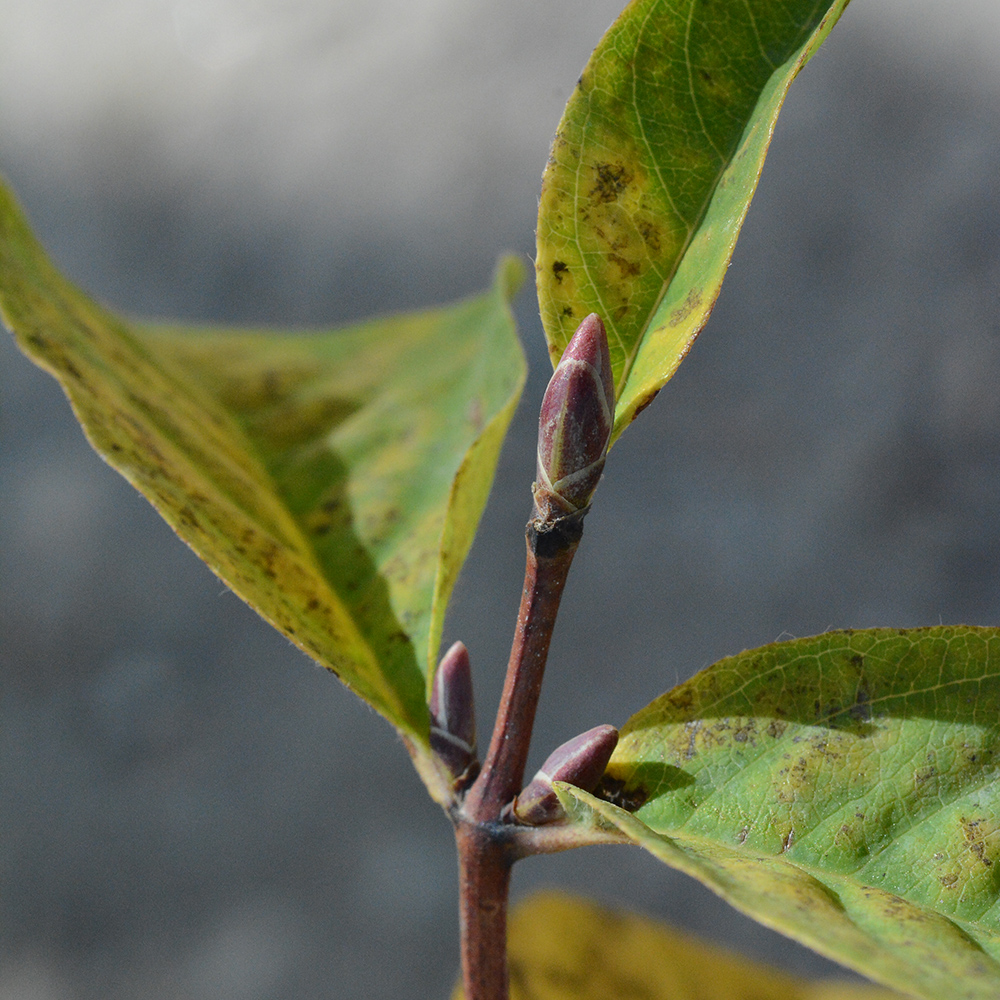


 {photo by Peggy dePasquale, WWA)
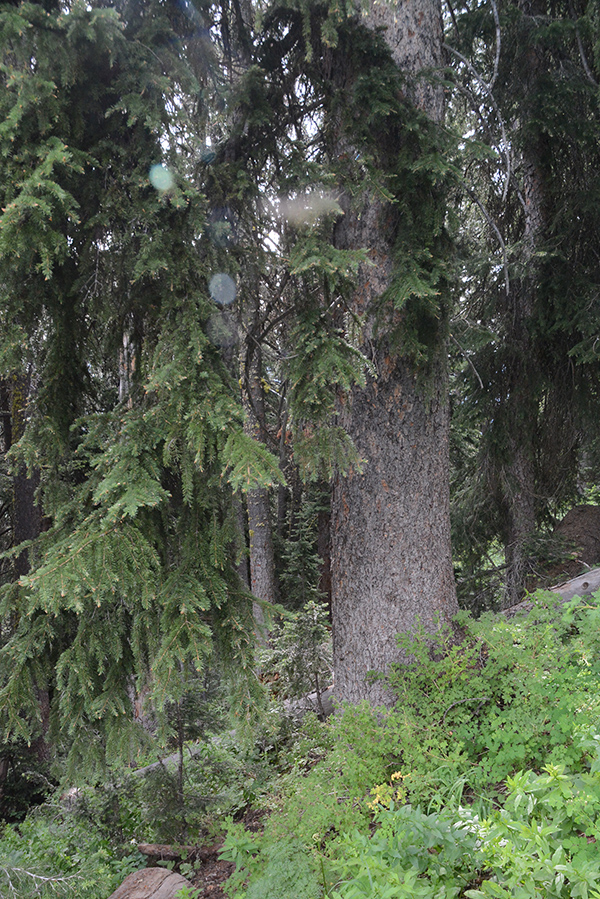
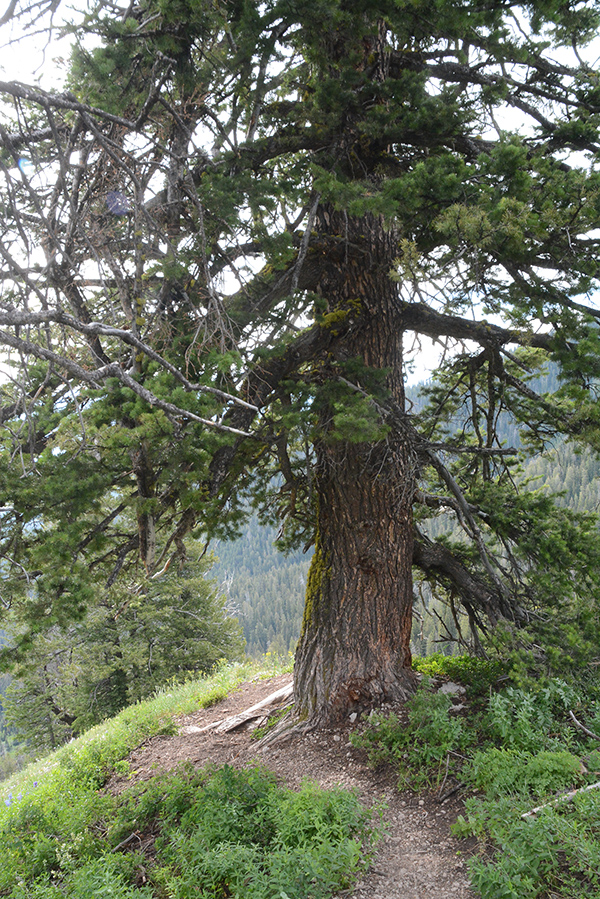
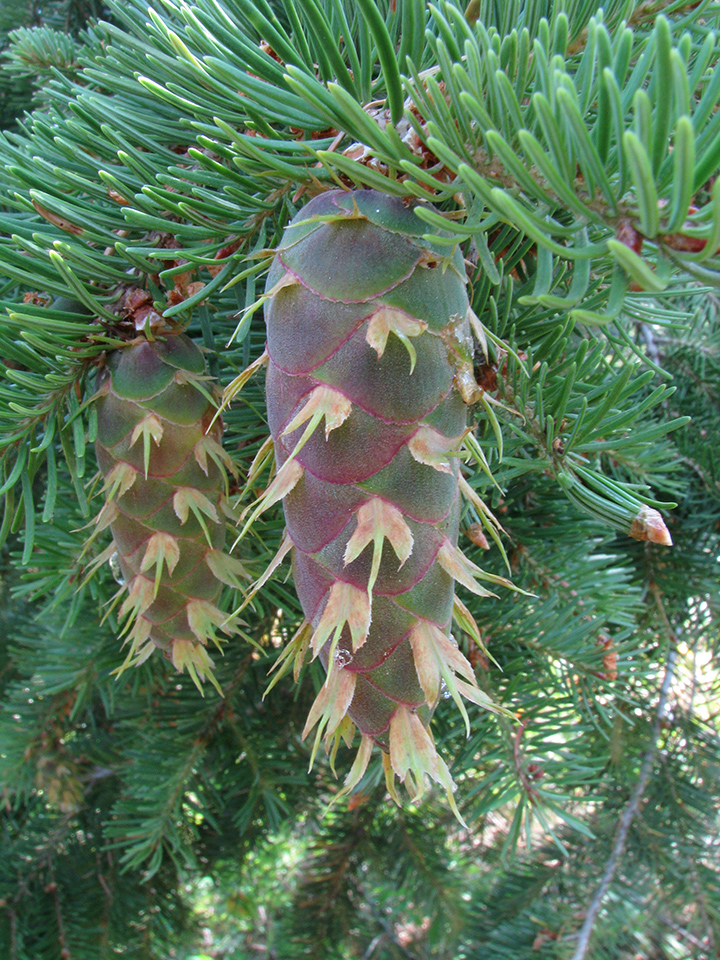
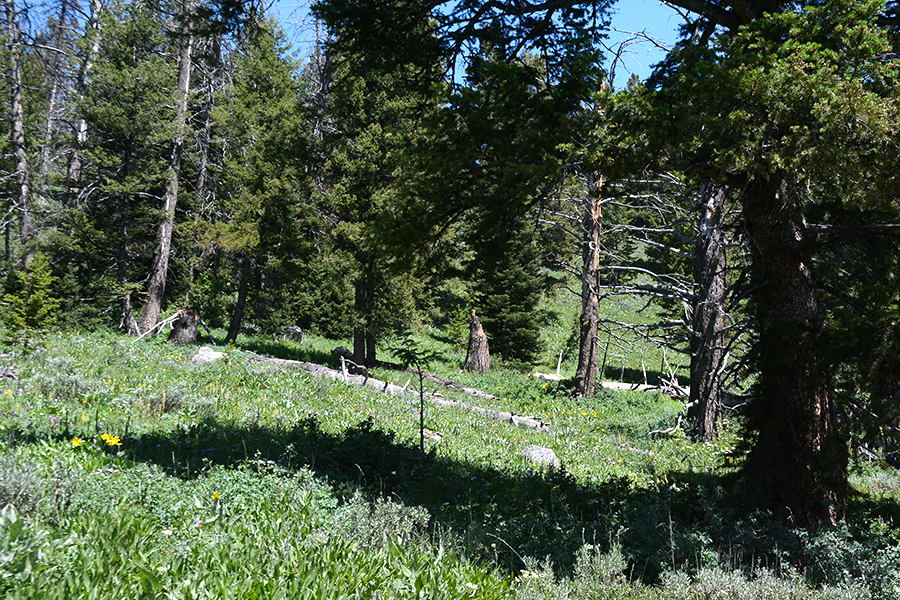
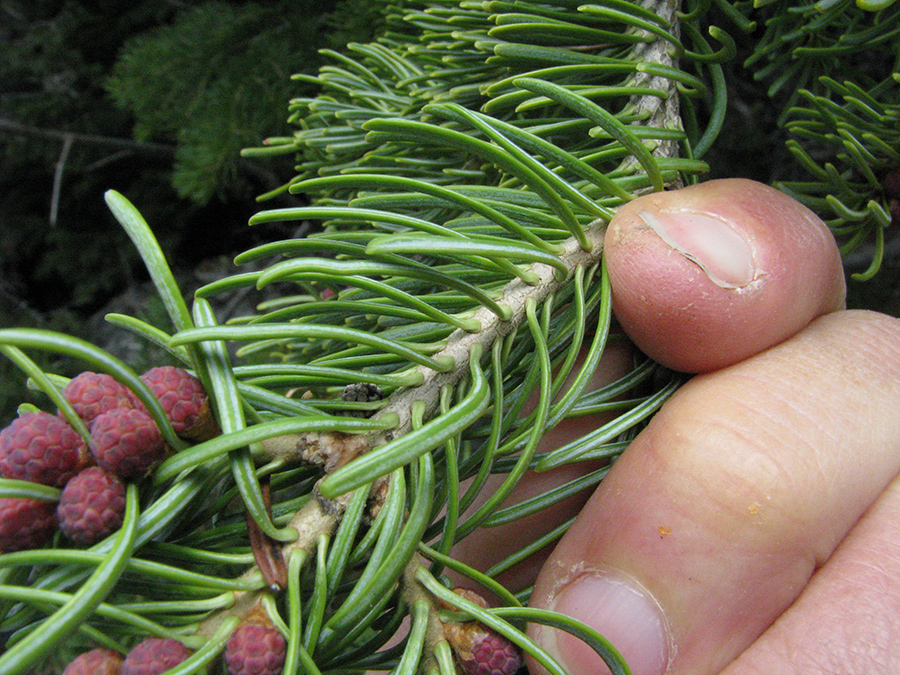 These two tree species are stalwarts of the higher elevation “spruce/fir” forests seen around Jackson Hole and south into the Snake River Range of the Palisades WSA. They grow where there is sufficient moisture/snow.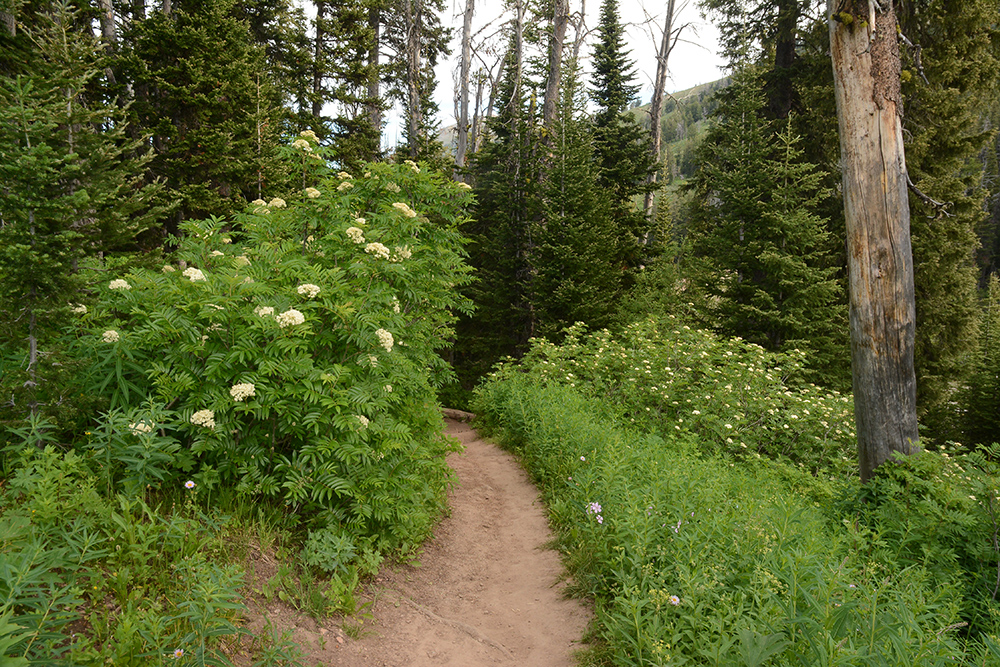
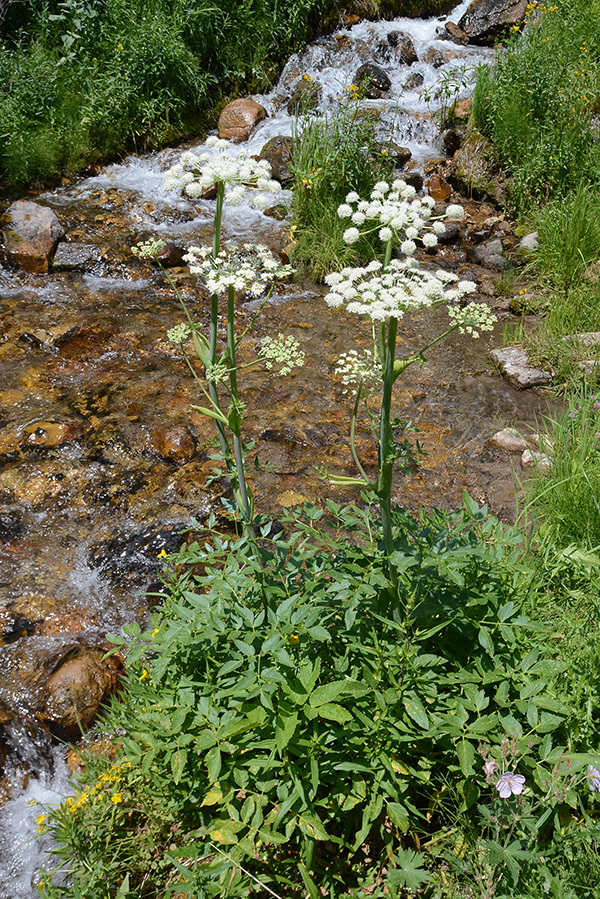
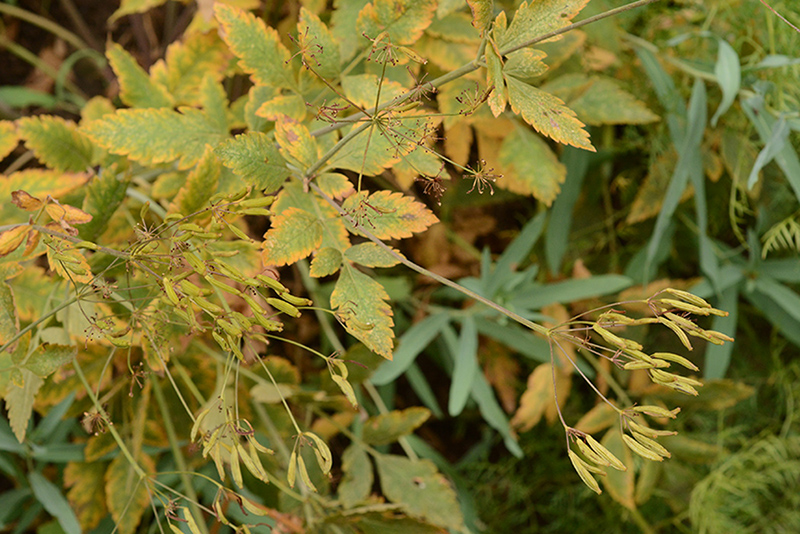
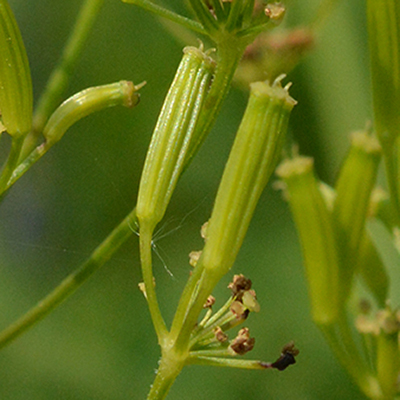
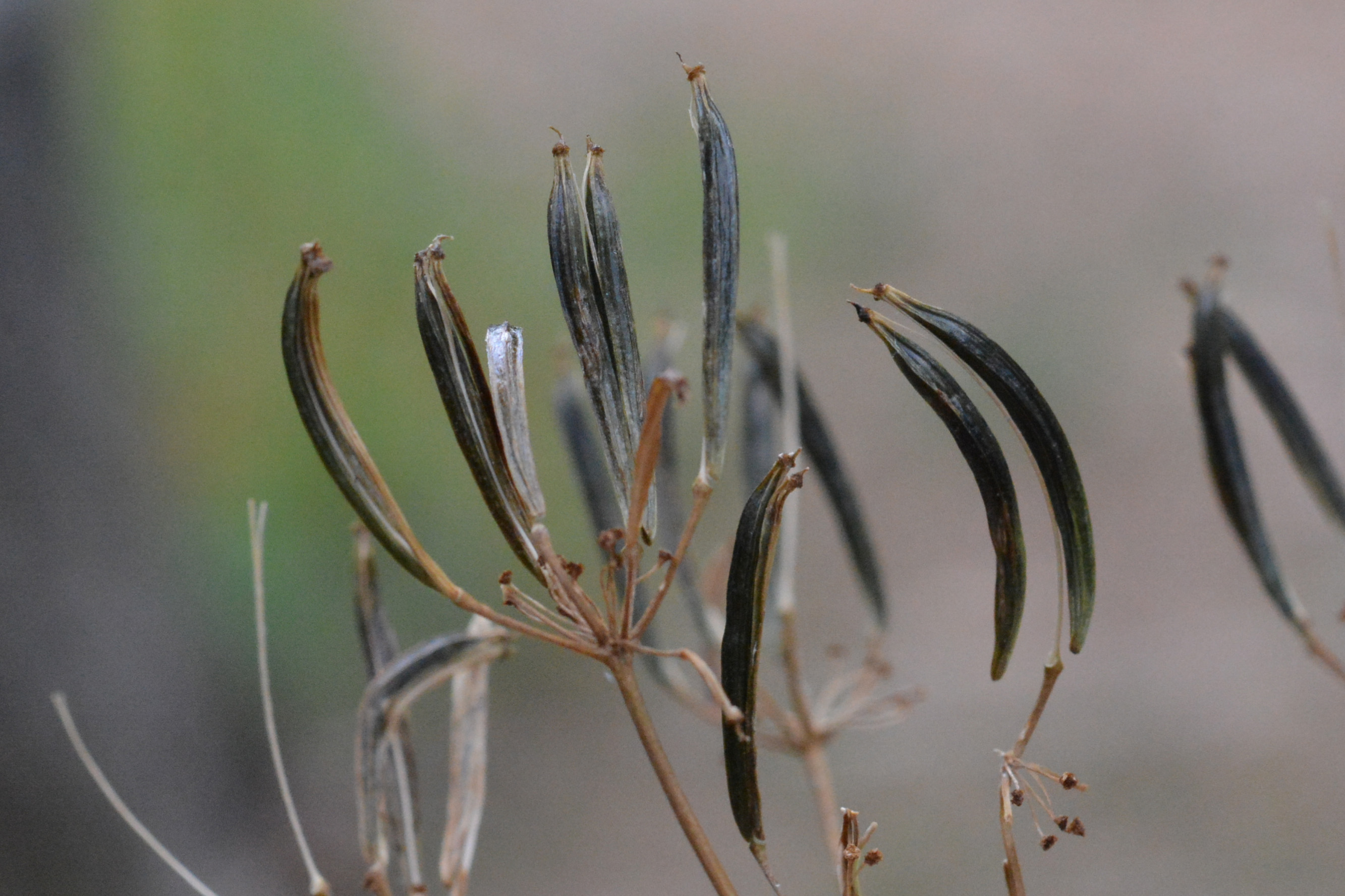
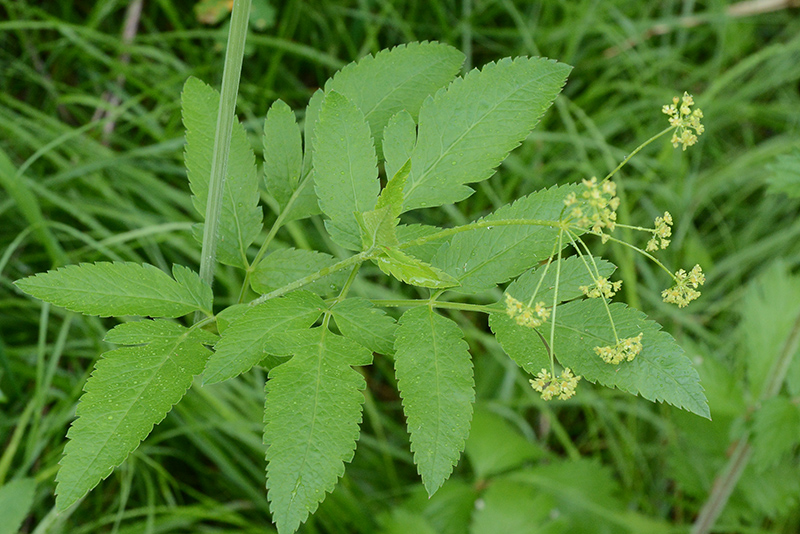
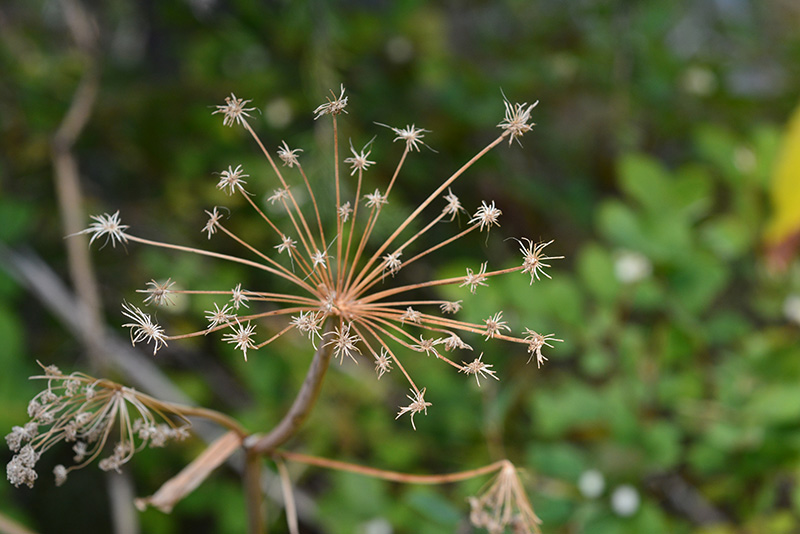
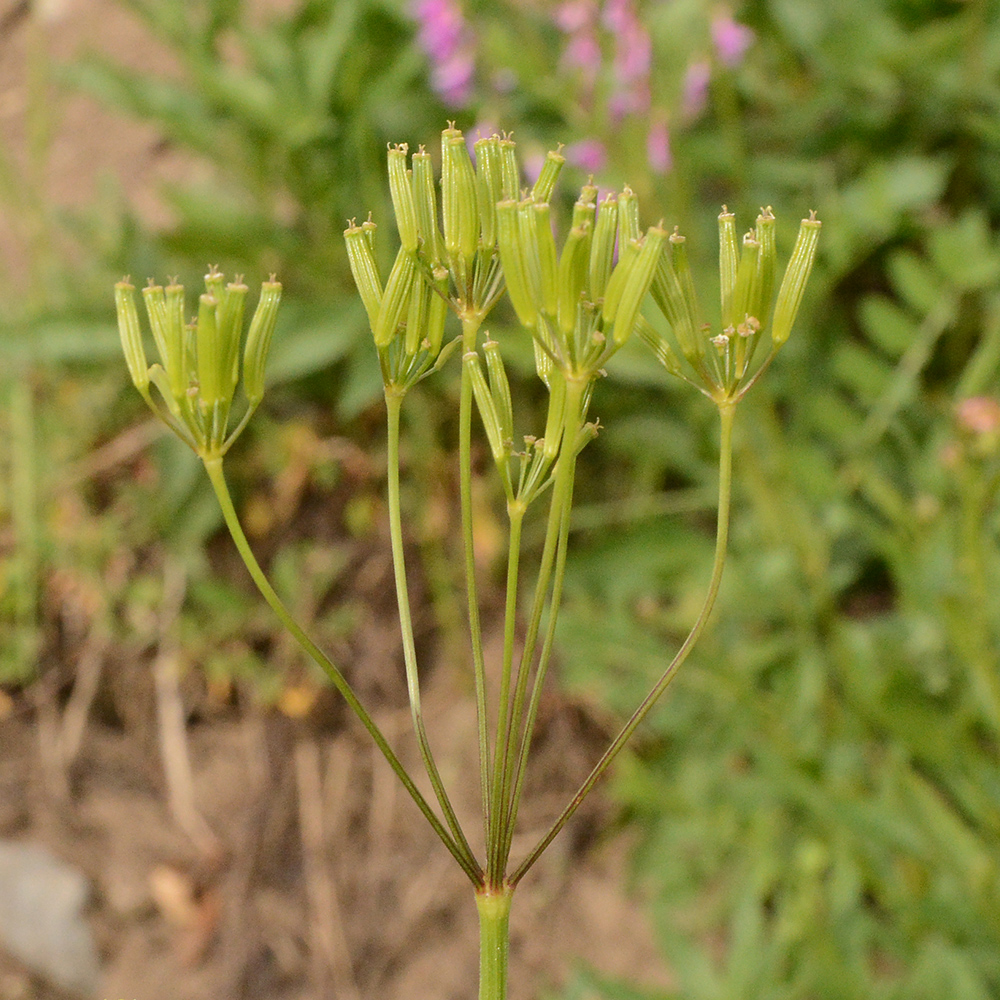
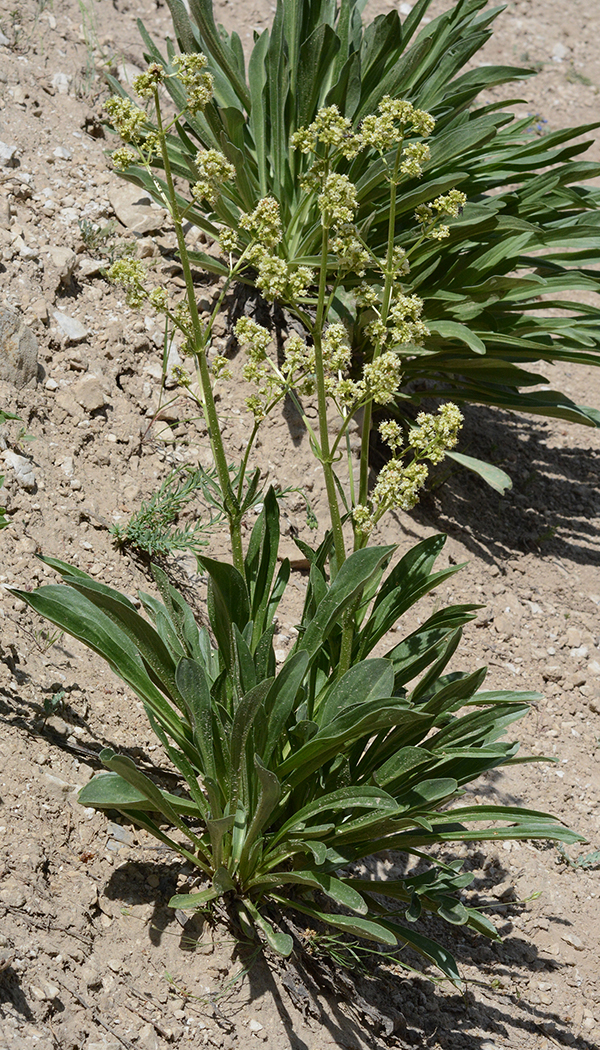
 Fern-leaf Lovage – Ligusticum filicinum – Tall 3-4’ plants hold up clusters of lacey white flowers. Leaves are finely dissected and skirt the stems to 2-3’. Abundant in montane parks and aspen groves. The shaggy thick fragrant roots have been used medicinally by Native Americans. C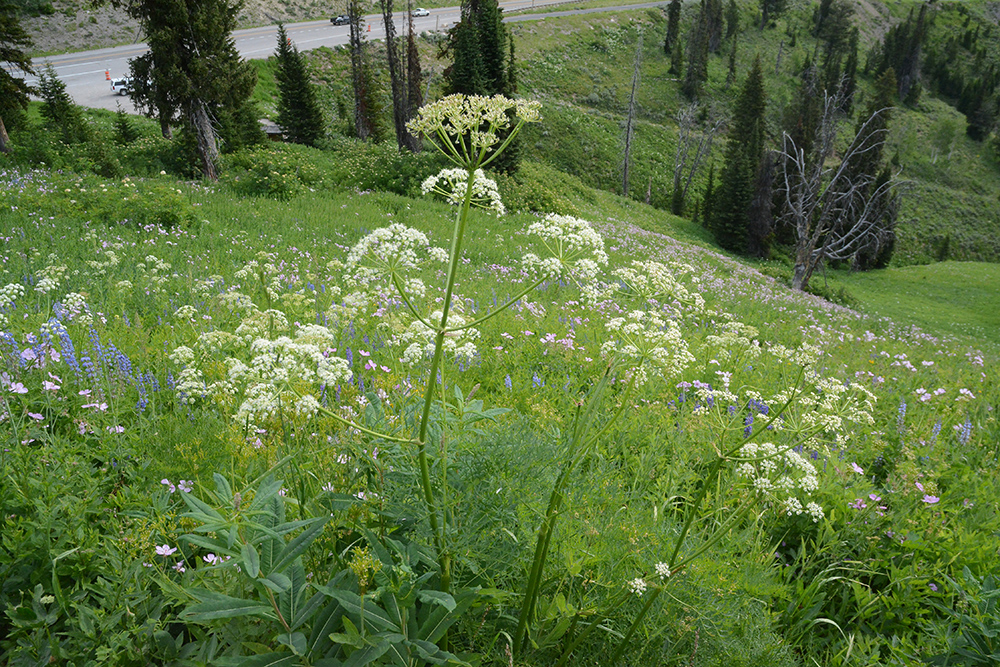
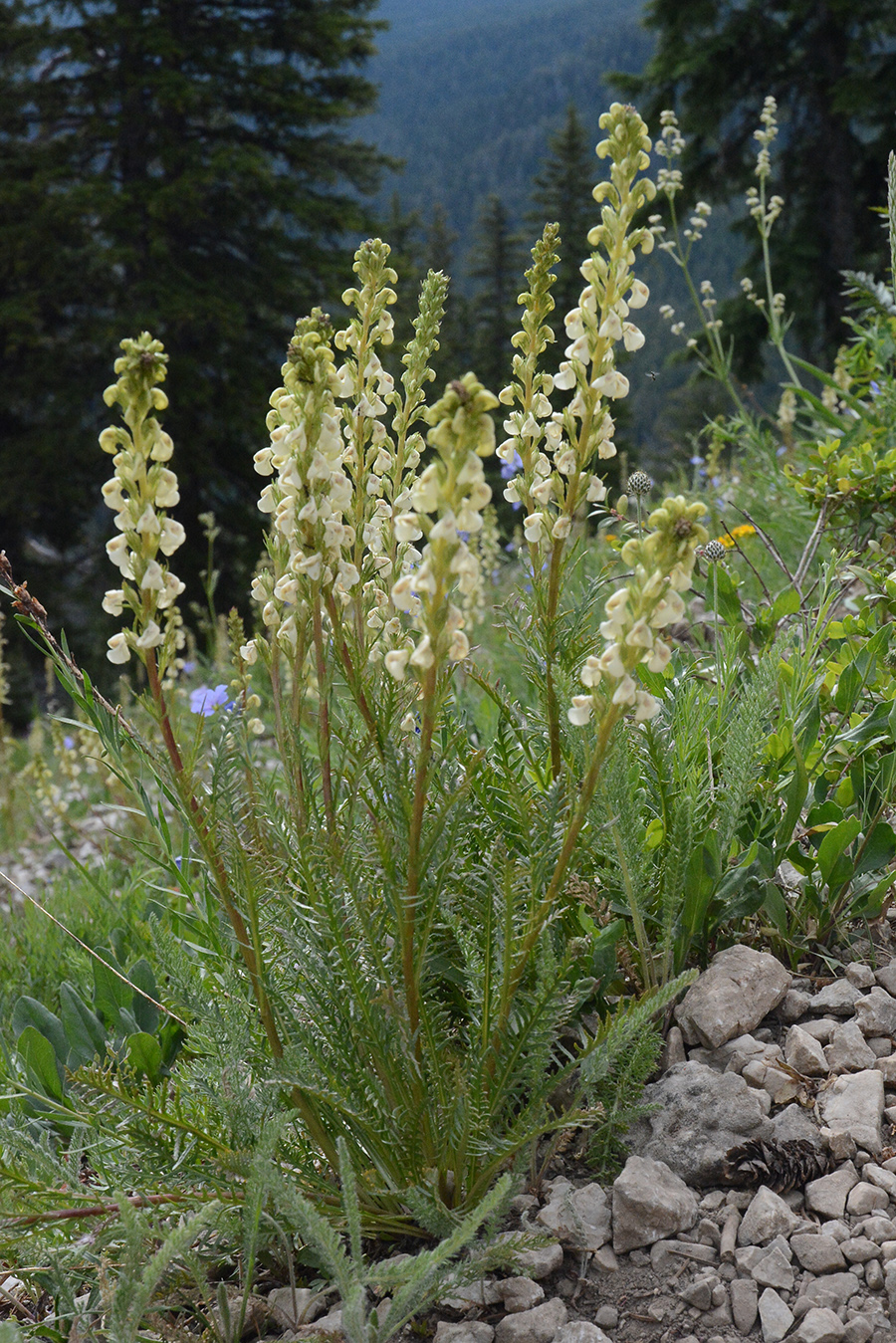 Its creamy white flowers just fit the shape of particular pollinators, often bumblebees. A bee lands, vibrates its wings, and dislodges the pollen down the coiled “beak” onto its back. At the next flower, the female stigma is designed to reach pollen stuck between the head and thorax—where the bee can’t reach it. A very precise operation. The divided leaves help in ID. Drier locations. F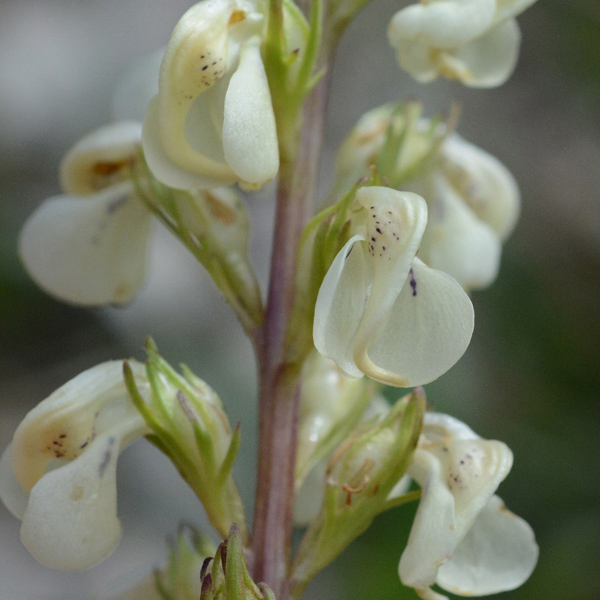
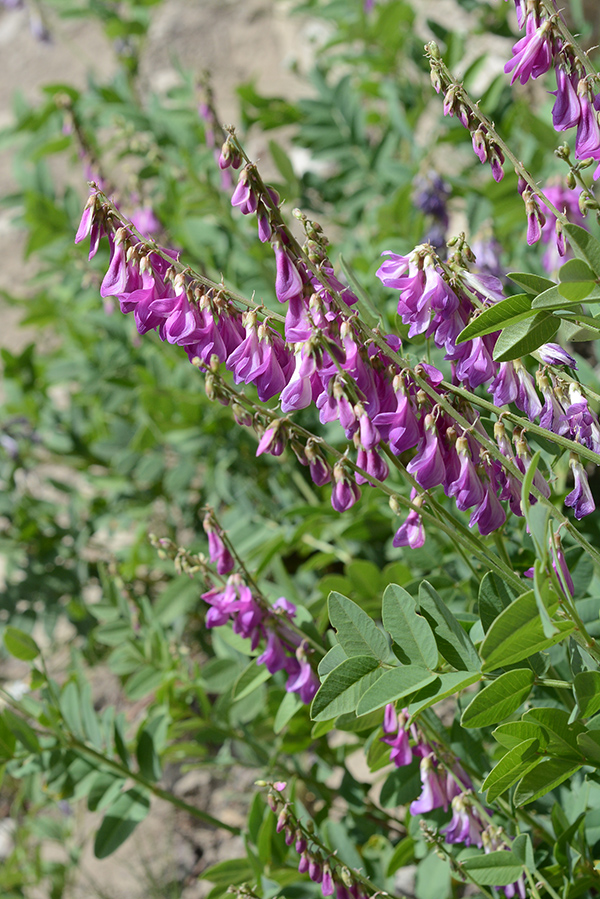
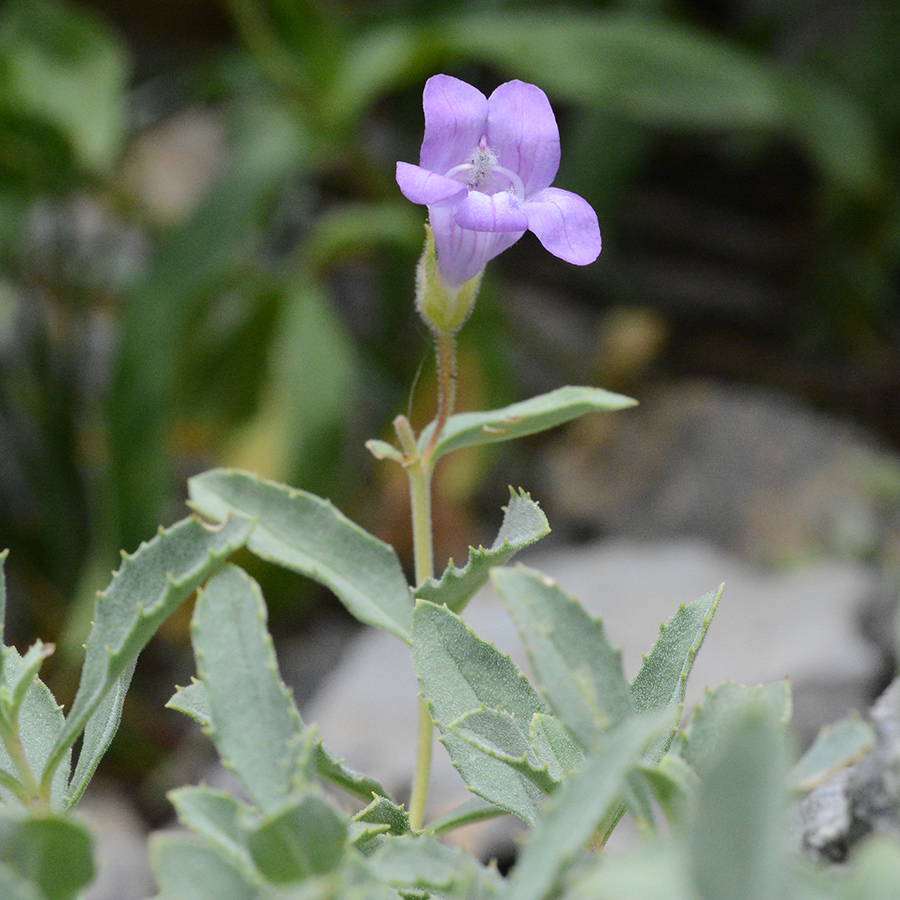
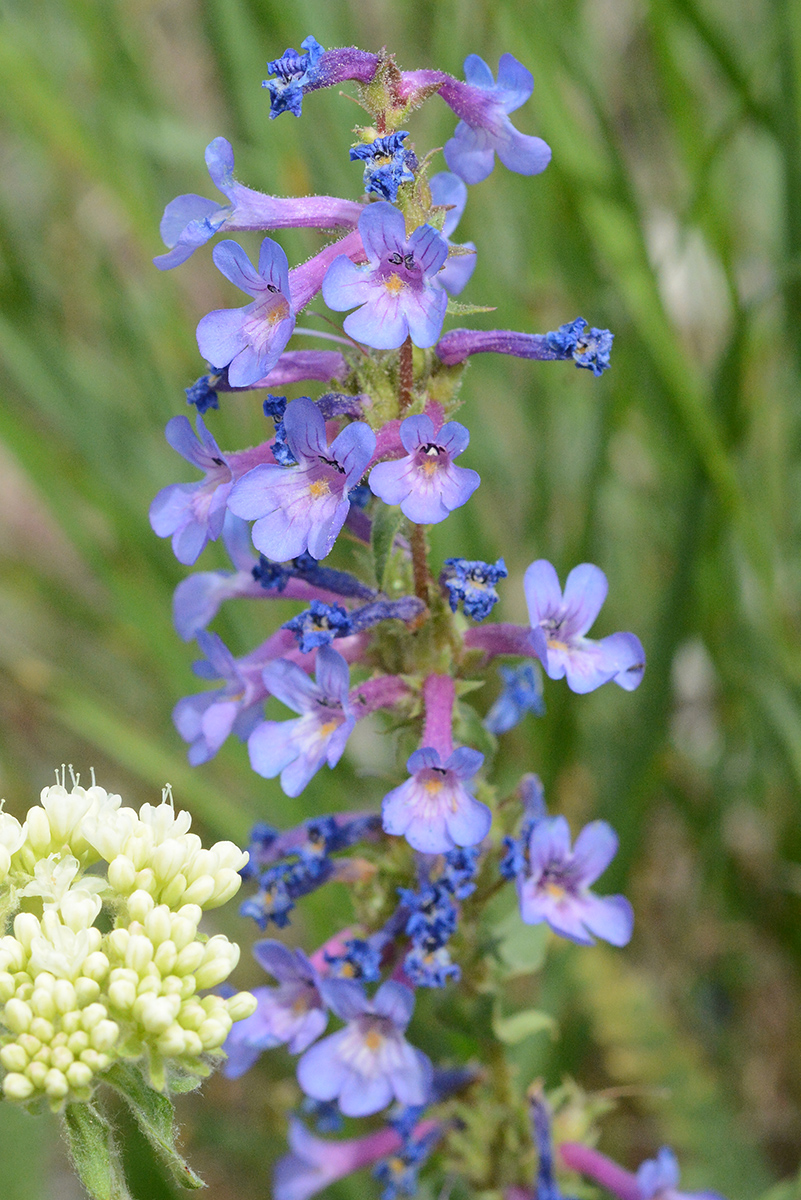 Wasatch – Penstemon cyananthus – mid-sized plants average 18-24” tall; Dry to moist slopes. F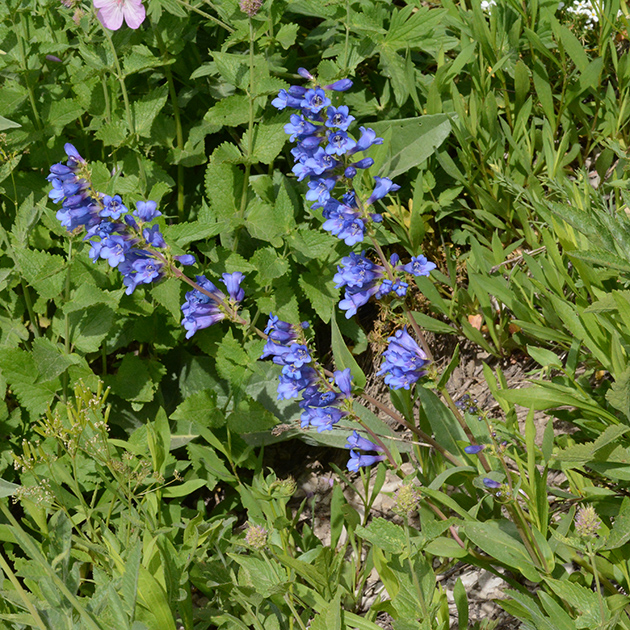
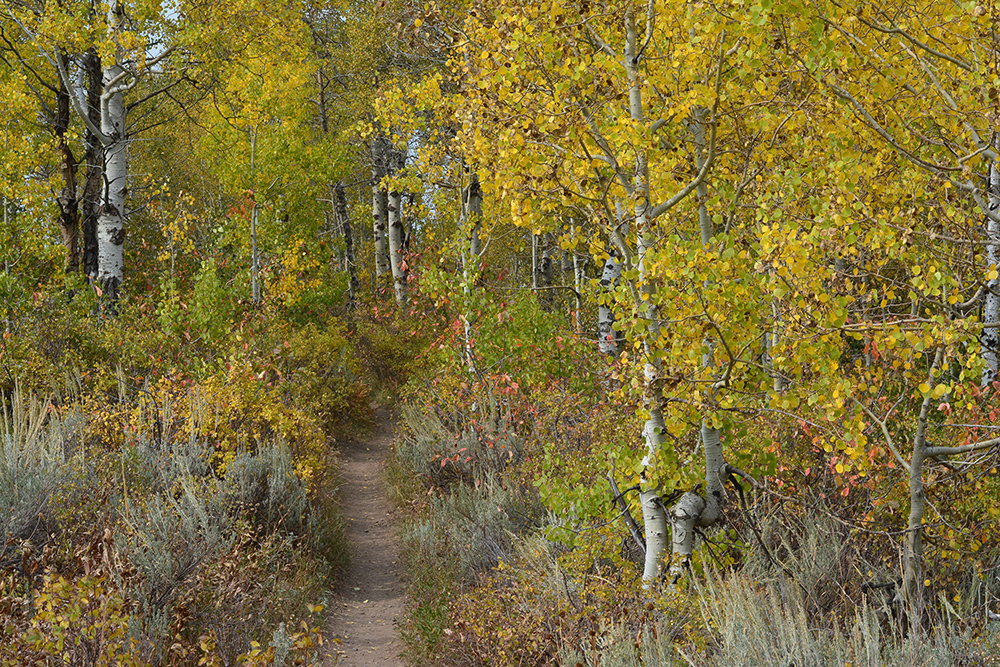
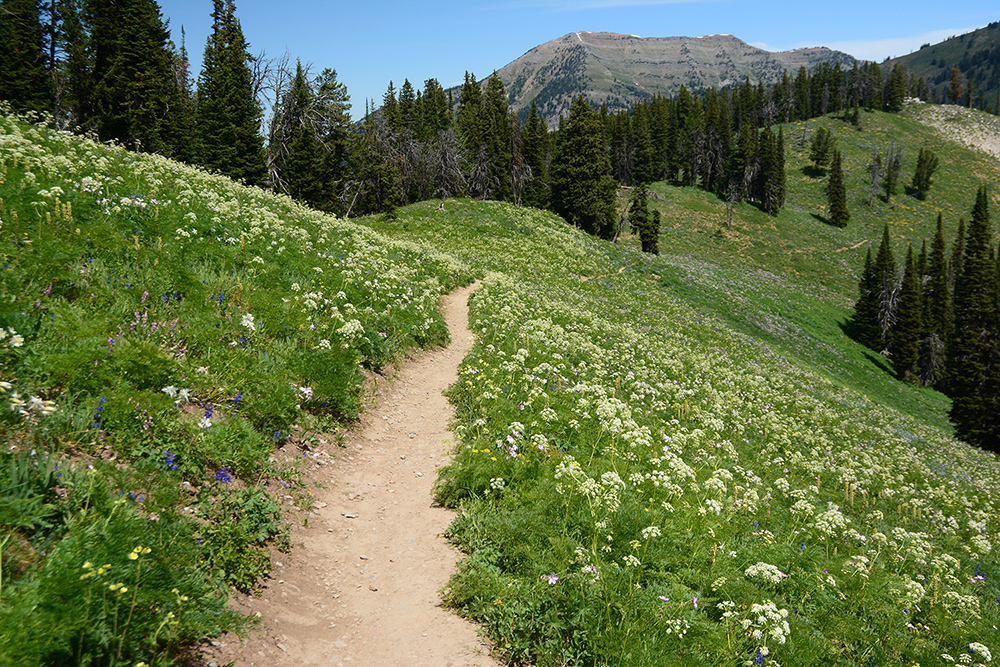
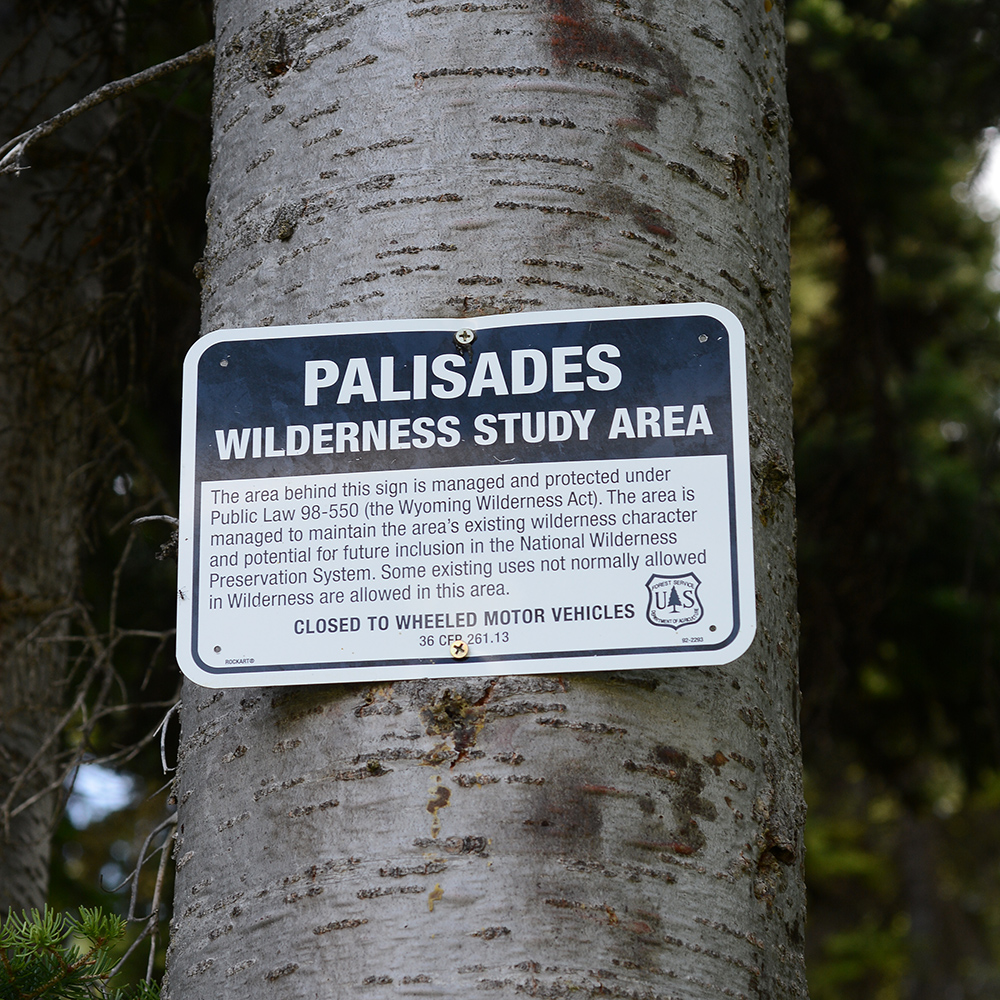 You will continue through the small patch of spruce/ fir forest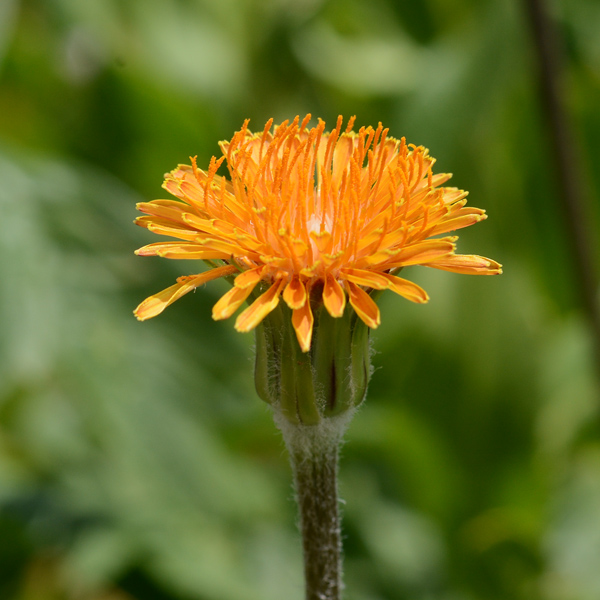
 These fruits come after the early blooming flowers mature. Flowers have four, 1-2” long violet-blue sepals (there are no petals) that form an elongate, thickened, bell-shaped flower.
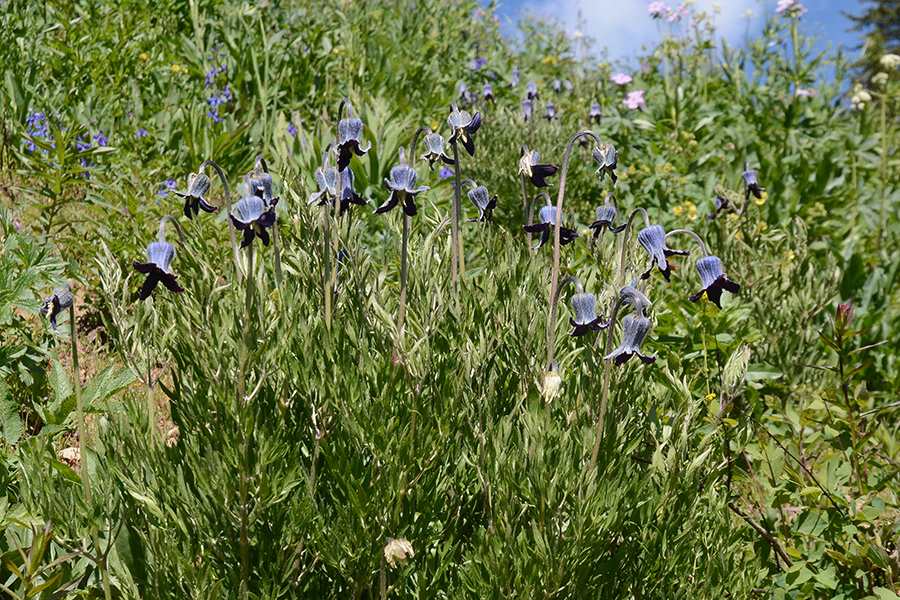 The large opposite leaves are dissected into elongate leaflets. Sugar Bowls are considered a harbinger of spring in the valley, yet it is blooming at end of the trail now! O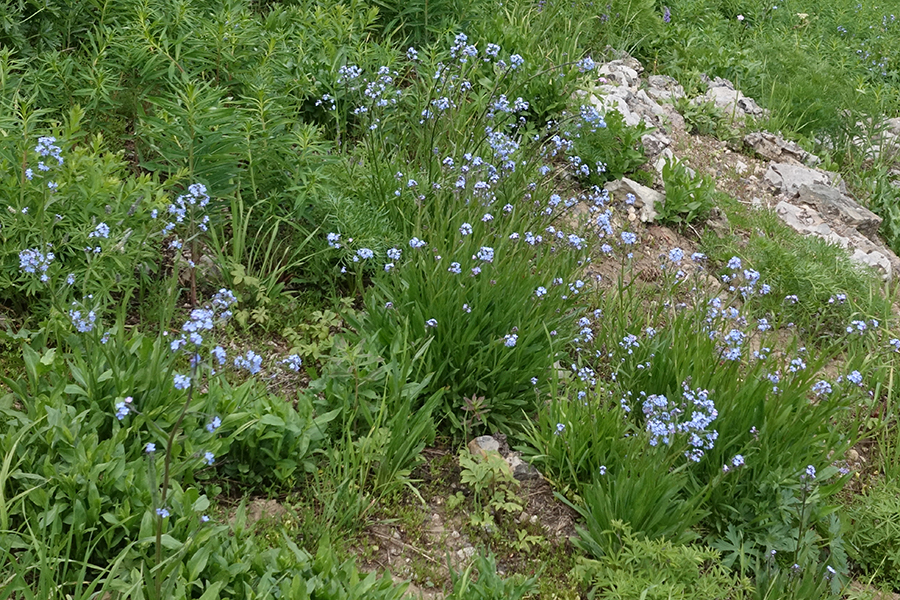
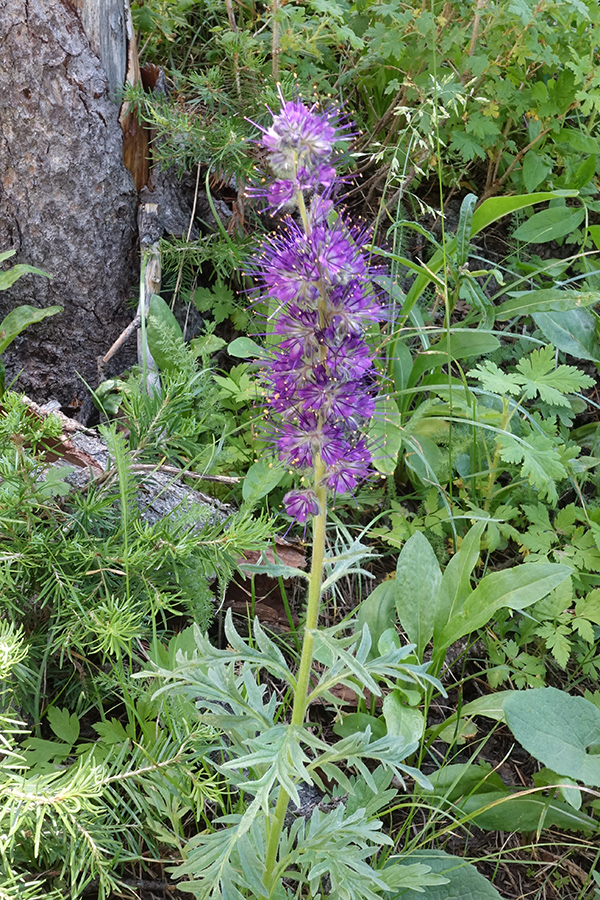
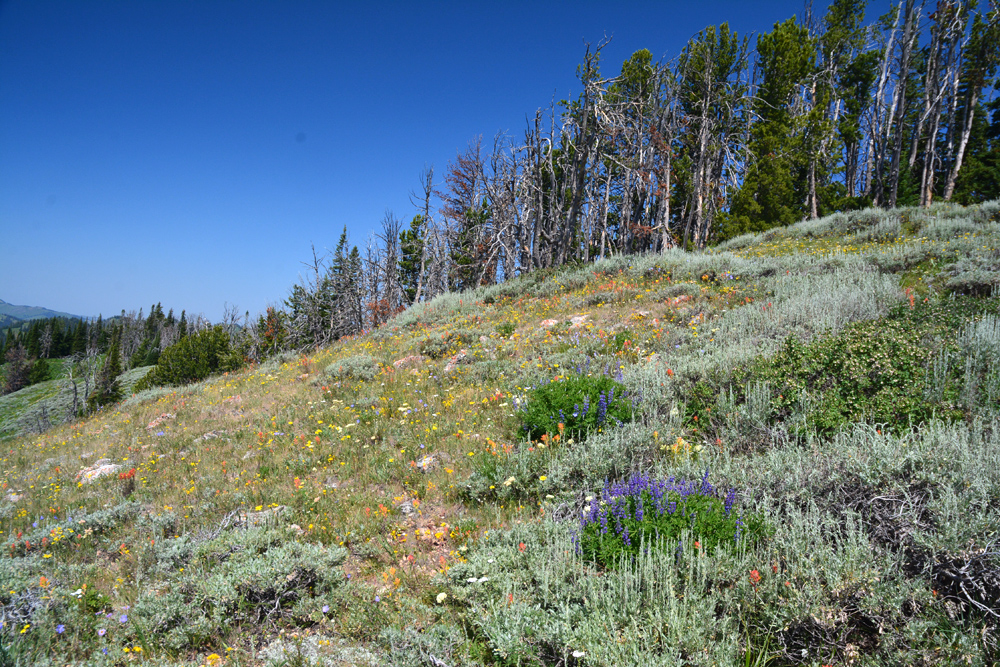
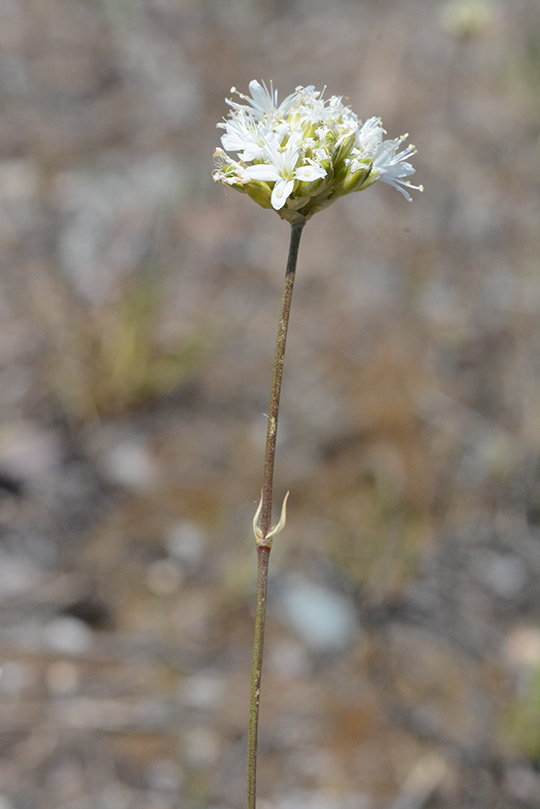
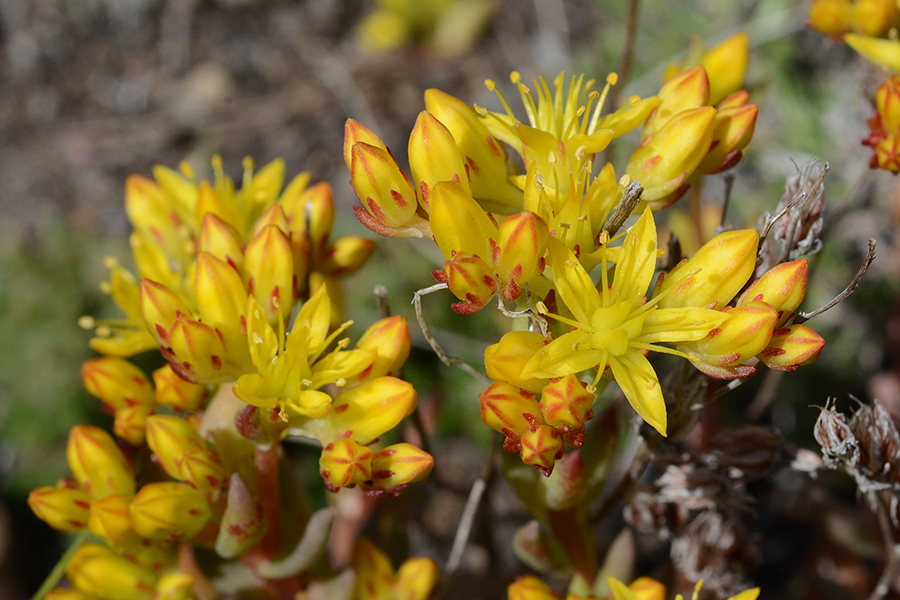
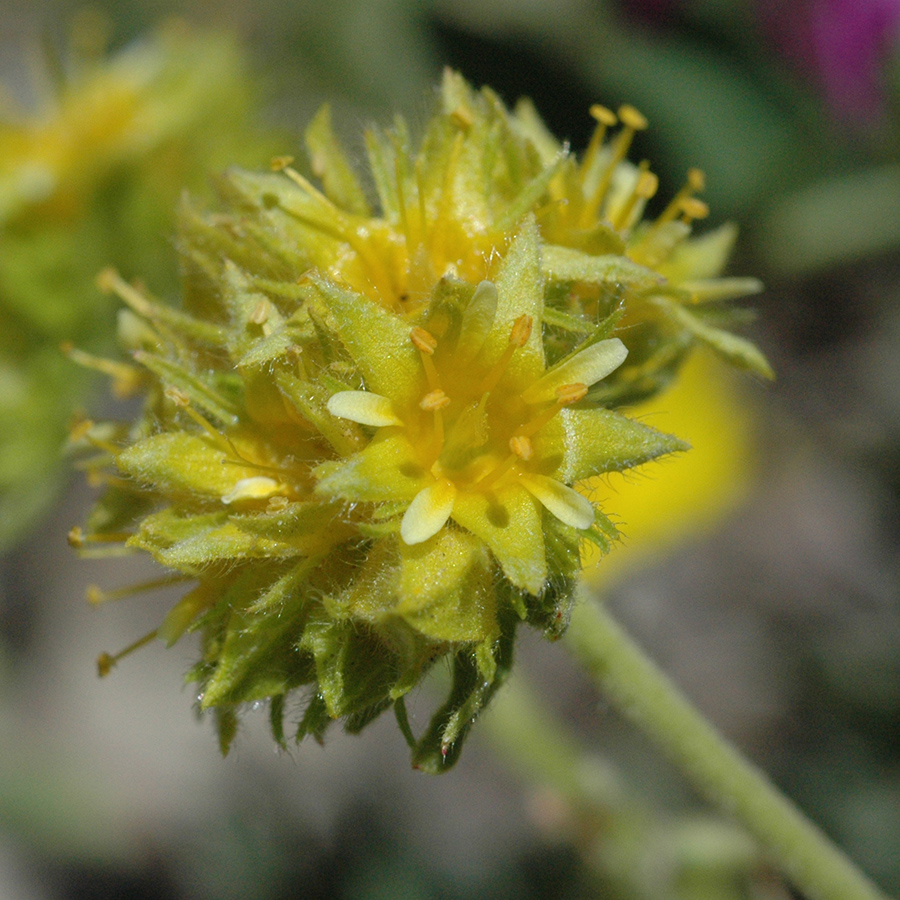
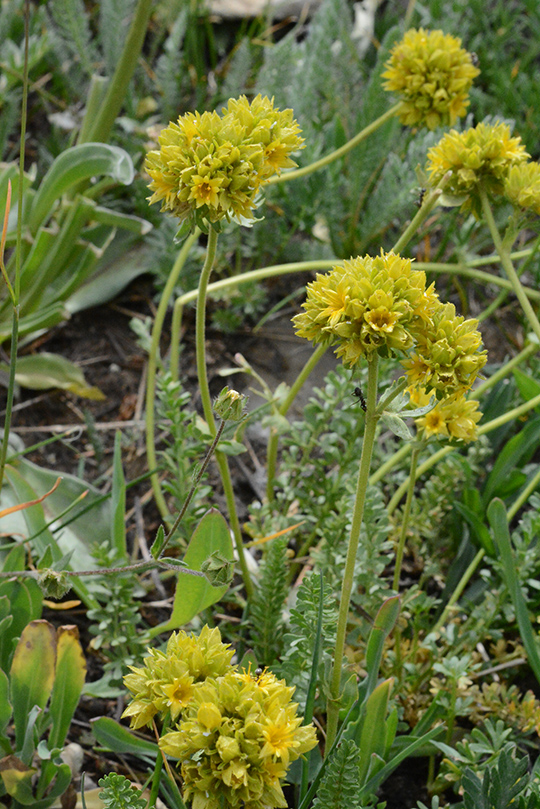
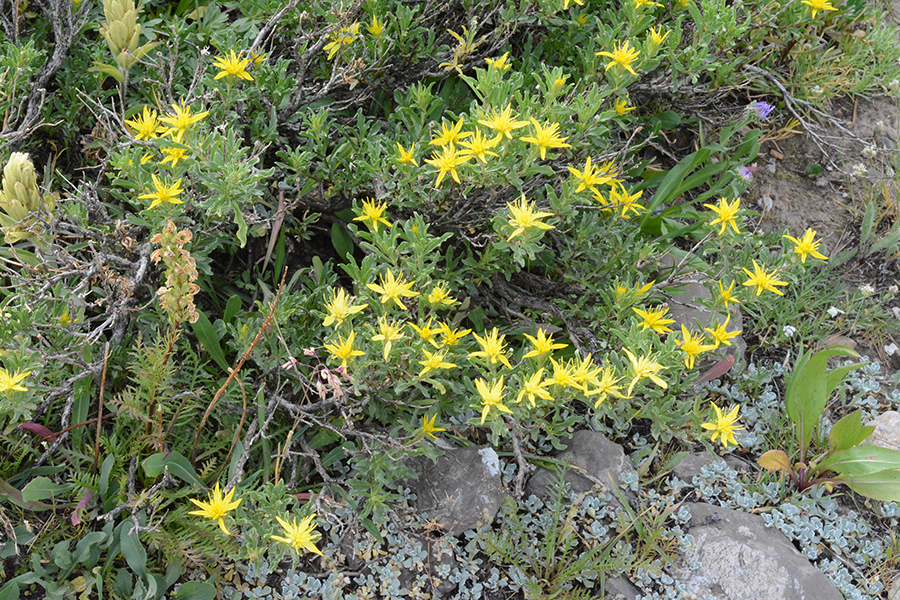
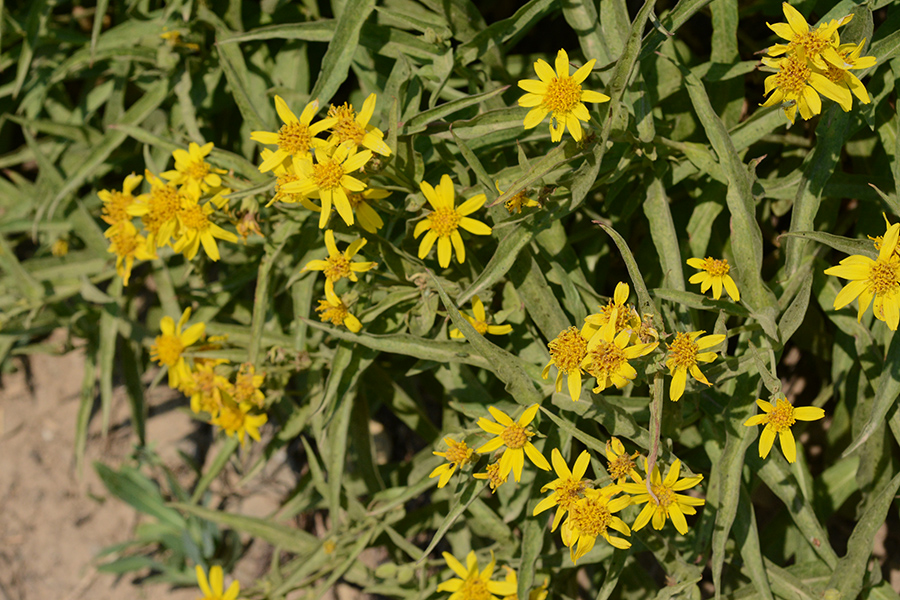
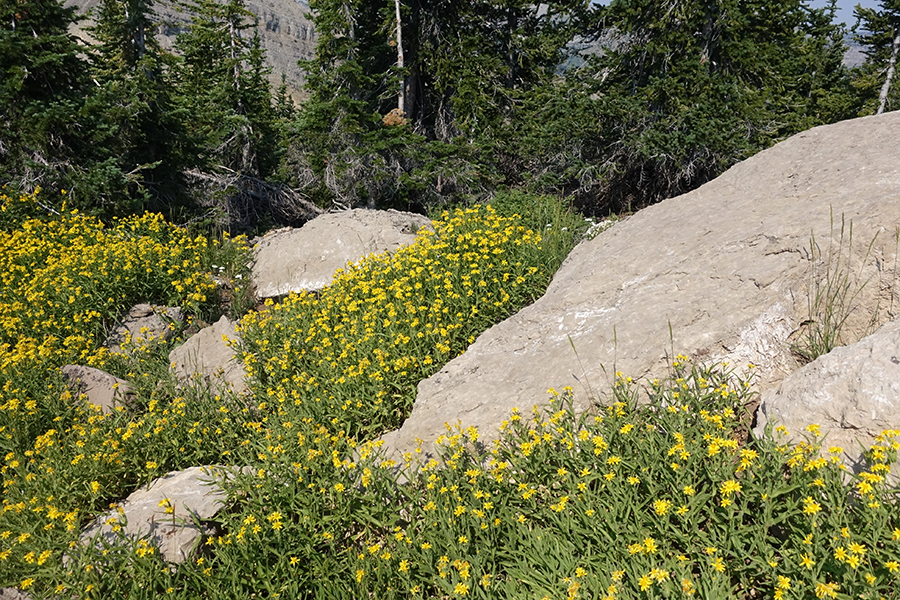
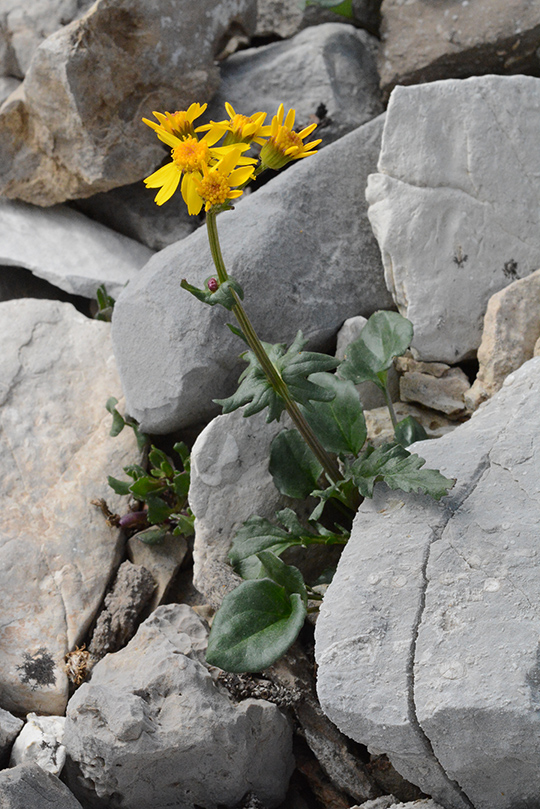
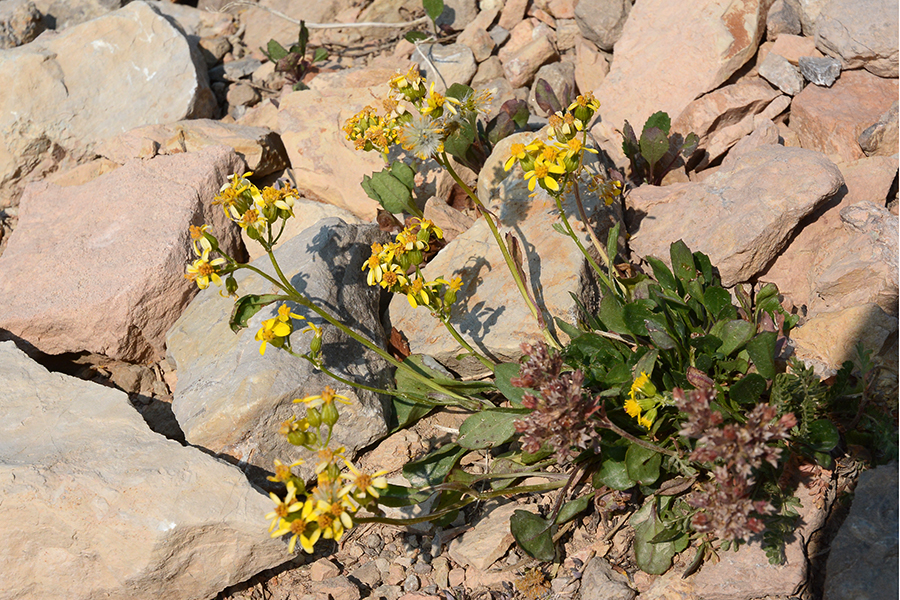
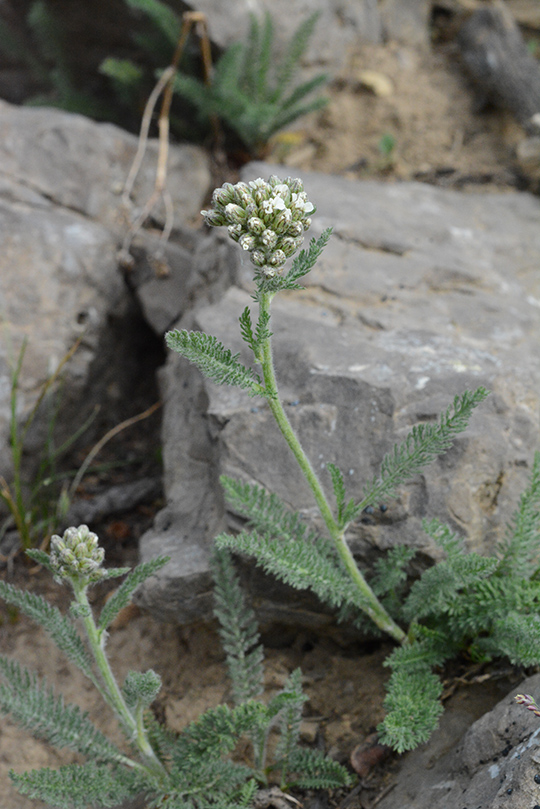
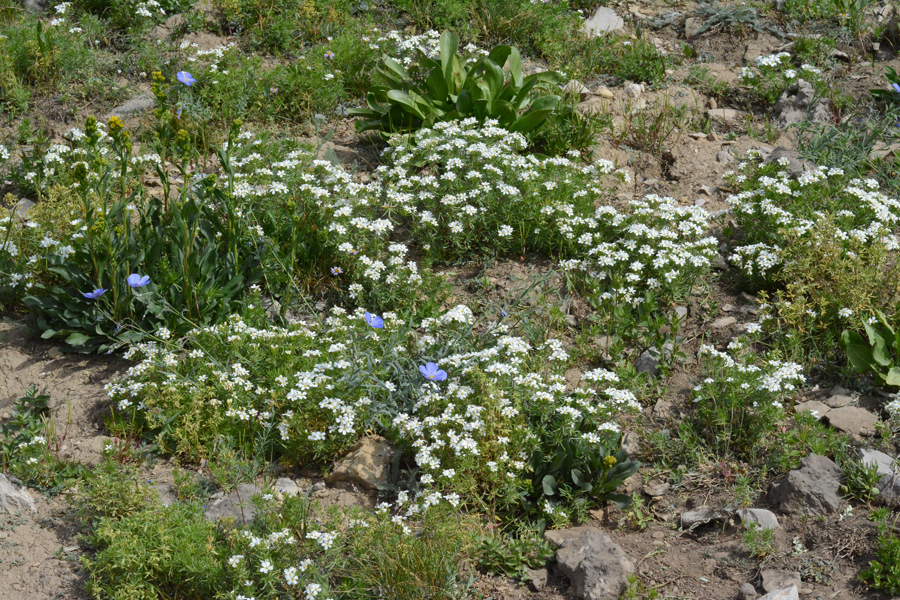
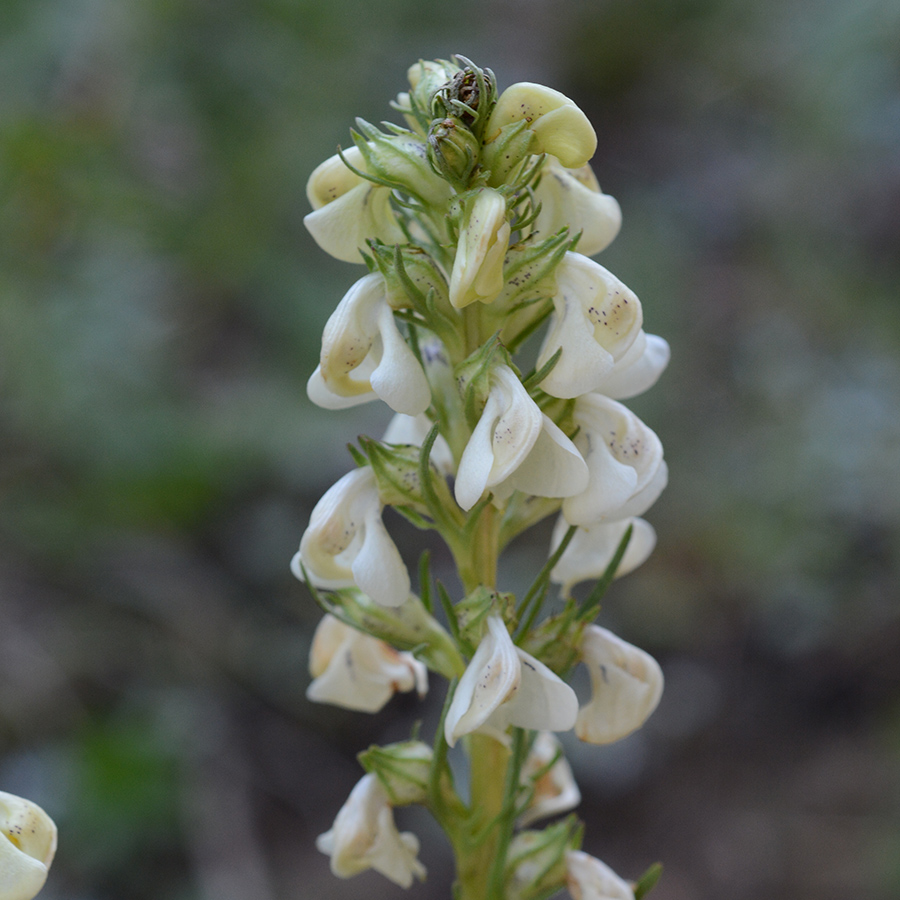
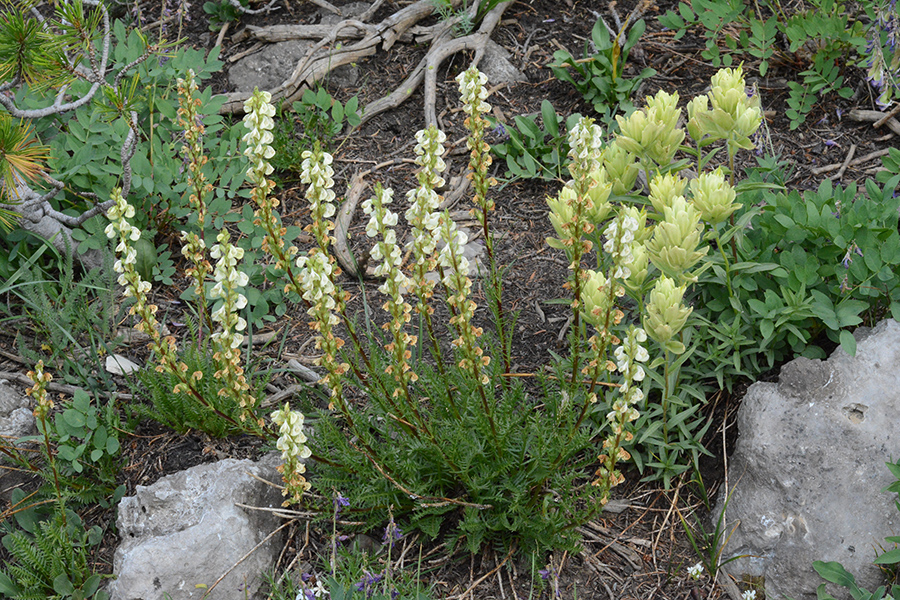
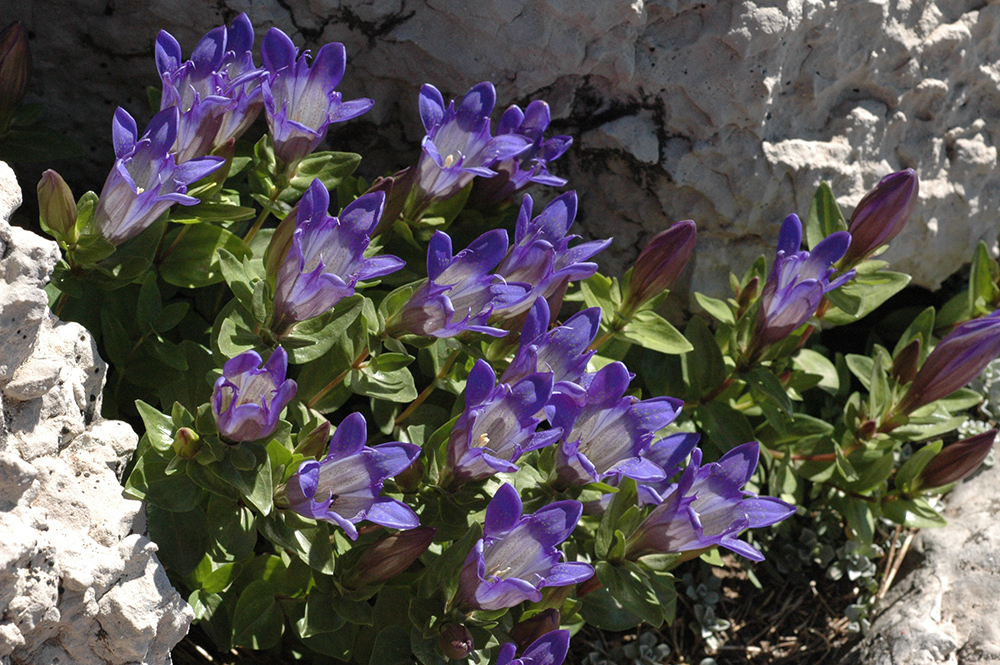
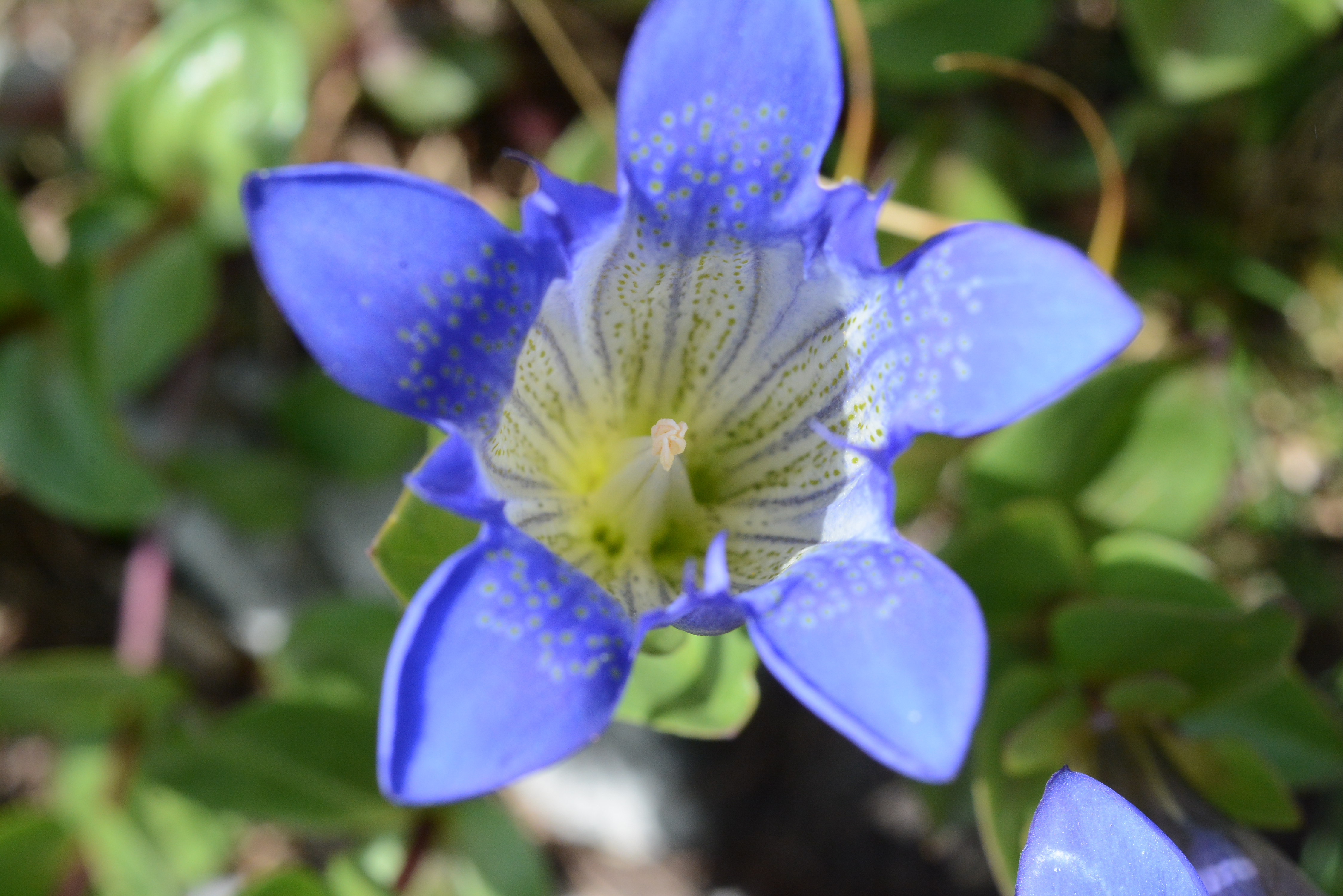

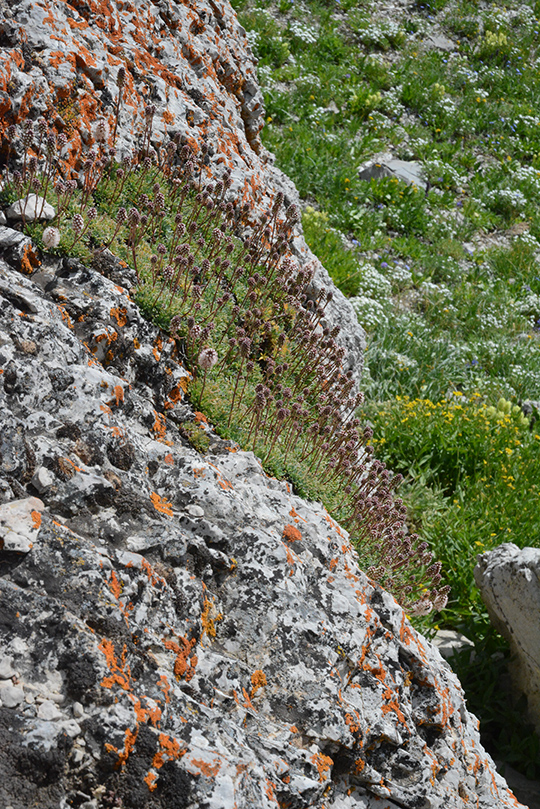
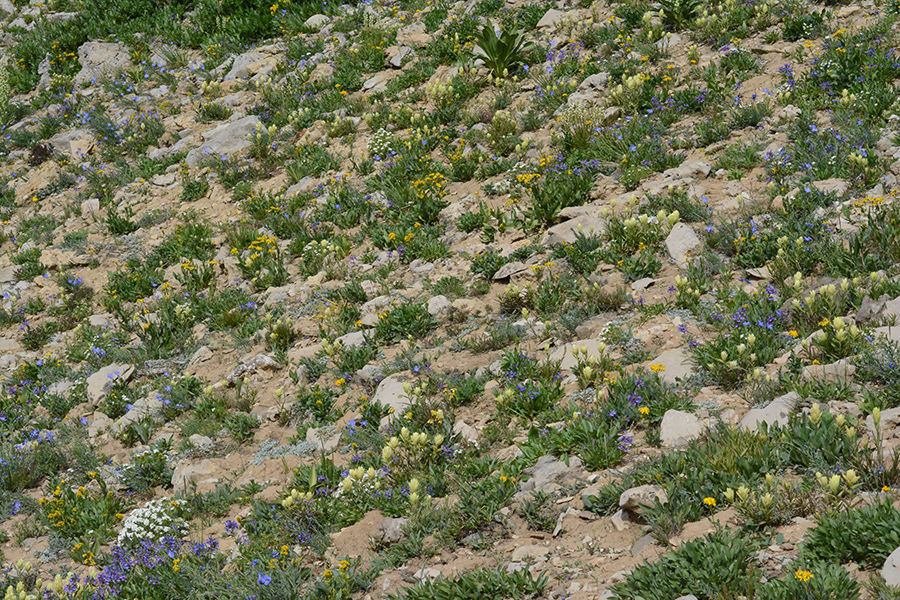
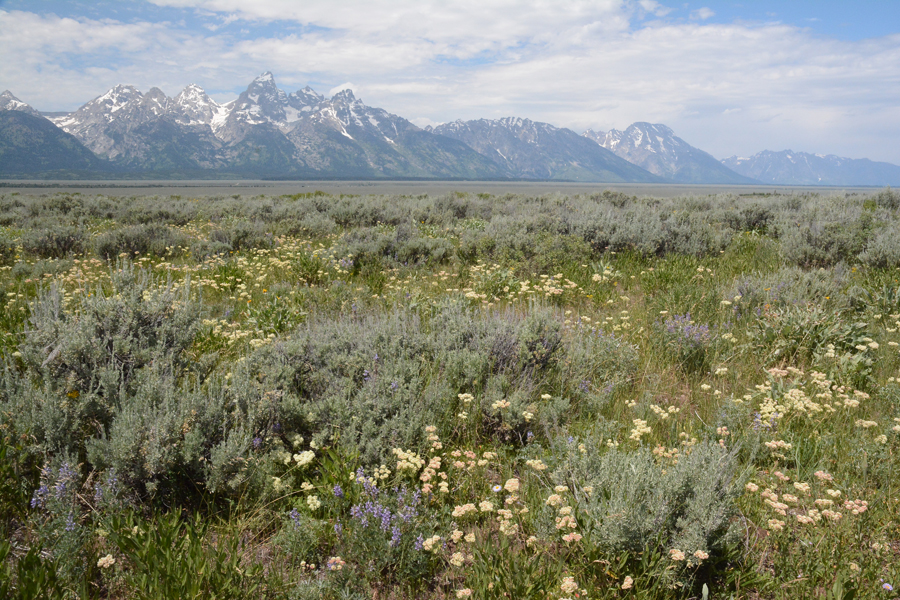 A drive along Antelope Flats Road or inner Park Road rewards one with clouds of Sulphur Wild Buckwheat – Eriogonum umbellatum.
 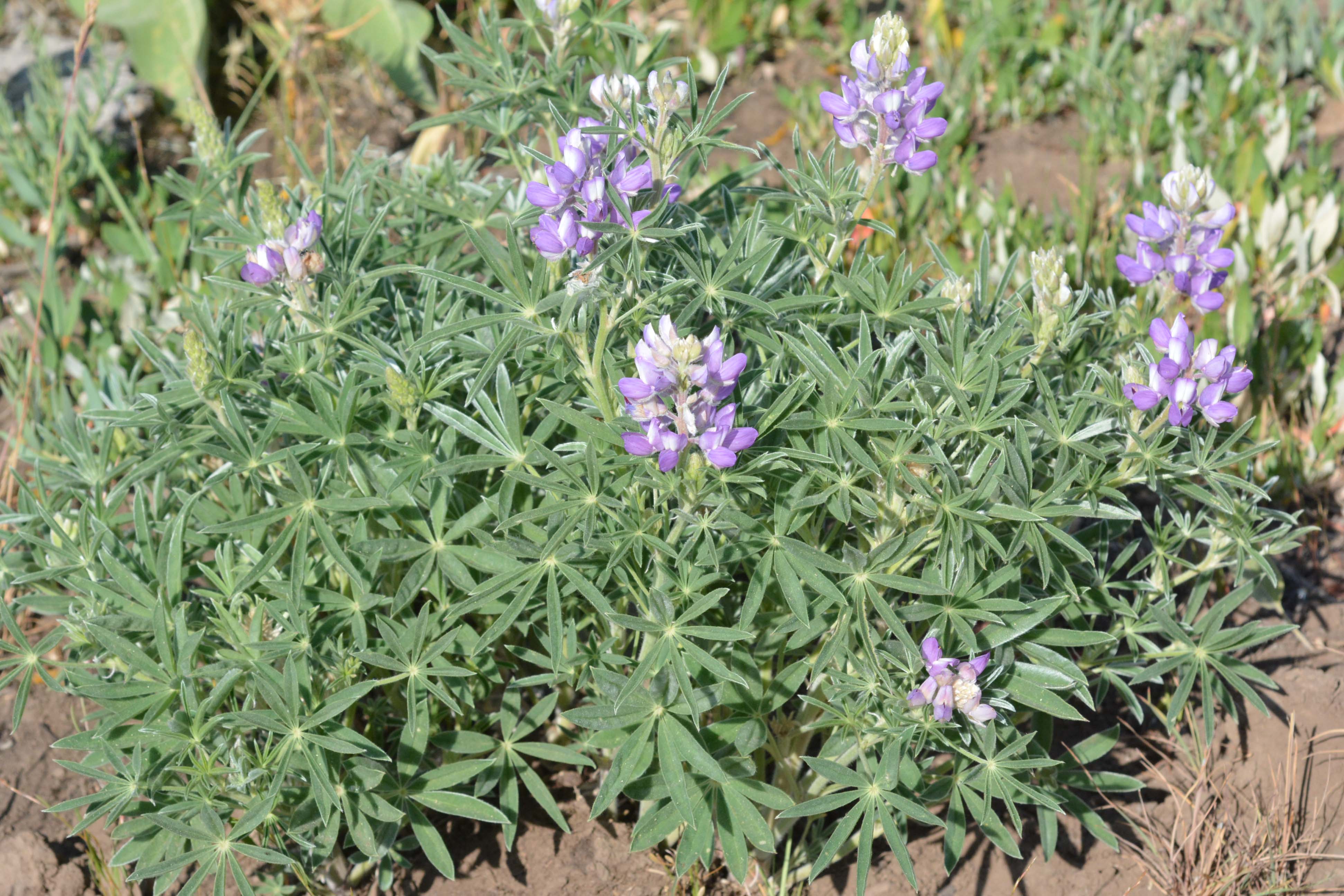 In some areas such as near Oxbow Bend or up Old Pass Road, Scarlet Gilia — Ipomopsis aggregata — appears particularly abundant this year. In other areas, it stands more or less among sagebrush.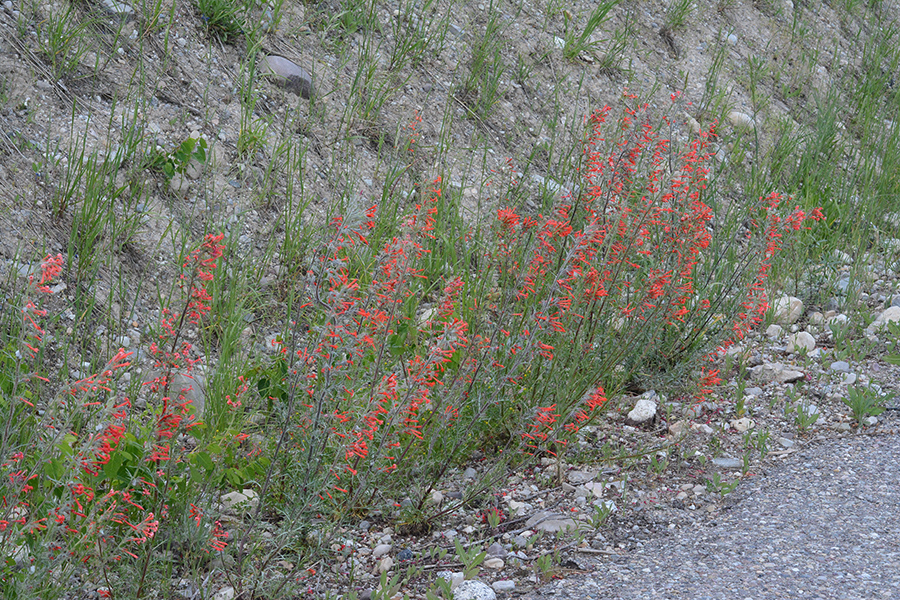
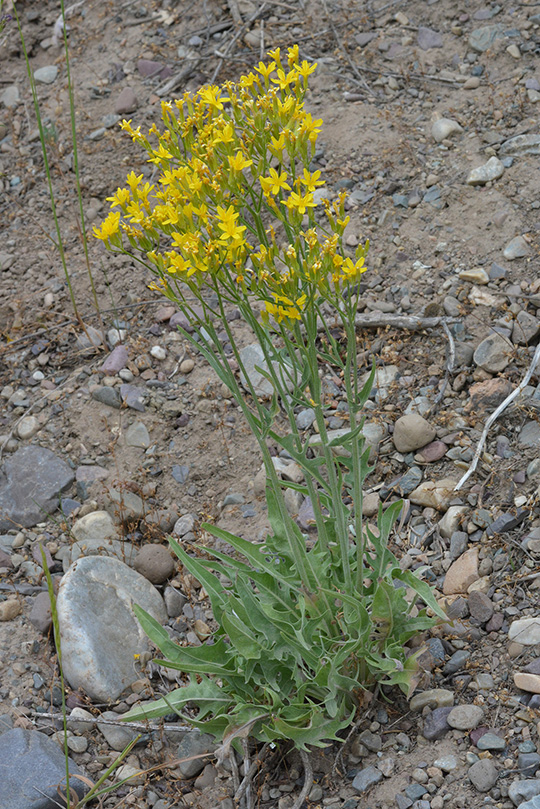
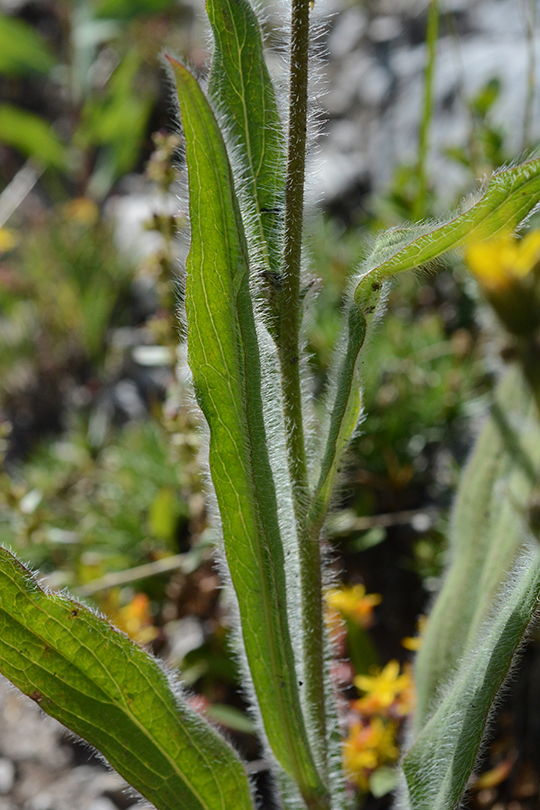
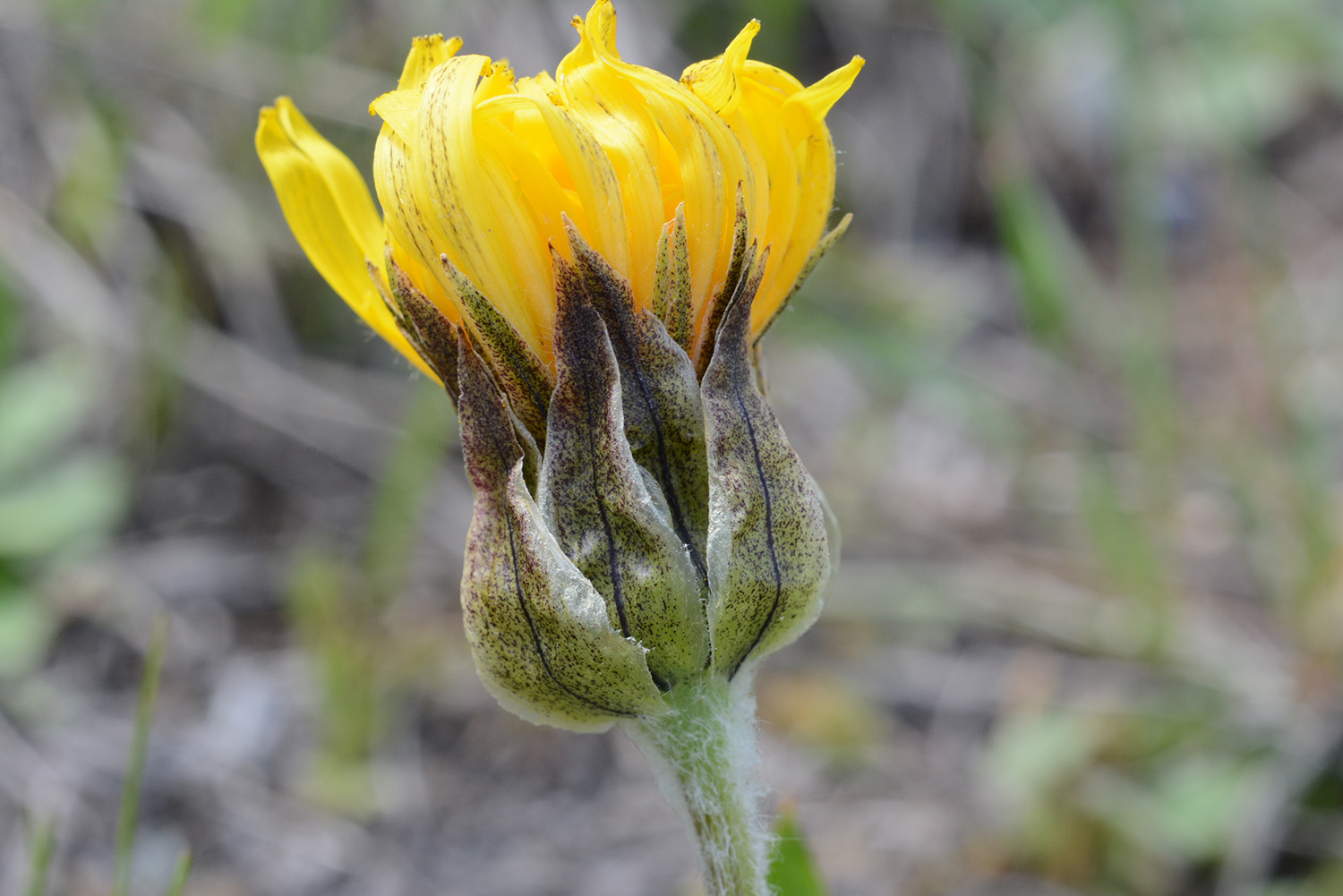
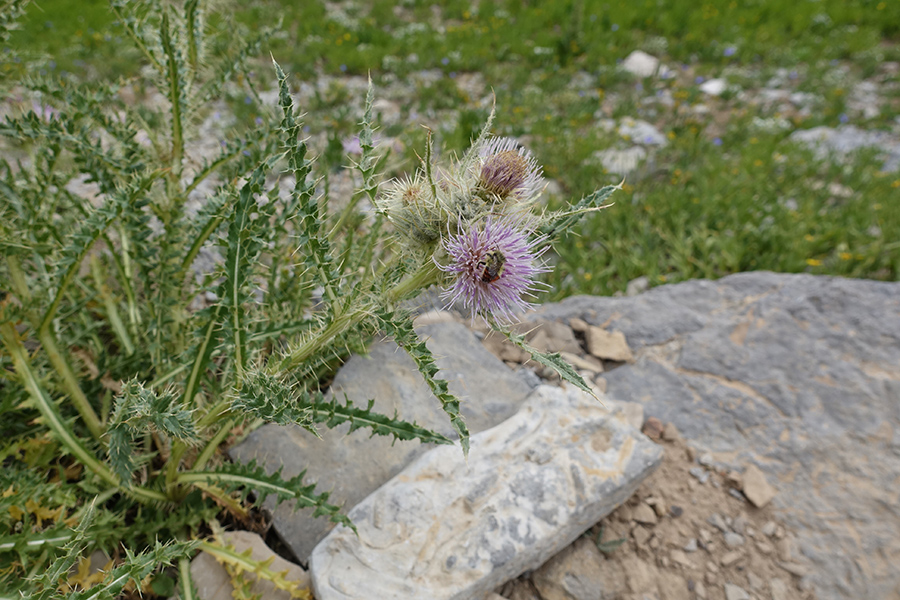
 Leaves have several deep, sharply toothed lobes and are a bit fuzzy or “tomentose”.
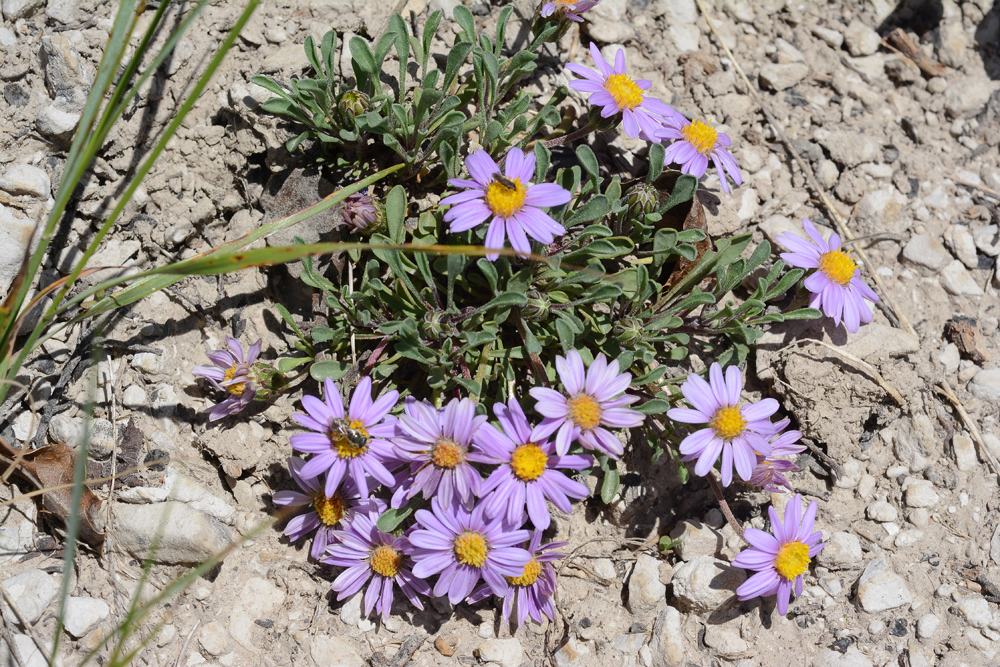
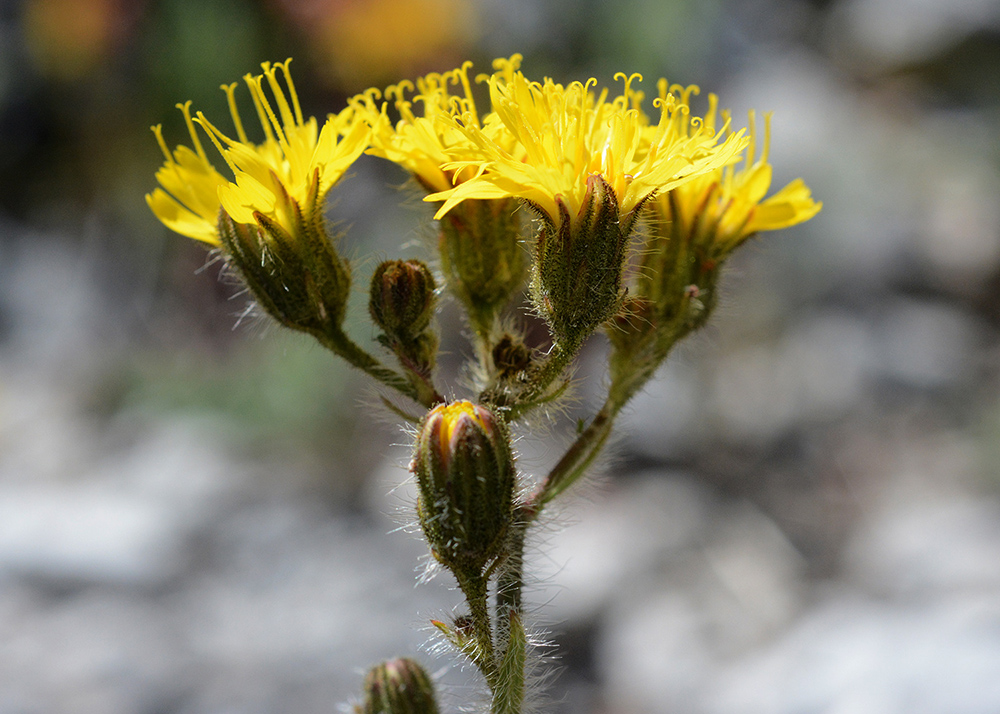
 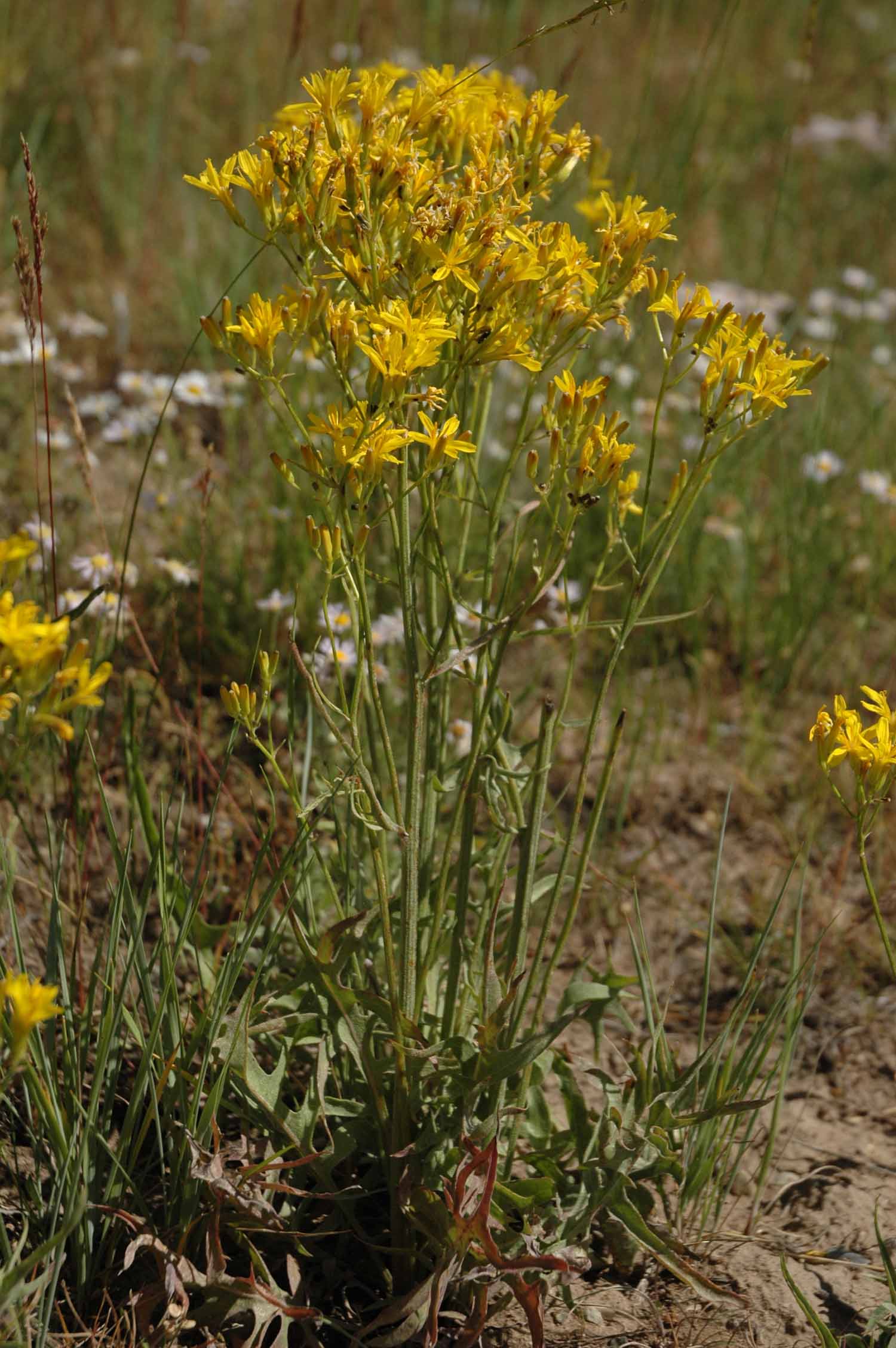 Modoc Hawksbeard – C. modocensis – has fewer flower heads (up to 40/plant) but each has more than 10-60 ray flowers and the bracts are stippled with black stiff hairs. Leaves and stem are very hairy. See if you can find these two species and discern the differences. There are other look-alike species as well.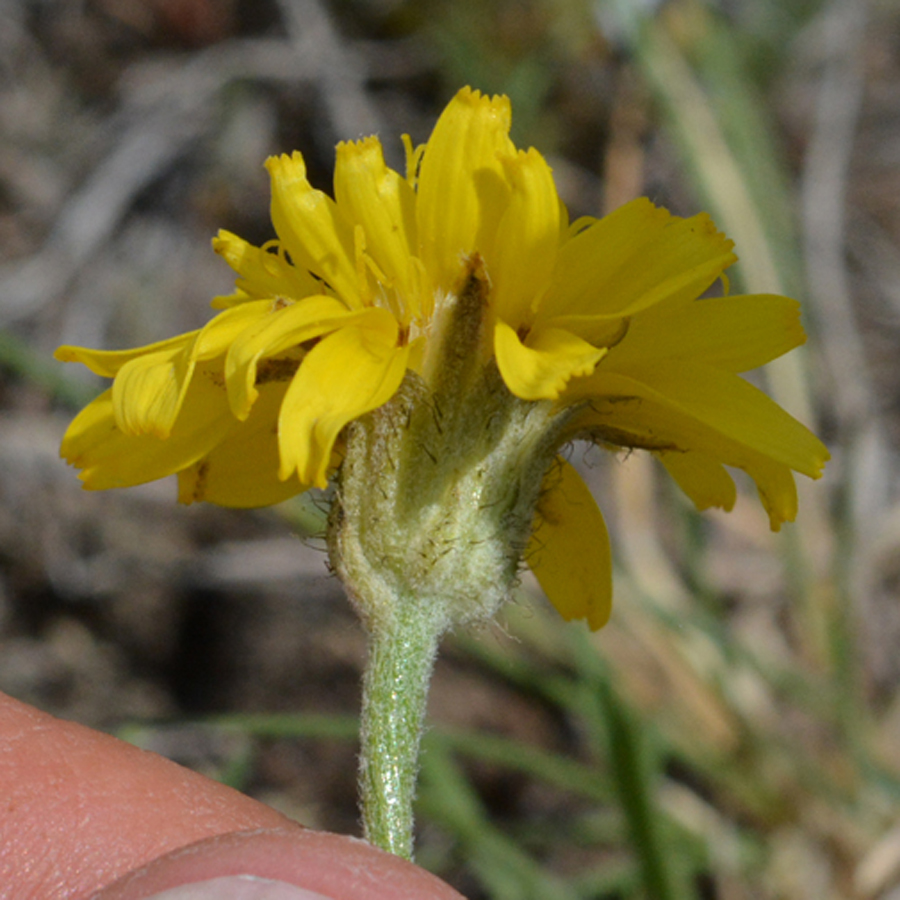
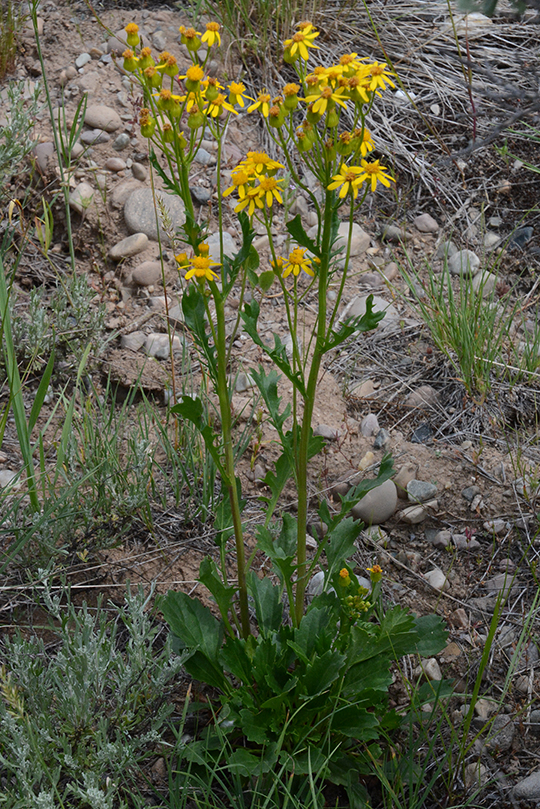
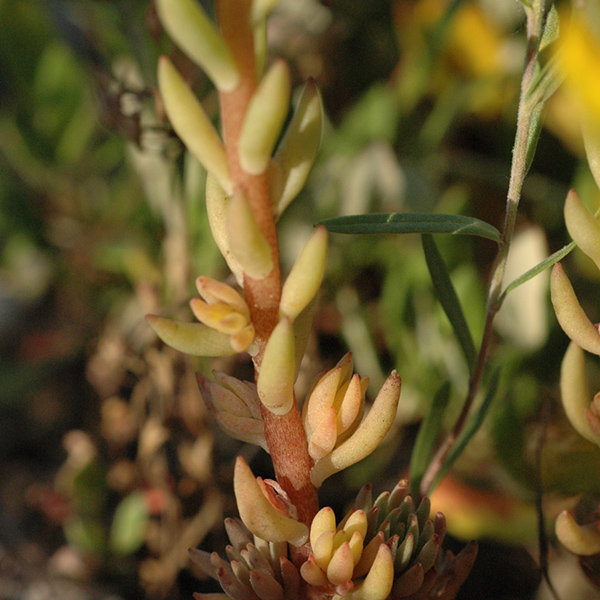
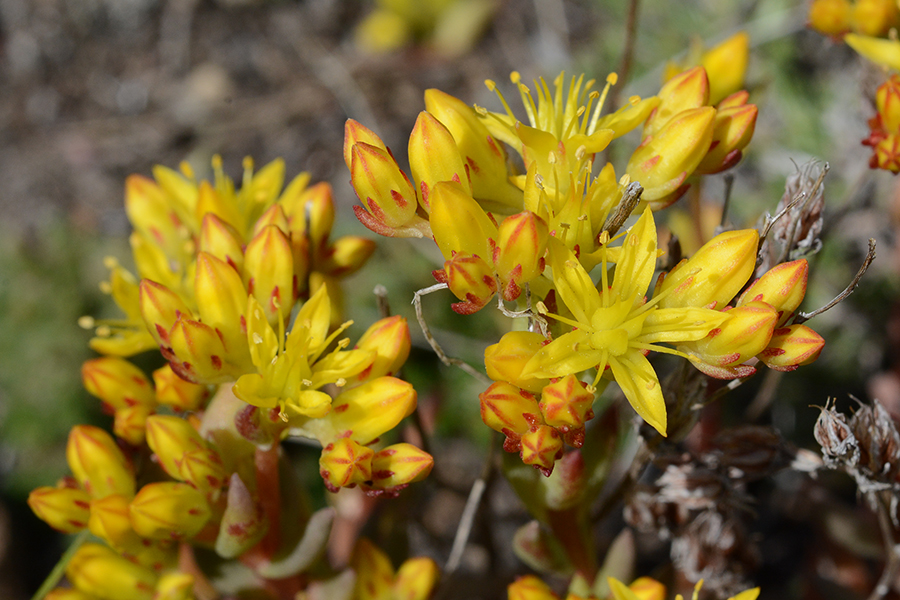
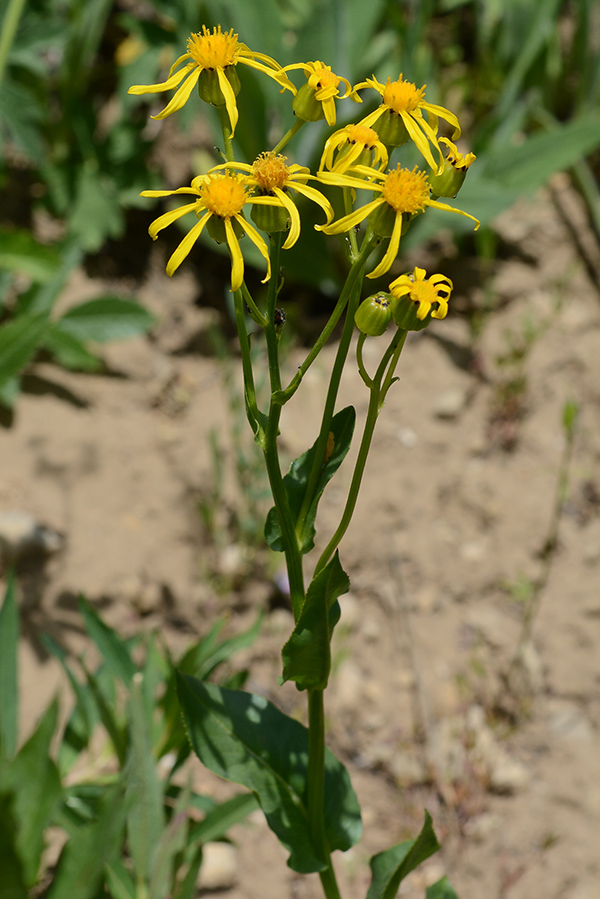
 Note the arrangement of its flowers: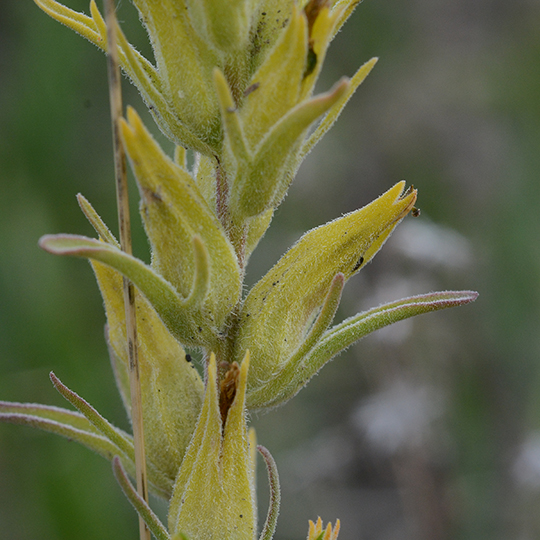
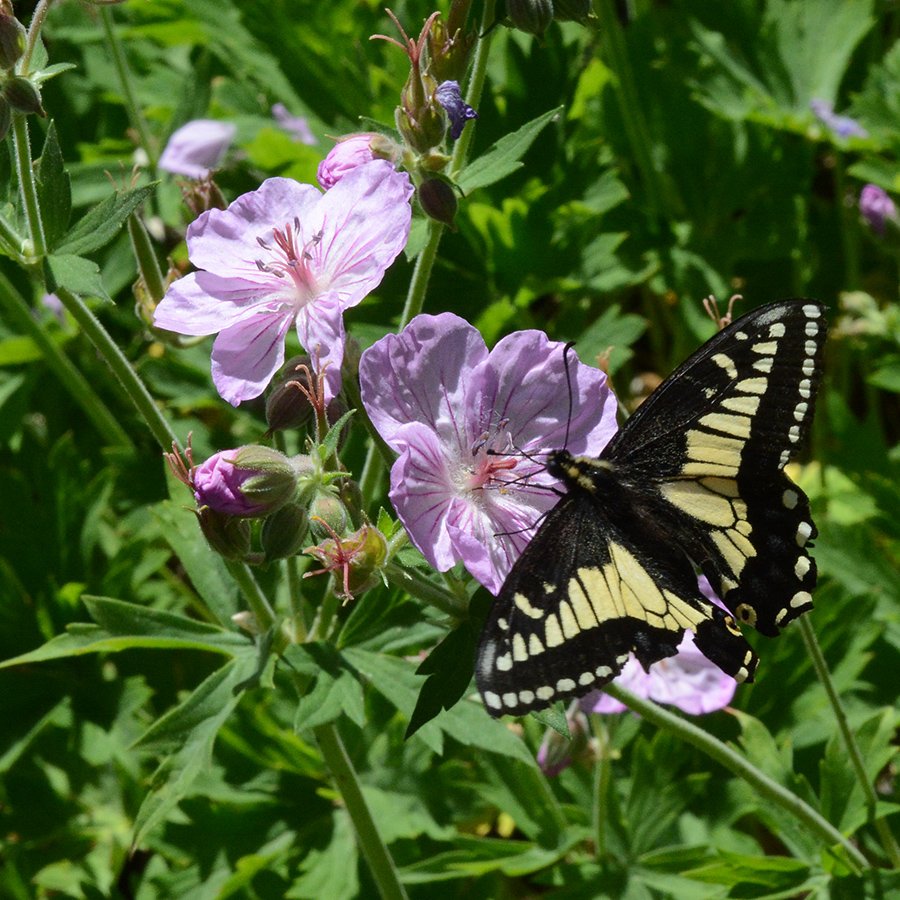
 Sticky Geraniums – Geranium viscosissimum — are abundant. Here is a swallow-tail butterfly sucking up nectar. Anyone know which species?
 Scarlet Paintbrush – Castilleja miniata – is emerging.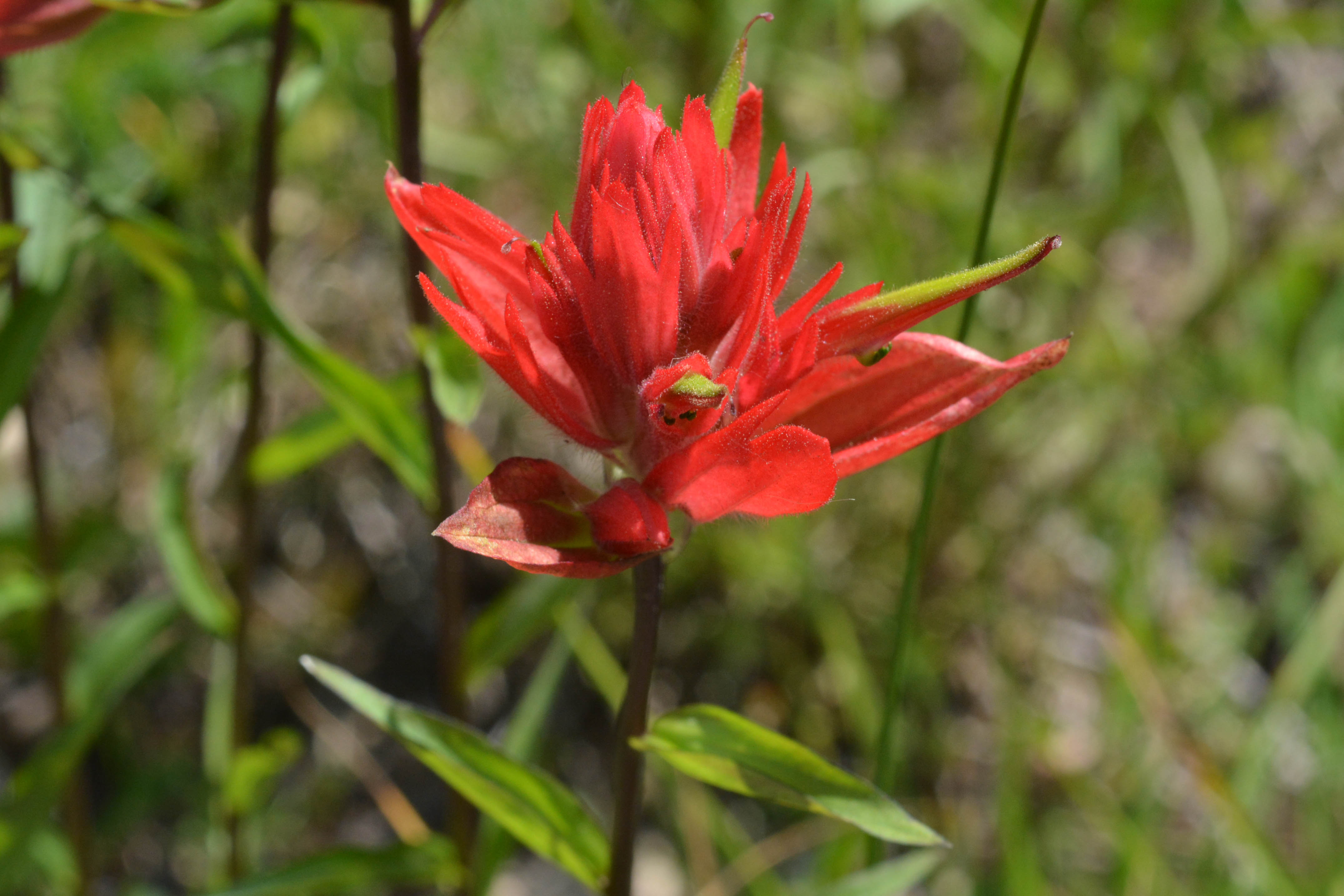
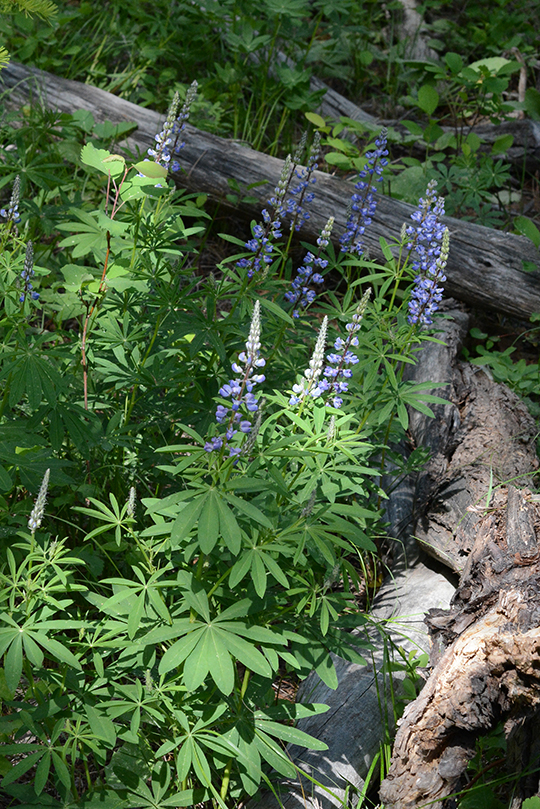
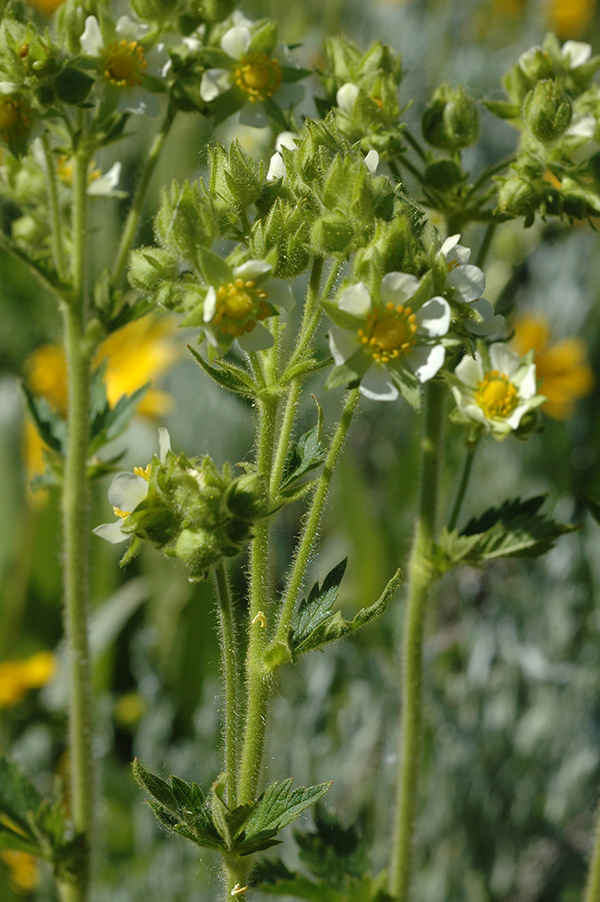
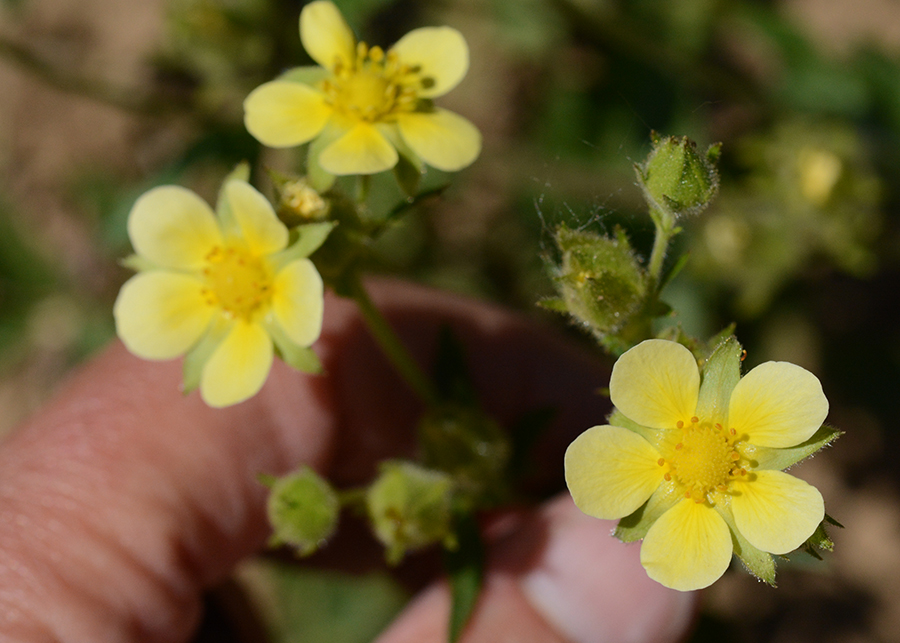
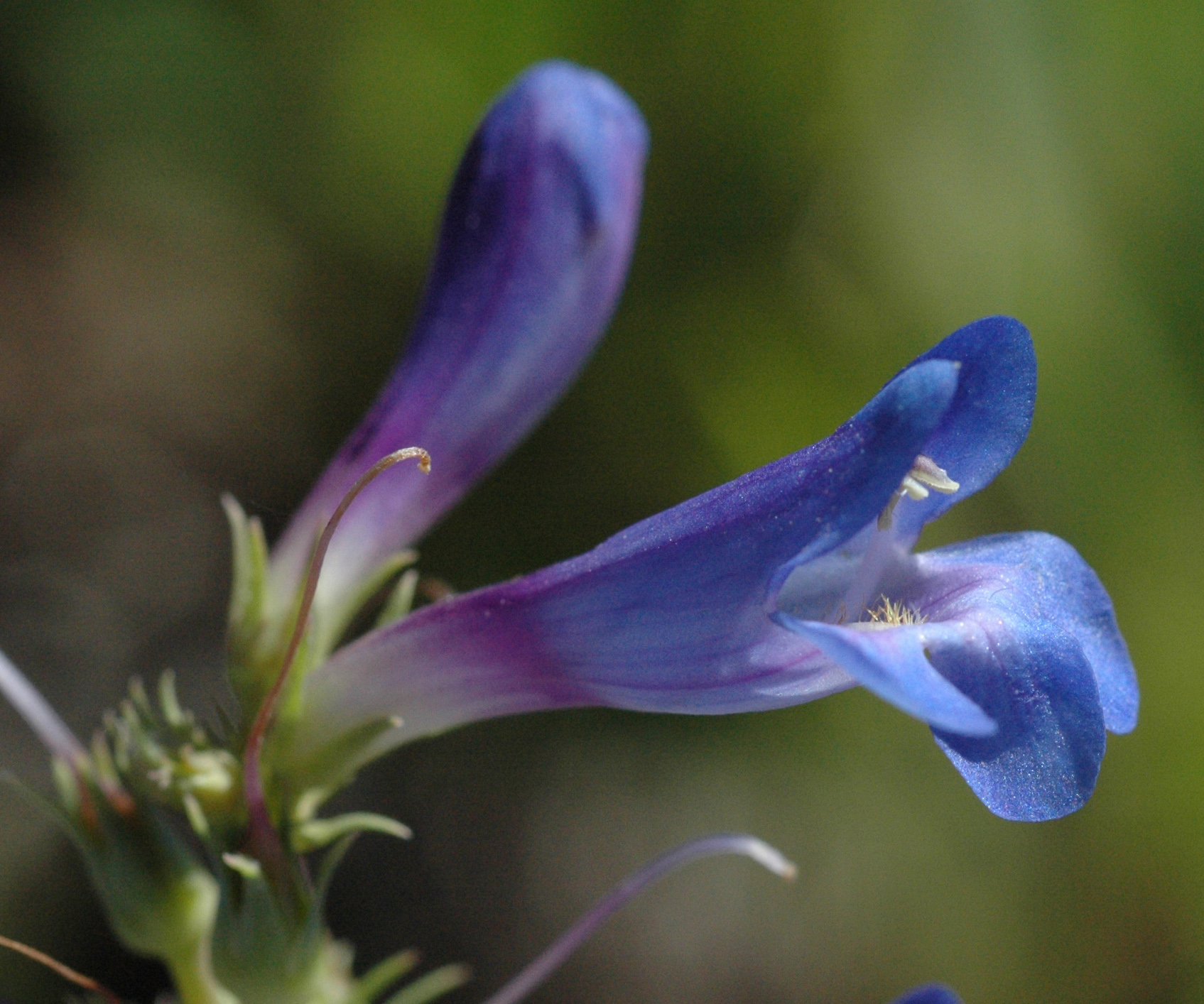
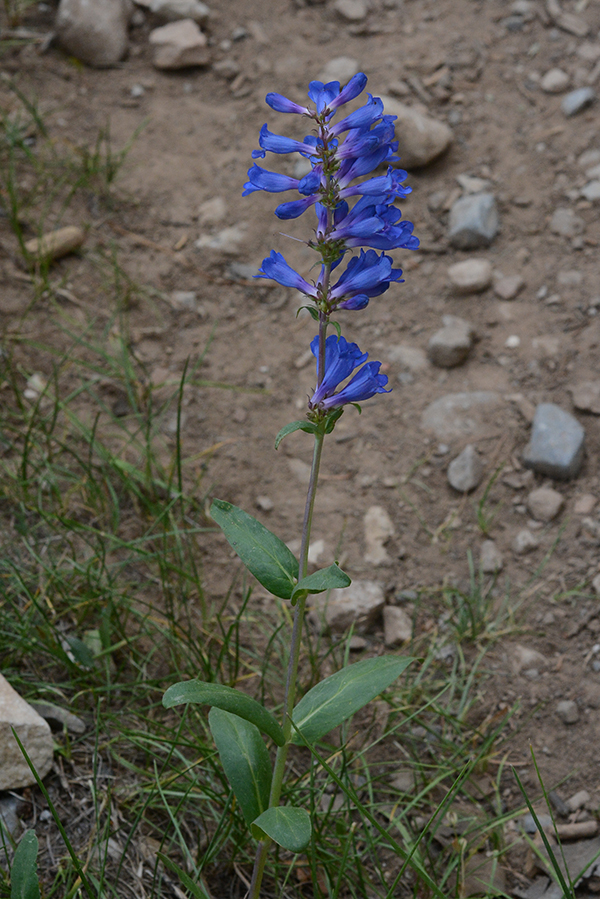 This species found along the Ski Lake Trail keyed out to Wasatch Beardstongue — P. cyananthus.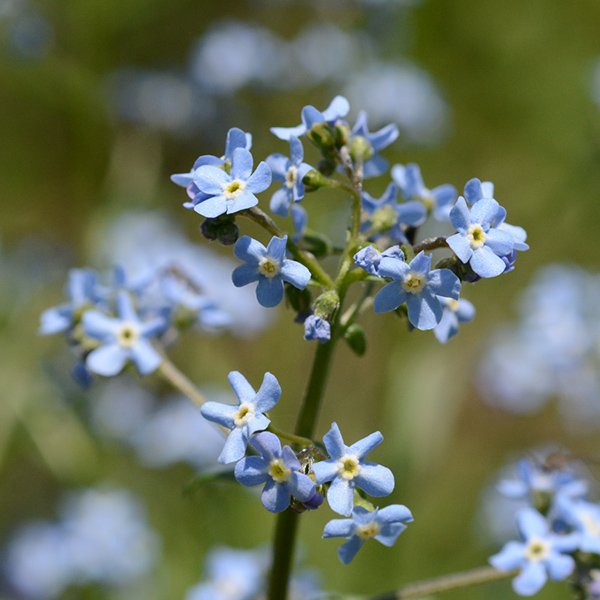
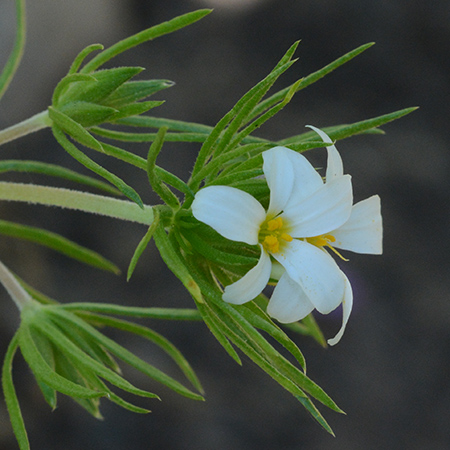 Flowers are extremely fragrant. Bend over for a whiff. It is also related to Scarlet Gilia.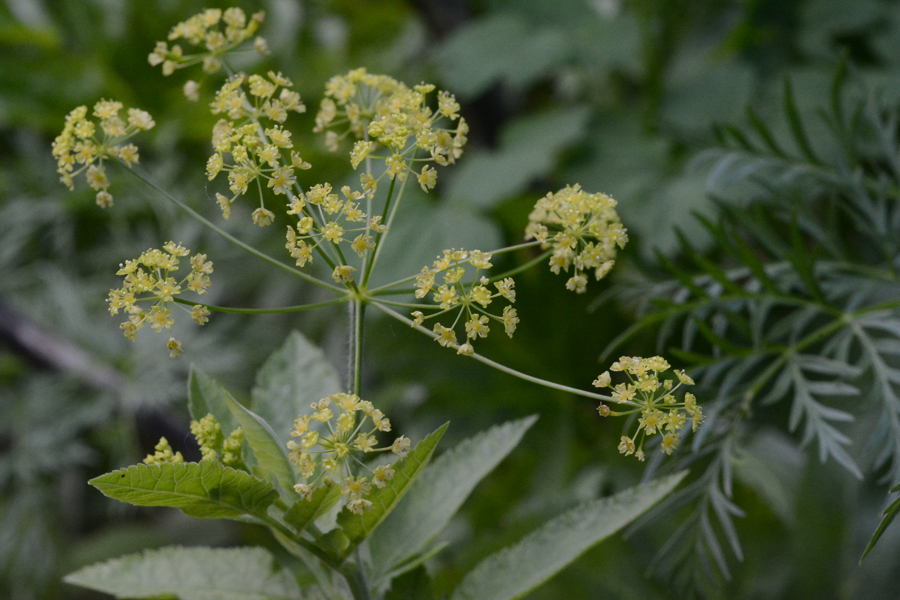
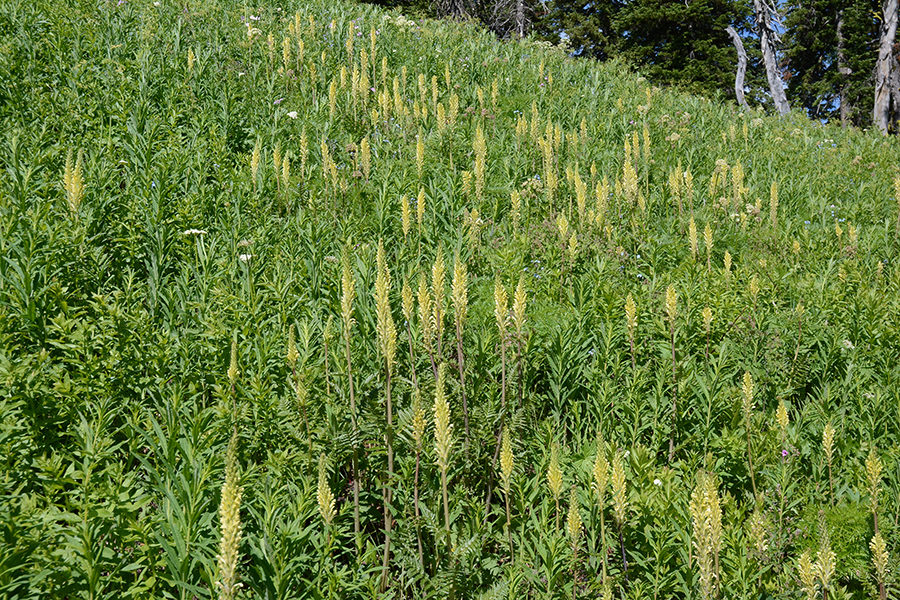
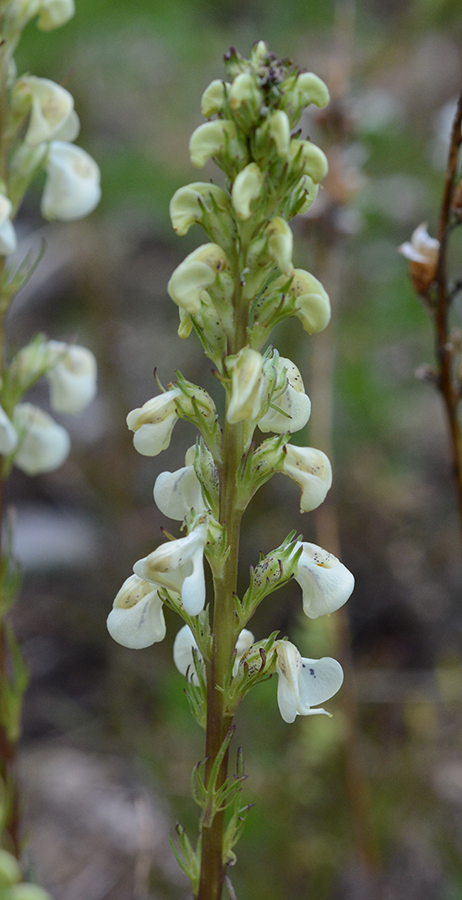
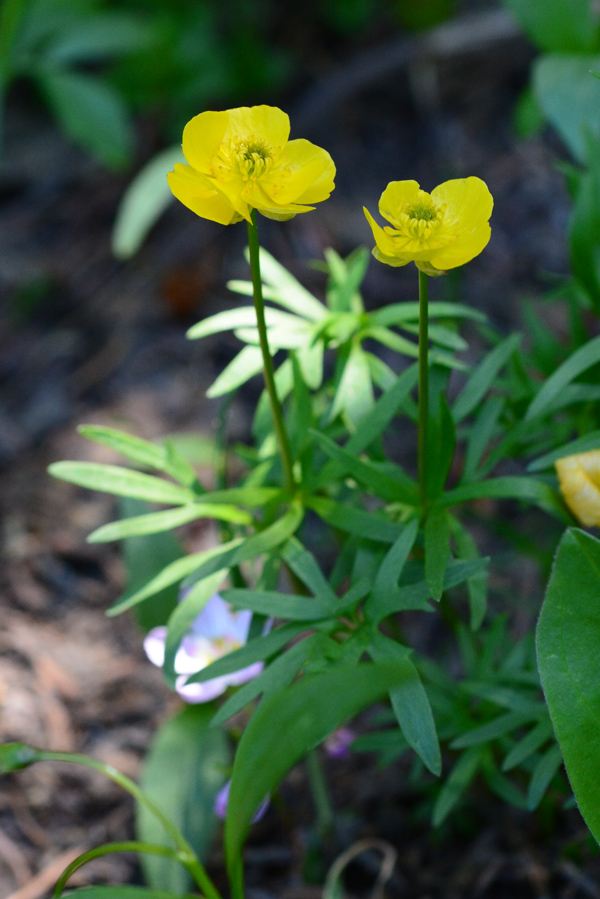
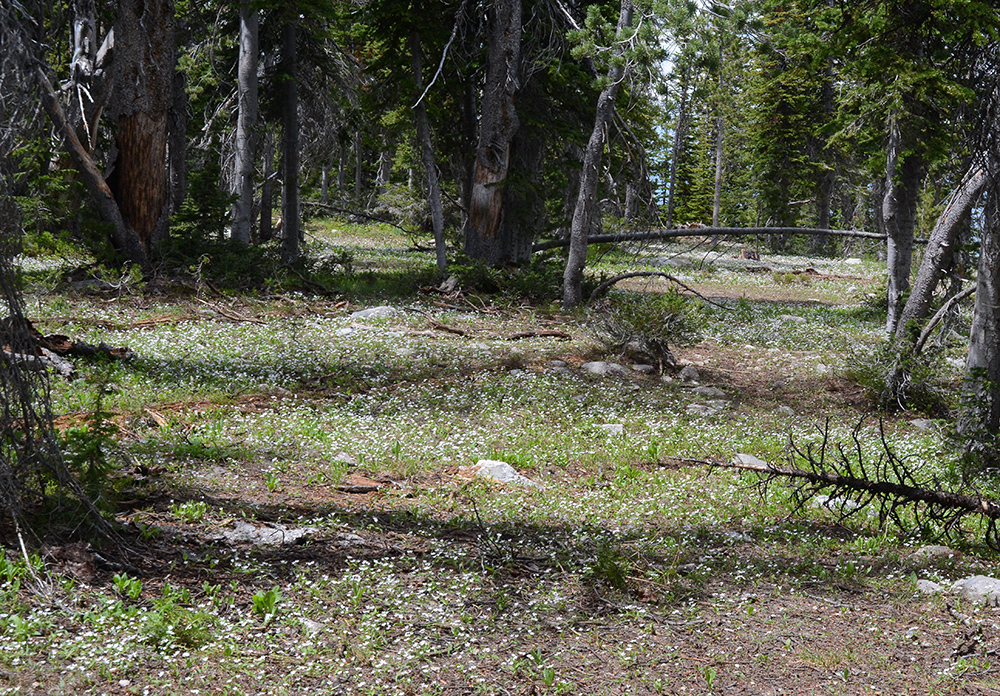 Species particularly adapted to very short growing seasons are also blooming where snow has just melted. Patches of Rocky Mountain Snow Buttercups – Ranunculus adoneus – are frequent. Note their fine leaves.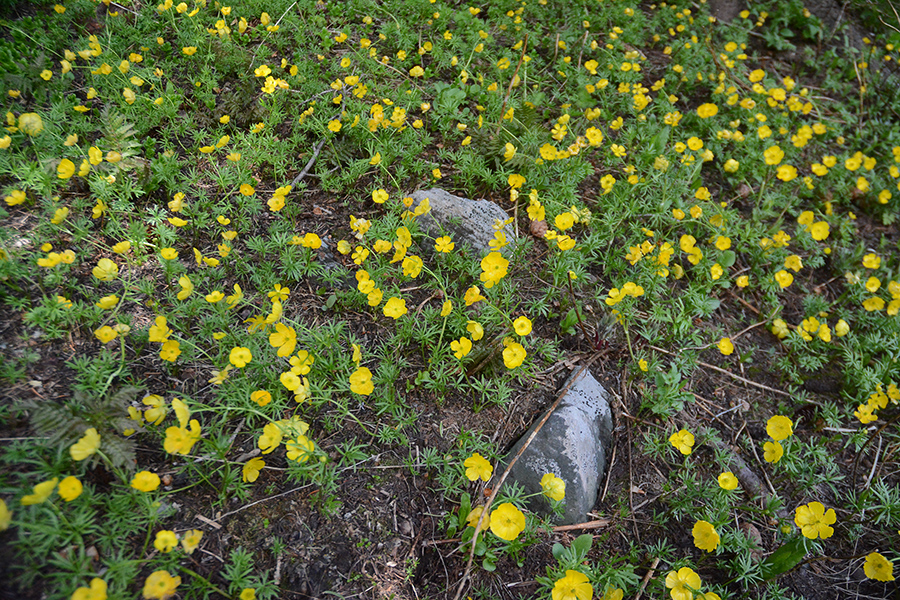
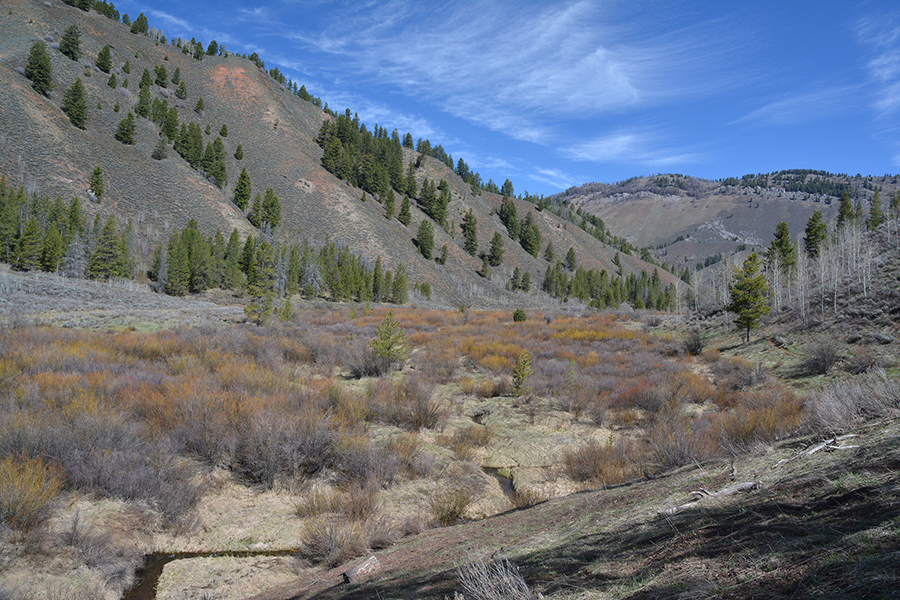 Spring sun is warming south-facing slopes of buttes and hillsides. Snow along Grand Teton National Park roads is finally retreating. Wetlands are warming. Bugs and birds are flying about. The delight is in the details of small flowers; no big show yet.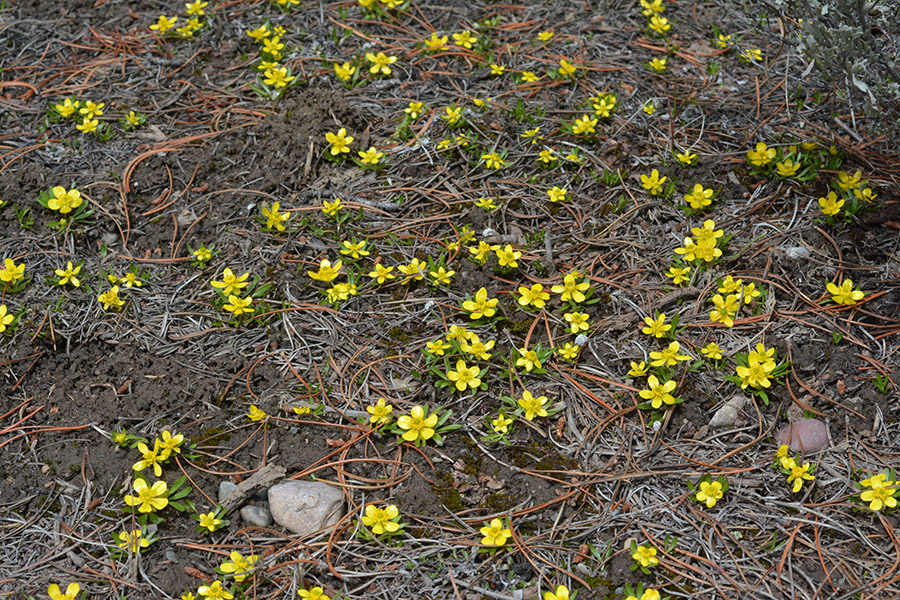
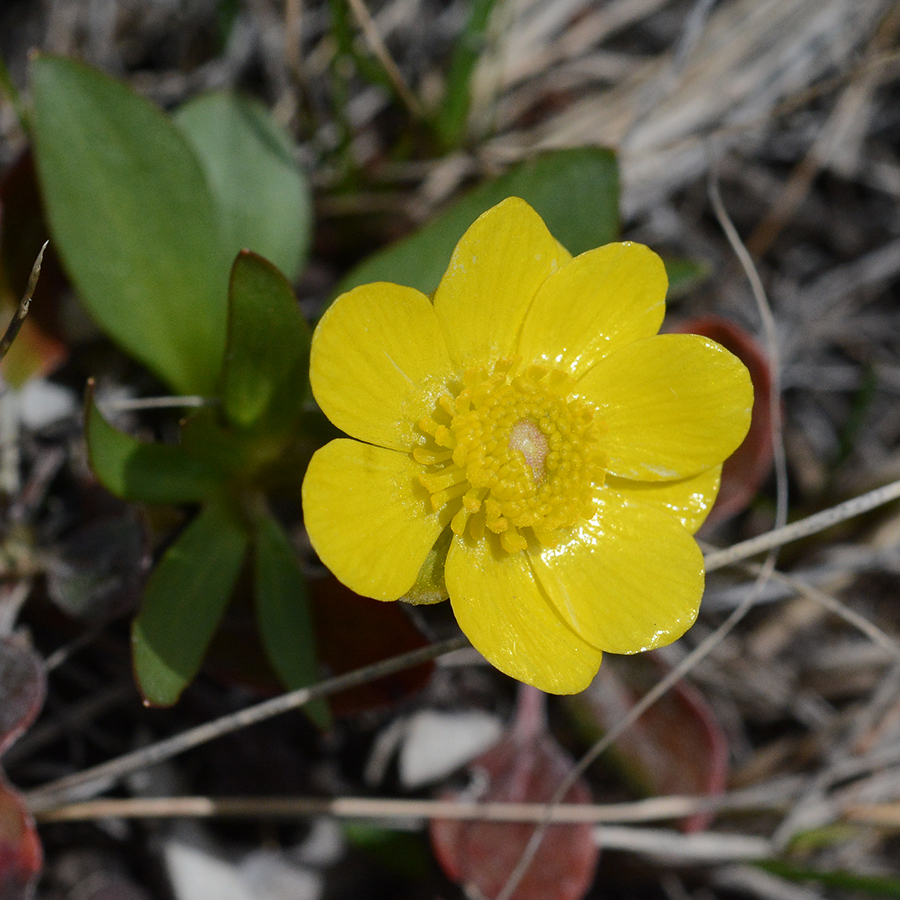
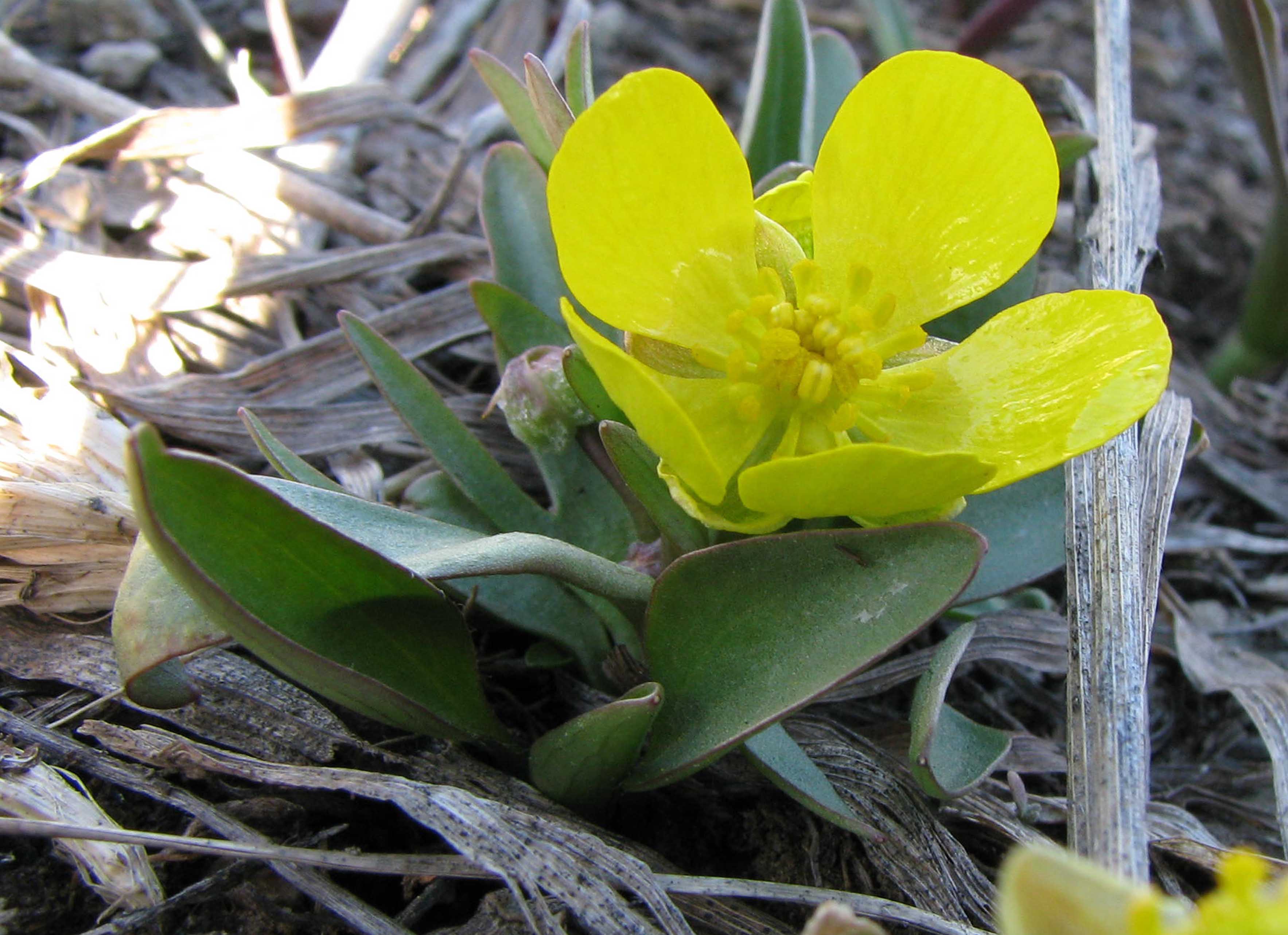 The lowest leaf of Sagebrush Buttercup – Ranunculus glaberrimus – is unlobed, the upper leaves are 3-lobed. It is a denizen of sage flats.
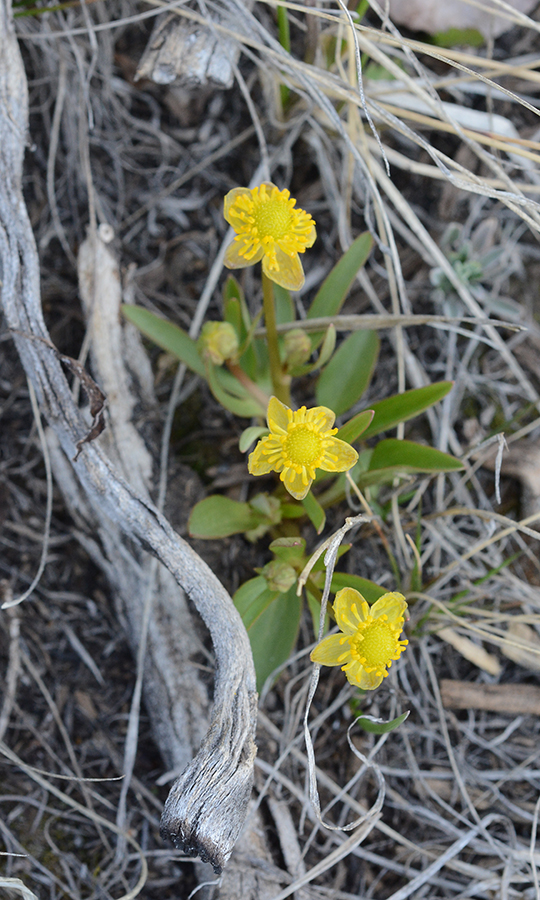 Some individual Sagebrush Buttercups don’t have petals, only sepals. I dont’ know why the flashy petals aren’t there.
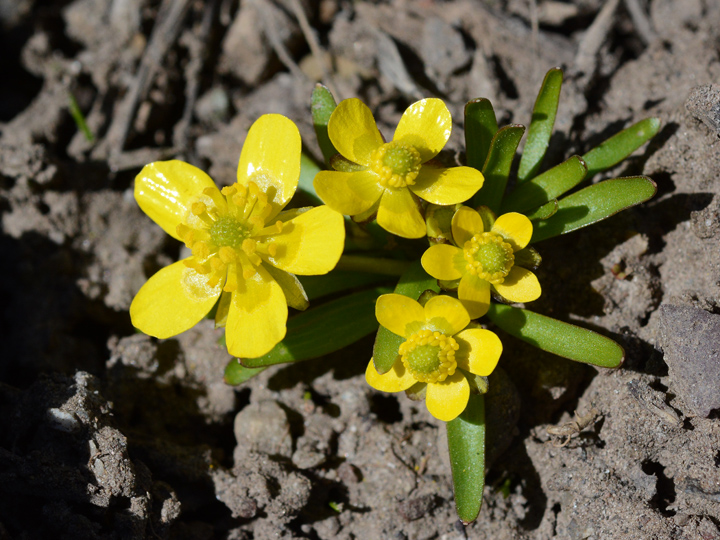 In Utah Buttercup – R. jovis – both the lower and upper leaves are lobed into three parts. Note buttercups have many separate anthers and stigmas—a common characteristic of this family. It is found in relatively moist locations, including woodland edges and openings.
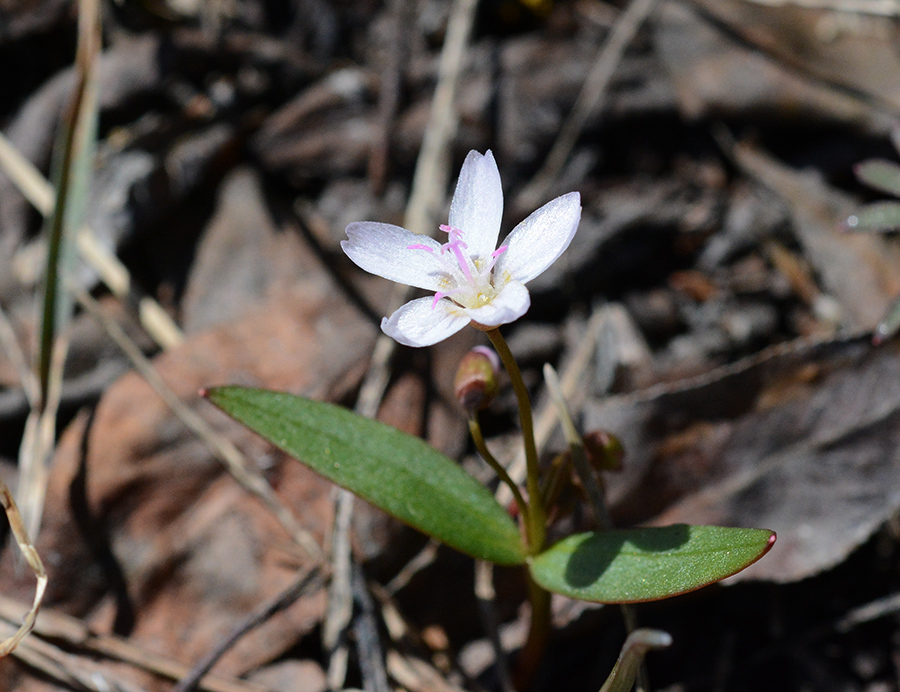
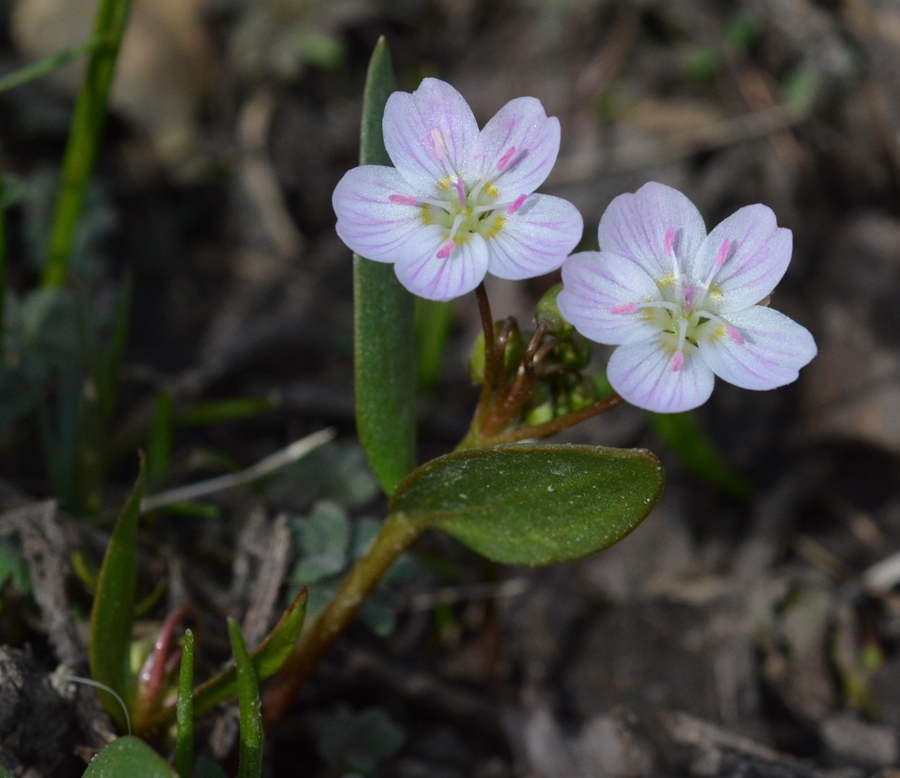 Springbeauties – Claytonia lanceolata — grow in scattered in patches. Some blooms exhibit obvious pinkish veins that direct pollinators to yellow nectaries in the center. Pollinators bump against the anthers and get dusted with pollen.
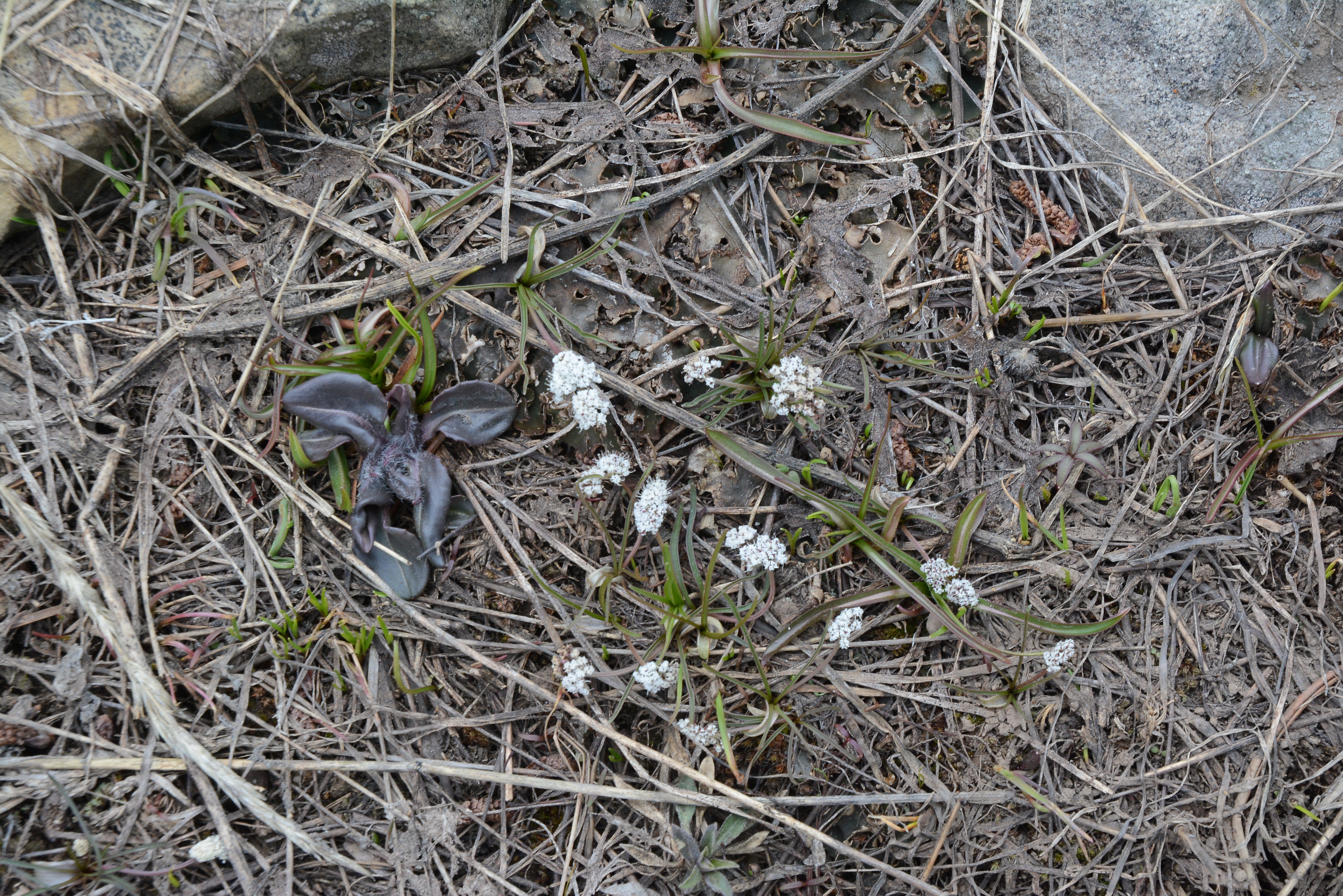 It is easy to step on Turkey Peas – Orogenia lineariifolia. The plants look like bits of lichen or stone, nothing to think about.
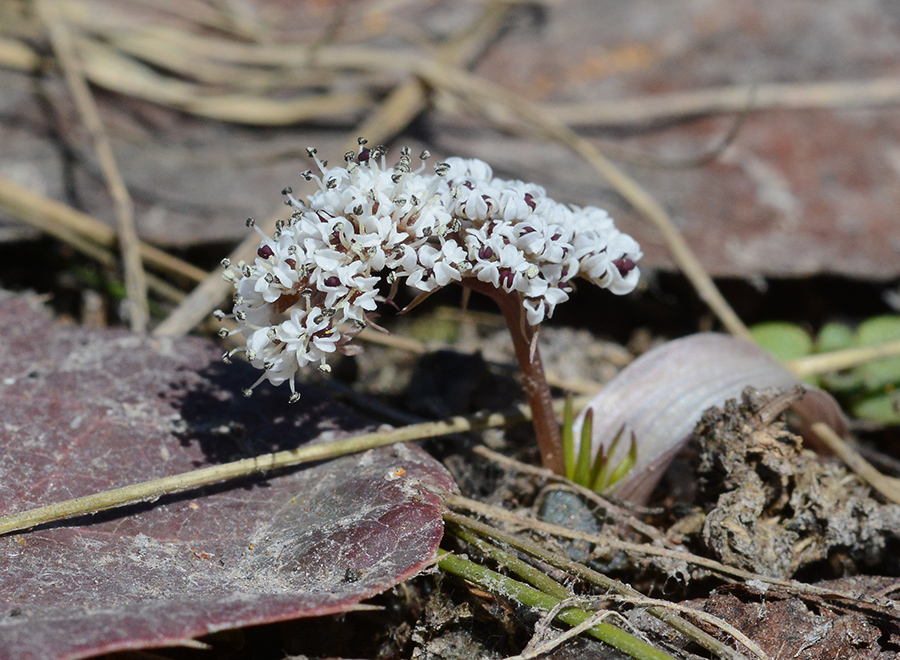 However, Turkey Peas are more interesting if you take a close look at their tiny white flower with maroon centers that together form clusters barely an inch long. Think about what tiny insects must pollinate them–likey small flies and bees.
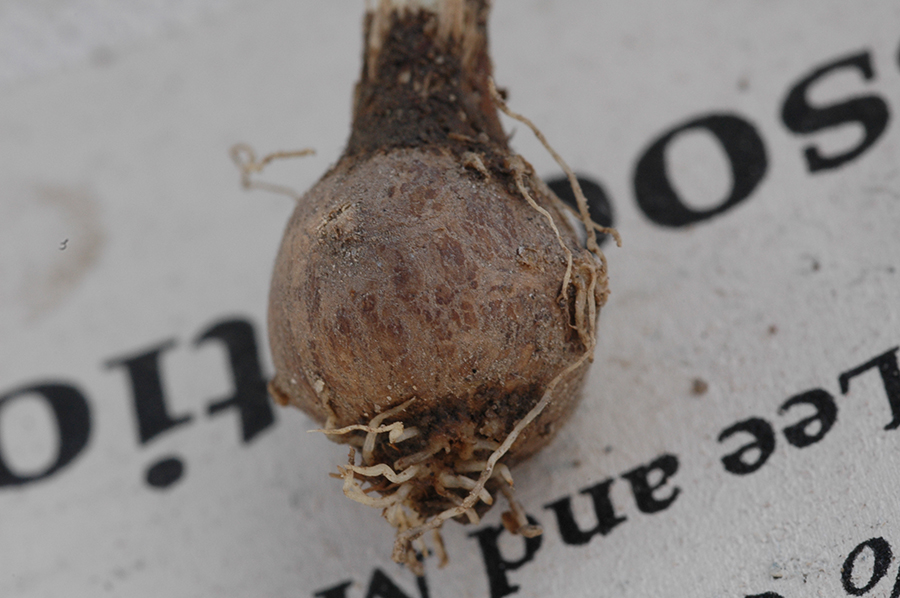 Sandhill cranes, bears, and rodents seek out the thumb-sized bulbs (“peas”) for food. (Turkeys would likely eat the bulbs if they lived in Jackson.)
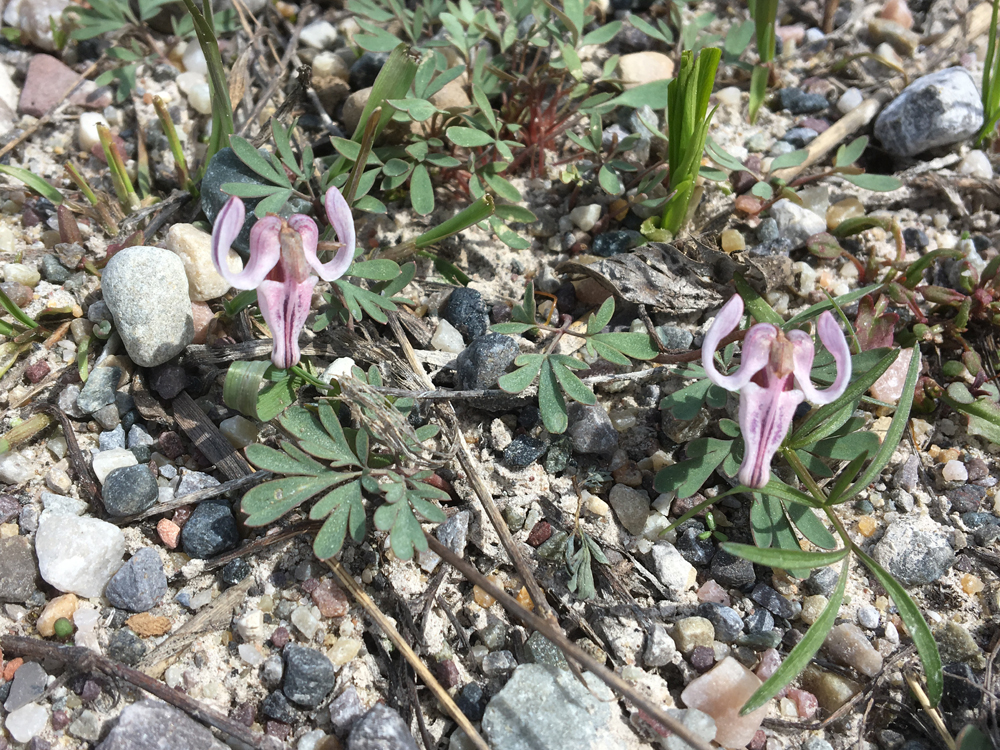 The quintessential western plant Steer’s-head – Dicentra uniflora – requires some belly botany. Scan an area for divided leaves and then get down to stare at the steer-like flowers. This is the larval host plant for the Parnassian butterfly Parnassius clodius, which Dr. Debrinski from MSU is researching in Grant Teton National Park (more info on her research below).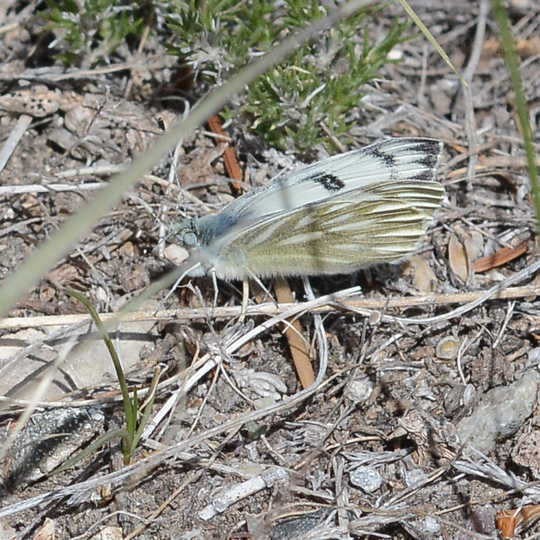
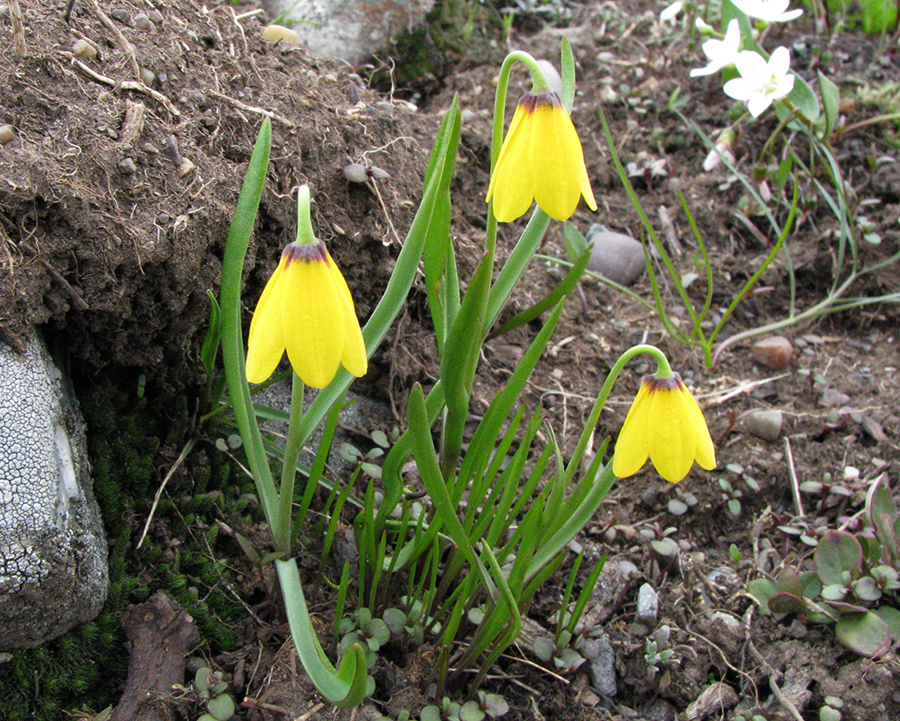 Yellowbells – Fritillaria pudica – are always cheerful! The 6-8”-high plants sprout from miniature scaly bulbs. The base of the 6 yellow tepals is said to change from red to green depending on pollination, but I can’t see any consistent difference happening to the outside flower color or anthers and pistil on the inside. Maybe you can.
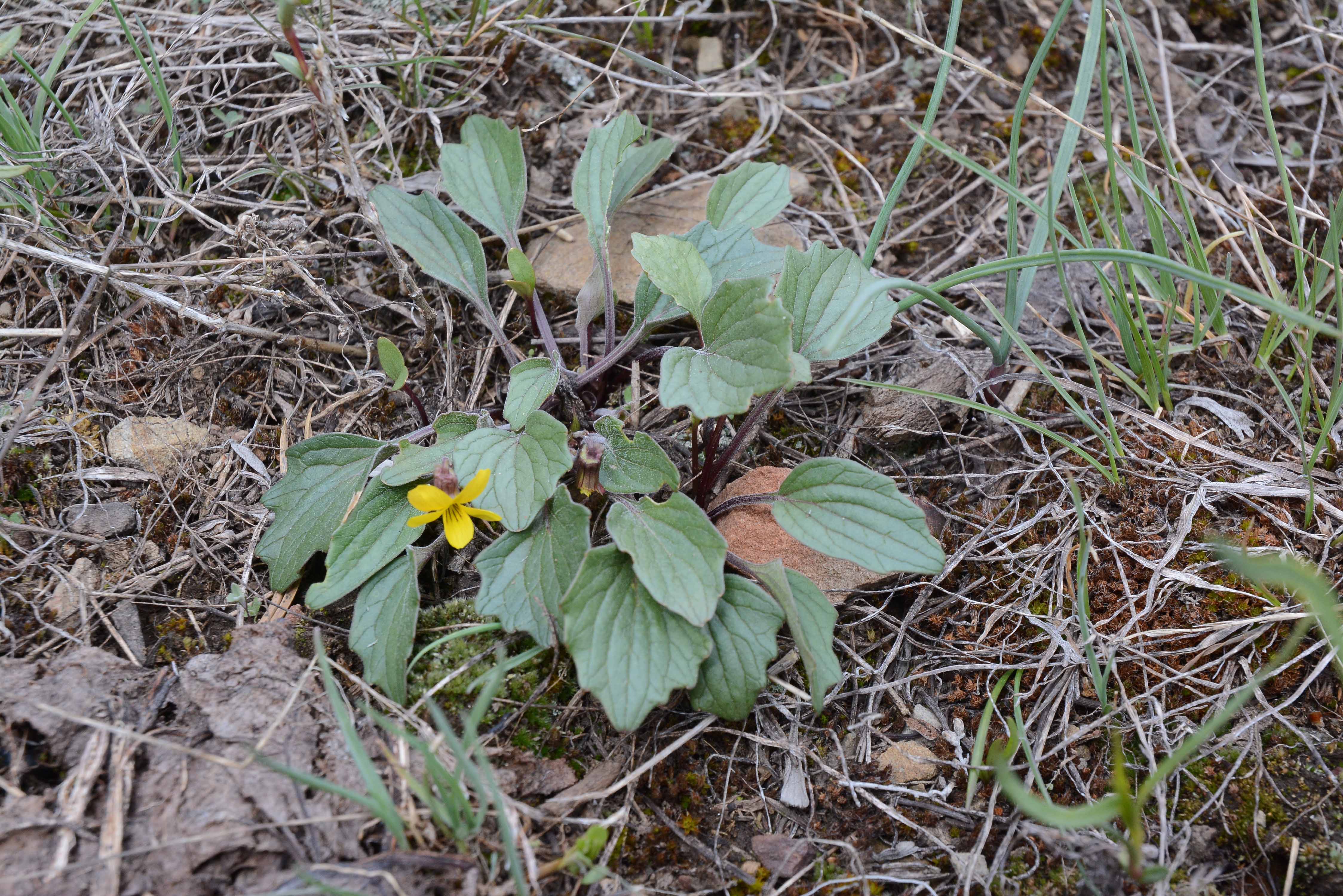 Goosefoot Violet – Viola purpurea var. venosa – has leaves shaped like goose feet with a few more toes. The back of the leaves and yellow petals are often purple, hence “purpurea” in its botanical name. Note the dark center of the flower and the convenient landing pad of petals for pollinators.
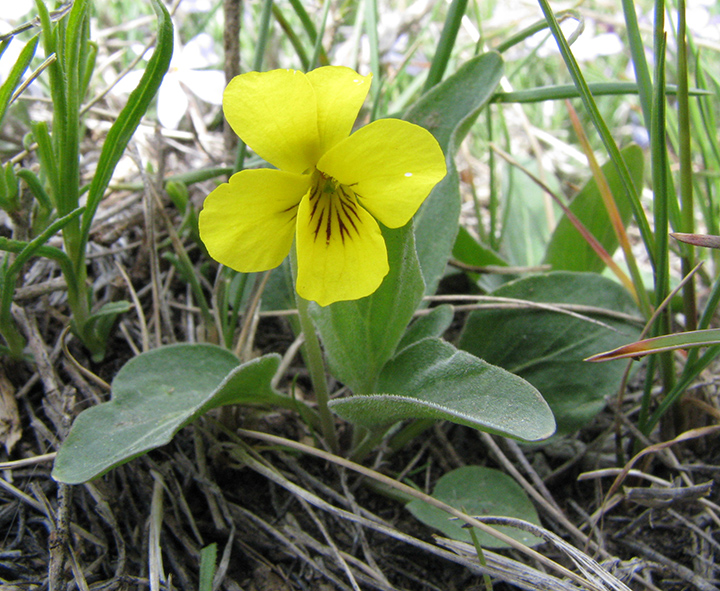 Several yellow violets intergrade in leaf features which confuse me and other botanists trying to sort out the names. This cheerful specimen is one of three look-alike species – V. vallicola, V. praemorsa, or V. nuttalii. Leaf ratios, shapes, and hairiness, as well as ultimately seed-capsule sizes, determine identification.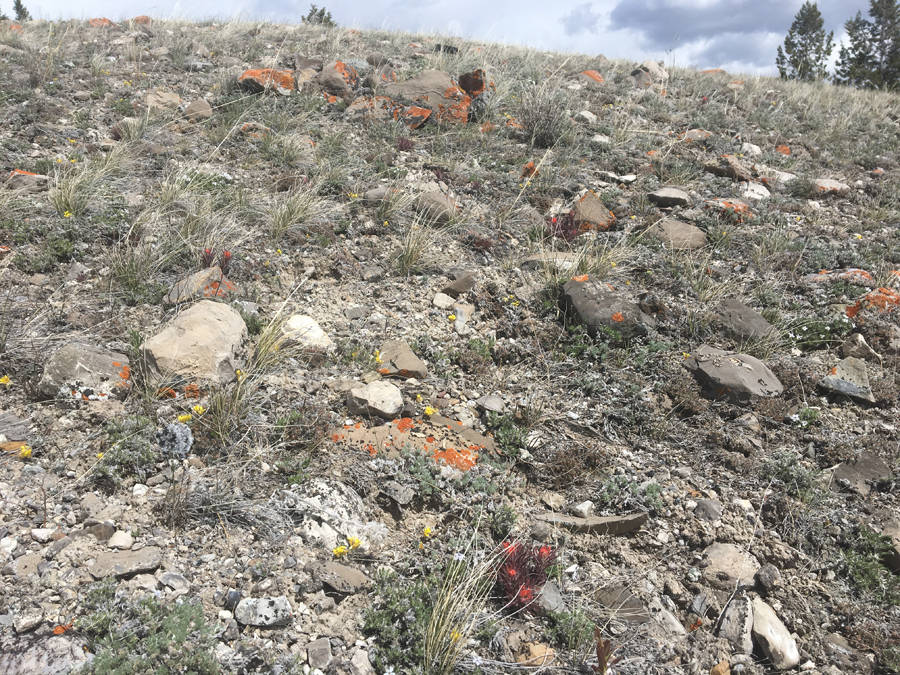
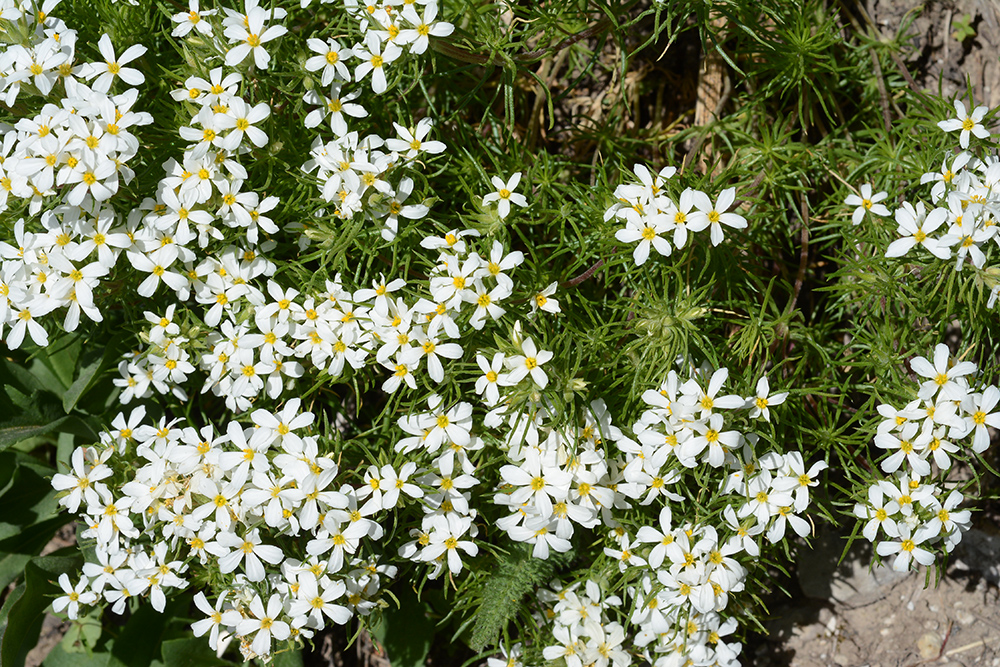
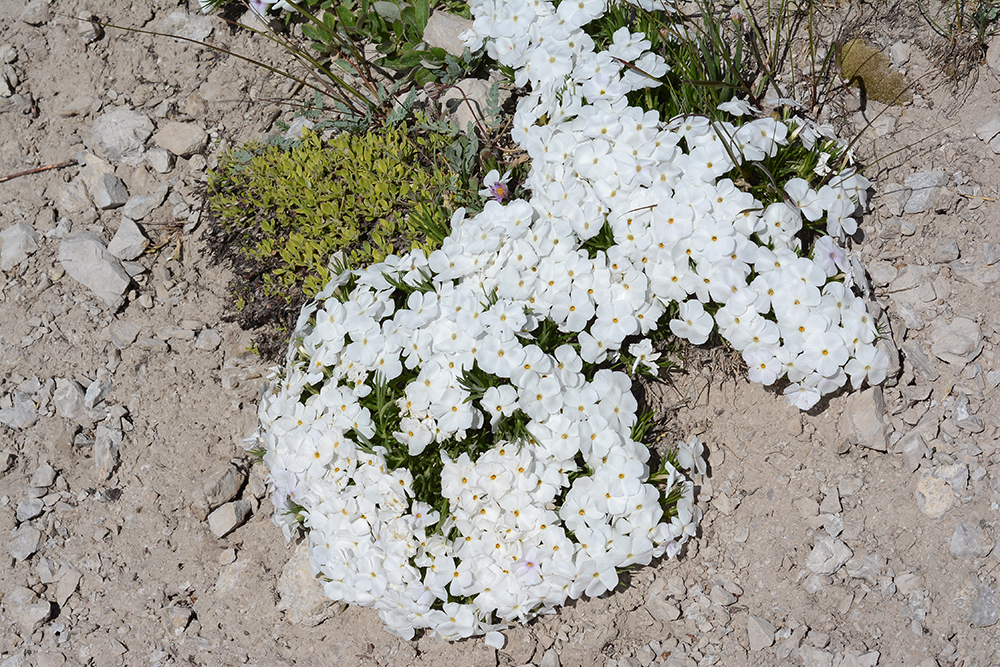
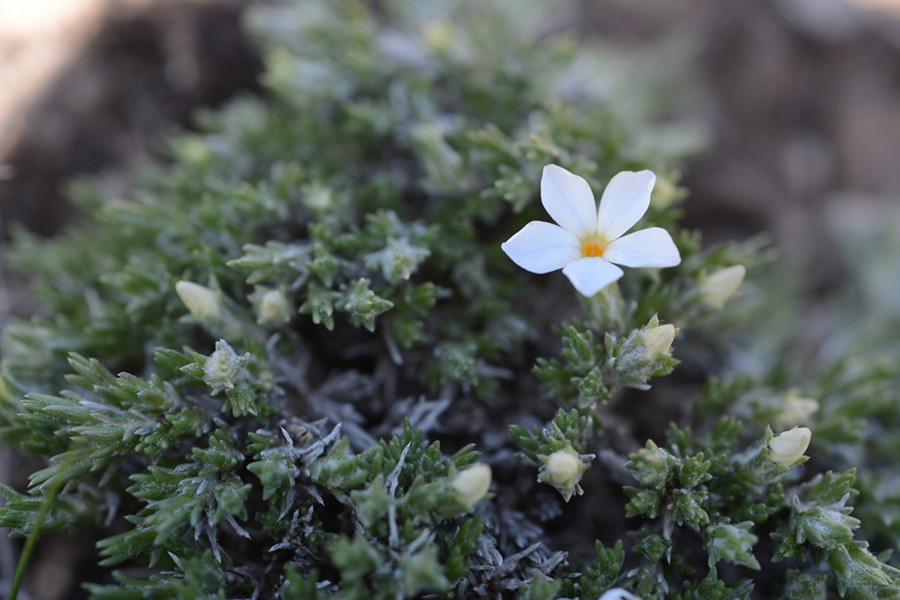 Hood’s Phlox – Phlox hoodii – is often the first out, with its white to bluish flowers. Bees and flies pick up on the sweet fragrance. They come in and land on the flared petal tips and dip their long tongues deep down the center tube for nectar. They then carry the orange pollen off to other flowers nearby. The leaves of Hood’s Phlox are opposite, very small and tight on very slow growing stems that collectively form a cushion shape. Plants inches wide can be decades old.
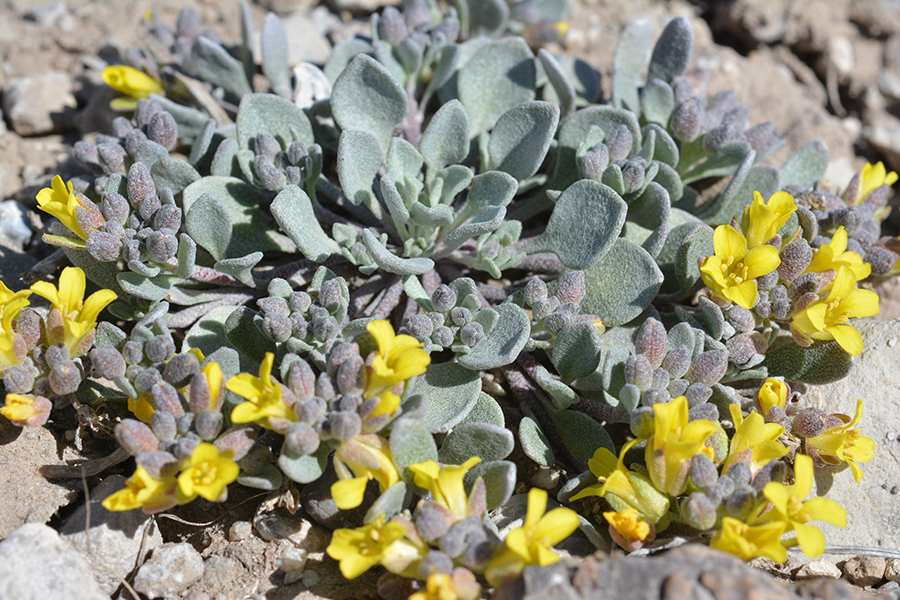 Nearby, Twinpods – Physaria didymocarpa – feature bright-yellow, 4-petalled flowers at the end of sprawling 3-4” stems. Spade-shaped, silvery leaves help identify this member of the Mustard Family. Mustards usually have 4 petals, 6 anthers (2 short, 4 long), and one 2-parted pistil.
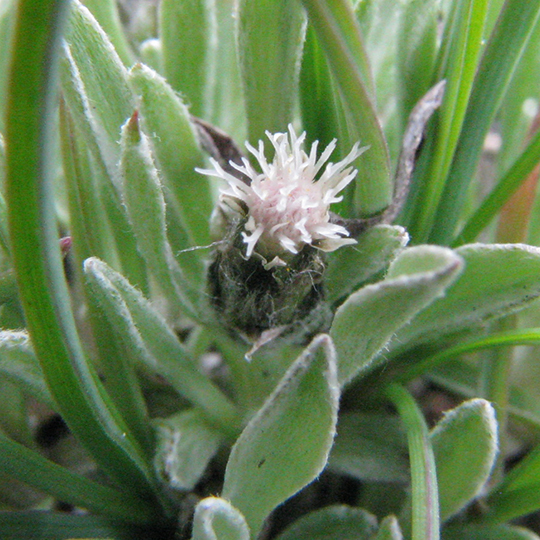
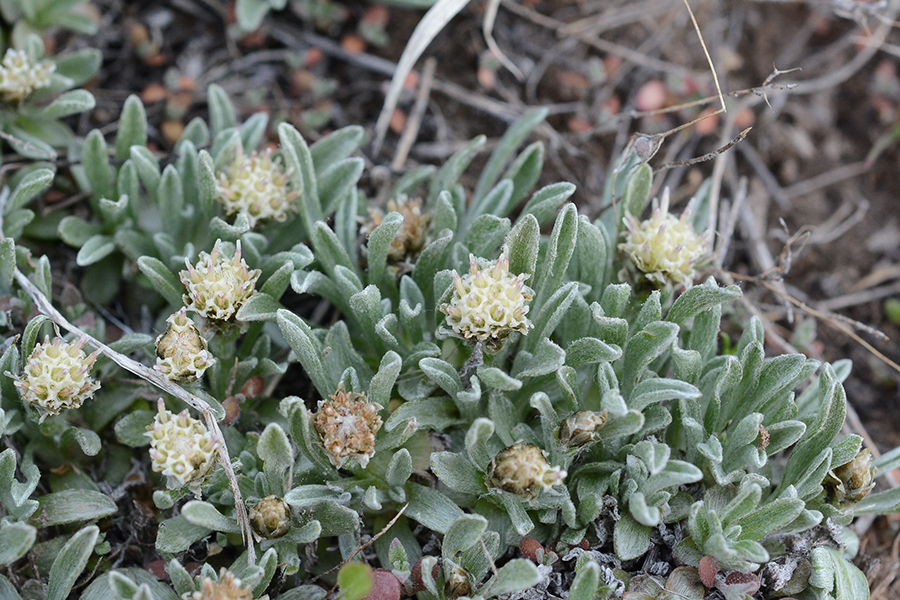 The first pussytoes to bloom is Low Pussytoes – Antennaria dimorpha. The tiny gray, finely hairy leaves form mats on the ground. Look closely for the flowers.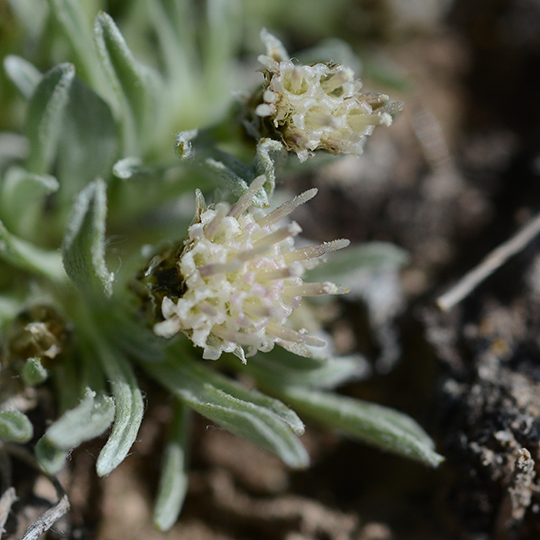
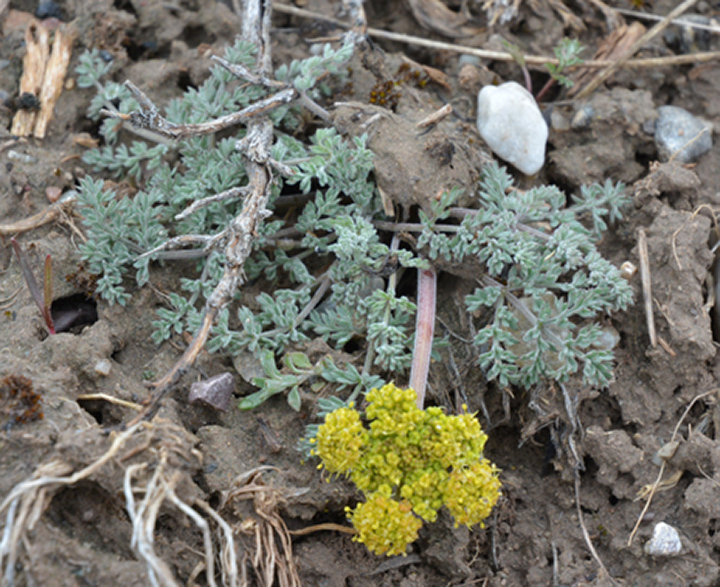 Sprawling Cymopteris – Cymopteris longipes – is spreading its whorl of dissected silvery leaves low to the ground. As a member of the Carrot Family, plants have umbels, in this case with yellow flowers.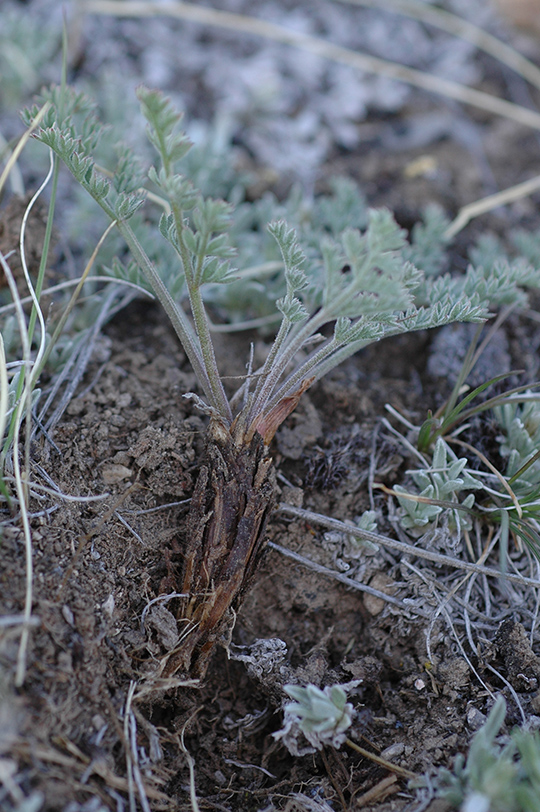
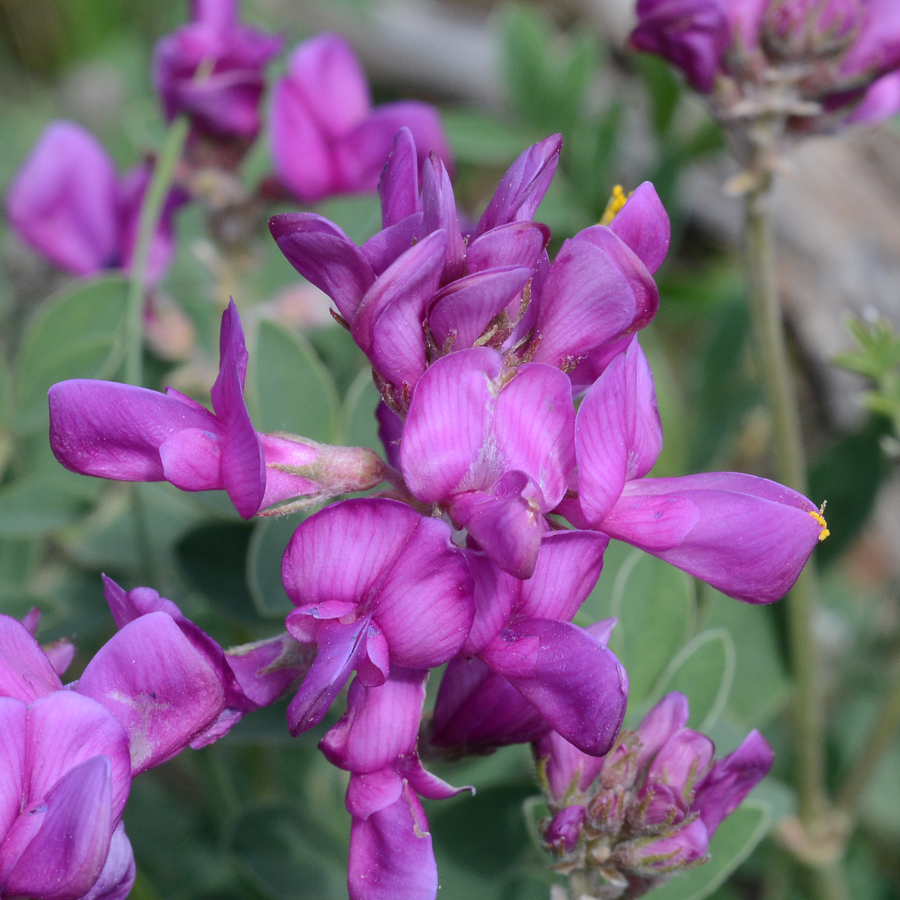
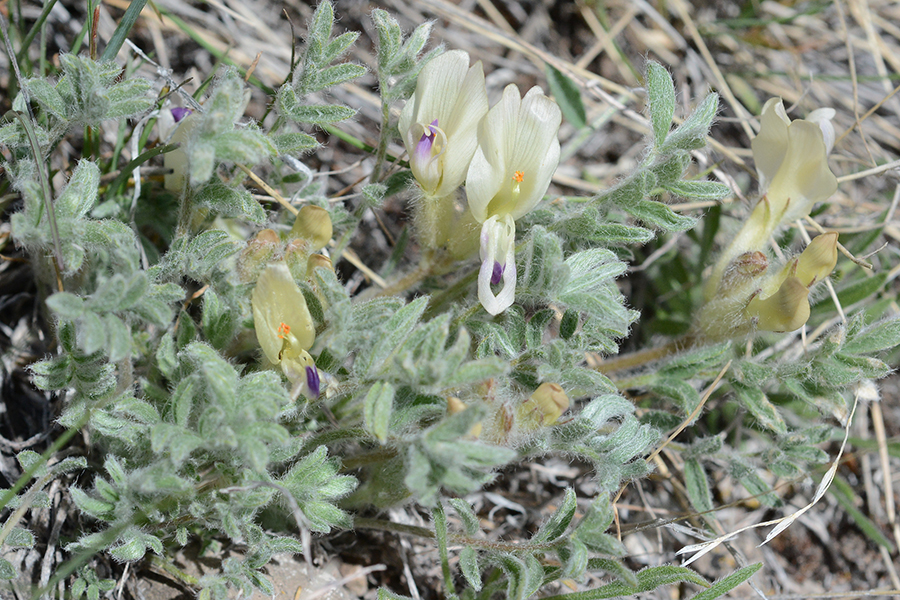 Pursh’s Milkvetch – Astragalus purshii – is also just beginning to flower on dry knolls. The pea-like flowers are slightly yellow to white with a blue bow to the keel (lower two petals). Some flowers open wide for pollinator business. Note the pinnately divided leaves are silvery hairy.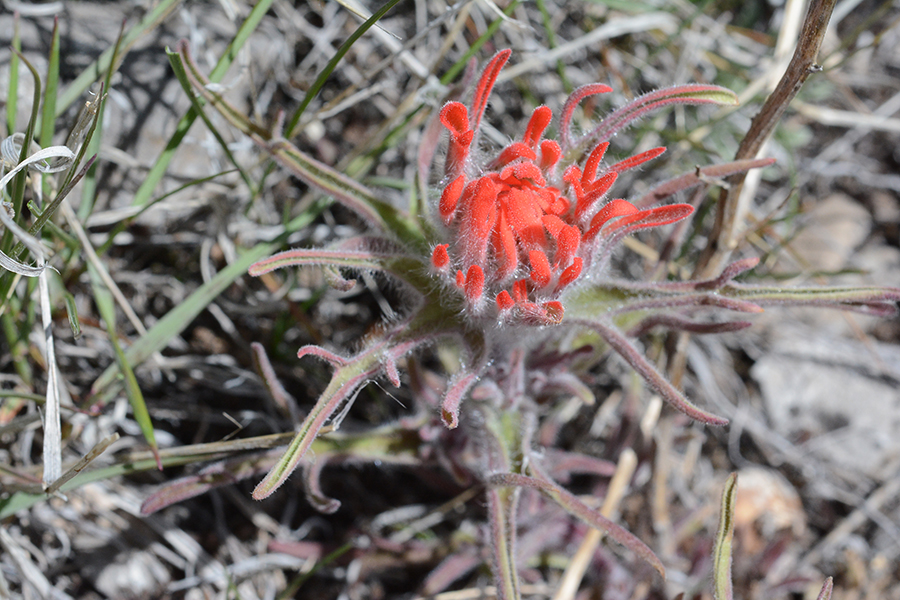
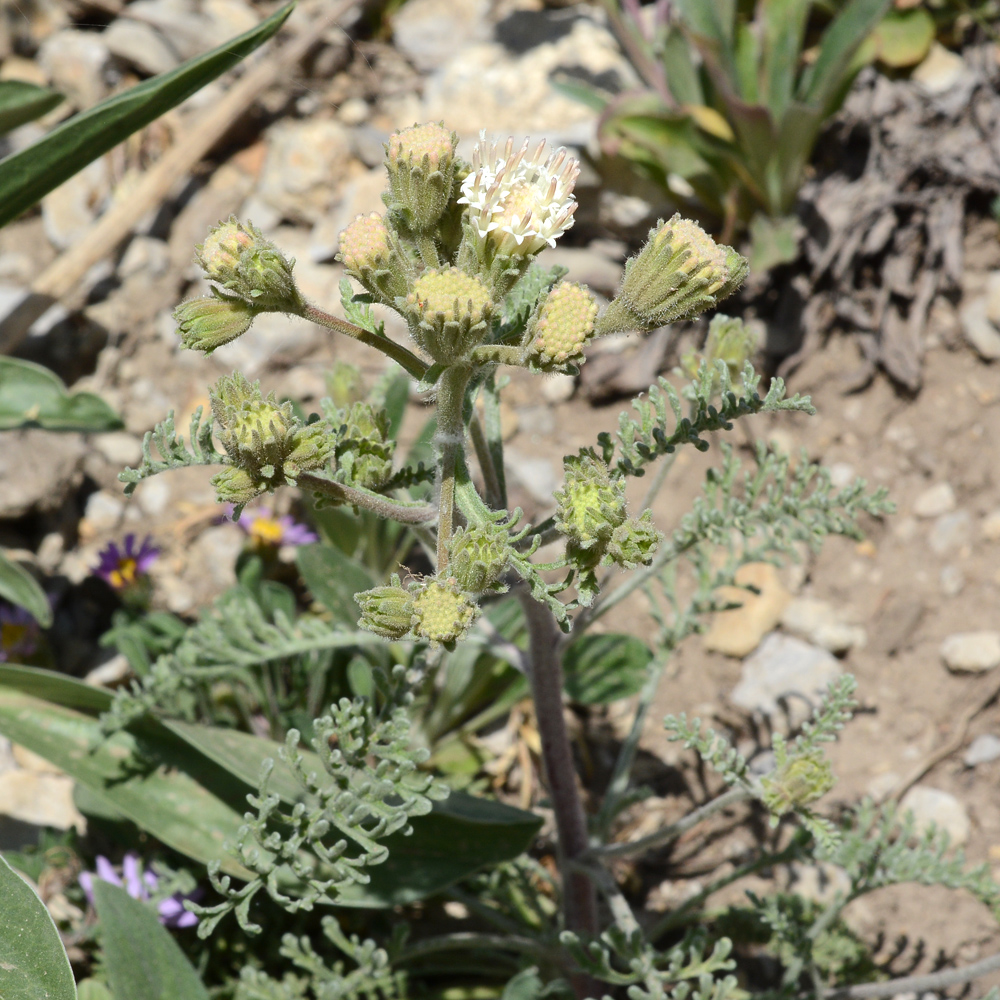
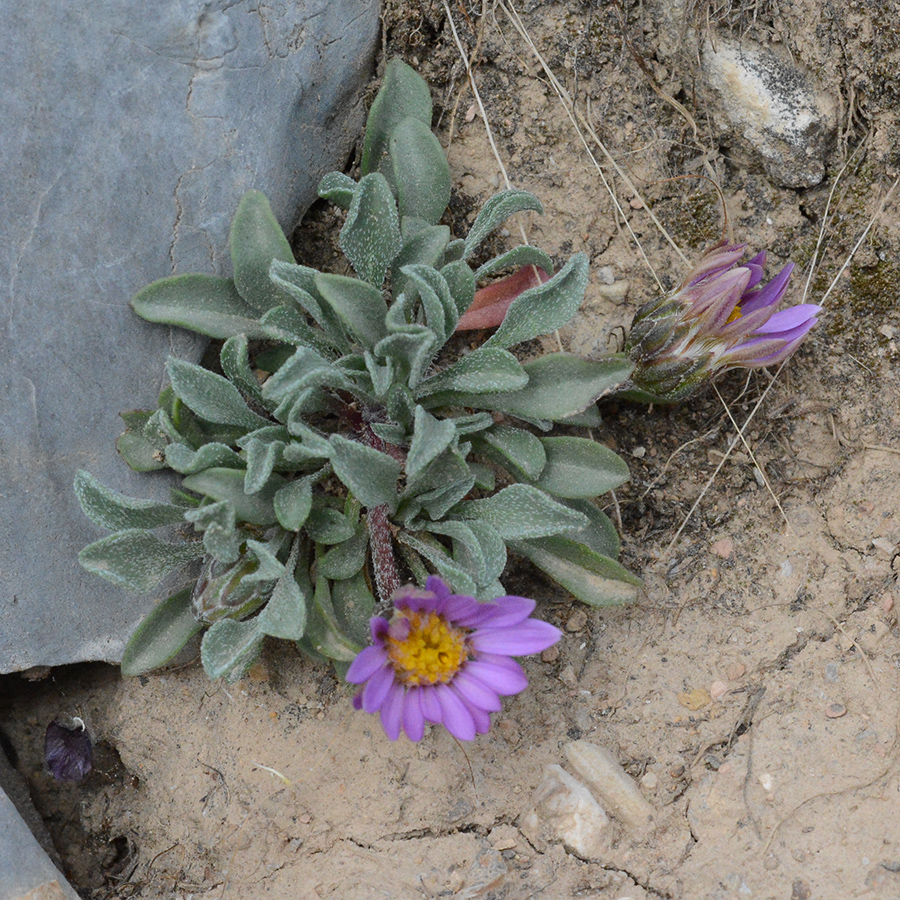
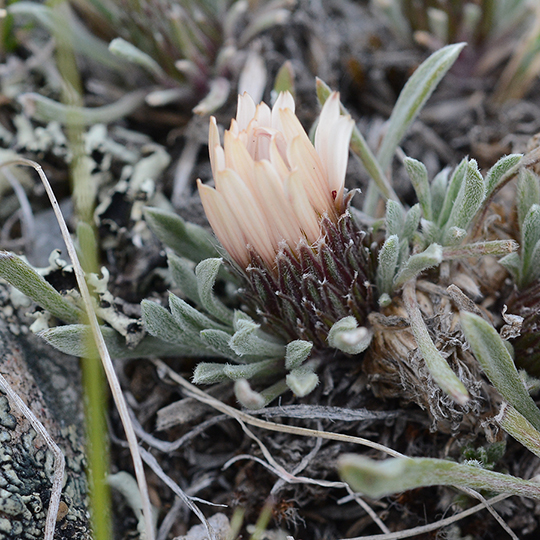 Our local Townsendias belong to a beautiful but often confusing genus. This plant has all the features of T. leptotes: narrow leaves, whitish petals, a whorl of 4-5 rows of pointed bracts tinged with color. Apparently this species and T. montana can hybridize or self-fertilize to the point that some experts say separating the two species appears “arbitrary.” I say, let’s just enjoy the flowers if you can find them. They are pretty rare.
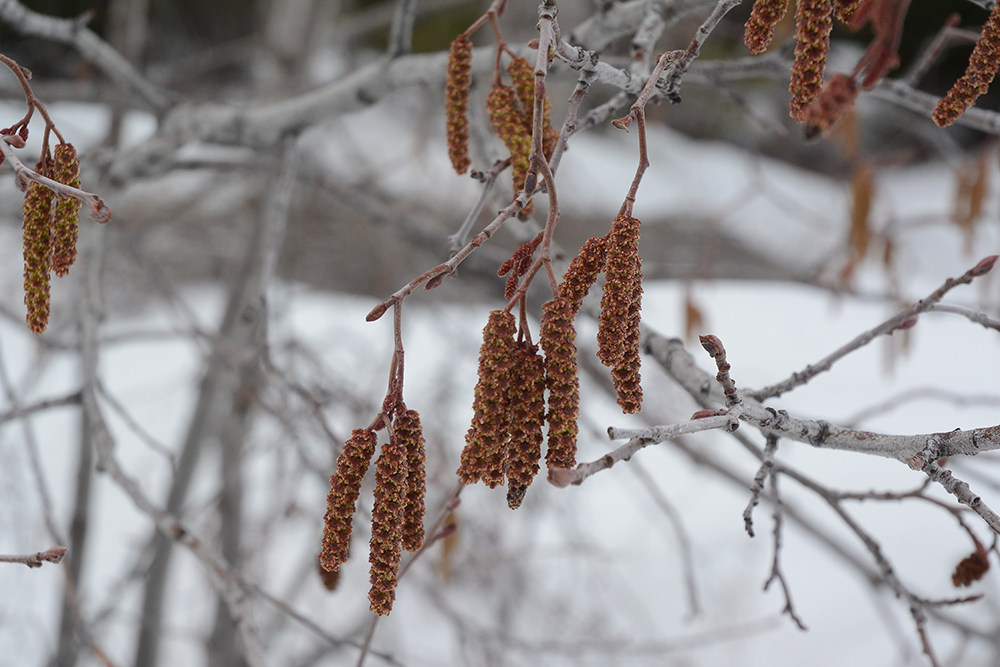 Shrub swamps throughout the valley are warming up. Ducks, moose, and beaver are moving through the waters under dangling catkins of alders and amidst thickets of pussywillows.
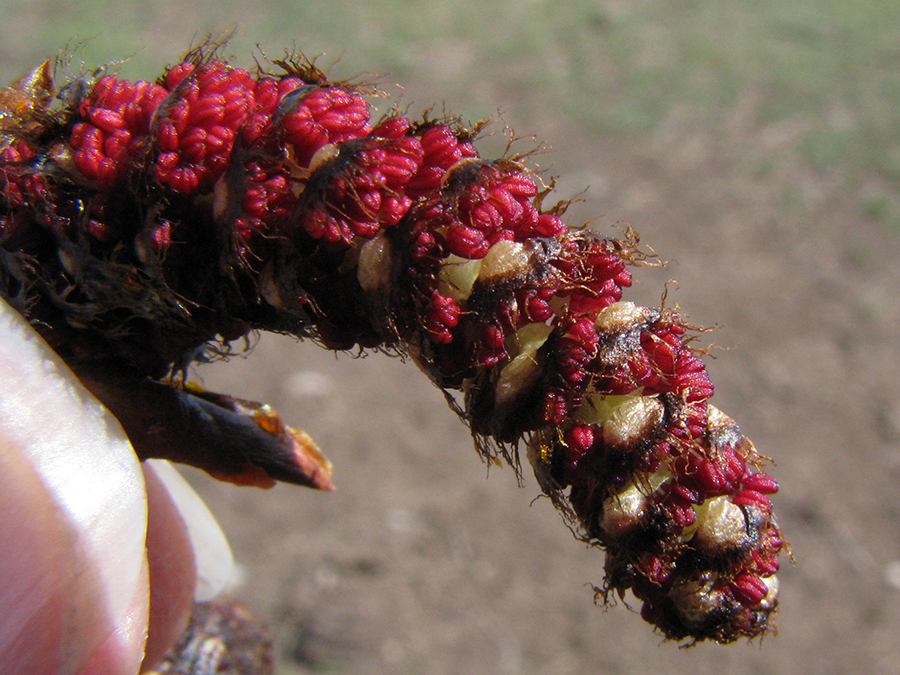
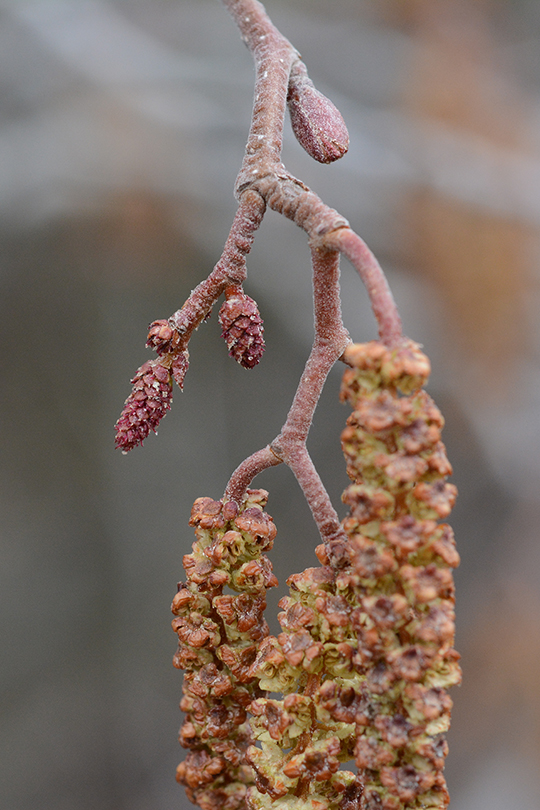 Male catkins of mountain alders – Alnus incana var. occidentalis – elongate: their pollen is released upon the wind to meet up – purely by chance – with the stigmas of female flowers (above left in photo) in separate, stout “cones.”
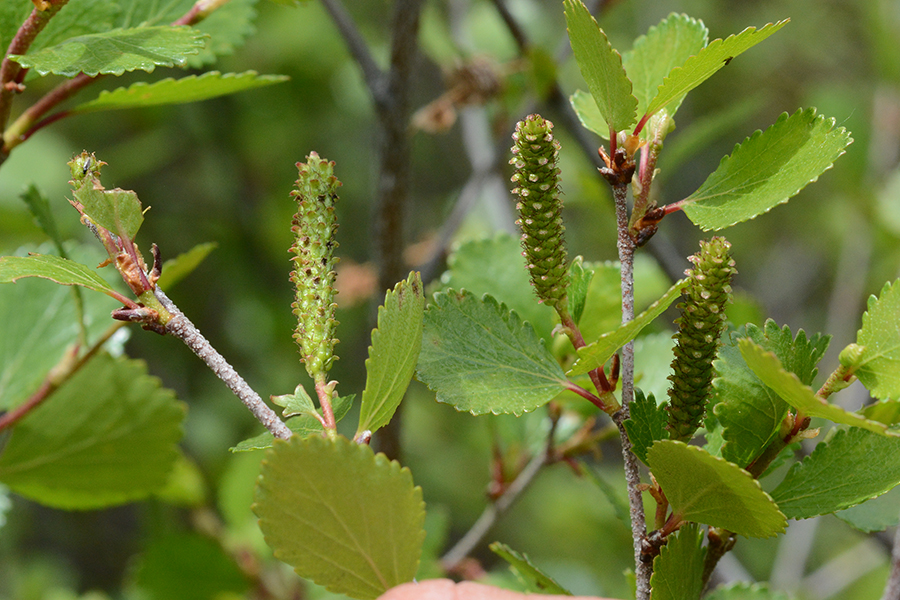 Later in May, its relative Bog Birch – Betula glandulosa – will bloom after its leaves have filled out.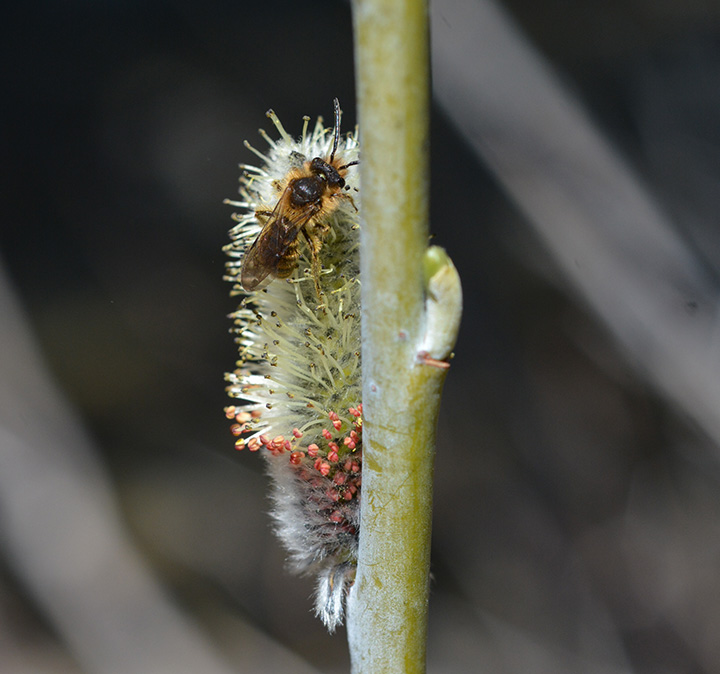
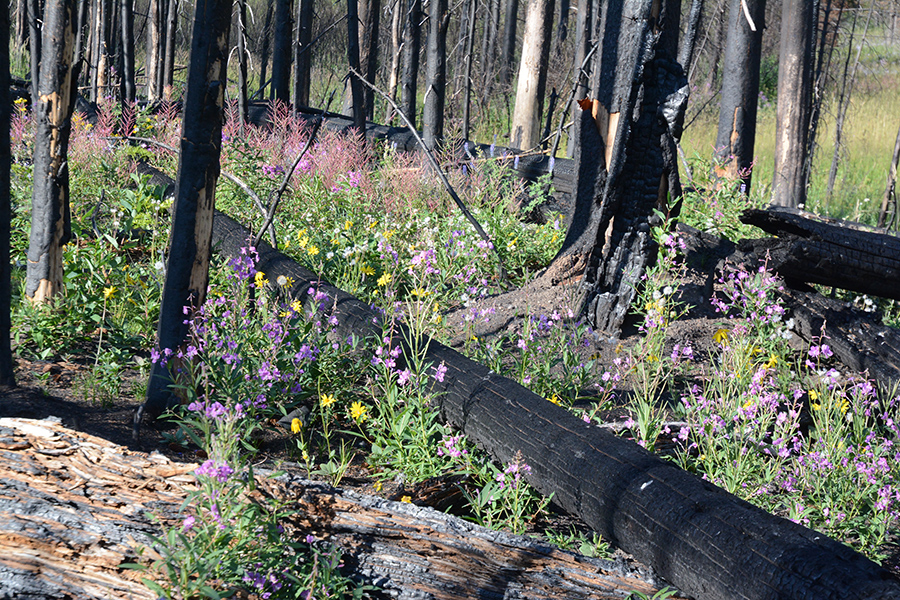
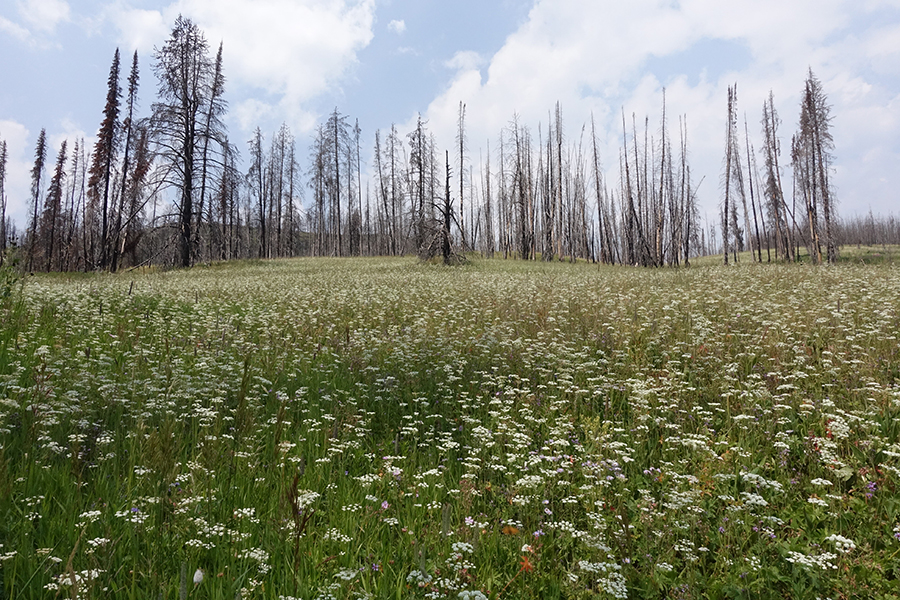 Forest fires can appear devastating at first, but for the most part nature has its systems for resilience. Depending on how hot the fire was and what plants were present both above and below ground and nearby, vegetation will return in its own due course. In some cases, plants sprout that have not been noticed in years, and indeed are triggered to flower after the heat of the moment. Others take advantage of the open ground and fly in with fresh seeds. Still others have stored seed until the magic moment. Wildlife also takes advantage of the changes.
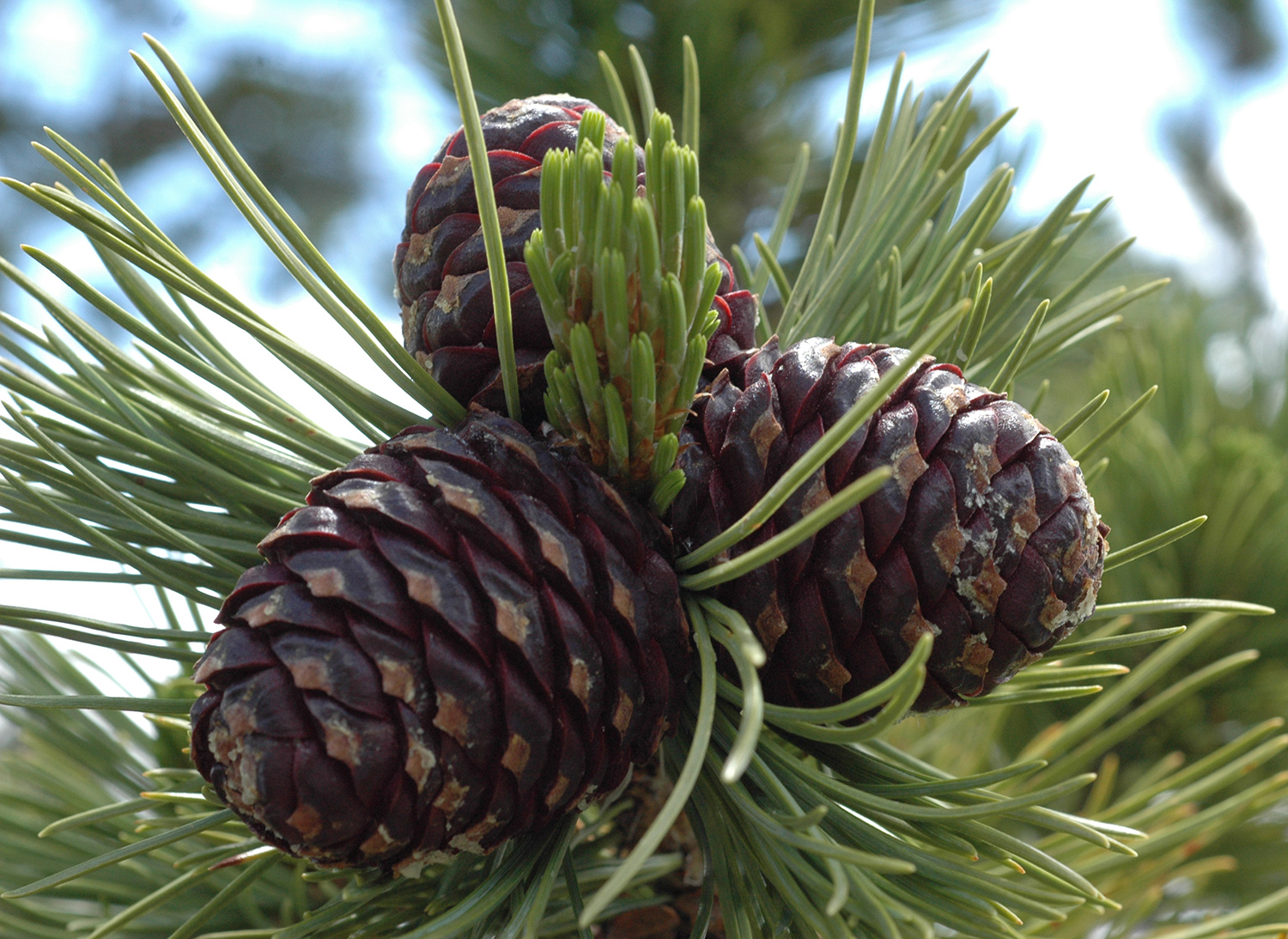
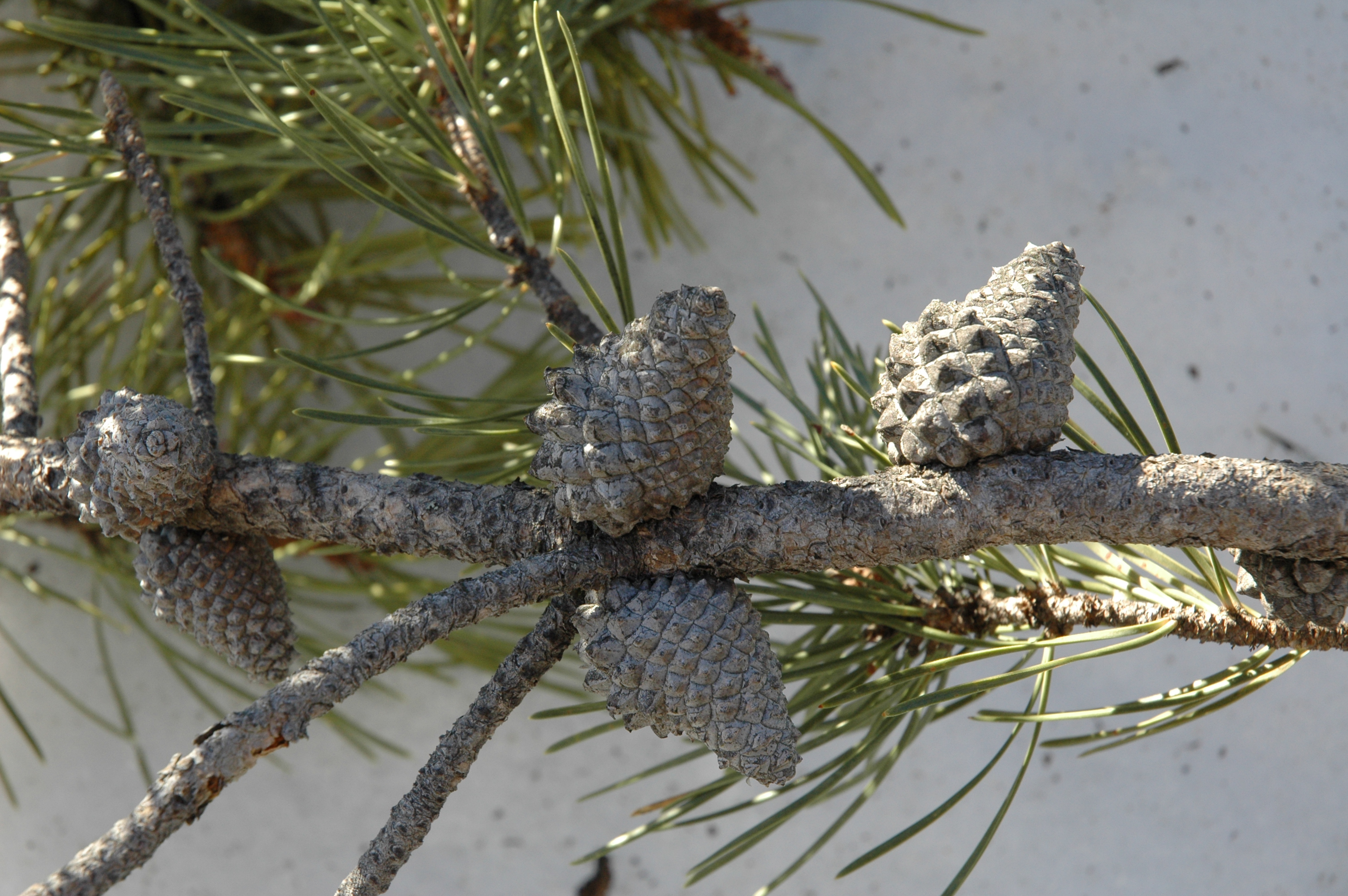 Their cones have thick scales with spine tips which protect the seeds inside from mauraders and weather for years. When a fire comes through, the resin that has sealed the scales shut melts, and cone scales open wide, releasing winged seeds upon the wind. The delicate embryos fall onto newly exposed soil, which may be enhanced by ash, and quickly germinate. Ash often contains recycled nutrients and retains warmth which helps the seeds grow. Seeds germinate quickly, giving them a headstart among competing plants. Pines in fact need sun to grow well. A truly fire adapated species!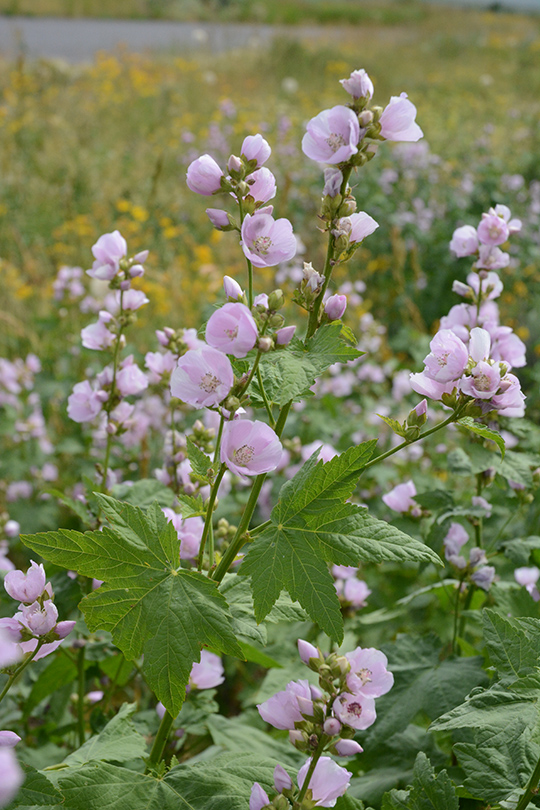
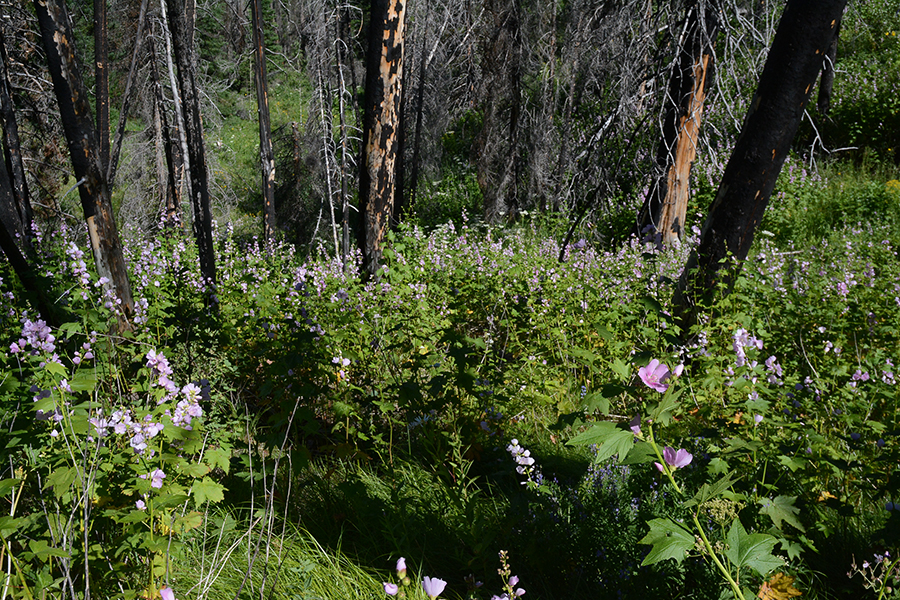 Due to a prescribed burn south of Hoback, the slopes along the trail up Palmer Creek are now covered with 4-5’ flowering Mountain Mallow plants (photo above taken 7.13.18). Soon fruits, which look like peeled hairy tangerines, will split to release seeds for the next generation decades in the future (photo below).
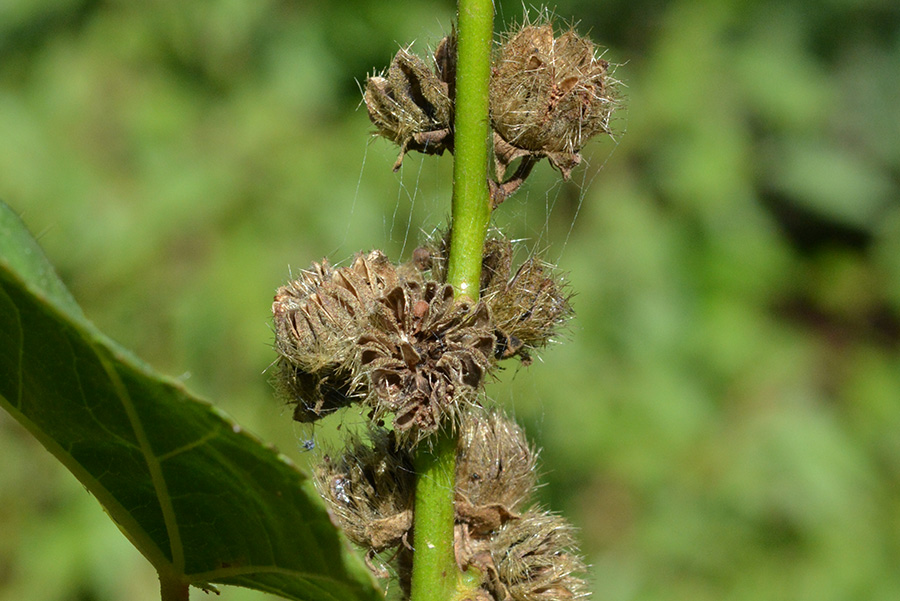 Note: In mountain mallow the seedbank is in the soil, in lodgepole pine, the seedbank is in the air.
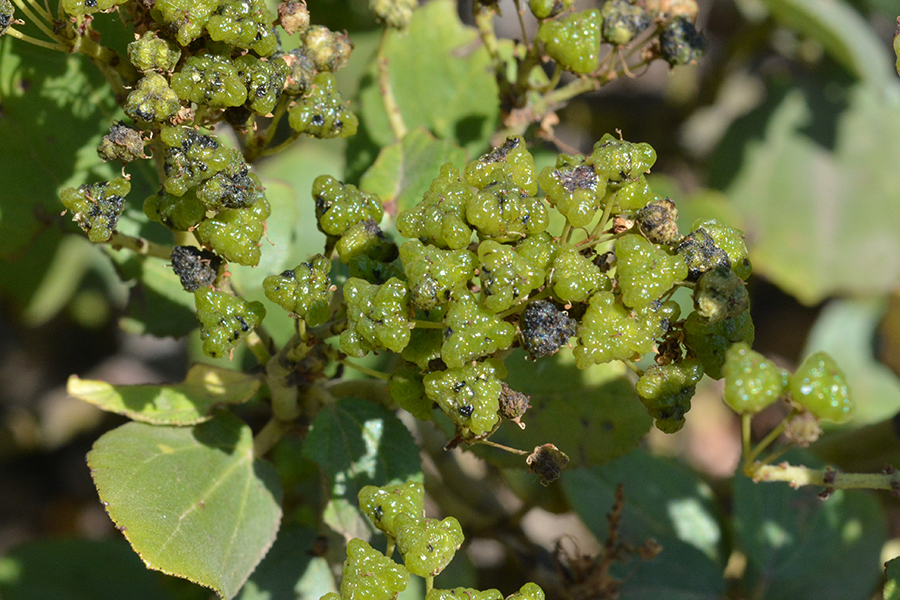
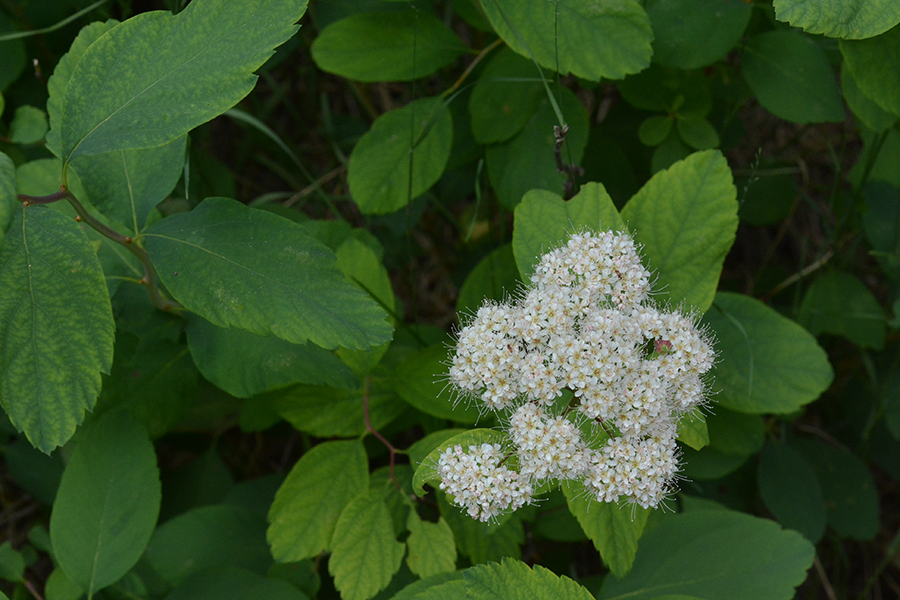
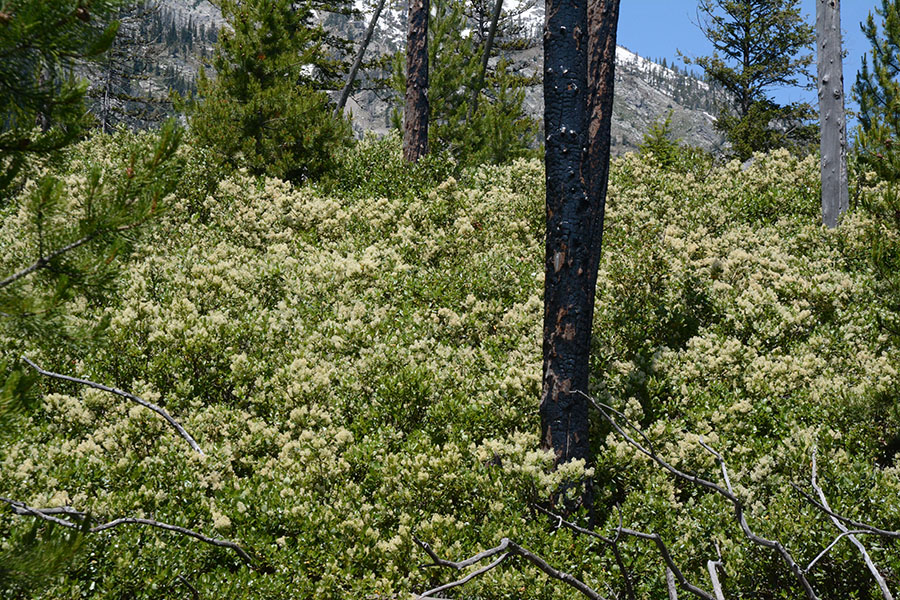 This evergreen, resinous, sprawling shrub will shoot up new branches from old roots after a light fire. After heavy burns, it can also sprout from “Rip-van-Winkle” seeds.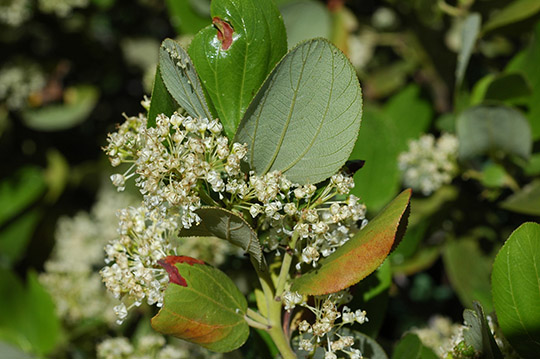
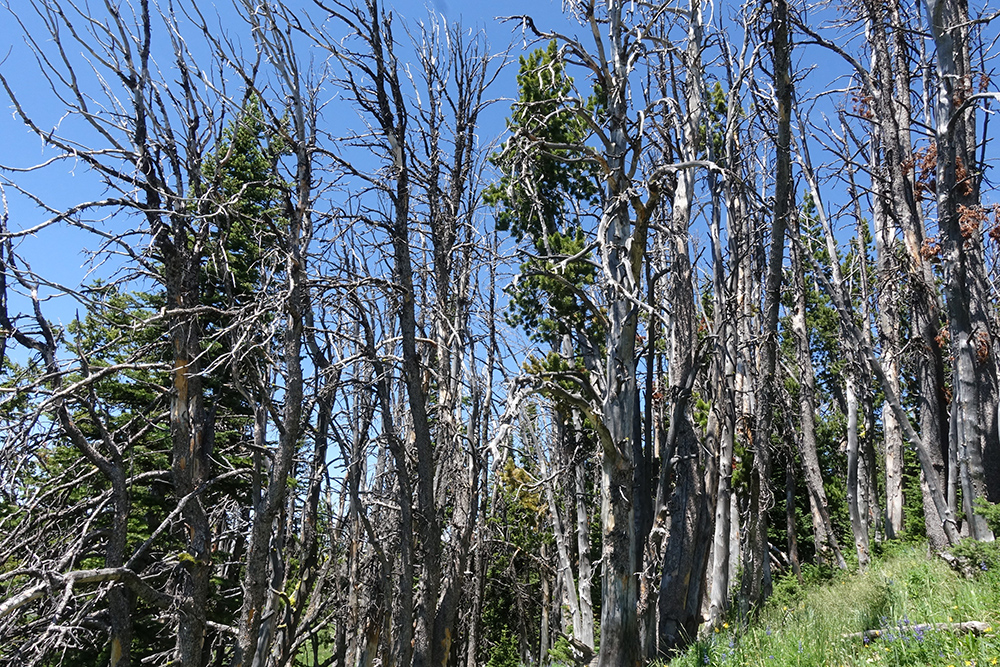
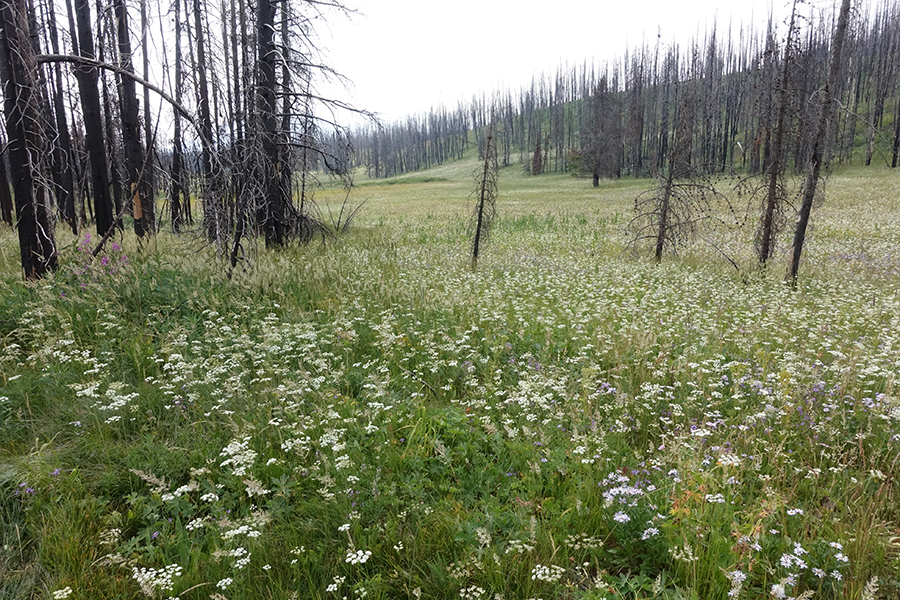 Notably, in some areas it burned through lodgepole stands that were recolonizing from a fire only a few years before. Ecologists and foresters are concerned that this unusual short “return” interval will be the pattern of future fires in this era of climate disruption.
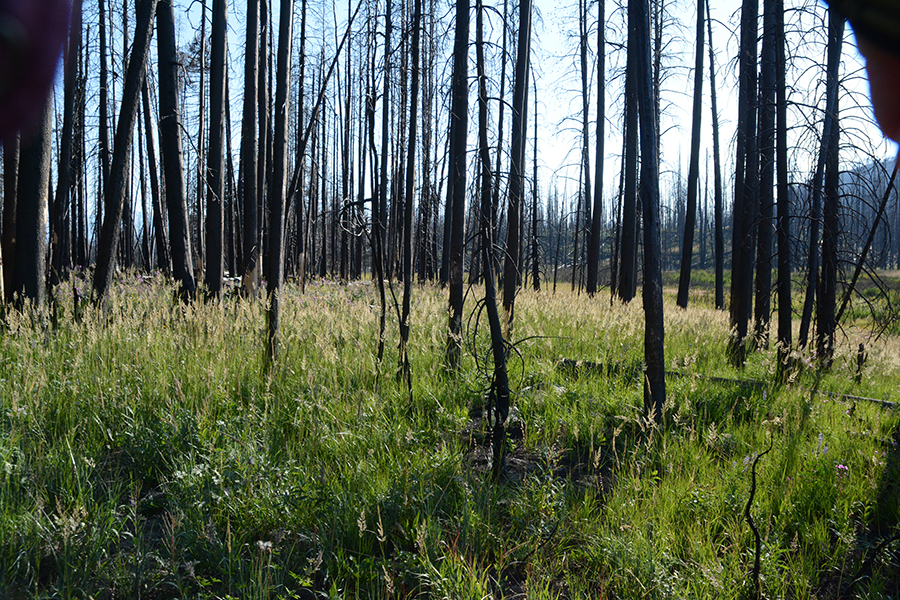 Deep fibrous roots of Pinegrass are important for holding soils, especially when soils are vulnerable to erosion after fires. Plants are blooming in profusion near the parkway.
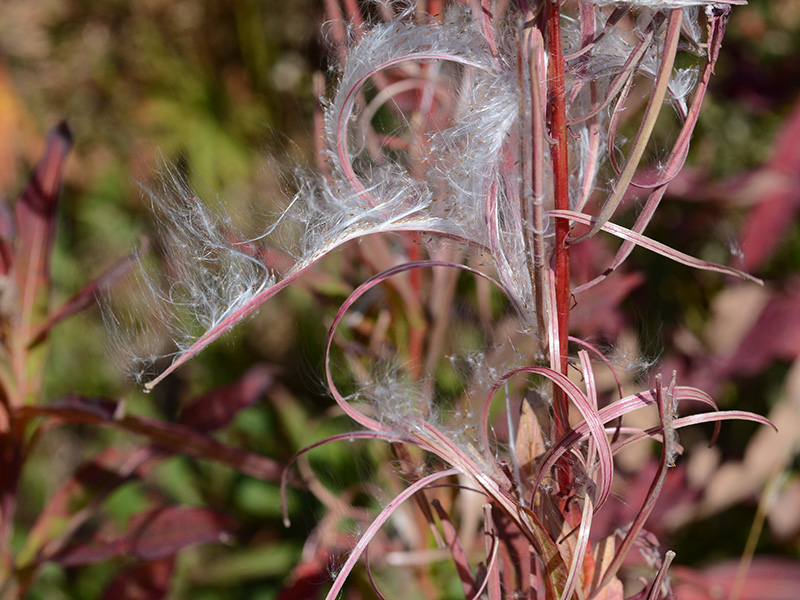
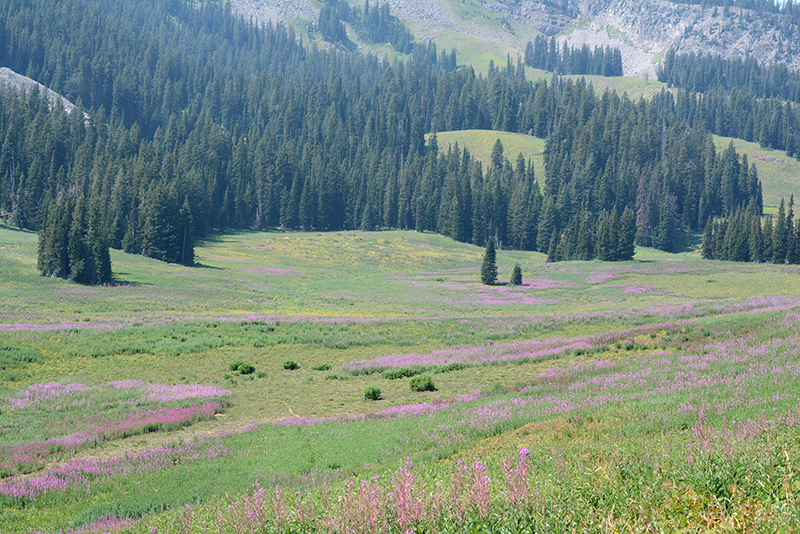
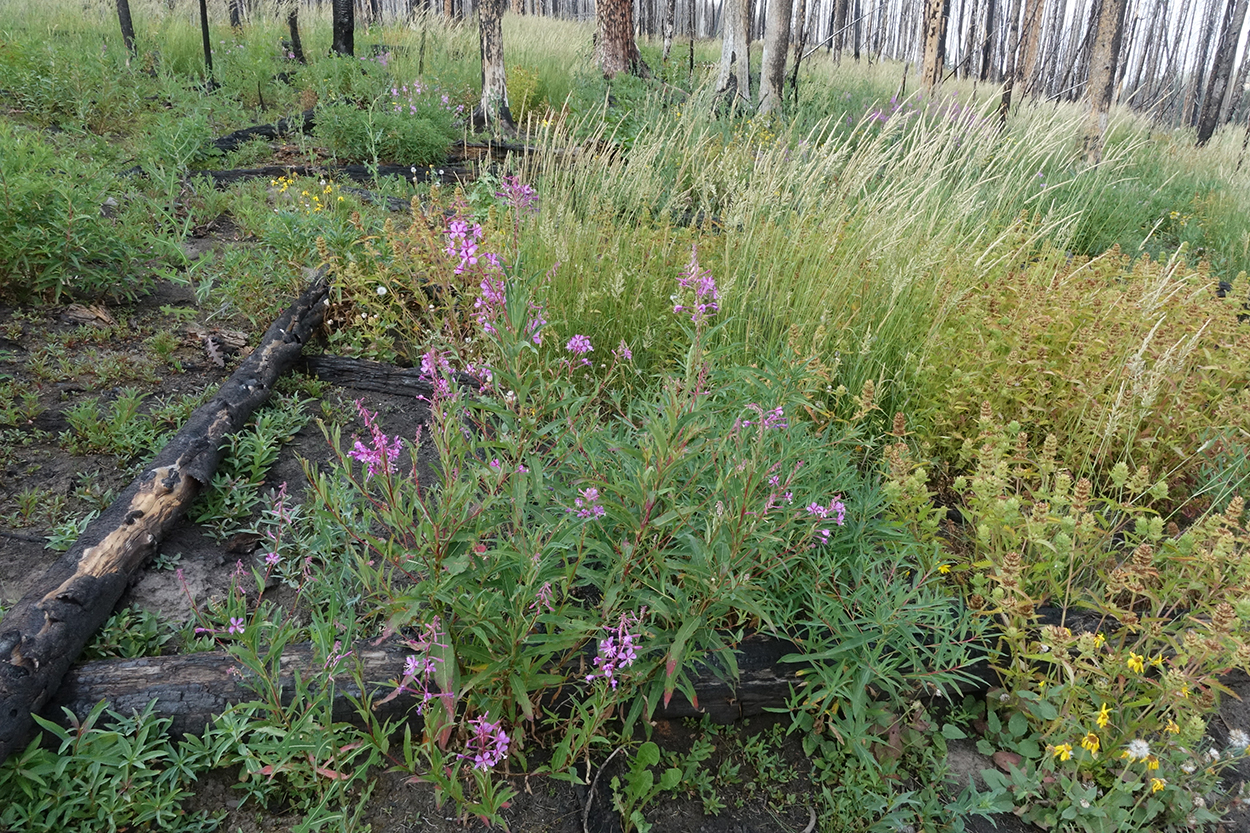 Fireweed – Epilobium/Chamerion angustifolia – is well known for showing up after fires. In the insulating soil, rhizomatous (underground creeping) stems growing 4-6” deep may have survived the above-ground heat to sprout again. Even one surviving plant can shed 1000s of seeds that can catch upon the wind, land, and germinate quickly on exposed ground. (Photo above shows both Fireweed and Pinegrass.)
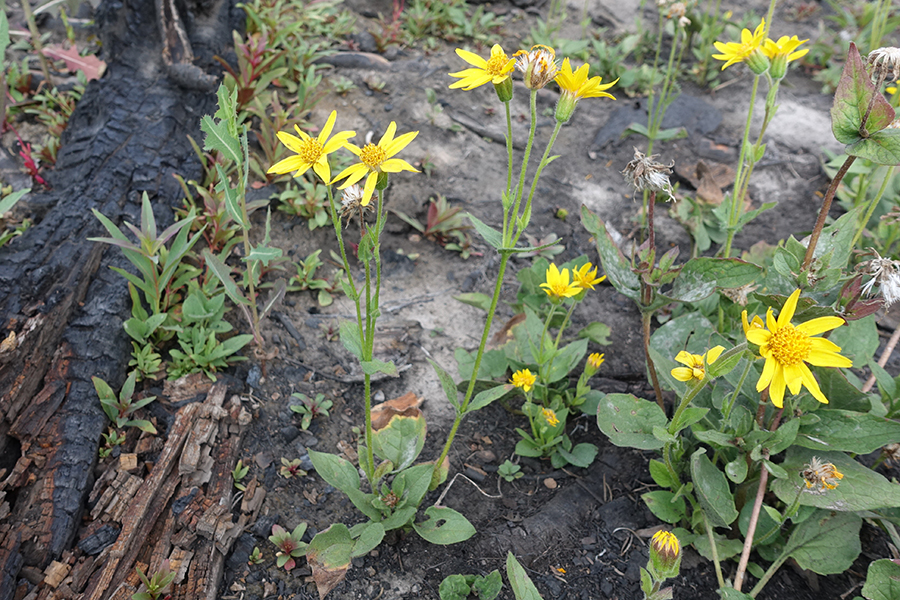 Cheerful patches of Broadleaf Arnica – Arnica latifolia – and a strange hybrid, likely Arnica X diversifolia – a cross between Heartleaf and Broadleaf arnica, are growing in charred soils (photo above).
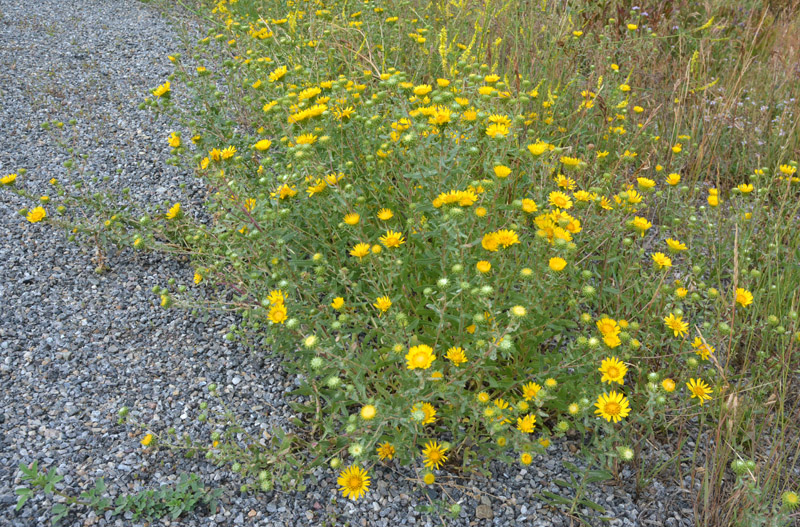
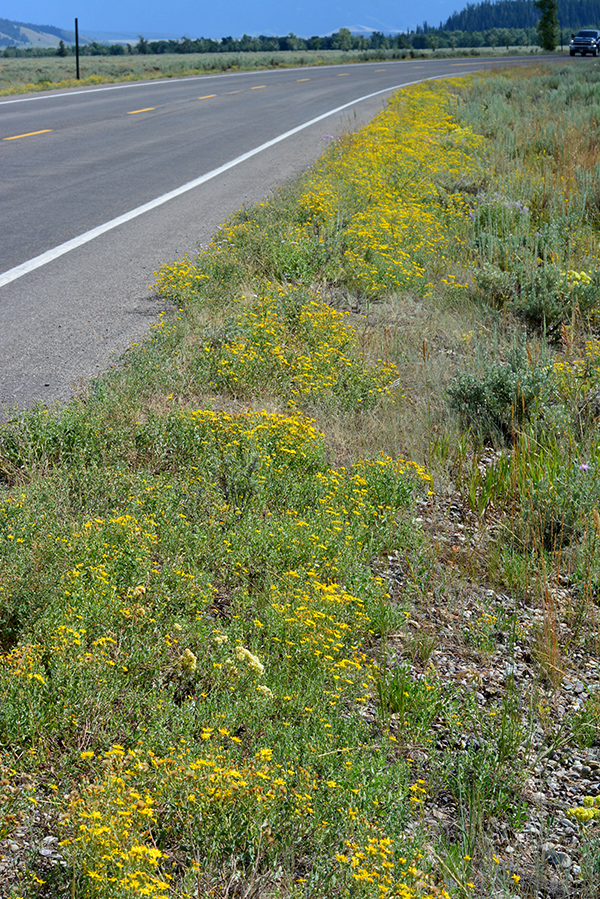
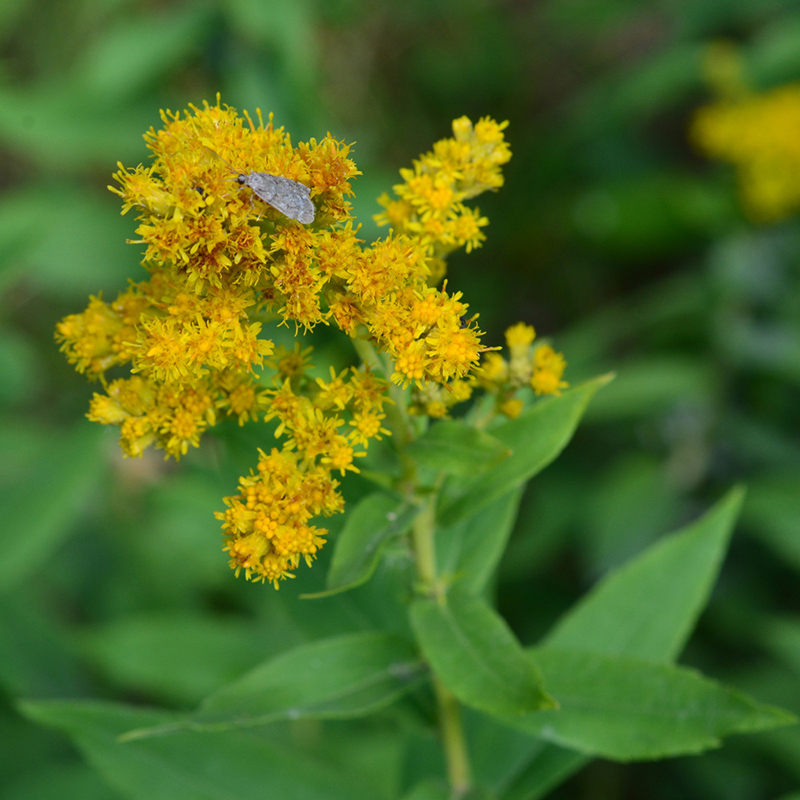
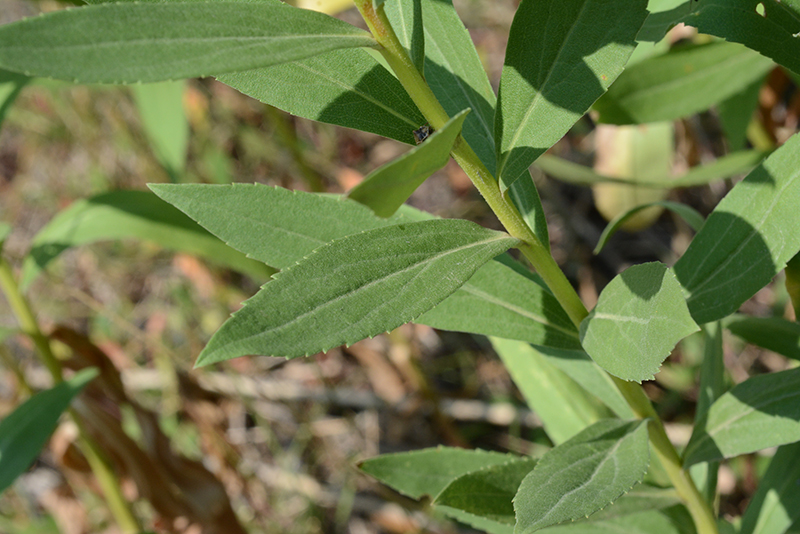
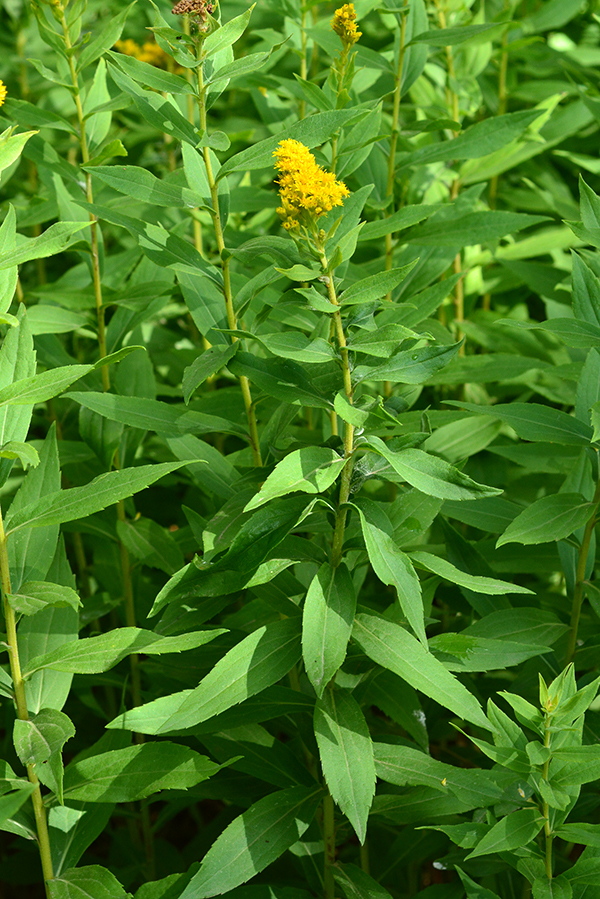
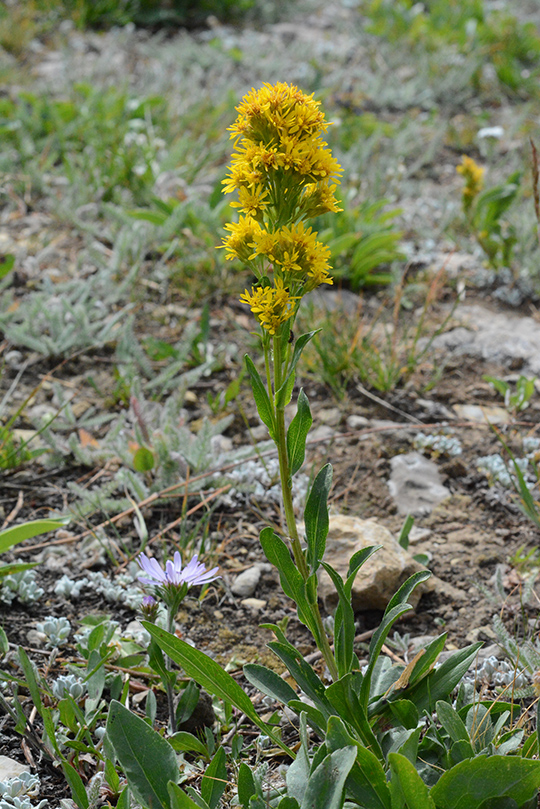
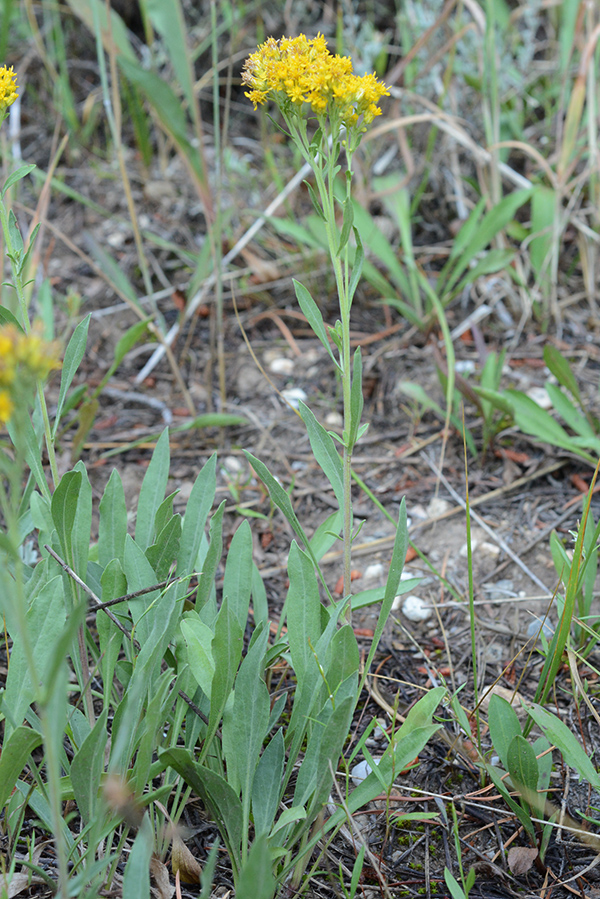
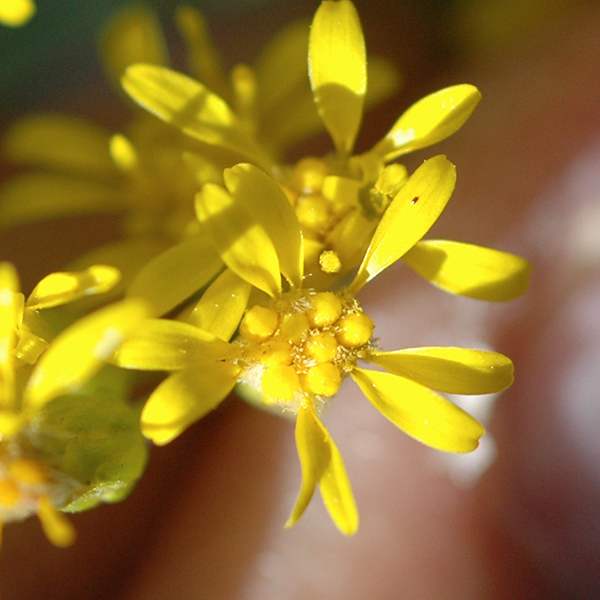
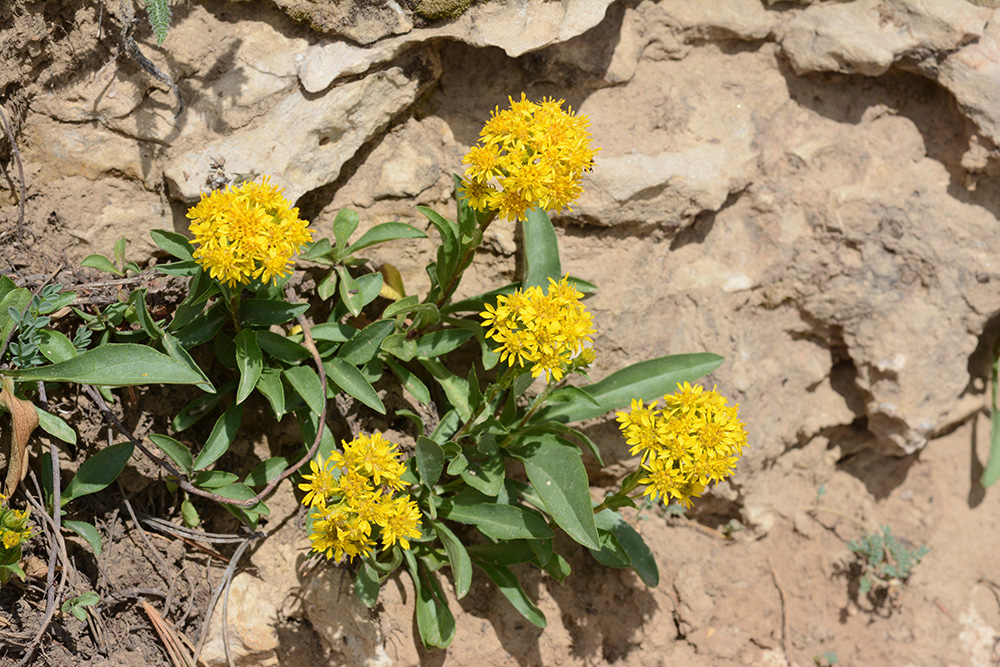
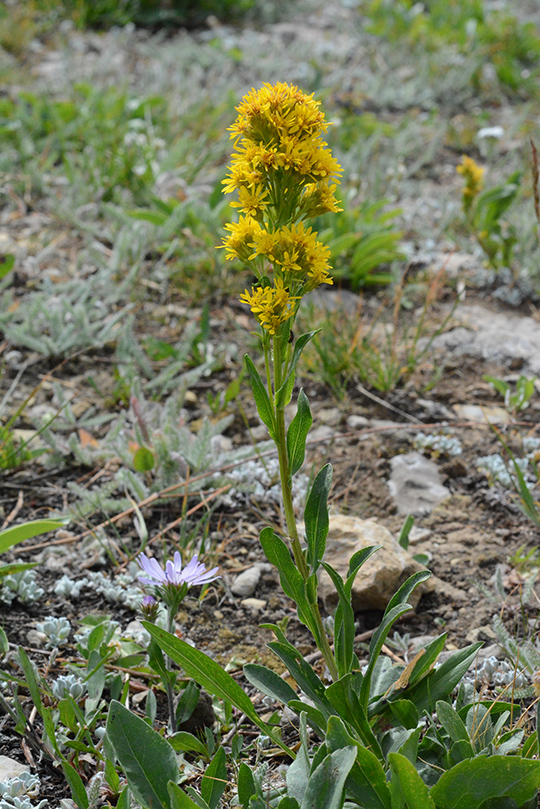
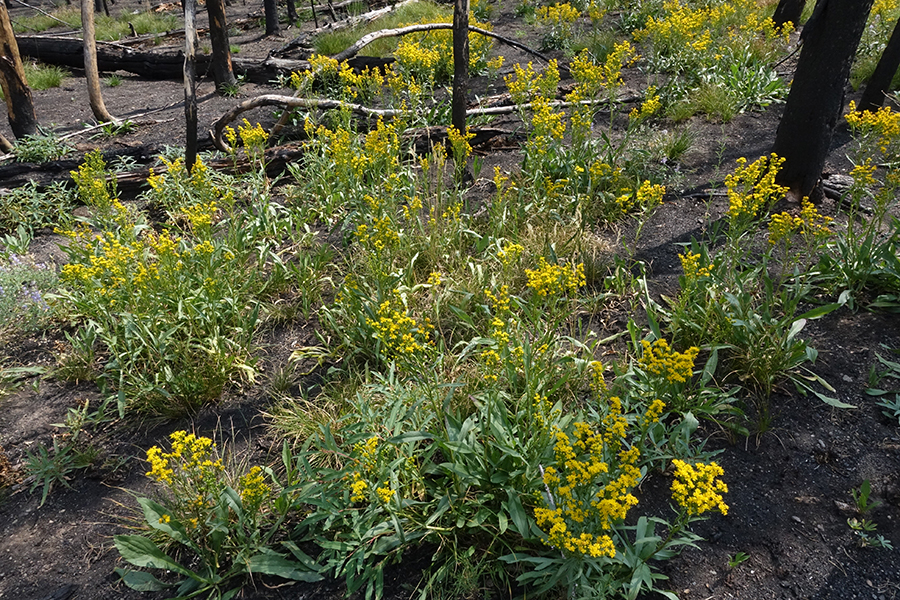 Large clumps of yellow Missouri Goldenrod – Solidago missouriensis – was dense along Grassy Lake Road, brightening the dark scene (photo above).
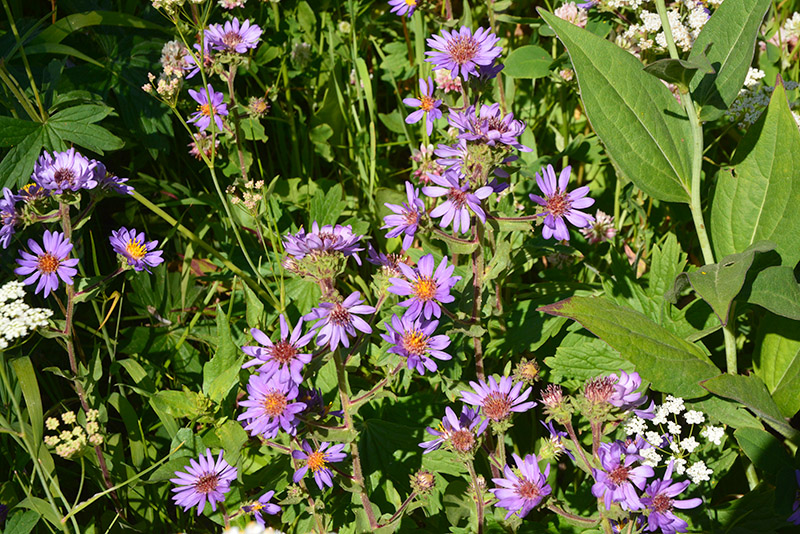
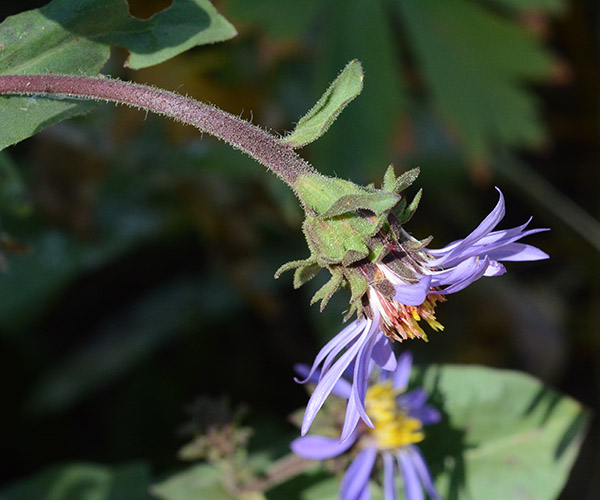
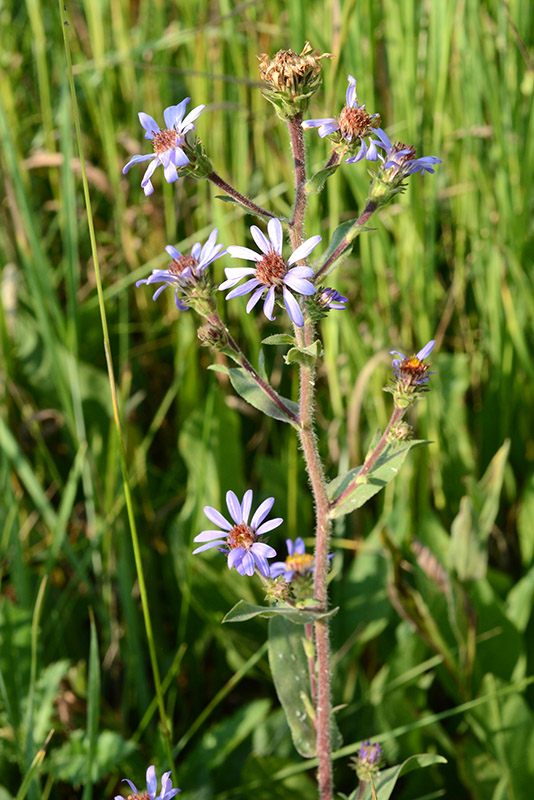
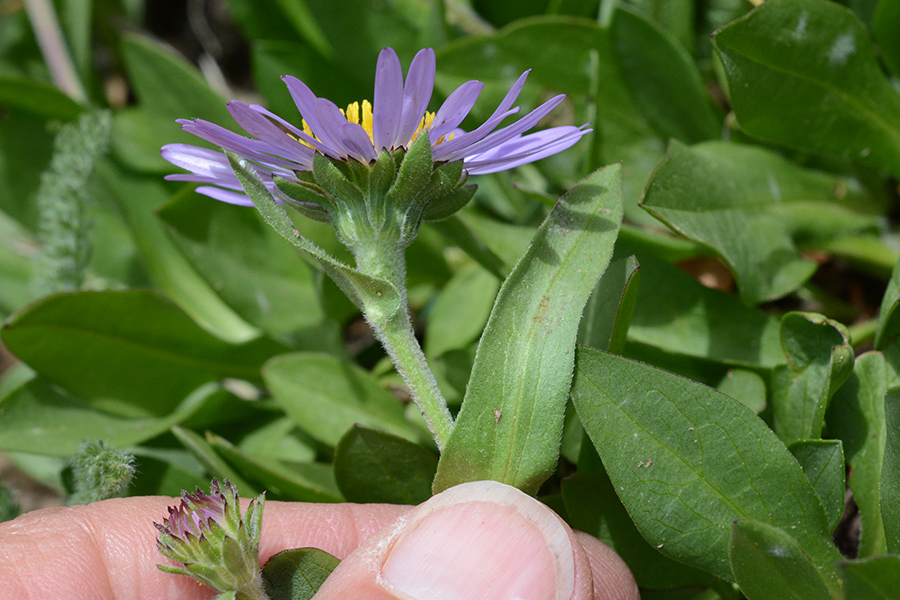
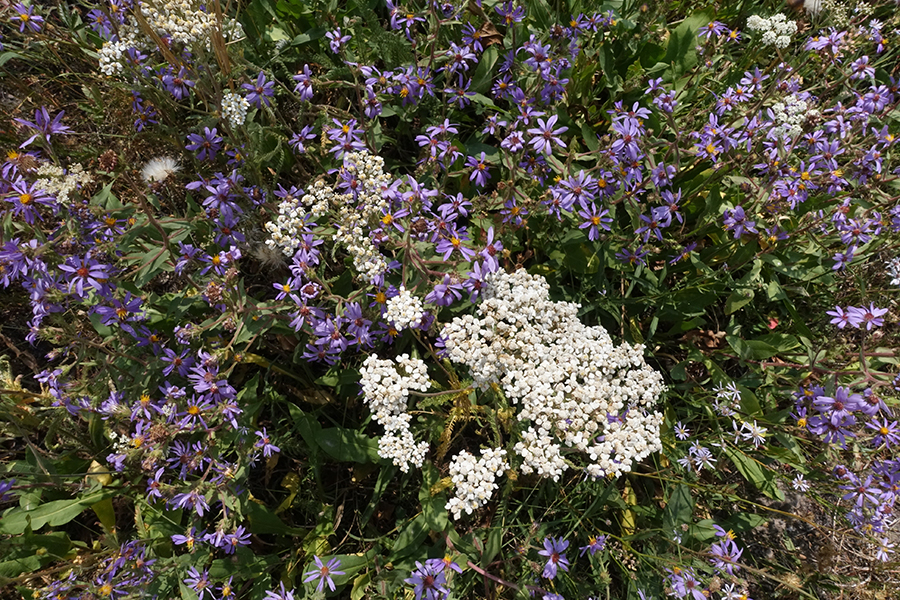 A mix of Yarrow – Achillea millefolium – and Thickstem Aster – Eurybia integrifolia – are common in fields right now, but they are also flourishing in the sun under dead lodgepole pine trees along Grassy Lake Road (photo above).
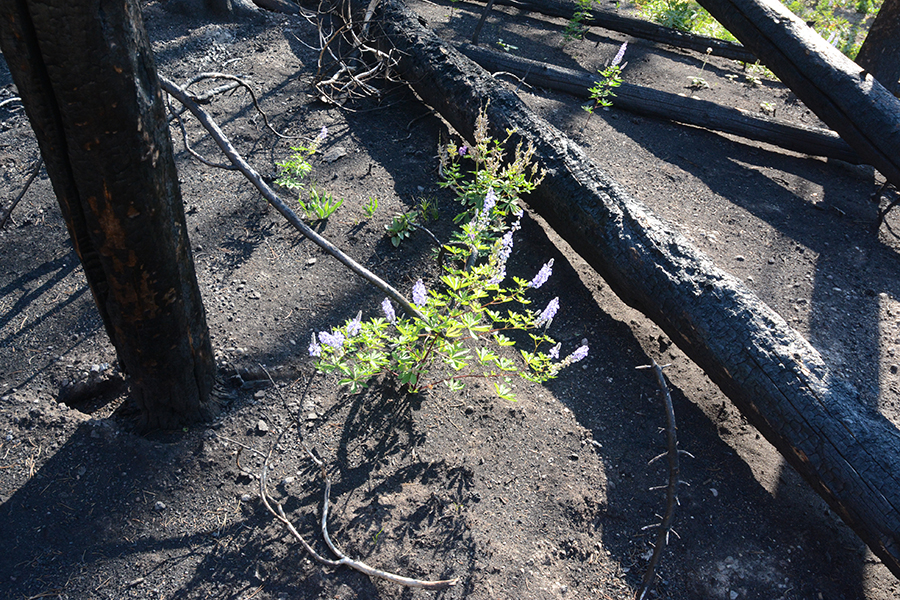 Silvery Lupine – Lupinus argenteus – seeds are “scarified” by the heat of fire, enabling buried seeds to germinate relatively quickly. As a legume, lupines have a mutually beneficial relationship with bacteria in their root nodules that can “fix” nitrogen. This provides lupines an advantage in colonizing poor soils (photo above). Their heavy seeds pop out of their pea-pod like fruits.
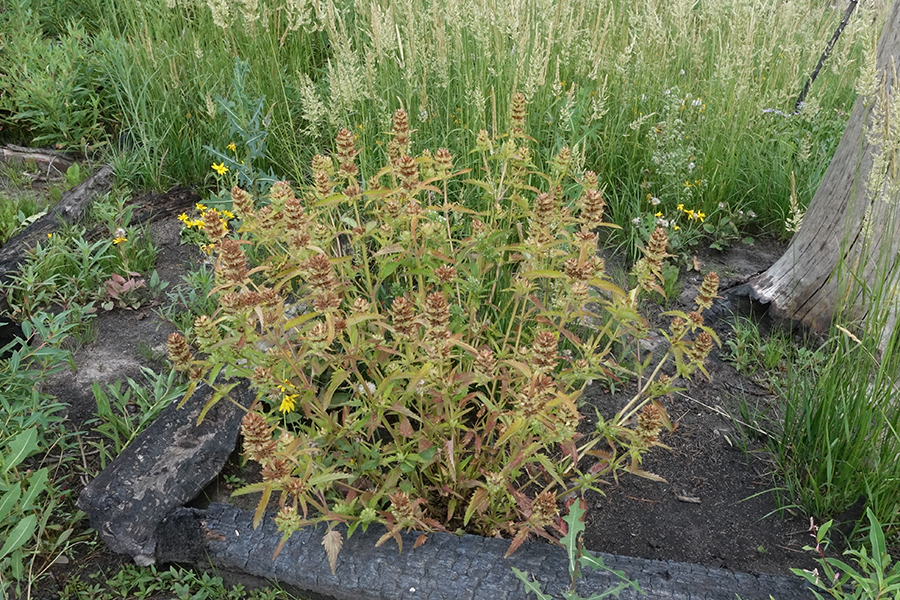 A robust member of the Mint Family – Dragonhead – Dracocephalum parviflorum – (photo above) was a new species to this botanist. Apparently it thrives in disturbed soils.
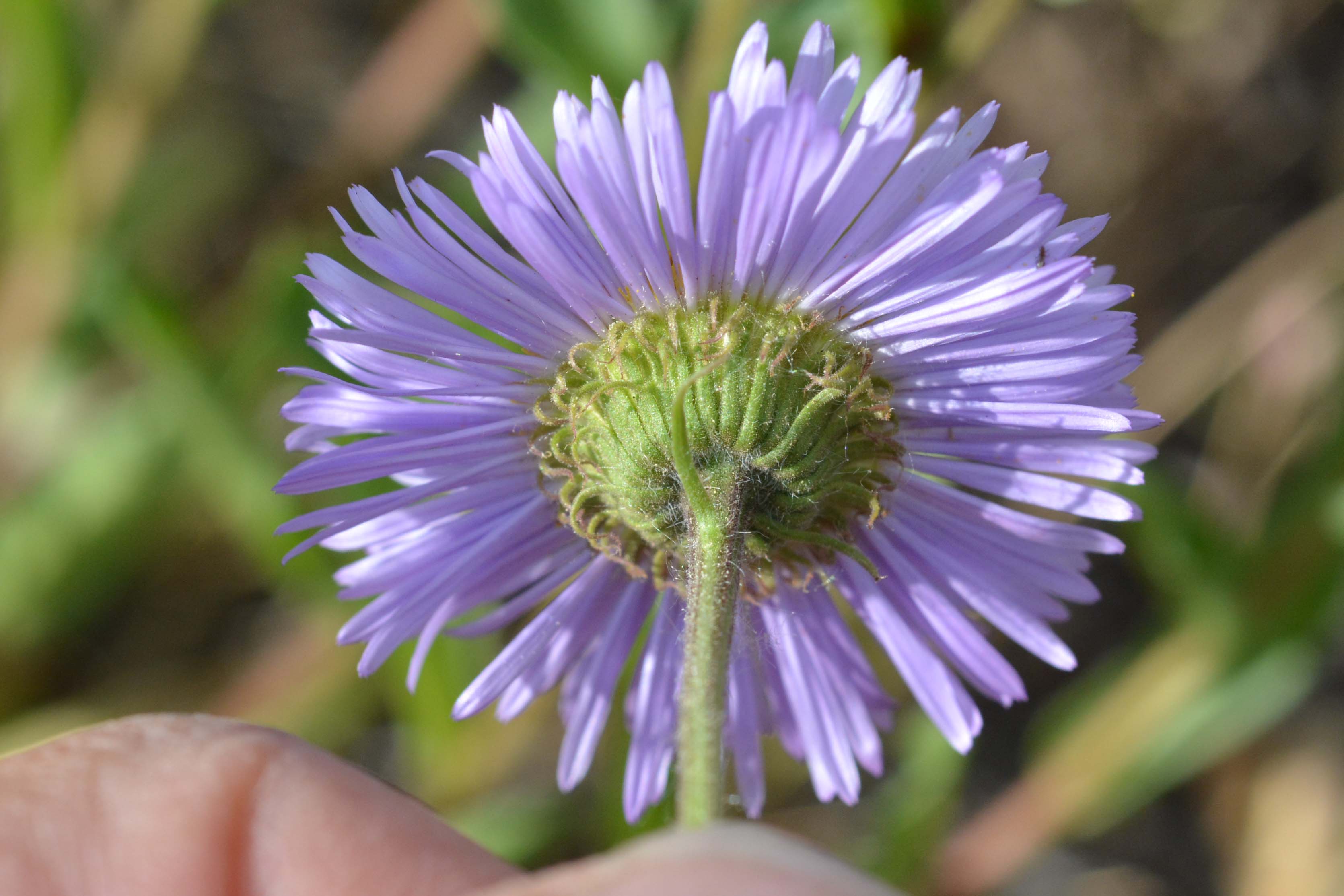
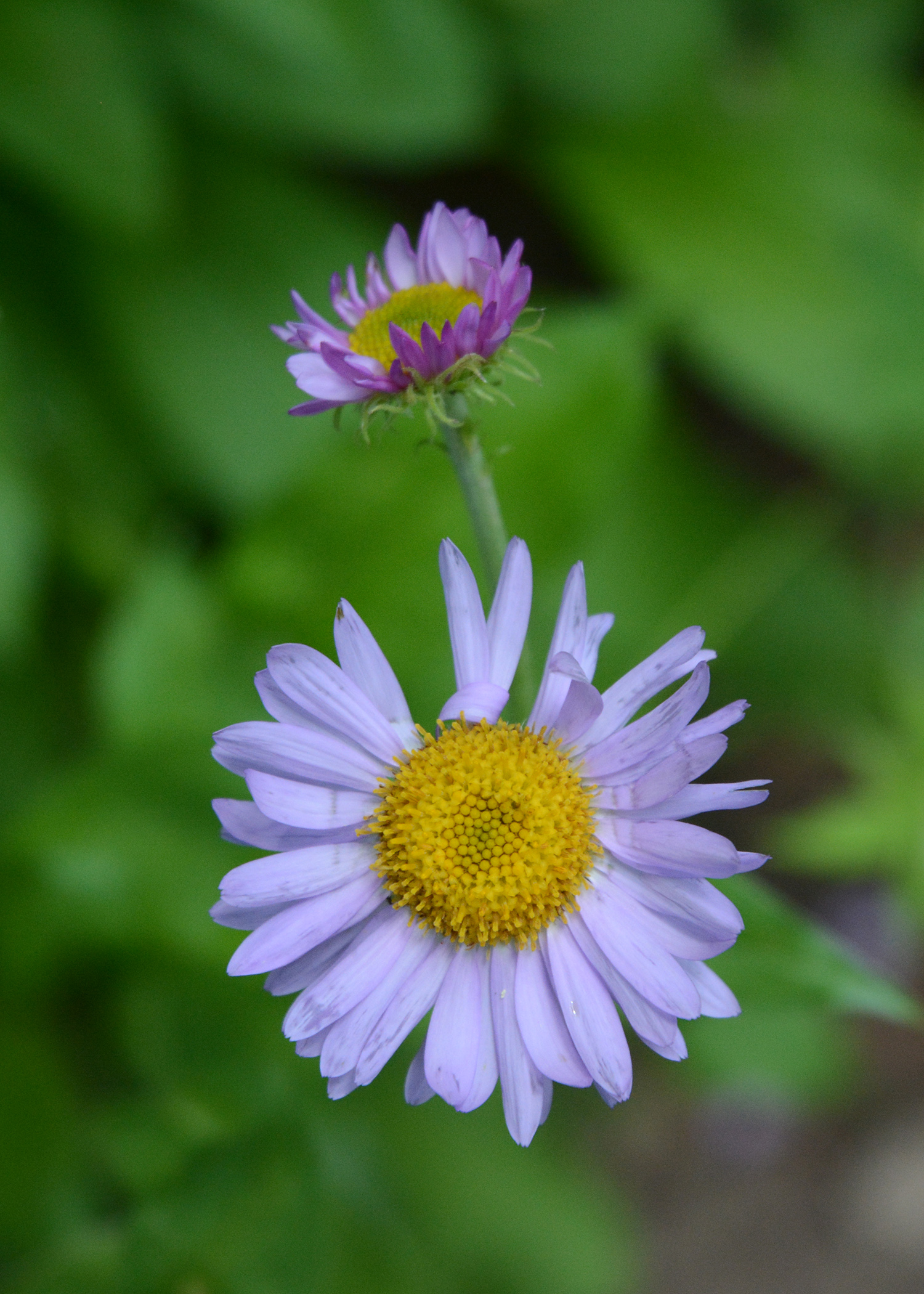
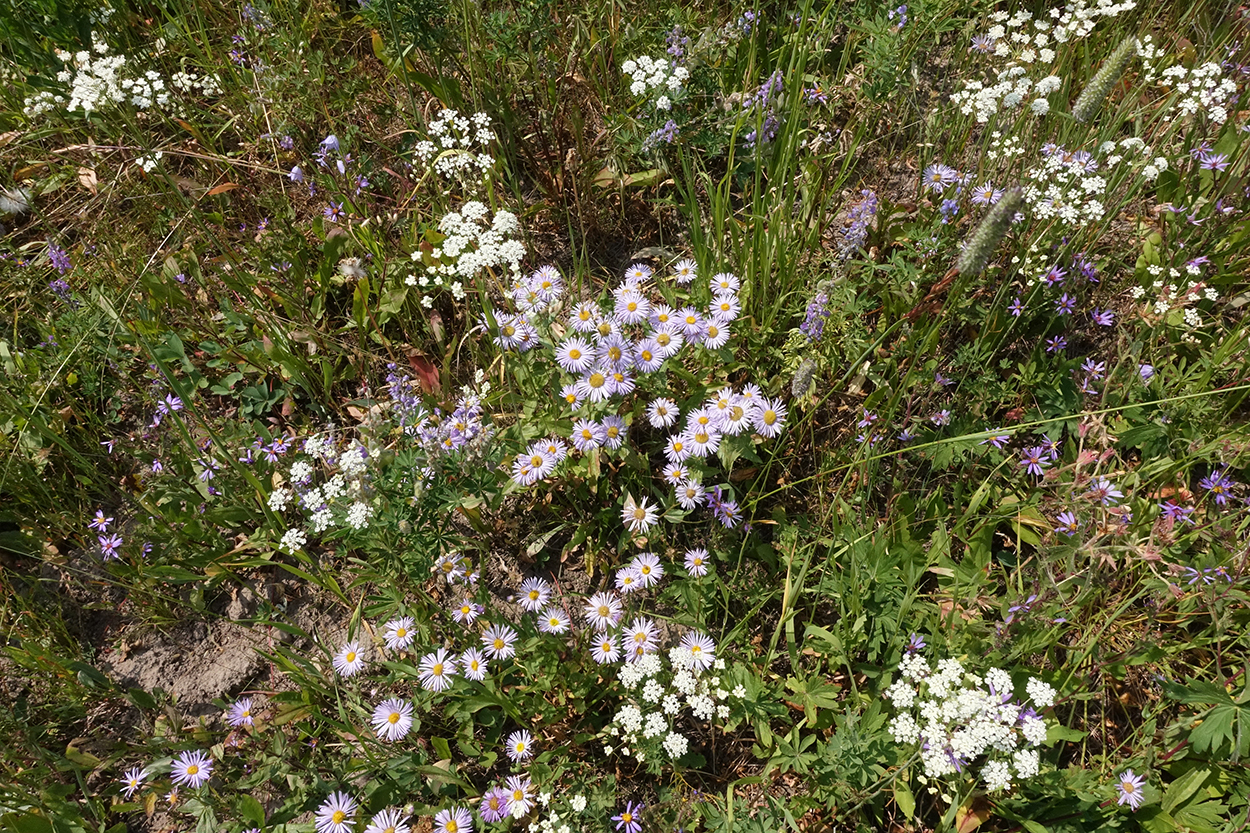 Patches of other common meadow flowers have retained a niche as well, including Oregon Daisy – Erigeron speciosus – (photo above) with its many narrow, lavender ray flowers (ray flowers look like petals). Many perennials have deep storage roots that are often insulated by soils to heat of fire (or the cold of winter.)
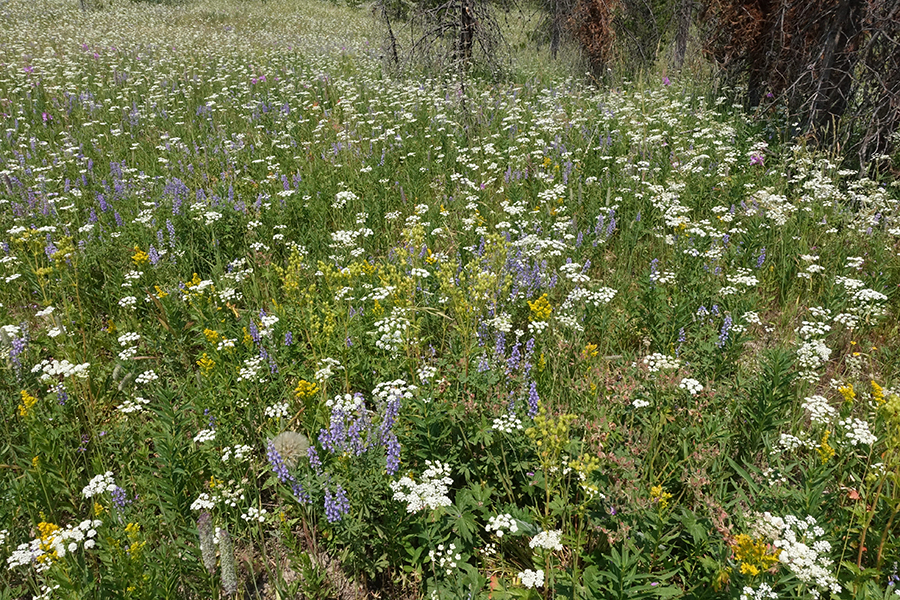 Common Yampa – Perideridia montana – has created a tapestry of white. Upon a walk through the area, one can see that many late-summer flowers which are common elsewhere as here as well: a hidden layer of Sticky Geranium – Geranium viscossimum, blue spires of Tall Delphinium – Delphinium occidentale, yellow sprays of Cinquefoil – Potentilla spp., orange-yellow Rocky Mountain Golendrod – Solidago multiradiata, and spikes of blue Silvery Lupine mix in.
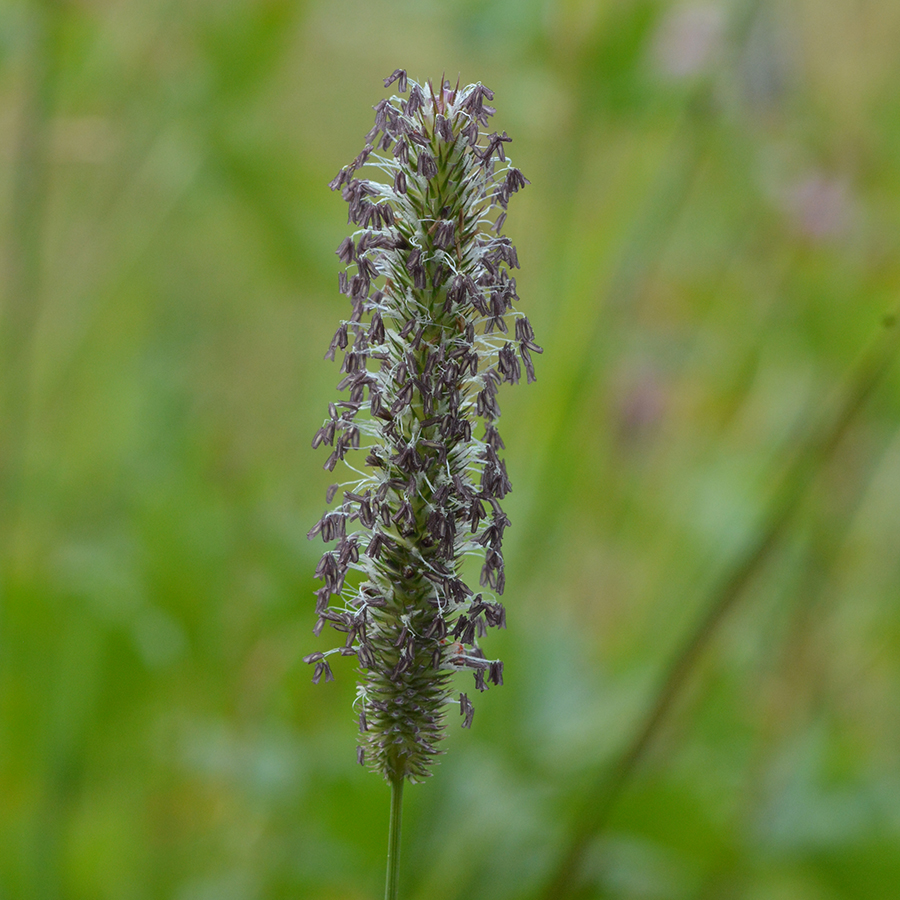 Mountain Brome – Bromus carinatus (photo below),
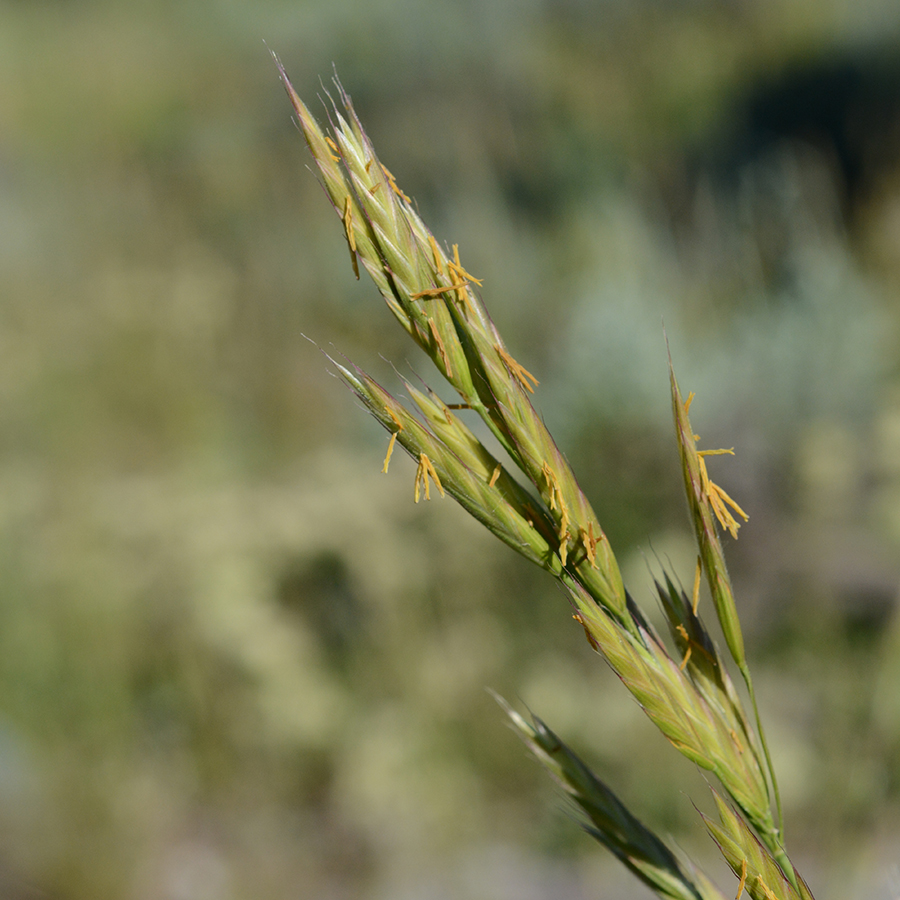 and elegant spikelets of Oniongrass – Melica spectabilis (photo below):
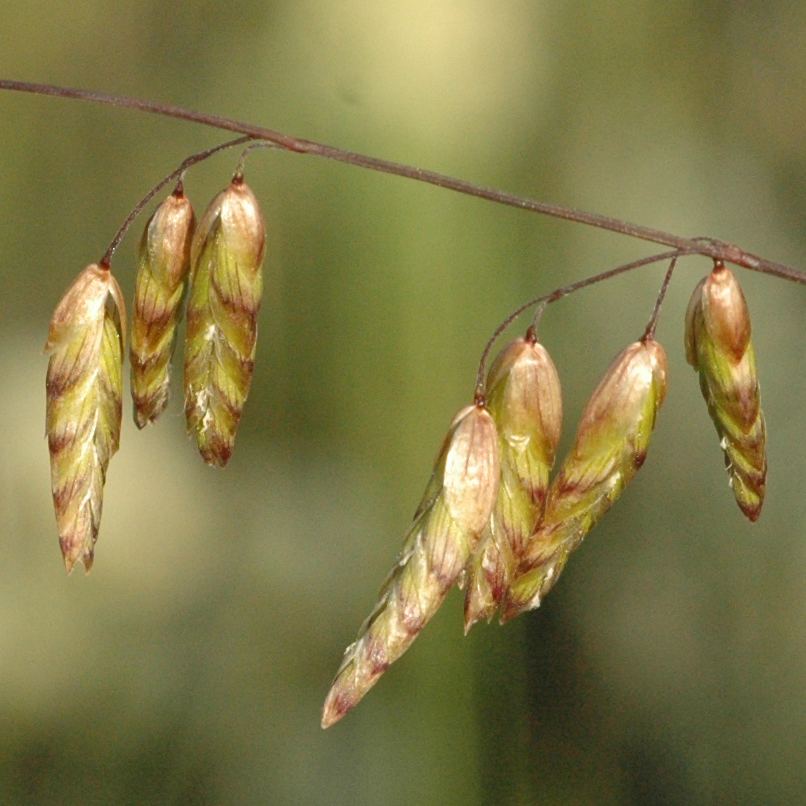 (Note all the grasses pictured above are in bloom)
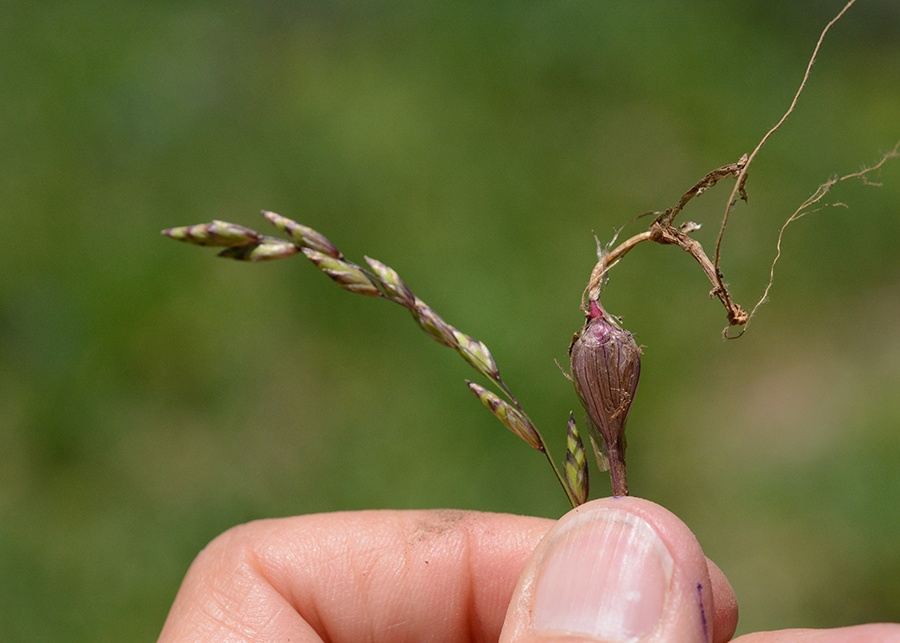 Grasses have evolved to sprout from buds at the base of their leaves – an adaptation to both browsing and fire.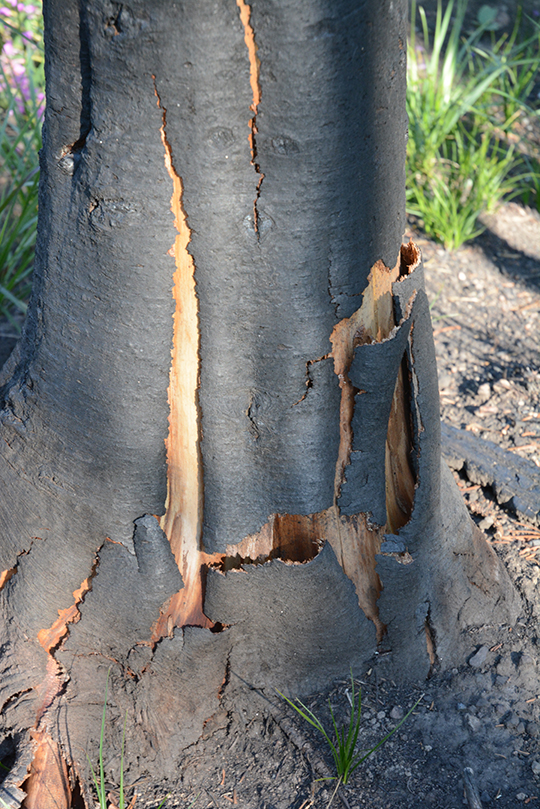
 Teton Plants