What’s in Fruit? – Late Summer 2025 – Part II: Dried Fruits:

Not all fruits are brightly colored and juicy. (see “What’s in Fruit? – Late Summer 2025 – Part 1: Fleshy Fruits”). Seeds have different strategies for dispersal: Flying off on the wind, hitching a ride on fur and clothing, using gravity to settle down, and/or being ejected away from their parent plant. Luck is an essential component of seed dispersal and success.

Here are some examples of dispersal strategies. Enjoy looking at the details of how plants work.

Fruits that Stick:

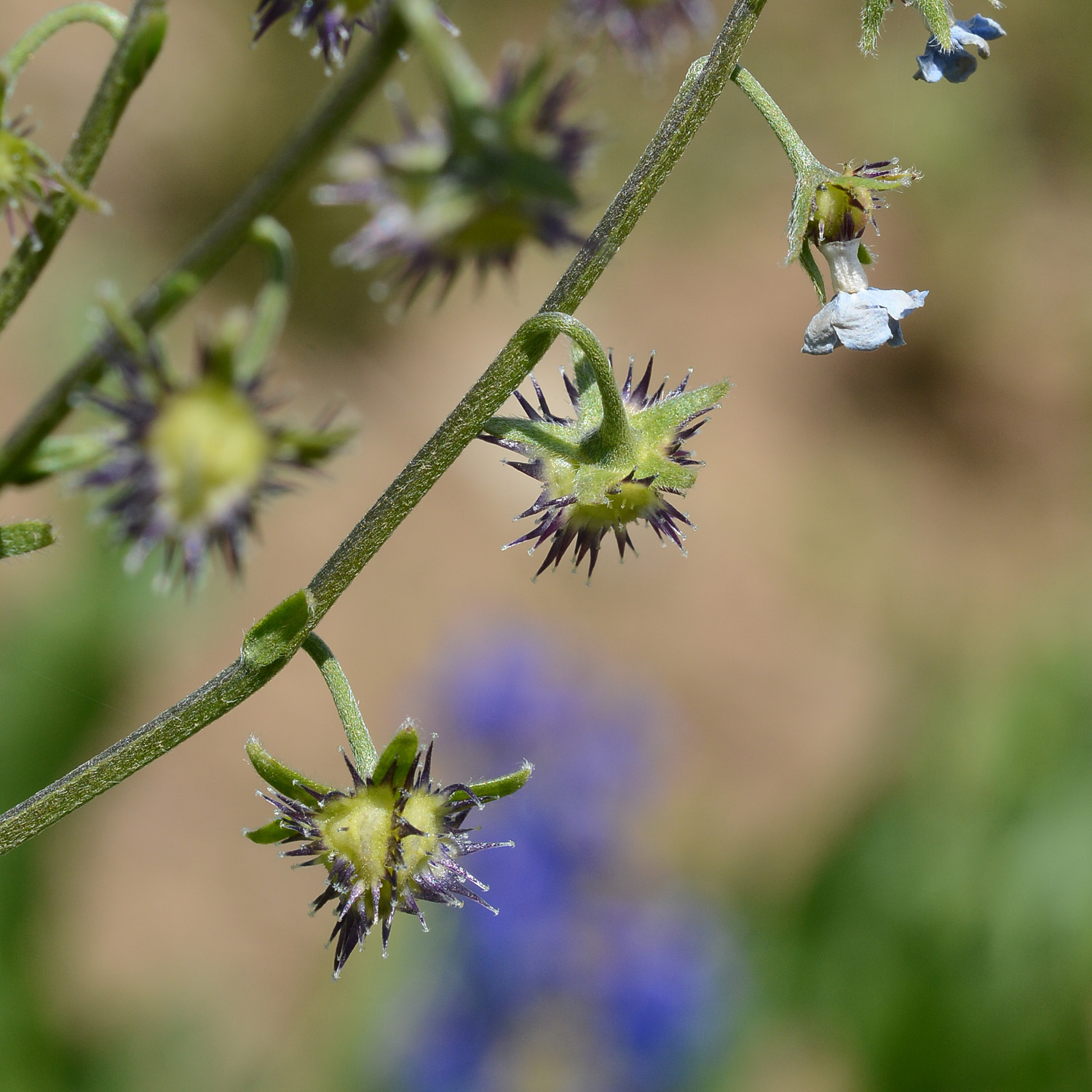
Some fruits have little hooks like velcro – the notorious invasive HoundstongueCynoglossum officinale – is one such species.

Yet, another is the pesky native appropriately called Jessica StickseedHackelia micrantha.

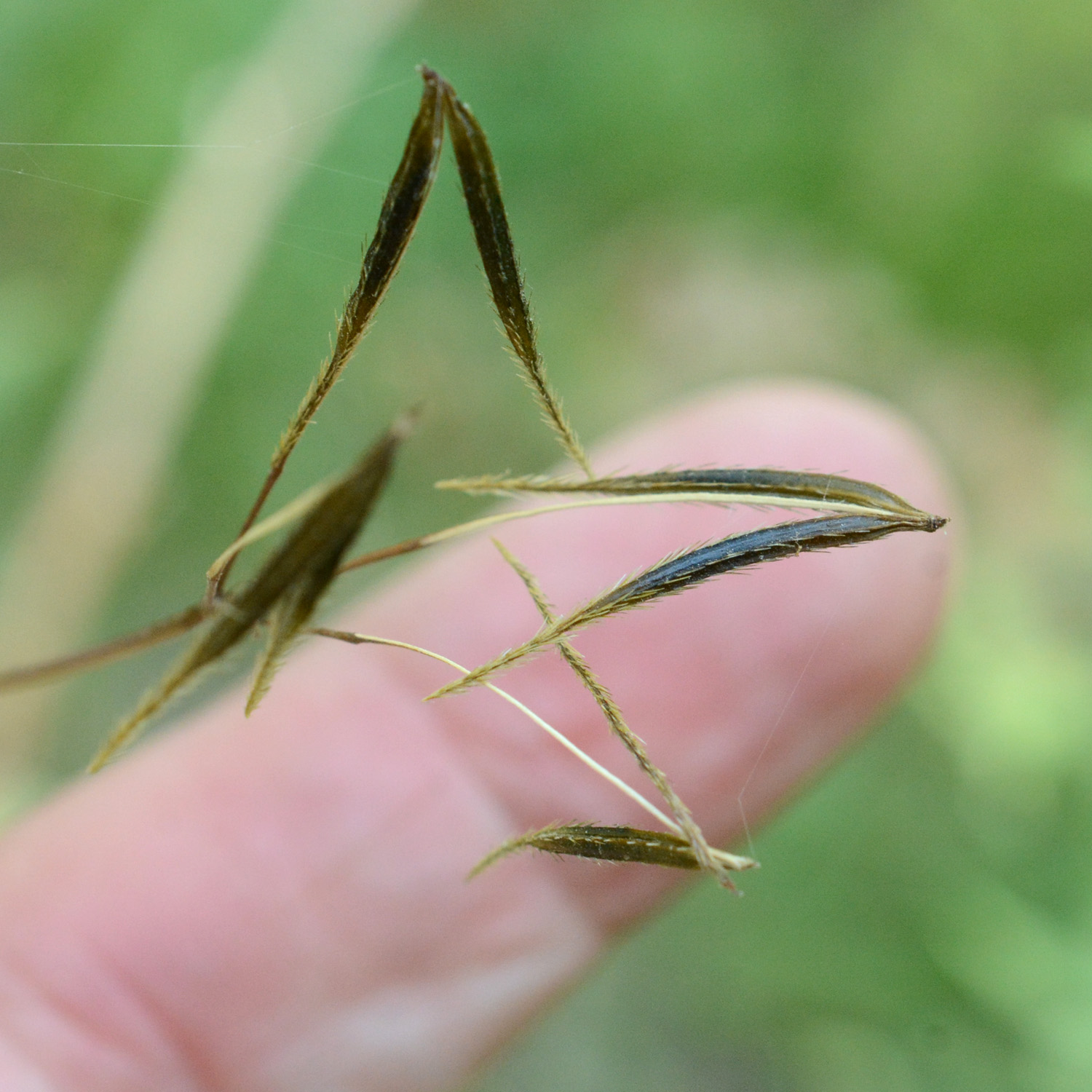
Sweet CicelyOsmorhiza chiliensis – fruits are called schizocarps e.g. split fruits. This is typical of the Parsley Family. In this woodland species, fruits are sharply pointed and have stiff hairs to stab and grab you.
Fly on Wings:

Related to Sweet Cicely above, is the very large Cow ParsnipHeracleum spondylium. It too has schizocarps held out in umbels – umbrella like structures. However, its schizocarps are flat and very thin so they skim off on the wind.
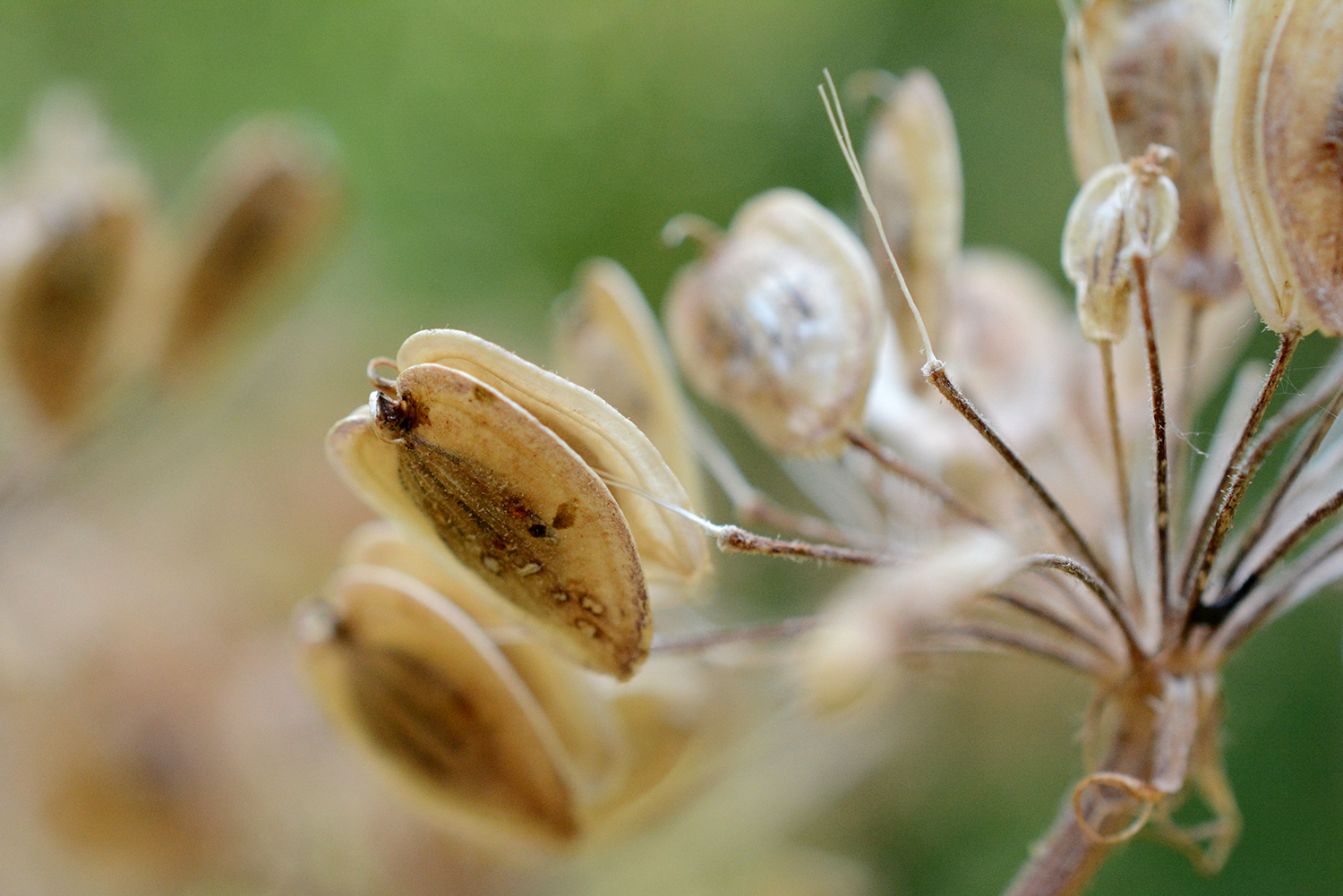
Upon a close look you can see how the two sides of the schizocarp are held together by a delicate filament. It is surprising how long these fruits will hang out there amidst the breezes. Also, note the darker seed inside inside each half. And to the upper right, you can see the left-over filaments–so very delicate looking, but sturdy.

Rocky Mountain MaplesAcer glabrum – have structures called samaras. The male flowers (below) are borne on separate tall shrubs (usually)
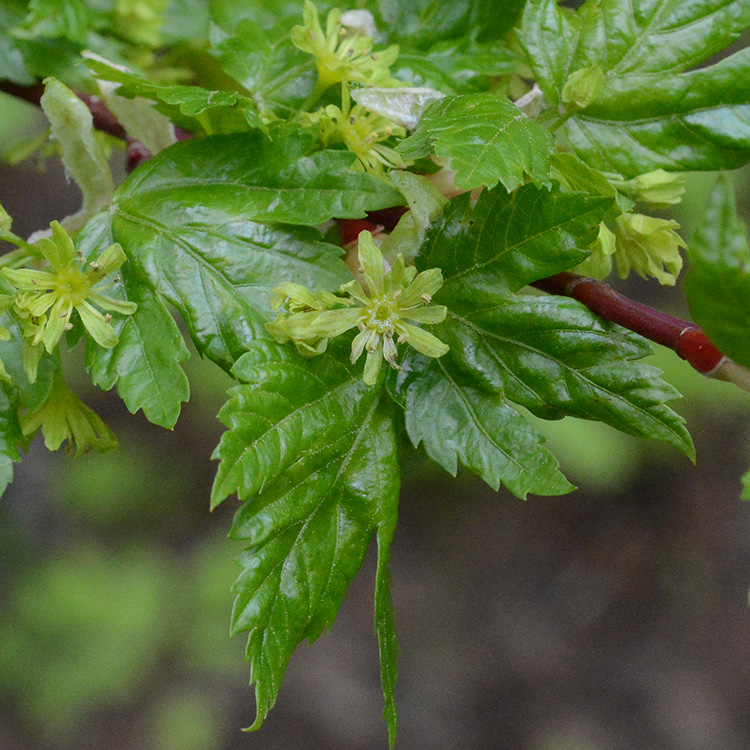
from those with female flowers. Below you can see the two-parted stigma of the female flower ready to receive pollen.
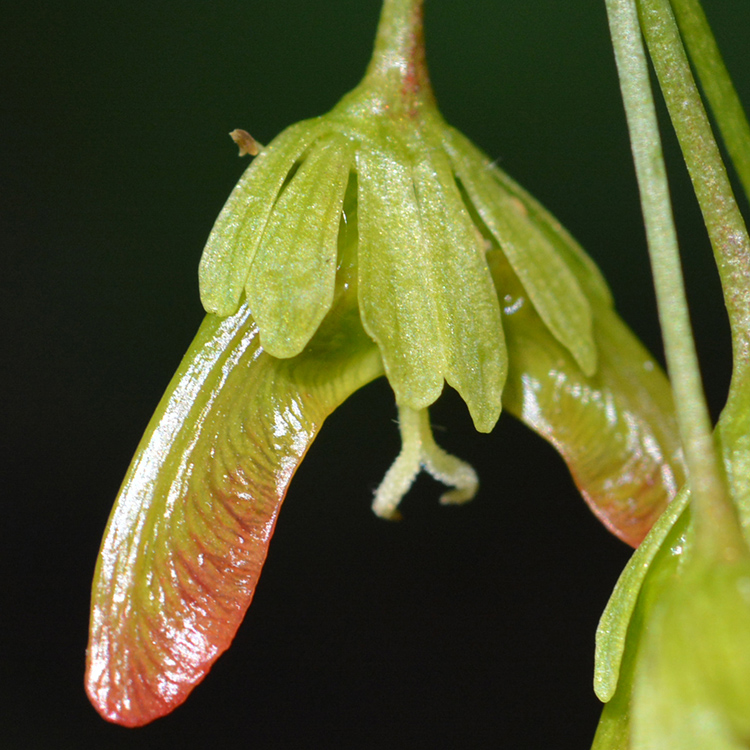
After the ovules are fertilized, the samara develops with two enclosed seeds, each with a wing derived from the ovary.
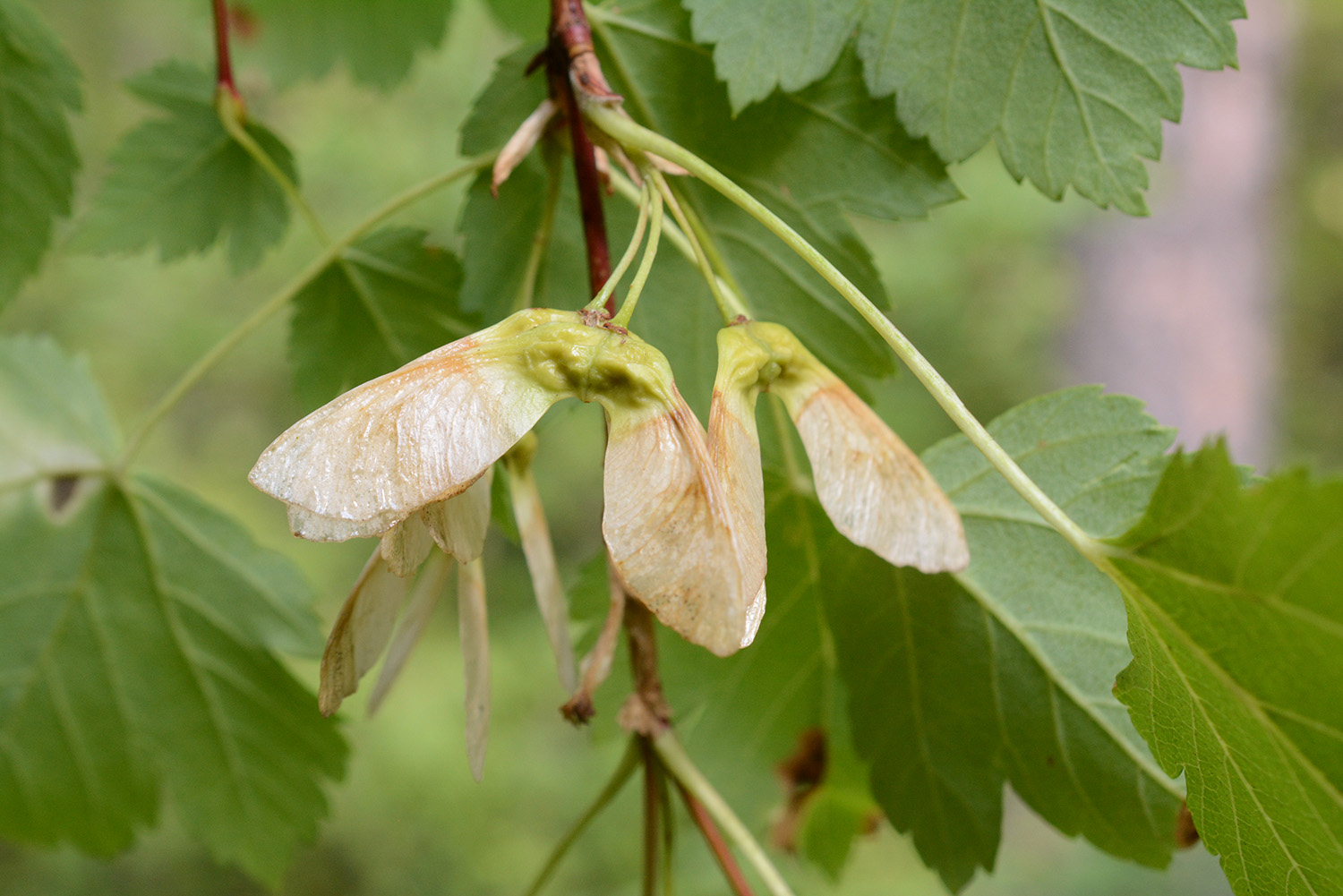
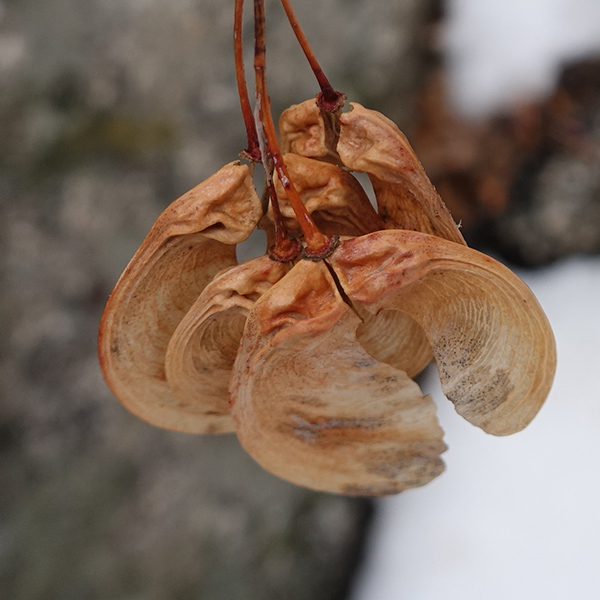
As children we used to watch the dried fruits break away from their branches and helicopter down to earth. Various birds particularly white-crowned sparrows and finches are known to eat the samaras, and moose, elk, mule deer browse heavily on maple shrubs.
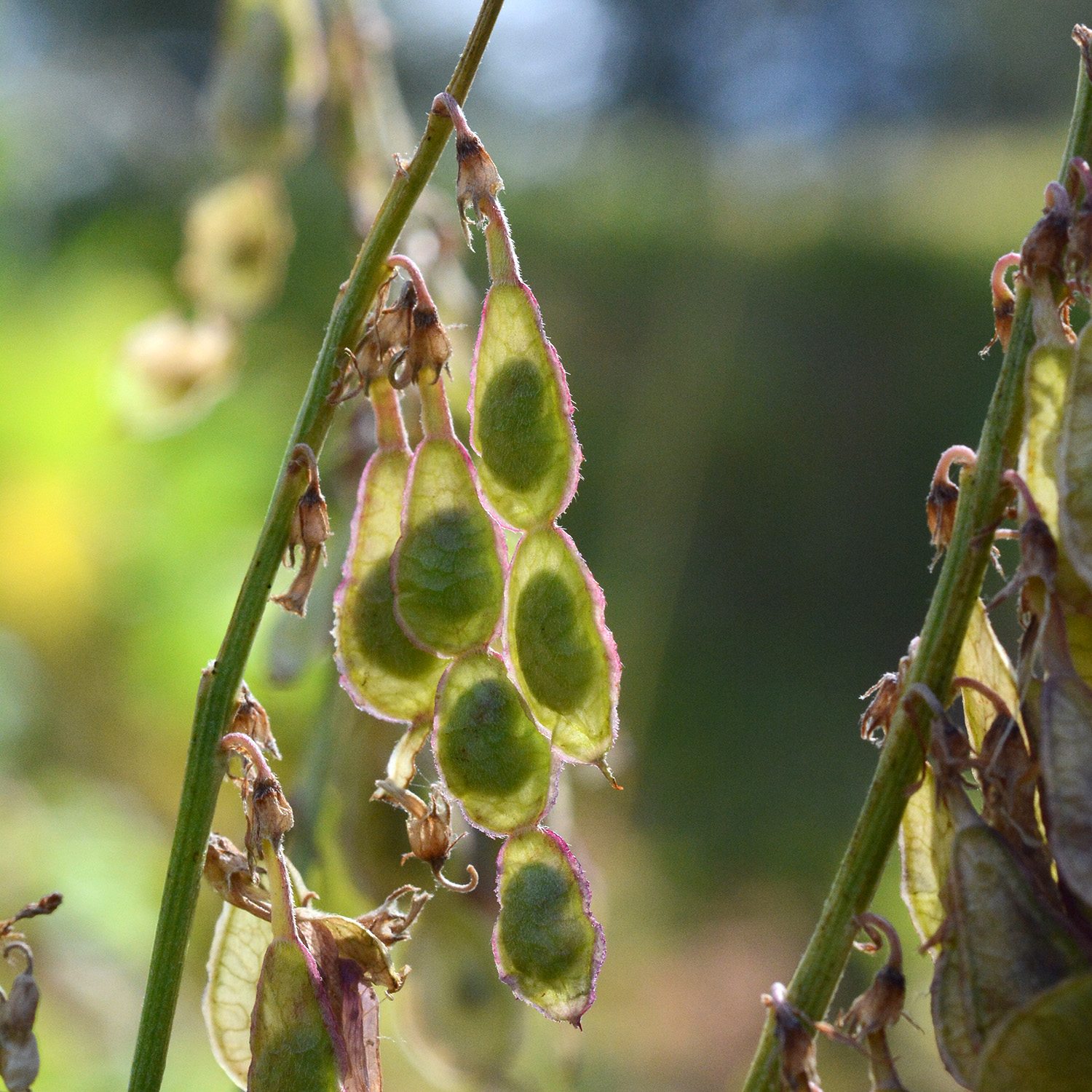
In the Legume or Pea Family, Western SweetvetchHedysarum occidentale – has flattened pods with segments called loments. When the loments dry, the segments break apart and are free to fly – like frisbees on the wind. You can see the silhouettes of the bean-shaped seeds within sections of the loment fruit.
Fly on Fluff

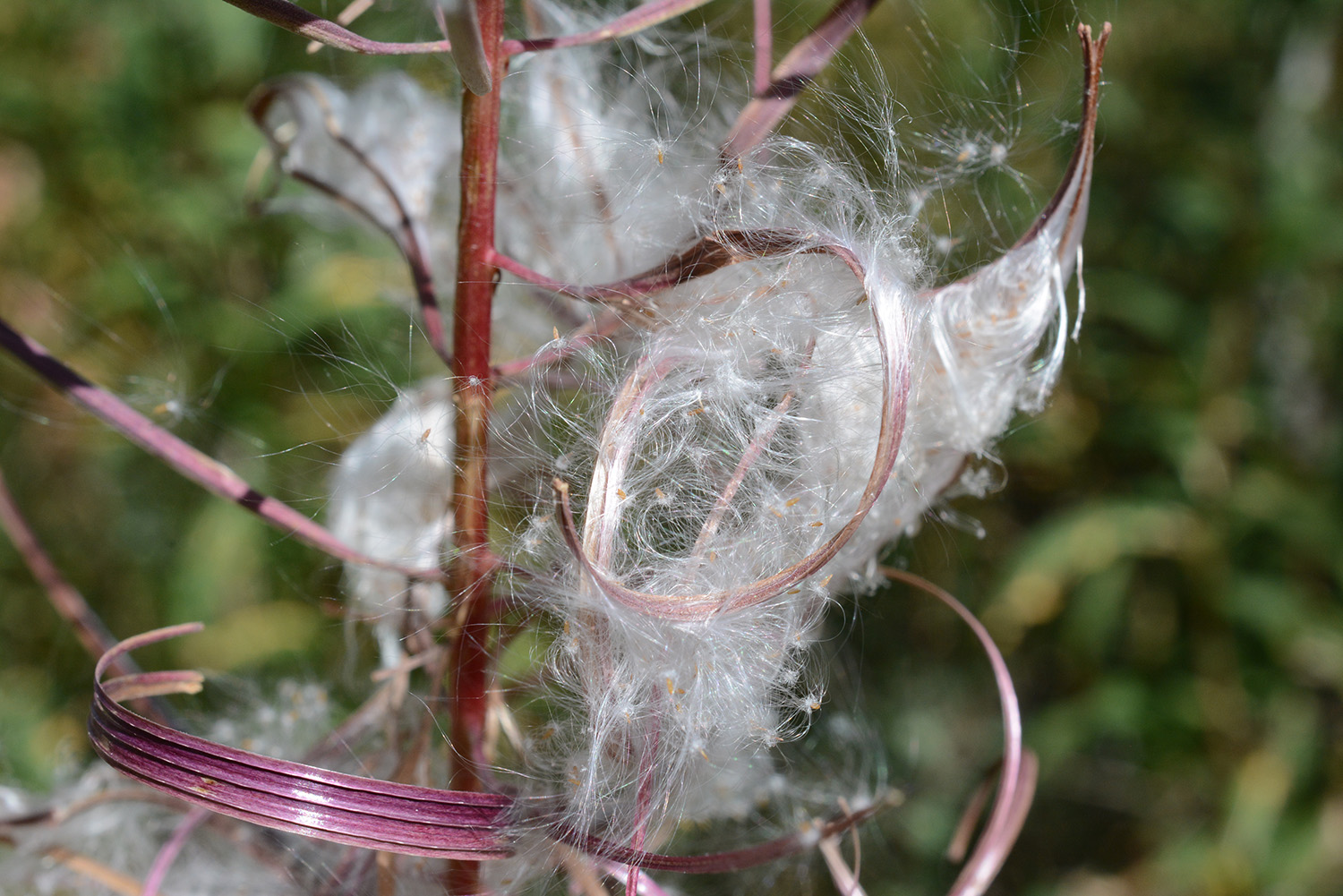
Spires of fireweed are spectacular at this time of year with their long seed pods splitting, curling, and releasing 100s of seeds upon the breeze. Each seed has a bit of fluff – non-technical term – at the tip.
You may perhaps come across the twining Western Blue Virgin’s BowerClematis occidentalis. Growing primarily in the shade, it is a woody vine with 3-parted leaves.
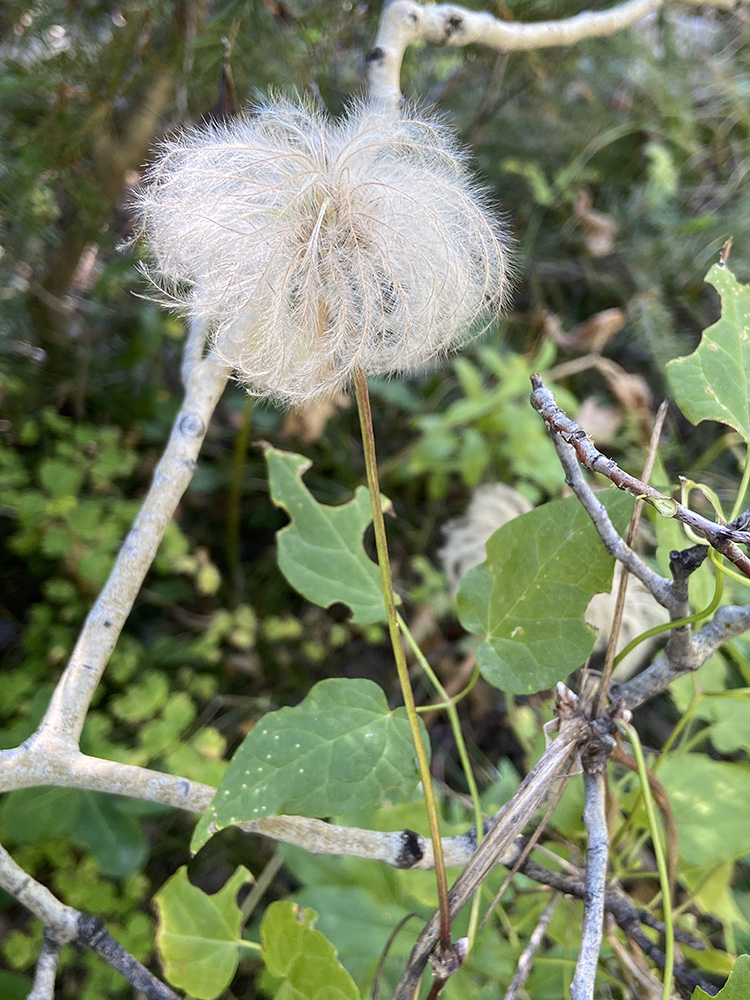
The individual fruits are derived from individual pistils/carpels typical of the Buttercup Family. Fruits – technically achenes – have one seed inside and are covered in long hairs. The wind will help pry the seeds form the tangle and fly off free.

The Aster Family, covered in the last “What’s in bloom – mid August 2025”, produces fruits termed cypselas (vs. achenes) that are formed from the inferior ovary of each tiny flower. Each flower produces only one seed. Many have a pappus of fine hairs (e.g. fluff) that carries the fruits off on the wind. 

Hairy False Golden AsterHeterotheca villosa – has hairy cypselas each with a pappus of fine hairs at the top. Note there are many fruits on the platform, typical of the Aster/Composite Family.

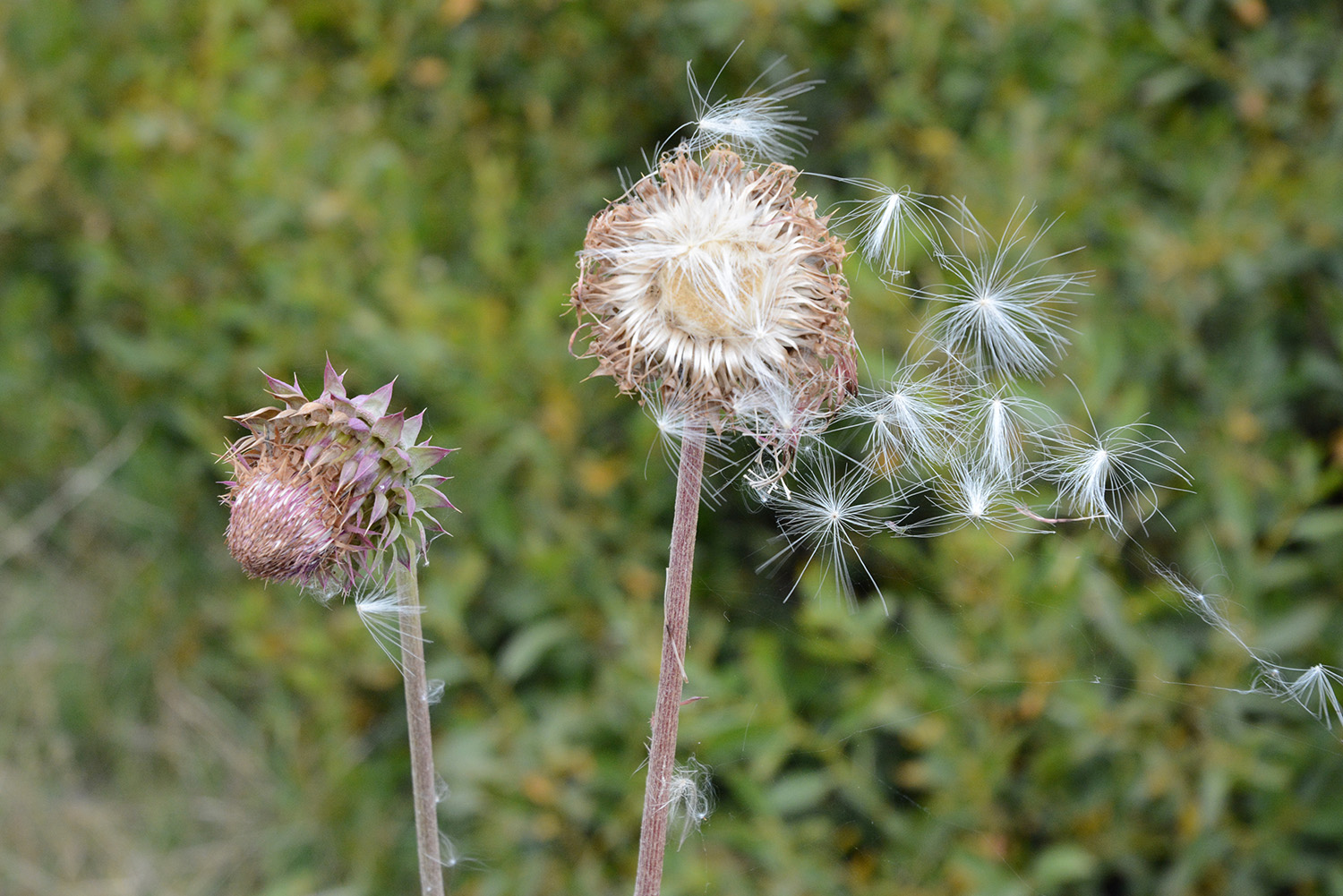
Dandelions, asters, goldenrods, rabbitbrushes and many more have this method of dispersal, including the highly invasive Musk ThistleCarduus nutans.

Habitat Heroes, trained and organized by the Teton County Weed and Pest – Meta Dittmer – and TC Conservation District – Morgan Graham, have in deed done heroic work clearing out thistles up Game Creek and other areas around the valley. More volunteers welcome! Contact Meta Dittmer.

Growing amidst mountain sagebrush and rabbitbushes in dry habitats, 1-2′ shrubs of Spineless HorsebrushTetradymia canescens – stand out at this time of year. They have silvery pubescent stems and leaves topped by plumose heads of
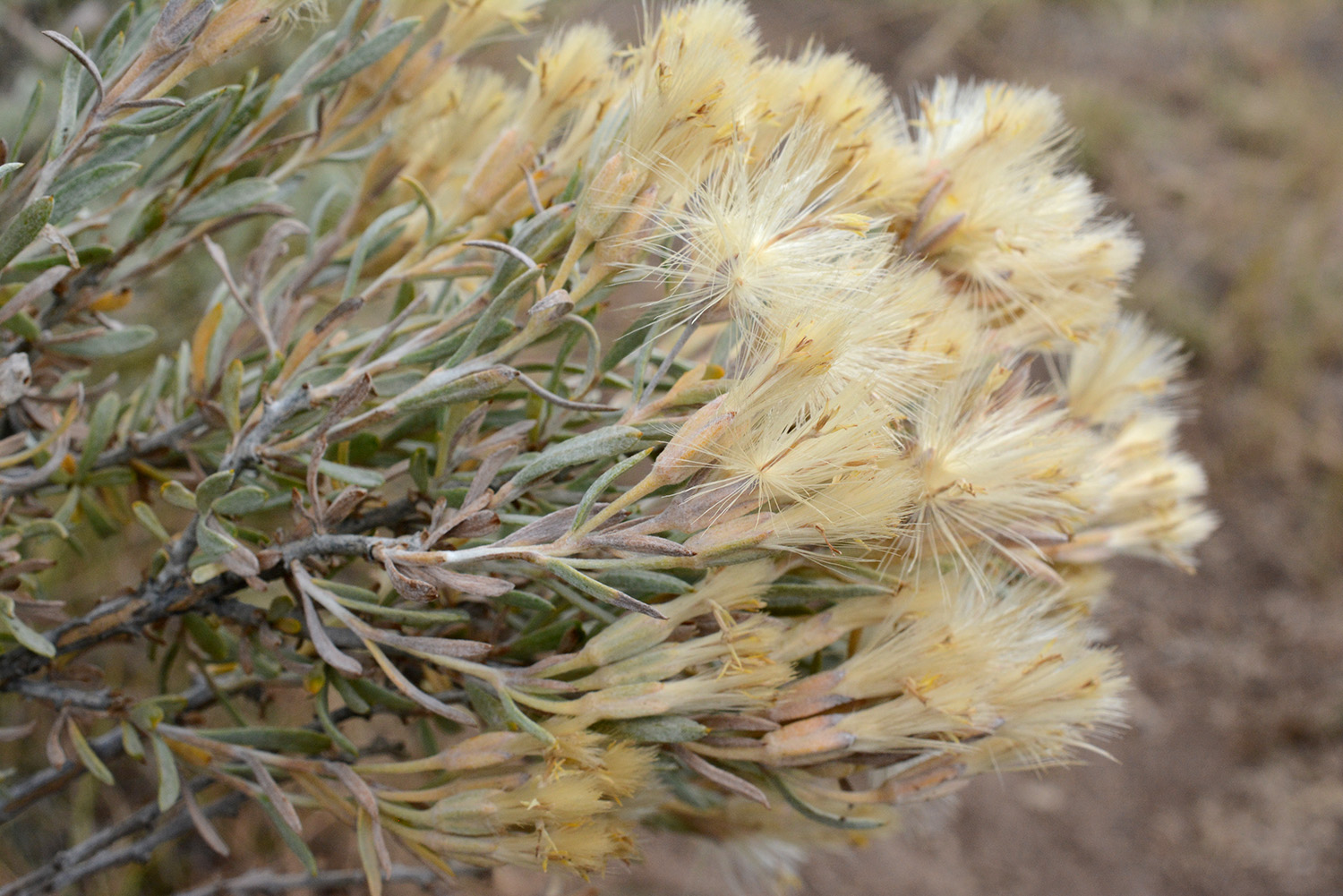
cypselas covered in fine long hairs. These fruits are dispersed on the wind.
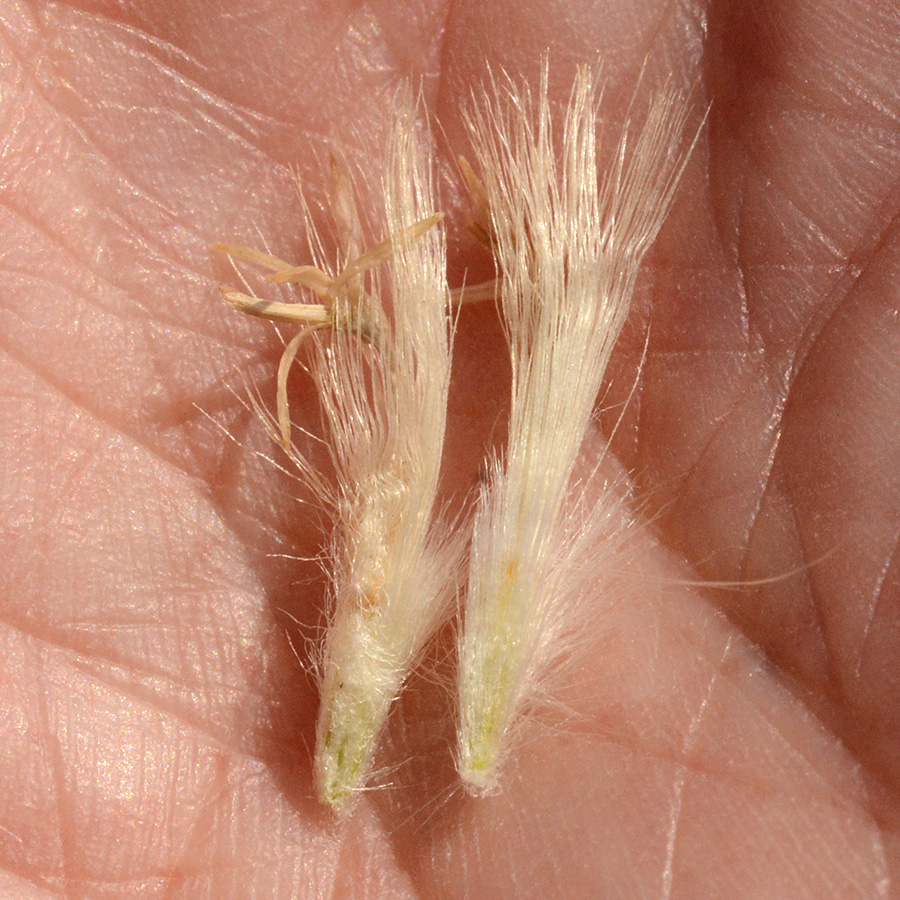
It is fun to pull out the handlens and see the variation in the cypselas: look at the pappus and other coverings of the fruits of the Aster Family. These details help taxonomists determine the different species of this world-wide family–the largest plant family on Earth except perhaps the Orchid Family.

Birds and Gravity (pluck and drop)

Other composite fruits have scale-like projections at the top of each cypsela. Its not clear whether this helps the cypsela hitchhike on passers-by or perhaps to deter marauders from getting to the tender fruits below. Five-nerved Little-sunflowersHelianthella quinquenerva – is an interesting example.
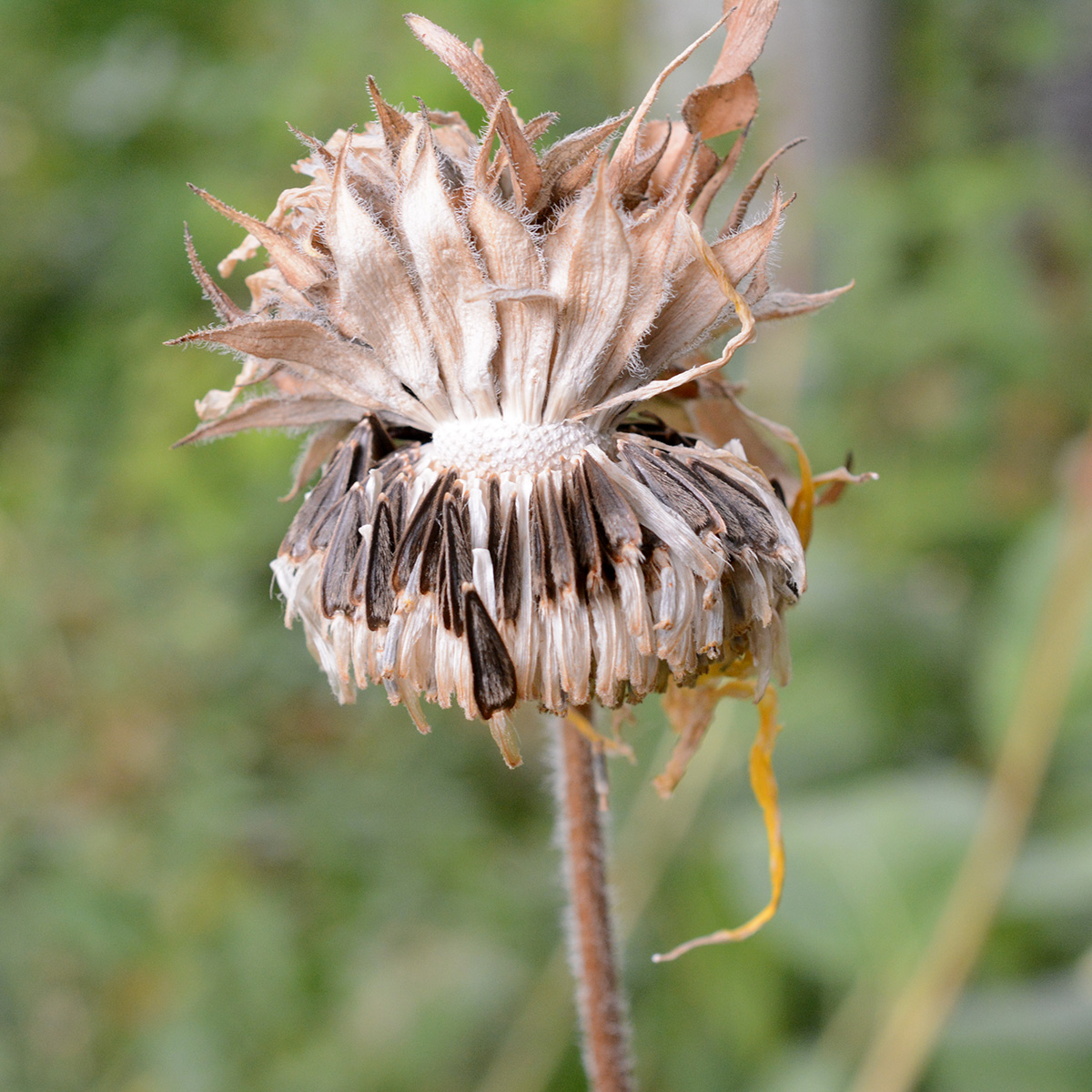
The cypselas are dark with a bit of a brush at the tips (technically a pappus of the non-fluff style). The lighter, flimsier, scale-like structures surrounding them are technically called paleae (palea singular), and are not part of the fruit itself. In this case, the paleae likely serve as barricades to insects wanting to eat the nutritious seeds.

Other cypselas nestle deep inside stiff, sharp paleae as seen in Arrowleaf BalsamrootsBalsamorhiza sagittata. Look closely in the center and you will see the squarish-shaped tops of the cypselas. The sharp dividers are the paleae.
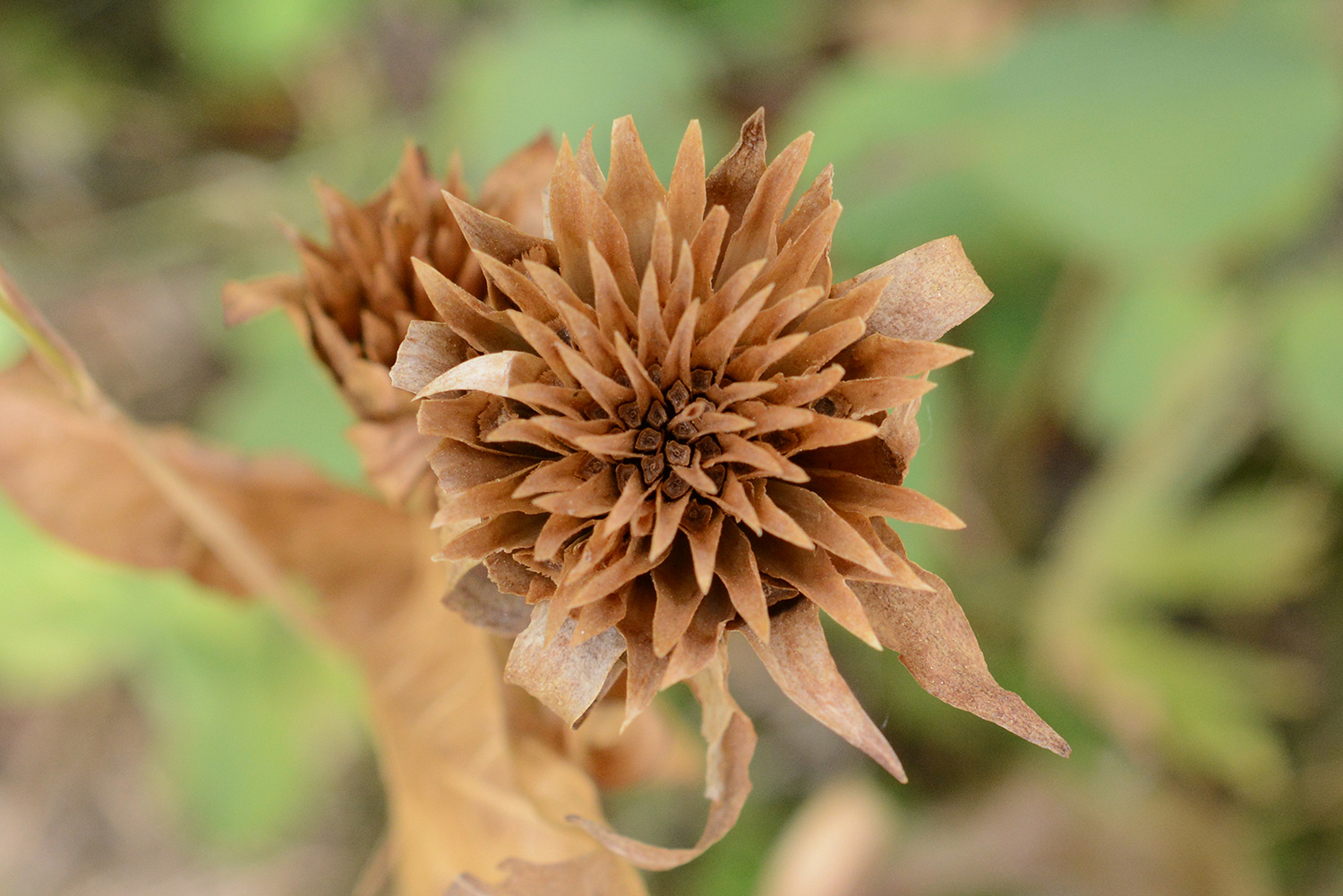
Being able to separate the fruits from the paleae is helpful when collecting seeds for restoration projects, as do the Grand Teton National Park volunteers. These Seed Heroes, led by Jasmine Cutter, have been harvesting these and other seed this summer for habitat restoration. If you wish to volunteer, contact Jasmine Cutter:
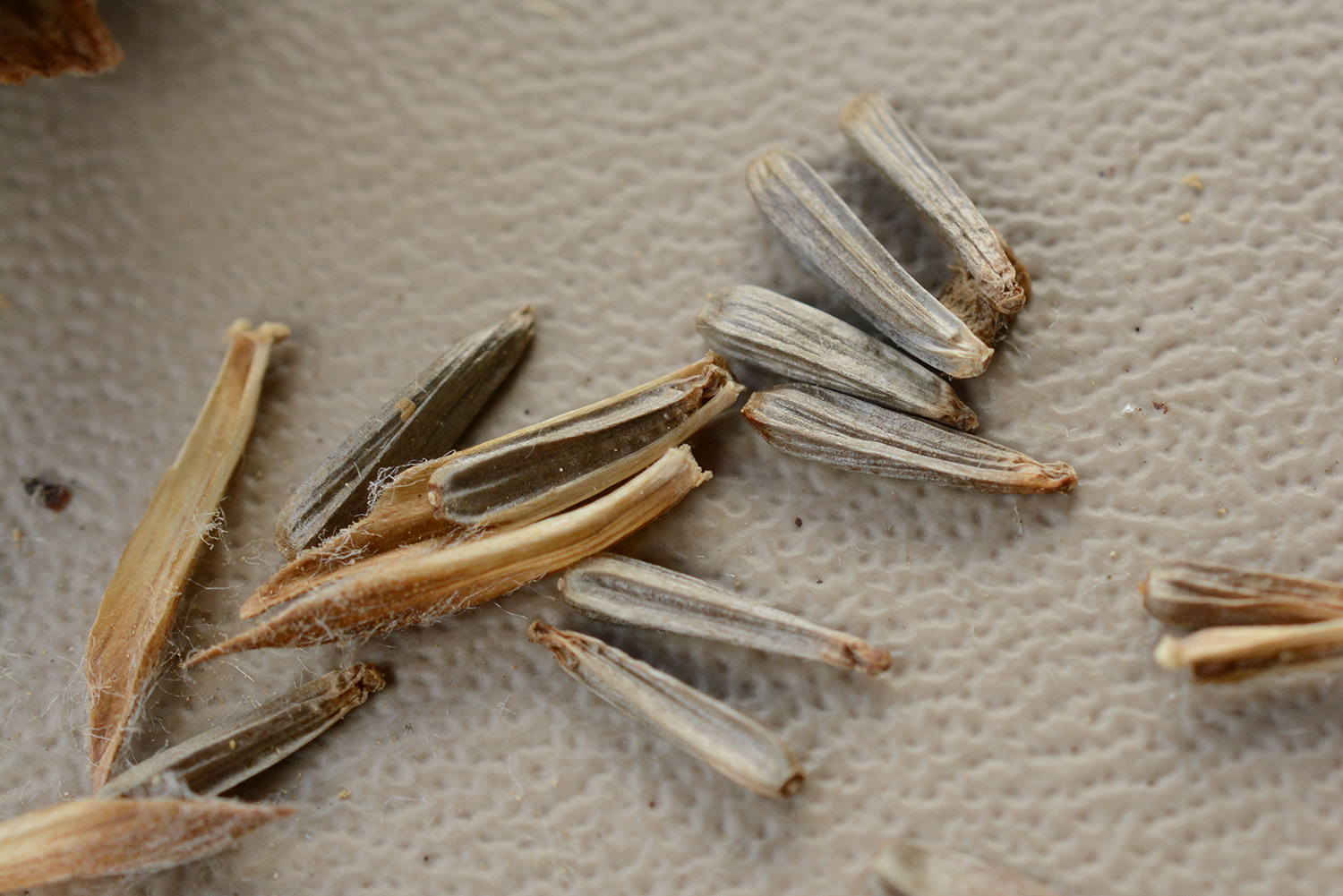
These types of fruits are often plucked out by birds, shaken out by wind, or just dropped when the heads fall apart.  

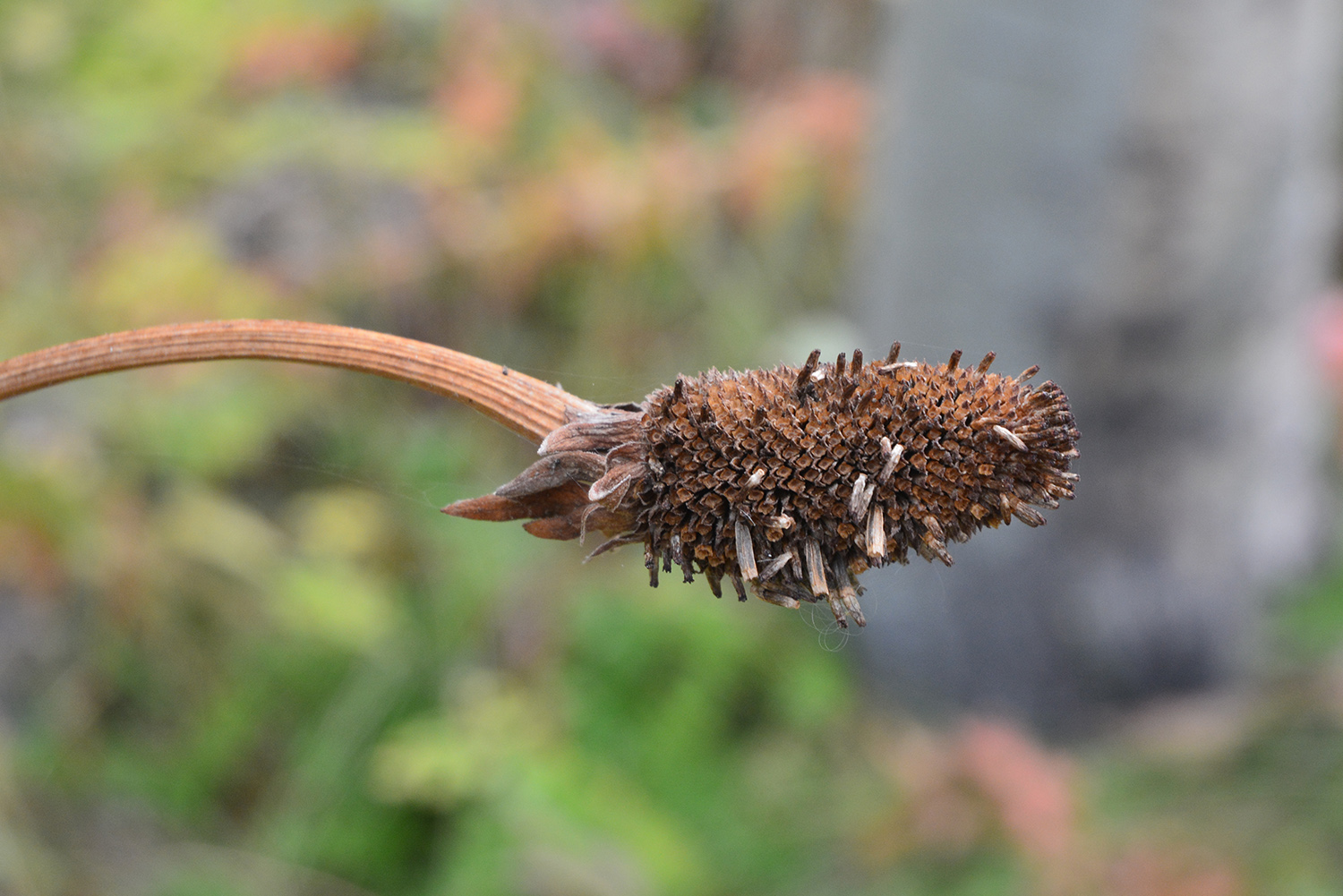
Fruits of Western or Rayless Coneflower  – Rudbeckia occidentale – sit up on the cone-like central platform – receptacle – and are distributed by birds and gravity. Interestingly, it appears that the short, tough, paleae hold the fruits in place.
Shake Outs:

Some dried fruits split open and shake out the seeds, often over time. Landing at different intervals helps increase chances of success, depending on the seed’s germination needs regarding moisture and timing.

Look for Lewis’ flax –  Linum lewisii – where the capsules split apart.
MonkshoodAconitum columbianum – have smooth follicles that gradually split open and shake out tiny rough seeds.
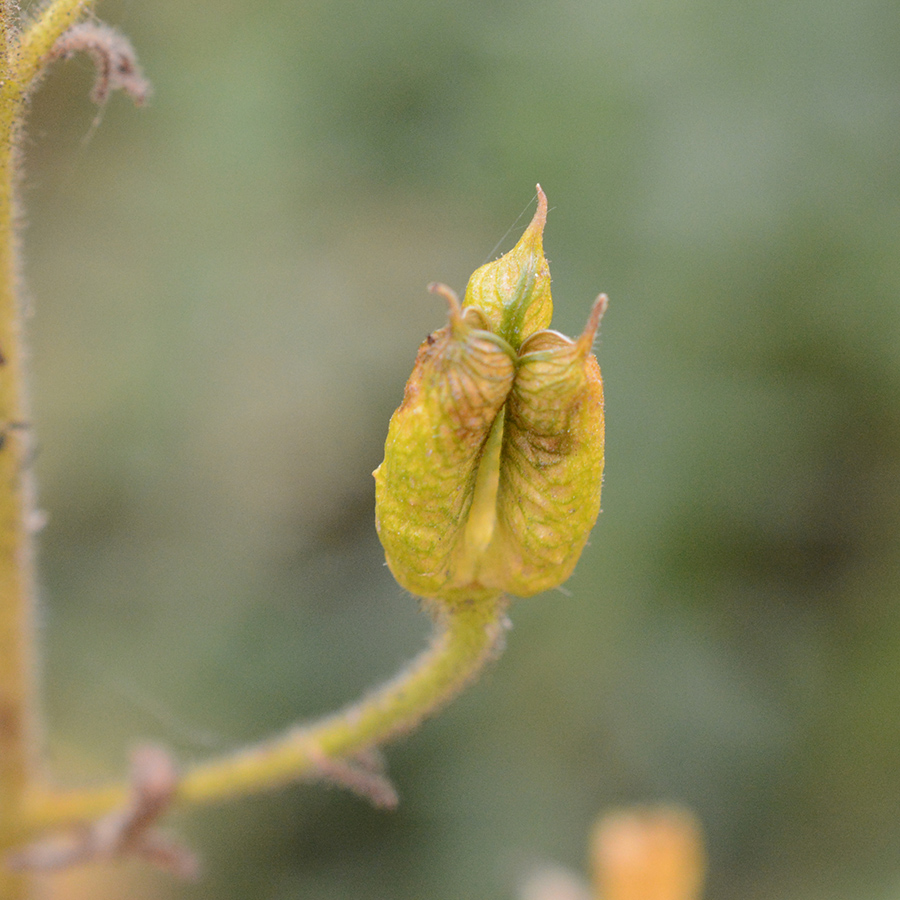
They look very similar to the fruits their relative Tall Delphinium/Larkspur Delphinium occidentale – except Monkshood fruits are smooth on hairy stems. Larkspur fruits are finely hairy,
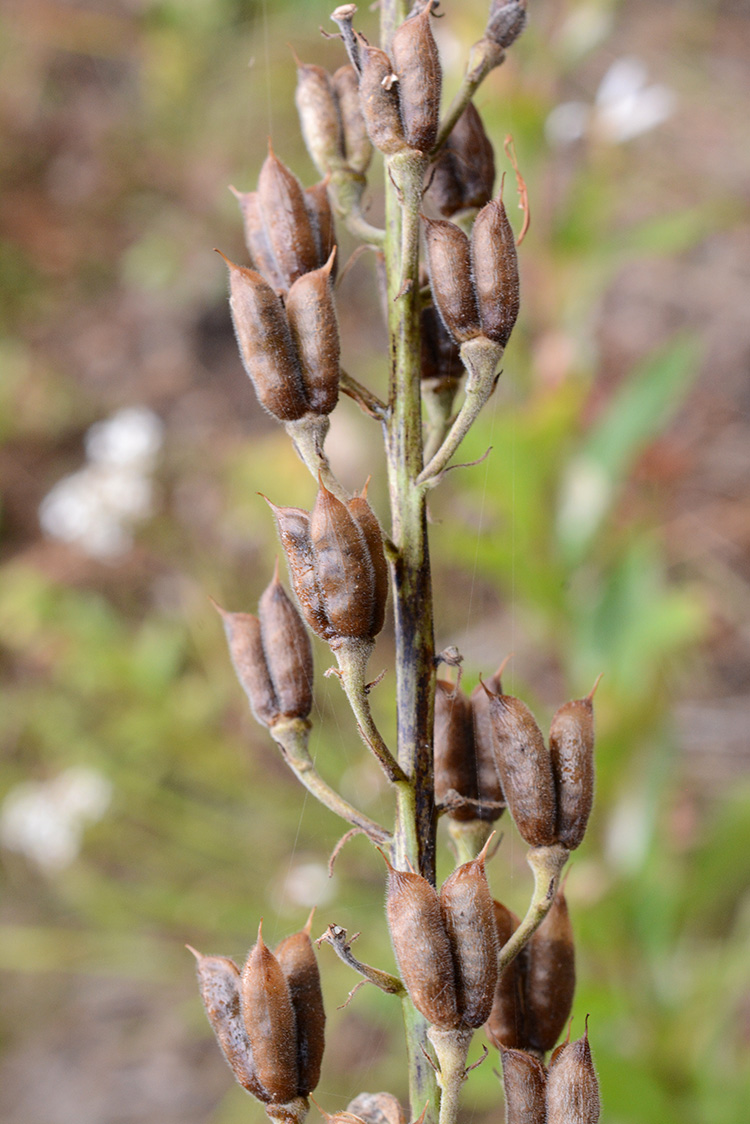
and the stems are smooth with a bluish-gray covering that can be rubbed off (glaucous) and the lobed leaves are stalked.

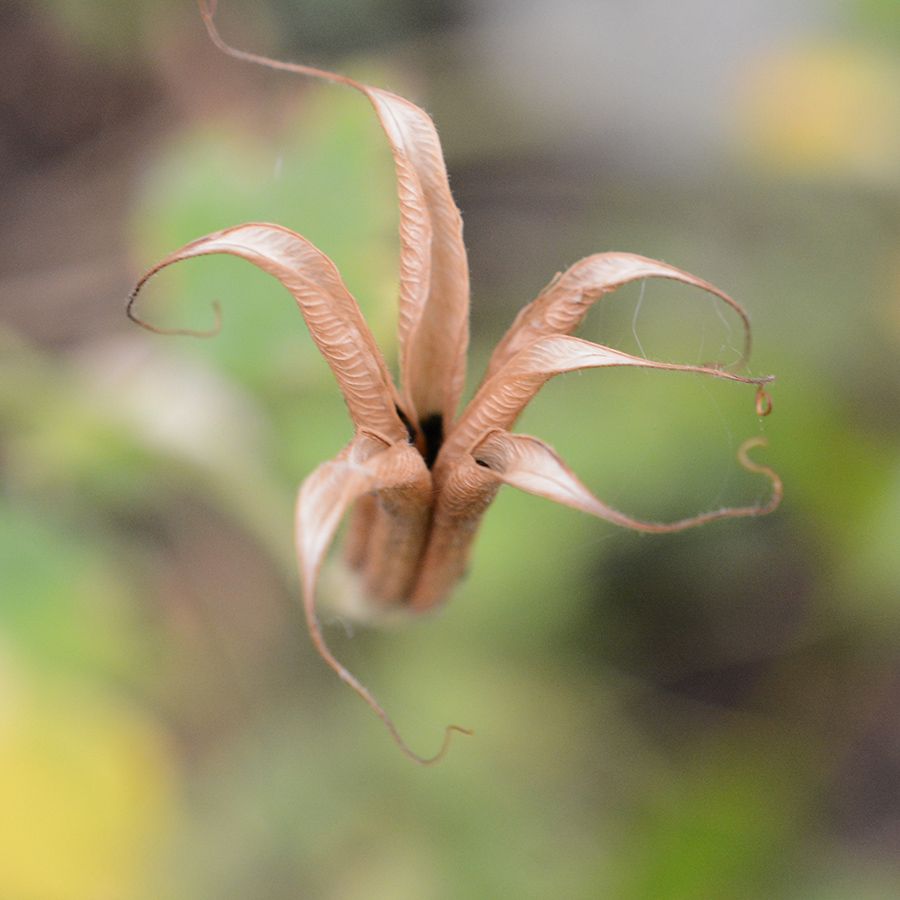
Also in the Buttercup Family, Colorado ColumbineAquilegia coerulea – have three-parted dry fruits with seeds inside.
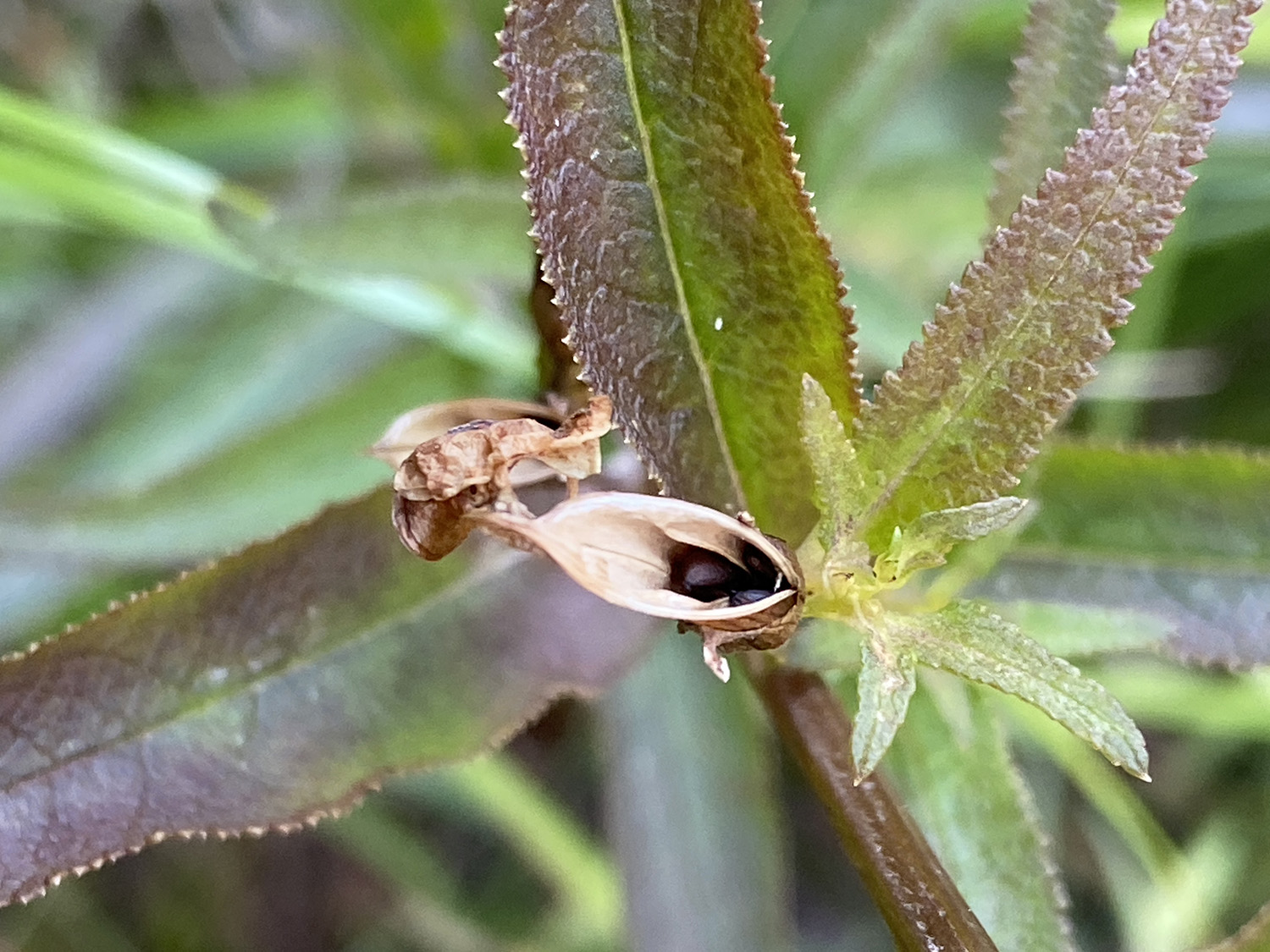
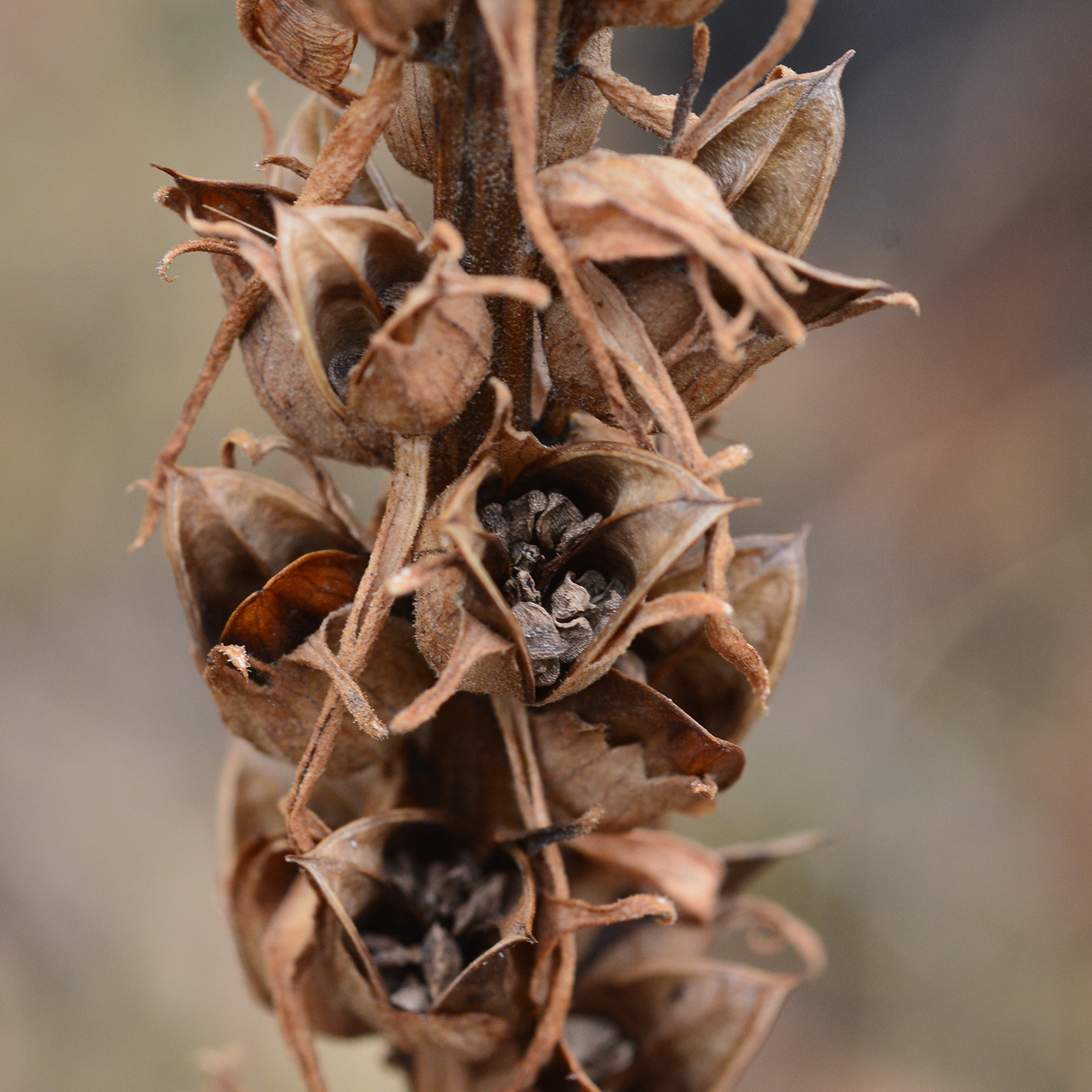
The mouth-like dried fruits of LousewortsPedicularis spp. – release seeds a few at a time. Below is Large LousewortP. procera – seen around Wally’s World and Game Creek. Look for other Lousewort fruits, as well.
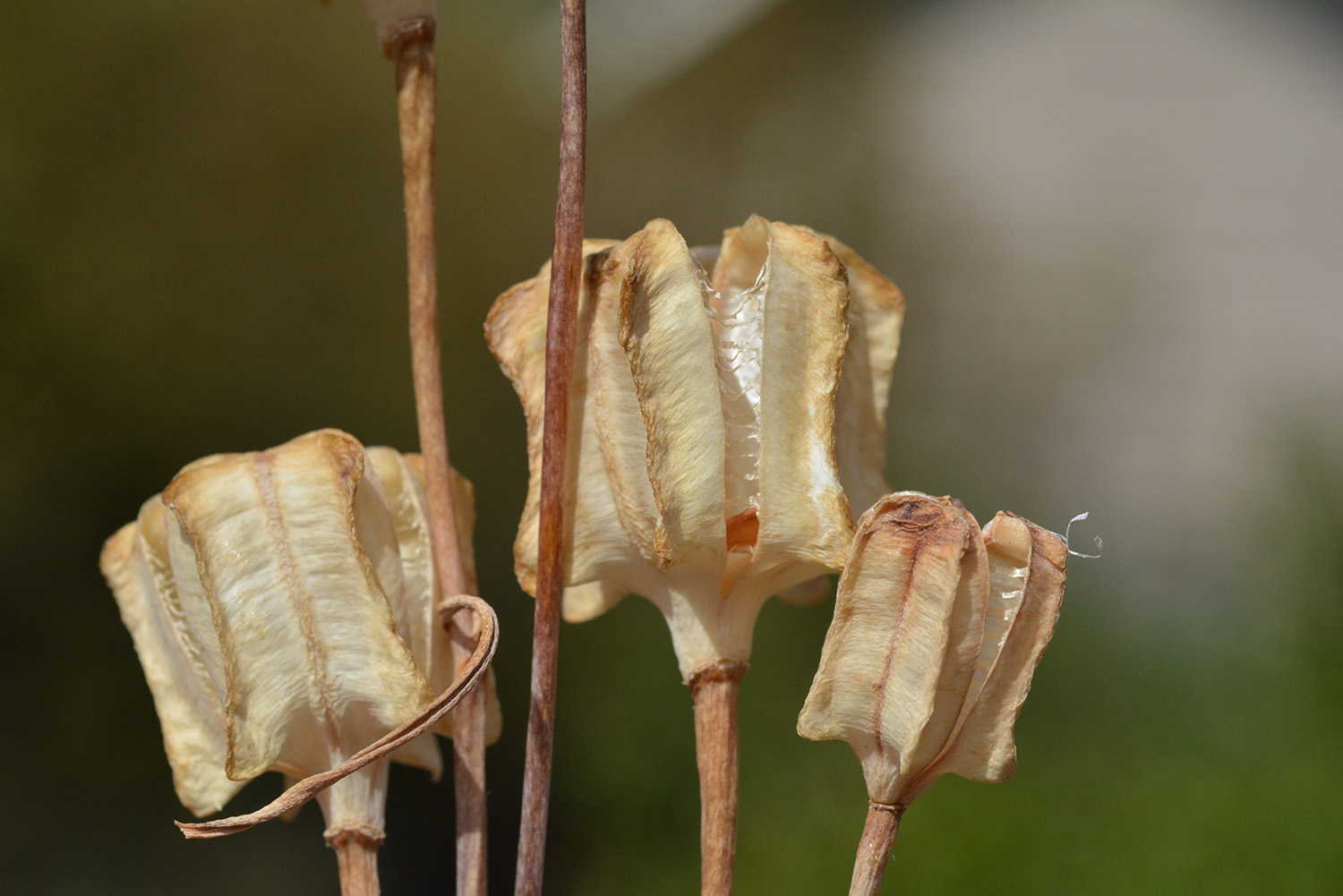
Leopard LilyFritillaria atropurpurea – are clearly seed shakers.
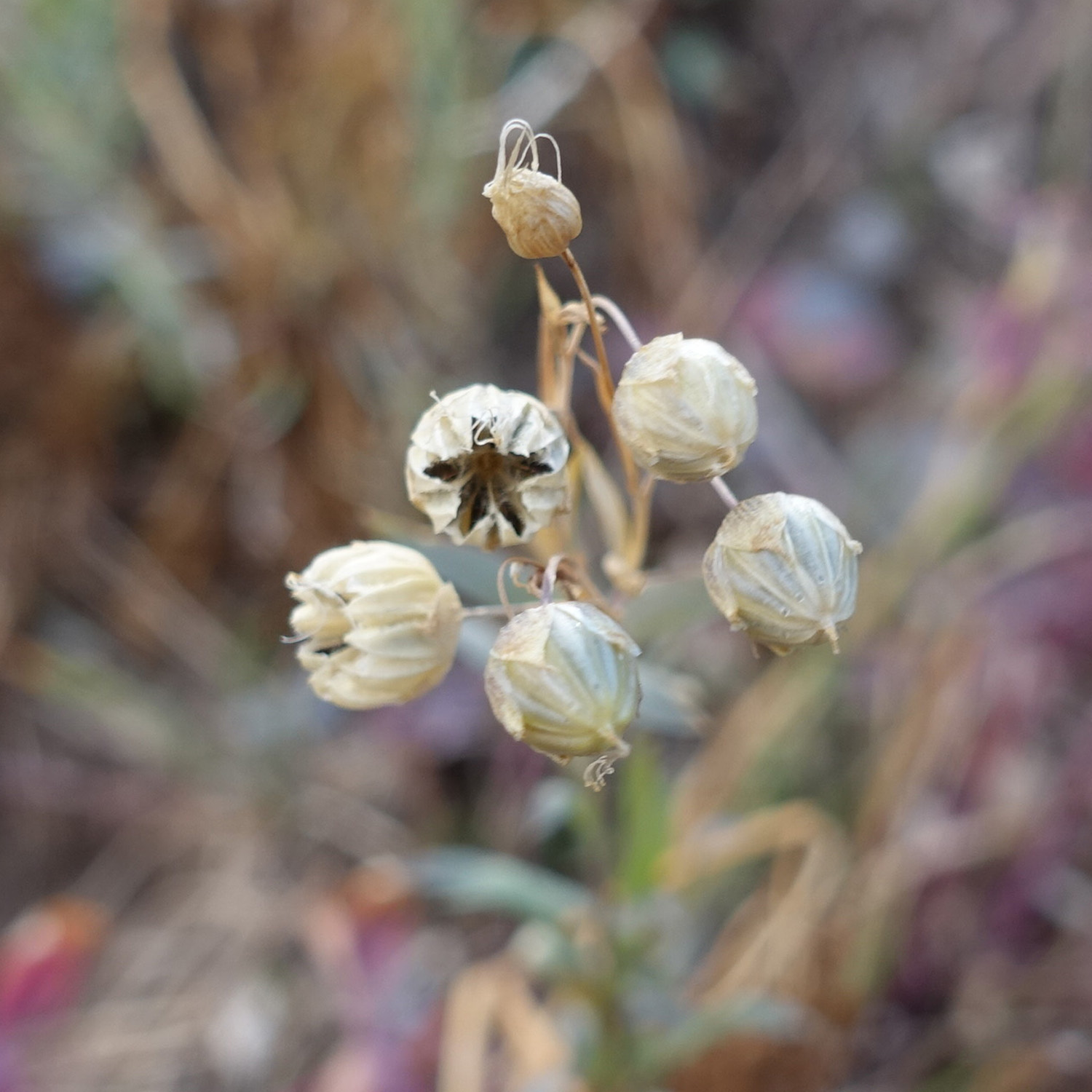
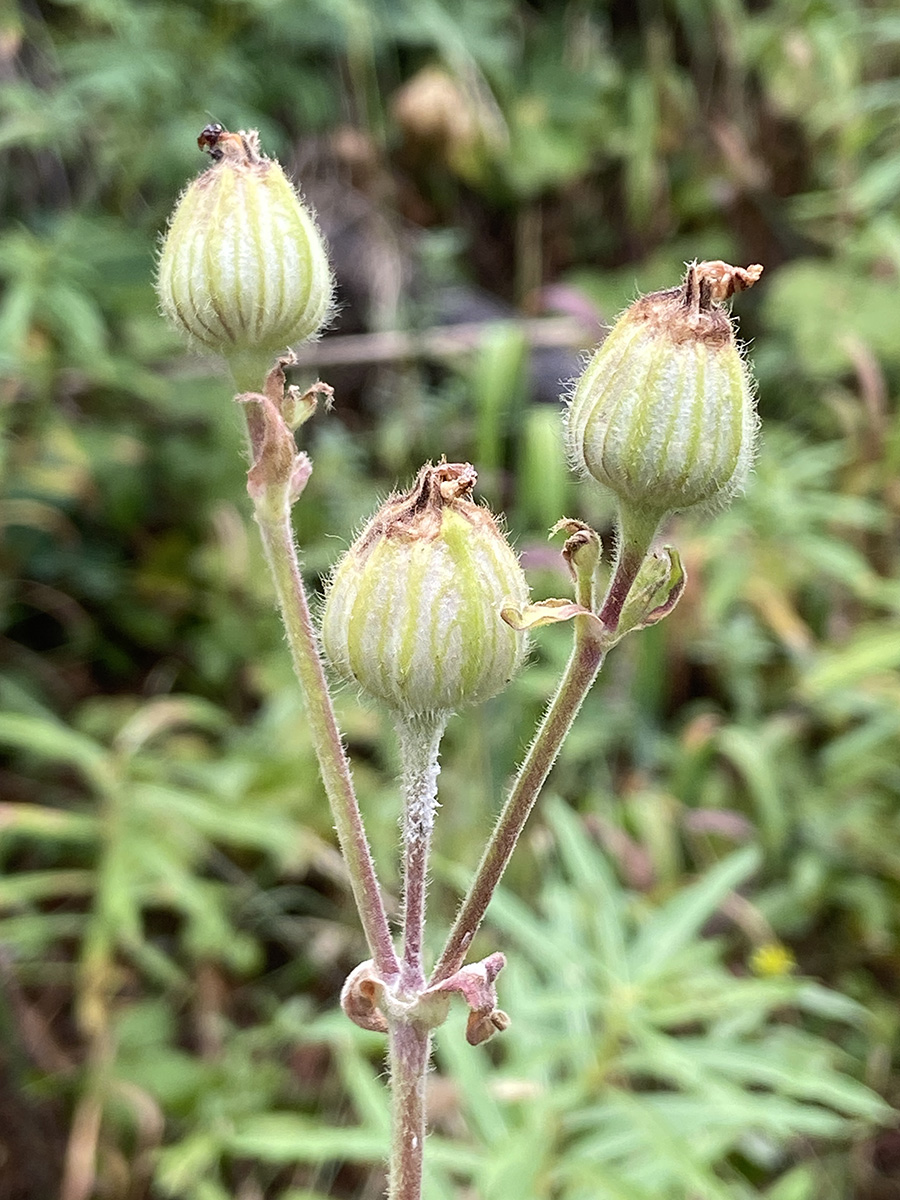
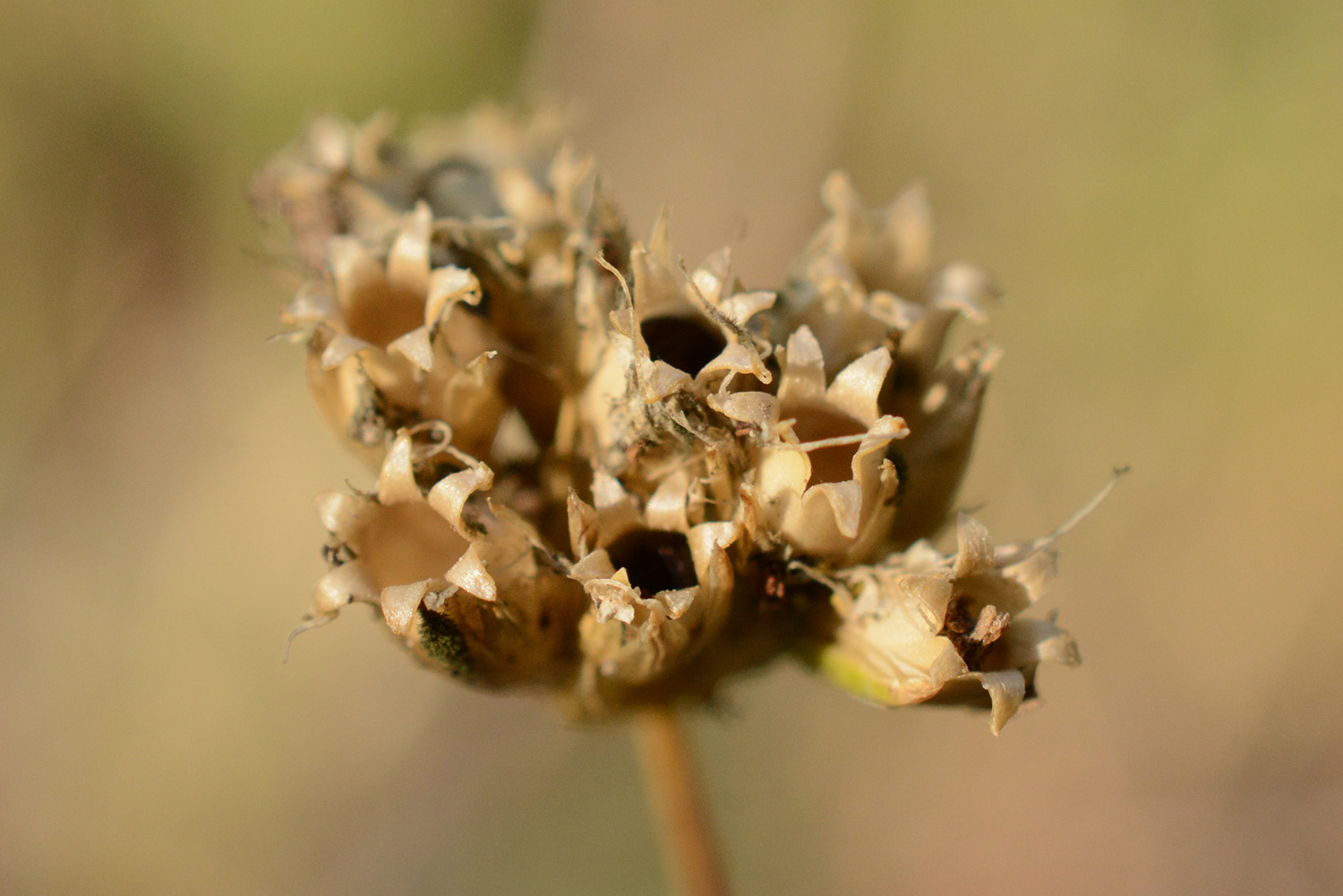
Below is the globe-like, dry fruit of non-native White Campion Silene latifolia. White Campions have separate male and female plants.
The dried petals and firm ovary form an elegant cup

that shakes out seeds.

As these plants are primarily annuals, they depend on these seeds for their future.

You can see the resemblance to its much smaller native relative Ballhead SandwortEremogone congesta, also in the Pink or Caryophyllaceae Family. Both flowers and fruits provide details of family connections.
A couple more to look for:

Orchids, such as this CoralrootCorallorhiza spp. – have dust like seeds easily scattered by the lightest breeze.

Orchid seeds rely on mycorrhizal fungi to nurture the the embryo. As this genus does not have chlorophyll, it also depends on different mycorrhizae to support adult plants.

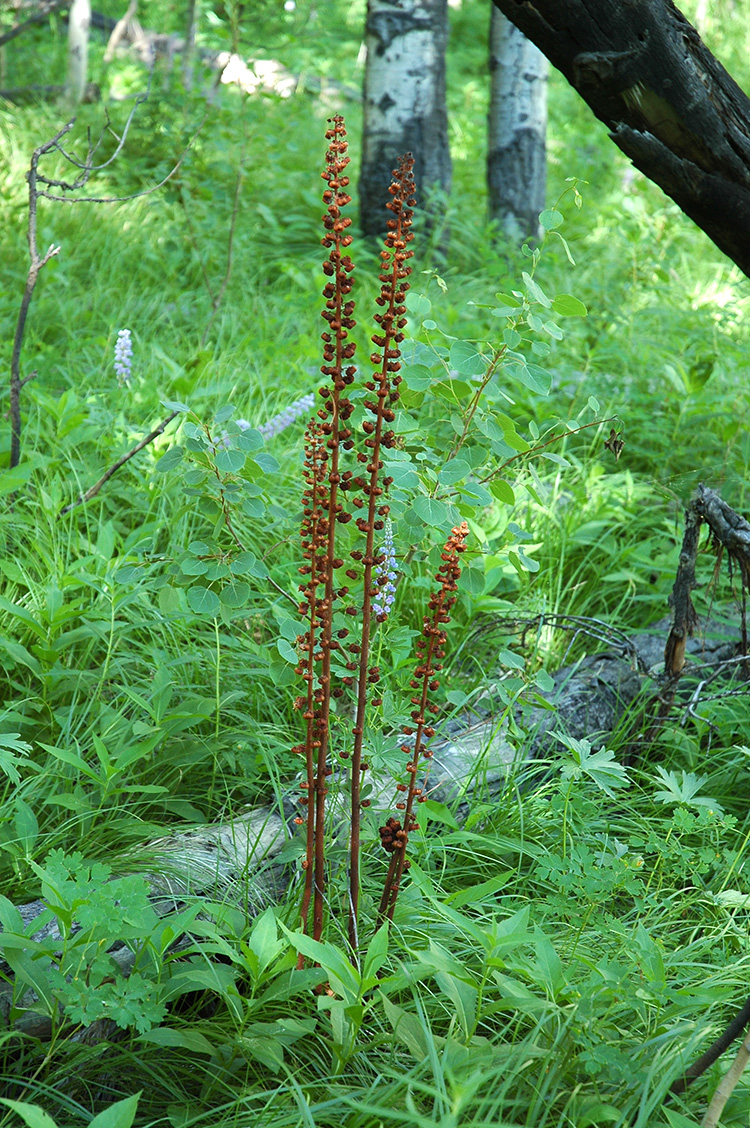
Dried fruits of PinedropsPterospora andromedea – slowly break apart and release
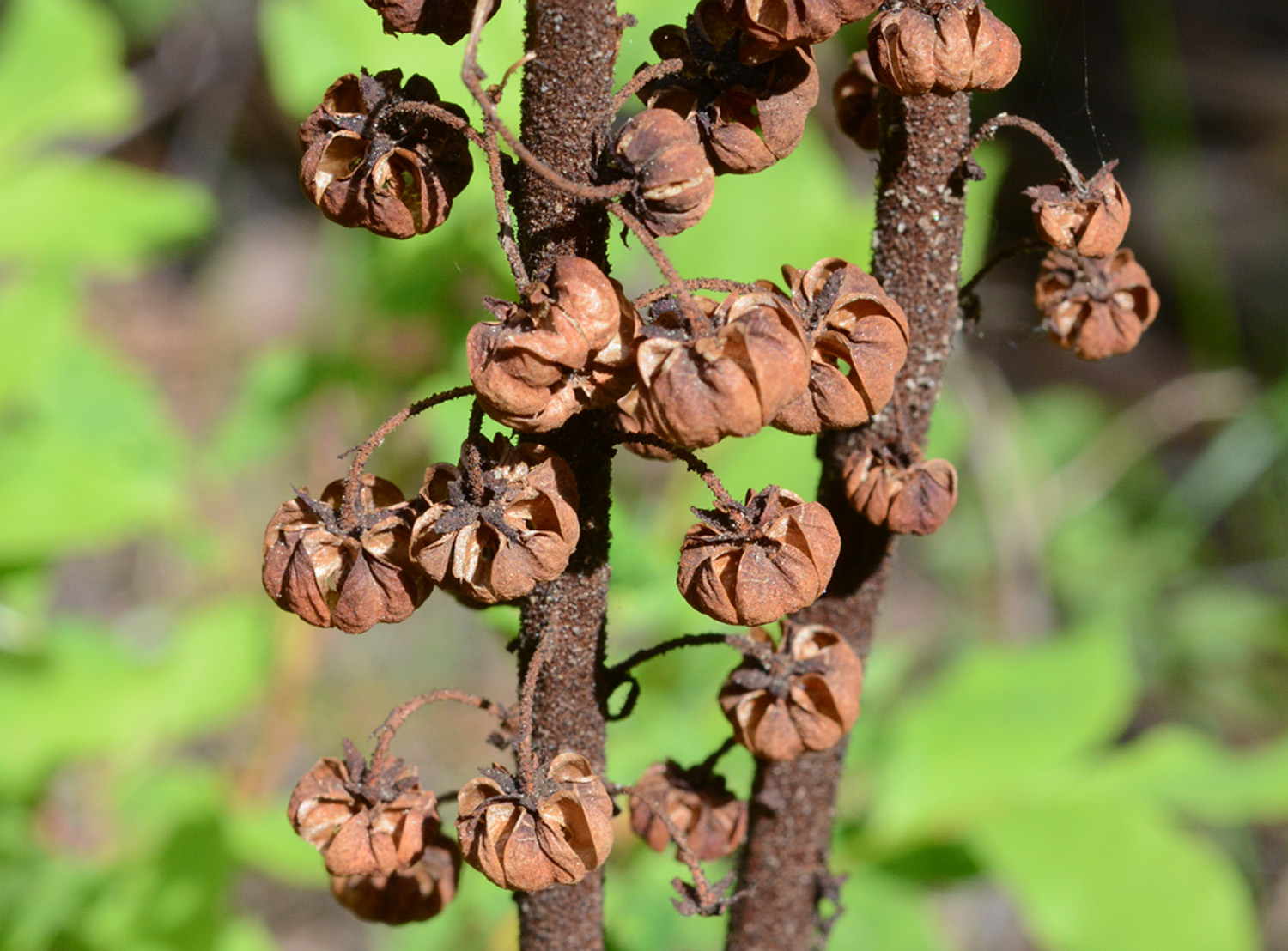
spectacular seeds – if you can see them. Each tiny seed is attached to a membranous wing to aid their flight to new ground. A 10x handlens reveals their delicate nature better than a camera.

As these 3-4′ plants have no chlorophyll they rely on mycorrhizal fungi to relay nutrients from various coniferous host plants.
Fruits that Fling:

Sticky geraniumGeranium viscossissimum – flowers each produce a total 5 or more seeds, usually 1-2 nestled in each of 5 separate compartments of the ovary at the base of the pistil. When the ovary begins to dry, tension builds up, the style splits apart, curls, and literally catapults the seeds several feet beyond.

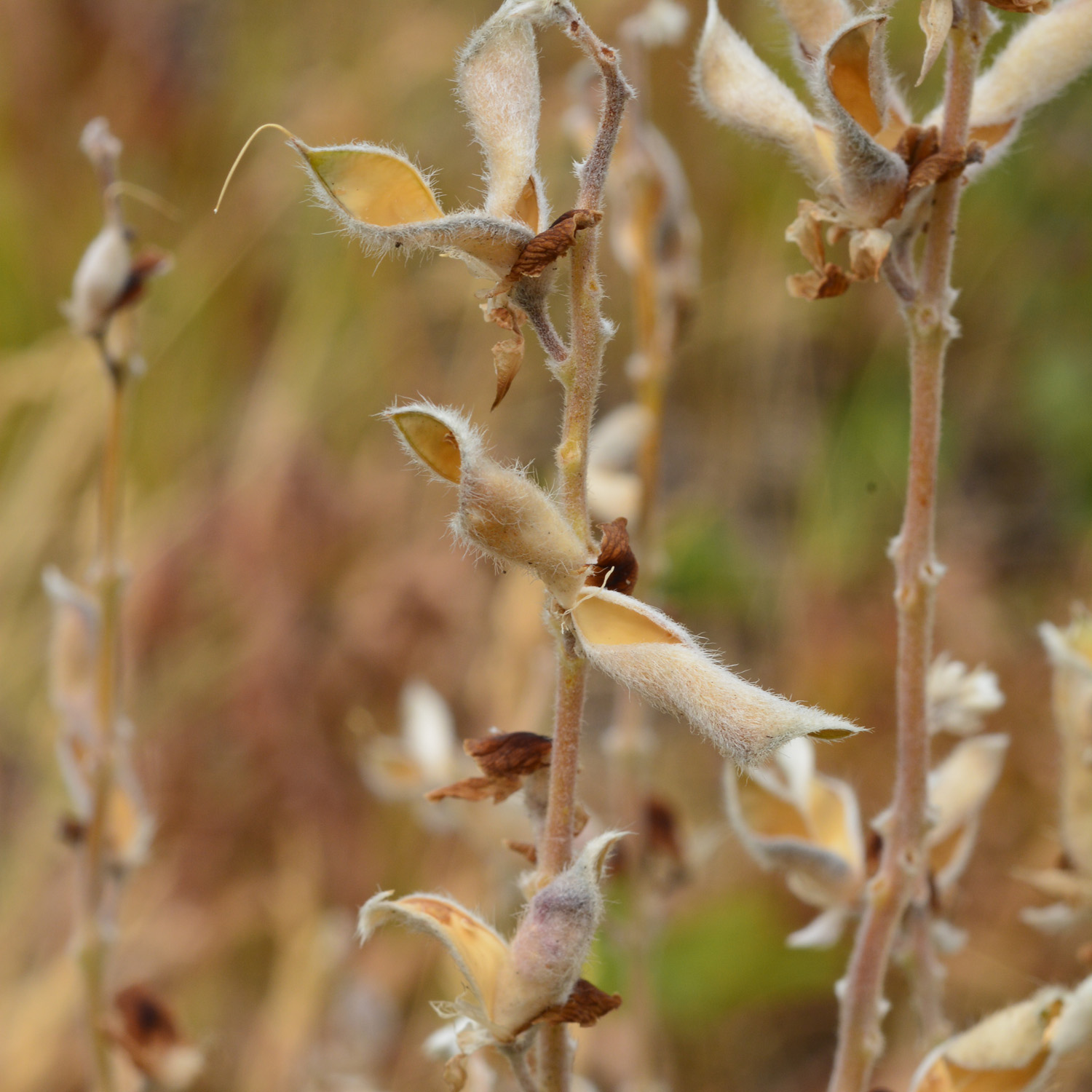
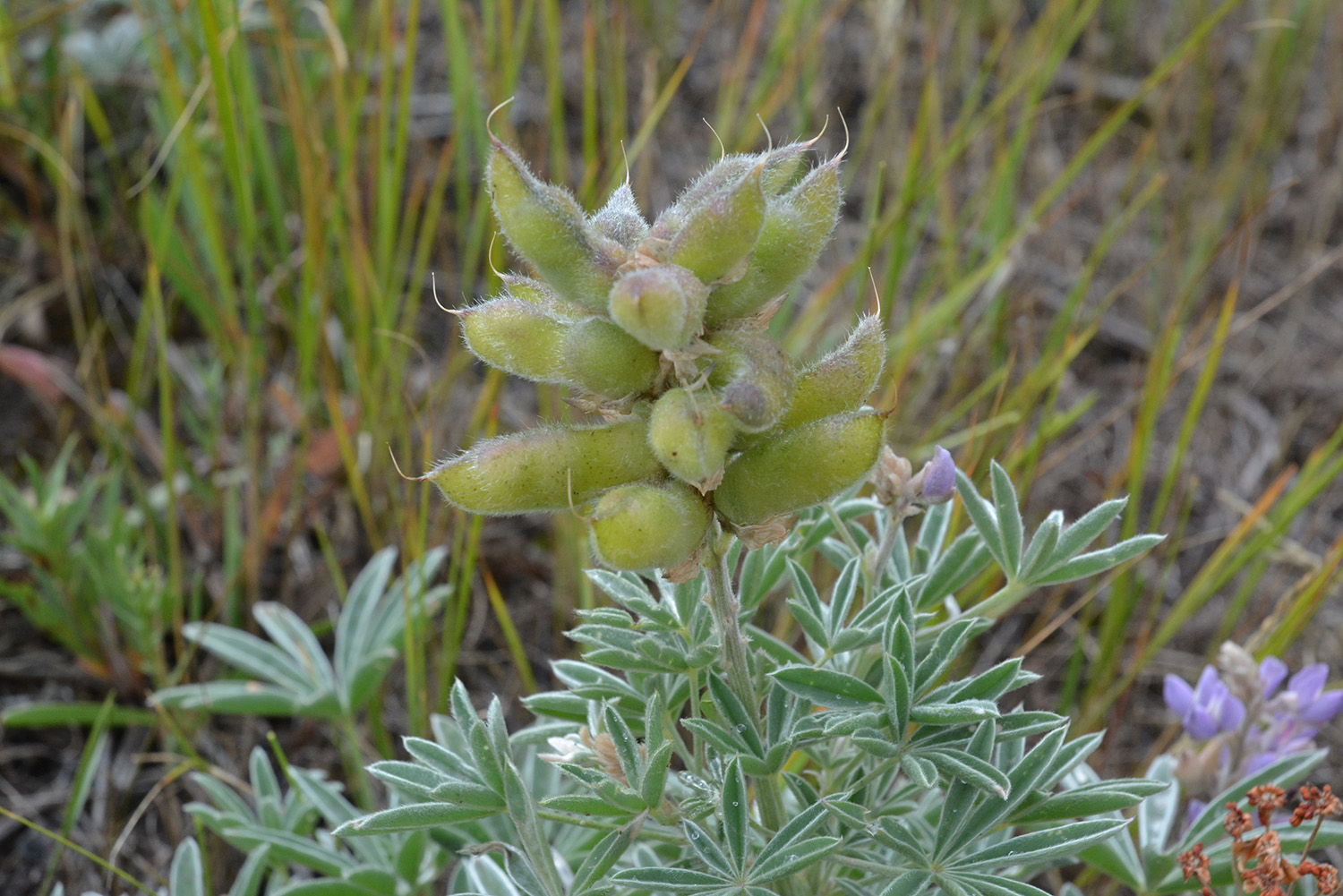
Our native lupinesLupinus spp. – are in the Pea or Legume Family/Fabaceae. As with our edible peas and beans, lupines have pods with several individual seeds inside. In lupines, these pods dry, twist, split, and eject the hard seeds beyond the parent plant.  Do not eat the seeds. Our species of lupine are poisonous – including its foliage and even more so the seeds. 
Over the next few weeks, see how many different fruits you can find, and try to figure the modes of seed dispersal.

Botanizing is fun in fall.

Frances Clark, September 1, 2025

As always, comments and corrections are most welcome.
What’s in Fruit? Late Summer 2025 – Part 1: Fleshy Fruits

This spring was moist and relatively warm so the flowers flourished and pollinators were abundant.  Thus many, many of the flowers were pollinated by bees, flies, wasps, butterflies, moths, and more, thereby, setting the stage for developing fruit. 

Fruits envelop seeds and serve to spread the seeds out into the world away from their parents. Fleshy fruits have evolved to be eaten by mammals and birds and then be excreted or regurgitated away from the parent plants. The flesh carries different kinds and levels of nutrients from starches and sugars to energy-packed lipids. The coverings are in different colors, often red, but also white, blue, black, and orange. The seeds within may be abundant to just one, but all count on wildlife to transport them elsewhere.

First, some basic botany (feel free to skip):

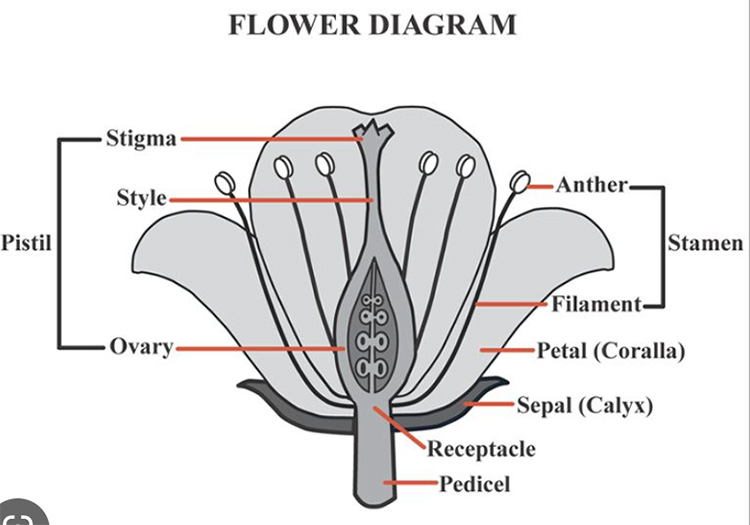
The anther, e.g. the top part of a stamen, produces male pollen grains; the stigma, the top part of the pistil, is where the pollen lands, and if compatible, grows a tube down through the style into the ovule with an egg, where it releases two sperm, one to fertilizes the egg inside the ovule, the other to form food/endosperm (a process called double fertilization). Thus a seed is formed. (Flower diagram from Pinterest:)

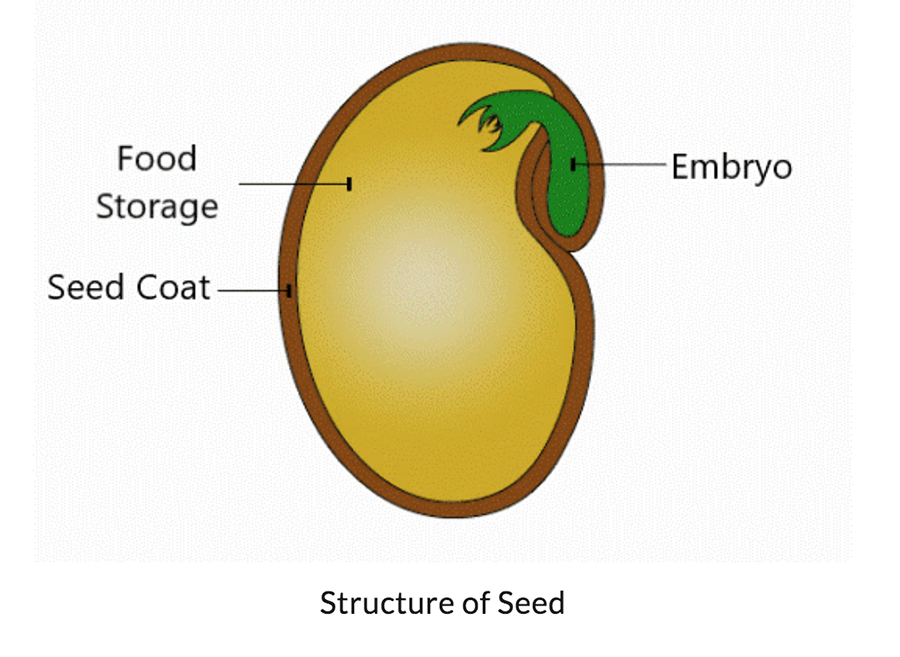
A typical seed includes a tiny plant (embryo), extra food (endosperm), and a protective seed coat. (Illus: courtesy of edurev)

These seeds in turn are enclosed inside a fruit which develops from the ovary (sometimes called a carpel). Ovules become seeds, Ovaries/carpels become fruits.

Fruits come in all sorts of shapes, sizes, structures, smells, tastes. Fruits are key to seed dispersal. This posting highlights some of the fleshy fruits you can see around the valley right now. Enjoy looking for the variations.

Lush Berries (loosely defined) – attract birds and mammals to disperse seeds

Several early blooming shrubs produced fruits that have already been scarfed up by birds and others. For instance, it is hard to find the pairs of red fruits of Utah Honeysuckle – Lonicera utahensis – and the twin black fruits held in maroon bracts of its relative Twinberry – Lonicera involucrata. Favored huckleberries – Vaccininium membraceum, V. scoparium – were in short supply or already consumed. However, other fruits are at peak and abundant.

Many wild fleshy fruits are in the Rose Family. They are related to the apples, cherries, plums pears, and peaches which we love. 

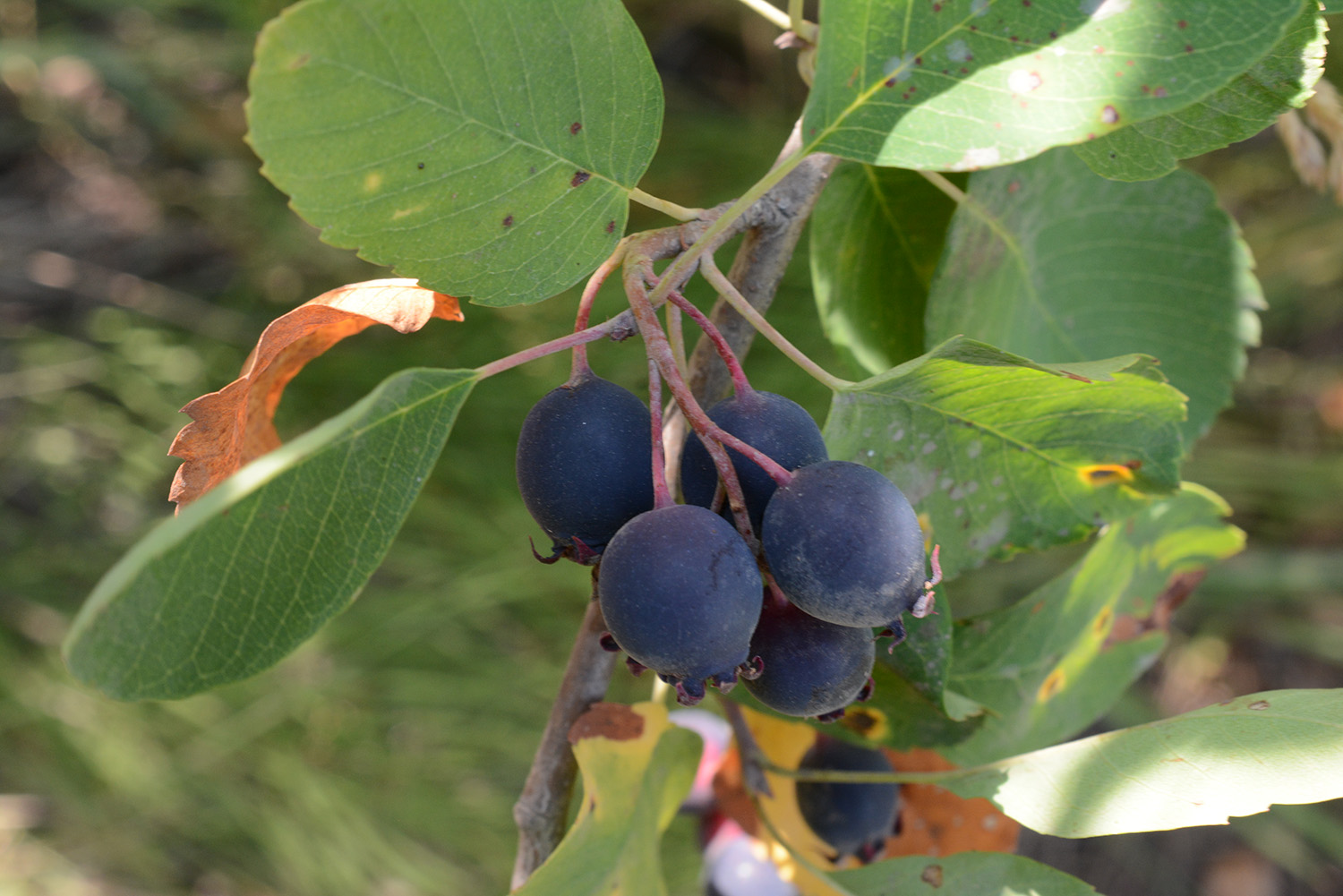
ServiceberriesAmelanchier alnifolia,

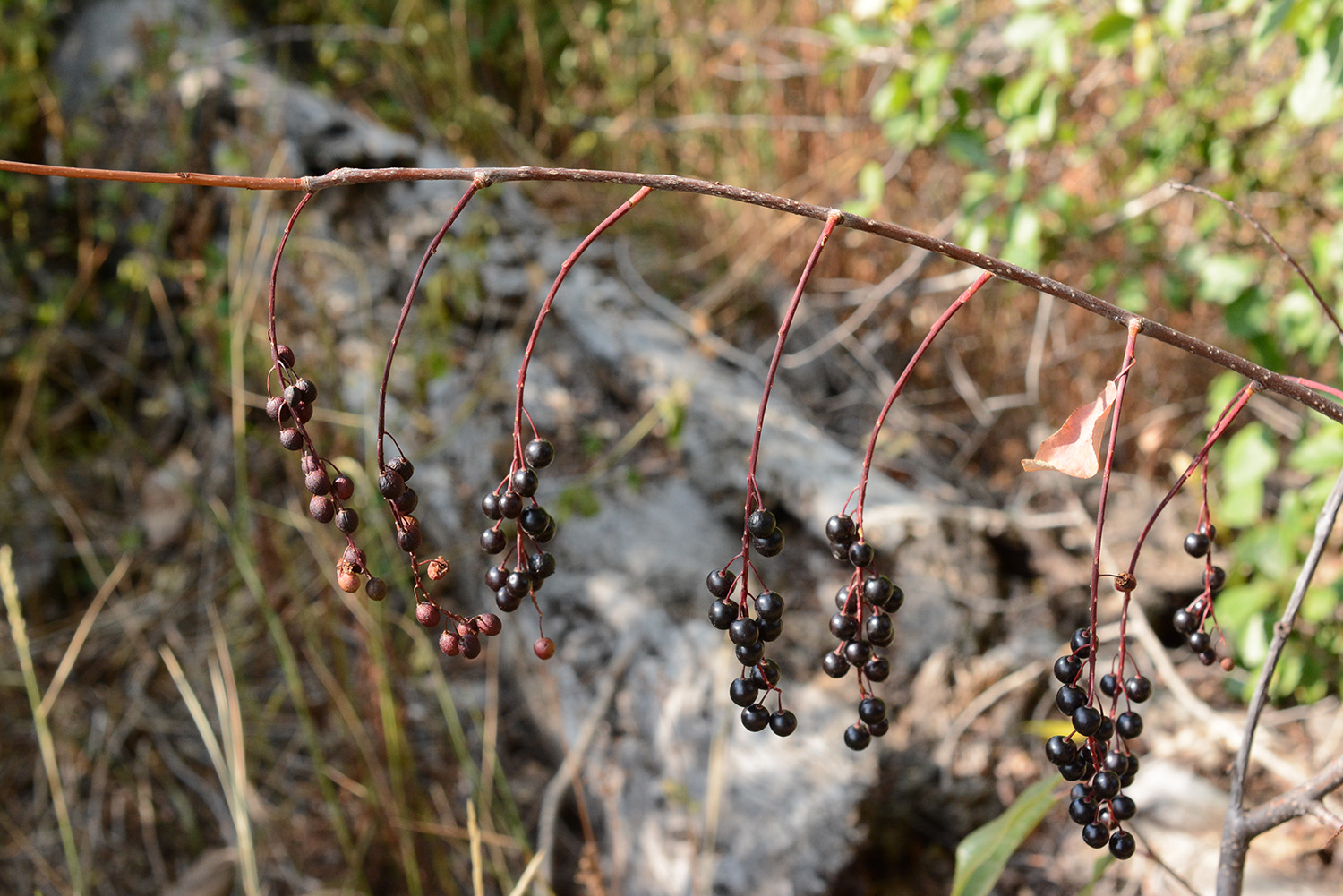
and ChokecherriesPrunus virginiana – dangle their fruits.

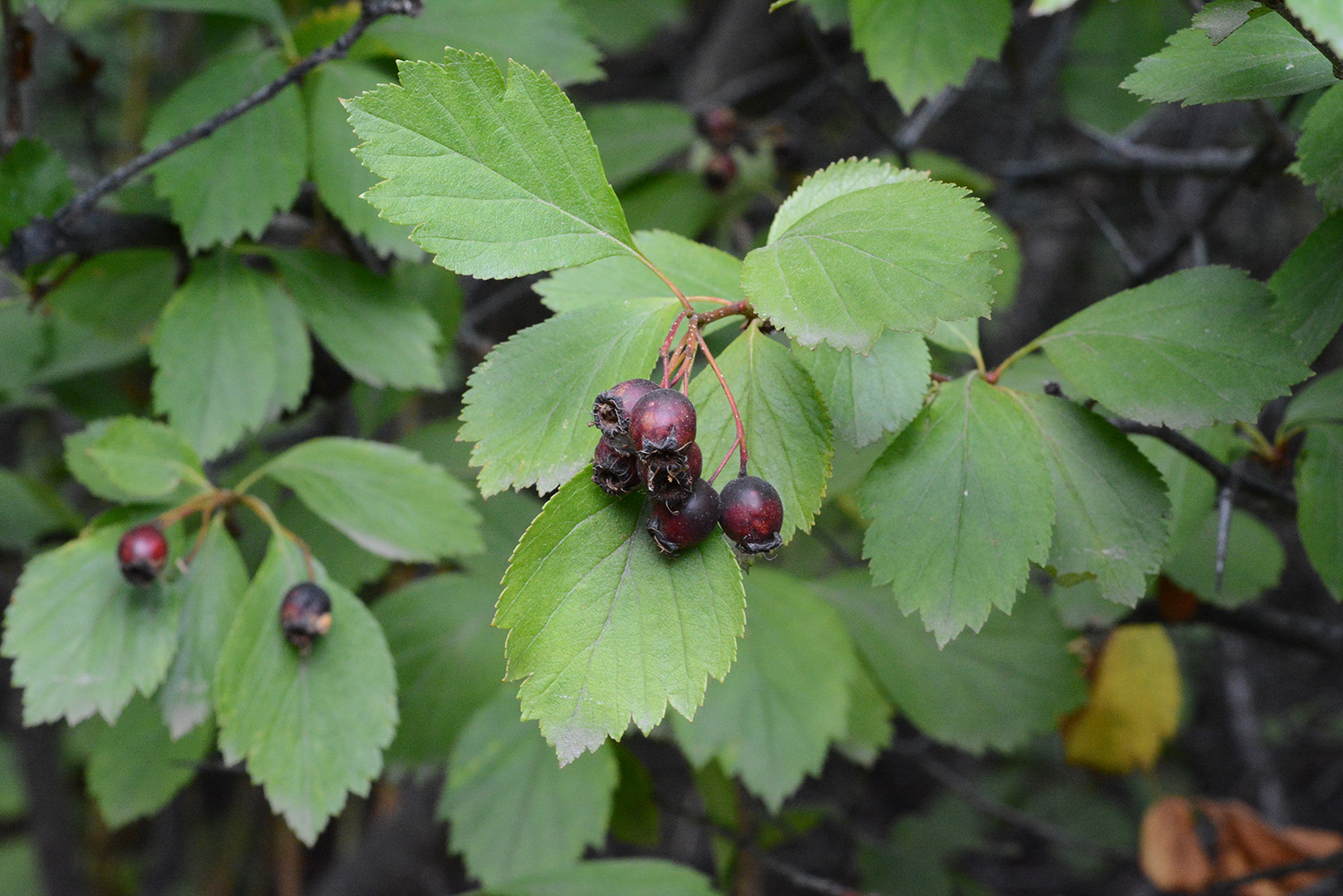
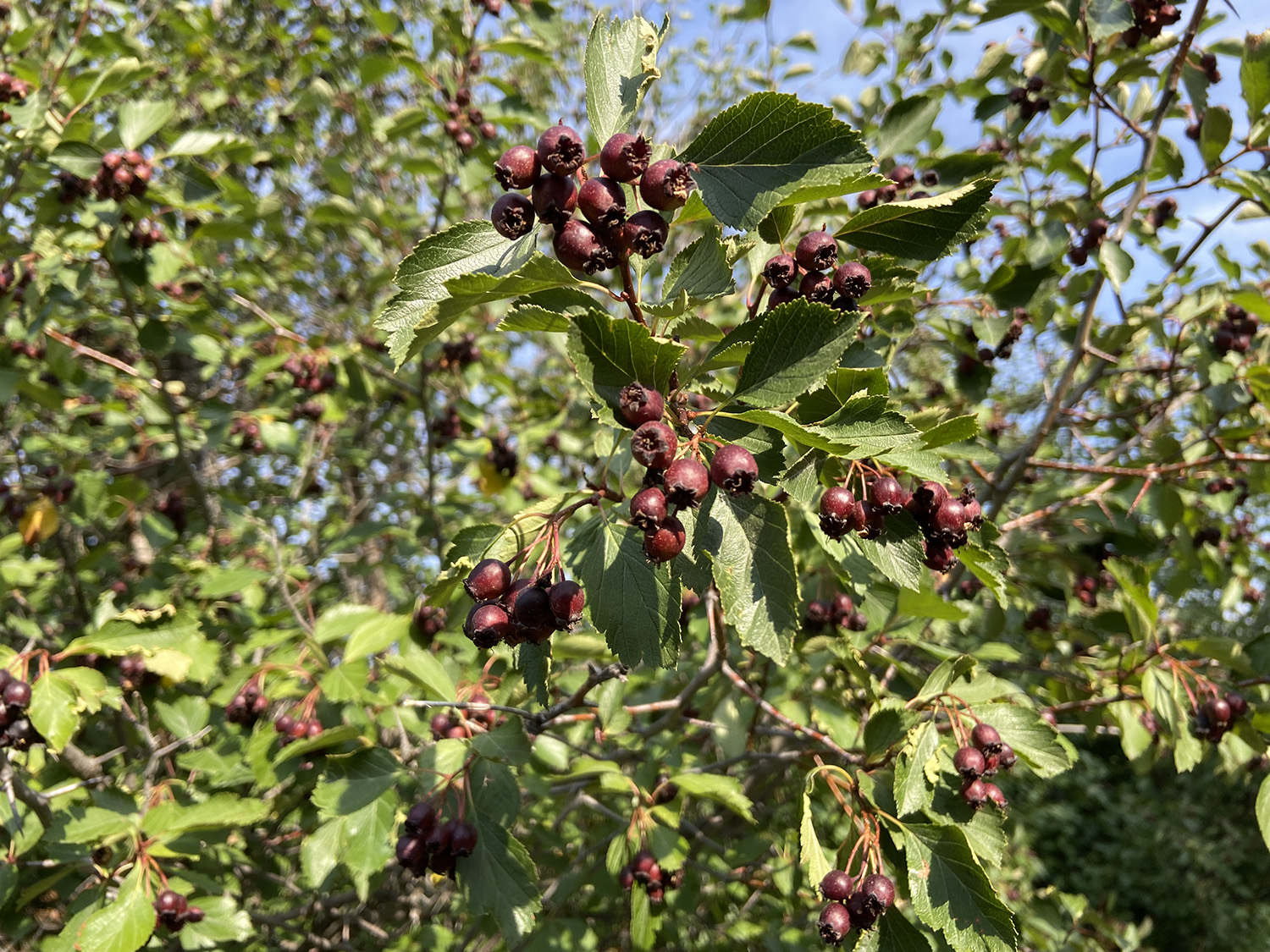
Black HawthornsCrataegus douglasii – are especially abundant right now along Moose-Wilson Road and around the Lawrence Rockefeller Preserve visitor center.

The orange fruits of Mountain AshSorbus scoparia – stand out above the alternating compound leaves of the 6-10′ or more shrubs.

Birds, bears, coyote, fox, and others like all these juicy fruits and deposit the seeds.

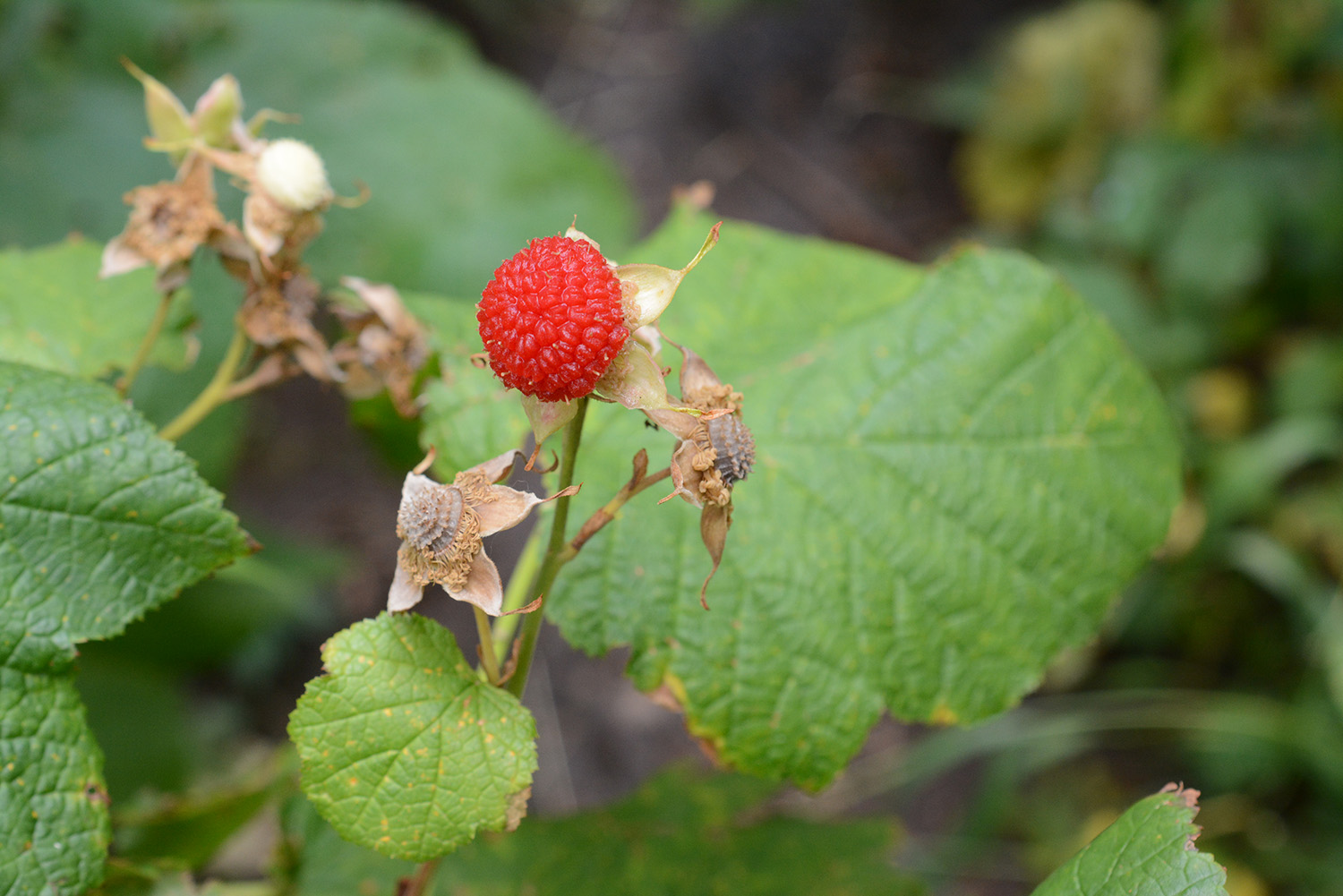
Thimbleberry – Rubus parviflora – is also in the Rose Family. These 3-4’ shrubs are found along streams or moist sites that provide enough water for the 4-6″ leaves to stay turgid. The raspberry-like fruits go fast.

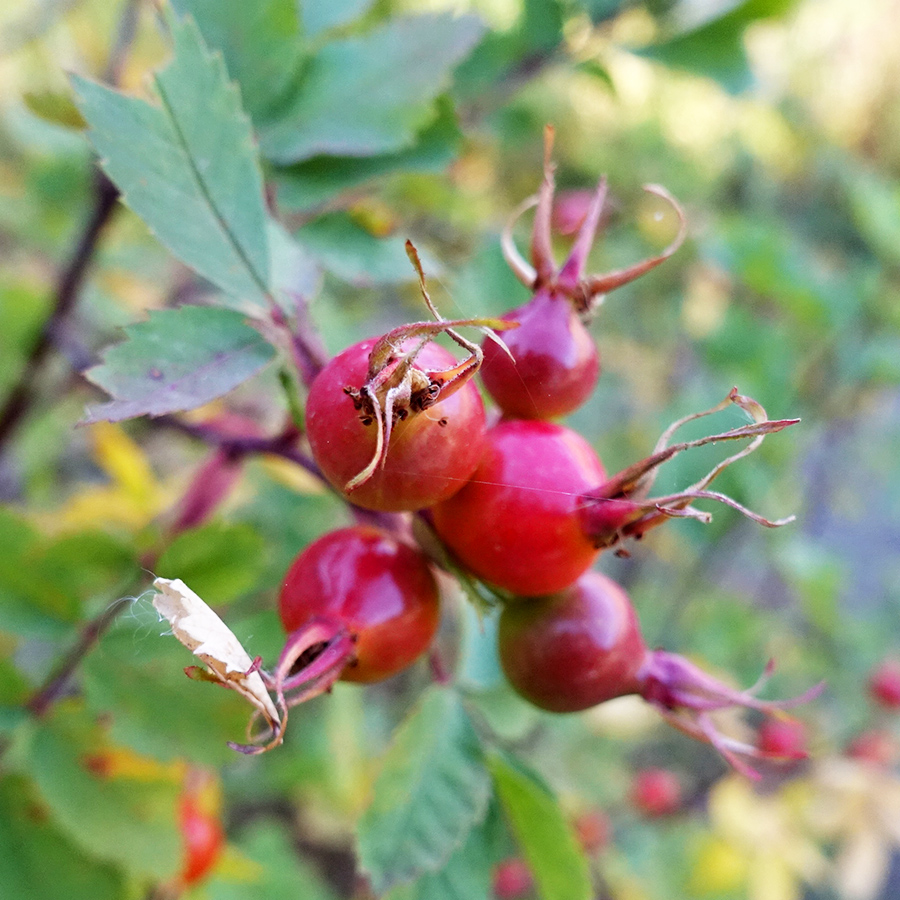
And there are also rose hips forming on Wood’s and Nootka Roses Rosa woodsii, R. nutkatensis. These leathery structures are held out on prickly stems and compound leaves typical of any rose.

Tough rose hips are usually not the preferred food at this time of year–they become important later on in winter when other food sources are more scarce. A variety of our local animals eat the fruit: mule deer, moose, and elk, bears, coyotes, and rodents, as well as some birds such as American Robins and grouse. Rose hips are high in a variety of vitamins, particularly vitamin C, as well as minerals and antioxidants. Hips have been used for making tea to ward off colds and flu.

Other Shrubs with fleshy fruits visible along shady trails:

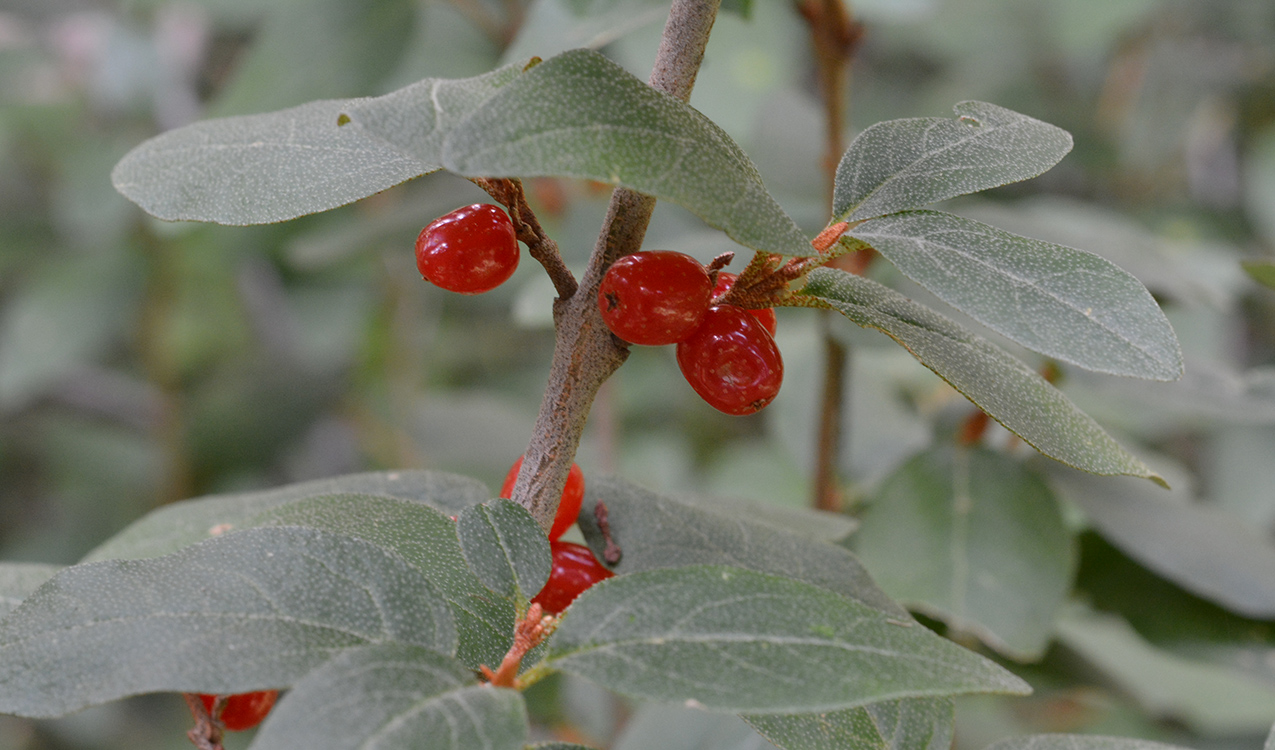
Russet BuffaloberriesShepherdia canadensis – form bright red fruits on 3-10’ shrubs.

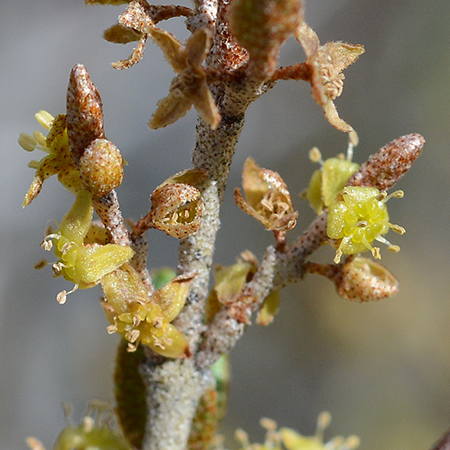
Last spring, male and female flowers bloomed on separate plants as a strategy to prevent self-fertilization. Male flowers as shown below have only stamens. The glistening, sugary, donut-like nectary at the base of the stamens attracted pollinators to pick up pollen and then fly it to another Buffaloberry plant with female flowers, also with appealing nectaries.

Only the female flowers, of course, produce fruits.

Black and grizzly bears, as well as grouse, all eat the berries. The plants can grow in relatively poor soils because they are nitrogen fixers. By adding nitrogen back into the soil, plants also provide islands of nutrients for other colonizing plants.

Red-stemmed DogwoodCornus racemosa – produce bunches of elegant white berries.

Note the distinctive opposite, oval leaves with parallel veins.

Dogwood fruits are important as they are high in lipids which have extra energy needed for migrating birds. Whole plants are especially relished by moose!

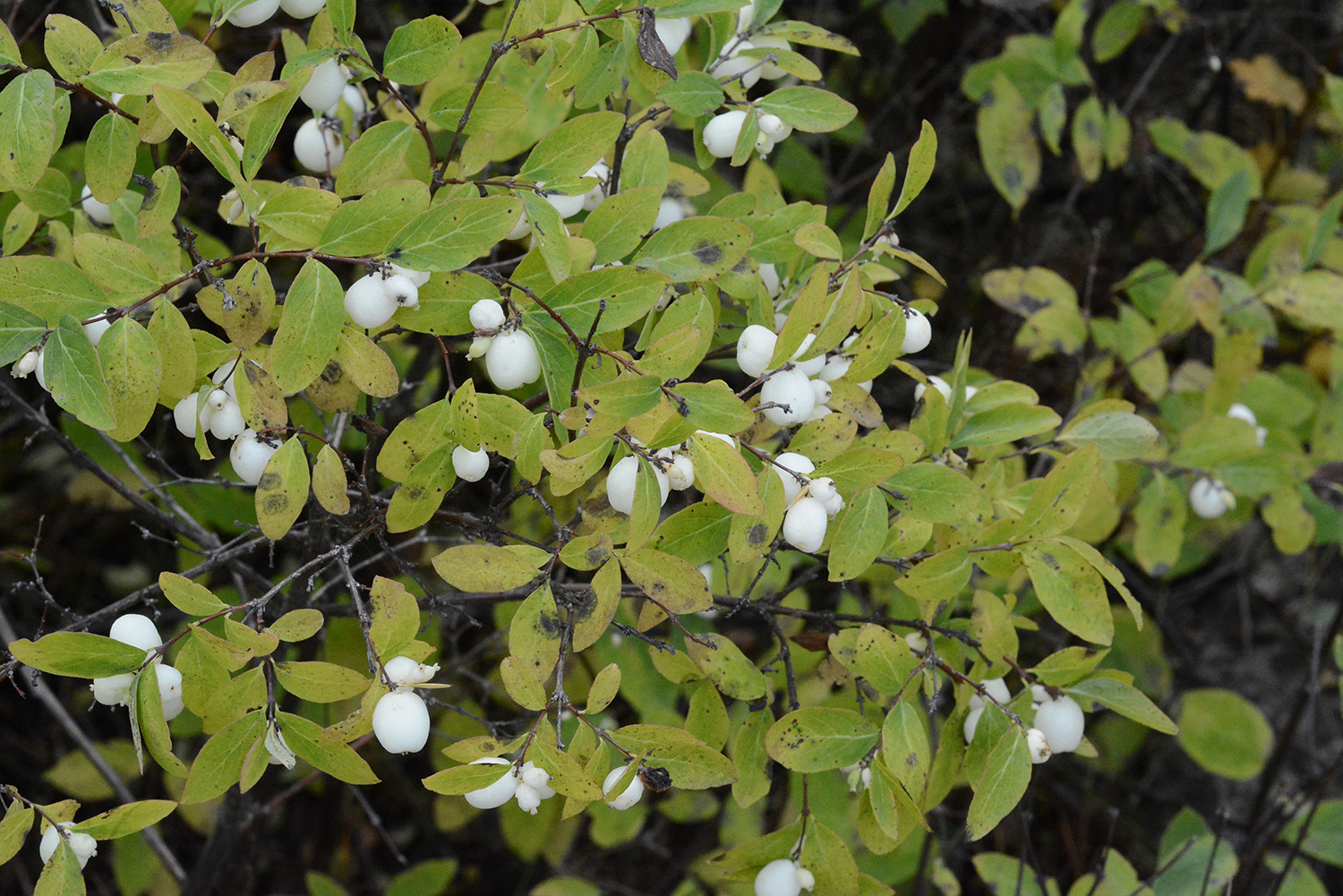
Another plant with opposite leaves and white berries, but not at all related, is SnowberrySymphoricarpos spp. Due to unappealing toxins, fruits tend to hang on a bit longer into winter when the toxins are broken down in the cold. Ruffed and Dusky Grouse, along with other birds, consume them.

Throughout the year, these twiggy shrubs provide important wildlife cover .

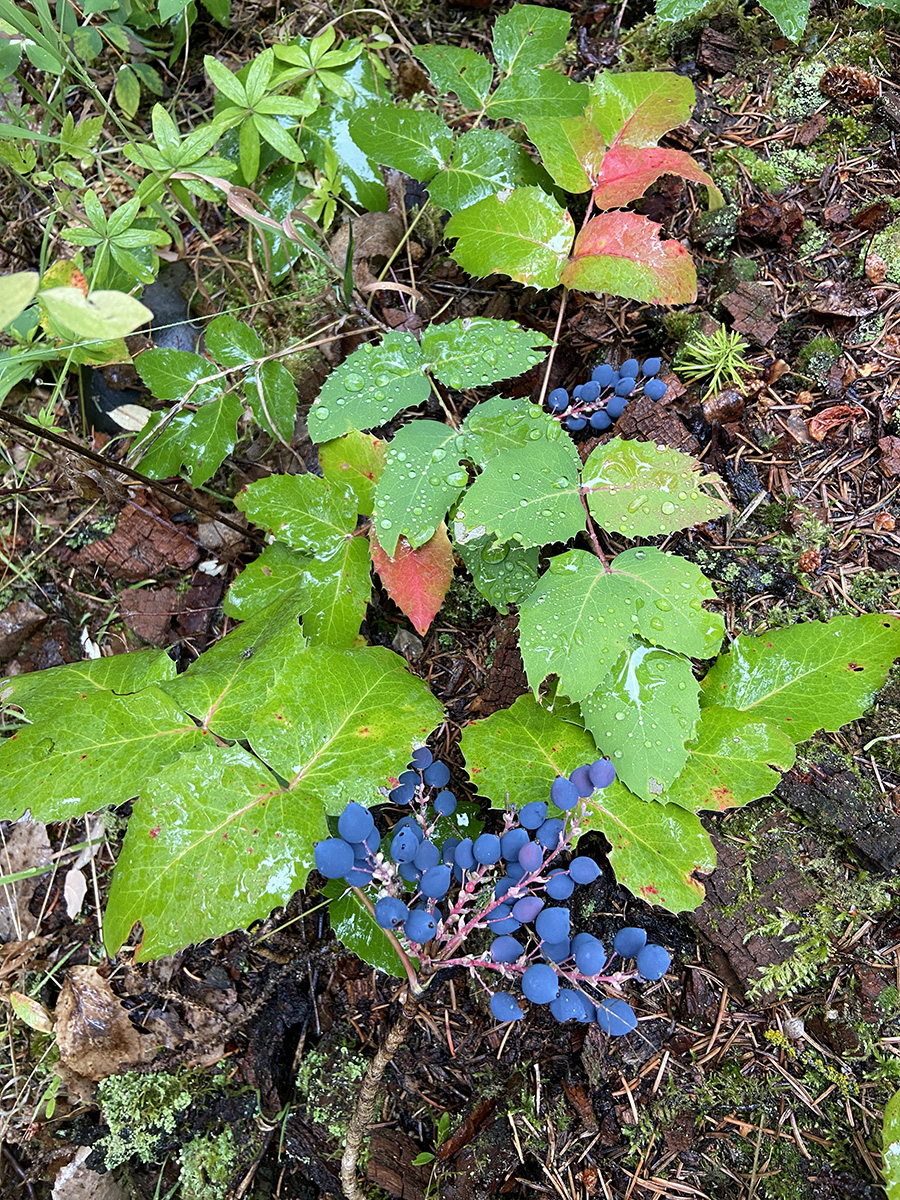
The creeping evergreen Oregon GrapeMahonia/Berberis repens – sports bunches of blue , one-seeded berries. If you gently scrape the roots, you can see a yellow color. The plants, including fruits, contain berberine, a chemical that has been used for centuries and is being researched as a potential for use of diabetes, heart disorders, and as an antioxidant. As always, know your plant and check the medical literature before using or consuming any native plant.

Wildflower berries can be seen in moist or shady spaces:

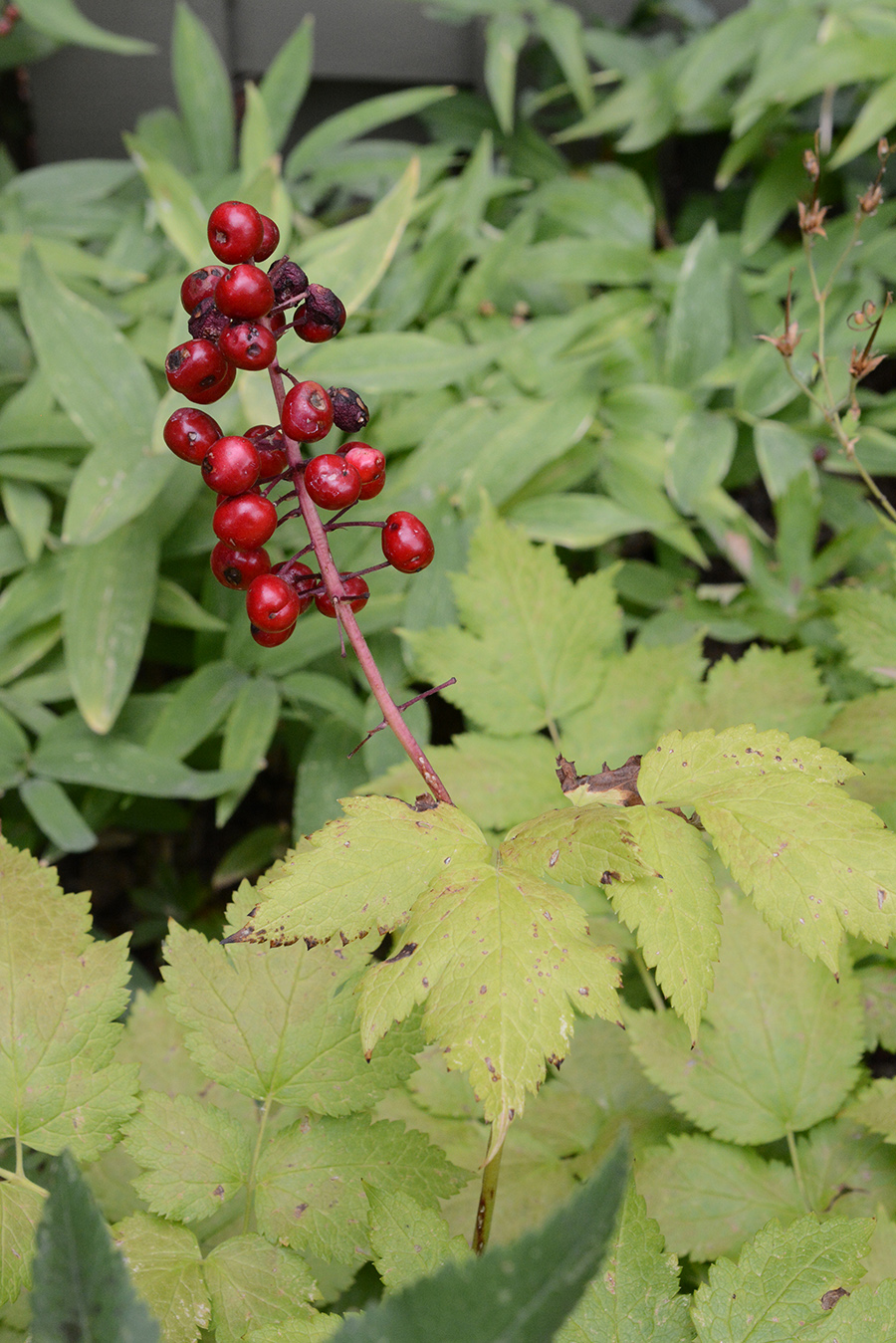
Red BaneberriesActea rubra var. rubra – literally stand out above a 2-3’ cluster of compound, toothed leaves. There is also a variety – var. neglecta – with white berries.

Do not eat! “Bane” means watch out/poison, which they are. The berries also taste terrible to us but not to the birds that eat them. They gobble up the fruits, fly off, and poop out the seeds. This plant is in the highly variable, mostly poisonous Buttercup Family – Ranunculaceae. 

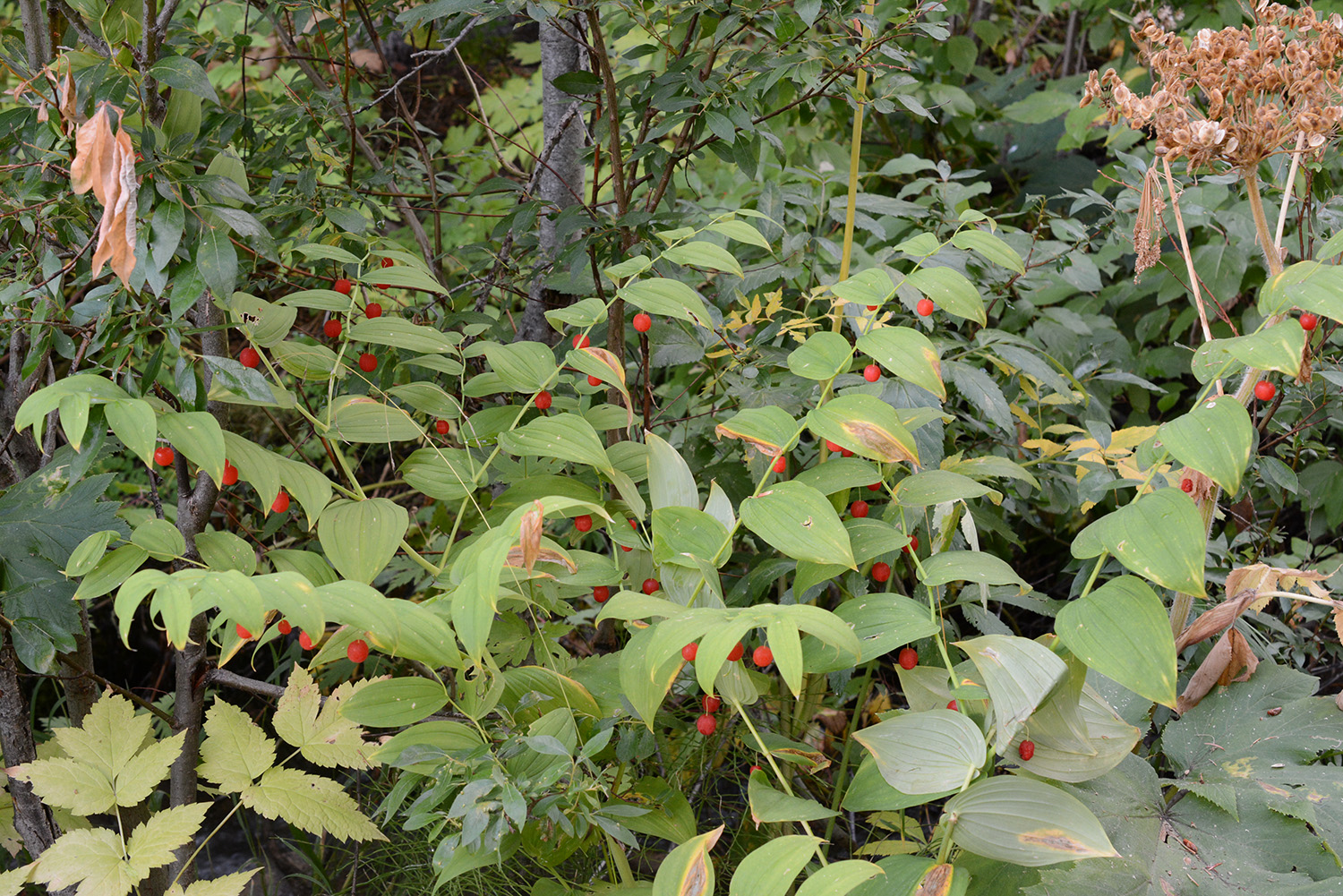
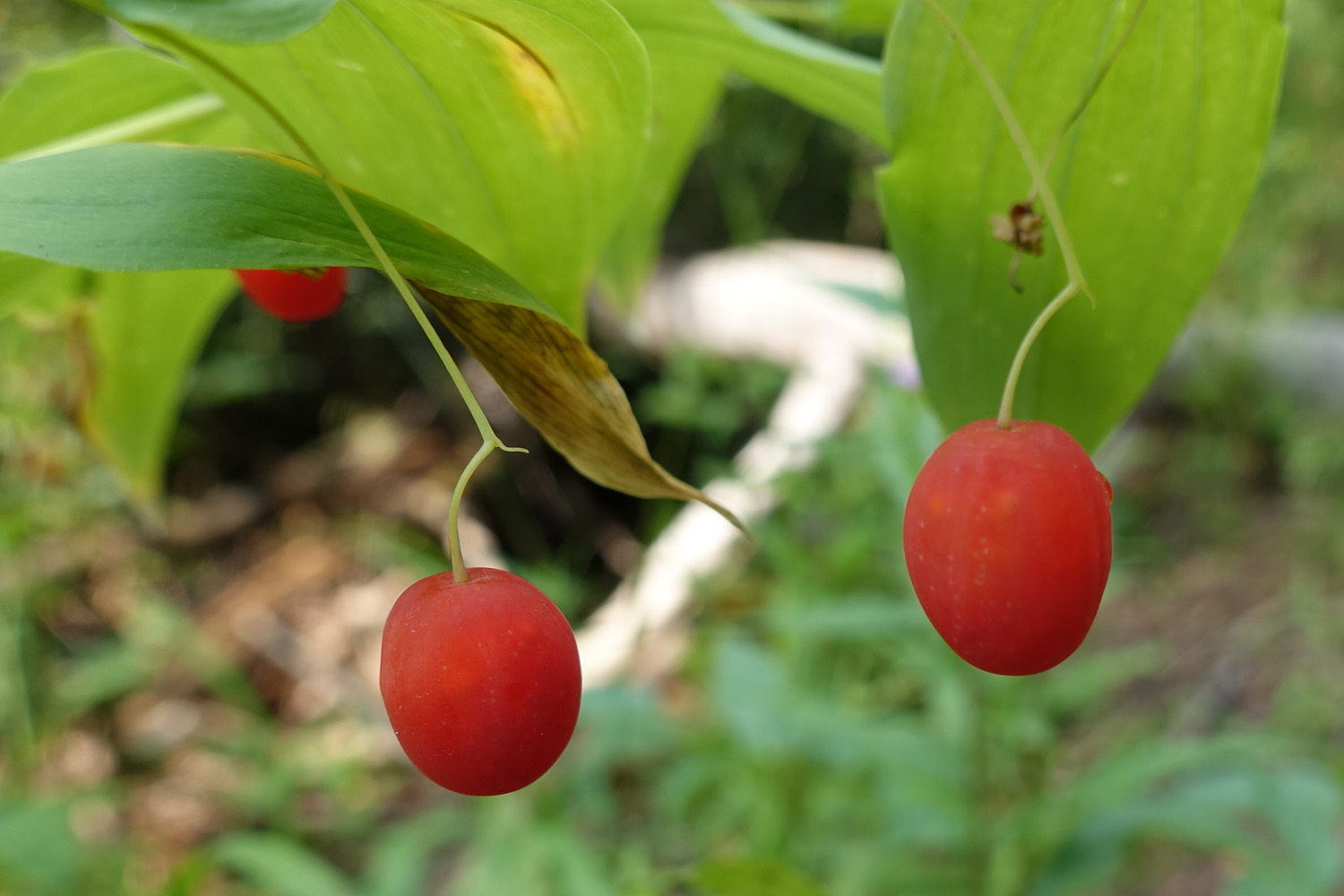
Twisted stalkStreptopus amplexifolius – grows 3-5’ tall most often along streams.  Look under the arching stems

for red ovoid fruits dangling from kinked stalks.

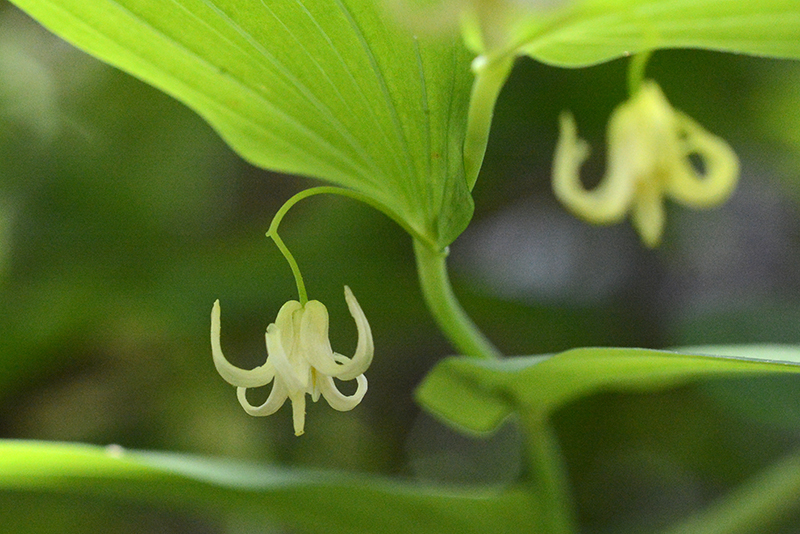
The fruits come after the delicate yellow flowers with 6 curled back tepals have been polllintated.

FairybellsProsartes trachycarpa – has lumpy, thumbnail-size fruits with an orange-then-red, velvet-like covering. These fruits are usually held in pairs on the tip the 2-3’ stalks.

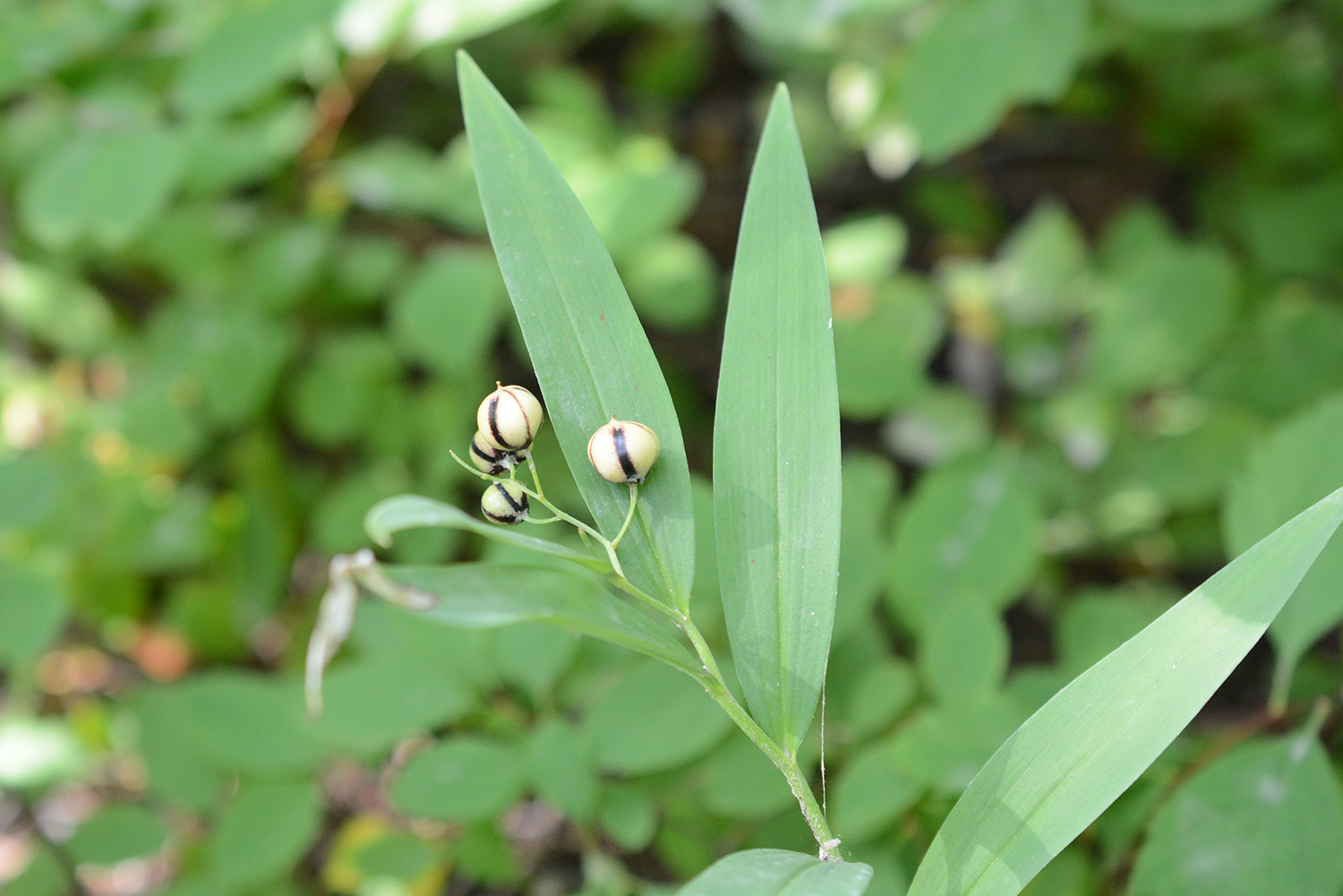
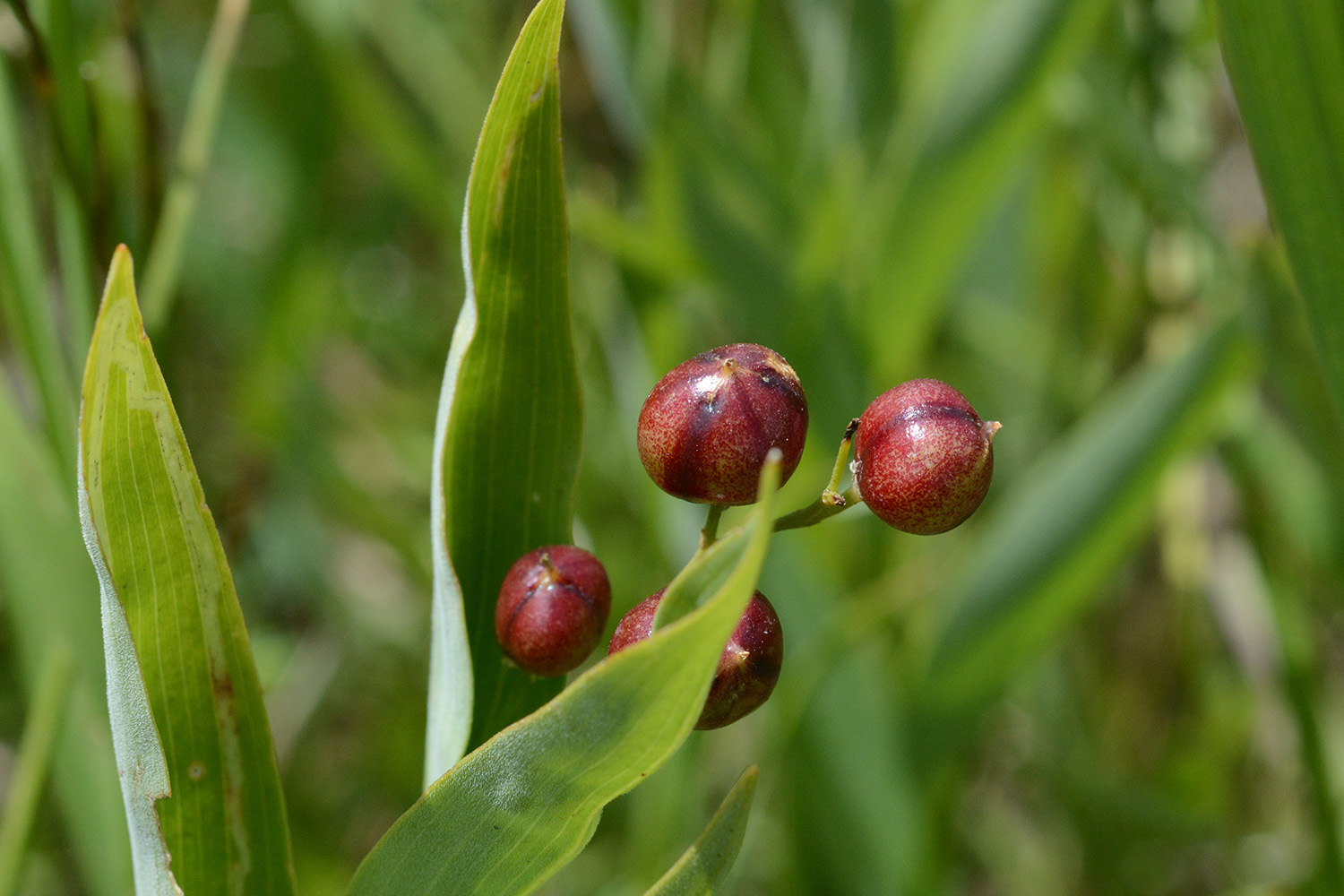
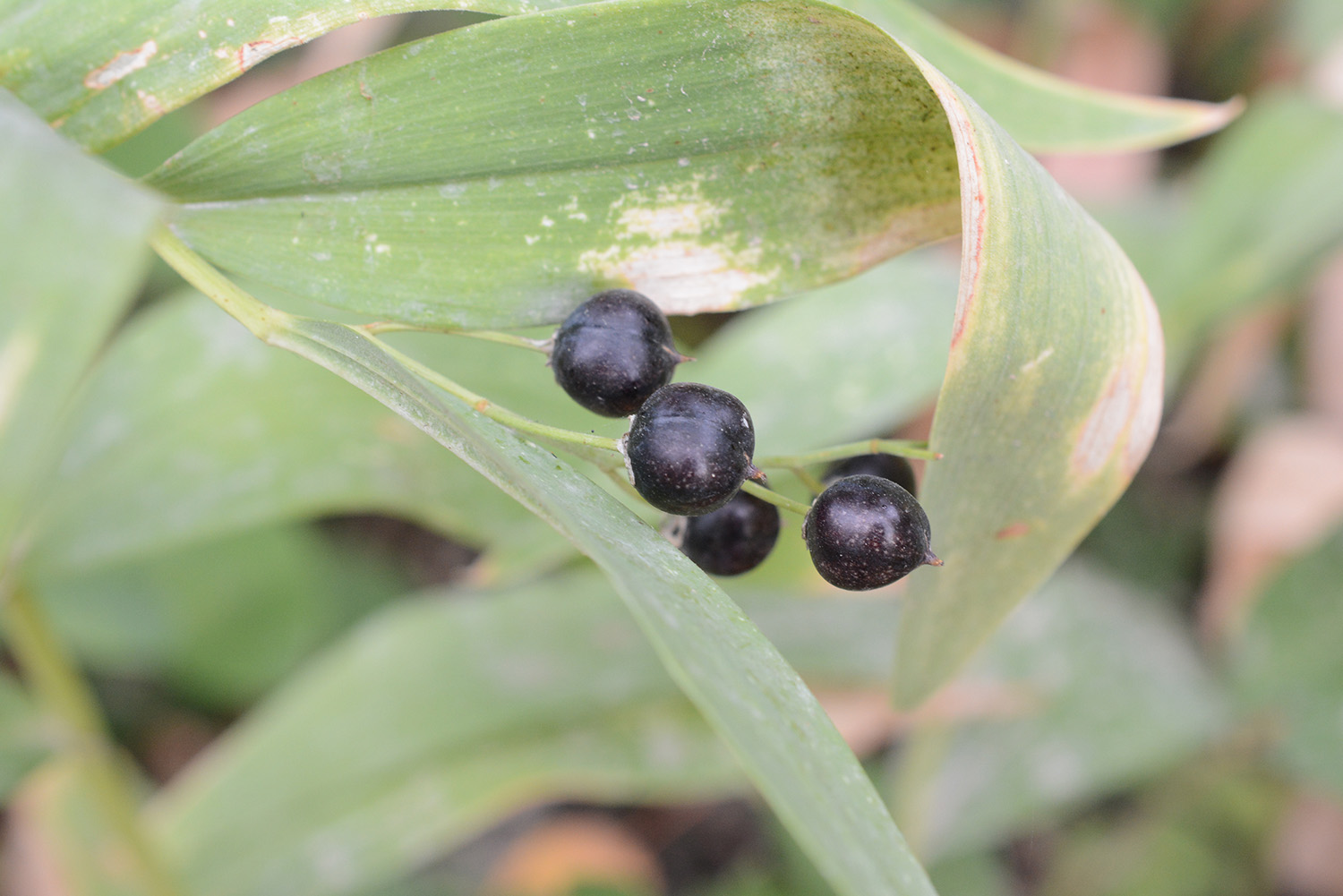
False Solomon’s SealsMaianthemum spp. – have fruits borne at the ends of arching stems with alternating leaves and parallel veins. Starry False Solomon’s SealM. stellatum – tends to be a smaller, more upright plant and fruits ripen sooner than it’s larger relative. It is interesting to watch the progression of fruit color: berries start off with a distinct stripe,

which slowly expands with a reddish wash,

and then the fruits become black.

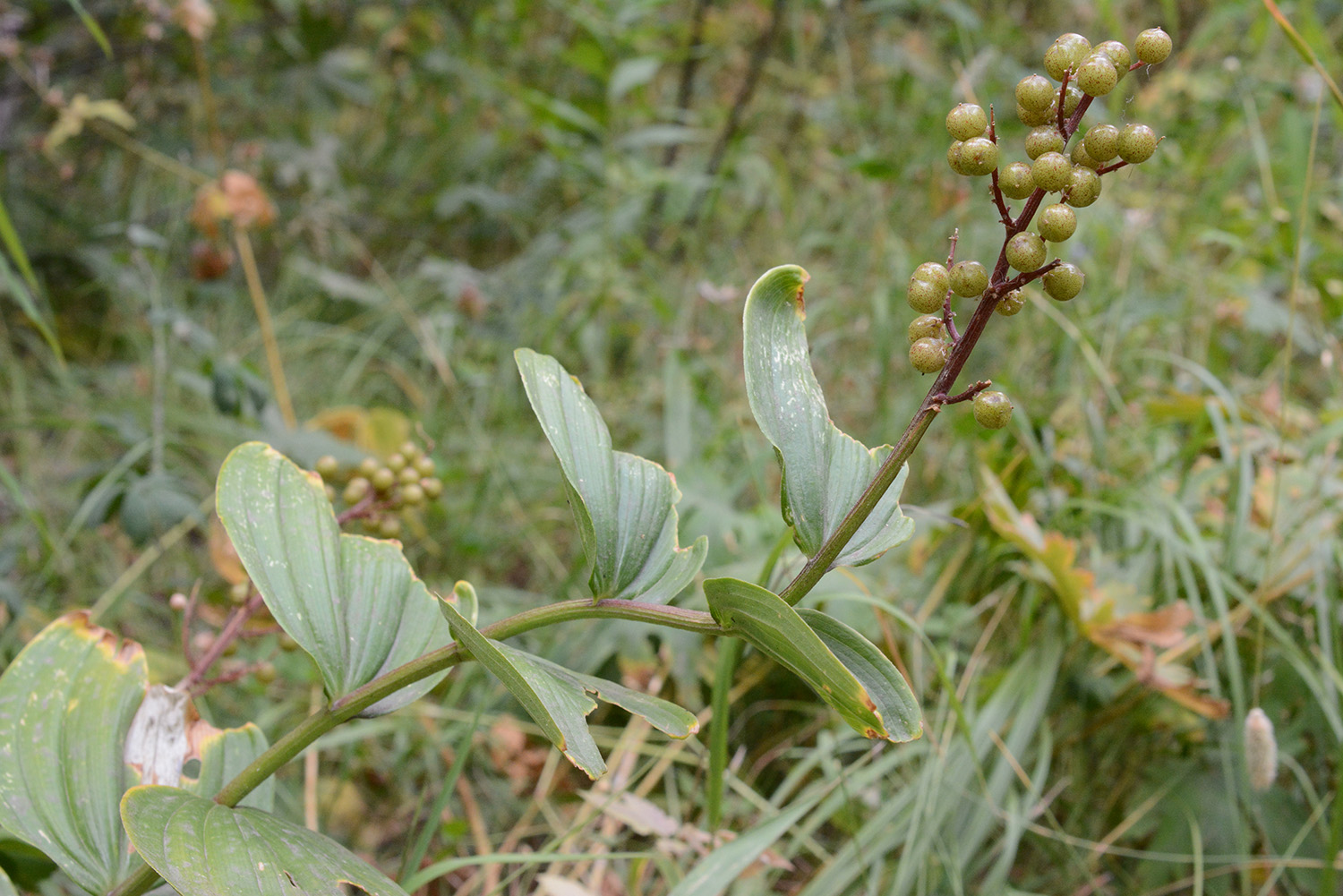
False Solomon’s SealM. racemosum – is a larger, 1-2′ arching plant with a more branched inflorescence.

The spotted fruits eventually turn red:

Both these species have rhizomes that can be divided for home gardens.

Look for these and other fleshy fruits on your hikes. Make it a treasure hunt and enjoy the differences in color, consistency, seeds, and even in taste–a tongue tip (but not baneberry!).

And look for what may be consuming them

There are many other fruits out there…see What’s in Fruit? – Part II: Dried Fruits in the next posting.

Frances Clark, September 1, 2025

As always, your comments and corrections are most welcome! Send to our email – tetonplants@gmail.com — we will respond when we aren’t out botanizing.

What’s in Winter? – Deciduous Trees and Shrubs!

Deciduous trees and shrubs lay bare their branches in winter. Loosing their leaves is a survival strategy to withstand cold and drought. It also prevents breakage of limbs from the weight of snow on broad surfaces. (Compare with the evergreen species in our previous posting.)

First, the basic design and function of a deciduous leaf. 

As with needles of evergreens, deciduous leaves are essentially solar panels and food factories. Very simply put, through the process of photosynthesis, green chlorophyll with cloroplasts captures sunlight which powers leaf cells to combine water and carbon dioxide to make sugars and release oxygen.

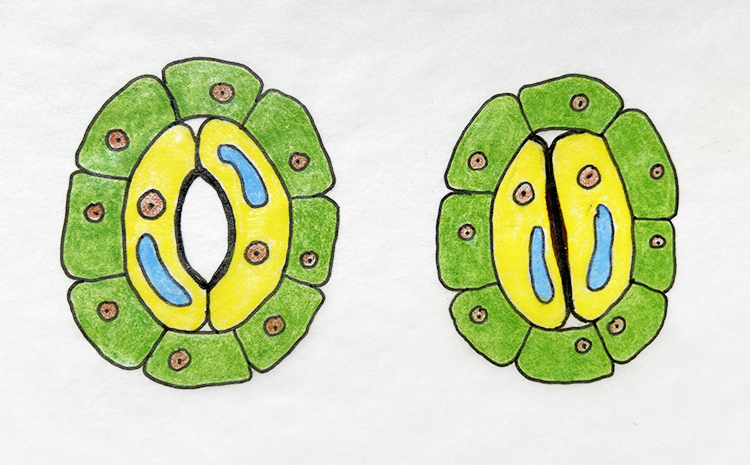
Water with nutrients comes into the plant through fine roots by osmosis, travels up through a series of pipes – vessels – and out into the leaves. On the underside of the leaf are lip-like openings – stomates – which let in CO2. The cells in the leaf create sugar (energy) and release the by-product oxygen. Oxygen flows out the stomates into the air (which we breath) along with a lot of water vapor. At night when the stomates are closed and photosynthesis is shut off due to no light, additional processes occur that uses the sugar energy along with various nutrients to produce products for plant growth.

Broad leaves are very efficient factories. Their wide surface can gather lots of light; and as long as there is water and sufficient nutrients, particularly nitrogen, they have the resources to power and produce what the plant needs to grow in a short season. However, these chemical processes require a certain temperature range to be efficient and, as noted, plenty of water. Water transpiration helps to cool the machinery – so to speak – in the leaf during warm weather.

Winter poses a problem:  At lower temperature the chemical processes don’t work. As the air freezes, water in leaf cells freezes and ruptures the cells. Then the groundwater freezes, the factories can’t get the basic raw materials of water and nutrients they need.

So, when the days get shorter and cooler, hormones start closing down the factories in a very orderly process. Any extra materials in the leaf like nitrogen are relayed back into the stem for storage; sugars and starches are stored in the parenchyma cells. The pipes out to the leaf become sealed off with cork; and the now-brown leaf drops off. 

Other processes have occurred in the plant. After producing leaves and flowers in spring, by mid-summer the plant begins making fruits and forming buds. Buds contain the initial stem cells for growth the following spring. The stored sugars and starches provide energy to keep the bud cells alive. Stored energy is also used to keep alive the the thin ring of living cells found just under the bark of woody plants – the cambium.

Living cells lie just beneath the bark of dormant woody plants.

Buds contain the initial stem cells for growth the following spring. Triggered by day-length and warmth, hormones will stimulate the relay of energy and materials to the buds so the stem cells can begin to build new food factories–leaves–in spring .  

All these new leaves emerge from a single bud, fueled by food stored the previous fall.

Other adaptations occur for winter dormancy so that plant cells can withstand below-freezing temperatures, but enough said for now.

ID of Winter Woody Plants:

Botanizing in winter can be fun and challenging. The obvious features for identification have shriveled so you need to use more detective work, gathering as many clues as possible. Take some photos, look closely at the entire plant and bark, and then if permitted take samples and bring them inside where it is warmer to handle and compare the specimens. Don’t forget to notice where it is growing–habitat. Once you have deduced a name, you can look up more info about the plant including what they looked like in summer!

Key features:

  • Arrangement of buds – alternate or opposite
  • Buds: # of scales, shape, surface texture
  • Leaf scars and traces
  • Bark
  • Habit e.g. shape
  • Smell and taste

More about buds:

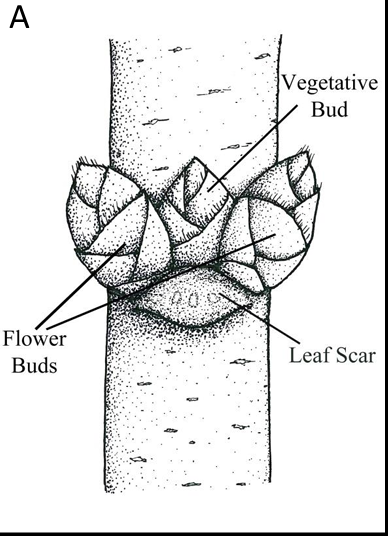
Diagram from University of California – Dept. of Agriculture: In_A_Nutshell76343

Buds protect the growing tissue (stem cells) of a new stem or flower that will emerge in spring.

Some buds have distinctive shapes and sizes. Bud scales cover the stem-cells in definite patterns depending on the species. Buds can be smooth, hairy, sticky.

Buds sit at the juncture of twig and leaf e.g. in the “axils” of each leaf. In winter you can see the leaf scar—where the leaf fell off leaving “traces” where the veins/vessels carried water and nutrients into the living leaves.

The shape and size of the scar and the number and arrangement of leaf traces are clues to ID.

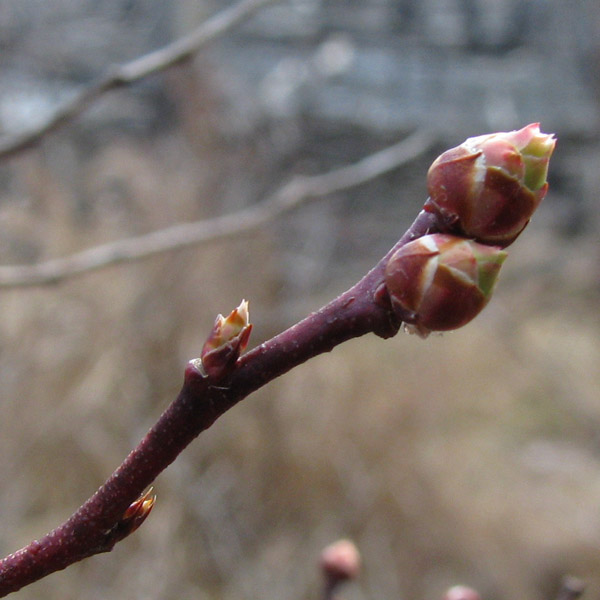
Often you will see a difference in bud size and/or shape on the same plant. It is often the difference between a flower bud and a new stem which will have leaves.

The large buds will be blueberry flowers, the side small buds, leafy branches

Woody Plant ID:

The 5 species below have early wind-pollinated flowers that produce small dry fruits that are well dispersed before winter.

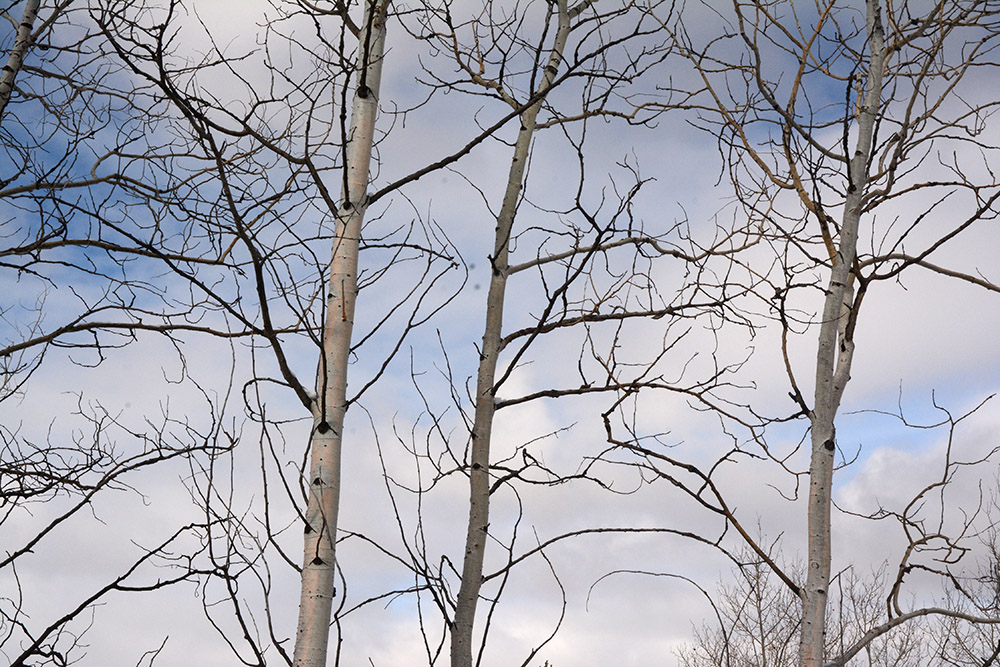
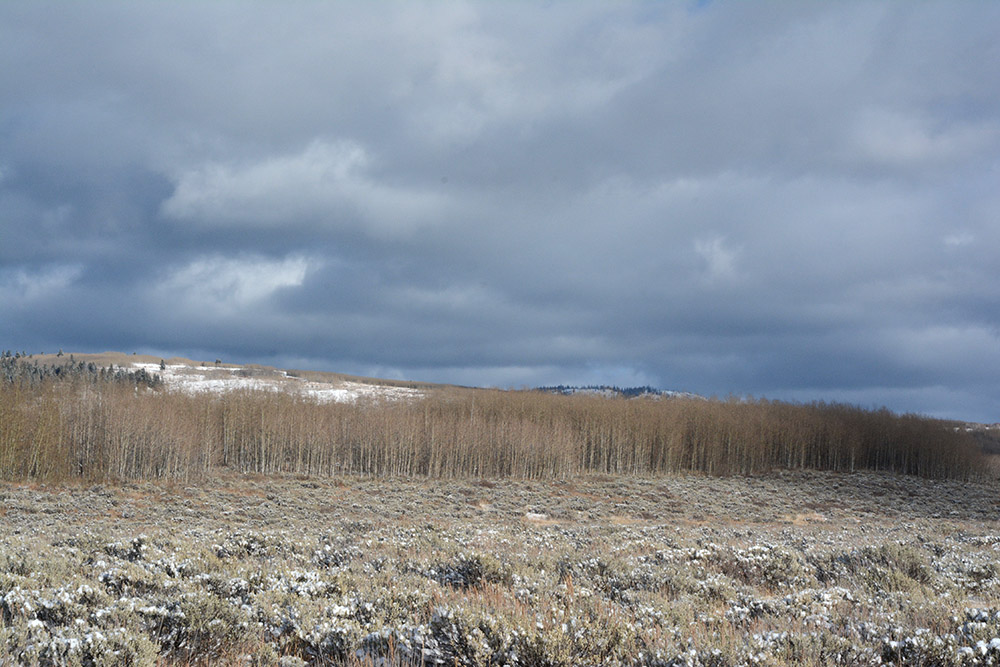
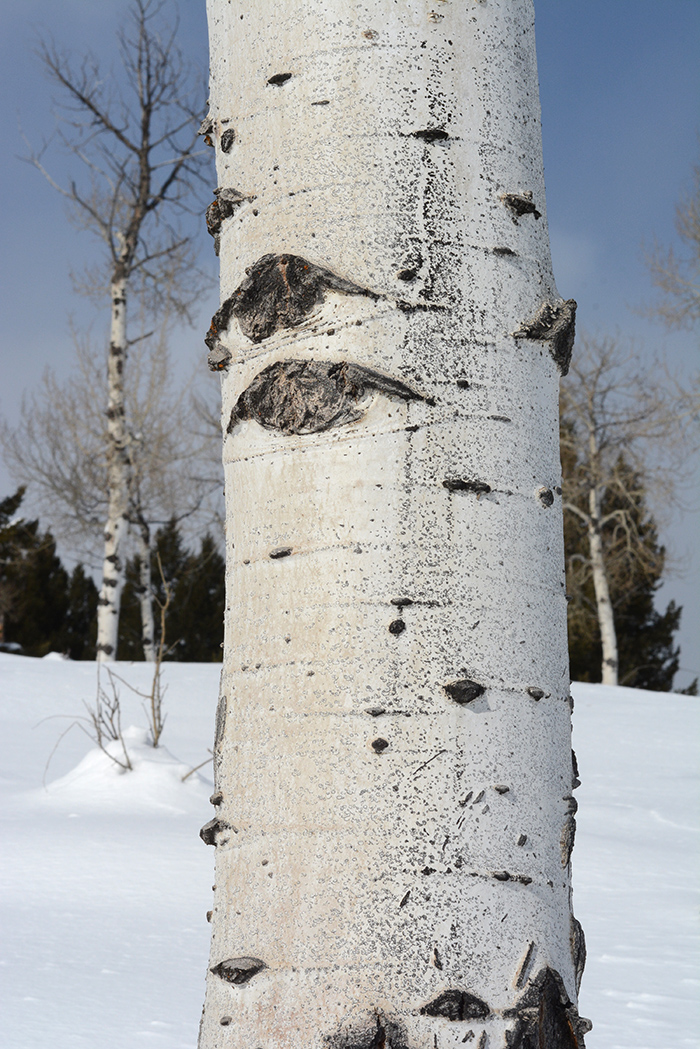
Trembling Aspen Populus tremuloides – is our most common deciduous tree in Jackson Hole. Aspens form clones that blanket large areas of hillsides, particularly on the eastern hills of the valley.

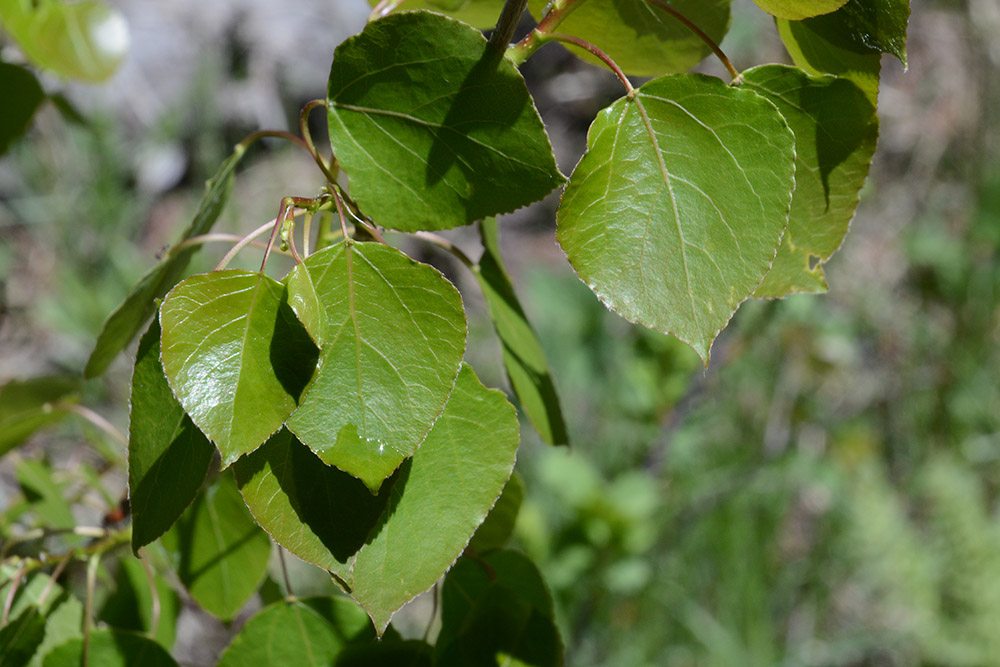
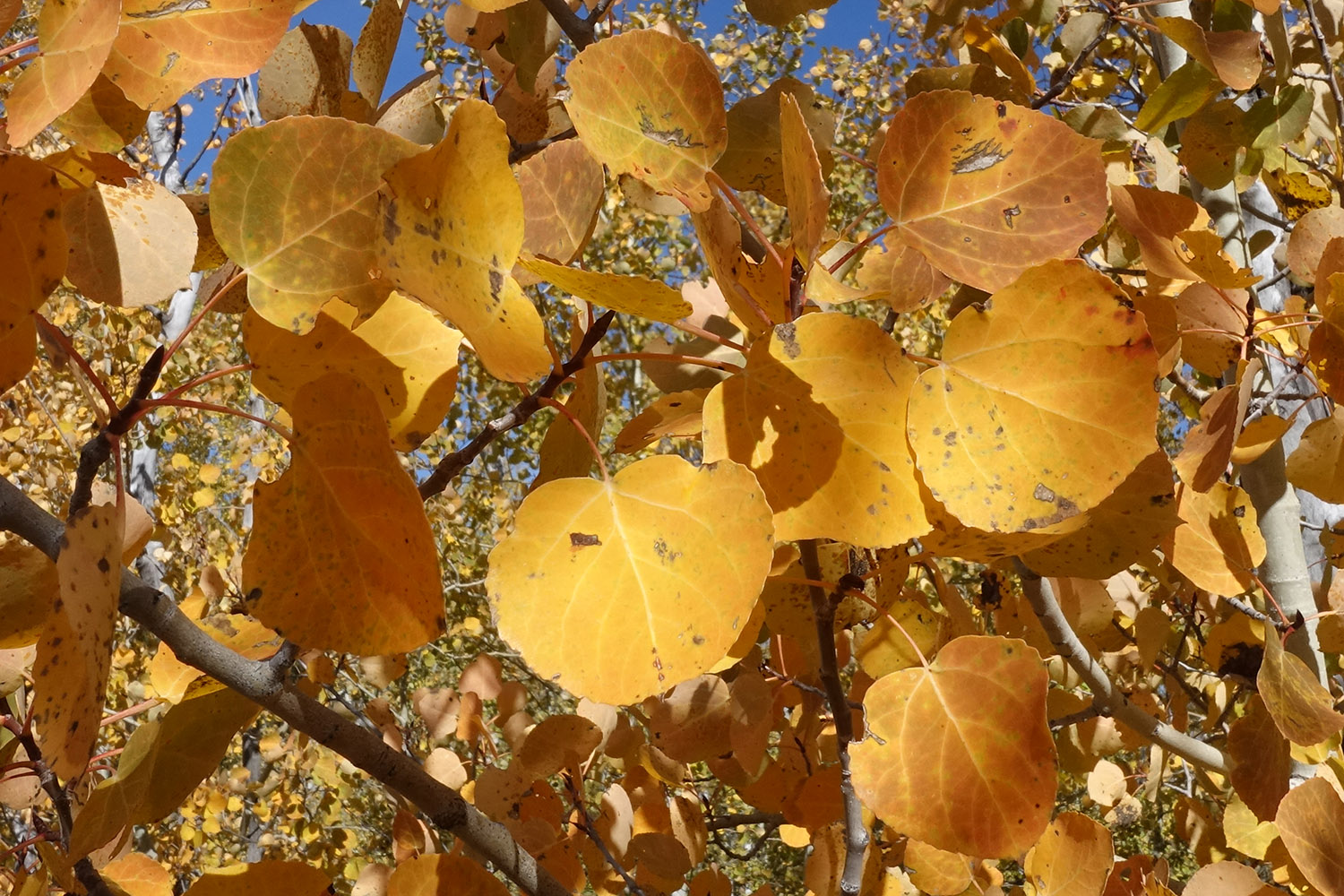
In spring the spade-shaped leaves unfurl a luminescent green and by October fall off in a dramatic show of yellows and oranges. In winter the smooth, greenish-white bark stands out. By looking closely at the shape and patterns on the trunks, one can see the similarity among these genetically identical sprouts.

The whitish trunks with black scars where the limbs branch out are the easiest ID feature. The bark is usually smooth and the outer cells of the bark will often rub off on your hand. There is a layer of green chlorophyll just under the thin bark which aids in photosynthesis in winter. 

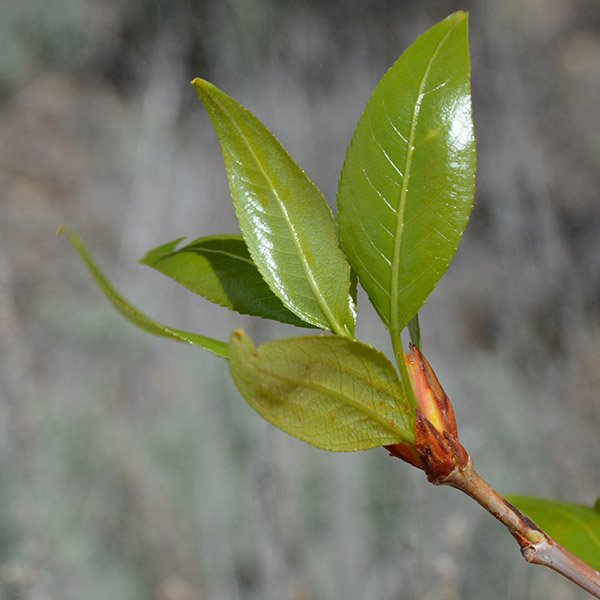
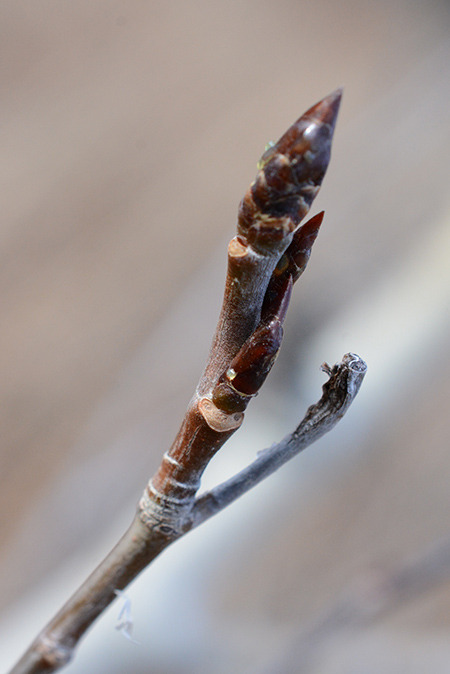
The buds are smooth, dark brown, elongate, with a few bud scales and a leaf scar with 3 traces. 

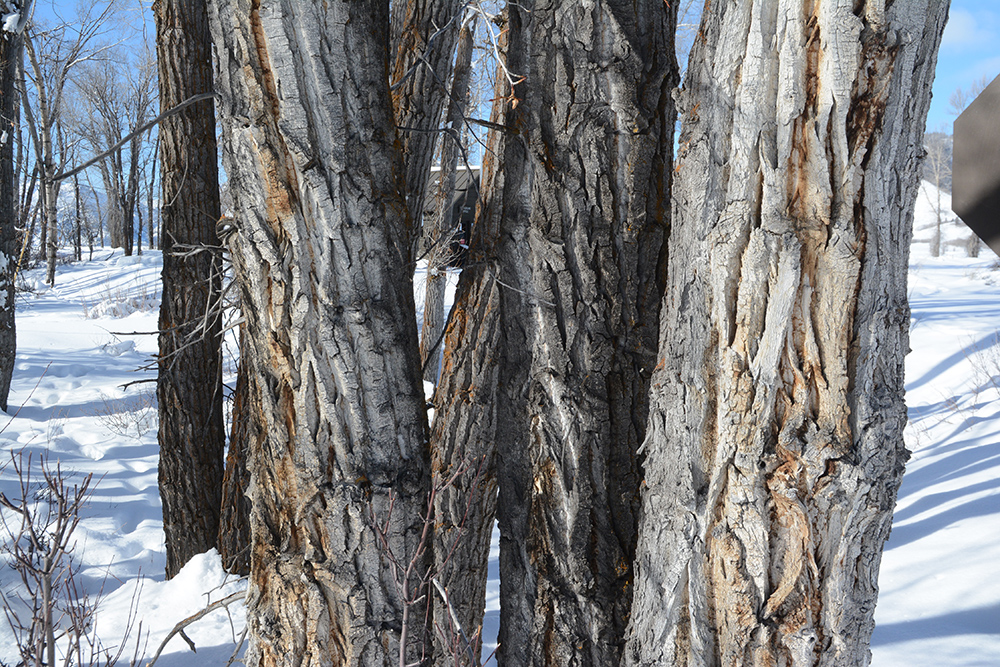
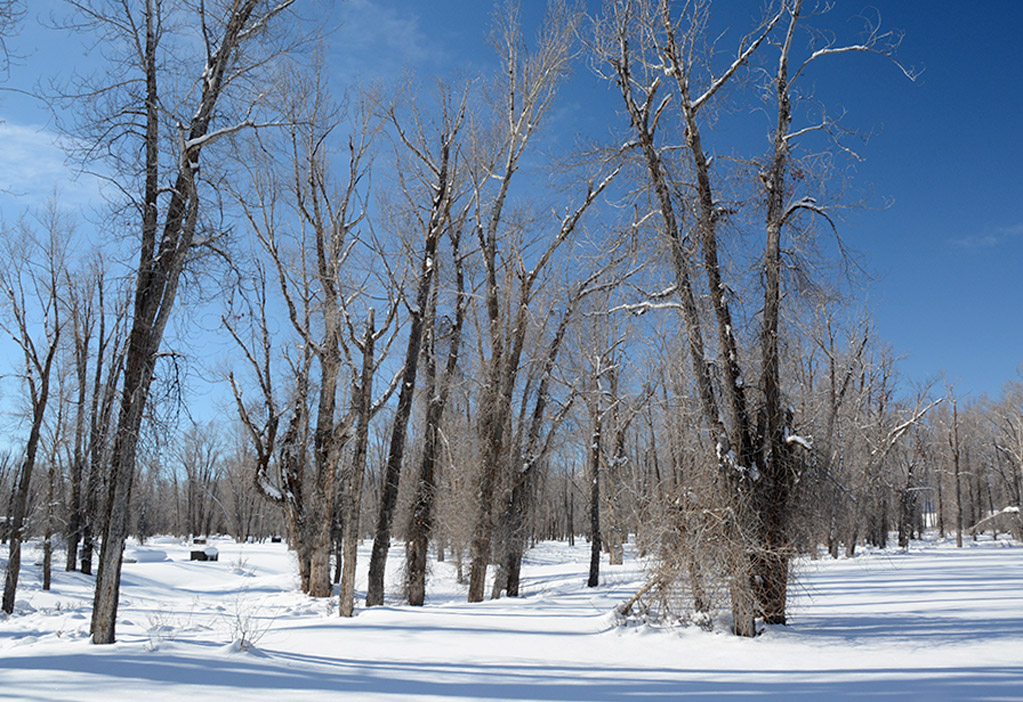
Aspen have cousins called Cottonwoods. Narrow-leaf CottonwoodPopulus angustifolia, (and P. balsamifera, P. acuminata) – are easiest to tell apart from Aspens by the plant’s larger size overall and much thicker, rougher bark. Cottonwoods grow in floodplains and along old drainage ditches.

They tend to grow as stand-alone trees or groups, not in clones. The lower trunks often have shaggy-looking side branches.

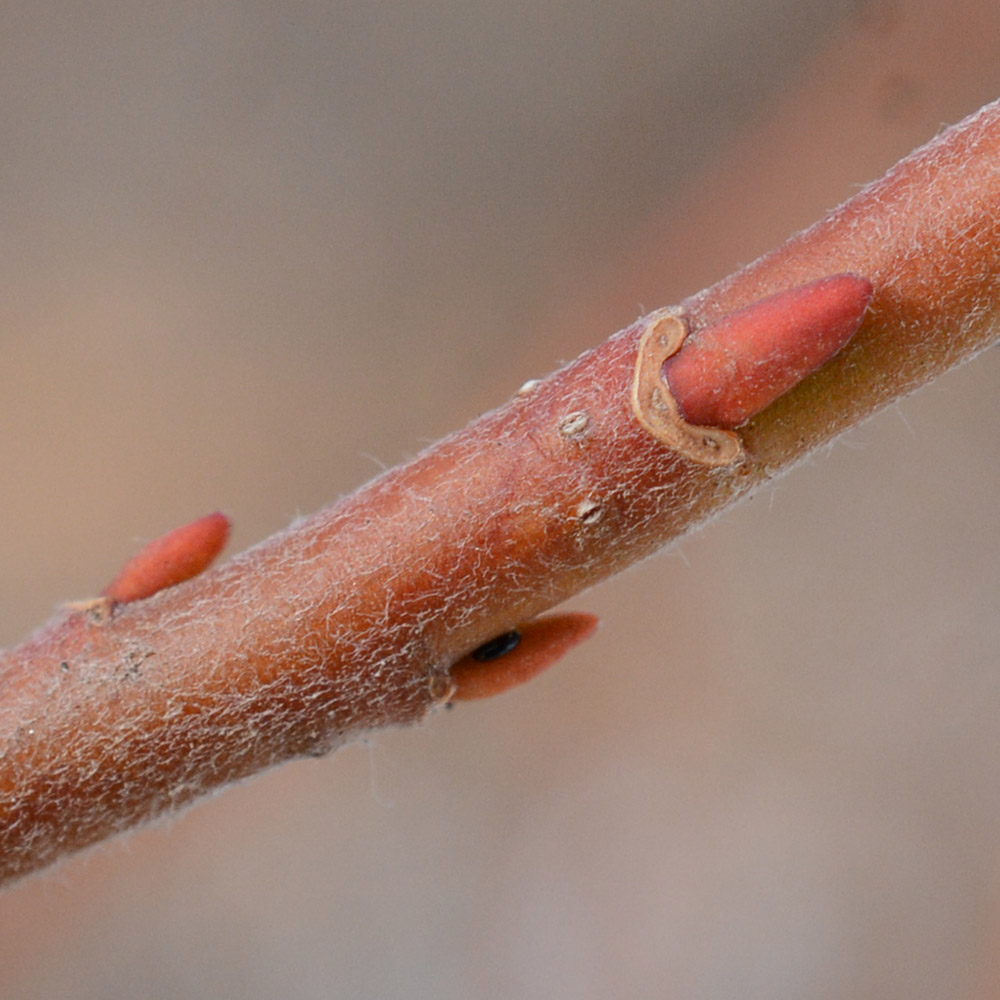
Cottonwood buds are larger than Aspens, and some are rather resinous and fragrant. Scales are less distinct.

WillowsSalix spp. – are in the same family as aspens and cottonwoods.  We have 28 native species of willows in Teton County growing from alpine zones to wetlands and floodplains as shrubs. Several of our medium-sized species have stem colors ranging from yellow, orange, to reddish.

This is just one of 42 willow species. They vary greatly in size and overall color.

The easiest way to know a willow in winter is to look at the buds.

Buds alternate and have a single scale—sock like—over the growth point beneath. The bud scar is narrow with three bundle traces. Relatively larger buds on a stem harbor pussies – the silvery “furry” catkins that emerge in spring.

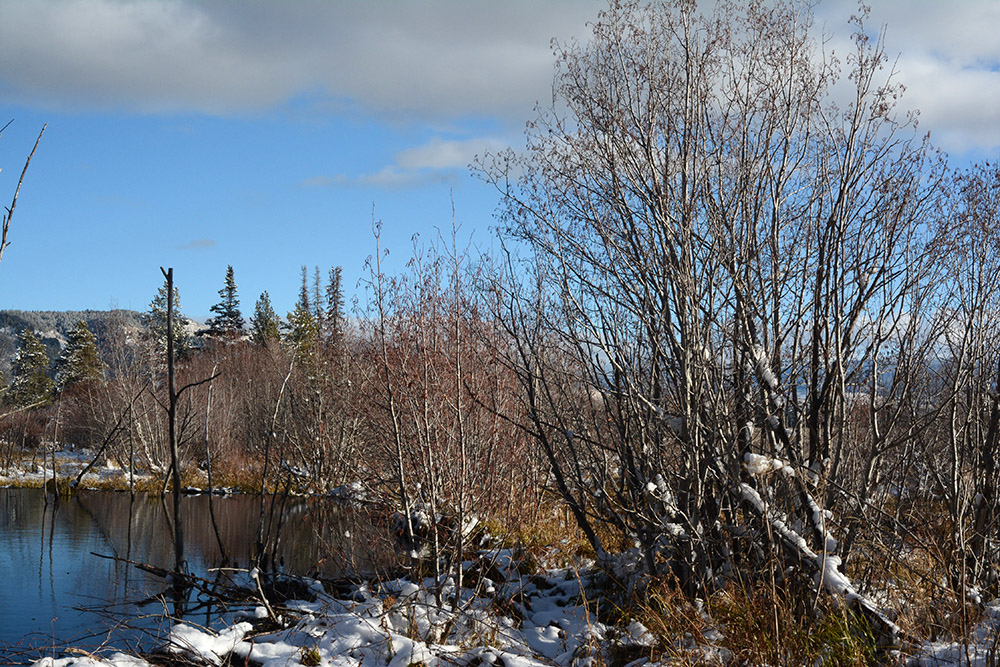
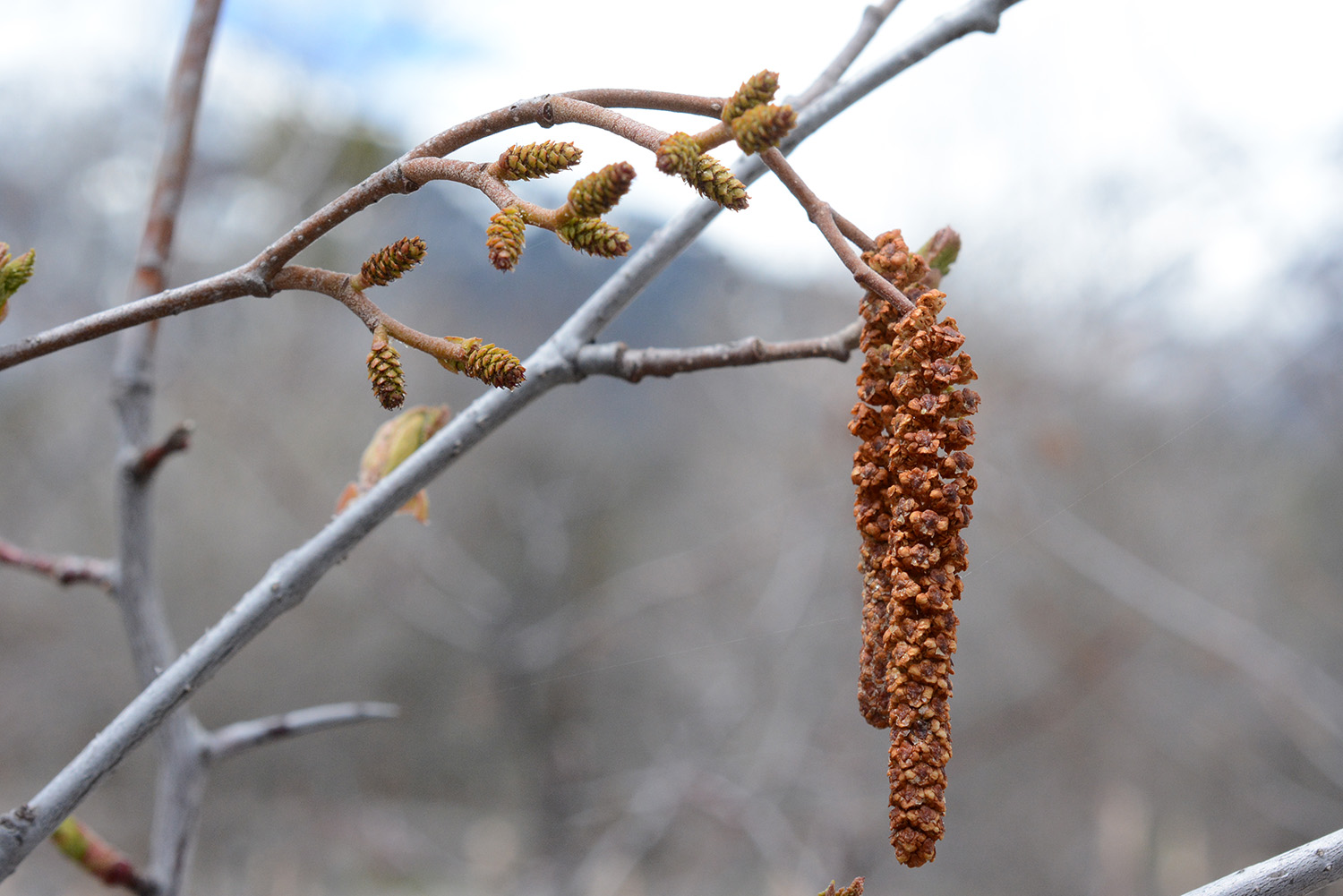
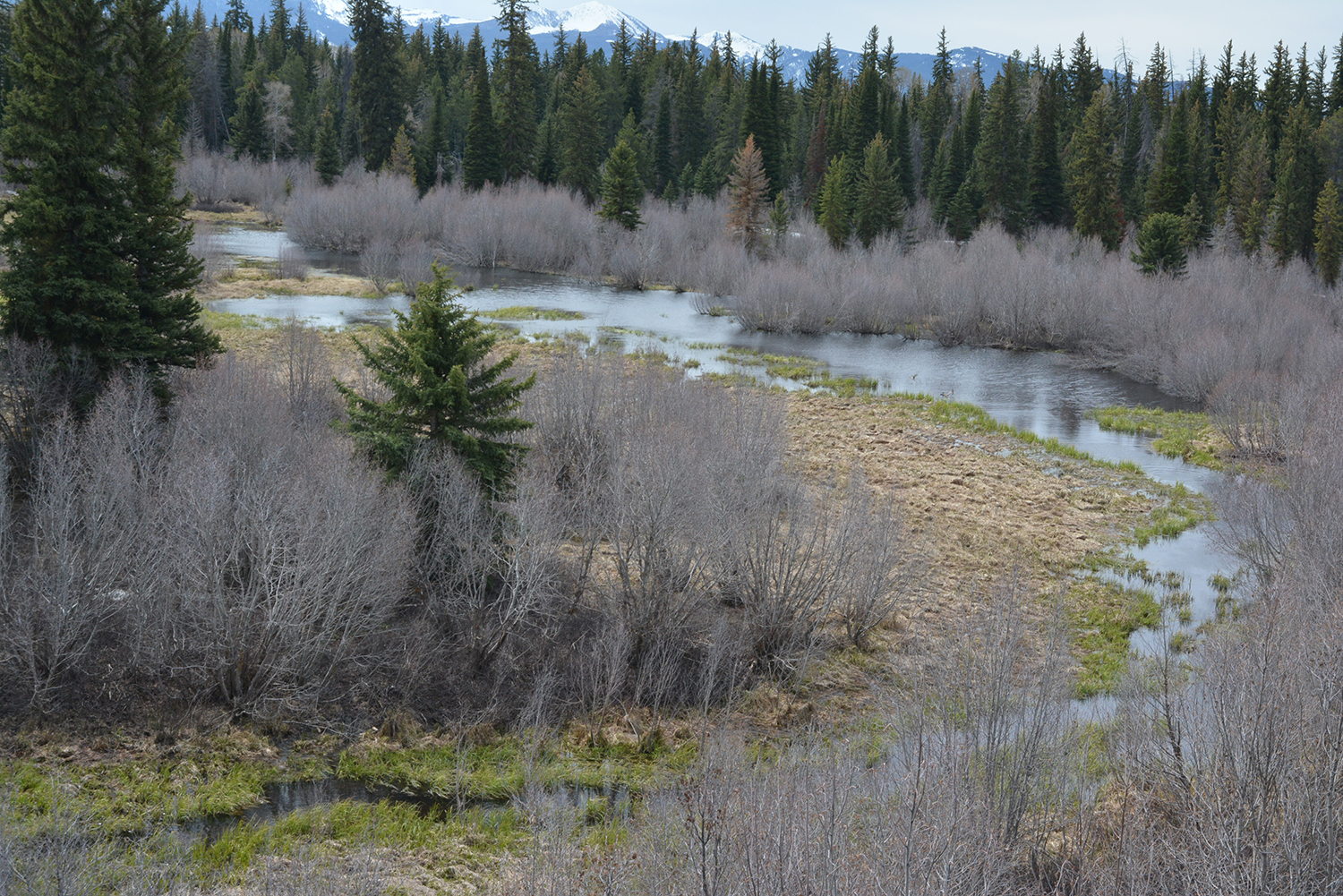
Thin-leaf AldersAlnus incana ssp. tenuifolia/occidentalis – grow in wet areas and are often inaccessible for a close look.

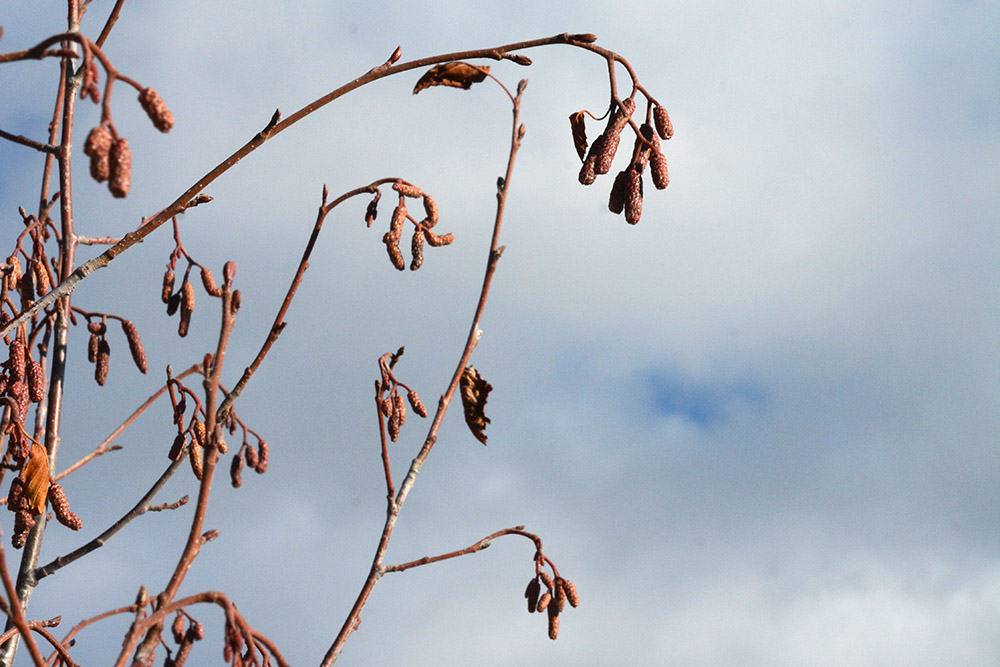
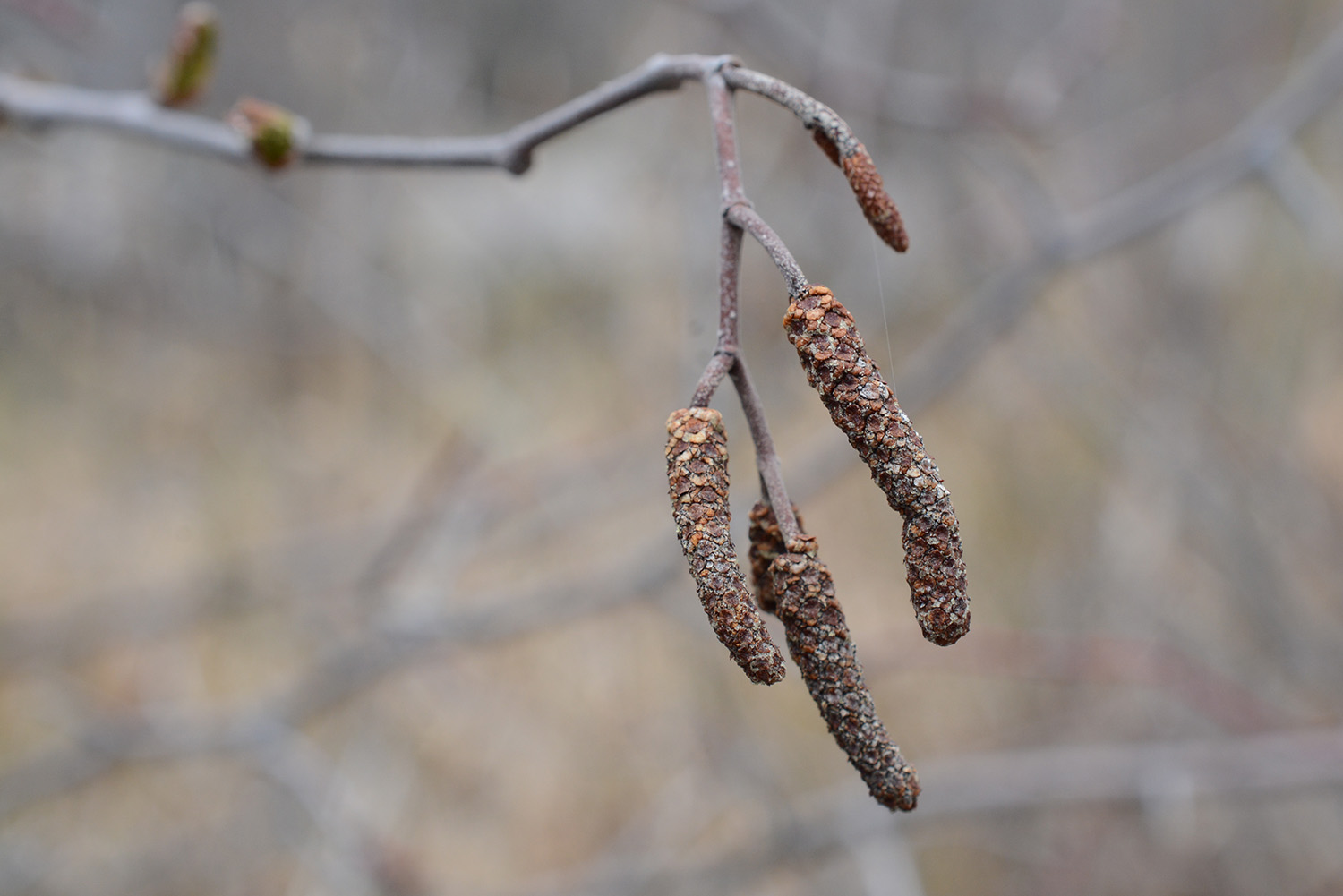
However you can often see the elongated buds dangling from 10-15′ high branches. These male catkins will open to shed pollen upon the wind in early spring.

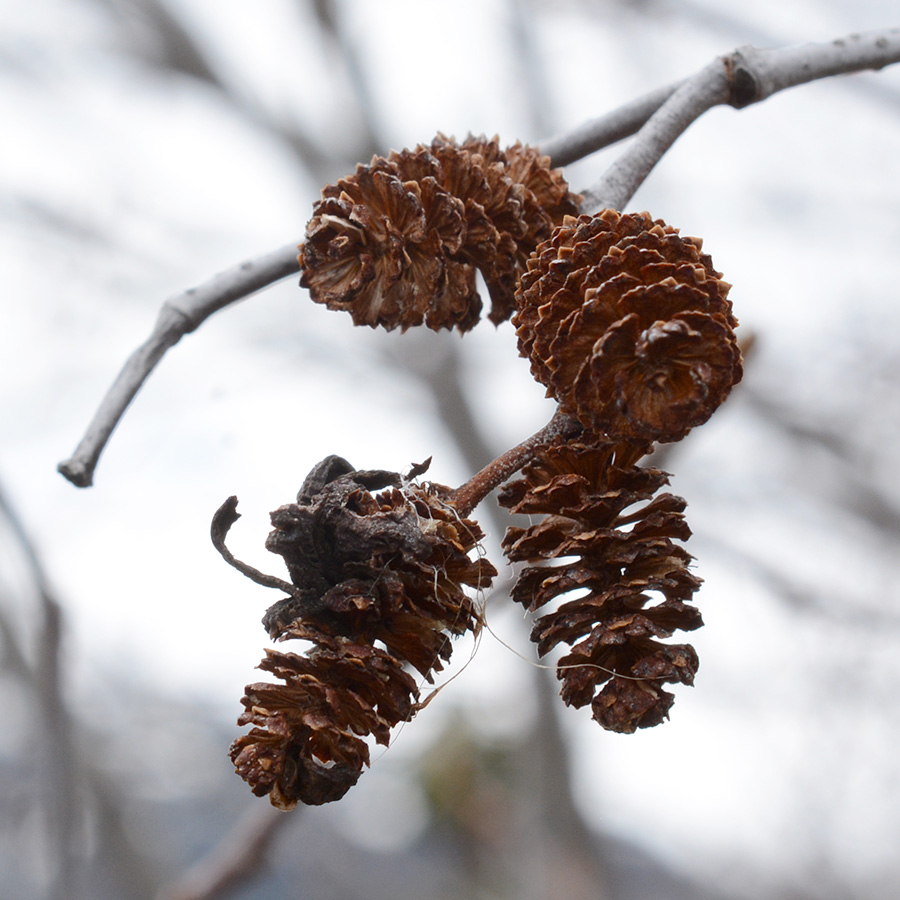
The woody cone-like structures are last year’s female catkins that shed their seeds last fall. 

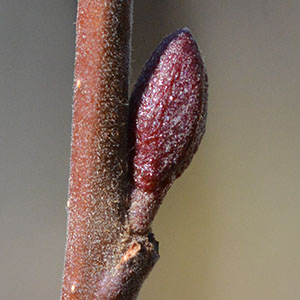
Buds for next spring’s leafy stems have two opposite – valvate – scales on a bit of a stalk.  

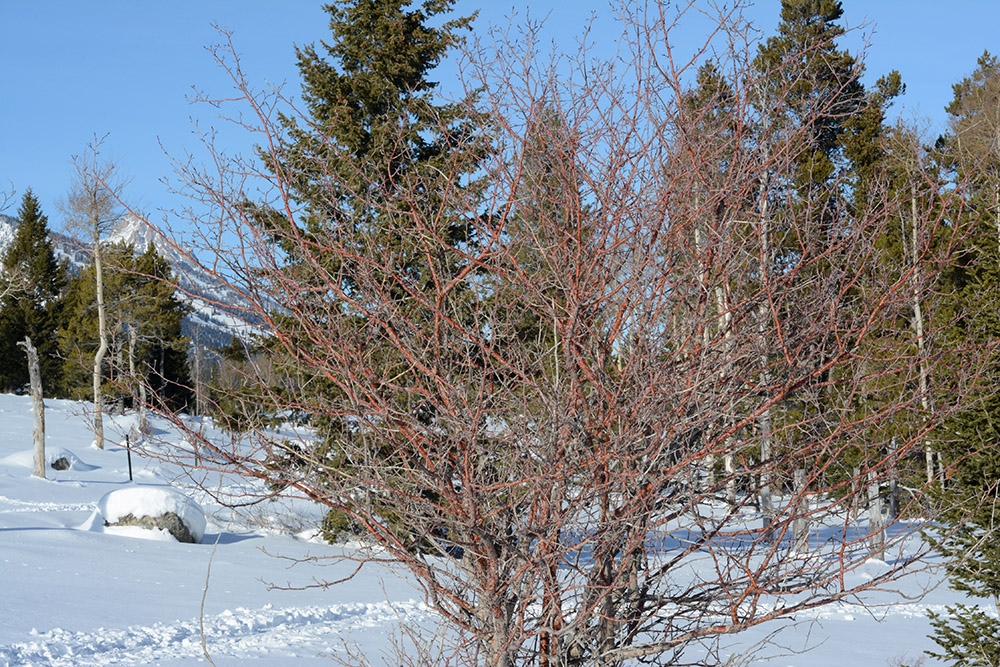
The bark is gray with lenticels – pores that allow for gas exhange through the bark of the stem.

Alders are important for preventing erosion along streams and avalanche slopes. Plants are able to establish in poor soils as they can fix-nitrogen with the aid of bacteria in root nodules. The nitrogen is used for the alder to grow. When the leaves drop and breakdown, the nitrogen is then available for other plants to use as well. The many fine alder roots also hold the ground.   

Trees and Shrubs with large fruits—if you can find them:

Many of the following shrubs and small trees provide substantial fruits for a variety of birds, small mammals and large, and they tend to disappear fast, before winter. Branches and buds serve as nutritious browse for deer, moose, and grouse. Thickets provide protection from predators and wind. Bark and buds, and maybe a shriveled leaf or fruit, can help ID. Use all the clues you can find.

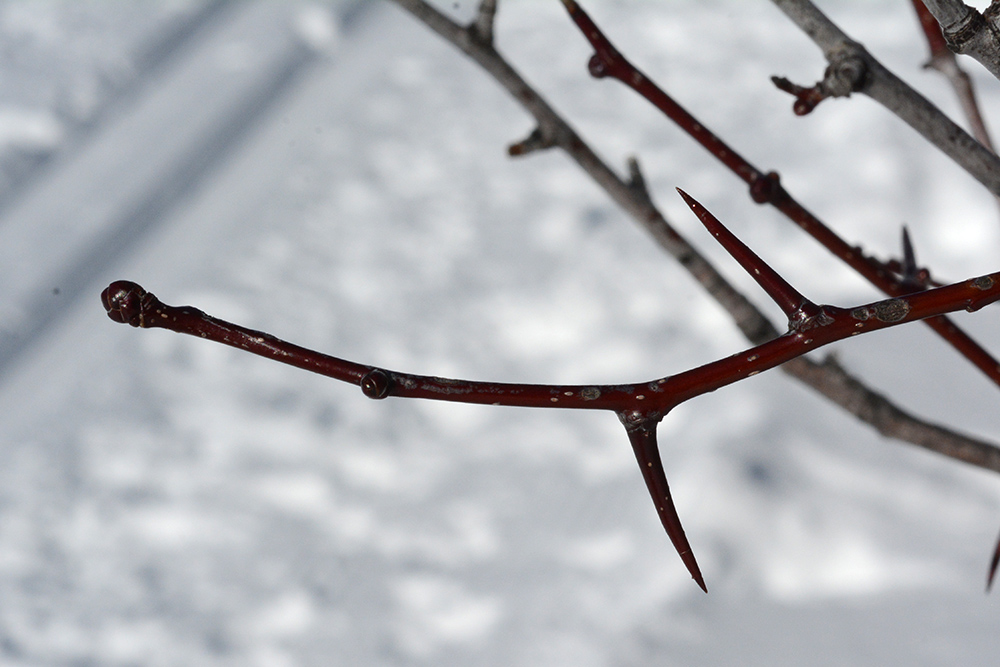
Douglas HawthornCrataegus douglasii – are typically small 15-20’ roundish trees.

They have 1”, slightly curved to straight thorns. Thorns are technically modified stems. The young twigs are shiny maroon, aging to orange. The buds are distinctly round. 

There may be a few remaining shriveled fruits, but the bears tend to get to them first. Hawthorns are frequent around LSR visitor center and along the Moose-Wilson Road. Watch for the thorns when you are out skiing.

ChokecherryPrunus virginiana – can grow to 20′ or more. It is found along roadsides of Moose-Wilson Road, along Old Pass Road, up draws of buttes, and mixed into edges of forests.

Bark often has dots or lenticels—pores where gases can go in and out of the stem.

If broken and warm enough, twigs have an odd smell – a bit like almonds. Cherries have the chemical ingredients for cyanide. 

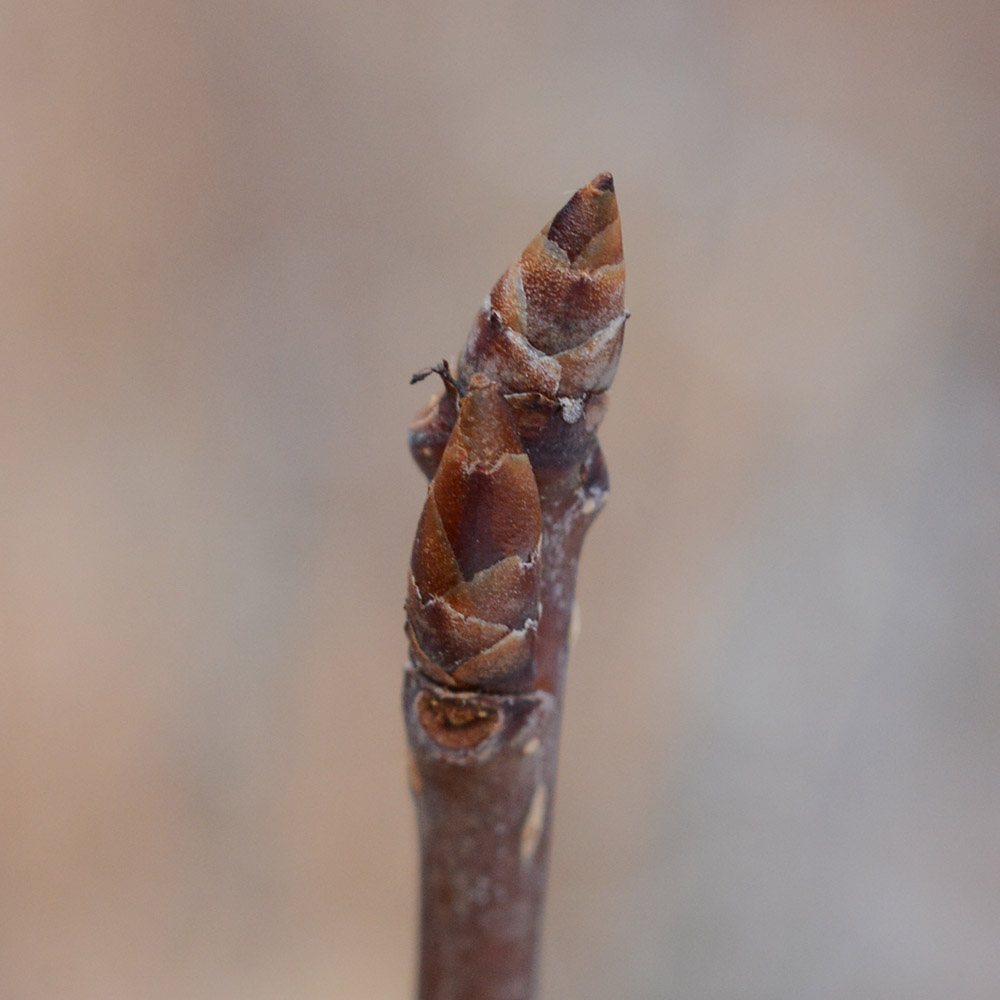
Buds are alternate, pointed, with several smooth scales. 

The leaf scar is roundish and with three bundle traces – the central one is larger.

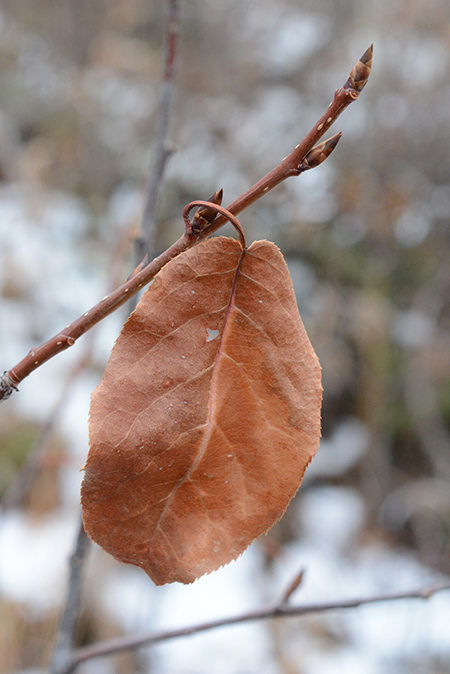
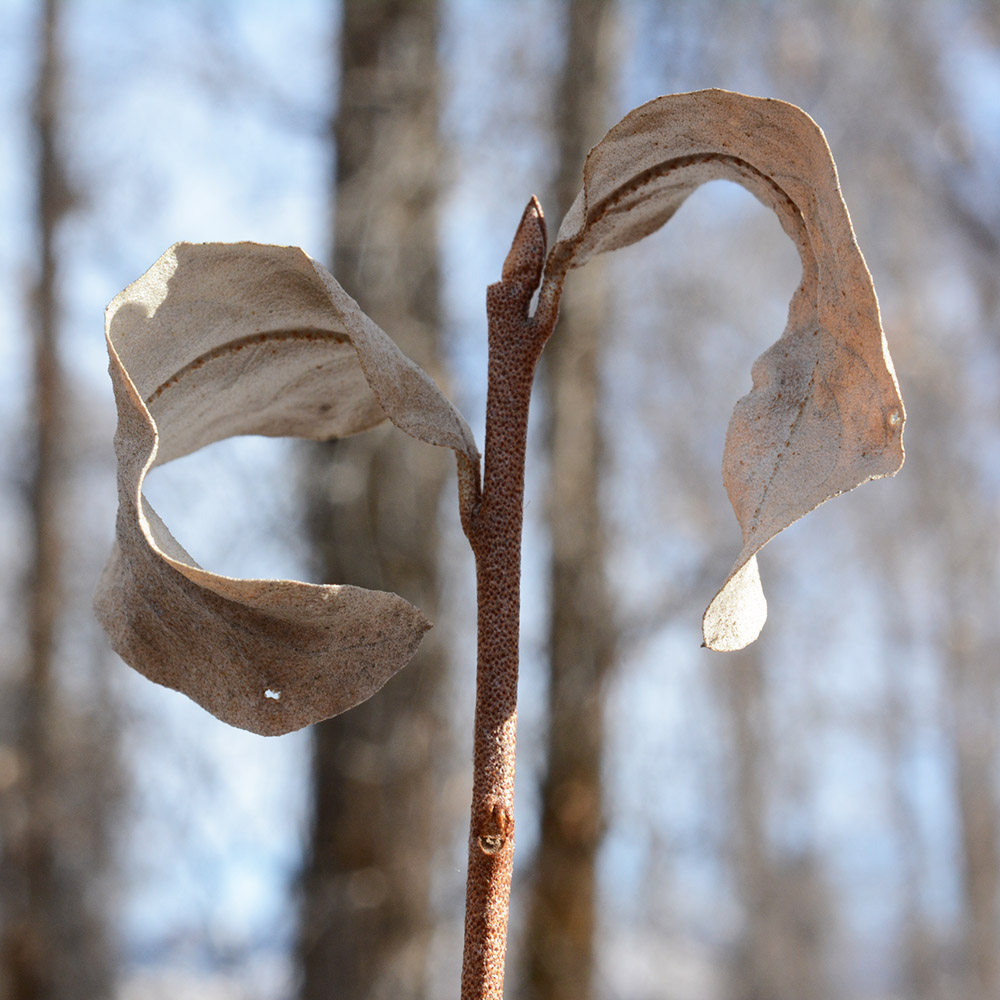
Sometimes you are lucky to find an old leaf hanging on….This is very helpful! The leaves are 2-3” long, oblong with little teeth all along the margin.

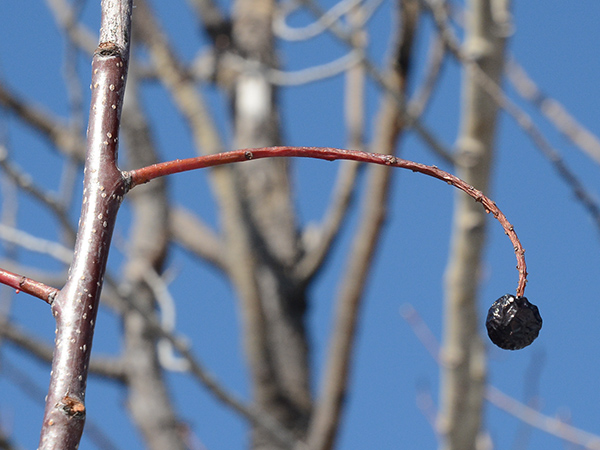
You may also find an old fruit stem…it arches and sometimes has little stubs where the fruits were held.

Note the lenticels on the stem and the smooth fruit, the last of several on the flower stalk.

The fruits were likely consumed by birds or bears. The hard seeds (pits) pass right through them. However, as humans it is best not to bite into the seeds…. they harbor prussic acid e.g. cyanide. Native Americans and fur trappers used to make pemmican from mashing the fruits and seeds in with animal fats for their own survival during winter. The process breaks down the pit poisons.

ServiceberryAmelanchier alnifolia – is similar in size and habitat to Chokecherry. Look closely for the differences:

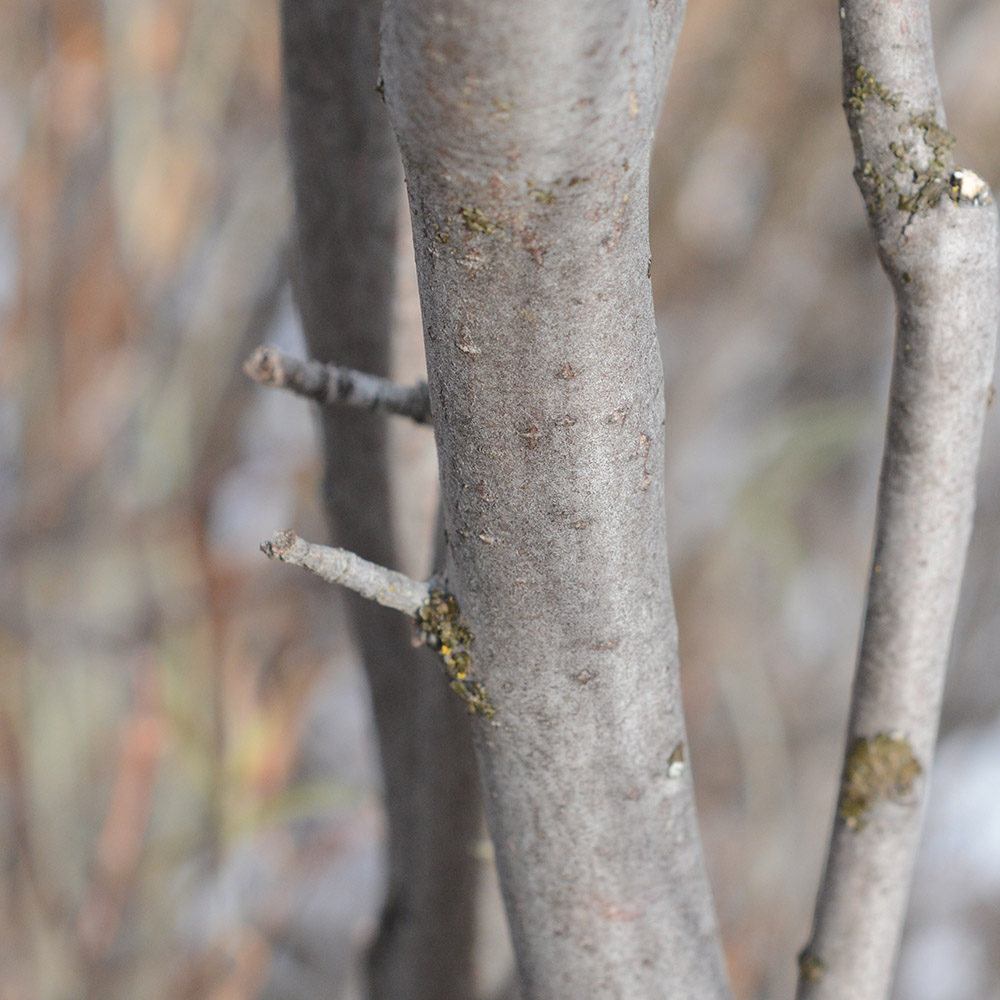
Bark is light gray.

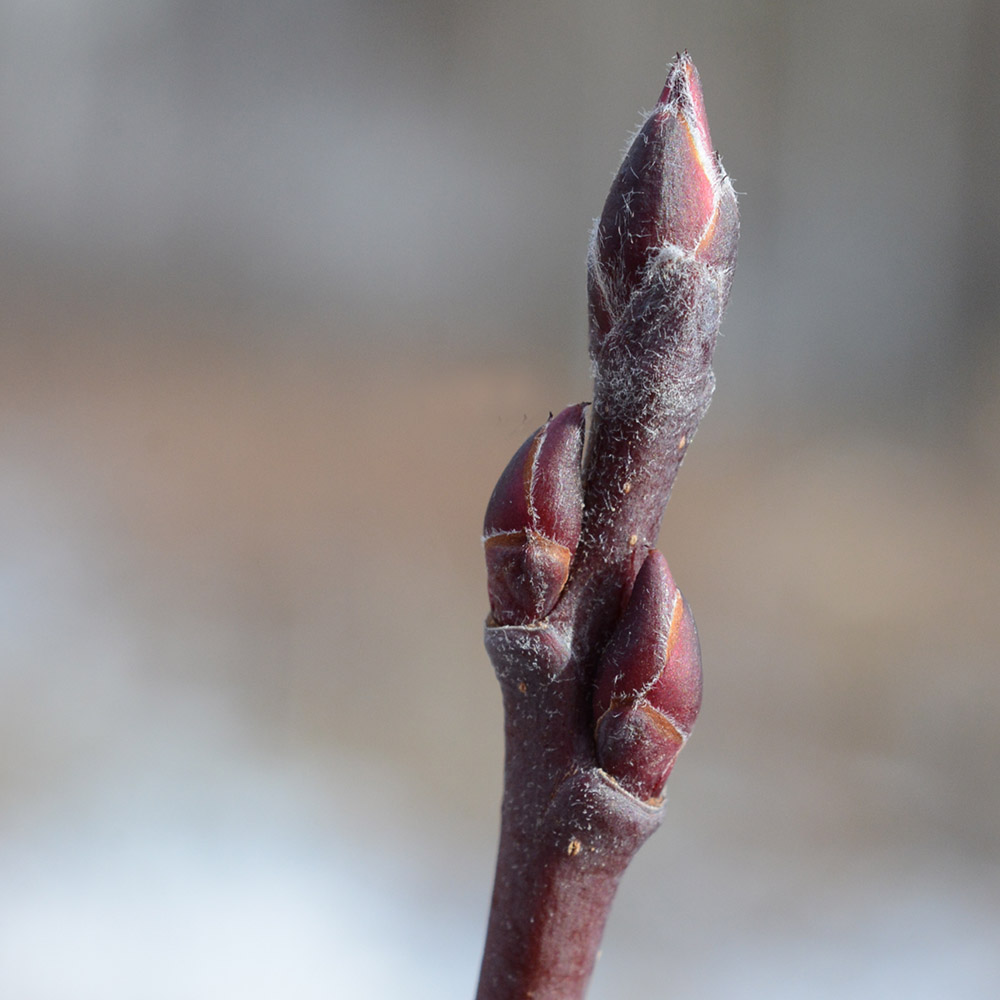
Buds are pointed with several tidy scales, often pubescent. Leaf scars are very narrow.

Dried leaves are roundish with teeth near the tips. 

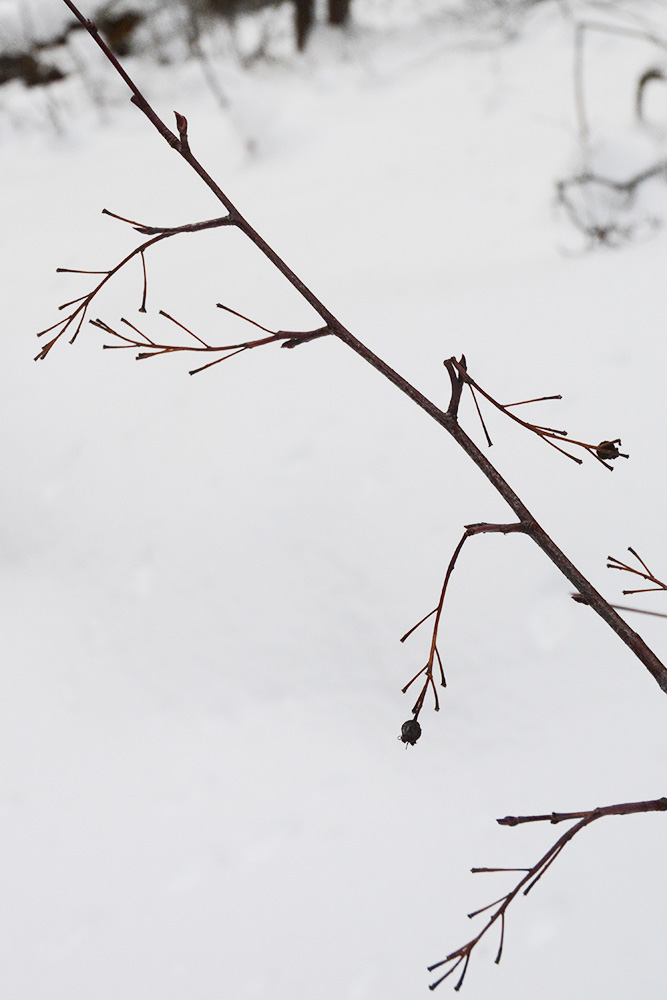
Shriveled fruits are held on stems of various lengths..

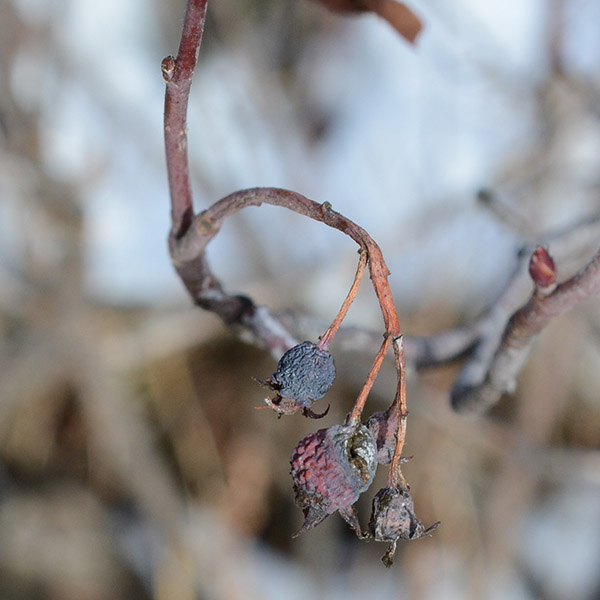
Note: Unlike the Chokecherry’s fruit which is smooth, the shriveled serviceberry fruit has a rough spot at its end:

Seeing the differences Serviceberry vs. Chokecherry is not easy:

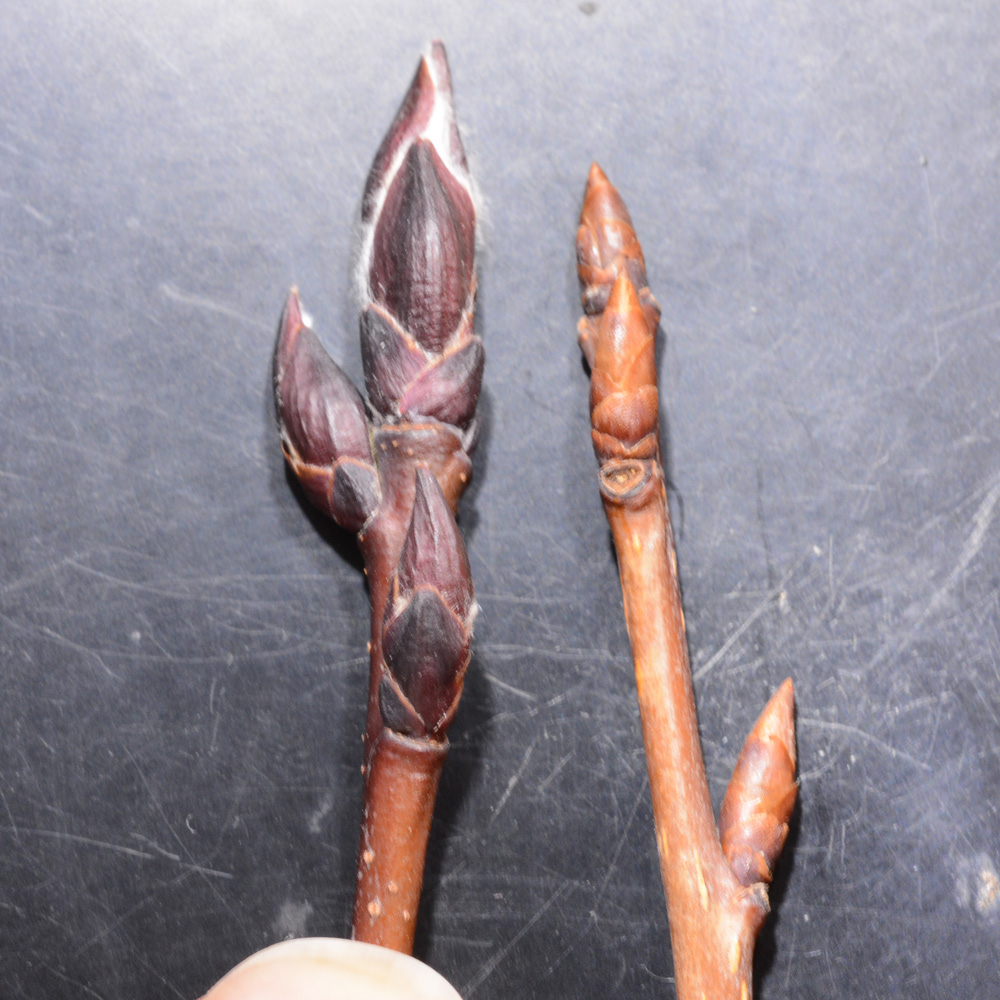
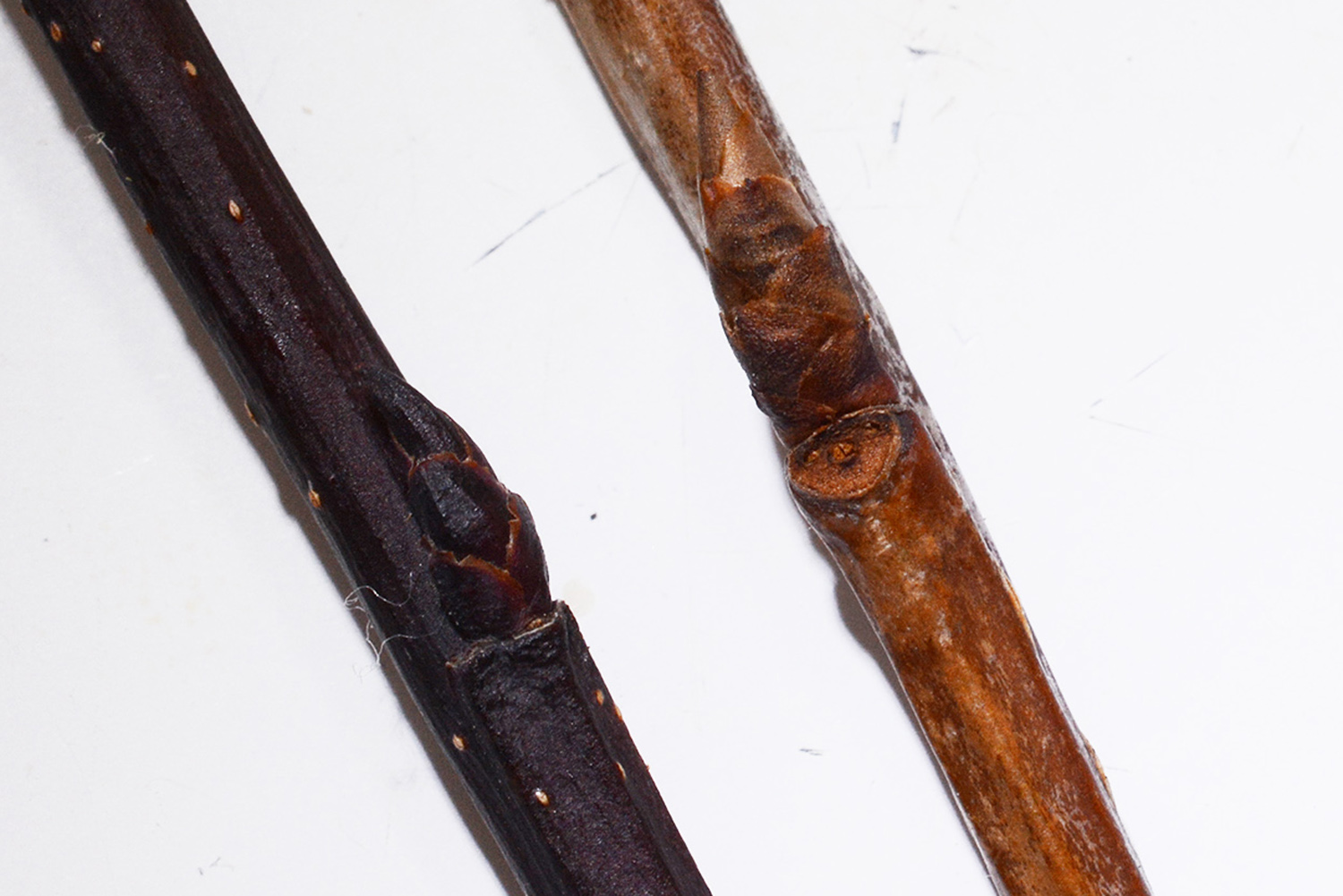
Serviceberry (l) vs. chokecherry (r): note size of buds, color, and scars.
Close look at the buds and scars: note the leaf scar is narrow on serviceberry and the chokecherry with roundish scar with one obvious bundle trace in the center–(like the pit of the fruit).

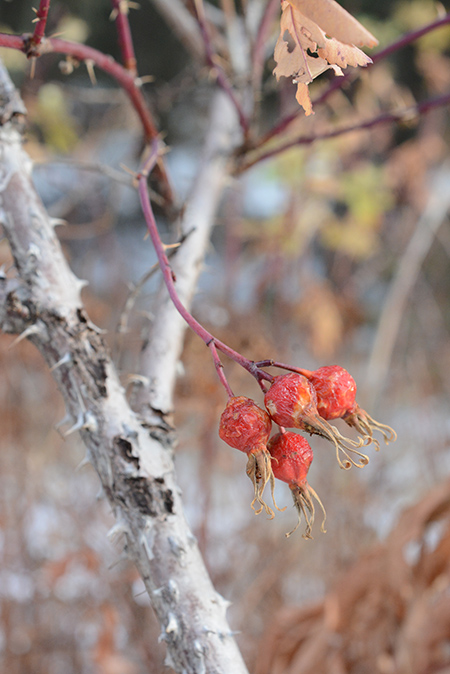
The stems of Wood’s and Nootka Roses – Rosa woodsii and R. nutkana – are covered with “prickles”, which arise from tissue layers on the stem. In winter, young stems are red to purplish and the prickles stand out. Older stems are gray.

Fruits of roses often remain throughout winter until wildlife are really hungry. If you dissect a rose hip you will discover the true fruits inside: several dry achenes each wrapping a single small seed.

The red hip is actually the swollen bases of petals and sepals fused together in a structure called a hypanthium. It has high levels of pectin and Vitamin C.

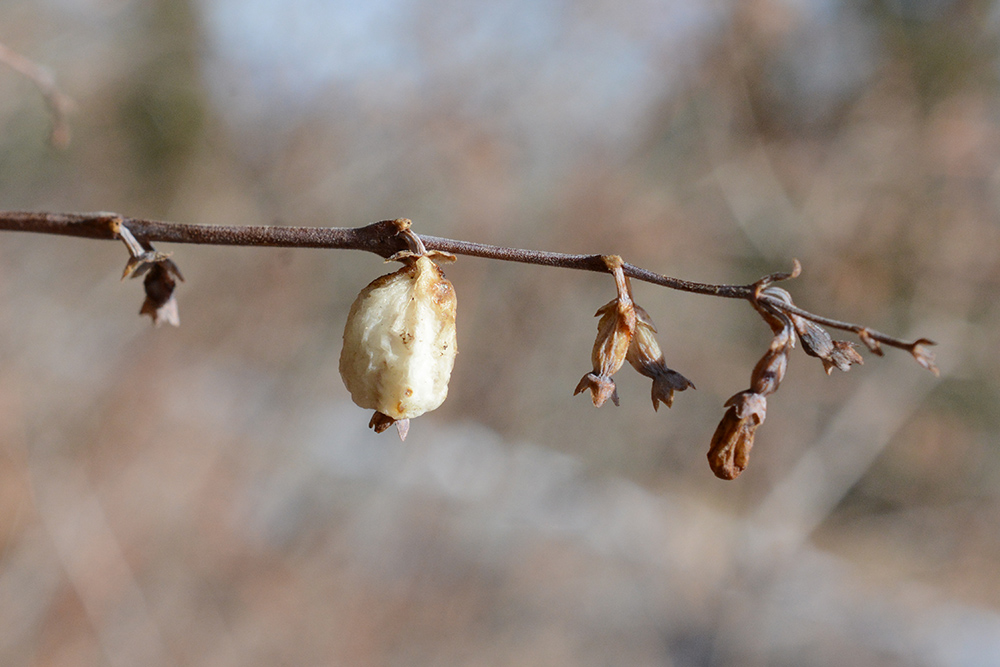
Snowberries – Symphoricarpos albus and S. oreophilus – still may hold onto a few shriveled white fruits.  

The overall look is “twiggy” with slender side stems and small opposite buds.

Look at the thin, opposite branches with opposite small buds and the line between them.

Snowberry leaf buds. Small and pointed.

The white mushy fruits are technically drupes, which have an outer skin, fleshy innards, and then a two very tough oval seeds. Critters from birds to small mammals appreciate the fruits and the protective thickets. Snowberry is also a key host plant for Vashti Sphinx Moths.

Red-stemmed DogwoodCornus stolonifera – is true to its name. Overall appearance of the plant is deep maroon.

Young stems are particularly red.

Note the branches are opposite, like the buds.

Buds have a single scale, like a willow; but notably the buds of dogwoods are opposite on the branch. The leaf scars are very narrow.

You may also find remnants of the array of fruits.

As they are energy packed with lipids, most of the white-to-blue fruits were quickly consumed by migrating birds in the fall.

Red-stemmed dogwoods are considered “moose ice cream.” The stems are favored by these huge ungulates. As the plants grow fast, I welcome the moose pruning my ornamental native dogwoods.

SilverberriesEleagnus commutata – are most often found here in flood plains. You can see them spreading by rhizomes under cottonwoods along the Snake River. The silvery leaves alternate on the stems, often remaining into winter. Note the copper-colored, scaly texture of the stems and the simple buds.

The silvery oblong fruits dangle off 6-10′ high branches.

Research indicates that moose particularly like this plant for browse. Various birds will use the fruits. Domestic stock do not like to eat Silverberries.
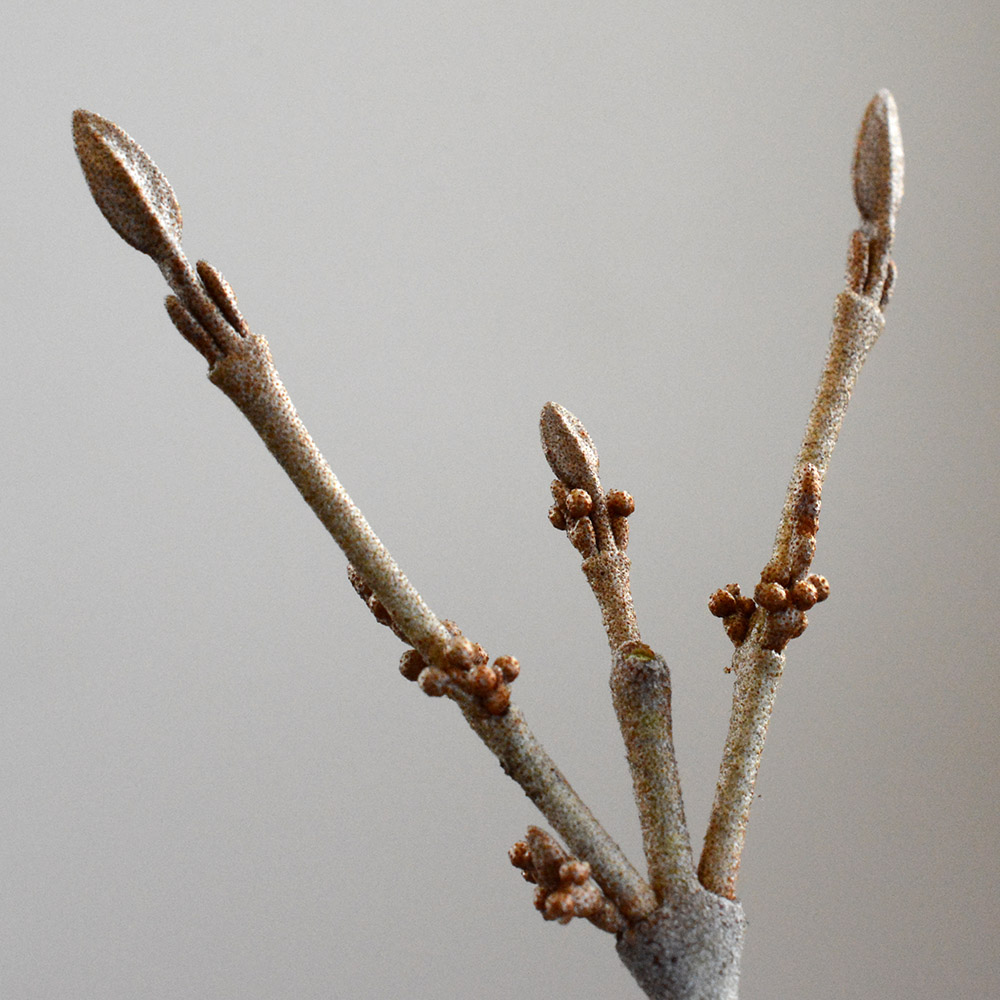
Its relative, Russet BuffaloberrySheperdia canadensis – also has the little rusty dots on the stems indicative of the Oleaster or Eleagnaceae Family.

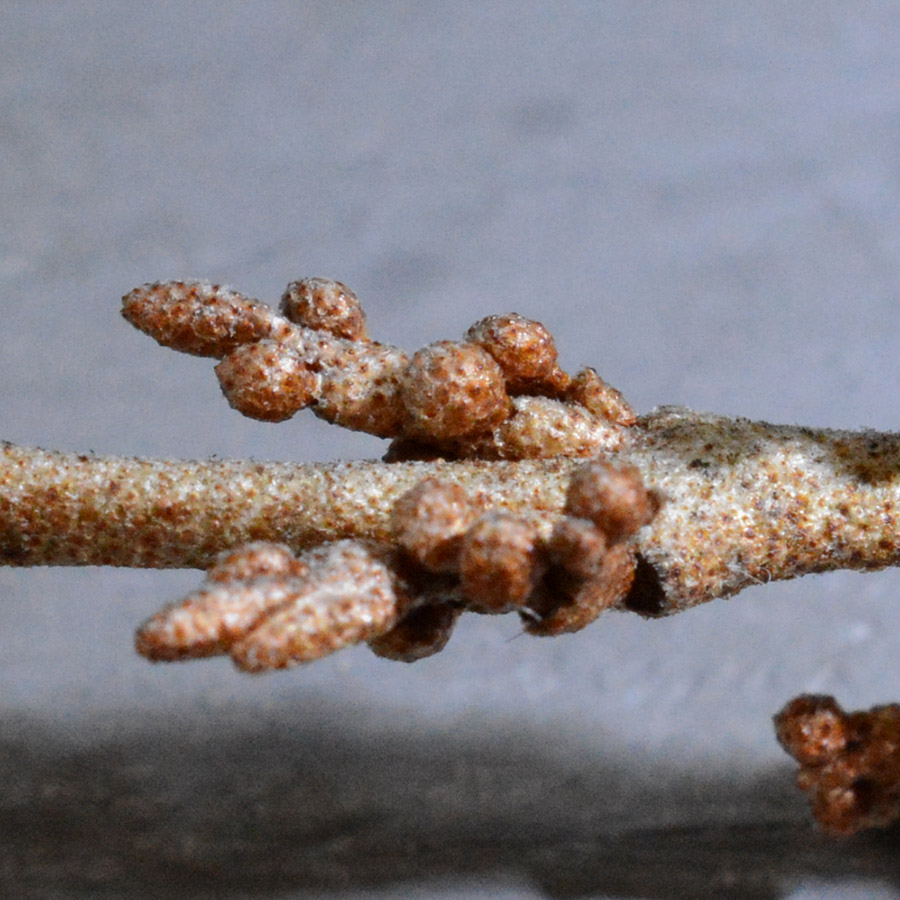
Note the buds are opposite. The terminal buds already have the formation of paired leaves in prayer. The oblong side buds have one scale and will emerge as leaf-bearing branches. The clustered round side buds will become small yellow flowers in spring: male flowers on one plant, female flowers on another plant.

The berries are red with the same rusty covering. I haven’t seen any at this time of year.

A few low shrubs with small dried fruits:

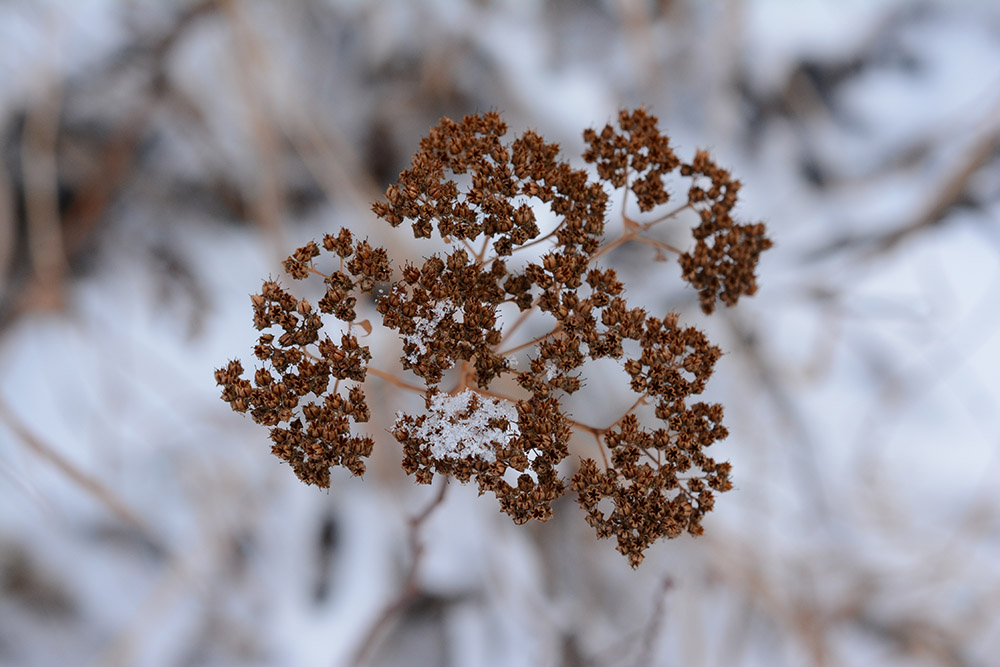
Sometimes you will see the fine 2’ tall stems and 3-4”-wide dried inflorescence of Birch-leaf SpiraeaSpiraea betulifolia var. lucidula – along a trail.

The flat-topped clusters of tiny flowers have become sprays of 5-parted tiny dried fruits that split open to release tiny seeds. These dried “corymbs” also hold snow.

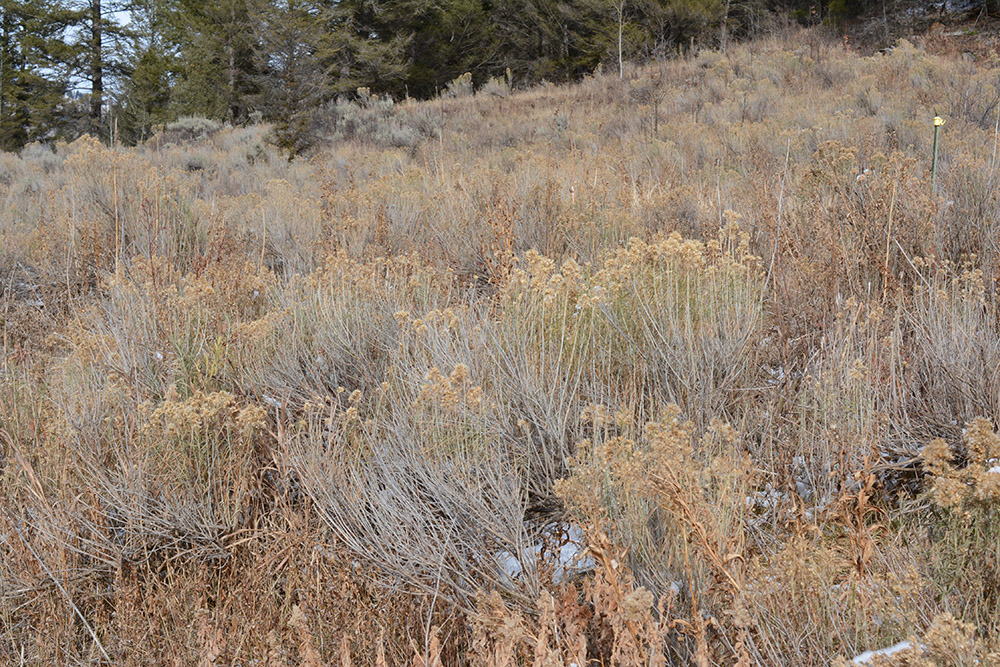
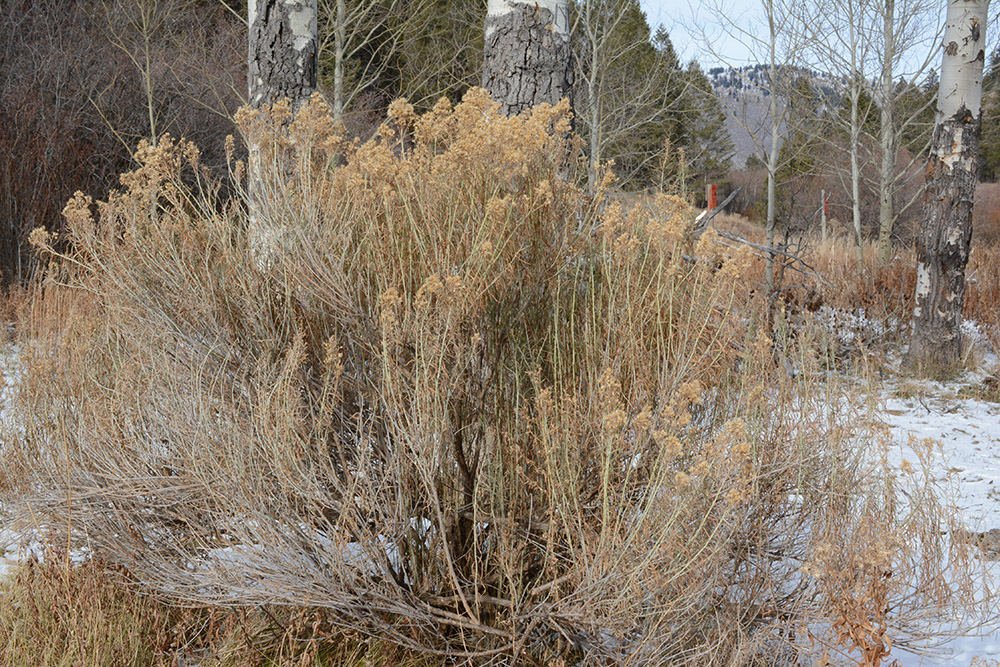
Rubber RabbitbrushesEricameria nauseosa var. graveolens – are abundant along the Game Creek Trail. This is just one of three look-alike sub-species in Teton County.

This species is a large, 2-4’-tall and -wide shrub.

with greyish, finely matted hairs on the greenish stem. The remaining leaves are very narrow, 2-3” long with 1-3 faint veins.

At the tops of the branches are clusters of hay-colored dried bracts remaining from the yellow composite flowers of the fall. They may still hold a few seeds attached to fluff – a pappus, but most have already flown off in the wind. It is in the Aster Family.

Break a stem and take a sniff. If warm enough, it yields a distinctive odor and an unpleasant taste—hence the species name “nauseosus” — a key way to know it is a Rabbitbrush. In warmer weather younger stems are flexible, rubbery, and produce a rubber-like sap which was of interest as a rubber substitute during World War II. The resins are of continued commercial interest. Click here for more detail. Hence the name Rubber Rabbitbrush.

It has two very similar cousins – subspecies – but just knowing this is a Rubber Rabbitbrush is an accomplishment

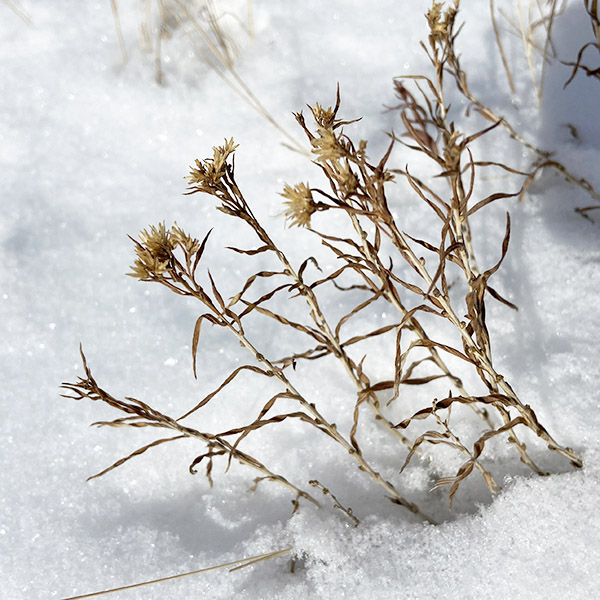
Another related and confused group are Sticky RabbitbrushesChrysothamnus viscidifolius. They are usually only 1-1.5′ tall (more readily covered by snow),

Sticky Rabbitbrushes have twisted leaves and usually smooth brittle stems.

The plants are slightly sticky – viscid – in warm weather–hence the name. Both types of rabbitbrushes overall tend to grow in sunny dry, infertile, often disturbed soils.
Thats a lot of species! Take your time. See how many you can find. Enjoy!
Here is a summary:

Trembling Aspen – tree with white, thin bark with black streaks above side branches; clonal growth over hills,

Cottonwoods – large individual trees with thick ridged bark, in floodplains

Willows – shrubs often with colorful stems; buds with single scale.

Alder – up to 10-25′ colonizing shrubs along wetlands, light brown elongate catkins dangling. Gray bark with lenticels. Buds with two scales.

Douglas Hawthorn – 20′ rounded tree with 1″ thorns, round buds on reddish twigs.

Serviceberry – 20′ lanky shrubs with gray smooth bark; often pubescent buds with a few to several scales, narrow leaf scar; left-over fruits with rough at ends, contain several small seeds

Chokecherry – 20′ lanky shrub with dark bark with dots of lenticels; buds with several smooth scales, rounded leaf scar with one obvious trace; round fruit held on on curved stalks, smooth at end. Hard pit in center. Distinct smell to broken twigs

Rose, Woods or Nootka – 3-5′ shrubs; prickles on stem: young stems reddish, old grey; red rose hips often remain on plants into spring.

Snowberry – common shrubs 2-4′ tall in a variety of upland habitats – very “twiggy” with thin opposite branches and buds; fleshy fruits white and often shriveled or gone.

Red-stemmed Dogwood – shrubs to 4-6’+ high and wide with distinct maroon-to-red stems. Branches opposite; buds narrow bud with single scales. Usually wet areas, often with willows.

Silverberry – rhizomatous 4-6′ upright shrubs, found in floodplains; silvery oval fruits hang off of of rusty looking stems, silvery leaves may remain, alternating leaves and buds.

Buffaloberry – 3-4′ shrubs, rusty stems with opposite branches and buds, terminal buds like two leaves in prayer, clusters of round buds on the side to become flowers. Here and there in shade.

Birch-leaf Spiraea – 2-4′ stems very thin, has flat-topped dark brown clusters of tiny dry fruits. Woodland trails.

Rubber Rabbitbrush – usually greenish stems covered in fine white hairs – tomentum; alternate leaves linear, straight, 2-3″ long; stems have strong odor (if warmed) and flavor; bracts from yellow flowers remain through winter. Dry open sites, often with sagebrush.

Sticky Rabbitbrush – only 1-2′ tall, browned leaves alternate, twisted. Bracts remain on top. Dry sites.

______________________

Dec 1, 2024, (minor corrections 12.12.24)

Frances Clark, Wilson, WY

As always we appreciate your comments and corrections. Please email tetonplants@tetonplants.com

Note: Plants are highly variable in their size and range in habitat. Heights are estimated for this area and habitat based on personal observation.


What’s in Winter? – Evergreens!

Winter weather has come to Jackson Hole. Plants are in dormancy – no growth, no blooms.  However, there are still plants to see, especially trees and shrubs. This posting will focus on the evergreens.

“Evergreen”—what does that mean? Evergreen plants hold on to their leaves through the winter into spring or in the case of conifers over several winters. They form new leaves before they drop off the old leaves; therefore, the overall plant stays green. (There are evergreen tropical plants, but that is another story for another climate.)

Why are some of our plants evergreen?

The short answer: it is a survival strategy in the very cold, snowy weather. Evergreen leaves are tougher, thicker, often smaller than deciduous leaves. Leaves are able to stand up to the snow load, withstand abrasion caused by wind blasting ice grains, and photosynthesize longer—make food—at lower temperatures than deciduous woody plants. They have “invested” more in each leaf; but by keeping these food factories running over several months even years, the investment pays off. The plant survives, even prospers in the difficult conditions.

Our evergreen trees – conifers – dominate our mountains and moraines. They have needles which are thin but tough. Needles are packed with green chlorophyll which is key to photosynthesis—making energy. 

Water is very limited in winter due to frozen ground, so reducing water loss is essential. Thus, much of the leaf is covered by a thick waxy covering (cuticle), and the stomates are embedded in thin white rows. Needles are often bunched together.

Stomates are tiny lip-like openings that take in carbon dioxide and release moisture and oxygen during the photosynthetic process of making starch. Stomates typically open during the day for photosynthesis and close at night for respiration.

Drawing by Mary Lohuis

Conifers have adapted to photosynthesize at relatively low temperatures. During the shoulder seasons, leaves are able to manufacture food. These intermittent times of energy production fuel the plant’s basic metabolic systems. Perennial plants have living cells–such as the cambium layer just under the bark and stem cells in buds–that need fuel during the winter. Like keeping the heat on in your house so the pipes don’t freeze. Conifers also need to fuel the living needles through the long months of winter. Evergreen needles provide enough food to keep the basic systems going and also provide a head start for new growth in spring.  

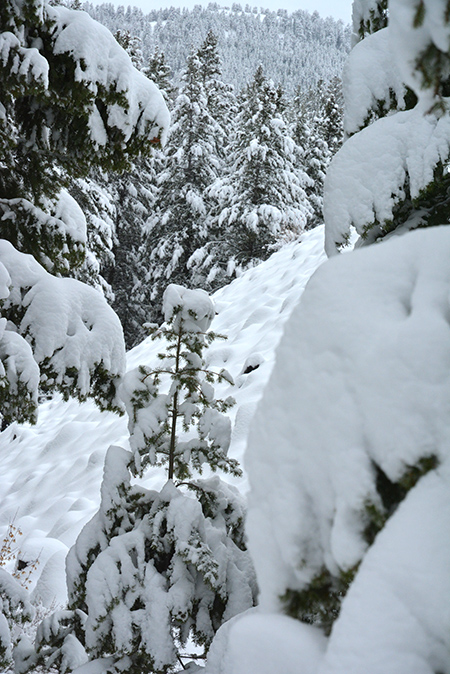
Notably, conifer habit – growth form – helps to keep the trees upright. Branches are evenly arranged around the tree for maximum exposure of leaf surface for photosynthesis and to balance the weight of snow. Branches often retain snow which helps keep the needles from drying. Or if overloaded, the conical structure and downward pointing branches of firs and spruce can shed extra weight. Others, such as Douglas-firs and Lodgepole Pines have strong branches that wave readily in strong winds, dumping off the weight.

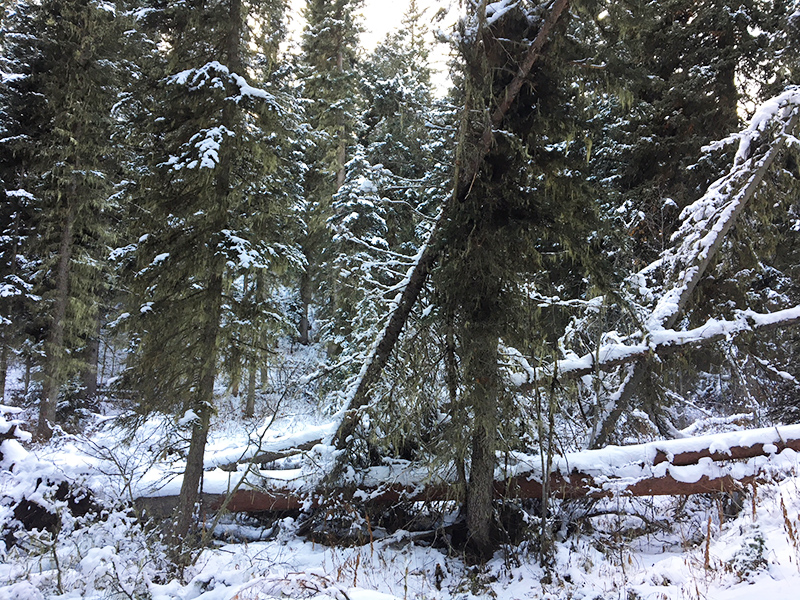
Our conifers are essential for wintering wildlife. They provide large mammals cover from harsh winds and cold. Horizontal branches and downed trees provide routes for foraging red squirrels, Pacific martens, and other weasels. Birds of all sizes nestle into the dense branches. Seeds and buds provide nutrients for all. Tracks and bird calls are clues to the significance of conifers in winter.

Below are the 7 evergreen trees you are likely to see. 

Keys to ID include needles and twigs, buds, bark, and when available cones. The shape or habit of the plant can help ID from afar. 

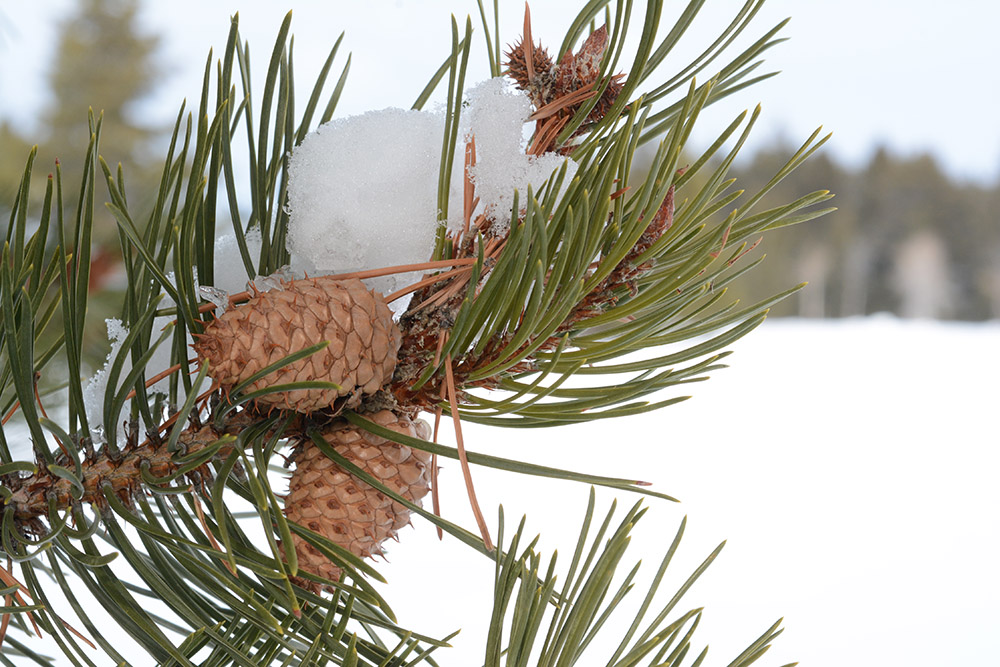
Pines have relatively long, narrow needles that are arranged in bunches (fascicles). Their cones develop over 18 months before maturing and releasing their seeds, usually in fall.

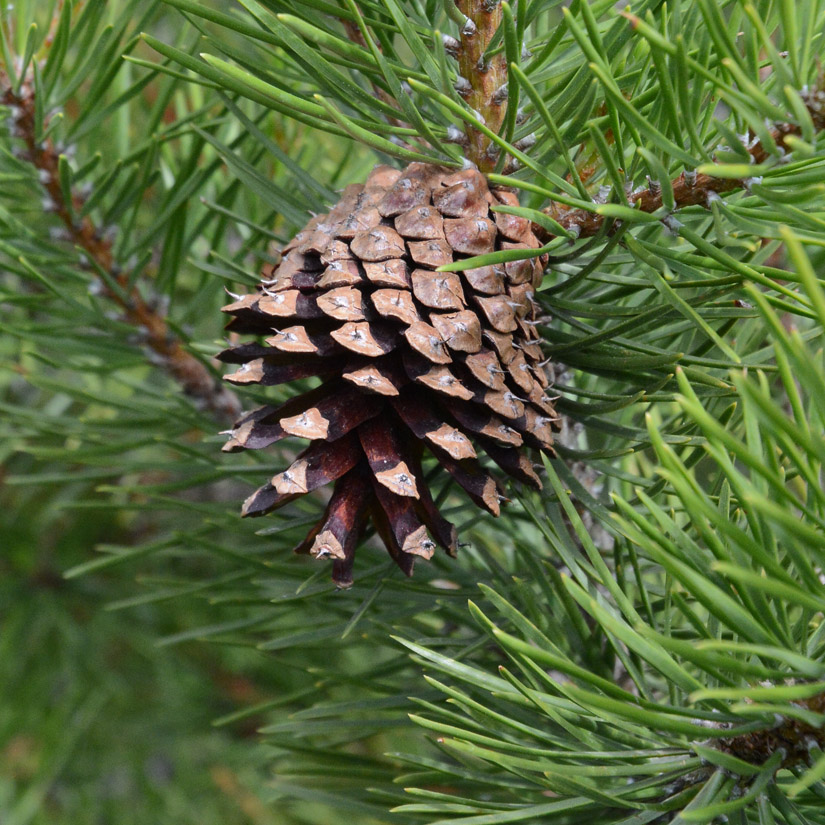
Lodgepole PinePinus contorta – is common in Jackson Hole. Often in association with other conifers, Lodgepoles grow at the base of the Grand Tetons, over moraines, and stretch out on outwash plains in the north end of the park. 

They have fascicles of two 1-2 ½” needles. The needles can stay on the tree for several years. Old needles will brown and fall off in fall–the tree in not dying.

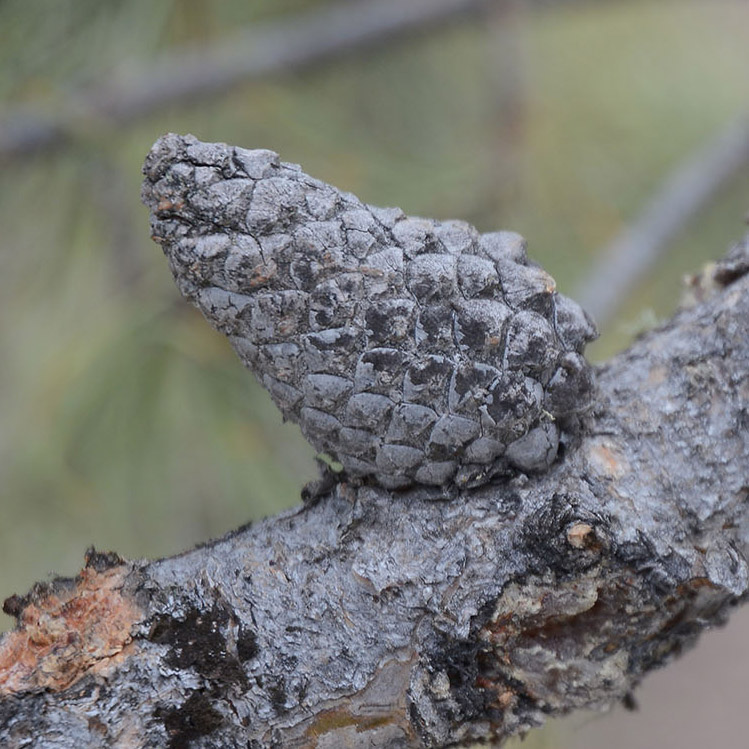
At the tip of the branch are the cones forming from last spring, the larger cone is over 1 year old and will mature its second fall.

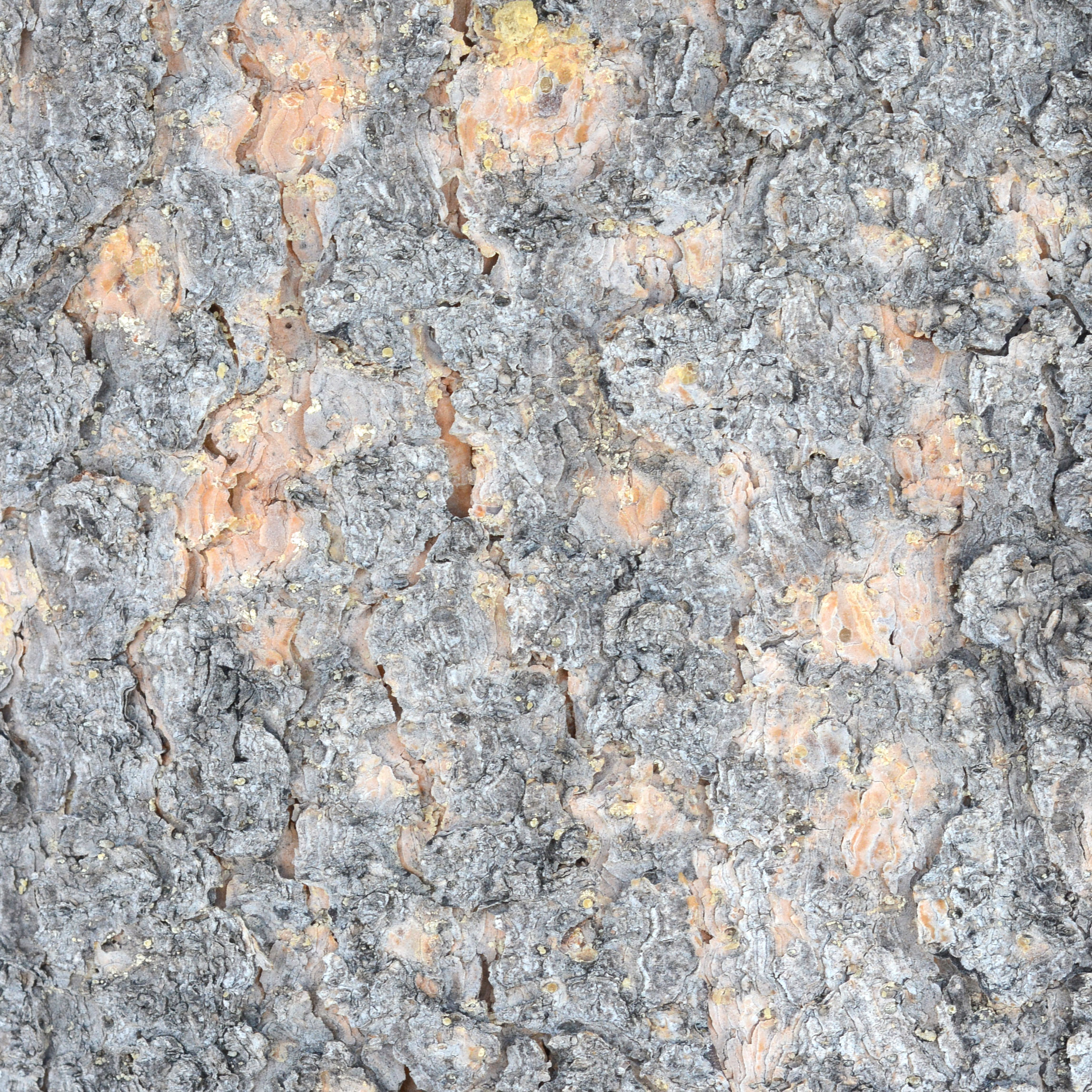
The bark is rough often with an orangey caste.

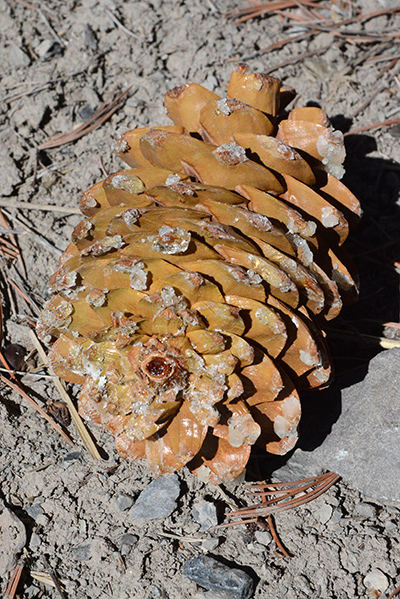
Cones are 2 ½” with sharp points on the scales to deter chewing by red-squirrels and prying by Cross-bills. Cones can open at 18 months

or stay closed on the tree for years until a fire causes them to open (serotinous).

Once opened, the winged seeds fly out on the breeze. The overall habit of the tree is highly variable. 

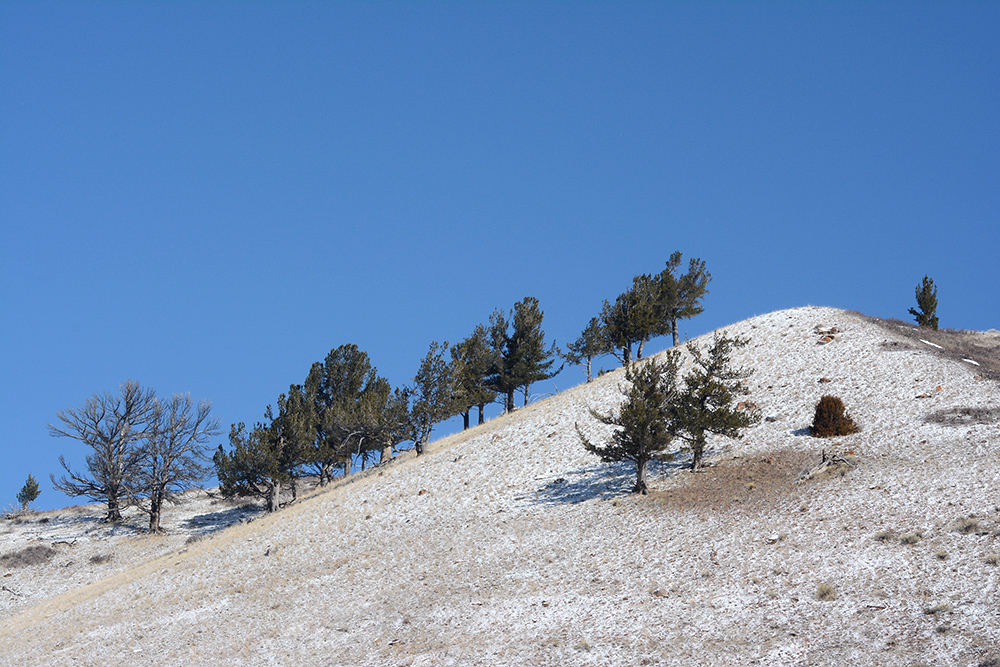
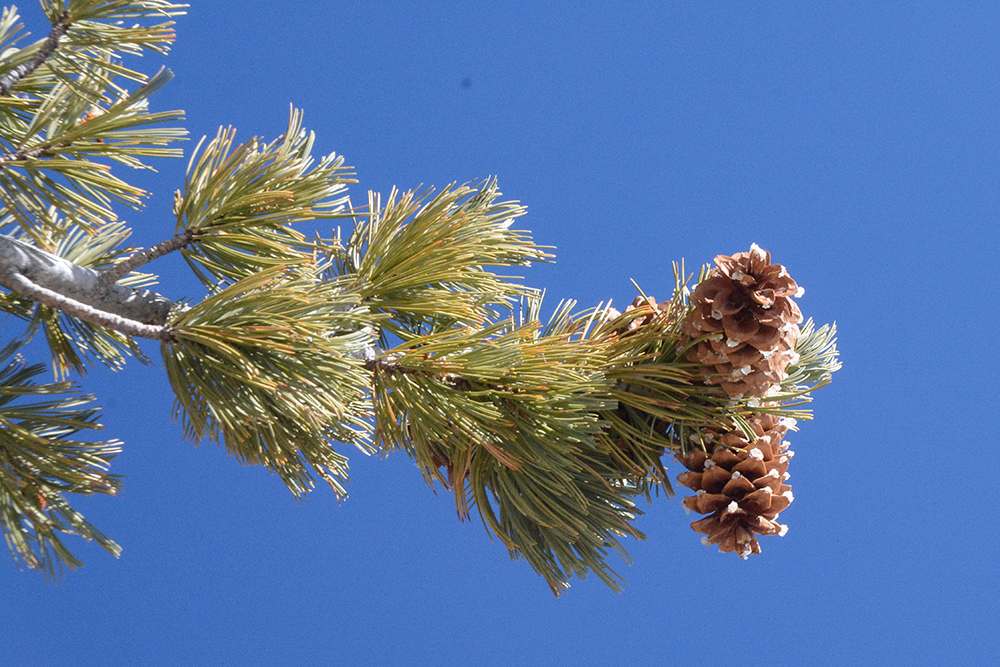
Limber PinePinus flexilis – grows sparsely on dry hillsides such as on Miller Butte or the red hills out the Gros Ventre Road. The overall shape of the tree is full and branches often curl upward.

Small gray branches are flexible—hence the name – with fascicles of five 2” needles. The cones are about 3 ½” long and open fully in the fall releasing nut-like seeds, not quite as large and nutritious as those of White-bark Pine.

The cones then drop off.

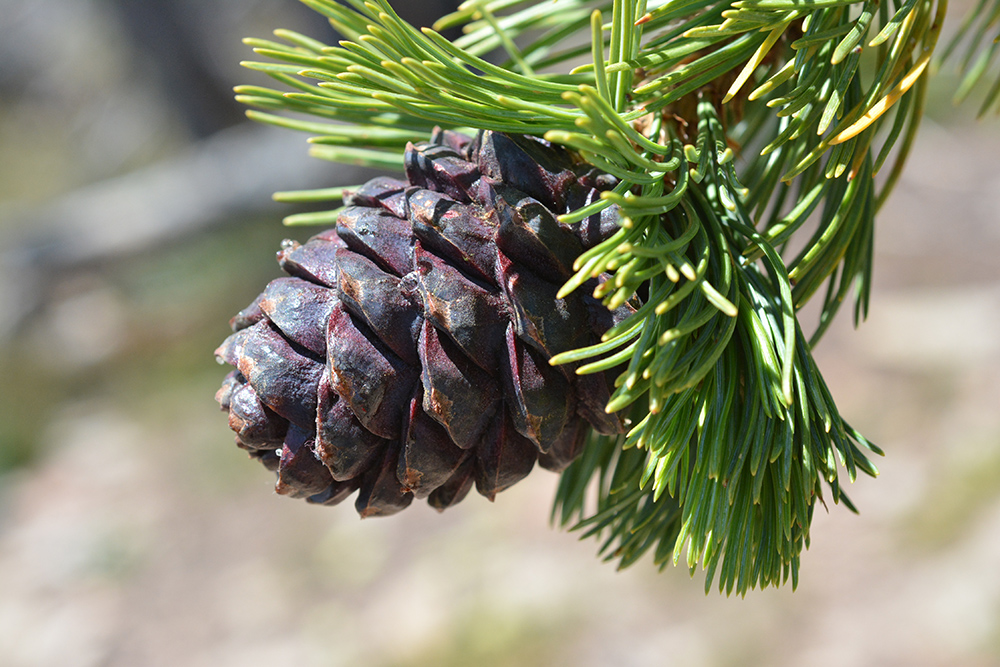
The similar White-bark pinePinus albicaulis – is found at higher elevations. They, too, have 5 needles/fascicle, but the branches are not so flexible. Notably the purplish cones stay closed until the bills of Clark’s nutcrackers pry them open.

The seeds are large and highly nutritious similar to the pine nuts we eat. These seeds are essential food for the nutcrackers which cache the seeds 2-3 per hole by the thousands in fall. They have a prodigious memory that enables them to find what they need in late winter to feed their young. Red squirrels also cache the seeds, but their middens are often pillaged by grizzly bears who also find them highly nutritious. The remaining buried sees are ready to sprout come spring. It takes about 60 years for a White-bark Pine to produce cones.

Spruce, firs, Douglas-firs all have single short needles. They produce cones with smooth scales in a single growing season. 

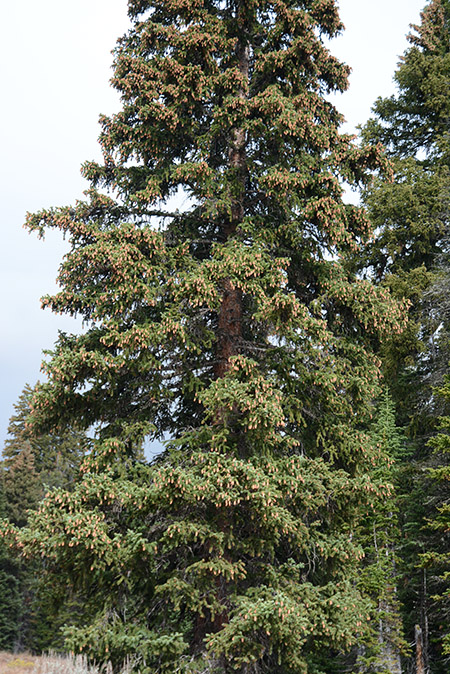
Engelmann SprucePicea engelmannii – grows at relatively high elevations and/or in cool ravines. They can grow very tall with rounded crowns. Cones dangle down.

Spruces require more moisture than pines. They can live for 200-300 years and are components of old growth forests along with Subalpine Firs. 

Spruces are “unfriendly”. “Shaking hands” with a spruce hurts.

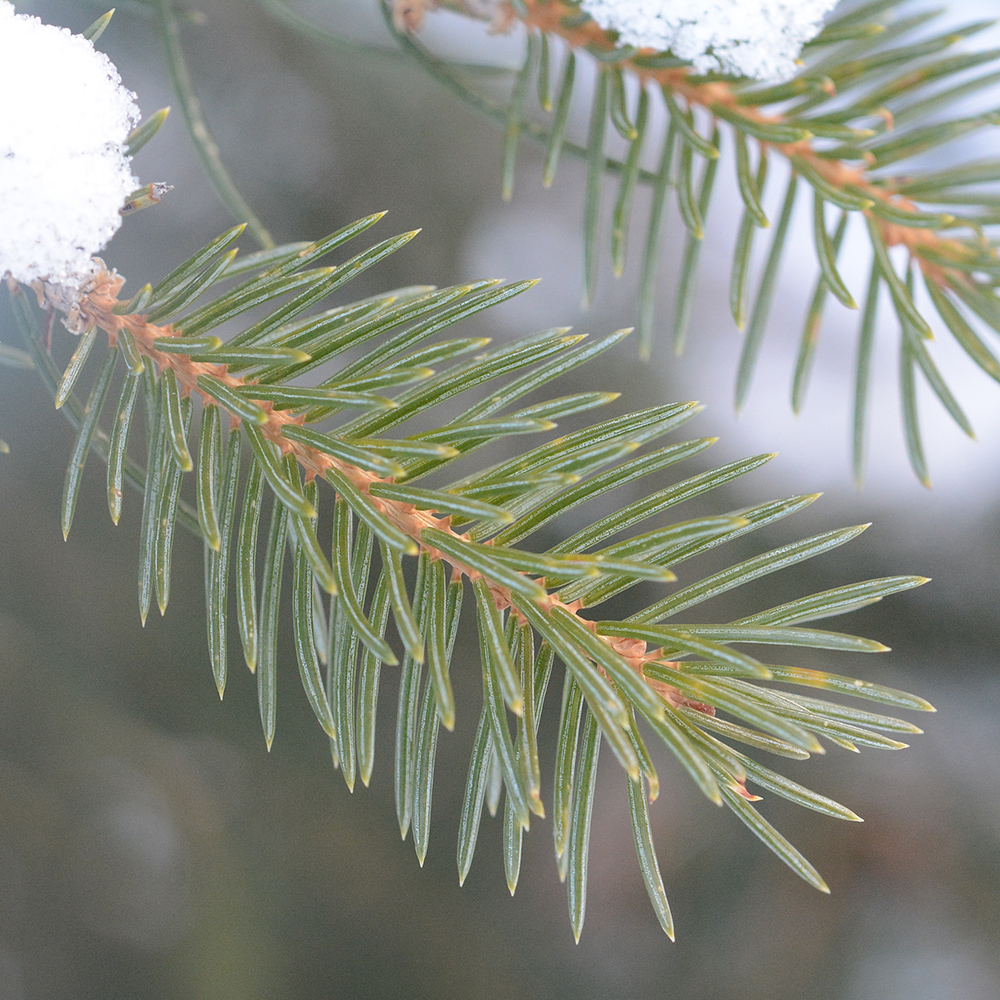
Their needles are square and pointed and set on little pegs. They are smelly when crushed. Twigs are slightly hairy–a handlens helps to see these.

Spruce bark is rough and “flakey.”

The 1 ½”-2 ½” cones are elongate and dangle from the tops of the trees. Cones will release their seeds in the fall and then fall off. Red squirrels will avidly collect cones before they open and stash them in middens for winter food. Then they defend this vital hoard vociferously.. 

Colorado SprucePicea pungens – is found naturally in the flood plains of the Snake and Gros Ventre Rivers.

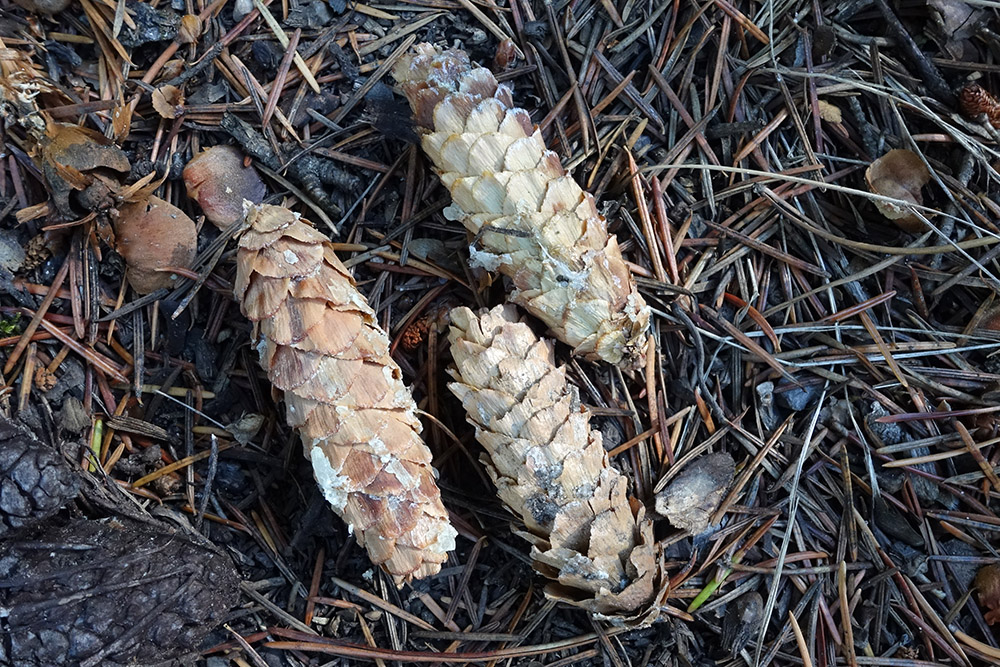
Compared to Engelmann Spruce, Colorado Spruce cones are longer 2 ½-4″, and more elongate with smoother edge scales. Also, the twigs are smooth–no hairs. The outer branches tend to hang down. The two species can be hard to separate and can hybridize.

Many people plant ornamental selections commonly called Blue Spruce or Colorado Blue Spruce. They are the same species but selected for their distinctive blue-colored needles.

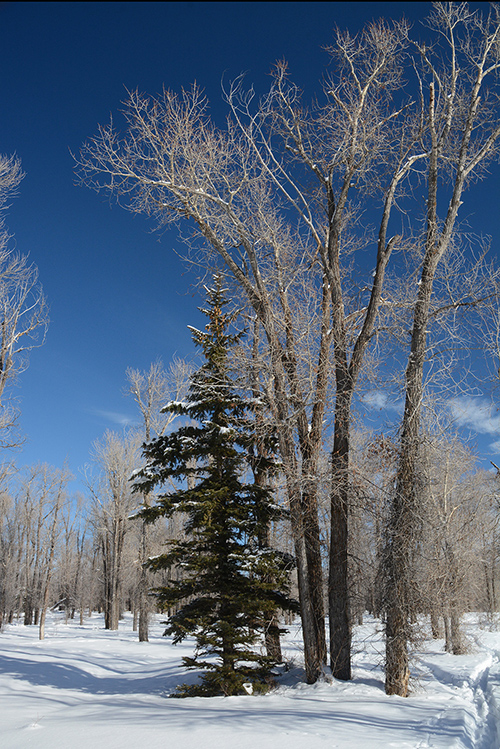
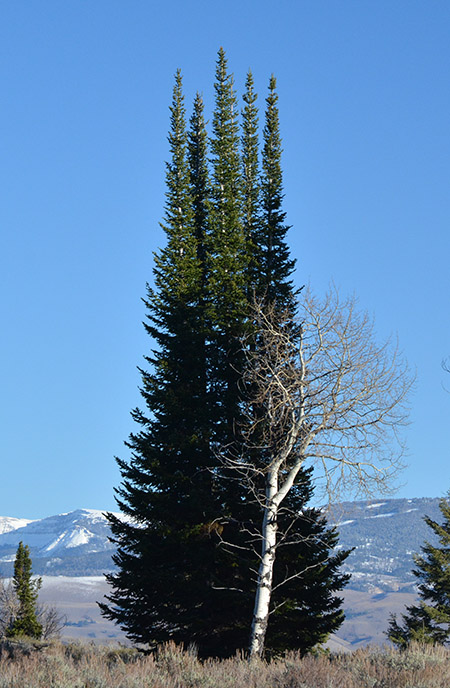
Subalpine FirsAbies lasiocarpa – often stand out for their pointed crowns.

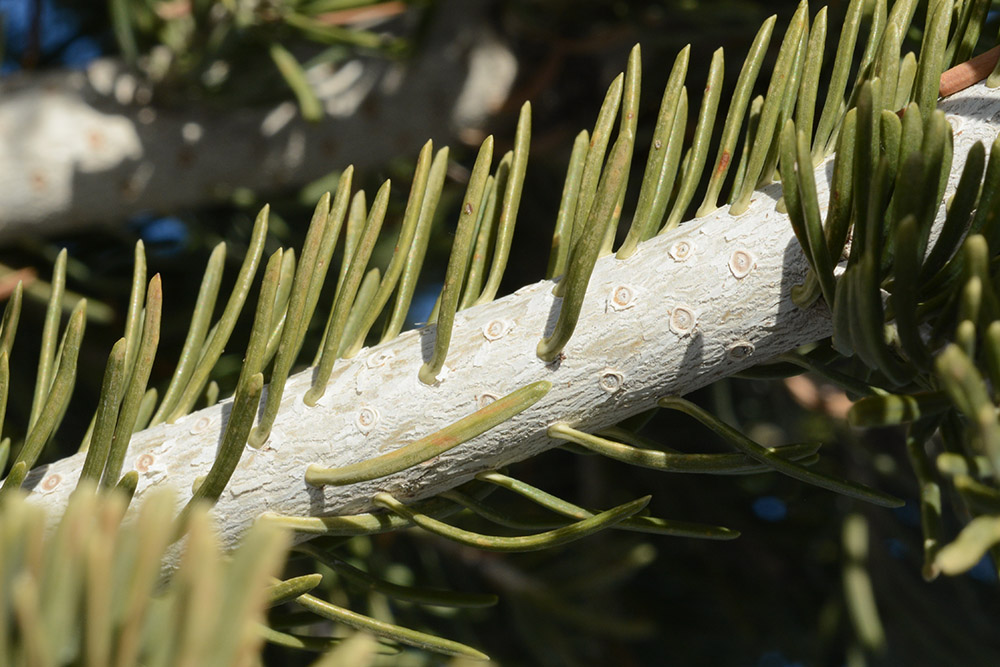
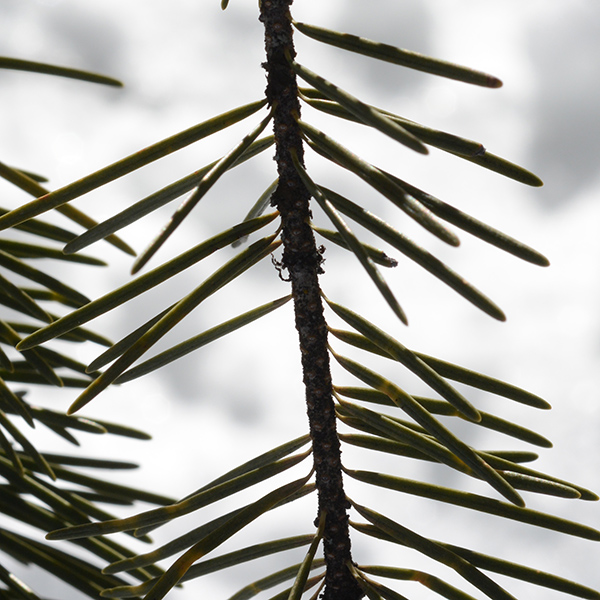
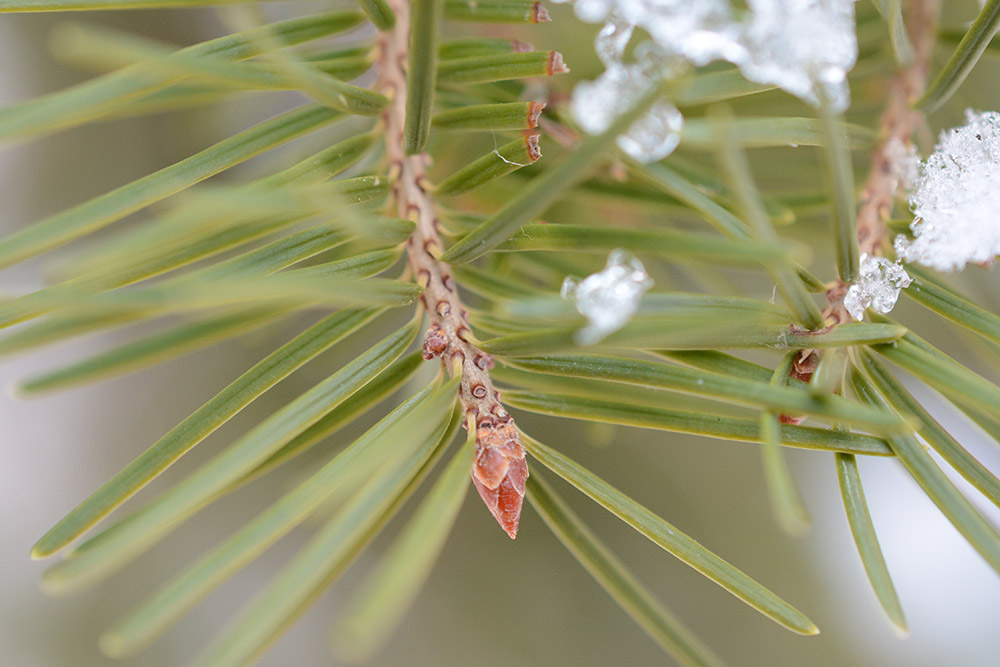
Firs are “friendly”.  It is easy to shake hands with a fir. The needles are flat, soft, blunt, and embedded on the twigs as if their bases were soft like putty.

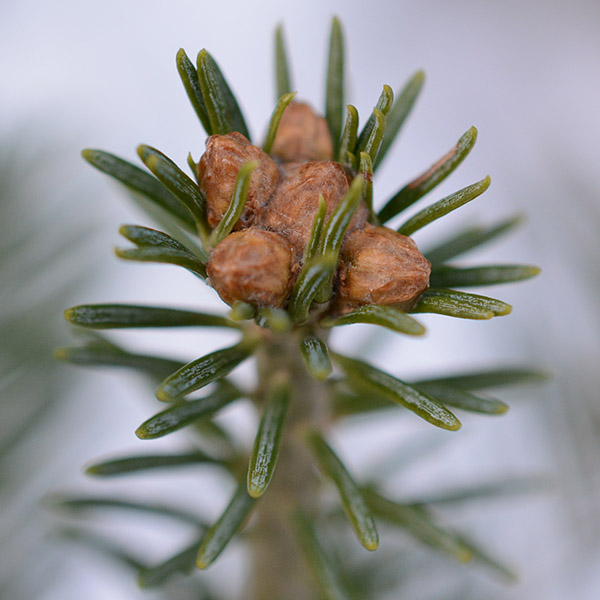
The buds are blunt. 

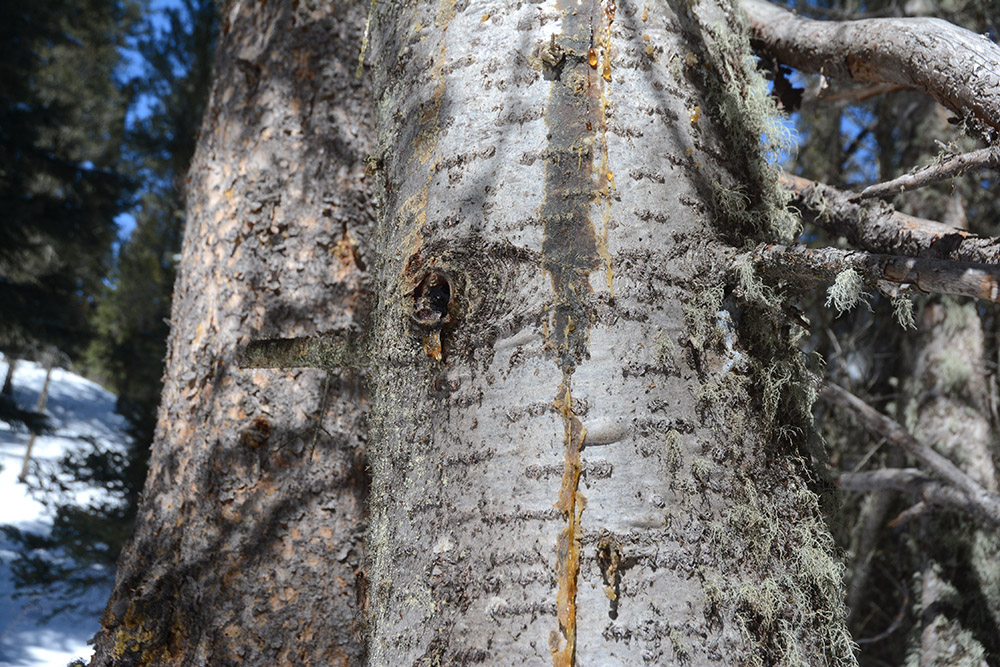
The bark is smooth and gray with irregular horizontal rows of resin. The resin fills in any wounds and has been used by people, too, to prevent infection. 

The tree behind the fir is a spruce…notice the difference in the bark.

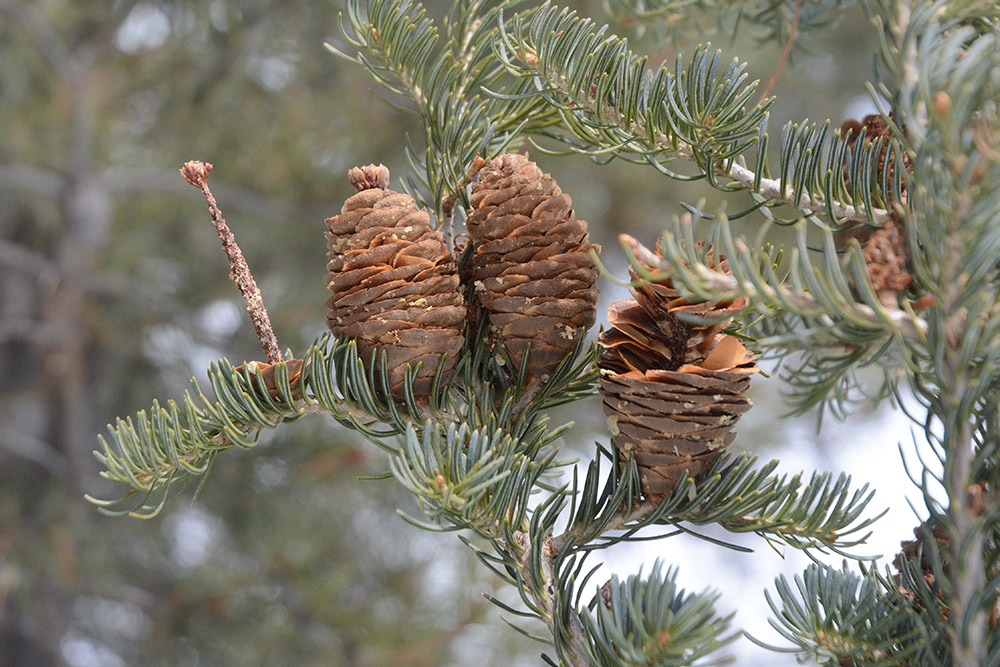
Notably, the 1½ -3” cones stand upright at the top of the tree. At first they are purplish but then turn brown.

In fall, not only the seeds but also the scales will fly off in the wind, leaving a central stalk.

Douglas-firPseudotsuga menziesii – is not a true fir. Its needles are flat with short petioles and soft to the touch.

Note the short petiole to each needle.

The buds are pointed.

Early years the bark is a deep gray and scaly.

Bark thickens with age–an adaptive strategy to survive low level fires.

Doug-firs grow on dryish sunny slopes, often clear of other trees and shrubs due to their resistance to intermittent fires. Cones are the tell-tale feature for ID. The 2 ½” cones have bracts under each scale.

Some say the bracts are the tails of mice which have run under the scales to hide from owls. The dense evergreen habit often harbors owls and other birds.

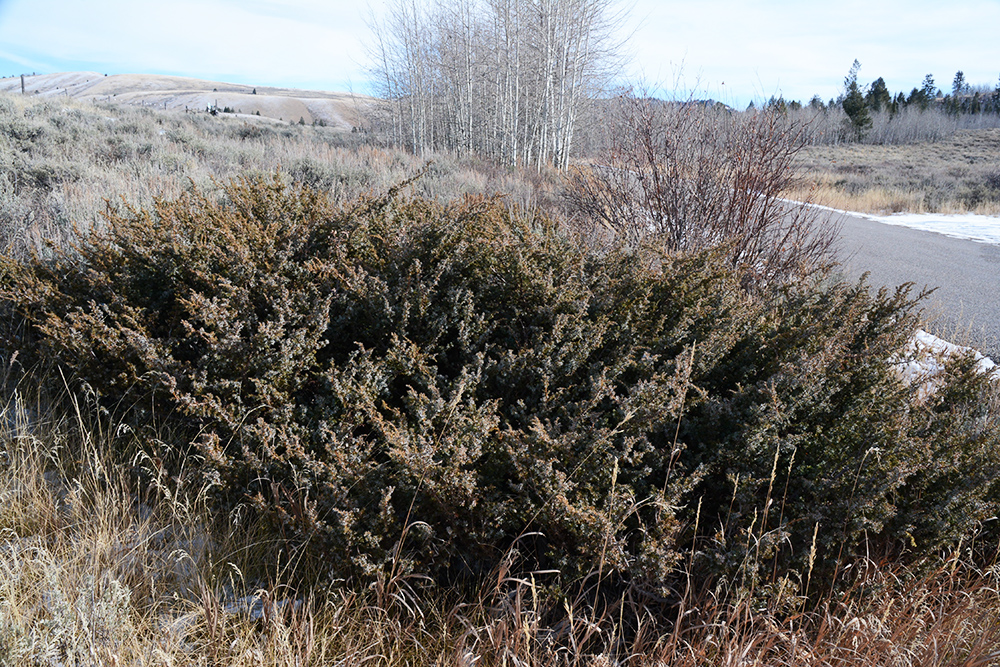
Rocky Mountain JunipersJuniper scoparium – are most visible in the dry slopes of Miller Butte or Game Creek.

They grow into various shapes, often because they are heavily browsed by deer. Their needles are “scalelike” on flattened twigs.

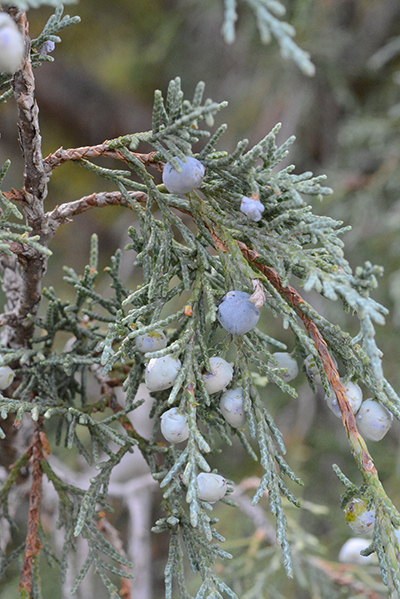
Their female cones look like bluish berries which are priority winter food for Townsend’s Solitaires, a gray, robin-sized bird which defends its territory with lovely liquid calls, and the colorful, noisy Cedar Waxwings. Male buds are on separate plants and are of little notice at this time of year. Only female plants produce cones.

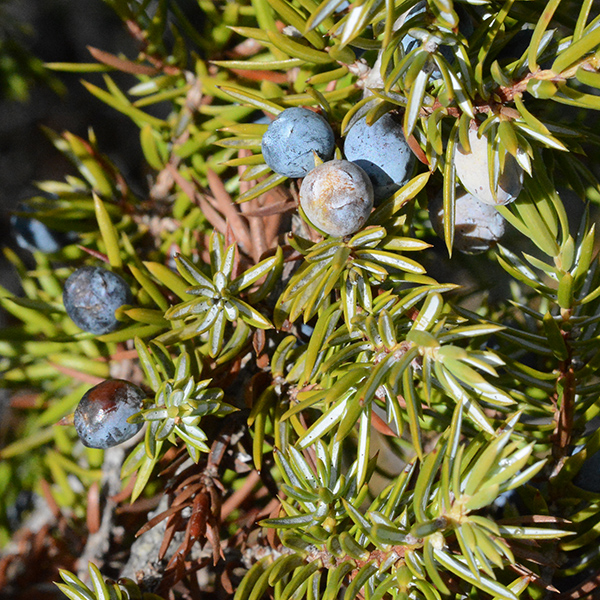
Its shrubby cousin Common JuniperJuniperus communis – is relatively rare here and more noticeable in winter. They are sprawling 3-4′ high shrubs.

with small sharp needles. The whitish stomata are readily visible.

Walking around the Bradley-Taggart Lake trails, three evergreen shrubs with broad leaves can be seen. 

SnowbushCeonothus velutinus – blankets slopes after forest fires. The seeds may have lain in the soil for decades, until the extreme heat of a forest fire broke their dormancy.  The mature plants are dense and sprawling. The 2-3” oval leaves have three prominent veins and a distinctive fragrance. 

In winter they curl to prevent too much loss of water from the undersides where the stomates form.

The dry fruits may still be seen.

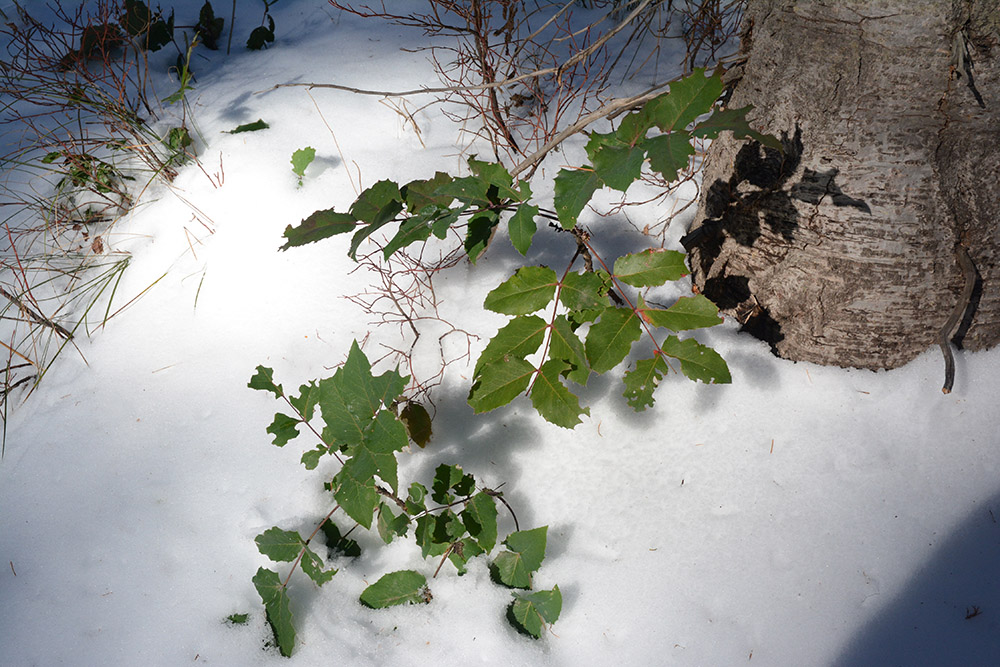
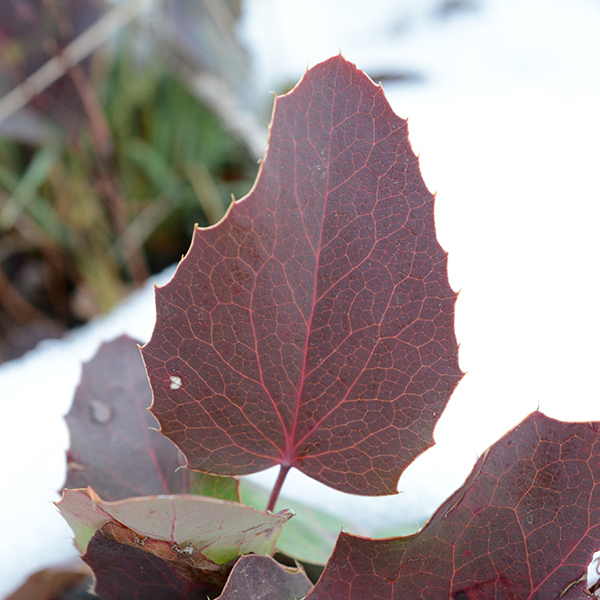
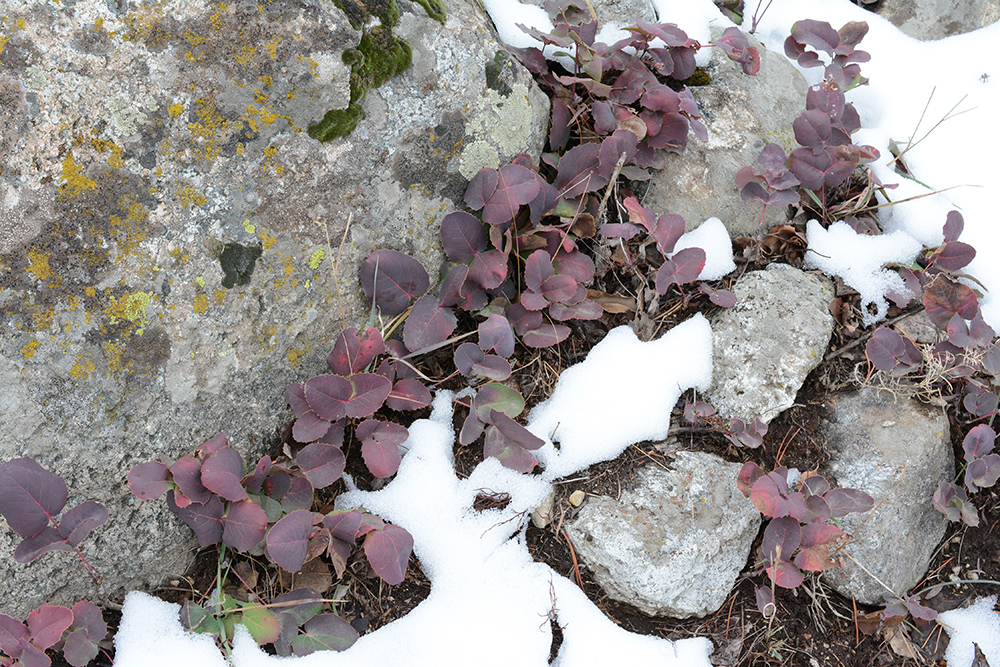
Found in a variety of habitats from dry rocky areas to forest floors, Oregon GrapeMahonia repens – can poke up to 2’ above the ground. 

The leaves are compound with the leaflets looking like sharp holly leaves.

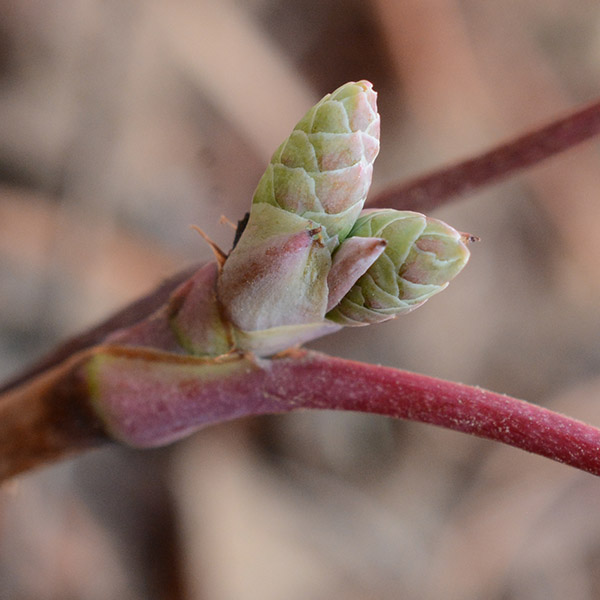
Look at the woody stem for the bud that marks the beginning of the petiole of the leaf with its holly-like leaflets. 

The purplish fruits may be around, but are usually eaten quickly by grouse and other birds. Winter leaves exposed to sun are purplish.

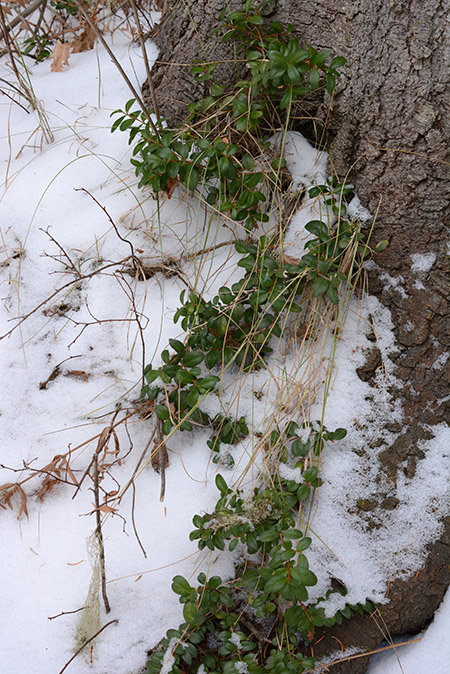
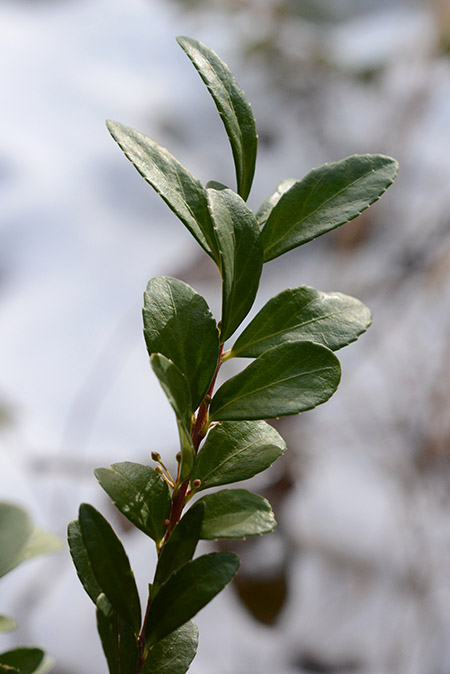
Mountain Lover Paxistima myrisintes – is found by walking in shady to moist sites. 

Its small ½-1” toothed oval leaves grow opposite each other on the twigs which will soon be covered with snow. 

And out on the valley floor

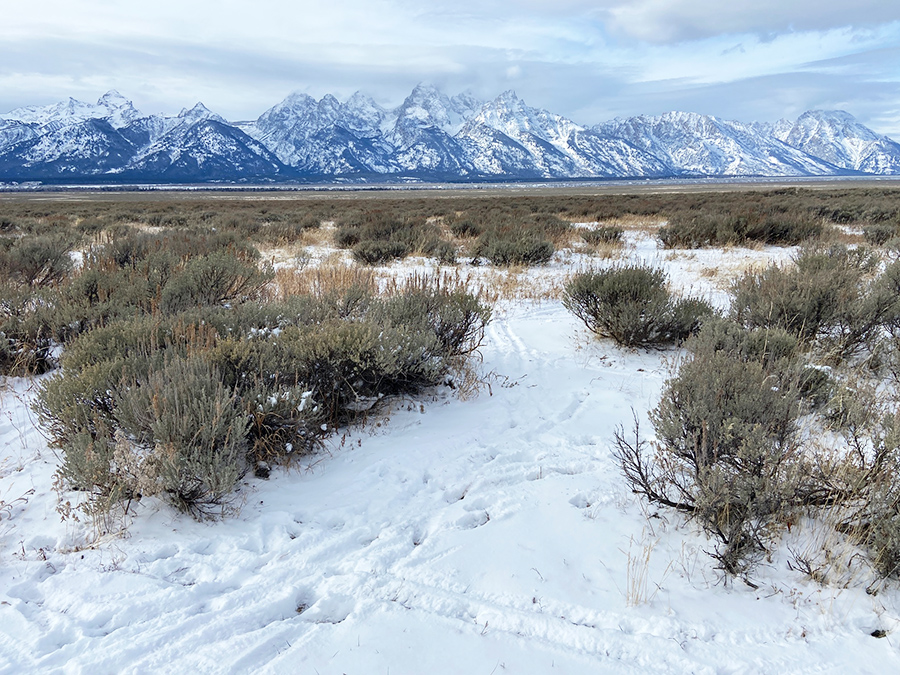
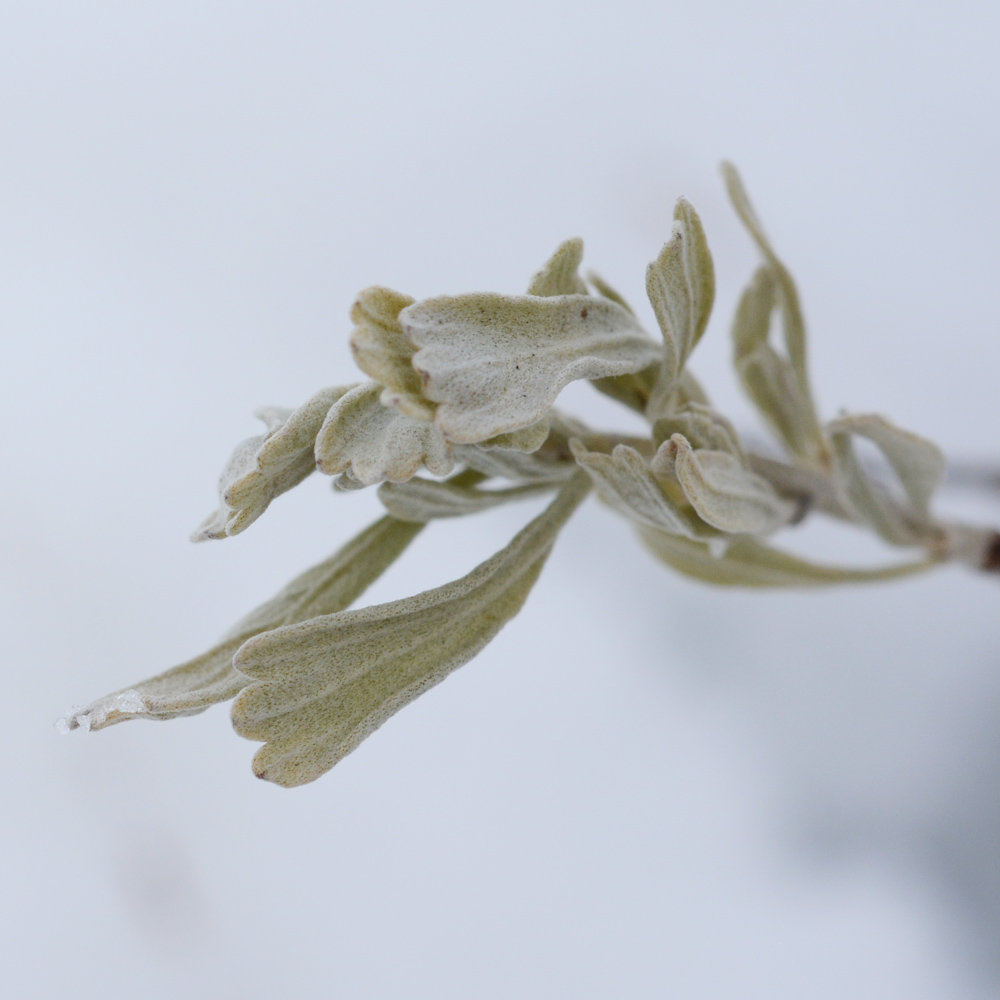
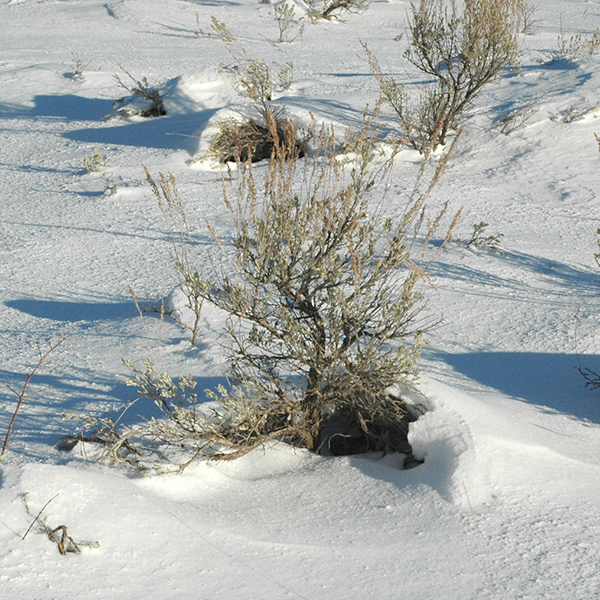
The most frequent evergreen shrub in the valley is Mountain Big Sagebrush – Artemisia tridentata var. vaseyana.  Most of us are familiar with the greyish, hairy, three-toothed, <1” leaves with the distinctive aroma from terpenes.

These dominant plants are essential for sage grouse who nibble on the leaves a and buds and huddle under the snow-laden branches in winter. Elk, mule deer, and bighorn sheep all browse the plants.

Intermixed with sagebrush on Antelope Flats is Antelope BitterbrushPurshia tridentata.

Purplish Antelope Bitterbrush intermingle with lighter Mountain Big Sagebrush.

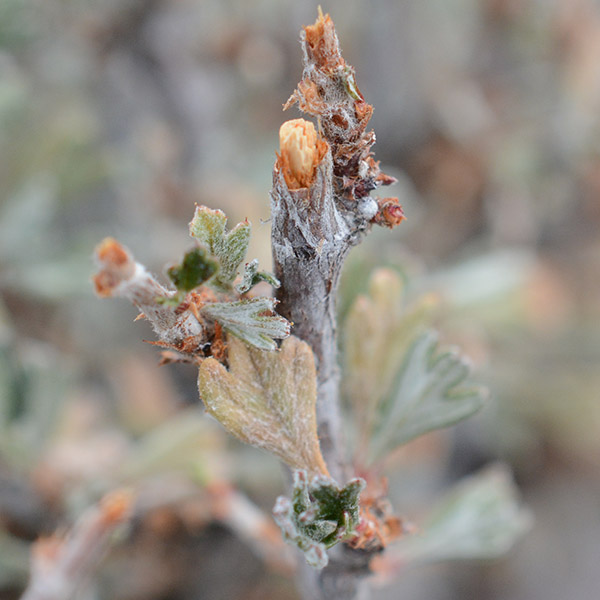
Both species produce larger leaves in the first flush of growth in spring, then add smaller leaves, more drought tolerant leaves later in the summer. They drop off the big leaves and retain the smaller leaves through winter.

Some say Antelope Bitterbrush is deciduous but a close look shows tiny leaves.

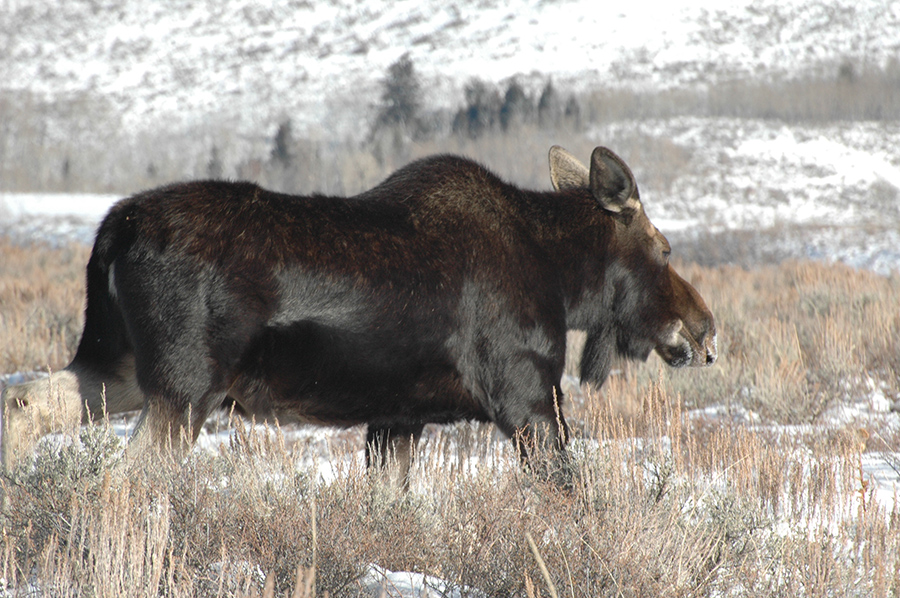
Moose munch on Antelope Bitterbrush November to December, not the nearby sagebrush..

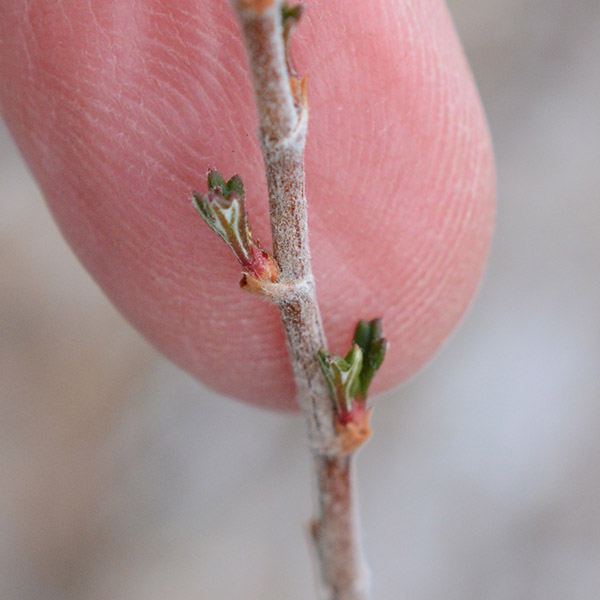
Bitterbrush has three-toothed leaves without silvery dense hairs on the surface. The surface is deep green and a bit hairy and the underside finely hairy with 3 distinctive veins. Stems are purplish.

The smaller winter leaves is an adaptation to reduce water loss and protect the leaves from blowing snow crystals.

This time of year evergreens stand out. It is fun to drive and hike/ski about for these species and take a closer look. After a while you begin to recognize them from afar. They all are essential shelter and food for a variety of critters who have not migrated to warmer climes or buried themselves for the winter.

Look for the next “What’s in Winter” posting for common deciduous trees and shrubs.

November 21, 2024, updated slightly 11.26.24, 12.12.24

Bursting Buds of Catkin Flowers – Willows, Aspens, Cottonwoods, and an Alder

Botanically buds are incipient stems. Formed in the fall, a set of meristematic tissue (stem cells) are enclosed inside “bud scales” for the winter, all ready to break open when daylight increases, the soil thaws to release water, and the air warms. Then hormones are triggered to set the stem cells on their genetically programed path to growth. Buds can become new stems with leaves and/or new flowers. Some of the most obvious buds at this time are seen on members of the Willow Family either as a newly extending branch with leaves or in the form of catkins. 

Catkins are reproductive structures. Unlike our usual flowers with fancy petals and such, catkins are typically very modest. A central stalk has many small flowers – either male or female attached to it. A “bract” or scale-like structure protects the anthers (m) or an pistil (fm). There are no sepals or petals. Most catkin flowers are wind pollinated and, therefore, come out before the leaves interrupt the flow of pollen.

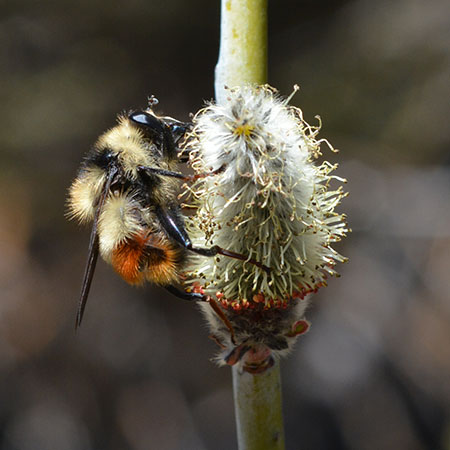
There are dozens of willow species – Salix spp. – in Teton County growing from wetlands up into the alpine. Plants are often called pussy willows because of their soft silvery-looking catkins.  Many willows are the very first flowers to bloom and are therefore very important sources of both nectar and pollen for the first flies and bees of the season. These insects depend on the nutritious pollen for raising their broods. The nectar is a much-needed energy source.

In willows, behind each bract are nectaries, as well as the essential sexual parts: male anthers or female pistil. (Note: the female structure overall is termed a pistil which includes a stigma at the top to catch pollen, sometimes a style or neck like structure, and the ovary which contains the ovules e.g. eggs). Male and female catkins are on different plants. Flowers exude a fragrance that lures in pollinators, and colorful red or bright yellow anthers also help to attract bees.

Male willow catkins with yellow anthers.
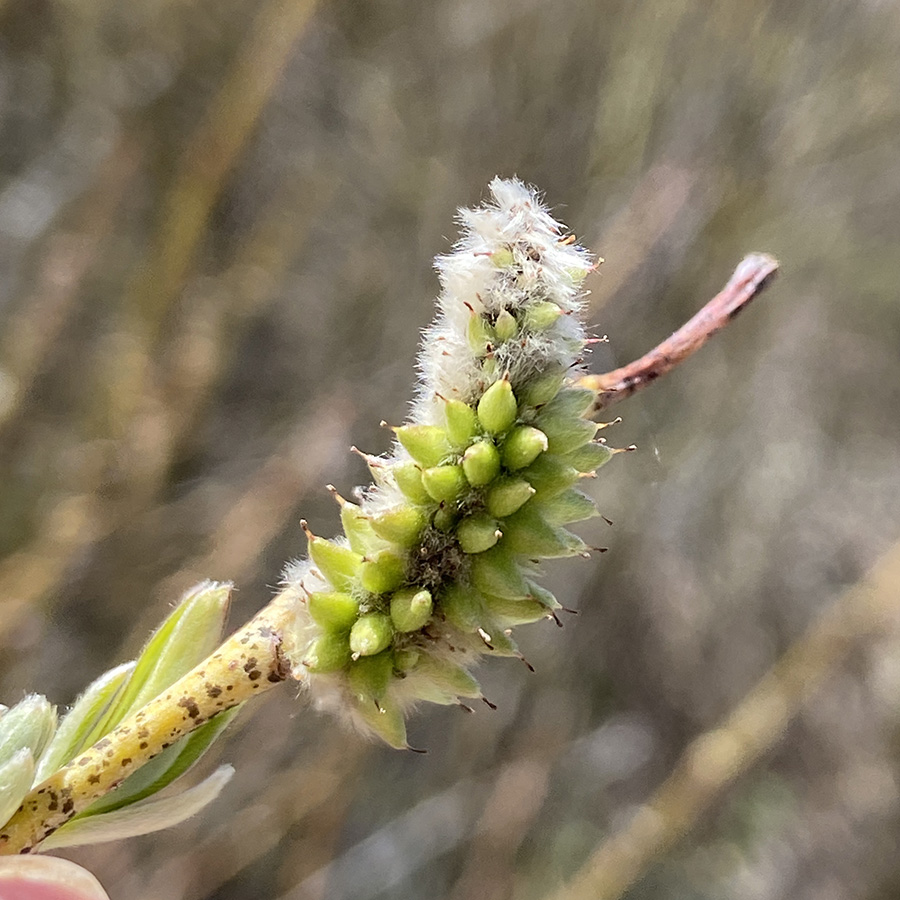
Female willow catkin forming capsules. Note the stigmas at the tips.

Aspens and Cottonwoods are both in the genus Populus. Unlike willows, their flowers do not have nectar and are exclusively wind pollinated. They too have male or female plants to help insure out-crossing of genes. There is no genetic diversity benefit to dropping the pollen onto a female flower on the same tree. In Populus bracts below each tiny flower are forked and hairy. The flowers are held in little membranous cups which can be hard to see. Its fun to look for these fine features with a 10x hand lens.

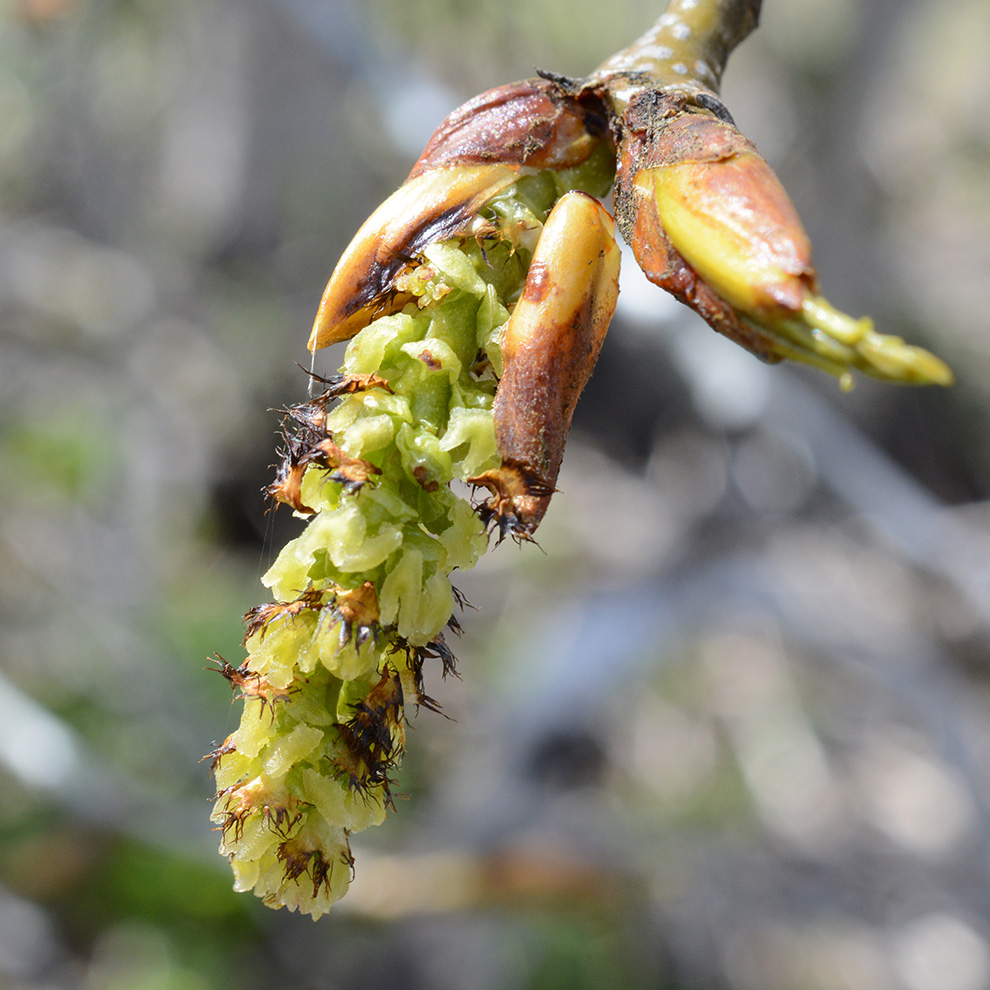
Trembling aspensPopulus tremuloides – have been dangling catkins for the past couple of weeks. Male catkins are falling off while female catkins are still extending or forming fruits.

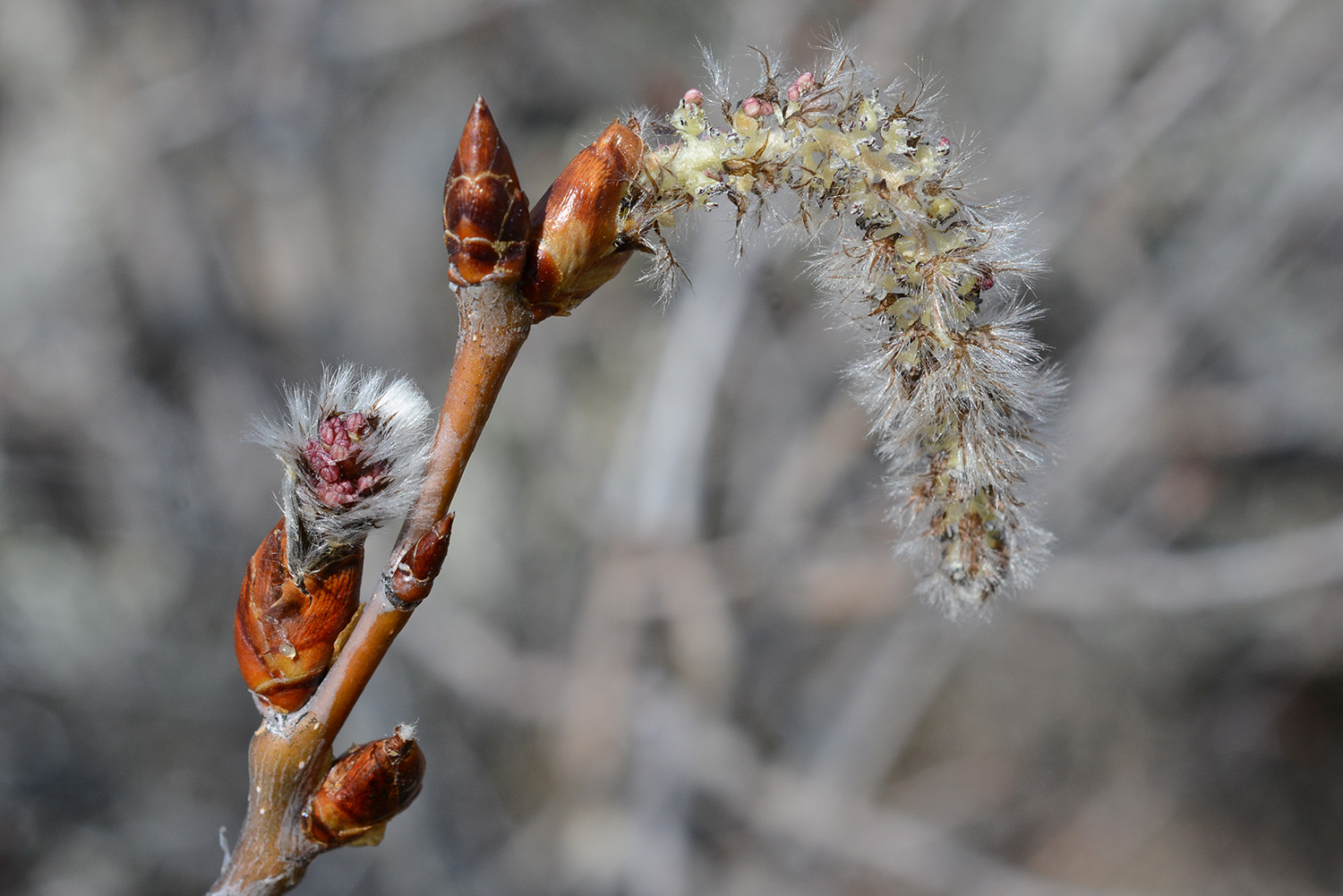
Aspen male catkins – on the left just out of its bud; to the right more extended. Note the hairy bracts.
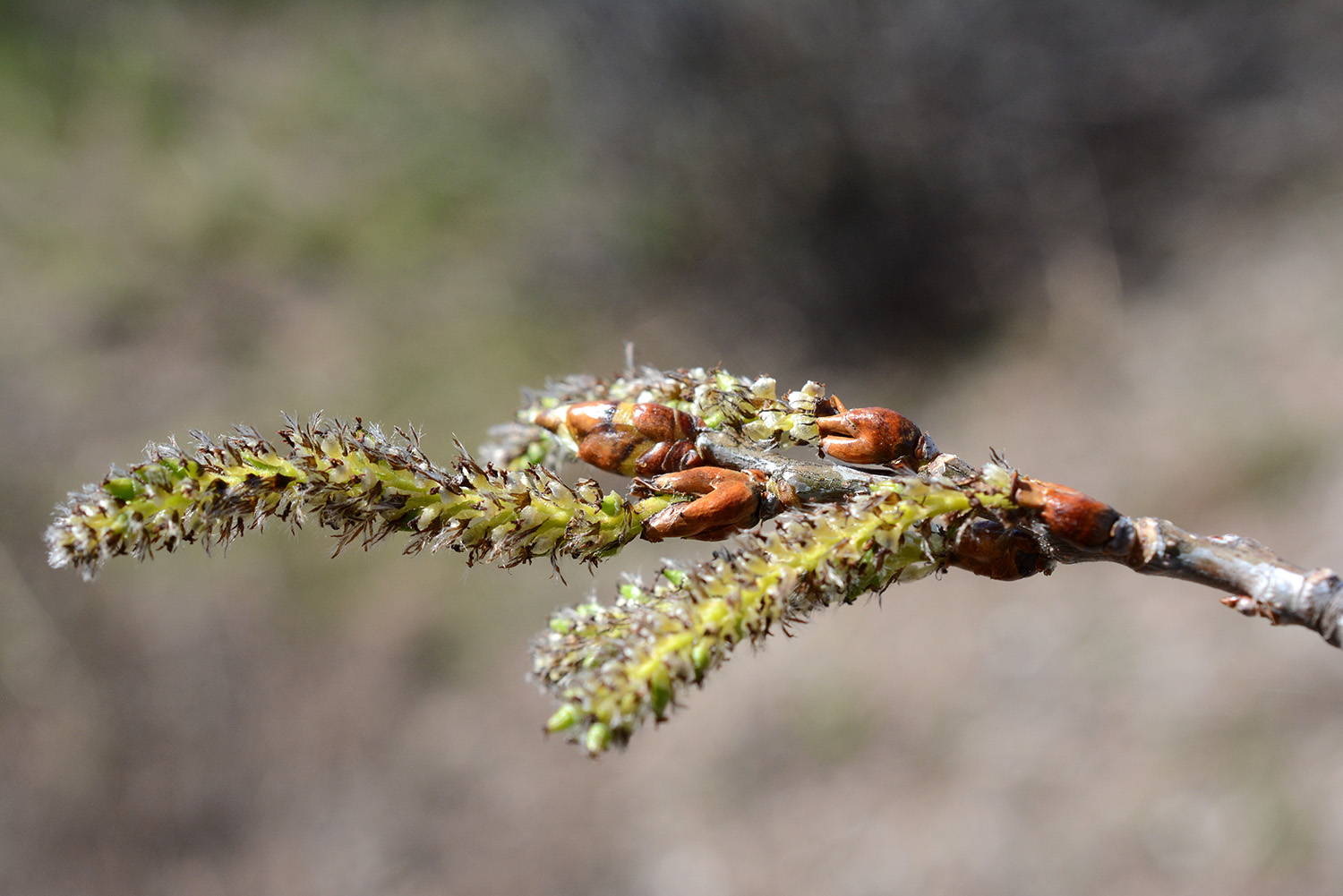
Aspen female catkins tend to be stiffer.
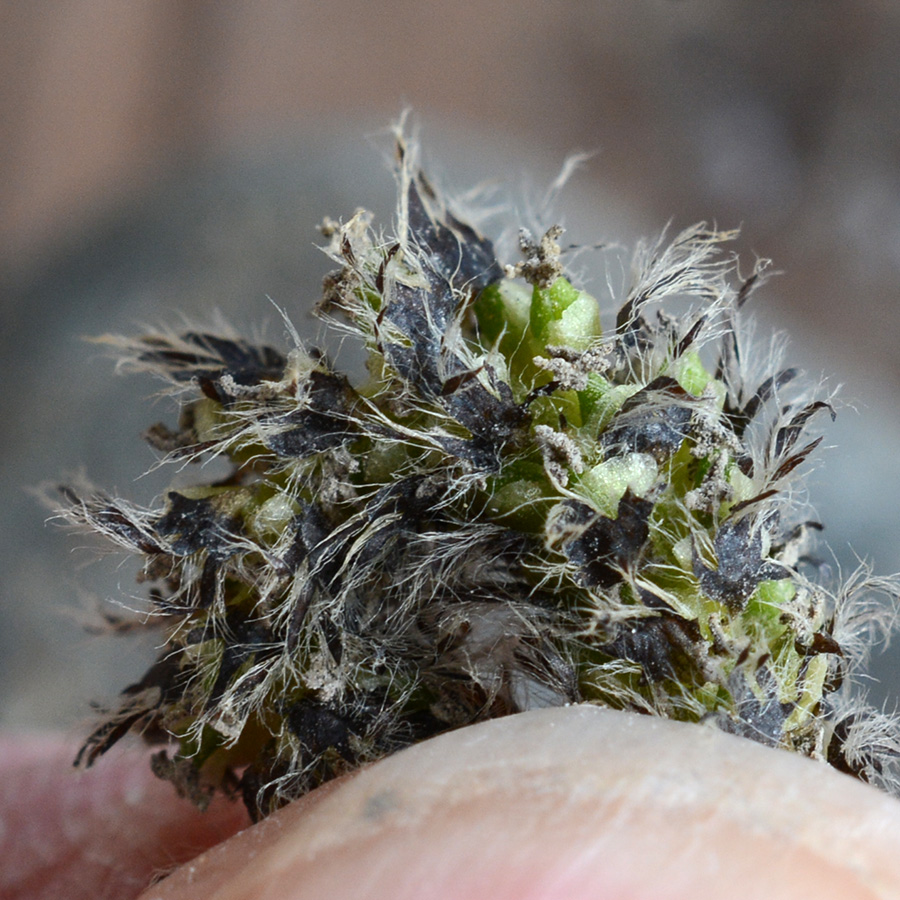
Aspen female catkin: pistils can be seen in little cups. Dark stigmas emerge from the tips of the pistils to capture pollen. Note the black, sharply forked bracts with hairs.
Once fertilized, the ovary begins to swell into a fruit called a capsule and seeds will form inside.

Although plentiful, aspen seeds are short-lived and require particular moisture and soils to survive. Most of our aspen trees sprout from rhizomes – underground creeping stems – rather than from seeds – to form large groves of one genetic identity. 

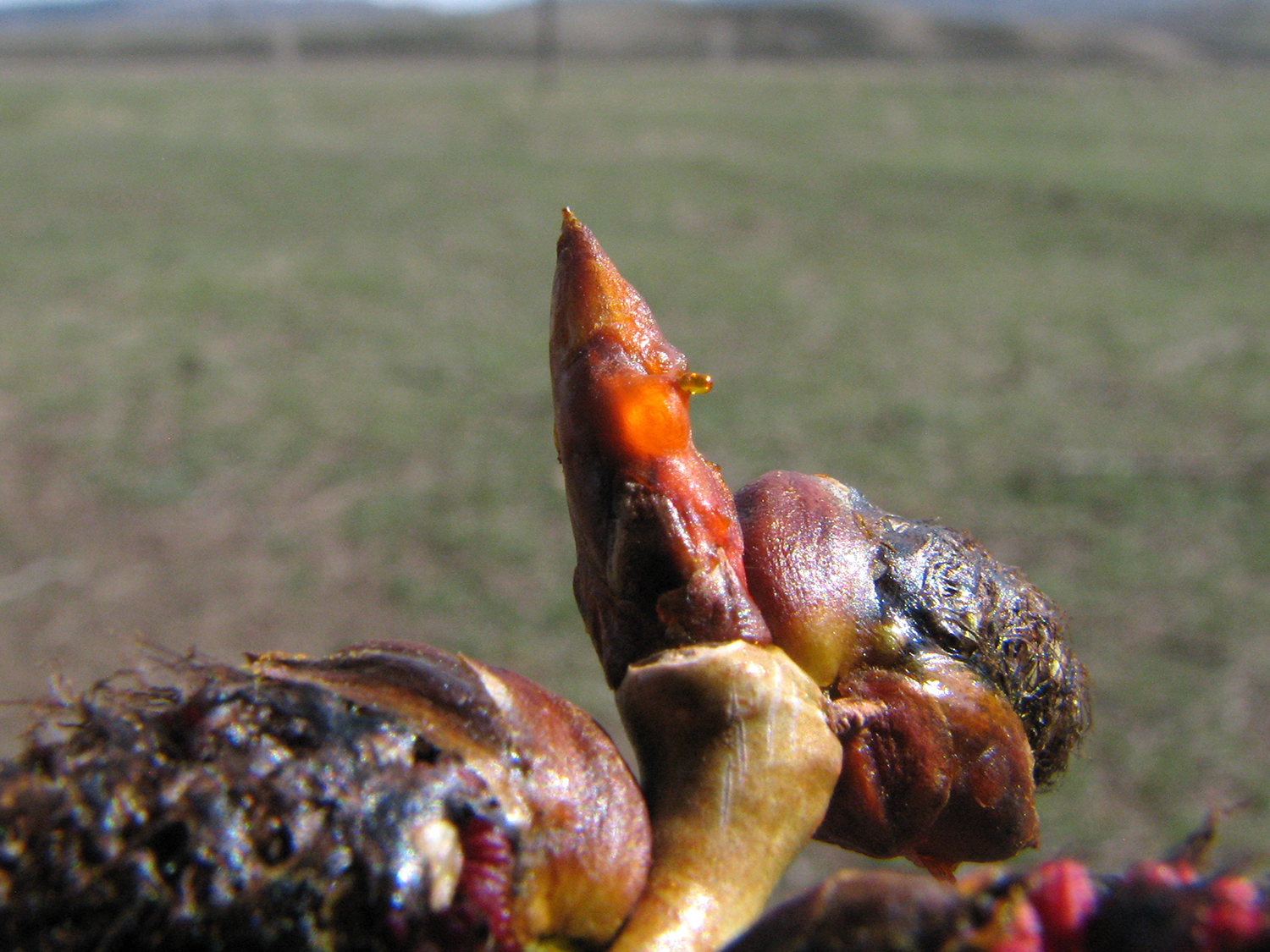
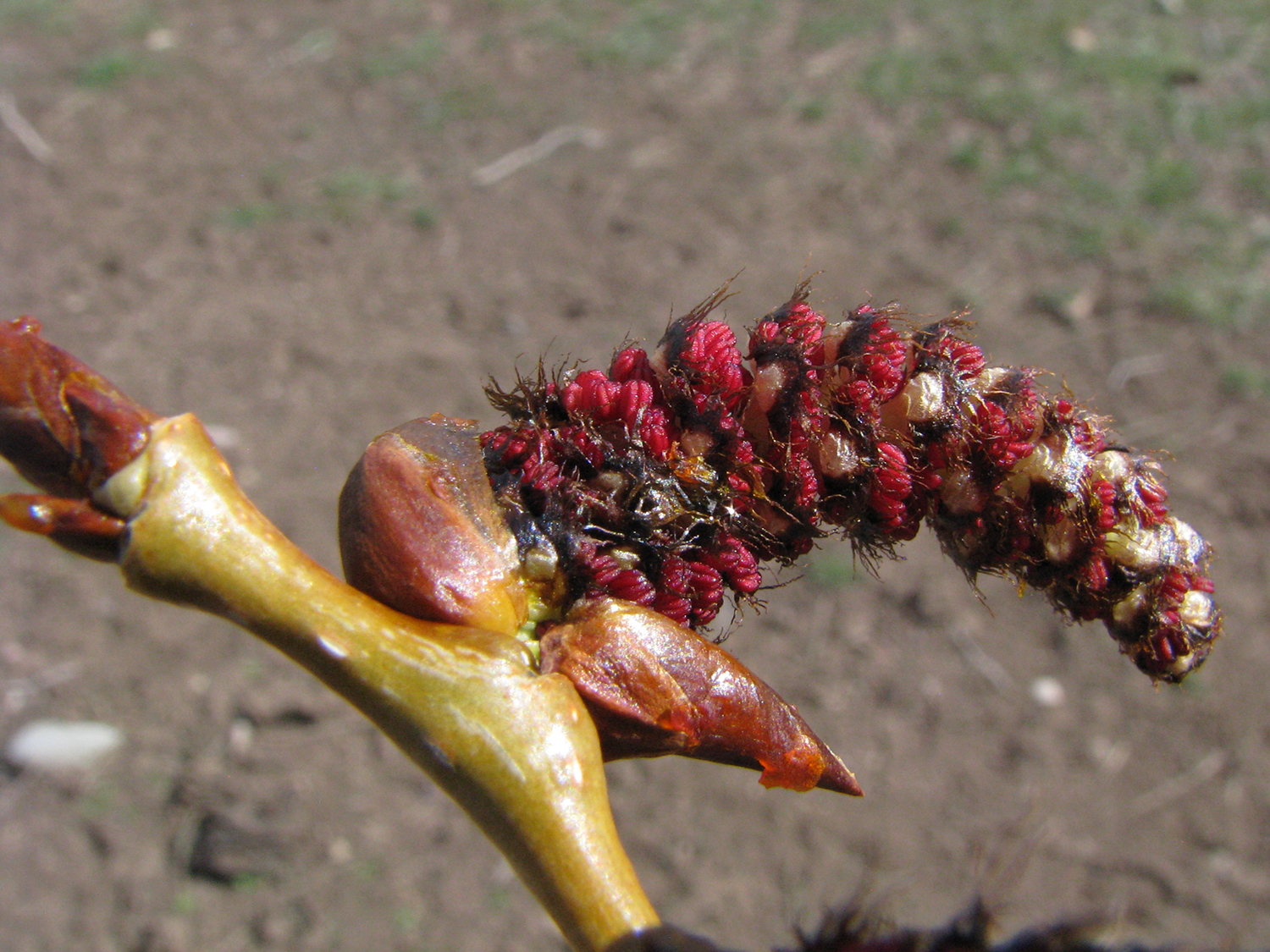
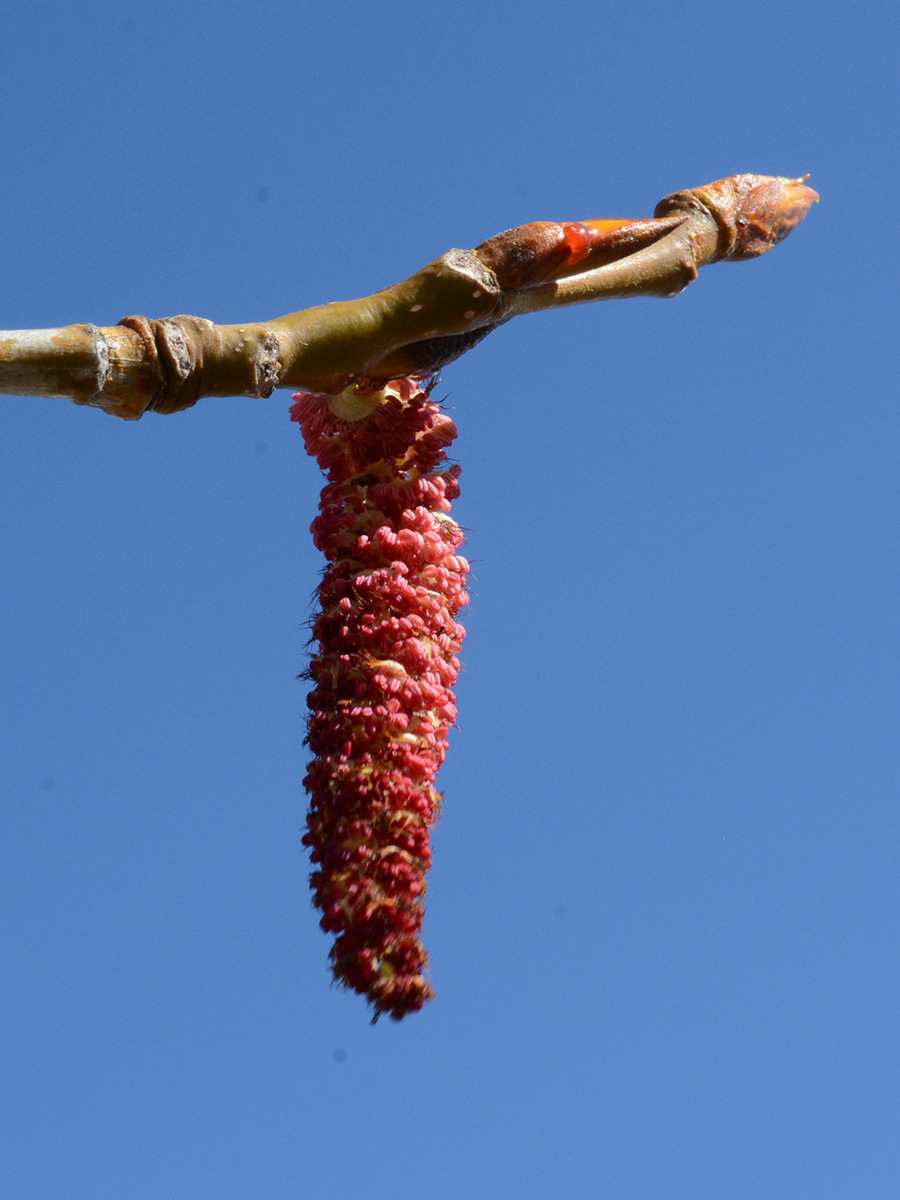
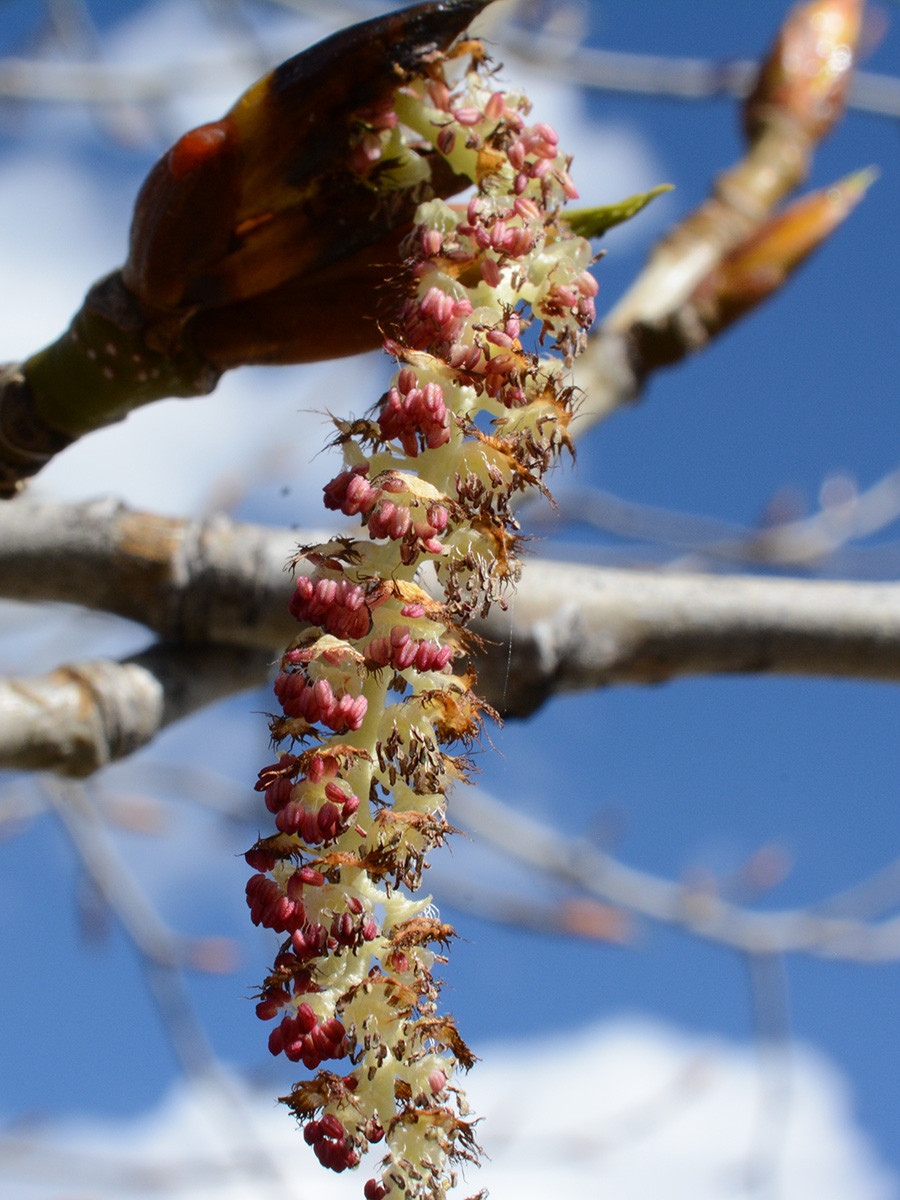
CottonwoodsPopulus spp. – have the biggest buds and catkins. Behind each lobed and silky bract and sitting in a small cup, many red anthers expand and open up. Spent male catkins then drop off. Single female pistils also sit in little cups protected by silky bracts. Their 2- to 3-parted stigmas are relatively large and fleshy looking.

Male catkins tend to stretch and dangle loosely, their anthers waving pollen upon the wind. Then the catkins fall off, done.

Females catkins are a bit stiffer. Here the stigmas are fleshy and assumedly sticky to catch the pollen as it wafts on the wind.

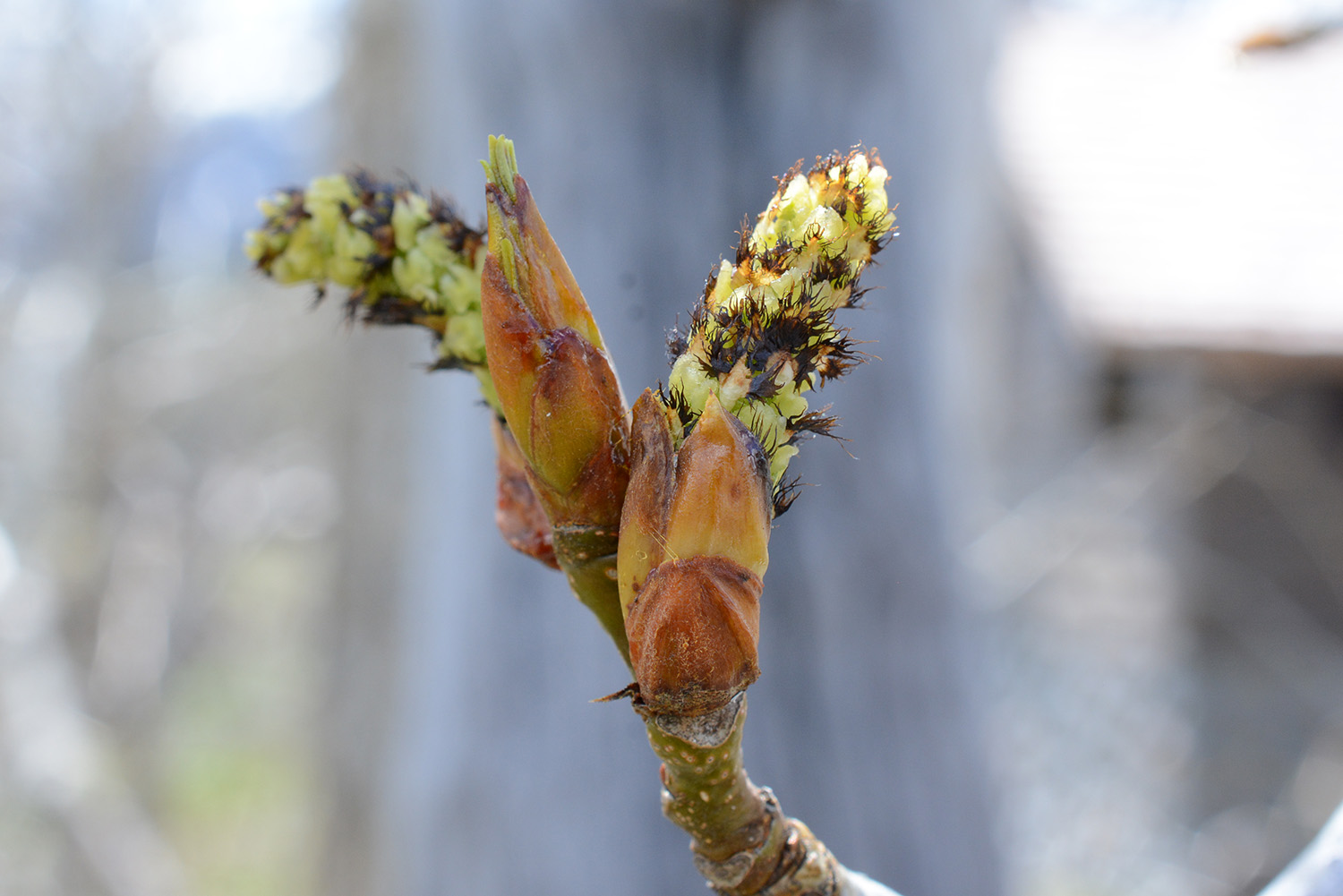
Femaile cottowood catkin just emerging. Note the black bracts.
Female cottonwood catkin stretching. Note the fleshy stigmas,
After pollination, over the next couple of weeks the ovaries mature into capsules and are about to burst!
The catkin then explodes with fluffy seeds coming from many capsules. Fruits and leaves all came out of buds triggered to expand just a few weeks before.

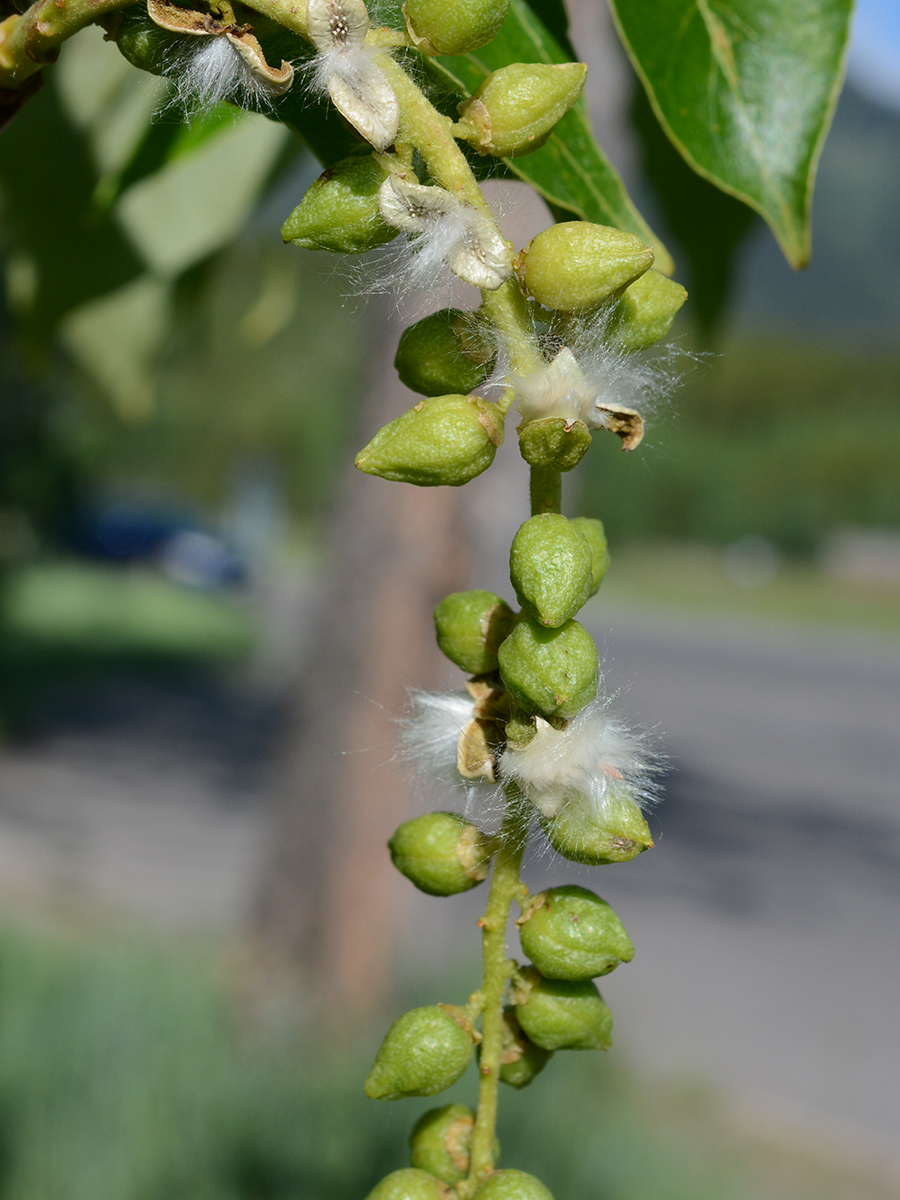
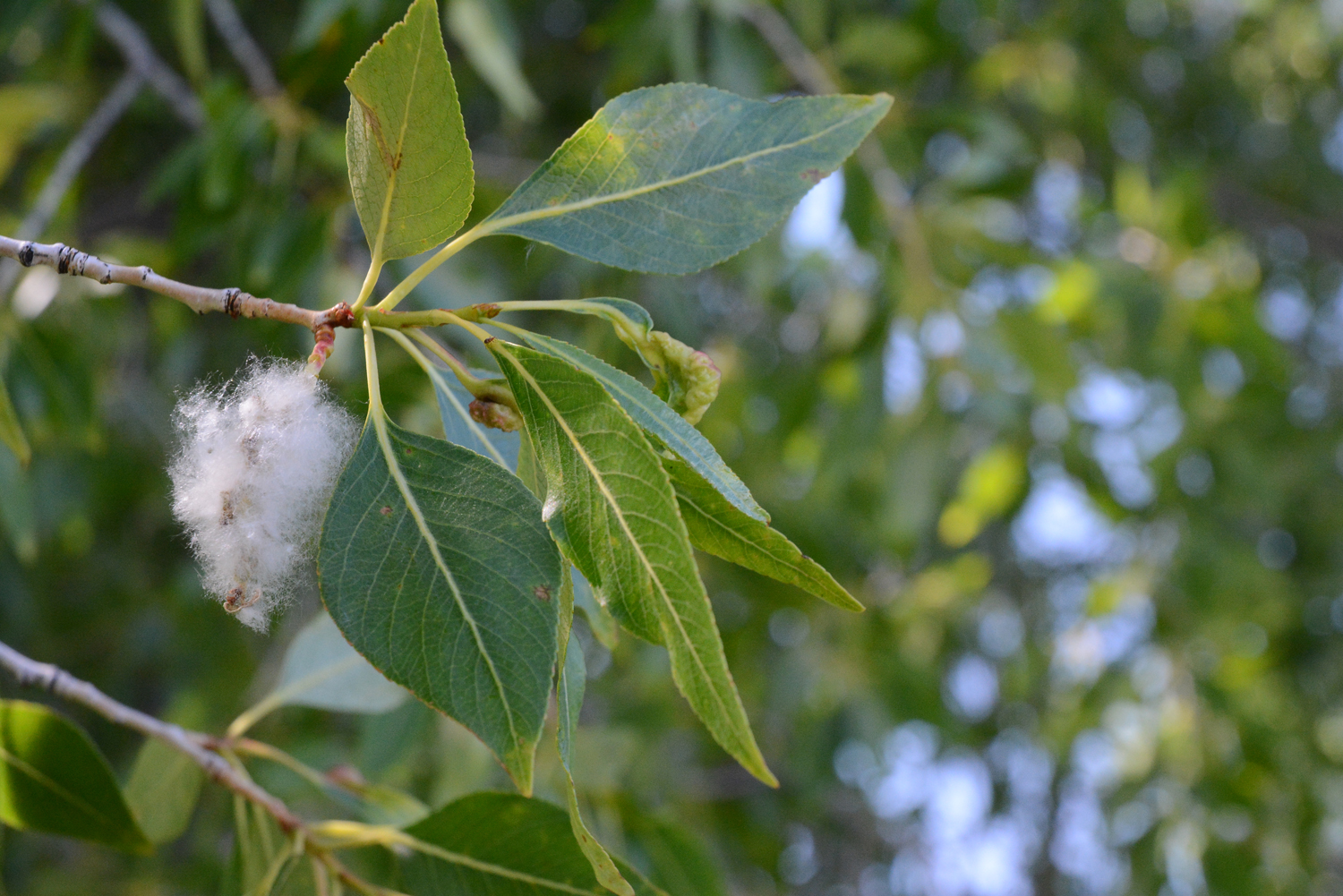
The fruits of both aspens and cottonwoods will be a capsule that splits open releasing many tiny seeds attached to fluff (hairs) for distribution by wind. Seeds are viable for only 2-4 weeks. 

In cottonwoods, only one seed in thousands will end up germinating and surviving into a full-sized plant. The first root must grow fast enough to continue to reach water as the soil dries. Many cottonwoods count on episodic flooding to succeed from seed.

After the willows, aspens, and cottonwoods release their tiny seeds upon the wind—like mini-snowstorms, the old catkins fall to the ground—all within about 4-6 weeks. By then the leaves are fully unfurled and there is no trace of the profusion of reproductive activities a few weeks before. 

Alders are in a separate family – the Birch Family. Their male and female catkins are on the same plant.  

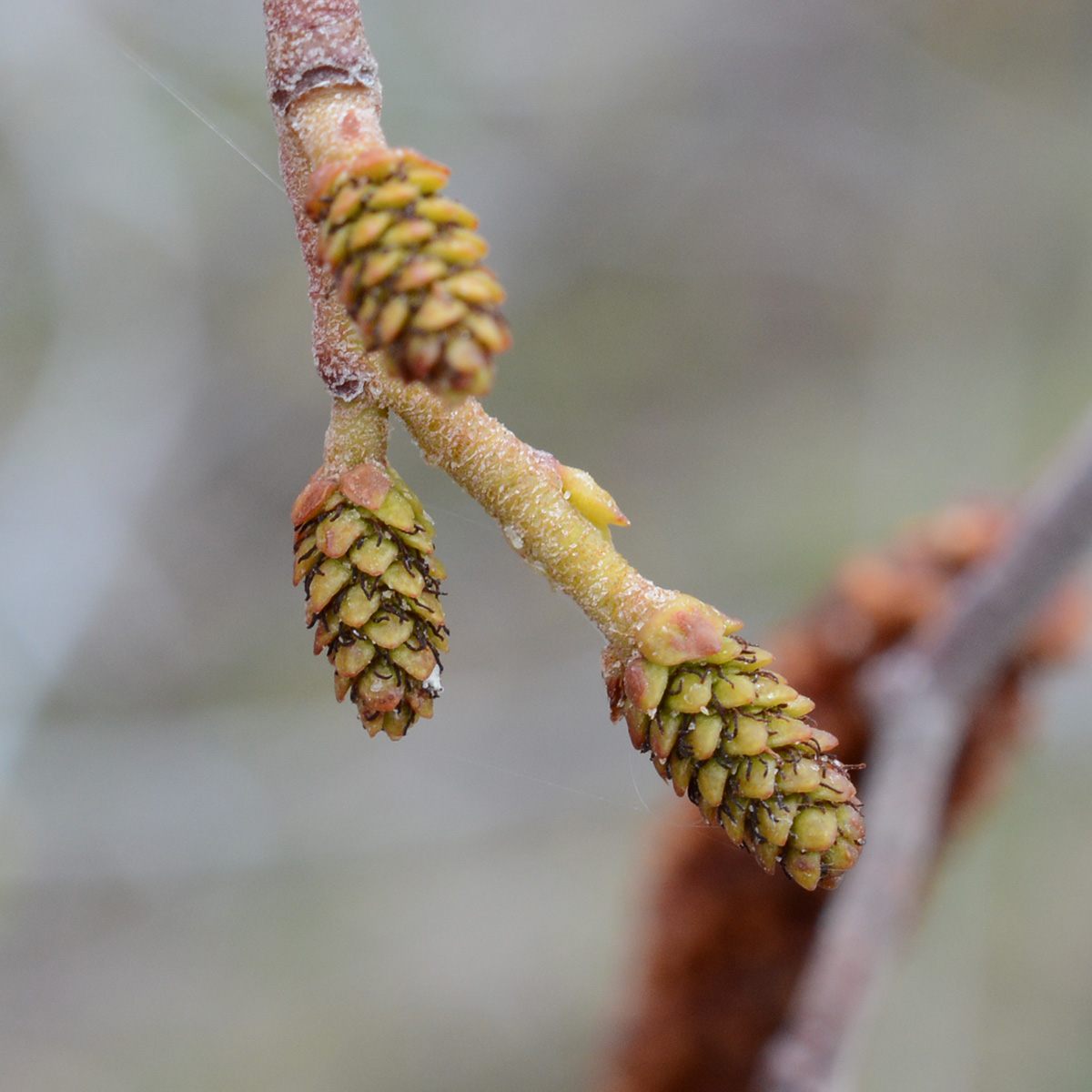
Male and female catkins are on the same tree, often on the same branch of Speckled AldersAlnus incana var. tenuifolia. Male and female catkins have been on the ready since fall. Come spring, the male catkins stretch and dangle while the much smaller upright female catkins expand slightly.

The female catkins reveal dark stigmas above each tight scale.

If all goes well, pollen will land on the stigmas, and a dried flat seed called a samara will slowly form. These seeds will remain within a hard cone-like structure until late autumn, when the scales will open and seeds will fly off like frisbees on the wind.

Alders can fix nitrogen (as do legumes), thereby providing much needed nutrients to exposed soils after rock slides, floods, or fires. Alders were important plants in colonizing areas after the glaciers retreated. Their fibrous roots also prevent erosion. They grow plentifully around Saw Mill Ponds and along adjacent creeks.

Have fun investigating the various ways flowers emerge in the spring and how they are pollinated to produce seeds for their future.

May 22, 2024 – Jackson Hole