Conservation Notes: Thistles in Teton County

Those of us in the Wyoming Native Plant Society are interested not only in natives, but invasives, for they can be destructive, as we know. However, it seems that many people believe that any thistle is by definition a weed. Not so. We have both native thistles and noxious weeds here, and this post intended to help everyone know the difference.

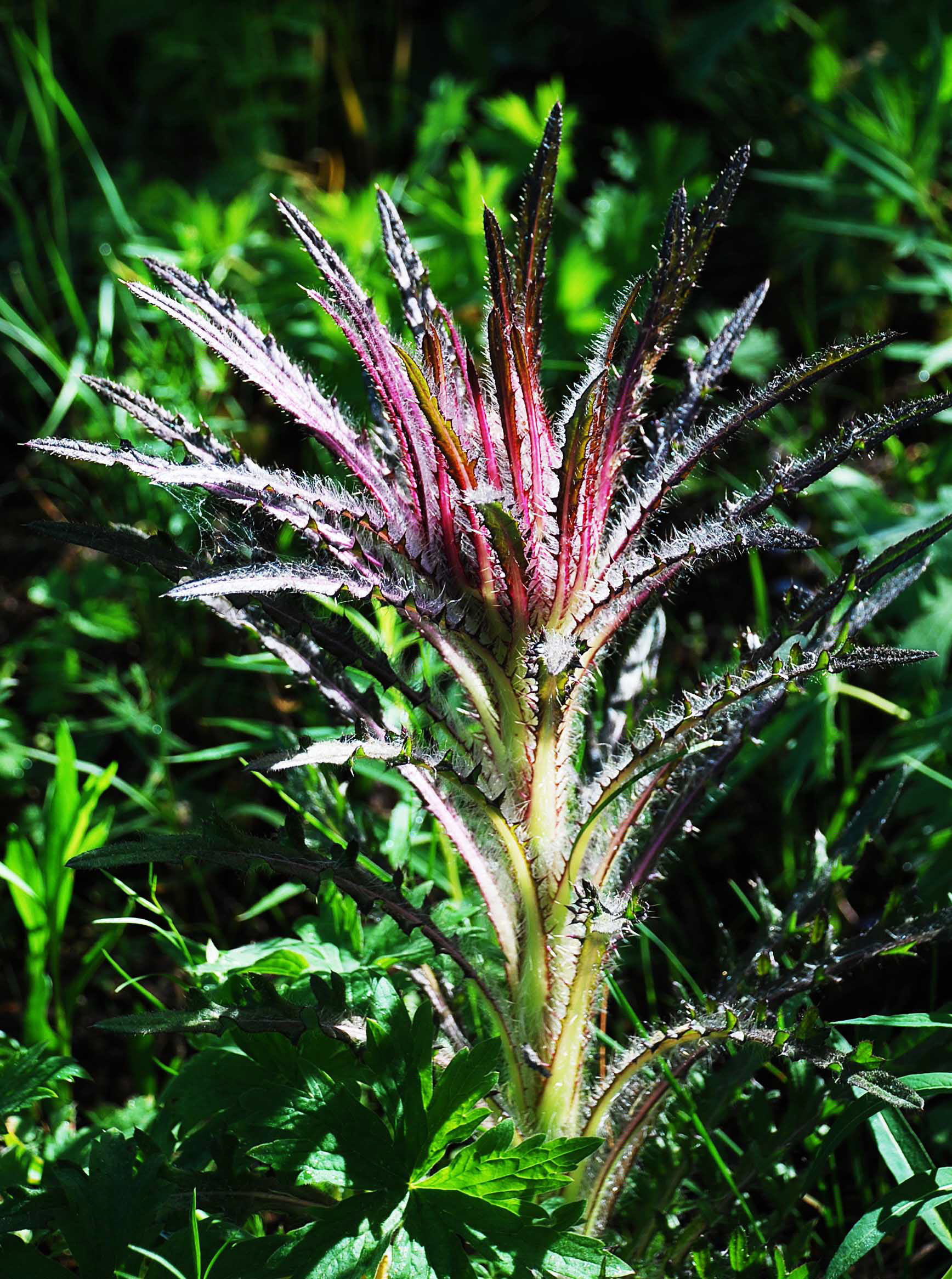
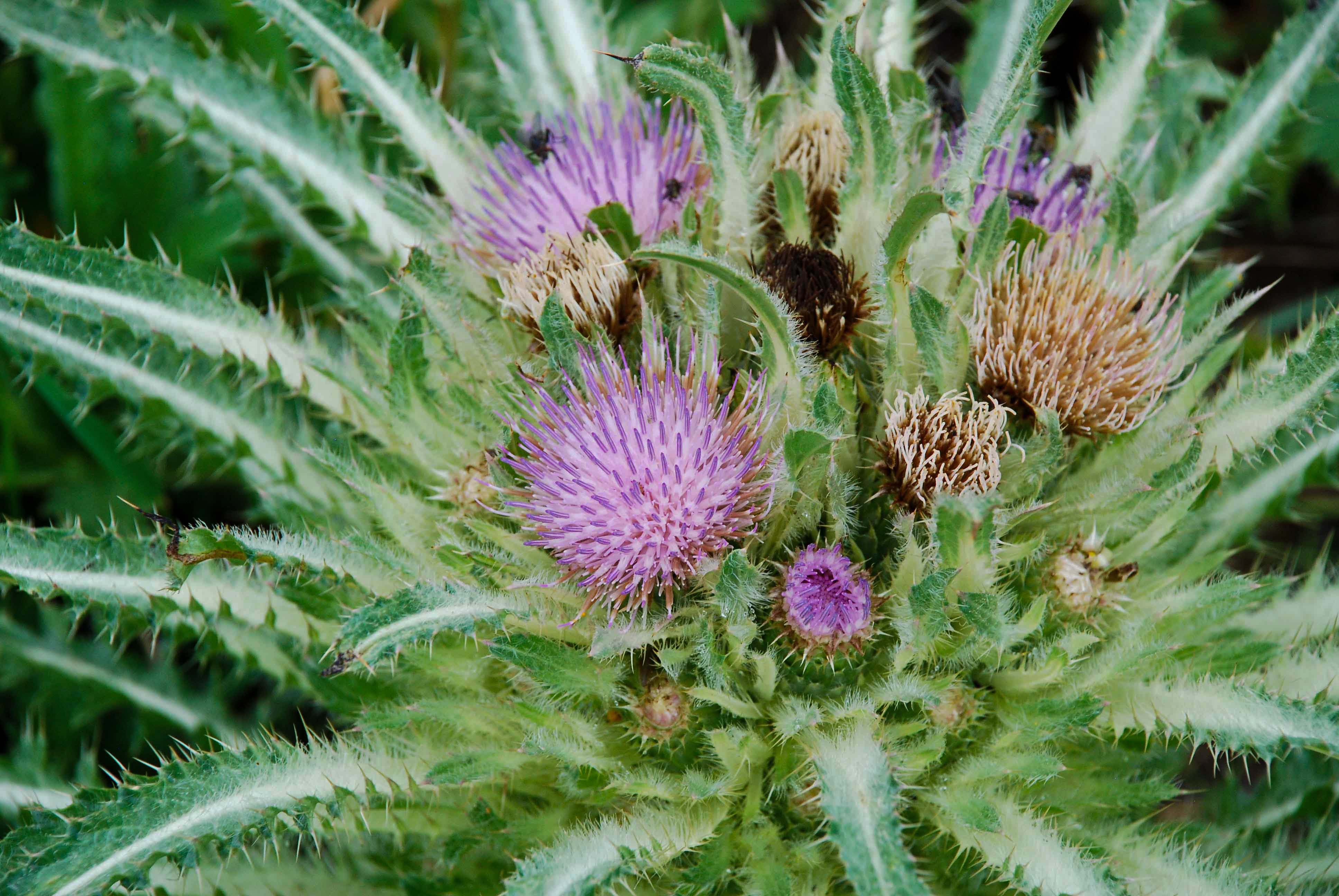
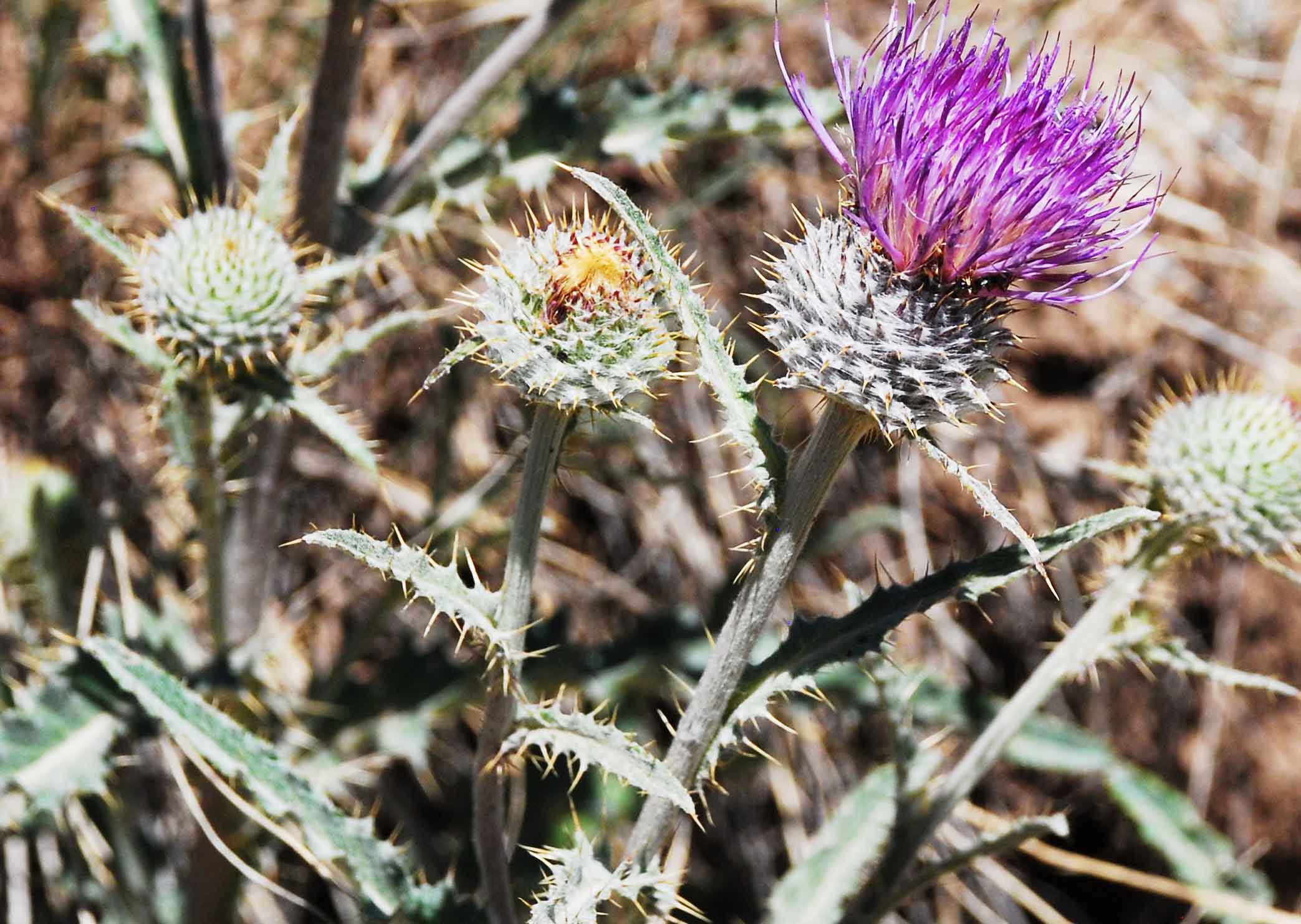
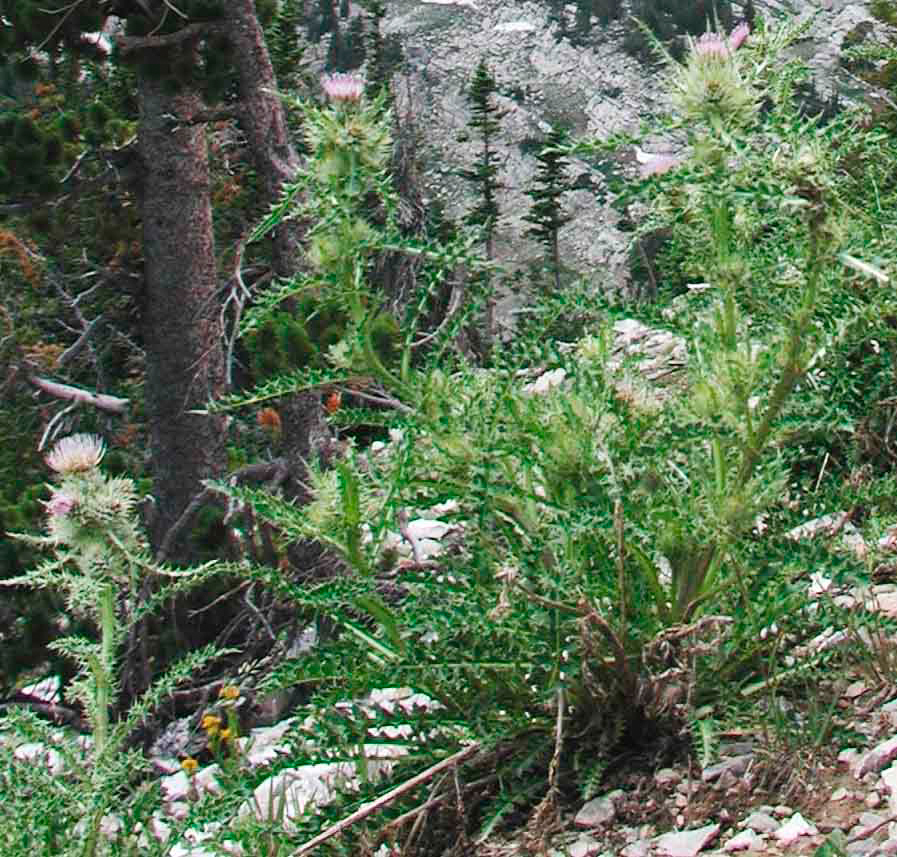
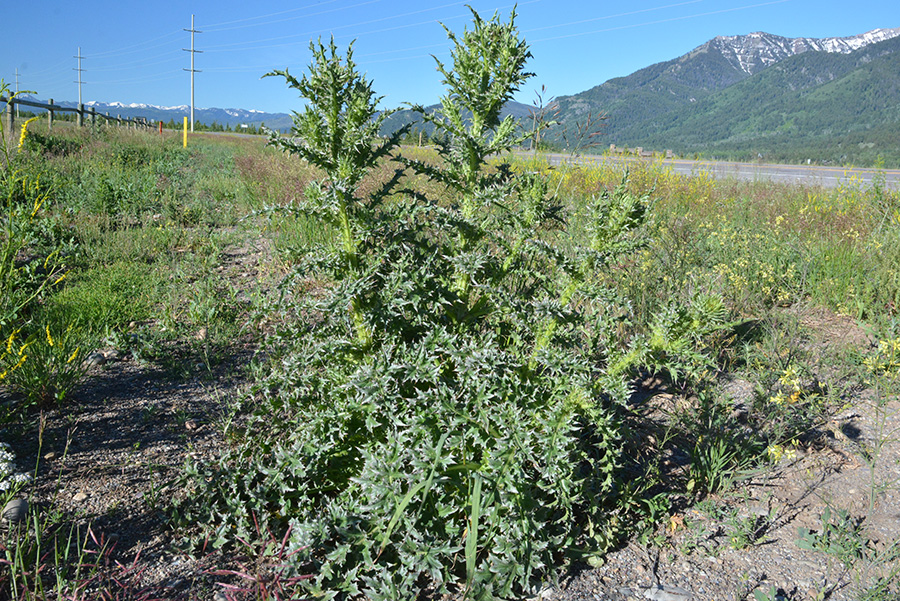
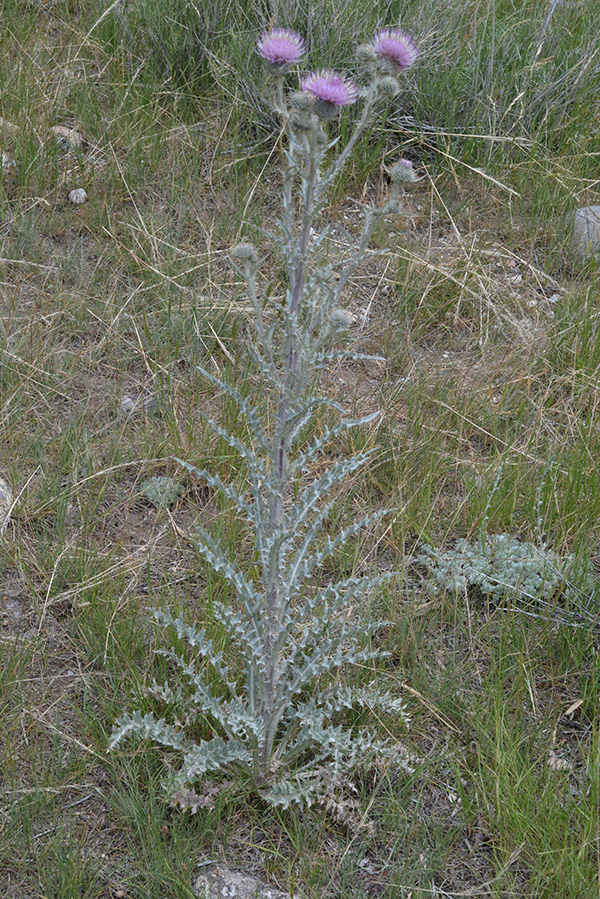
Plant keys and guides help identify thistles with technical details, but a broad-brush way to tell the so-called good from bad thistles involves things you can see immediately. All the species of native thistles are covered in white hairs that give them a gray or silvery appearance. Elk thistle (Cirsium scariosum) is distinguished by having a single leafy stem 3 feet tall and a cluster of pale flowers near the top.

Elk thistle, showing growth habit of one main stem and flower cluster at top.

Elk thistle, Cirsium scariosum, showing growth habit of one main stem and flower cluster at top.

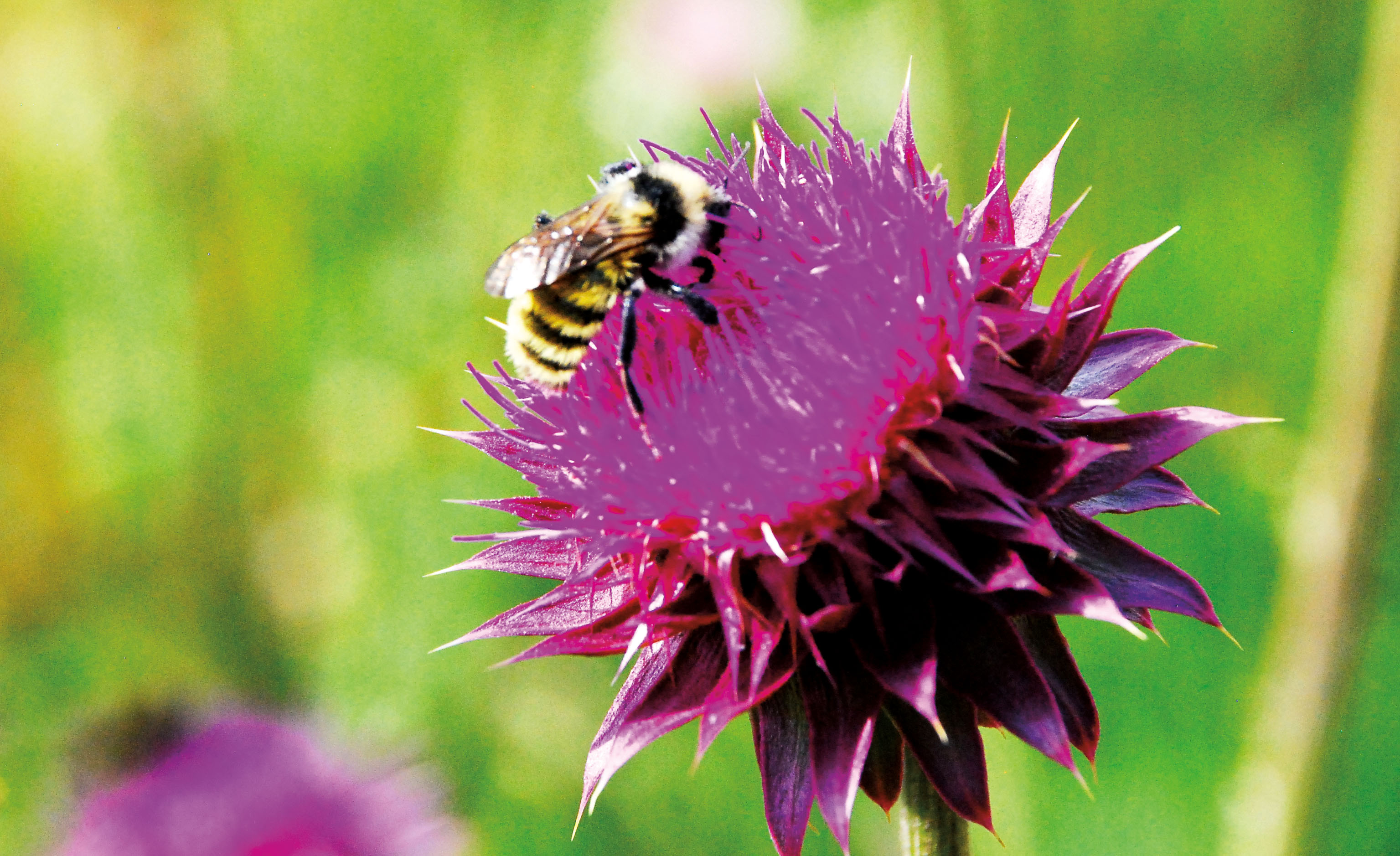
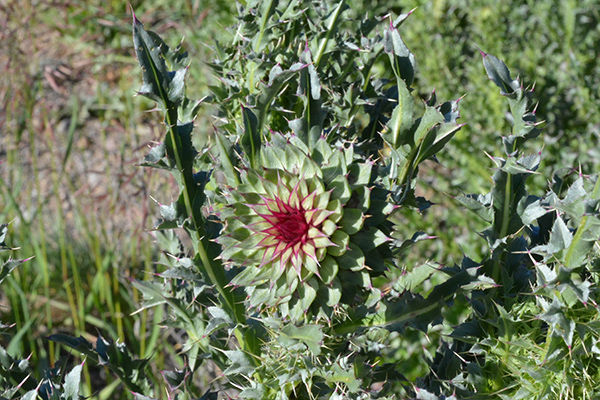
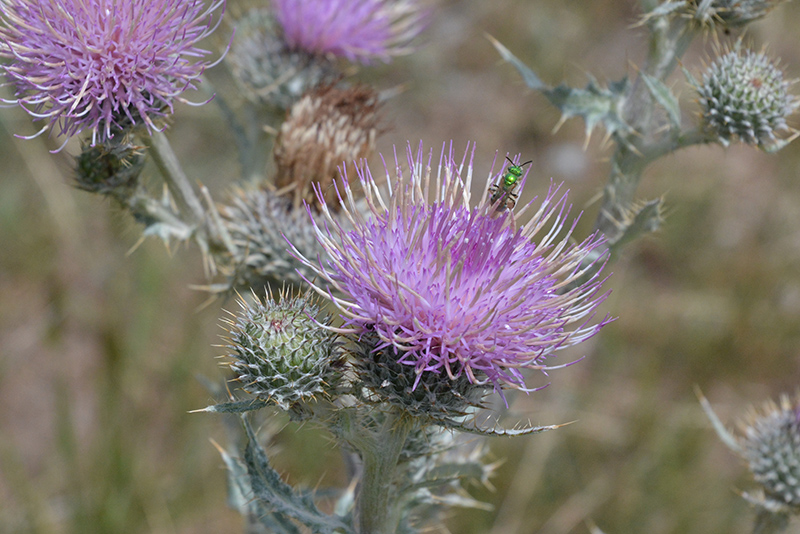
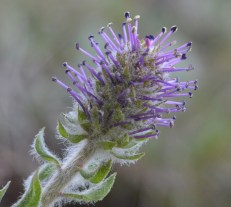
Flowerhead of the elk thistle, Cirsium scariosum.

Flowerhead of the elk thistle, Cirsium scariosum.

Our other mid-elevation native species, Teton thistle (Cirsium subniveum), is also grayish in appearance, but it has branches coming off the main stem, each with one to several showy flowers that range from pale to a more intense violet. They are usually around 2-3 feet tall. If you look at the base of the leaves, especially at the lower part of the stem, they are strongly decurrent, as if pasted to the stem for as much as an inch.

Teton (Jackson Hole) thistle, Cirsium subniveum.

Teton (Jackson Hole) thistle, Cirsium subniveum.

Tweedy’s thistle (Cirsium tweedyii or C. eatonii), an alpine species, is similar in appearance to Teton thistle, and also has branches and decurrent stem leaves, but is only seen above around 9,000 feet. Look for it above Tower 3 on the Rendezvous Mountain road.

Tweedy’s thistle, Cirsium tweedyii.

Tweedy’s thistle, Cirsium tweedyii or C. eatonii.

These native thistle species are found with other forbs and grasses and rarely dominate. In newly disturbed sites, where their airborne seeds can take hold, they can be pioneer species, but as other plants colonize the disturbance, they take their place as an occasional plant among the wide variety of natives. Deer and elk favor the young growth and flowers, and pollinators of all kinds visit the many disk flowers. Seeds are eaten by birds and small rodents.

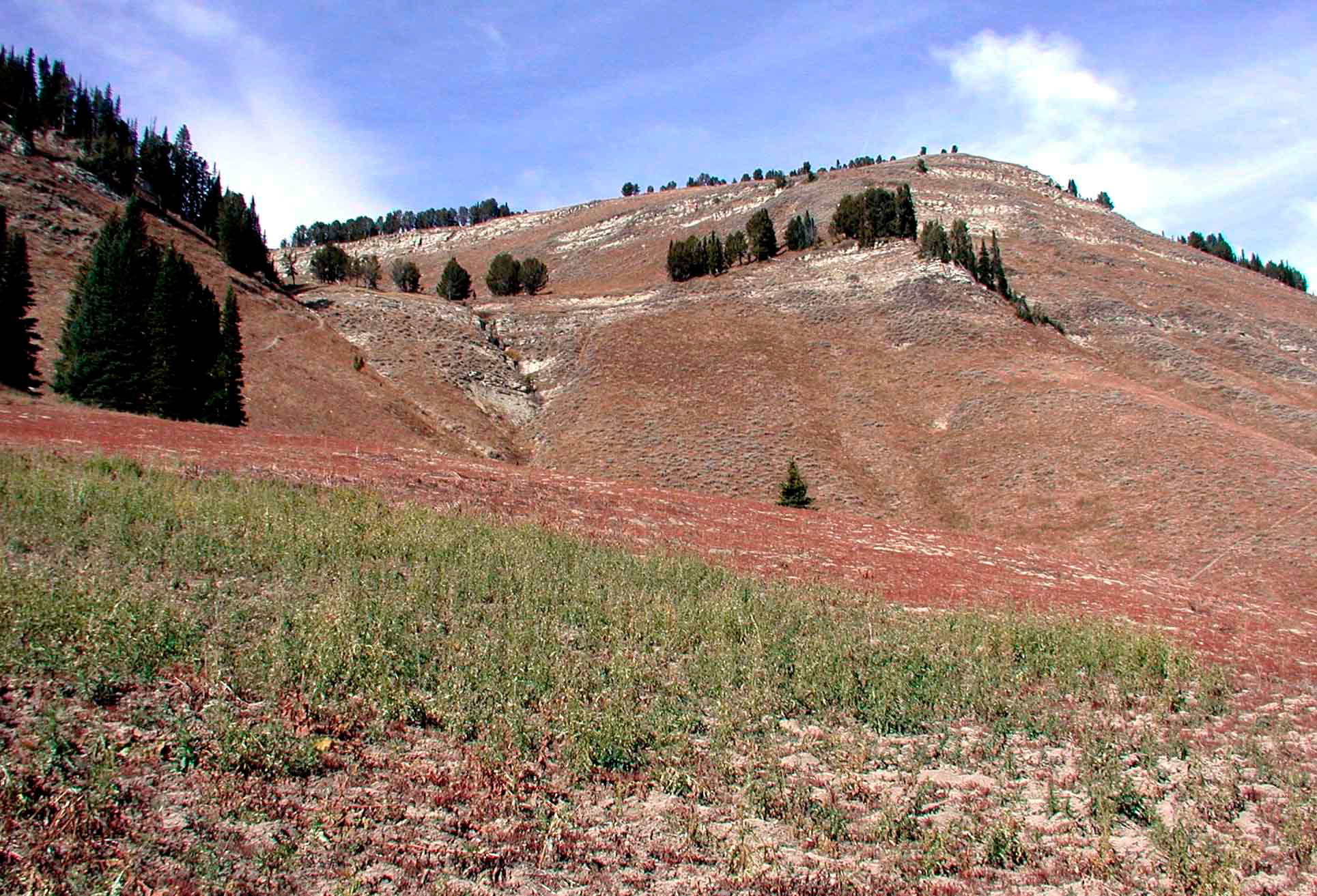
The most common non-native thistles do not appear gray or silvery. The plants have hairs, but they still look mostly dark green. Canada thistle (Cirsium arvense) grows in clumps, has narrow stems and leaves, and clusters of small purple flowers. Usually found in moist places, it can reach 3 feet. This patch, in a recently vacated sheep grazing allotment, is the only green thing left after the sheep have left in fall. A few years later, mountain brome and bluebell are becoming lush and keeping the thistle contained.

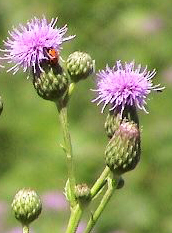
Canada thistle flowers, Cirsium arvense.

Canada thistle flowers, Cirsium arvense.

Canada thistle flowers, Cirsium arvense

Canada thistle flowers, Cirsium arvense

Musk thistle (Carduus nutans) is the largest of the weeds, with flowering stems reaching 6 – 8 feet. It has a thick-leaved, robust base and a stout stem that branches near the top. Its deep-magenta flowers can be more than an inch wide.

Musk thistle, Carduus nutans.

Musk thistle, Carduus nutans.

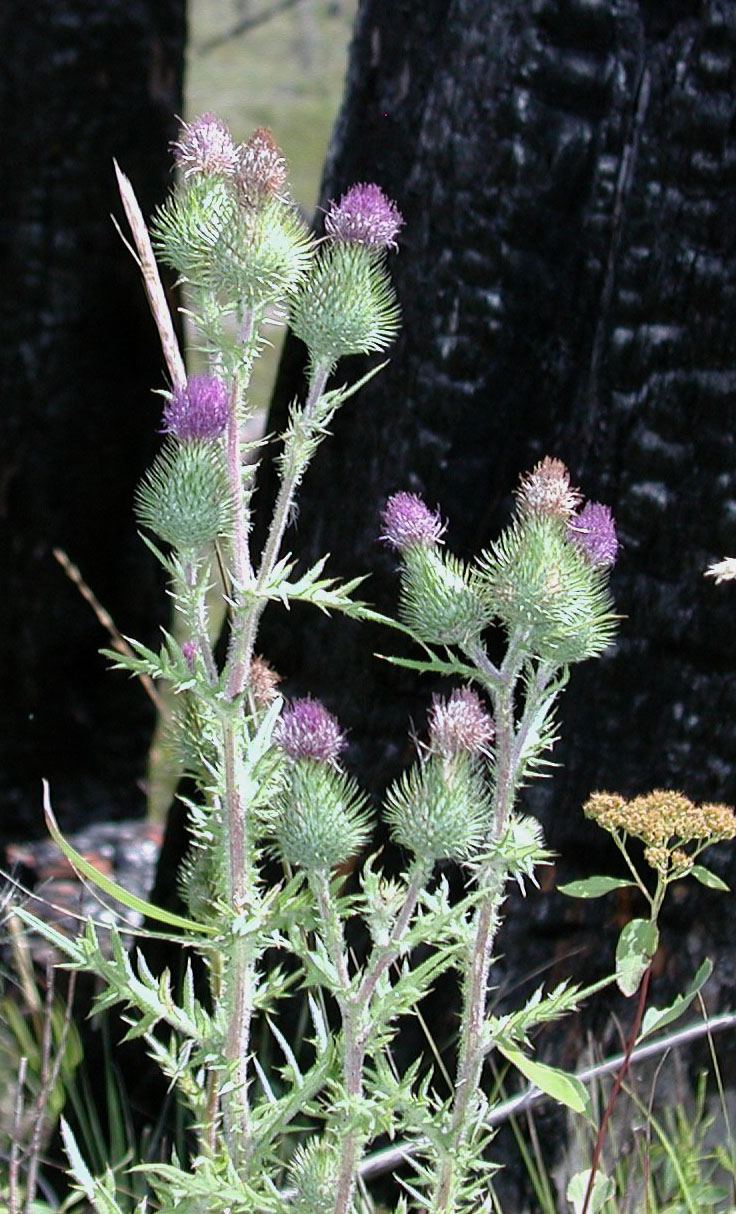
Bull thistle (Cirsium vulgare) is less widespread, and more silvery looking, than other weedy thistles. It is branching, kind of like Teton thistle, but the habit is more upright and it has stiff bristly stem leaves that are not decurrent. The calyx is tall and vase-shaped, whereas the calyx of the Teton thistle appears more rounded.

Bull thistle, Cirsium vulgare.

Bull thistle, Cirsium vulgare.

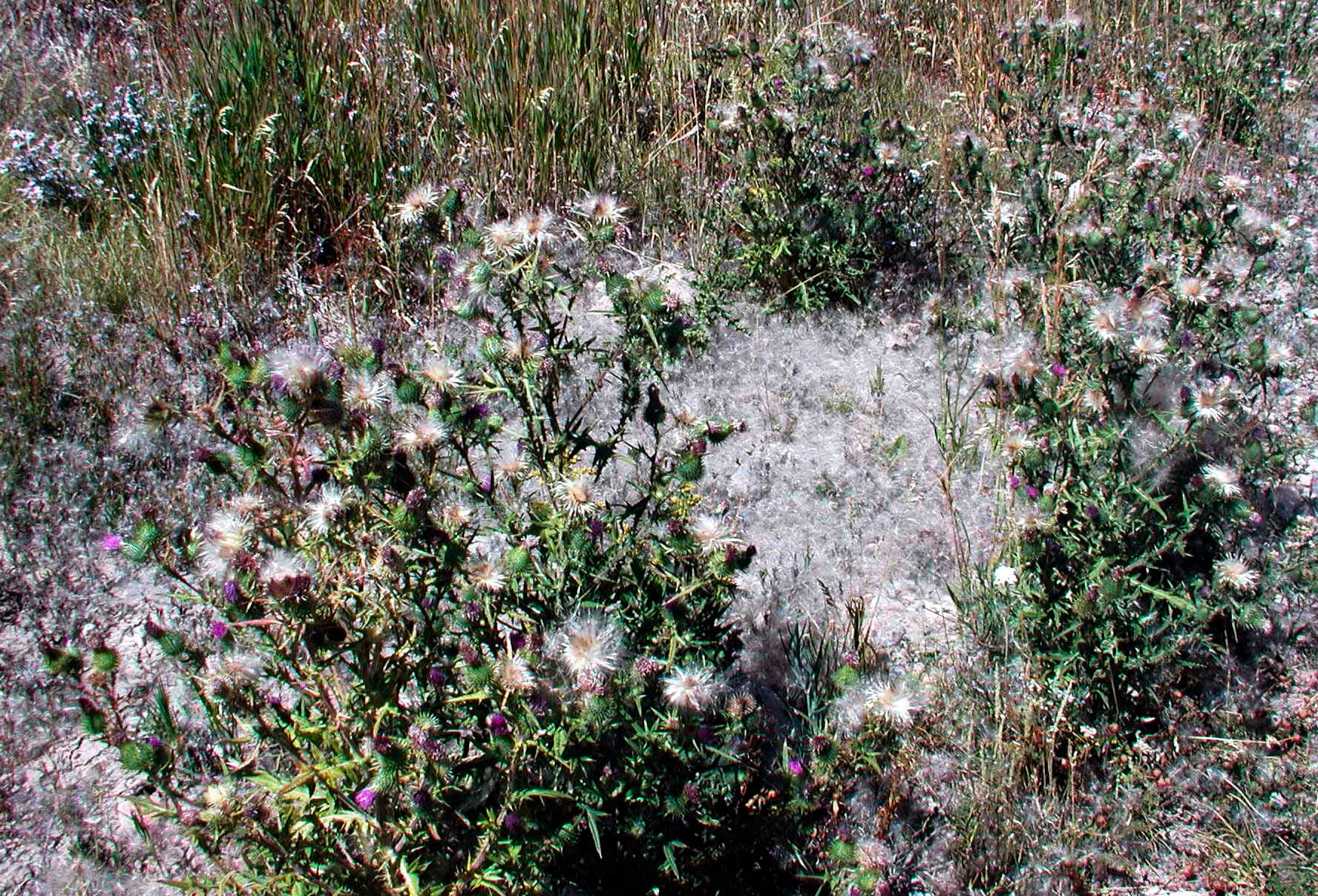
The photo below shows a patch of bull thistle gone to seed – an impressive number of parachute seeds that can take off in the wind and colonize disturbed areas deep into the backcountry.

Bull thistle, Cirsium vulgare, gone to seed.

Bull thistle, Cirsium vulgare, gone to seed.

A few recommended do’s and don’ts for anyone interested in helping reduce these weeds:
• Let Teton County Weed and Pest know if you find an infestation, especially of musk thistle. UTM (GPS) coordinates nice to have if in the backcountry. Weed and Pest will send crews to spray if needed.
• If you see someone pulling native thistles, let them know these aren’t weeds.
• Do pull musk thistle if so inclined (thick gloves recommended!). They have tap roots so they can be pulled. However, if they are in bloom it does no good to leave them lying there. The blooms will mature and go to seed. Before they bloom they can be pulled and left.
• Don’t pull thistles unless you’re sure of the identity.
• Don’t try to pull Canada thistle. It has underground rhizomes and cutting them will only stimulate growth.

TC Weed and Pest (www.tcweed.org) is a good resource for identifying weeds, thistles or otherwise.

Susan Marsh, Jackson, WY

Late July Wildflowers in Jackson Hole

The sage flats are subtly colorful, mostly with yellow, cream, and rose hues of persistent and pervasive sulphur buckwheat flowers and fruits (Eriogonum umbellatum varieties). Lupines still flourish, sage is extending its silvery flower stalks, and the grasses wave gracefully in the breeze.   For fresh blooms and splashy color you have to go higher and higher.
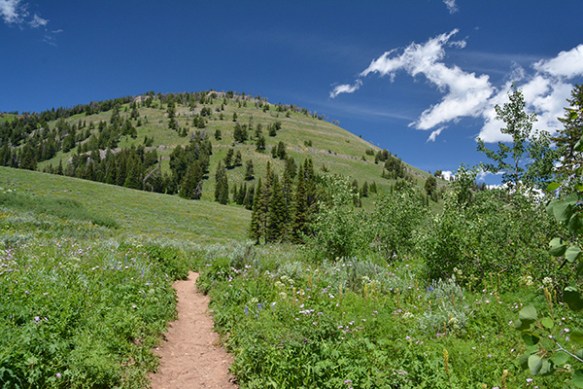
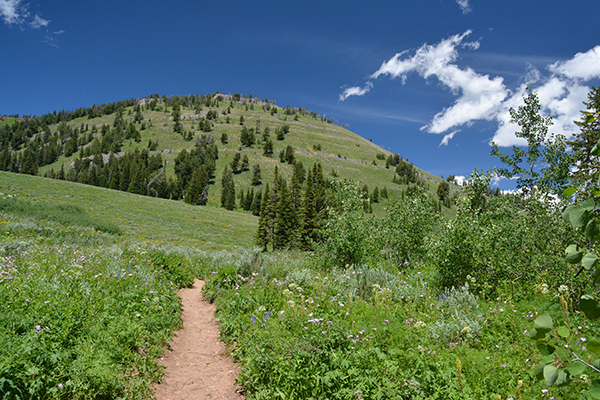
Walk through the meadows up to Ski Lake, and beyond.

Walk through the meadows up to Ski Lake, and beyond to find flowers.

Cool canyons and high meadow slopes feature floral bouquets.   What we think of as spring flowers: Spring beauties (Claytonia lanceolata) may be blooming in recently melted snow patches.  On dry slopes, late summer bloomers may be out already, such as Engelmann Aster (Eucephalus engelmannii).  On any given slope, flowers will mix in different combinations of pink sticky geranium, red to yellow paintbrushes, blue lupines and asters, lavender erigerons, yellow sunflowers, white columbines, to name a very few!

Mid-elevation hikes are good for botanizing.  Trails south from Teton Pass and north to Ski Lake exhibit extraordinary diversity of bloom.
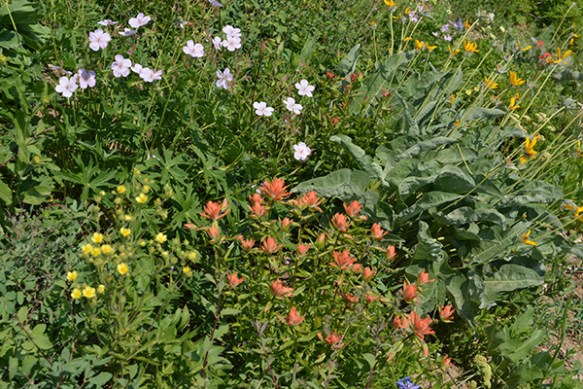
A_BTNF_PassTrMid_Flws_71714_2crpWebMoose-Wilson Road and hikes to Phelps Lake are also great right now.  You may want to visit Goodwin Lake, Two Ocean Lake, and other mid elevations at the north end of the valley as well.  This list does not include the incredible alpine and subalpine flowers found at 9,500’ and above.

Keep scrolling down to discover what is in bloom now and to identify what you may have already found.  Also reference past “what’s in bloom” pages:

Longtime Favorites:

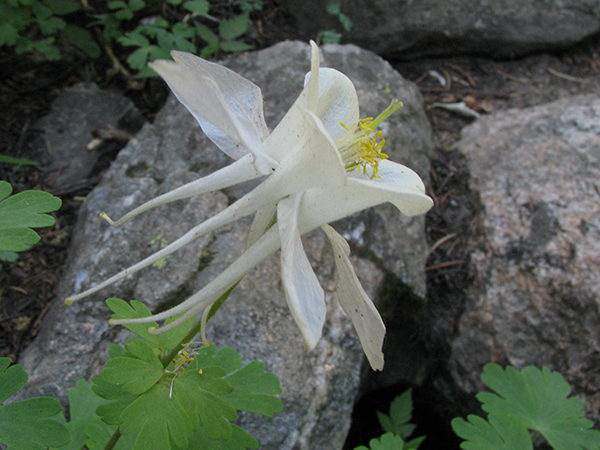
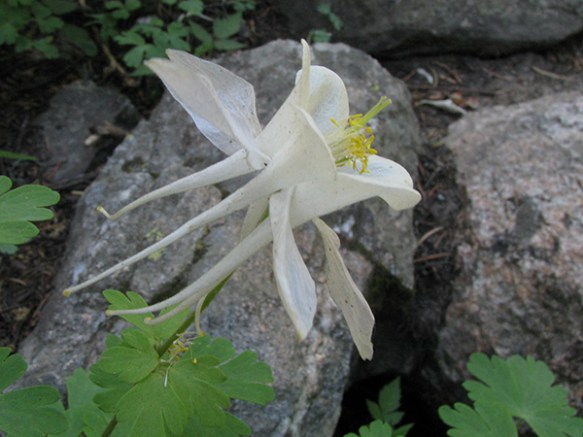
Colorado or White ColumbineAquilegia coerulea  var. ochroleuca– The delicate “talons” or spur-like petals extend 2” beyond the rounded sepals (which look like petals) and contain nectar for long-tongued pollinators: hummingbirds and hawkmoths.A_AquCoe_flb_GraCanTr_62912_1crpWeb
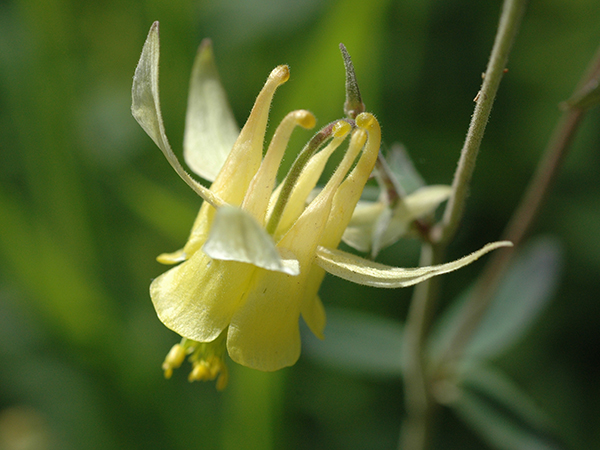
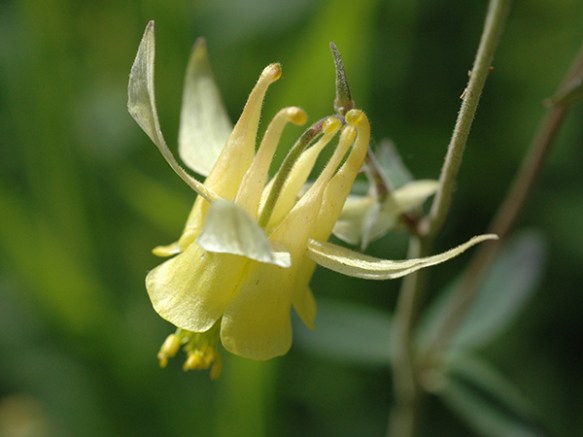
Not to be confused with the lemon-yellow to bluish color Yellow Columbine (Aquilegia flavescens) which flexes shorter, stubbier spurs.  Long-tongued bees are more likely pollinators.A_AquFla_flCU_SawTmtUT_8911_4crpWeb
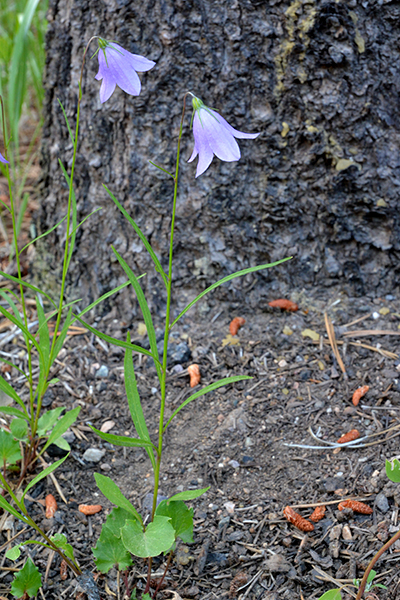
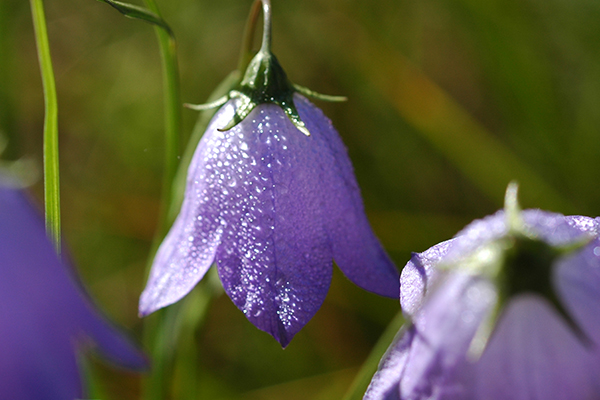
Harebell Campanula rotundifolia – The dangling blue bells are long-time favorites of locals, blooming from mid summer to the end of autumn.
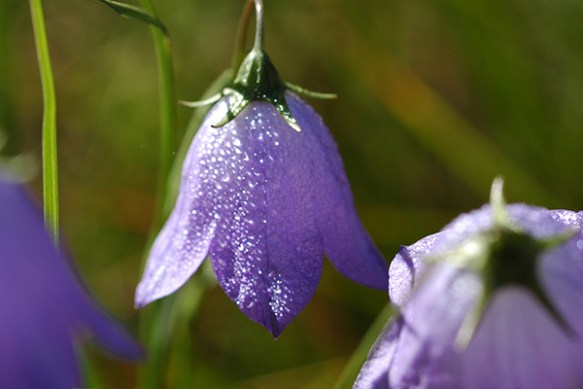
Harebell - a longtime favorite

Harebell – a longtime favorite

A_CampRotu_habfl_MWrd_72014_3Q2crpWeb

The leaves at the base are more or less round, but the stem leaves are linear in Harebell.

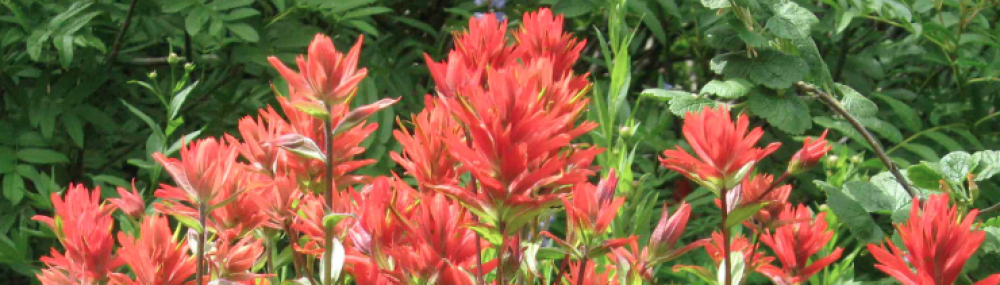
Paintbrushes – Castilleja spp.  These members of the Snapdragon family have complex flowers. Often the fused petals (galea) hide amidst colorful sepals and bracts. The species often hybridize or double their chromosomes, making it difficult to identify the species precisely.  For instance, color can be highly variable. Below are samples of the more obvious and beautiful, common species.

Wyoming PaintbrushCastilleja liniarifolia – The state flower inhabits sagebrush habitat and dry slopes.  Unlike many other paintbrushes, the “galea”, the beak of fused petals, is green and sticks out well beyond the tube of colorful orange-red sepals which split deeply on the back. Colorful forked linear bracts (leaf-like structures) are held beneath each flower adding to the show.  Alternating down the 2-foot stem, the leaves are thin and often forked.  The plants have a wild, lean elegance.
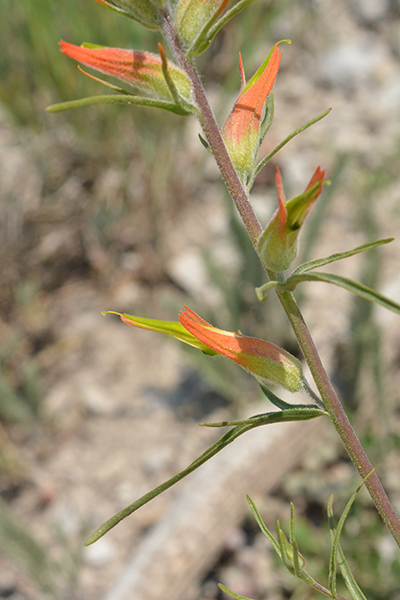
Wyoming Paintbrush - our state flower

Wyoming Paintbrush – our state flower. Note the stigma sticking out beyond the flower, ready for pollen borne on the heads of hummingbirds.  The green galea leans out beyond the colorful calyx tube.

Other paintbrushes in the mountains include the Scarlet Paintbrush –  Castilleja miniata.  Stems  are up to 3’ high.  Colors vary from pink, to salmon, to whitish to scarlet.
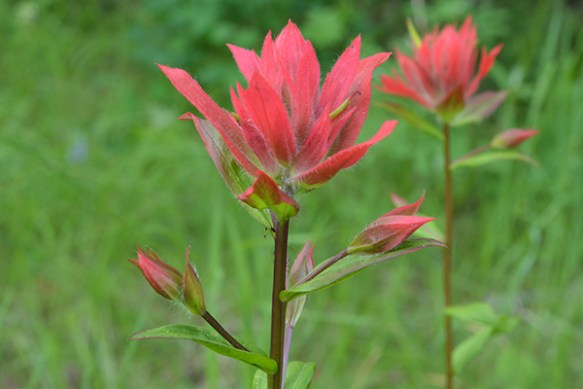
Scarlet Paintbrush is highly variable in its color.

Scarlet Paintbrush is highly variable in its color. Note the leaves and bracts are not lobed.  The green galea of fused petals is almost hidden by the colorful sepals and bracts.

Also look for the very similar, shorter Alpine PaintbrushC. rhexifolia – in subalpine to alpine locations. The bracts are slightly lobed at their tips.  Distinction by color, unfortunately, is in the eye of the beholder.
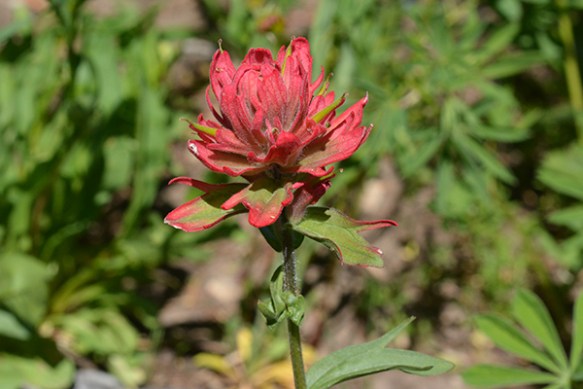
Note the lobed tips of this species.

Note the lobed tips of the bracts and leaves of Alpine Paintbrush, which otherwise looks a lot like Scarlet Paintbrush (above).

Sulphur PaintbrushCastilleja sulphurea –  The “galea” barely pokes out beyond the sepals and bracts which are both usually pale  yellow (but there are color variations!) with many long, often sticky hairs.  The leaves, like the bracts, are usually more or less entire, not divided.
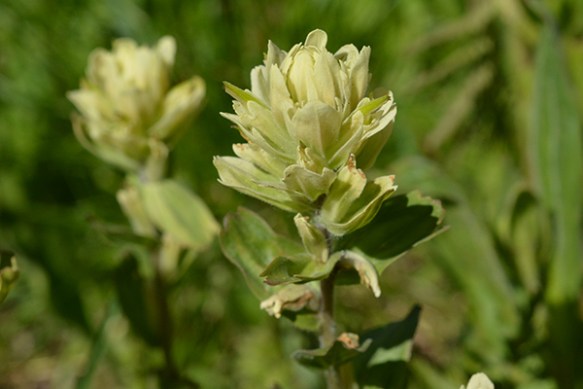
Sulphur Paintbrush can grow in clusters.

Sulphur Paintbrush can grow in multi-stemmed clusters.

Mountain BluebellsMertensia ciliata – The sky-blue flower clusters drip over mountain streams at this time of year.  This is the only bluebell species of this large 3-4’ size.
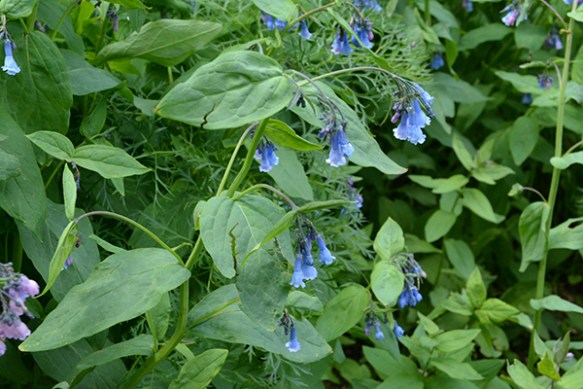
Mountain Bluebells is often along streams or wet meadows.

Mountain Bluebell often grows along streams or in wet meadows.

Western SweetvetchHedysarum occidentalis   – The violet pea-shaped flowers dangle in stiff racemes above 1’ foliage.  Look for the flattened fruits that hang down in chains later in the summer.
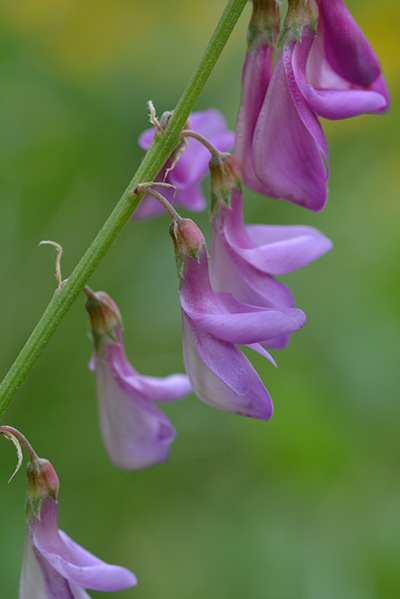
A_HedyOcci_flCU_SkiLk_62613_1web

Note the “keel” and “banner” of Western Sweetvetch are longer than the side “wings” of the pea-like flowers.  The green calyx of fused sepals at the base of the petals has uneven teeth–looking like a scoop.

Standouts:
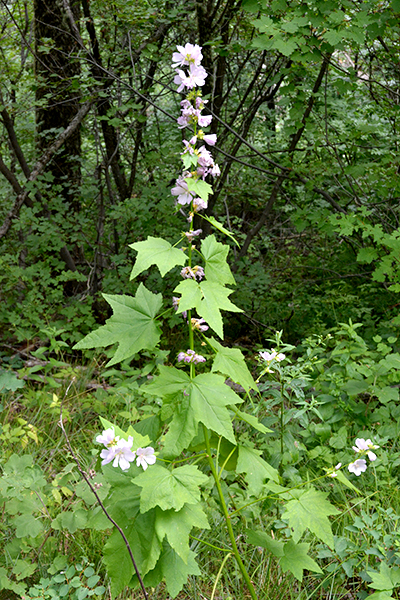
A_IliaRivu_Flhab_PhlLkTr_72114_1Q2CrpWeb

Mountain Hollyhock is in cool canyons and long sunny roadsides.

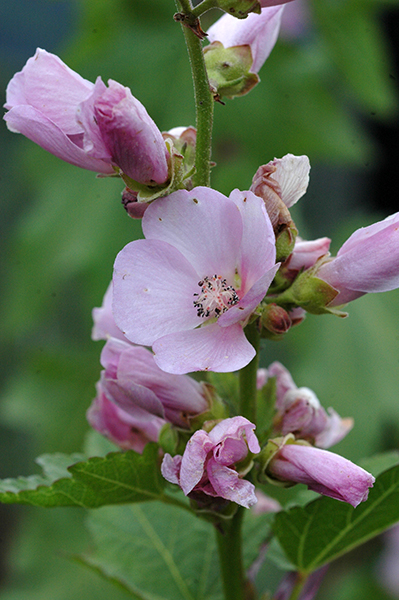
Wild HollyhockIlliamna rivularis – stands out along sunny dry roadsides as well as in shady canyons.  The 4-6’ plants are hard to miss with their large lobed leaves and lavender to pink hollyhock-like flowers.
A_IliRiv_flCU_ShadMtnRd_8411_1crpWeb

Look inside the 1.5” petals of Mountain Hollyhock: dozens of anthers form a tube and down inside are 5 separate styles with nobs on their ends (capitate).  The 1” fruits look like very hairy wheels of cheese.  Each section (carpel) encloses 2 or more seeds. These features make it different than your garden Hollyhock (Malva sp).

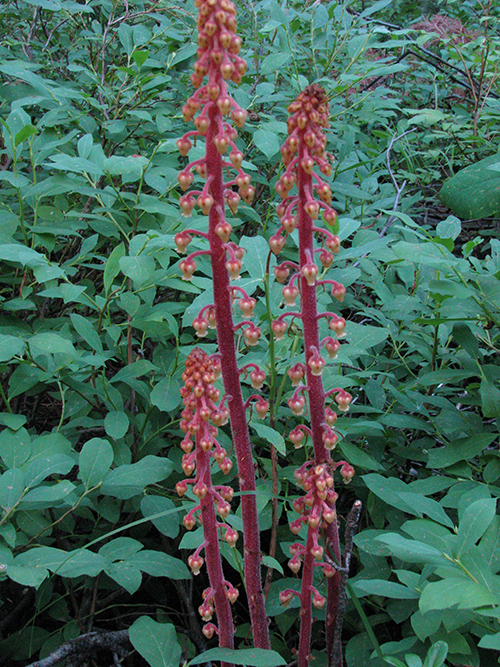
Pinedrops – Pterospora andromeda – One- to four-foot singular stalks grow in dry coniferous woods.  The rusty red stems have no green leaves.  Instead of photosynthesizing, the plant roots are surrounded by mychorrhizal fungi that draw upon another unknown host for carbohydrates to benefit the pinedrops.  Much is still mysterious about this species.
A_PteAnd_Fl_TNP_8511_2web

The dangling bell shaped flowers of Pinedrops will each produce a dry capsule containing 1000s of tiny seeds, easily scattered by wind deep into the duff to co-join with fungal threads.

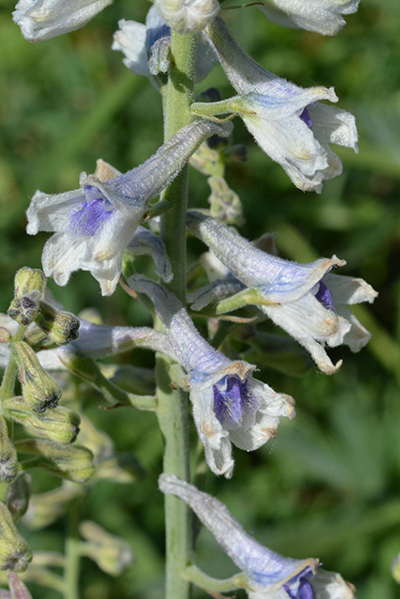
Western LarkspurDelphinium occidentalis – Growing 5-6 feet in moist meadows, this plant has complicated flowers perfect for specific bee pollinators to puzzle out.  The smart bee’s reward is nectar at the end of the “spur”.
The tall Western Larkspur presents interesting puzzles to pollinators.

The tall Western Larkspur presents interesting puzzles to pollinators.

Aster Family – Asteraceae:
A_BalSag_FlCU_CurCan_6711smWeb

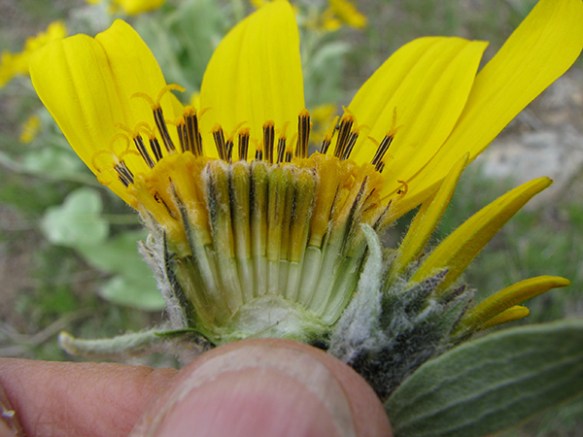
This flower head of balsamroot shows the ray flowers on the outside and smaller upright disc flowers clustered on the inside–each will produce a fruit. Note the fuzzy bracts surrounding the whole.  So each flower head can have many, many flowers, hence the old family name Compositae

The Aster Family is one of the largest plant families in the world.  The basic plan of several tiny flowers sitting on a receptacle making each cluster or “head” look like a single flower is universal.  However, the variation in “involucral bracts” surrounding the “head”; the receptacle shape; outer and inner flower types—ray vs. disc; color; pappus -bristles or scales; seed shape and size are technical aspects that place  “asters”,  “ daisies”, and “sunflowers” into different genera.  Common names add to the confusion.  Regardless, it is fun to investigate the plants:  Can you see similarities and differences between flowers?  Pollinators know which is which, if not by name.

Subaplpine Erigeron – Erigeron peregrinus – Flower heads are usually one per stem and the petal-like rays are 2-4 mm wide (relatively broad), usually bluish lavender.  Plants can grow 2+ feet tall.  The upper leaves may or may not be reduced.
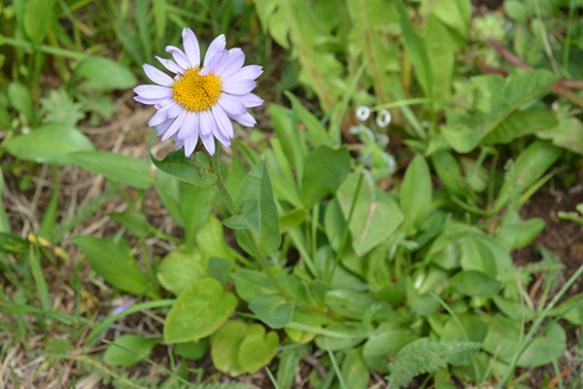
Single heads with broad blue ray flowers are typical of Erigeron peregrinus.

Single heads with broad, blue petal-like ray flowers are typical of Subalpine Erigeron.

Oregon Erigeron – Erigeron speciosus – Rays .5-.2 mm., narrower and more plentiful (75-150)  than Subalpine Erigeron.   Each stem may have 1-10 flowers.   Upper leaves are gradually reduced and usually egg-shaped (ovate), the lower leaves are more elongate.  Leaves are typically smooth with some stiff hairs along the margin (ciliate).
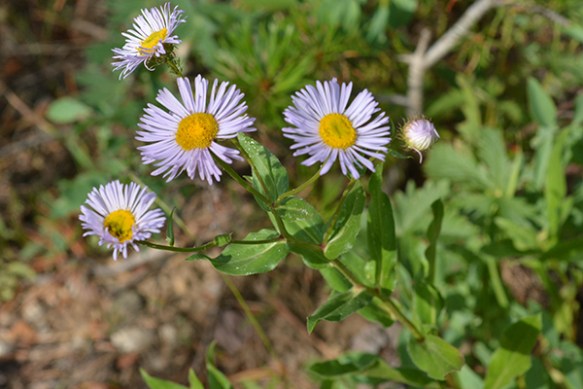
Erigerons have many small rays.

Oregon Erigeron has  several flower heads with many small rays, egg-shaped leaves near the top, and longer leaves with side hairs near the bottom of 2-2.5′ plants.

Little Sunflowers or HelianthellasHelianthella spp.– This genus has sunflower-like heads, e.g. yellow petal-like ray flowers around the outside, and small disc flowers on the inside.  The large elliptical leaves are arranged opposite near the base to sub-opposite higher on the stem. Leaves are sandpapery rough.  Unlike dandelions, the “pappus” is scale-like, not fluff-like. This genus has flattened achenes (frutis) with thin edges vs. not flattened of a true sunflower (Helianthus sp. –think of the sunflowers seeds you shell and eat!).
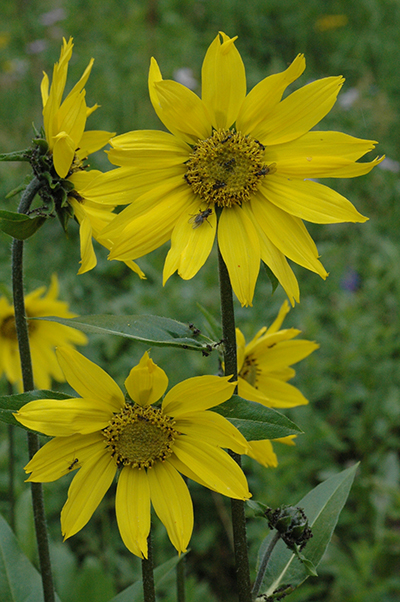
A_HeliQuin_FlCU_TetPs_72412_1crpWeb

Five-nerved Helianthella – Helianthella quinquenervis – stands up tall to 4 1/2’, and stares straight at you. The lower leaves may be 1’ long, with 5 obvious nerves. Basal leaves may be present. Flower heads are 3-5” across, solitary or with a few smaller below.  The bracts on the back are broadly triangular and often have hairs along the outer edges.  Found in moist woods in the mountains.
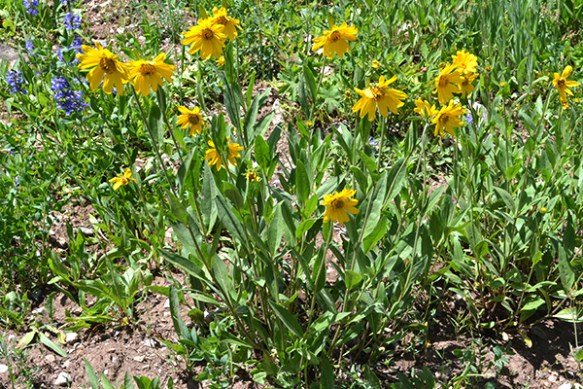
One-flowered Helianthella - Helianthella uniflora - is shorter 2-3' tall, and more demure in its posture.  Lower leaves have 3-veins,  Flower are 2-3" across and the bracts are narrowly triangular.

One-flowered HelianthellaHelianthella uniflora – is shorter 2-3′ tall, and more demure in its posture. Lower leaves have 3-veins, Flower are 2-3″ across and the bracts are narrowly triangular. It grows in sage flats and up relatively dry slopes.

Groundsels  – Senecio spp. – This genus has yellow ray flowers plus disc flowers.  The involucral surrounding each flower head is made up of one row of narrow, equal bracts, like a palisade fence. (Occasionally, a few smaller bracts can be seen at base.)  The plants are typically smooth or cobwebby, never rough with stiff hairs as in look-alike sunflowers or sticky-hairy as in arnicas.   The silvery white pappus (fluff) gives it its Latin name Senecio meaning  “old man”.  The following three species are large, leafy, and common in the appropriate habitat.
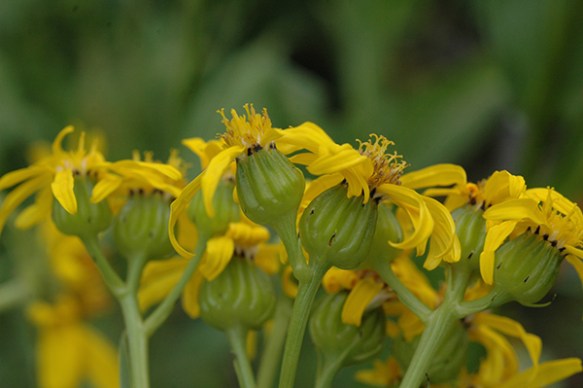
groundsels have a single row of even-sized bracts surrounding the flower heads.  This is Thick-leaved Groundsel or Senecio.  

Groundsels have a single row of even-sized bracts surrounding the flower heads. This is Thick-leaved Groundsel or Senecio.

Toothed Senecio or Butterweed GroundselSenecio serra – The large leaves are linear or lanceolate, with pointed tips.  The margins are saw-toothed.  Plants grow to 4-5 feet, with multi-branching, rounded clusters of flowers.   Common in meadows along open areas of Moose-Wilson Road and elsewhere.
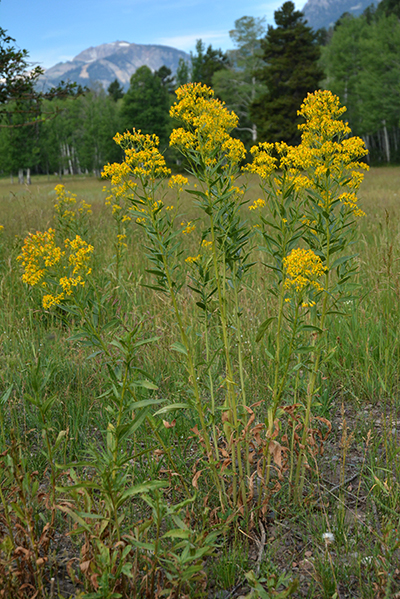
A_SeneSerr_habfl_MWrd_72014_1web

Butterweed grows in large colonies along Moose-Wilson Road.

Thick-leaf or Bracted SenecioSenecio crassulus – Smaller than the Toothed Senecio, this species is approx 2’-3 tall, with thickish leaves often rounded near the base.  They alternate up stem.  Edges smooth (entire) or with very small teeth.  Involucral bracts are thickened, waxy, with black tips.  Seen in high elevation meadows.
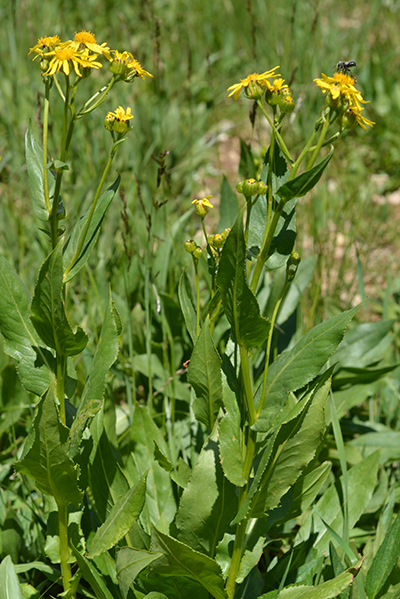
A_SeneCrass_habfl_SkiLkTrHigh_Junc_72214_1Q2web

Thick-stemmed groundsel height varies but can be 4′ tall in moist areas. The leaves are usually toothed, often broad at base and clasping the stem.

Arrow-leaf SenecioSenecio triangularis – Leaves several up the stem to 2-6” long, elongate, obviously triangular and toothed. Found in wet areas such as seeps, stream-sides, and wet meadows. (no photo)
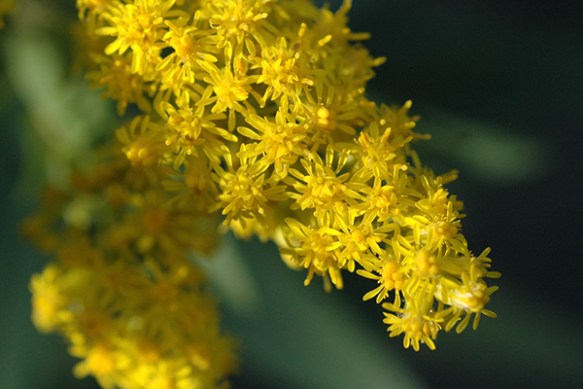
A_SolcfCan_flCul_BtLkTr_82311CrpWeb

Goldenrods do not cause hayfever. The pollen is too heavy to be carried by wind.

Goldenrods – First, goldenrods are not the cause of hay fever.  Their pollen is way too heavy to be tossed on the wind and up your nostrils.  Strong bees and flies are needed to carry pollen, it is so heavy.  These pollinators are attracted to the yellow clusters of flowers.  Look closely.  The flower heads are tiny: 1/8-1/4” wide.   Each of these flower heads has both yellow ray and disc flowers.  Often these tiny flower heads are arranged along one side of the branching inflorescence.  Leaves are simple, alternate, smooth edged or slightly toothed.  Low growing species — less than a foot or so –typically have basal clusters of leaves and then small leaves which reduce in size up the stem. Tall growing species typically have many, mostly same sized, leaves up the stem, and no basal leaves.

Rocky Mountain or Low GoldenrodSolidago  multiradiata – About 1-1.5’ tall, these tufted plants are often wedged into rocks or along sides of trails.  Look for approx. 13+ ray flowers per head and ciliate hairs along the petioles of basal leaves.
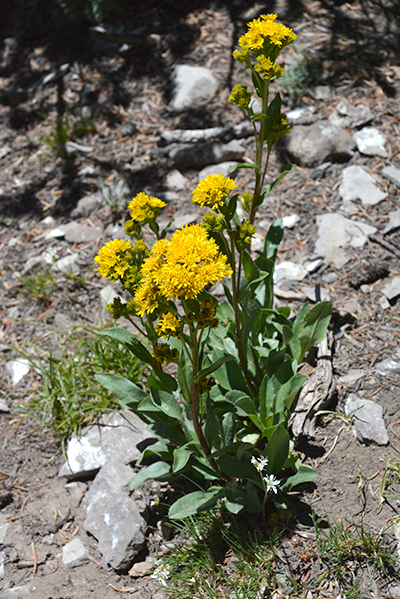
Low Goldenrod has "bursts" of flowers at the top, each head with many tiny ray flowers.

Low Goldenrod has “bursts” of flowers at the top, each head with many tiny ray flowers.

Canada Goldenrod – Solidago canadensis – 2-3+’ tall stems with leaves of similar size.  Canada goldenrod has pointed, 2-4” leaves with sharp teeth and three strong veins.  The tiny flowers are arranged along one side of the arching flower stems.  The plant is finely rough hairy along much of its stem.
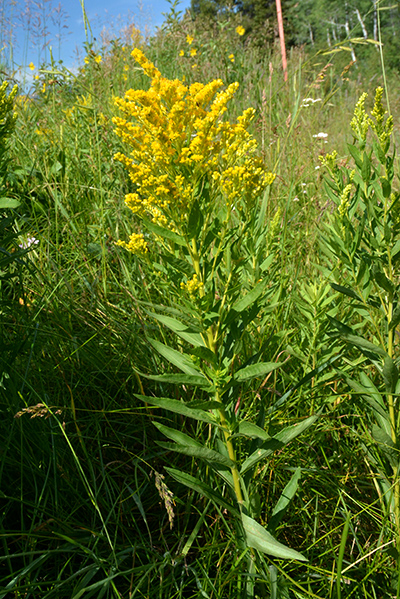
Canada Goldenrod can look a bit like a tall groundsel, but the individual flowers are tiny.

Canada Goldenrod can look a bit like a tall groundsel, but the individual yellow flower heads are tiny.

Parsley/Carrot family – Apiaceae.

This family used to be called the Umbelliferae because the tiny flower are arranged at the ends of umbrella-like ribs—e.g. stalks arising from a central point.  Each flower has 5-tiny petals and an interesting fruit that splits in two called a schizocarp.   These fruits can be the key to identification and are fun to compare.

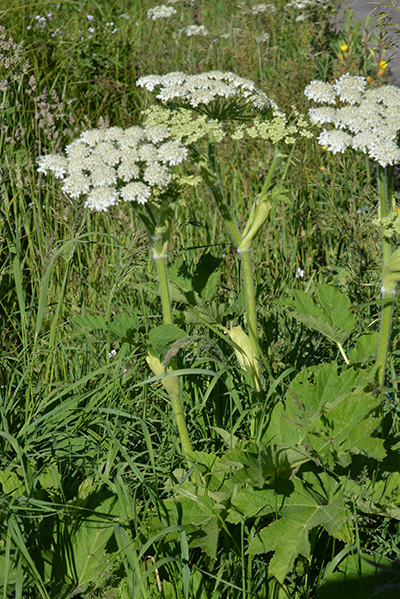
Cow parsnip Haracleum spondyleum – This floral giant is hard to miss in moist areas and aspen groves: the flat flower clusters are the size of dinner plates.  The inch thick stems are bristly hairy and the huge compound leaves are divided into three broad leaflets each with 3 pointed lobes.  Overall the plants can be 4-5’+ tall.A_HeraSpon_flhab_MWrd_7113_2crpWeb
Fern-leaf Lovage – Ligusticum filicinum – The white flower clusters are salad-plate size and are held 1-2’ above large finely dissected leaves—reminiscent of giant carrot leaves.   Fruits will be 1/4″ oblong schizocarps.LiguFili_habfl_TetPsTr_7413_1crpfxweb
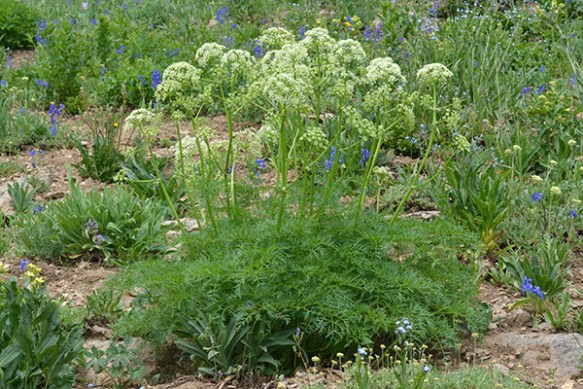
Fernleaf Lomatium/Spring Parsley – Lomatium dissectumRemember the large pale yellow spring parsley with fern-like leaves, similar to lovage,  that bloomed in spring?  Most of the plant has dried up, but the fruits are held up at eye height on umbrella ribs to disperse by wind or bird.A_LomaDiss_fr_PhlLkTr_72114_1aWeb
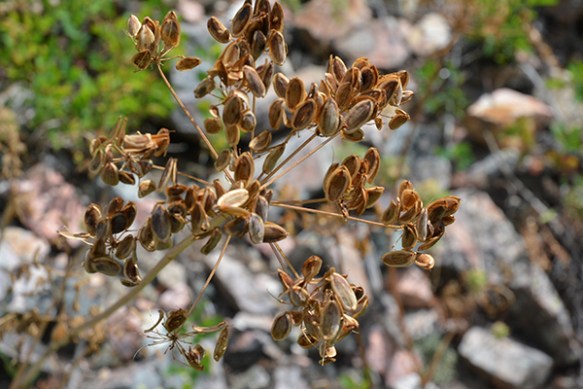
Sweet Cicely or Western Sweetroot – Osmorhiza occidentalis – This 3’ species is the largest of three local members of this genus.  Note few “umbrella” ribs compared to some other members of this family.  The tiny yellow-green flowers have turned into inch-long, elongate, smooth fruits that taste a bit like licorice or anise.
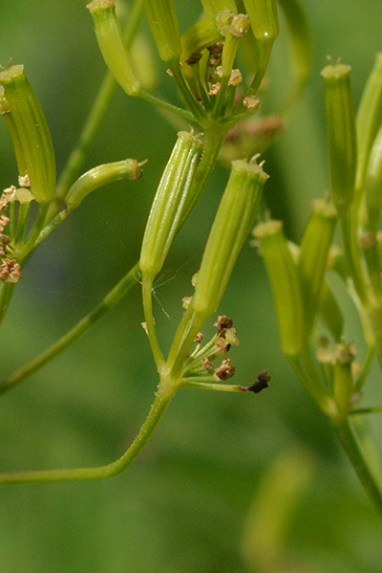
The elongate fruits of western sweetcicely have a tangy, anise flavor.

The elongate fruits of western sweet cicely have a tangy, anise flavor.

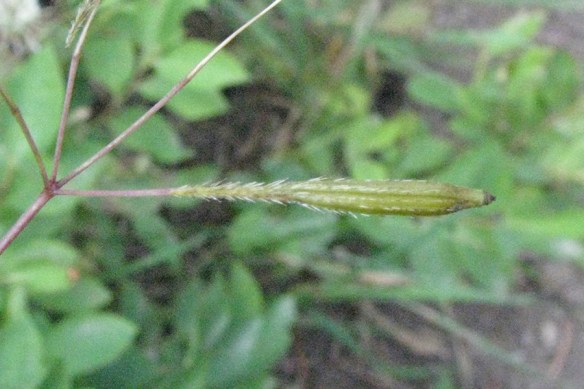
Two other species can be hard to distinguish as both have elongate fruits with downward pointed hairs. Both are be found in shady, moist locations. Again it is just fun to observe and taste the differences!
A_Osmchil_Fr_BTNF_8313_3crpWeb

Note the stiff hairs, sharp tip of the fruit of this Sweet Cicely. The fruit will split and stick to clothes and fur.

Sweet CicelyO. berteroi/chiliensis – Flowers borne on approx 1.5 feet stalks which may stretch to 4’ high in fruit.  The narrow, pointed fruits with stiff hairs attach to hikers and wildlife for dispersal.

 Bluntseed SweetrootO. depauperata – 10” or less tall with elongate, club-shaped fruit with a blunt tip held on wide spreading stalks.
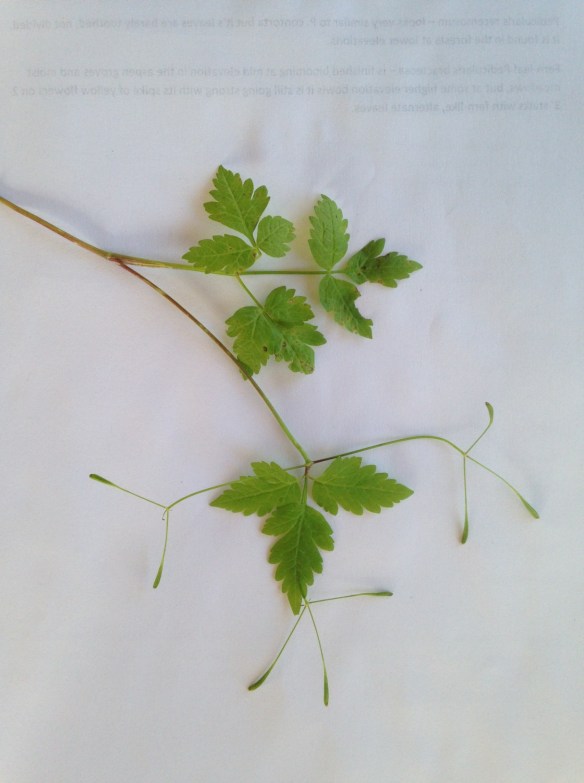
Depauperate Sweet Cicely is most delicate.  The club-shaped fruits are held at wide angles.

Bluntseed Sweetroot is most delicate. The club-shaped fruit with blunt ends are held at wide angles.

Common Yampa –  Perideridia montana – Look for the tiered lacey white inflorescences 3-4” wide just beginning to bloom in sage flats and meadows.   The leaves are very skimpy: only 1-3 on the 1-2’ bluish gray stems, each with maybe 4-5 pairs of linear leaflets that fizzel quickly.  The swollen roots are relished by bears and other wildlife.
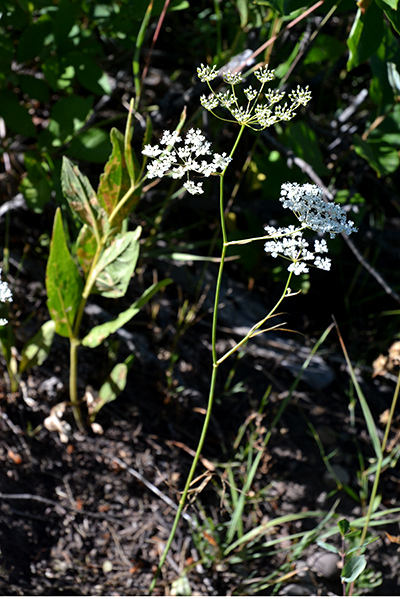
Yampa root is cherished by bears, ground squirrels and even people.

Yampa root is cherished by bears, ground squirrels and even people.

These are just a few wildflowers you may find while out hiking mid-summer.  It is fun to try to recognize a plant family and compare its members’ flowers and fruits.  Slowly, the plant varieties will become familiar friends, and with practice you may remember their names!  In any case, you have had a good “conversation”.

Frances Clark, Wilson, WY

Note: Measurements are approximate.  Using the scientific names you can look up precise details and more about each species.  Also, there may be other look-alikes than are compared here.
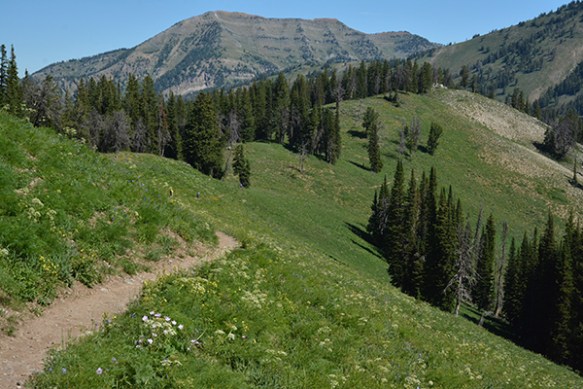
A_BTNF_PassTr_VwN_72714_1web

Roadside “Weeds” in Teton County – Early Summer 2014

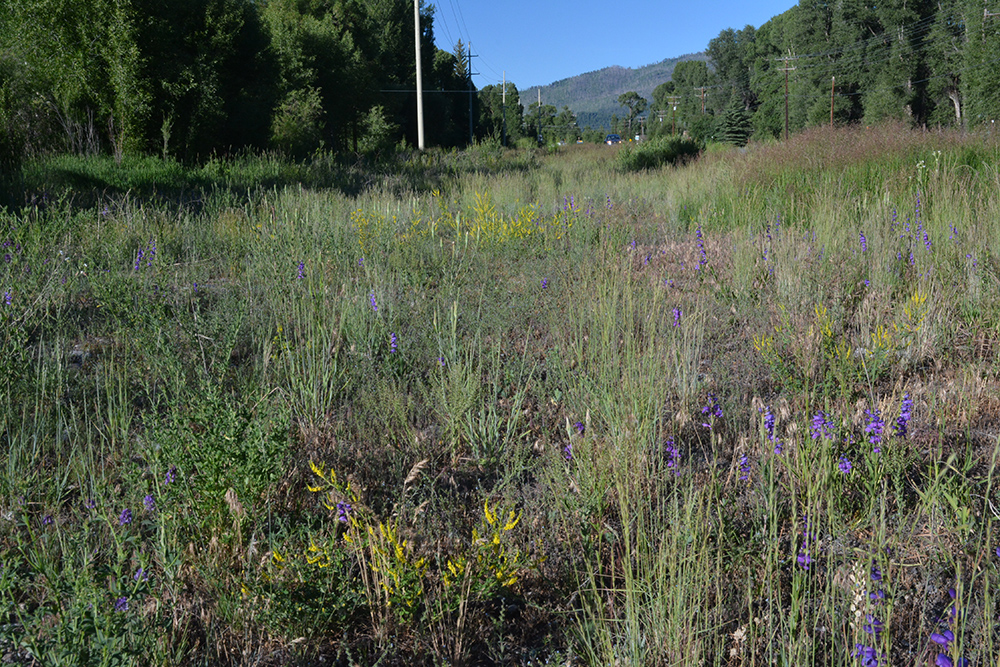
Driving down our roads, over a dozen rambunctious plants – “weeds”– catch the eye in early July.

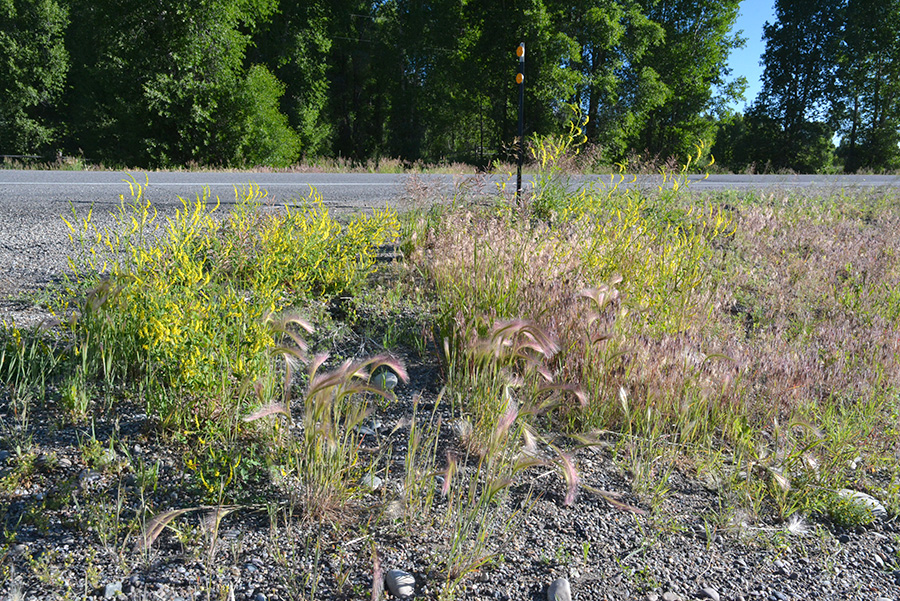
"Weedy" plants proliferate along disturbed edges of roads, ditches, etc.

“Weedy” plants proliferate along disturbed edges of roads, ditches, etc.

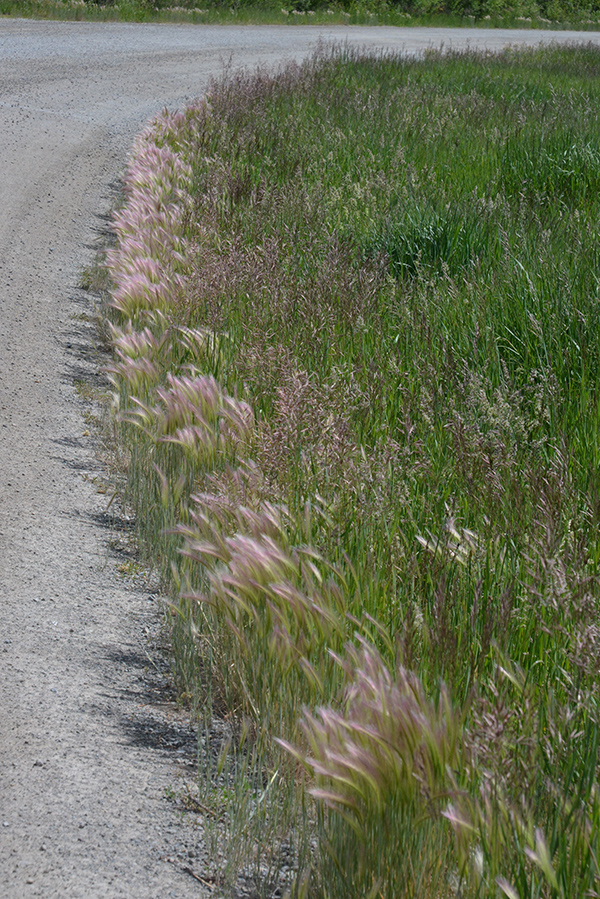
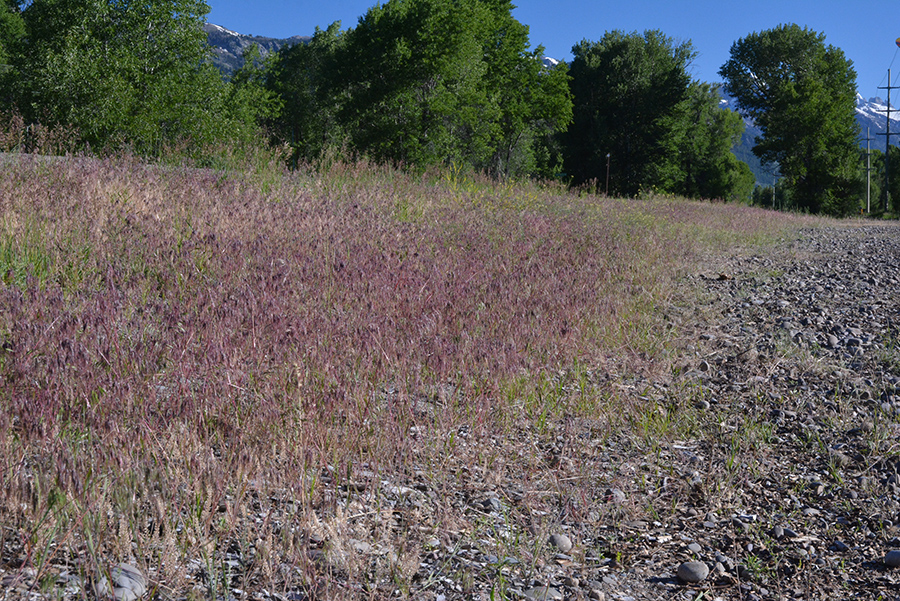
Barley is easy to recognize at this time of year.

Foxtail Barley is easily recognized. It is a tenacious local or “native”growing along road edges.

With a bit of practice, even from a distance, you can identify the big patches of plants: windshield botany.

Different terms help describe their origins.  Many “weeds” are introduced to this area from afar–these we call “non-native” species.  Some non-natives are beautiful and benign—spreading slightly beyond our human landscapes—“naturalized”; other non-natives may be beautiful (or not) but are terrors—they spread in large numbers from roadsides into neighboring natural and agricultural areas altering their quality–these we call “invasive exotics”.

“Noxious weeds” are those listed by various agencies for control.  A few roadside plants are wonderfully resilient “natives”—locals that know how to get along in particularly tough, transient circumstances.  “Weed” is a loose term used by gardeners for plants out of place and by the public for those untidy, rampant interlopers—e.g. plants we don’t want around.  Wherever they are from, these common roadside species are interesting plants to investigate.

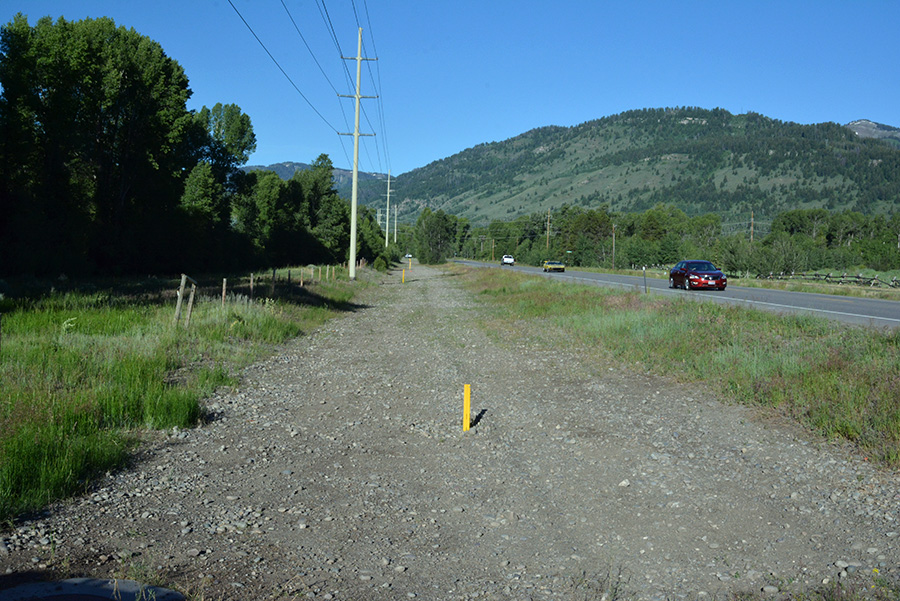
All the plants described here adapt well to disturbance.  Human disturbances are created during road, bikeway, and ditch construction and maintenance; utilities installation; and overgrazing.

Weeds_Mixed_Rdside_62914_3aFixWebMed

Natural disturbances include landslides and flood-scoured shorelines.  Most “weedy” plants grow and propagate profusely in full sun, extreme wind, heat, and poor soils.

Many newcomers spread from nearby gardens, vehicle wheels, bird or cow poop, and muddy shoes or paws.  They are often annuals or biennials: plants that grow, set seed, and die within in a year or two.  They typically disperse 1000s of seeds per plant—their genetic survival strategy.  Perennial weeds have extensive root systems that enable them to form dense colonies, out-competing other species for resources. Invasive exotics and noxious weeds affect the productivity of our agricultural fields and the natural diversity of our native habitats.

Note: The plants with a (*) are targets for control by the Teton County Weed and Pest District and Grand Teton National Park Service.   For more information, please to go to: http://www.tcweed.org

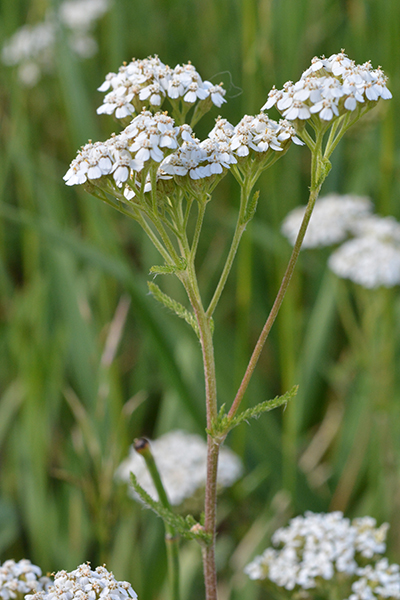
Yarrow – Achillea millefolium – Yarrow grows in temperate zones around the northern hemisphere—circumboreal.  It has medicinal qualities historically used by Achilles during the Trojan War (hence the latin name: Achillea) and by our Native Americans, and still today by herbalists.  The flat “cymes” of white flowers and soft, fern-like leaves have made this plant distinctive for millennia.

AchiMil_infl_hm_62824_2aCrpWeb

Yarrow is a member of the aster family and grows around the northern part of the globe.

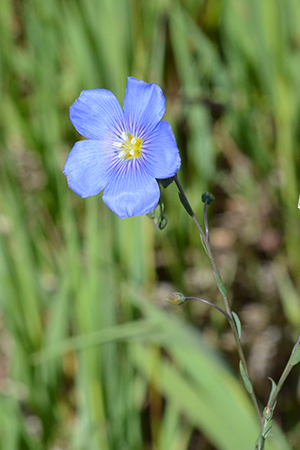
Blue FlaxLinum lewisii –These sky blue flowers open wide to the morning sun, thereby attracting bee and fly pollinators. Their many skinny, 1” leaves are arranged alternately on slender, 2-3’ delicately branched stems that bend with the breeze. It is related to the European Flax (L. usitatissimum), still used for making linen. This is a beautiful native found along roadsides and into sagebrush and montane communities.

Lewis' Flax is named during the Lewis and Clark Expedition.  Its sky blue flowers catch the eye.

Lewis’ Flax was named during the Lewis and Clark Expedition. Its flowers reflect the blue sky.

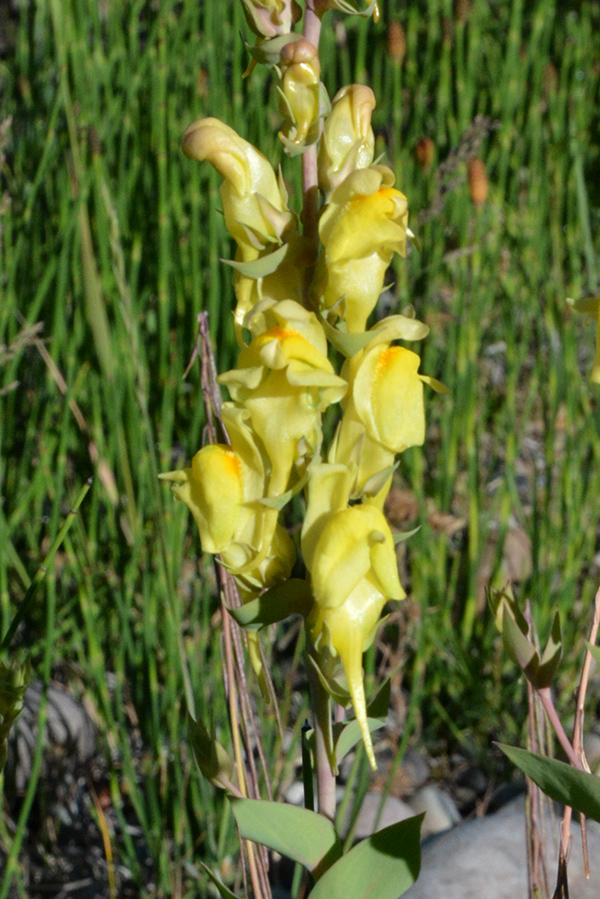
Dalmatian Toadflax*Linaria dalmatica – Related to garden snapdragons, this persistent invasive exotic has yellow flowers with long spurs born arranged at the tops of straight, 2-2.5’ stems.  Each plant can produce 500,000 seeds that can live in soils for ten years!

LinaDal _fl_Rdside_62914_2aQ2web

Dalmatian Toadflax looks like our garden snapdragon. The yellow flowers with long spurs born at the tops of straight 2-2.5’ stems. Blue-green, stiff, arrow shaped leaves clasp the stems.

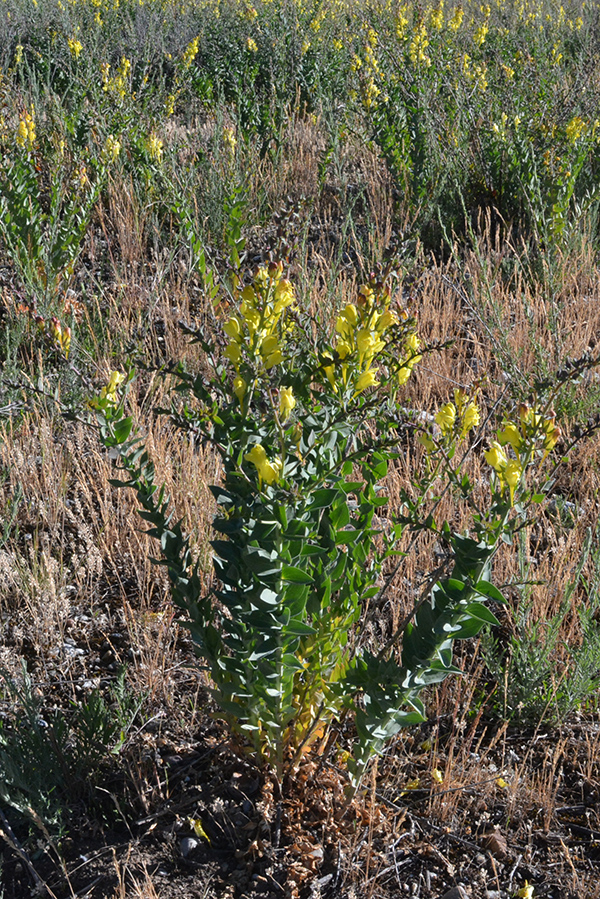
Each plant can produce 100,000 seeds and last 10 years in the soil.  Here the offspring are spreading.

Each Dalmatian Toadflax plant can produce 500,000 seeds and last 10 years in the soil. Here the offspring are spreading.

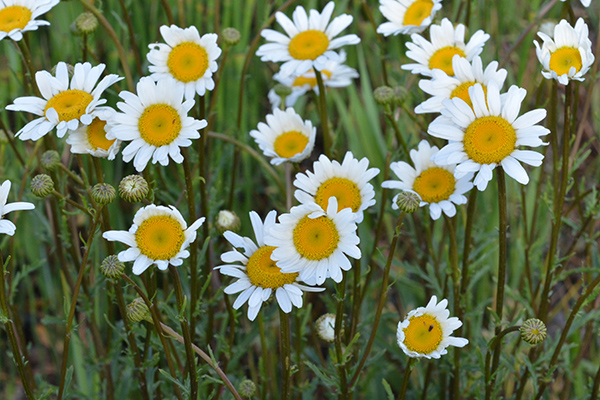
Oxeye Daisy* Chrysanthemum leucanthemum/C. vulgare – Introduced as a garden ornamental for its showy flowers, the wavy-lobed, 2-3” long leaves are unpalatable and irritable to both wildlife and livestock. Oxeye Daisy invades readily into pastures and up mountain slopes by seed and root.  While it is tempting to keep a few plants for flower arrangements, their side effects are not worth it!

Beautiful bucolic Oxeye Daisies are not not benign and need to be removed from gardens and pastures.

Bucolic Oxeye Daisies are not not benign and need to be removed from gardens and pastures.

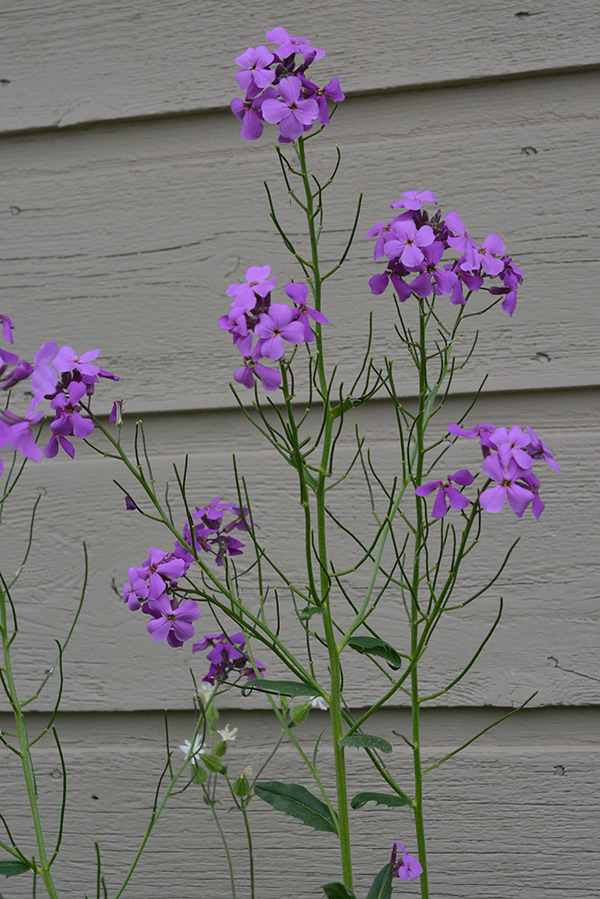
Dame’s Rocket*Hesperus matrionalis – This attractive plant from Eurasia is a garden escape often found in our subdivisions.  Note the 4 purple (sometime white) petals that flare at the ends.  This is a large-flowered member of the Mustard Family and releases 1000s of seeds in a year.  The fruits ripen into elongated siliques.  These short-lived plants extend their roots quickly into new habitats, affecting wildlife values of aspen groves and the like.

Dame's Rocket spreads from our gardens into natural areas.

Dame’s Rocket spreads from our gardens into natural areas.

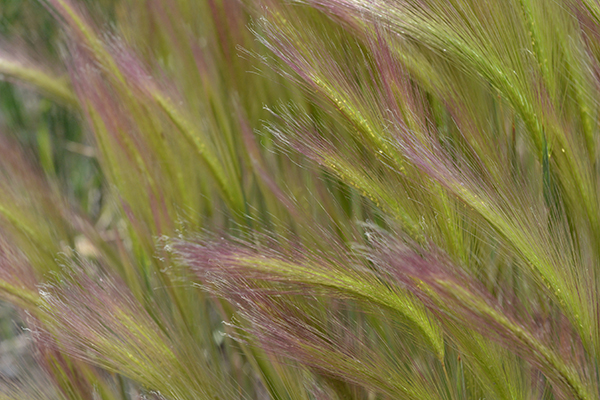
Foxtail BarleyHordeum jubatum – Not quite waving amber waves of grain, this shining blond-to-rose-colored grass festoons road edges.  While the 8-12” plants look soft and silky, their grains are encased in stiff spears (awns and glumes) that deter grazing animals.  The barbed seeds easily attach to passing tires, shoes, and fur. This is a tenacious native.

Barley feels silky until it dries it's spine.  It is a very tenacious local.

Foxtail Barley feels silky until it dries it’s spines.

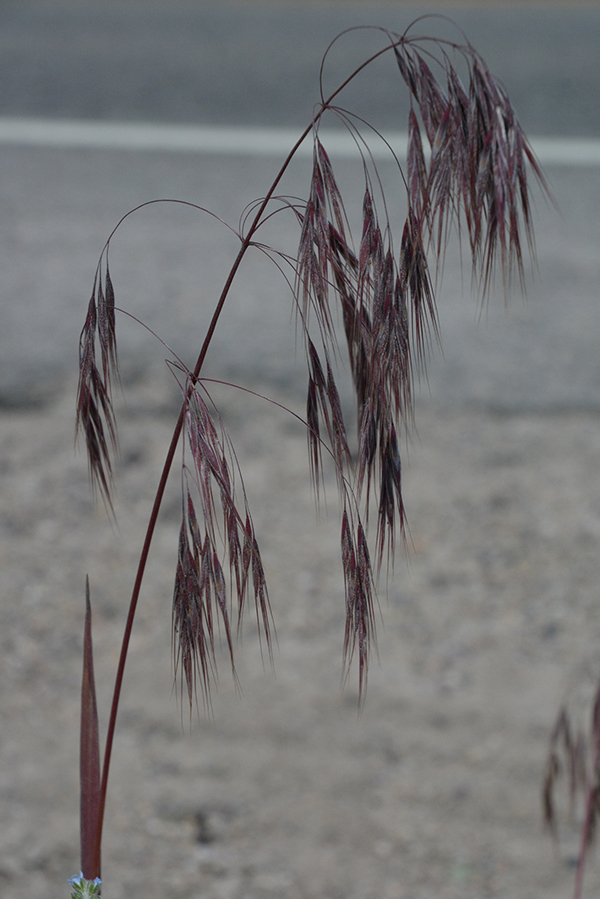
Cheat Grass, Downy Brome*Bromus tectorum  – The scourge of grasslands throughout the West, this quickly growing annual is unpalatable to livestock or wildlife due to its sharp, hurtful awns.  It crowds out nutritious native grasses and changes the ecology of shrublands and grasslands by altering the fire regime: the fast-curing plants provide tinder for fires from spring to fall.  Look for the purplish to brown patches spreading from roads up the slopes of our buttes.

Another grass, cheat grass is the scourge of our native grasslands, altering the beauty and ecology of our ecosystems.

Another grass, cheat grass is the scourge of our native grasslands, altering the beauty and ecology of our ecosystems.

Cheat grass spreads like wildfire--in fact it spreads wildfire:  The annuals dry up by early summer providing tinder for any spark.

Cheat grass spreads like wildfire–in fact it spreads wildfire: The annual plants dry up by early summer providing tinder for any wayward spark.

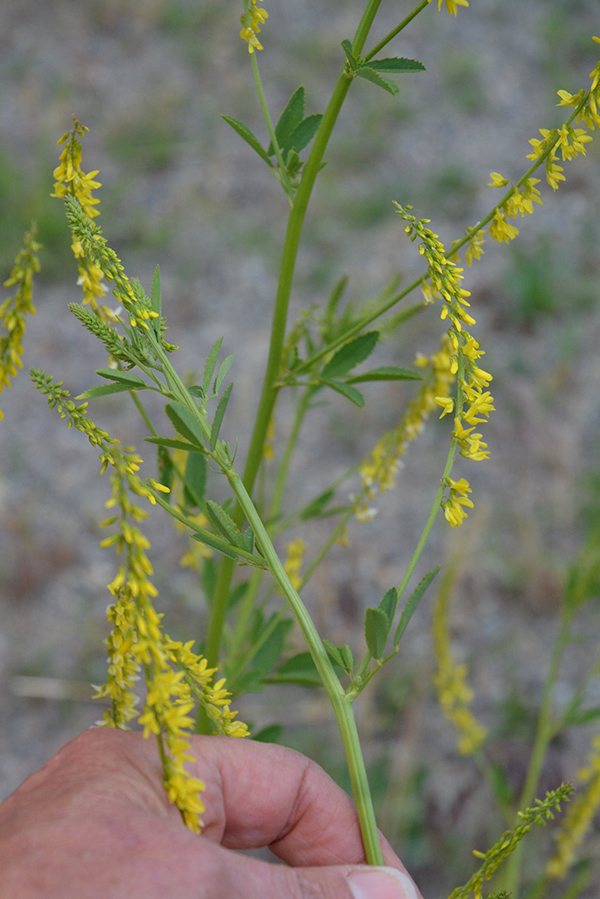
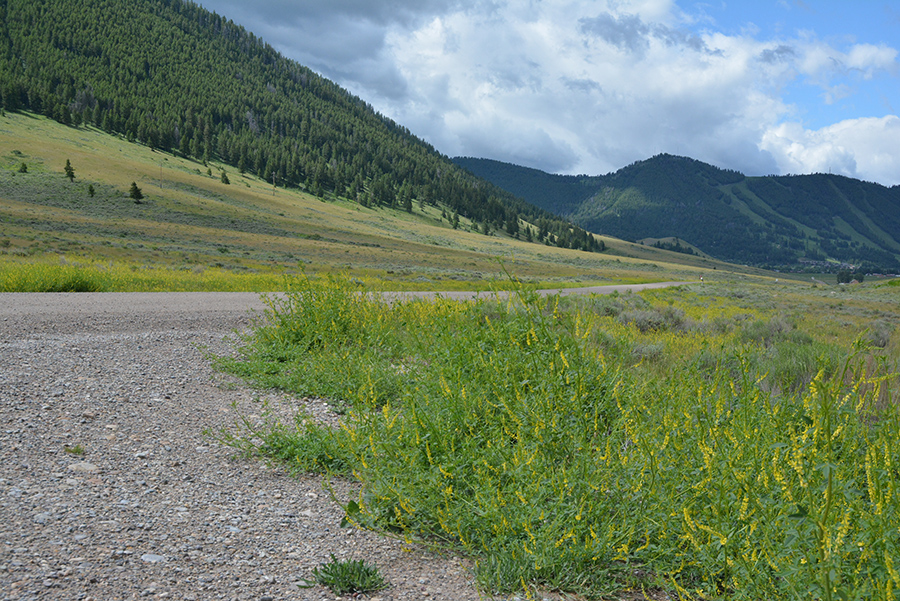
Yellow Sweet CloverMelilotus officinalis – A member of the pea family hailing from Europe, this 2-5’ plant. can fix its own nitrogen, enabling it to grow on the poorest of soils. The tiny, yellow, pea-like flowers have a sweet fragrance from the presence of coumarin.  In moist hay, coumarin can be converted by fungi into a poisonous anticoagulant, called dicoumarol—toxic to cattle.  Natural area managers target Yellow Sweet Clover for its aesthetic and ecological alteration of our beautiful grassland and shrub habitats. In Jackson Hole it is well established along roadsides and buttes.

MiliOff_infl_rdside_62514_1smW

Yellow Sweet Clover is identifiable by its three-parted leaves and pea-like yellow flowers on 3-4′ stems.

Sweet Yellow Clover is colonizing our roadsides and buttes.

Sweet Yellow Clover is colonizing our roadsides and buttes.

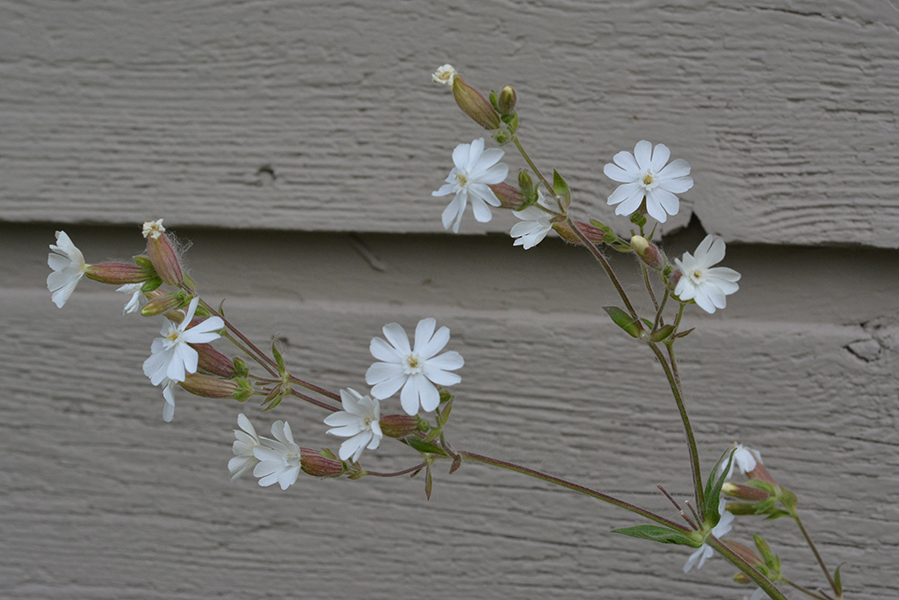
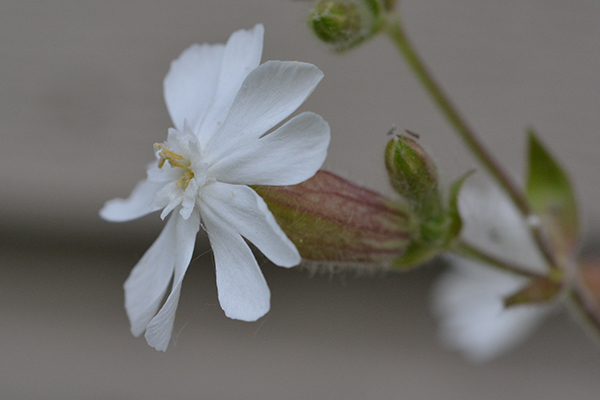
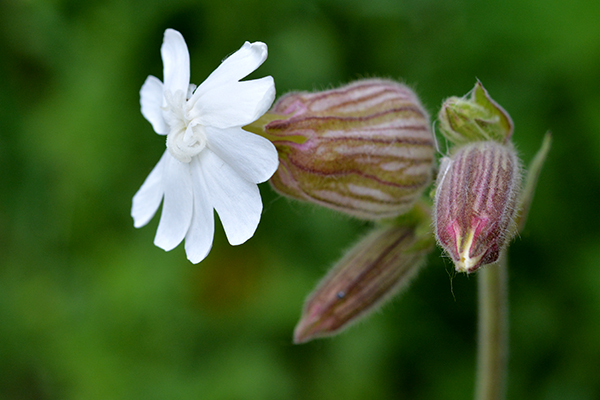
Bladder CampionSilene latifolia – Introduced from Europe, this naturalized species is a delight to investigate.  The fragrant white flowers bloom at night into the next morning, attracting moth, bee, and fly pollinators.  Plants proffer either male or female flowers.  The 5 sepals (outer whorl) form a sac and the five white petals flare out above it.  Male flowers have only anthers which barely reach beyond the petal tube.  Females have 5 extended, curling stigmas ready to grasp the pollen relayed by a visiting pollinator. Once fertilized, over 100 seeds may form inside a dried capsule, to be shaken out by the wind, like grains of salt from a salt cellar. Females extend curled stigmas and have a more pregnant looking calyx than the male flowers.

Bladder Campion is naturalized from Europe.  A given plant produces male or female flowers, which are typically pollinated by moths at night.

Bladder Campion is naturalized from Europe. A given plant produces male or female flowers, which are typically pollinated by moths at night.

Male flowers of Bladder Campion have a relatively narrow calyx and the anthers reach just beyond the flared petals.

Male flowers of Bladder Campion have a relatively narrow calyx (“bladder”) and the anthers reach just beyond the flared petals.

Female flowers of Bladder Campion have curled elongate stigmas ready to adhere pollen from visiting moths.

Female flowers of Bladder Campion have curled, elongate stigmas ready to adhere pollen from visiting moths.  The bladder looks more pregnant.

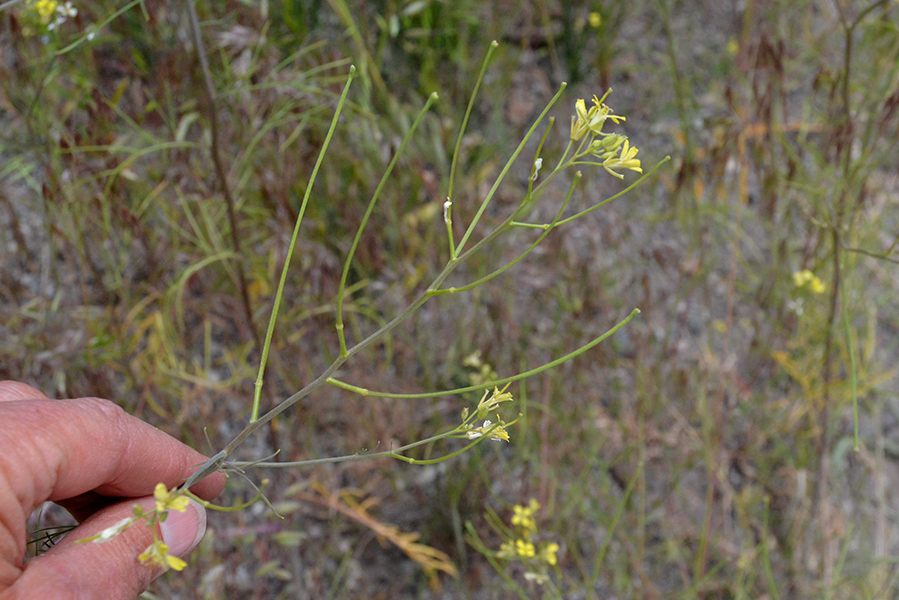
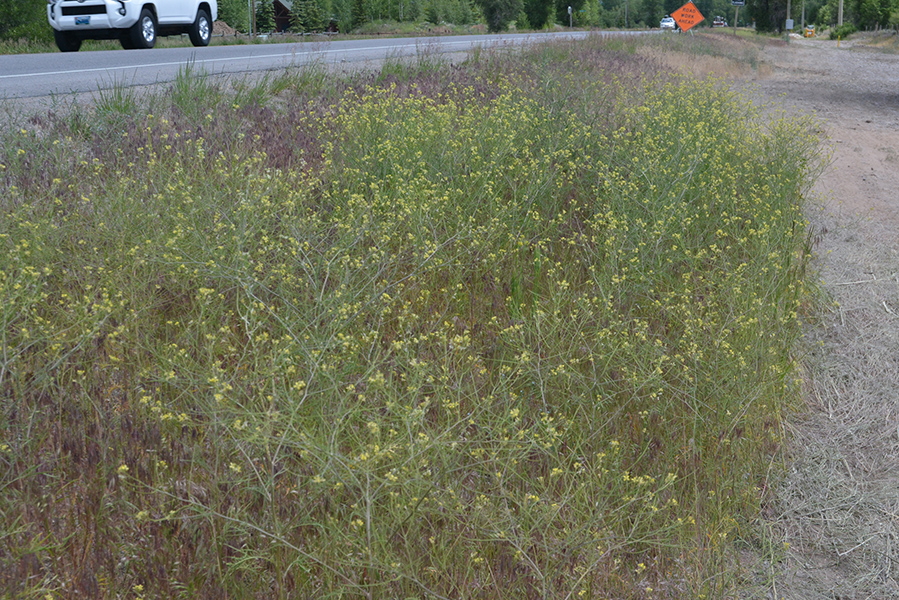
Tumble Mustard – Sisymbrium altissima – This 3-4’ tall, airy plant has ½”, 4-petaled yellow flowers and 3-4” very narrow fruits (siliques).  The stem leaves are pinnately divided into narrow segments while the basal leaves are much broader and larger overall.  This is a very invasive plant, which dries quickly, breaks from its roots, and tumbles its seeds across open spaces.

It is hard to image the extensive impact these delicate looking plants of Mustard Tumbleweed have on our environment.

It is hard to image the extensive impact these delicate looking plants of Tumble Mustard have on our environment.

Tumble Mustard break off their bases, and tumble their tough seeds across the landscape.

Tumble Mustards break off at their bases and tumble with the wind, releasing seeds across the landscape.

Salsify or GoatsbeardTragopogon spp.  The giant dandelion-like flowers are seen here and there along roadsides and fields. Right now their flower heads are ripening into fluffy but often dingy, 3- 4” spheres. Each elongated seed has its own elaborate parachute.  Take a close look!  We host 3 species naturalized from Europe.

Goatsbeard look a bit like giant dandelions in bloom.

Goatsbeard look a bit like a giant dandelions in bloom.

The spherical heads of Goatsbeard will soon shed dozens of seeds, each with its own parachute.

The spherical heads of Goatsbeard will soon shed dozens of seeds, each with its own parachute.

Thistles* – Canadian thistle (Cirsium vulgare) and Nodding or Musk Thistle (Carduus nutans) are  just a few thistles from Europe targeted for eradication.   These spiny plants overwhelm many pastures and grasslands.   

Musk Thistle is a daunting competitor in pasture lands.

Musk Thistle is a daunting competitor in pasture lands.

Musk Thistle can be a bit deranged, but glorious in its conquest.

Musk Thistle can look a bit deranged, but glorious in its conquest.

However, there are also native thistles, such as – Cirsium scariosum, which are highly beneficial to insects and larger wildlife. In a later blog, we will help you identify the native thistles from the exotic invasives.

Musk Thistle is a daunting competitor into pasture lands.

Native thistles. like Circium scariosum, can look a lot alike some invasive thistles.  It is important to know the difference.


Cirsium scariosum is a beautiful native thistle beneficial to wildlife of all sizes.

Cirsium scariosum is a beautiful native thistle beneficial to wildlife of all sizes.

So while you are driving, biking, or walking stop and take notice.  Dissect the flowers. Examine the fruits and seeds.  Smell and feel the leaves.  Think about why these plants are so successful.

And as always, we appreciate your comments, corrections, and questions.

Frances Clark, Wilson, WY

P.S. This essay is about native and non-native plant species.  Absolutely no inference should be made to our many visitors or workers from around the country and world, whom I welcome here in Jackson Hole.

Plants in "waste" or disturbed habitats often are interesting to botanize hands-on.

“Waste” or disturbed habitats are interesting places to botanize.  You are usually welcome to collect, dissect, and examine specimens.  Just don’t spread them to new locations!

Sage Habitat Floral Additions – July 1, 2014

More Sage Habitat Wildflowers:

View of Early summer flowers on Antelope Flats, including  Sulphur Buckwheat

View of Early summer flowers on Antelope Flats, including
Sulphur Buckwheat, Wild Geranium, Balsamroot,

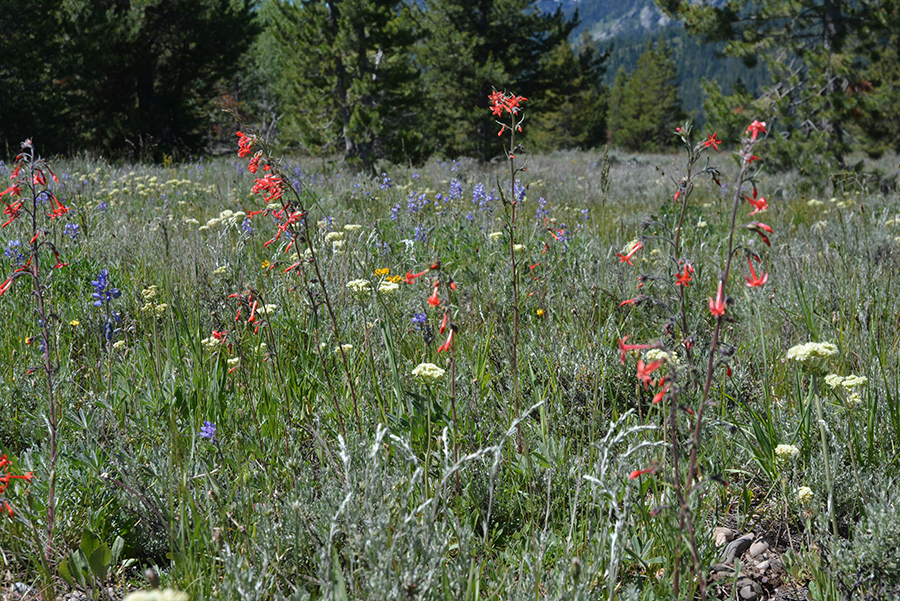
Since the last posting on Sage Habitat Wildflowers, Sulphur Buckwheat  is now profuse throughout the park.  Its creamy white billows of flowers are interspersed with red spikes of Scarlet Gilia and tiered towers of Blue Lupine. Nuttall’s Larkspur is still intermittent in the north end of the park along with various low-growing daisies (Erigeron spp.) and pussytoes (Antennaria spp). Wild geraniums are rampant on surrounding hillsides, too.

Lupine Meadows with Scarlet Gilia, Sulphur Buckweeat and Lupine.

Lupine Meadows with Scarlet Gilia, Sulphur Buckweeat and Lupine (Lupinus polyphyllus).  The flats around String Lake are also gorgeous.

The following are fresh additions to the wildflower bouquet.

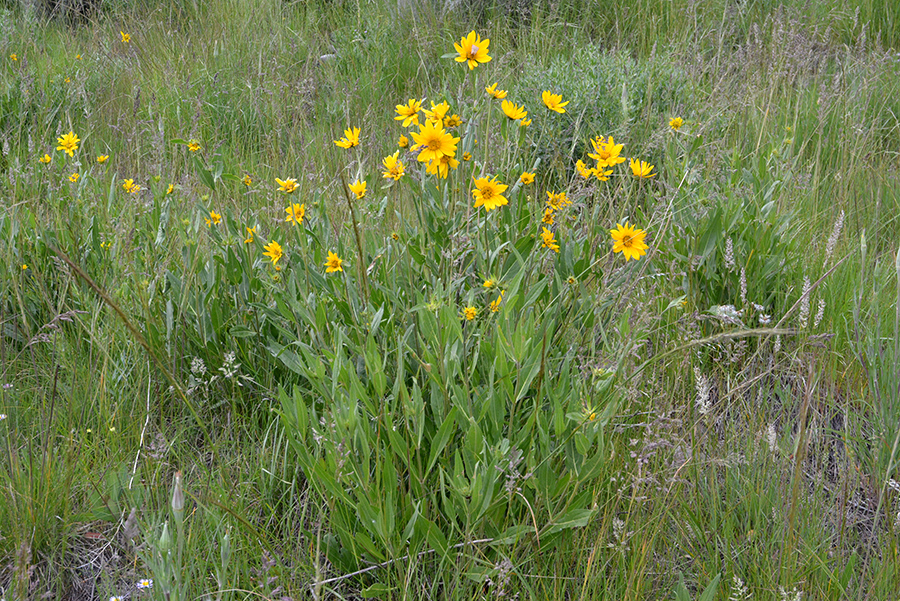
One Flowered Sunflower or Helianthella is beginning to bloom in place of the fading Arrowleaf Balsamroot.  Single, large sunflowers are borne atop 3-4’ stems.  The 6” leaves have 3 strong nerves embedded in the elliptical leaves held opposite each other on the sturdy stalks.  The plants grow in clumps on dry slopes.

One-flowered Helianthella - Helianthella uniflora - has single 2" flowers on strong stems with 3 veined leaves.

One-flowered Helianthella – Helianthella uniflora – has single 2″ flowers on strong, upright stems.  Elongate leaves are mostly opposite and embedded with 3 obvious veins.

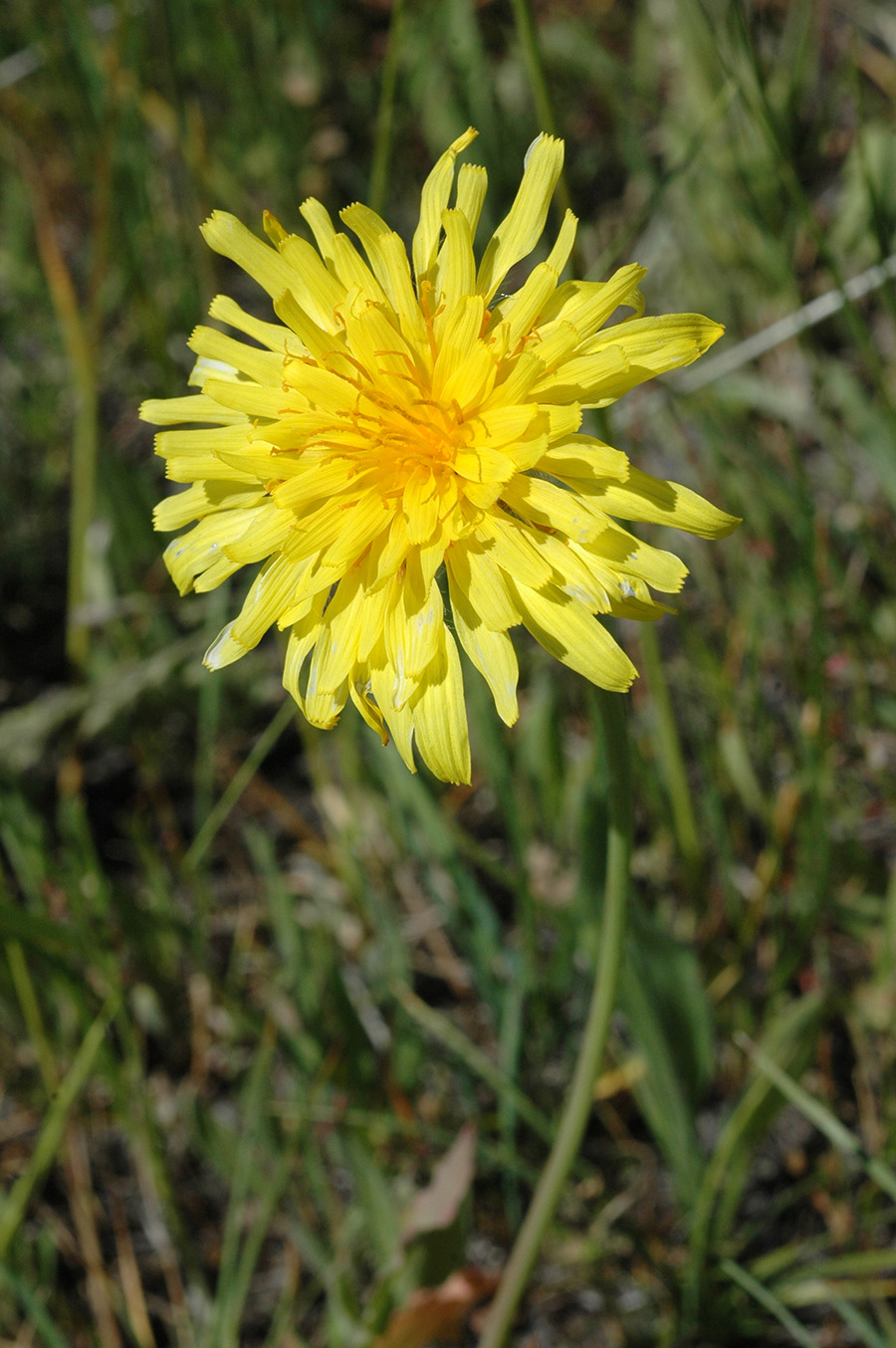
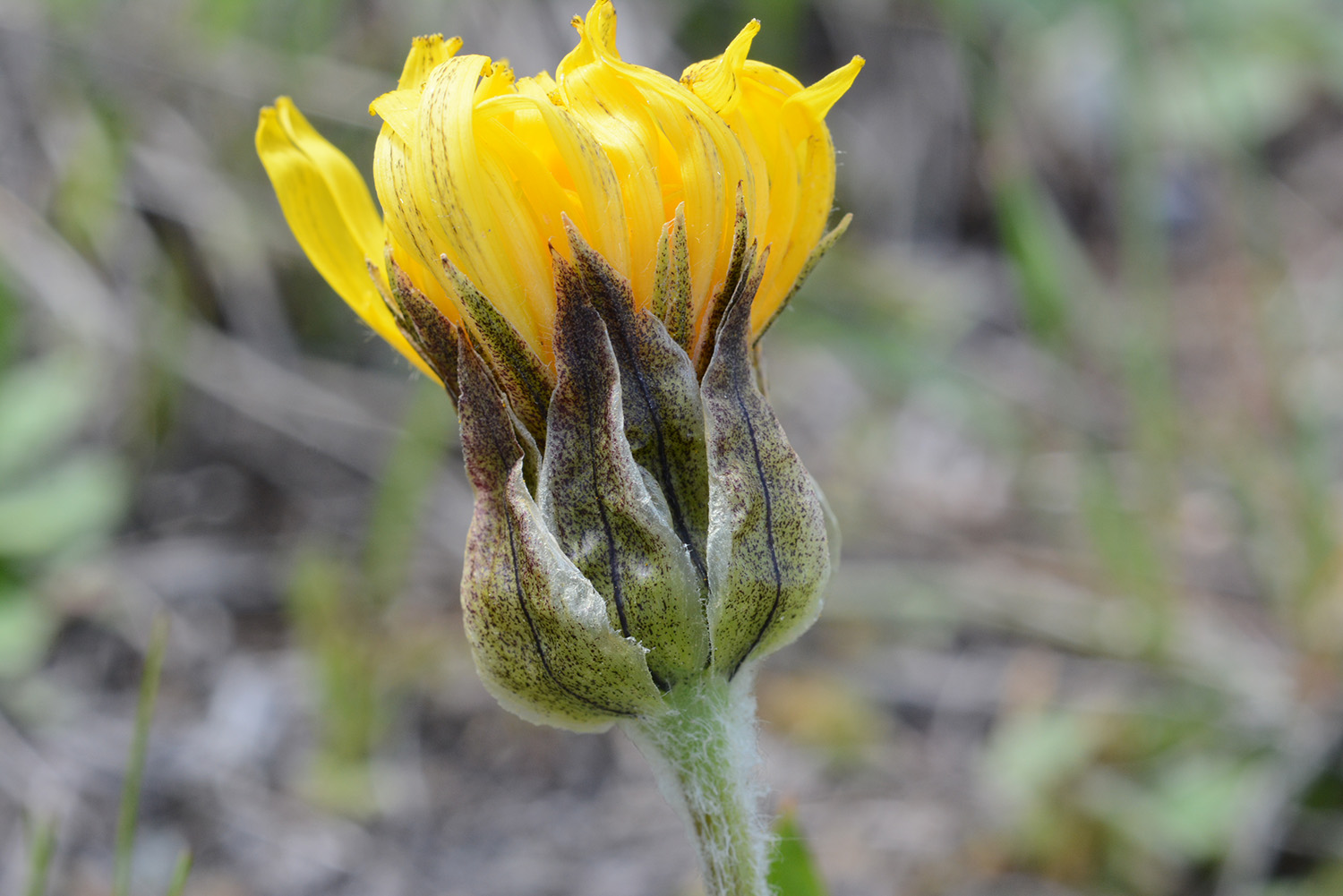
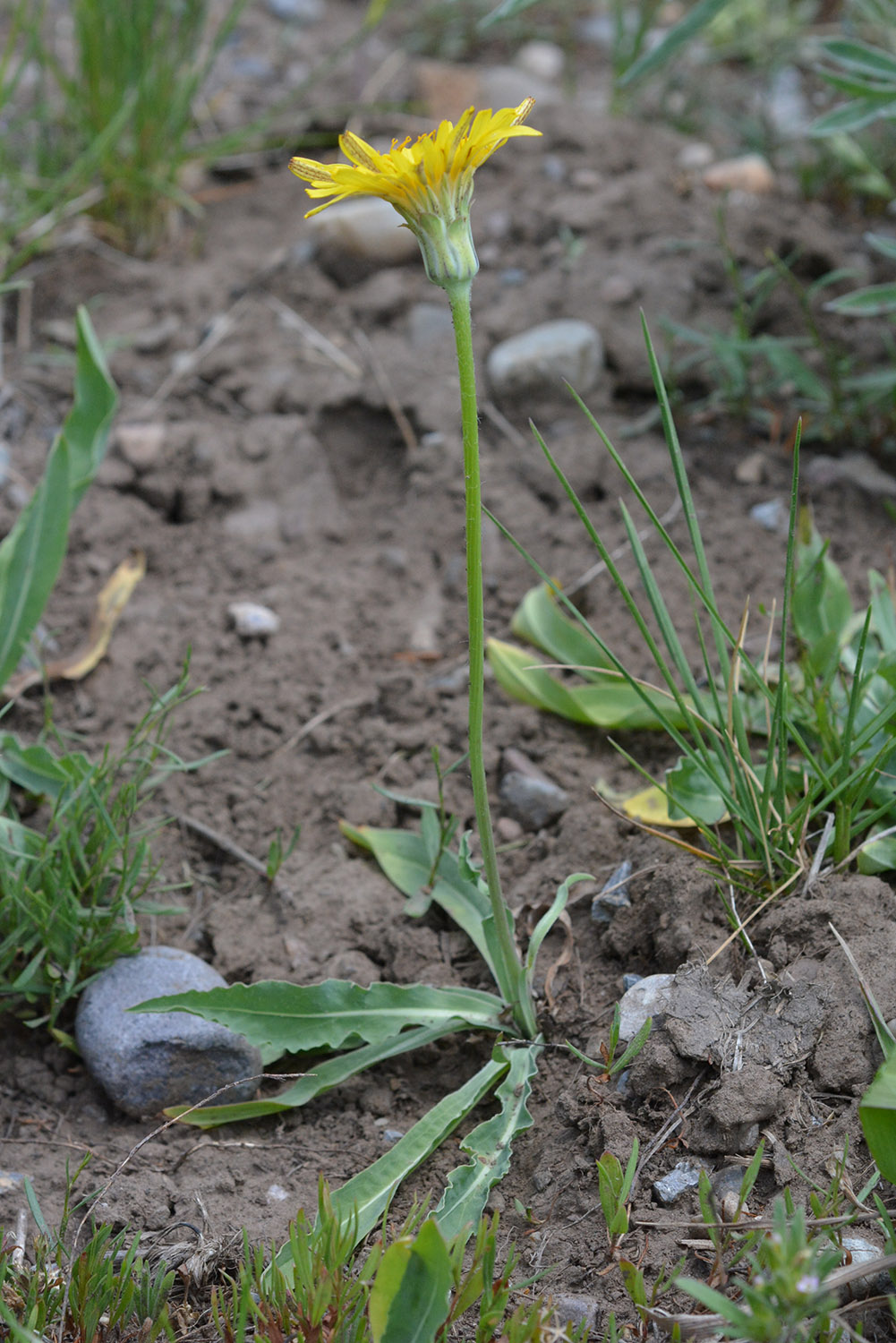
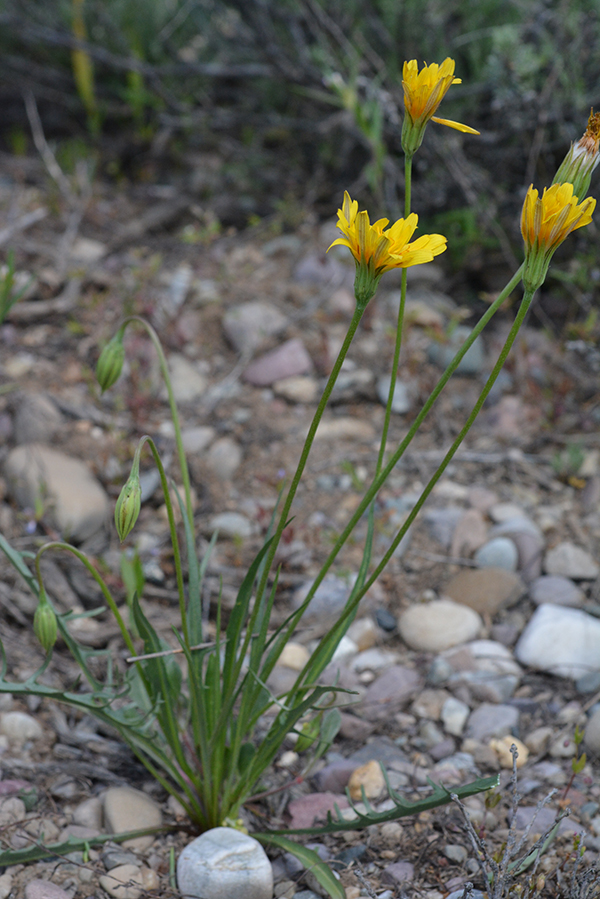
False or Mountain DandelionAgoseris glauca varieties – Each plant has a single 1-2” yellow dandelion-like flower on a 6-10”-long stalk. The linear leaves are basal. In some varieties they are mostly smooth-edged, in others they may be roughly lobed.  The bracts beneath the flower heads are neatly pointed and may or may not be hairy.

Mountain Dandelion - Agoseris glauca - looks very much like a dandelion, but look closely....

Mountain Dandelion – Agoseris glauca – looks very much like a dandelion, but look closely….

Mountain Dandelions have tidy, upward pointing bracts around each flower head.

Mountain Dandelions have tidy, upward pointing bracts around each flower head.

While leaves are variable on Mountain Dandelion, they are usually linear and all basal.  The amount of teeth and lobing varies.  Each plant has only one flower.

Each plant has one flower and the leaves are all basal and usually linear.   However, the amount of teeth and lobing varies on the leaves and the flower bracts and stem may be more or less hairy.  There are three distinct varieties of Mountain Dandelion.

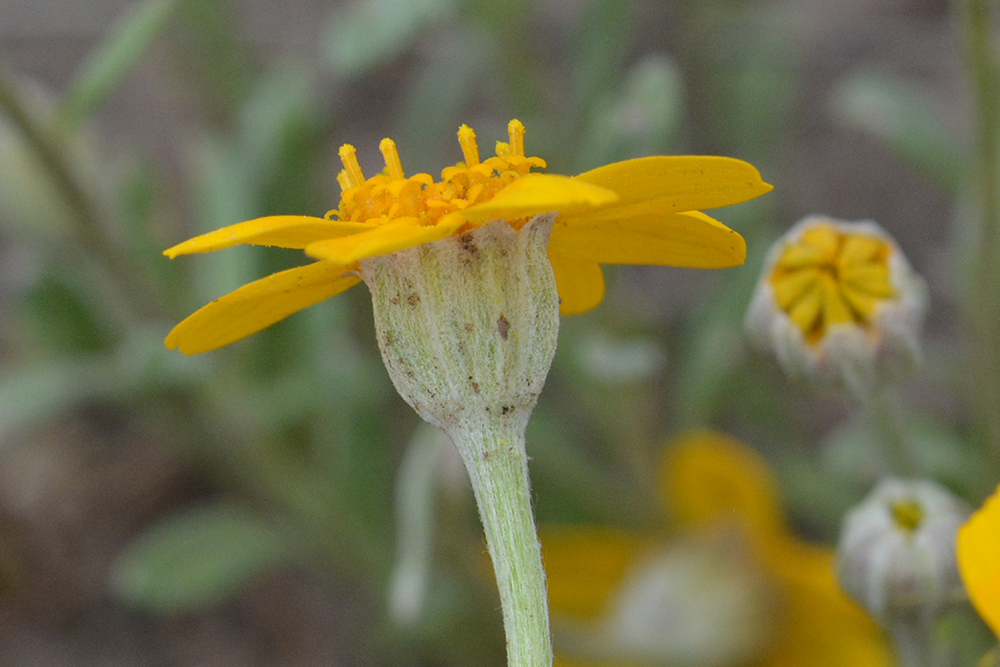
WoollyleafEriophyllum lanatum – Just bursting out, these bright orange members of the aster or composite family attract a closer look.  You will notice that the few bracts around each flower head are neatly arranged and woolly. The rounded “petals”, or actually ray flowers, have a slight variation in color from outer to inner surface, probably creating an ultra violet “bulls eye” for landing pollinators.  The oblong to linear leaves alternate up these 8” stems.

Woollyleaf is a bright orange and usually 12" high in clusters.

Woollyleaf is bright orange and grows in small patches usually 12″ high .

The tidy woolly bracts under teh rounded ray flowers helps to identify this species.  Many composites can look alike!

The tidy, woolly bracts under the rounded ray flowers help to identify this species. Many composites can look alike!

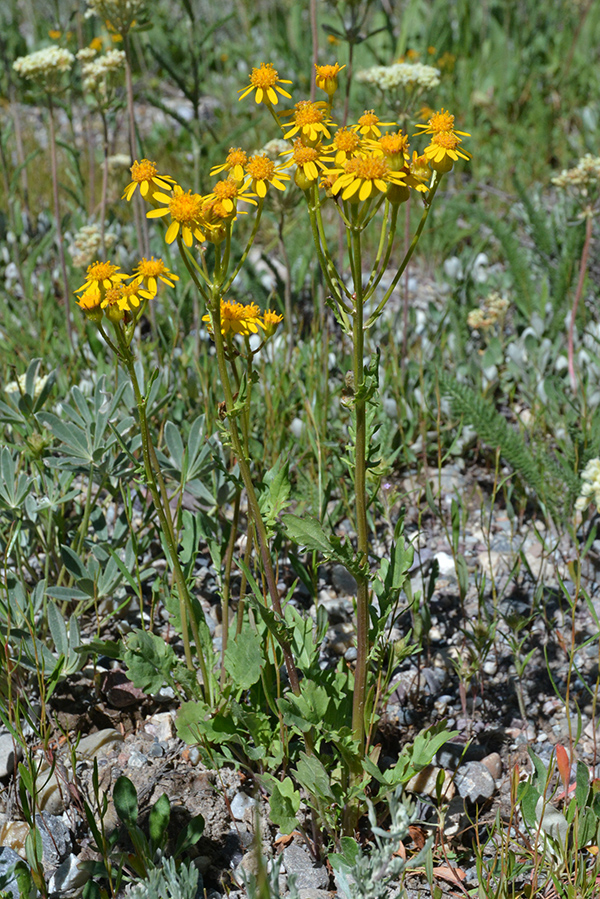
Manyface Groundsel – Packera (Senecio) streptanthifolia – A deeper orange yellow, and more compact in its growth form than the other common sagebrush denizen, Columbia Goundsel (Senecio integerrimus), Manyface Groundsel has non-hairy, lobed leaves on the stem and at the base.   The leaves can be highly variable.  Both groundsels are blooming in sage flats in the north end of the park.

Another confusing composite are the groundsel.  This one on Lupine Meadows is Manyface Groundsel, probably because the variable leaves make it difficult to ID.

Another confusing composite are the groundsels. This one on Lupine Meadows is Manyface Groundsel, probably because the variable leaves make it difficult to ID.

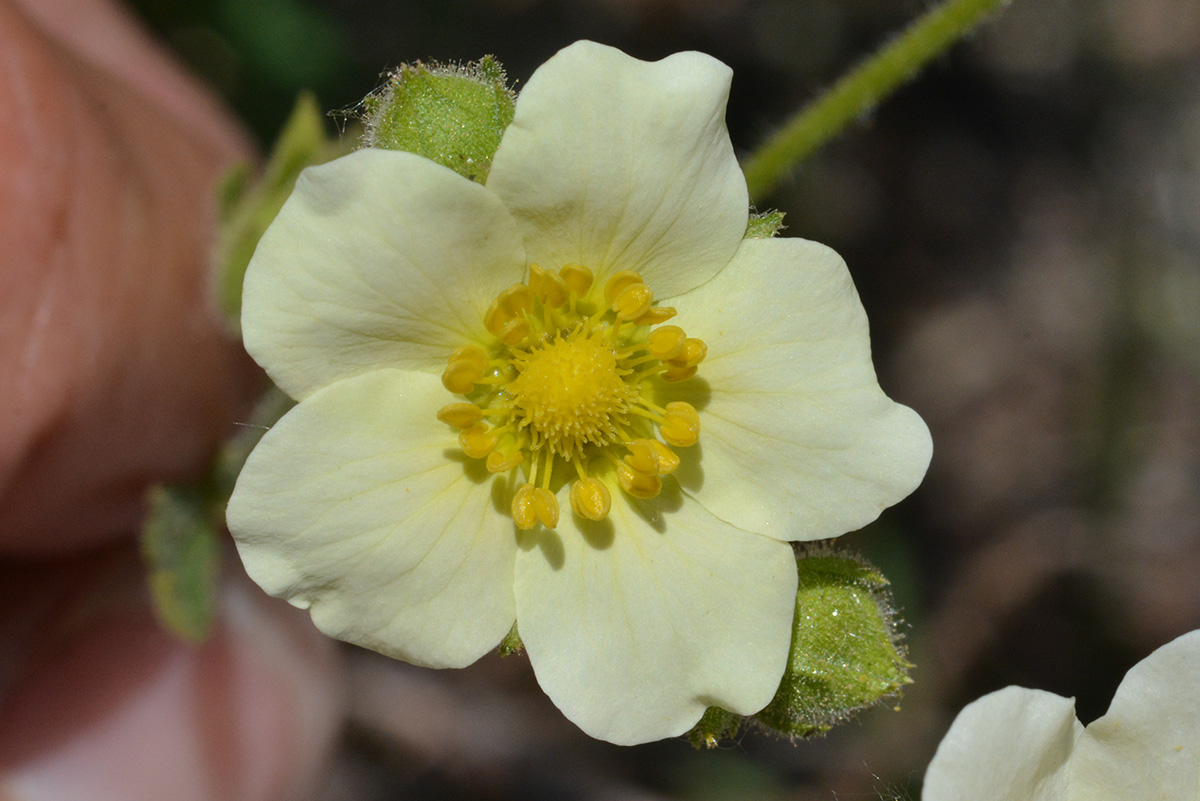
Cinquefoil Potentilla spp. – Several cinquefoils are blooming now.   Overall, they are a confusing group to distinguish. Botanists look at the leaves: are they palmately or pinnately divided.  Are they hairy or smooth, and are the hairs glandular or not.  Are they silvery?  Taxonomists also examine the flowers: while all species have 5 sepals and 5 petals—usually some shade of yellow, they also count the anthers: 20 or 25 or 30.  And most particularly, they look at how the stigmas are arranged on the many ovaries.  A microscope helps! Cinquefoils hybridize and have many varieties.  So let’s settle for Cinquefoil for now, unless you like botanical Sudoku.

Cinquefoils are easy to get to genus with their 5 sepals, 5 petals, many anthers and even more pistils.  However determining species is much tougher.

Cinquefoils are easy to idenitify to genus with their 5 sepals, usually yellow- to-cream colored 5 petals, many anthers and even more pistils. However, determining species is much tougher.  It is a member of the Rose Family.

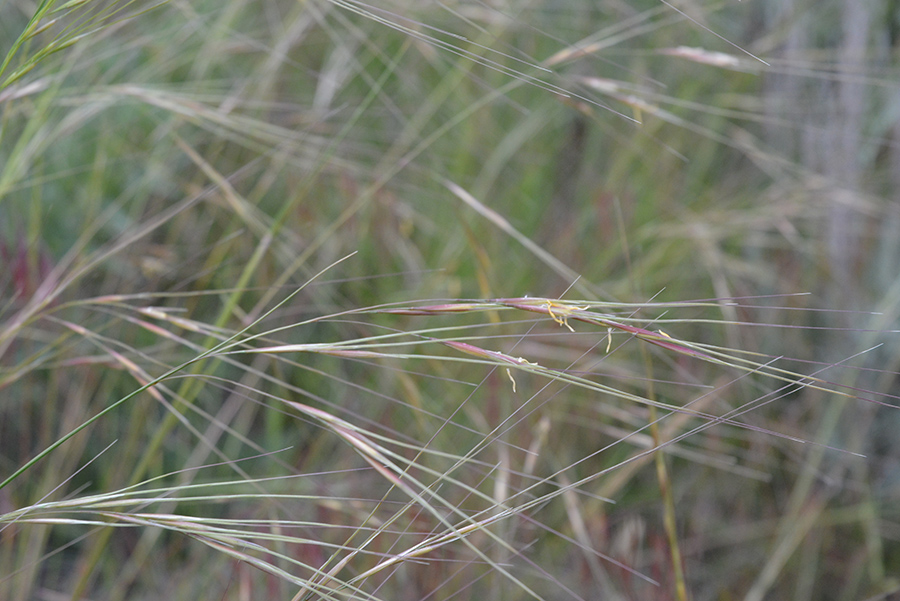
Grasses—Many grasses bloom in late June—those of us with allergies may have noticed.   The pollen is carried on the wind to feathery stigmas of nearby relatives.  One of the most elegant grasses on dry hillsides is Needle-and-thread –  Heterostipa comata with its 8-10 inch needle-like “awns”. (Must be the needles of a giant!)  Other grasses in bloom include bluegrasses, bromes, and fescues.  Take a close look and see what is happening.

Needle-and-Thread - Heterostipa comata -  has elegant but sharp "awns" 4-5" long.

Needle-and-Thread – Heterostipa comata – has elegant but sharp “awns” 8-10″ long.  It is in full bloom in this photo.  Flowers are not showy as it is wind pollinated.  The wind does not see or smell like our animal pollinators do.

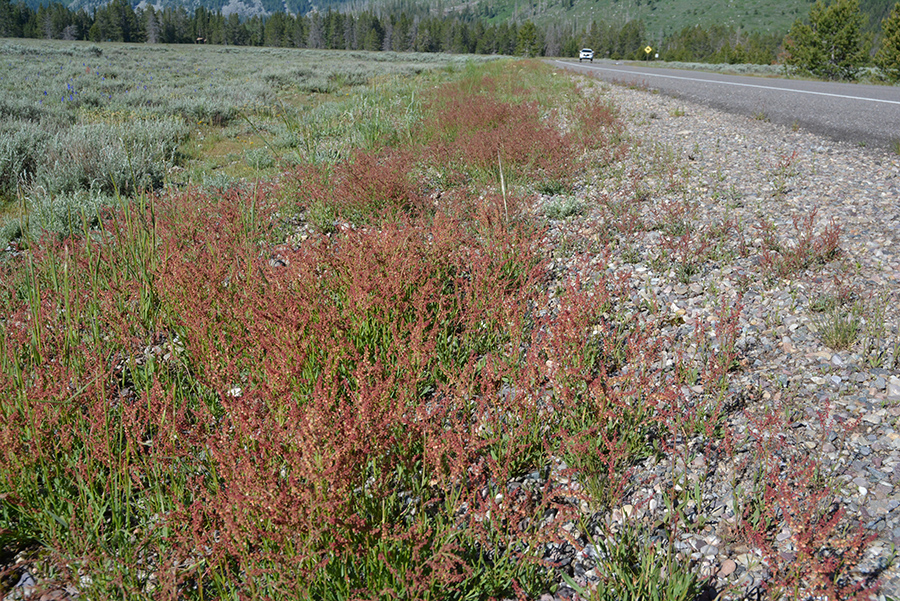
Sheep SorrelRumex spp.– Two species of Sheep Sorrel are obvious right now.  The more common Sheep Sorrel — Rumex acetosella — creates a 6-8” high rusty red haze along roadsides and in open areas.

Along roadsides in the park, you may notice the low brick red haze of sorrel - Rumex acetosella.  The seeds are appealing to sparrows and rodents in fall.

Along roadsides in Grand Teton National Park, you may notice the low brick red haze of Sheep Sorrel – Rumex acetosella. The 2-3″ leaves have elongated, spreading “ears” at their base. The flavor is tangy.

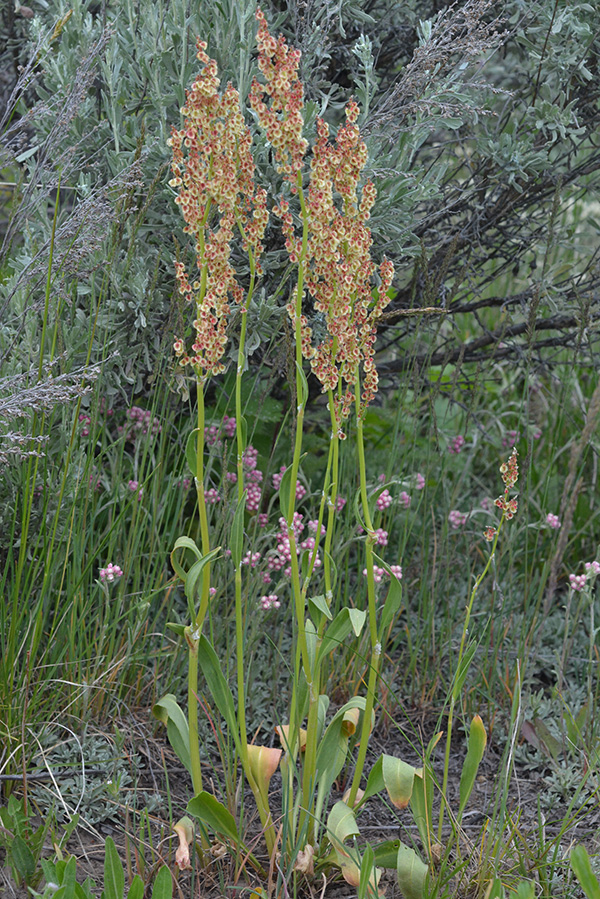
Femail plants of Rumex - Rumex paucifolia - is a taller plant to 18" or so.  produce three-winged fruits.  Both these species have male and female plants.

Female plants of Alpine Sheep Sorrel – Rumex paucifolia –  growing to 18″ or so.  Both sorrel species have male and female plants.

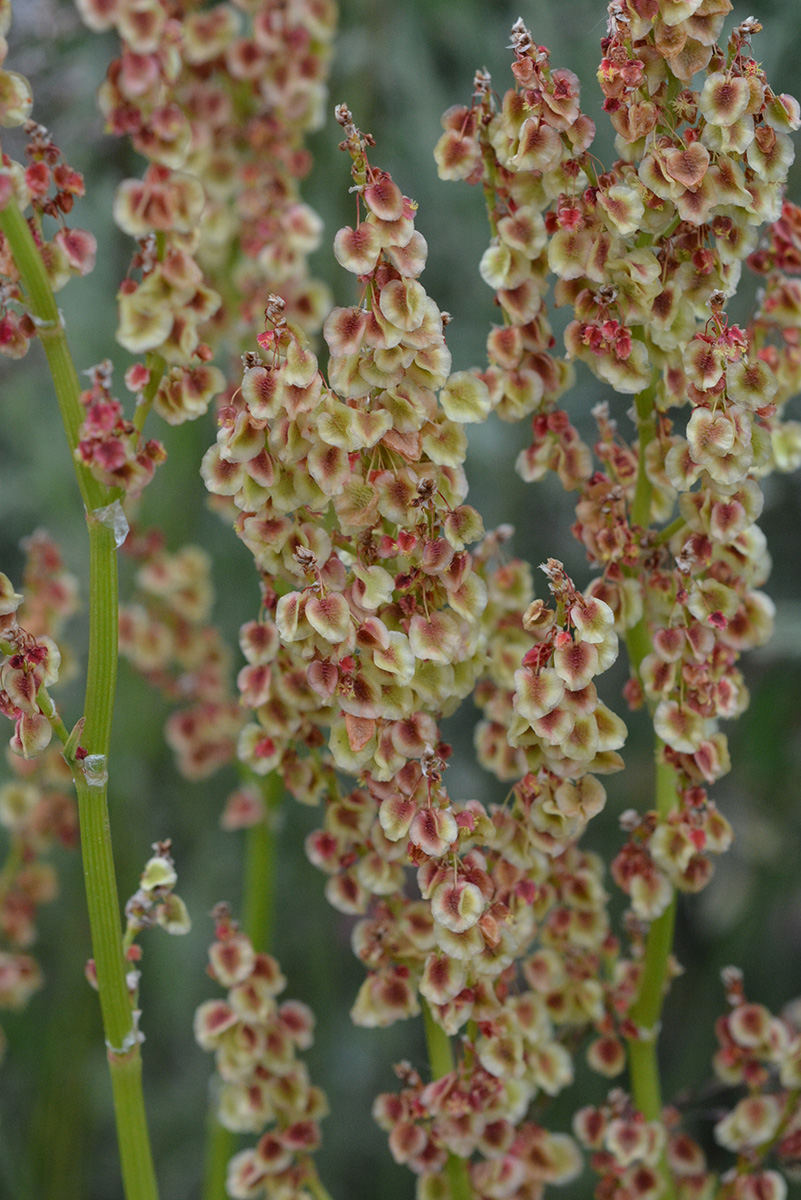
Alpine Sheep SorrelRumex paucifolius – is more stand-alone and can grow to 2-3’. It often sticks up above low growing sagebrush.  Its 4-6” leaves are entire (no teeth or lobes) and elliptical, alternating up the stem.  Both sorrels have separate male and female plants. The roundish fruits are three-winged. The seeds are valuable food for birds and rodents.

buckwheats produce 3 winged fruits that are relished by small birds and rodents in fall.

Alpine Sheep Sorrel, as in others of the genus,  produce 3 winged fruits that are relished by small birds and rodents in fall.

Prickly Pear CactusOpuntia fragilis – This spiny succulent is blooming on the rocks next to the parking lot at Kelly Warm Springs.  Cacti store water in their stems, which also contain chlorophyll for photosynthesis.  The spines are essentially reduced leaves and provide some shade as well as protection from predators.  Hooked spines serve as a transport mechanism—as you will find out if you get too close!  Cacti have a different photosynthesis cycle than most of our wildflowers, an adaptation to the intense sun, heat, and dryness of their location.

Prickly Pear Cactus - Opuntia fragilis - is blooming out at Kelly Warm Springs on the rocks.  Watch out!

Prickly Pear Cactus – Opuntia fragilis – is blooming out at Kelly Warm Springs on the rocks. Watch out!

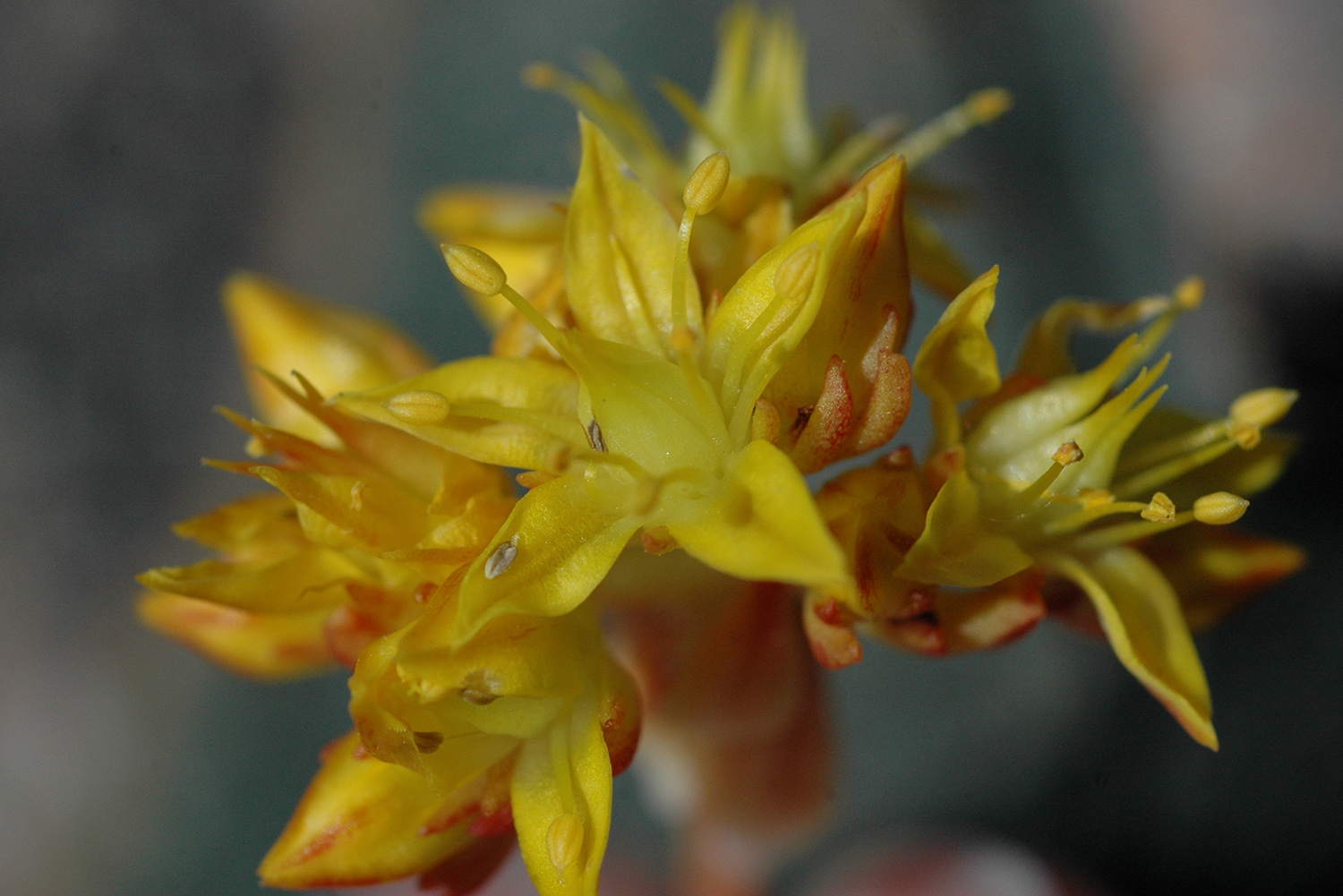
Lanceleaved StonecropSedum lanceolatum – Another plant especially adapted to dry conditions, the leaves are succulent: swollen and fleshy, holding onto extra water just in case a drought occurs.  Also, unlike most plants, stonecrops open their stomates (pores) only at night to acquire essential carbon dioxide without losing too much water.  They retain Co2 until the sun comes up, and then it completes the photosynthetic cycle in the light with the pores closed.  This complex chemical pathway is abbreviated as CAM, for your reference. The five ovaries are distinctive from one another creating a “crown” when they mature into fruits. Each section will split open releasing many tiny seeds.

Sedum or Stonecrops have special adaptations for very dry sites.

Stonecrops have special adaptations for very dry sites.  Note the five petals 10 stamens and 5 separating follicules that will become the many-seeded fruits.

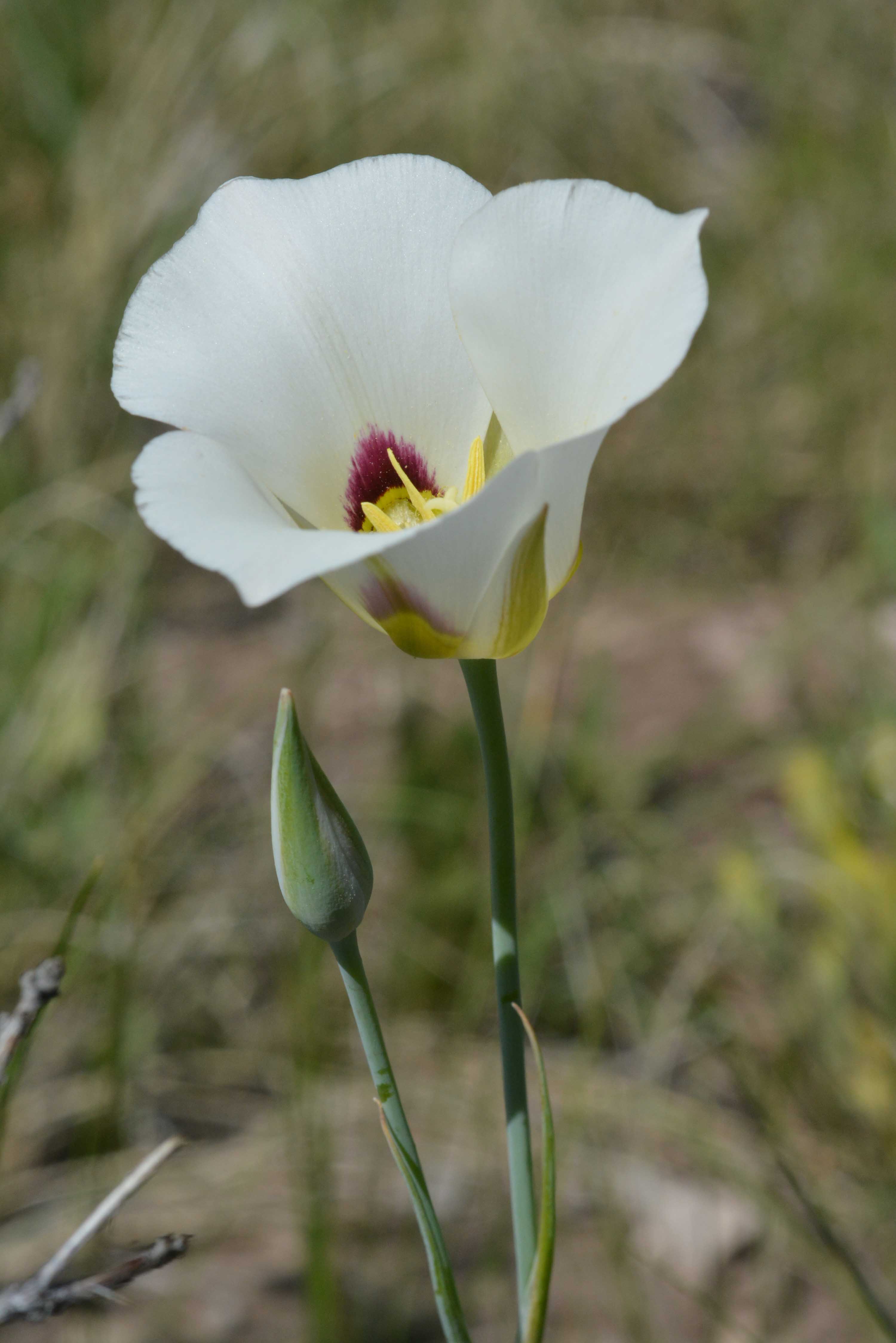
Nuttall’s Sego LilyCalochortus nuttallii – This elegant chalice is blooming on dry rocky sites out Flat Creek Road up into Curtis Canyon, and likely along the Gros Ventre Road.  They are very fragile.

Calochortus nuttallii

Nuttall’s Mariposa/Sego Lily is occasionally found on dry slopes overlooking the Valley.

And a shrub:

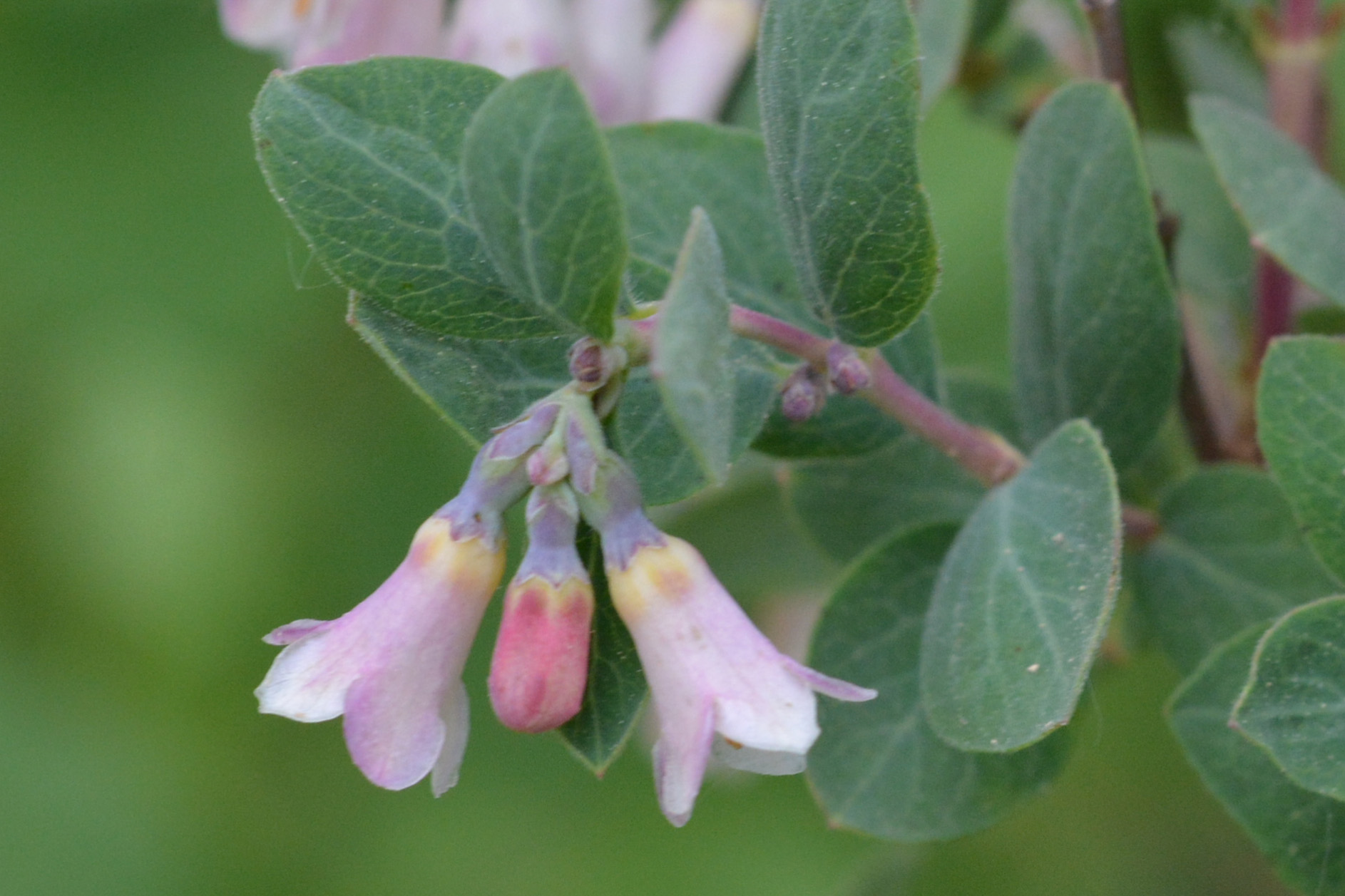
Mountain SnowberrySymhiocarpus oreophilus – is flaring its pinkish petals to attract pollinators.  The bluish green leaves are oval and opposite on the twiggy branches.  The twiggy shrubs spread several feet while growing to 2-4’ high.  The thickets often grow on moraines and provide excellent habitat for birds nesting and seeking cover.

Symphoriocarpus oreophilus

Mountain Snowberry – Symphiocarpus oreophilus – inhabits montane slopes, and sometimes into the sage flats.

Soon these flowers will fade and the show will shift to the hills and into the forest and eventually up into the alpine.  We have many pleasures ahead!

As always we appreciate any corrections, questions, or comments.  On this website, visit our calendar of events for our programs, and be sure to sign up for our tetonplants emails which will give you a exclusive heads-up for our “impromptu” hikes this summer.

And special thanks to the Jackson Hole News & Guide, June 25, Valley section, for providing a map and photos to encourage us all to find the flowers.

Frances Clark, Wilson, WY


Early Summer Blooms – Jackson Hole

Image

TNP14_BalsSag_AntFl_61214_3aCrpSmThe weather has gone from summer back to spring (winter) today, June 14.  The flowers have popped throughout the valley with the heat of the past 10 days.  With little rain this spring, there is no time to lose to enjoy the riotous color and heady fragrances at lower elevations in the valley.  Fortunately, while flowers may be fading in the southern end of Jackson Hole, they are still fresh in the northern end.

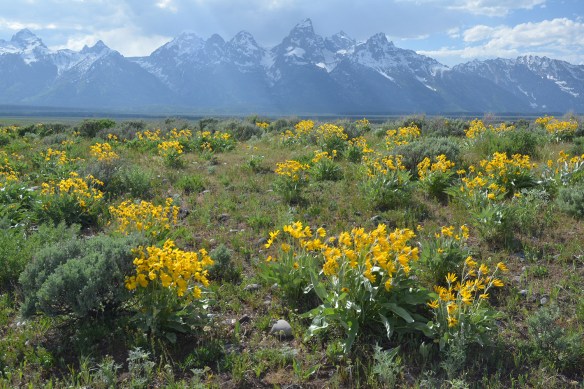
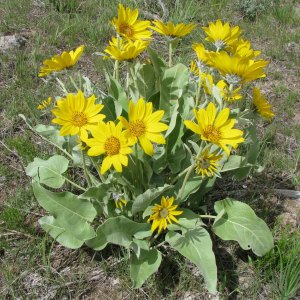
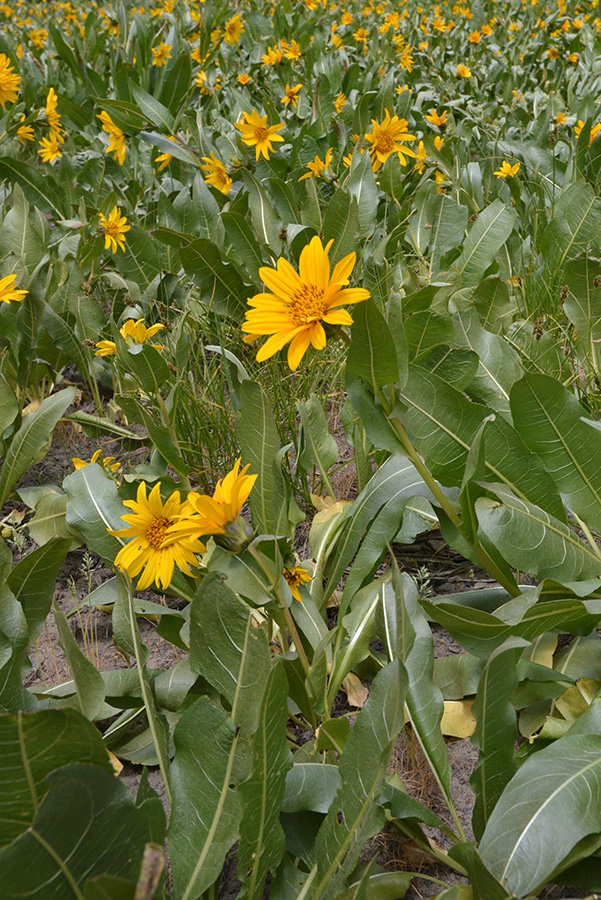
Balsamroot - Sage Flats, Jackson HoleBalsamroot and the look-alike-but-not-quite mules-ears are in full yellow glory.

Balsamroot (Balsamorhiza sagittata) has large arrow-shaped leaves with a grayish cast, all arising from the base.  Sun-yellow flowers stand well above the foliage.  Balsamroot is growing all along the sage flats and up the open hillsides.  Antelope Flats and the top of Signal Mountain feature impressive shows.

Mules-ears -Wyethia amplexifolia

Mules-ears –Wyethia amplexifolia


Mules-ear wyethia (Wyethia amplexicaulis) has deep green leaves shaped like huge mules ears, alternating up the 1-2’ stems (taller in wetter springs).  The 3-4” flowers are a deeper orange-yellow than balsamroot.  It is found in slightly moist spots, such as near the corner of Antelope Flats Road and the highway and along Cattleman’s Road just west of Oxbow Bend.


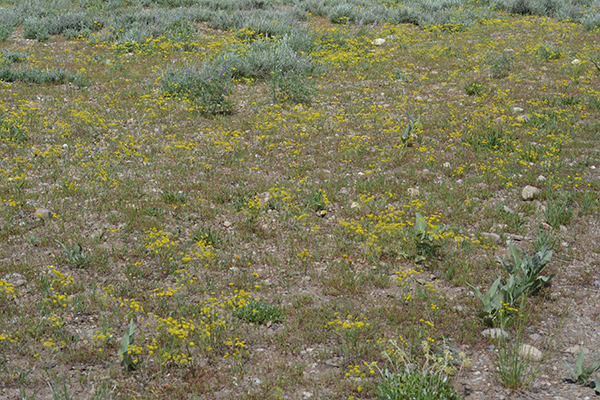
Amidst sage flats and into forest edges are many common favorites: Pink sticky geraniums, lavender to white long-leaved phlox, red scarlet gilia, blue lupines, and yellow modoc hawksbeard are showing their colors amidst the sunny balsamroot. Spikes of cream death camas grow intermittently along Gros Ventre Road south of Blacktail Butte, and patches of pale yellow paintbrush (Castilleja pilosa var. longespica) cluster along the northeastern side of the loop.  (Scroll down for photos.)

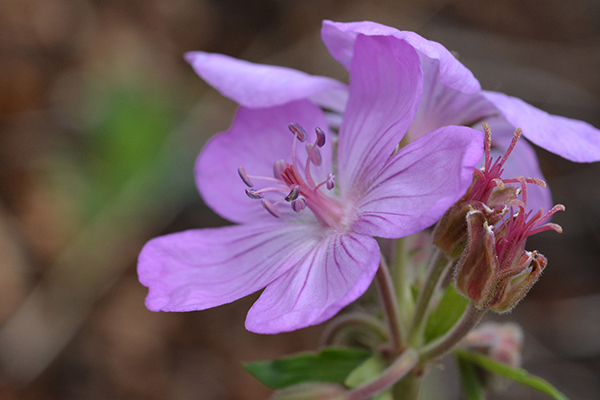
Wild Geranium - Geranium viscosissimum

Sticky Geranium – Geranium viscosissimum – The wide open, pink flowers with lines form landing pads for many kinds of pollinators eager for  pollen and nectar found in the center of the flower.

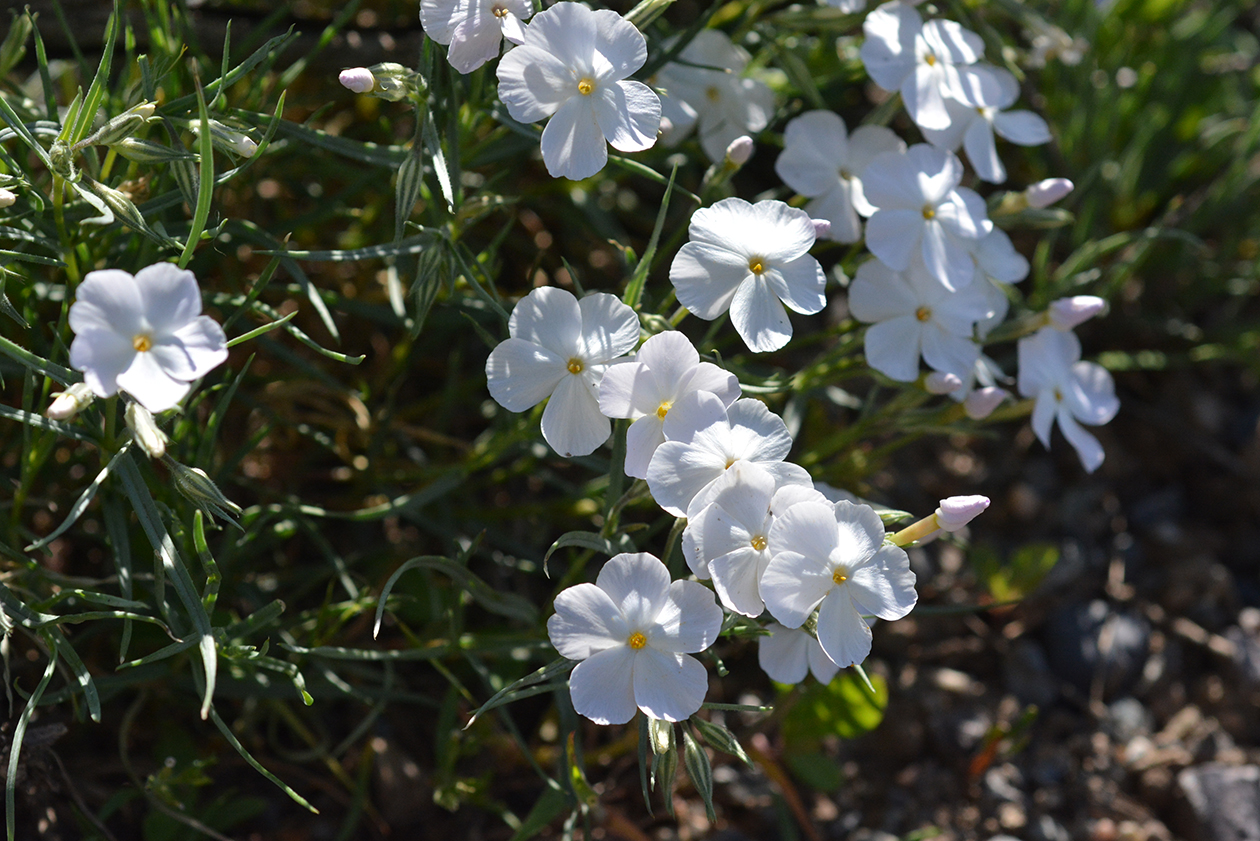
Longleaved Phlox - Phlox longifolia - has variable colors.  Note the petals twist in bud

Longleaved Phlox – Phlox longifolia – has variable colors from pink to lavender to white. Note the petals twist in bud.  Flowers are extremely fragrant!

Death Camus - Zigadenus venenosus - is indeed poisonous.  Racemes of cream colored flowers dress 1' stems with narrow basal leaves.

Death Camus – Zigadenus venenosus – is indeed poisonous. Racemes of cream colored flowers dress 1′ stems. Narrow leaves are mostly basal.

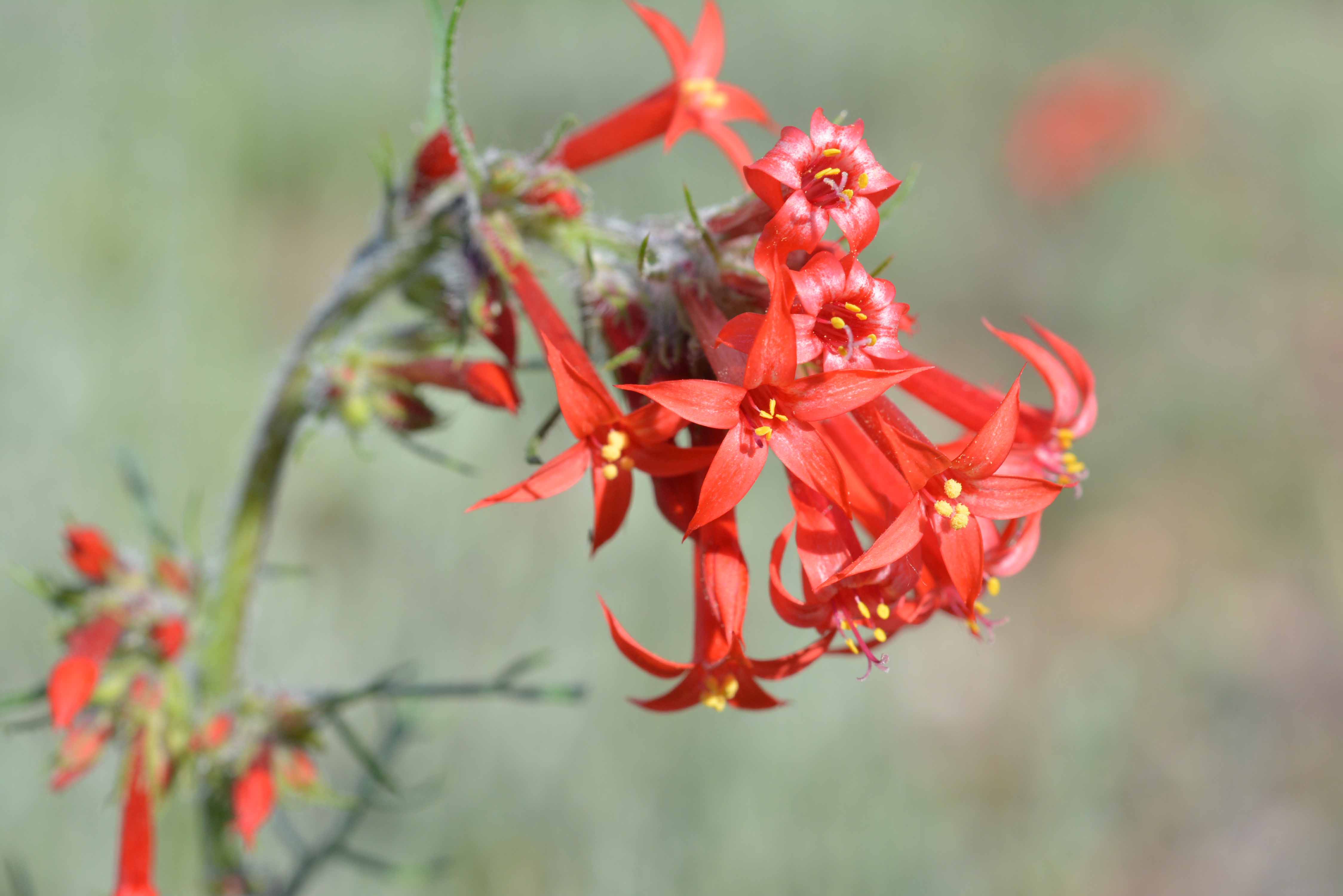
Scarlet Gilia (Ipomoxis aggregata) - Tubular red flowers attract hummingbirds, but also other long-tongued insects.

Scarlet Gilia – Ipomopsis aggregata  – Tubular red flowers attract hummingbirds, but also other long-tongued insects.

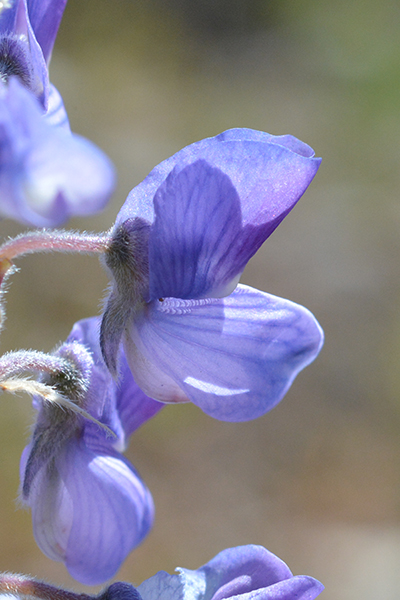
Lupine - Lupinus polyphyllus - found on sage flats has smooth banner, relatively large flowers which open wide.  Lupinus sericeous is also found on sage flats.

Bigleaf Lupine – Lupinus polyphyllus – found now on sage flats has a smooth “banner” petal and relatively large flowers which open wide. Silky Lupine – Lupinus sericeous – is also found on sage flats. There are 5 species to learn.

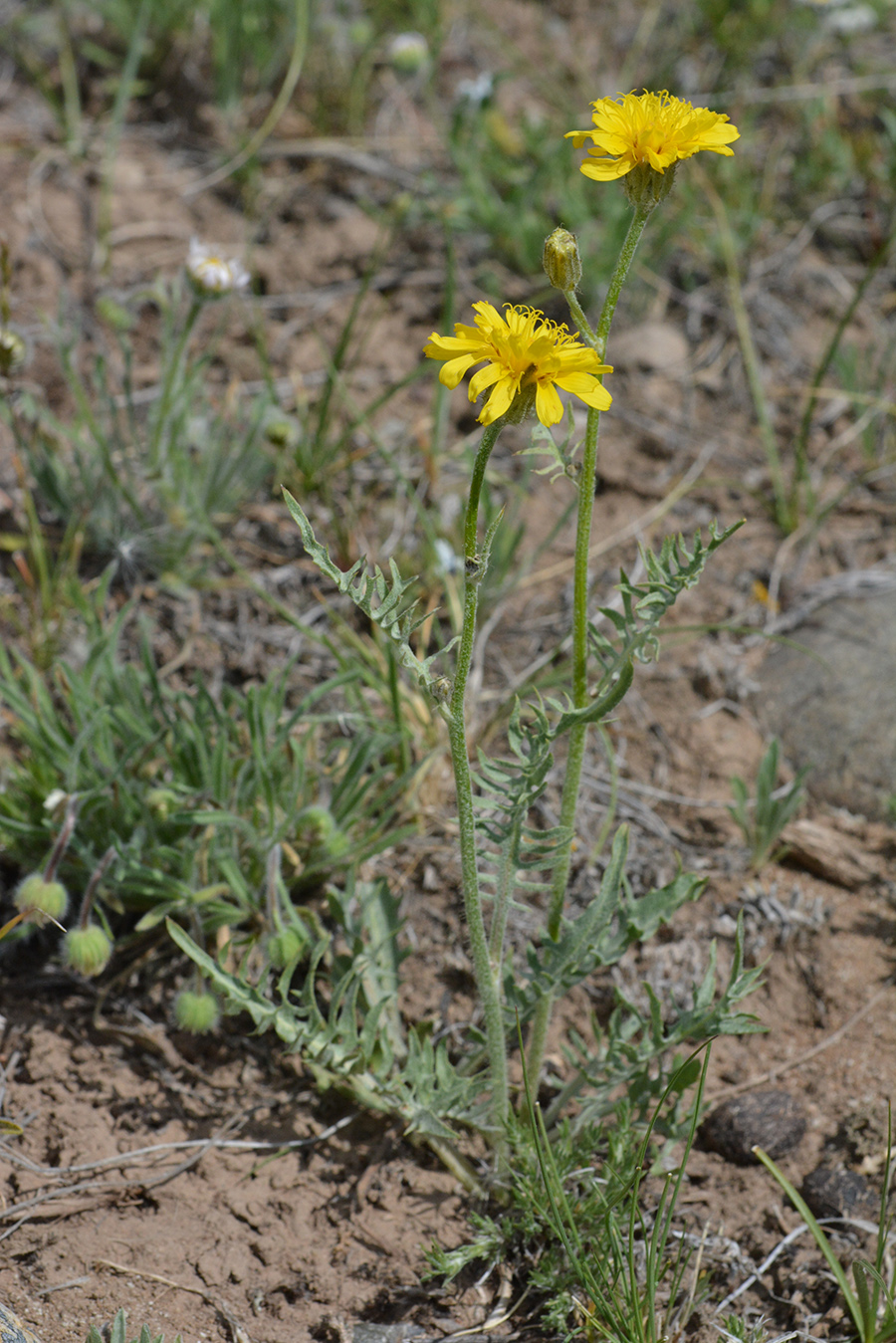
Modoc Hawksbeard - Crepis modocensis - The leaves are often pinnately lobed, the flowers have black hairs.  Several species.

Modoc Hawksbeard – Crepis modocensis – The leaves are often pinnately lobed and alternate up the stem; the flower heads have black, stiff hairs. Several species.

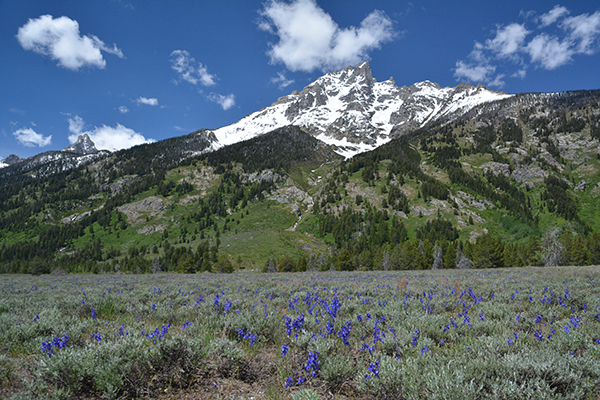
Desert parsley provides a persistent yellow haze along park roads and deep blue Nuttall’s larkspur is beautiful at Lupine Meadows right now.  Lambs-tongue groundsel and nodding microseries, with its drooping buds and dandelion-like flowers, provide frequent splashes of yellow.  A large sky blue penstemon (Penstemon cyaneus) occasionally finds a spot on gravelly slopes.

Desert Parsely - Lomatium ambiguum - grows along dry, disturbed roads sides in the park.

Desert Parsely – Lomatium ambiguum – grows along dry, disturbed roadsides in the park.

Lupine Meadows with Nuttall's Larkspur - Delphinium nutallianum - 6/14/15

Lupine Meadows with Nuttall’s Larkspur – Delphinium nutallianum – 6/14/15

Groundsel - Senecio integerrimus - is common in sage flats.  Look for the even sized involucral bracts around the flower heads and the cobwebby hairs on the stem and leaves.

Lambs-tongue Groundsel – Senecio integerrimus – is common in sage flats. Look for the even- sized involucral bracts around the flower heads and the cobwebby hairs on the stem and variable leaves.

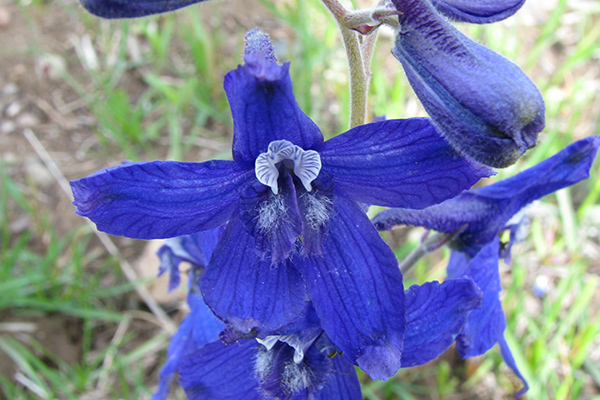
Nuttall's Larkspur - Delphinium nuttallianum - has deep blue flowers.

Nuttall’s Larkspur – Delphinium nuttallianum – has deep blue, complex flowers that bar many but the strongest and smartest pollinators, such as bumblebees.

Nodding Microseries - Microseries nutans - looks a bit like a dandelion or an agrostis, but bud droop and the pappus is feathered.  Leaves are mostly, but not all basal, and narrow.

Nodding Microseries – Microseries nutans – looks a bit like a dandelion or an agrostis, but the buds droop and the pappus (fluff) is feathered. Leaves are mostly, but not, all basal and narrow.

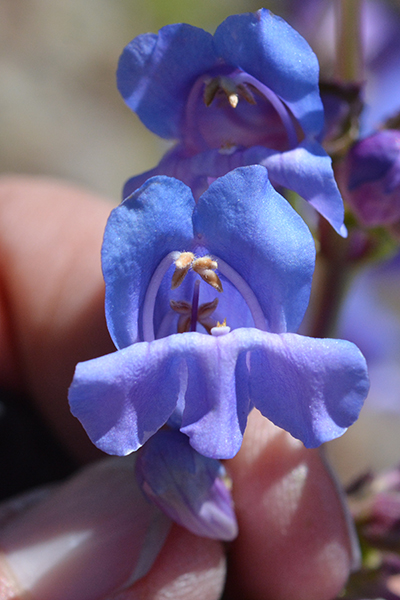
Blue penstemon - Penstemon cyaneus - identification relies on hairiness of plants and even anthers!  The anthers here slit open and are held at an angle.

Blue penstemon – Penstemon cyaneus – Penstemon identification relies on hairiness of plants and even anthers! The anthers here are hairy on the back, slit open, and are held at an angle. The flowers and stem are smooth.

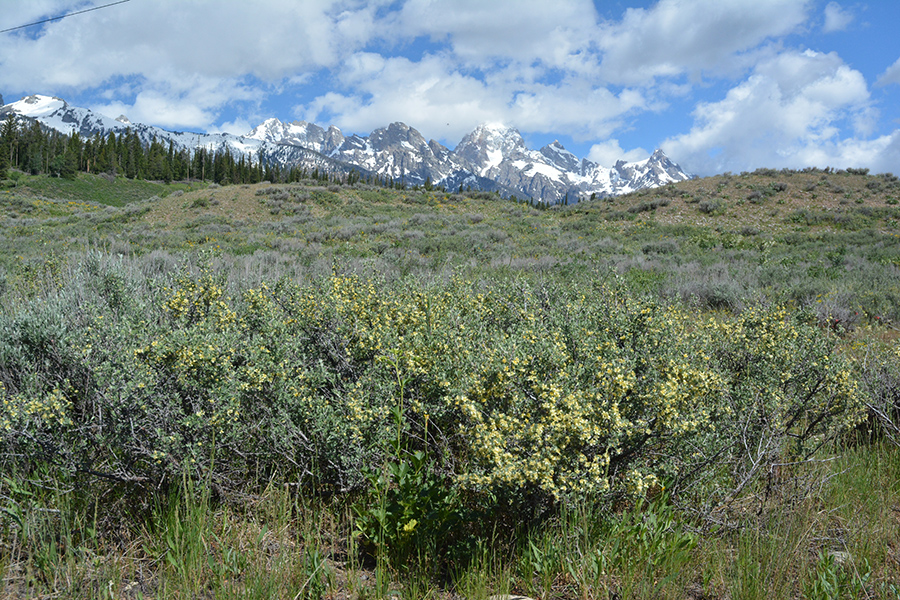
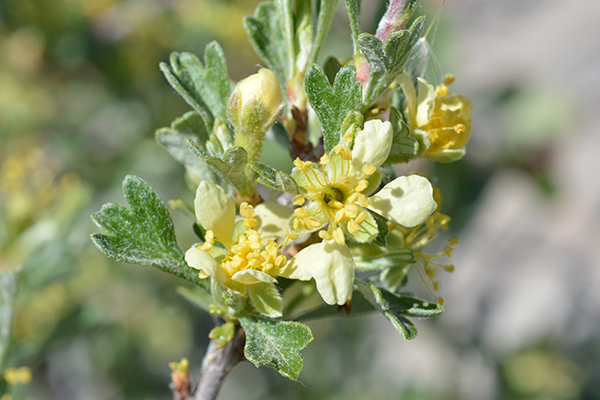
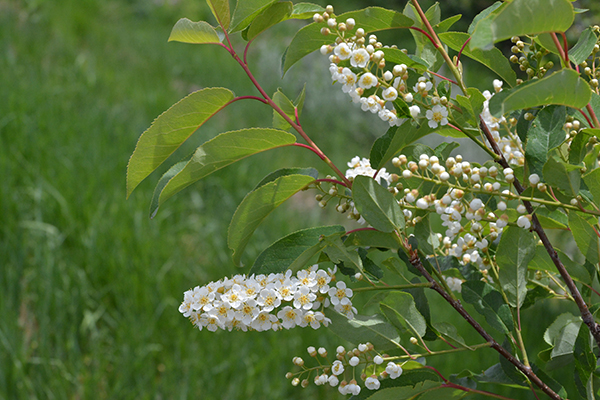
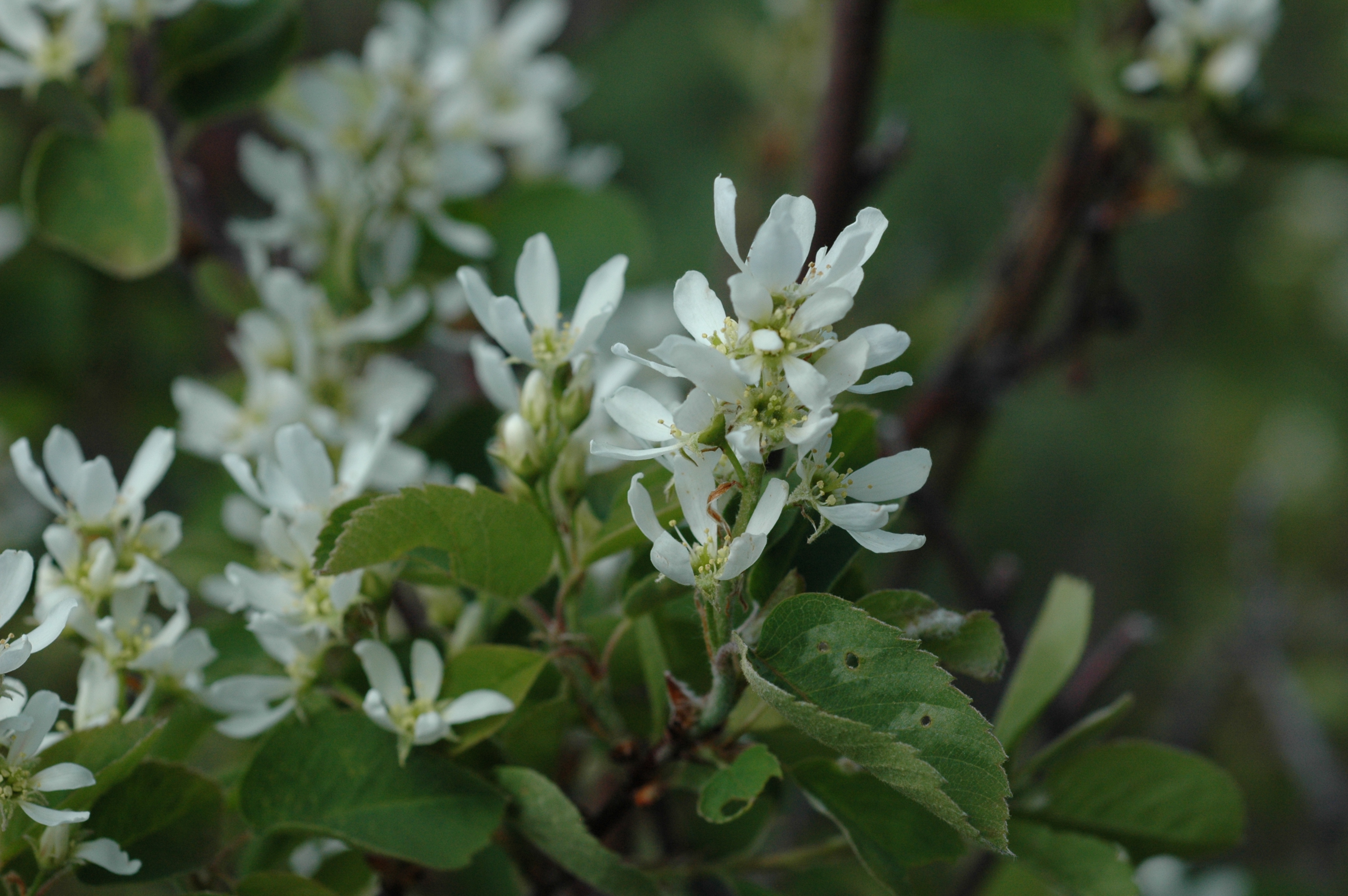
Shrubs of antelopebrush (also called bitterbrush) perfume the sage flats with their small yellow flowers. Serviceberry has short clusters of five-petaled flowers while black chokecherry has long wands of flowers that wave along the edges of moister hillsides, such as along the Moose-Wilson Road and Old Pass Road in the south and Oxbow Bend in the north end of the park. These two white-flowering shrubs are members of the rose family and will have berries important for bears, birds, and other wildlife come late summer into fall.

Antelopebrush is perfuming Jackson Hole.

Antelope/bitterbrush perfumes Jackson Hole.

Antelopebrush - Purshia tridentata - has fragrant pale yellow flowers and three-pointed leaves.

Antelopebrush – Purshia tridentata – has fragrant pale yellow flowers and three-pointed leaves.  Moose reslish this plant in winter.

Chokecherry - Prunus virginiana - has long wands of flowers attractive to many pollinators.  Fruits are vital to wildlife.

Chokecherry – Prunus virginiana – has long wands of flowers attractive to many pollinators. Fruits are vital to wildlife.

Serviceberry - Amelanchier alnifolia - is in the rose family and produces delicious fruits for people and wildlife.

Serviceberry – Amelanchier alnifolia – is in the rose family and produces delicious fruits for people and wildlife.

Tent caterpillars will soon cocoon and metamorphose into moths.

Tent caterpillars will soon cocoon and metamorphose into moths.

You may notice the tent caterpillars defoliating chokecherry.  They build their silken tents where they capture the sun on spring mornings, warming the bodies of these industrious, spinning creatures.  Soon they will cocoon individually and after a couple of weeks become moths.  The caterpillars are protein bars for birds.

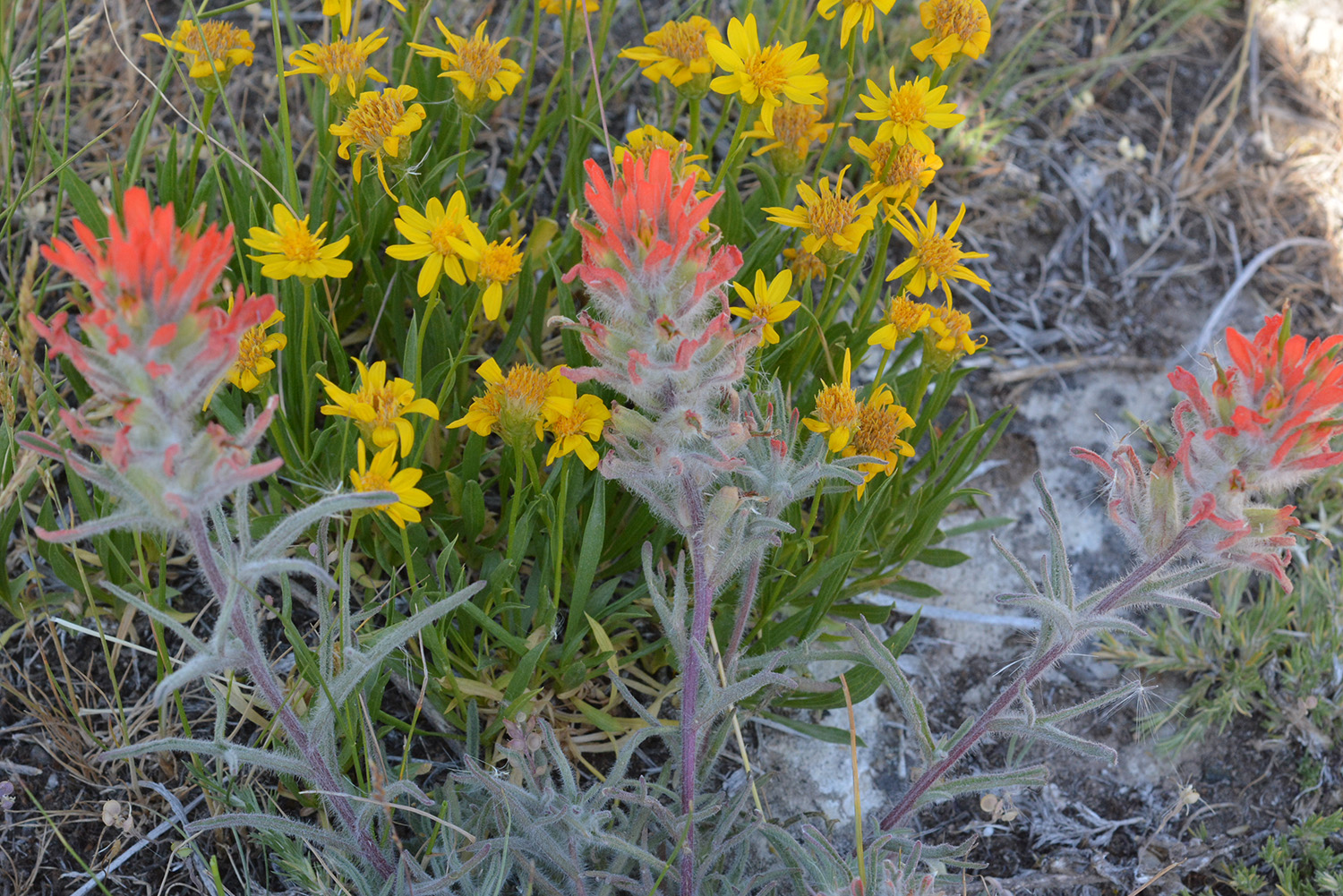
Flat Creek Road through the north end of the National Elk Refuge features early Indian paintbrushes, one brilliant red (Castilleja chromosa) the other yellow (Castilleja flava var. rustica), which dot the dry ground.   Low mats of pussytoes (Antennaria microphylla) and daisies (Erigeron spp.) spread through yellow patches of arnica (Arnica sororia, A. longifolia), stemless goldenweed (Stenotus acaulis) and a clump or two of blue humble penstemon (Penstemon humilis) rise along the hills to the north. Strong winds are challenging to their insect pollinators.  However, grasses are waving their miniature flower heads for the breeze to facilitate pollination.  Soon sulphur buckwheat will add soft yellow hues to the scene.  The fuzzy fruits of Pursh’s Milkvetch can be found lying on gravelly soils.

Red Indian Paintbrush with Stemless Goldenweed - Castilleja chromosa and Stenotus acaulis - grow out Flat Creek Road.

Red Indian Paintbrush with Stemless Goldenweed – Castilleja chromosa and Stenotus acaulis – grow out Flat Creek Road.

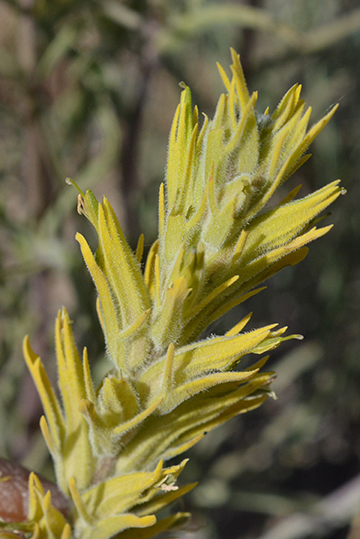
Yellow Indian Paintbrush - Castelleja flava var rustica - one of several yellow paintbrushes.  The details are in the flower proportions and bract shape, as well as  hairs and color. Not easy to ID.

Yellow Indian Paintbrush – Castelleja flava var. rustica – one of several yellow paintbrushes. The details are in the flower proportions and bract shape, as well as hairs and color. Not easy to ID.

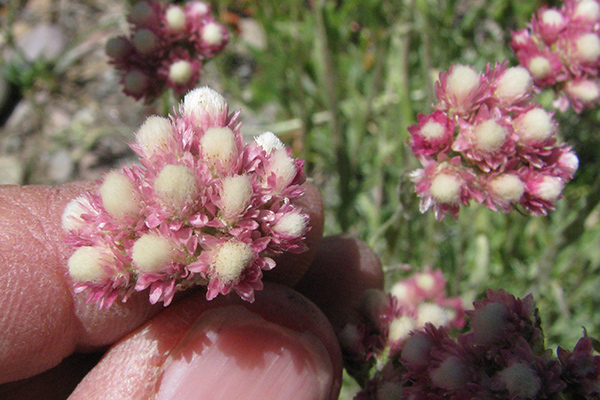
Rosey Pusseytoes - Antennaria rosea/microphylla - The small heads can be pink to white.

Rosey Pusseytoes – Antennaria rosea/microphylla – The small heads can be pink to white.  Silvery leaves are small and create low tight mats. Several pusseytoes are in bloom right now.  Fun botanical puzzles!

Sulphur Buckwheat - Eriogonum - will soon be blooming throughout the valley.

Sulphur Buckwheat – Eriogonum umbellatum – will soon be blooming throughout the valley.

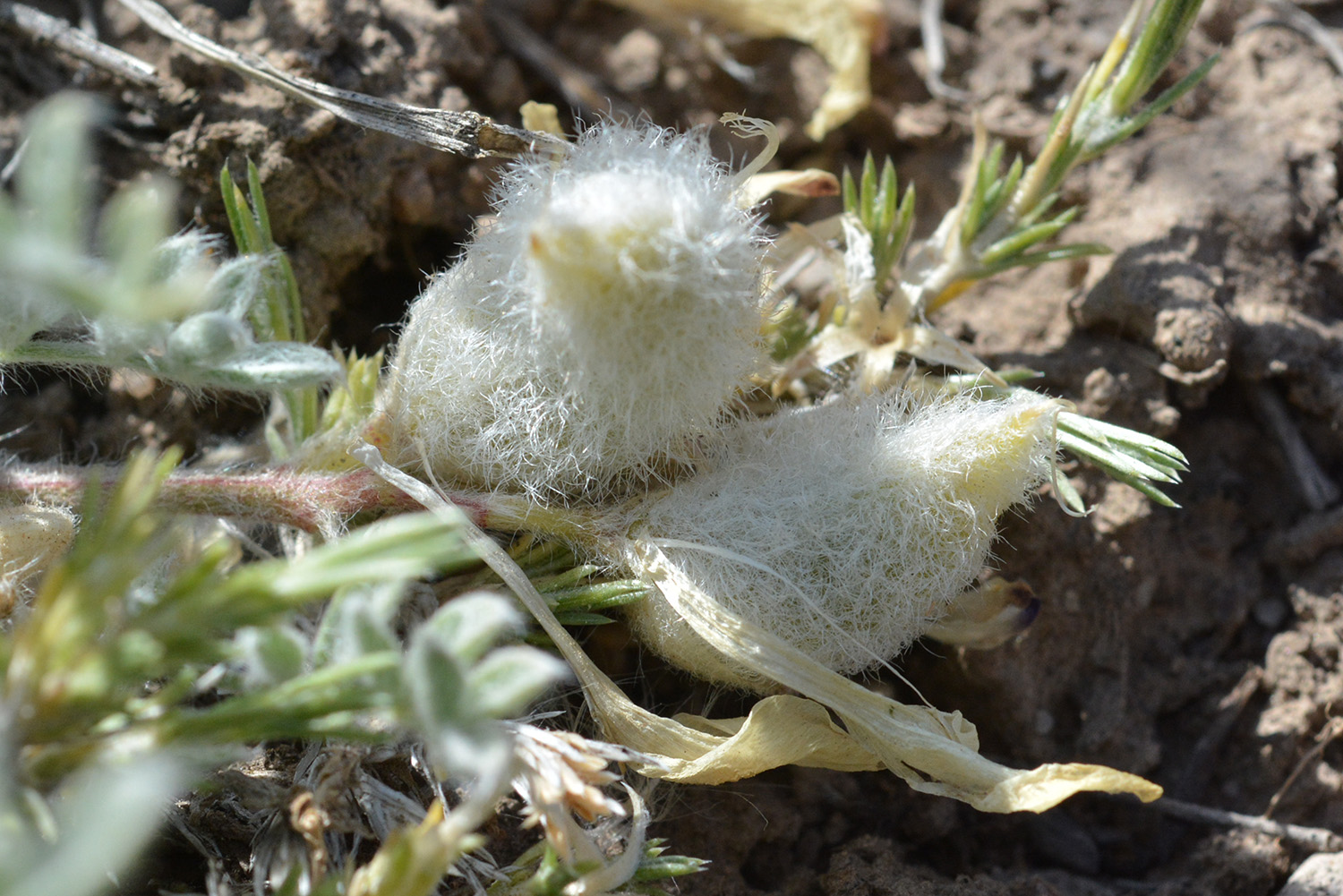
Pursh's Milkvetch - Astragalus purshii - Inhabitats of dry exposed flats, the early spring flowers from fuzzy fruits already!

Pursh’s Milkvetch – Astragalus purshii – inhabits dry, exposed soils. The early spring, pea-like flowers form fuzzy fruits already!

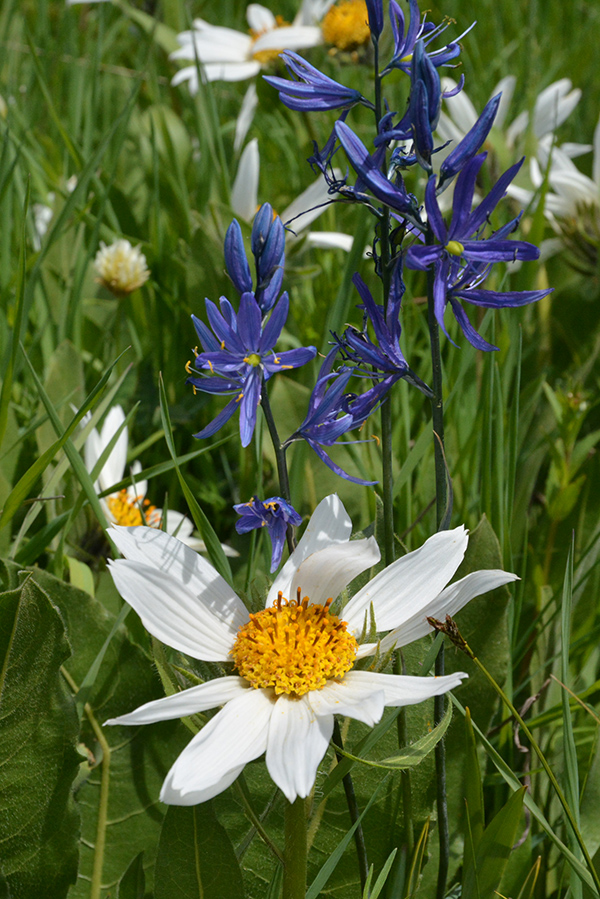
And finally, blue camas and white mule’s ears are in full spender in a wetmeadow at the north end of the park.

White Mules-ears - Wyethia helianthoides - and Blue Camas - Camassia quamash - bloom together in a wet meadow.

White Mules-ears – Wyethia helianthoides – and Blue Camas – Camassia quamash – bloom together in a wet meadow.

These are just a few of the wildflowers to see right now–coming and going–this mid June.

Please let us know what your are finding.

Frances Clark, Wilson, WY

June 14, 2014

White Mules-ears and Blue Camas in a wet meadow.

White Mules-ears and Blue Camas in a wet meadow.

Mid-May Blooms 2014

Wildflowers are coming out in earnest as aspen leaves expand in the southern half of Jackson Hole. Dry slopes and sage flats are good spots to look for color:Josie’s Ridge, Cache Creek, High School Butte, the edges of the Elk Refuge Road in Jackson and areas along the Gros Ventre Road in Grand Teton National Park are easy to access. There are several very distinctive species easy to identify, and a few that can be confounding even to the professional botanists. They are all intriguing to look at close up.

AnemPate_flbuds_JosRdg_2614_2Q2crp180sm

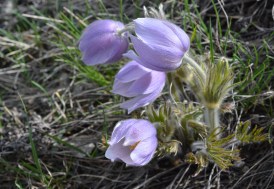
Pasque Flower (Anemone patens var. multifida) is a local favorite. Several large bluish sepals, not petals, form the 2” cup-shaped flower and wrap warmth. Many yellow anthers fill the center, appealing to early pollinators.  Leaves are divided and “fuzzy”. Silky hairs likely warm the plants by reducing wind and holding the sun’s heat as these plants emerge on breezy slopes.

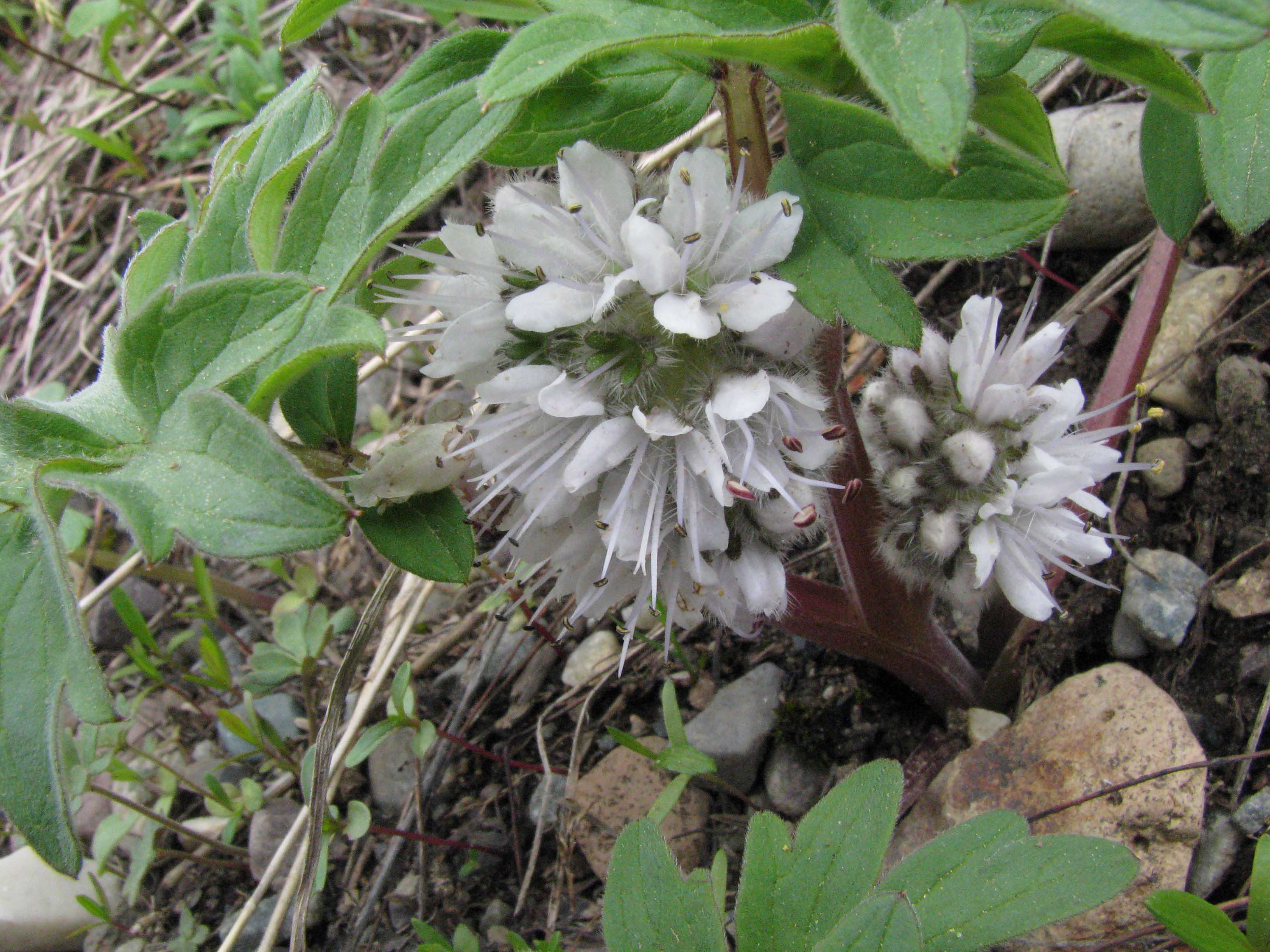
Kittentails (Besseya wyomingensis) are a treat to find. Kittentails - Besseya wyomingensis The “flower” is actually a group of tiny flowers set on a central stalk creating a “spike”.  Each flower has only two sepals, no petals, and two stamens with purple-blue filaments and anthers, which provide the overall color.  Leaves are gray wooly, with rounded teeth. Plants flower at 3-4” but stretch to 12” over the season.


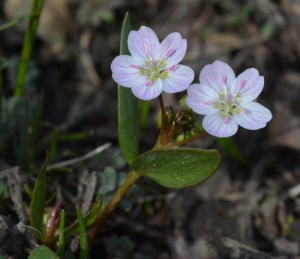
Spring Beauty  (Claytonia lanceolata) – These delicate ephemerals  grow fast from tiny corms (like crocus).  One pair of elliptical leaves grow opposite each othClayLan_fllv_JosRdg_2614_1crp180smer on the 4-6” stems, just beneath the flowers.  Several white to pinkish flowers open wide with rose pink lines on the 5 petals converging to gleaming nectar glands in the center.  The whole plant will die back within only a few weeks, as ephemeral as these lovely spring days.


CommUmbe_flCU_RKOrd_61413_1crp180smBastard Toadflax (Comandra umbellata) is the only member of the Sandlewood Family in Wyoming and can be parasitic on surrounding plants.  The bluish green, 6-8” plants support clusters of tiny, slightly waxy flowers with 5 whitish sepals (no petals).  Sometimes the plants look bright yellow from a fungus.  Bastard Toadflax is an alternate host of the Comandra Blister Rust that infects lodgepole pine.

CommUmb_Rust_RKORd_5713_1crp180sm


Spring  Parsley:  At least two genera and several species of the Parsley Family confound botanists at this time of year. They are all called Spring, sometimes Desert, Parsley.  ID is confirmed by looking at roots and fruits—which are not available.  Here are two Spring Parslies to look out for:

Longstalk Spring Parsley – (Cymopteris longipes) CymoLonp_habfl_kws_42614_3Q1_crpsmSilvery gray, divided leaves form what appears to be a lacy basal rosette, with a pale yellow set of umbels arising from the center.  However, later in the season, the stalk stretches to 8” below and above the set of leaves—giving it a very different look.  The final division of the umbels has a delicate whorl of bractlets: tiny leaf-like structures, that form the  “involucel”.   This species is common on very dry slopes.

LomaFoen_flhab_GVJct_5314_1crp180smSpring Parsley (Lomatium cf. foeniculaceum) — Note the deep green, lacy leaves, and reddish stalk.  The flowers are bright yellow with a definite whorl of wide bractlets forming the involucel.  These are abundant now along the outwash flats along  Gros Ventre Road near the junction with the highway.  ID needs to be confirmed come summer when the fruits are ripe.

LomaFoen_flCU_GVJct_5314_1crp180sm

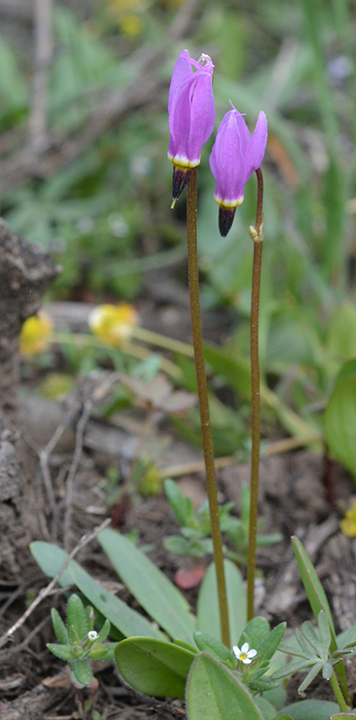
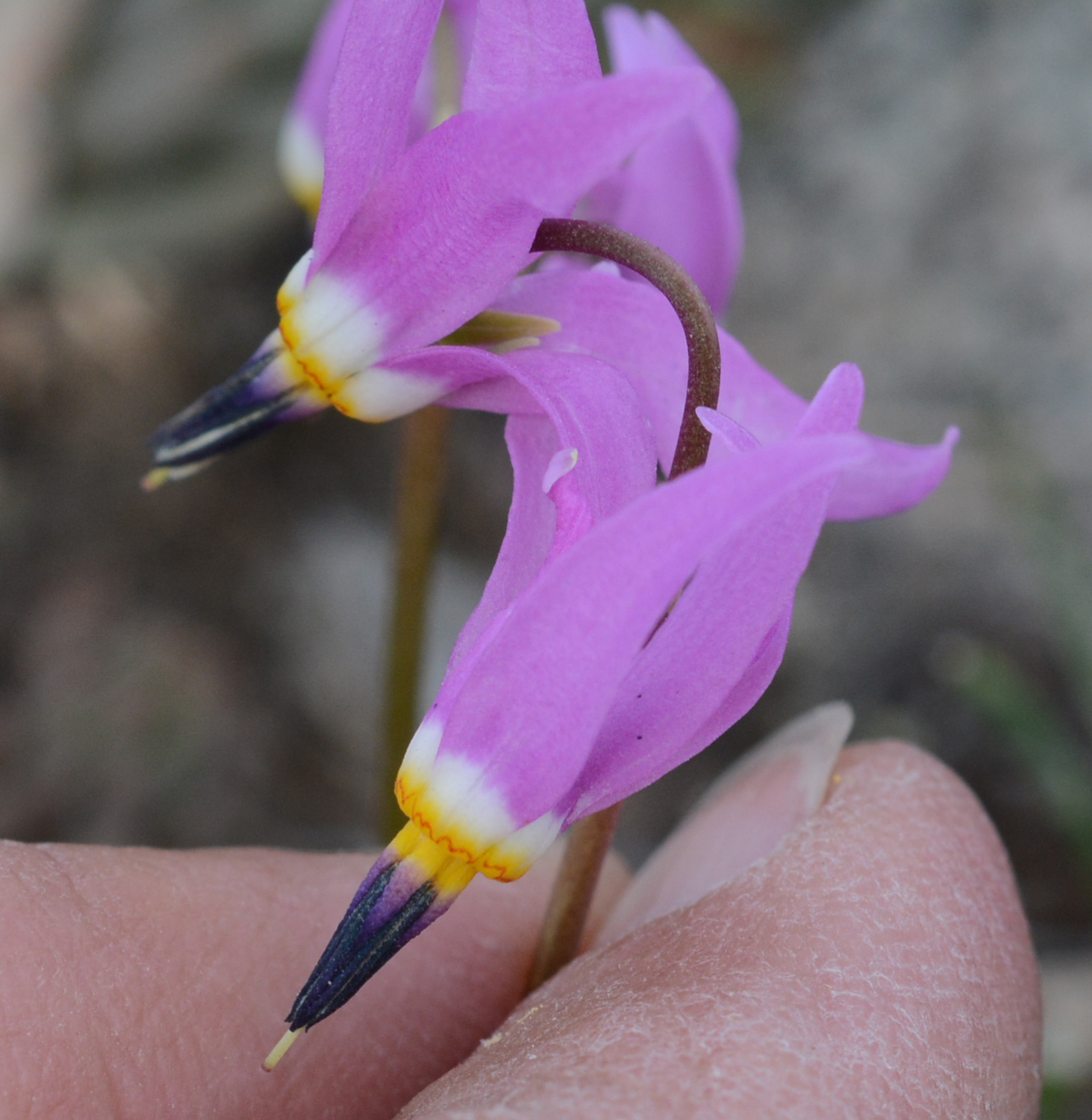
Shooting Stars (Dodecatheon conjugens) dangle their DodeConj_habfl_JosRdg_2614_1crp180smmagenta flowers.  These elegant flowers depend upon bumble bees for pollination.  Hanging upside down, bees vibrate their wings at a certain frequency which releases pollen on the belly of the bee (buzz pollination).  The bee flies to another flower where the stigma is exerted, and the pollen sticks.


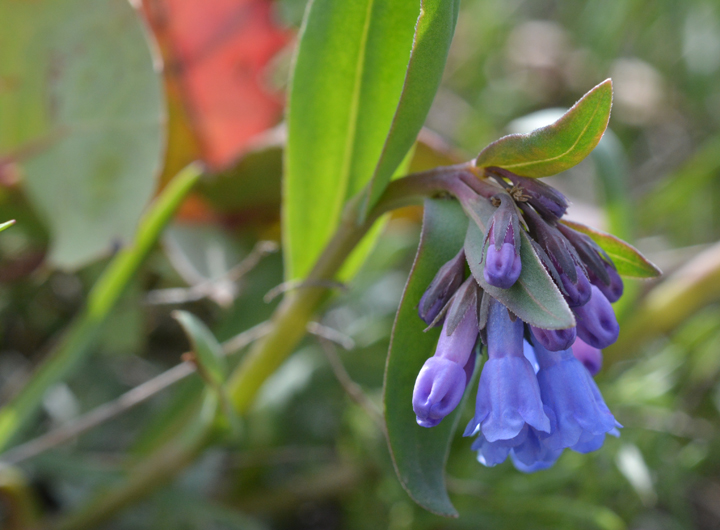
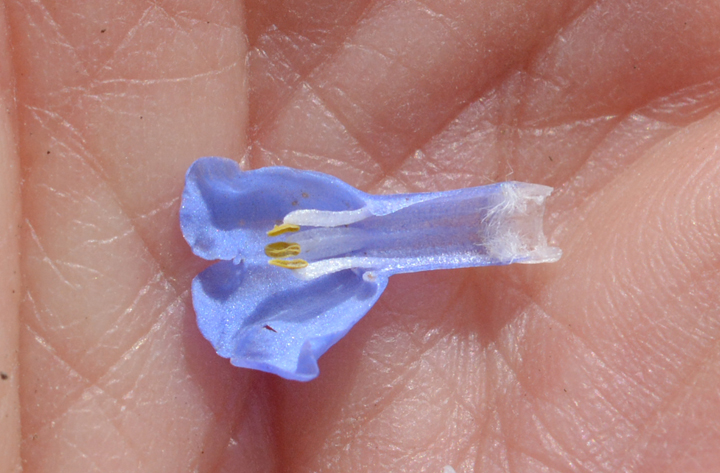
MertObl_FlCU_JosRdg_2614_2acrp180smOblongleaf Bluebells – (Mertensia oblongifolia/viridis—these are now one species) – This spring flowering bluebell grows only to about 10” high.  Flowers are arranged in curled clusters (cymes) and change from deep pink to sky blue.   The narrow tube flares out into a more open portion of the flower (limb).  Inside, the filament of the anther joins at this junction, and is quite broad. The 5 anthers project just beyond the flower opening.  MertObl_FlDis_JosRdg_2614_1crp180smThese details distinguish this species from other local species, including a summer species Mountain Bluebells (M. ciliata) which is much larger plant found in wet seeps.


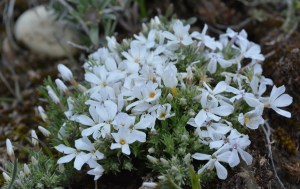
Hood’s Phlox (Phlox hoodii) – Low mats of white to pale blue flowers spread across dry hills and flats.  The tiny tubular flowers are sweetly fragrant.  This species is distinguished by the ½”-wide floPhlHoo_flhab_AntFl_KWS_42714_1crp180smwers and the dense, needle-like leaves often with cobwebby hairs and pungent odor.  Other similar species P. multiflora and P. pulvinata will soon be out with larger 1” wide flowers.


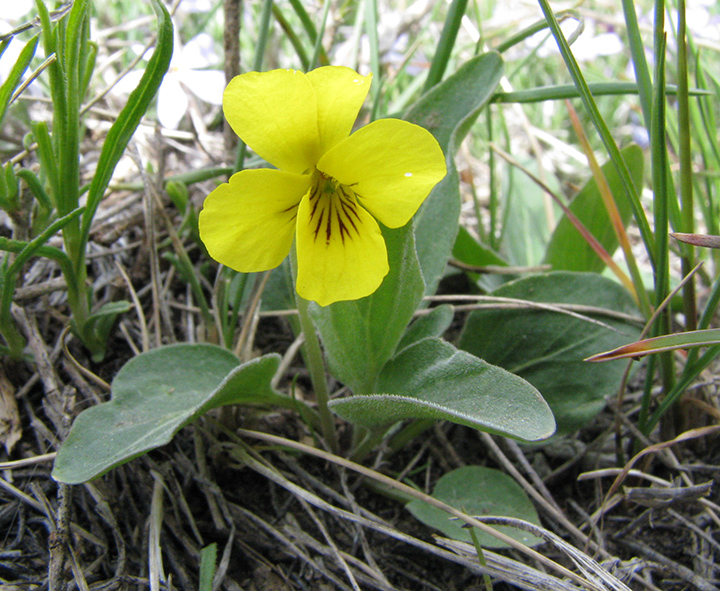
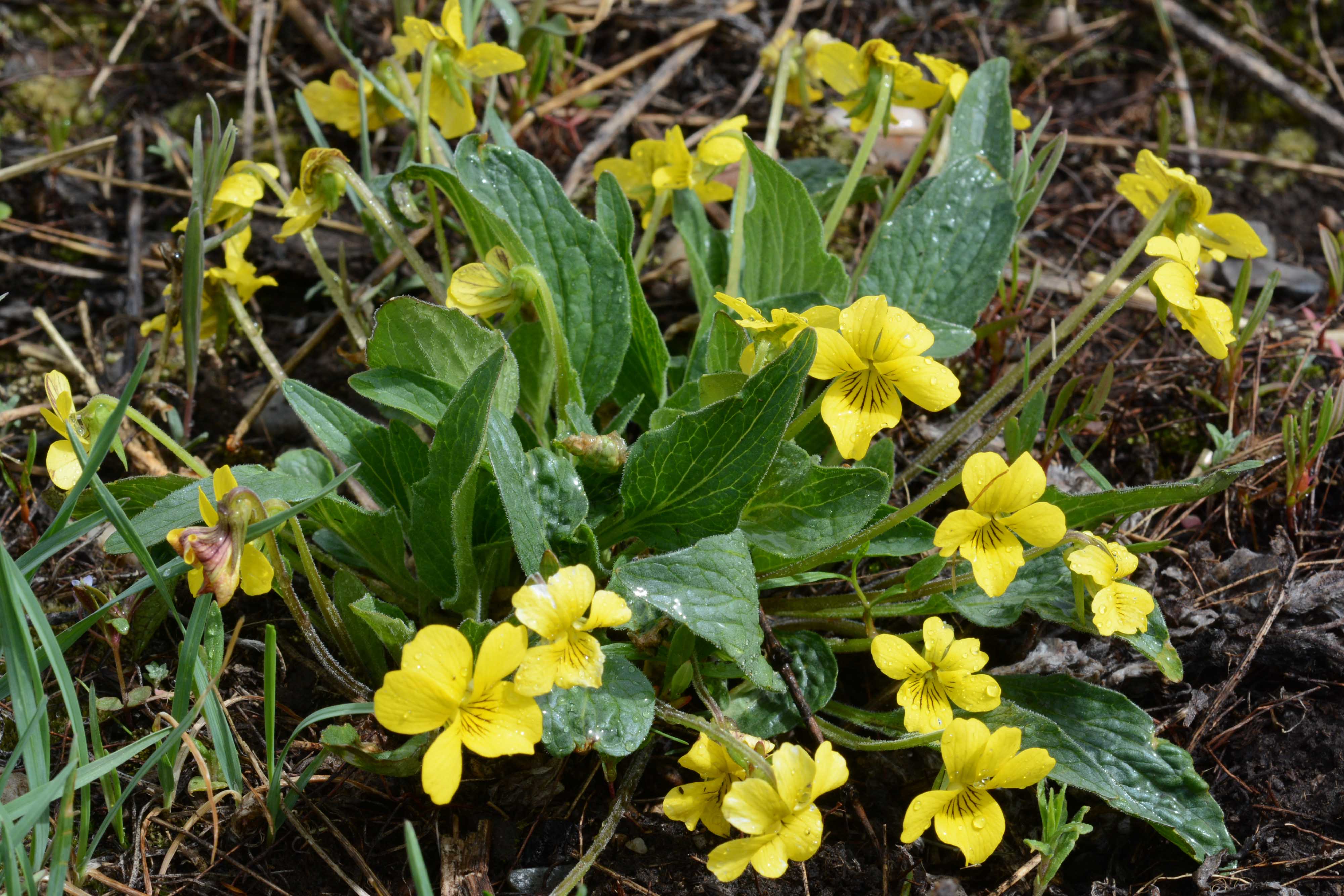
ViolNutt_fl_JosieRidge_fl52011_1crp180smYellow Violets typically have basal leaves ranging from heart-shaped to lance-shaped.   Yellow flowers arise on stalks from the center.  Several  species can be confounding: Viola nuttallii , V. praemorsa,  and V. vallicola.  I think this is Nuttall’s Yellow Violet given the size of the plant and flower  and shape and dimension of the leaves, but I am not sure.  So we may leave it as Yellow Violet (Viola sp.)
While names help you share your experiences or look up more information, just examining flower details and watching pollinators can be delightful.

Have fun flower watching!

Frances Clark, Wilson, WY


Early Spring Bloom in Jackson Hole – 2014

As the snow melts from south and west facing slopes and along road edges, it’s time to scout for some very early spring wildflowers.  Early bloomers grow low to the warming ground and utilize stored food in thickened roots to grow fast.  Small flies, bee-flies, and bumble bees are typical early spring pollinators, flying only a few inches above the ground looking for nectar and pollen.

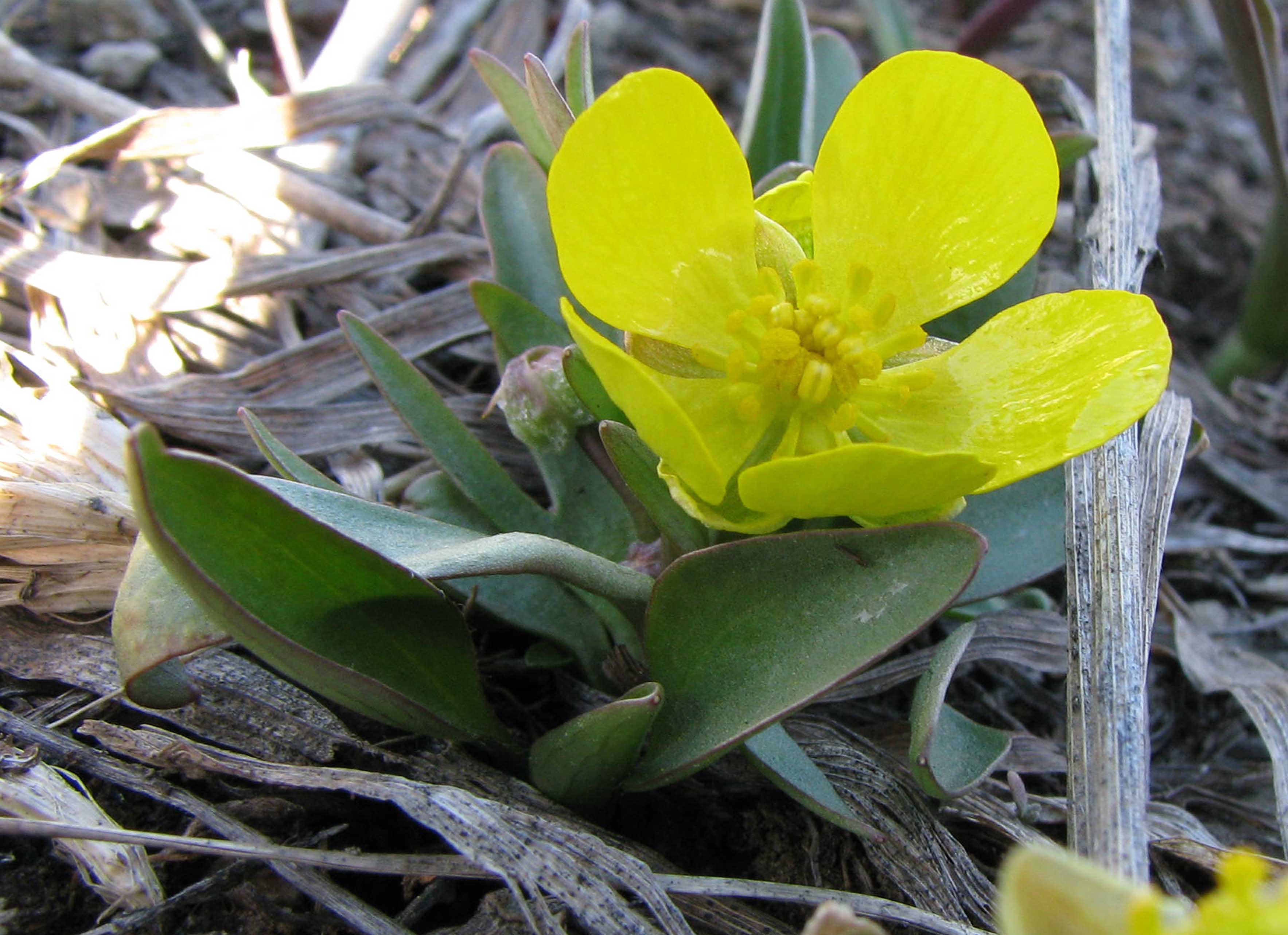
Sagebrush Buttercup (Ranunculus glaberrimus var. ellipticus) is a harbinger of spring with its saucer-shaped flowers of 5 yellow petals, multiple anthers, and a protruding cluster of pistils.  Leaves on the stem divide into 2-3 lobes, but basal leaves are usually elliptical and whole.  Below ground is a bunch of thickened roots.
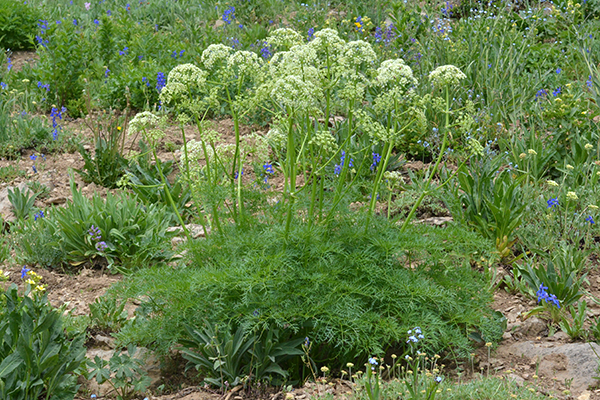
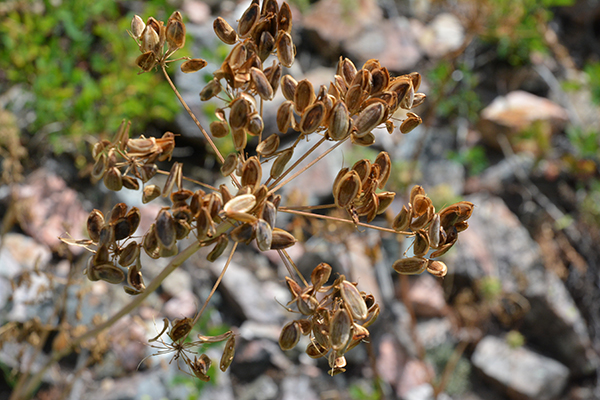
The lowest leaves of Sage Buttercup are not lobed.

The lowest leaves of Sage Buttercup are not lobed.

Sagebrush Buttercups are tasty to Sage- and Sharp-tailed Grouse , rodents,  as well as mule deer in early spring.  They are found on sunny sage flats such as Antelope Flats.

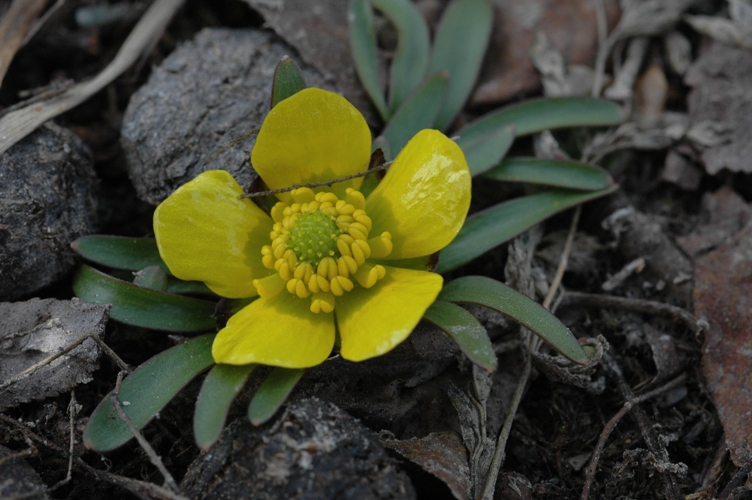
The lowest leaves of Utah Buttercup are deeply 3-5 lobed.

Basal leaves of Utah Buttercup are  3-5 lobed.

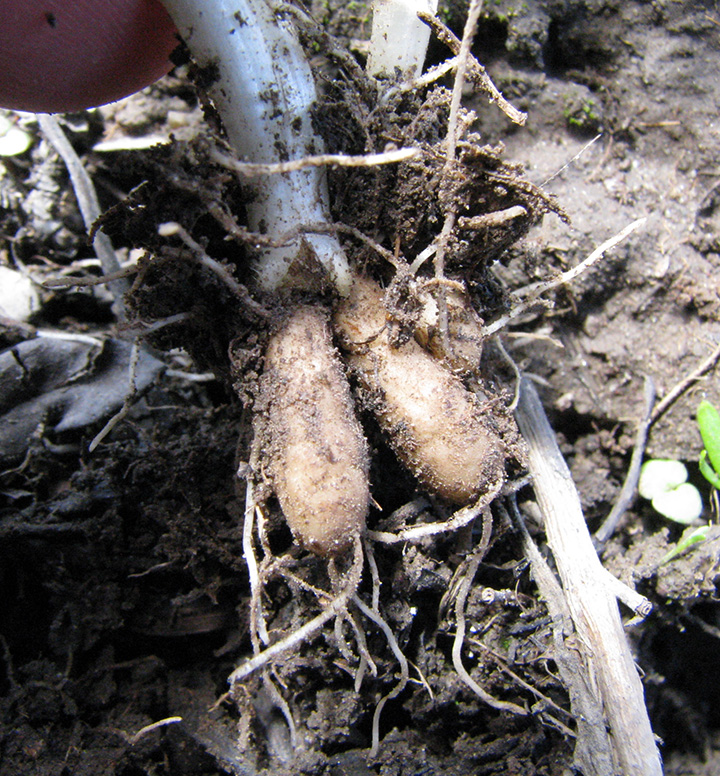
The look-alike Utah Buttercup (Ranunculus jovis) blooms a week or so later and grows in slightly shadier locations. The lower leaves   are deeply lobed and the roots are a bit thicker than Sagebrush Buttercup.

Utah Buttercup has large swollen storage roots.

Utah Buttercup has large swollen storage roots.

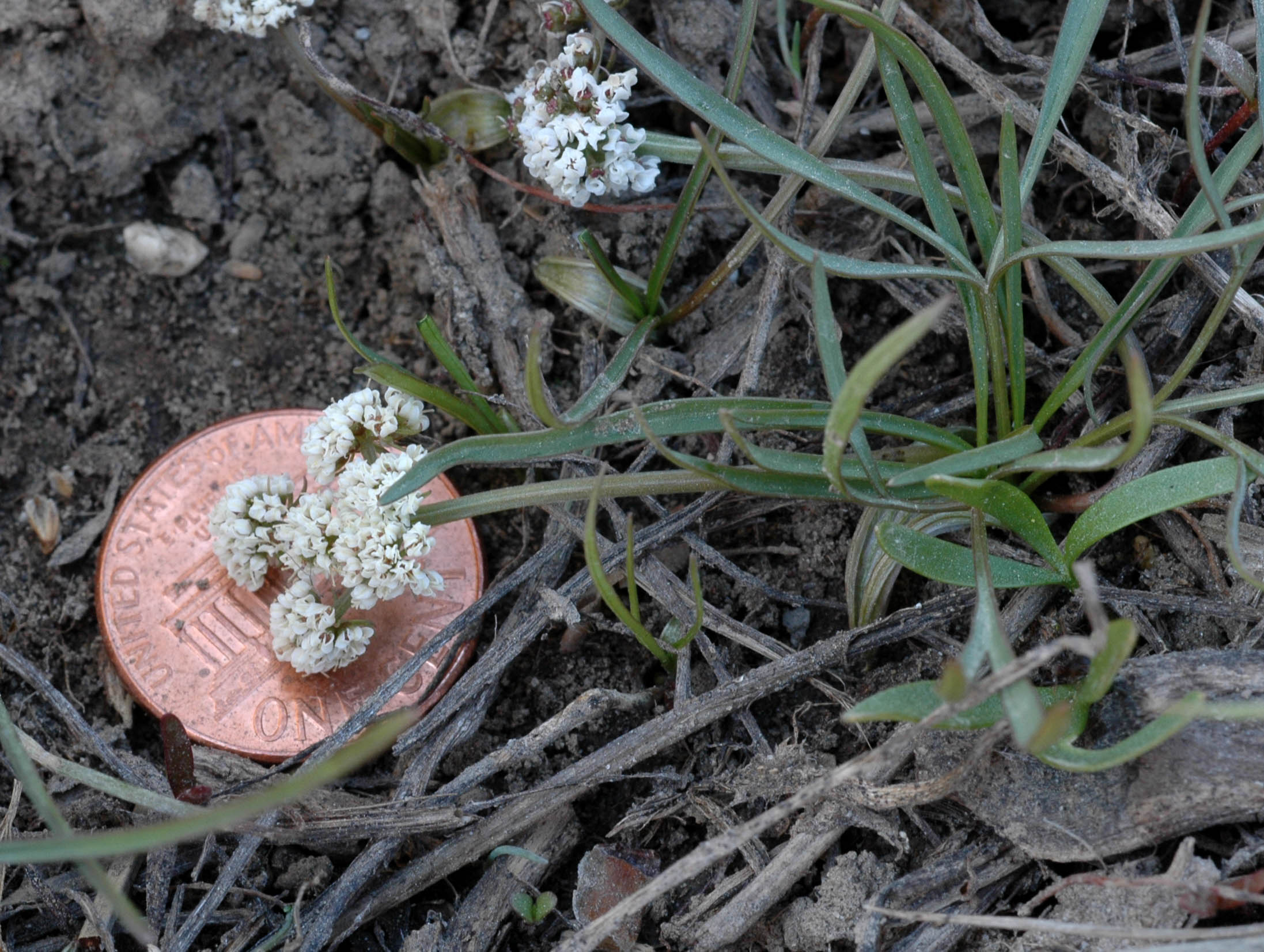
Turkey Peas (Orogenia linearifolia) are a challenge to find.  The

The flower clusters of Turkey Peas are smaller than a penny.

The flower clusters of Turkey Peas are smaller than a penny.

cluster of flowers is often less than a penny in size and the leaves are 2-3 times dissected and typically only an inch or two long.

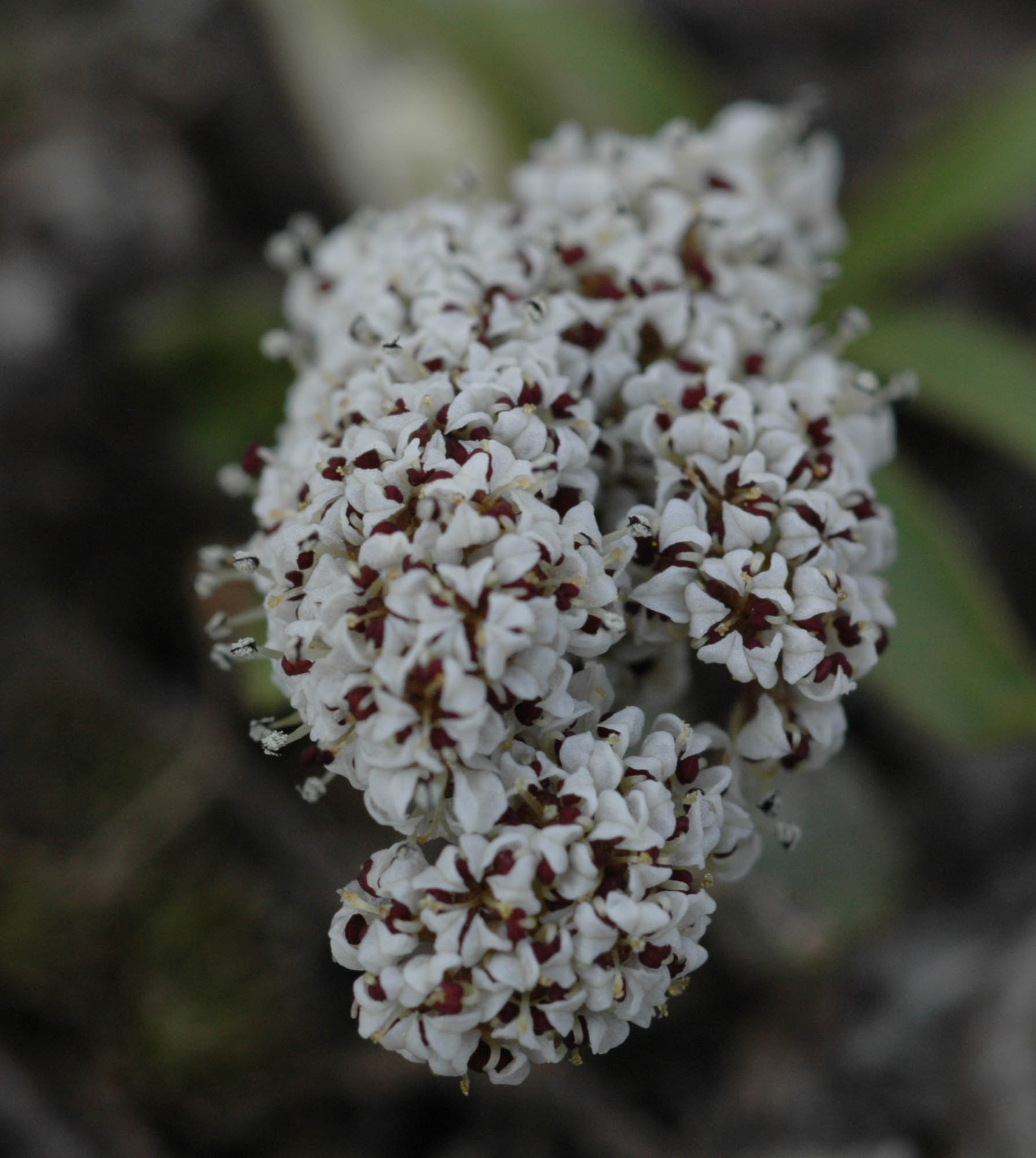
Five white petals of curve over two deep purple stigmas of Turkey Peas.

Five white petals of curve over two deep purple stigmas of Turkey Peas.

Looking very closely with a hand-lens, you can see 5 white petals surrounding a deep-purple pair of stigmas in the center.   The clusters of flowers are borne in an umbel (as in umbrella), one indicator that it is a member of the Parsley Family.

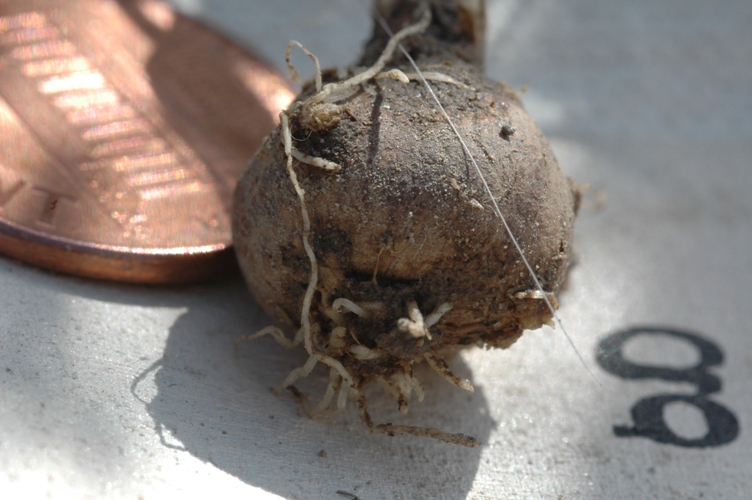
Turkey Peas has a bulb-like storage root.

Turkey Peas has a bulb-like storage root- the “peas” relished by wildlife.

Look for very tiny flies and bees pollinating them.  Below ground are the “peas,” thickened, roundish roots about ½ inch in diameter.

Yellowbells is a member of the Lily Family: count the 6 tepals and 6 anthers.

Yellowbells is a member of the Lily Family: count the 6 tepals and 6 anthers.

Yellowbells (Fritillaria pudica) hasn’t been reported yet, but search for 2-3 lily-like leaves only 3-4” long, and a nodding, single yellow bell. The flower has 6 yellow tepals (3 sepals and 3 petals that look alike).  Note the 6 stamens inside.  The linear leaves and flowers with parts in multiples of 3s are keys to it being in the Lily Family. This plant has tiny bulbs which are eaten by rodents.

Flowering Trees and Shrubs:  It is easy to overlook wind-pollinated species as their tiny flowers are inconspicuous—they don’t advertise to pollinating insects.  Often, wind-pollinated species have separate male and female flowers. Often these very tiny flowers are arranged in long clusters called catkins.  Sometimes the male and female catkins are on separate plants to help assure cross-pollination.  Wind pollinated species typically bloom before their leaves come out, so the leaves don’t get in the way of pollen dispersal.
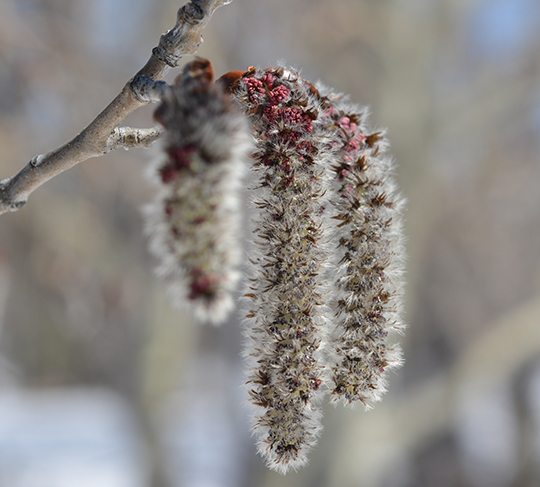
Quaking Aspen - dangling male catkins look like gray caterpillars - look for silvery hairs.

Quaking Aspen – dangling male catkins look like gray caterpillars – look for silvery hairs.

Quaking Aspen (Populus tremuloides) is in bloom in Jackson and other warm spots in the southern end of the valley.  Grayish “fuzzy” caterpillar dangles are male catkins stretching out into the wind. Female flowers are more closely held on the branches of separate plants, and often bloom slightly later.   The separation in time and space ensures cross pollination, assuring a healthy mix of genes.

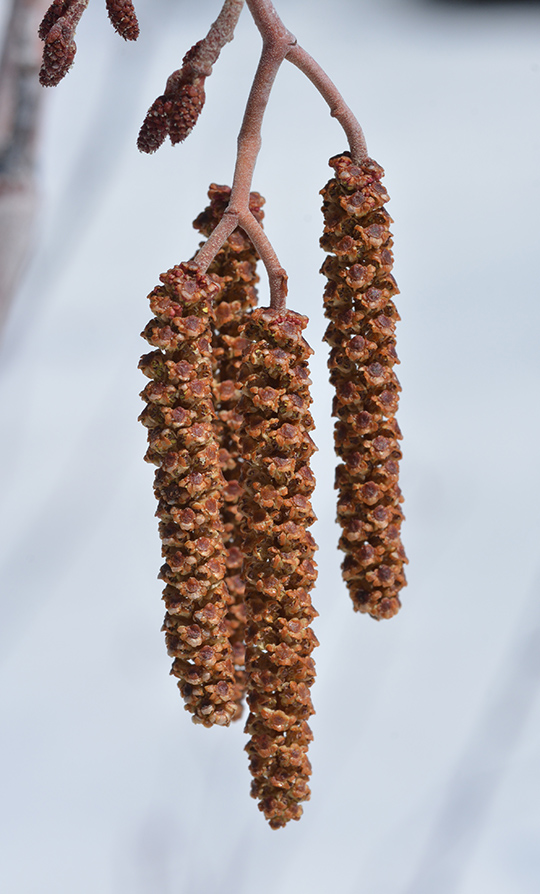
Around ponds and along streams, 6-8 foot tall Mountain Alders (Alnus incana var. occidentalis) are flourishing.

Mountain Alder male catkins are rusty colored just before they produce yellow pollen dispersed by wind.

Mountain Alder male catkins are rusty colored just before they produce yellow pollen dispersed by wind.

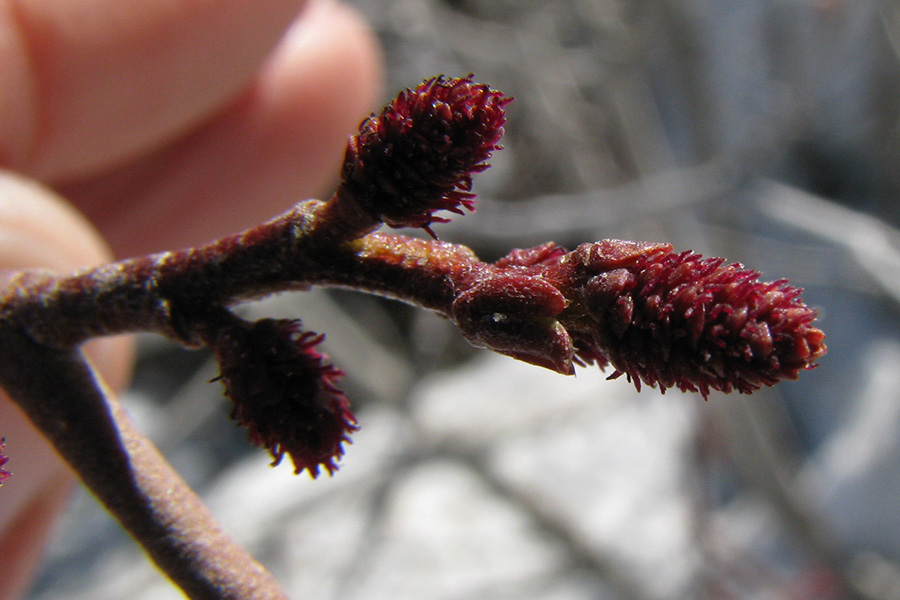
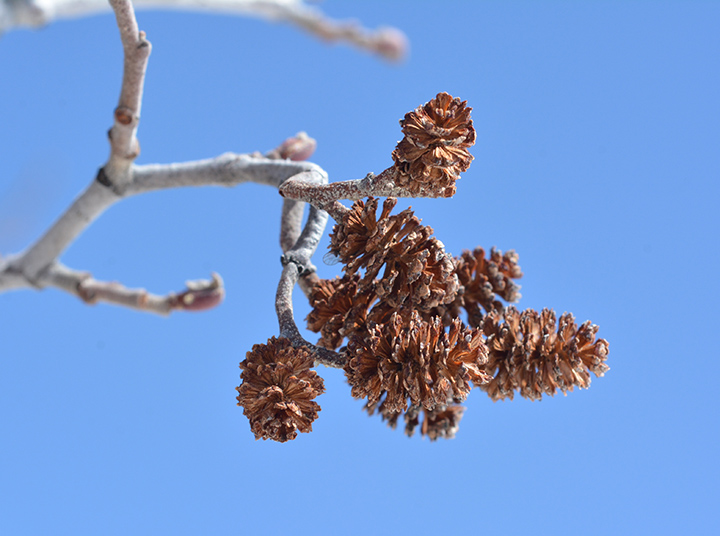
The rusty haze seen from a distance is from the catkins: male flower clusters dangling and swaying in the breeze.   On the same twig are tiny female flowers held in tight, egg-shaped “cones.”  Pollen from the elongated male catkins is blown to the female stigmas (take a close look) that catch pollen.  Once pollinated, females will form seeds inside what look like miniature brown pine cones.  Last years’ open brown  “cones” may still be found on plants.

Female catkin of Mountain Alder, note crimson stigmas.

Female catkin of Mountain Alder, note crimson stigmas.


Last years female "cones" of Mountain Alder help in identification of this wetland shrub.

Last year’s female “cones” of Mountain Alder help in identification of this wetland shrub.

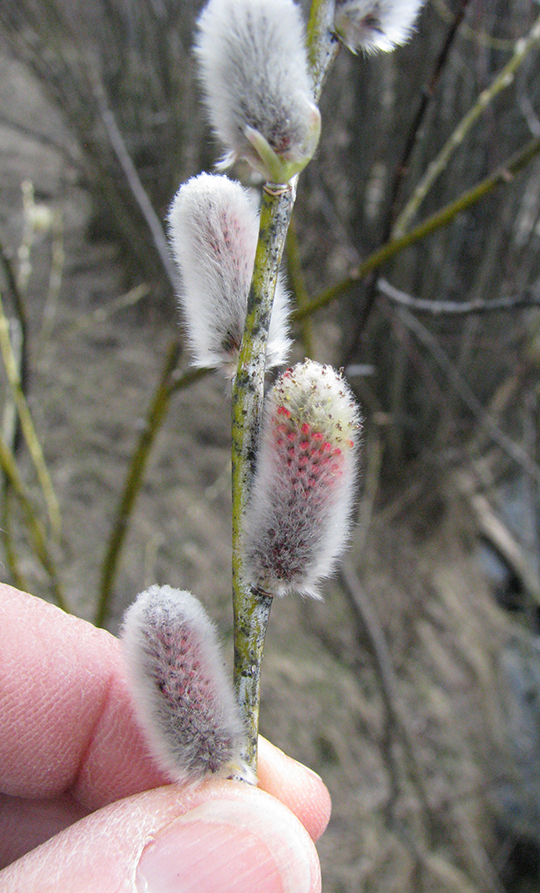
Individual willow species (Salix spp. ) are notoriously difficult to identify, but we all know the “pussies”,

Booth's willow - Male catkins or pussies.

Booth’s willow – Male catkins or pussies.

the silvery catkins that stand out along the branches before the leaves unfold.  Male and female catkins are borne on separate plants. See if you can determine which are male and which are female (Hint: male have pollen, females are swollen ovaries that become fruits with seeds inside). Willow catkins usually have wind pollinated flowers, but some are insect pollinated.  Take a close look as they emerge and see if you can see which is which and why. (Think of attractants and rewards for pollinators!)

Enjoy the emergence of spring!

April 15, 2014 – Frances Clark

Find Wildflowers Galore Throughout Jackson Hole – Early July

Temperatures soared last past week (low 90s in the Jackson) and the snowpack was melting fast.  While there are still colorful spots in the sage flats and along the low-elevation wetlands and streamsides, the flower show is rapidly moving up the mountains.  Fortunately, last weekend’s rain storms and cooler temperatures will help the flowers persist.   Even so, don’t wait to get out to see what’s in bloom!

Below are some places I have hiked/botanized this past week .  The next post will include photos of common plants you can discover.  Also check out past posts for some plant ID.  The sage flowers are still blooming!

Where to find flowers: 

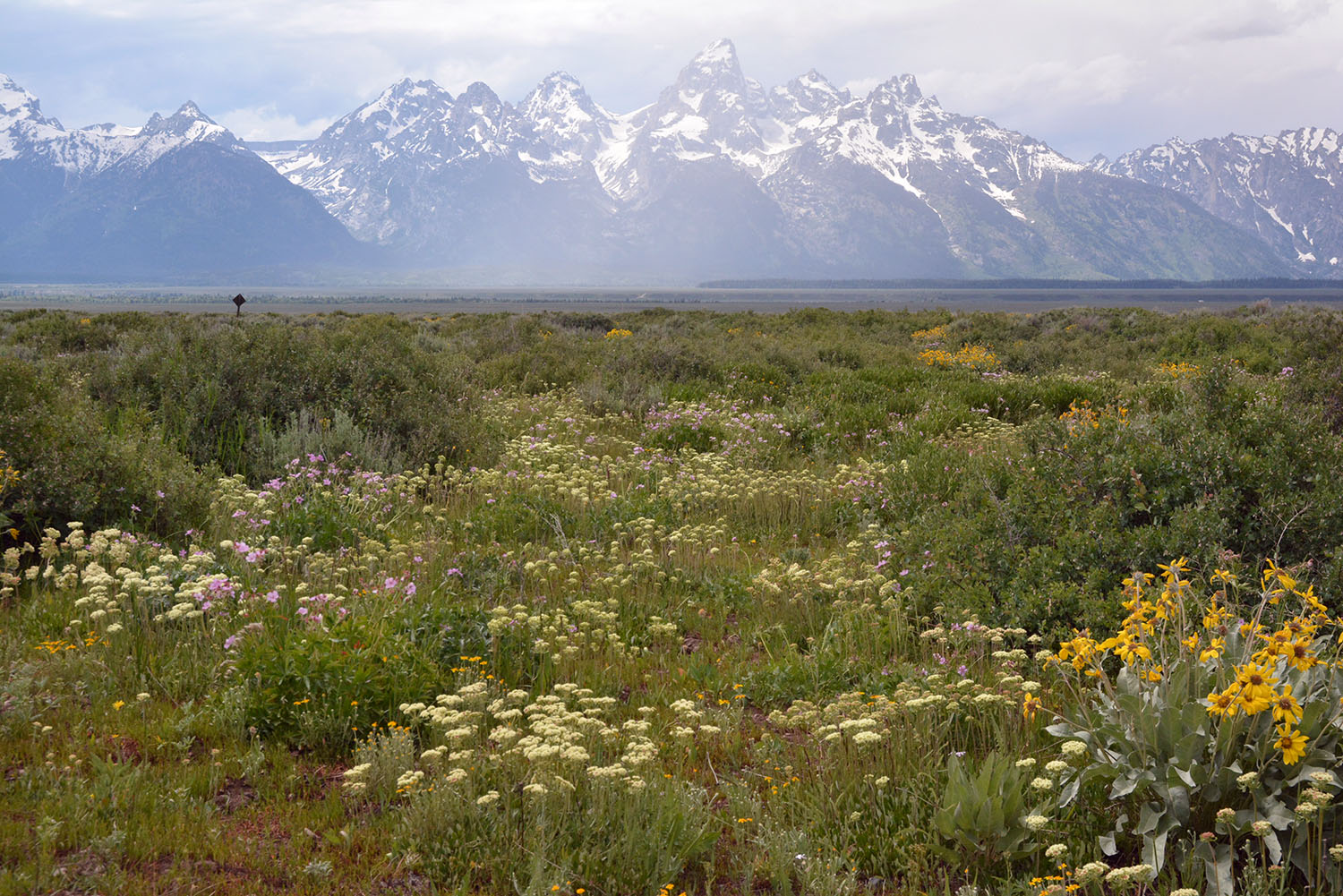
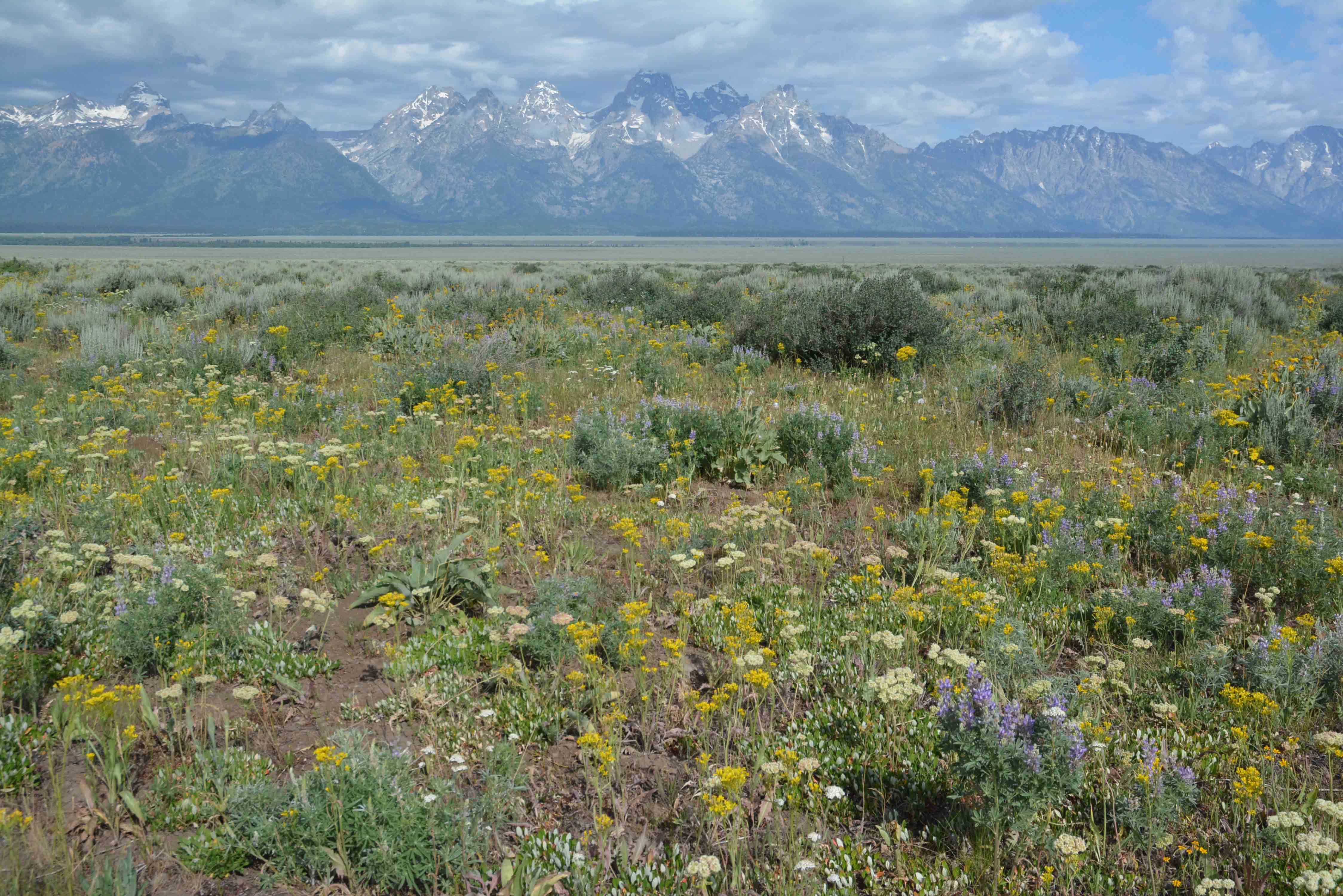
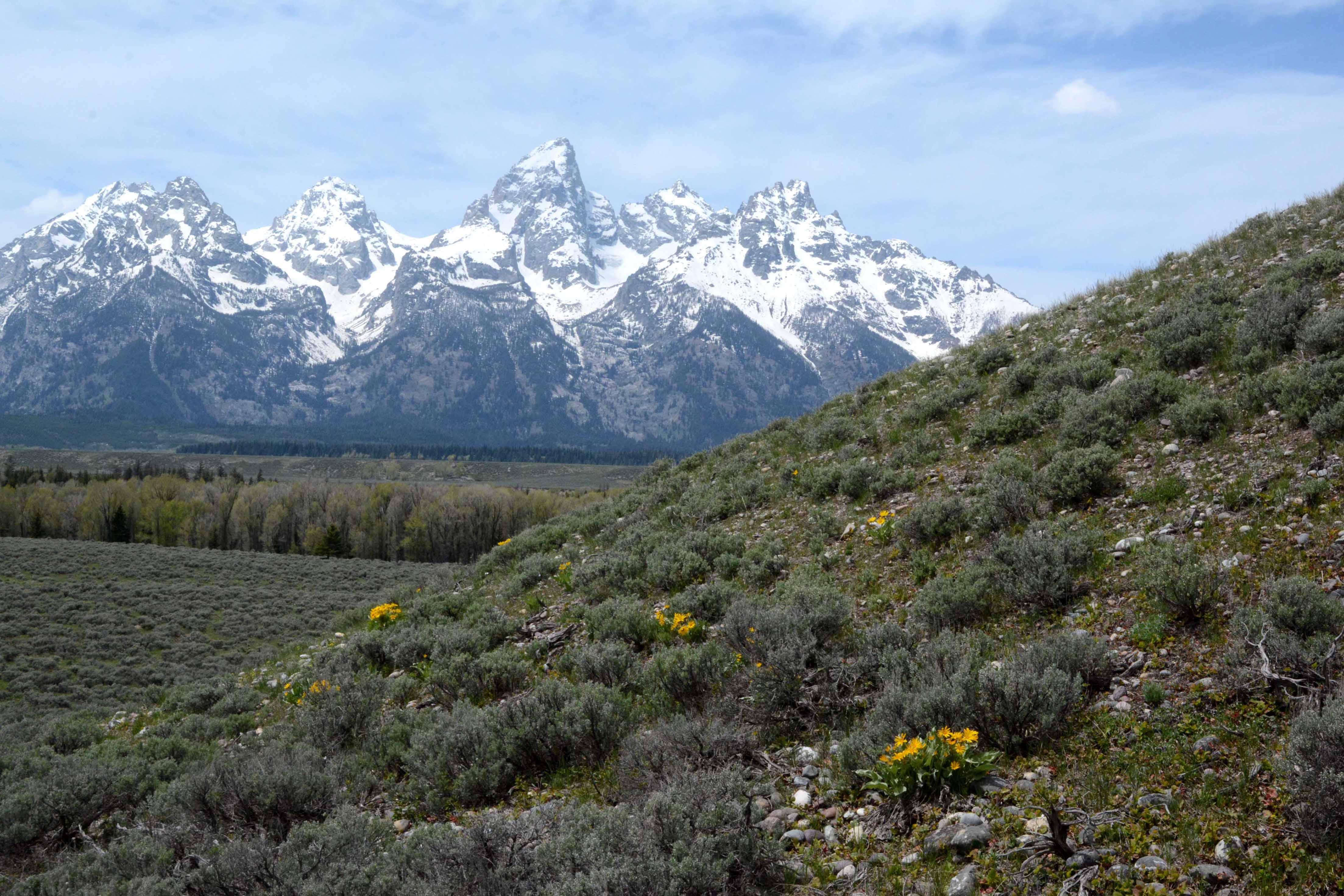
The view from Antelope Flats west to the Tetons is filled with wild flowers.
The view from Antelope Flats west to the Tetons is filled with wild flowers.
Antelope Flats: Drive the loop around the sage flats to the northeast corner and up the road to the Teton Science School to see Lupines, Hawksbeard, Sulphur flowers, One-flowered Sunflowers, and Sticky Geranium.   Prickly Pear Cactus (Opuntia fragilis) is blooming yellow on the rock outcrop by the Kelly Warm Springs pullout.

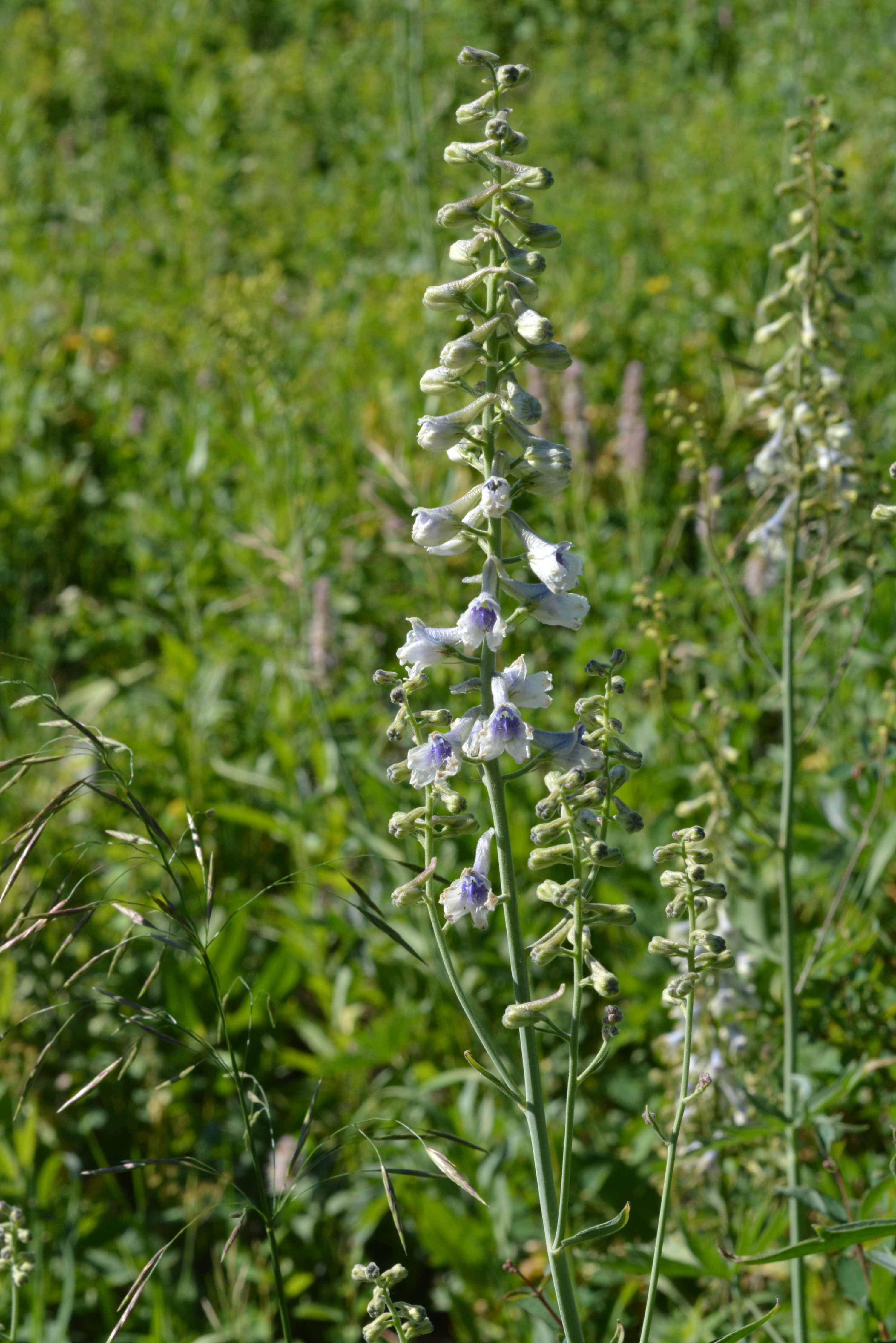
Delphinium occidentale

Tall Larkspur, also called Duncecap Larkspur, is indeed 7′ tall where it grows in moist meadows.

Moose-Wilson Road:  Marsh, moist-meadow, and roadside  habitats feature 5’-tall Duncecap Larkspur (Delphinium occidentale) and profuse pink Wood’s Rose (Rosa woodsii).  Monkshood grows to a similar height as the Larkspur but has deep blue flowers with hoods.  Cow parsnip spreads its broad plate-size clusters of flowers attracting many different of pollinators. Richardson’s Geranium has white instead of pink flowers and has rose-tipped glands.  Watch out for the nettles along the wayside.   

Curtis Canyon Road east of the National Elk Refuge:  

Goodwin Lake Trail has masses of flowers: One-flowered Sunflowers, Sticky Geraniums,  Paintbrushes and Cinquefoils.

Goodwin Lake Trail has masses of flowers: One-flowered Sunflowers, Lupines, Sticky Geraniums, Paintbrushes and Cinquefoils.

Calochortus nuttallii

Nuttall’s Mariposa Lily is occaisionally found on dry slopes overlooking the Valley.

Elegant but rare Mariposa Lilies (Calochortus nuttallii) and an unusual cream colored Wild Buckwheat (Eriogonum brevicaudata) grow on the dry knoll of the overlook.  Further up the road towards the Goodwin Lake trailhead meadows are full flowers:  wild gardens galore! Paintbrushes, Scarlet Gilia, Sticky Geranium, One-flowered Sunflower, Larkspurs….


Cascade Canyon Trail:

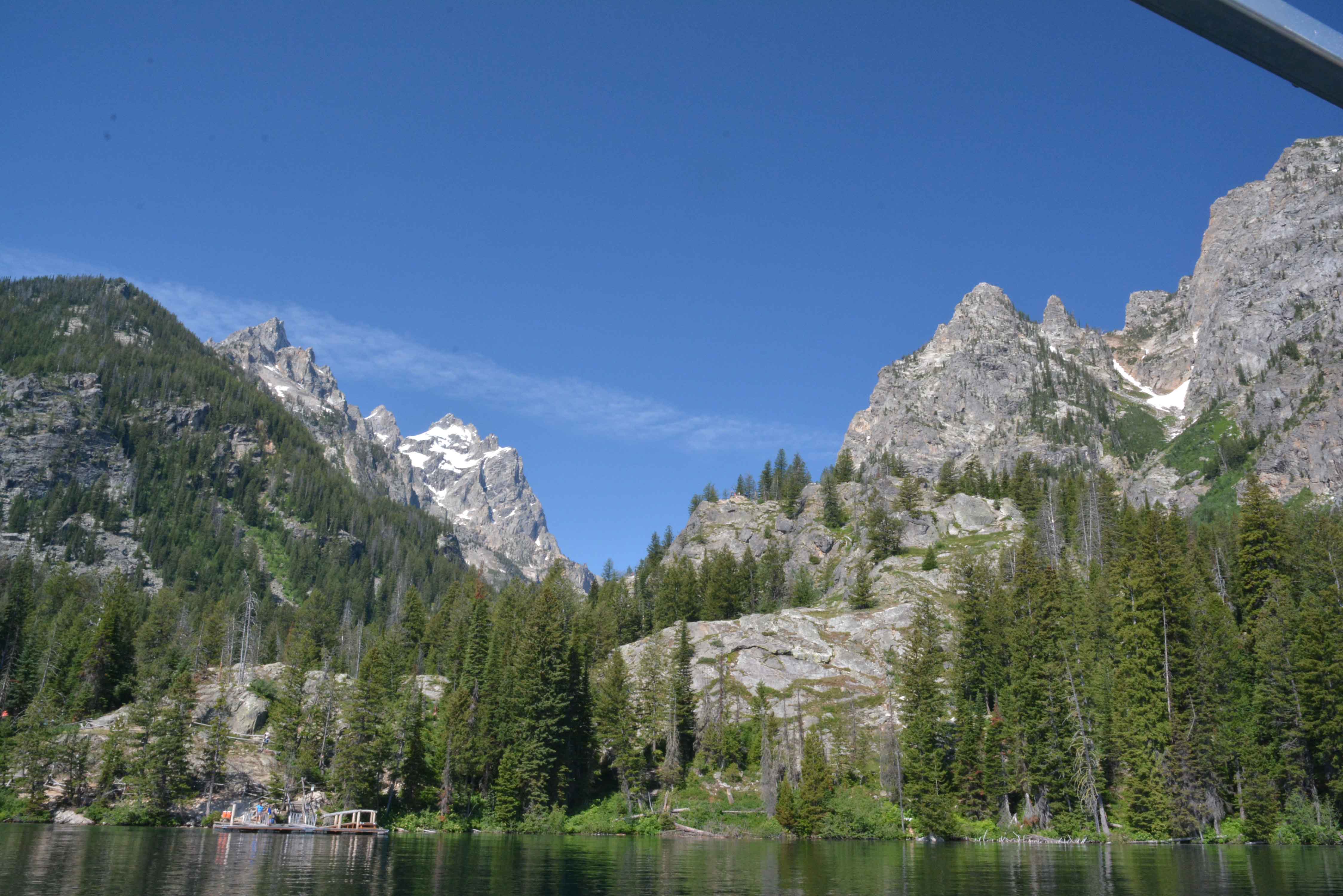
Take the boat to Cascade Canyon and expore the forest, slopes, and talus for flowers.
Take the boat to Cascade Canyon and expore the forest, slopes, and talus for flowers.
 Flowers here prefer the shade of the mixed conifer forest, as well as, open sites of talus (listen for pika) and avalanche chutes.  White Columbine (Aquilegia coerulea) is surprisingly common.  Other woodland plants include Western Thimbleberry, Meadowrue, and the talus slopes feature Red Raspberry, ferns, cinquefoils.  Willows are dispersing their seeds upon the wind, and berries of mountain ash, cherry, elderberry, and blueberry are slowly forming.  

Teton Pass and Ski Lake trails south of the park provide access to higher elevations with meadows and mixed-coniferous forest species. 

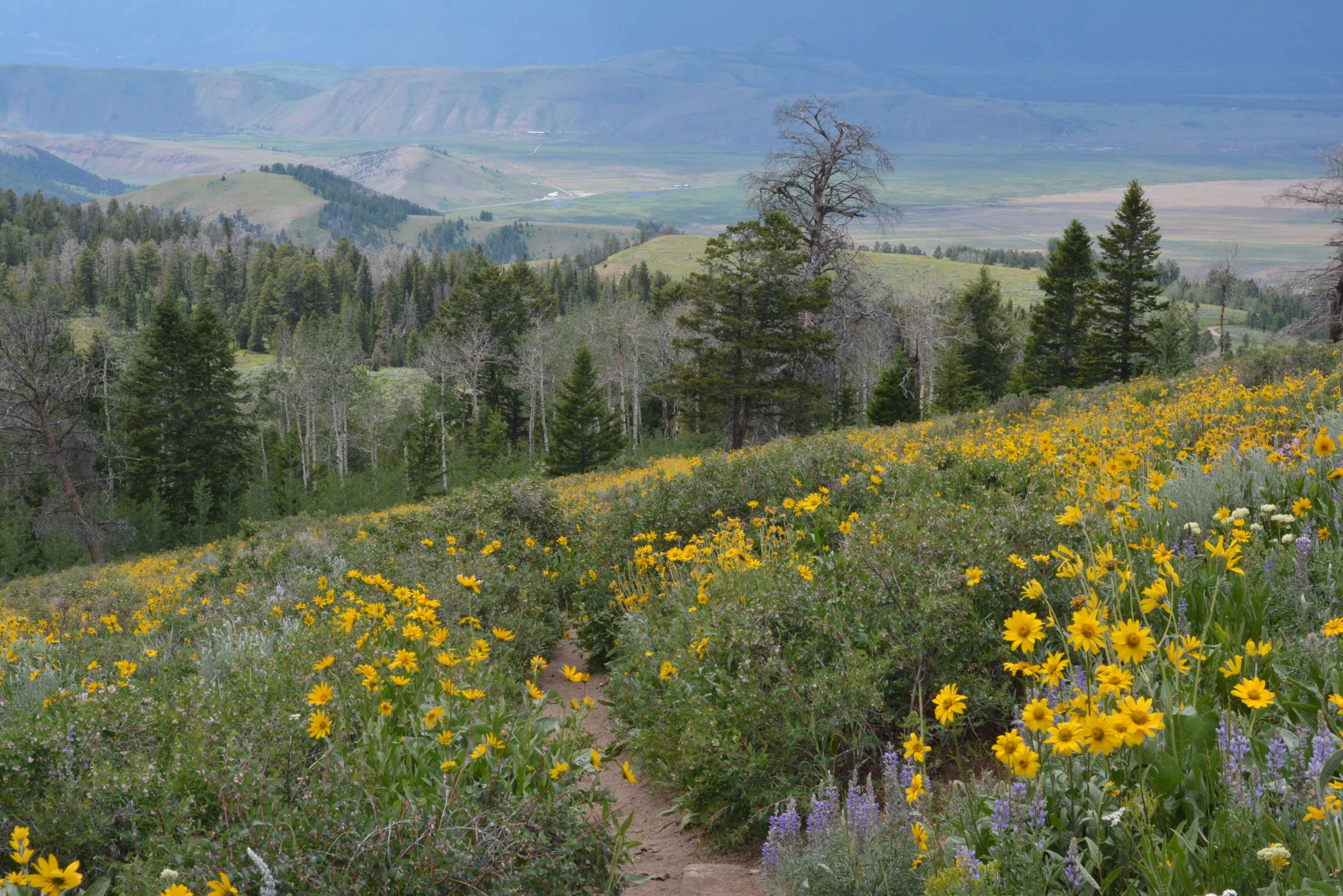
Just south of the high point of the Teton Pass Trail is a mosaic of bloom.

Just south of the high point of the Teton Pass Trail is a mosaic of bloom.

I found dozens of different flowers along the 1.5 mile trail ranging from very early blooming Nuttall’s Delphinium and Spring Beauty to sedums, groundsels, three species of paintbrushes, sandworts, cinquefoils, flax, penstemons, phacelia, fleabanes….

Rendezvous Mountain: 

Hymenoxys grandiflora.

Rydberg’s Sunflower grows to about 6″ on the harsh scree slopes atop Rendezvous mountain.

Take the tram up to 10,500 feet to access subalpine and alpine flowers, such as the ever-durable Rydberg Sunflower (Hymenoxys grandiflora) and the diminutive Beautiful Paintbrush (Castilleja pulchella), to name just two alpine specialties.  Various members of the mustard family such as Smelowskia calycina and Lesquerella paysonii sprawled on the scree.   Alpine Townsendia, Teton Anemone, and Telesonix were also in bloom.    

Catilleja pulcerima

Beautiful Paintbrush grows only a few inches high in the rugged alpine habitat.

More to come!  Let us know what your are finding and where by responding to this blog or emailing us at tetonplants@gmail.com

Frances Clark, Wilson, WY

Wild Plants of Teton Slopes – Late June


The montane slopes of the Tetons are filling with flowers of all colors, shapes and sizes. Its time to take a hike and revel in their intrique. While this post features flowers along portions of Granite Canyon and Ski Lake Trails, they are common throughout the Tetons.

Granite Canyon Trail

Granite Canyon Trail

Mixed in with aspens and sagebrush along the first stretch of Granite Canyon Trail, one can find Western Snowberry (Symphoriocarpus oreophilus) just coming into bloom as the Antelopebush and Serviceberry fade.

Symphoriocarpus oreophilus

Mountain Snowberry

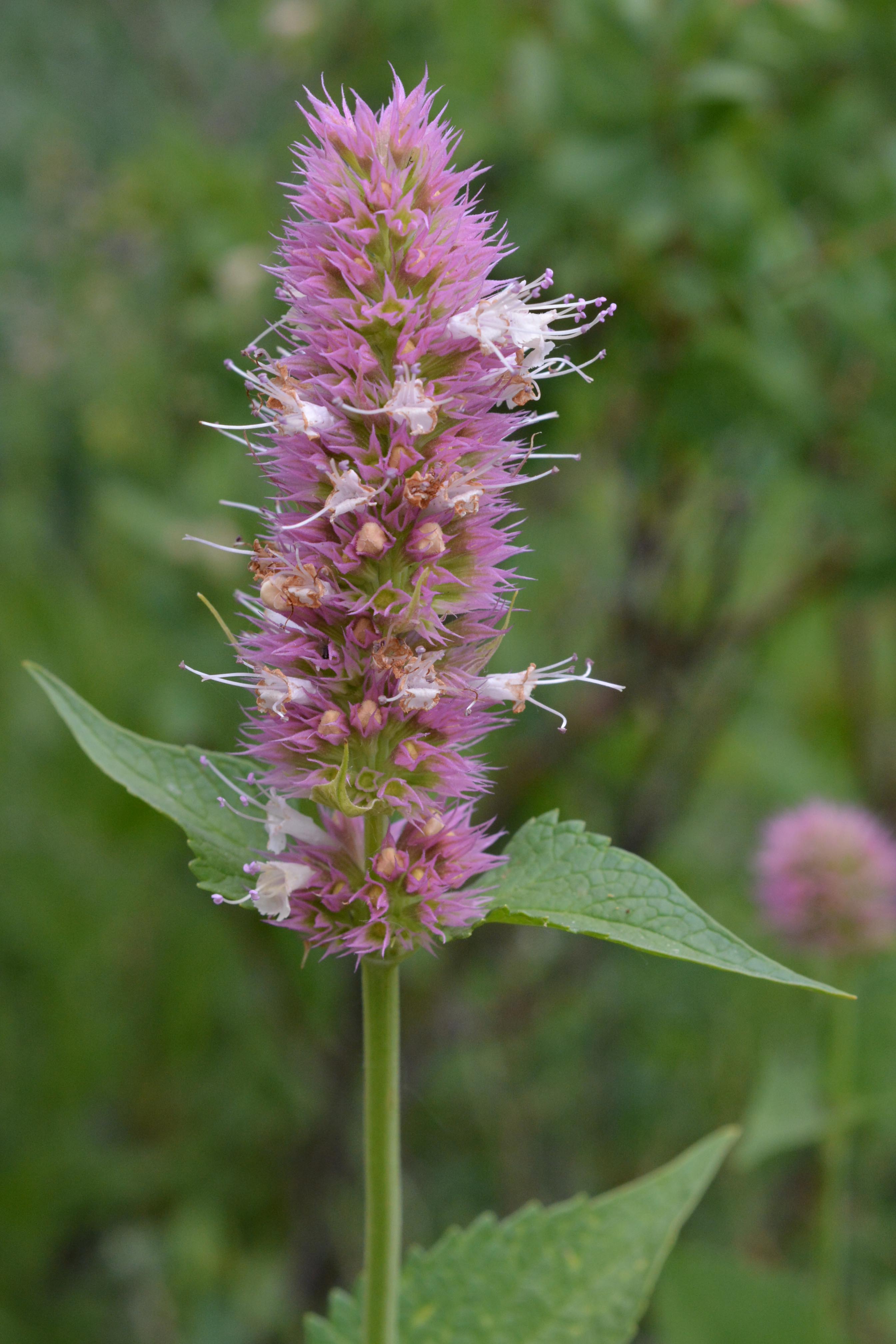
Fuzzy looking Giant Hyssop or Mountain Mint stick out their anthers beyond the gapingB_AgasUtri_Fl_GrCanTr_62513_1 flowers, easy for pollinators to brush against and glean pollen as they stick their mouth parts deep into the flower to suck nectar. As we push by, we may get a whiff of minty like aroma.

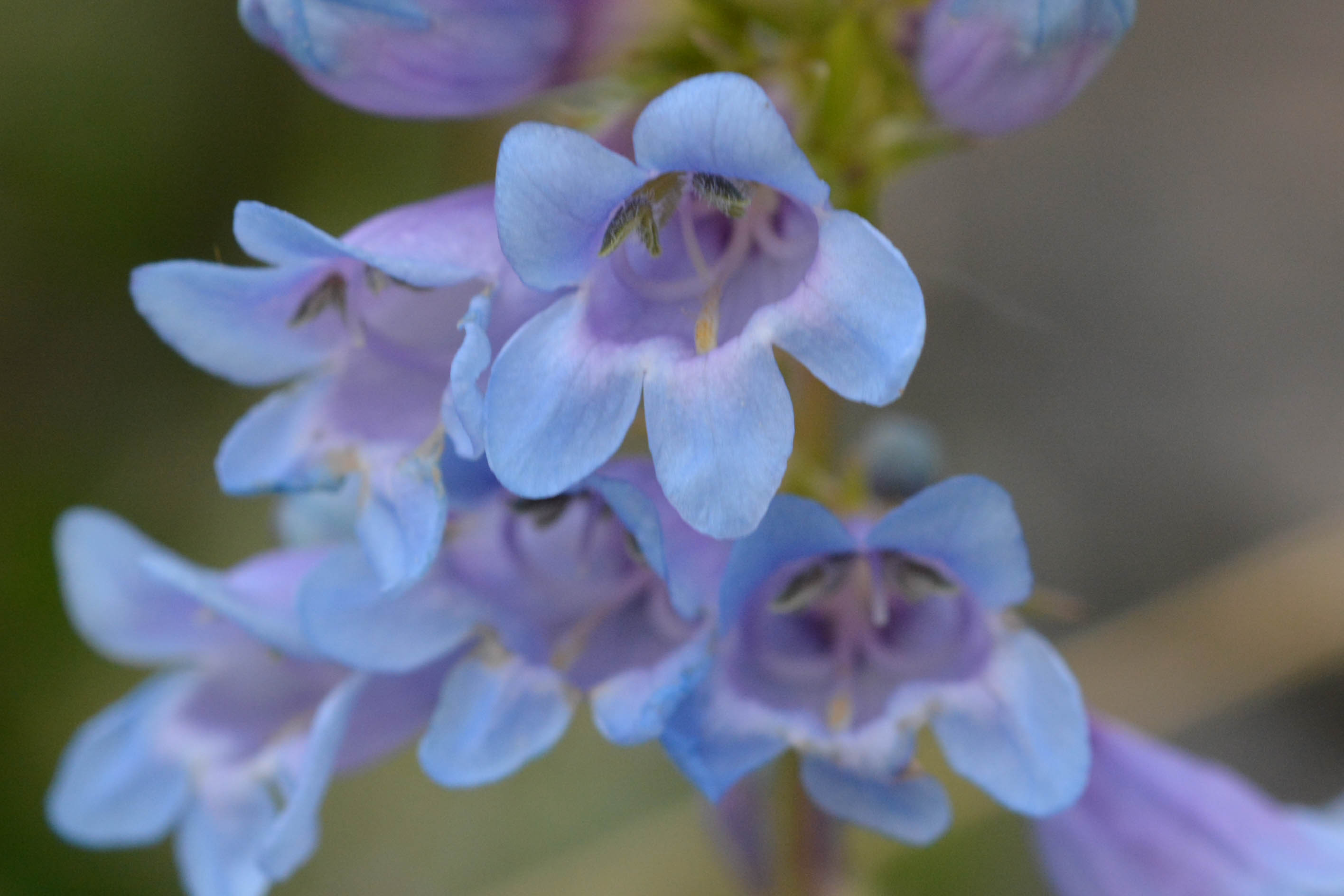
Further up the first rise of the moraine, a piece of sky has fallen by the trail:  a sky-blue beards-tongue or Penstemon stands straight and tall.  Look inside the flowers to find that the anthers are hairy on the back, one of the key identification features.

Pensstemon cyanus

A sky blue Penstemon – Penstemon cyanthus – has smooth leaves, petals, and ovary (!) as well as anthers with hairs on their back side. Look closely!

Other suprises include an occasional wild hyacinth (Tritelia grandiflora), and early One-flowered Sunflower (Helianthella uniflora), and a few remaining long-leaved phlox (Phlox longifolia).  One variety of Silver Lupine (Lupinus argenteus ssp,) is also coming into bloom.  Listen for the House Wren that nests in an aspen trunk and the Green-tailed Towhee singing on top of Big Sage.  You don’t have to travel far to see much.

Ski Lake Trail with Balsam Root

Ski Lake Trail with Balsamroot, Sticky Geranium, Lupine, and Wood Betony.

A more energetic but perhaps more rewarding foray is up the first half of the Ski Lake Trail.

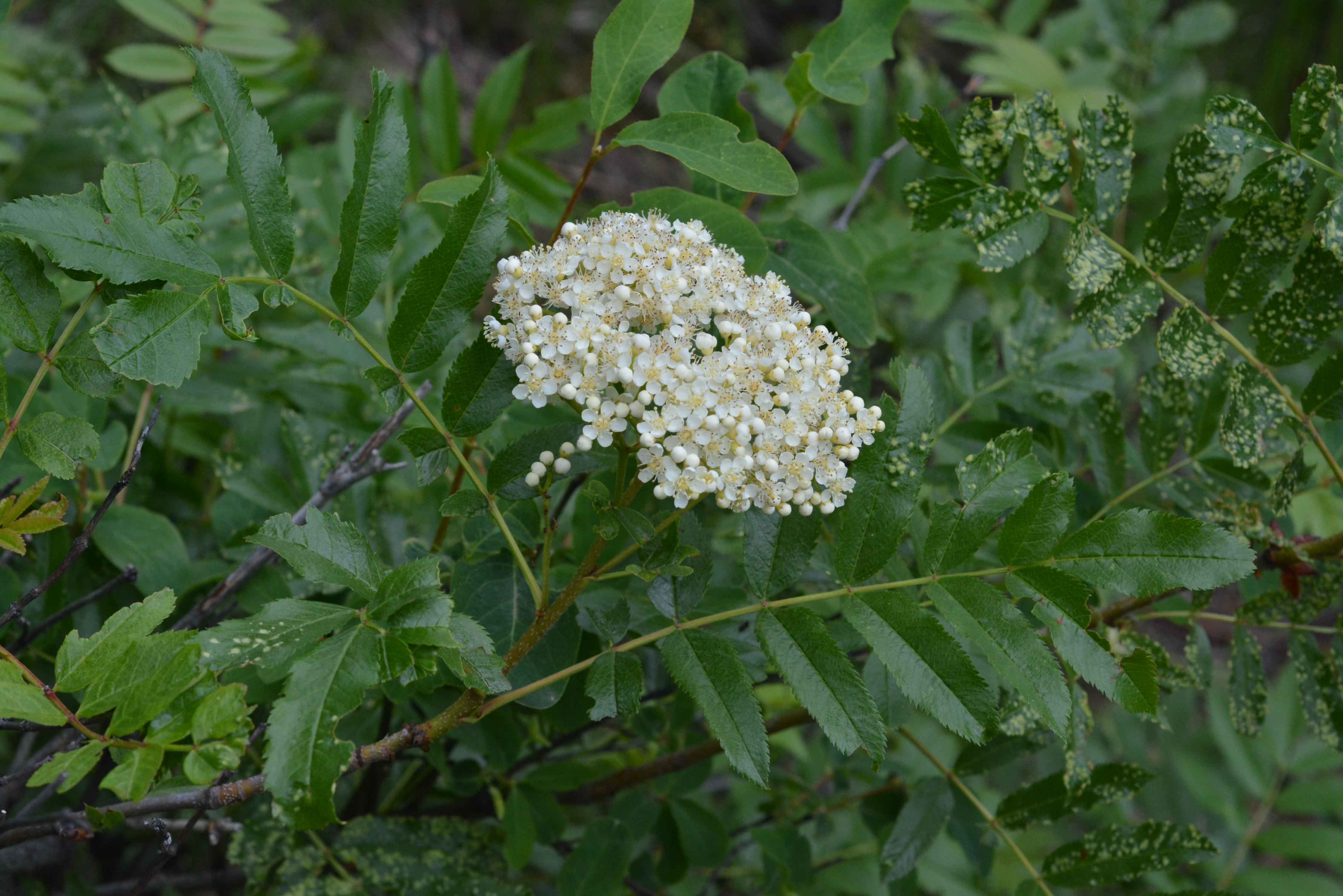
Sorbus scoparia flowers

Mountain Ash with alternate, compound leaves.

As one first starts up the trail, a substantial shrub attracts attention with its large flat clusters of small white flowers.  Western Mountain Ash (Sorbus scoparia) has pinnately compound, sharply toothed leaves arranged alternately up the stems.  The look-alike Black Elderberry (Sambucus racemosa) holds its leaves opposite each other.  The fruits will benefit wildlife in the fall.
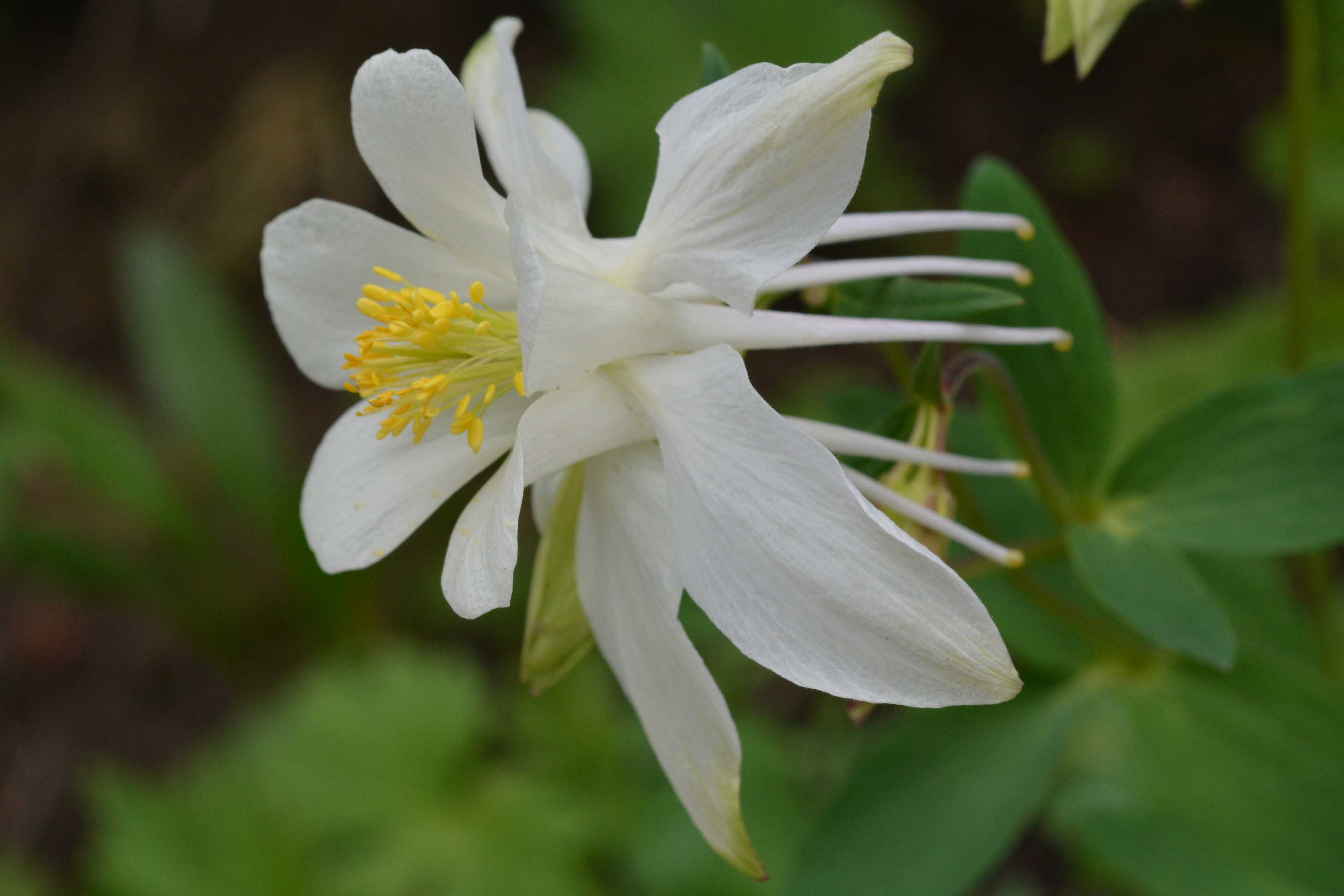
Aquilegia flavescens

Yellow columbine ranges in color from white to yellow.  Note the long spurs harboring nectar.

Yellow Columbine (Aquilegia flavescens), often white in color, seems to fly through the shade. The botanical name means eagle talons.  The long spurs hold nectar for those pollinators which have a long enough tongue or beak to reach to the end.  While the visitors are seeking the sweet nectar, their bodies are showered in pollen  from the protruding anthers.

Pedulcaris bracteosa

Fernleaf Lousewort, Wood Betony

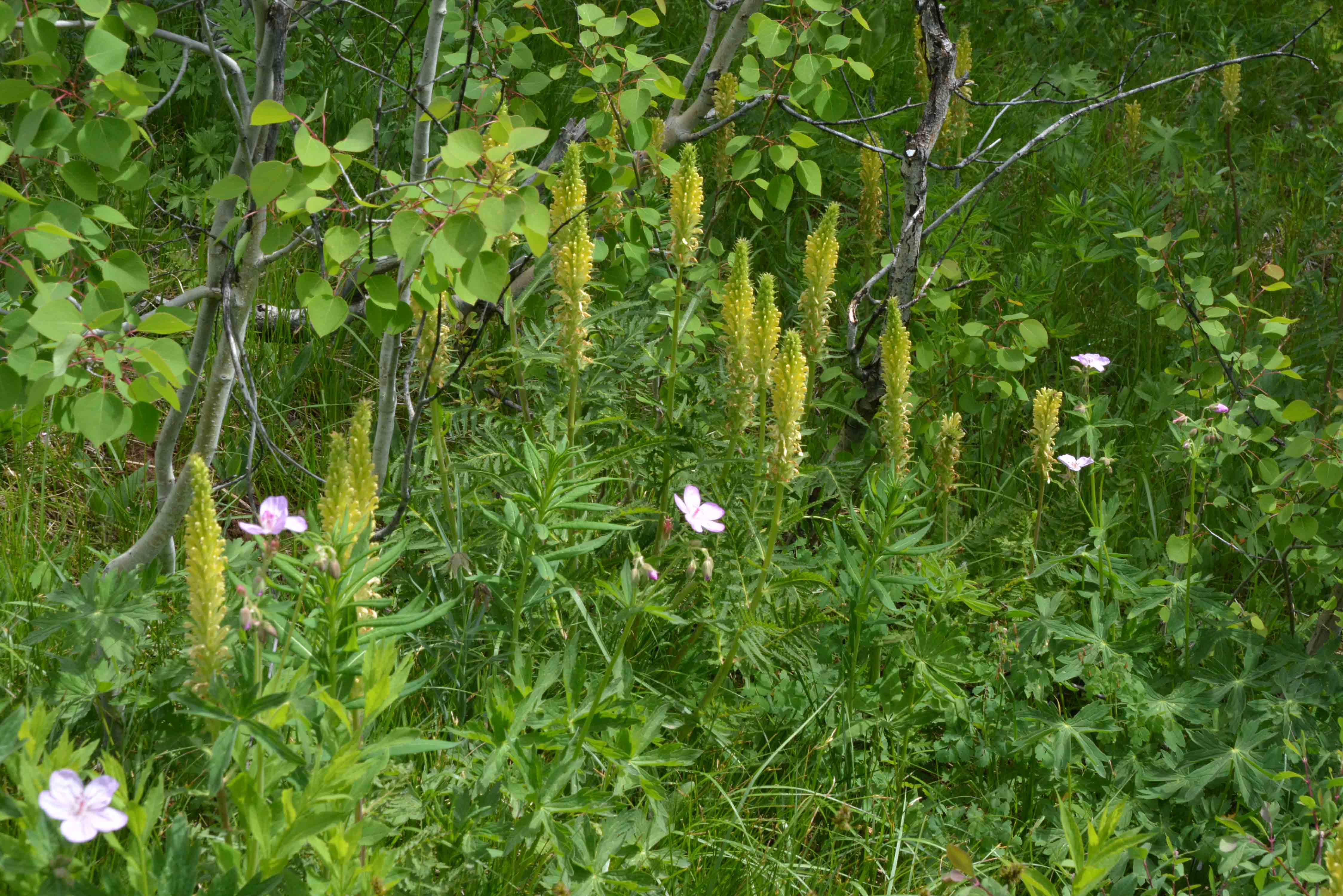
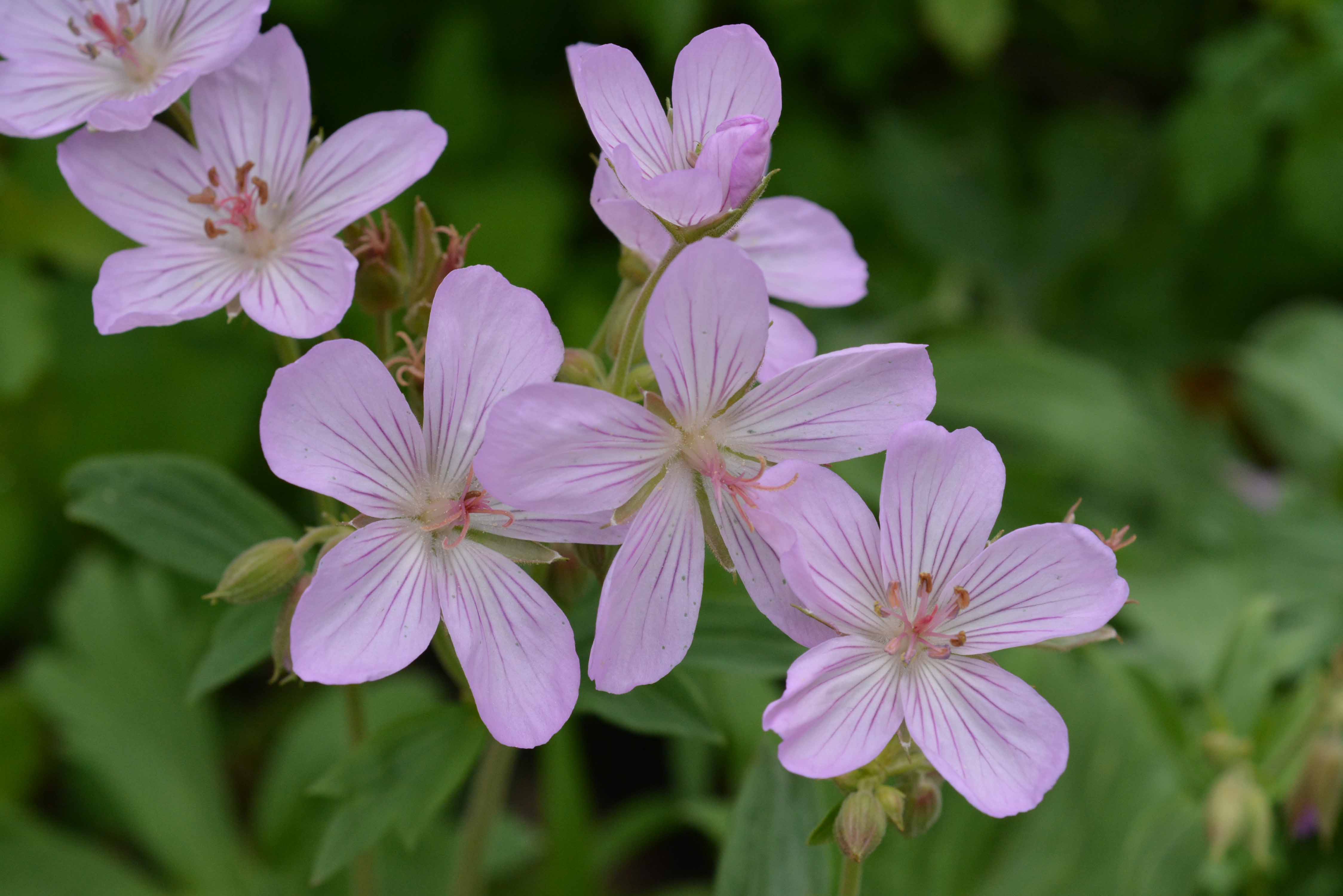
Along the first moist slopes, Western Valerain (Valeriana occidentalis) holds out bunches of tiny white flowers on opposite pedicels. The leaves are also opposite along the stem.  I confess I am constantly confounded by the two large (2-4′) members of the Parsley Family:  Fern-leaved Desert Parsely (Lomatium dissectum) and Fern-leaved Lovage (Lomatium filicinum).  One is growing in abundance, but is not quite in bloom. Anyone know which it is?  What are easy to identify are the Silver Lupines (Lupinus argenteus var. argenteus) with their blue pea-like flowers and palmately dissected leaves, yellow spires of Fern-leaf Lousewort, also called Wood Betony (Pedicularis bracteosa), and pink Sticky Geranium (Geranium viscossissimum)

Geranium viscossimum

Sticky Geranium

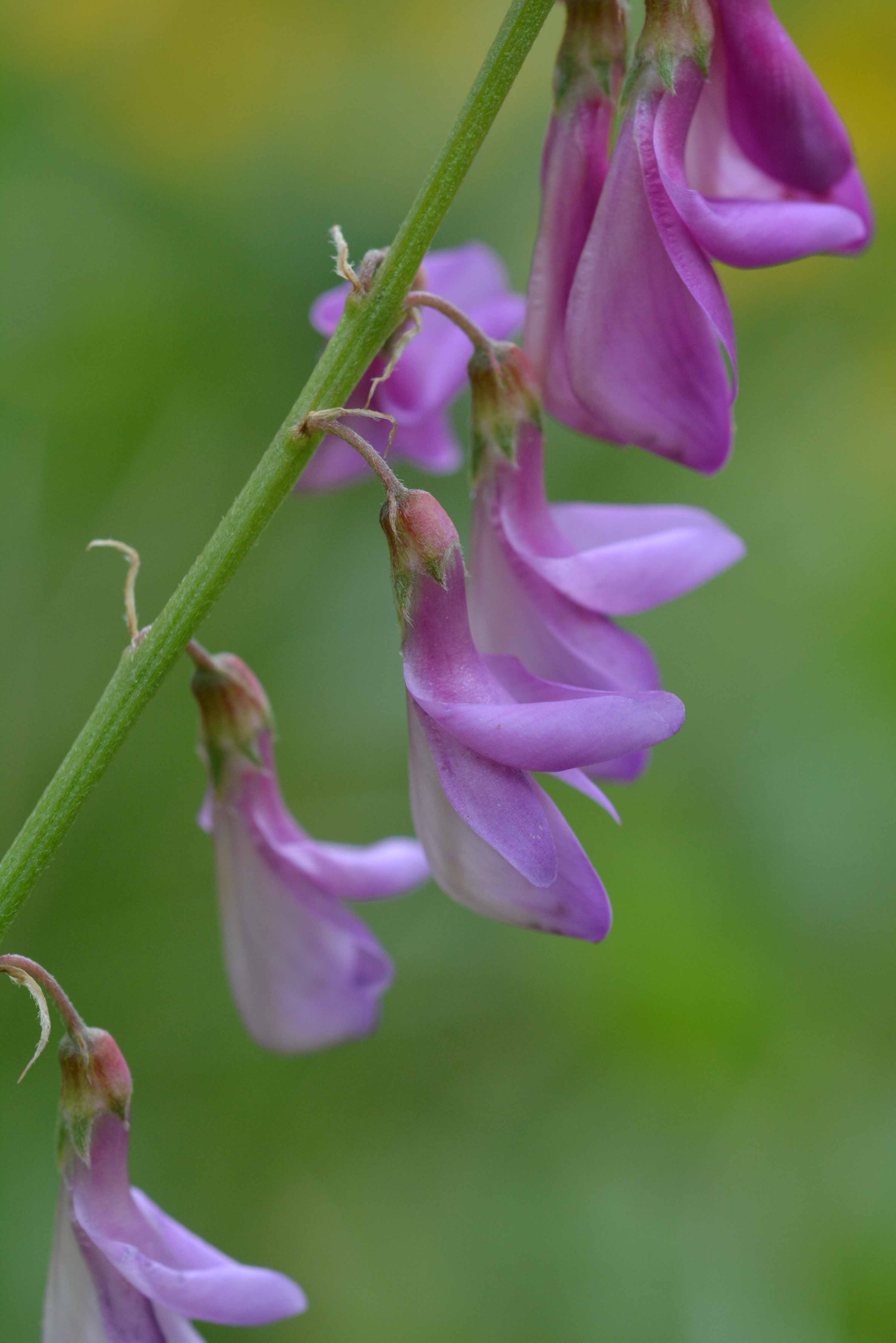
which mix together at random, creating quite a show.   These show-offs are interspersed with the dandelion-look-alike: Nodding Mircroseris (Microseris nutans), various sedges and grasses.  The Western Sweet-vetch (Hedysarum occidentale) with its dangling violet-pink pea flowers and compound leaves attracts particular attention.

Hedysarum occidentale

Western Sweet-vetch

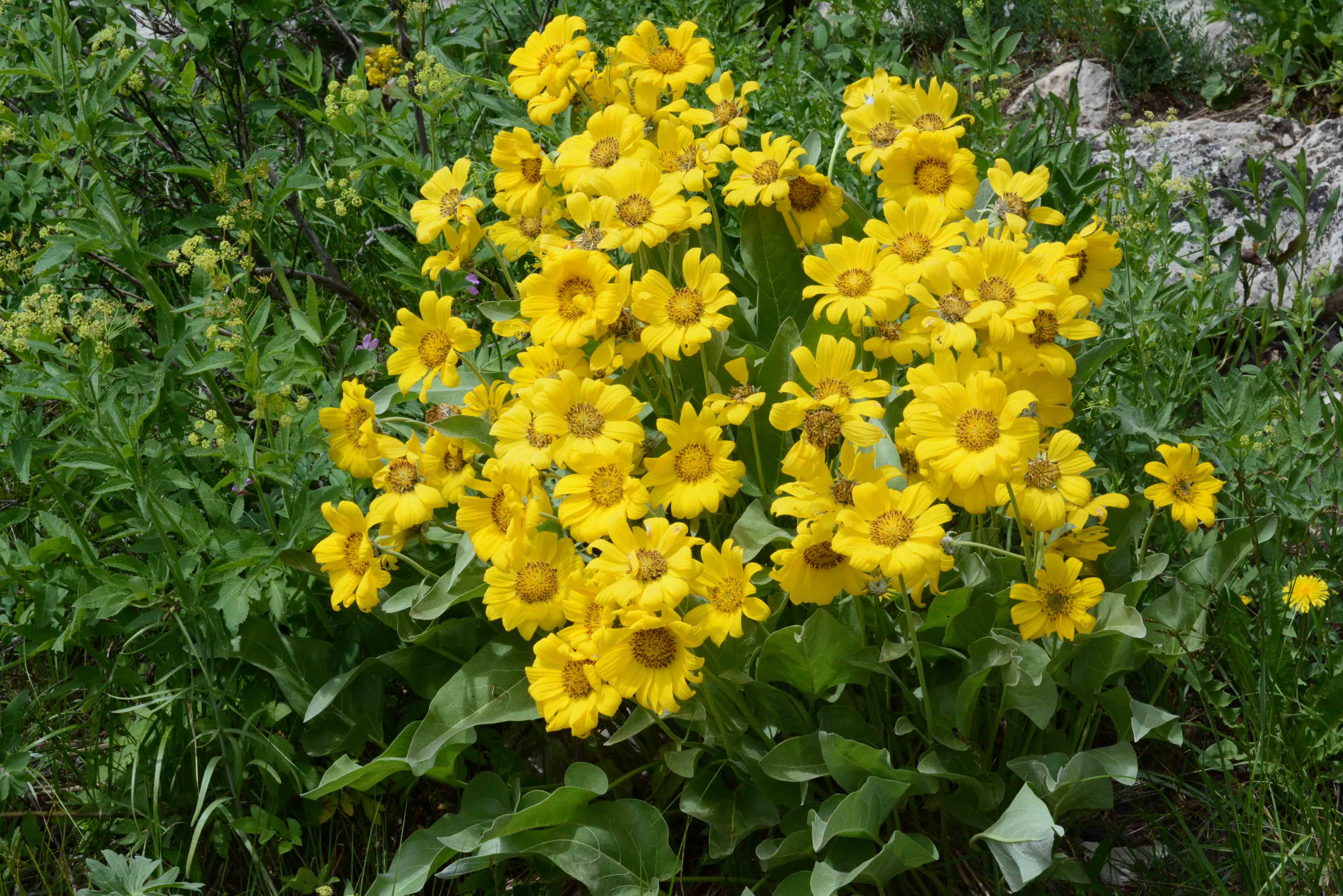
Balsamorhiza sagittata

Balsamroot is still blooming at elevation high above the valley floor.

Balsamroot covers slopes here, as it does throughout the valley this year.   You can’t miss it!  But elsewhere you can confuse it with similar Mules Ears (Wyethia amplexicaulis).  Balsamroot (Balsamorhiza saggitata) has true- yellow flowers and large, greyish-green leaves that are shaped like an arrowhead.  It is usually found on relatively dry slopes or sage flats.  Mules Ears has dark green, 18″ oval leaves and its flowers are a more orange-yellow.  It is found in moist pockets such as off Cattleman’s Road near Oxbow Bend. The big wow is when the bright yellow balsamroot grows alongside patches of deep blue Nuttall’s Larkspur (Delphinium nuttuallianum)

Frasera speciosa

Green Gentian, Monument Plant

A monumental plant which only blooms in abundance every few years is the Green Gentian (Frasera speciosa).  Formerly thought to be a biennial, researchers have discovered an individual plant must live 30-40 years as a rossette of leaves before it has stored up enough energy to finally shoot up its expansive flowering stalk.  After it blooms, the whole plant dies, but only after shedding thousands of seeds. For more of the story go to   http://www.mtnativeplants.org/filelib/72.pdf.  Once every 2-4 years we have an abundance of these plants blooming. And this is such an extraordinary year.

Many more colorful plants are found along this trail and elsewhere in Jackson Hole.  Indeed this trail which rises over 900 feet in elevation covers a two-month span of bloom from start to end.  As you approach Ski Lake there is still the very early Spring Beauty (Claytonia lanceolata) flowering where the snow has just melted off, as well as the large blue bell-shaped flowers of Sugarbowls (Clematis hirsutissima).

Below are some additional plants to look for.Erysimum asperum

Western Wall Flower (Erysimum asperum) – This is one of the more attractive members of the Mustard Family. Note 4 petals, 6 stamens, and one pistil are typical features of this large family.

Osmorhiza occidentalis

Western Sweet-cicely (Osmorhiza occidentalis) – Yellow sprays of tiny flowers will develop licorice tasting fruit.

Thalictrum occidentale - male flowers

Ribes montigenum

Mountain Gooseberry (Ribes montigenum) – Red saucer-shaped flowers and glandular leaves. The sticky hairs trap pine pollen.

Maianthemum racemosum

False Solomon’s-seal (Maianthemum racemosum) -Note broad lily-like leaves with wavy edges and flowers held in racemes. The plant grows upright in sun but arches in shade.


Castilleja miniata

Scartle Paintbrush or Common Red Paintbrush (Castilleja miniata) – Paintbrushes can vary widely in their color even within the same species.   The color is provided mostly by the bracts that are held below the individual flowers.  Here the bracts are broad and toothed.  In this species the leaves are entire, not toothed or divided.

Scarlet Gilia (Ipomoxis aggregata) - Tubular red flowers attract hummingbirds, but also other long-tongued insects.
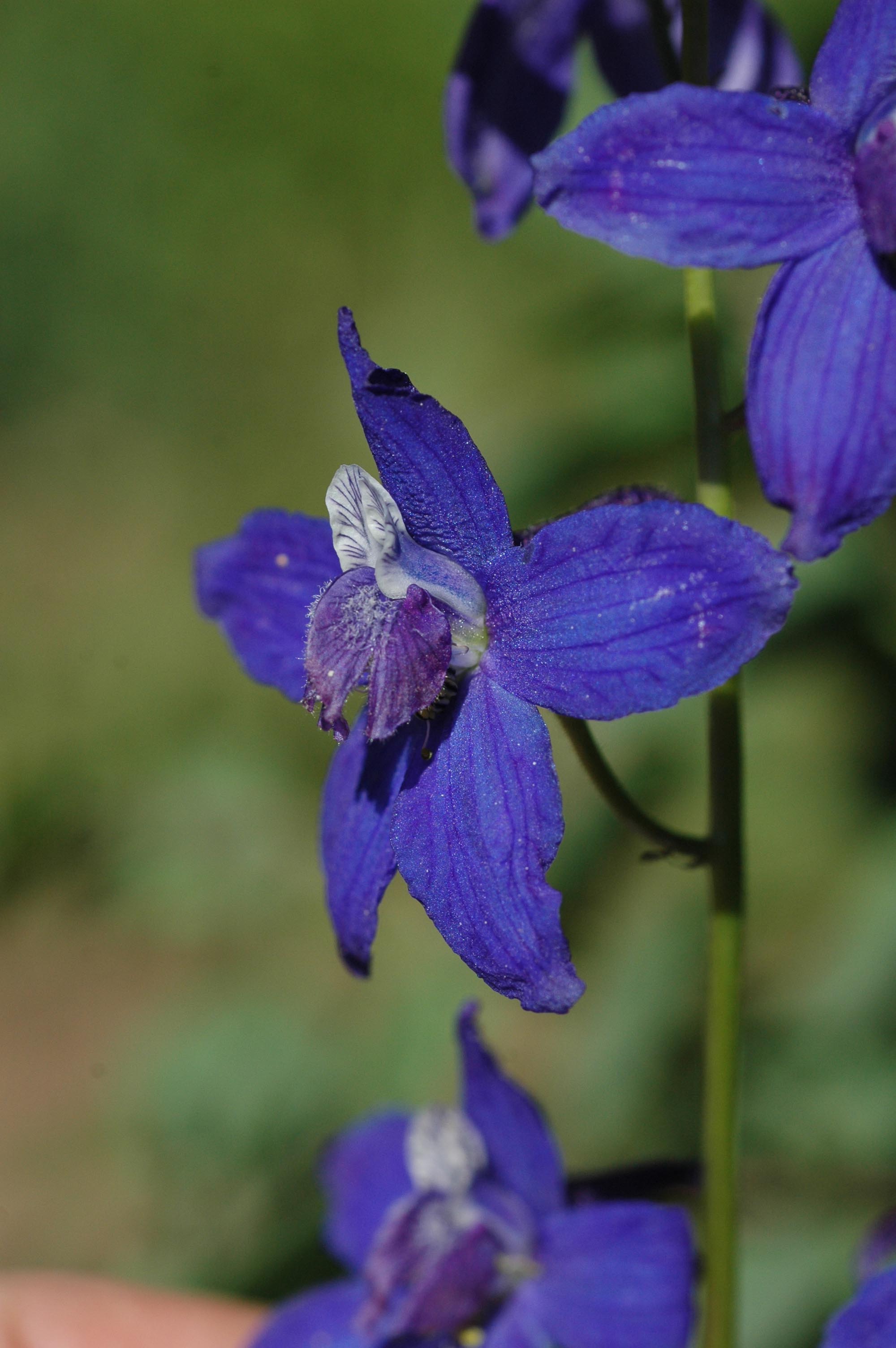
Scarlet Gilia (Ipomopsis aggregata) – Tubular red flowers attract hummingbirds, but also other long-tongued insects. These are also in blooom along the inner park road amidst the sage brush.
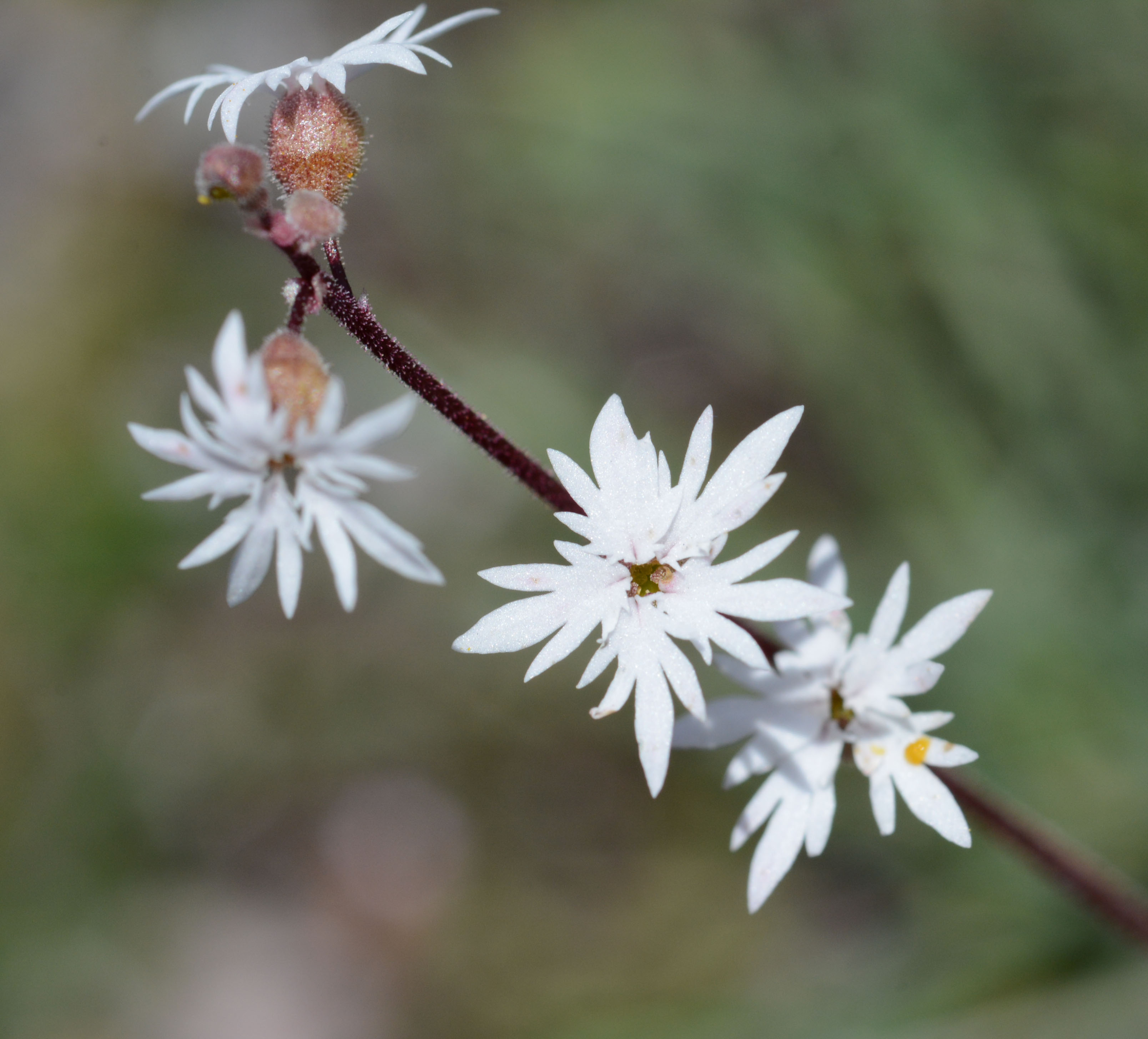
I hope you get out and enjoy this wonderful time of year.  Let me know of any questions, and send in your comments or plant id questions to this site or to our email tetonplants@gmail.com

Frances Clark, Wilson, WY