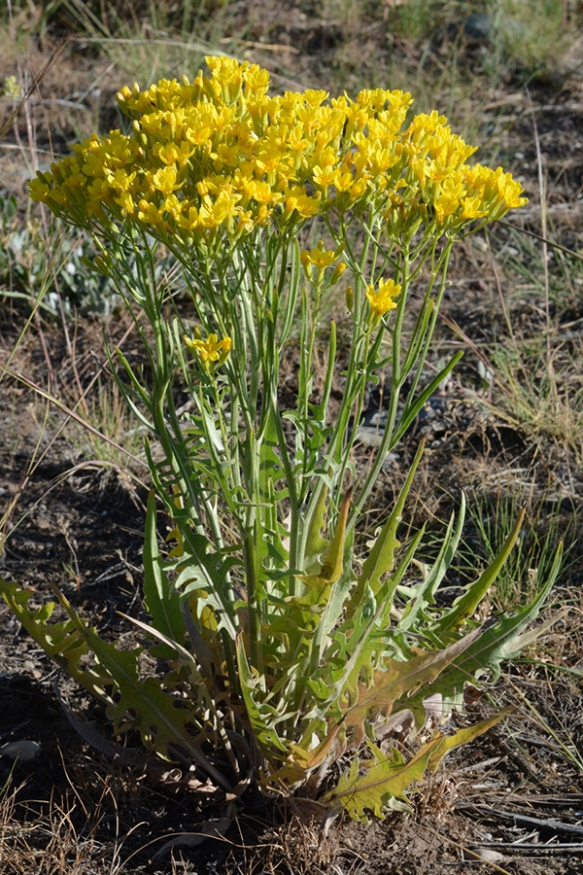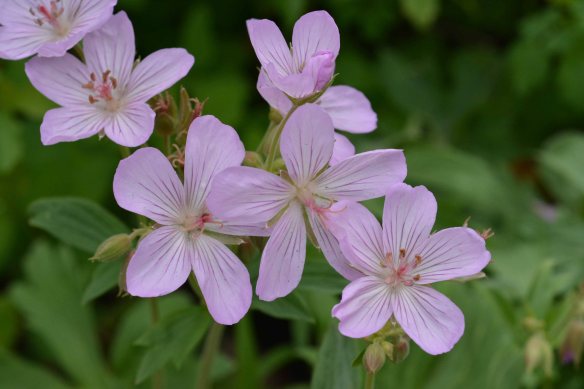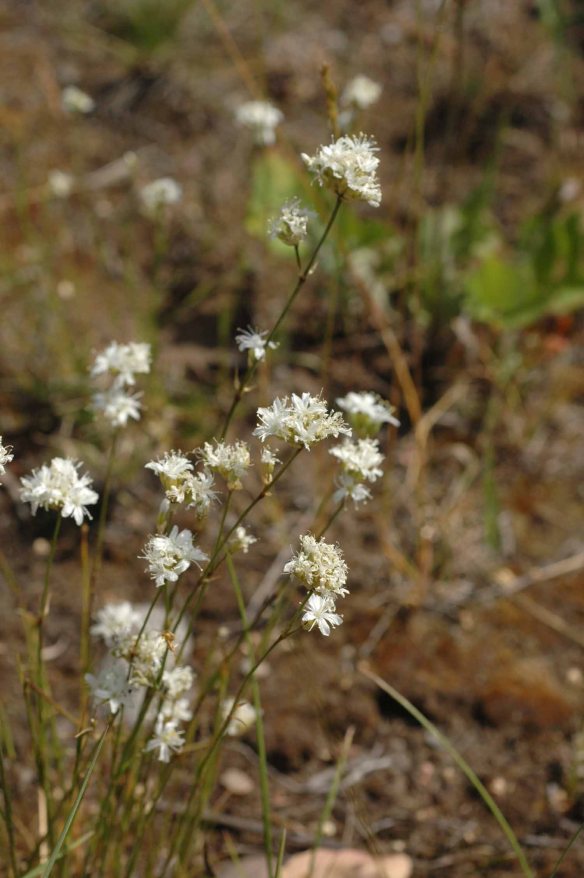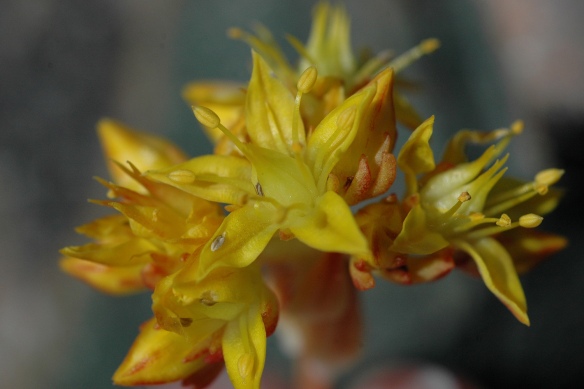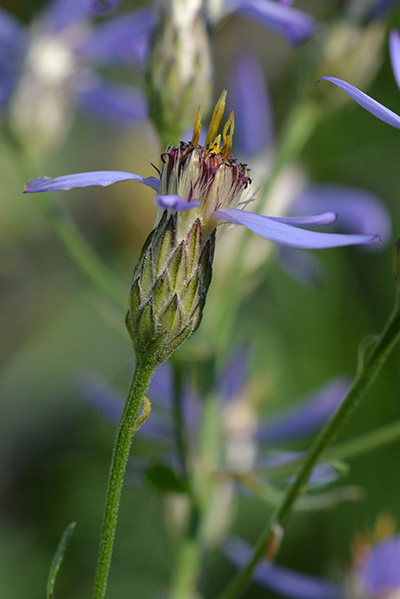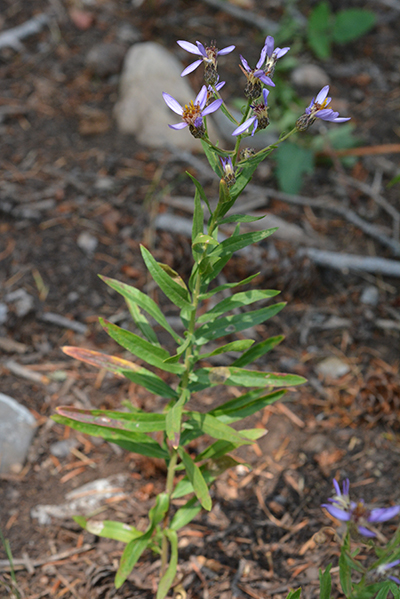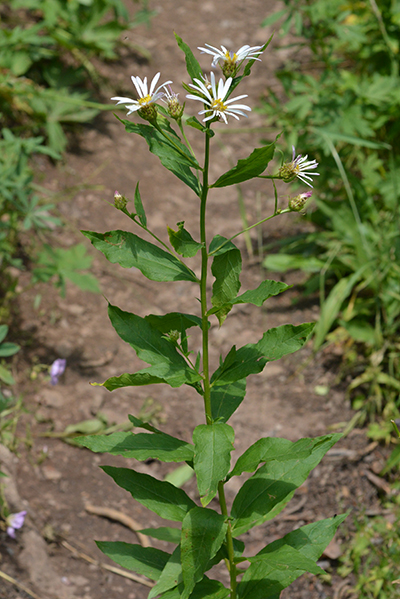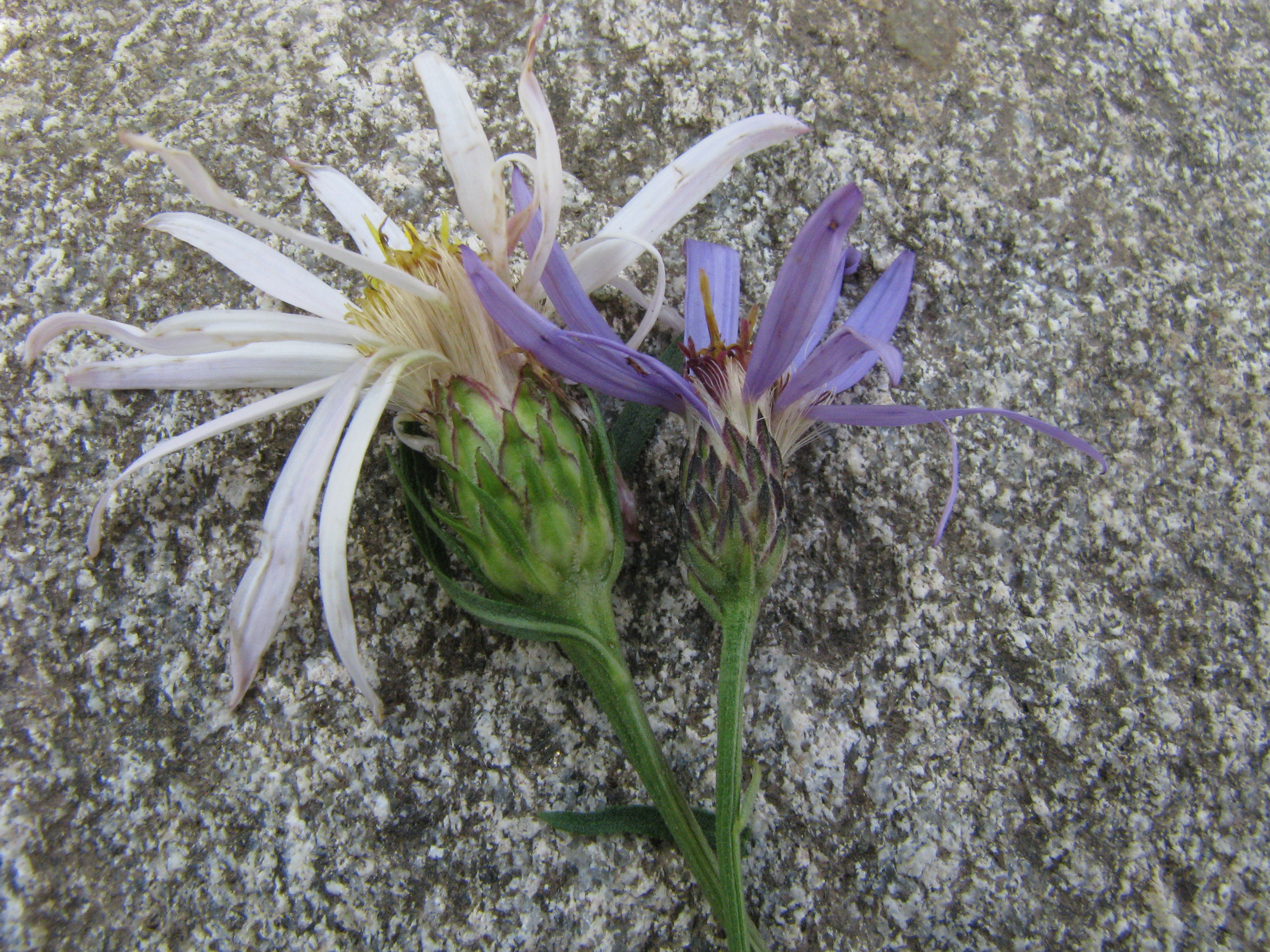
Wally’s World and Aspen Groves – late June 2017

BTNF_Mung_WalWld_VwS__WyetAmpl_fl_6.18.17_1_Q2_5x3_200

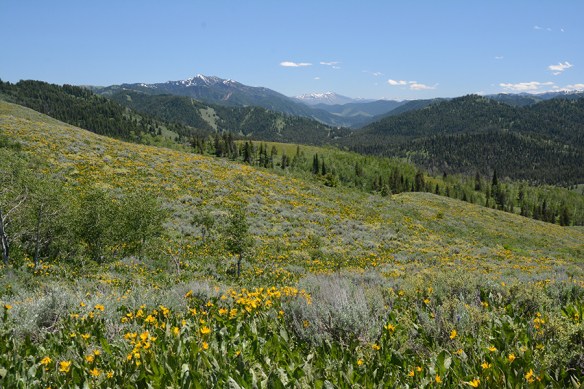
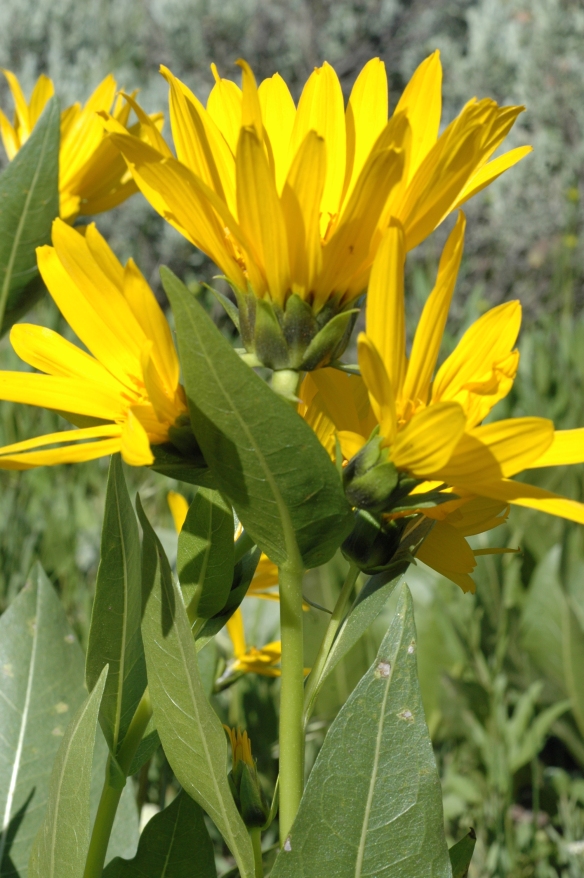
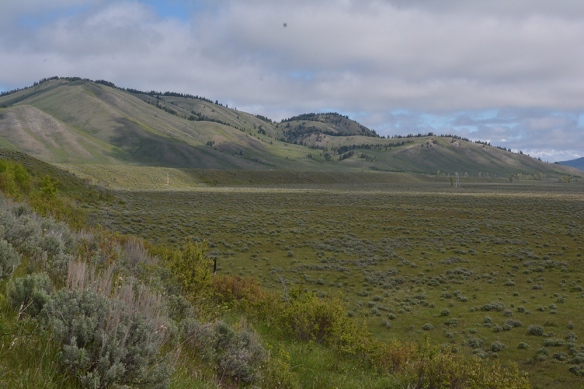
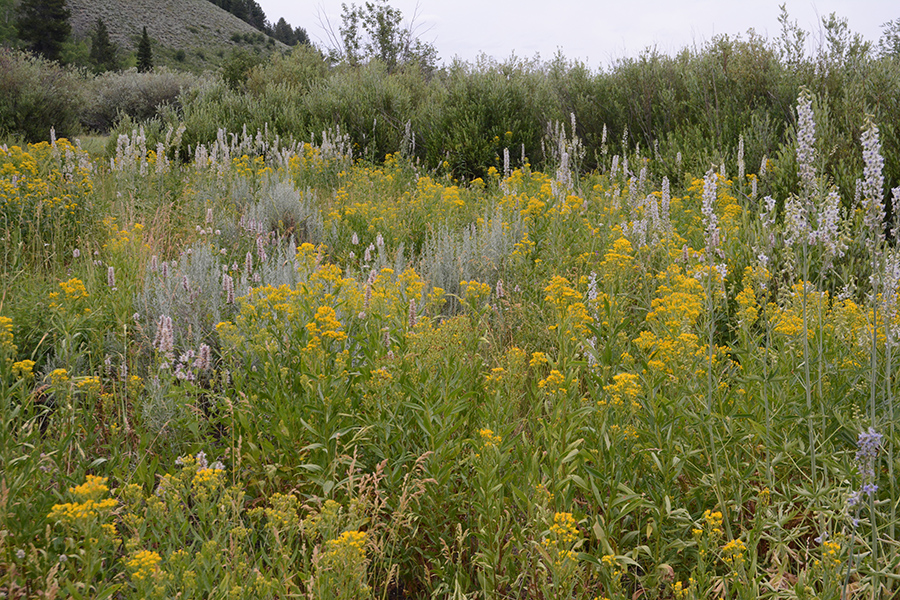
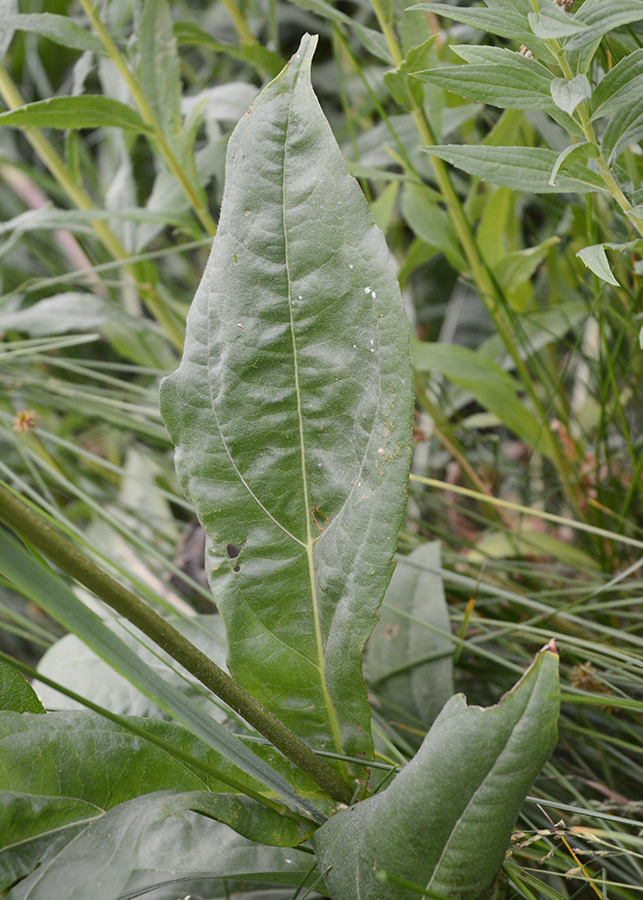
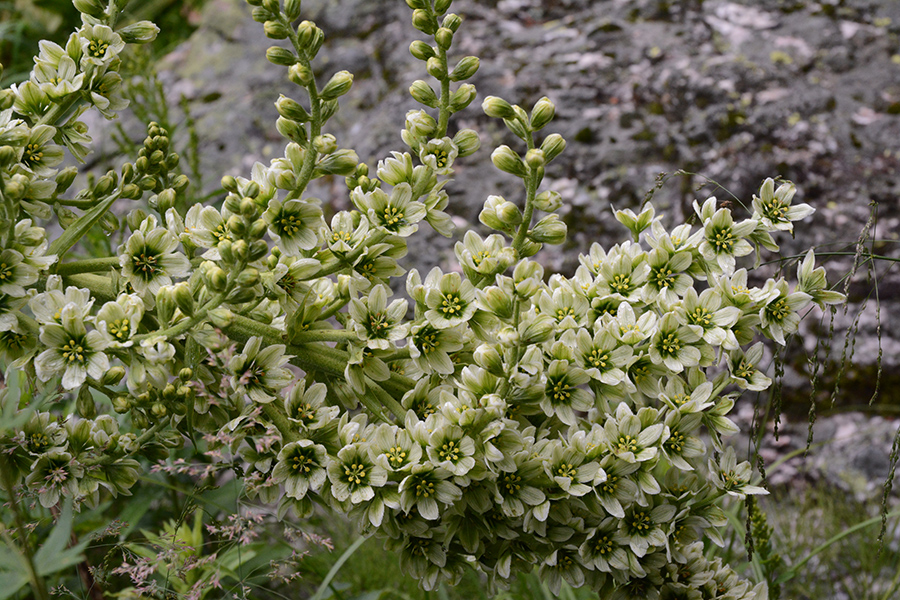
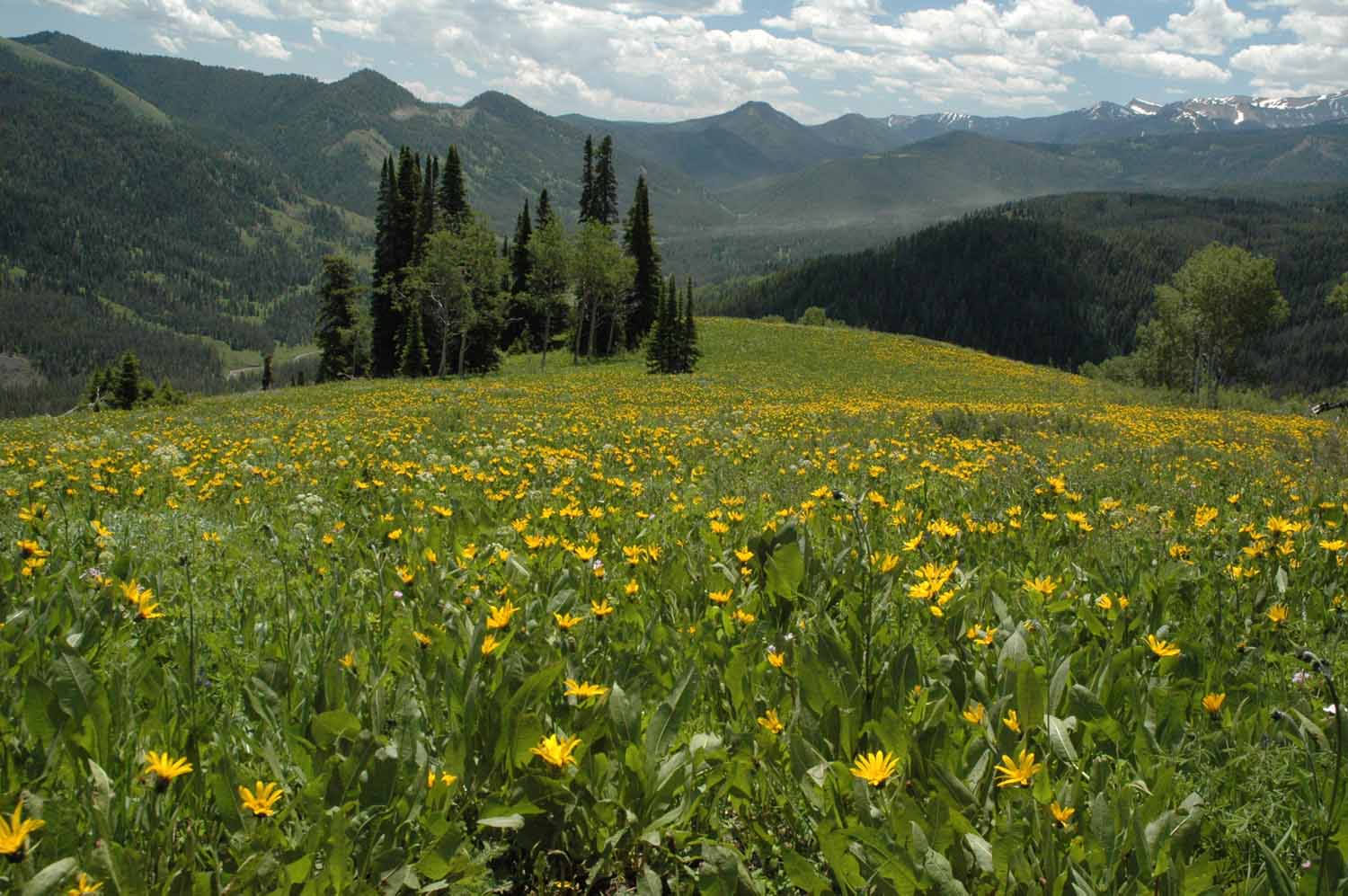
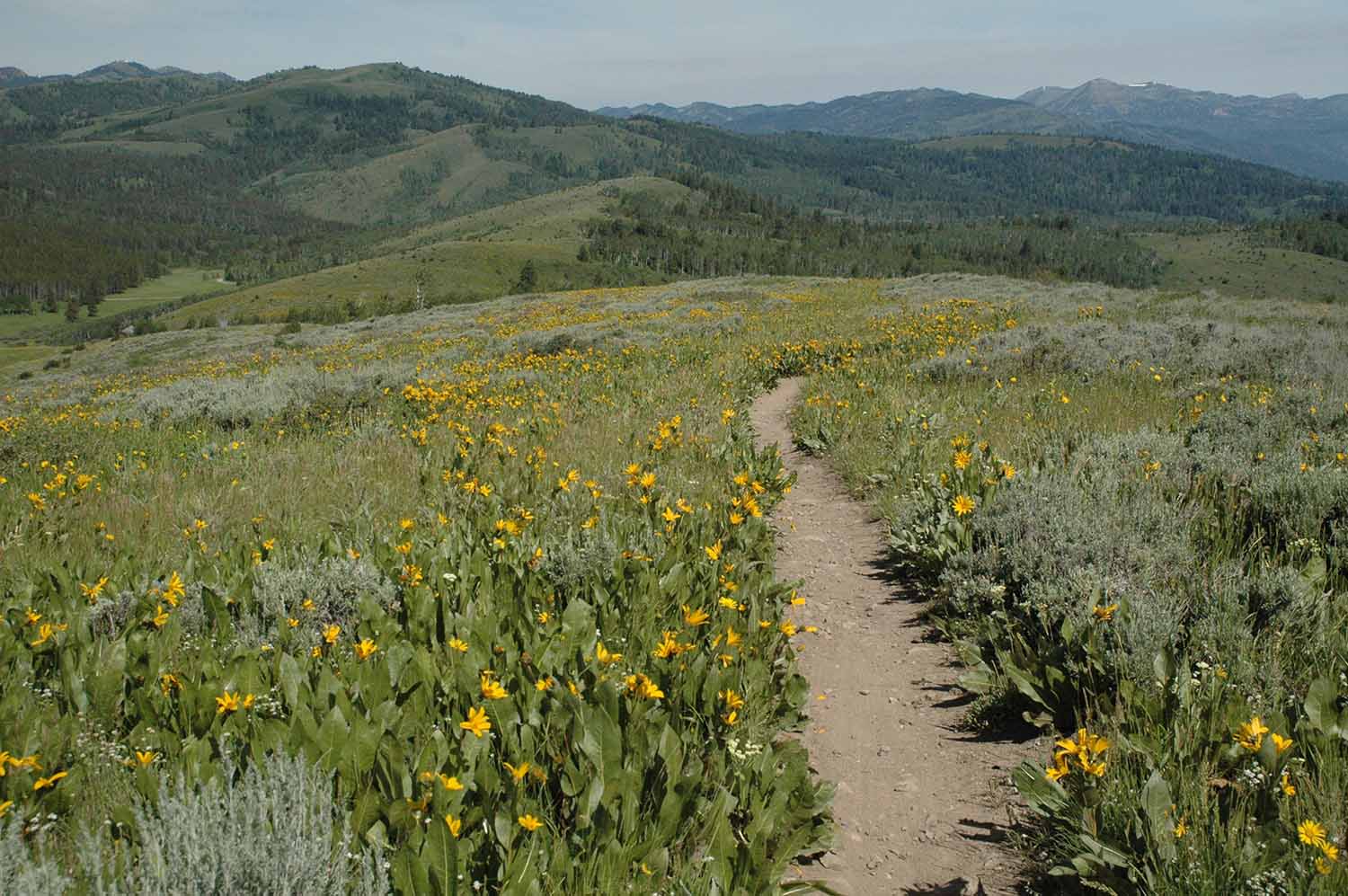
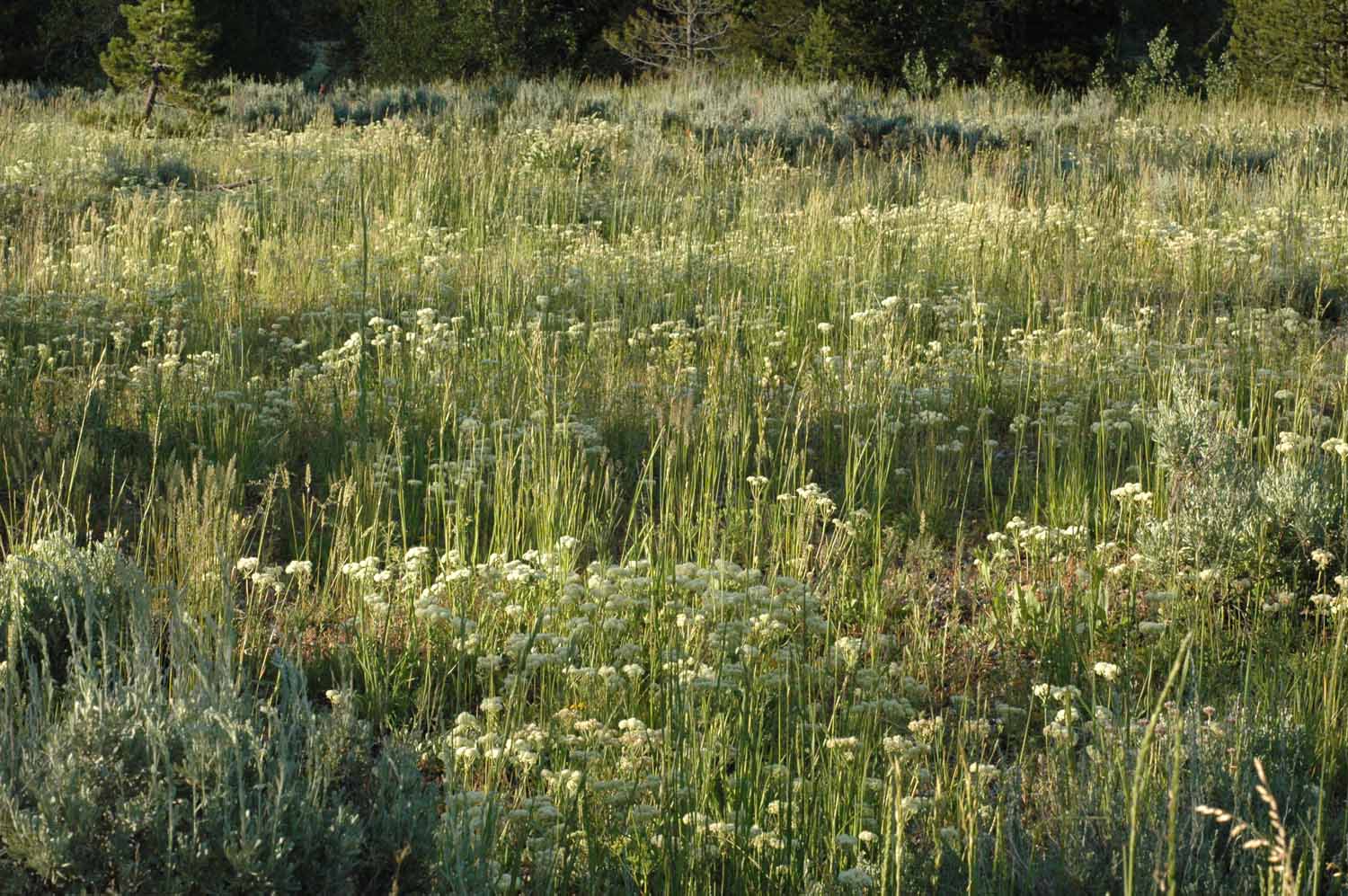
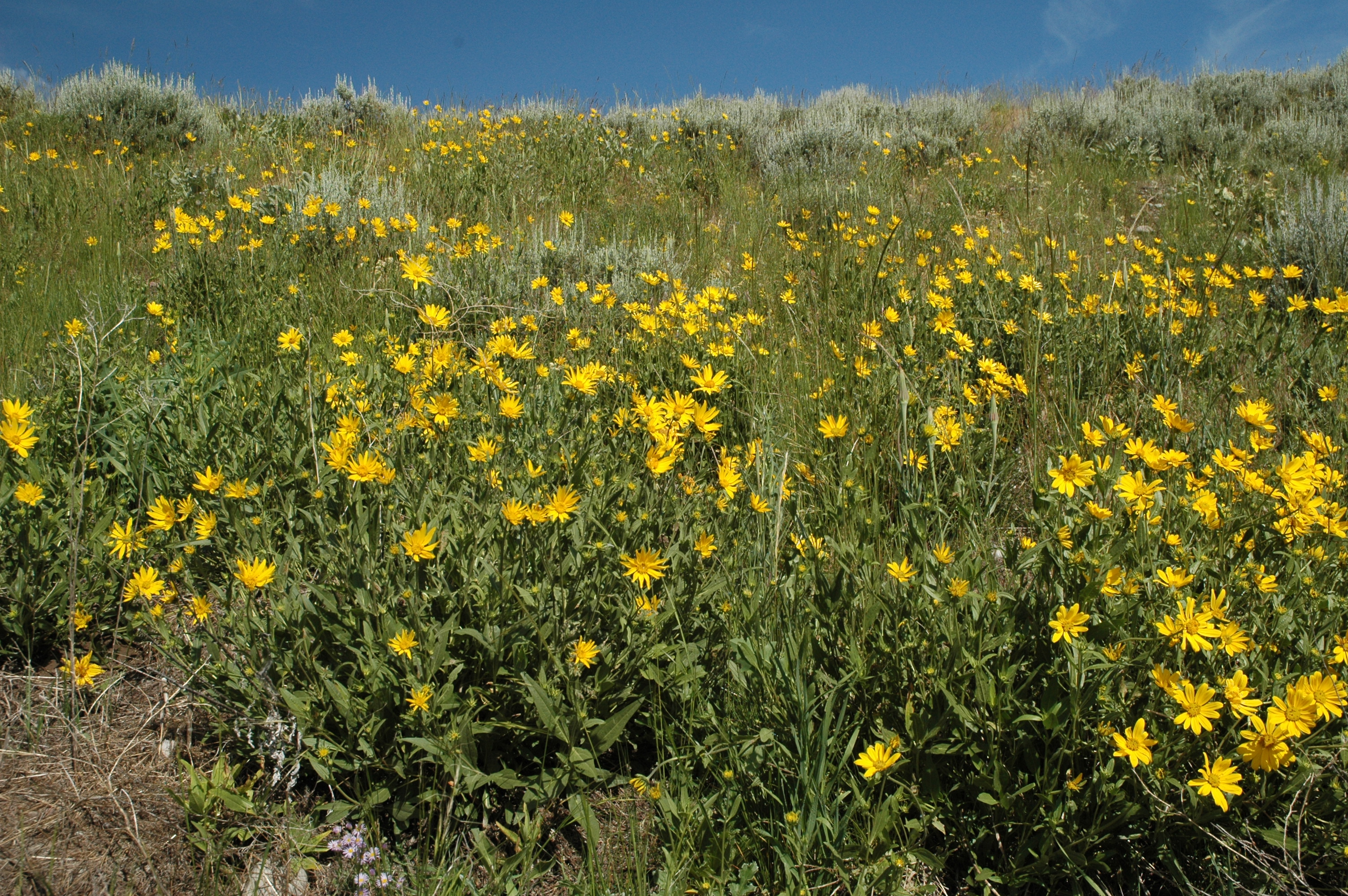
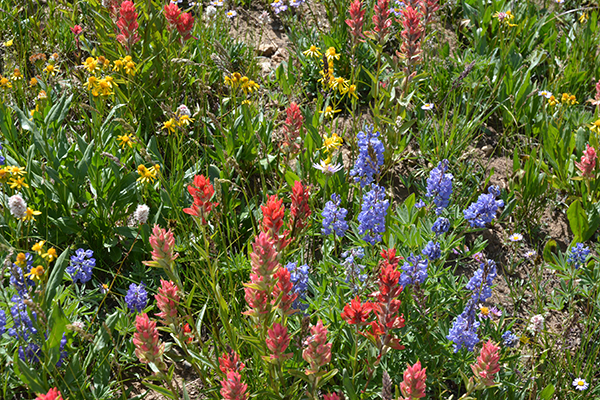
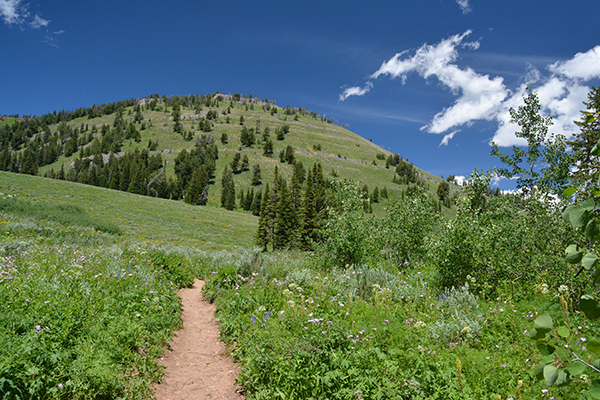
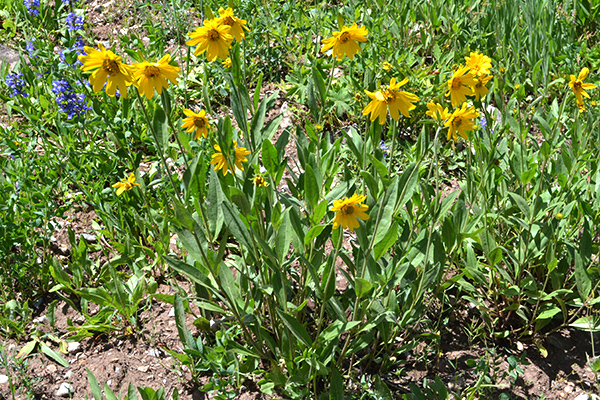
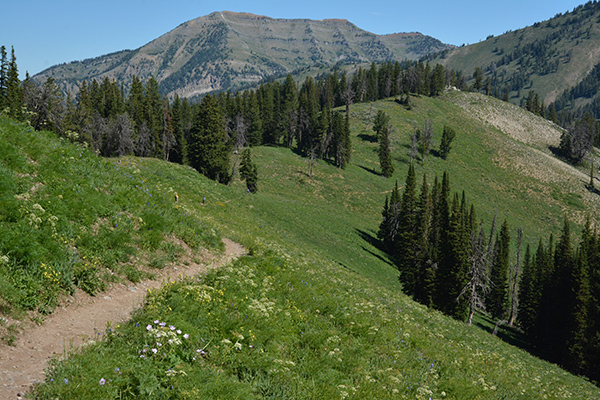
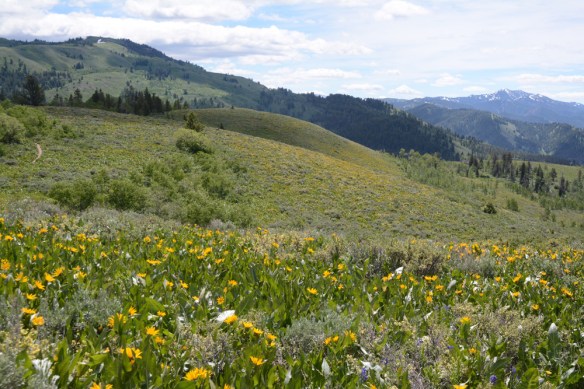
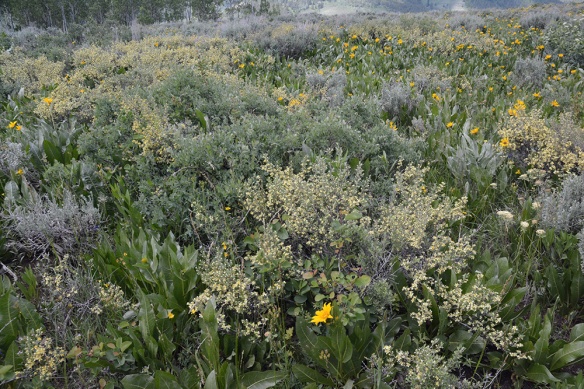
Wally’s World and Poison Creek Trails which loop around the shoulder of Munger Mountain encourage explorations into dry meadows and aspen groves.  Wally’s World Trail runs along an open ridge overwhelmed by mulesears – Wyethia amplexifolia – and abundant fragrant Antelopebrush.  This trail has many of the same sagebrush habitat plants noted in the recent 6.23.17 post (please see).
BTNF_Mung_WalWld_Vw_PursTrid_fl_6.18.17_1_Q2_5x3_200

AntelopebrushPurshia tridentata – mingles with sagebrush, snowberry, and mulesears along the ridge of Wally’s World, Bridger-Teton National Forest, off Fall Creek Road, Wilson.

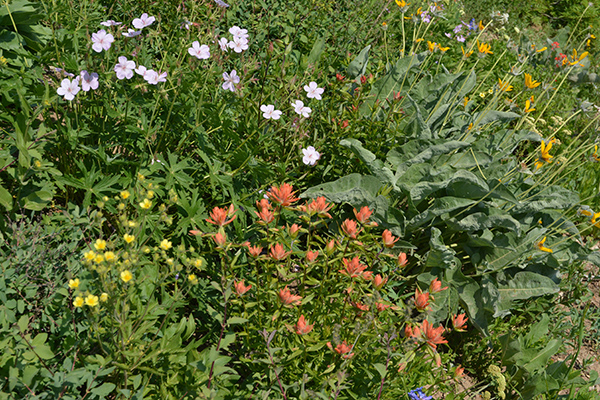
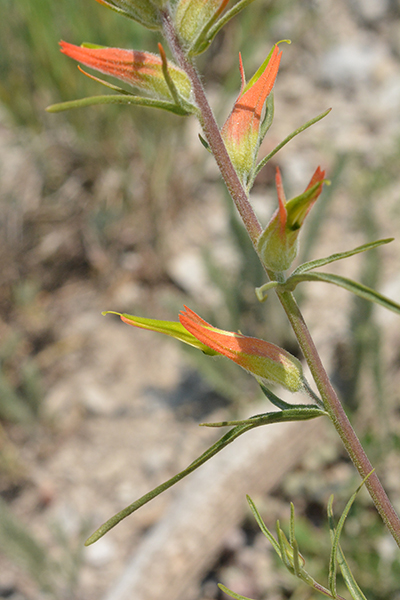
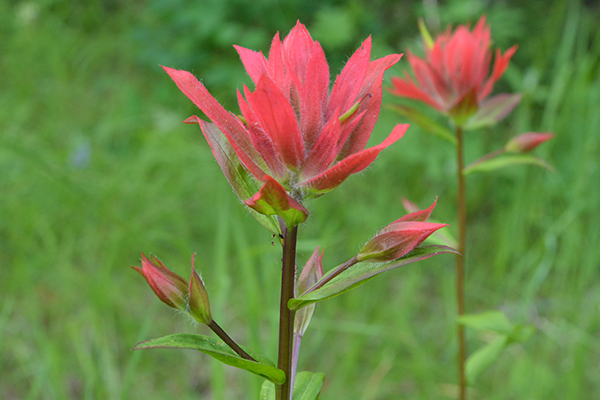
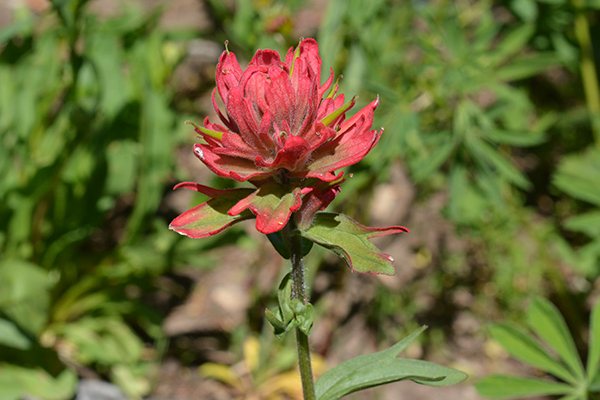
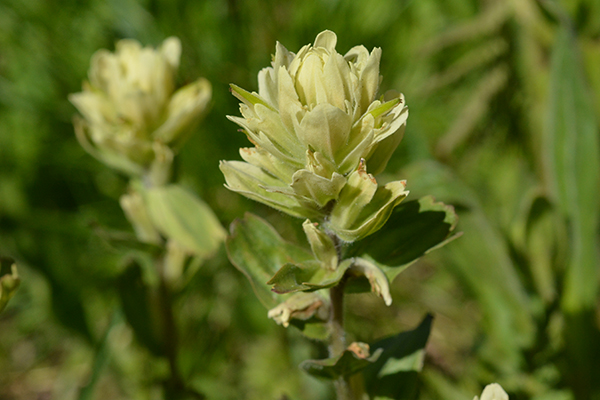
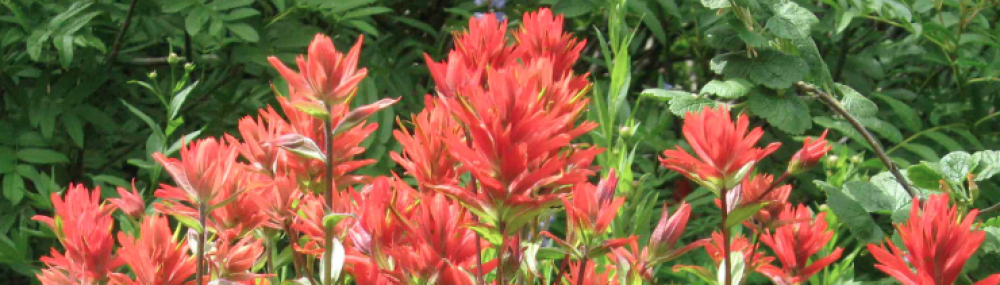
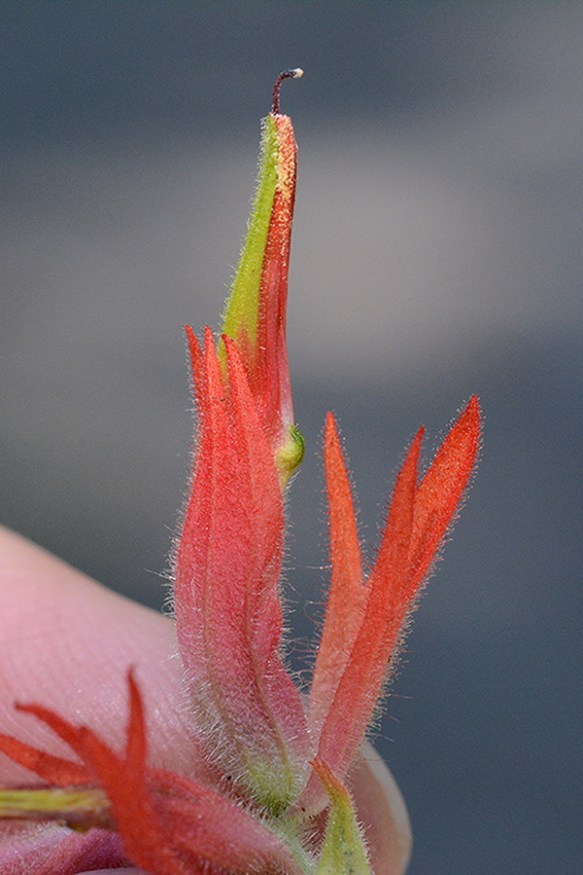
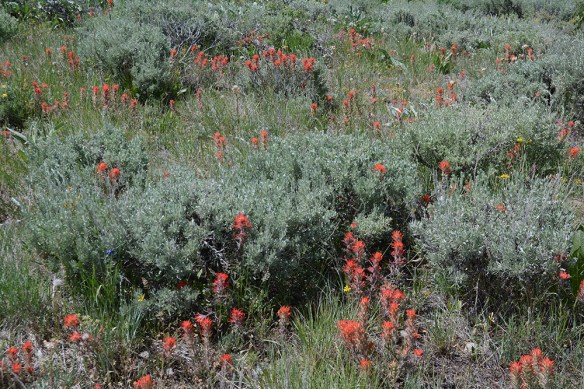
Mixed among the sagebrush with Sulphur Buckwheat, Scarlet Gilia, Ballhead Sandwort, and Hawksbeards, are two different red paintbrushes.  PaintbrushesCastilleja spp. – are tricky plants to identify because of their modified flower parts and also because they hybridize and vary in color, leaf shape, and growth habit even within a given species. Interestingly, they also are hemiparasites.
CastMini_flCU_GrCtr_73116_4_Q2_crp_3x5

Paintbrush flowers are hard to identify in part because they have complicated flowers.  A colorful bract (shown to right) is under each flower. Each flower has a colorful calyx tube which is lobed. It surrounds the usually greenish galea = tube of fused petals. The stigma and anthers are protected inside. Here the stigma sticks out from the green and red galea.  If you are not in the national park and have plenty around, pick apart — dissect — a single flower and see what is what.
CastAnguAng_ArtTri_WalWld_6.18.17_1_5x3_200a

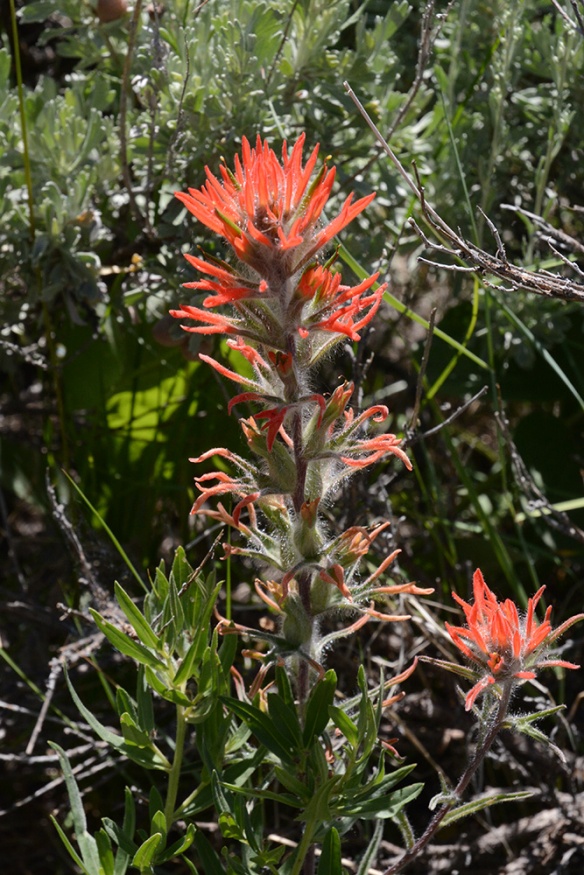
One of the red paintbrushes Northwestern PaintbrushCastilleja angustifolia (C. Chromosa) – and Big SagebrushArtemesia tridentata var. vaseyana – mix together.  There is more to this view than meets the eye….
CastAnguAng_flst_Mung_6.22.17_1_crp_3x5_200.jpg

Many paintbrushes are hemiparasites on a variety of hosts: grasses, legumes, and also sagebrush.  Northwestern PaintbrushCastilleja angustifolia  (C. chromosa) – attach “houstonia” to the roots of sagebrush and draw upon its water, nutrients, and some carbon to help the paintbrush grow more robustly.  This hemiparisite doesn’t depend entirely on the host: the chlorophyll in the leaves enables the plant to photosynthesize sugars (which include carbon).
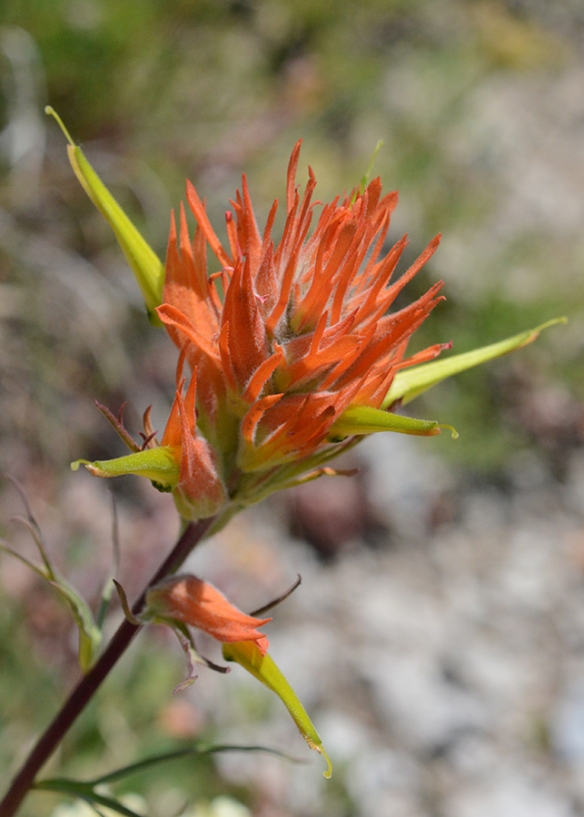
CastLini_fl_PassTr_62915_1crpsm

The state flower Wyoming PaintbrushCastilleja linariifolia – is a hemiparasite on sagebrush as well. In this paintbrush, the bracts are divided into linear lobes, the calyx is orange, toothed, with a long slit down the front where the elongate green galea leans out. This reddish tubular flower is pollinated by hummingbirds.


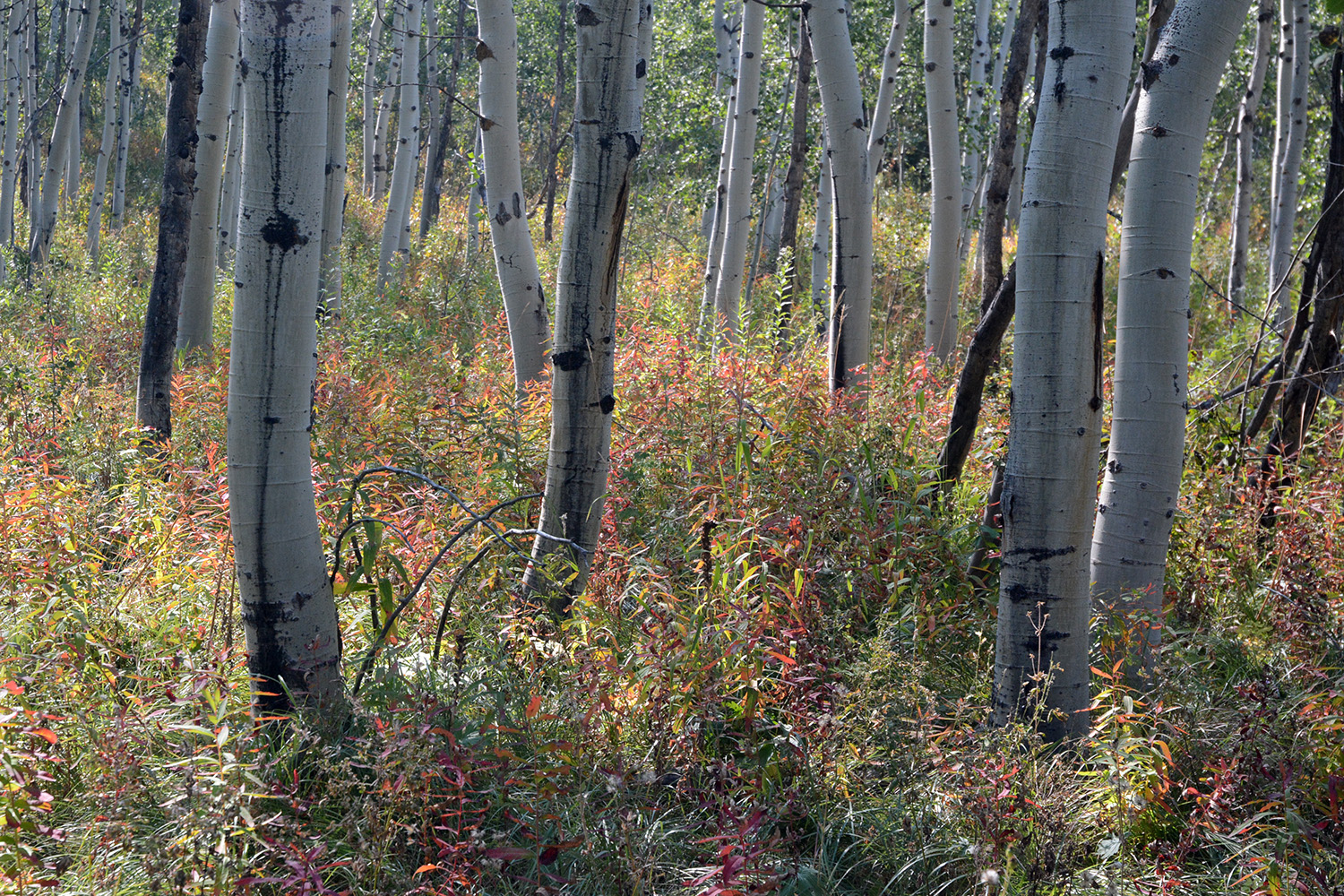
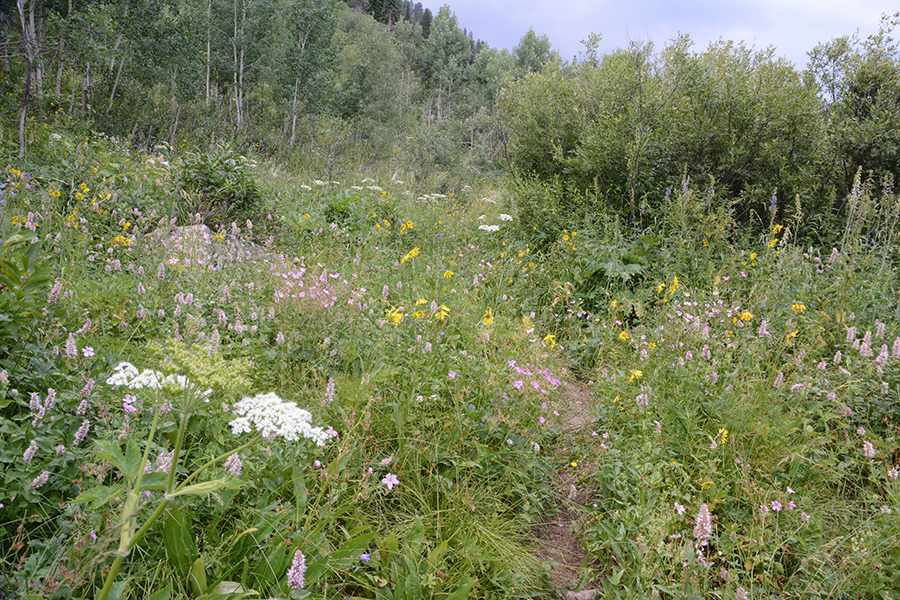
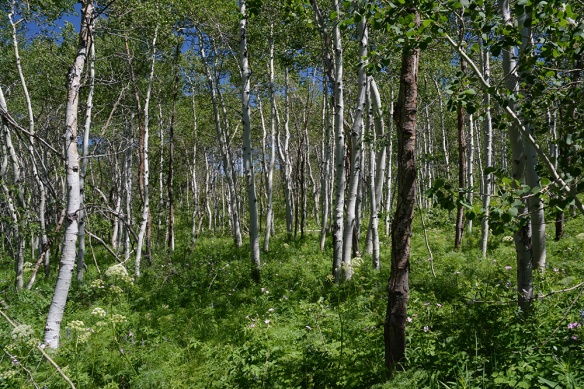
Aspen Forests are rich places to botanize.  BTNF_Mung_Aspen_6.22.17_6_Q2_5x3_200With light shade, greater moister, and more nutrients recycled from the deciduous aspen leaves, wildflowers are able to flourish at this time of year.
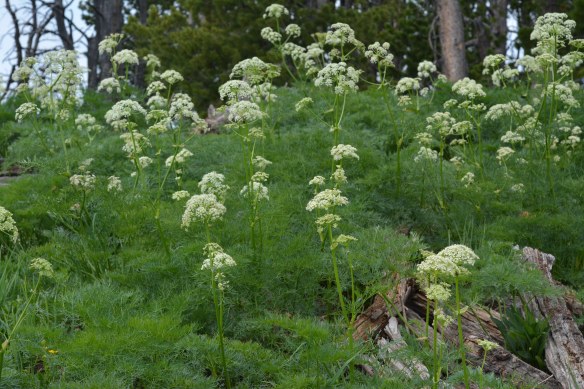
LiguFili_flhab_TetPsTr_7413_1Med

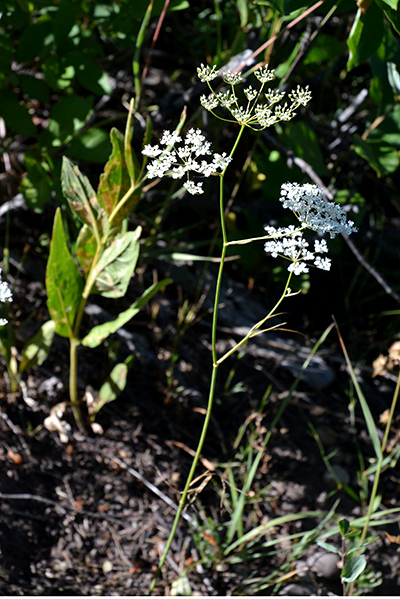
The 3- to 4-foot Fernleaf LovageLigusticum filicinum – is beginning to flower. Note the large delicate leaves and umbels of tiny white flowers.
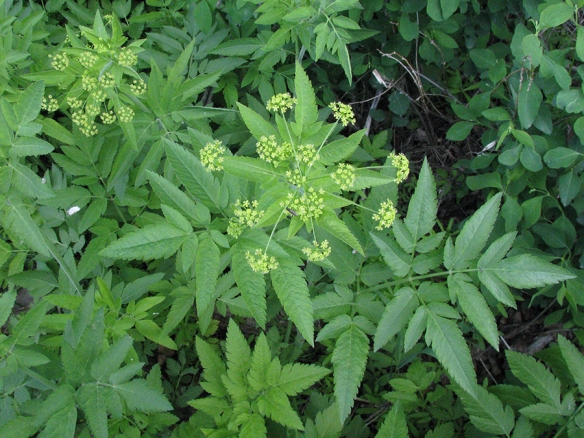
OsmoOcci_flhab_LSR_6312_2_5x3

In the same family – the Parsely or Apiaceae Family, SweetrootOsmorhiza occidentale – has tiny greenish yellow flowers in umbels and also large divided leaves.
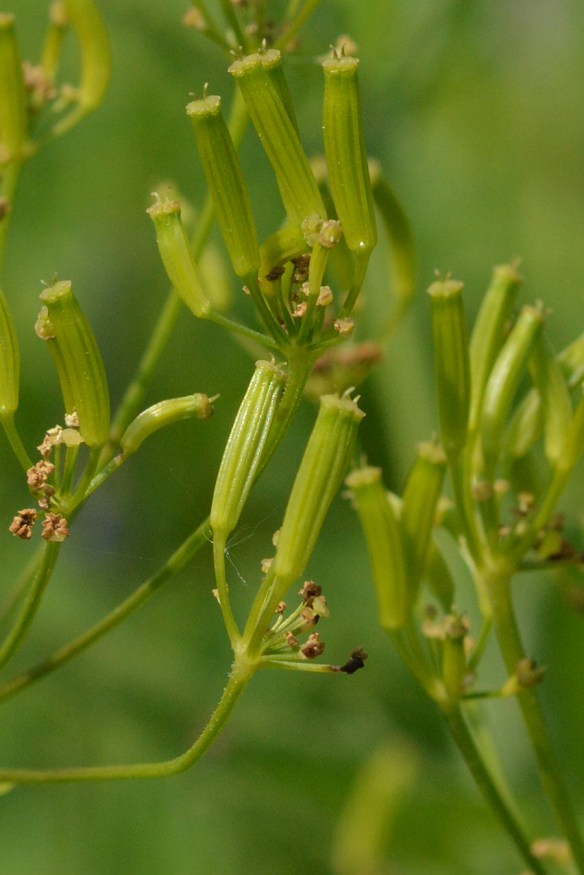
A_OsmoOcci_fr_PassTr_71714_1_crpPPT.jpg

Sweetroot is just beginning to form its tangy fruit.  It is in the same family as many herbs we use: parsely, caraway, dill, fennel, etc.  While most are safe to taste, a few species in this family are highly toxic, such as poison hemlock.
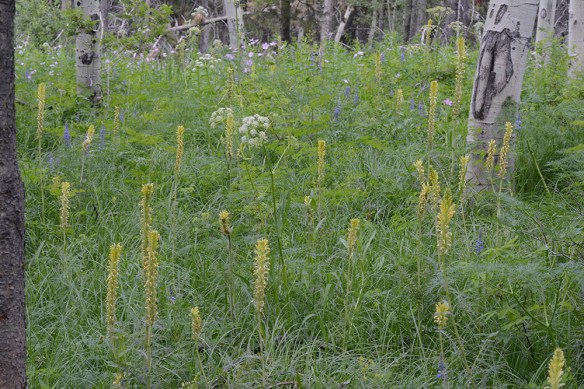
PediBrac_habfl_Mung_6.24.17_1_5x3_200

Also in the light shade of aspen groves or in open moist hillsides, are the yellow spires of Bracted LousewortPedicularis bracteosa.  These plants are also hemiparasites, operating like the paintbrushes, obtaining nutrients from surrounding plants.
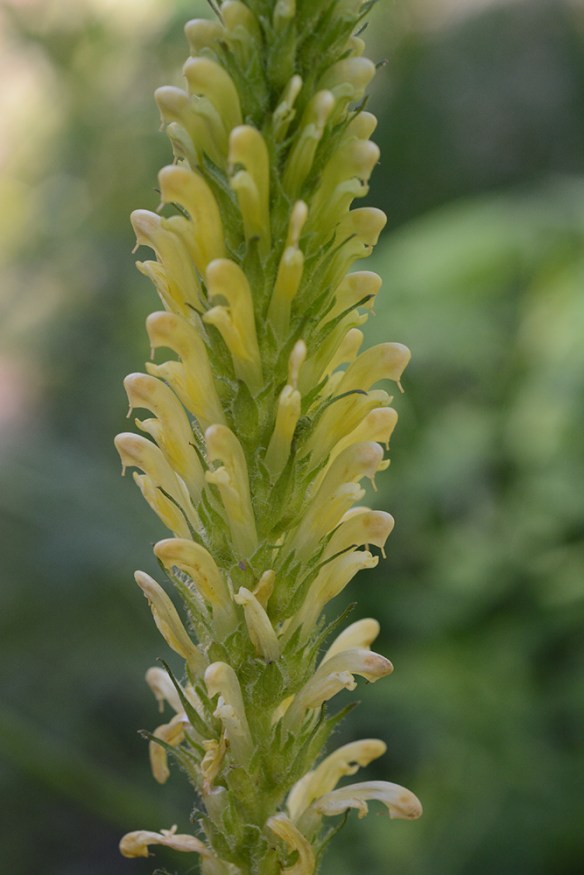
PediBrac_flst_Mung_6.24.17_1_3x5_200

But perhaps equally interesting is its pollination.  Louseworts have very specific pollinators: bees that can just fit into the flower opening.  As they push inside for nectar, bees get a dusting of pollen on their bodies.  One pair of bee legs is designed for combing off pollen and stashing pollen grains in “buckets” on the hind pair of legs.  However, bee’s can’t reach the pollen lodged between their head and thorax.  When a bee visits the next flower, a perfectly shaped protruding stigma taps into that crevice and bingo the pollen gets stuck to the sticky stigma. The plant wins and seeds can now form!
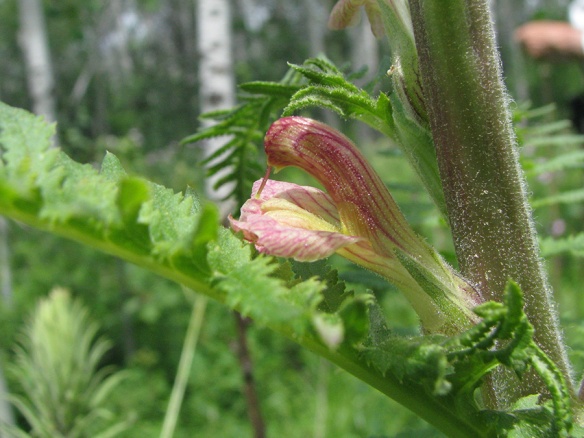
PediProc_flCU_mung_62115_3Q2_5x3_180

A much more unusual species, Tall LousewortPedicularis procera – can be seen on Munger Mountain.  The flowers are bigger and reddish, and the fern-like leaves are more frilly than the more common Bracted Lousewart.

Different species of lupines, paintbrushes, and even geranium are found in shadier woodland vs. open sage-covered habitats.
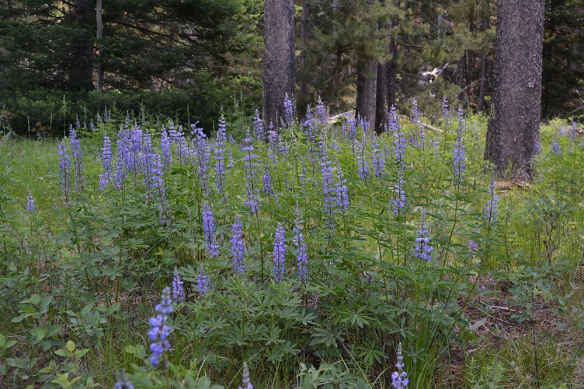
A_LupiArg_habfl_MWrd_62514_2Q2_5x3

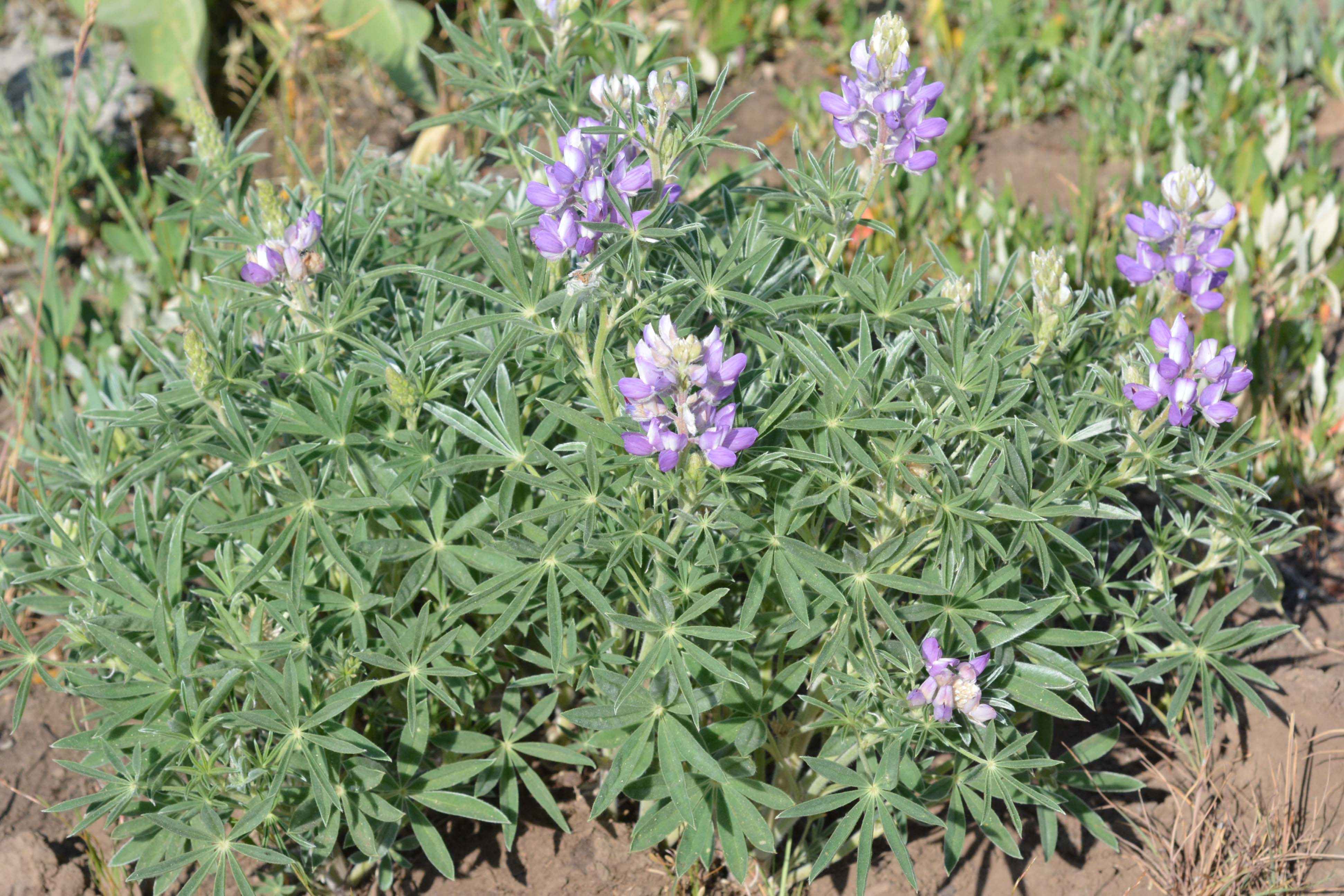
Silvery LupineLupinus argenteus – is found most frequently in forests–aspen or pines.
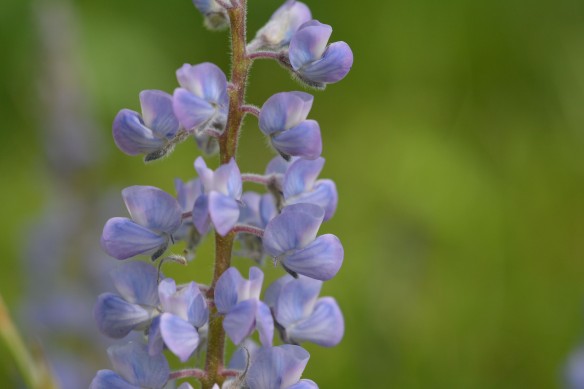
A_LupiArgeRub_flcu_SigMt_61613_Q21sm

Silvery Lupine differs from the Silkly lupine, which is found in sageflats, by having many fewer silky hairs.  The banner–the top petal which folds backwards–is smooth, not hairy.  The flowers are slightly smaller and the leaves greener.   
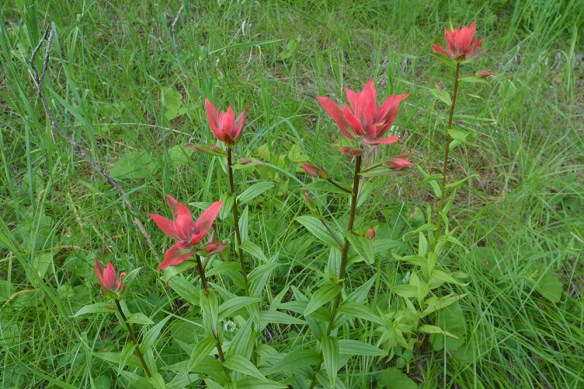
CastMini_habfl_MWrd_72014_2_5x3_200

One-foot or more tall Scarlet PaintbrushCastilleja miniata – has bright red, unlobed bracts beneath the red flowers.  Also, the leaves are  usually not deeply lobed as are the two red paintbrushes observed in sunny, dry locations. 
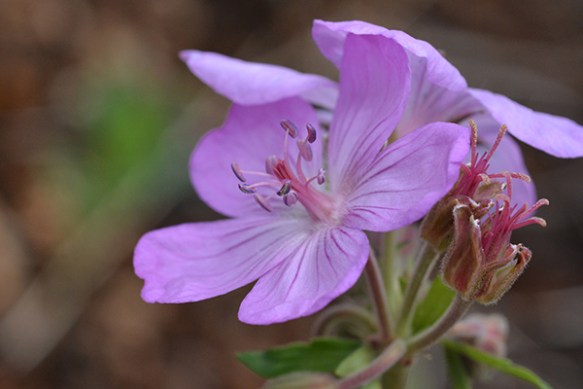
B_GeraVisc_flCU_SkiLk_62613_1QWeb

Sticky GeraniumGeranium viscosissimum – is abundant right now both on sageflats and in woodlands.  Note the nectar guides — the deep pink lines leading into the center of the flowers.  If you look closely with a handlens you can also see (and feel) the many sticky hairs on most parts of the plants.  The hairs happen to be clear.
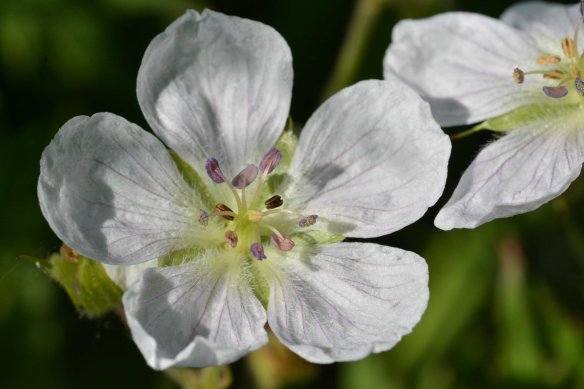
Geranium richardsonii

Richardson’s GeraniumGeranium richardsonii – is white and grows in moist sites.  Its hairs are different!
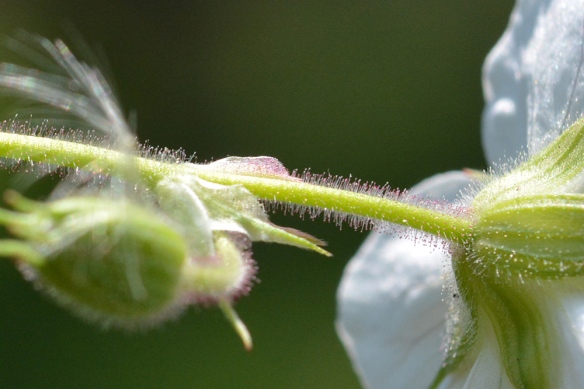
GeraRich_st_GrdVwTr_7813_1_crpsm

The sticky hairs of Richardson’s Geranium are purple-tipped. Think of a gooey forest of defense against tiny invaders.

Several members of the Buttercup Family (Ranunculaceae) do well in the shade.  Many look very different and have very singular pollination behaviors from one another. Families are like that.
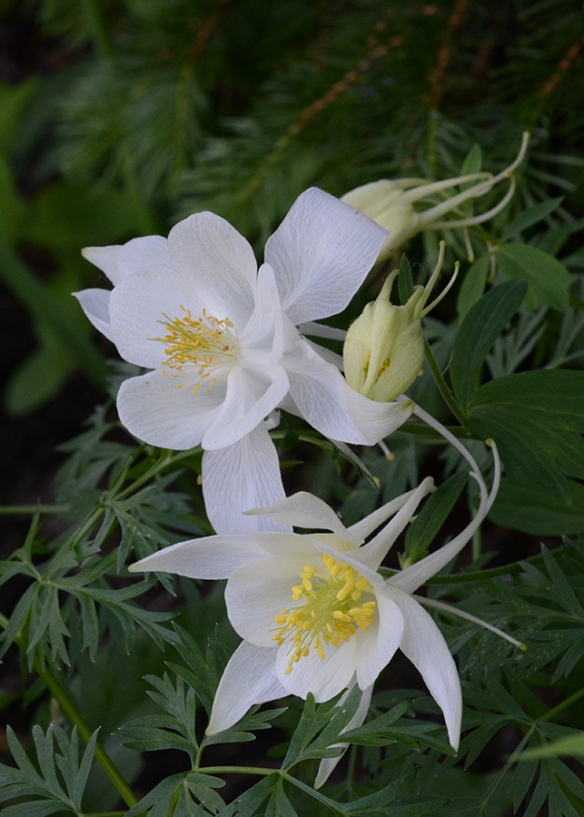
AquiCoer_fl_PassTr_62915_2crpsm

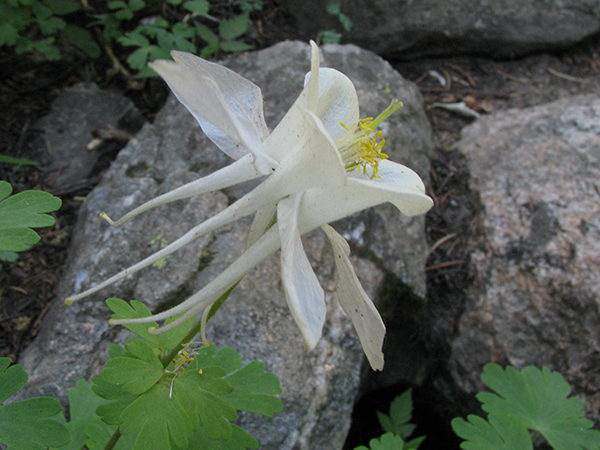
Colorado ColumbineAquilegia coerulea – is very showy and a favorite to find. Elegant flowers have 5 flaring white petal-like sepals, 5 tubular petals that form 2”-long spurs trailing out the back, and many yellow anthers. Leaves are delicately dissected into 9 parts. These 6-24” plants are pollinated by moths and hummingbirds which have mouth parts that can reach the nectar way back in the flower “spurs”.
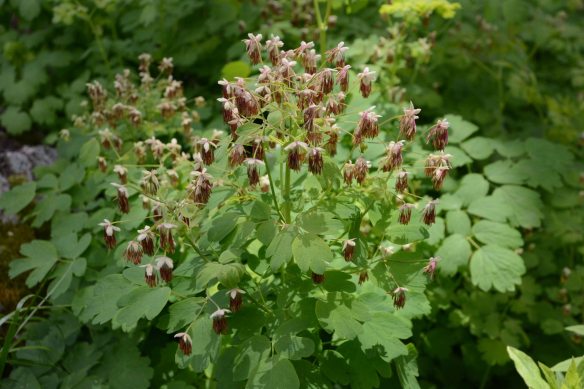
Thalictrum occidentale - male flowers

In contrast to columbine, the flowers of MeadowrueThalictrum occidentale – are very inconspicuous.  It has male and female plants. Wind blows the pollen from the male anthers to the female stigmas on a nearby plant. This is a male plant. 
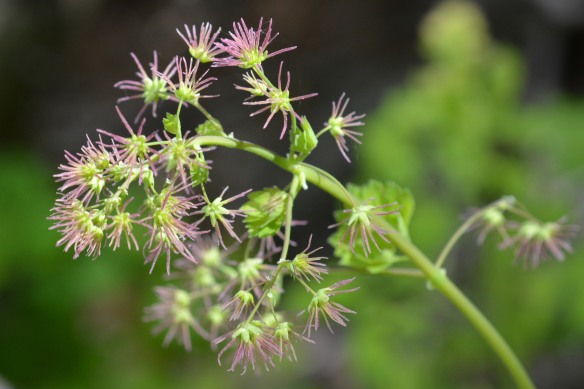
A_ThalOcci_FlFm_PhlLk_6413_1acrpsm

Female flowers of Western MeadowrueThalictrum occidentale. The pink stigmas stretch to catch pollen grains.  As the wind cannot “see” there is no need for showy petals and such to attract pollinating birds or insects. Also, petals would get in the way of the wind.
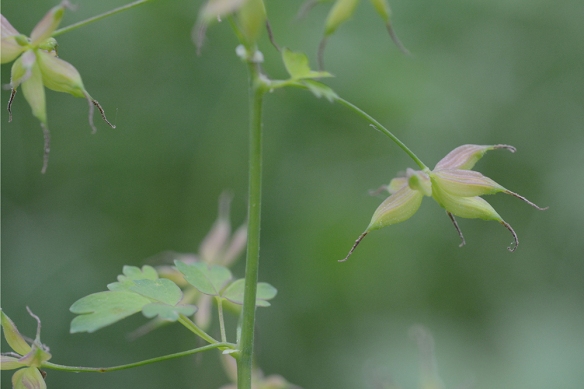
ThalOcci_fr_WallyWld_6.14.16_1a_crp_5x3

Fruits of Western Meadowrue are already forming.  There are actually two possible meadowrue species T. fenderi and T. occidentale.  The size and shape of the fruits help to distinguish the two species.  This observer does not swear to the species ID as T. occidentale.
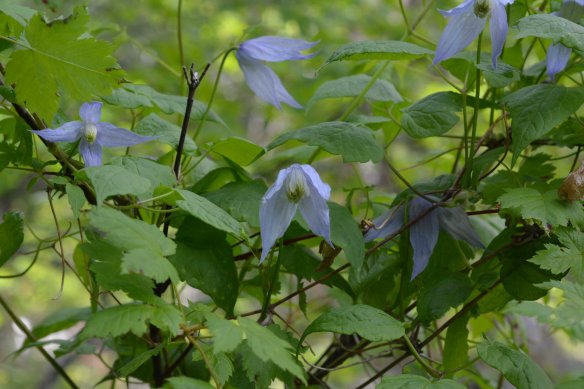
ClemOcci_habfl_PhlLk_6413_1sm.jpg

Yet another buttercup relative literally hangs out in the bushes.  Western ClematisClematis occidentalis – is a vine which curls its tendrils around branches to support itself.  The flowers nod downwards.  Often it is hard for us to see more than the back of the blue flowers; however, low flying pollinators look up into the blue to see hundreds of gleaming white stamens – a treasure trove of pollen. Heaven. 
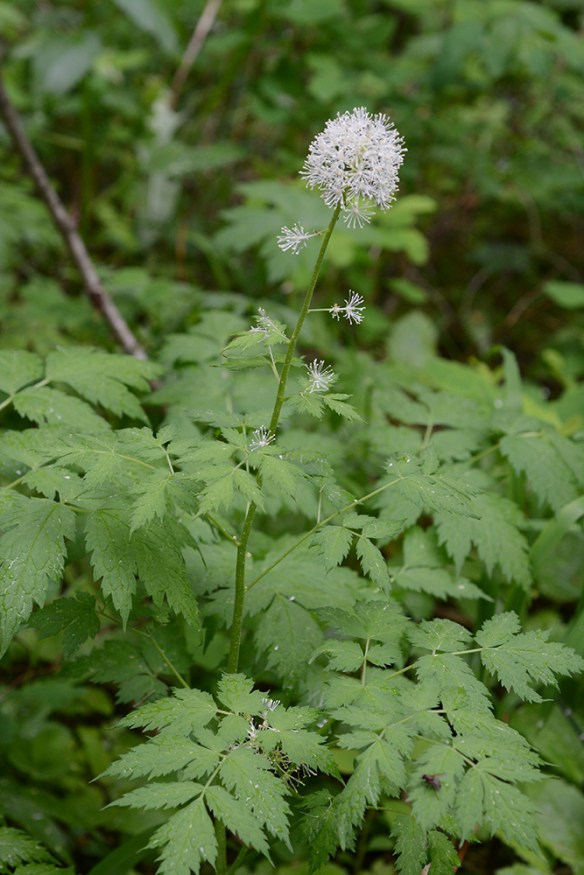
ActeRubr_fllv_TrCk_6.12.16_2_3x5_200

This cousin has many small white flowers whose numerous stamens (not petals) form a starry effect.  Placed together, the flowers create an appealing show to small pollinators.  

ActeRubr_Fr_PhlLkTr_72114_1sm.jpg

While delicate in appearance, the flowers will produce ruby red berries that are poisonous–they were  used to make poison arrows.  Hence the name Red BaneberryActea rubra. Bane in a plant’s name indicates poisonous.  “Bane” means misery, misfortune, pain in the English language. 

After looking at the photos, can you see any family resemeblance among the buttecup relatives?  Hint: Look at leaves, look at stamens….(answer below)

Three additional flowers to look for in the forest at this time.

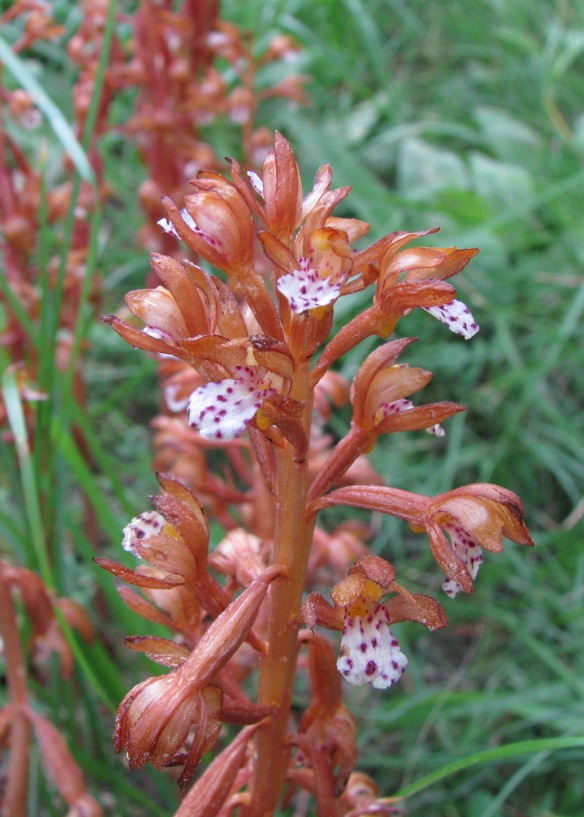
One is pretty obvious–reddish stems and spotted flowers:
CorrMacu_fl_WalWld__612115_1CrpSm

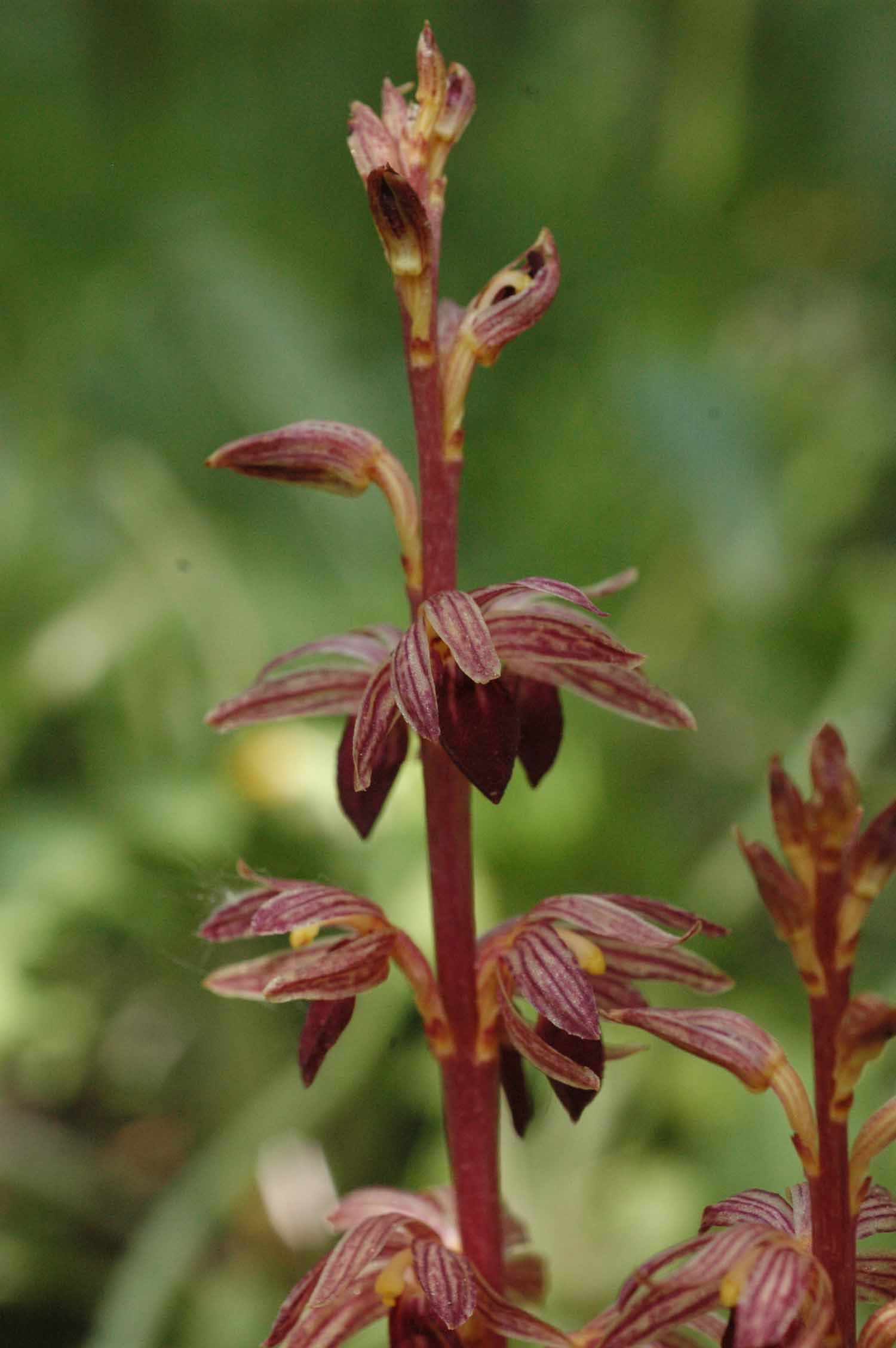
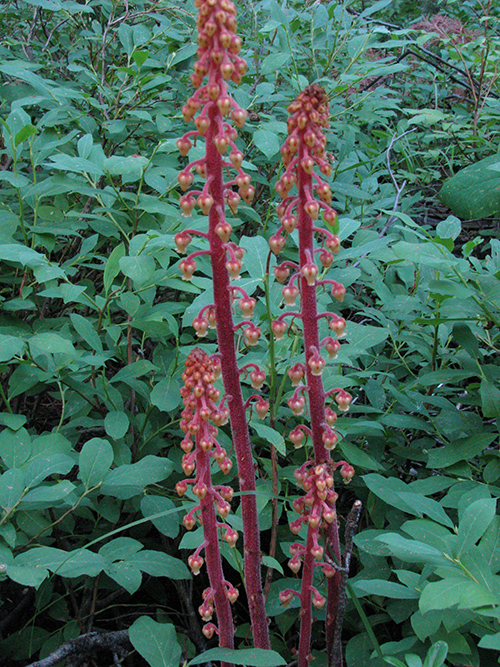
Spotted CoralrootCorallorhiza maculata – is growing along trail edges in aspen groves.  Coralroots do not have chlorophyll for photosynthesis and instead are connected to mychorrizal fungi which transport water, nutrients, and carbon from host trees.  There are several species of coralroot in Teton County.  This reddish species has white flowers spotted with red. Each flower has two tiny lobes on either side of the lowest petal (lip) and a bump (spur) under the throat . 

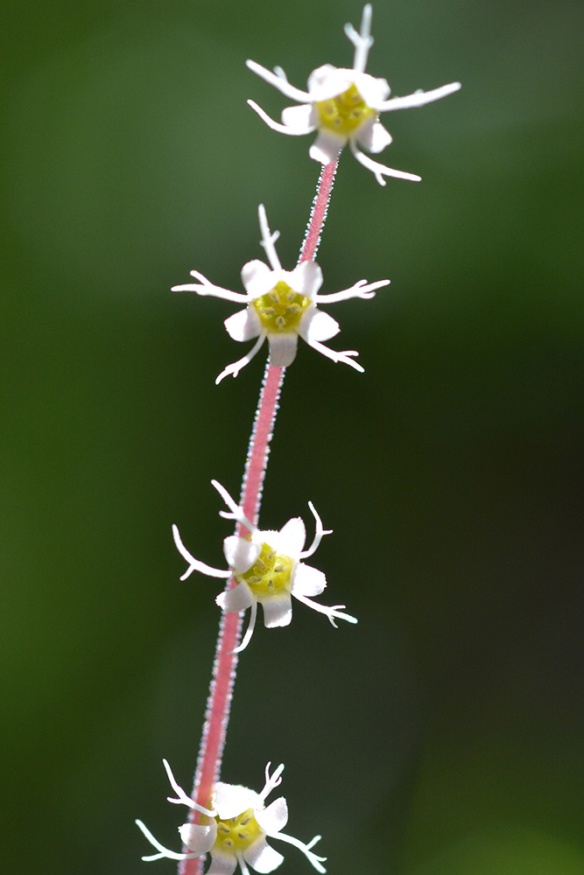
Two are tiny, easily overlooked or even stepped upon!
MiteStau_flCU_PhlLk_6413_2crpsm_5x3_200

These merry flowers are barely 1/4″ wide and decorate slender 12″ stems.  With the light behind them, Small-flowered Mitreworts – Mitella stauropetala – look like magical fairy wands.  
ListCaur_habfl_BlkRkTr_6.22.16_1a_Q2_3x5

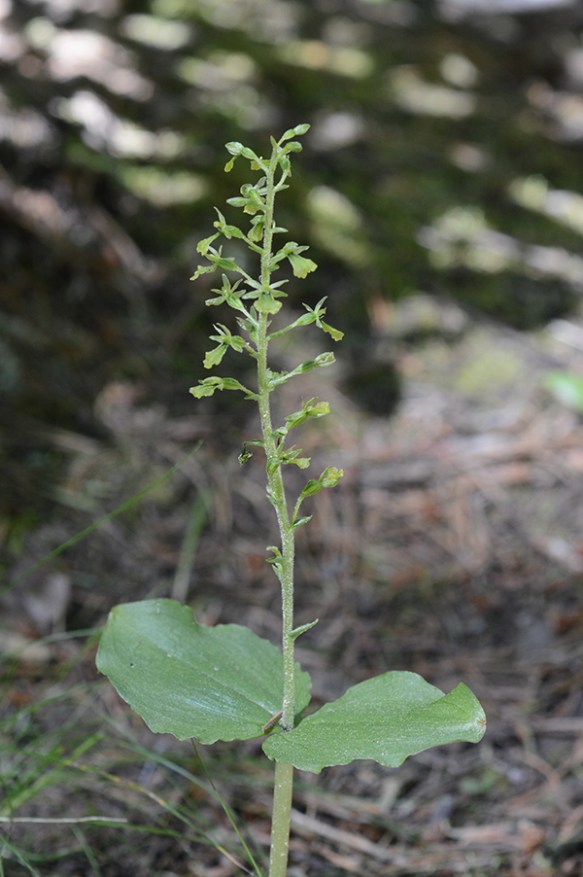
Northwestern Twayblade – formerly Listera caurina, now Neottia  banksiana – is a 4-12″ orchid found in conifer forests (vs. aspen groves).  We came upon a few hidden clusters today.  It is found in Wyoming only in the Teton County.

There is no information on the pollination of Northwestern Twayblades–Listera caurina. However, one of its close relatives Listera cordata, which is also found in Teton County, has an amazing pollination mechanism that may be similar to this species. It is detailed below to encourge us to look for both species and do a close comparision,
ListCaur_inflCU_BlkRkTr_6.22.16_4_Q2_crp_3x5

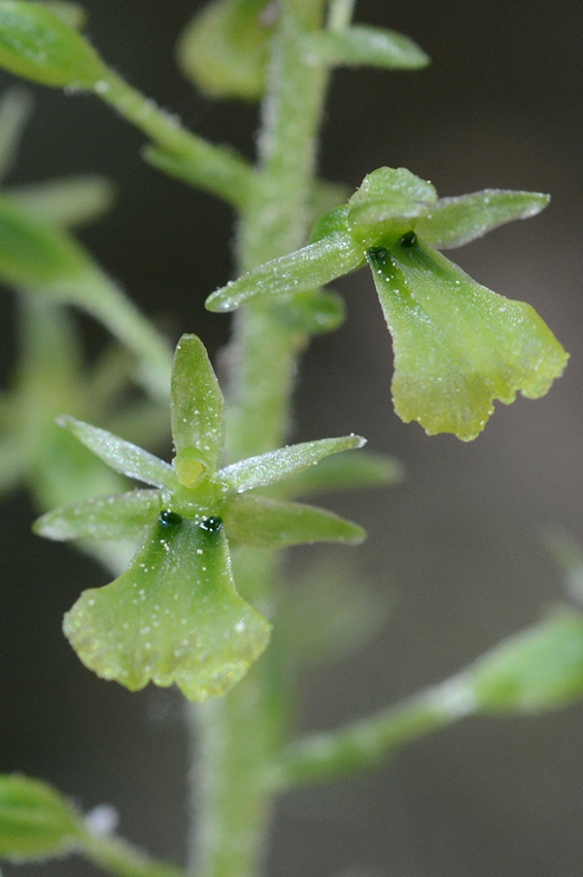
  Pictured is Northwestern Twayblade. The story below is about its relative Heart-leaved Twayblade.  First it is important to know that in orchids, the miniscule pollen grains are held in wads called pollinia…. Also the the anthers and pistil are fused into a single column or rostellum….  Attracted by the fetid odor and a bit of nectar, a small pollinator, such as  fungus gnat, comes to the flower. Rooting around the lower lip for nectar, it triggers one of three pressure-sensitive hairs on the arching upper part of the flower–the rostellum–above it.  At this point, the rostellum “releases a droplet of glue and the pollinia are instantly released to fall on the glue.”  Off the gnat goes with the pollinia stuck to its body.  Quickly, the tip of the rostellum unfolds to shield the underlying stigma to prevent self-fertilization in case the gnat returns. The next day, the wide stigma is uncovered and it arches up, receptive to the next gnat carrying pollinia from a different plant.  As the gnat crawls under the rostellum for nectar, the pollinia sticks to the stigma and hundreds of pollen grains germinate to form hundreds of dust like seeds. Thus begins the opportunity for new generations.  (Based on research of pollination of Listera cordata in California – Ackerman and Mesler, Am. Journal of Botanty, 1979)

Observing any twayblades in Jackson Hole, very carefully try to determine 1. odor, 2. presence of trigger hairs, 3. is the stigma exposed or covered? This could help determine if the pollination mechanisms within these two species are at all similar.

In any case, there are many more flowers to see!  Keep on botanizing!

Frances Clark, Wilson, WY – June 28, 2017

P.S. Many Buttercup Family relatives typically have deeply divided to compound leaves; highly modified sepals and petals or sometimes none; and many, many anthers. Delphinium/larkspur, monkshood, and sugar bowls are all related, as well.


Mid-June Blooms in Sage 2017

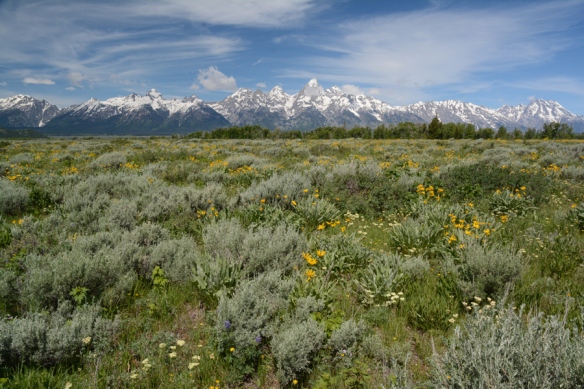
TNP17_vw_Tetons_Antflt_frTSSrd_6.19.17_1c_sm5x3_180Many of us have been out frantically trying to keep up with the blooming flowers.  The warm weather–in the 70s+–has keep flowers going and coming in the sagebrush habitat in Jackson Hole.  Late spring favorites of Nuttall’s Larkspur, Arrowleaf Balsamroot, and Western Groundsel are fading in the southern end of Grand Teton National Park, but new favorites are unfurling fast.
Not only are we plant lovers looking for wildflowers, but so are pollinators–bees, flies, butterflies, and hummingbirds.  They appear more numerous this week than even a week ago.  Their increased presence is important as most (but not all–such as dandelions and some pussytoes) flowers need to be pollinated to set seeds for the next generation.

Below are some photos to inspire botanical forays.  Flowers are easily seen throughout Antelope Flats east Highwat 89, and Bradley-Taggart Lake, Lupine Meadows, and soon String Lake Trails along the inner park poad.  Similar flowers are also blooming in open areas along Cache and Fall Creeks and the beginning of the Ski Lake Trail.

Two shrubs are blooming throughout much of the valley:

PursTri_fllv_TNP_61514_1crpSmWeb

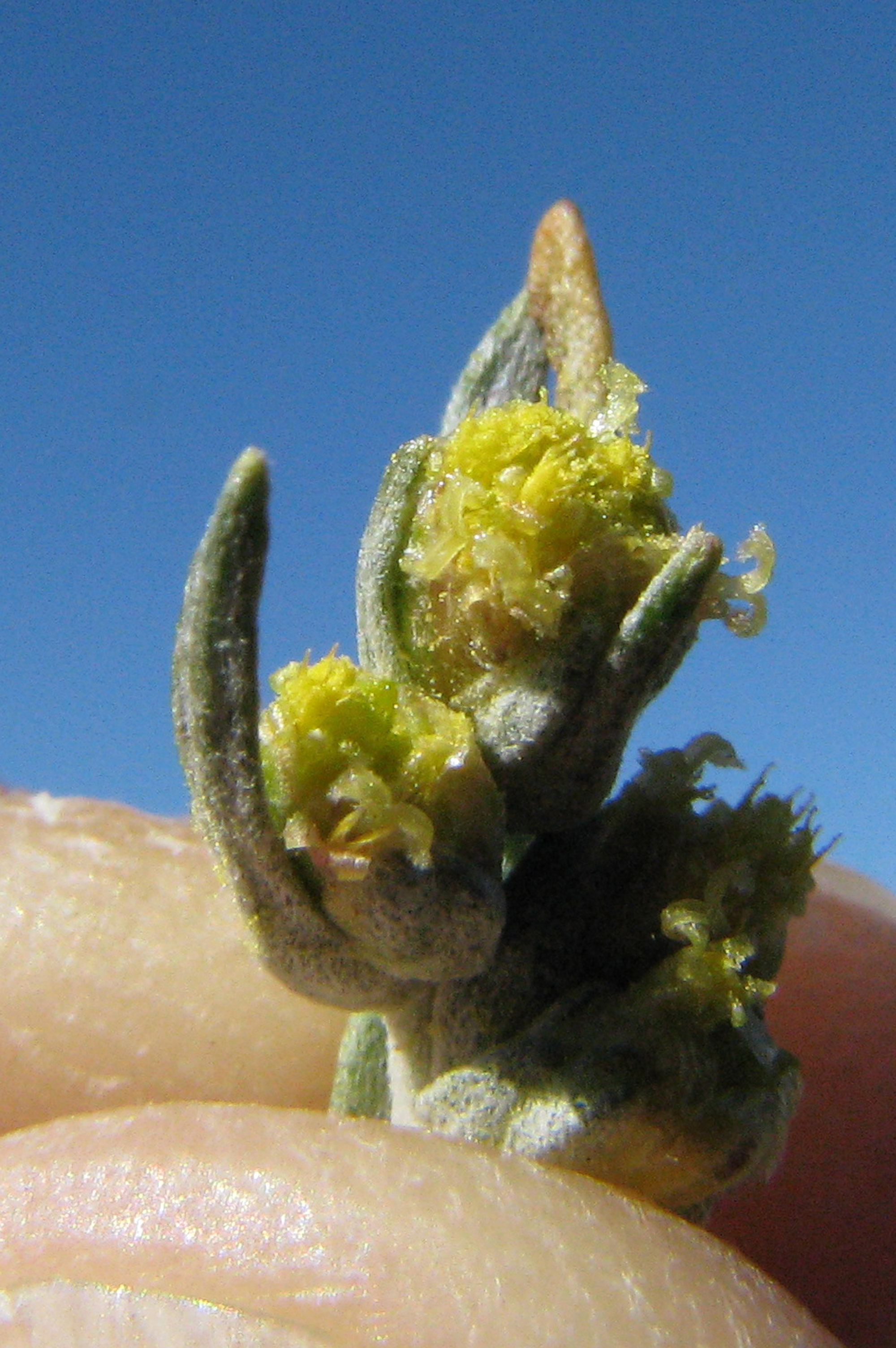
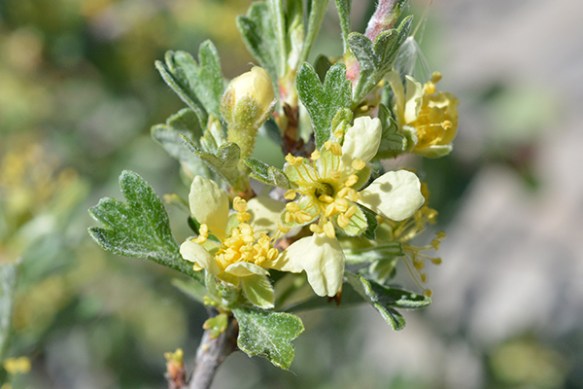
AntelopebrushPurshia tridentata – has fragrant pale yellow flowers and three-pointed leaves.

SympOreo_flCU_TNP_61815_1fixSm

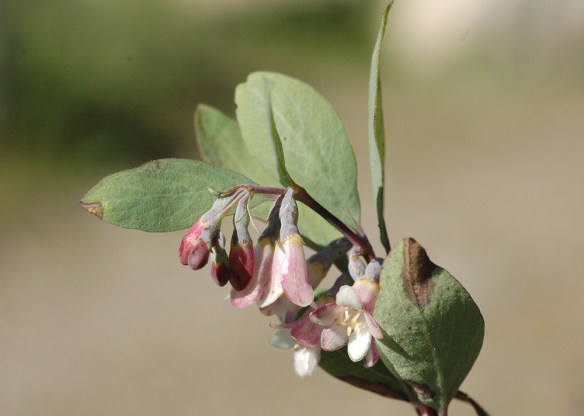
SnowberrySymphiocarpus oreophilus – a 2-3 foot shrub with opposite oval leaves, is blooming in both shade and sun.  The pink flowers will produce white berries.

Wildflowers that are particularly showy include Sulphur Buckwheat, two species  — yes two — of lupine, and tall wands of Scarlet Gilia.

ErioUmbe_fl_BTTrHd_62215_3

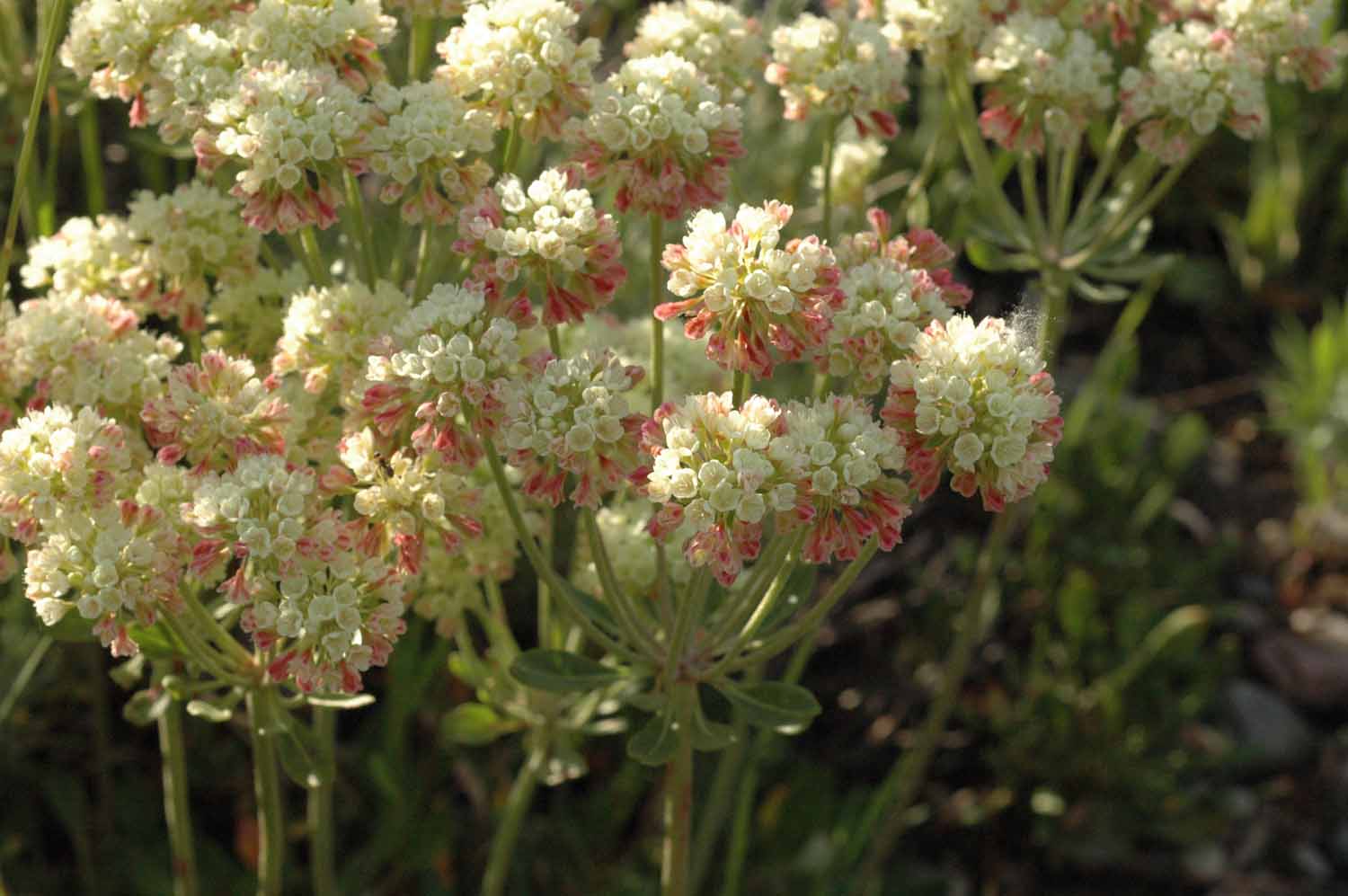
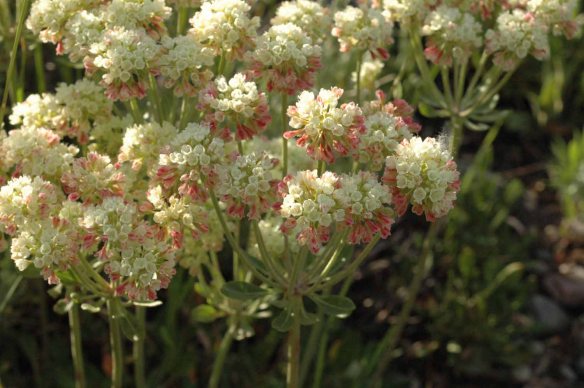
Sulphur BuckwheatEriogonum umbellatum – grows mats of small oval leaves which are overshadowed by clouds of creamy yellow flowers, often tinged with pink.  The flower clusters have a collar or whorl of leaves under the umbrella-like flower stalks.

LupiSeri_FlCU_BlkTBut_8711_crp_3x3

Silky LupineLupinus sericeous – is the typical lupine of sage flats.  It is related to our garden peas. The familiar looking flowers have a very hairy “banner”–back of upper petal–and hairy stems and leaves.  Later they will have very hairy pods–but don’t eat the seeds: they are poisonous. 

B_LupiSeri_habfl_AntFl_7513_2sm

Silky LupineLupinus sericeus – has fine silvery hairs covering most of the 2’-2.5’ plants.  All lupine leaves are “palmately divided”: several leaflets are connected in the center and then attached to the petiole –“palmate” like fingers off the palm of your hand. The hairs help keep the plants from drying out in the hot flats. They reflecting the light and maintain humidity close to the leaf surface to prevent too much transpiration of water from the leaves during the hot days.

LupiPoly_flSt_Cu_LupMea_6.17.17_1a_crp_5x3_180.jpg

Compared to silkly Lupine, meadow lupineLupinus polyphyllus – has larger flowers and the banner (the upper petal) is smooth on the back and reflexed at a wider angle to the lower two petals. This species tends to grow in moister open areas, such as along the cobbled creeks and river edges, but sometimes it is found in pockets of sage clad flats or hillside.

IpomAggr_flst_AntFl_6.19.17_1_crp_3x5_240.jpg

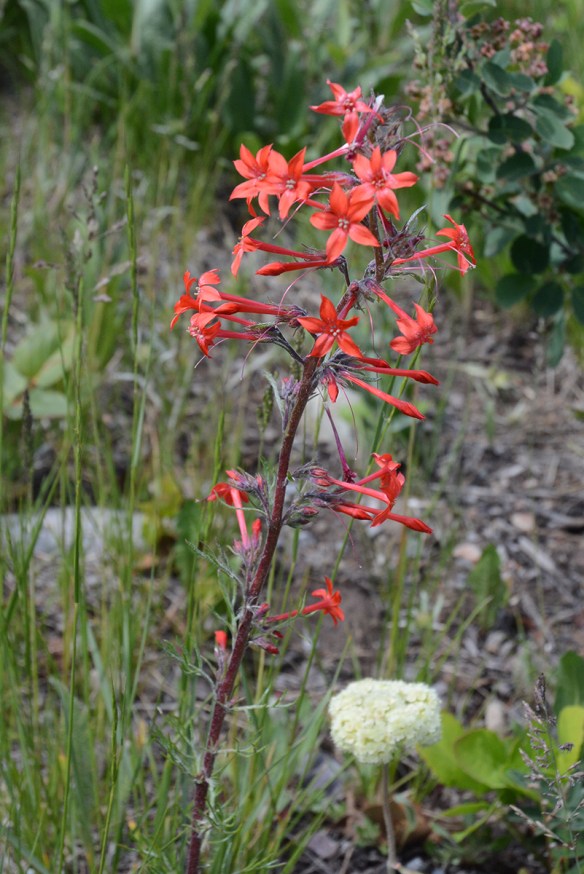
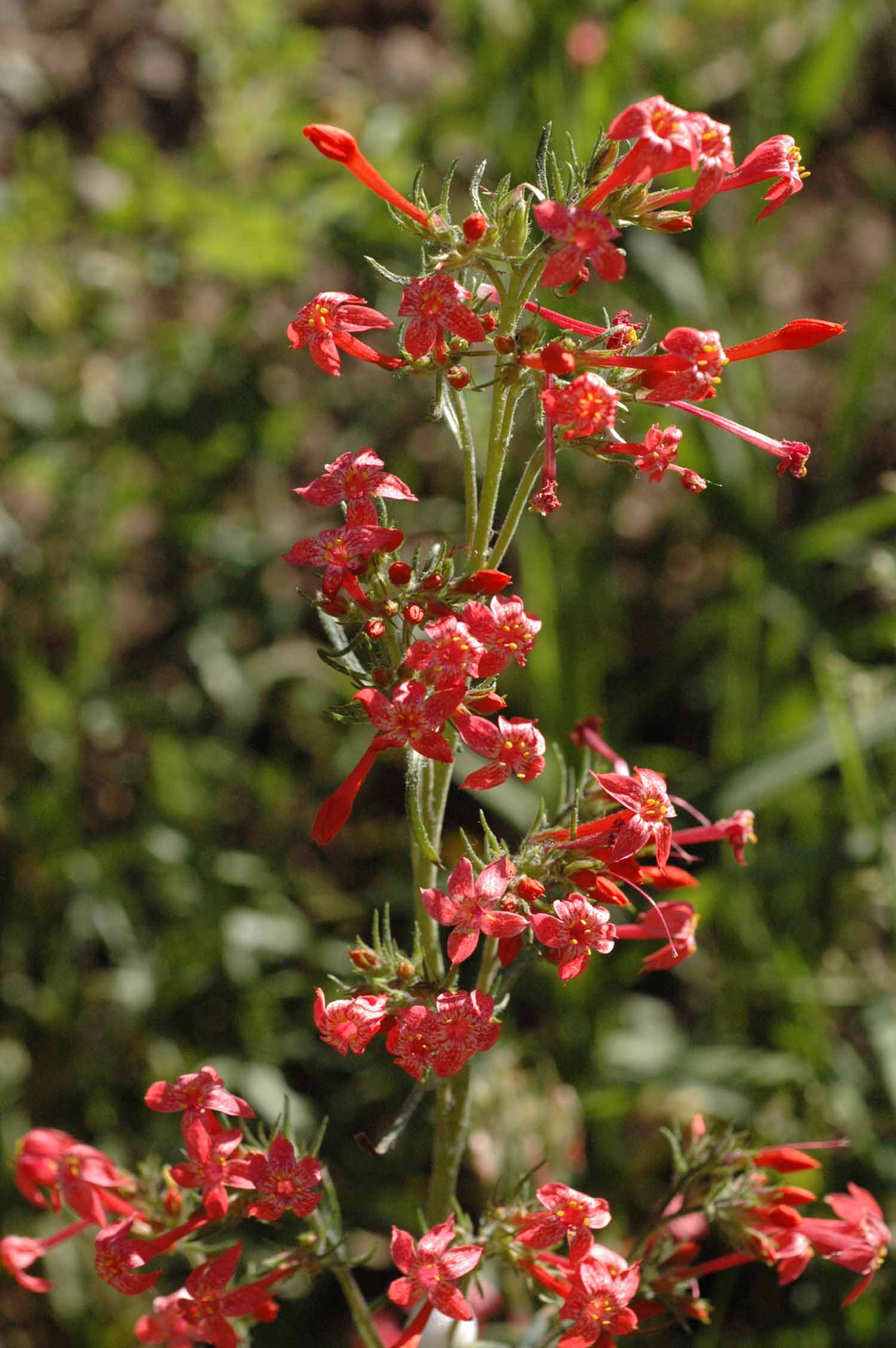
Hummingbirds are attracted to the red tubular flowers of Scarlet GiliaIpomopsis aggregata.  Seeing red (many insects can’t), the bird can hover, insert its long beak, and extend its tongue to lap (not suck) up nectar deep inside the tough tube of petals.  In the process, the bird’s head gets dusted with pollen grains which it carries onto the next flower.  There, its forehead gets bonked by the extended stigma of the ready flower.  Thus the flower is pollinated! Of course this happens at the lightning speed of the flying hummingbird.

Tucked in between the larger plants are a few others such as very fragant Long-leaved Phlox and the confusing False Dandelions and Hawksbeards are out now.  They each have their ways of accomodating pollinators.

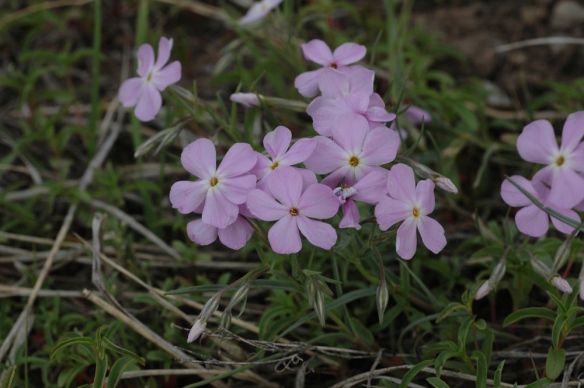
PhloLong_flst_Mung_6.24.17_1a_Q2_crp_5x3_240

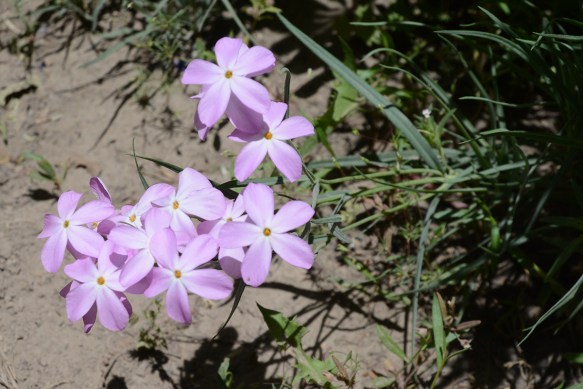
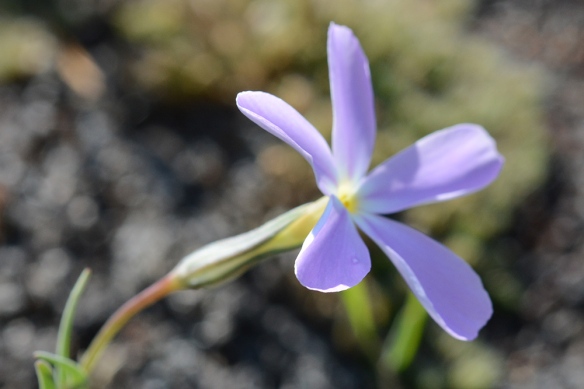
Long-leaved phlox – Phlox longifolia – seems to peer up from the trail.  Unlike its cushiony early-spring relatives, this species has 10-12″-long stems and 2-3″ long narrow opposite leaves.  

PhloLong_FlCU_Schw_8.16_1_x53

The beguiling fragrance of Long-leaved PhloxPhlox longifolia – attracts small flies, bee flies, and butterflies to the bluish to pink 5-petaled flowers. Only the insects with just the right length mouthparts can reach down the long tube to the nectar deep within, and in the meantime the flower is pollinated.

AgosGlau_fl_AntFl_71111_med

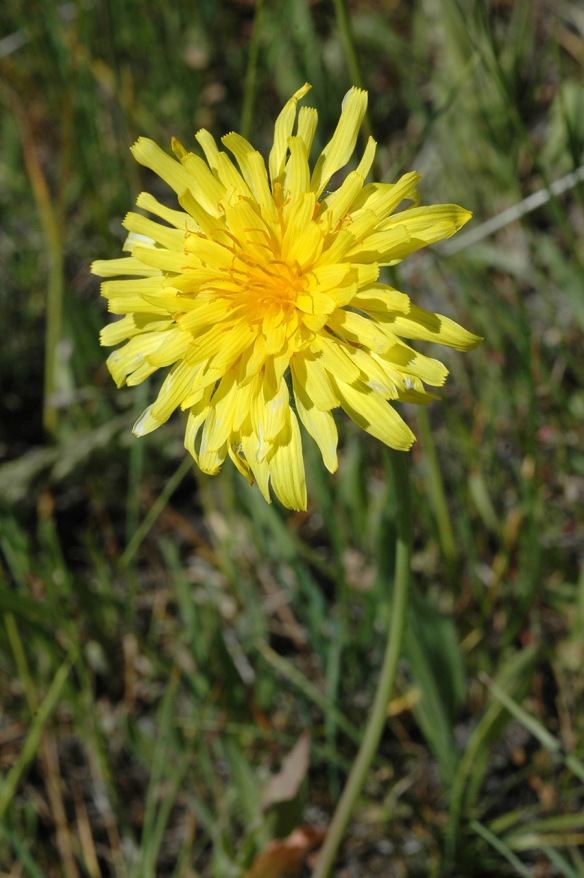
Mountain DandelionAgoseris glauca – looks very much like a dandelion, but look closely….The green bracts that surround the flower heads are different.  In the dandelion – Taraxacum officionale – the outer bracts bend backward (left below), vs. their standing up on the Mountain Dandelion (right below)

B_AgosGlauLac_fr_AntFl_7513_1aSm

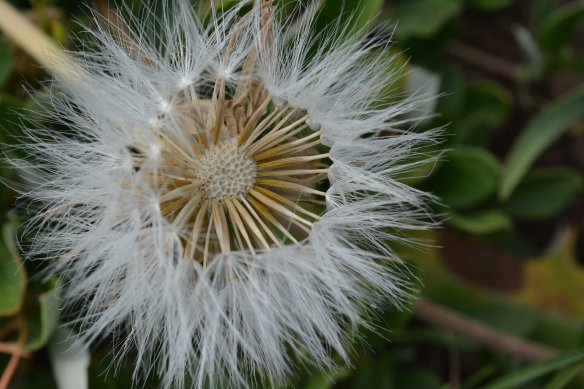
Also the seeds are different than the weedy dandelion as they do not have rough ribs with nubs on them.  The finely ribbed fruits of False Dandelion are carried off by white parachutes of bristles pappus. (Yes, very like dandelions!)  There are 3 subspecies of mountain dandelions, for those hard-core botanists who wish to pursue the differences.

2a.CrepcfAcum_habfl_AntFl_63013_1bQ2_3x5sm

HawksbeardsCrepis sp. – are robust plants of the sageflats. The leaves bunch at the base but also grow up the branching 8-16+” stems (unlike mountain or common dandelions). The leaves are often sword-shaped and variably pinnately (branching like a feather), toothed, lobed, or dissected.  The flower heads can have a few to many many individual flowers.  It is easy to see 3-4 species blooming in the same area.

B_GeraVisc_fl_SkiLk_62613

Unlike some of the complicated flowers shown above, Sticky GeraniumGeranium viscosissimum – is wide open to pollinators.  The five petals have lines directing insects into the center of the flower where the nectar lies hidden (nectar guides).  Geraniums seem to be flowering everywhere now — sage-covered hillsides to aspen woodlands.  Sticky geraniums are obviously adaptable and persistent.  


A couple of other flowers may go unseen in the sage-flat habitats either because they appear a bit wispy or are short and pudgy.  They are both remarkably hardy to dry sites.

EregCong_fl_AntFl_62415_1

In mostly dry locations, delicate Ballhead SandwortEremogone congesta – is abundantly scattered in delicate clumps among more robust plants. Sandwort is in the same family as florist carnations and garden pinks, sporting opposite needle-like leaves joined together in a bit of a bump on the stem. ‘Congesta’ in the botanical name refers to several small white flowers grouped tightly together in a head at the top of each wiry stem.

SeduLanc_flCU_ChitTr_YNP_72111_2CrpMed

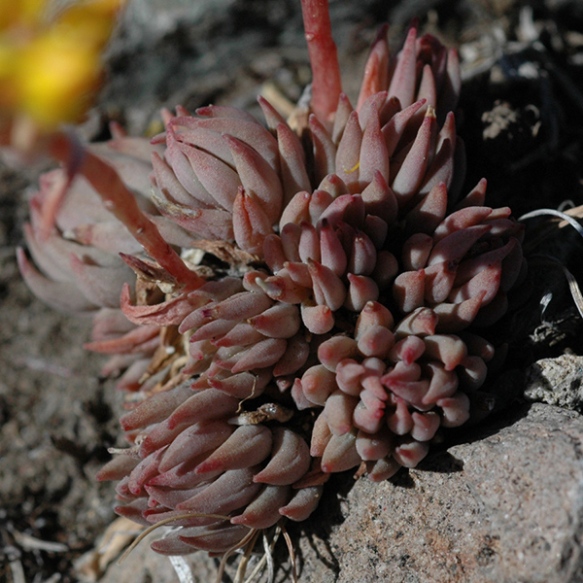
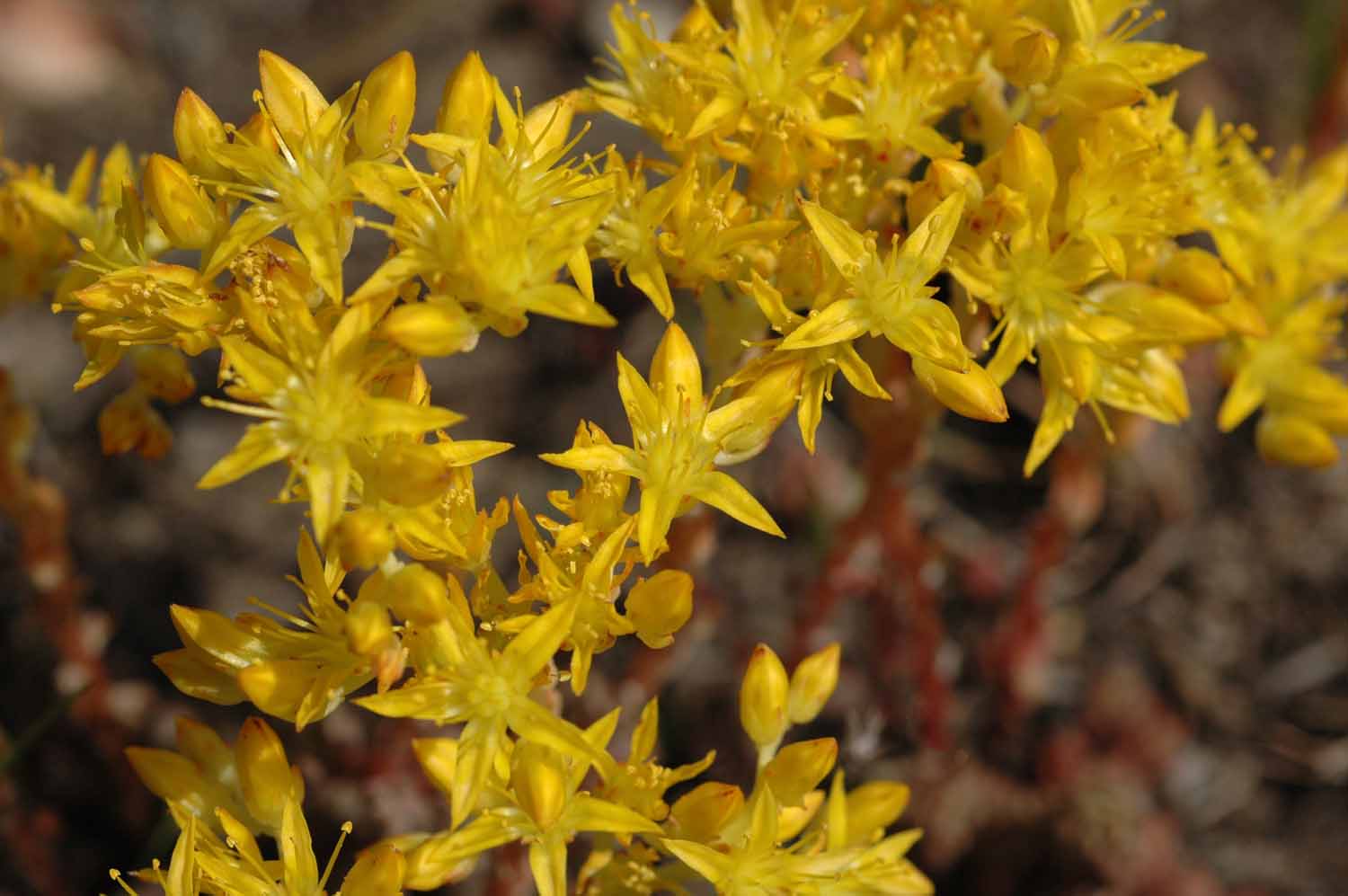
The bright yellow, star-shaped flowers on 6″ stems of Lance-leaved Stonecrops are beginning to show up.  If pollinated, flowers will produce seed that can scatter widely from beneath the parent plant.  But what happens if the pollinator doesn’t visit….?

SeduLanc_lvs_ChitTr_YNP_72111_crp3x3

If knocked off the plant, the small 1/4-1/2″ succulent leaves, bundled at the base of flower stalks, can grow roots and start whole new plants, which is one way stonecrops can move around the neighborhood. Lance-leaved StonecropSedum lanceolatum – is related to hens and chicks, popular garden and house plants. 

Also scattered midway up the inner park road, are two species of the Parsely Family, that you may notice as they can be quite showy in spots.  They were blooming around the Sawmill pond overlook along Moose-Wilson Road about a week or more ago.

PeriBola_flhab_MWrd_61413_2_Crp_5x3_200

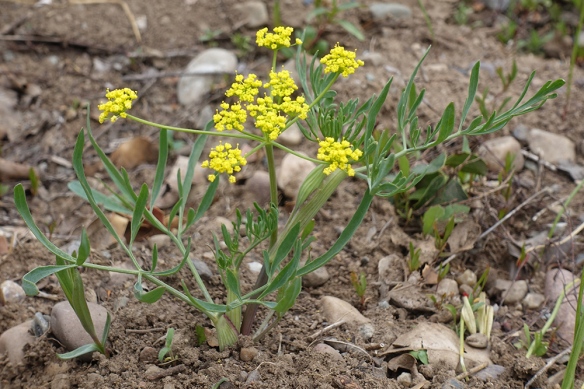
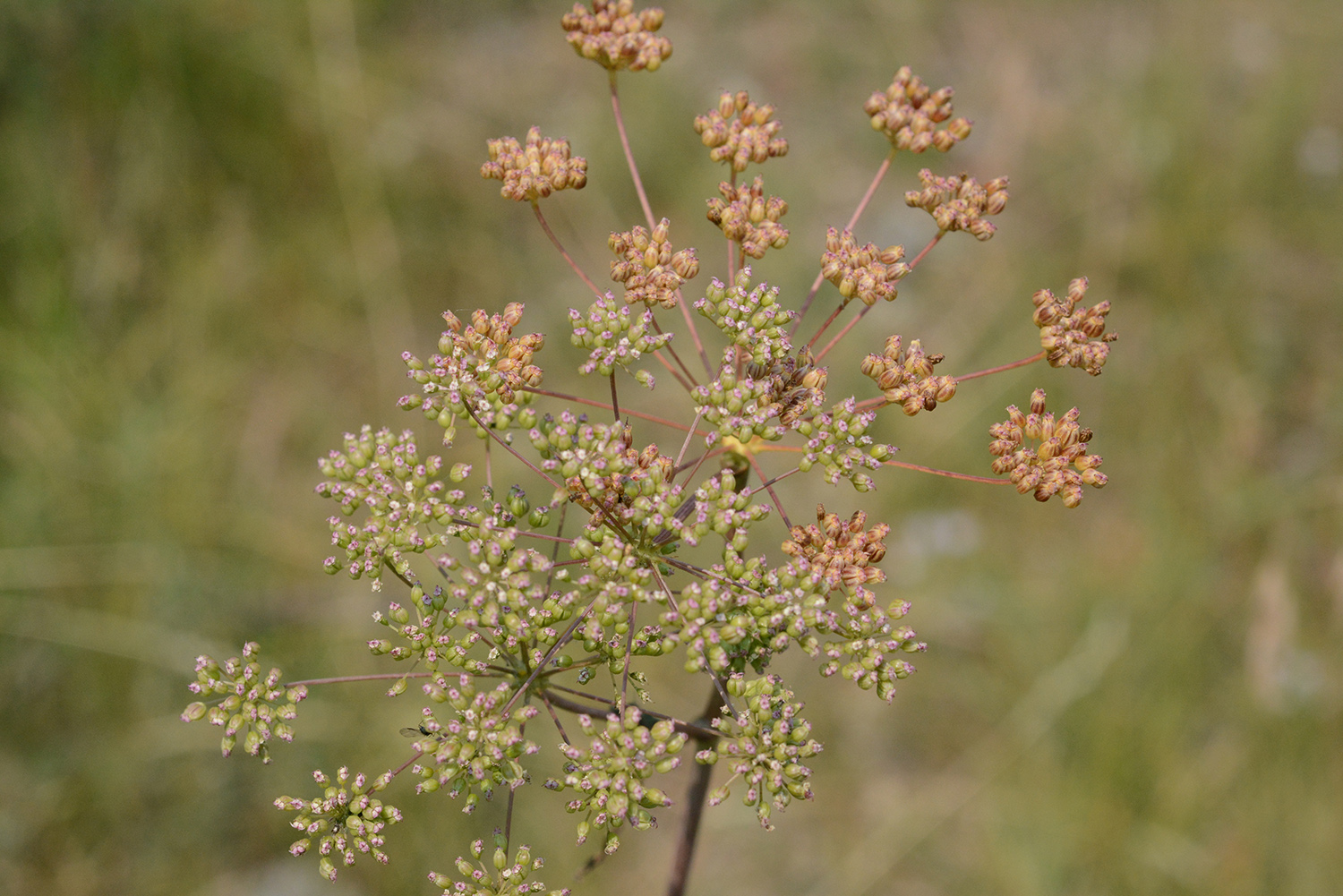
Two members of the Parsley or Apiaceae Family, (previously the Umbelliferae family because of their characteristic arrangement of tiny flower on the tips of umbrella-like petioles) are in bloom.  One is a delicate, white, 2-foot tall relative of the Common Yampah – Boland Yampah – Perideridia bolanderi.  The other is plant growing below is the a sharp-yellow Wyeth BiscuitrootLomatium ambiguum.  This latter is forming tangy seeds.

There are many more flowers out there, but two more species might fascinate botany nerds, who dive into the details.

AnteLuzu_Flst_LupMea_6.17.17_1_Q2_3x5_200

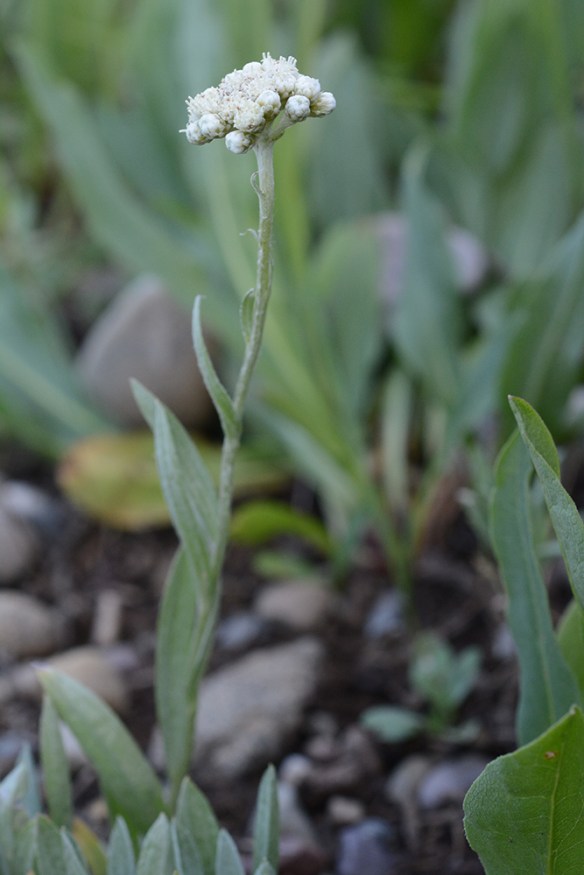
The many pussytoes – Antennaria species — are confusing to ID.  Partly this is because they can set seeds without cross pollination, and in the process double the chromosome numbers in their off-spring.  Some species also just plain hybridize with close relatives.  These “complexes” create overlapping, confounding identification features.  Upon close examination, this species was clearly Antennaria luzuloides or Rush Pussytoes.

AnteLuzu_Fl_LupMea_6.17.17_1a_Q2_crp_5x3_200

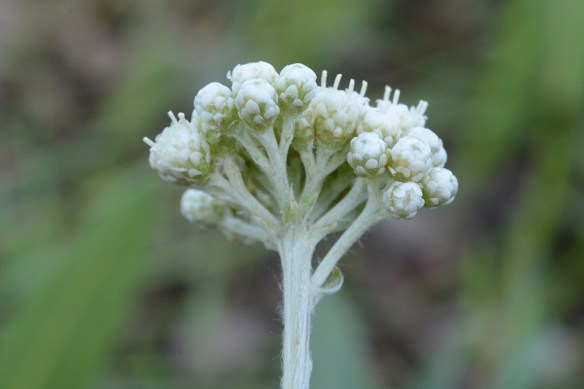
Besides the fairly large leaves going up the stem (vs only forming a close mat of tiny leaves at the base), the bracts around the flower heads of Rush Pussytoes — Antennaria luzuloides – are smooth, not fuzzy as is often the case in pussy-toes.  These bracts are also light green to white, with no black.  

MicrNuta_fr_AntFl_6.19.17_1_Q2_crp_5x3_200

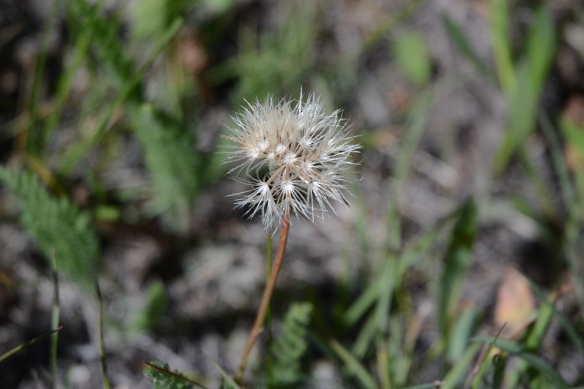
Hiding under the colorful wildflowers of the moment, on 6″ stalks, these 1″ balls reminiscent of dandelions, might catch the eye.  Look closely….

MicrNuta_frCU_AntFl_6.19.17_1b_Q2_crp_5x3_240

These are heads of Nodding microserisMicroseris nutans.  Flower heads of yellow, dandelion- like flowers have formed fruits, one per former flower.  The pappus that will carry the fruit away is delicately formed.  The base of each pappus bristle broadens out, catching the sunlight like a drop of water.  Spring is fleeting.

BTNF_Mung_WalWld_VwS_WyetAmpl_PursTrid_6.22.17_5_Q2_5x3_180.jpg

WyetAmpl_flCU_191GrosVrd_71111_1v

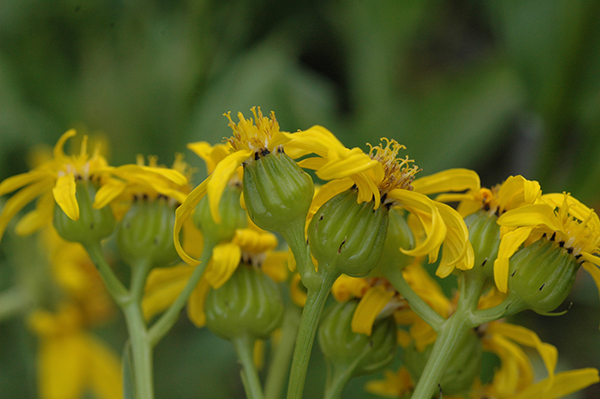
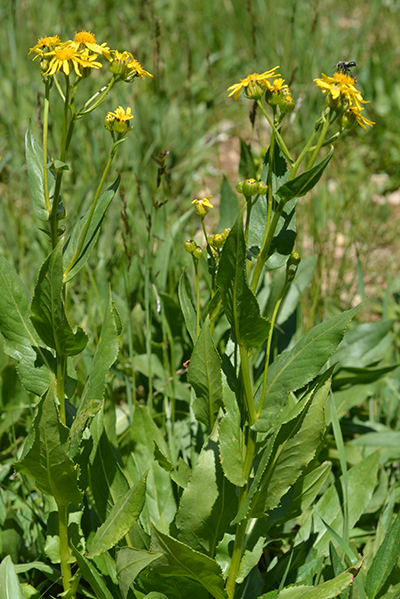
Mulesears have large, dark yellow flowers, 12-18″ elongate, deep green leaves. It grows in heavier soils than Balsamroot. 

There are many more flowers to see.  The Mulesears on Munger Mountain–Wally’s World Trail, accessed off Fall Creek Road, south of Wilson, is at peak right along with many of the flowers described above and more.

We hope to have the next post show what to see on some of these open ridges and aspen groves around Jackson Hole.

Frances Clark, Wilson, WY – June 25

P.S. We always appreciate comments, particularly notice of any errors.  We strive to be accurate in our identification and descriptions.


Earliest of Spring Flowers

TNP17_BlkTBt_Sslope_4.13.17Spring is arriving at its own pace here in Jackson Hole. We are all eager to see flowers!
Early spring flowers hug the warm ground:

Best to hunt along south-facing slopes or sagebrush spots where snow has recently melted and sun has had a chance to warm the ground long enough to encourage both flowers and insects to emerge.

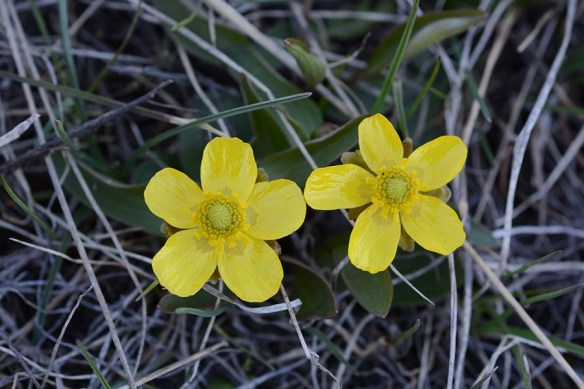
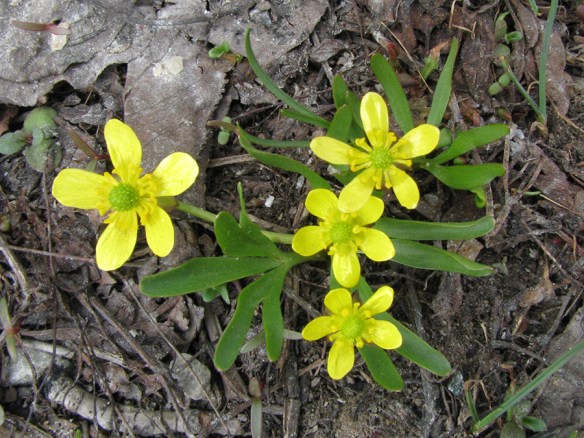
Glistening yellow saucers of Sage Buttercup (Ranunculus glaberrimus) are held just above the ground where sun adds extra warmth beneath the wind.   Often one can see large colonies. The north end of Moose-Wilson Road just west of the Murie Center road will soon be aglow.

RanuJovi_WBrk_4.12.17_1crp_rota_3x5_180

There are two look-alike species of spring buttercups.  This one is Utah Buttercup.  Can you tell why?

WyPl_RanuJovi_fllv_AntFl_42415_1_crp_5x3_180sm

Utah Buttercup (Ranunculus jovis) has 3-5 parted, lobed to divided leaves.  These plants were found in a remnant patch of sagebrush in Wilson.

RanuGlab_fl2_BltB_4.13.17_1_crp5x3_180sm

Sage Buttercup (Ranunuclus glaberrimus) has whole leaves.  Note the many yellow anthers surrounding a slightly conical set of pistils in the center.  These plants were nestled into the dry slopes of Blacktail Butte.

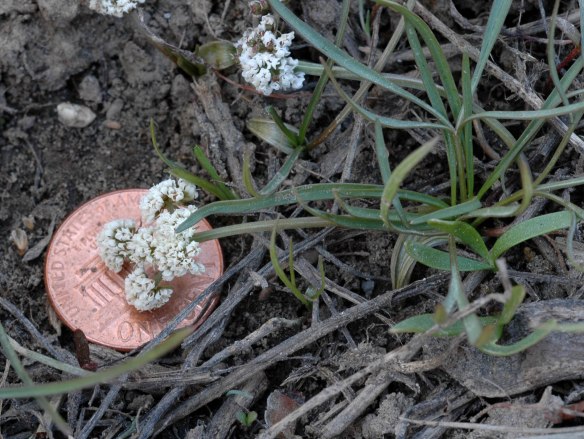
Tiny Orogenia (O. linearifolia) or Turkey Peas is barely visible amidst withered vegetation from the year before. This member of the parsley family has miniature umbels of dingy white flowers and narrow leaves. Hard to spot.

OrogLin_FlSt_Pen_WilBrk_41012_1bsm2

The flowers of Turkey Peas or Orogenia are truely tiny. Note the leaves are slender like grass.

7aOroLin_bulbCU_WilBrk_4912_1Q2-34x34

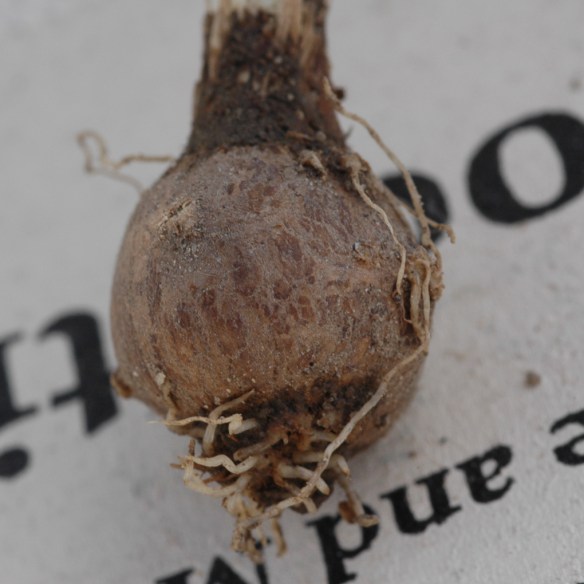
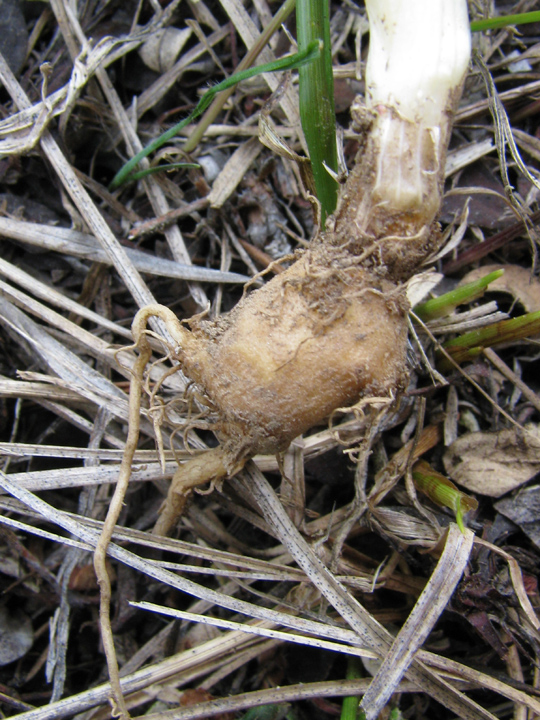
The underground corms store food over winter – appealing to “turkeys” or– here in Jakcson Hole — sandhill cranes and other critters.  These are indeed pea size. (Corms are swollen stems – note the roots come out of the base of the bulge, a clue that all above is stem.  Crocus is a corm as well.)

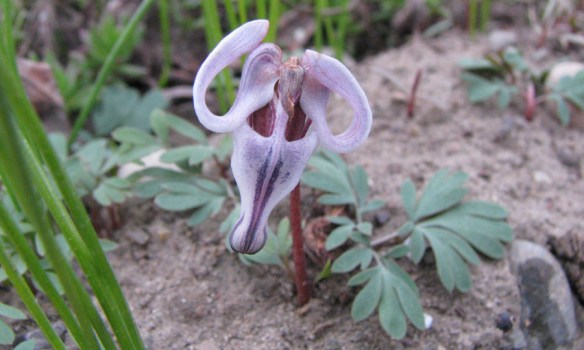
Steer’s-heads (Dicentra uniflora) are also a spring favorite which requires sharp eyes to see.  If you are lucky, you may find a stampede of Steer’s-head.

DiceUni_flCU_nrMurieCtr_52111_2a_5x3_180sm

This truly western flower — aptly named Steer’s head – nods just above its bluish-green, divided leaves (two leaves in this picture).  Pollinators push in from the sides. The plant is about 1-2″ tall.

Twin Bladderpod (Physaria didymocarpa) — featuring 4 yellow petals typical of the mustard family — is scattered in bunches on south-facing dry slopes, such as Blacktail Butte and above Kelly Warm Springs.

PhysDidy_flhabtop_BltB_4.13.17_1_crp5x3_180

The silvery tough leaves, which are shaped like a spade, are wholed into a rosette. The flowers are in clusters on longer stems.  Later they will form pairs of balloon-like fruits.  Hence the name Twin Bladderpod.

Several other members of the mustard family bloom early.

AllyAlly_flhab_BlkTB_4.13.17_1_crp5x3_180sm

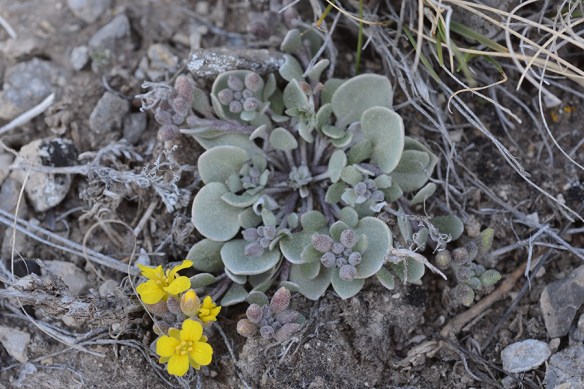
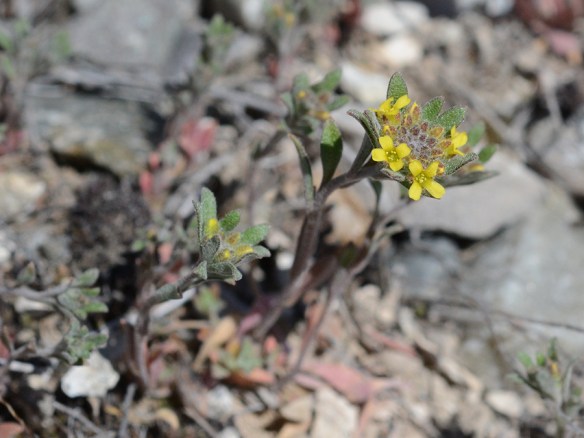
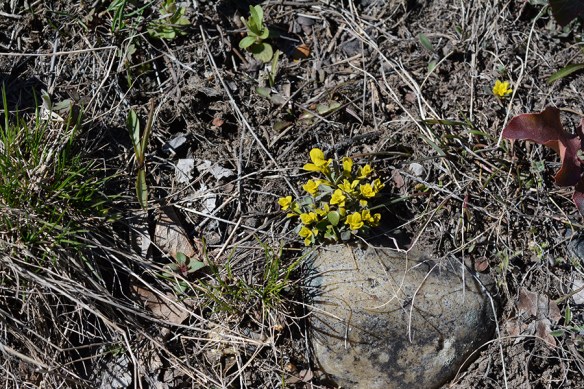
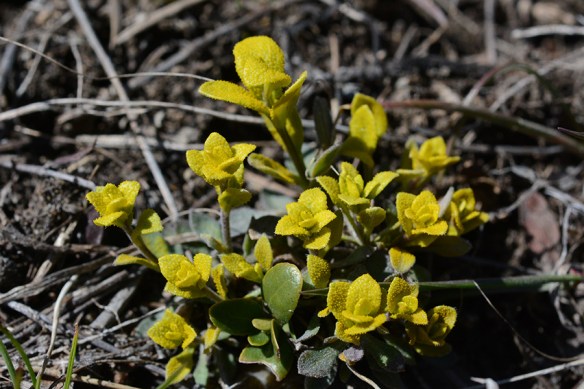
A somewhat weedy native mustard, Pale Alyssum (Alysum alyssoides) has tiny 4-petaled yellow flowers clustered at the top of 1-2″ stems.  As spring goes on, these annuals, perhaps biennials, grow a bit taller and can form colonies in disturbed places.  In fact, there are two close look- alikes determined only by their fruits (fruits are important in mustard ID!).  A. desertorum has smooth fruits, A. alyssoides hairy fruits.

Earnest botanists and pollinators alike can be “fooled” into thinking a fungus-infected mustard (typically rockcress) is in flower.

ArabFung_vwflhab_BlkTB_4.13.17_1_crp5x3_180sm

Pseudo-flower — looks like this rockcress is in bloom….but not. Look closely.

Arabfungi_flCU_BlkTB_4.13.17_1a_crp_5x3_180sm

A rust fungus (Puccinia sp.) causes the mustard to look like it is in flower, deceiving pollinators into spreading spores to other plants.  The fungus gets its nutrients from the young plant.

The rust fungus causes the young plant to form pseudo-flowers. Growing into the leaves, using the plant’s nutrients, the fungus causes the leaves to yellow and produce a sugary substance and even fragrance similar to flowers. The yellow pigment, which reflects strongly within the UV spectrum, is particularly bright to the eyes of insects. Attracted, pollinators land and crawl around looking for rewards of pollen or nectar and “disappointed,” depart carrying spores on feet and bodies to more mustard plants. The fungus is spread to benefit the fungus, not the plant or insect. In another twist of the story, at a later stage the fungus on the same plant may produce another type of spore that can infect nearby grasses….and the story is even more complicated than this! We can learn much from our mistakes!

BoecSp_flhab_BlkTB_4.13.17_1_drp_3x5_180

Rockcress  (Boechera sp) is often a host plant of the rust fungus.  Here the plant is blooming without infection.

Hood’s Phlox (Phlox hoodii) is just beginning to bloom in sagebrush and grassy habitats on slopes. Its fragrant flowers are worth getting down on hands and knees to sniff.

PhloHood_flhab_BltB_4.13.17_1_5x3-180sm

Hood’s Phlox (Phlox hoodii) just beginning to bloom on Blacktail Butte 4.13.17.

Others plants to look for:  Spring Beauties, spring parslies (Lomatium and Cymopteris), Yellowbells (Fritillaria pudica), pussytoes (Antennaria sp.), and more.

ClayLan_fllv_JosRdg_2614_1crp180sm

Spring BeautyClaytonia lanceolata – has 5-petaled, pinkish to white flowers in clusters atop stems with two, opposite, oval leaves.

CymoLonp_habfl_kws_42614_3Q1_crpsm

A Spring Parsely 

FriPud_FlHab_FallCrRd_41312_2fixSm

Yellowbells is a member of the Lily Family: count the 6 tepals and 6 anthers.

Let us know what you find!

Wind-pollinated flowers are stretching out on shrubs and trees.

WYHab_WL_MWRd_OWAlder_4.24.15Q2_5x3_180sm

Wetlands such as those found along Moose-Wilson Road are habitat for two wind-pollinated species in flower now.

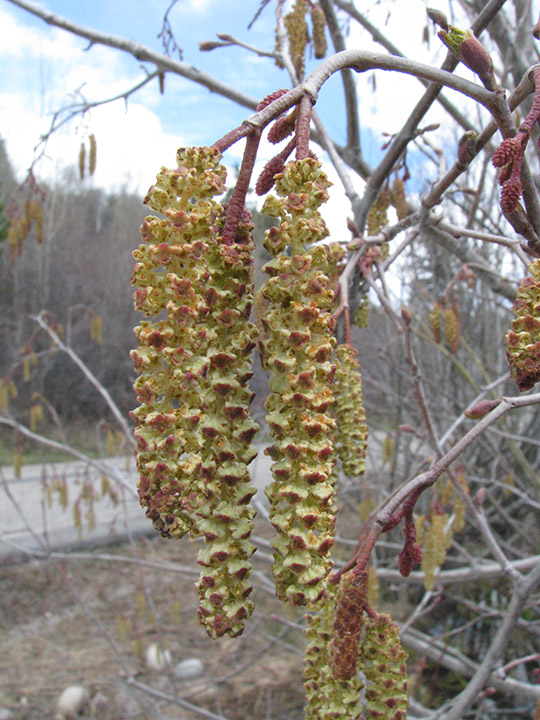
Wind pollinated flowers are not fancy.  There is no reason to show-off to the wind which cannot see.  Instead, flowers are often very inconspicuous with male and female flowers often on different plants or different parts of the same plant to avoid inbreeding. Often wind-pollinated plants grow in colonies, to better the odds for catching pollen. Pollen is abundant, again placing more bets in the gamble for successful wind pollination. It is fascinating to look very closely at the many tiny flowers arranged in “catkins.”  See if you can tell which catkins are males, which females.

AlnInc_fl_MWrd_51711_1csm

At first rusty brown, then stretching to yellow, male catkins of alder (Alnus incana var. tenuifolia) dangle in breezes near wetlands. Each dangle or “catkin” includes dozens of flowers.

AlnInc_Flfm_MWrd_51311_1sm

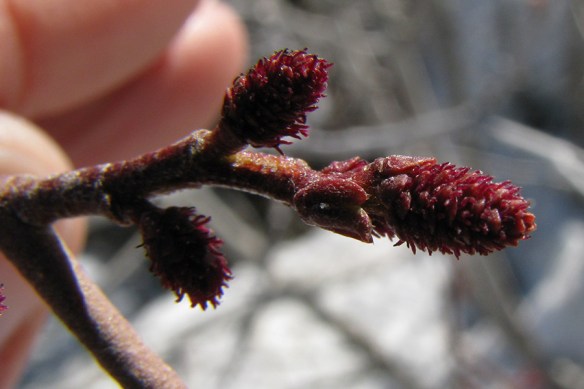
A bit back on the same branch, separate, stouter female catkins cluster in 3-4s.  The female stigmas stick out beyond scales which protect them.

AlnInc_fr_41414_MWRd_1_cpsm

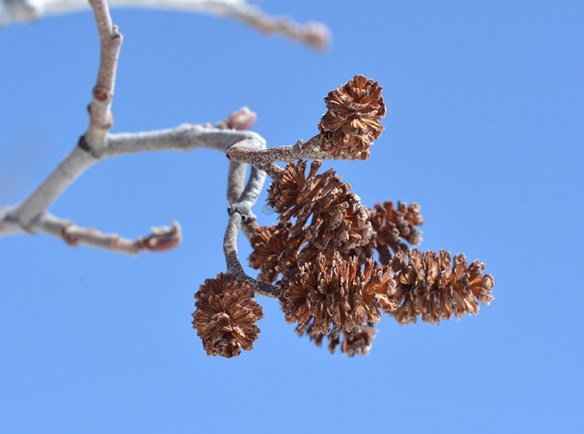
Later these structures will harden into brown “cones” which will open to relsease seeds in the fall. They persist into the next year, helping to identify this wetland shrub as an alder.

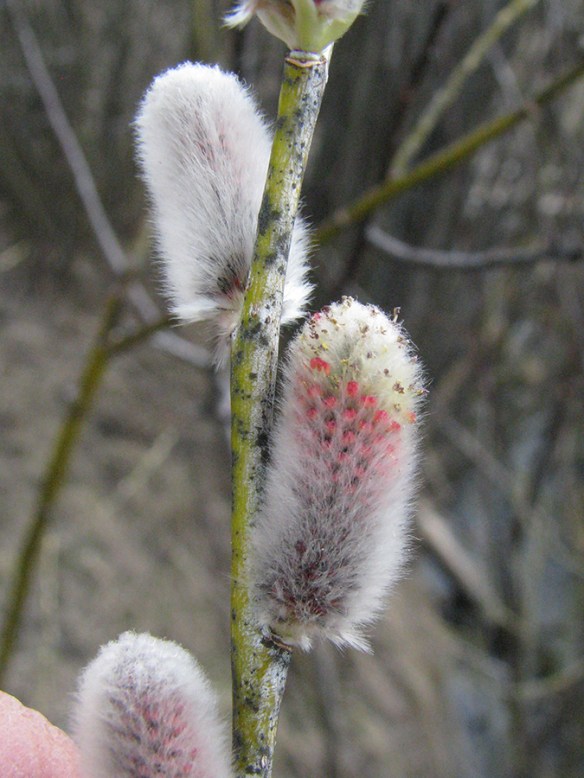
Willows (Salix spp.) produce upright “pussies” or male and female catkins, which are on separate plants to assure cross-pollination.

Salboo_Flm_CU_FallCrRd_41312_2_3x5_180sm

Some willows rely on wind to carry pollen to a nearby female plant–a chancy bet.  Others feature nectar glands and colorful stigmas and anthers to attract pollinators to do the job.

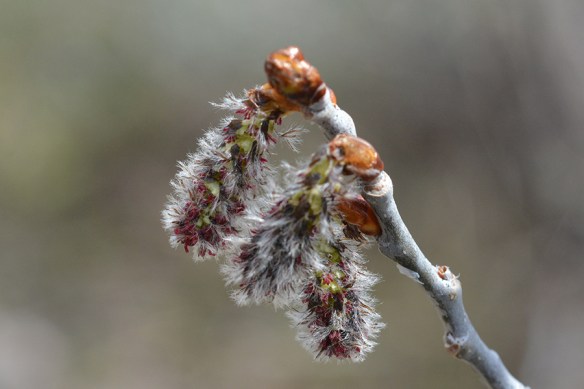
In the same family as willows (Salicaceae), Aspen trees (Populus tremuloides) appear “fuzzy” with long silvery catkins. Resembling furry gray caterpillars, 3-4” catkins have anthers tucked within small scales with tufts of hairs. See if the anthers have released yellow pollen yet. Can you find the smaller female catkins with red stigmas on separate trees nearby?

12b. PopTrem_fmFl_MosCrk_42814_3b_crp_5x3_180sm

Female aspen catkins.  Note the silvery white hairs which are attached to the greenish scales.  The marroon protrusions within are female stigmas.  Each scale protects the delicate fertile parts. There are dozens of flowers in each elongated catkin.

Enjoy investigating the flowers of spring. It is only the beginning of botanical adventures to come.

Frances Clark

April 14, 2017

Jackson Hole Flowers in Early June

With unseasonably high temperatures this past week, spring flowers are developing fruits and summer flowers are blooming strong throughout the southern end of Jackson Hole. These same species will have encores over the next week or so in the northern valley and into Yellowstone National Park.

Here are some of the most common and obvious wildflowers blooming in sagebrush dominated flats and hillsides.  We hope you will enjoy learning some plant names and how flowers are designed to attract pollinators. Enjoy the amazing diversity and beauty of plants.

TNP15_AntFl_vwBTBut_52915_1_5x3

Yellow composites:

Arrow-leaf BalsamrootBalsamorhiza sagittata – is the big showy “composite” seen on hillsides and sageflats right now.  The large flower heads illustrate the typical features of the Aster or Sunflower Family.  This is one of the largest flower families in the word with 1000s of intriguing variations which have evolved for success.

A_BalSag_FlCU_CurCan_6711smWeb

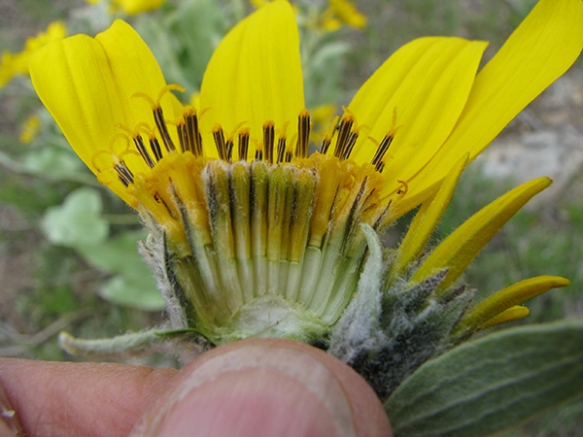
A cross-section of a Arrow-leaf Balsamroot flower head.

Around the outside of the so-called flower head, bright yellow “petals” are actually individual “ray” flowers with five fused petals flattened to one side. The “disc” flowers in the center are tiny flowers with 5 connected yellowish petals forming a flared tube.  Above each, a dark column of anthers wraps around an emerging stigma which arches into two parts, ready to capture pollen from visiting pollinators. (Note the outer disc flowers are in full bloom, the inner are still in bud.)  Hairy, silvery bracts surround the flat platform or “receptacle” holding the many individual flowers. (If this is too much information, just have fun looking closely!)

2. A_NER_BalsSagHab_52013_1Q2_5x4sm

Arrow-leaf Balsamroot has one flower head on each 1.5’ stem. The large leaves are arrow-shaped with silvery hairs and arise from the base of the plant.

Don’t confuse Balsamroot with the soon-to-flower Mule’s EarsWyethia amplexicaulis.

WyetAmpl_flCU_191GrosVrd_71111_1v

Mule’s Ears have large, deep yellow flowers with smooth bracts, and 12-18″ oval, deep green leaves which can grow along the stems. They grow in heavier soils than Balsamroot.

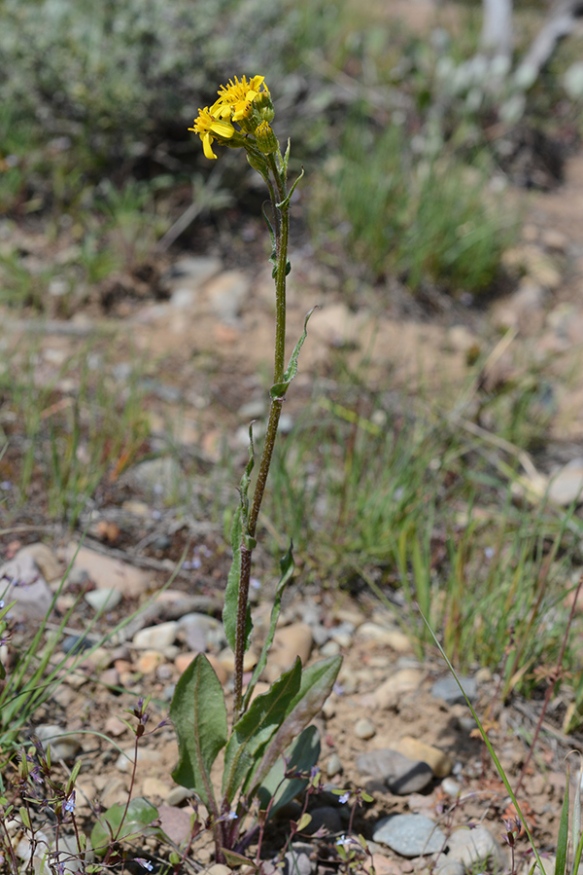
Western GroundselSenecio integerrimus – has several yellow flower heads with both ray and disc flowers on single stems. The plants usually grow to 8-12”.   SeneInte_habfl_RKO_5.28.16_2_3x5

SeneInte_flst_AntFl_5.27.16_1a_3x5

In Groundsels, bracts are all the same length – like a palisade fence – and are black tipped.

SeneInte_stCU_AntFl_5.27.16_1_crp_3x5

Along with these other features, cobwebby hairs on leaves and stem provide definitive ID of Western Groundsel.

At first glance, three other composites look like Common DandelionsTaraxacum officinale. They grow about 6-8” (or more) tall and have showy yellow heads with only ray or “ligulate” flowers. Look closely at bracts, number of flower heads, and the location and shape of leaves.

The fruits are very helpful in understanding why the taxonomists separate these genera. However, we have to wait until they ripen.  Practice by looking at dandelion fluff and fruits.

Dandelion (Taraxacum officinale)

Common Dandelion has all “ligulate” or “ray” flowers. Notice the leaves are all at the base (basal).

TaraOffi_flside_YNP_6.9.16_1_crp5x3

Note the two rows of bracts in Dandelions: bracts of the outer row fold down, those of the inner row are upright. Bracts are very helpful clues in ID of look-alike composite flowers.

False DandelionAgoseris glauca – also has only one head per plant. The bracts are variable. Leaves are all at the base or “basal.” Three varieties with different leaves and hairiness to the bracts are a challenge to botanists.

AgosGlau_fl_AntFl_71111_med

Mountain DandelionAgoseris glauca – looks very much like a dandelion, but look closely….

AgosGlacG_flCU_DMansB_52113_1Med

Mountain Dandelions have tidy, upward pointing bracts around each flower head. Some bracts can be hairy or smooth, depending on variety. Leaves vary, too.

Nodding Microseris Microseris nutans – is very similar to the above, but again look closely: there is often more than one flower per stem or plant and buds typically nod. Leaves are mostly basal, but one or two may attach to the stem, as well.

MicrNuta_habfl_BTTh_61514_4Q2_3x5

 Observe how  Nodding Microseris differs from the other species. Note the nodding buds.

Coming into bloom are several species of HawksbeardCrepis sp.

2a.CrepcfAcum_habfl_AntFl_63013_1bQ2_3x5sm

HawksbeardsCrepis sp. – are robust plants found in sageflats. The leaves bunch at the base but also grow up the branching 8-16” stems. The leaves are often sword shaped and variably pinnately toothed, lobed, or dissected.

2b.CrepModo_fl_AntFl_52814_1crp180Q2_3x3sm

In Hawksbeards, the number of flower heads varies, as does the number of individual ray flowers per head. Some species have stiff hairs,which can be black. All these features are used for ID the 3-4 species common in Jackson Hole.

Don’t miss the blues:

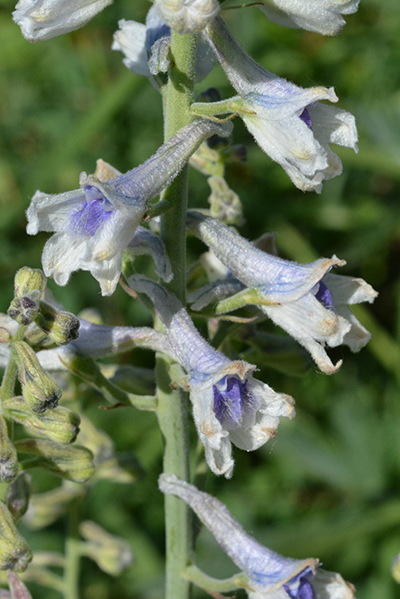
Low or Nuttall’s LarkspurDelphinium nuttallianum – has been blooming for a while. It attracts queen bumble bees, solitary bees, and in some places hummingbirds as pollinators.

2.A_DelpNutt_Hab_AntFl_51712_2a_5x3sm

Nuttall’s Larkspur is still blooming strong.

2b.A_DelpNutt_FlCU_AntFl_51613_1aQ2_5x3_sm

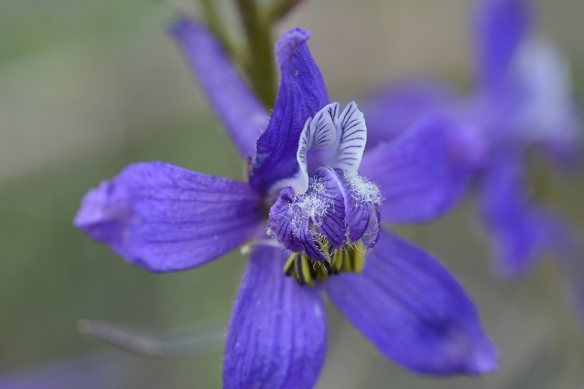
Larkspur flowers are intriguing: 5 deep blue-purple sepals flare out at the sides. The upper sepal forms a long tube behind called a “spur.” Four petals are designed to guide the pollinator into the center of the plant. The two white upper petals are stiff and sport blue “nectar guides.” Each of these petals extends back into the sepal spur and holds nectar as a reward for savvy pollinators. The lower two hairy blue petals flop down, shielding the anthers while also providing landing pads for insect pollinators.

At the right time, anthers shed pollen upon pushy pollinators. The pollinators, after a drink of nectar, fly off to a similar flower and with luck (for the plant) knocks the transported pollen onto the three receptive stigmas. Pollination and, hopefully, the formation of seeds has begun!

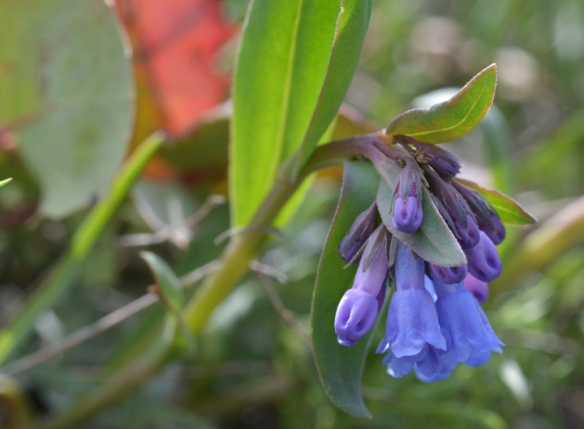
Mountain BluebellsMertensia viridis/oblongifolia – often grow on grassy slopes and amidst sage plants. Pollinators – bees, butterflies, and hummingbirds – are attracted at first to the curved bunch of pink and blue flowers.

A_MertObl_FlCU_JosRdg_2614_2acrp180sm

Pollinators zero in on individual blue flowers, where they hang or hover while reaching down the tube for nectar. Watch the color changes of the flowers as they ripen and then fade in the course of pollination and for what insects show up!

Long-leaved PhloxPhlox longifolia – grows taller and looser than earlier blooming white phloxes which are mat forming, such as Hood’s and Many-flowered Phloxes.

9b.PhloLong_fl_AntFl_51712_1b_5x3sm

Flowers of Long-leaved Phlox range in color from white to pink to bluish. The are often 4-6″ tall with 1″ leaves.

PhloLong_FlCU_Schw_8.16_1_x53

A beguiling fragrance attracts small flies, bee flies, and butterflies to the bluish to pinkish 5-petaled flowers. Only the insects with just the right length mouthparts can reach down the long tube to nectar deep within. Coincidentally, the flower is pollinated.

Other dashes of color:

Prairie SmokeGeum triflorum – is a member of the Rose Family. The leaves are about 4-6” long, and are “pinnately” (like a feather) dissected–looking “fern-like (although ferns are a whole different order of plants). Leaves cluster plentifully at the base of the spreading plants.

GeumTrif_Flhab_AntFl_52814_1crpmed

Prairie Smoke has many divided leaves and stalks dangling three flowers (hence the botanical name “triflorum“).

GeumTrif_FlCU_YNP_6.6.16_1a_Q2_crp3x5

Five fused maroon sepals (with extra bracteoles) surround the pale yellow petals of Prairie Smoke. Together they protect many anthers and pistils inside.

GeumTrif_frCU_BNR_6.2.16_1a_Q1_5x3

After pollination, each of many pistils mature into feathery fruits, to fly off in the breezes. The heads look like a “bad hair day.” Many fruits together provide the “prairie smoke” effect.

Puccoon, Stoneseed, GromwellLithospermum ruderale – is a robust plant in the Borage Family.

LithRude_habfl_antFl_52613_2_5x3

Flowers of StoneseedLithospermum ruderale – are held in the axils of the 1-3″ linear leaves on 1-2′ stems.

LithRude_fl_MWrd_5.27.16_1a_5x3

The pale yellow flowers have a delicate lemon-like fragrance, worth bending down for a  sniff. They attract bumblebees, hawkmoths, solitary bees, and flies.

LithRude_frSt_RKO_81813_3Q2_4x3sm

Later, flowers will form white fruits with very tough seeds inside…hence the botanical name, which translates into “stone seed.”  The seeds are readily predated by deer mice.

Many peoples have used this plant for a variety of medicinal purposes, a reason why it has so many common names.

Three particularly abundant species:

Wyeth Biscuit RootLomatium ambiguum – with its wide spreading “umbels” of tiny bright yellow flowers is still growing in abundance at the Sawmill Pond Overlook and along the inner park road.

LomaAmb_habfl_BTTh_61514_1web

Wyeth Biscuit RootLomatium ambiguum – grows along dry, disturbed road sides in the park.

LomaAmbi_habfl_MWRd_5.16.16_2a_Q2_5x3 copy

The tiny bright yellow flowers are in umbels (think umbrellas) typical of the Parsley Family. The leaves are dissected into at least 9 segments of various lengths and width. Note the swollen leaf bases.

LomaAmbi_Rt_SpauBayRd_6811_1Q2_3x5

The tuber-like roots were eaten by Native Americans and are sought after by rodents and bears.

It is easy at first to confuse Wyeth Biscuit Root with its more obscure relative. Nine-leaf Spring Parsley – Lomatium simplex var. simplex – has pale yellow flowers and leaves dissected into 9 long, thin segments of equal width and length.

LomaSimp_lfstfl_DmBar_5712_2Q2_5x3

Note the grayish 9-parted leaves and the pale yellow flowers (which will spread into wider umbels) on Nine-leaf Spring Parsley.

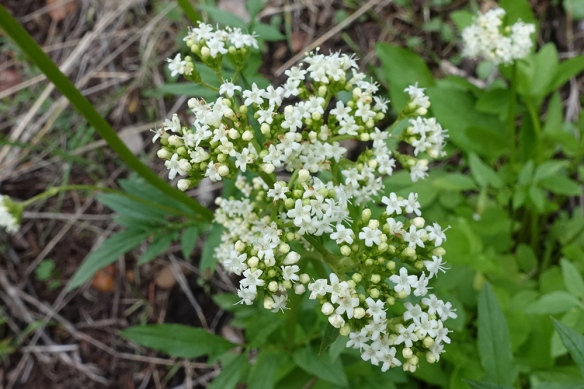
Western ValerianValeriana occidentalis – appears in almost every habitat – grassy hillsides, near wetlands, and sage flats.  While some promote Valerian as a sleep aide, it contains very toxic chemicals.  Plants develop such chemicals for defense.  Always research carefully any “medicinal” herbs.

ValeOcci_Fl_GameCrk_5.24.16_1_crp_5x3

Note the tiny flowers of  Western Valerian.  In the field, observe how the clusters are held in an “candle-arbor like” arrangement.

ValeOcci_Flhab_GameCrk_5.24.16_3_crp_3x5

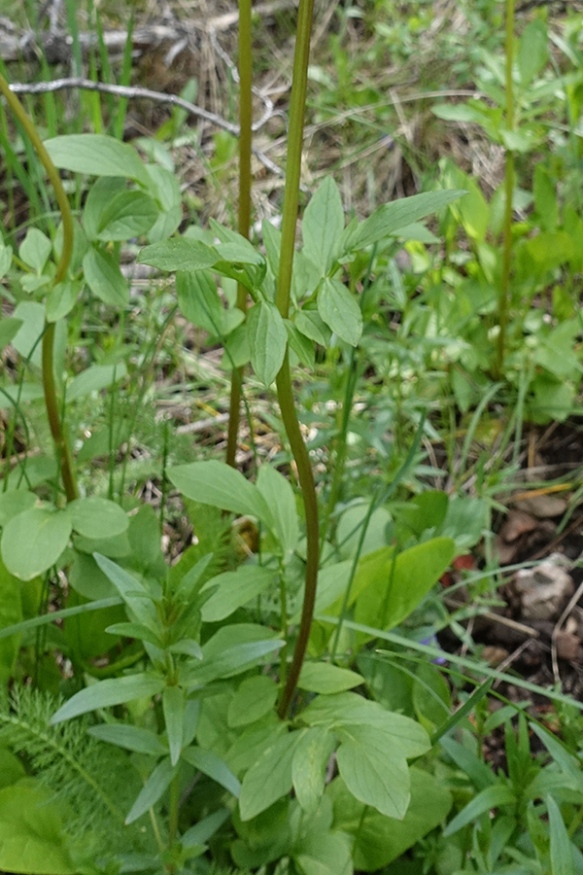
Leaves on the stem are opposite and pinnately compound.  Those at the base are usually undivided ovals.

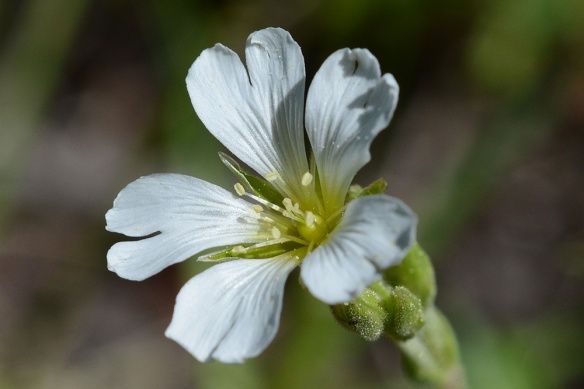
Bright white Field ChickweedCerastium arvense – is found often in disturbed habitats.

CeraArver_FLCU_MWOL-5.28.16_1Q2_crp_5x3

Each petal of Field Chickweed is notched at the tip. Can you count the number of anthers and styles in the center?

CeraArve_lfAxil_YNP_6.6.16_1_Q2_crp_5x3

The sharp-pointed, needle-like leaves are opposite on the 6-8” stems and often have extra leaves in the axils, which help distinguish it from Bering Chickweed – C. beeringianum – of subalpine and alpine habitats.

Many more flowers are in bloom on dry knolls and hillsides and in relatively moist forest edges. And new flowers will continue to bloom in the flats.  We will post additional information soon.

Frances Clark

Wilson, WY – June 10, 2016

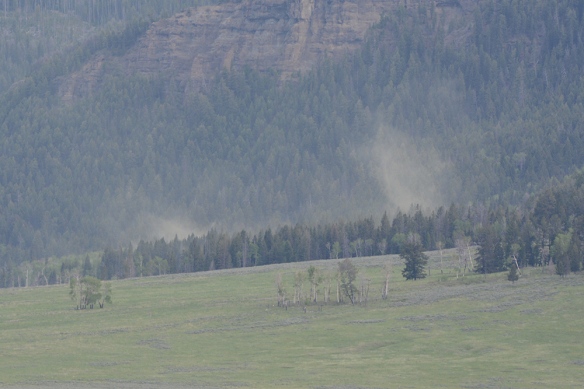
P.S.  Of particular note at this moment of writing, is the phenomenal amount of pollen being shed by Lodgepole Pines (and perhaps other conifers.)  The photo taken in the Lamar Valley three days ago is representative of what is happening all around us now.

YNP16_Lamar_Pollen_6.6.16_1_crp_5x3

Pine pollen looks like a fire starting in Yellowstone’s Lamar Valley on June 6, 2016. Expect a big cone year in fall 2017.

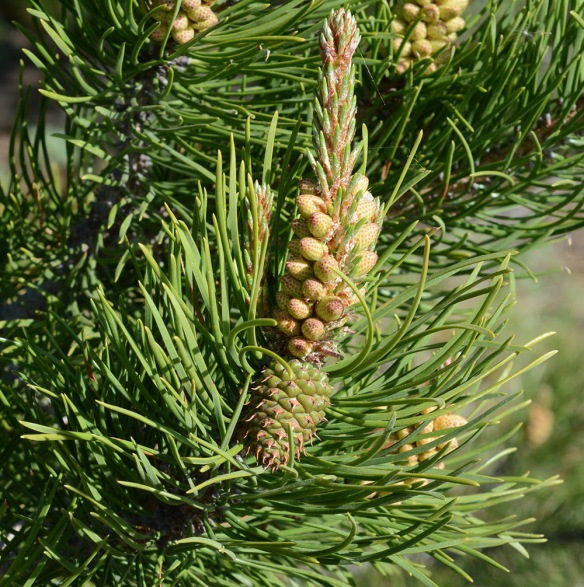
PinuCont_BrMale_YNP_6.9.16_1_crp_5x5

In this photo, the stack of male pine “cones”  will soon shed thousands of pollen grains upon the wind and, with lot of luck, pollen will land on separate female cones.  However, pine seeds be ripe until 18 months from now. The green female cone shown here is from last spring’s pollen event.


Summer Falling in the Tetons

These last few days of summer hold memories of weeks past and expectations of weeks to come. Flowers are transforming into fruits and leaves are turning from shades of greens into hues of yellows, reds, and oranges.

Ski Lake Trail

Shadows lengthen as days shorten upon the montane meadows of Ski Lake Trail, Bridger Teton National Park.

Aster Flowers and More:

Several wildflowers are still blooming, although they look rather ragged. Most are members of the Aster Family and sport many guises. The typical “aster” flowers attract the final, almost “desperate” pollinators, which are clinging to flower heads seeking remnant nectar and pollen. A few sunflower-like species still shine along roadways. Other flowers are individually very discreet, at least until they bloom together in such forces that you can’t fail to notice the yellow cast of pollen. And yet another species just stinks.

Note: Identification of Asters emphasizes “bracts”. These leaf-like structures surround the heads.  Heads consist of the bracts, a receptacle (platform), and many individual flowers whorled inside. Bracts are highly variable, beautiful, and helpful in ID. (also note in identification of any plant: look at several individuals to get full variation in size, color, features.)

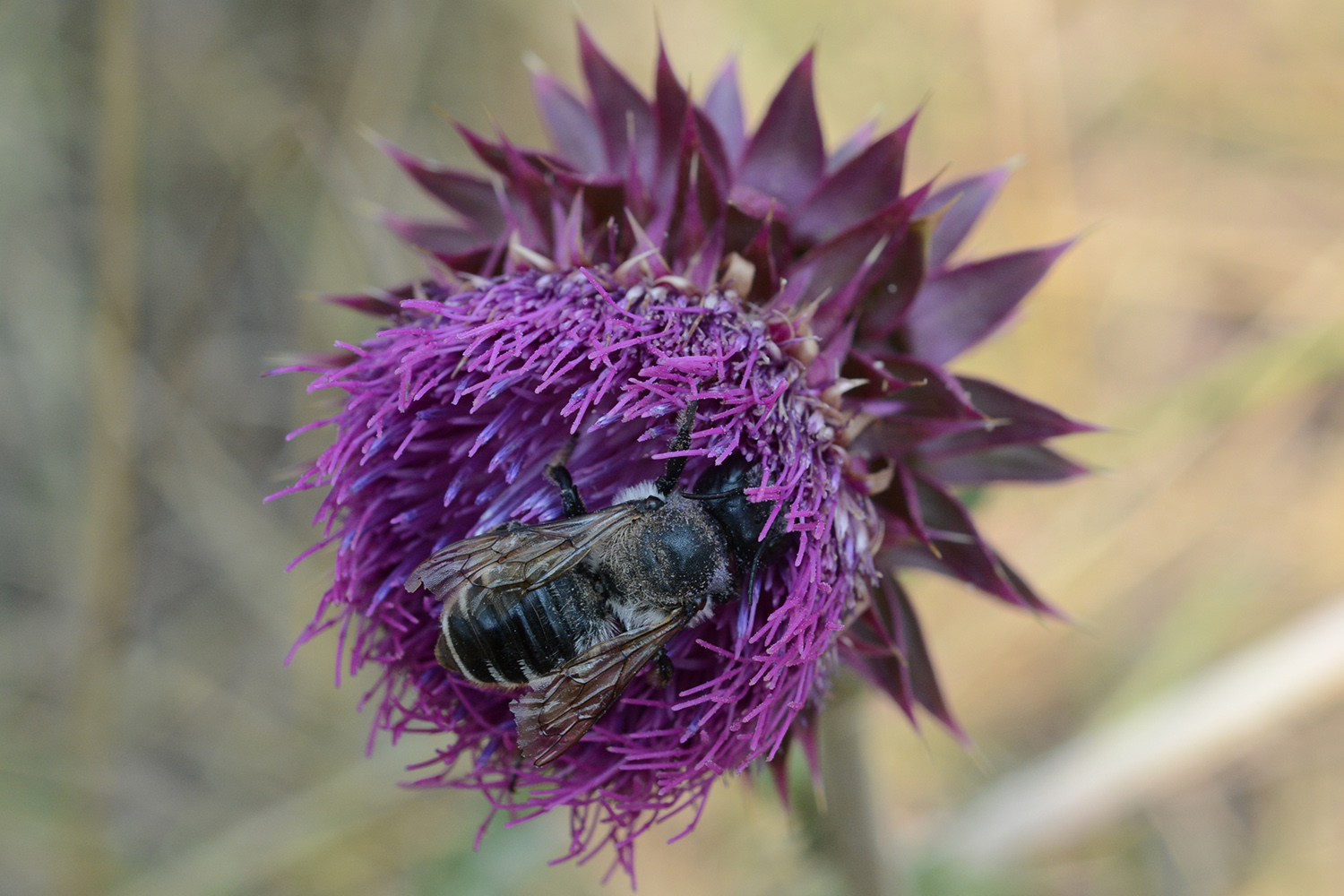
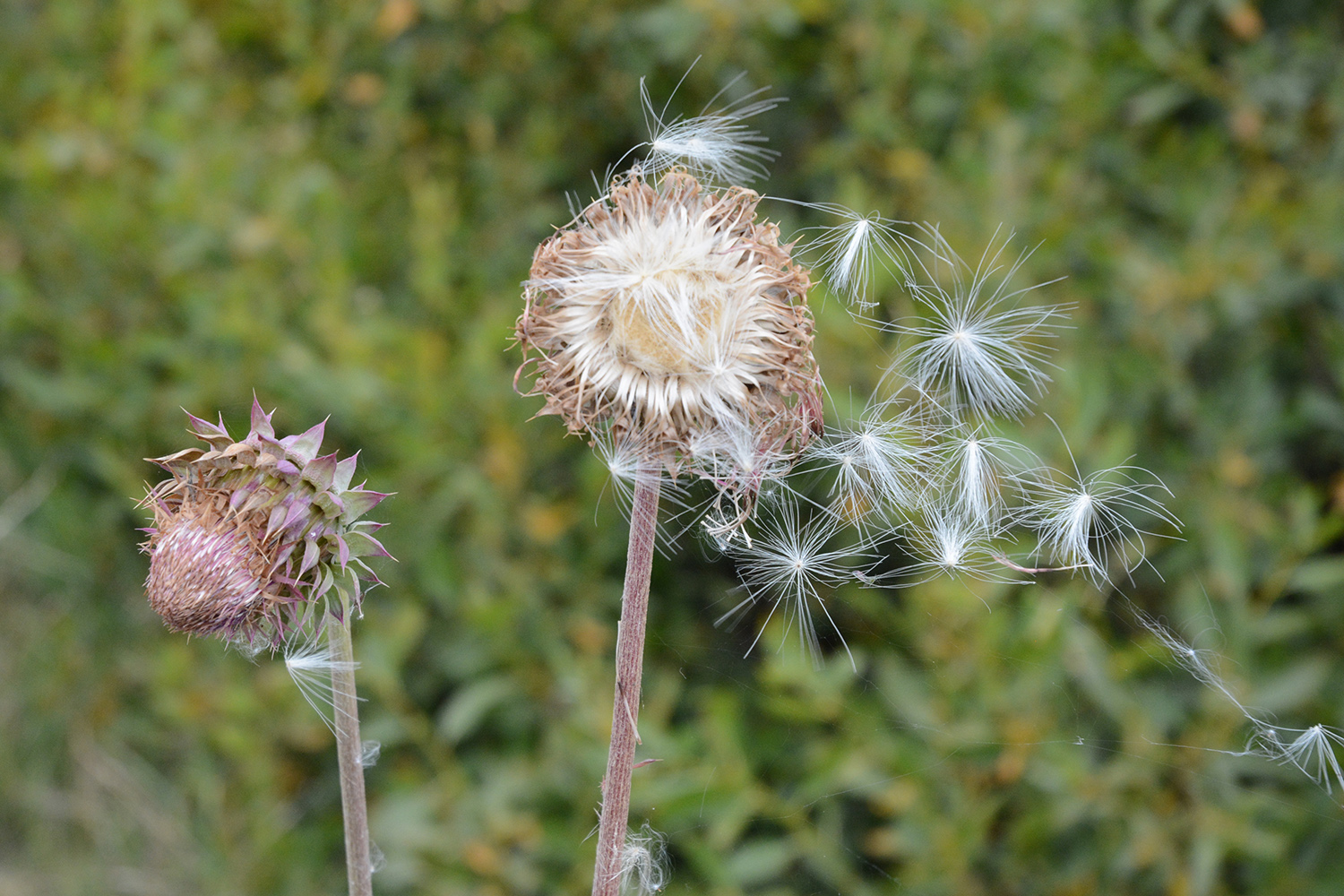
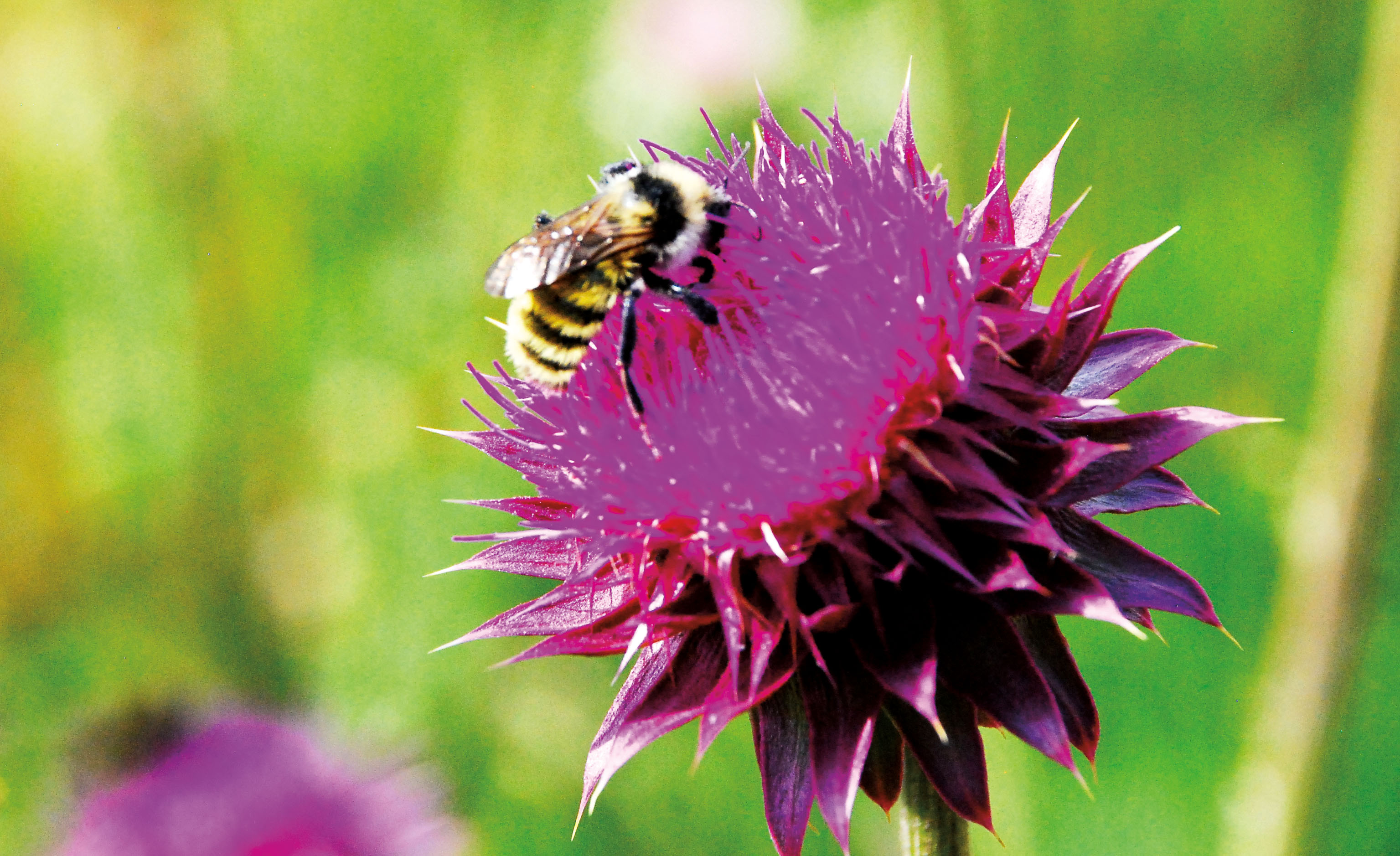
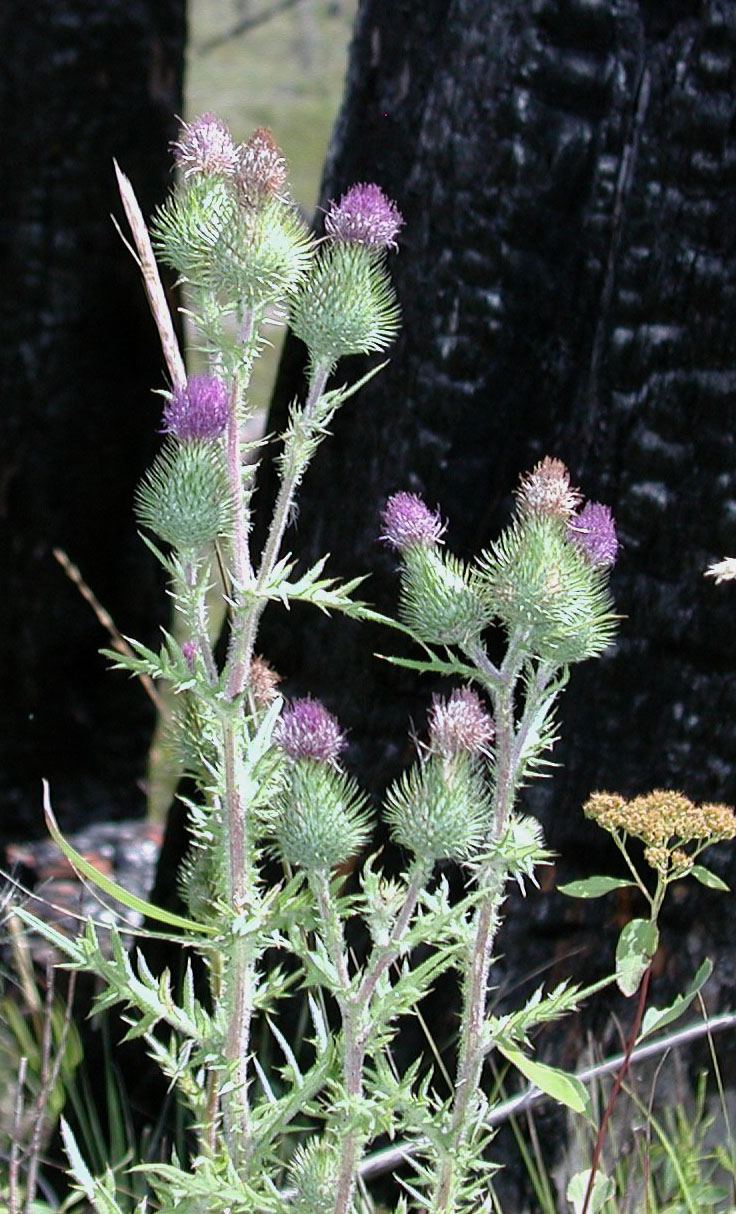
The non-native, invasive, but forever fascinating and in fact beautiful, Musk ThistleCarduus nutans – represents the change of the season:

A bumblebee digs deep into the elongate violet blue flowers surrounded by the armour of stiff thick bracts.

A bee digs deep into the elongate violet-blue flowers surrounded by the armor of thick bracts.

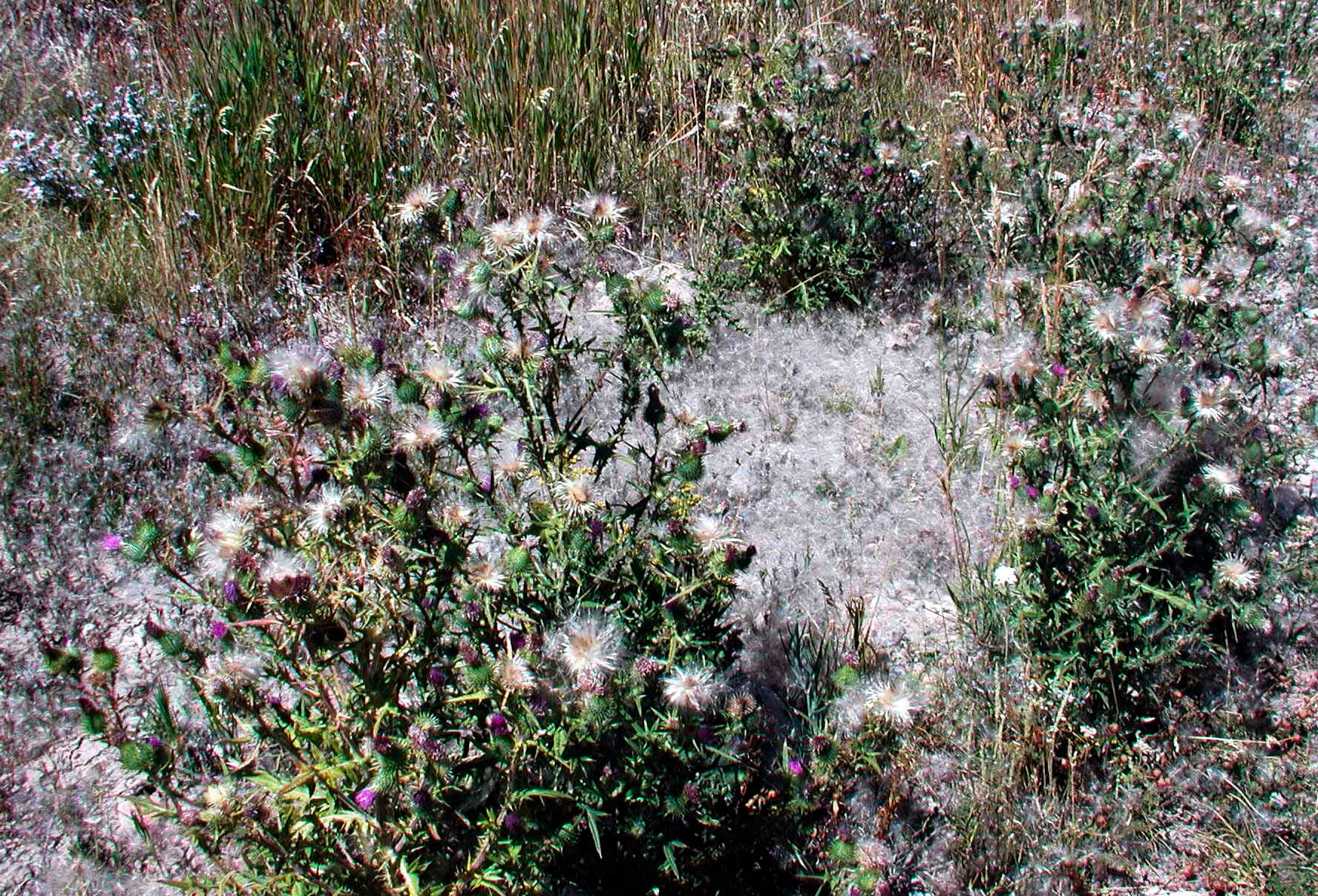
Nearby, wind teases out the tuffs of fluff, which carry seeds into unknown adventures…likely to become pests on nearby lands.

Nearby, wind teases out tuffs of fluff, which carry seeds of Musk Thistle into unknown adventures…likely to become pests on nearby lands.

Two similar asters attract butterflies and bees:

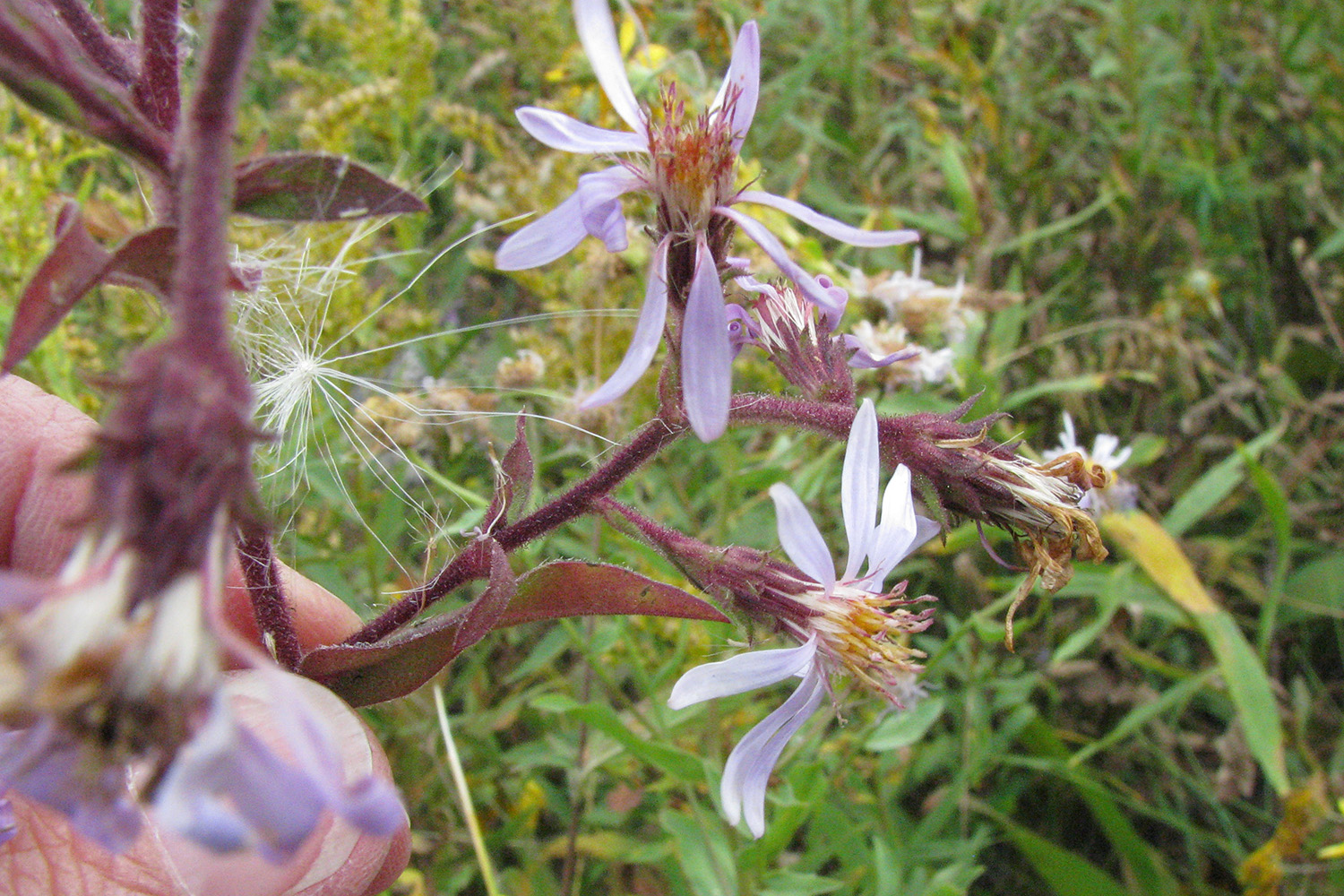
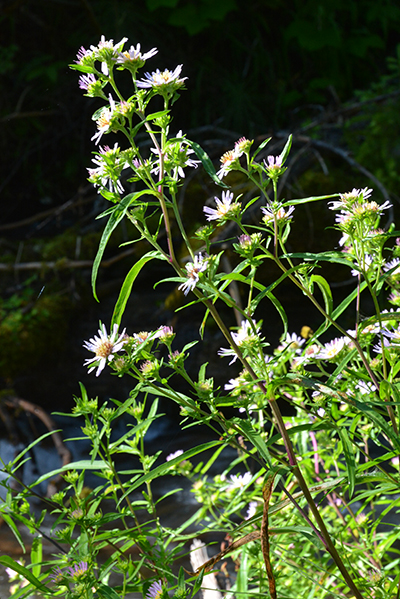
Leafybract AsterSymphyotrichum foliaceum var. canbyi – is still blooming strong by seeps and streams or on higher elevation slopes. This species is relatively easy to separate from other aster species. (Another variety S. f. var. apricus is found in subalpine to alpine elevations.)

The bracts are loose, leaf-like shingles encircling the head.

The bracts are loose, leaf-like shingles encircling the head, hence the name Leafybract Aster. (Note these larger outer bracts may or may not be there.  Look at several flowers to see).

The elongate leaves cling while alternating up the 16”-30” stems.

The elongate leaves of Leafybract Aster cling more  and more closely while alternating up the 16”-30” stems. Note the many pale ray flowers and the relatively wide leaves which are typically <7 times as long as wide.

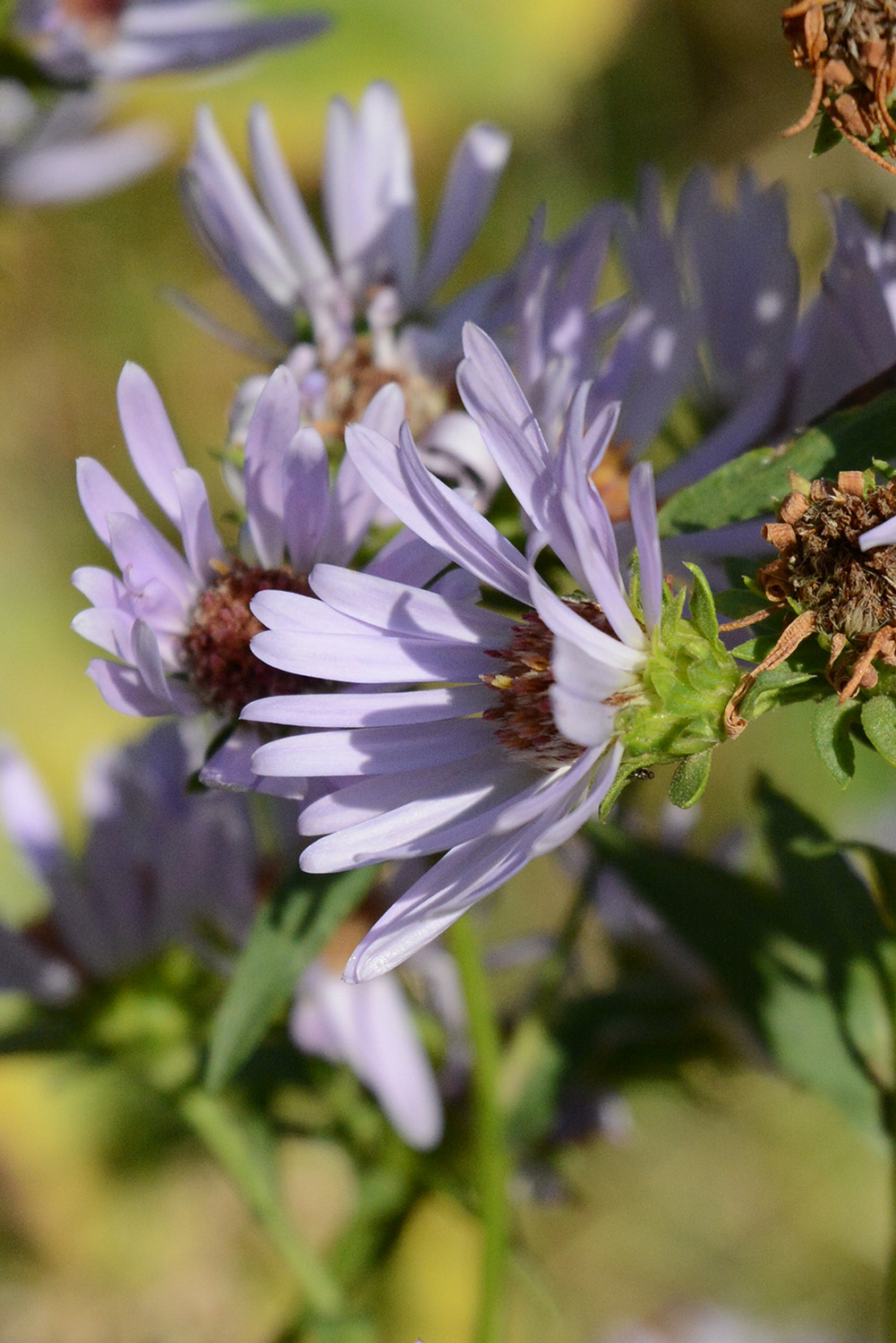
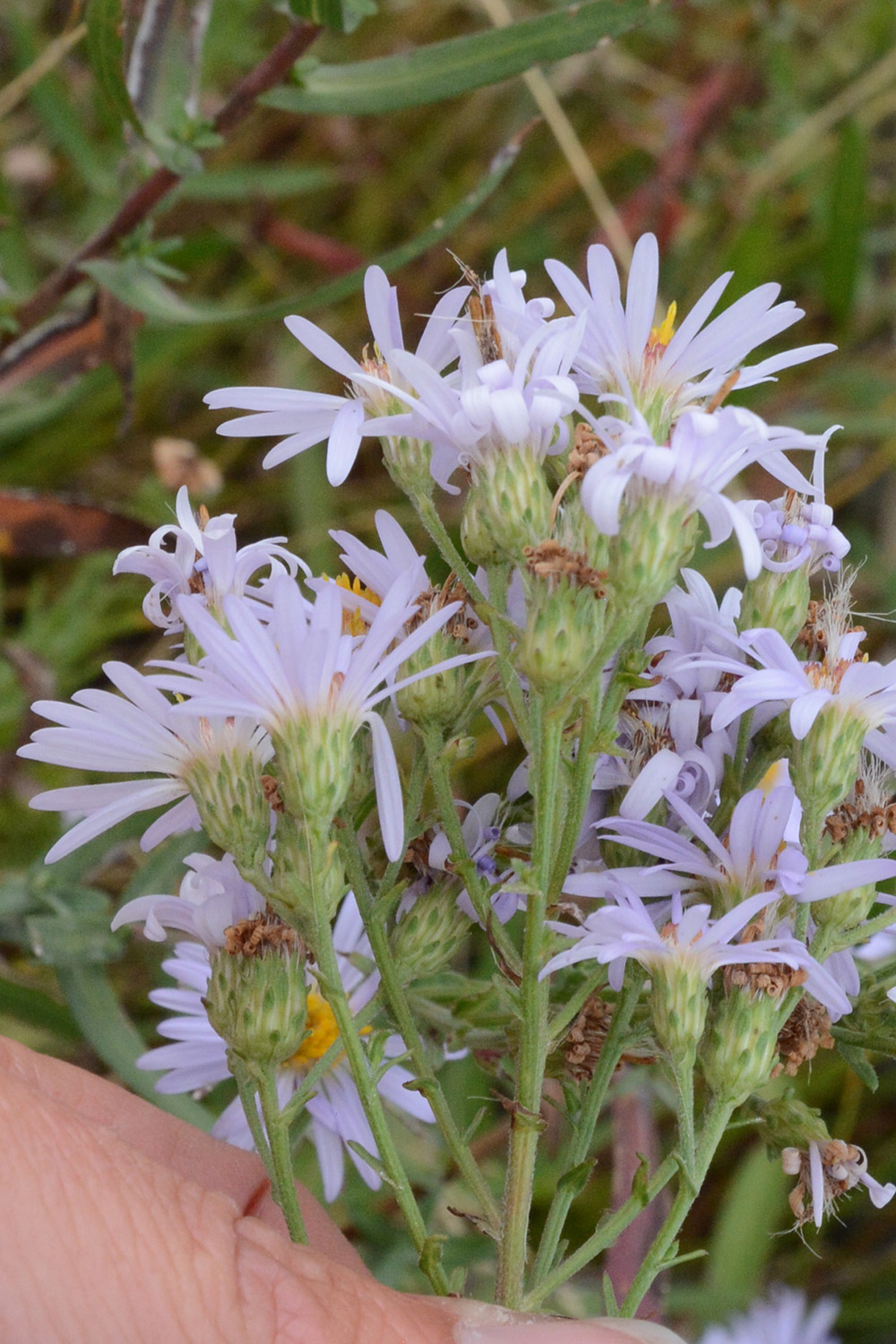
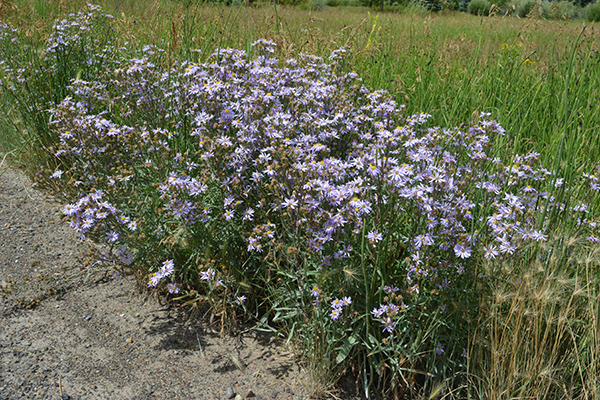
Pacific AsterSymphyotrichum ascendens – is a very common aster along roadsides and trails.

- is overall a smaller and bushier plant with the upper part of the 1-2’ stems covered with pale blue flowers.

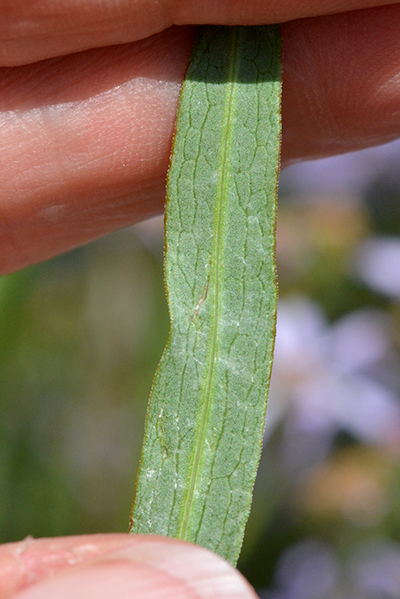
Pacific Aster is overall a smaller and bushier plant than Leafybract Aster (above) with the upper part of the 1-2’ stems covered with pale lavender flowers.  The leaves are long and narrow >7x as long as wide.

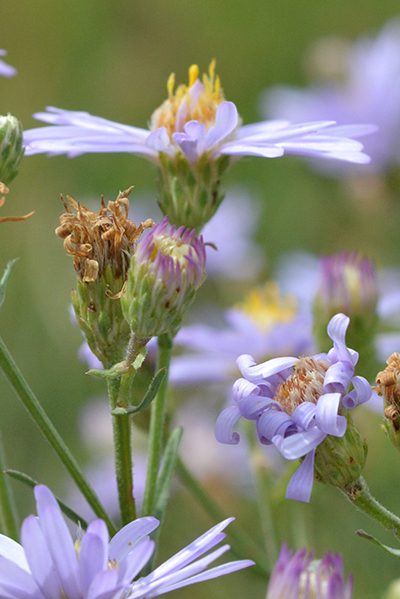
The bracts are narrow, sharp pointed, and tightly held against the heads.

The bracts of Pacific Aster are narrow, sharp pointed, and tightly held against the heads.  The lower, outer bracts are much shorter than the inner upper bracts.

Two other aster species can be confusing:

The flowers of Thickstem AsterEurybia integrifolia – attract attention due to their larger size.

The relatively few ray flowers are an unusual intensity of violet-blue and the disc flowers are yellow turning purple. Looking closely, you can see that the flower heads and stems have many sticky glandular hairs.

In Thickstem Aster the relatively few ray flowers are an unusual intense violet-blue. The inner disc flowers begin yellowish turning purple. Looking closely, you can see that the flower heads and stems have many sticky glandular hairs, a very helpful ID feature. Often these parts turn deep purple. The upper leaves clasp the thick, slightly zigzag stems. Overall the plants are heftier (and certainly stickier) than the two aster species described above.

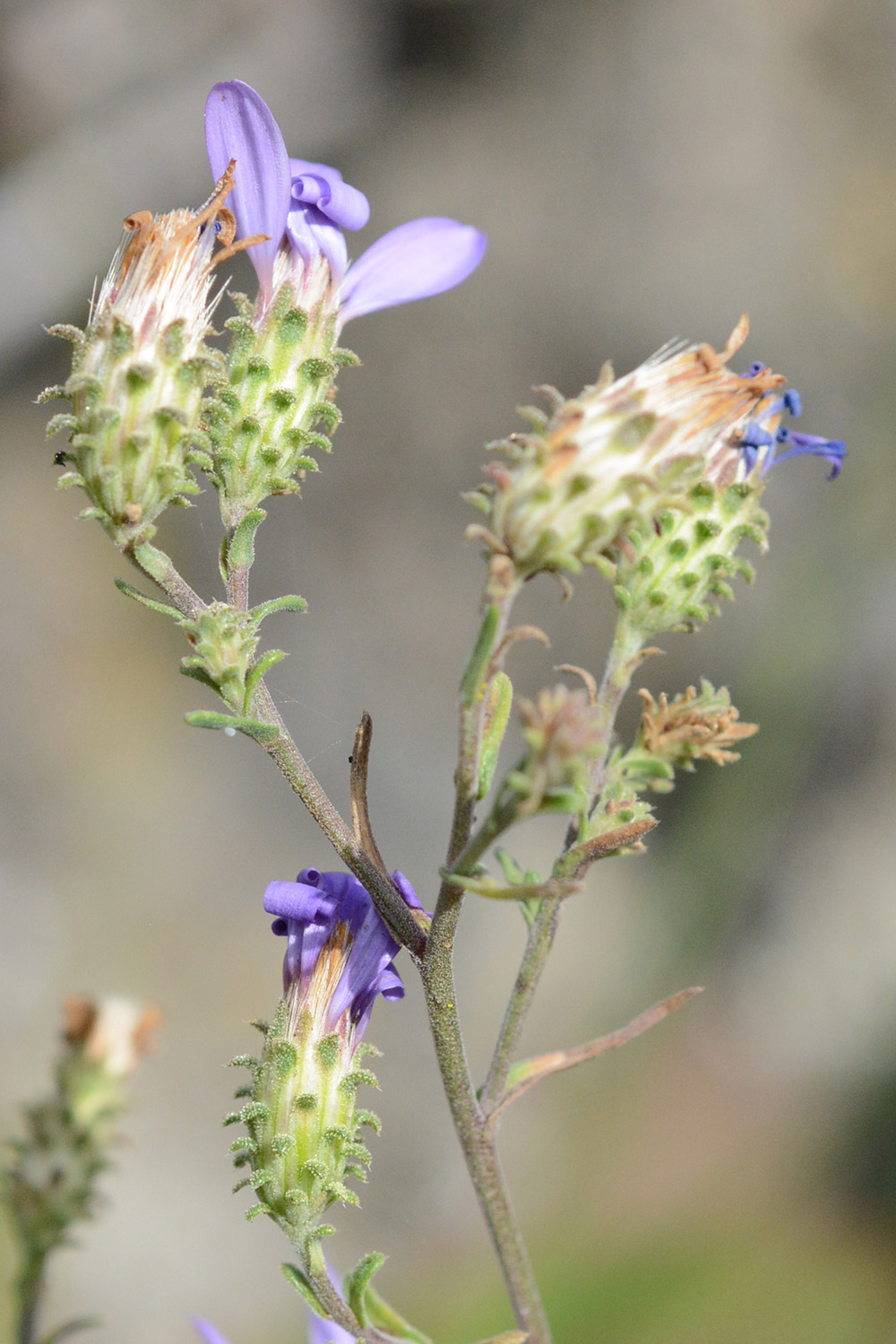
Hoary Spiny AstersMachaeranthera canescens – are still blooming on sage flats and other dry sites.  The delicate looking plants are deceptively durable.

Silvery hairs on stem and leaves reflect back intense light, reduce wind velocity, and shade the surface of the plants, thereby keeping the plants from transpiring too much water on hot windy days. The spines on the tips of the slightly toothed,1-2” leaves and at the tips of the outward curved flower bracts give the plant its name.

The violet blue flowers of Hoary Spiny Aster catch the eye along Granite Canyon Trail.  Tiny silvery hairs on stem and leaves reflect back intense light, reduce wind velocity, and shade the surface of the plants, thereby keeping the plants from transpiring too much water on hot windy days.     

The spines on the tips of the slightly toothed,1-2” leaves and at the tips of the outward curved flower bracts give the plant its name: Spiny Aster

The spines on the tips of the slightly toothed 1-2” leaves and at the tips of the outward curved flower bracts give the plant its name: Hoary Spiny Aster

Two sunflower-like flowers persist along roadsides and trails.

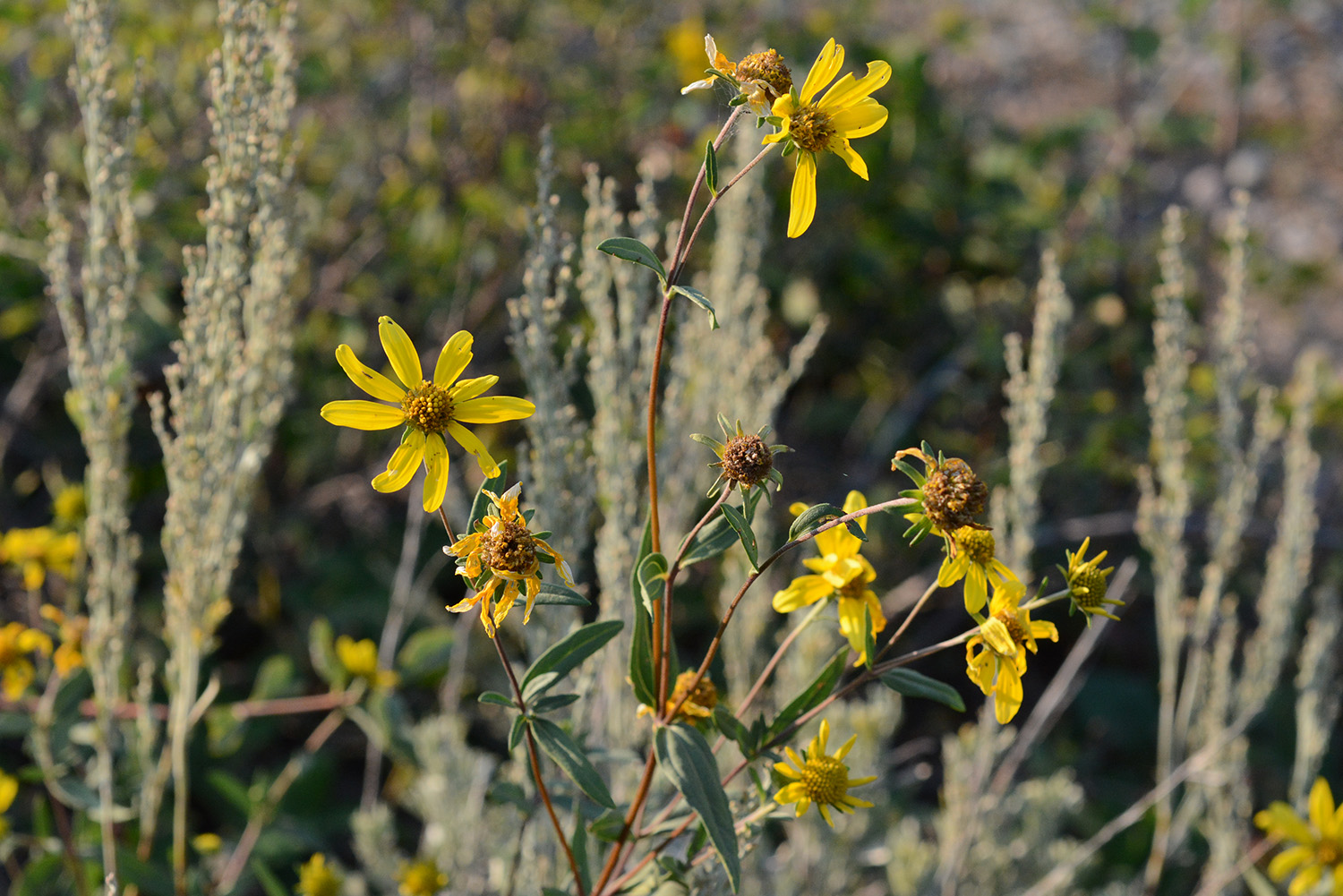
Showy Goldeneye - Viqueria multiflora – continues to stare at you along portions of Ski Lake and History Trails near Teton Pass, as well as, roadsides of Grand Teton National Park. The 2-3” leaves are opposite and slightly arrow-shaped. The broad, golden ray flowers pale towards their tips. The plants average about 2’ tall.

Showy GoldeneyeViqueria multiflora – continues to stare at you along portions of Ski Lake and History Trails near Teton Pass, as well as, roadsides of Grand Teton National Park. The 2-3” leaves are opposite and have pinnately veined leaves. The golden ray flowers pale towards their tips. The wiry plants average about 2’ tall.

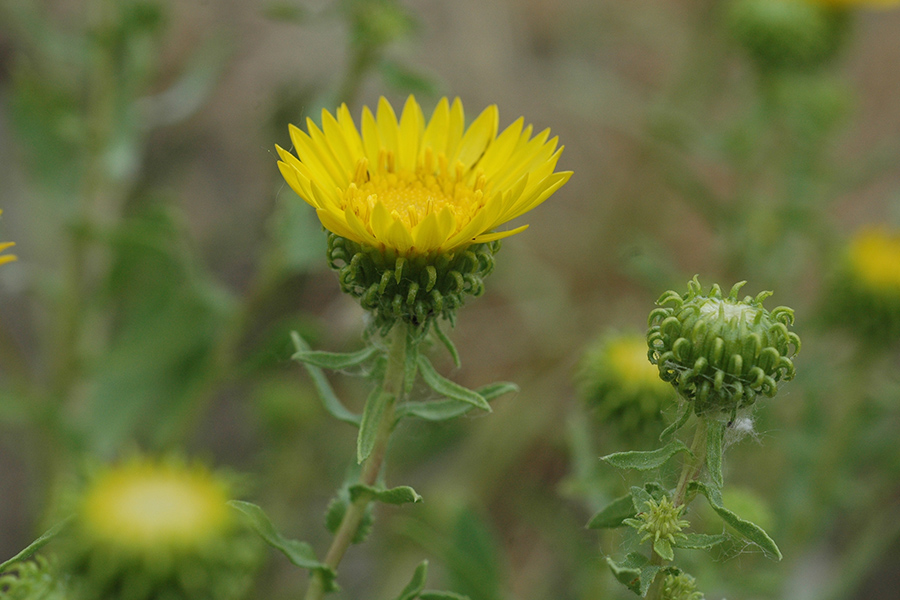
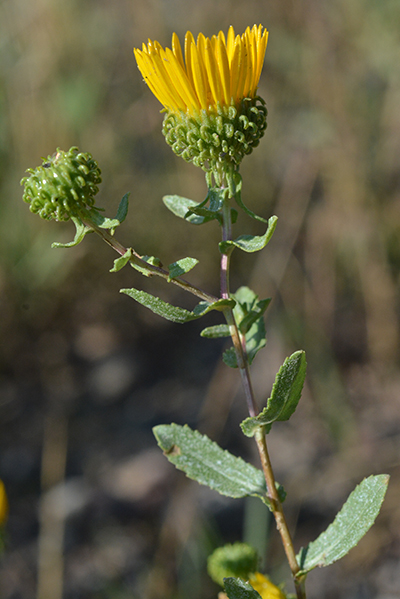
Curly Cup Gumweed—Grindellia squarrosa – is easy to recognize. Resinous bracts curl back and fuse together forming spiny cups beaming brilliant rays of sunshine. They thrive along dry, disturbed edges of the inner park road.

Curly Cup GumweedGrindellia squarrosa – is easy to recognize. Resinous bracts curl back and stick together to form spiny cups which beam brilliant rays of sunshine.  They thrive along dry, disturbed edges of the inner park road.

Two more very different members of the Aster Family with tiny flowers:

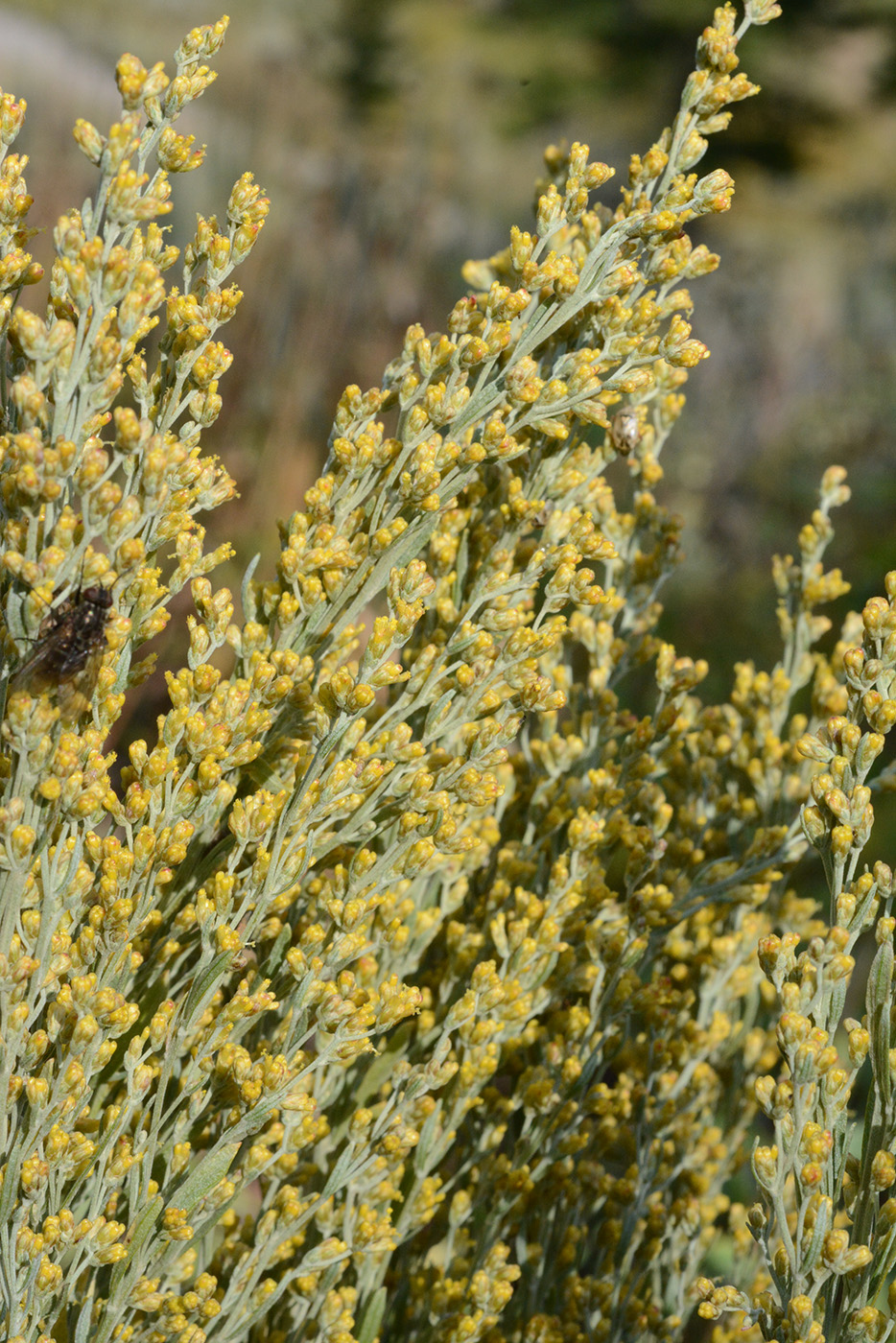
It is easy to overlook the fact that the Big Sagebrush – Artemesia tridentata var. vaseyana - is in full flower right now in parts of Jackson Hole.

It is easy to overlook the fact that the Big SagebrushArtemesia tridentata var. vaseyana – is in full flower right now in parts of Jackson Hole.

With Big Sagebrush, only a few individual flowers form the tiny flower heads, which are easily overlooked.

With Big Sagebrush, only a few individual flowers form the tiny flower heads, which are easily overlooked. Look carefully for the arching stigmas that will capture windblown pollen.

However, the tiny flowers arranged all along the slender stalks, add up to quite a show. They disperse millions of tiny pollen grains upon the wind. Such light and plentiful pollen is a source of allergies in humans.

While individually inconspicuous, the tiny flowers arranged all along the slender stalks add up to quite a show. They disperse millions of tiny pollen grains upon the wind. Such light and plentiful pollen is a source of allergies in humans.

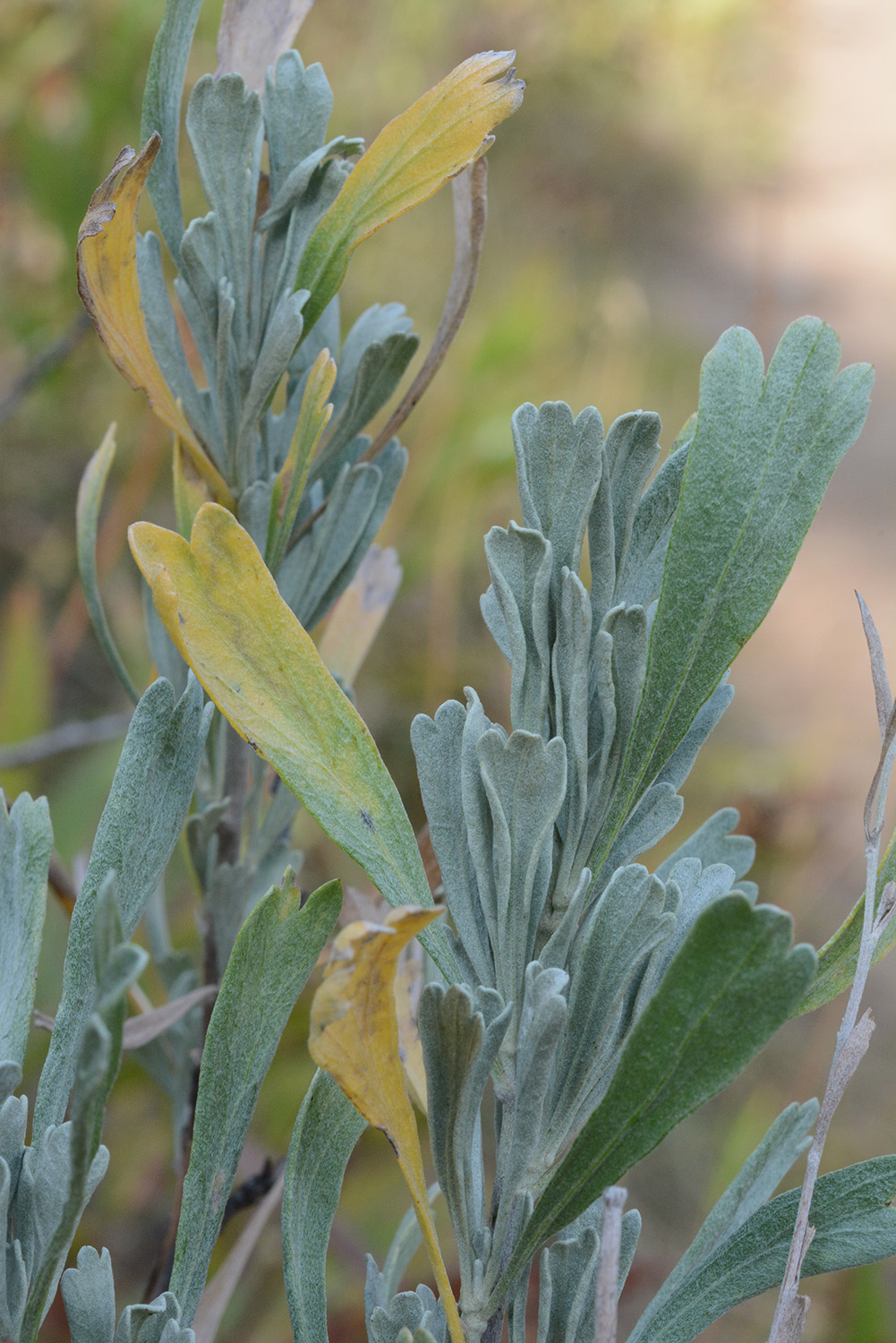
Also, observe Big Sagebrush leaves. The larger ones produced when water was plentiful in spring are dying off, but the smaller leaves of early summer will remain through the winter.

Also, observe Big Sagebrush leaves. The larger ones produced when water was plentiful in spring are dying off, but the smaller leaves of early summer will remain throughout the winter.  The shrub is evergreen.  These leaves are essential to the survival of Sage Grouse.

A particularly odd ball member of the Aster Family:

The oddball Tarweed – Madia glomerata – is often crushed underfoot, releasing an intense smell reminding some people of tar. The glandular hairs containing the scent are a defense mechanism to deter grazing animals. It is interesting that some people like the fragrance while others find it pretty stinky, and in fact plants vary in their chemical arsenal. While many grazers avoid the plants, honeybees use the pollen and ground squirrels eat the protein-rich seeds. Tarweed is a native annual that is used in habitat restoration efforts.

Often only six inches high, TarweedMadia glomerata – is easily crushed underfoot, releasing an intense smell reminding some people of tar. The glandular hairs containing the scent are a defense mechanism to deter grazing animals large and small. It is interesting that some people like the fragrance while others find it pretty stinky. In fact plants vary in their chemical arsenal. While many grazers avoid the plants, honeybees use the pollen and ground squirrels eat the protein-rich seeds. Tarweed is a native annual that is used in habitat restoration efforts.

Schizocarps in the Carrot Family: A Quiz

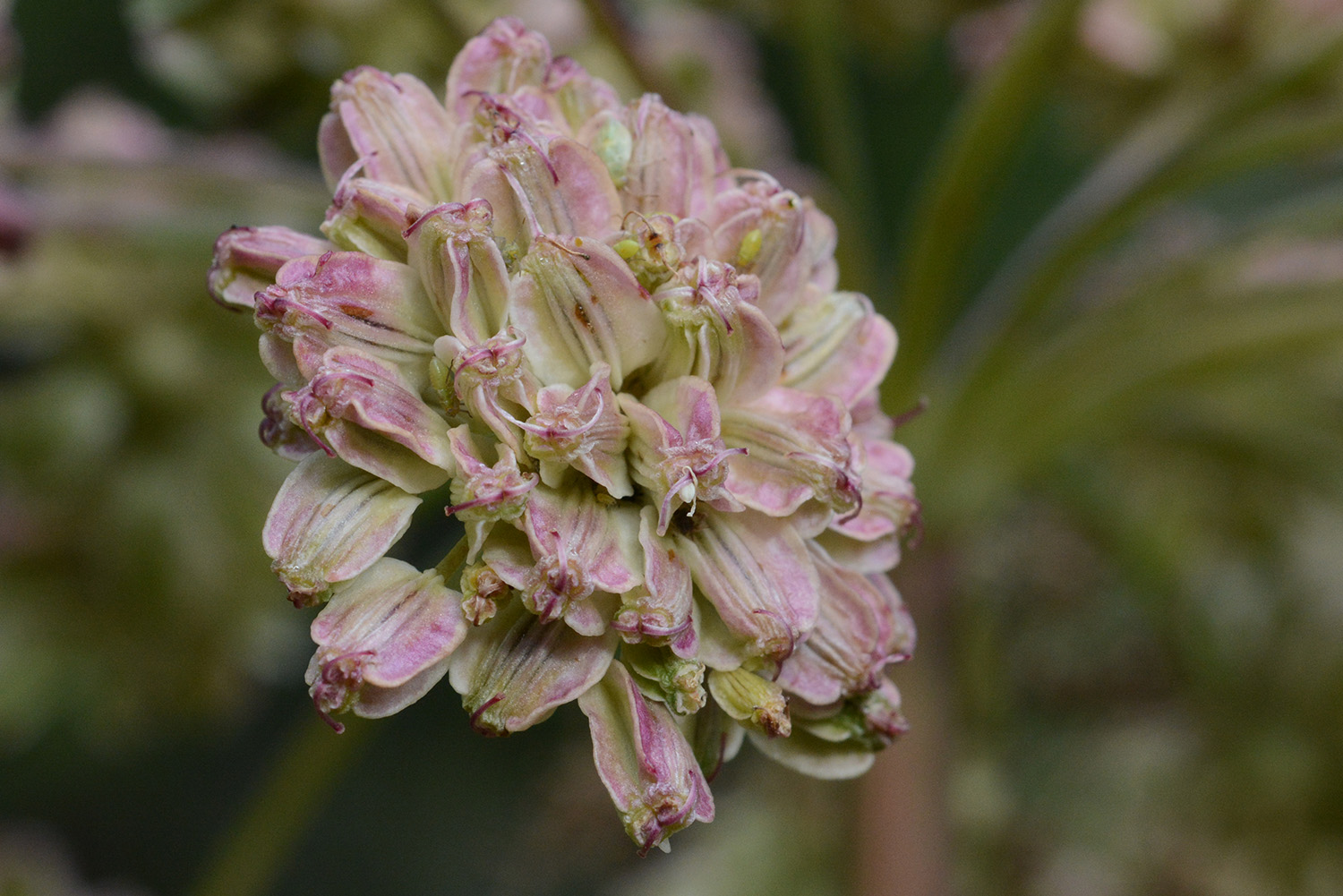
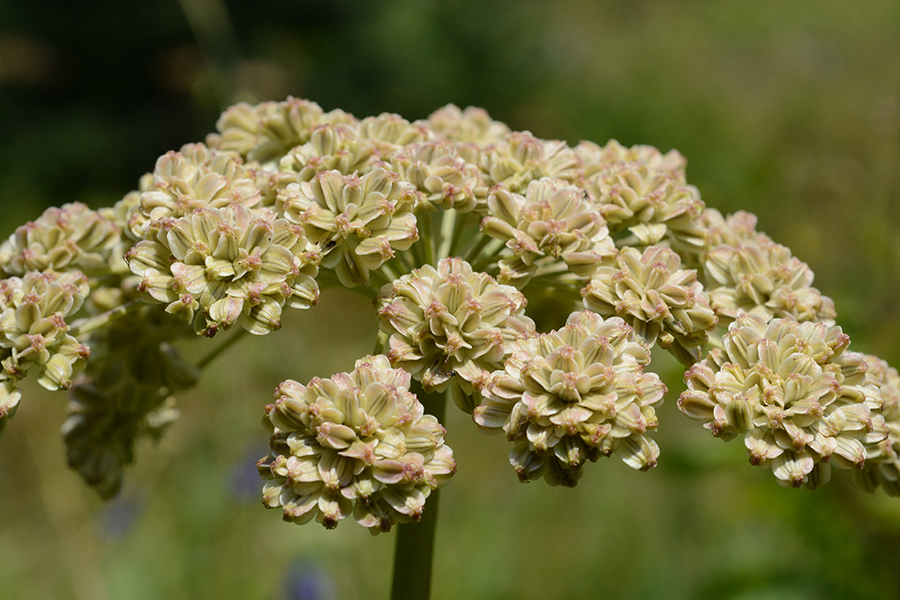
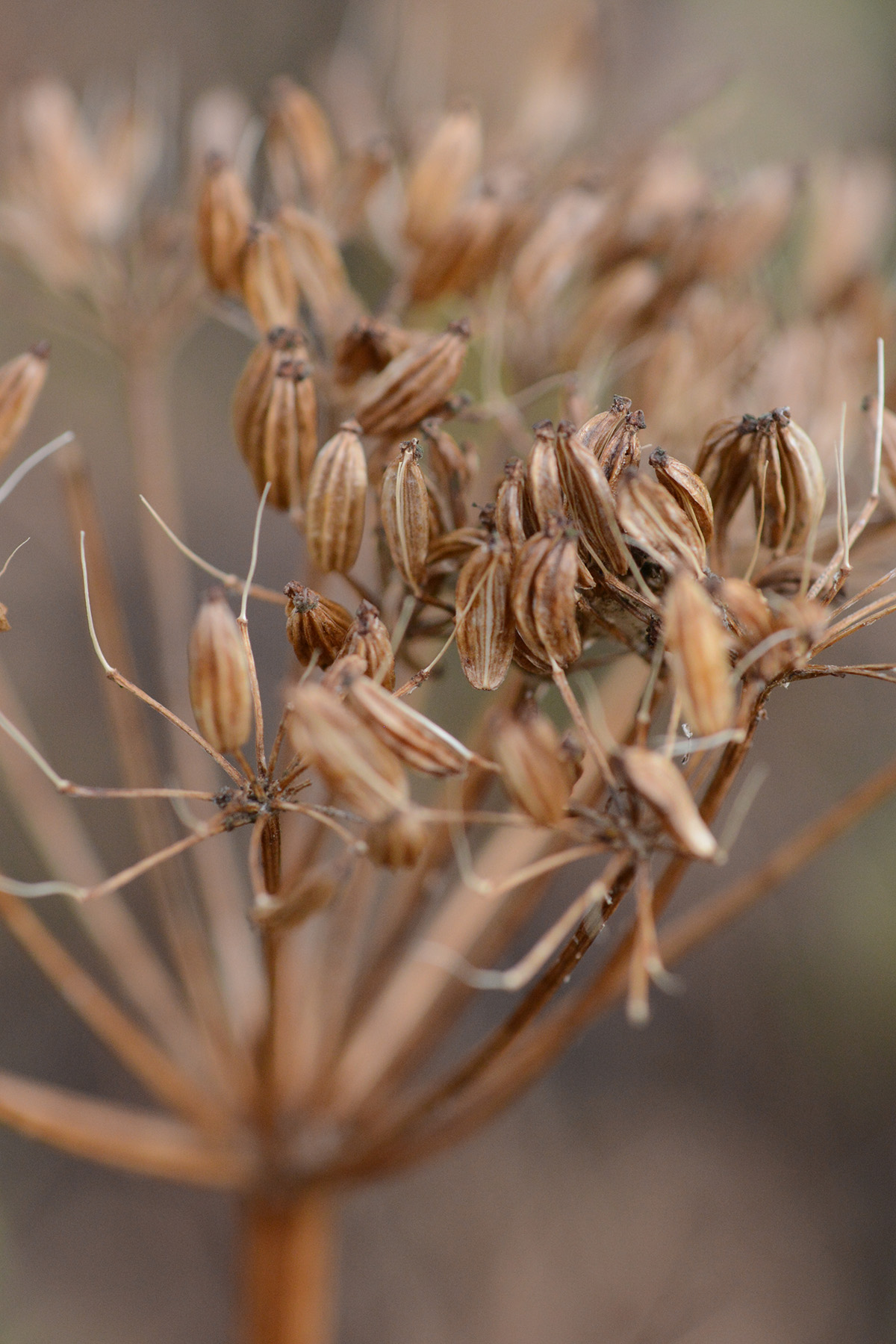
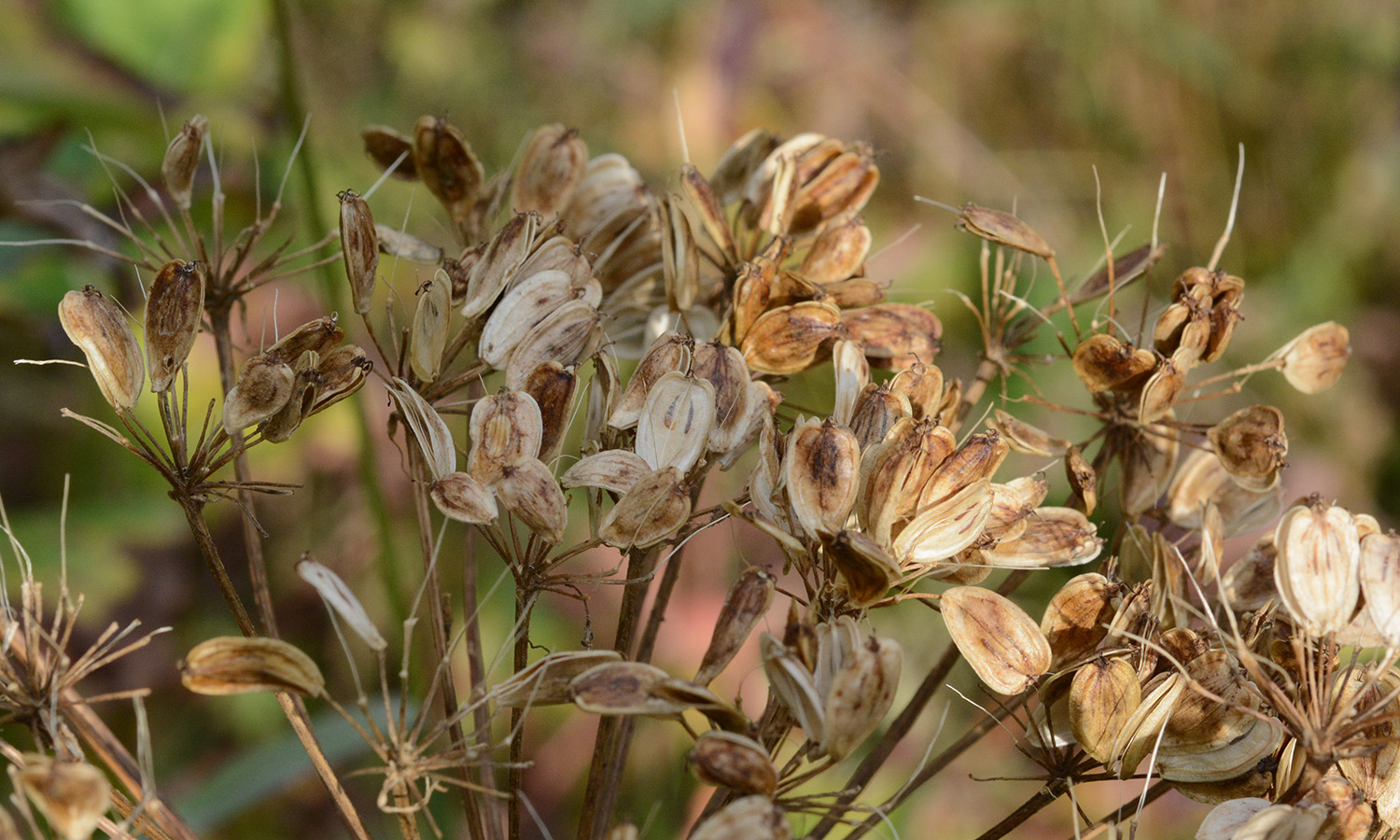
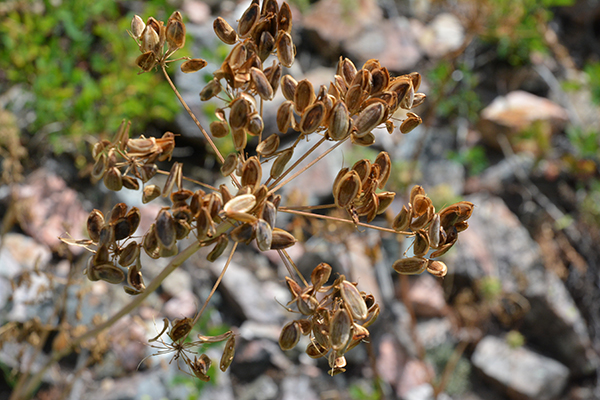
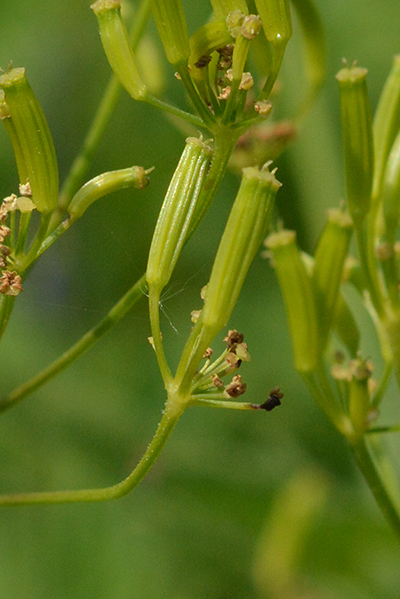
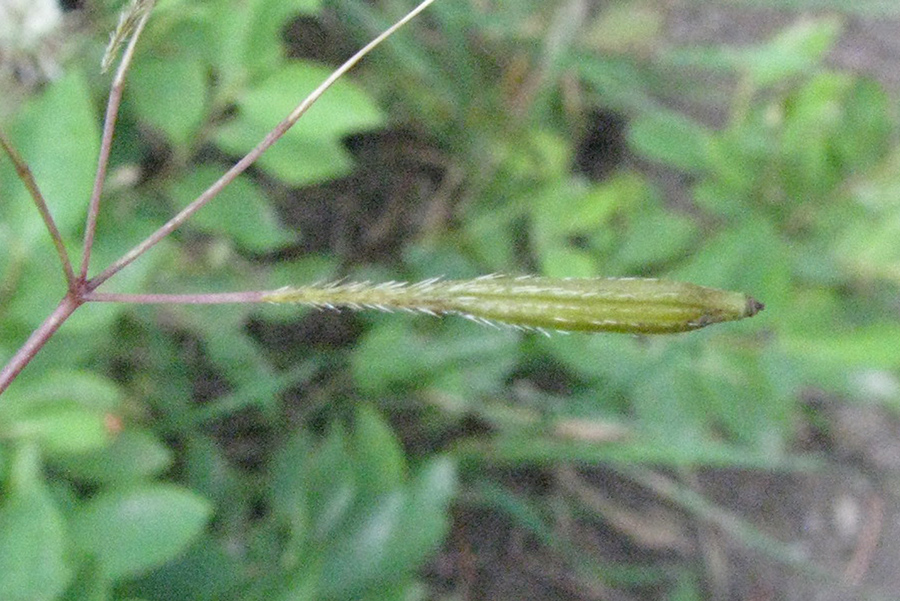
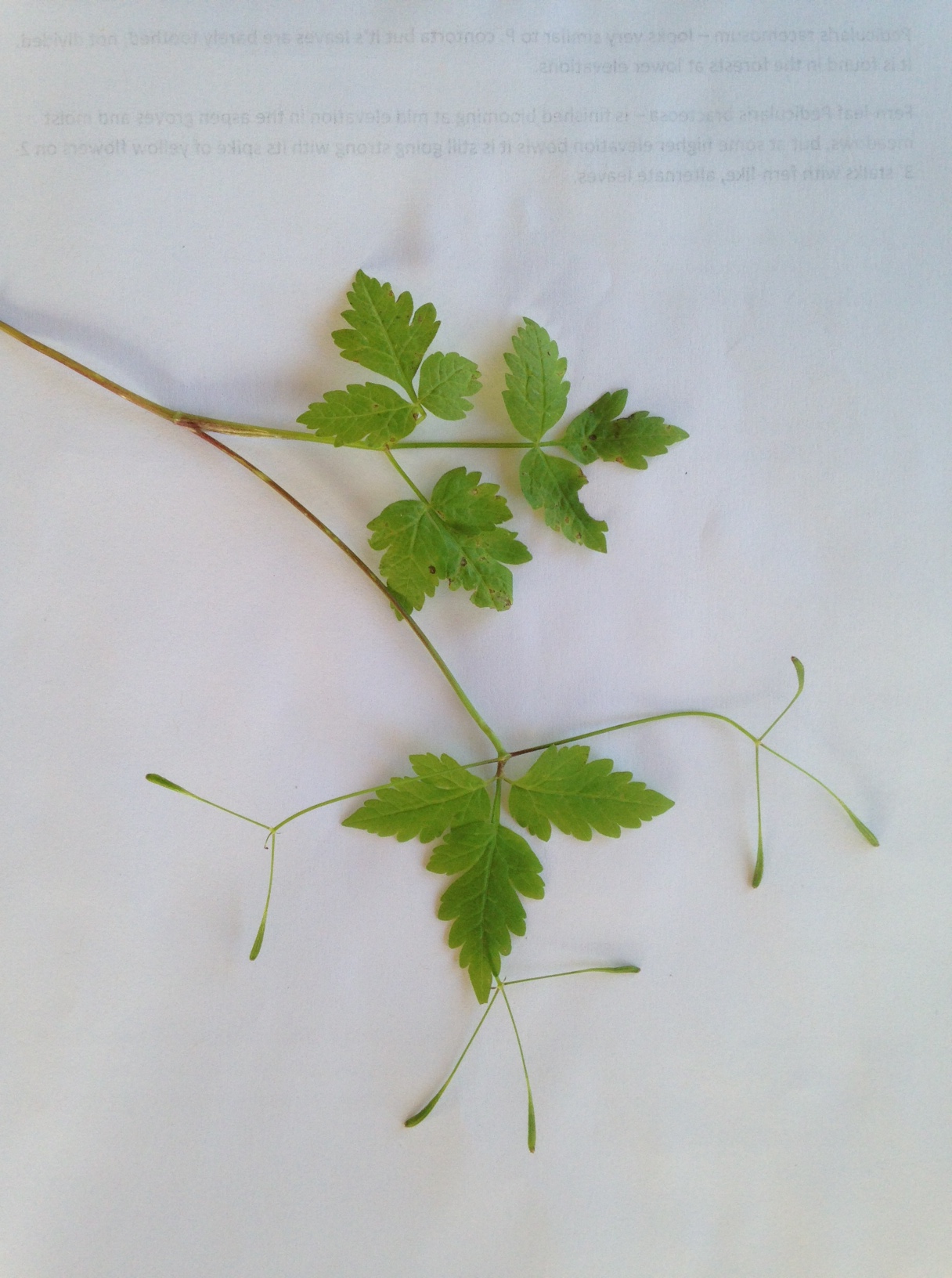
Many of the members of the Carrot or Parsley Family (Apiaceae) are now in fruit. Below are photos of “schizocarps” – the uniquely designed fruits of this family: they split in half and are arranged in umbrella-like structures. Can you determine which species they belong to (hints provided): Wild LicoriceOsmorhiza occidentalis; Cow-parsnipHeracleum spondylium; Fernleaf LovageLigusticum filicinumSharp-tooth AngelicaAngelica arguta, Common YampaPerideridia montana? (Answers at end.)

Look closely: the fruits are flatted top to bottom and have 3 ridges as well as wings.

A. Look closely: the two sides of the horizontally splitting fruits are each flat with 3 ridges on the back and wings to the sides.

A. The umbels of fruits stand 5-6' feet high on smooth stems in moist locations.

A. The umbels of fruits stand 5-6′ feet high on smooth stems in moist locations.

These plants bloomed late this summer predominantly in the sage flats. Fruits are short and relatively smooth. (see closeup below),

B. These plants bloomed late this summer predominantly in the sage flats. Fruits are almost round and relatively smooth. (see closeup below),

Another hint: the roots of this plant are favored by bears.

B. Another hint: the roots of this plant are favored by bears. Note the splitting of the individual fruits. Also the stylopodiums: the swollen, persistent bases of the stigmas.

Elongate fruits with a bit of a point are flavorful.

C. Two to three-foot plants of forest edges and meadows hold up elongate smooth, purple black fruits.  Note the beige central stalks (lower left) that held the two sided fruits which were flavorful when younger.

This slightly curved, ridged schizocarps are rounded.

D. These slightly curved, ridged schizocarps are more or less oblong.  The large compound leaves are finely dissected.

These fruits are very flat with two to three decorative lines.

E. These fruits are very flat with two to three decorative lines.  The plants are very large, coarsely hairy, and grow in moist areas.

Answers: A: Smooth-toothed Angelica B: Common Yampah C:Wild Licorice or Sweet-Cicely D: Fernleaf Lovage E: Cow-parsnip

Fleshy Fruits:

Last and not least, especially for the birds, bears, and small mammals of Jackson Hole, are the fruits of the Rose Family. When investigating the wild fruits, first consider your cultivated apples, cherries, peaches, plums, etc, which are relatives.  The flesh you are eating is actually the swollen base of fused sepals and petals and even anthers surrounding an inferior ovary in which seeds (pits or individual seeds) form, e.g. you are eating the ripened “hypanthium”. This fleshy juicy part is what most birds and mammals consume as well, although some rodents chew upon the hard coated seeds. The tasty fruit is the “reward” for dispersing the seeds.

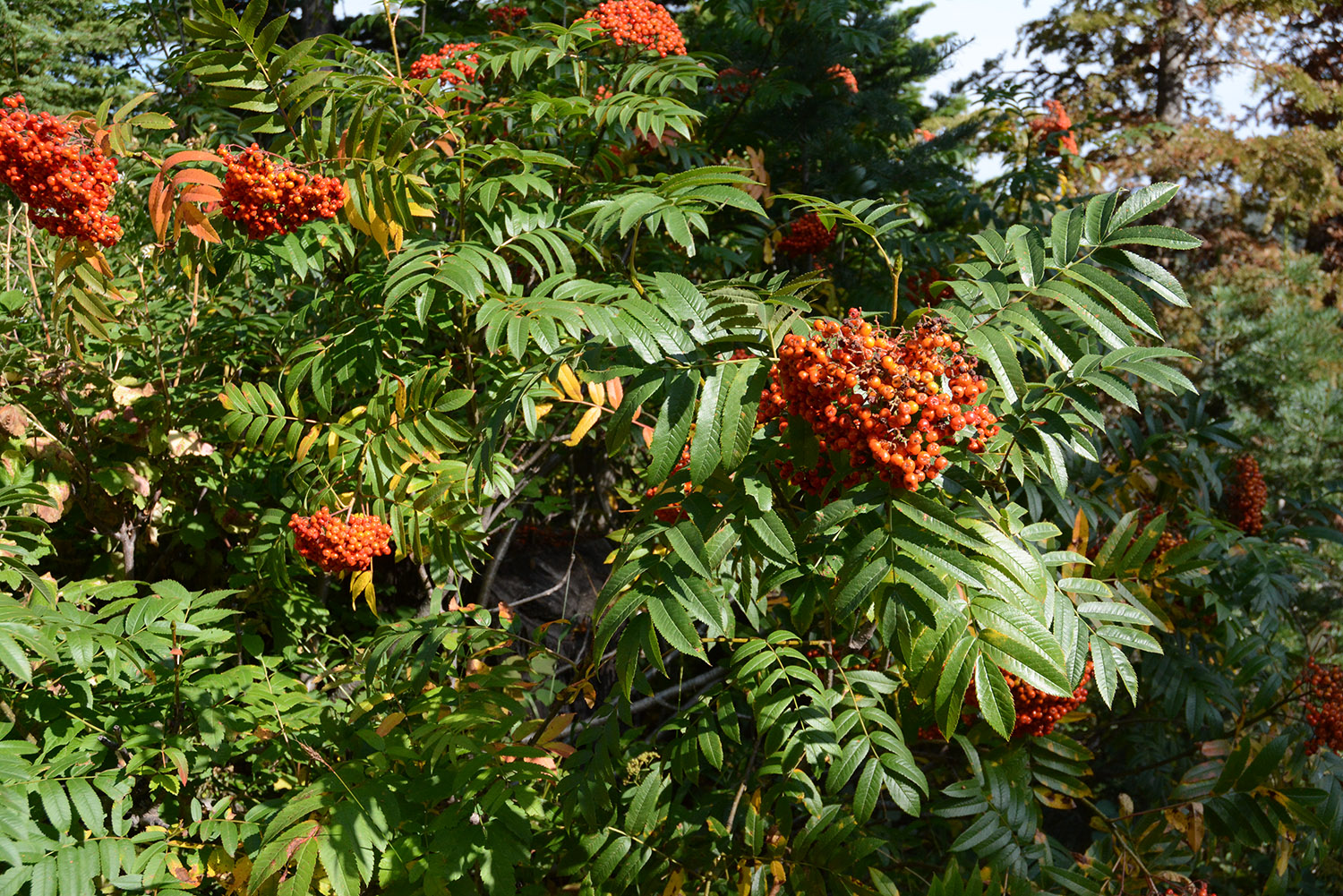
Mountain Ash – Sorbus scopulina - decorates the beginning of Ski Lake Trail and various canyons. Note the shiny compound leaves, as well as the clusters of orange fruits.

Mountain AshSorbus scopulina – decorates the beginning of Ski Lake Trail and various canyons. Note the shiny compound leaves, as well as the heavy clusters of orange fruits.

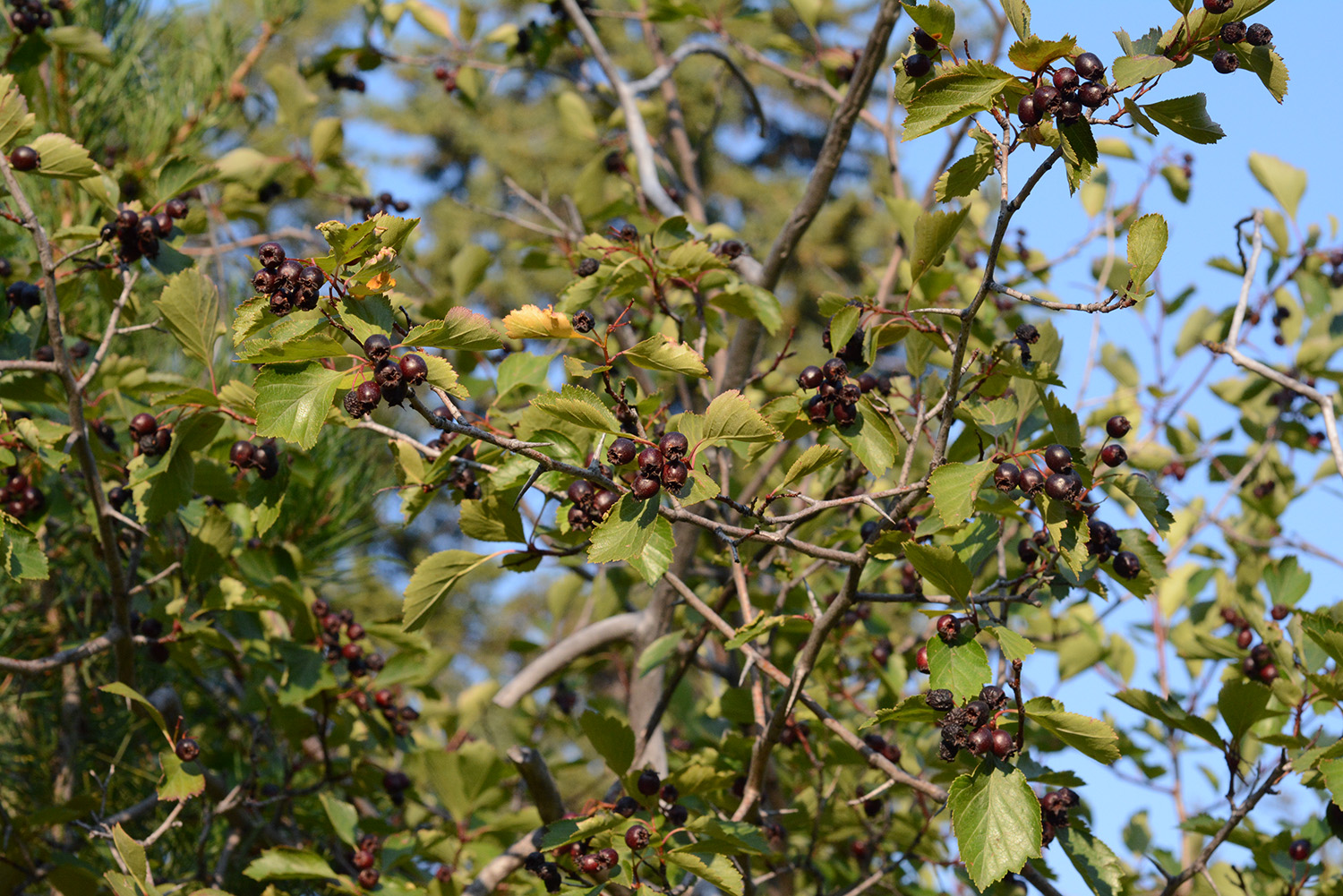
Hawthorns – Crataegus douglasii – are filled with bunches of dark fruits protected (supposedly) by 1-2” long thorns. No wonder people are seeing black bears along the Moose-Wilson Road where this plant is particularly abundant. Do be careful hiking around berries of any kind right now.

Hawthorn trees – Crataegus douglasii – are filled with bunches of dark fruits protected (supposedly) by 1-2” long thorns. No wonder people are seeing black bears along the Moose-Wilson Road where this plant is particularly abundant. Do be careful hiking around berries of any kind right now.

Chokecherry – Prunus virginiana – Arranged in a raceme, several fruits dangle on short stems from a central stalk. Chemicals in the pits and leaves convert to hydrocyanic acid in the stomach of humans and livestock, which inhibits cellular respiration and the ability to use oxygen: in short they are poisonous. On the other hand, the fruits, are relished by many animals and numerous insect species overcome the defense systems. This plant is important for sustaining biodiversity.

Fruits of ChokecherryPrunus virginiana – are arranged in a raceme, e.g. fruits dangle on short stems from a long central stalk. If ingested by humans or livestock, chemicals in the pits and leaves convert to hydrocyanic acid which inhibits cellular respiration and the ability to use oxygen: in short they are poisonous. On the other hand, the fruits, are relished by many animals (which excrete the pits) and numerous insect species overcome the defense systems. Plants may or may not be poisonous to different species, and in different life stages.  This plant is very important for sustaining biodiversity.

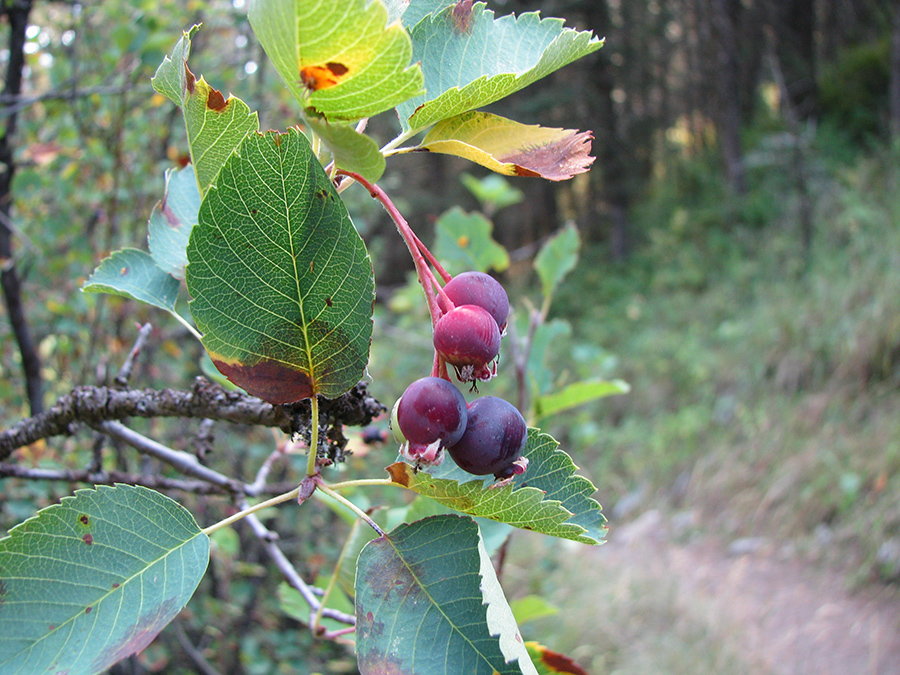
Serviceberries – Amelanchier alnifolia – still retain some blue-purple fruits, although many birds such as robins, cedar waxwings, western tanagers, have already consumed them to fuel their migration south.

ServiceberriesAmelanchier alnifolia – still retain some red-blue-purple fruits, although many birds such as American robins, cedar waxwings, and western tanagers, have already consumed them to fuel their migration south.

Wood’s Rose - Rosa woodsii – holds several fruit at the tips of twigs. Rose hips are particularly high in vitamin C, perhaps as much as 60x as much as lemons….but who eats a whole lemon? These fruits will last on the plants through much of the winter, providing food when other resources are short.

Wood’s RoseRosa woodsii – holds several fruits at the tips of twigs. Rose hips are particularly high in vitamin C, perhaps as much as 60x as much as lemons….but who really eats lemons?
These fruits will last on the plants through much of the winter, providing food when other resources are scarce.

Fireweed Finale:

FireweedChamerion/Epilobium angustifolium – is the traditional harbinger of autumn.

 Fireweed is almost finished blooming, with bumblebees garnering the last bits of pollen and nectar.

Fireweed is almost finished blooming, with bumblebees garnering the last bits of pollen and nectar.

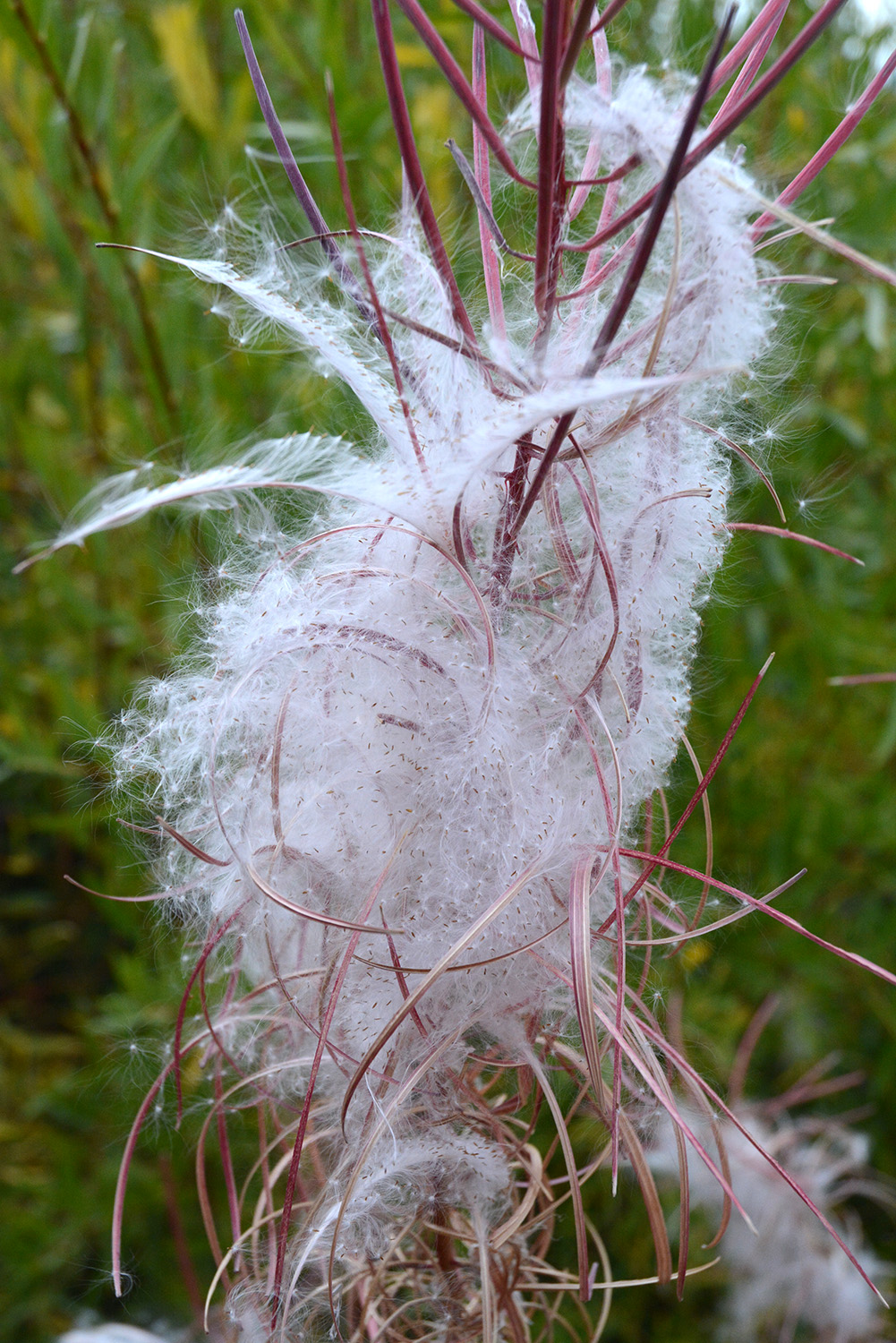
The elongated seeds have burst in a whirlwind dance of dispersal.

The elongated fruits of Fireweed have burst into a whirlwind dance of seeds dispersing.

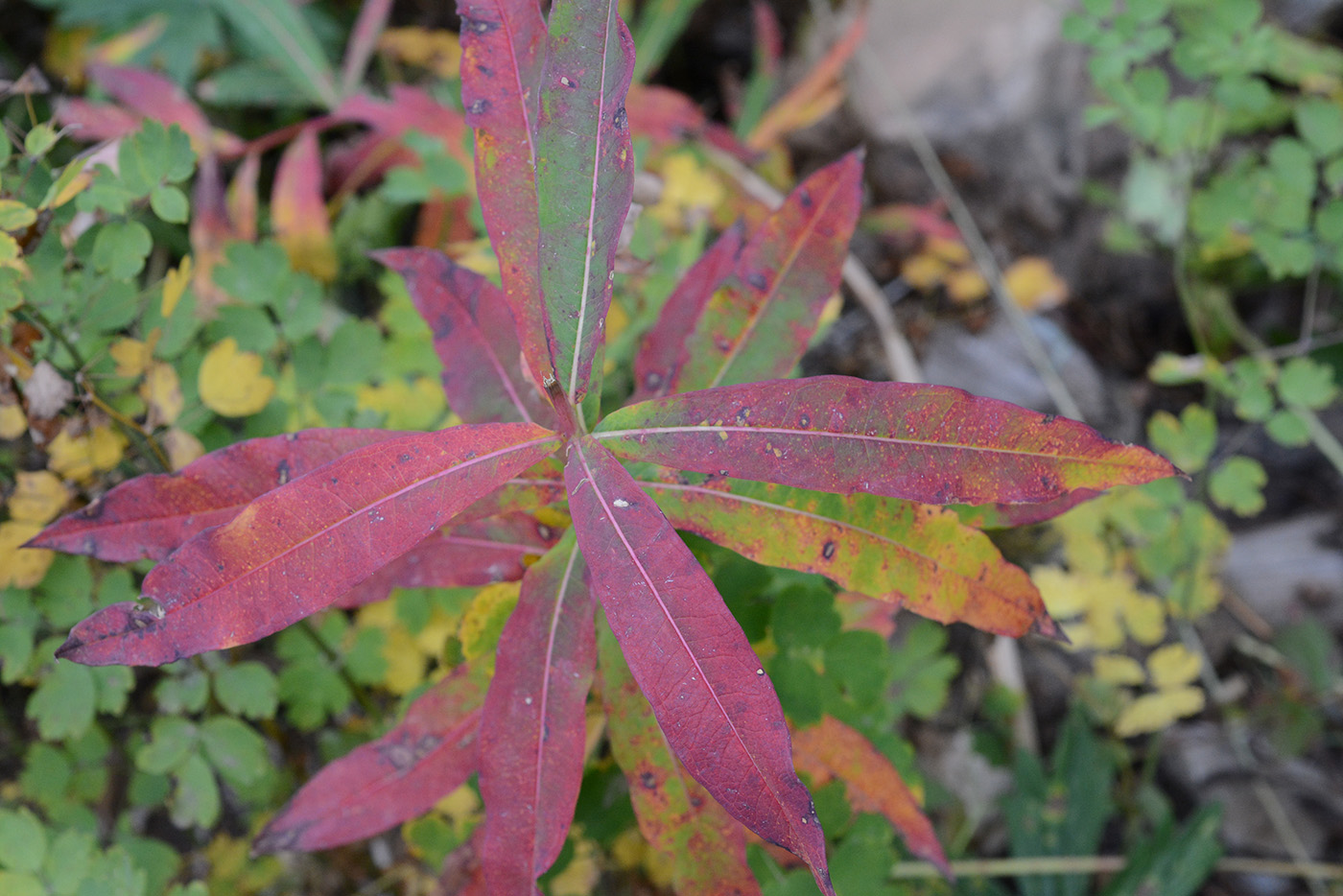
The crimson leaves provide an encore before the hard frost.

The crimson leaves provide an encore before hard frost.

Enjoy the fall:

Plants can be enjoyed in all seasons for their flowers, fruits, leaves, bark, structure. Observe closely and celebrate the cycle of the year.

Aspen groves on Munger Mountain are full of fall treats.

Aspen groves on Munger Mountain are full of fall treats.

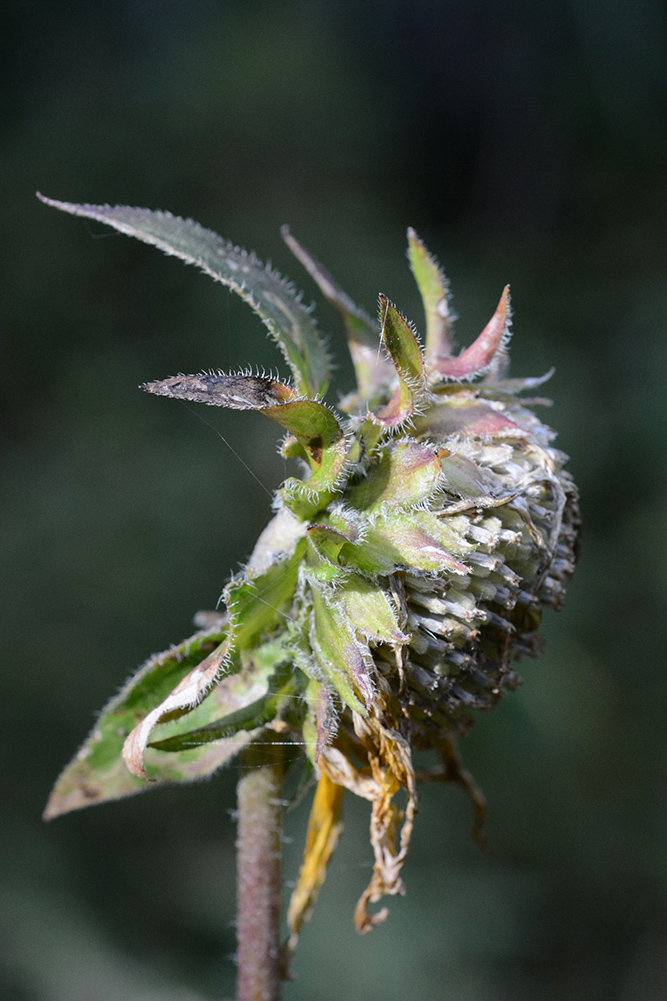
Some cultures revere the beauty of aging. Here is a dignified, grizzled head of the statuesque Five-nerved Helianthella – Helianthella quinquenervis.

Some cultures revere the beauty of aging. Here is a dignified, grizzled head of the statuesque Five-nerved HelianthellaHelianthella quinquenervis.  

Happy botanizing!

Frances Clark, Wilson, WY

August 31, 2015

P.S. This blog is designed to encourage further exploration into the wonders of our native plant world.  As always, we appreciate you comments, additions, and corrections.

Big Favorites Found Mid Summer in the Tetons – July 2015

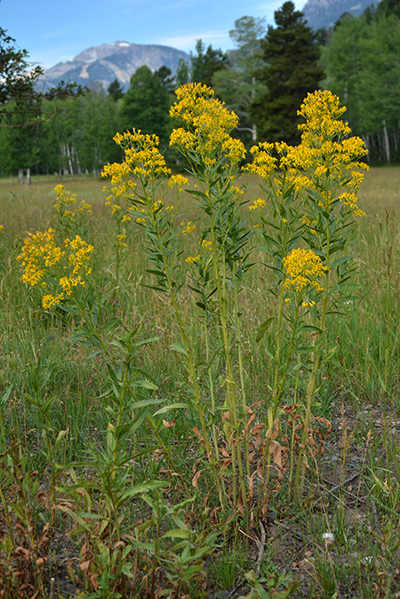
Moose-Wilson Road has an array of tall forbs (wildflowers) - Tall Larkspur, Butterweed Groundsel, and Canada Goldenrod.

Moose-Wilson Road has an array of tall forbs (wildflowers) – Tall Larkspur, Butterweed Groundsel, and Canada Goldenrod.

As one drives along the Moose-Wilson Road or up to Two Ocean Lake, or hikes through montane meadows, several tall 3-6’ wildflower species may divert your attention. Most of these thrive in relatively moist and/or cool situations where they can take up sufficient moisture to support their large bodies of stems and leaves, along with plentiful, showy flowers.

Moose Pond Trail has a small meadow with Cow Parsnip, Giant Hyssop, Sticky Geranium and more!

Moose Pond Trail has a small meadow with Cow Parsnip, Giant Hyssop, Sticky Geranium and more!

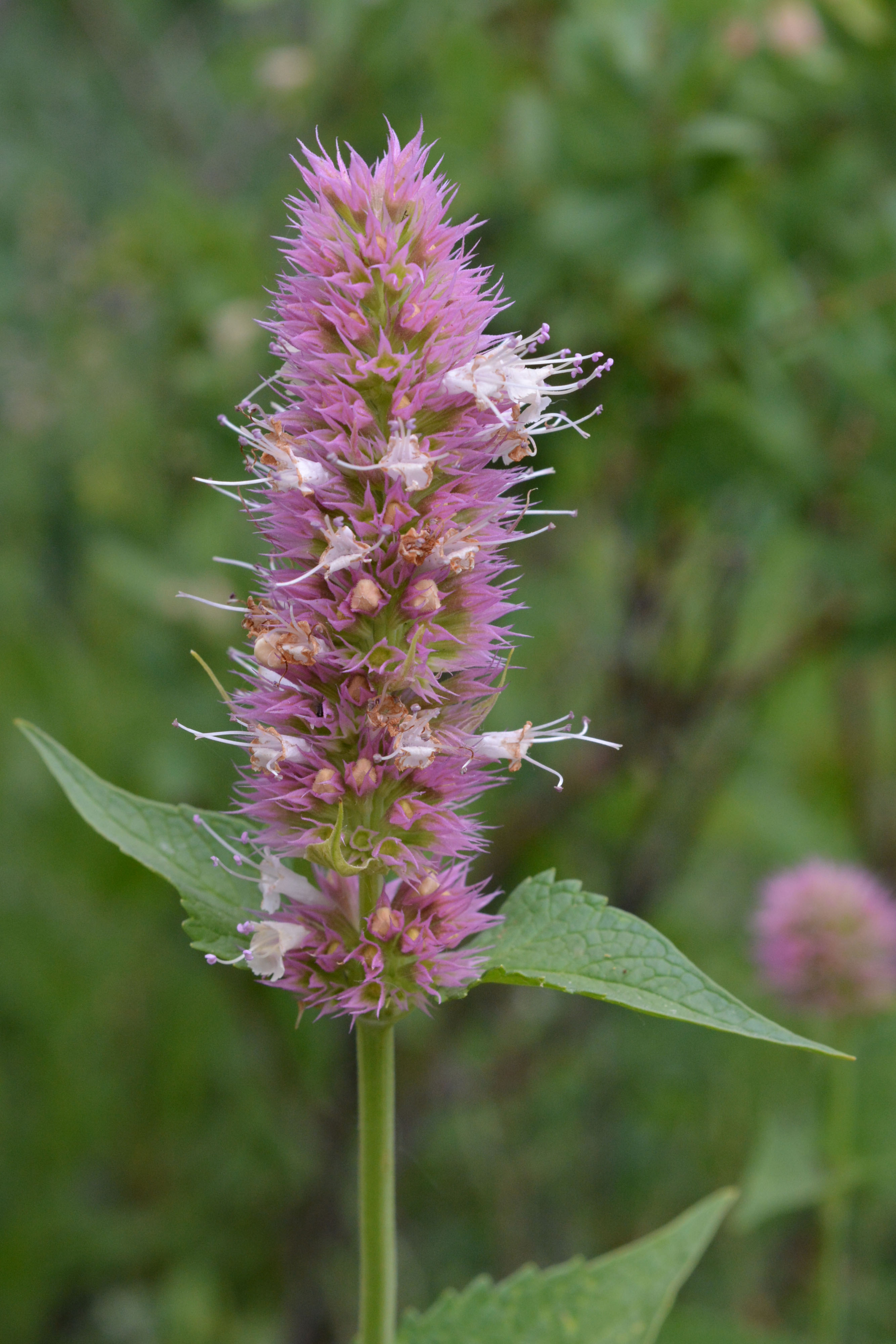
Giant Hyssop - Agastache urtifolia - is a member of the Mint Family.  And is occasionally pollinated by hummingbirds,

Giant HyssopAgastache urticifolia – is a member of the Mint Family.   Feel the square stem, smell the fragrant leaves, and observe what comes to the “irregular” flowers. Occasionally it is pollinated by hummingbirds, probably attracted by the reddish pink bracts.  The stamens protrude beyond the fused petals, bonking pollen on the heads of pollinators.

Pause and take a close look and think about what is happening: What do the flowers look like: are they simple or complicated; all they all the same color or highly variable; what are their pollinators? Unseen variations may be that some species are extremely poisonous. Other species display an extraordinary abundance of flowers this year due to unusual environmental triggers last year. Many factors: environmental and biological–affect what grows where in Teton County and well beyond. Below are a few species to ponder.

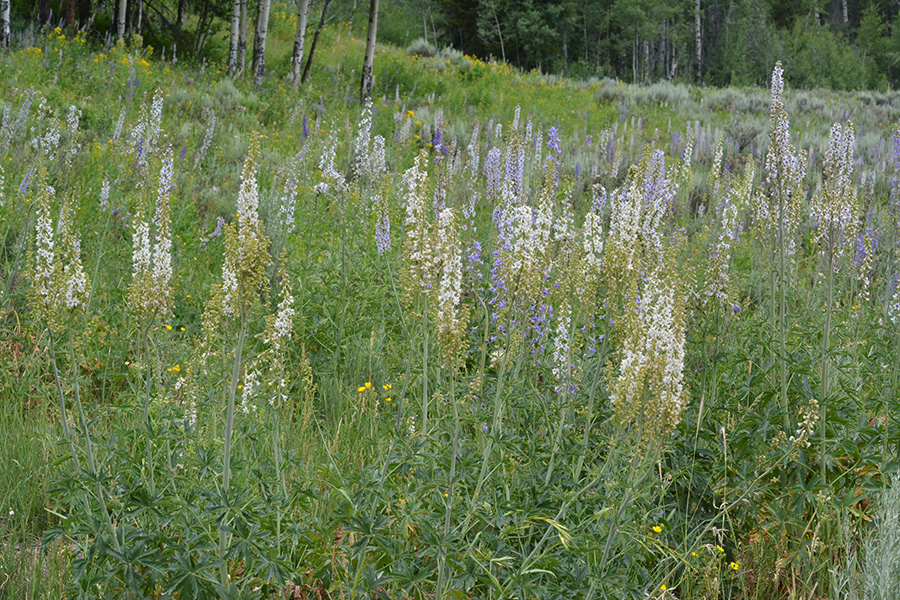
Tall Larkspur - Delphinium occidentale - comes in a range of colors from white to deep blue.

Tall LarkspurDelphinium occidentale– comes in a range of colors from white to deep blue.

Tall LarkspurDelphinium occidentale – Many have noticed the 4-6’ tall, deep blue, pale blue, to white spires along the Moose-Wilson Road and meadows of Two-Ocean Lake and near Goodwin Lake Trail. The reason for the three color variations of our Grand Teton populations was studied by Ron Scogin in 1993. While he didn’t come to any direct conclusions, the researcher found that all plants had similar number of flower stalks (inflorescences) although the albino stalks had many fewer flowers/stem. All had similar seed results per flower indicating that the pollinators–bees and hummingbirds–visited them without discrimination. Furthermore, over time, the proportion of each color morph has remained pretty much the same. The proportion was likely dependent on the original number of seeds per morph and are result of the “founder effect”. So far the colors remain separate and in the same approximate proportions. A follow up study, with new genetic understanding, would be interesting.  For more details on the work 20 years ago: http://repository.uwyo.edu/cgi/viewcontent.cgi?article=1792&context=uwnpsrc_reports

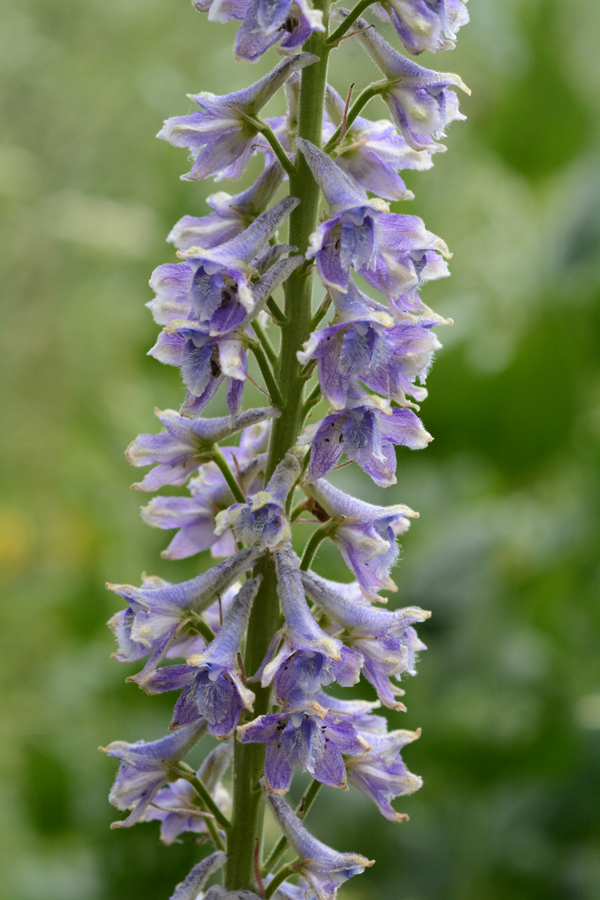
Tall Larkspur has trumpet shaped flowers that require pollinators to push deeply into them to receiive their rewards.

Tall Larkspur – Delphinium occidentale – has trumpet shaped flowers that require pollinators to push deeply into them to receive their rewards. (And an esoteric taxonomic note:  According to the expert Holmgrens, we have only D. occidentale, not D. glaucum here in Wyoming.  It comes down to hairy, not smooth, follicles or fruits.)

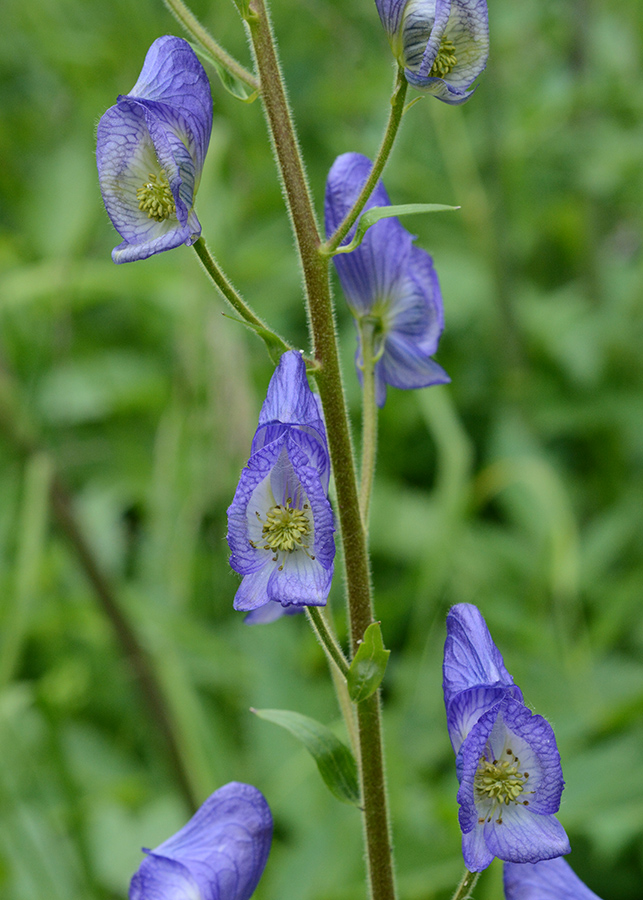
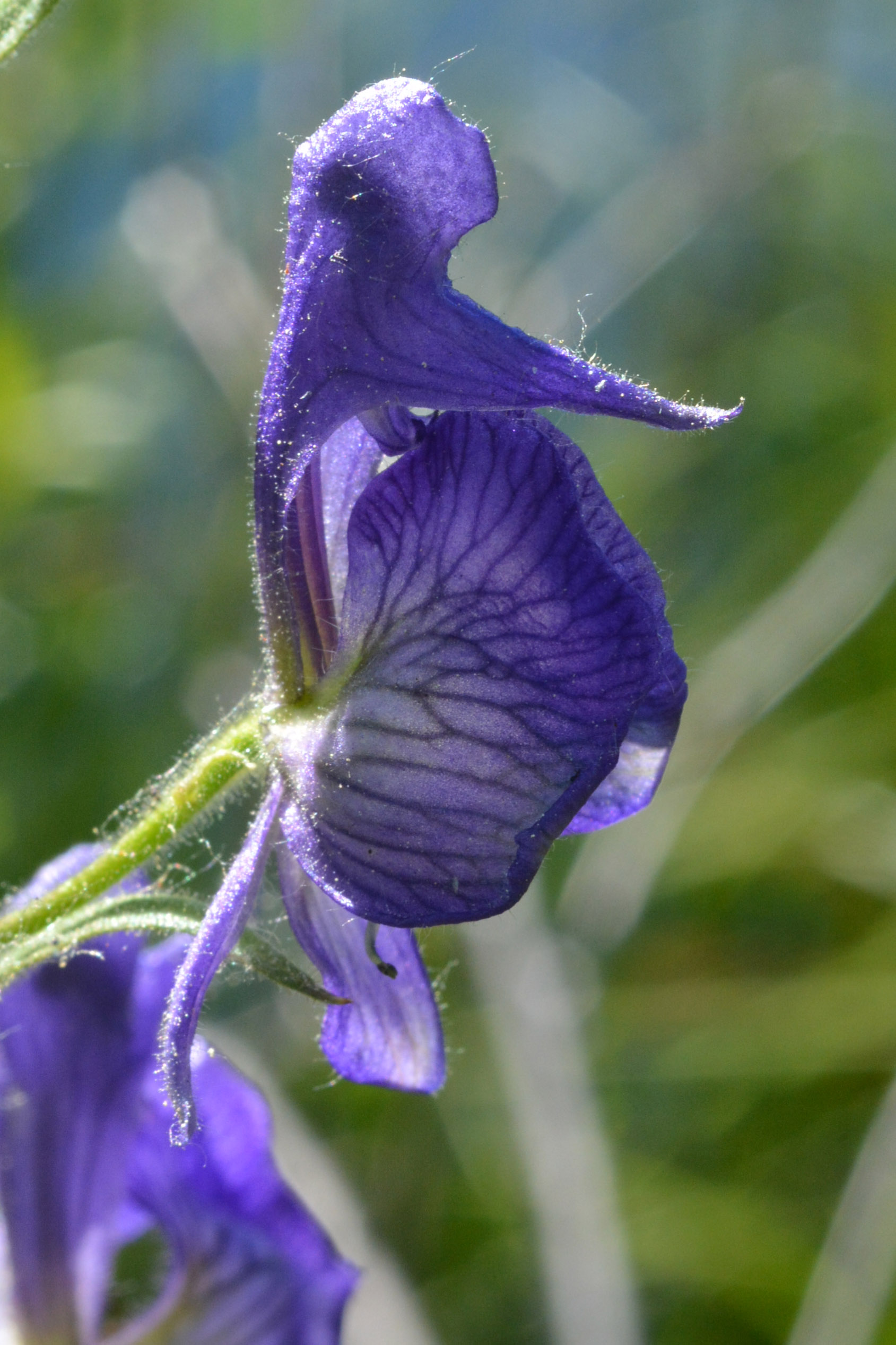
MonkshoodAconitum columbianum –The genus name Aconitum comes from the Greek akoniton: Theophrastis used this name to indicate “poisonous plant”, which indeed it is!

Monkshood - Aconitum columbianum - is related to the similar looking Tall Larkspur.  both are in the Buttercup Family and have complicated flowers.  It is also deadly poisonous.

MonkshoodAconitum columbianum – is related to the similar looking Tall Larkspur (see above). both are in the highly variable Buttercup Family and have complicated flowers. It is also deadly poisonous.

Monkshood is pollinated by both queen and worker bumblebees, as well as moths and hummingbirds. Observe the structure of the flower. The five sepals (not petals) form a complex purple flower.

Aconitum columbianum

Monkshood sports a “hood” that covers two petals and nectaries. Four additional sepals: two side, two bottom, surround the many anthers and three stigmas. All parts of the plant are poisonous. Found in wet meadows.

The two lower and two side sepals encase and then expose the numerous anthers, while the hood covers two greatly altered petals which contain a stiff coiled spur terminating with nectar glands. Observe when the anthers open and release their pollen (then fade), and when the 3 hidden stigmas become available amidst the anthers: the timing of the male and female reproductive parts is separate to facilitate out-crossing.

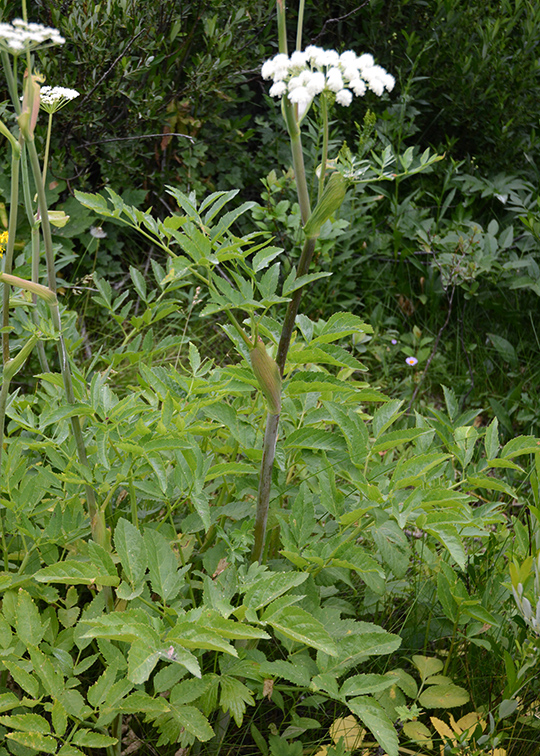
Sharp-tooth AngelicaAngelica arguta – A member of the Parsley Family – as one can tell by the umbrella arrangement of their tiny flowers, this plant typically grows to 4-5’ in moist montane situations.

Angelica is in the Parsley Family, same as the similar Cow Parsnip.  But Angelica has more divided leaves and is smooth, not hairy.

Sharp-tooth AngelicaAngelica arguta – is in the Parsley Family, same as Cow Parsnip (see below). But Angelica has more divided leaves and has a smooth, not hairy, stem.

Sharp-tooth Angelica can be mistaken for the more robust Cow Parsnip, but notice the large, toothed leaves are divided into numerous, smaller leaflets. The stem is smooth and slightly bluish. Angelicas have been used for medicines by many indigenous people, but note the species also resembles Water Hemlock – Cicuta maculata – called “suicide plant” by the Iroquois – which also grows in moist to wet sites! Always make sure you know the ID of any plant you use!

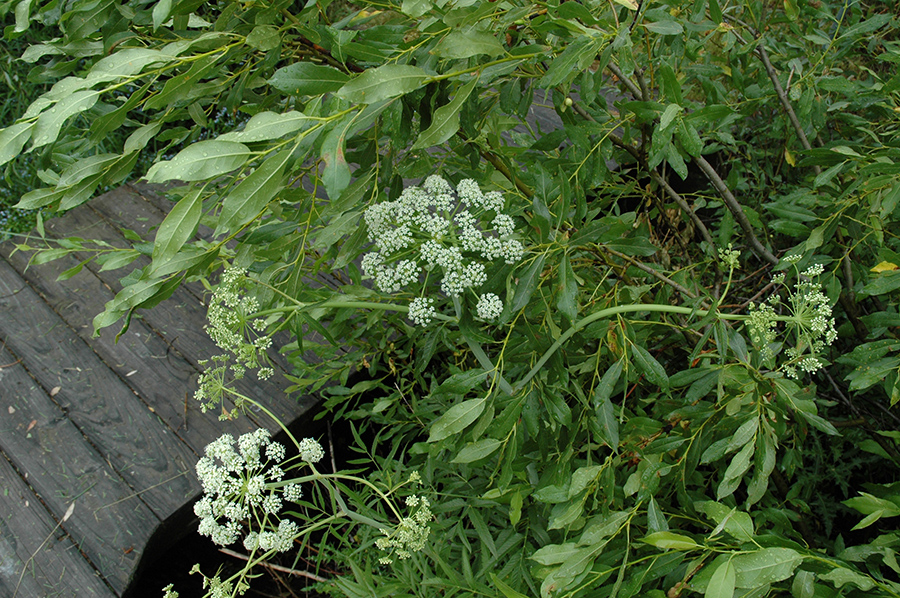
Water Hemlock - Cicuta maculata - grows in similar places and can be mistaken for Angelica.  The Iroquois called this plant

Water HemlockCicuta maculata – grows in similar wet places and can be mistaken for Angelica. The Iroquois called this plant “suicide plant” for a reason. Here it is in a ditch in Wilson.

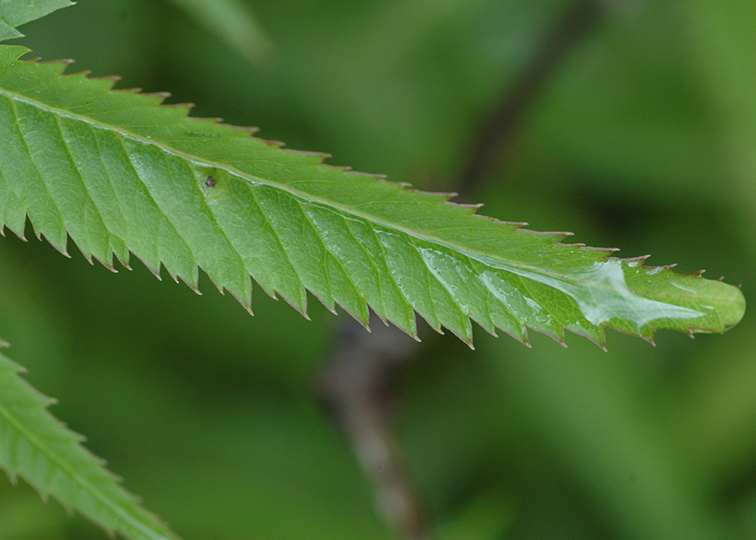
Water Hemlock - Cicuta maculata - looks very similar to Angelica, but it is not an angel.  It is deadly poison.  Note the veins go to the junctions of leaf.  Know your plants before you touch or eat them!

Water HemlockCicuta maculata – looks very similar to Angelica, but it is not an angel! It is deadly poison. Note the side veins end at the indentations of the teeth of the leaf. Know your plants well  before you touch or eat them!

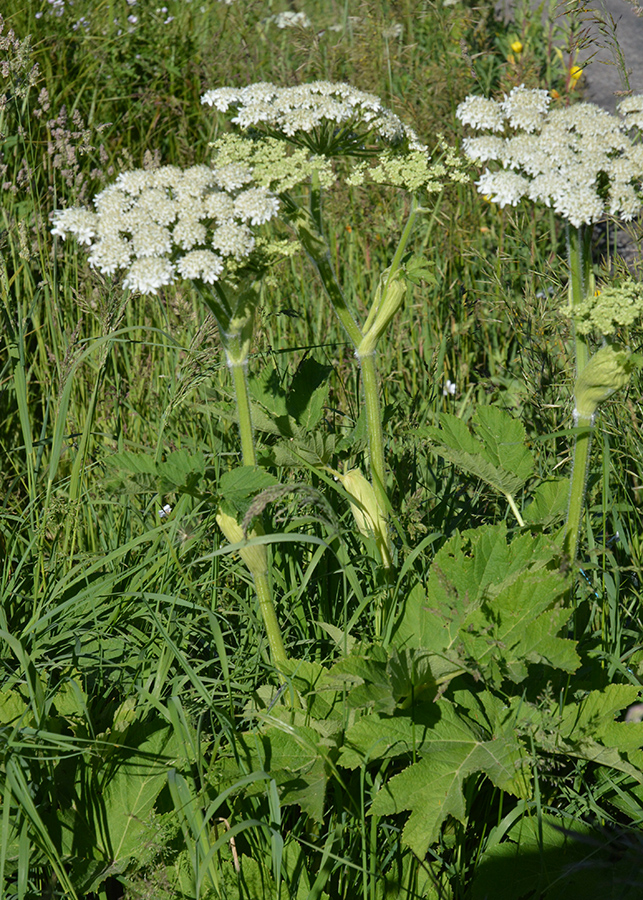
Cow Parsnip Heracleum spondylium – One of the largest and most obvious members of the Parsley Family, this giant is found in wet meadows. The inflorescence is the size of a dinner plate. The stems are very hairy (hairs may cause a rash) and the giant leaves are divided into three large, jagged lobed leaflets.   Many pollinators take advantage of the numerous tiny flowers.

Cow Parsnip - Heracleum spondylium - has large jagged leaves, plate-sized flower clusters, and is hairy.

Cow ParsnipHeracleum spondylium – has large jagged leaves, plate-sized flower clusters, and very hairy stems.  The hairs can cause a rash in some people.

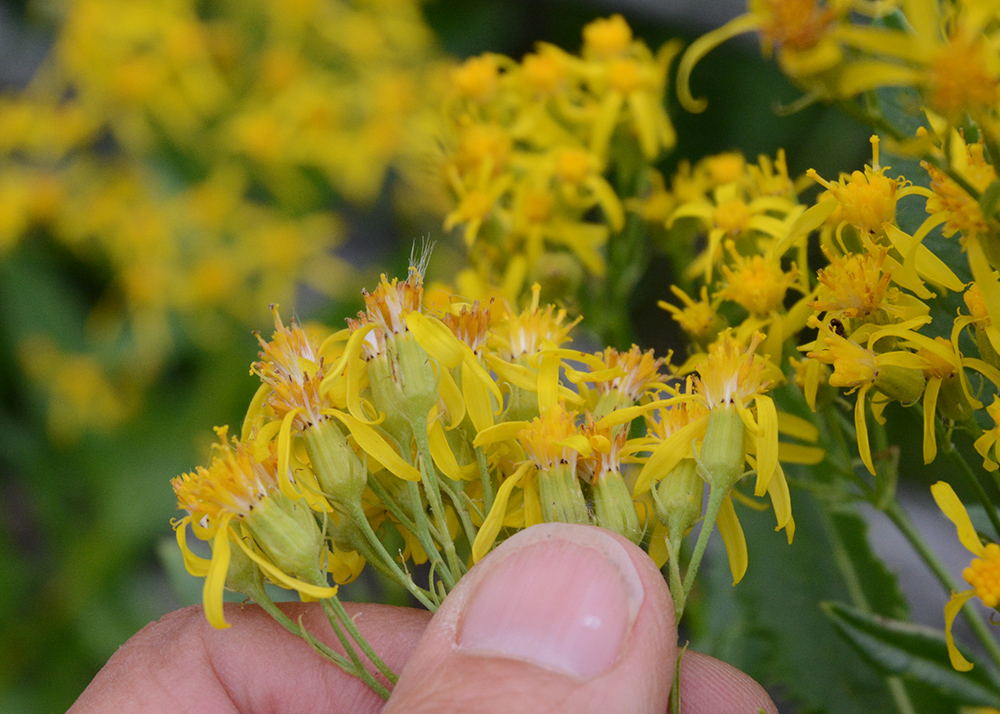
Butterweed Groundsel – Senecio serra – This tall, 4-5’ yellow composite plant is frequent in moist to wet meadows. The leaves are 4-5”, oblong to lance-shaped, with many teeth (unlike the similar S. triangularis whose leaves are elongate triangles.) Senecios typically have a “palisade fence” of waxy, even-sized bracts surrounding the flower head. In this case, each bract is black tipped. The showy ray flowers are few—here about 6-8, and the disc flowers several. Combined, the head provides a platform for many pollinators—including butterflies–which can crawl over and sip nectar from each of the tiny goblet- shaped disc flowers. The fruits (achenes) will have a tuft of white fluff to help send them on their way. “Senes” = old man. Ragwort is another common name.

Butterweed Groundsel - Senecio serra - is common along road sides and in meadows right now.

Butterweed GroundselSenecio serra – is common along road sides and in meadows right now.  The 5-6″ elongated, serrated (like a saw) leaves help separate it from other large Groundsel species.

Butterweed Groundsel has shiny bracts, often black-tipped, surrounding each head of flowers.

Butterweed Groundsel has shiny, even sized bracts, often black-tipped, surrounding each head of flowers.

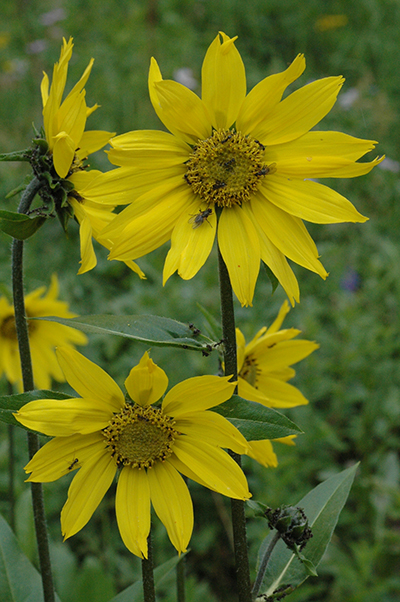
Five-veined Little Sunflower/Helianthella –Helianthella quinquenervis –  Not so little, this 3-4’ robust plant is closely related to One-flowered Sunflower (H. uniflora) seen throughout the valley these past few weeks. This species is larger, the flower heads are bent at right angles to the stalk—they appear to glare straight at you, and the lower leaves have 5 strong veins. It prefers more moist conditions than H. uniflora.

Five-nerved Helianthella - Helianthella quinquenervis - appears to stare right at you!

Five-nerved HelianthellaHelianthella quinquenervis – appears to stare right at you!

Five-nerved Helianthella is named for its 5 strong veins on the lower leaves.

Five-nerved Helianthella is named for its 5 strong veins on the lower leaves.

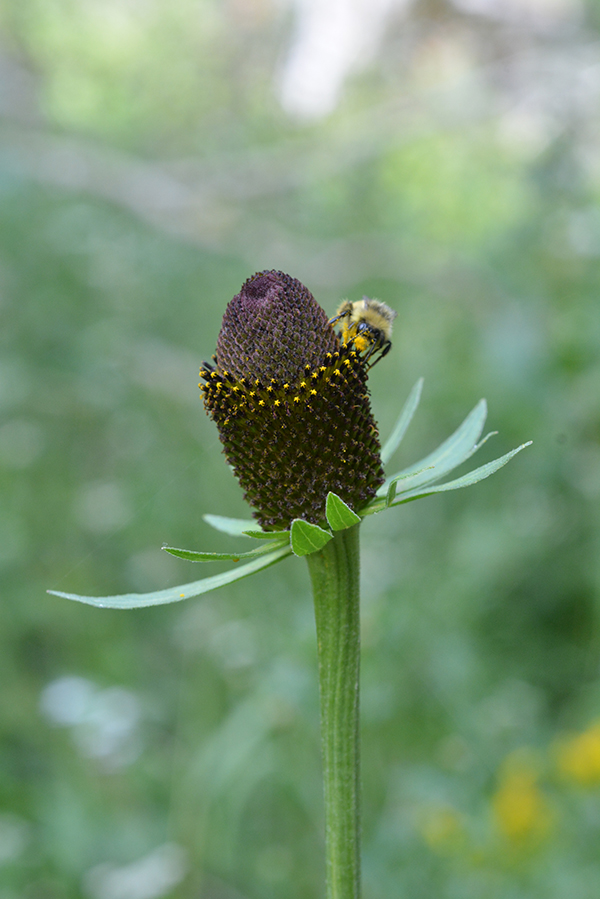
Western ConeflowerRudbeckia occidentalis – This member of the Sunflower Family never looks quite in bloom (compare to Helilanthella above). We expect yellow “ray flowers” to whorl around the outside of each “head”.  However, in this species, there are no flashy ray flowers, only a whorl of green bracts.  There is a “cone” of tiny “disc” flowers which begin to bloom from the base and gradually, with time, spiral up to the tip.  The bees know it is ready for pollination somehow and are often seen crawling around, dipping their mouth parts into the tiny maroon cups for nectar and collecting pollen.

Western Coneflower - Rudbeckia occidentale - Tiny disc flowers attract bee pollinators.  It flowers from bottom to top.

Western ConeflowerRudbeckia occidentalis – Tiny disc flowers with yellow pollen attract bee pollinators. It flowers from bottom to top.

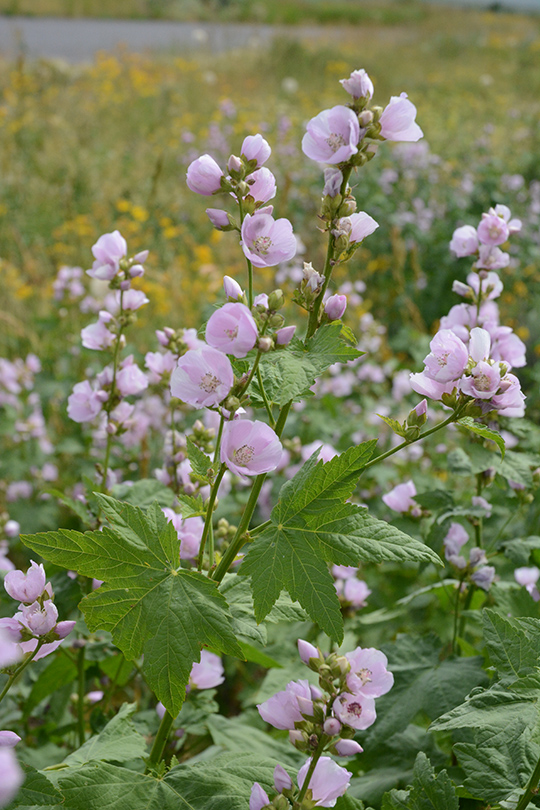
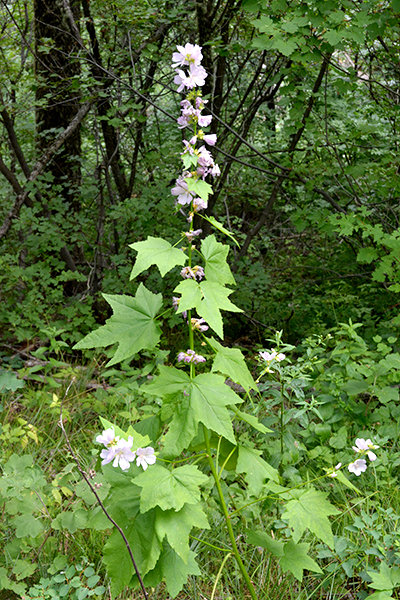
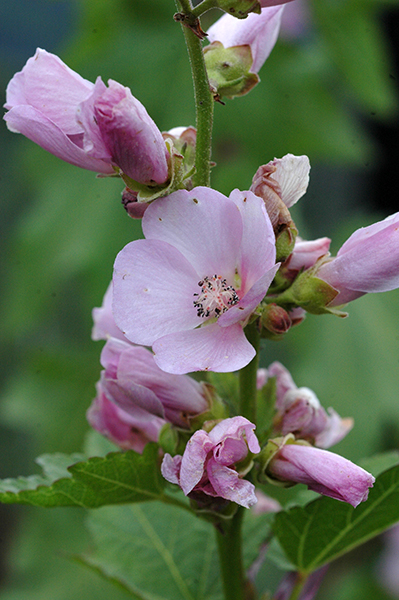
Mountain or Wild HollyhockIliamna rivularis – Many people notice this pink plant popping up here or there along the park road or main highway, as well as in meadows or woodland edges.

Mountain Hollyhock - Illiamna - pops up along highways, in the woods, and especially in areas after forest fires.

Mountain or Wild HollyhockIliamna rivularis – pops up along highways, in the woods, and especially in areas after forest fires.

The stems are lined with many large 2-3” flowers. The stamens form a tube in the center with 5 roundish stigmas sticking out. The leaves are like maple leaves.

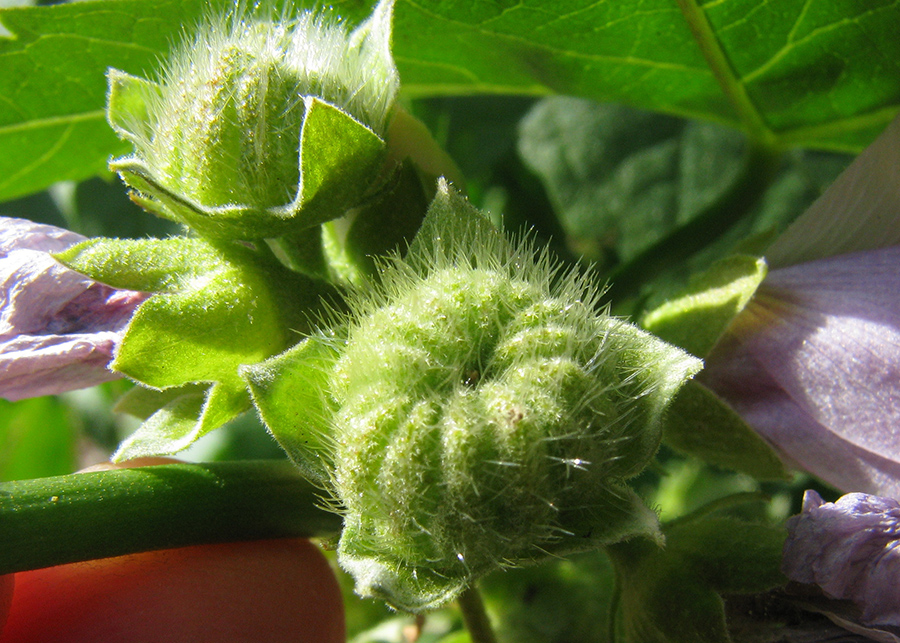
The fruit of Mountain Hollyhock - Iliamna rivularis -  looks like a hairy tangerine.

The fruit of Mountain Hollyhock – Iliamna rivularis – looks like a hairy tangerine.

The hairy fruit will look like a somewhat compressed 1” tangerine which divides into several sections. This plant in the Mallow Family (Malvaceae) is related to garden hollyhock, marshmallow, okra, and cotton.

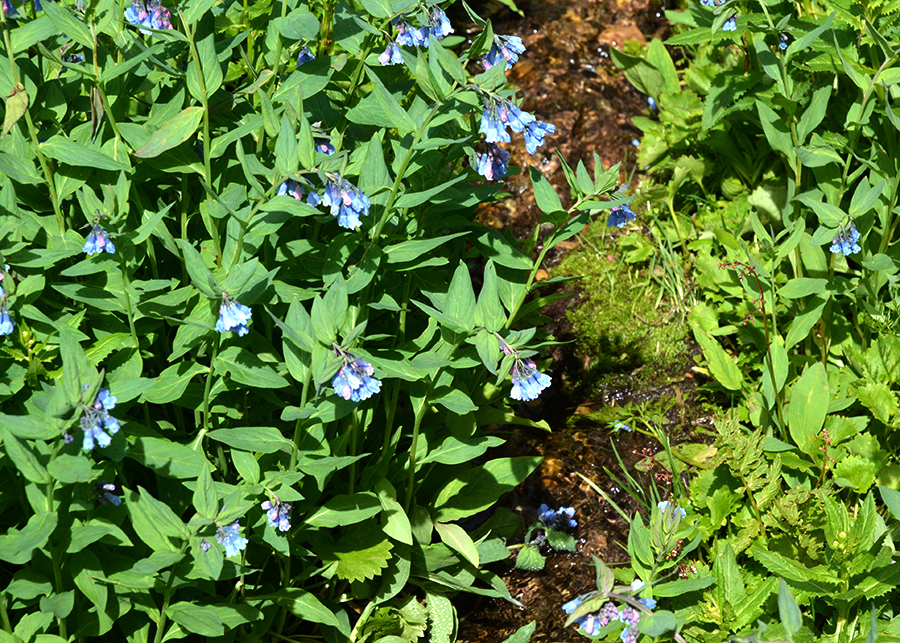
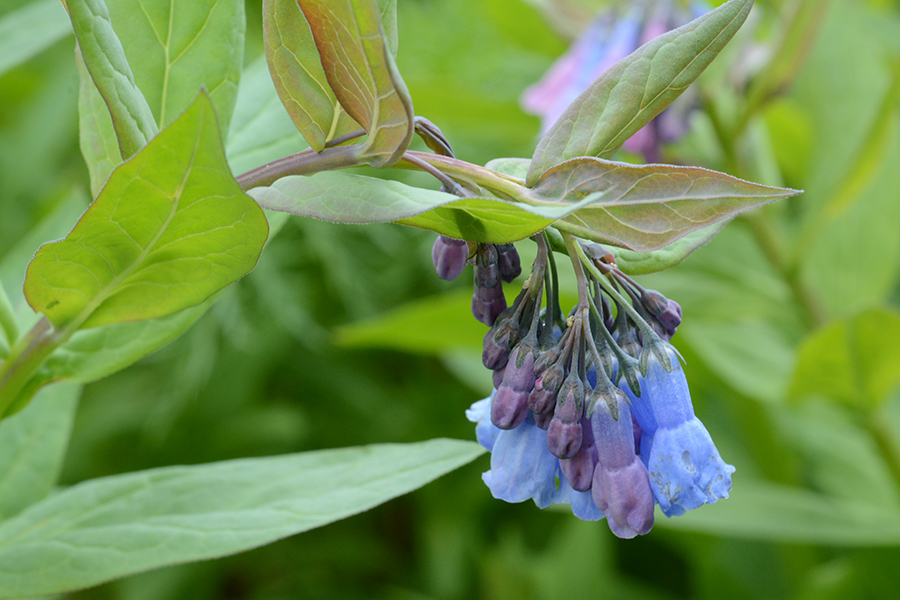
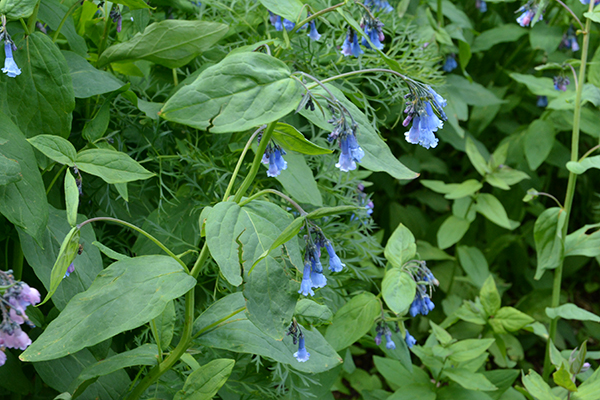
Mountain BluebellsMertensia ciliata – Colonies of 2-3’ bluebells inhabit wet seeps and meadows at high elevations.

Mountain Bluebells - Mertensia ciliata - colonizes wet meadows at high elevations.

Mountain Bluebell – Mertensia ciliata – colonizes wet meadows at high elevations, for instance above Ski Lake.

The 2-4” oval, bluish green leaves alternate up the stems which often arch over stream sides. The dangling tubular flowers start out pinkish and then turn blue when ready to attract bumblebee pollinators. The anthers have small pores at their tips. The frequency of buzzing bee-wing muscles shakes out the pollen onto the bee!

Mountain  Bluebells are buzz-pollinated.  Bees vibrate their wings at a certain frequency, and pollen falls onto their bellies!

Mountain BluebellsMertensia ciliata – are buzz-pollinated. Bees vibrate their wings at a certain frequency, and pollen falls onto their bellies! Note the flowers go from pinkish purple to light blue, signaling to the bees when to visit.

Mountain Bluebells are self-compatible—they can receive their own pollen and make seeds, although the resultant off-spring often are not as strong – inbreeding depression.

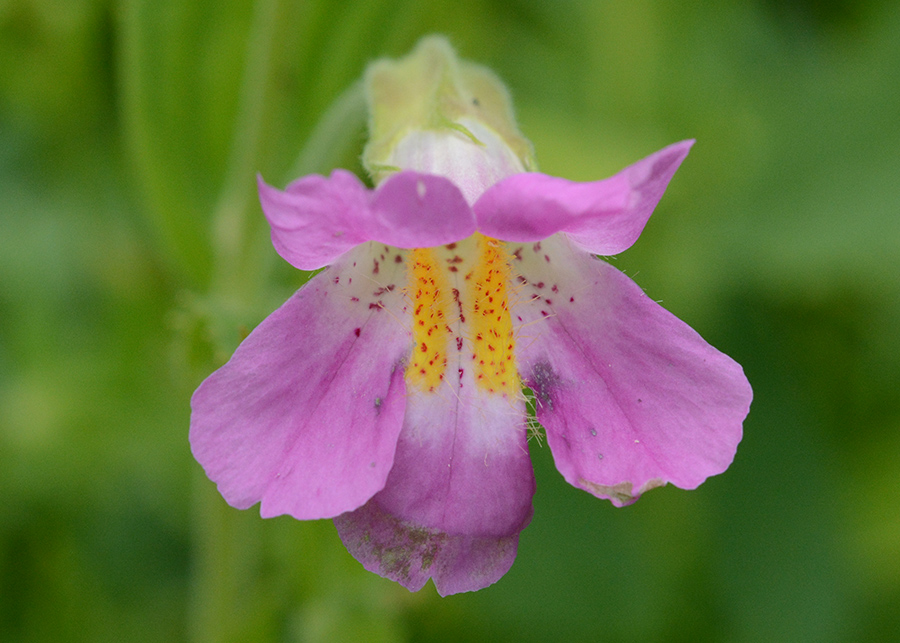
Monkey FlowerMimulus lewisii – These cheerful brilliant pink flowers with splashes of yellow on their lower petals ornament rivulets and seeps in the cool mountains. The leaves of Monkey Flower, which have three strong veins, are arranged opposite to each other along 2-3’ stems. They are pollinated by bumble- and mason bees.

Lewis' Monkey Flower - Mimulus lewisii - graces seeps with its cheerful blooms.

Lewis’ Monkey FlowerMimulus lewisii – graces seeps with its cheerful blooms.  You can see the nectar guides attracting bumble- and mason bees into the center of the flower.

Some of you may have seen a very similar species in the Sierras – M. cardinalis – whose red flowers are pollinated by hummingbirds. In the laboratory, the species will interbreed; however, in nature where the ranges of the two species overlap they do not exchange genes: the pollinators are different. Therefore, the two species maintain their integrity and continue to evolve in their own way.

False Hellebore - Veratrum californicum/tenui - is having a

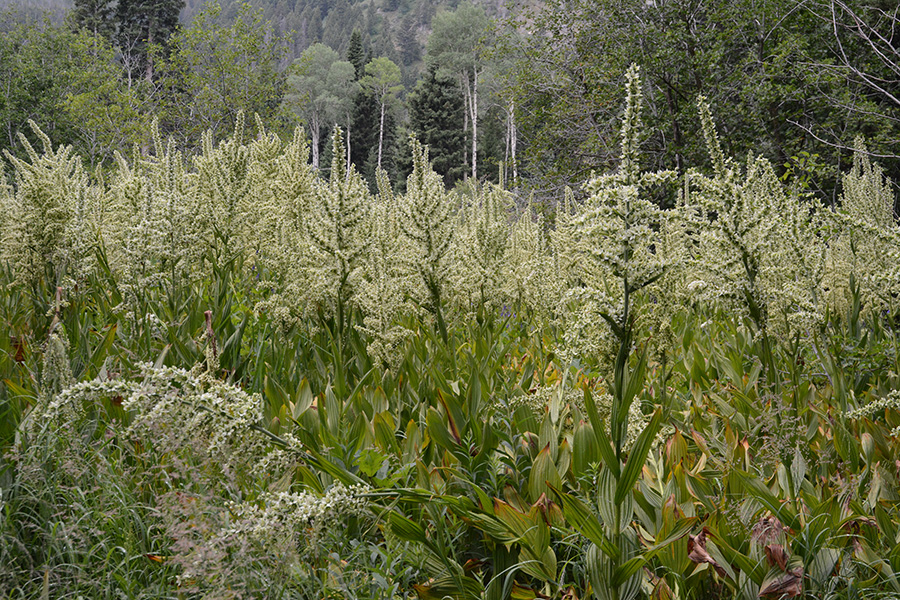
False HelleboreVeratrum californicum/tenuipetalum – is having a “mast” year. This profuse stand is growing the west end of Phelps Lake.

False Hellebore – Veratrum californicum/tenuipetalum – This is a very poisonous plant in the Lily family (now split off into the Bunch-berry Family-Melanthiaceae) which grows in very damp soils. It has formed a very large, 6’-7′-tall colony along the west end of Phelps Lake this year. This is a display of “masting”—when a plant species produces many, many flowers and fruits synchronously in one year. The overabundance attracts many pollinators: flies during the day, moths at night, and the plentitude makes it difficult for all the seeds to be consumed.

The abundance of flowers and then hopefully seeds first attracts many pollinators, and once pollinated produces an abundance of seeds--too many to be eaten by hungry predators.

The abundance of flowers of False Hellebore first satiates pollinators, and then once they are pollinated, hopefully flowers produce an abundance of seeds–too many to be eaten by hungry predators.

Research indicates that “masting” of False Hellebore is cued by cool July temperatures the previous year, a trigger which could be affected by warming of climate change. Observe the flowers near the top of the bountiful flower stalks: they are typically male and female, while the lower flowers are only male.  See if you can find the difference.

Look at the flowers closely.  Apparently the upper flowers are

Look at the flowers of False Hellebore closely. Apparently the upper flowers are “perfect” with both male and female parts. The lower flowers have only male parts. Hard to tell which this example is.

Information on dispersers and fate of the seeds of False Hellebores was not readily available in a web search. However, there is great information on the masting biology of these plants: http://www.amjbot.org/content/100/3/519.full

These are just a few of the fascinating flowers in bloom right now.  A future posting will discuss some of the smaller species that are beginning to flourish.  In any case, keep on hiking, observing, and enjoying the bounty of flowers we have this summer!

Frances Clark, Wilson, WY

July 23, 2015

P.S. As always, this blogger appreciates comments, corrections, additions to the information provided here.

9:50 p.m.

Late June Blooms in Jackson Hole!

Throughout Jackson Hole native plants are flowering in abundance due to plentiful May rains and now the unseasonably hot weather.  We have picked only a few highlights. There is much more to observe.

Snowbrush on the Moraines:

Snowbrush Ceonothus- Ceonothus velutinus – covers the burn area of the 1999 Alder Fire located south and west of String Lake.  You can also see Snowbrush in another burned forest on the way to Bradley and Taggart Lakes.  Not only are the flowers showy, but also the fragrance is heavenly.

Seeds of Snowbrush - Ceonothus velutinus - can remain in the soil for decades, ready to sprout after a fire.

Seeds of Snowbrush CeonothusCeonothus velutinus – can remain dormant in soil for decades, ready to sprout after a fire.  Mature plants cover the moraine by String Lake, Grand Teton National Park.

Smokebrush has elegant clusters of white flowers and leaves with three strong veins and a glossy texture on the surface. Buds can be sticky with resin.

Snowbrush Ceonothus has elegant clusters of white flowers and 3-4″ leaves with three strong veins and a glossy texture on the surface. Buds and leaves can be sticky with resin, which provides a different fragrance.

Mulesears on Mountain Sides

Another big show is Mulesear Wyethia (Mulesear for short).  Mulesear looks to many people like the popular and plentiful Balsamroot because of its big yellow sunflower-like flowers and its large leaves. However, Mulesear has darker yellow ray flowers, glossy green elliptical leaves that grow up the stems compared to paler yellow flowers and arrow-shaped, gray-green leaves that grow only from the base of Balsamroot.  Importantly, Mulesear grows in heavier clay soils vs. the well drained soils where we find Balsamroot.

Mulesears have large, dark yellow flowers, 12-18

Mulesear Wyethia – Wyethia amplexicaulis – has large, dark yellow flowers and 12-18″ elongate, deep green leaves (the size and shape of mule’s ears!). It grows in heavier soils than the look-alike Balsamroot.

Cliff Creek drainage in the Bridger-Teton National Forest south of Hoback was magnificent last week.

Cliff Creek drainage in the Bridger-Teton National Forest south of Hoback was magnificent last week. These mountains consist of sedimentary rock which breaks down into clay particles, forming heavier soils.  Note in the distance the mist of pine pollen wafted on the wind.

Wally's World trail off Fall Creek Road near Munger Mountain was full of wildflowers June 20.

Wally’s World trail off Fall Creek Road near Munger Mountain was full of wildflowers June 20.

You can also see stands of Mulesear along the highway near Antelope Flats Road and up by Cattleman’s Bridge near Oxbow Bend in Grand Teton National Park.

Sulphur Buckwheat and More on Sage Flats

The glacial outwash plains of Jackson Hole within Grand Teton National Park are in full bloom.  Amidst the silvery Big Sagebrush (Artemesia tridentata var. vaseyana), is a tapestry of color: creams, blues, yellows, reds, maroons.  The plant composition varies but the following species are typical at this time.

Sulphur Buckwheat - Eriogonum umbellatum - has mats of small oval leaves, and umbels of creamy yellow flowers which are often tinged with pink.  They are blooming throughout the valley.

Sulphur BuckwheatEriogonum umbellatum – forms mats of small oval leaves and clouds of creamy yellow flowers which are often tinged with pink. Sulphur Buckwheat is  blooming throughout the valley. Note the whorl of leaves just below the inflorescence or flower cluster.

Sulphur Buckwheat, grasses, and Sedum are common at the beginning of the Bradley Taggart Trail Head.

Sulphur Buckwheat and Lance-leaved Stonecrop are overtopped by many grasses at the beginning of the Bradley-Taggart Trail.  Grasses seem more abundant this year compared to 2014.

Several species of grasses overtop the low-growing, showy flowers.  Melica -Melica spectabilis - has elegant egg-shaped spikelets.

Several species of grasses are in full bloom, although the flowers are naturally inconspicuous. Grasses count on the wind for pollination and the wind cannot see or smell, so no fancy colors , patterns, or  scents are necessary.  Even so, close up, Melicgrass –Melica spectabilis – has elegant, dangling spikelets of individual flowers.  Light, wind-dispersed pollen is causing hay-fever (hay comes from grasses!) in many people right now.

Lance-leaved sedum - Sedum lanceolatum - has succulent 1/2

Lance-leaved Stonecrop – Sedum lanceolatum – is tucked below the taller plants.  They have succulent 1/2″ leaves on 6-8″ stems and bouquets of 5-parted, star-shaped yellow flowers. Members of this desert-adapted plant family have a very different metabolism than most other plants.  Look up “CAM- Crassulacean acid metabolism” on the internet to find out more!

Scarlet Gilia - Ipomopsis aggregata - attracts hummingbird, it main pollinator.  Birds see red (insects don't) and the stiffly arrayed tubular flowers enable hummingbirds to hover while lapping up nectar deep within.

Scarlet GiliaIpomopsis aggregata – attracts hummingbirds. Birds see red (insects don’t) and the stiffly arrayed tubular flowers enable hummingbirds to hover while lapping up nectar deep within.  In the process of drinking the high-test nectar, the forehead of the bird bumps the protruding yellow anthers, collecting pollen.  Upon the bird’s next visit, the next flower may have a long stigma to which the pollen will stick.  With luck, the pollen tube grows and fertilizes the egg deep inside the plant….fertile seeds then form!

The south end of the inner Park Road includes dashes of Scarlet Gilia as well as swaths of rusty Dock.

The south end of the Park Road includes tall accents of Scarlet Gilia, as well as plumes of creamy Sulphur Buckwheat.  

Silky Lupine - Lupinus sericeus

Silky LupineLupinus sericeus – is typical of sage flats and dry hillsides.  It has hairs on the backside of the “banner” of the pea-like flowers and very hairy palmate leaves.  As of this posting, I have seen few plants flowering compared to last year. Are you finding it?

Sheep Sorel - Rumex acetosella - adds another color to the tapestry.  A plant of more disturbed soils it is a non-native species.  Plants grow as either males or females.  Take a close look for pollen (male) or stigmas and ovaries (female).

Sheep-sorrrelRumex acetosella – adds another color to the tapestry. A plant of disturbed soils, it is a non-native species. Plants have tiny either males or female flowers . Take a close look to find anthers (male) or stigmas and ovaries (female). Sheep-sorrel happens to be in the same family – Polygonaceae – as Sulphur Buckwheat – Eriognoum spp.

Look for the brightly colored Rocky Mountain Groundsel - Packera (formerly Senecio) streptanthifolia - pops up in odd corners of the sageflats: Here it is in Lupine Meadows. The leaves vary greatly in their shape and incisions.

Bright yellow Rocky Mountain GroundselPackera (formerly Senecio) streptanthifolia – pops up in odd corners of the sage flats, such as Lupine Meadows. The leaves vary greatly in their shape and incisions.  The “flowers” typically have only 8-10 “petals” or ray flowers, per head.

Hawksbeard - Crepis aggregata - is common along the Gros Ventre Road. Note the sword-shaped leaves at the base of the plant.

This species of HawksbeardCrepis aggregata – is common along the Gros Ventre Road. Note the sword-shaped, deeply lobed leaves at the base of the plant.  The dozens of flower heads have only a few ray flowers each.

Little Sunflowers - Helianthella uniflora - are big bright spots on dry slopes surrounding the flats, and occasionally on the flats.

One-flower Sunflowers  or HelianthellasHelianthella uniflora – are 2- to 3-foot tall bright spots in the sage flats along Gros Ventre Road.  They also are found along dry river benches and lower slopes of the buttes. It’s more robust relative – Five-nerved Helianthella – H. quinquenervis – blooms here and there. Look for the 5 strong nerves on the large lower leaves to help distinguish the two.

These last three yellow species are all members of the Aster or Sunflower Family.  It is fun to compare their flowers, leaves, and habit (size, shape, and posture) of these relatives.

Aspen Groves on Rolling Hills 

Aspen stands are particularly welcome oases.  The dappled light created by the shimmering deciduous leaves and the more alkaline soils compared to the pine forests nurtures a rich array of flowers.  The trees themselves are homes to many woodpeckers which in turn create holes for nesting House Wrens, Mountain Bluebirds, and Tree Swallows.

Aspen stands feature a rich array of flowers and birds.  The species vary from place to place. This shot is taken on the west slope of Munger Mountain.

Stands of AspenPopulus tremuloides – feature a rich array of flowers and birds. The mix of species varies from place to place. This shot is taken on the west slope of Munger Mountain. Aspen are easily seen at Cascade Canyon Trail Head, Oxbow Bend, and Two-Ocean Lake Road in GTNP.

One of the most common flowers in aspen groves, meadows, and sage flats is the Sticky Geranium.

Sticky Geranium is common throughout the valley.  Its wide open flowers with obvious nectar guides form landing pads available to many types of pollinators.

Sticky GeraniumGeranium viscossissimum – is common throughout the valley. Its wide open petals with obvious nectar guides form landing pads available to many types of pollinators. 

Two members of the Parsley Family are found in open forests. Can you figure out from the pictures below why it was once called the Umbelliferae Family?

Fernleaf  Lovage - Ligusticum filicinum - is a tall - 2-4 foot plant with ferny, greatly dissected leaves.  The white flowers held on wide umbels are equally as delicate.

Fernleaf LovageLigusticum filicinum – is a tall – 3- to 5-foot plant with ferny, greatly dissected leaves.  The white flowers held on wide umbels are equally as delicate.

Related to the lovage is Western Sweetroot, Wild Licorice - Osmorhiza occidentalis - also has delicate flowers in umbels, but the compound leaves are much less divided.

Related to Fernleaf Lovage, Western Sweetroot, Wild LicoriceOsmorhiza occidentalis – has delicate yellow-green flowers in umbels.  The compound leaves are much less divided and have the fragrance of anise or licorice, as does the root.  True licorice comes from a member of the Pea Family, not the Parsley Family.

Wild Licorice or Sweet Cicely - Osmorhiza occidentale - is a member of the Carrot or Parsley Family.  As with many members of this family - anise, caraway, dill - the seeds are filled with flavor.  Take a taste!

Note the elongate, ribbed, smooth fruit.  Western Sweetroot or Wild LicoriceOsmorhiza occidentalis – is a member of the Carrot or Parsley Family.  As with many members of this family – anise, caraway, dill – the seeds are filled with flavor. Try a taste!

Two members of the Orchid Family can be discovered along trails in aspen groves and elsewhere if you are lucky.  Both are small plants with only a few 1-2′ stems of a reddish to fleshy hue.  They have no chlorophyll but depend on a fungal relationship to nourish the plants. Coralroots get their names from their knobby roots.

Spotted Coralroot - Corallorhiza maculata - is variable in its decoration. However 2 lobes on either side of the base of the lowest petal (lip) and a bump (spur) under the throat of flower help in ID.

Spotted CoralrootCorallorhiza maculata – is variable in its decoration. However, a lobe on each side of the base of the lowest petal (lip) and a bump (spur) under the throat of the flower help confirm ID.

Striped Coralroot - Corrallorhiza striata - The largest of 5 species of Coralroot, this reddish plant has no chlorophyll, but rather depends on a fungus to relay nutrients from other plants nearby.

Striped CoralrootCorrallorhiza striata – is the largest of 5 species of Coralroot in Teton County.  This reddish plant has no chlorophyll, but rather depends on a fungus to relay nutrients from other plants nearby.

Shrubs of Note

Several shrubs are coming into bloom right now.  Serviceberry, Hawthorn, and Chokecherry are beginning to develop fruits that will be favored by bears, birds, and small mammals in the fall, particularly in such places as along the Moose-Wilson Road.  Antelopebush is also fading in the sage flats.  However, Mountain Ash and Elderberry are coming into bloom in the canyons.  Here are three other shrub species that are obvious in their habitats:

Rosa Woodsii - Wood's rose

Woods RoseRosa woodsii – flowers in abundance along roadsides. Many pink flowers are clustered together at the tips of twigs.  Another rose species with sparsely prickly branches bares flowers individually: Nootka Rose – R. nutkana.

Snowberry - Symphiocarpus oreophilus - a 2-3 foot shrub with opposite oval leaves, is blooming in both shade and sun throughout the valley.

Mountain Snowberry Symphiocarpus oreophilos – a 2-3 foot shrub with opposite oval leaves is blooming in both shade and sun throughout the valley.

Red-stemmed Dogwood - Cornus sericea - is a favorite food of browsing moose, as my ornamental plantings attest.  This wetland shrub is easy to identify with its opposite oval leaves with parallel veins and clusters of 4-petaled white flowers.

Red-stemmed DogwoodCornus stolonifera – is a favorite food of browsing moose, as my ornamental plantings attest. This wetland shrub is easy to identify with its opposite oval leaves with parallel veins and clusters of 4-petaled white flowers.

Odd Species:

The following are a few discoveries in particular habitat niches:

Streamsides and ditches:

White Bog Orchid - Platanthera dilatata - is found in wet spots.  The details of the small white flowers and the lovely fragrance help to identify it.

White Bog OrchidPlatanthera dilatata – is found in wet spots. The small white flowers have a lip or lower petal that is expanded near the base, and a spur extending underneath.  The lovely fragrance clinches its identity as White Bog Orchid.

Twisted Stalk - Strepotopus amplixifolia - graces the edges of streams.  The kinked stalk to the flower gives it its name.

Clasping Twisted StalkStreptopus amplixifolius – graces the edges of streams. The kinked stalk to the flower gives it its name.

Hot spot:

Now in bloom on the ledges by Kelly Warm Springs, this flower is gorgeous.  The pad-like stems break off to help in dispersal.  They attach readily to you!

Prickly PearOpuntia fragilis – is in bloom on the ledges by Kelly Warm Springs.  The flower is gorgeous. The pad-like stems break off easily (fragile) to help in dispersal. They will attach readily to you: do not touch!

Beneath my foot:

Hiking up Cliff Creek, by chance we didn’t step on this 3-4″ wonder.

Broomrape - Orobanche uniflora - is a mysterious species of an odd family.  Scientists don't even know if it is an annual or perennial.  Perhaps it lives more than one year, but after it flowers it dies.  Without chlorophyll, the plant is attaches to other species for its food.  Apparently it is not picky as to its host.

One-flowered Broomrape, Ghost PlantOrobanche uniflora – is a mysterious species of an odd family. Scientists don’t even know if it is an annual or perennial. Perhaps it lives more than one year, but after it flowers it dies. It is unclear what pollinates it, or if it pollinates itself.  Without chlorophyll, the plant attaches to other species for its food. Apparently it is not picky as to its host plants. It is a rare species in several states.

There is much more to see, but only so much time to write.  Hopefully, this posting will provide incentive for you to go and see for yourself what is in bloom.  We appreciate your photos (between 500k to 2-3 mb–please not larger) and any identification questions or pointers of where to see them–tetonplants.org.  We can post them too!

Frances Clark, Wilson, WY

Late August blooms still coming in the Tetons

A_BTNF_TabMt_3VwFlBowl_81614_1Q1fixwebOne is continually surprised by how many new plants are coming into bloom: in high meadows, along wetlands, sage flats, and roadside edges.   Many of them are “composites” or members of the aster, daisy, or sunflower family: Asteraceae.  Many are yellow, others- mostly “asters”- are blue, and some you may not know are in bloom at all: sagebrushes.  A few other unrelated odd species pop up as well, such as elegant gentians and inelegant broomrape.  Below are a few wildflowers that you might notice on your hikes and drives around the valley.  Plus a quiz plant!

Yellow Composites:

Western ConeflowerRudbeckia occidentalis – The purplish brown cone-shaped receptacle never looks quite in bloom until you notice the bees working them over.

Western Coneflower - tiny flowers attract bee pollinators.

Western Coneflower – tiny flowers attract bee pollinators.

Looking closely, you may see a row or two of tiny “disc” flowers with pollen being pushed up.  They start blooming at the base and gradually continue row by row up to the tip.  These 5’ plants with large 6-8”, rough, oval leaves are found in moist meadows.

Curly Cup GumweedGrindelia squarrosa – A relative newcomer to Jackson Hole from its surrounding native range, it has now migrated in along dry roadside edges, mostly in the south end of the valley.   GrinSqu_fllv_NER_81714_2crpWebLook carefully at the bases of each head to see the distinctive bracts curling back from the center.

The curly sticky bracts give the plant its name: Curly Cup Gumweed.

The curly resinous bracts give the plant its name: Curly Cup Gumweed.

These one-of-a kind heads are very resinous: sticky and pungent.  The 1”  leaves are toothed, and often clasp the stems.  Sage grouse chicks 5-8 weeks old relish gumweed in Montana, and maybe here as well?

Showy GoldeneyeViguiria multiflora – Also found along roadsides and trails in the sun to partial shade, these cheerful 1-3’ high plants catch your eye.  Flowers are borne loosely atop wiry stems.

ViquMult_flhab_2OL_8814_2crpWeb

Showy Goldeneye catches attention along roadsides and trails with its cheerful flowers and tidy opposite leaves.

The 2”-3” long, neat, oval leaves with pinnate veins are held opposite each other.  The flower heads are surrounded by tidy rounded bracts, and you may notice the 8-10, broad, petal-like ray flowers are slightly darker toward the center.  In bee vision, this slight change in hue creates a bull’s-eye pattern.  Pollinators have a perfect landing pad from which to gather nectar and honey.

Parry's or Rayless Arnica is the odd-ball of the popular Arnica genus.  It has no sunny ray flowers, only disc flowers.

Parry’s or Rayless Arnica is the odd-ball of the popular Arnica genus. It has no sunny ray flowers, only disc flowers.

Parry’s/Rayless ArnicaArnica parryi – This odd-ball arnica grows 1-2’ tall on the edges of high meadows and coniferous forests.  Unlike its sunflower-like cousins, this species has rusty yellow flower heads with disc flowers only bunched together in 1” heads.  However, the bracts beneath are all the same size;  the leaves, although small, are opposite each other in 2-4 pairs on the stem; and the seeds will have fluffy parachutes (pappus)—all typical of Arnica.  This plant is sticky hairy.

Several yellow composite shrubs brighten sageflats.  This is Rabbitbrush.

Several yellow composite shrubs brighten sageflats. This is Rubber Rabbitbrush – Chrysothamnus nauseosus.

Three sunny composite shrubs: Three shrubs add yellow splashes and swaths of color along roadsides, sage flats, and disturbed, dry habitats. Their genus names have been debated for years as the scientists sort out who is related to whom.  Each species has several varieties, further indicating a range of often confusing characteristics.

Rubber RabbitbrushEricameria/Chrysothamnus nauseosa – This 3-4-foot shrub adds panache to the grey-green hues of sagebrush habitats.  The broad, rounded crown is colored by many narrow flower-heads clustered  together on the ends of upright woody branches.  The very narrow long leaves (1/8” wide to 4+” long) stick out from a grayish, furry stems (tomentose).  The twigs have a milky latex sap which gives it its name.

Rabbitbrush has felt-like gray hairs on the stem and long, flattish leaves, as well as bright yellow flowers.

Rubber Rabbitbrush has dense felt-like gray hairs on the stem and long, flattish leaves, as well as bright yellow flowers. Look for butterflies nectaring on these profuse flower heads.

Douglas RabbitbrushChrysothamnus visidiflorus – Similar at first glance to Rubber Rabbitbrush and sometimes placed in the same genus, this shrub differs in being generally shorter 1-2’ shrubs; green, not gray, hairy young stems; and 2-3” oblong, usually twisted leaves which are a bit sticky (viscid).

Douglas Rabbitbrush has bunches of yellow flowers at the ends of brittle, greenish stems.

Douglas Rabbitbrush has bunches of yellow flowers at the ends of brittle, greenish stems.

The leaves of Douglas Rabbitbrush are usually twisted, and the stems are not densely gray hairy.

The leaves of Douglas Rabbitbrush are usually twisted, and the stems are hairy, but not felt-like.

Hairy Golden AsterHeterotheca/Haplopappus/Chrysopsis villosa – The lowest growing of the three late-summer blooming shrubs, this somewhat woody species grows  6-12 ” in dry disturbed sites and road edges, often with blue Pacific aster.  The leaves are hairy and slightly wavy, only about ½-1” long.  The ½” flowers are a soft yellow.  This genus remains a muddle taxonomically.HaplVilp_habfl_TNPrd_81514_3Q2crpweb

The genus for Golden Aster has been in dispute.  Two rows of pappus hairs is one clue.  Yikes!

The genus for Hairy Golden Aster has been in dispute. Two rows of pappus hairs is one clue. Yikes!

Blue to White Aster-like flowers:  Taxonomically Aster is no longer Aster as scientists around the world have shared and refined their knowledge of this confusing group of plants.  The Europeans claim the old Aster name.  Our genus “Aster” is split now into several new groups with hard to spell and pronounce names.  Below are the common names (still aster) listed with the new botanical names.  Differences are based on growing habit, flower-head bracts, obscure pappus hairs, and invisible DNA.  Luckily, some kinds are quite easy to tell apart once you look. Pollinators of aster flowers are typically bees and butterflies.

Thickstem AsterEurybia integrifolia – Common in meadows, these 1.5-2’ plants have thick, often purplish-red stems coated with sticky hairs. Stems branch mostly near the top, holding out deep-violet flower clusters.  Each flower-head has loose, leaf-like bracts that are also very sticky.  The glandular hairs form a gluey forest that deters small insects from creeping up the stems to lay their eggs in the larder of fattening seeds.  The oval leaves clasp the upper stem, the lower leaves can be petioled.

The stems of Thickstem aster are not only thick, but also sticky.  A forest of glandular hairs deter crawling insects from laying eggs in the developing seeds.

The stems of Thickstem Aster are not only thick, but also sticky. A forest of glandular hairs deters crawling insects from laying eggs in the developing seeds heads.

Chaffy AstersEucephalus sp. The three Wyoming species of Chaffy Aster typically sport a few upright stems which are trimmed bottom to top with many alternating, oval to elongate leaves. The plants branch like candle-arbors near the top where a few sparse flowers are arrayed.  Flower-heads have relatively few (6-12) showy ray flowers.  The receptacle is elongate, covered with 3 rows of broad, dry (chaffy), triangular bracts arranged like shingles on a roof.  These three species are often found growing among one another.

Nuttall AsterEucephalus elegans (Aster pereglans) –This species is the shortest and most elegant of the three, averaging 1-1.5’ or so.  The flower-heads display 5-7 violet-purple ray flowers.  The tightly arranged bracts are hairy, especially around the edges, and are often traced with purple. The oblong 2” leaves are neatly arranged up the stem.

Flowers of Nuttall's Aster exhibit fine features of the genus: the broad bracts in several rows, and a few ray flowers.

Flowers of Nuttall’s Aster exhibit fine features of the genus: the broad bracts in several rows and only a few ray flowers.

EuceEleg_habfl_PhiPs_8914_1Q2web

The leaves of Nuttall’s Aster, as with other members of the genus, alternate up the whole stem, gradually becoming smaller.

Engelmann’s AsterEucephalus engelmannii –This  aster stands up to 3-5’ tall and tends to lean out from the shade of forest edges or above other robust meadow plants.  The large bright white, slightly ragged flower-heads cluster near the tips of the sparse branches. The straight stems are covered with many 3-4” oblong leaves.

Engelmann's Aster is the largest of the three chaffy asters.

Engelmann’s Aster is the largest of the three chaffy asters.

For comparison:  Engelmann's Aster left, Nuttall's Aster right.

For comparison: Engelmann’s Aster left, Nuttall’s Aster right.

Blue-leaf AsterEucephalus glaucus – Look for colonies of 1-2’ stems covered with gray-blue leaves. The flowers are white to pale lavender and the bracts are pale, smooth, and thin-textured. The overall appearance is rather ghostly.  It lurks in relatively dry and high, often sunny, locations.

Blue-leaf Aster has a ghostly appearance on rocky high elevations.

Blue-leaf Aster has a ghostly appearance on rocky high elevations.

American Asters – Symphyotricum spp. – There are several truly aster-like asters that now have an impossible botanical name: Symphyotrichum (Sim-fee-o-trick-em).  In case you really want to know, here are three (out of about 7) common showy species:

SympAsce_habfl_home_81414_1aQ2crpWeb

Pacific Aster is the most common aster: it tolerates a wide range of conditions and ranges greatly in height, but it always has lots of flowers!
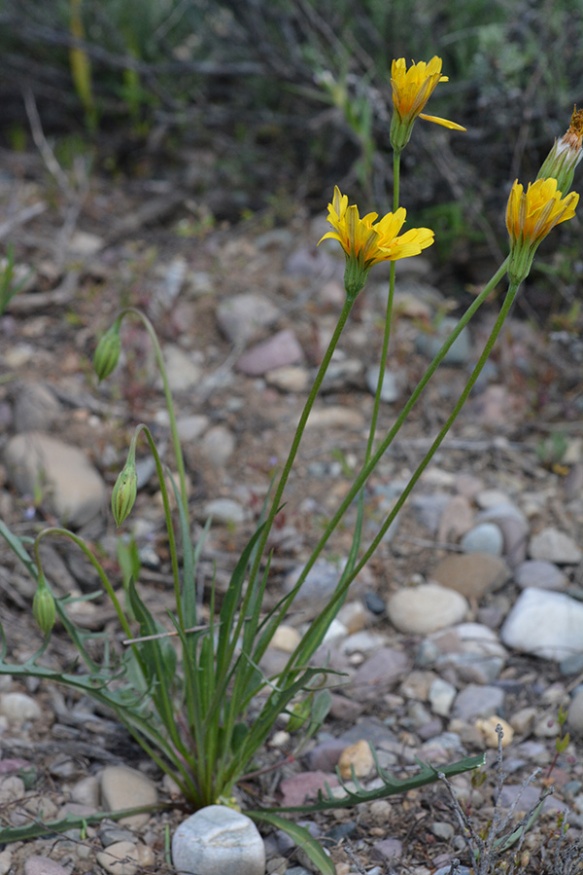
Pacific AsterSymphyotrichum ascendens –One of the most common and tolerant asters, Pacific aster  started blooming a few weeks ago and continues to do so along roadsides: from 6” where it may have been mowed or grazed, to 2+ feet where there is extra moisture.  The light blue flower-heads grow along much of the stem.  The bracts on the underside are shorter at the base and longer on the inside (ascending).  The leaves are elongate and if you look closely, the venation is elongate too—these characteristics help us know it for sure.

The leaf of Pacific Aster has elongate venation and is a key to identification.

The leaf of Pacific Aster has elongate venation: a key to identification.

Another key to ID of Pacific Aster are the bracts:  the lower ones are definitely shorter the the upper ones.

Another key to ID of Pacific Aster are the bracts: the lower ones are definitely shorter the the upper ones.

Bracted AsterSymphyotrichum eatonii – Found on stream edges with wet feet, this 2-4’ aster can at first be confused with Leafy Aster (below) as the blue flower heads have leafy bracts.  However, the leaves of Bracted Aster are narrow and long ( >7x longer than wide), and the habitat is definitely wet.  Flowers cover much of the plant and the stem is usually slightly hairy all over.

Bracted Aster is found along streamsides and wet meadows.  Note the long leaves and many flowers along the stem.

Bracted Aster is found along streamsides and wet meadows. Note the long leaves and many flowers along the stem.

Bracted Aster also has leafy bracts, which can be confused with the species below: Leafy Aster.  ID depends on several clues.

Bracted Aster also has leafy bracts, which can be confused with the species below: Leafy Aster. ID depends on several clues.

Leafy AsterSymphyotrichum foliaceum – Just coming into bloom in moist meadows, near streams, and high elevations, this aster has broad oval leaves that often clasp the stem and several blue flower-heads with many ray flowers, which together create quite a show.  Looking under the flower-head you can see the leaf-like bracts that give it its name.  There are several varieties with different details of leaves, bracts, etc., but just “Leafy Aster” is fine.

Bracted Aster usually has leaf-like bracts and long broad leaves.

Leafy Aster usually has leaf-like bracts and long broad leaves.

Sagebrush Artemisia spp.  –  Many people don’t realize that our common sagebrushes are wind pollinated members of the Aster family: they don’t have showy flowers but rather produce pollen in tiny composite heads with no ray flowers and only a few disc flowers.

This Low Sage plant is in full bloom - not showy as it is wind pollinated

This Low Sagebrush plant is in full bloom at Lupine Meadows.  It is not showy as it is wind pollinated.

Low SagebrushArtemisia arbuscula –  A 1’ shrub that dominates Lupine Meadows in the park is now in bloom: 6-8” narrow stalks with tiny flower heads, each with about a dozen disc flowers, wave like wands and shed pollen to the wind—magic that any pollen meets a stigma surface to initiate seed formation.  Its 1/4-1/2″  leaves have 3 lobes–like Big Sagebrush – held close to tough woody stems.

The composite flowers of Low Sagebrush are tiny.

The composite flowers of Low Sagebrush are tiny.

Soon our Mountain Big Sagebrush – Artimesia tridentata var. vaseyana — will wave about pollen too.

In full flower: Mountain Big Sagebrush

In full flower: Mountain Big Sagebrush.  You can see the curved stigmas of the flowers, ready to catch the falling pollen.

And other special plants:

Naked BroomrapeOrobanche uniflora – Rare to find, this peculiar plant has no chlorophyll but rather depends on its roots to connect it to other living plants for food.  Saxifrages, sunflowers, and goldenrods are often its “host” plants.

This weird rare plant, broomrape, does not have chlorophyll, it connects to other host plants for food.

This weird rare plant, Broomrape, does not have chlorophyll, it connects to other host plants for food.

Mountain Bog Gentian –Gentiana calycosa. – These deep blue, 6-8” plants with egg-shaped, opposite leaves unfurl their pleated petals to attract late flying pollinators such as bumble bees. Look for it blooming at high elevations .

Mountain Bog Gentian graces high elevations with its pleated, speckled blue flowers.

Mountain Bog Gentian graces high elevations with its unfurling, speckled, blue flowers.

What is this?What is this?*

Quiz plant*:  This is the flower of a tall plant that is considered the harbinger of autumn.  It colonizes abundantly after  ____, a behavior that gives it its name. Answer below.

Enjoy hiking higher to see more showy blooms or looking closely with a hand lens at many wind pollinated plants.  And don’t forget to look for fruits: berries, pods, capsules, etc. Fall is coming!

Lupines, groundsels, Indian paintbrush are now blooming over 9000'.

Lupines, groundsels, Indian paintbrush are now blooming over 9000′.

Frances Clark, Wilson, WY

*Quiz answer: Fireweed – Chamerion/Epilobium angustifolium – The 8 anthers open sequentially releasing pollen. Pollen grains are linked by microscopic hairs which become entangled in the hairs of its bee pollinators.  These same micro-strings attach readily to the 4-parted stigma which has little bumps. In each flower, the anthers develop first, then the 4-lobed stigma expands, to avoid self-pollination.  The plants bloom from bottom to top.

Conservation Notes: Thistles in Teton County

Those of us in the Wyoming Native Plant Society are interested not only in natives, but invasives, for they can be destructive, as we know. However, it seems that many people believe that any thistle is by definition a weed. Not so. We have both native thistles and noxious weeds here, and this post intended to help everyone know the difference.

Plant keys and guides help identify thistles with technical details, but a broad-brush way to tell the so-called good from bad thistles involves things you can see immediately. All the species of native thistles are covered in white hairs that give them a gray or silvery appearance. Elk thistle (Cirsium scariosum) is distinguished by having a single leafy stem 3 feet tall and a cluster of pale flowers near the top.

Elk thistle, showing growth habit of one main stem and flower cluster at top.

Elk thistle, Cirsium scariosum, showing growth habit of one main stem and flower cluster at top.

Flowerhead of the elk thistle, Cirsium scariosum.

Flowerhead of the elk thistle, Cirsium scariosum.

Our other mid-elevation native species, Teton thistle (Cirsium subniveum), is also grayish in appearance, but it has branches coming off the main stem, each with one to several showy flowers that range from pale to a more intense violet. They are usually around 2-3 feet tall. If you look at the base of the leaves, especially at the lower part of the stem, they are strongly decurrent, as if pasted to the stem for as much as an inch.

Teton (Jackson Hole) thistle, Cirsium subniveum.

Teton (Jackson Hole) thistle, Cirsium subniveum.

Tweedy’s thistle (Cirsium tweedyii or C. eatonii), an alpine species, is similar in appearance to Teton thistle, and also has branches and decurrent stem leaves, but is only seen above around 9,000 feet. Look for it above Tower 3 on the Rendezvous Mountain road.

Tweedy’s thistle, Cirsium tweedyii.

Tweedy’s thistle, Cirsium tweedyii or C. eatonii.

These native thistle species are found with other forbs and grasses and rarely dominate. In newly disturbed sites, where their airborne seeds can take hold, they can be pioneer species, but as other plants colonize the disturbance, they take their place as an occasional plant among the wide variety of natives. Deer and elk favor the young growth and flowers, and pollinators of all kinds visit the many disk flowers. Seeds are eaten by birds and small rodents.

The most common non-native thistles do not appear gray or silvery. The plants have hairs, but they still look mostly dark green. Canada thistle (Cirsium arvense) grows in clumps, has narrow stems and leaves, and clusters of small purple flowers. Usually found in moist places, it can reach 3 feet. This patch, in a recently vacated sheep grazing allotment, is the only green thing left after the sheep have left in fall. A few years later, mountain brome and bluebell are becoming lush and keeping the thistle contained.

Canada thistle flowers, Cirsium arvense.

Canada thistle flowers, Cirsium arvense.

Canada thistle flowers, Cirsium arvense

Canada thistle flowers, Cirsium arvense

Musk thistle (Carduus nutans) is the largest of the weeds, with flowering stems reaching 6 – 8 feet. It has a thick-leaved, robust base and a stout stem that branches near the top. Its deep-magenta flowers can be more than an inch wide.

Musk thistle, Carduus nutans.

Musk thistle, Carduus nutans.

Bull thistle (Cirsium vulgare) is less widespread, and more silvery looking, than other weedy thistles. It is branching, kind of like Teton thistle, but the habit is more upright and it has stiff bristly stem leaves that are not decurrent. The calyx is tall and vase-shaped, whereas the calyx of the Teton thistle appears more rounded.

Bull thistle, Cirsium vulgare.

Bull thistle, Cirsium vulgare.

The photo below shows a patch of bull thistle gone to seed – an impressive number of parachute seeds that can take off in the wind and colonize disturbed areas deep into the backcountry.

Bull thistle, Cirsium vulgare, gone to seed.

Bull thistle, Cirsium vulgare, gone to seed.

A few recommended do’s and don’ts for anyone interested in helping reduce these weeds:
• Let Teton County Weed and Pest know if you find an infestation, especially of musk thistle. UTM (GPS) coordinates nice to have if in the backcountry. Weed and Pest will send crews to spray if needed.
• If you see someone pulling native thistles, let them know these aren’t weeds.
• Do pull musk thistle if so inclined (thick gloves recommended!). They have tap roots so they can be pulled. However, if they are in bloom it does no good to leave them lying there. The blooms will mature and go to seed. Before they bloom they can be pulled and left.
• Don’t pull thistles unless you’re sure of the identity.
• Don’t try to pull Canada thistle. It has underground rhizomes and cutting them will only stimulate growth.

TC Weed and Pest (www.tcweed.org) is a good resource for identifying weeds, thistles or otherwise.

Susan Marsh, Jackson, WY

Late July Wildflowers in Jackson Hole

The sage flats are subtly colorful, mostly with yellow, cream, and rose hues of persistent and pervasive sulphur buckwheat flowers and fruits (Eriogonum umbellatum varieties). Lupines still flourish, sage is extending its silvery flower stalks, and the grasses wave gracefully in the breeze.   For fresh blooms and splashy color you have to go higher and higher.

Walk through the meadows up to Ski Lake, and beyond.

Walk through the meadows up to Ski Lake, and beyond to find flowers.

Cool canyons and high meadow slopes feature floral bouquets.   What we think of as spring flowers: Spring beauties (Claytonia lanceolata) may be blooming in recently melted snow patches.  On dry slopes, late summer bloomers may be out already, such as Engelmann Aster (Eucephalus engelmannii).  On any given slope, flowers will mix in different combinations of pink sticky geranium, red to yellow paintbrushes, blue lupines and asters, lavender erigerons, yellow sunflowers, white columbines, to name a very few!

Mid-elevation hikes are good for botanizing.  Trails south from Teton Pass and north to Ski Lake exhibit extraordinary diversity of bloom.

A_BTNF_PassTrMid_Flws_71714_2crpWebMoose-Wilson Road and hikes to Phelps Lake are also great right now.  You may want to visit Goodwin Lake, Two Ocean Lake, and other mid elevations at the north end of the valley as well.  This list does not include the incredible alpine and subalpine flowers found at 9,500’ and above.

Keep scrolling down to discover what is in bloom now and to identify what you may have already found.  Also reference past “what’s in bloom” pages:

Longtime Favorites:

Colorado or White ColumbineAquilegia coerulea  var. ochroleuca– The delicate “talons” or spur-like petals extend 2” beyond the rounded sepals (which look like petals) and contain nectar for long-tongued pollinators: hummingbirds and hawkmoths.A_AquCoe_flb_GraCanTr_62912_1crpWeb

Not to be confused with the lemon-yellow to bluish color Yellow Columbine (Aquilegia flavescens) which flexes shorter, stubbier spurs.  Long-tongued bees are more likely pollinators.A_AquFla_flCU_SawTmtUT_8911_4crpWeb

Harebell Campanula rotundifolia – The dangling blue bells are long-time favorites of locals, blooming from mid summer to the end of autumn.

Harebell - a longtime favorite

Harebell – a longtime favorite

A_CampRotu_habfl_MWrd_72014_3Q2crpWeb

The leaves at the base are more or less round, but the stem leaves are linear in Harebell.

Paintbrushes – Castilleja spp.  These members of the Snapdragon family have complex flowers. Often the fused petals (galea) hide amidst colorful sepals and bracts. The species often hybridize or double their chromosomes, making it difficult to identify the species precisely.  For instance, color can be highly variable. Below are samples of the more obvious and beautiful, common species.

Wyoming PaintbrushCastilleja liniarifolia – The state flower inhabits sagebrush habitat and dry slopes.  Unlike many other paintbrushes, the “galea”, the beak of fused petals, is green and sticks out well beyond the tube of colorful orange-red sepals which split deeply on the back. Colorful forked linear bracts (leaf-like structures) are held beneath each flower adding to the show.  Alternating down the 2-foot stem, the leaves are thin and often forked.  The plants have a wild, lean elegance.

Wyoming Paintbrush - our state flower

Wyoming Paintbrush – our state flower. Note the stigma sticking out beyond the flower, ready for pollen borne on the heads of hummingbirds.  The green galea leans out beyond the colorful calyx tube.

Other paintbrushes in the mountains include the Scarlet Paintbrush –  Castilleja miniata.  Stems  are up to 3’ high.  Colors vary from pink, to salmon, to whitish to scarlet.

Scarlet Paintbrush is highly variable in its color.

Scarlet Paintbrush is highly variable in its color. Note the leaves and bracts are not lobed.  The green galea of fused petals is almost hidden by the colorful sepals and bracts.

Also look for the very similar, shorter Alpine PaintbrushC. rhexifolia – in subalpine to alpine locations. The bracts are slightly lobed at their tips.  Distinction by color, unfortunately, is in the eye of the beholder.

Note the lobed tips of this species.

Note the lobed tips of the bracts and leaves of Alpine Paintbrush, which otherwise looks a lot like Scarlet Paintbrush (above).

Sulphur PaintbrushCastilleja sulphurea –  The “galea” barely pokes out beyond the sepals and bracts which are both usually pale  yellow (but there are color variations!) with many long, often sticky hairs.  The leaves, like the bracts, are usually more or less entire, not divided.

Sulphur Paintbrush can grow in clusters.

Sulphur Paintbrush can grow in multi-stemmed clusters.

Mountain BluebellsMertensia ciliata – The sky-blue flower clusters drip over mountain streams at this time of year.  This is the only bluebell species of this large 3-4’ size.

Mountain Bluebells is often along streams or wet meadows.

Mountain Bluebell often grows along streams or in wet meadows.

Western SweetvetchHedysarum occidentalis   – The violet pea-shaped flowers dangle in stiff racemes above 1’ foliage.  Look for the flattened fruits that hang down in chains later in the summer.

A_HedyOcci_flCU_SkiLk_62613_1web

Note the “keel” and “banner” of Western Sweetvetch are longer than the side “wings” of the pea-like flowers.  The green calyx of fused sepals at the base of the petals has uneven teeth–looking like a scoop.

Standouts:

A_IliaRivu_Flhab_PhlLkTr_72114_1Q2CrpWeb

Mountain Hollyhock is in cool canyons and long sunny roadsides.

Wild HollyhockIlliamna rivularis – stands out along sunny dry roadsides as well as in shady canyons.  The 4-6’ plants are hard to miss with their large lobed leaves and lavender to pink hollyhock-like flowers.

A_IliRiv_flCU_ShadMtnRd_8411_1crpWeb

Look inside the 1.5” petals of Mountain Hollyhock: dozens of anthers form a tube and down inside are 5 separate styles with nobs on their ends (capitate).  The 1” fruits look like very hairy wheels of cheese.  Each section (carpel) encloses 2 or more seeds. These features make it different than your garden Hollyhock (Malva sp).

Pinedrops – Pterospora andromeda – One- to four-foot singular stalks grow in dry coniferous woods.  The rusty red stems have no green leaves.  Instead of photosynthesizing, the plant roots are surrounded by mychorrhizal fungi that draw upon another unknown host for carbohydrates to benefit the pinedrops.  Much is still mysterious about this species.

A_PteAnd_Fl_TNP_8511_2web

The dangling bell shaped flowers of Pinedrops will each produce a dry capsule containing 1000s of tiny seeds, easily scattered by wind deep into the duff to co-join with fungal threads.

Western LarkspurDelphinium occidentalis – Growing 5-6 feet in moist meadows, this plant has complicated flowers perfect for specific bee pollinators to puzzle out.  The smart bee’s reward is nectar at the end of the “spur”.

The tall Western Larkspur presents interesting puzzles to pollinators.

The tall Western Larkspur presents interesting puzzles to pollinators.

Aster Family – Asteraceae:

A_BalSag_FlCU_CurCan_6711smWeb

This flower head of balsamroot shows the ray flowers on the outside and smaller upright disc flowers clustered on the inside–each will produce a fruit. Note the fuzzy bracts surrounding the whole.  So each flower head can have many, many flowers, hence the old family name Compositae

The Aster Family is one of the largest plant families in the world.  The basic plan of several tiny flowers sitting on a receptacle making each cluster or “head” look like a single flower is universal.  However, the variation in “involucral bracts” surrounding the “head”; the receptacle shape; outer and inner flower types—ray vs. disc; color; pappus -bristles or scales; seed shape and size are technical aspects that place  “asters”,  “ daisies”, and “sunflowers” into different genera.  Common names add to the confusion.  Regardless, it is fun to investigate the plants:  Can you see similarities and differences between flowers?  Pollinators know which is which, if not by name.

Subaplpine Erigeron – Erigeron peregrinus – Flower heads are usually one per stem and the petal-like rays are 2-4 mm wide (relatively broad), usually bluish lavender.  Plants can grow 2+ feet tall.  The upper leaves may or may not be reduced.

Single heads with broad blue ray flowers are typical of Erigeron peregrinus.

Single heads with broad, blue petal-like ray flowers are typical of Subalpine Erigeron.

Oregon Erigeron – Erigeron speciosus – Rays .5-.2 mm., narrower and more plentiful (75-150)  than Subalpine Erigeron.   Each stem may have 1-10 flowers.   Upper leaves are gradually reduced and usually egg-shaped (ovate), the lower leaves are more elongate.  Leaves are typically smooth with some stiff hairs along the margin (ciliate).

Erigerons have many small rays.

Oregon Erigeron has  several flower heads with many small rays, egg-shaped leaves near the top, and longer leaves with side hairs near the bottom of 2-2.5′ plants.

Little Sunflowers or HelianthellasHelianthella spp.– This genus has sunflower-like heads, e.g. yellow petal-like ray flowers around the outside, and small disc flowers on the inside.  The large elliptical leaves are arranged opposite near the base to sub-opposite higher on the stem. Leaves are sandpapery rough.  Unlike dandelions, the “pappus” is scale-like, not fluff-like. This genus has flattened achenes (frutis) with thin edges vs. not flattened of a true sunflower (Helianthus sp. –think of the sunflowers seeds you shell and eat!).

A_HeliQuin_FlCU_TetPs_72412_1crpWeb

Five-nerved Helianthella – Helianthella quinquenervis – stands up tall to 4 1/2’, and stares straight at you. The lower leaves may be 1’ long, with 5 obvious nerves. Basal leaves may be present. Flower heads are 3-5” across, solitary or with a few smaller below.  The bracts on the back are broadly triangular and often have hairs along the outer edges.  Found in moist woods in the mountains.

One-flowered Helianthella - Helianthella uniflora - is shorter 2-3' tall, and more demure in its posture.  Lower leaves have 3-veins,  Flower are 2-3" across and the bracts are narrowly triangular.

One-flowered HelianthellaHelianthella uniflora – is shorter 2-3′ tall, and more demure in its posture. Lower leaves have 3-veins, Flower are 2-3″ across and the bracts are narrowly triangular. It grows in sage flats and up relatively dry slopes.

Groundsels  – Senecio spp. – This genus has yellow ray flowers plus disc flowers.  The involucral surrounding each flower head is made up of one row of narrow, equal bracts, like a palisade fence. (Occasionally, a few smaller bracts can be seen at base.)  The plants are typically smooth or cobwebby, never rough with stiff hairs as in look-alike sunflowers or sticky-hairy as in arnicas.   The silvery white pappus (fluff) gives it its Latin name Senecio meaning  “old man”.  The following three species are large, leafy, and common in the appropriate habitat.

groundsels have a single row of even-sized bracts surrounding the flower heads.  This is Thick-leaved Groundsel or Senecio.  

Groundsels have a single row of even-sized bracts surrounding the flower heads. This is Thick-leaved Groundsel or Senecio.

Toothed Senecio or Butterweed GroundselSenecio serra – The large leaves are linear or lanceolate, with pointed tips.  The margins are saw-toothed.  Plants grow to 4-5 feet, with multi-branching, rounded clusters of flowers.   Common in meadows along open areas of Moose-Wilson Road and elsewhere.

A_SeneSerr_habfl_MWrd_72014_1web

Butterweed grows in large colonies along Moose-Wilson Road.

Thick-leaf or Bracted SenecioSenecio crassulus – Smaller than the Toothed Senecio, this species is approx 2’-3 tall, with thickish leaves often rounded near the base.  They alternate up stem.  Edges smooth (entire) or with very small teeth.  Involucral bracts are thickened, waxy, with black tips.  Seen in high elevation meadows.

A_SeneCrass_habfl_SkiLkTrHigh_Junc_72214_1Q2web

Thick-stemmed groundsel height varies but can be 4′ tall in moist areas. The leaves are usually toothed, often broad at base and clasping the stem.

Arrow-leaf SenecioSenecio triangularis – Leaves several up the stem to 2-6” long, elongate, obviously triangular and toothed. Found in wet areas such as seeps, stream-sides, and wet meadows. (no photo)

A_SolcfCan_flCul_BtLkTr_82311CrpWeb

Goldenrods do not cause hayfever. The pollen is too heavy to be carried by wind.

Goldenrods – First, goldenrods are not the cause of hay fever.  Their pollen is way too heavy to be tossed on the wind and up your nostrils.  Strong bees and flies are needed to carry pollen, it is so heavy.  These pollinators are attracted to the yellow clusters of flowers.  Look closely.  The flower heads are tiny: 1/8-1/4” wide.   Each of these flower heads has both yellow ray and disc flowers.  Often these tiny flower heads are arranged along one side of the branching inflorescence.  Leaves are simple, alternate, smooth edged or slightly toothed.  Low growing species — less than a foot or so –typically have basal clusters of leaves and then small leaves which reduce in size up the stem. Tall growing species typically have many, mostly same sized, leaves up the stem, and no basal leaves.

Rocky Mountain or Low GoldenrodSolidago  multiradiata – About 1-1.5’ tall, these tufted plants are often wedged into rocks or along sides of trails.  Look for approx. 13+ ray flowers per head and ciliate hairs along the petioles of basal leaves.

Low Goldenrod has "bursts" of flowers at the top, each head with many tiny ray flowers.

Low Goldenrod has “bursts” of flowers at the top, each head with many tiny ray flowers.

Canada Goldenrod – Solidago canadensis – 2-3+’ tall stems with leaves of similar size.  Canada goldenrod has pointed, 2-4” leaves with sharp teeth and three strong veins.  The tiny flowers are arranged along one side of the arching flower stems.  The plant is finely rough hairy along much of its stem.

Canada Goldenrod can look a bit like a tall groundsel, but the individual flowers are tiny.

Canada Goldenrod can look a bit like a tall groundsel, but the individual yellow flower heads are tiny.

Parsley/Carrot family – Apiaceae.

This family used to be called the Umbelliferae because the tiny flower are arranged at the ends of umbrella-like ribs—e.g. stalks arising from a central point.  Each flower has 5-tiny petals and an interesting fruit that splits in two called a schizocarp.   These fruits can be the key to identification and are fun to compare.

Cow parsnip Haracleum spondyleum – This floral giant is hard to miss in moist areas and aspen groves: the flat flower clusters are the size of dinner plates.  The inch thick stems are bristly hairy and the huge compound leaves are divided into three broad leaflets each with 3 pointed lobes.  Overall the plants can be 4-5’+ tall.A_HeraSpon_flhab_MWrd_7113_2crpWeb

Fern-leaf Lovage – Ligusticum filicinum – The white flower clusters are salad-plate size and are held 1-2’ above large finely dissected leaves—reminiscent of giant carrot leaves.   Fruits will be 1/4″ oblong schizocarps.LiguFili_habfl_TetPsTr_7413_1crpfxweb

Fernleaf Lomatium/Spring Parsley – Lomatium dissectumRemember the large pale yellow spring parsley with fern-like leaves, similar to lovage,  that bloomed in spring?  Most of the plant has dried up, but the fruits are held up at eye height on umbrella ribs to disperse by wind or bird.A_LomaDiss_fr_PhlLkTr_72114_1aWeb

Sweet Cicely or Western Sweetroot – Osmorhiza occidentalis – This 3’ species is the largest of three local members of this genus.  Note few “umbrella” ribs compared to some other members of this family.  The tiny yellow-green flowers have turned into inch-long, elongate, smooth fruits that taste a bit like licorice or anise.

The elongate fruits of western sweetcicely have a tangy, anise flavor.

The elongate fruits of western sweet cicely have a tangy, anise flavor.

Two other species can be hard to distinguish as both have elongate fruits with downward pointed hairs. Both are be found in shady, moist locations. Again it is just fun to observe and taste the differences!
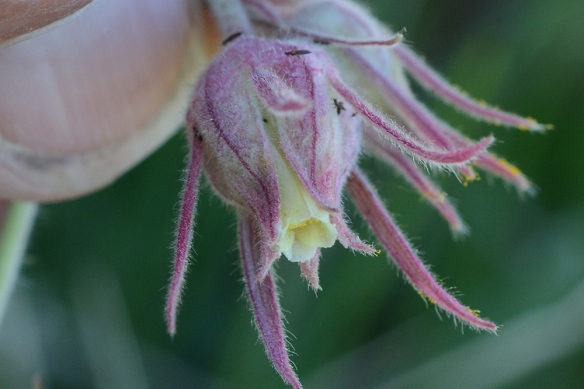
A_Osmchil_Fr_BTNF_8313_3crpWeb

Note the stiff hairs, sharp tip of the fruit of this Sweet Cicely. The fruit will split and stick to clothes and fur.

Sweet CicelyO. berteroi/chiliensis – Flowers borne on approx 1.5 feet stalks which may stretch to 4’ high in fruit.  The narrow, pointed fruits with stiff hairs attach to hikers and wildlife for dispersal.

 Bluntseed SweetrootO. depauperata – 10” or less tall with elongate, club-shaped fruit with a blunt tip held on wide spreading stalks.

Depauperate Sweet Cicely is most delicate.  The club-shaped fruits are held at wide angles.

Bluntseed Sweetroot is most delicate. The club-shaped fruit with blunt ends are held at wide angles.

Common Yampa –  Perideridia montana – Look for the tiered lacey white inflorescences 3-4” wide just beginning to bloom in sage flats and meadows.   The leaves are very skimpy: only 1-3 on the 1-2’ bluish gray stems, each with maybe 4-5 pairs of linear leaflets that fizzel quickly.  The swollen roots are relished by bears and other wildlife.

Yampa root is cherished by bears, ground squirrels and even people.

Yampa root is cherished by bears, ground squirrels and even people.

These are just a few wildflowers you may find while out hiking mid-summer.  It is fun to try to recognize a plant family and compare its members’ flowers and fruits.  Slowly, the plant varieties will become familiar friends, and with practice you may remember their names!  In any case, you have had a good “conversation”.
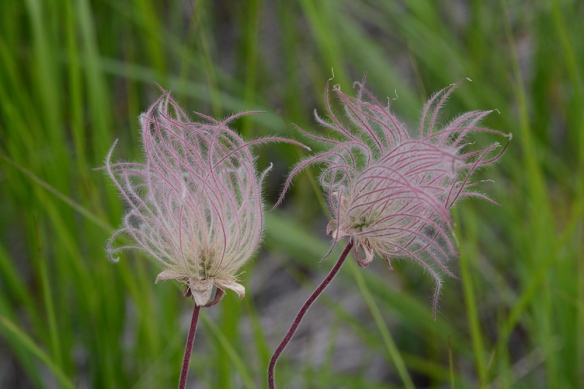
Frances Clark, Wilson, WY

Note: Measurements are approximate.  Using the scientific names you can look up precise details and more about each species.  Also, there may be other look-alikes than are compared here.

A_BTNF_PassTr_VwN_72714_1web